Whether shrubby or herbaceous, peonies beautify the garden every spring. With their vibrant white, cream, yellow, pink, or red dresses, they captivate and play the divas… and sometimes, they can be quite elusive when it comes to taking the stage. Imagine for a moment that you decide to deliberately sabotage the show, not out of malice, but simply for the pleasure of seeing how these grand ladies would react?
In this article, we will explore with a dash of irony and a pinch of sarcasm the most effective methods to fail with your peonies, while inadvertently slipping in the secrets to achieving success. Because yes, even in failure, there are lessons to be learned, right?
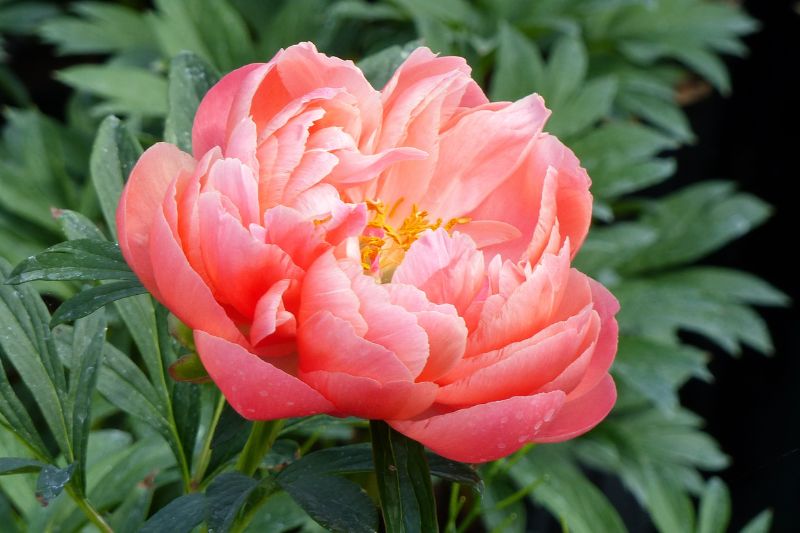
Lesson 1: Ignore the sunlight needs of the peony
To fail with your peonies right from the planting stage, placing them in the shade is a masterstroke. It is there, under the cover of trees and shielded from the sun's rays, that you unknowingly create the perfect setting for a despairing performance. Peonies, deprived of their main light source, will become leggy... or worse, may not flower at all!
But what if, in a fit of rebellion against this scenario of shade and sadness, you decided to change the script? Yes, these garden divas demand sunlight as their spotlight, and that for at least six hours a day! This is their secret to spectacular flowering.
Lesson 2: Neglect the type of soil
In this second act of our gardening opera, the soil plays the role of the conductor, dictating the tempo and quality of our plant stars' performance. By deliberately choosing compact, clayey soil that is, of course, waterlogged, you compose a dissonant symphony for your peonies. Their roots, like frustrated musicians, struggle to find their rhythm, suffocated in an environment that does not allow them to breathe… or to thrive.
Yet, in a surge of rebellion against this underground cacophony, what if you decided to tune the violins? For the secret lies in the composition of the soil! Indeed, peonies appreciate well-drained soil enriched with organic matter (compost will be your friend) and preferably with a neutral pH. The roots of the peonies will then find a vibrant echo, nourishing and allowing for a flowering worthy of the loudest ovations.
Lesson 3: Water too much or not enough
Let’s continue our improvisational theatre, with the main character being: watering. Alternate between abundant watering, worthy of a torrent, and the dryness of a desert. You will plunge your peonies into a state of constant stress. The roots of your plants, like dancers trying to follow chaotic music, are sometimes drowned by a wave of water, sometimes desperately searching for a drop to drink in cracked, thirsty soil. There, it’s certain: the dance will soon come to an end!
However, if you feel inclined not to let them drown or dry out, the key lies in seeking the middle ground. Practice the dance of measured watering, watering when the soil becomes dry to a depth of 2 cm. This balance will provide your peonies with the ideal stage to shine brightly.
Lesson 4: Ignore diseases and pests
Let’s return to our garden scene, where you decide that diseases and pests also have a role to play in this play, without being countered, thus taking centre stage. Your peonies, the main actresses, find themselves vulnerable, exposed to a scenario where they struggle alone against sometimes invisible… but dreadfully effective adversaries. Without your intervention, the garden becomes a tragic scene where fungal diseases and pests become the leading roles. That’s what you wanted, right?
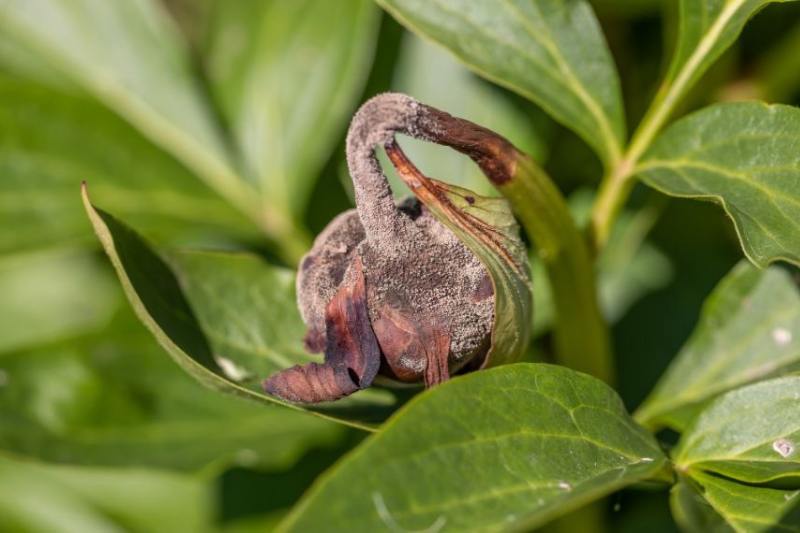
However, by taking on the role of the attentive gardener-director, scrutinising the set for signs of impending harmful intrigue, you can take the necessary measures to protect your peonies. Intervening with targeted treatments and preventive care is like rewriting the script in favour of your peonies, allowing them to play their role with brilliance.
Lesson 5: Improvised pruning
And for the final act of this article, what if you transformed into "Edgar with the silver hands," a doppelgänger of the famous Edward, but with less talent? Prune the peonies with scissors that you haven’t cleaned beforehand, without a plan or discernment. You might think you’re shaping an avant-garde masterpiece, while in reality… you’re just improvising, cutting here and there, in the middle of the flowering period! This reckless approach is the perfect scenario for a botanical drama, where the peonies, the actresses of their own tragedy, find themselves stripped and weakened… The perfect melodrama!
However, for gardeners who, in a burst of controlled creativity, aspire to sculpt their garden, wait until after flowering to intervene, when the curtain falls and the peonies are ready to regenerate backstage. This thoughtful pruning, far from being an improvisation, is a meticulous rehearsal for next year’s show. It not only helps keep the plant healthy but also encourages even more spectacular flowering, ensuring that the next act is welcomed with even more brilliance.
Whether shrubby or herbaceous, peonies beautify the garden every spring. With their vibrant white, cream, yellow, pink, or red dresses, they captivate and play the divas… and sometimes, they can be quite elusive when it comes to taking the stage. Imagine for a moment that you decide to deliberately sabotage the show, not out of […]
As summer draws to a close and the days shorten, a hint of melancholy may arise in the gardener. This is the end-of-summer blues, a nostalgia for the past splendour of the garden in full bloom. Rather than fearing the end of summer, rejoice! While many plants fall asleep after the summer heat, others continue to bloom tirelessly or are just beginning to flourish. From ephemeral annuals to late-flowering perennials and long-lasting varieties, as well as flowering shrubs and summer bulbs, your garden is far from going into hibernation. Salvias, Echinaceas, Sedums, Lavateras, and Hydrangeas, combined with the last blooms of annuals, extend the show! These late flowers bring new life to the garden when most plants take their bow. In the late season, they come to the rescue of the depressed gardener and flourish with renewed vigour. Let’s discover these long-lasting flowers that bloom from the end of summer until autumn to extend the beautiful season!
Annual flowers: an ephemeral yet spectacular display
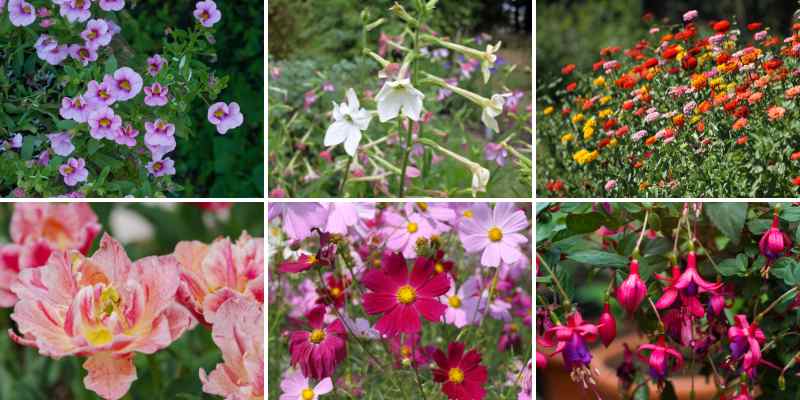
Despite their ephemeral nature, annuals and biennials are essential assets for generously flowering the garden for long months. They adapt to all desires, whether in the ground or in pots, creating often very colourful and cheerful displays. They come in an infinite variety of colours allowing for endless combinations, whether in gradients or monochromes, elegant or vibrant! Additionally, they are easy to grow and maintain, filling gaps between shrubs or perennials. These beautiful annual flowers bloom from June and generally for 5 months, sometimes longer, without interruption, ensuring a whole flowering season. Despite their limited lifespan, these annuals are an excellent way to keep your garden vibrant and colourful until autumn's doorstep. Planting plugs occurs in spring, and seeds can also be sown directly in place when the soil is well warmed. They are stunning in mixed borders, at the edges of beds, as well as in pots or window boxes. They are very easy to combine with other summer blooms, perennials or summer bulb plants. Among the champions of floral abundance:
- Ornamental Tobaccos orNicotiana: add a touch of exoticism, with their colourful trumpet-shaped flowers ranging from white to red and bright pink, fragrant in the evening.
- Petunias, Surfinias and Calibrachoas are remarkable for their generous and continuous flowering lasting from May until the first frosts. With their trumpet-shaped flowers, bicoloured, tricoloured, or striped, they offer a myriad of vivid and deep or pastel colours, sometimes even bordering on kitsch.
- Annual Lobelias that bloom continuously until the first frosts and come in many vibrant colours.
- The elegant Cosmos, with their large simple and airy flowers in a wide range of colours, renew abundantly from June to September.
- Godetias (or Clarkias), another charming annual plant, very floriferous from June to September with large silky flowers painted in various often soft, solid or variegated tones.
- Pelargoniums or Geraniums (zonal pelargonium, ivy pelargonium or "king of balconies") are essential for adding relief and colour to beds, borders, and sunny spots, hanging baskets, and window boxes from May to October. There is something for every taste and situation.
- Zinnias are lovely late-flowering daisies. Resilient and prolific, they are among those unmissable annual plants ensuring continuous flowering in vibrant, sometimes even exuberant colours, until the first frosts.
- Fuchsias, whose bell-shaped flowers, either simple or double and often bicoloured, bloom from May-June to September-October.
But also: Coreopsis, marigolds (Calendula), African marigolds (Tagetes), nasturtiums, bacopas, Dipladenias, annual Rudbeckias, diascias, Osteospermums, all in bloom from spring until the first frosts.
Read also:
Perennials: the promise of lasting beauty
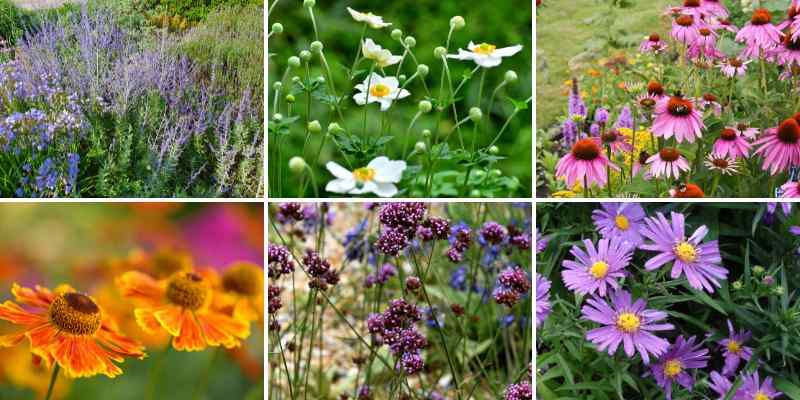
Some generous or late-flowering perennials extend the beautiful season into winter. Many of them continue to bloom once the summer's heat has faded. Their flowering spans from early summer to frost. They return each year, requiring little maintenance and offering a myriad of colours in return. Depending on their size, they will enliven the foreground of beds, fill gaps, or provide structure and lightness. Here is a selection of essential perennials that will bloom until September-October:
- Asters, a must-have for late blooms. These very hardy perennials, like the autumn asters, such as Aster novi-belgii, light up the late season with their starry and colourful blooms! They are covered from August to November with numerous small white, blue, purple, or pink flowers. Melliferous, they attract a multitude of pollinating insects.
- Japanese Anemones, with their delicate star-like flowers, are essential in late summer and autumn beds. These perennials, typical of the "vicar's garden," are among the most beautiful late summer flowers for partial shade, blooming in luminous corollas from September to November. Their delicate beauty contrasts with their robustness, as they can tolerate a variety of soil and light conditions (they accept sun in humus-rich soil).
- Echinaceas, with their vibrant daisy-like flowers, are robust and reliable perennials, offering spectacular blooms in late summer and until September-October without interruption. Fertile, very easy to grow, and accommodating, they bloom in naturalistic beds, borders, and English mixed borders. After flowering, the brown cones suspended on their inflexible stems will extend the decorative effect into the dreary season.
- Perovskias, with their silvery aromatic foliage and lavender-blue flowers, like Perovskia atriplicifolia ‘Blue Spire‘, form a graceful bush blooming from June to September, even until October in Mediterranean climates. This particularly long flowering attracts butterflies, bees, and bumblebees all summer.
- Buenos Aires Verbenas are also beautiful perennials in bloom from summer to autumn. All light and airy, their mauve-blue flower umbels are accompanied by a constant flurry of foraging insects.
- Sedums or Autumn Stonecrops (‘Autumn Joy’, for example) bring colour in early autumn when the garden starts to lack flowers. They bloom from August until November. With their colours ranging from deep to soft or bright, they add much charm to the late season.
- Chrysanthemums are a great way to achieve colour late in the season. They reward us from September to November with their colourful daisy-like flowers beautifully complementing the fiery foliage and last blooms of autumn.
Among other late-flowering perennials, consider Gauras, with their butterfly-like flowers dancing in the breeze, the Heleniums or Autumn Hélénies whose daisy-like flowers come in a wide range of warm tones and truly set the garden ablaze at the end of the season. Also think of Achilleas, Echinops, Phlox paniculata, Anthemis, and ornamental salvias such as the Salvia nemorosa "Blue Bouquetta" Alklf, a variety of perennial sage that offers particularly long and abundant flowering from May to October in an incredible colour, and kniphofias, some varieties of which display their fiery spikes until October (Kniphofia rooperi, ‘Traffic Lights’).
- Discover our collection of late-flowering perennials
Flowering shrubs: a screen of colours until autumn
Summer-flowering shrubs charm us with their colourful blooms and provide structure, texture, and colour to the overall decor. They are essential in sunny or semi-shaded areas, in hedges, beds, as standalone plants, or even in pots on the terrace for smaller varieties. Some are still in bloom at the end of the season, or begin to flower from mid-August to late September, gently announcing the arrival of autumn:
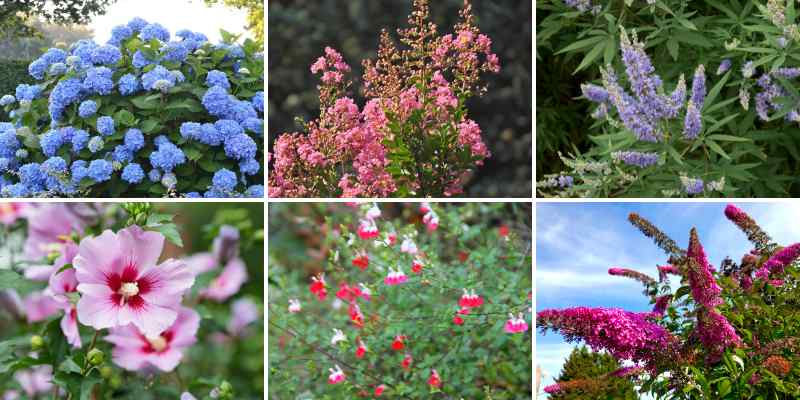
- The Buddleia or Butterfly Bush, whose colourful and fragrant flower spikes irresistibly attract butterflies renew from July to September-October (‘Adonis Blue’, 'Nanho Purple', Pink Panther).
- The Crape Myrtle (Lagerstroemia) or Summer Lilac that bloom in large dense bouquets of frilly flowers often offering a second flowering sometimes until October (‘Souvenir d’André Desmartis’, 'Périgord Pourpre’).
- The Hibiscus syriacus or Garden Althea that rewards us all summer with simple or double delicately crumpled flowers depending on the varieties, ranging from white to purple. They bloom in July, rebloom in August to flower again from late summer to the entrance of autumn (‘Eruption®’, ‘French Cabaret’).
- The classic Hydrangea or Hydrangea macrophylla which, with its large globular inflorescences, ensures a spectacle in late summer, especially as their flowers change colour as they mature. 'Endless Summer’ is part of an extremely remontant series, as it flowers from early summer until October.
- The Lavatera which forms very pretty long-flowering bushes. It produces, from June to September-October, a multitude of lovely satin-like flowers resembling hibiscus flowers, in pink, blue, or white.
- The Siberian Sage or Perovskia that gracefully fits into natural scenes, forming a graceful bush with aromatic silvery foliage and lavender-blue flowers. 'Silvery Blue‘ offers an endless summer bloom of very bright lavender blue.
- Flowering Shrubs are very floriferous shrubs whose flowering extends from May to October depending on the climate. Like Hot Lips’, they are capable of blooming abundantly from late summer to frost.
Among other late-flowering shrubs, we can mention ceanothus, which produce clusters of vibrant blue flowers, spiraeas, whose small delicate flowers attract many pollinating insects, hardy fuchsias (Fuchsia magellanica 'Ricartonii') or the Vitex agnus castus ‘Latifolia’ which adorns itself with violet-blue flower panicles in August-September.
Summer bulbs: an underground surprise
Designed to colour your beds, borders, and pots until autumn, these buried treasures reveal their late blooms when other plants begin to fade. Among the most beautiful bulb flowers that we can enjoy fully until autumn:
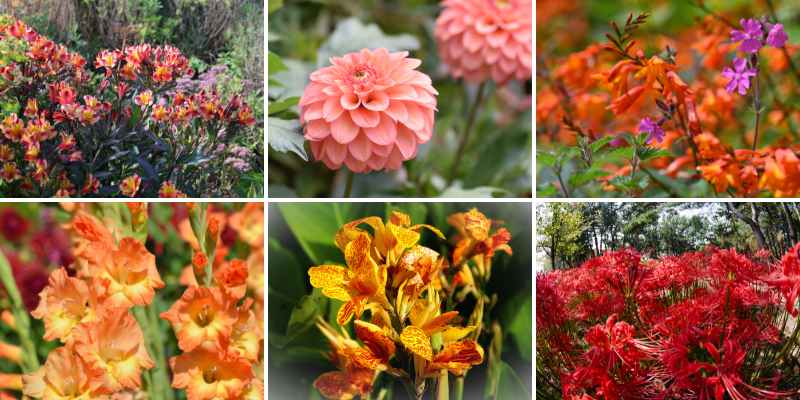
- Dahlias are the champions of long-lasting blooms, from June or July to September or October (until November in temperate climates). Ball Dahlias, giant or dwarf, for beds, decorative, cactus or semi-cactus, or even landscape”, fanciful or sober, exuberant or romantic, these generous summer-flowering bulbs offer an infinite choice for the gardener. They also produce excellent cut flowers. Their brilliant display in late summer and autumn is a reward for the gardener's patience. Be careful, as they are frost-sensitive, they need to be dug up in autumn in cold regions.
- Inca Lilies or Alstroemerias are magnificent vigorous bulbous plants that produce a multitude of stylised, brightly coloured flowers, often brown-striped from June to October. They are suitable for both bouquet making and for decorating beds and pots.
- Gladioli are another bulbous plant that blooms in grand style, from July until September-October, showcasing their long colourful spikes. They accompany vegetables right into the vegetable garden!
- Cannas, with their large tropical leaves and flamboyant flowers, add an exotic and lush note in late summer. They can reach heights of 1.5 to 2 m. We appreciate them for their warm-toned blooms, yellow, orange, or red, as well as for their extremely decorative foliage. Some, like Canna 'Durban', will bloom from July until frost (before being brought indoors for winter).
Finally, do not overlook the Lycoris, also known as red spiders. These bulbs offer a fascinating display with their bare stems emerging from the ground in late summer, followed by exotic trumpet-shaped flowers, Eucomis, and the Crocosmias that bloom in late summer for two months, in fiery colours that pair well with autumn foliage.
- All our summer bulbs
Grasses: the dancers of the ending summer
Grasses are essential plants for any gardener wishing to extend the beauty of their garden beyond summer. Their beauty reveals itself at the end of the season and persists even in winter when their stems dry. Beyond their fine and graphic foliage, grasses are also decorative with their light, fine, or feathery blooms. With their graceful and moving appearance, they can mask deflowered plants and remain decorative even in winter when their spikes are faded. Their airy silhouette and subtle hues harmonise perfectly with the colour palette of late blooms, adding texture and movement to the garden landscape. They are ideal companions for autumn-flowering perennials such as asters, hardy chrysanthemums, and Japanese anemones. Among those that bloom in late summer:
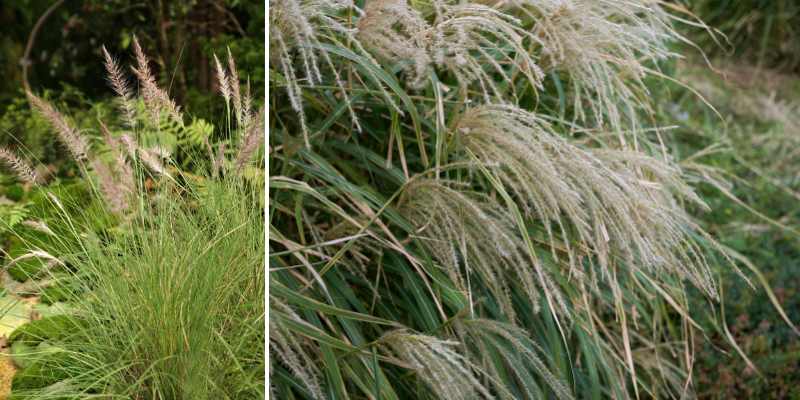
- Pennisetums, or "Fountain Grass," stand out with their remarkably silky spikes, dancing elegantly in the wind. While all bloom until October, some, like Pennisetum alopecuroïdes ‘Hameln’ reserve their broom-shaped spikes in cream-white with brown reflections for the very end of summer, in September-October.
- Miscanthus, or "Chinese Reed", which from August to October rewards us with a rich bloom, pink, red, or silver depending on the varieties, in silky panicles that shimmer under the declining sun. Their foliage, ranging from green to golden, offers a superb contrast with the colourful flowers.
- Don’t forget the “Diamond Grass” (Calamagrostis brachytricha) which is among the most beautiful autumn grasses with its beige spikes tinged with purple that endure even under frost.
As summer draws to a close and the days shorten, a hint of melancholy may arise in the gardener. This is the end-of-summer blues, a nostalgia for the past splendour of the garden in full bloom. Rather than fearing the end of summer, rejoice! While many plants fall asleep after the summer heat, others continue […]
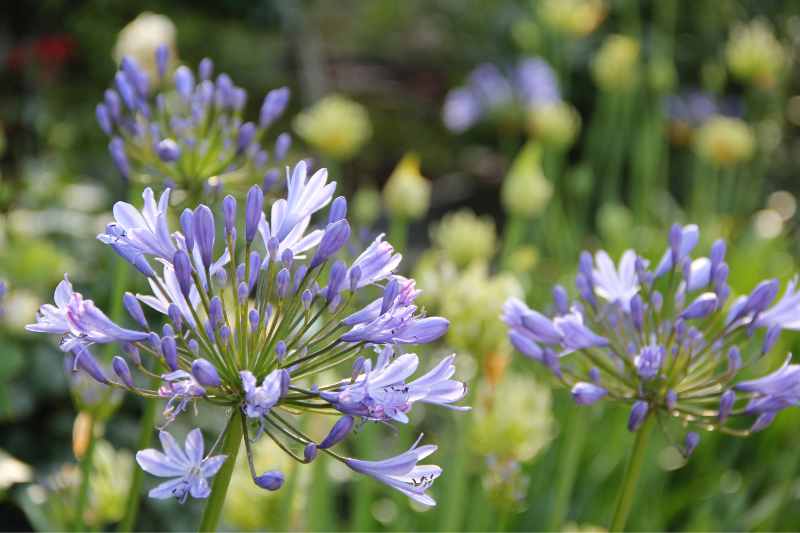
In the peaceful world of gardening, a new threat is emerging, sending shivers down the spines of agapanthus lovers across France. Indeed, the agapanthus gall midge, a small African insect that was previously harmless, is becoming a growing scourge for these majestic plants. With an increase in cases in France, the question is no longer whether, but rather when and how this pest can be stopped. What is the impact of the agapanthus gall midge on our agapanthuses? How can we identify the signs of this infestation? Are there effective control methods to protect agapanthuses across the country? The beauty of our gardens is at stake: it is time to act!
Agapanthus gall midge: what is this insect?
The agapanthus gall midge, or Enigmadiplosis agapanthi, is a particularly harmful pest for agapanthuses. This insect, which belongs to the Cecidomyiidae family, originates from South Africa, like the agapanthuses themselves, but has since migrated to other parts of the world, including Europe.
The agapanthus gall midge is a tiny midge whose larvae develop within the buds and stems of agapanthuses, causing deformities and often inhibiting flowering. The damage can be significant, potentially leading to the death of the plant in the most severe (but very rare) cases.
The insect is so minuscule that only symptoms can help us determine its presence rather than direct observation.
What are the symptoms of an infestation?
Signs of an infestation by the agapanthus gall midge may include deformed or unopened flower buds, stems that wilt or turn yellow or brown, and the presence of small white larvae or orange pupae inside the stems or buds. The larvae of the agapanthus gall midge develop within the flower buds themselves. In cases of heavy infestation, the entire flowering may be halted in agapanthus crops.
How to act?
Controlling this pest can be challenging, as there is no specifically approved control method for the agapanthus gall midge. Control methods include the removal and destruction of the infested parts of the plant. But there is no need to uproot or remove your agapanthuses! Research is ongoing to find other effective control methods against this pest. However, we remain hopeful that a natural predator will come to regulate the gall midges naturally. Fingers crossed!
What is the situation in France?
Let’s not panic just yet! In Europe, the first official observations were recorded in the UK in 2015, then in the south-west of France in 2017 and later in Brittany in 2019. Since then, the agapanthus gall midge has been steadily progressing without the situation being, for now at least, truly alarming. However, the national agapanthus conservatory on the island of Bréhat, in Côtes d'Armor, is sounding the alarm and urging gardeners to be vigilant. Be sure to check your agapanthuses at home, in your gardens, and act quickly by removing the parts of the plant suspected of being attacked by this gall midge.
In Belgium, for now, the agapanthus gall midge seems to be absent. (Note: yes, we assure you, certain agapanthuses more resistant to cold, such as Agapanthus 'Black Buddhist', can be grown in Belgium and northern France, but in well-drained soil or in pots!)
To learn more, here is the document from the French Ministry of Agriculture on the subject.
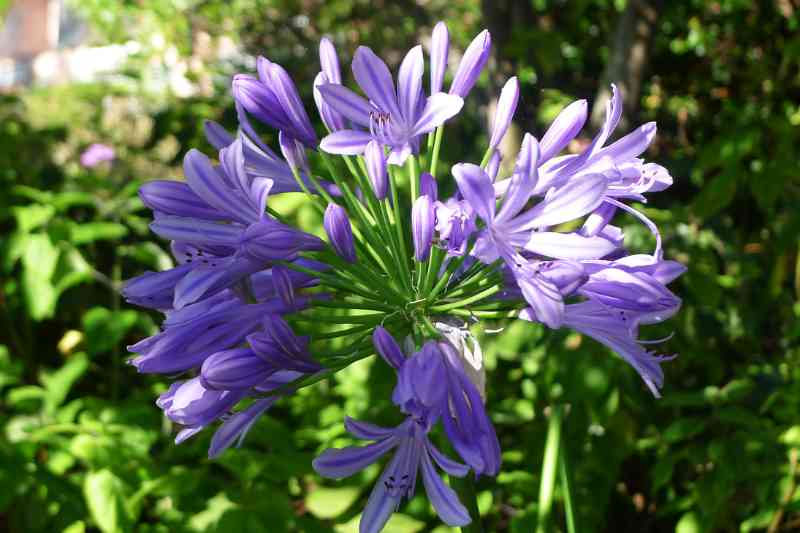
In the peaceful world of gardening, a new threat is emerging, sending shivers down the spines of agapanthus lovers across France. Indeed, the agapanthus gall midge, a small African insect that was previously harmless, is becoming a growing scourge for these majestic plants. With an increase in cases in France, the question is no longer […]
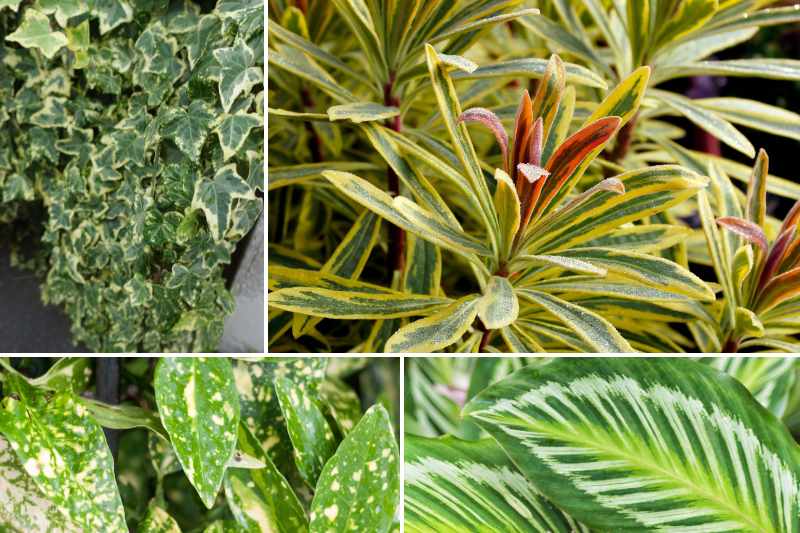
We love variegated foliage... or not. But in any case, it never fails to leave gardeners indifferent. You can find perennials, trees or shrubs with variegated or marbled foliage in white, cream, yellow, or another colour... Sometimes simply marginate, sometimes almost entirely devoid of green... But the question we are asking today is: what causes this foliage or another part of the plant to become bicoloured or multicoloured?
What is a variegated foliage?
We refer to variegation when a part of a leaf, flower, or even fruit appears "discoloured." These discoloured parts are completely or partially devoid of chlorophyll, the pigment that gives the green colour and enables photosynthesis.
It is important to know that a green leaf contains chlorophyll (we should even say chlorophylls, as there are several types), but also a certain amount of other pigments that are more or less hidden: carotin, xanthophyll, anthocyanin... When chlorophyll disappears, the other pigments become visible. This is what gives the yellow, orange, red, or brown colours of leaves in autumn when chlorophyll naturally fades. For variegations, it works on a similar principle, except that it is not the decrease in light that causes chlorophyll to disappear, but other reasons. When chlorophyll partially disappears, we end up with white, cream, yellow... and sometimes even pink or red spots.
Where do these variegations come from?
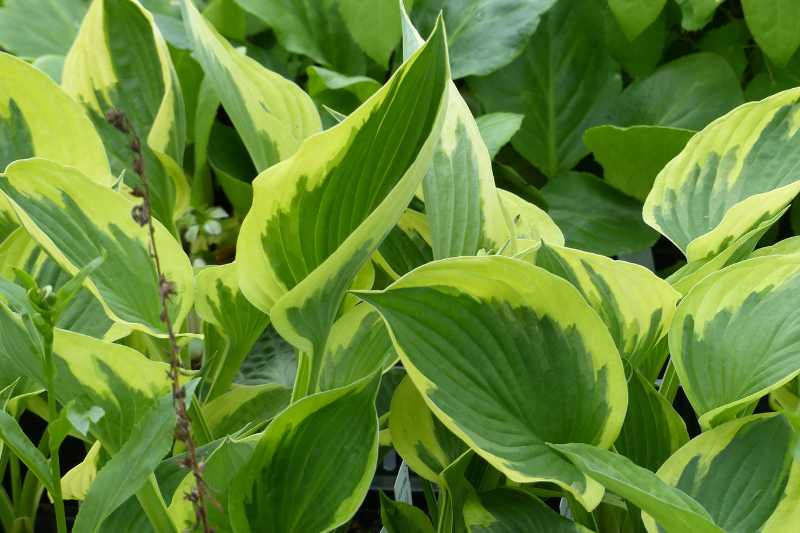
Variegations in a leaf can arise from various causes:
The most common case is mutation-induced variegation. A young seedling or part of a plant mutates and suddenly becomes variegated. Since the variegation is not stable, and therefore not sexually reproducible, these plants should be propagated vegetatively (cuttings, layering, grafting). Be on the lookout for such mutations in your own garden. You never know, you might obtain a remarkable new variety.
Variegations can also be caused by a virus. This is rarer, but it does happen. A benign virus infects the plant, which in response produces variegated parts (leaves, flowers, fruits). This is the case with most variegated-leaved Hibiscus, such as Hibiscus 'Summer Ruffle', or with bicoloured tulip varieties;
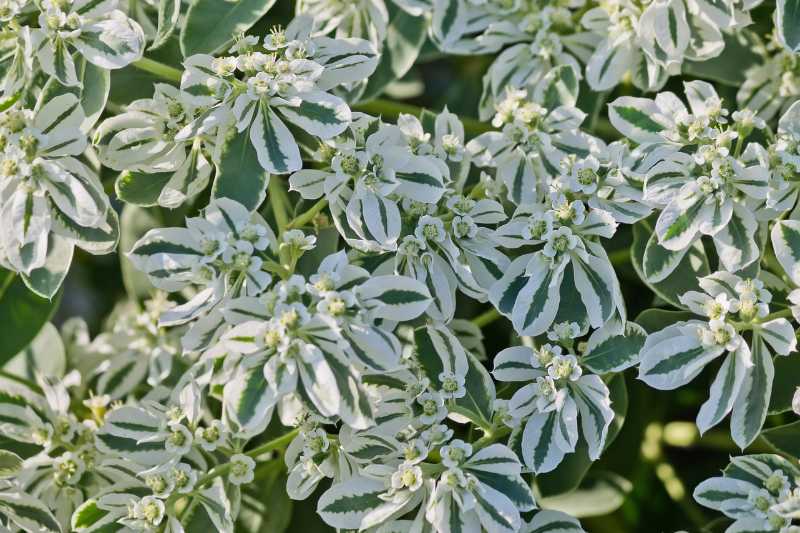
Finally, some variegations are entirely natural. Indeed, certain plant species have evolved to develop variegated or punctate parts. Botanists do not have explanations for all these species. However, it can be said that the natural variegation of certain species is a defence mechanism, as seen in Hypoestes which produce leaves speckled with small dots or in Adelonema walisii which reveals very variegated leaves of yellow-cream. The former gives the illusion that the plant has already been eaten by an insect, while the latter is camouflaged in the decor to avoid being browsed by herbivores. Some species may also use variegations to more effectively attract pollinators, as seen in Euphorbia marginata.
But is it serious, doctor?
As mentioned, even if variegation is caused by a virus, this virus is completely benign. However, having a low chlorophyll content within a leaf can lead to reduced vigour. In other words, a variegated variety will often grow a little slower than its green-leaved counterpart. But don’t let that stop you from planting them!
One small note, however: some variegated mutations are so low in chlorophyll that it would be impossible to propagate them by cuttings, as the cutting would not have enough energy to produce roots. These mutations are therefore propagated by grafting (which significantly increases the purchase price).
A bit of botany
We find Latin terminologies in some species names or the names of old variegated varieties such as: variegata, marginata, pulverulenta...
- Variegata for variegation: meaning variegated, as in Cornus controversa 'Variegata';
- Maculata: meaning maculate, thus a large coloured spot, as in Phlox maculata or Begonia maculata;
- Marginata: meaning marginate, thus bordered by a fine coloured band, as in Agave angustifolia 'Marginata';
- Striata : meaning striate or marbled, thus marked by coloured bands of varying widths, as in Bletilla striata;
- Punctata : meaning punctate, thus sprinkled with small coloured dots or spots, as in Lysimachia punctata;
- Pulverulenta : meaning it seems to have been sprinkled with a lighter substance, as in Catalpa speciosa 'Pulverulenta';
- Reticulata : which colouring follows the pattern of the veins, as in Iris reticulata;
- Crotonifolia : with Croton-like leaves (a famous houseplant - Codiaeum variegatum), thus exhibiting irregular discolouration, as in Aucuba japonica 'Crotonifolia'.
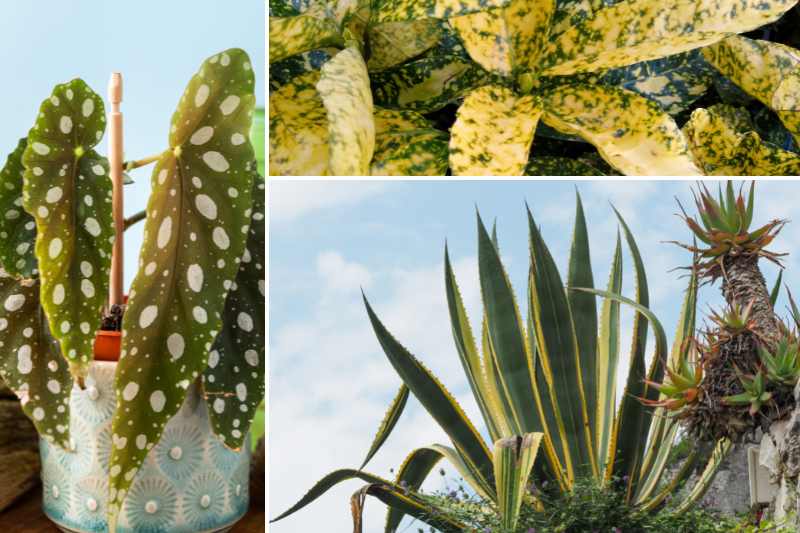
Did you know? Since 1956, breeders have not been able to use Latin to name new varieties and cultivars. The choice has mainly fallen on the English language, although exceptions exist. This is why we find words like 'Gold', 'Silver', 'Rainbow', 'Cream'... in the names of plant varieties featuring variegations.
We love variegated foliage… or not. But in any case, it never fails to leave gardeners indifferent. You can find perennials, trees or shrubs with variegated or marbled foliage in white, cream, yellow, or another colour… Sometimes simply marginate, sometimes almost entirely devoid of green… But the question we are asking today is: what causes […]
Hellebores are perennials distinguished by their beautifully coloured winter flowering. Their flowers come in shades of pink, red, purple, white, and yellow, with petals surrounding a very decorative bouquet of central stamens. Their flowers are sometimes beautifully speckled with purple spots. A new range of hellebores has recently joined our catalogue: we are proud to present these varieties to you today!
To learn everything about hellebores, feel free to consult our complete guide: “Hellebores: planting and cultivating them”
1 - What are the advantages of these new varieties?
The new varieties we are presenting today are from the ViV and HGC ranges (Helleborus Gold Collection). They encompass several dozen varieties, offering a very wide choice! They are particularly notable for being produced through in vitro propagation.
In vitro propagation is a multiplication technique carried out in a laboratory that allows for the production of new young plants from a fragment of the mother plant. It is somewhat akin to micropropagation: a small section of the plant is taken, placed in a suitable medium, and it will develop into a complete young plant.
This guarantees uniform young plants: the new young plants are rigorously identical to the one from which they originated, as they are clones with the same genome. This represents a significant advantage in the case of hellebores, as when they are multiplied by sowing, the new young plants exhibit colour variations and are generally not true to the original variety. Indeed, classic varieties hybridise very easily with one another.
In vitro hellebores therefore provide an excellent solution to ensure variety conformity. Moreover, with selective breeding work, the hellebores from these ranges are generally more compact, more floriferous, and they offer more colourful and intense flowering. They are also free from viruses and diseases.
Discover the most beautiful varieties
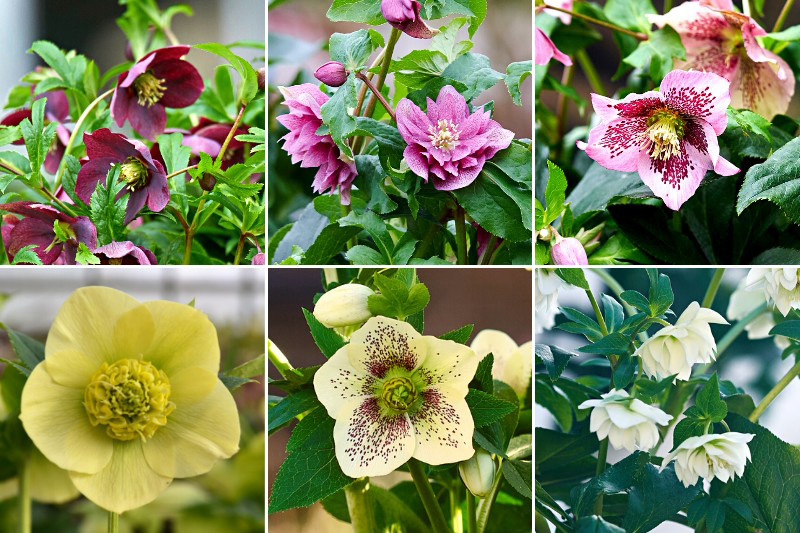
Hellebores from the ViV range:
- Hellebore ViV Victoria: This is probably one of the most beautiful Oriental hellebores. It is a stunning variety with violet flowers, featuring five petals, contrasted by a bouquet of yellow stamens. It forms a compact clump, about 40 cm tall.
- Hellebore ViV Ariana: ‘Ariana’ is a beautiful variety with downward-facing double flowers: these consist of several rows of imbricate petals, in a purplish pink colour, speckled with small purple spots. This gives the flowers a sophisticated and elegant appearance.
- Hellebore ViV Celestina: This superb variety flowers early, as soon as September, producing simple flowers with light pink petals, beautifully speckled with purple.
- Hellebore ViV Lucrezia: ‘Lucrezia’ stands out with its very bright yellow flowers! They consist of five petals, surrounding a central collar and a heart of stamens. They bloom from January to February, bringing a touch of light in the middle of winter!
- Hellebore ViV Maeva: This is a beautiful variety with simple flowers, featuring yellow petals speckled with small purple spots. This makes its flowering intense and contrasting! With its compact size, it is well-suited for pot cultivation.
- Hellebore ViV Gianina: ‘Gianina’ is an early variety, flowering as soon as September, and offers beautiful pure white double flowers. The flowers are large, consisting of several rows of petals, and feature a bouquet of yellow stamens at the centre.
Hellebores from the HGC range:
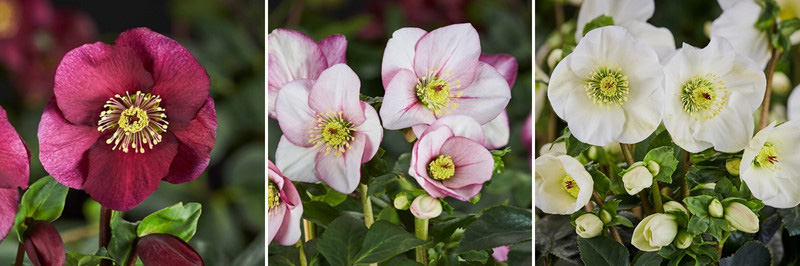
- Hellebore lemperii Leona: This hellebore bears large flowers with dark red petals, surrounding a heart of yellow stamens, well contrasted. Its intense colour is appreciated! It is ideal in pots, to bring colour to a balcony or terrace.
- Hellebore lemperii Liara: ‘Liara’ bears large simple flowers (up to 10 cm in diameter) from December, consisting of five petals in pale pink, with a deeper pink reverse, offering beautiful colour nuances. This is a very romantic flowering!
- Hellebore lemperii Linn: This variety offers simple cream-white flowers, adorned with yellow stamens. It forms a well-compact clump and bears particularly large flowers, reaching about 15 cm in diameter.
3 - How to cultivate them?
Hellebores will thrive if you plant them in shade or partial shade, in rich, cool, but well-drained soil. They have the advantage of being perfectly hardy, tolerating temperatures of around –15 to –20 °C. These new varieties, being floriferous and compact, are perfect for pot cultivation on a terrace, balcony, or windowsill, but they can also be planted in the ground. You can pair them with the decorative foliage of heucheras, the beautiful yellow flowering of Eranthis hyemalis, and the delicate white bell-shaped flowers of snowdrops. Also consider winter-flowering shrubs, such as Viburnum x bodnantense 'Dawn', Daphne odora 'Aureomarginata', and Hamamelis.
4 - To learn more
- Our complete guide: “Hellebores: planting and cultivating them”
- Find all our articles on hellebores by clicking here.
- For more options, discover our entire range of hellebores
- The ViV hellebores website and the HGC hellebores website
Hellebores are perennials distinguished by their beautifully coloured winter flowering. Their flowers come in shades of pink, red, purple, white, and yellow, with petals surrounding a very decorative bouquet of central stamens. Their flowers are sometimes beautifully speckled with purple spots. A new range of hellebores has recently joined our catalogue: we are proud to […]
The Agapanthus 'Navy Blue', also known as ‘Midnight Star’, is a very popular variety of agapanthus in northern gardens and for good reason, it is one of the few that withstands the cold so well (it can survive down to about -10°C). It is also one of the few to provide a myriad of flowers in a deep navy blue that is intense.
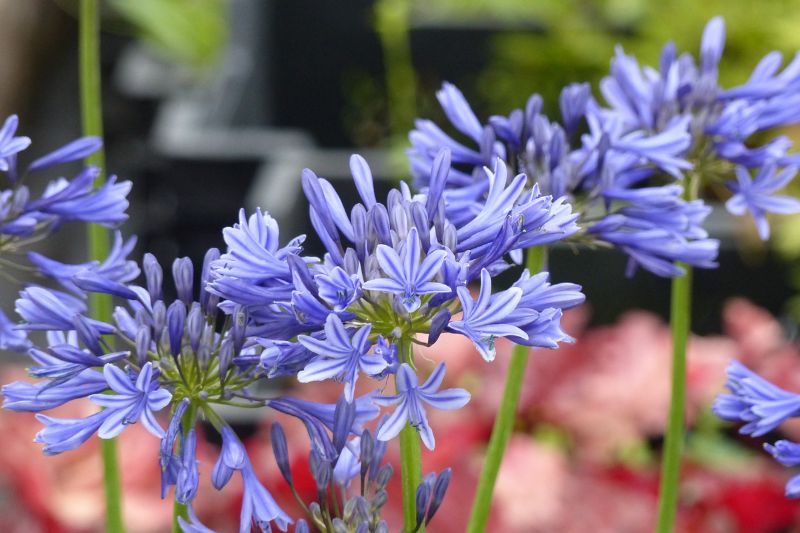
Particularly floriferous and vigorous, this medium-sized variety does not exceed 60 cm in height. It has a deciduous foliage of wide, bright green ribbons that elegantly covers the ground throughout the beautiful season. When its flowers appear, usually in July-August, it transforms into a bouquet of intense blue.
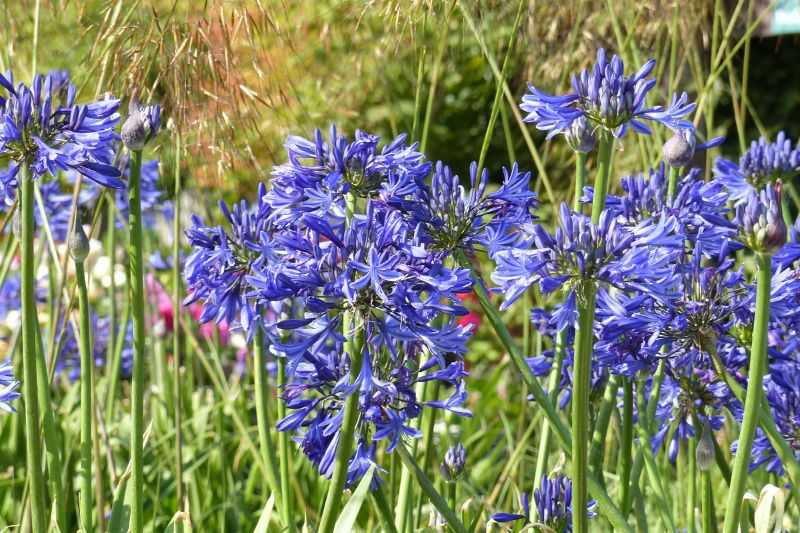
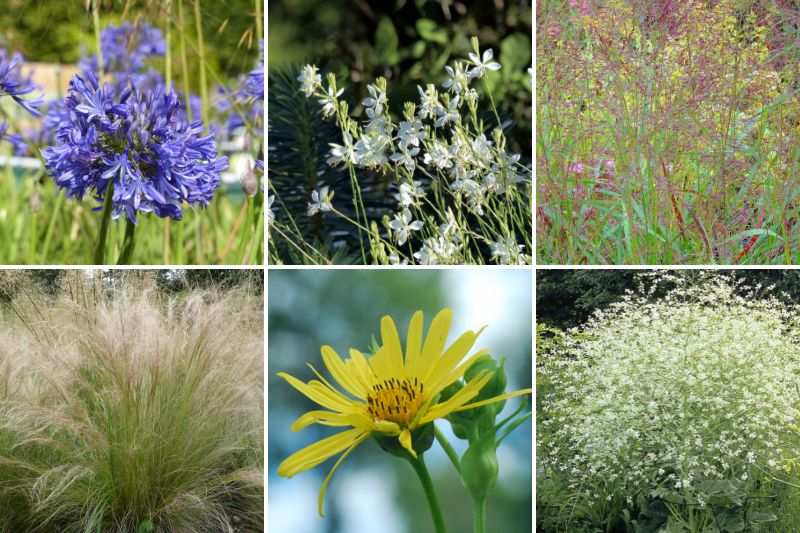
It is in a naturalistic garden, alongside Gaura, Stipa, Panicum, Crambe cordifolia and Silphium that this variety has thrived in my garden for nearly 20 years now. It has endured winters well below -10°C, scorching summer heat, and yet it is still here. From a single plant, which I divide every 4 years at the end of winter, I propagate it in my borders, and it now covers 5 m².
Final tip: To keep it thriving in my clay soil, at planting, I replace my sticky soil with pure sand (2 to 3 times the volume of the stump) so the stump is protected from excess water in winter.
The Agapanthus ‘Navy Blue’, also known as ‘Midnight Star’, is a very popular variety of agapanthus in northern gardens and for good reason, it is one of the few that withstands the cold so well (it can survive down to about -10°C). It is also one of the few to provide a myriad of flowers […]
A friend of mine, who is also a well-known gardening columnist (and an excellent gardener, which makes for two significant differences between us), recently told me: “It annoys me, I can’t keep lavender alive…”
This was, I must say, a huge relief for me: I was not alone in carrying this shameful secret: repeatedly failing to keep one of the easiest plants in the garden, lavender.
This prompted me to make a public coming out and share with eager gardeners this specific know-how: how to fail at growing a lavender in 5 lessons!
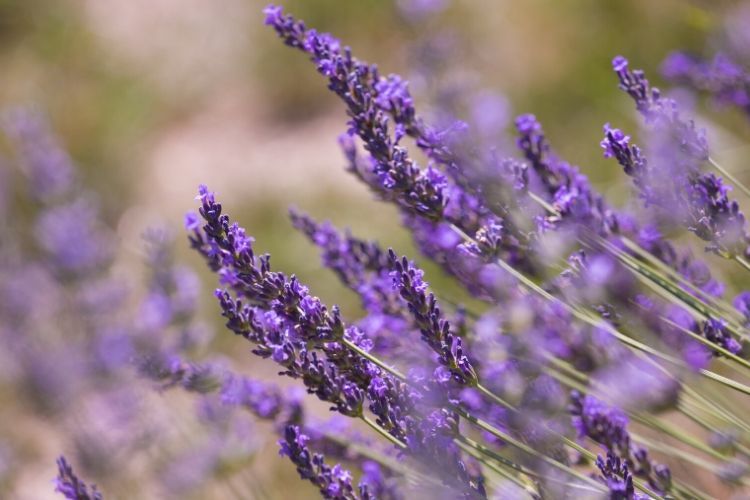
Of course, not everyone is on equal footing: those who, like me, are fortunate enough to live in a cold, rainy climate with heavy soil will find it much easier to successfully fail at growing lavender than those unfortunate enough to live in the sunny climes of Provence.
However, by carefully following these simple and practical tips, accessible to all, I am sure many will also manage to kill their lavenders.
Lesson 1: to kill lavender, smother it!
Lavender comes from the South; it loves southern, stony, well-drained soils. It hates heavy soils that rot its roots in winter, which is why good gardeners prefer to plant in spring rather than autumn.
It can be planted in heavy soil, but requires drainage work: a large planting hole, at least twice the size of the pot, adding gravel or river sand, or, if necessary, turf.
So, to fail at growing your lavender, plant it at the wrong season (between November and February, for example) in heavy clay soil, which you have not lightened or loosened, ideally in a hole that is too small (if necessary, give a few frustrated heel kicks to make it fit);
This is a very reliable method for failing at lavender, which I have practiced extensively in our potato fields up North.
A rather perverse variant of this method is to put your lavenders in the position of gladiators in the circus games: plant lavenders very close together, say 15 cm apart: they will shade each other, and, by fighting, weaken one another, and part (at least) of your plants will end up dying, while the others will blacken, which is quite an effect.
Lesson 2: to fail at lavender, drown it!
Lavender does not appreciate repeated excess watering: it is a Mediterranean climate plant.
To kill lavender, water abundantly, not only after planting (which it likes, like all plants), but also throughout its (short) life: it will disappear by the first winter. To speed up the killing, create a watering basin that will keep the root ball moist during the dreary season, guaranteed success!
Lesson 3: to fail at lavender, put it in the shade
Lavender loves the sun… In the shade, it withers, stretches its branches sadly in search of light, flowers little or not at all, and dies quickly.
By planting in the shade (a true marked shade, it can flower quite well in light shade), you will achieve a result similar to the previous lesson. You can even combine lessons 1, 2, and 3 for a better result.
Lesson 4: to fail at lavender, overfeed it!
Used to poor soils, lavender behaves very poorly in rich environments: it eats too much, grows and grows… And very quickly collapses lamentably, leaving an awful black hole in the centre.
This lesser-known method is particularly recommended for sensitive souls; it allows you to fail at growing lavender (and many other things) in good conscience, through excess care: plant it in rich potting soil, generously amended with compost, supplemented by regular overdoses of fertiliser, preferably chemical: you may not kill it, but you will surely give it a rather monstrous appearance of a Chernobyl plant.
Generally, it is enough to plant poorly to fail. However, for safety, in case your lavender shows resilience, here is a maintenance tip:
Lesson 5: to fail at lavender, prune it regularly in a 'para' style
Like almost all evergreen plants, lavender does not like heavy or short pruning.
Of course, you can safely cut the dry flower spikes once a year (and make lovely fragrant bouquets), or a few overly exuberant young shoots. But do not prune the wood: it never regrows on old wood!
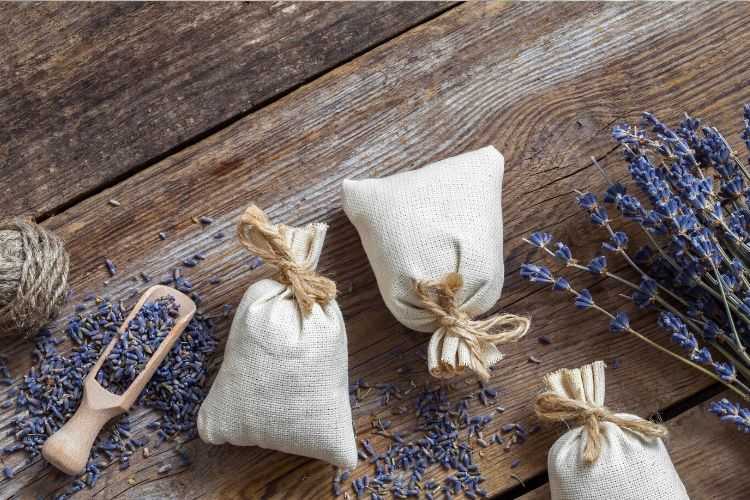
So to fail at lavender, prune it brutally and as short as possible: at the very least, you will make it look considerably ugly and prevent it from flowering properly; at worst, you will kill it. It is worth noting that even in Saint Rémy de Provence, this method works well.
Bonus tip for those who have had the courage to read everything, with a lazy method that I particularly recommend for its simplicity: you can also fail at growing lavender in a pot. Simply plant it in a small pot (say less than 20 cm), and do not water it. Admittedly, lavender does not like excess watering, but it is not a cactus: it needs water, which it seeks through a deep root system. For this reason, it does not settle well in a small pot (and above all, hates being moved).
You can therefore fail at it by simply keeping it in the tiny pot it came in when you bought it, while forgetting to water it!
Finally, to console the clumsy who, even by following these wise tips, still manage to keep a lovely fragrant lavender in the garden: even under good growing conditions, sun, well-drained soil, moderate watering, lavender does not age very well. It rarely lasts more than 10 years, especially in our Northern gardens, and generally becomes quite unattractive after 5 years: you will likely have the opportunity to see it die one day!
Discover everything you need to know about lavender to choose well, succeed in its cultivation, propagate it, or even dry it.
A friend of mine, who is also a well-known gardening columnist (and an excellent gardener, which makes for two significant differences between us), recently told me: “It annoys me, I can’t keep lavender alive…” This was, I must say, a huge relief for me: I was not alone in carrying this shameful secret: repeatedly failing […]
In my garden, I don't have the right soil to grow winter heathers. However, the little bees in the garden and I love them very much, both for their delicate melliferous bells in the cold season and for their evergreen and decorative foliage all year round. No matter, I grow them in pots and it works very well. In fact, my heathers are in bloom right now, come and see!
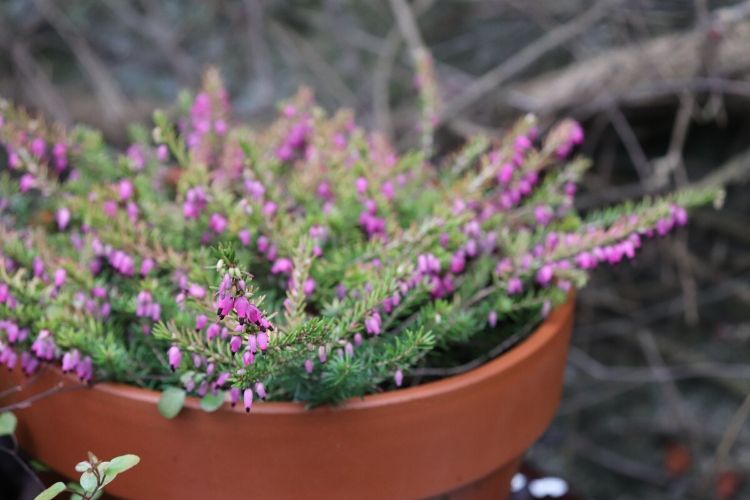
A heather with golden foliage in summer: Erica x darleyensis 'Eva Gold'
This heather has a compact habit, as well as beautiful and numerous magenta bells. But what makes it unique is its superb golden foliage in summer. This allows me to create a patchwork of colours simply with foliage.
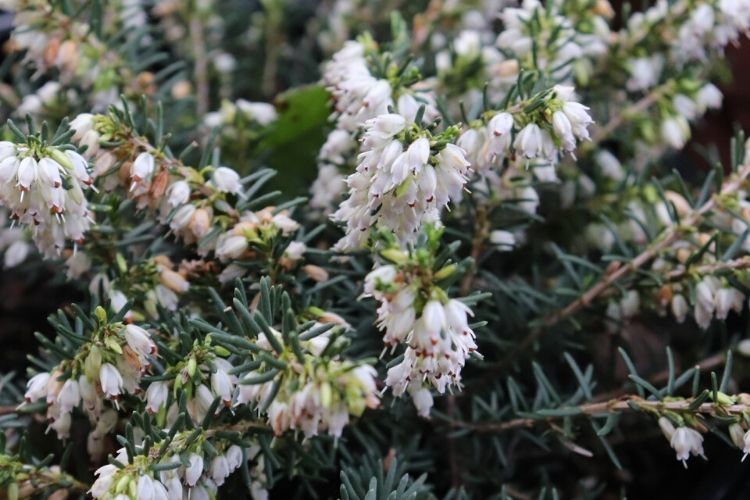
A white heather: Erica x darleyensis 'Silberschmelze'
We can agree, its name is quite a mouthful but its bright, pure white flowering literally melts my heart. Its foliage is not to be outdone as it also changes colour, shifting from light green to dark green and eventually reddening in the cold.
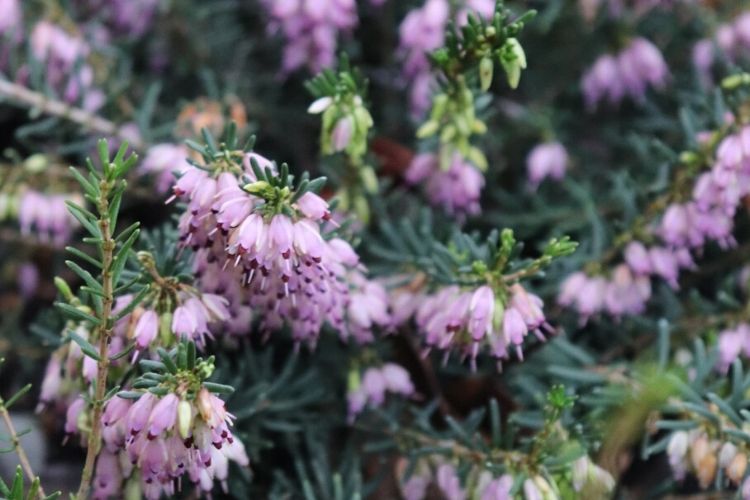
A lilac pink heather: Erica x darleyensis 'Darley Dale'
I couldn't resist this variety with its charming little lilac pink bells on beautiful dark green foliage. It is an old variety that has proven itself. It forms a dense, compact flowering cushion.
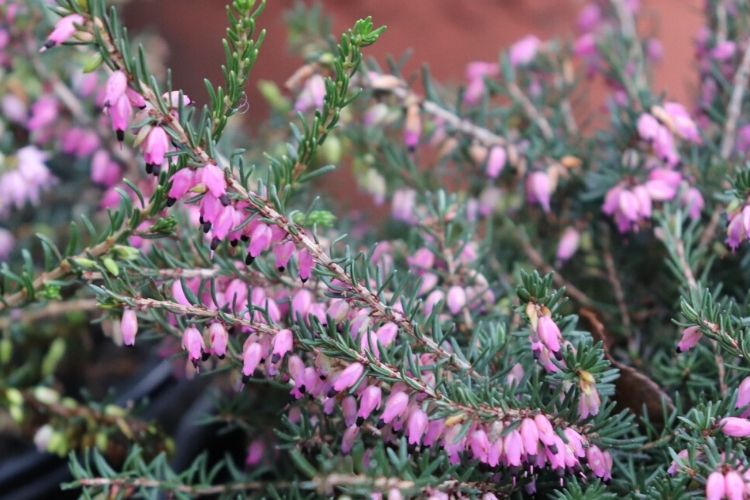
An essential heather: Erica x darleyensis 'Kramer's Rote'
This variety is one of the most appreciated and for good reason, it has all the qualities: vigorous, very floriferous, well compact, particularly accommodating. I love its bright dark pink flowers on its dark foliage that takes on bronze tones with the intensity of the cold.
An alpine heather: Erica carnea 'Golden Starlet'
I conclude with a snow heather that offers a profusion of small white bells on very bright golden foliage in autumn/winter. It is just starting to show a few bells, but I’ll show it to you anyway, otherwise it will sulk!
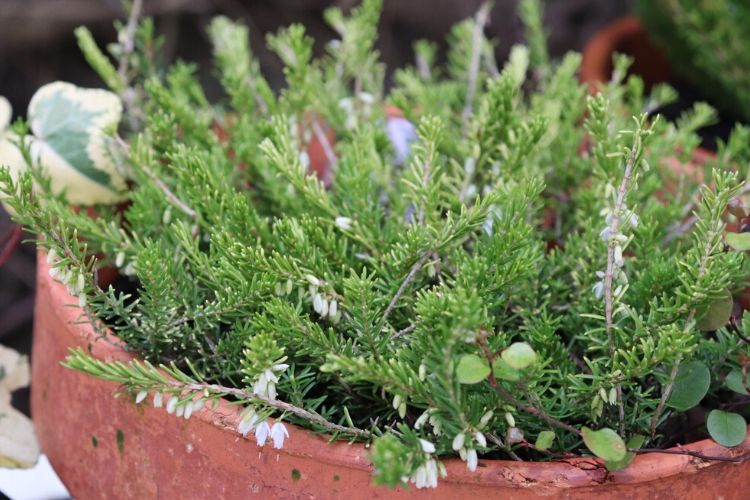
How to plant a heather in a pot?
As I mentioned, heather is well-suited to pot cultivation. They need a very well-draining substrate. For this, I placed some shards and a layer of clay pebbles at the bottom of my pots. Then, I simply used good horticultural compost in which I planted my heathers. For maintenance, I give them a trim after flowering and I make sure to protect them from the intense summer heat. With a rather slow growth rate, they can stay in their pots for a few years without any issues. In my opinion, fertiliser is unnecessary, as heathers prefer rather poor soils. I will simply repot them into slightly larger pots when they seem cramped.
To learn everything about growing heathers, check out our guide: Heather: planting, pruning and maintaining.
In my garden, I don’t have the right soil to grow winter heathers. However, the little bees in the garden and I love them very much, both for their delicate melliferous bells in the cold season and for their evergreen and decorative foliage all year round. No matter, I grow them in pots and it […]
Agapanthus are spectacular flowers often found in seaside gardens, particularly along the West Coast and in Brittany. In summer, they display beautiful blue, white, or mauve flowers in umbels that are both graphic and elegant.
As a worry-free perennial, the Agapanthus thrives in full sun in ordinary, well-drained soil that is not too dry in summer. Its lightness and ease of cultivation are real assets for creating a flowering bed or a pot.
Historically, their use in gardens was limited by their lack of hardiness and the small number of varieties... Today, Agapanthus now come in many varieties, and some even show good cold resistance, which presents another challenge: choice!
To help you, here is a selection of 7 reliable Agapanthus that will suit all gardens, regardless of their size, style, or climate.
Agapanthus Navy Blue (Midnight Star): the hardy one
The Agapanthus 'Navy Blue', also known as Agapanthus ‘Midnight Star’, is one of the most popular Agapanthus. This variety ranks at the top for best rating and best seller at Promesse de Fleurs, and you'll soon see why!
Its light umbels bear an intense navy blue. They appear abundantly from July to August. Its light green ribbon-like foliage is deciduous, but this variety is one of the hardiest Agapanthus, with a resistance down to -10°C in well-drained soil.
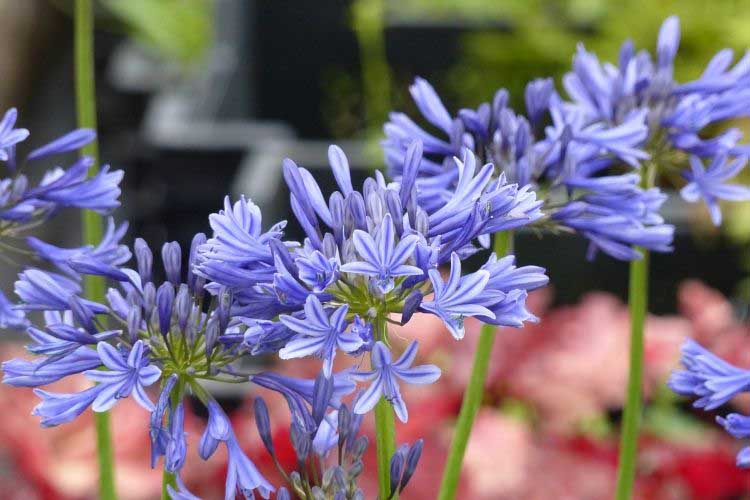
The hardy and popular Agapanthus Navy Blue
Vigorous and medium-sized, reaching 60 cm in height and 40 cm in spread, it adapts well both in pots and as a border plant.
→ To learn more about this variety, check out our article: "Agapanthus 'Navy Blue': a cold-resistant beauty"
Agapanthus Blue Giant: the iconic giant
The Agapanthus Blue Giant is a must-have perennial in Brittany! Often planted, it is valued for its very large dark blue flowers measuring 18 cm in diameter that can reach up to 1.5 meters in height. Its height makes it a remarkable plant for borders and backdrops. It creates significant, elegant vertical lines. You can also enjoy its beautiful large flowers as cut flowers.
Vigorous and robust with fleshy roots, it withstands temperatures down to -12°C.
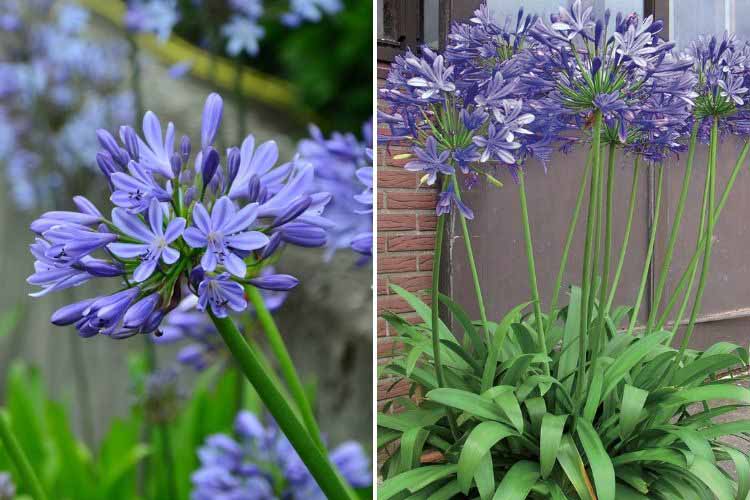
The Agapanthus Blue Giant reaches great heights
Agapanthus Albus: the essential one
Ideal for white gardens, the Agapanthus umbellatus Albus, also known as Agapanthus africanus albus, is distinguished by its white flowering. Its umbels of 15 cm in diameter rise to 1 meter above a ribbon-like semi-evergreen foliage. The umbels consist of snow-white flowers shaped like campanulas. Not very hardy, it tolerates temperatures down to -5°C, limiting its use to mild climates.
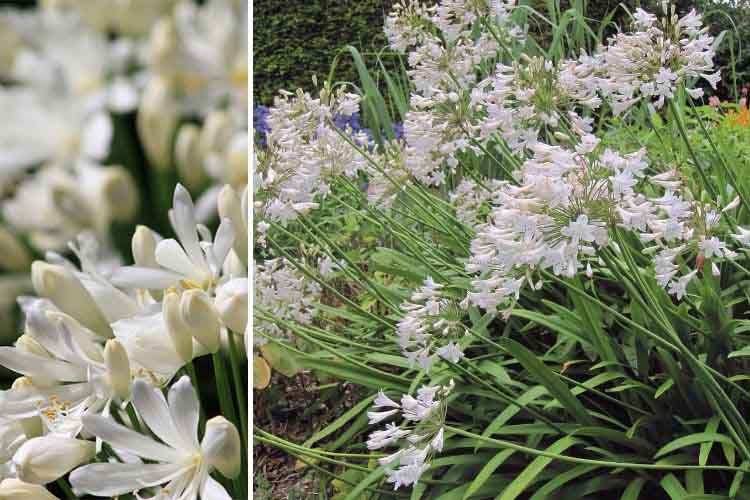
The white-flowered Agapanthus: Agapanthus albus
Agapanthus Royal Velvet: the new star
Original and recent, the Agapanthus Royal Velvet is a new star among Agapanthus due to its intense, trendy colour described as 'ultra violet'. It produces a stunning effect with its unique umbels of 10 to 12 cm in diameter, featuring a deep violet colour streaked with very dark blue-violet. The umbels rise to 80 cm above the ground, clearly above the (deciduous) foliage that forms a lovely clump. The elegance of the Agapanthus Royal Velvet is undeniable!
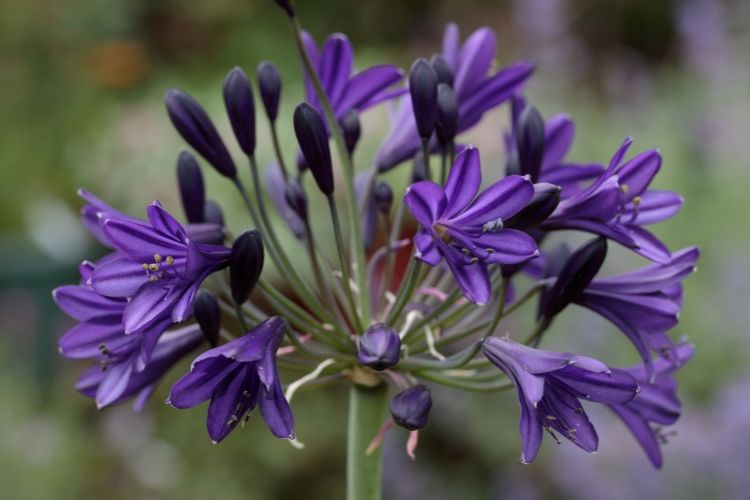
The Agapanthus Royal Velvet, a new variety with ultra violet flowers
Its intensely coloured flowers make it ideal for contemporary gardens as well as for exotic scenes featuring orange flowers like kniphofias, cannas, or hemerocallis.
In addition to its original colour, this variety boasts many advantages with its abundant flowering, robustness, and cold resistance down to -10°C.
Agapanthus Double Diamond: the compact one with double flowers
Recent, the Agapanthus Double Diamond is a variety that combines two qualities: a compact habit and generous flowering. Its main asset lies in its pure white double trumpet-shaped flowers. Grouped in umbels, they measure 10 cm in diameter and appear above a clump of persistent leaves in mild climates. Its compact habit (35 cm high and 30 cm wide) makes it ideal for pots, on terraces or balconies, as well as for borders in areas where winters are not too cold, as it does not tolerate temperatures below -5°C.
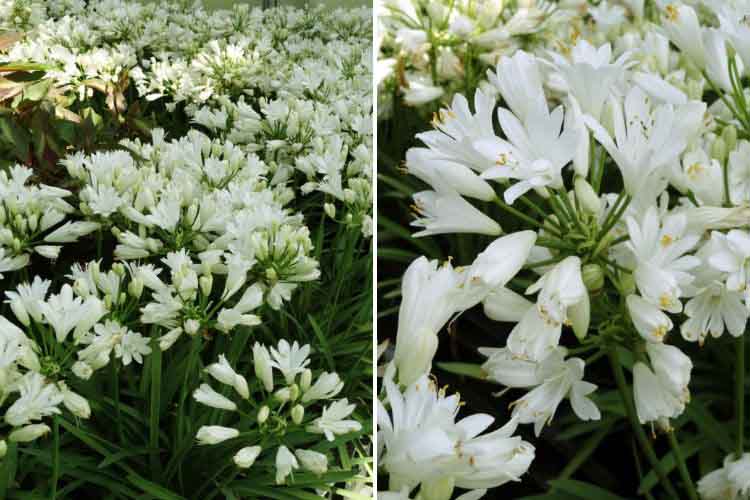 The Agapanthus Double Diamond, a small variety with generous double flowers
Agapanthus Twister: the bicolour
The Agapanthus Twister is an original variety appreciated for its bicoloured flowers. Large, up to 18 cm in diameter, its umbels consist of white flowers with a dark blue base. These two-coloured flowers provide a certain dynamism while blending the softness of the shades, accentuated by the green-grey foliage. Medium-sized, this Agapanthus reaches 60 cm in height and 50 cm in width, making it ideal for the middle of borders, behind ground-cover plants, and it can also be grown in large pots.
Finally, the Agapanthus Twister can be planted in many climates as it is one of the hardiest Agapanthus, tolerating temperatures down to -12°C.
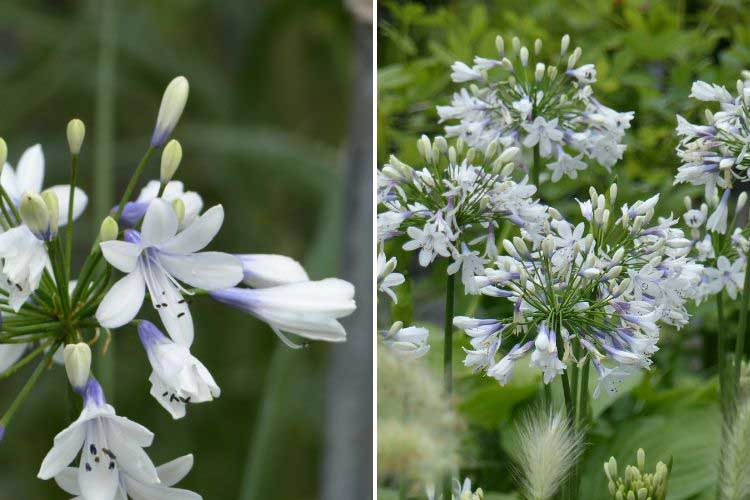
The Agapanthus Twister: bicoloured flowers, white and blue
Agapanthus Pitchoune Blue: the perfect cute pot plant
The Agapanthus Pitchoune Blue lives up to its name. All cute and small, this compact variety measures only 50 cm in height and 50 cm in width. Dwarf, it is perfect for border planting but also for pot cultivation, allowing it to be brought indoors for protection in winter, as it is not very hardy and only tolerates -5°C.
Although small, the Pitchoune Blue variety stands out for its abundant flowering. It pleasantly blooms in an overseas blue above persistent ribbon-like foliage. In the garden, it can be associated with or replaced by its "little sister" with white flowers, Pitchoune White, which offers the same qualities.
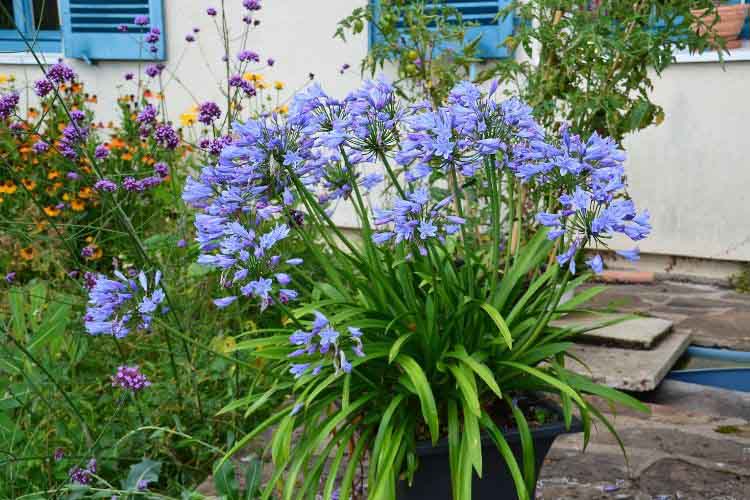
The Agapanthus Pitchoune Blue, a reliable choice, ideal for pots
Do you have other varieties to recommend? Feel free to share their names with us in the comments!
Agapanthus are spectacular flowers often found in seaside gardens, particularly along the West Coast and in Brittany. In summer, they display beautiful blue, white, or mauve flowers in umbels that are both graphic and elegant. As a worry-free perennial, the Agapanthus thrives in full sun in ordinary, well-drained soil that is not too dry in […]
Thistles, as a whole, are often associated with the field thistle (Cirsium arvense), a species more feared than appreciated. Consequently, they are relatively rarely planted in gardens. However, ornamental thistles are low-maintenance, easy to grow, and, above all, they are unmatched for adding interest to a somewhat flat flowerbed, even into winter thanks to the striking structure of their inflorescences that last for many months.
Here are our favourite "thistles" along with some ideas for pairing them.
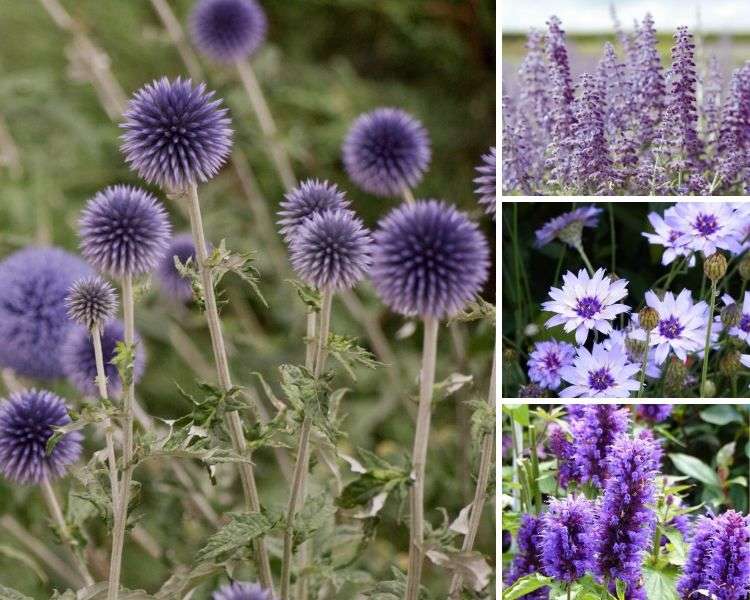
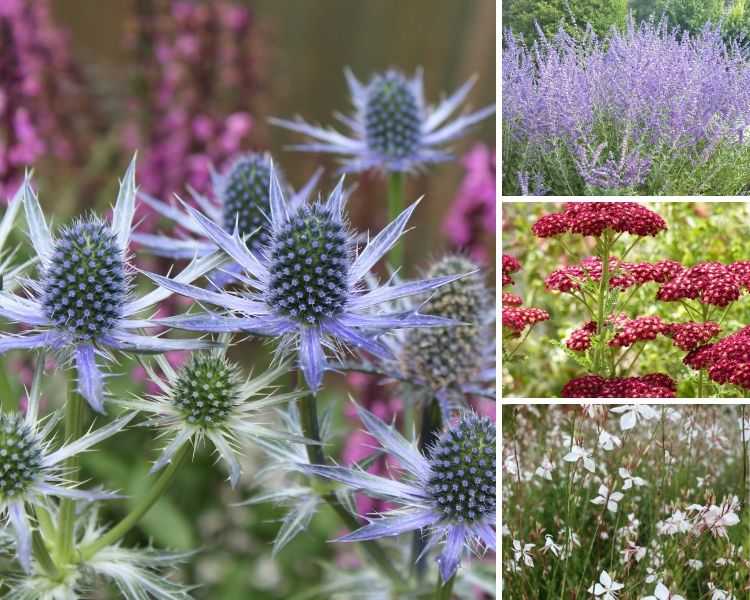
Echinops ritro, Globe Thistle or Azure Globe
Hardy and unassuming like a camel, this perennial thistle is distinguished by its blue flowering, which is remarkable from a distance. It features green foliage with silvery highlights, spiny, from which small globe-shaped flowers emerge from July to September.
- Growing conditions: in full sun in any well-drained soil, even poor or dry - hardiness: -20 °C
Echinops are easy to pair, particularly in summer beds where perennials and grasses mingle. They are also perfect for creating a lovely blue colour scheme, here with Echinops ritro, Perovskia Lacey Blue, Catananche caerulea, and Agastache Blue Boa.
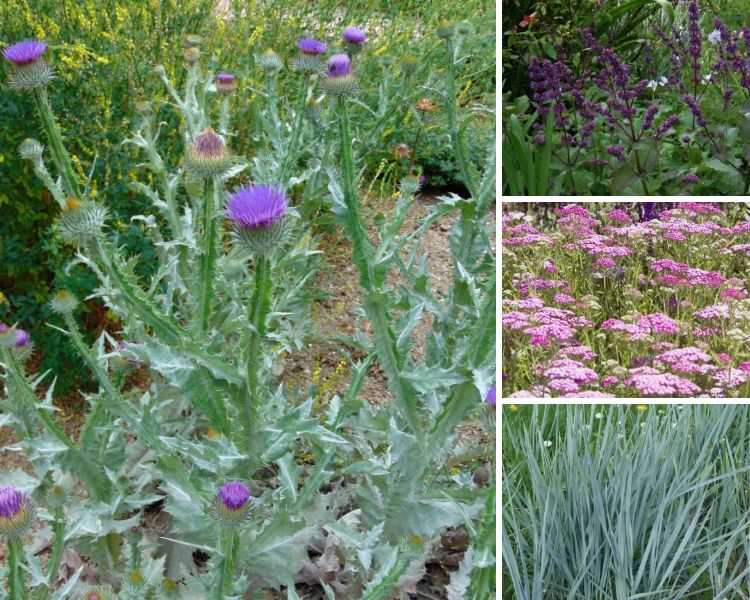
Onopordum acanthium, Cotton thistle
Monumental, the Onopordum acanthium (or nervosum) is a biennial plant that produces large purple-pink flowers reaching up to 2 metres high in July. They are perched on a hairy stem, which is adorned with greyish foliage armed with formidable thorns. Its growth is simply astonishing as it requires very little.
- Growing conditions: in full sun in any soil, even dry and calcareous - hardiness: -15 °C
More than just a companion, Onopordum acanthium is a standout. With its tall stature and graphic silhouette, it easily steals the show from surrounding plants. Nevertheless, to highlight it, feel free to pair it with Salvia verticillata Purple Rain, Achillea millefolium Lilac Beauty, and Elymus magellanicus.
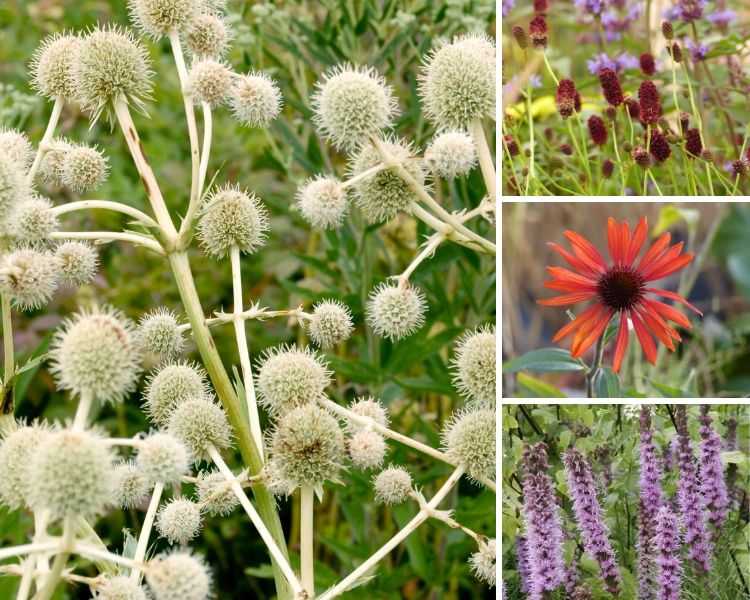
Eryngium yuccifolium, Yucca-leaved eryngium
Simply charming, this American eryngo is distinguished by its somewhat waxy, long leaves with sharp tips, as well as by its flowering. Carried on branched stems, its flowers appear in July, they are numerous, spherical, and a lovely greyish white. In a flowerbed, it is an excellent graphic plant that quickly forms a clump 1.5 metres high and 60 centimetres wide, ideal for adding a touch of white to summer beds.
- Growing conditions: in full sun in well-drained soil - hardiness: -15 °C
The yucca-leaved eryngo is the perfect plant to enliven a somewhat "flat" flowerbed. The shape of its flowers contrasts beautifully with vertically-oriented plants like agastaches, salvias, liatris, or other American perennials like echinaceas, heleniums, or the lovely Canadian Burnet. Here it is paired with Sanguisorba Red Thunder, Echinacea Hot Summer, and Liatris spicata.
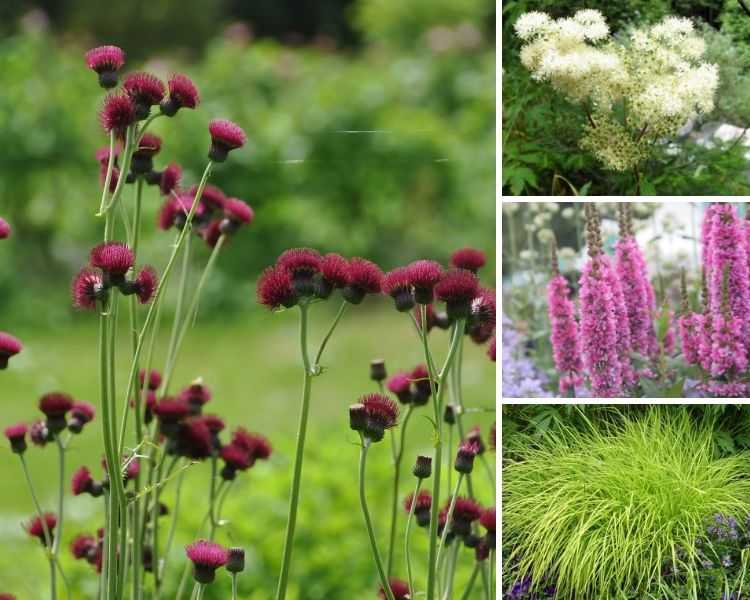
Cirsium rivulare Atropurpureum, River thistle
This thistle, perfect for heavy and moist soils, is appealing due to its purple-red flowering that begins in June. Its flowers, about 3 cm in diameter, are borne on tall branched stems that can reach a height of one metre. Graphic yet somewhat wild, this river thistle is a blessing for waterlogged soils and also for pollinating insects as its flowers are melliferous.
- Growing conditions: in full sun or partial shade in fairly rich, cool to moist soil - hardiness: -15 °C
Versatile, this thistle suits all styles of gardens: modern, English, or natural. It pairs well with Astrances, Japanese Anemones, Astilbes, Veronica, and with all grasses suited to cool or moist soils like Carex, Deschampsias, and Molinies. You can also combine it with Filipendula ulmaria, Lythrum salicaria Robert, and Carex elata Aurea.
Eryngium Jos Eijking®, Blue flower eryngium
The Eryngium Jos Eijking® is a magnificent blue thistle that shines with its cobalt blue hue but also with the graphic nature of its conical inflorescences crowned with finely cut bracts. Its average height (70 cm tall and 30 cm wide) is more than compensated by its colour, which ensures an extraordinary presence that will undoubtedly attract all eyes in the garden.
- Growing conditions: in full sun in well-drained soil, even dry - hardiness: -15 °C
Stunning in a flowerbed where all shades of blue are represented, this eryngo will shine even brighter if you add a touch of bright yellow (with Crocosmia Buttercup, for example).
For a calmer and more restful atmosphere, opt for white with Gaura lindheimerii, blue with Perovskia Blue Spire, and elevate it all with a note of Achillea Red Velvet.
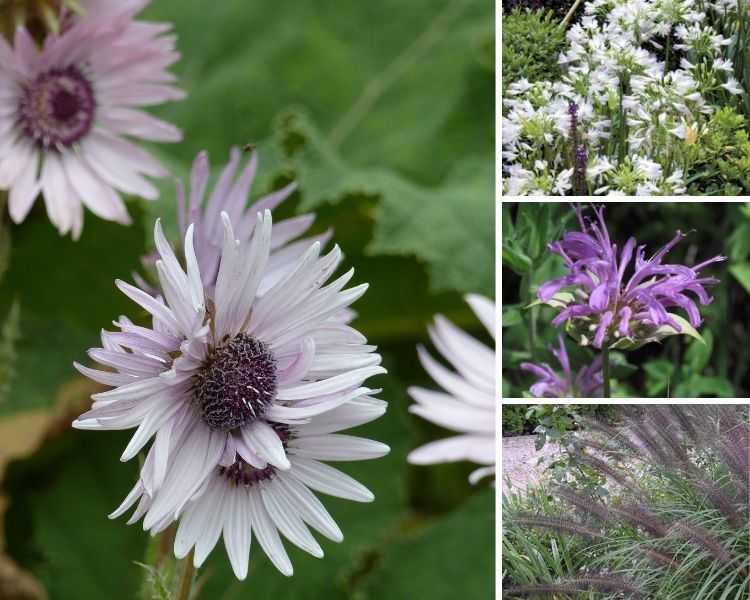
Berkheya purpurea, Purple African thistle
Large daisy-like mauve flowers with a purple centre perched on threatening spiny stems… here is the Berkheya purpurea! Curious, this perennial native to South Africa is quite hardy and particularly interesting in well-draining soil, though not too dry. We love it for its originality but especially for its 10 cm diameter flowers and its silvery-grey, downy foliage.
- Growing conditions: in full sun in well-drained soil but not too dry - hardiness: -10 °C
Perfect for a gravel garden, Berkheya pairs well with many perennials, but why not combine it with agapanthus (also native to South Africa) like Agapanthus Enigma, Monarda fistulosa Menthifolia, and to echo its dark heart, Pennisetum alopecuroides Black Beauty.
What about you? Do you have any thistles in the garden? What are your favourite varieties? Let us know in the comments!
Thistles, as a whole, are often associated with the field thistle (Cirsium arvense), a species more feared than appreciated. Consequently, they are relatively rarely planted in gardens. However, ornamental thistles are low-maintenance, easy to grow, and, above all, they are unmatched for adding interest to a somewhat flat flowerbed, even into winter thanks to the […]
Question: I planted a hosta, it disappeared in autumn / My hosta isn't reappearing in March. Is that normal?
Answer: Yes! Hostas are deciduous, they disappear for winter
and only return late in spring.
Why hostas disappear in autumn?
Hostas are perennial plants, their foliage completely disappears in winter.
Our advice: to avoid accidentally damaging your hostas, mark their location with a label, sturdy and clearly visible!
Why don't hostas reappear in March?
Hostas are late perennials, they only return in April - May. But beware of slugs!
Our advice: to prevent the young leaves of your hostas from being eaten by slugs in spring, protect them by spreading ferramol pellets or wood ash.
Further reading
Discover our tips:
- "How to fail at growing hostas in 4 lessons
- "9 Hostas resistant to slugs"
- "Slugs, 7 effective ways to fight naturally"
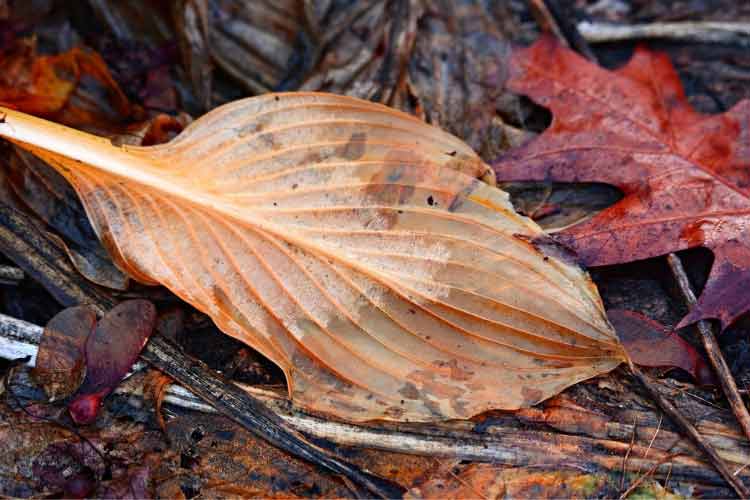
A hosta leaf in autumn
Question: I planted a hosta, it disappeared in autumn / My hosta isn’t reappearing in March. Is that normal? Answer: Yes! Hostas are deciduous, they disappear for winter and only return late in spring. Why hostas disappear in autumn? Hostas are perennial plants, their foliage completely disappears in winter. Our advice: to avoid accidentally damaging […]
Autumn is a particularly colourful season in the garden but the flamboyant shades unfortunately do not last long. Soon gardens will go to sleep and we will all, from March, be on the lookout for the first spring blooms... provided we were foresighted enough and planted in time! To enjoy the very first flowers of spring in the garden, here is my selection of 7 early perennial plants to plant in autumn.
Brunnera Diane's Gold
This perennial Siberian bugloss is a real gem for shady, cool areas of the garden. It bears heart-shaped foliage, chartreuse green that retains its pretty golden tones from spring through to the frosts. From April to June, it is adorned with a cloud of small, delicate bright-blue flowers. Easy to grow, it only needs soil that stays cool to spread and form a luminous carpet. In the garden it establishes easily under trees, at the base of hedges or as an edging for beds where it will add an elegant touch.
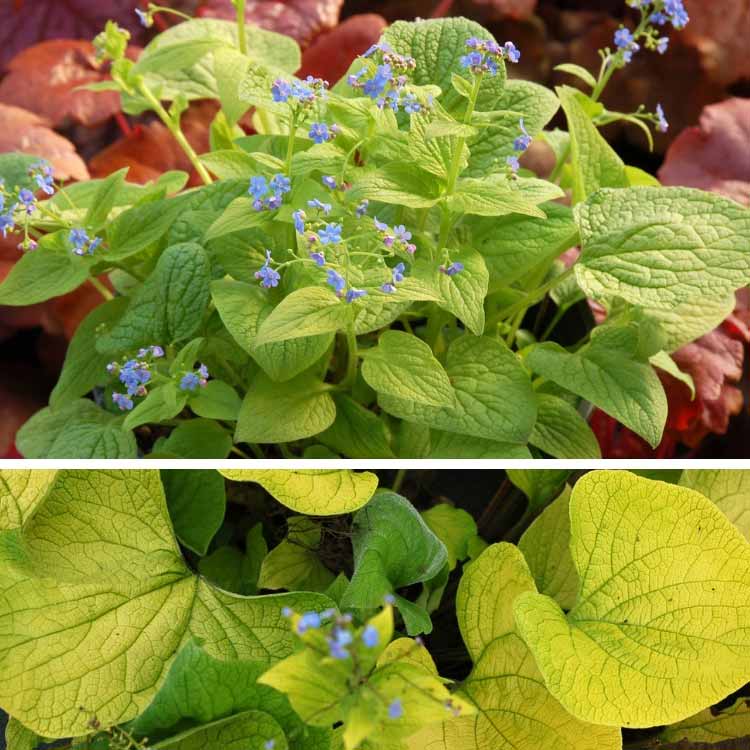
Brunnera macrophylla Diane's Gold - Siberian bugloss
Pachyphragma macrophylla
This perennial is probably the first to flower: from March it produces a multitude of charming small white flowers. It is a hardy plant that also has the advantage of establishing quickly and spreading gradually, without being overly invasive. In shade or partial shade and in rich, even heavy, soil, it forms attractive, persistent carpets studded with white in early spring. Charming with spring bulbs, with bleeding hearts or with Hostas, this woodland plant is also ideal for dressing neglected spots in the garden.
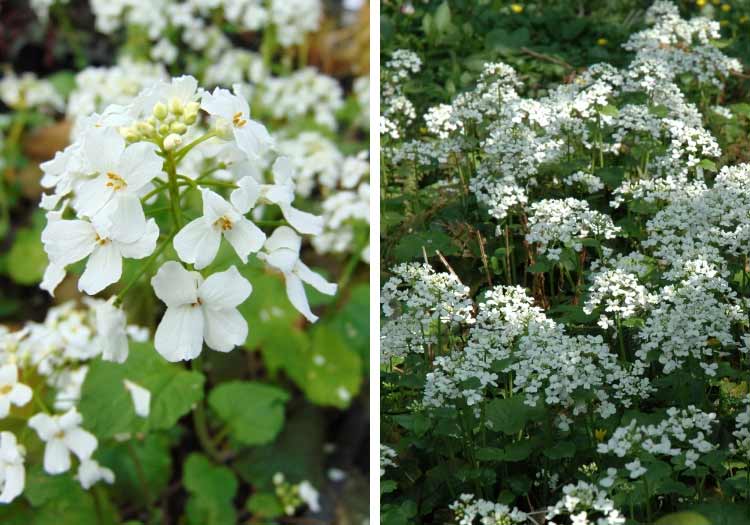
Pachyphragma macrophyllum
Disporopsis pernyi
If you like Solomon's seal, you will love this woodland perennial! Perfect for dry shade, from April to May it bears charming flower spikes bearing small cream-white bell-shaped flowers tinged with green. Growth is fairly slow, but once established it forms such a dense carpet that it can rival weeds. In the garden it will find a place under trees, with epimediums for example, on a bank or in a shaded rockery.
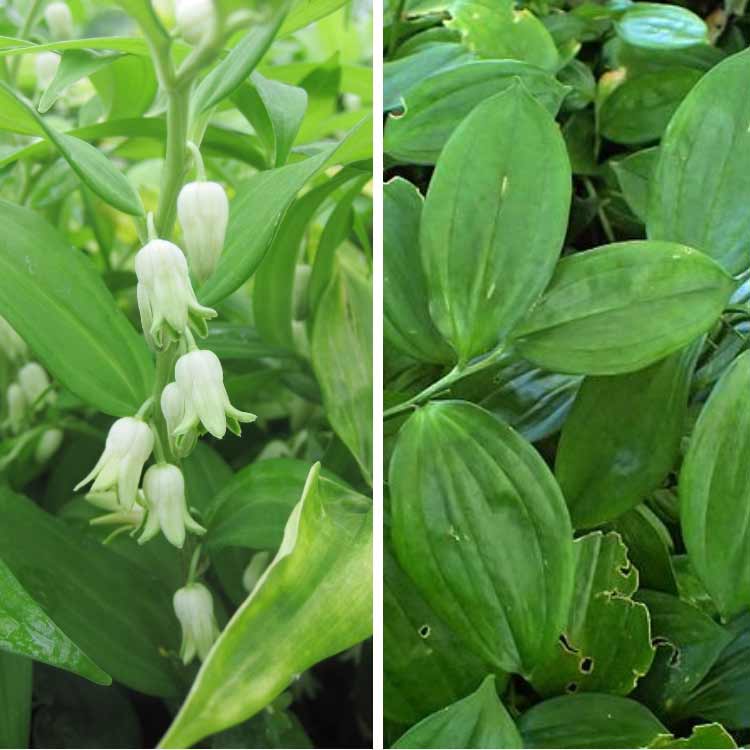
Disporopsis pernyi
Bergenia Dragonfly Angel Kiss
Bergenias need no introduction, so well known are they for their toughness! Nevertheless, this variety deserves attention: compact and very floriferous, it displays remarkable evergreen foliage: dark green that flushes red in winter. In spring, in April–May, it is topped by pale pink, semi-double flowers which create a very attractive display. Very easy to grow and hardy, this bergenia can be planted in pots on a terrace or balcony as well as in the garden.
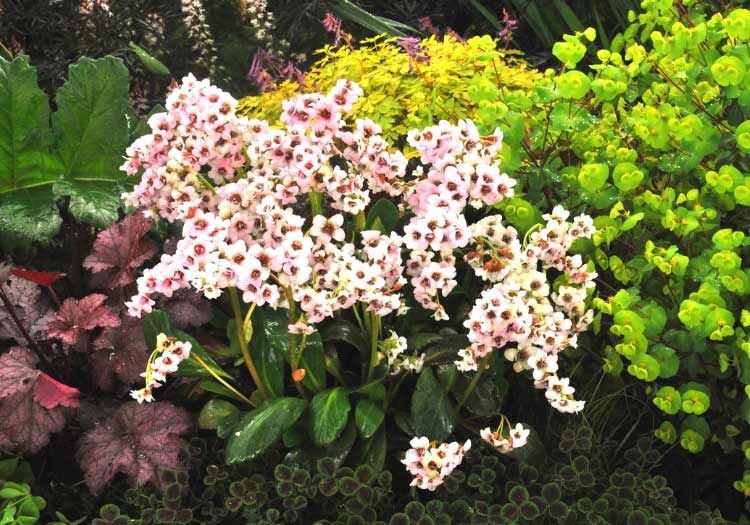
Bergenia Dragonfly Angel Kiss
Comfrey Sky Blue Pink
And no, comfrey is not only used to make manures and decoctions! It is also a vigorous groundcover perennial that can be very ornamental. The 'Sky Blue Pink' variety is proof of that. From April to June it bears white and blue flowers washed with pink above evergreen foliage. Almost indestructible, this plant withstands difficult conditions and grows very well in dry shade.
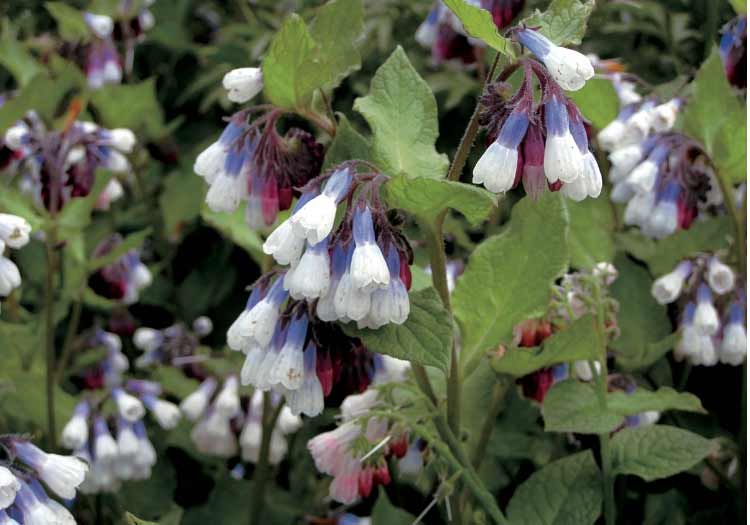
Large-flowered comfrey - Symphytum Sky Blue Pink
Epimedium Sphinx Twinkler
With exquisitely delicate flowers and colourful foliage, this epimedium—or Warley bishop's hat—has everything to please. Rhizomatous and spreading, it makes an excellent evergreen groundcover for shade and partial shade. In spring, in April–May, it unfurls delicate sulphur-yellow flowers suspended on slender stems. It's a delight, but don't be fooled by appearances: it is indeed a robust plant that coexists perfectly with tree and shrub roots.
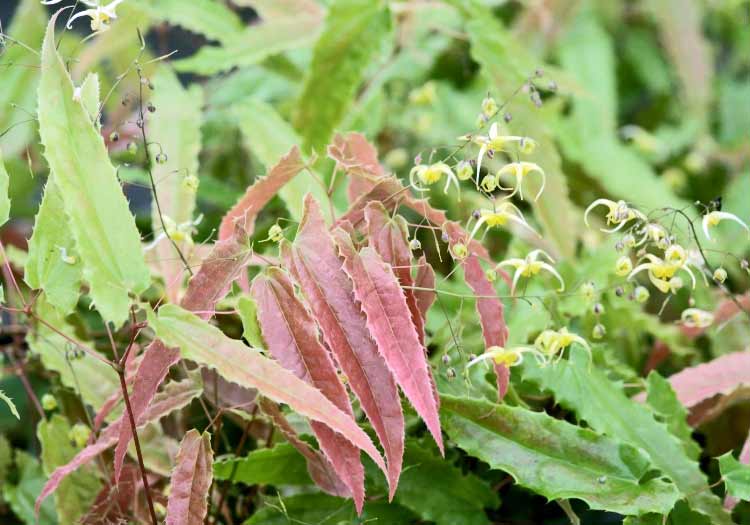
Warley bishop's hat - Epimedium Sphinx Twinkler
Ajuga Chocolate Chip
A devilishly effective groundcover, this creeping bugle produces small narrow chocolate-coloured leaves from spring to winter. In May–June short spikes of intense lavender-blue rise, striking in appearance. It is planted in partial shade in fairly cool soil and shows good resilience. This ajuga is ornamental, but can be very useful for replacing lawn on small areas or for filling large gaps in paving.
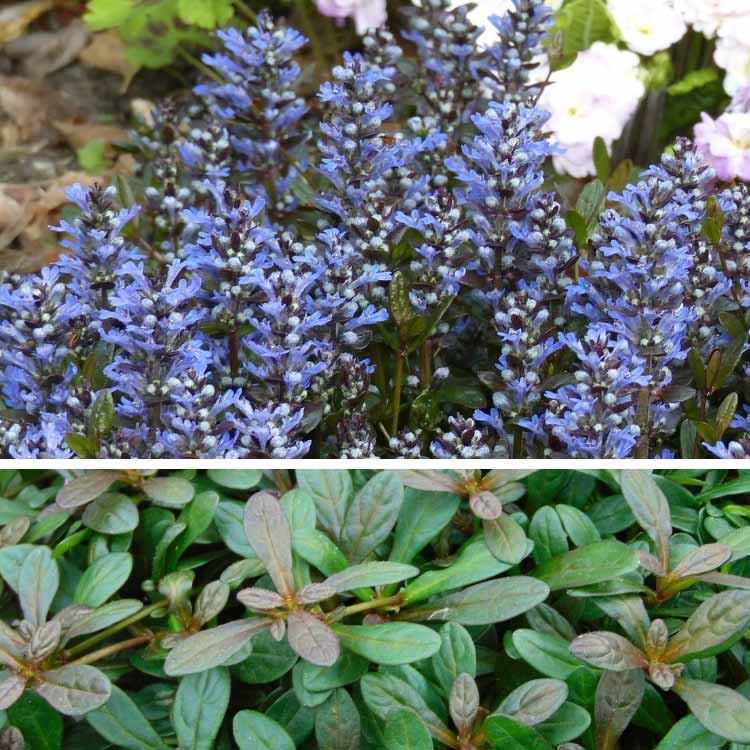
Creeping bugle - Ajuga tenorii Chocolate Chip (Valfredda)
Autumn is a particularly colourful season in the garden but the flamboyant shades unfortunately do not last long. Soon gardens will go to sleep and we will all, from March, be on the lookout for the first spring blooms… provided we were foresighted enough and planted in time! To enjoy the very first flowers of […]
The peony is one of my little spring pleasures. What a joy to come back from the garden with an armful of multicoloured flowers to make into bouquets. In good conditions, they last a few days in a vase, five days at most, but have incomparable charm and generosity. Today I share my tips for making beautiful peony bouquets!
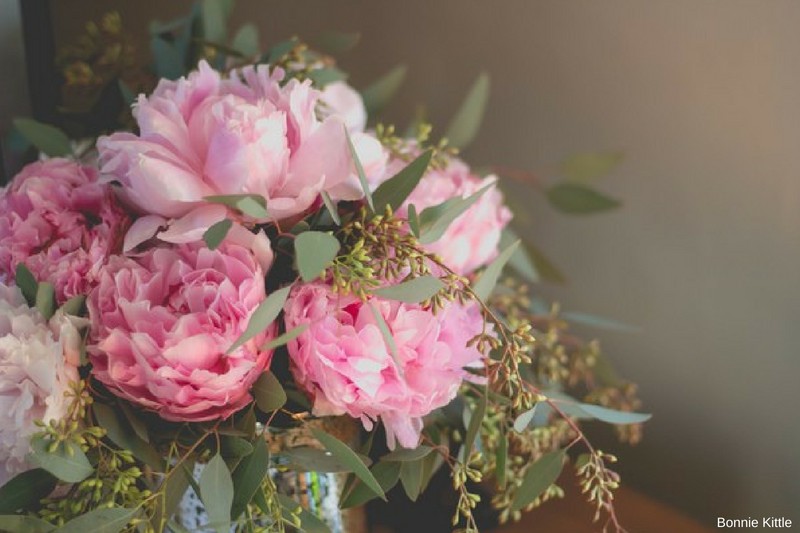
1/ Choose peonies while still in bud, nicely rounded but not too tight. Buds will open in the vase, giving you longer enjoyment.
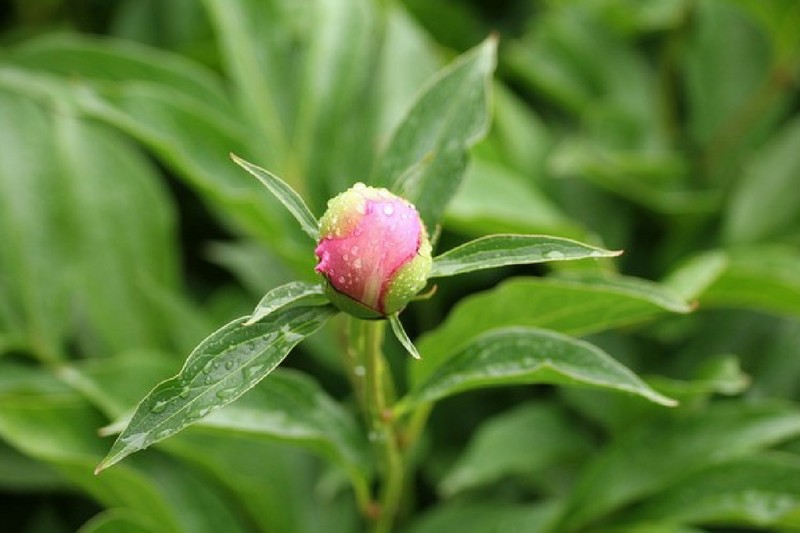
Peony bud slightly open; it will open in the vase.
2/ Remove leaves from lower part of stem; they must not sit in water.
3/ Cut stems at an angle with sharp scissors to optimise their hydration.
4/ Peonies need plenty of water: fill the vase well and, if desired, add a pinch of bicarbonate of soda.
5/ Change water and recut stems a little each day.
6/ Keep bouquet in a cool place, out of direct sun.
Peony is a flower that stands on its own. For a bouquet, you can use it alone or mix different colours. You can also combine it with other flowers: gypsophila, lilac, astilbe, cow parsley (Anthriscus sylvestris), small-flowered roses, Alchemilla, Smyrnium perfoliatum, spirea branches, or fern fronds or eucalyptus stems. Let your imagination run free!
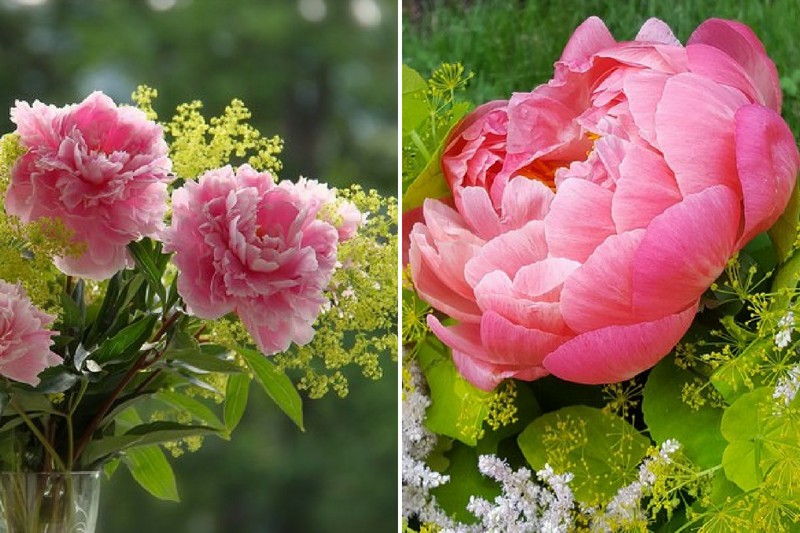
Examples of happy pairings: pink peony with Alchemilla mollis (left) and with Smyrnium perfoliatum (right).
The peony is one of my little spring pleasures. What a joy to come back from the garden with an armful of multicoloured flowers to make into bouquets. In good conditions, they last a few days in a vase, five days at most, but have incomparable charm and generosity. Today I share my tips for […]
The exotic-style garden is attracting an increasing number of gardeners. Bamboo, palm trees, and banana plants are among the most popular plants for creating scenes that evoke the tropical jungle, but there are many others! To make this dream accessible and sustainable, both outdoors and even in cold climates, there is only one option: to choose truly hardy plants that can withstand winter's harshness. Here is a small selection of our favourite plants (bushes and perennials)!
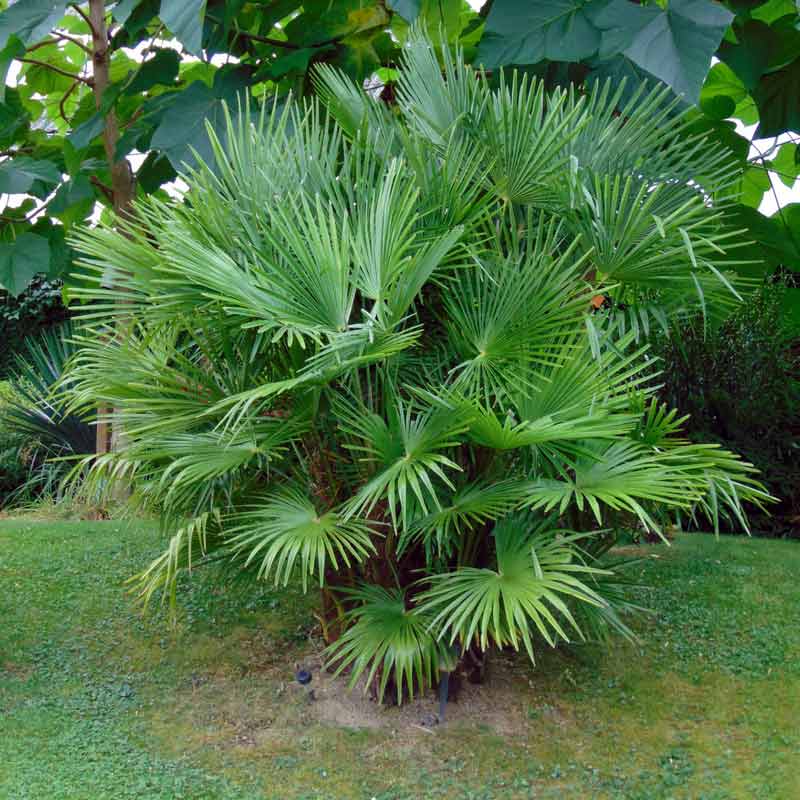
1) Trachycarpus fortunei, known as "Hemp Palm" - Hardiness: -18 °C
No, palm trees are not just on the Croisette… they can also be found in northern France, for example, with the Trachycarpus fortunei, which can withstand temperatures down to -18 °C. This ability to face the cold comes from its mountainous origins (China and Japan) as well as the thick fibre that protects its trunk. It can reach heights of 8 to 10 metres and prefers rich, light soil, thriving in full sun or partial shade.
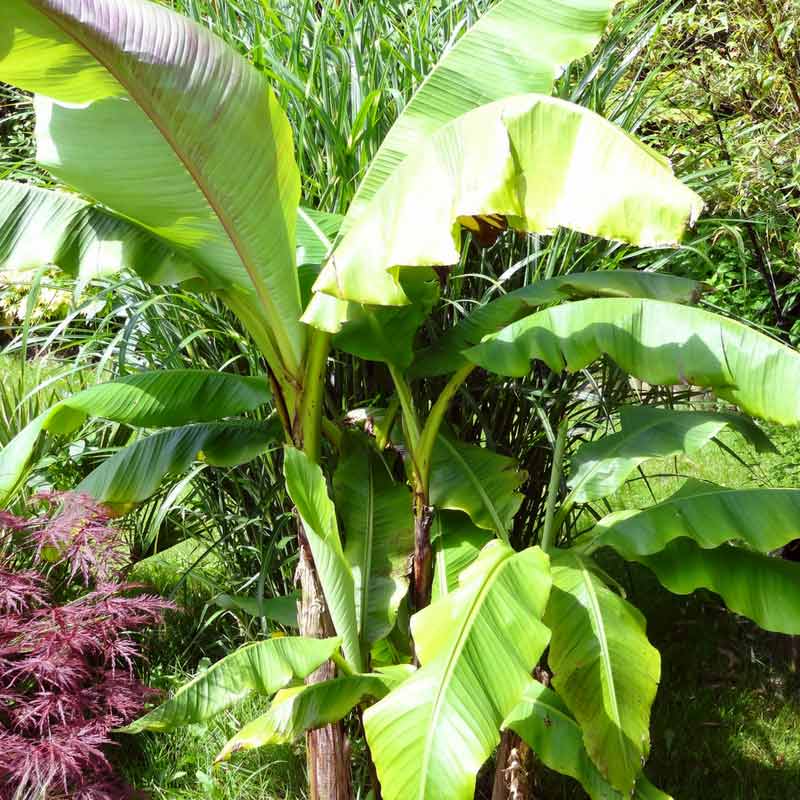
2) The Banana plant or Musa basjoo - Hardiness: -12 °C to -15 °C
The Musa basjoo is an outdoor banana plant, hardy, also known as the "Japanese Banana". It is a valiant plant that generally does not produce fruit but displays its large decorative leaves each year. It can grow over 2 metres tall, and even more if you ensure it receives what it needs: regular watering and rich soil. Its only weakness lies in poor wind resistance. If you don’t want its leaves to be turned into sad little brooms, it is essential to protect it by planting it in a sheltered area or a walled space.
Slightly less hardy but still quite resilient, also discover the Sikkim banana (or Sikkim Banana) Red Tiger, a variety with graphic leaves, light green with a purple underside, elegantly striped with burgundy.
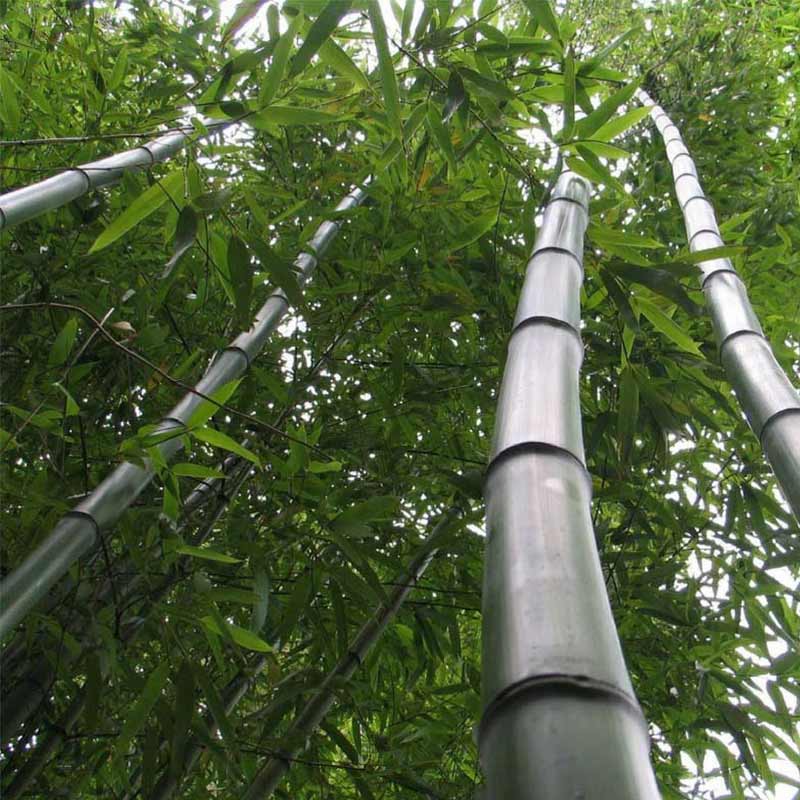
3) Bamboos: Phyllostachys vivax and Fargesia robusta - Hardiness: -20 °C and -15 °C
Bamboos are among the classics of exotic gardens, but their hardiness varies greatly depending on the species and varieties. Among the most spectacular, we particularly like the Phyllostachys vivax 'Huangwenzhu', a giant bamboo (running… plan for a rhizome barrier) that can grow its green canes striped with yellow to over 10 metres tall. Fast-growing, it will quickly form a small forest. Relatively smaller in size (4 to 5 metres tall) and non-running, the Fargesia robusta is better suited for small gardens. It features long green leaves and bright green culms.
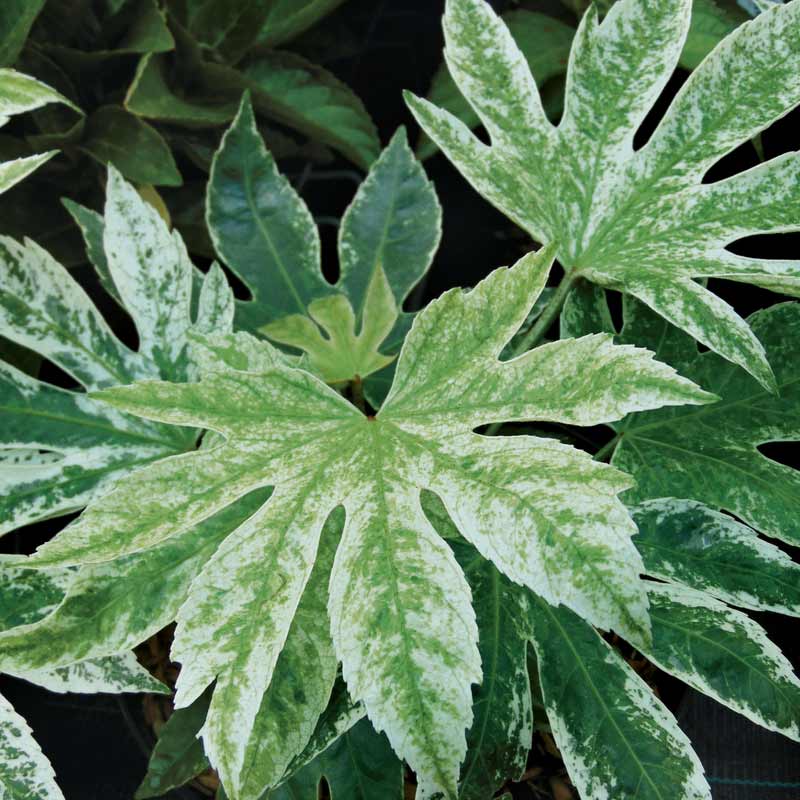
4) Fatsia japonica Spider's Web - Hardiness: -15 °C
The Fatsia japonica 'Spider's Web' is a shrub with a unique personality! About 2 metres tall, this Aralia showcases dark green, evergreen foliage splashed with cream-white. Its palmate leaves can reach up to 20 cm in diameter. In summer, they are topped with round white flowers that later turn into decorative black berries. This shrub thrives in shade or partial shade, in cool soil.
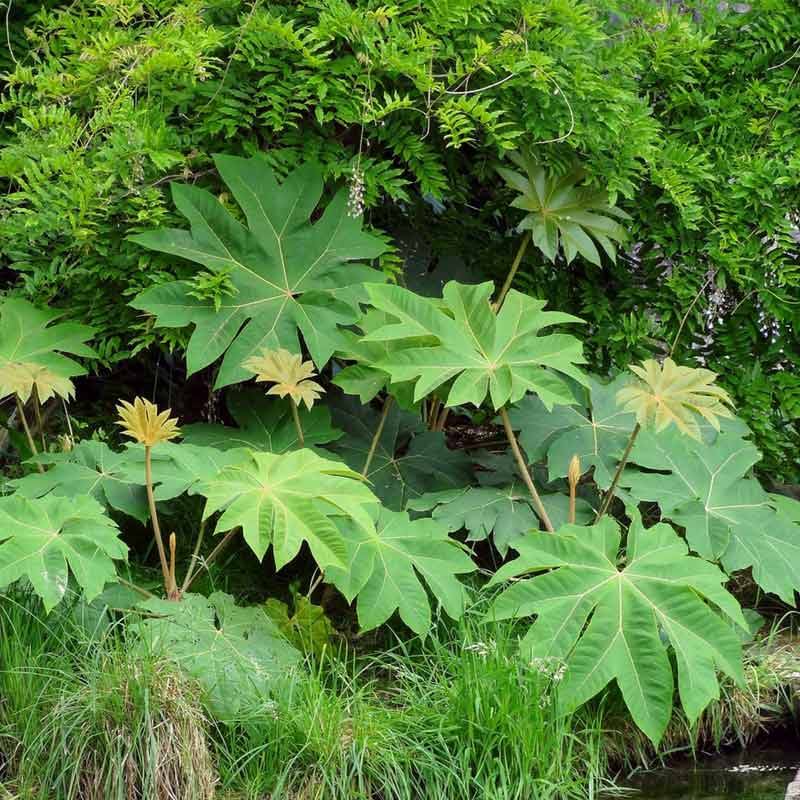
5) Tetrapanax papyrifera Rex, Rice Paper Plant - Hardiness: -10 °C
Halfway between a shrub and a perennial, Tetrapanax papyrifera 'Rex' is an exuberant plant that captivates with the XXL size and cut shape of its leaves that spread out like a parasol. Native to China and Japan, it is a rhizomatous plant, like bamboo, that tends to spread and may require a rhizome barrier. It grows in non-burning sun or partial shade, in fertile and rather cool soil. Its loose habit and Asian charm make this plant a perfect complement to bamboos.
Note that the aerial parts of this plant are destroyed at -5 °C, but it will regrow from the rootstock above -10 °C, once well established.
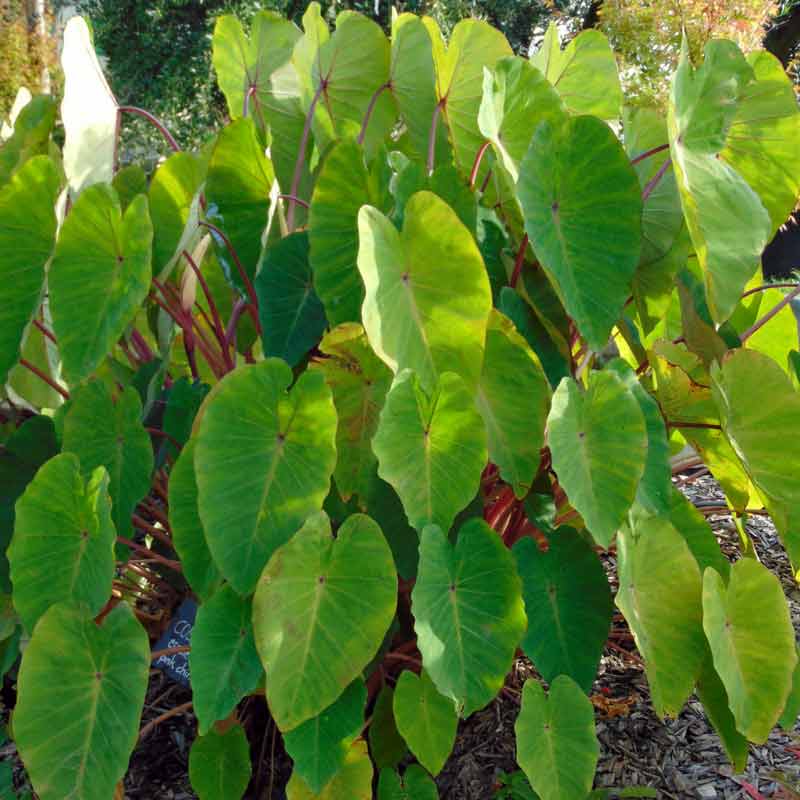
6) Colocasia Pink China - Elephant Ear - Hardiness: -10 °C to -12 °C
Lush, the Colocasia 'Pink China' stands out for the heart-shaped form and the colour of its large foliage: a lovely soft blue-green that contrasts with the pink of its petioles. Well known to houseplant enthusiasts, this colocasia can be grown in the garden, provided you mulch it to protect it during winter. It is planted in full sun or partial shade, in cool, humus-rich soil, and appreciates regular watering in summer.
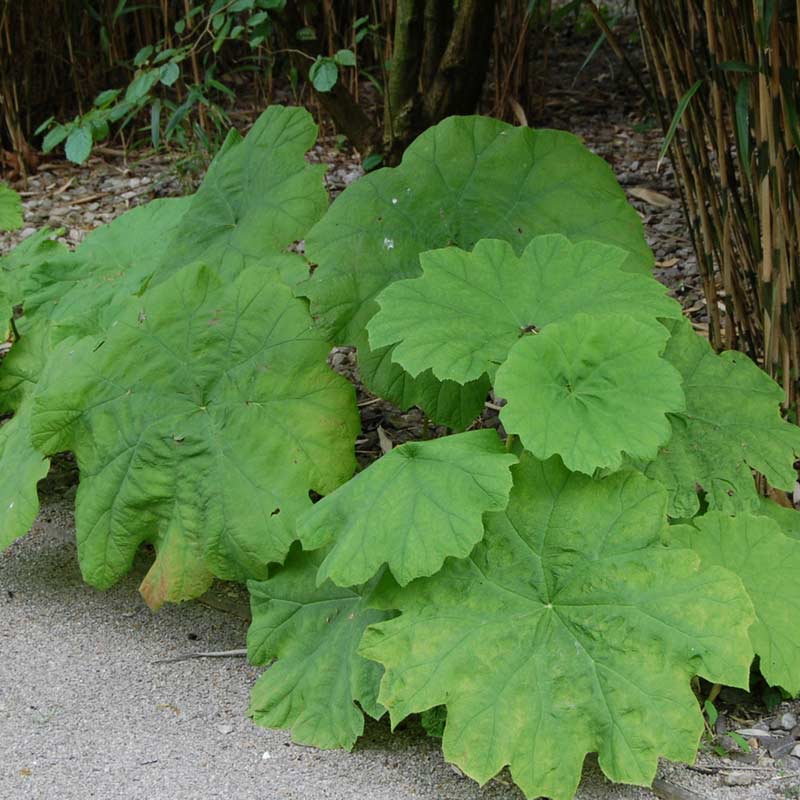
7) Astilboides tabularis - Hardiness: -20 °C
The Astilboides tabularis (sometimes called Rodgersia tabularis) is a spectacular woodland plant that stands out for its large, entire, rounded leaves, about 60 cm in diameter. It quickly forms a clump that can reach 1 metre high and 70 cm wide, or even more if the soil suits it. Its generous foliage is accompanied, in early summer, by light, creamy-white spikes of flowers. It is an ideal perennial for shade, thriving in rich, cool, but well-drained soils.
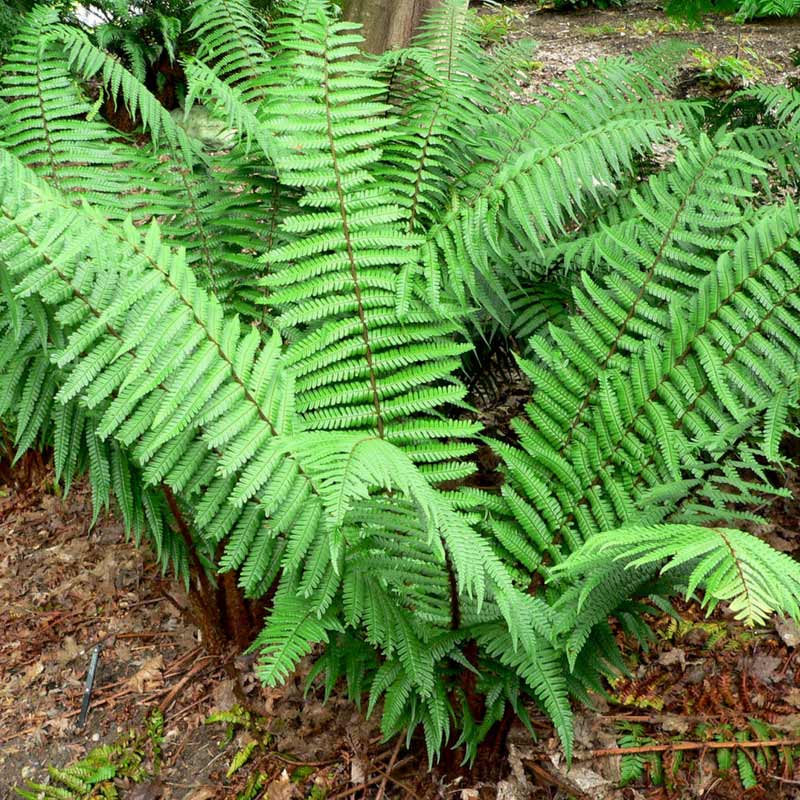
8) Dryopteris wallichiana, Large golden-scaled fern - Hardiness: -15 °C
Majestic, Dryopteris wallichiana is a large fern that unfurls a remarkable cut foliage highlighted by a black vein in spring. Of tall stature (1 to 1.5 metres high) and beautiful appearance, it somewhat resembles tree ferns, especially as its short basal trunk develops with age. It is a variety that is quite easy to cultivate, thriving in deep, very rich humus soil. It will look stunning in a border and can be accompanied by another hardy fern: the Eastern Ostrich Fern (Matteuccia orientalis).
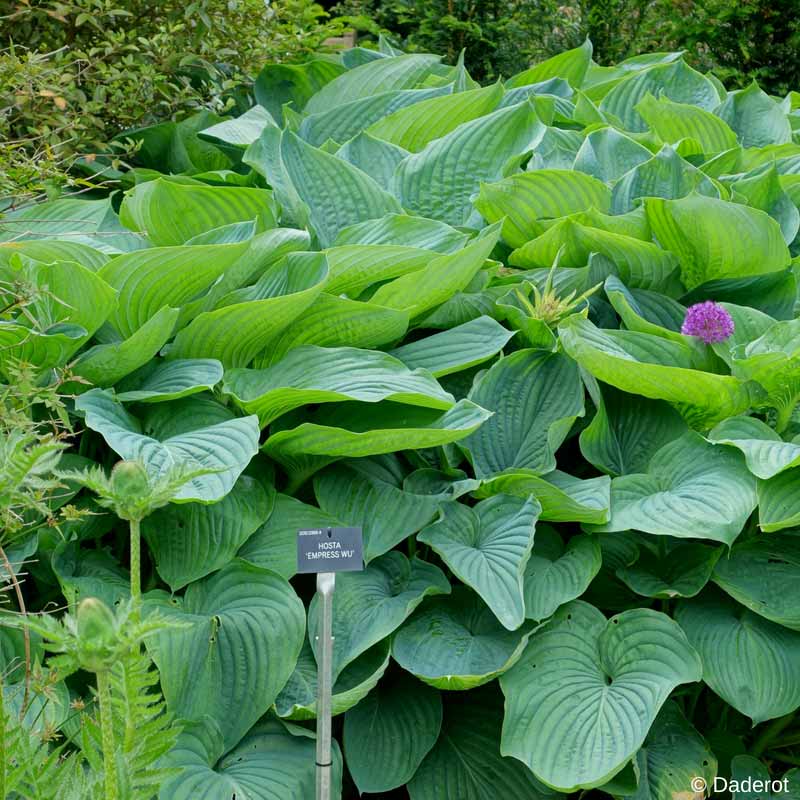
9) Hosta Empress Wu
Hostas are well known for their hardiness and ability to grow in shade or partial shade. While some fit easily into classic borders, others offer such abundant foliage that they easily find their place in a tropical-looking garden. This is the case for the giant Hosta 'Empress Wu', certainly the largest variety that can reach 1.3 metres in all directions in just a few years and displays magnificent blue-green foliage. It is a perennial that requires nourishment and water to express its full potential.
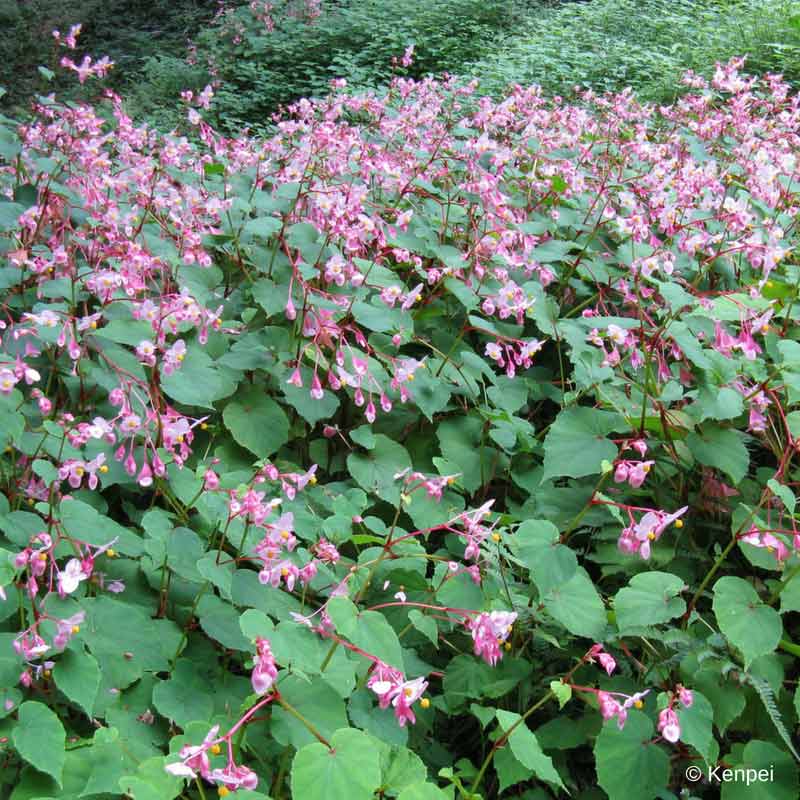
10) Begonia grandis evansiana - Hardiness: -15 °C
Begonias are not just for window boxes: Begonia grandis evansiana, a botanical species, perennial and resistant down to -18 °C here is proof! Its heart-shaped green foliage forms a beautiful bushy clump about 80 cm high and 50 cm wide, adorned throughout the summer with numerous small pink flowers borne on reddish stems. It can be grown in the ground or in pots, ideally in partial shade and in rich, cool soil.
The exotic-style garden is attracting an increasing number of gardeners. Bamboo, palm trees, and banana plants are among the most popular plants for creating scenes that evoke the tropical jungle, but there are many others! To make this dream accessible and sustainable, both outdoors and even in cold climates, there is only one option: to […]
Peony or Paeonia continues to enchant us with its large flowers in various shapes and colours. This is what makes it so charming!
Its generous flowering in spring is accompanied by great ease of cultivation, excellent hardiness, and good resistance to diseases... not to mention that some varieties are delightfully fragrant. It is a beauty with a captivating charm that, although it does not bloom for long, returns faithfully for many years.
HERBACEOUS PEONIES, SHRUB PEONIES, AND HYBRIDS
- The herbaceous peonies (Paeonia lactiflora) are the most well-known. I particularly love them for their longevity and easy-going nature. A staple of traditional gardens, they thrive in both old and contemporary gardens. Personally, I prefer them simple or semi-double, or even with an anemone heart if I fancy a touch of whimsy. They blend quite well into the decor of my naturalistic garden. Well, I admit, I also have some doubles. In fact, one of them comes from my great-grandmother's garden, passed down from mother to daughter, from gardener to gardener. Suffice it to say, I cherish it!
- The shrub or tree peonies (Paeonia suffruticosa) form majestic bushes with large flowers adorned with a lovely bouquet of golden stamens. They grow very slowly, but what a spectacle after a few years! I started planting them five years ago. First, a Paeonia delavayi var. lutea from a seedling, a gift from a friend, which I patiently waited for three years. I particularly admire its young copper-tinted foliage in spring, finely cut, and its pure yellow flowers. Another shrub peony joined the garden last year, namely Paeonia suffruticosa 'Charming Garden', but this one has yet to bloom. I shall be patient!
- Finally, the Itoh hybrids are the result of cross-breeding between a herbaceous and a shrub peony. They are characterised by exceptional robustness and traits from both parent types. The flowering period is extended, the beauty of the foliage lasts all season, and the colour palette is varied. I haven't planted any yet, but it won't be long.
A MULTITUDE OF SHAPES AND COLOURS
Peony flowers can be classified into several categories, knowing that the boundary between them is not always clear. Moreover, the shape and colour of the flowers can vary from year to year depending on climatic conditions and soil quality.
That said, we distinguish between singles (P. 'Flame'), Japanese (P. 'Neon'), anemones (P. 'Gay Paree'), crowns (P. 'Félix Crousse'), globular (P. 'Karl Rosenfield'), semi-doubles (P. 'Golden Treasure' and 'Lilac'), and doubles (P. 'Coral Sunset' and 'Sarah Bernardt').
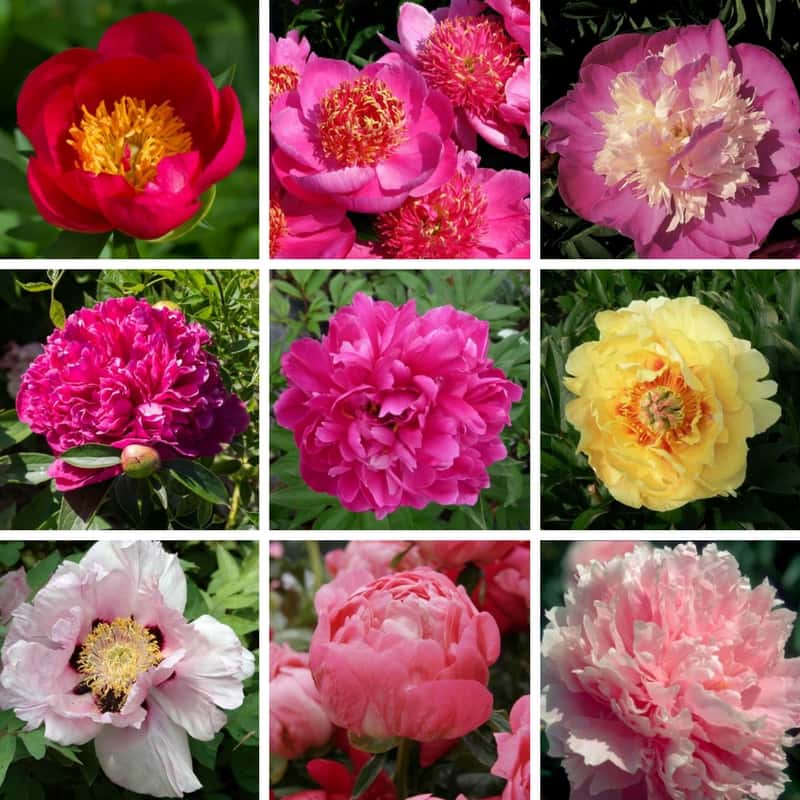
From left to right and top to bottom: Paeonia ‘Flame’ - Paeonia lactiflora ‘Neon’ - Paeonia ‘Gay Paree’ - Paeonia lactiflora ‘Felix Crousse’ - Paeonia lactiflora ‘Karl Rosenfield’ - Paeonia itoh ‘Garden Treasure’ - Paeonia ‘Lilac’ - Paeonia ‘Coral Sunset’ - Paeonia ‘Sarah Bernardt’
FRAGRANT FLOWERS
Peonies are renowned for their fragrance. They are famous in perfumery for their scents reminiscent of rose or lily of the valley. However, not all of them are fragrant! Generally, double-flowered peonies are more aromatic than single-flowered ones, but there are many exceptions. Among the varieties with the most remarkable fragrance are: ‘Myrtle Gentry’, ‘Alice Crousse’, ‘White Cap’, ‘Duchesse de Nemours’, and ‘Alice Harding’.
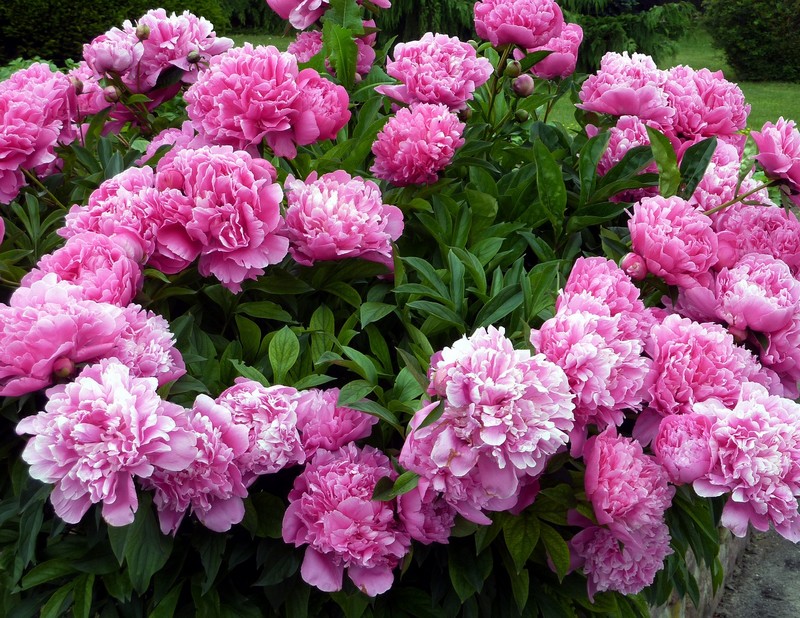
By the way, my ancestor's peony smells divine! When I sense rain approaching, I pick a bouquet to enjoy the flowers and their fragrance in the house.
WHERE DO PEONIES THRIVE?
The hardiness of peonies is no myth! They are not afraid of the cold and, with a few exceptions, they grow wild at altitudes where frosts are common. At worst, a few branches may suffer, but they will regrow beautifully the following spring. However, late frosts can impact flowering. I experienced this issue this spring, with frosts in May while the buds of my Paeonia delavayi var. lutea were already well-formed. Sheltered near a wall, most of its buds turned black, and a few survivors produced somewhat deformed flowers. In the rest of the garden, the herbaceous peonies simply did not bloom.
Choosing the right location is key to successful planting. Peonies thrive in the sun, otherwise, flowering may suffer. However, the ideal exposure varies depending on your geographical location. In Mediterranean regions, it is better to avoid full sun in the early afternoon. An east or southeast exposure is preferable. Similarly, in areas where late frosts are common (like mine in the Ardennes), prefer a west exposure to prevent the first rays of morning sun from causing too rapid a thaw, which can affect the quality of flowering. Elsewhere, full sun exposure is recommended. Note that a minimum of half a day of sun is necessary for good flowering.
Remember that peonies dislike waterlogged soils, so it is important to plant them in well-drained soil. In my clay soil, I have added plenty of humus (homemade compost, horse manure... an 8-year-old vintage from my farmer neighbours), as well as wood chips over the years to improve the soil. You can also add gravel or pumice at the bottom of the planting hole. These are greedy plants that do not appreciate competition. Mix good quality compost or well-decomposed manure into the planting soil. Be careful not to bury them too deeply: 2 to 3 cm of soil should cover the buds, no more! Finally, they do not like being moved, so choose the location of your new acquisition carefully; otherwise, it may sulk for 2 or 3 years before blooming again.
After that, maintenance consists of removing dead wood and dry or damaged parts when the buds start to swell in late winter for the shrub types, and simply cleaning the dry parts in March for the herbaceous types. A piece of cake!
TIPS FOR GOOD FLOWERING
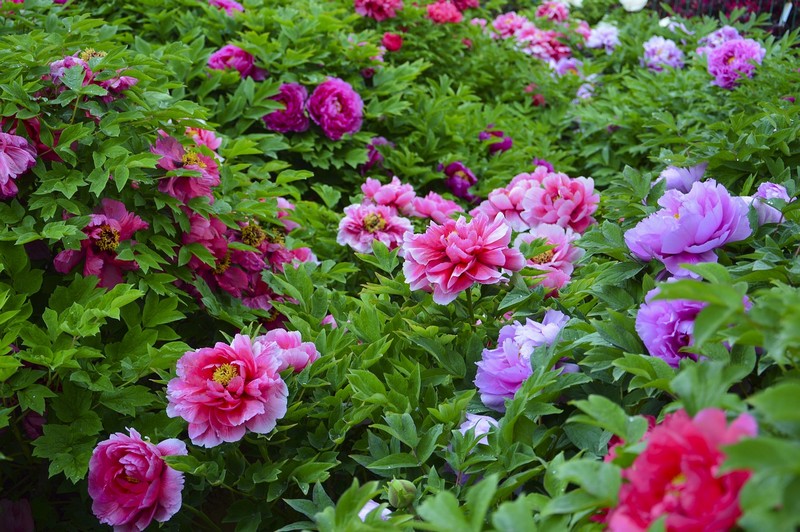
The first flowering of herbaceous peonies can occur between the first and third year after planting. This depends on the size of the plant. If it has one root and one eye, it will easily take three years to bloom. However, if it has four to five roots with three or four well-swollen eyes, there is a good chance it will bloom in the first spring if planted under good conditions.
The same goes for shrub peonies, but the probability of flowering is slightly lower in the first two years.
An application of humus is necessary every autumn. I spread a good amount of well-decomposed manure all around the plant. Then I bury it in the following spring during weeding. Peonies appreciate a potash boost that encourages flowering. However, be aware that nitrogen should be limited as it weakens the foliage and promotes the development of botrytis. Choose a fertiliser accordingly, or do as I do, a bit of wood ash each spring, and you're good to go!
Some peonies with fragile stems and particularly heavy flowers need support. This comes in the form of a metal circle with stakes to drive into the ground. Once the foliage develops, the device is completely hidden. It's simple and effective!
SUCCESSFUL PAIRINGS
Peonies lend themselves well to planting in borders or mixed beds. I find them wonderful with smaller flowers that highlight them, such as Cirsium rivulare ‘Atropurpureum’ or hardy geraniums, but also with irises, lupins, Centaurea montana, poppies, roses, alchemilla, delphiniums, alliums, and anthemis for an English garden, romantically appealing, or even with colourful foliage, particularly the purple of Sambucus nigra ‘Black Beauty’ or ‘Black Lace’.
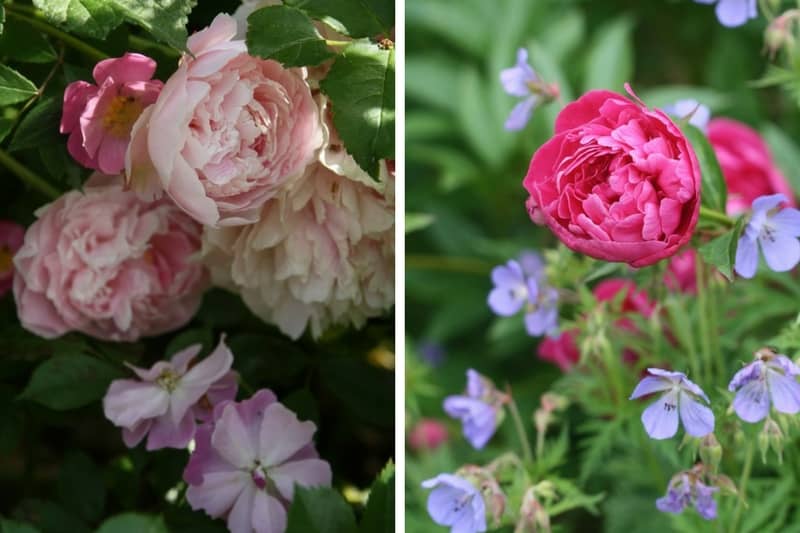
Paeonia lactiflora 'Sarah Bernardt' with the rose 'Lavender Dream' - Paeonia lactiflora from my ancestor with the Geranium pratense 'Mrs Kendall Clark'[/caption>
In my garden, the peonies ‘Bowl of Beauty’, ‘Springfield’, and ‘Do Tell’ are always very much admired by my visitors. They are surrounded by a variety of hardy geraniums, creating a very natural tableau.
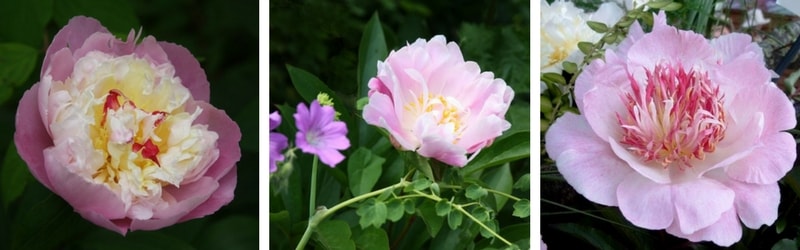 From left to right: Paeonia lactiflora 'Bowl of Beauty' - Paeonia lactiflora 'Springfield' - Paeonia lactiflora 'Do Tell'
And you, tell me, what are your favourite peonies?
Peony or Paeonia continues to enchant us with its large flowers in various shapes and colours. This is what makes it so charming! Its generous flowering in spring is accompanied by great ease of cultivation, excellent hardiness, and good resistance to diseases… not to mention that some varieties are delightfully fragrant. It is a beauty […]
Light grows lower and shadows lengthen, mornings are wrapped in mist and the damp in the air makes us shiver gently when stepping outside... as Sophie rightly pointed out, no doubt about it, autumn is here! In the garden, opulent blooms of perennials slowly give way to autumn colours of trees and shrubs... All perennials? No! A few stubborn autumn-flowering plants refuse to give up the limelight: the persistence of these late-flowering perennials won't yield until first hard frosts, and some may hold centre stage throughout October and even until late November in the best years.
In my medium-sized garden (700 m²), these perennials that extend the season are particularly precious for keeping borders attractive all year round, because I cannot afford to plant many trees and shrubs with coloured autumn foliage or even ornamental berry-bearing shrubs. Discover my top 5 late-flowering perennials every garden should have!
1) Cimicifugas
Certainly, they take up a bit of room and while their culture is not particularly difficult, they are not always easy to please. In my garden, they struggle with repeated summer droughts, which are not rare even in the far north! They are nevertheless superb when offered a good, humus-bearing soil that does not dry out too much in summer, in dappled shade beneath large trees, and even in sun so long as the soil stays cool. For the grace of its spikes of white flowers as much as for the delicacy of its sweet scent, I persist in keeping Cimicifuga or Actaea 'White Pearl' in good shape each summer with generous watering using collected rainwater. It therefore ranks among oldest plants in my garden (planted long before I was old enough to have a driving licence to roam nursery aisles on my own!). In my garden, it starts flowering late September to early October and finishes around All Saints' Day. Some may prefer purple-leaved varieties such as 'Atropurpurea', 'Brunette', 'James Compton' or 'Pink Spike' with vaguely pink spikes, but I like the elegance of its apple-green foliage when it emerges in spring far too much to want another!
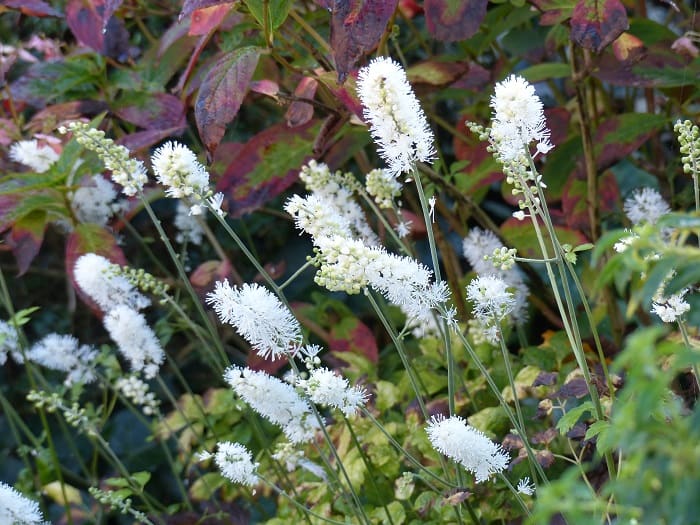
2) Japanese anemones
And above all one of them, the indomitable 'Honorine Jobert'. Its flowering starts in August, reaches its peak in September and will not stop before the end of the month. Still going strong some 140 years after its discovery by nurseryman Lemoine of Nancy, this venerable Lady of the garden recovers much better from dry spells than my Cimicifuga! Given to me by a fellow enthusiast years ago, I could no longer imagine my garden without this plant. Among its cousins, some flower earlier, from July–August, but then they do not last quite as long into autumn. If you prefer pink, do look at 'September Charm', 'Pamina' or 'Prinz Heinrich' for a shorter habit.
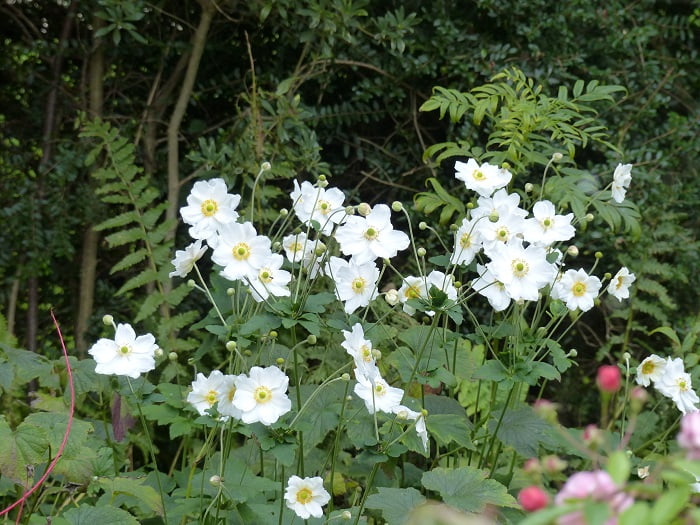
3) Asters
There are countless varieties and by collecting them one can easily have asters in flower from March to November. As I do not have the space required for that obsession (though the desire is certainly there!), I make do with a few well-placed clumps in strategic positions in beds where they take over from summer-flowering perennials. I have set aside the New England hybrids, too tall for my beds, but could not do without Aster ericoides such as 'Pink Star' and even less without the rarer Aster ageratoides 'Ezo Murasaki' with its seemingly endless flowering. Besides, those two are never sick! In shade, I once had Aster divaricatus that I probably unfairly pulled out at some point to replace with a rarity that did not last. That was probably a mistake I will have to put right one day!
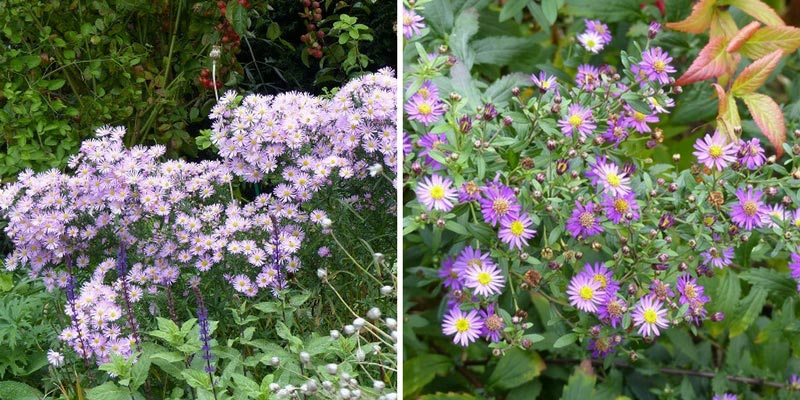
4) Fuchsia magellanica
Shrub or perennial, that is not the point... These hardy fuchsias that form real hedges in Ireland and Brittany are truly hardy and when frost is severe they regrow from the crown, their flowering then starting just a little later (late July). Once again, it is one of the very first plants I grew and I still keep the original stock of Fuchsia magellanica 'Ricartonii' from my grandmother. Fuchsias still suffer from that "grandmother's plant" image, which is highly unfair given the qualities of these shrubby perennials: hardy and easy to grow in sun or shade, they ask for almost nothing in return for their generous, elegant flowering. As icing on the cake, golden-leaved ('Aurea') and variegated ('Versicolor') forms exist. I also found at Saint-Jean-de-Beauregard the rare white and variegated form called 'Sharpitor'. If you dislike the characteristic pink-and-purple contrast, you can always opt for Fuchsia magellanica var. molinae, with pale pink-white flowers, and its variant 'Hawkshead' with pure white flowers tinged green at the tips. Tireless, only cold can halt their flowering!
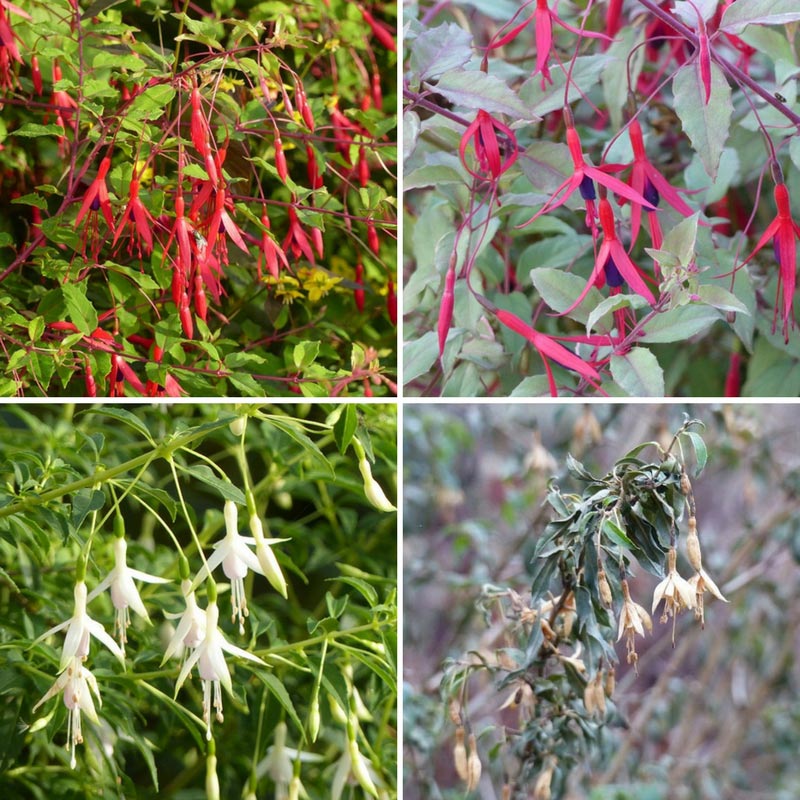
5) Persicarias
Having late flowering in a small garden is good, having long AND late flowering is even better! And that's precisely what persicarias (Persicaria amplexicaulis, formerly Polygonum) bring. Graphic, colourful spikes appear from July for the earliest varieties, and nothing can stop them thereafter! If they spread too much, you can cut them back as often as you like and they will come back all the stronger. I have seen them thrive in poor sandy soils, in dry chalky soils as well as in heavy clay. In short, they are foolproof and I love them all and there will certainly be one to suit you too! If you struggle to choose, I would still recommend 'Blackfield' deep claret-red, 'Alba' white and very free-flowering, 'Firedance' with more orange tones, 'Inverleith' which stays dwarf, and 'Rosea' old-rose, as among the best. New varieties appear regularly and are also well worth trying.
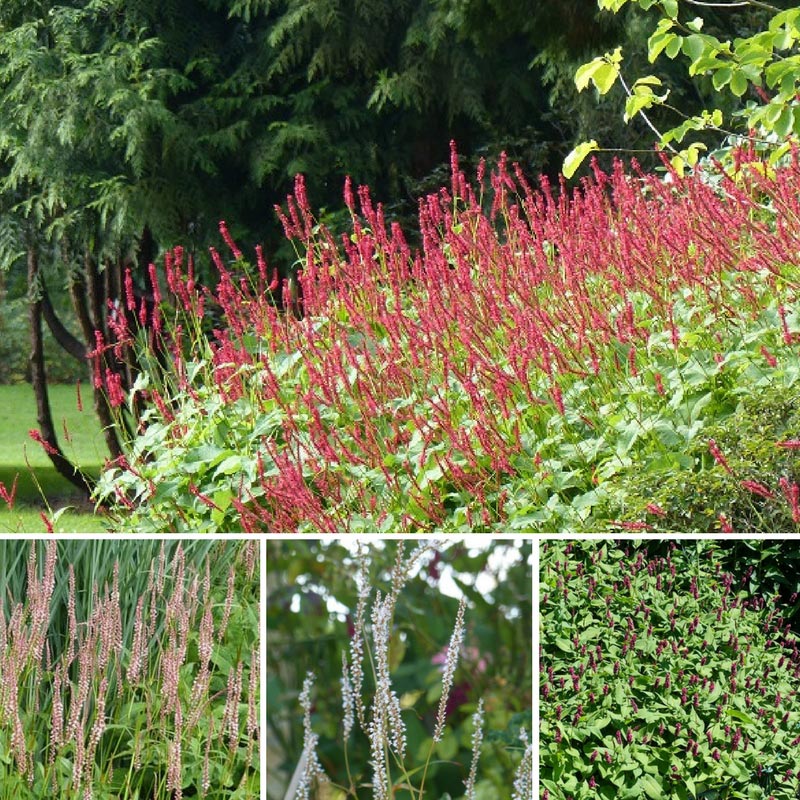
...Bonus: Diamond grass
Which modern, serious gardener can still make a garden without ornamental grasses? Almost all are beautiful in autumn, and even beyond, enhanced by mist, hoar frost and low-angle light, but if one stands out it is the famous "diamond grass" (Calamagrostis brachytricha), queen of autumn grasses. Its panicles appear only in September and show superb iridescent shades under autumn sunrays that look like diamond sparkles. At 70–80 cm tall and able to grow in any soil, in sun or shade, it remains a plant too little known yet foolproof.
True, I could also have told you about a Miscanthus, but its autumn colours would have competed with those of the shrubs! 😉
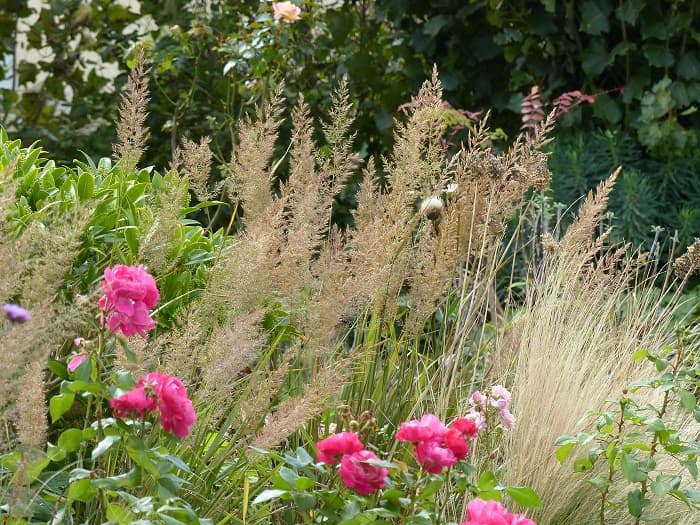
Light grows lower and shadows lengthen, mornings are wrapped in mist and the damp in the air makes us shiver gently when stepping outside… as Sophie rightly pointed out, no doubt about it, autumn is here! In the garden, opulent blooms of perennials slowly give way to autumn colours of trees and shrubs… All perennials? […]
We are approaching the end of the summer holidays, and many of us enjoy spending time by the Mediterranean... Holidays that are, of course, always too short! This frustrating phenomenon is something we strive to counter by giving our homes a touch of the Mediterranean! Whether it’s an antique pot, a small dry stone wall, an olive tree, a palm tree, a oleander, bougainvillea, an agave, and other "Mediterranean plants" whose mere mention brings us back to warmth and relaxation...
But what exactly is a "Mediterranean plant"? Is it a plant that grows spontaneously around the Mediterranean? A plant that thrives in a Mediterranean climate? A plant that has been produced in the Mediterranean basin? Let’s try to clarify...
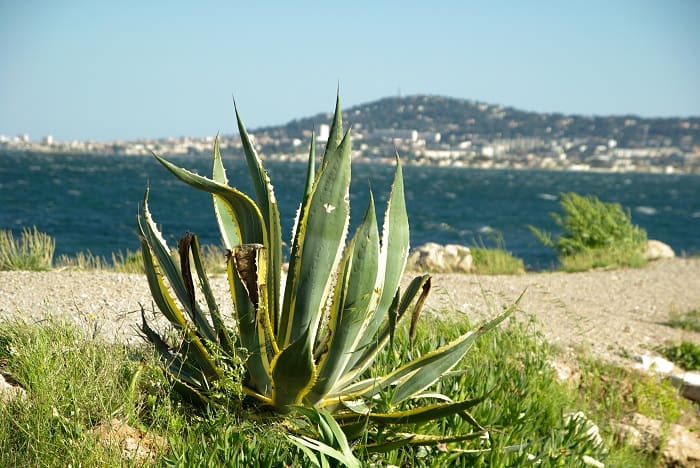
The Mediterranean climate that we cherish is primarily characterised by warm, dry summers that are very sunny, alternating with mild, wet winters. It is a temperate climate, with well-defined seasons. Rainfall is infrequent and highly concentrated, particularly in autumn. In summer, precipitation is less than soil evaporation and the consumption of living beings, leading to a water deficit for which Mediterranean plants have had to develop avoidance strategies. Finally, let’s not forget the wind, with the mistral and tramontane rivaling the famous north wind we are more accustomed to at Promesse de Fleurs!
.JPG)
This type of climate leads to two other significant phenomena for the Mediterranean natural environment: a high pressure from human activities and numerous outbreaks of fire, as sadly highlighted by current events. Lastly, the poor, well-draining soils, whether acidic or calcareous, are always low in nitrogen and potassium, often supporting only low and sparse vegetation, particularly in the garrigues. But there is a silver lining! These strong constraints generate a diversity that is all the more significant, with the number of plant species in the Mediterranean reaching 22,500, of which just over half are endemic, meaning they are only found in that specific location on the globe. This provides a first element of answer to our question, "What is a Mediterranean plant?".
Among these species of Mediterranean plants, there are many annuals that bloom and die before or after the dry summer period, bulbs that take refuge underground, and a whole range of so-called "sclerophyllous" vegetation, meaning plants with tough enough leaves to prevent rapid water loss. In particular, there are evergreen oaks, cork oaks, kermes oaks, olive trees, of course, but also oleanders and conifers like pines and cypresses. Note that they compensate for their slowed activity in summer by the persistence of their foliage in winter, which makes them particularly appreciated in gardens. Others have the opposite strategy and lose their leaves to survive during drought.

We must also mention the special cases of aromatic plants, such as lavenders, thymes, rosemaries, sages, hyssops, myrtles... which release volatile compounds, the essential oils, limiting water loss. Some cistus, like Cistus ladanifer, use the same technique, in addition to having a very deep taproot system. The velvety leaves, even downright cottony, of Stachys or Ballotta, are also a very effective barrier against water loss, which has been exploited for a long time in drought-free gardens. Brooms, on the other hand, simply have no leaves... And of course, nothing prevents plants from combining protections!

However, we have not yet discussed palms, mimosas, or even prickly pears, agaves, bougainvilleas, oranges, pittosporum, and all the others that populate our holiday memories on the Côte d'Azur! These plants, which have perfectly acclimatised to the Mediterranean zone, to the point of sometimes becoming invasive, are not native to there: we must therefore look for their origins elsewhere.
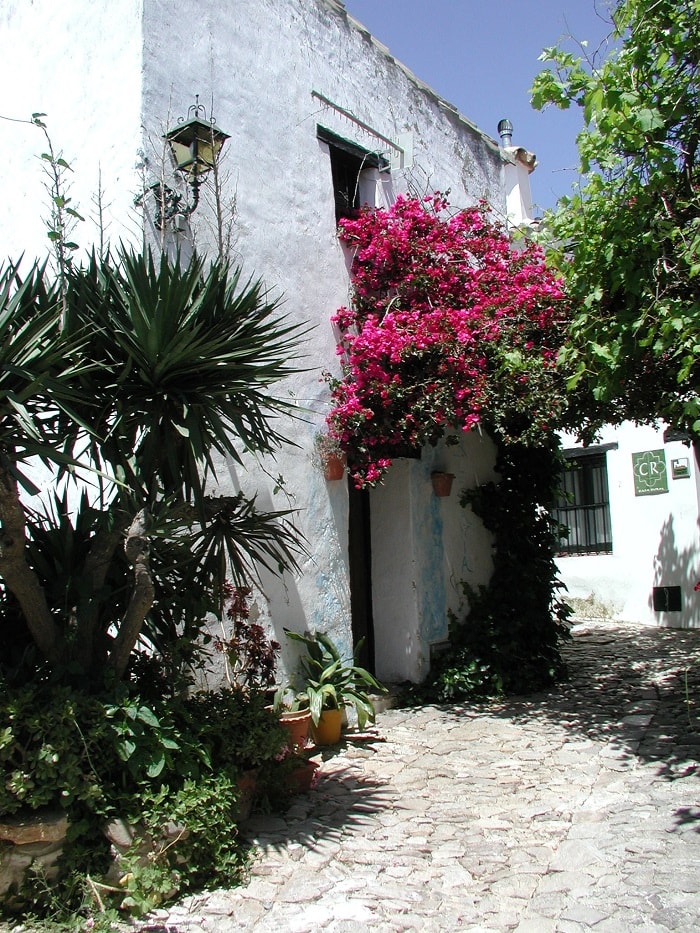
Indeed, while the Mediterranean region has given its name to its climate, it should not be inferred that the Mediterranean climate only exists around our beloved Mediterranean Sea! Similar conditions can be found in four other regions of the world:
- California
- central Chile
- South Africa
- southern Australia
Located on the western sides of continents, at latitudes between 30° and 45°, these temperate warm zones influenced by westerly winds correspond to the transition between subtropical and temperate climates in general.

From South Africa originate many Ericaceae and Proteaceae, well adapted to poor soils (the Proteaceae have a particular root system known as "proteoid" consisting of numerous short, closely spaced rootlets that are thought to improve nutrient solubility by altering the soil environment in which they grow). Highly sought after for cut flowers (Banksia, Protea) and for the production of flowering potted plants (the Cape heather, for example, which is found at All Saints), these plant genera are rarely encountered in our gardens, whether Mediterranean or not, due to their very delicate growing conditions.
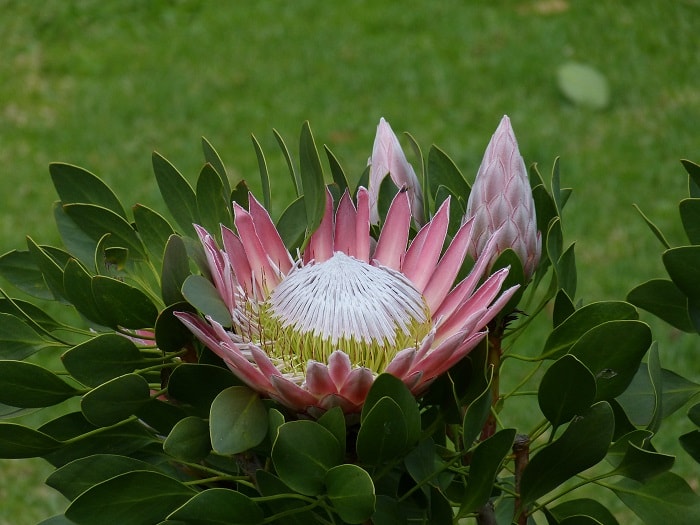
In reality, outside of collections, we cultivate very few plants in Europe that originate from the "other" Mediterranean climates. Thus, we must look even further for the origins of "Mediterranean plants" in the sense of the collective and horticultural imagination, which is ultimately what matters when creating a garden.

The mimosa (Acacia dealbata) is native to the east of Australia, an oceanic climate zone, and was introduced in France in the mid-19th century. It has remarkably naturalised since on the Côte d'Azur, just like the Pittosporum tobira, which is also cultivated for its foliage, native to the subtropical climates of Japan and Korea. Other plants commonly found in Mediterranean gardens come from desert-type climates, such as agaves, yuccas, and cacti. With the exception of 2 species out of 2,500 (!), palms are not native to the Mediterranean but to tropical and subtropical climates, just like the citrus trees that thrive in the mild Mediterranean climate but must be irrigated in summer. The spectacular bougainvilleas originate from the humid tropical forests of South America!
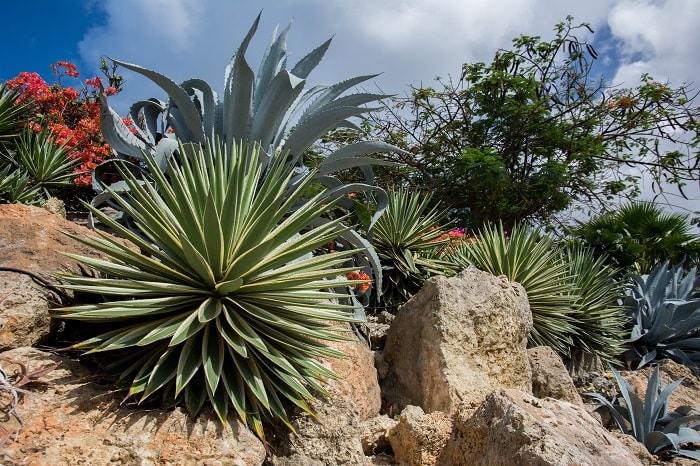
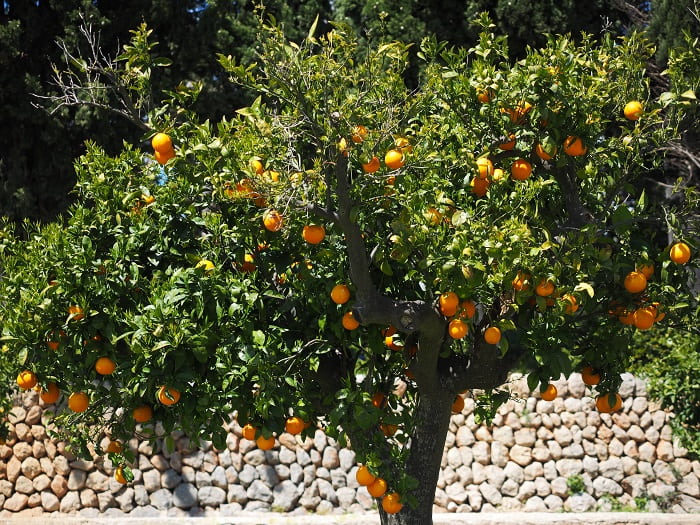
Thus, it is important to highlight the contrast between the image of the Mediterranean nature, vibrant in spring, much more subdued in summer, which corresponds to a long period of near-dormancy for the plants, and the image one might have of the Mediterranean garden, which is much more lush but is mainly composed of exotic plants that require watering in summer! In practical terms, the term "Mediterranean plant" thus means both everything and nothing, as it mixes botanical and cultural aspects! Caution is therefore advised for the gardener...
Plants that grow in the Mediterranean in nature are quite hardy (often down to -10°C to -12°C) and adapt easily in gardens throughout the rest of France, provided the soil is very well drained, even calcareous, and that a fairly sheltered spot from frost is chosen for planting; they grow easily without irrigation, which is why they are increasingly being planted. Many are so familiar to us that we easily forget their Mediterranean origins, as is the case with aromatics. Conversely, plants that grow in the Mediterranean in gardens can equally be called "Mediterranean" as the former, but they are nonetheless exotic, more frost-sensitive, and should be reserved for pot cultivation in a conservatory or on the terrace in summer where they can be regularly watered and wintered in a sheltered spot.

We are approaching the end of the summer holidays, and many of us enjoy spending time by the Mediterranean… Holidays that are, of course, always too short! This frustrating phenomenon is something we strive to counter by giving our homes a touch of the Mediterranean! Whether it’s an antique pot, a small dry stone wall, […]
Sowing hollyhock seeds is an easy activity that requires no special skill to succeed. When they do not reseed here and there at the foot of country house facades or along the bucolic paths of Île de Ré, hollyhocks can be sown easily in pots or broadcast directly, provided they are sown at the right time — that is, now!
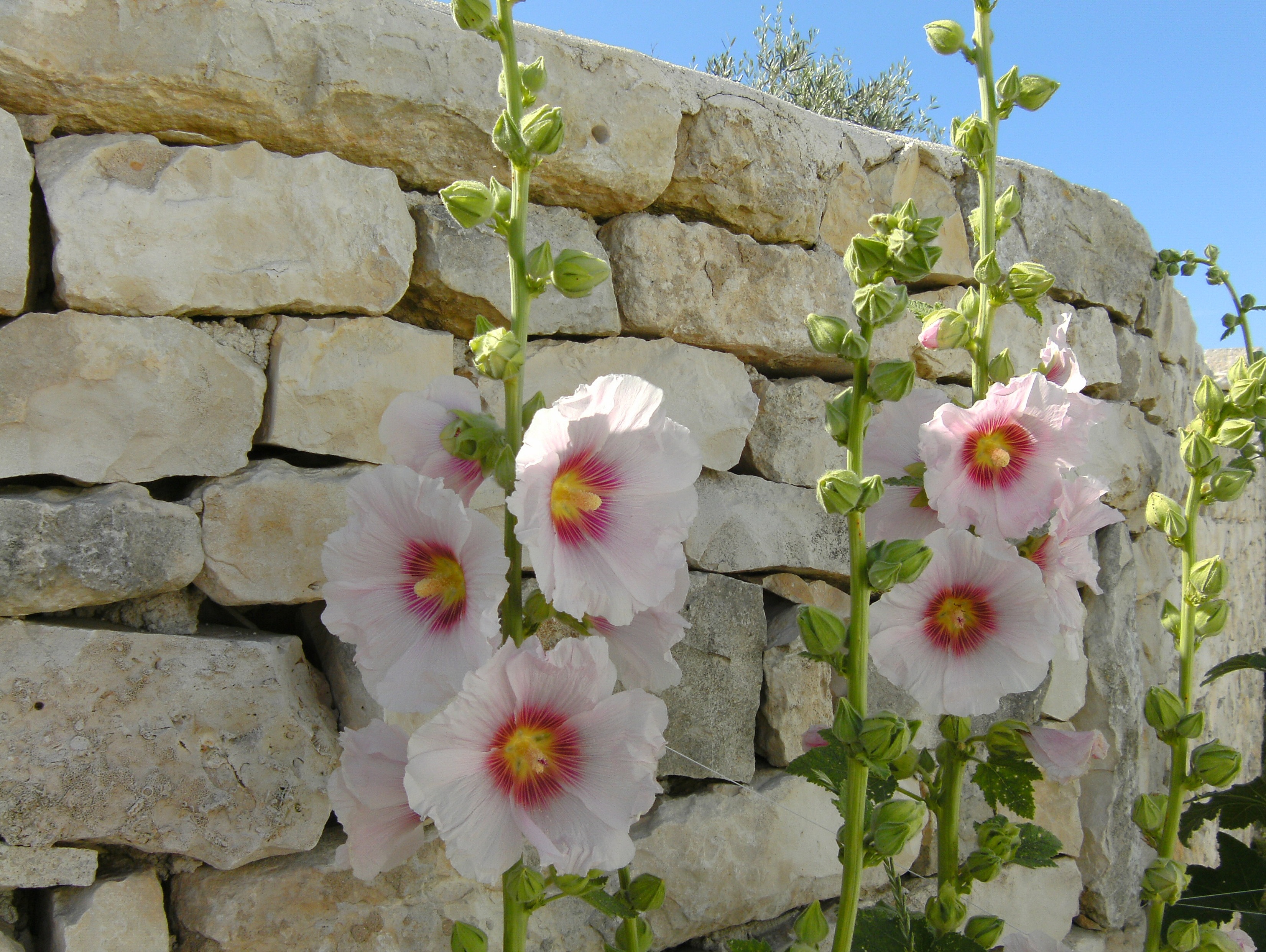
When to sow hollyhocks ?
Hollyhock seeds need plenty of heat and light to germinate, which is why it is important to sow them in summer to ensure rapid, even germination. Sow from late spring through mid-summer when the soil is warm enough and daytime temperatures exceed 20°C.
How to sow?
If you only have a few seeds of a selected variety, it is better to sow in pots or seed trays to give plants the best chance:
- Choose a seed tray or a large, deep pot (hollyhocks have long roots and therefore need plenty of depth).
- Add a seed compost or prepare a mix of one third fine potting compost, one third vermiculite (or perlite) and one third fine sand.
- Fill the tray, firm the surface and place the seeds on top.
- Cover the seeds with a thin layer of compost then water thoroughly.
- Place the tray in partial shade and keep the compost moist until germination.
Pot on seedlings 3–4 weeks after germination, when plants have four true leaves.
If, however, you have a large quantity of seeds collected from the garden, you can sow them directly in the ground.
- Choose a sunny, open spot, for example a path border.
- Broadcast the seeds over deep, stony or slightly sandy soil.
Germination will be less even, but the seedlings, whose roots can descend deeply, will produce flowering stems much taller than those sown in pots and then transplanted.
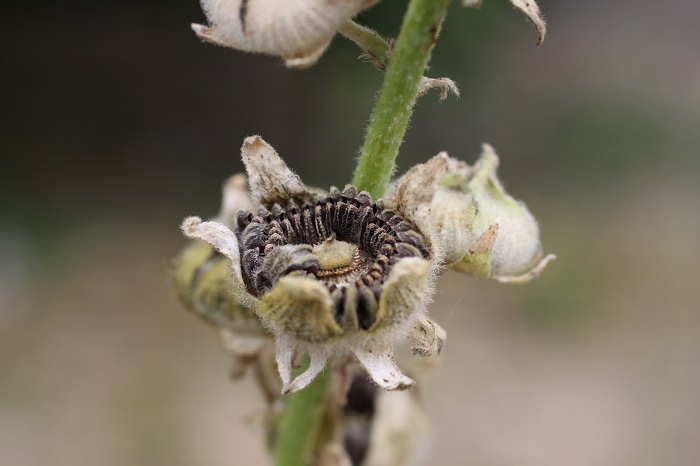
Sowing hollyhock seeds is an easy activity that requires no special skill to succeed. When they do not reseed here and there at the foot of country house facades or along the bucolic paths of Île de Ré, hollyhocks can be sown easily in pots or broadcast directly, provided they are sown at the right […]
All gardeners know foxgloves (Digitalis purpurea), sometimes called "Lady's Gloves" because of the shape of their flowers. They send up long spikes towards the sky, so laden with little bells they bend their backs. These lovely biennials self-seed abundantly wherever the wind takes them… But who knows their perennial cousins? I must confess I have a soft spot for the latter, particularly for two of them.
In my garden these varieties have returned faithfully for several years, spreading slowly and some are even sterile, which removes any risk of volunteer seedlings. To grow them successfully, plant preferably in partial shade, although they can do perfectly well in sun as long as the soil stays cool. Their flowering will charm you for years and will bring verticality and harmony from late spring. I would add that the evergreen foliage of these foxgloves is spared the voracity of garden slugs and that their flowers are a true cornucopia for pollinators!
So, without further ado, I invite you to meet my favourite perennial foxgloves.
1) Digitalis lutea and 'Glory of Roundway' : slender and graceful
The foxglove ‘Glory of Roundway’ is a wild beauty that attracts my visitors' admiration with its charming apricot-pink bells. Trying to be economical, I had planted only one pot at the time, which I later regretted because it really spreads slowly. So I recommend planting it in groups of at least three if you want a good clump quickly. It is a sterile hybrid obtained from the no less delicate Digitalis lutea with similar inflorescences but soft yellow. The latter will need to be staked because of the slenderness of its tall stems.
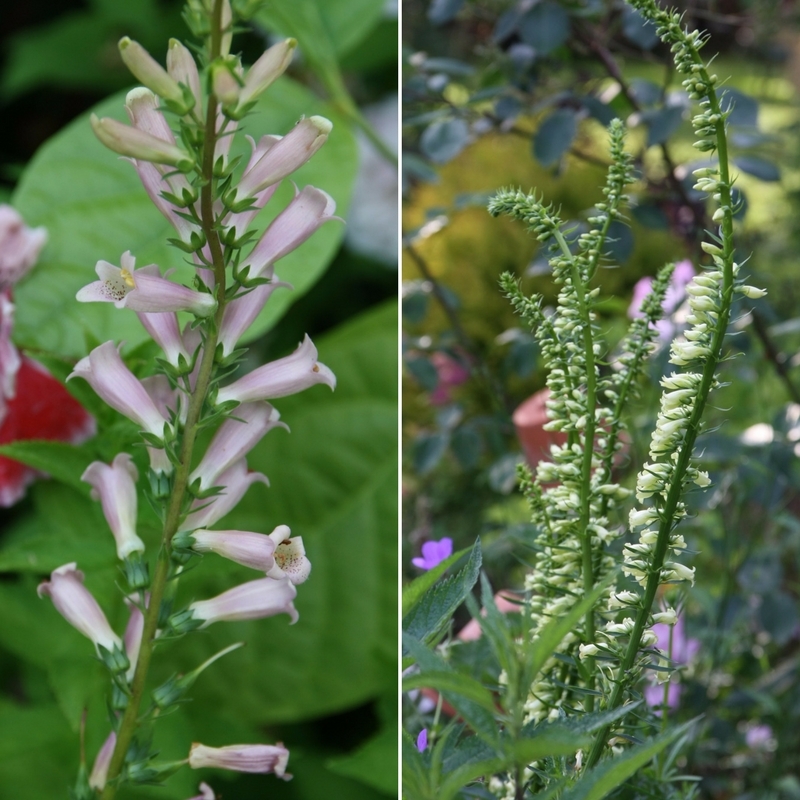
Digitalis 'Glory of Roundway' and lutea
Loyal companions for years and fabulous partners for the queen of flowers, these two varieties bring the lightness and elegance I cannot do without in my natural garden. The generous lutea self-seeds a little to my great pleasure. Finally, and not least, it tolerates some lime in the soil. Isn't that wonderful? Undoubtedly, they are my favourites.
2) Digitalis grandiflora ‘Carillon’ : dwarf and compact
Placed at the front of a border, Digitalis grandiflora ‘Carillon’ is absolutely delightful with its fresh butter hue. I love pairing yellow and white, whether among foliage or between flowers and even both. Especially as it is a combination that works wonders in shady corners. Paired with Geum rivale and blue-leaved hostas like ‘Halcyon’, on a carpet of Lysimachia nummularia ‘Aurea’, the combination is divine! This small foxglove, with its stocky habit, requires no support. It is also a perfect candidate for small gardens. So don't miss out!
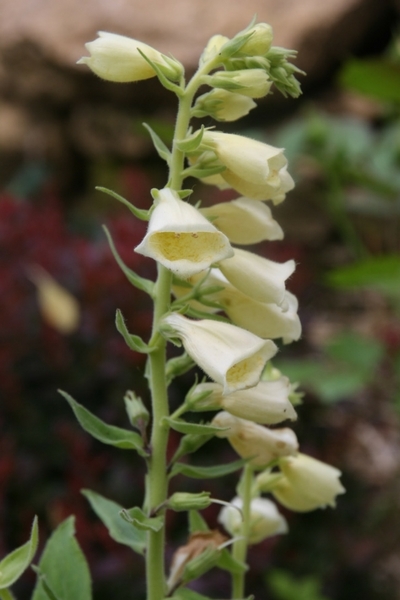
Digitalis grandiflora 'Carillon'
3) Digitalis mertonensis : an uncommon colour
Digitalis mertonensis offers flowers in a pretty old-rose shade. Plump, they are noticeable from afar. Its stems are robust and need no support. In my garden it is well surrounded: a carpet of Pulmonaria ‘Mrs Moon’ brightens the corner while awaiting its beautiful flowering, which will be accompanied by purple heucheras and hardy geraniums. Persicaria amplexicaulis ‘Rosea’ and Aster ‘Ezo Murasaki’ will then take over.
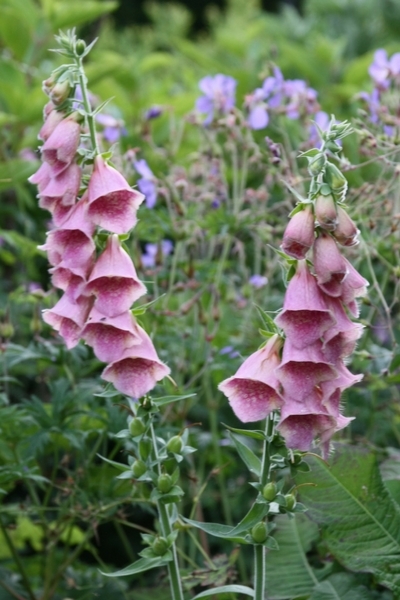
Digitalis mertonensis
4) Digitalis ferruginea : the originality of a giant
Perfectly at ease in sun, the incredible Digitalis ferruginea or rust-coloured foxglove always surprises with its verticality (1.80 m tall — nothing less). Up close, it is the shape of its flowers, with very marked, hairy lower lips, and its uncommon yellow-brown colour that catch the eye. More summer-flowering, it blooms later than other foxgloves, prolonging the pleasure. Planted in drifts, it creates a splendid effect, especially under the low rays of an evening. Accompany it with Echinacea purpurea, Angelica gigas and other summer beauties!
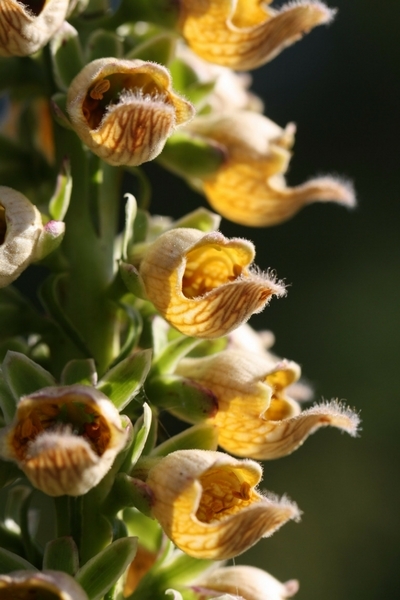
Digitalis ferruginea ‘Gelber Herold’
These latter foxgloves are considered short-lived perennials but they self-seed (if conditions suit them), which allows them to always keep their little place in the garden. However, for this to happen you must not cut the flower spikes as soon as flowering has finished.
One more thing — do not move foxgloves, take my word for it, their taproot does not like it at all! Read between the lines: I've tried (several times even... because once is really not fun) and I regretted it.
Give verticality and originality to your gardens with these beautiful perennial foxgloves — you won't regret it!
All gardeners know foxgloves (Digitalis purpurea), sometimes called “Lady’s Gloves” because of the shape of their flowers. They send up long spikes towards the sky, so laden with little bells they bend their backs. These lovely biennials self-seed abundantly wherever the wind takes them… But who knows their perennial cousins? I must confess I have […]
Looking for an excellent, generous groundcover to brighten shade or partial shade from early spring? I have just the plant you need: lungwort. Or rather lungworts, as they come in many varieties offering a range of colours and distinctive foliage that will work wonders in your garden.
I have a soft spot for these handsome, undemanding perennials. Their early and abundant flowering is much appreciated by pollinators.
I should add that they are very hardy and do very well in my clay soil, which to me is particularly valuable. Admittedly they are not evergreen but their dense foliage remains in place for many months, making them ideal companions in a low-maintenance garden.
So today I present a few of the cultivars in my Ardennes garden that, I’m sure, will pique your interest.
1- A colourful array
Some cultivars display several shades on the same plant. This is the case with Pulmonaria saccharata ‘Mrs Moon’, whose bells shift from pink to pale blue as they open. The same phenomenon is seen in the delightful ‘Majesté’, which also boasts remarkable foliage. If you prefer white, no problem, ‘Sissinghurst White’ is for you! Or ‘Opal’ in a very pale blue, almost white. Conversely, if you want to introduce violet, you will no doubt be won over by contrast of ‘Diana Clare’. Or why not the purplish-pink of ‘Leopard’? There is something for every taste!
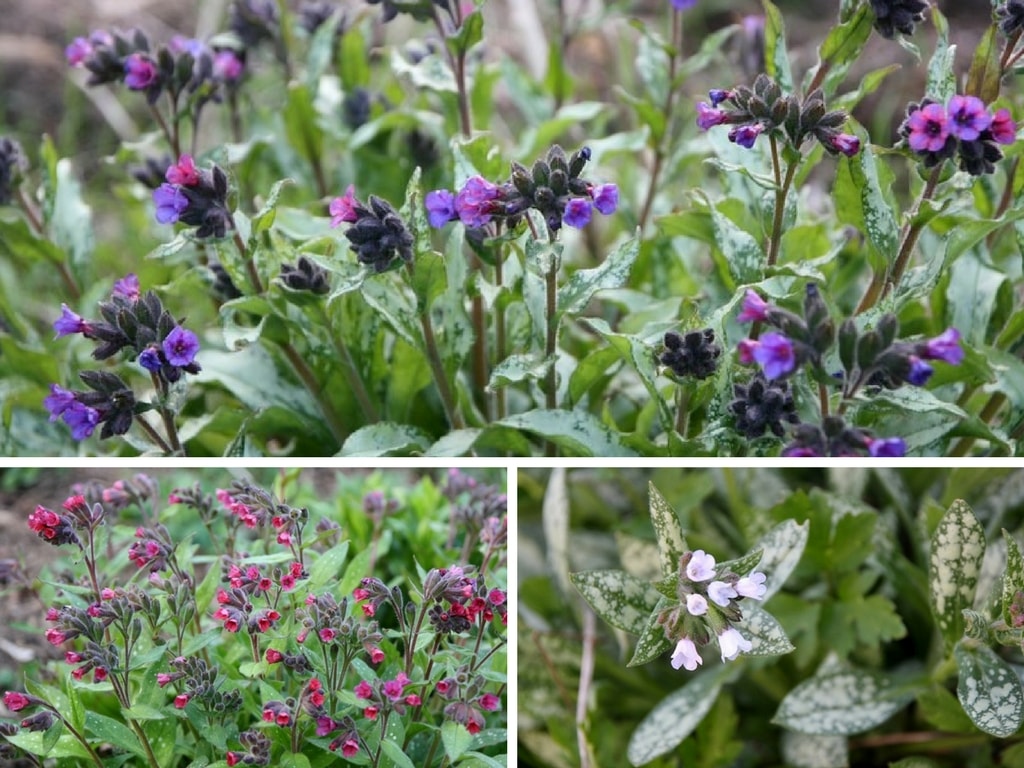
P. ‘Diana Clare’- P. ‘Leopard’ - P. ‘Opal’
2- Spotted foliage
Do you like to focus on foliage? It’s an excellent idea: foliage provides extra interest because it extends period of appeal. I increasingly plant species with interesting foliage, whether for shape, colour or texture. Among lungworts, some display admirable originality, while others favour a discreet charm that is equally appealing. This applies to majority of lungworts, whose leaf spots vary in prominence depending on species.
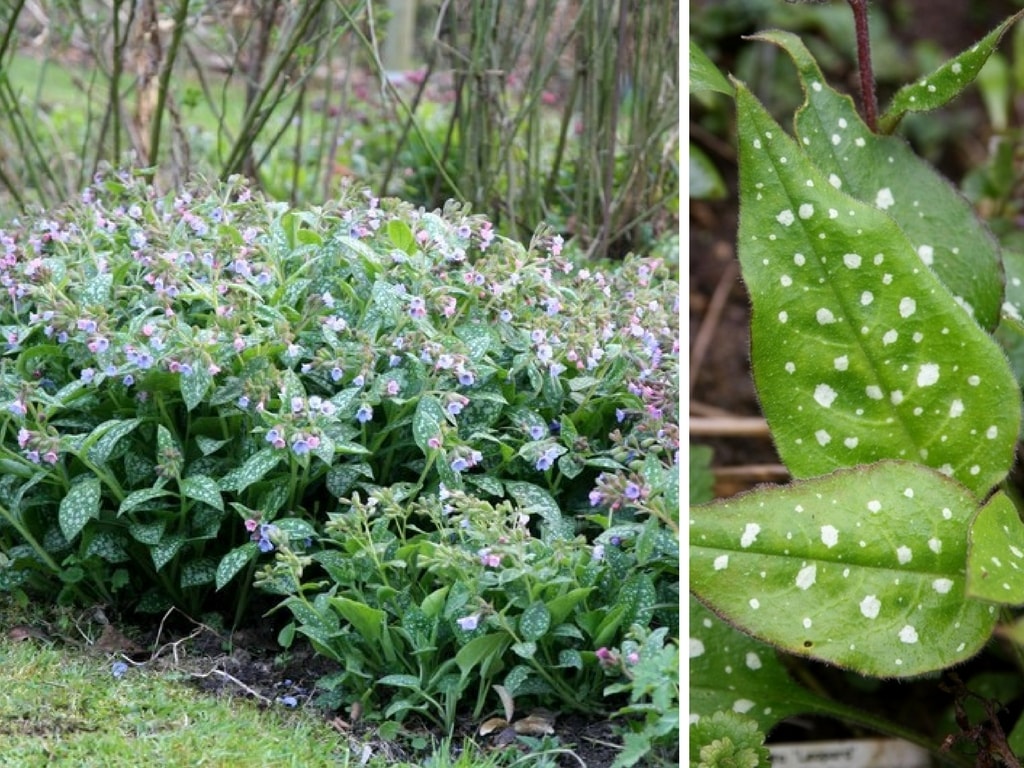
P. ‘Mrs Moon’ - P. ‘Leopard’
3- Elegance of silver foliage
It’s hard to miss those elegant silver leaves. ‘Majesté’ remains unrivalled and much admired. And rightly so! Its entirely silver foliage is most striking and its bells, pink with a hint of mauve, are delightful. It’s a real showstopper!
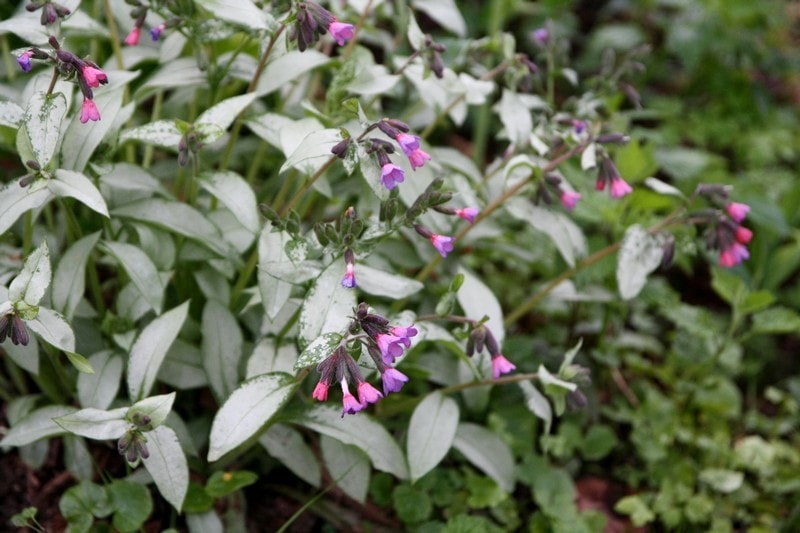
Pulmonaria angustifolia ‘Majesté’
I mentioned earlier the selection P. angustifolia ‘Diana Clare’ and its incredible violet flowering that stands out from afar. Its foliage, heavily inlaid with silver, is particularly striking.
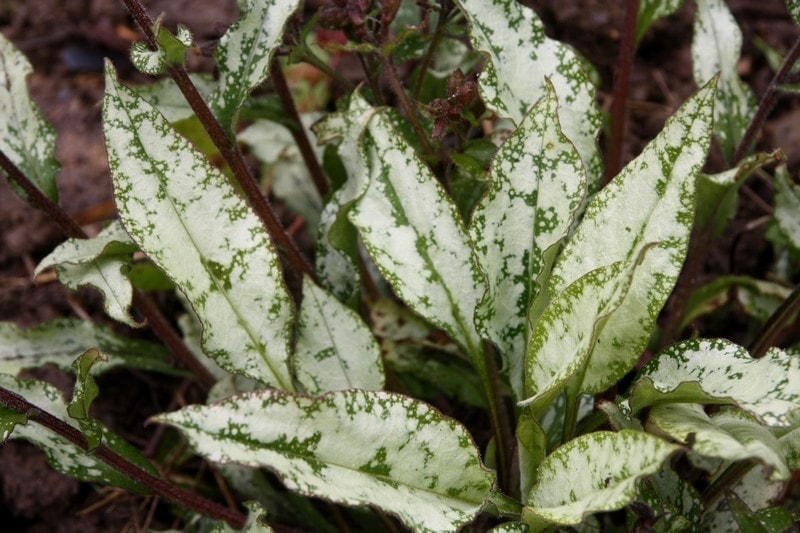
Pulmonaria angustifolia ‘Diane Clare’
As you’ll have gathered, I’m smitten and will certainly be adding more specimens to my garden. Given multitude of lungwort varieties to discover, I reckon this family will continue to surprise you.
Looking for an excellent, generous groundcover to brighten shade or partial shade from early spring? I have just the plant you need: lungwort. Or rather lungworts, as they come in many varieties offering a range of colours and distinctive foliage that will work wonders in your garden. I have a soft spot for these handsome, […]
Avens or Geum is a charming perennial that, for a time, fell out of favour. Was it because its old-fashioned name sounded too antique? Or because its modest stature and discreet character were easily overshadowed by louder plants?
Hard to know… Gardeners' moods and tastes can be changeable. Fortunately, here it is back in borders and in hearts.
If it hasn't won yours yet, here are good reasons to welcome it into your garden.
- Avens is sprightly, airy and utterly chic
Avens is a chic beauty, a little coquettish but without excess. Its flowers, single or double, with a natural look, are borne on tall, thin, supple stems. They come in a lovely range of colours, vivid or pastel, from butter yellow to red, often tinged with orange or pink. Its petals, sometimes slightly wavy, arrange themselves, skirt-like, around a delicate centre. Its toothed foliage provides a perfect setting and can even be an extra asset when it dons a golden dress, as with the sublime and 'Eos'.
- Avens flower from late spring into early summer… and sometimes even longer
It is a floriferous perennial that has the advantage of making an appearance when many other perennials are finishing or not yet in bloom. From late April through June, avens take over from early perennials and bridge the gap to early summer. Some varieties, like 'Totally Tangerine' (our customers' favourite this spring) are true champions, carrying their fruity orange for nearly five months!
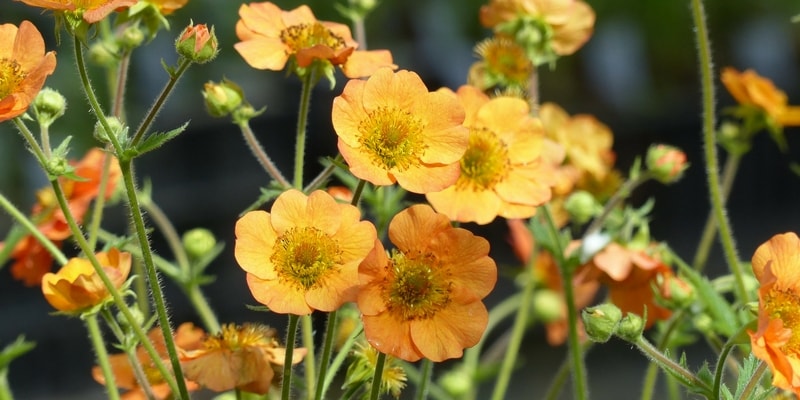
Geum 'Totally Tangerine', photographed in our greenhouses
- Geum slips in everywhere and pairs easily
Compact, Geum slips easily into a border, even a well-filled one. It pairs just as easily.
Yellow cultivars such as 'Banana Daiquiri' or 'Cocktail Gimlet' (to be enjoyed without moderation!) perfectly complement the flowering of blue hardy geraniums such as 'Spinners'.
The bright oranges pair, to great effect, with Allium aflatunense 'Purple Sensation' or sage 'Caradonna' to create dynamic combinations.
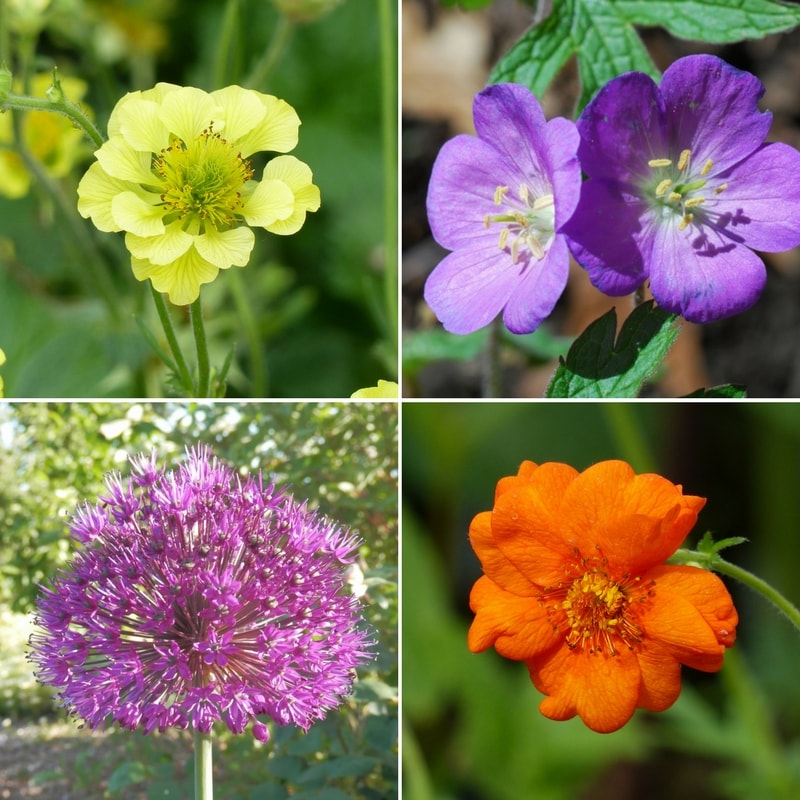
In a different, softer, tonal palette, 'Cosmopolitan', 'Mai Tai' and 'Flames of Passion' will also charm you with their subtle yet never bland colours.
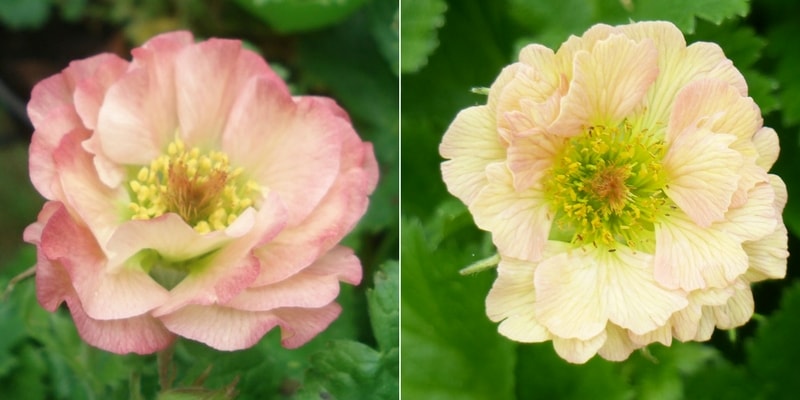
Geum 'Cosmopolitan' and 'Mai Tai'
Avens, of all colours, also get on well with columbines with whom they share a flair for frills… You can also plant them in a summer border with monardas, oxeye daisies or echinaceas that will take over at the end of their flowering. Note that Geum triflorum is perfect for a "prairie" style: once faded, its flowers turn into pretty pink, feathery egrets.
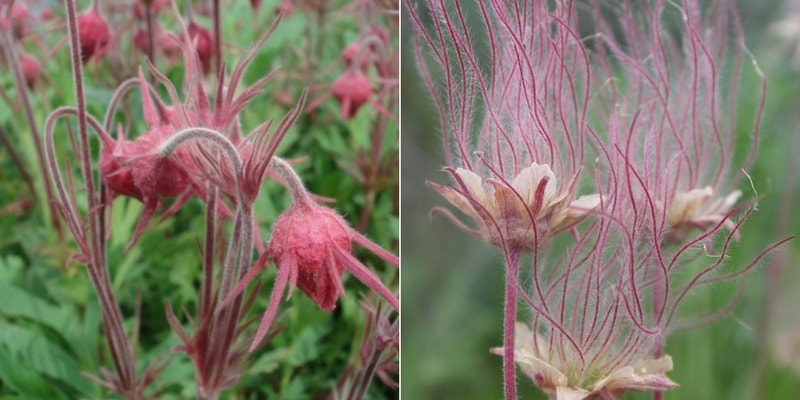
Geum triflorum and its pretty egrets (Photo: Matt Lavin)
-
They are easy to grow, even in rather damp soil
Geums grow in non-scorching sun or light shade, in good garden soil, preferably cool (in rather dry soil, a few waterings and a good mulch usually do the trick) and even in very wet soil for stream avens (G. rivale).
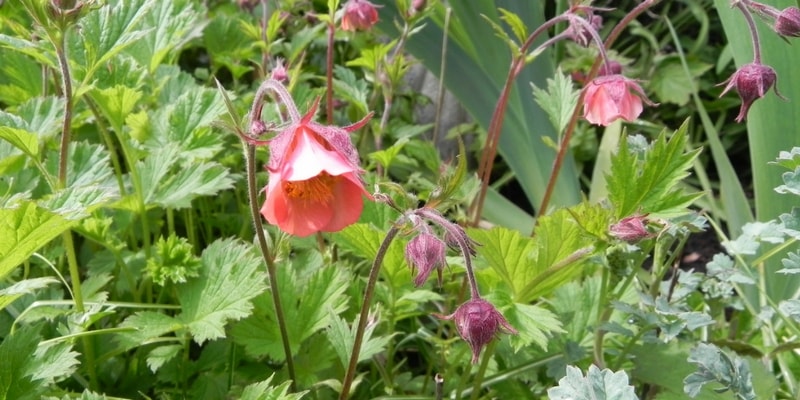
Geum rivale 'Leonard's variety'
Finally, know that they are hardy and reliable. What more could you ask?
And you, are you also a devotee of these lovely perennials? How far would you go to find a sought-after variety? Here, Pierre even brought some back from Bavaria… Who can top that?
Avens or Geum is a charming perennial that, for a time, fell out of favour. Was it because its old-fashioned name sounded too antique? Or because its modest stature and discreet character were easily overshadowed by louder plants? Hard to know… Gardeners’ moods and tastes can be changeable. Fortunately, here it is back in borders […]
In a garden, aromatic plants are often gathered in the same spot. This is convenient for harvesting, but one can also view things from another perspective. Indeed, the flowers and foliage of some of these plants are so ornamental that they integrate perfectly into flower beds.
A wide range is available to us: mints, fennel, rosemary, orach, chives, hyssop, oregano, sages, thyme, lavenders, sorrel, etc. Obviously, this list is not exhaustive. I would like to introduce you to my favourite plants and my preferred combinations.
1) Purple: the embodiment of elegance
Purple foliage brings elegance and originality to the garden. Notably, we can distinguish:
- The red orach (Atriplex hortensis rubra), perfect both in salads and in flower beds where it adds a lovely touch of whimsy. In the garden, it is ideal for creating dynamic colour reminders in the beds.
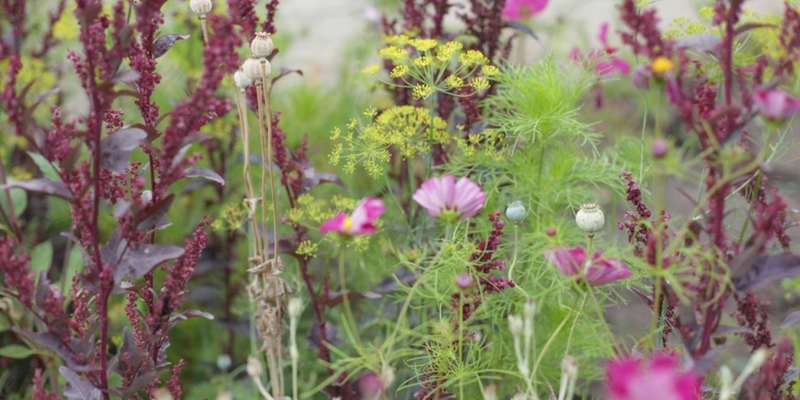
-
Some varieties of sorrel are equally impressive, just look: Rumex ‘Purpurea’ or Purple Sorrel with reddish-purple foliage and 'Sanguineus’ with green leaves veined in red are particularly attractive. In my garden, the latter pairs wonderfully with Heuchera 'Purple Petticoats' and Ajuga reptans ‘Black Scallop’.
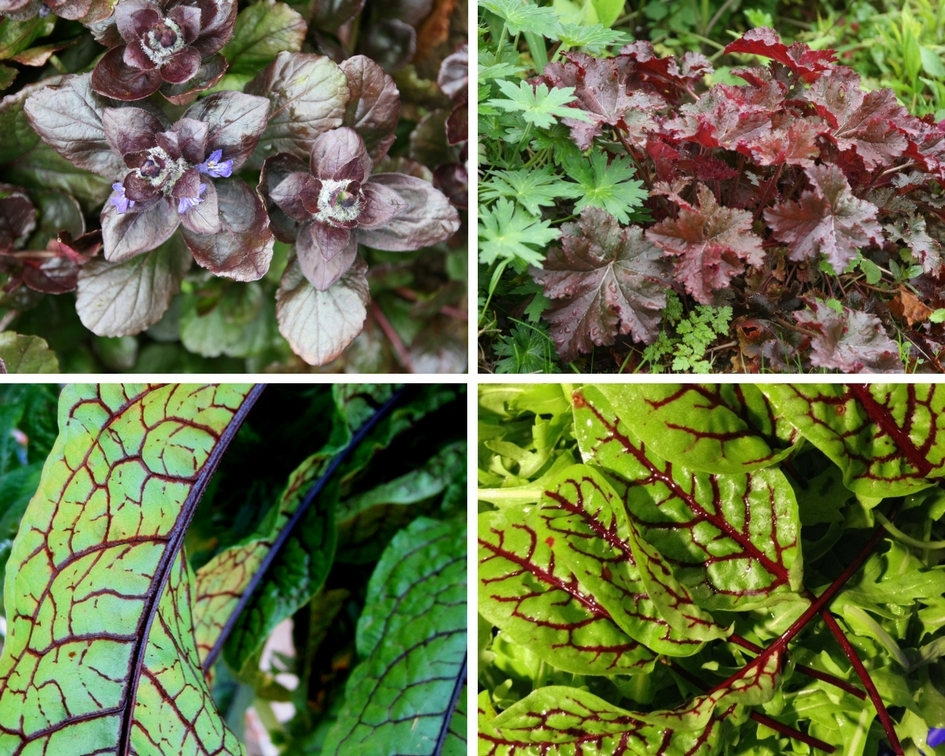
-
Medicinal sages exhibit various foliage variations. Salvia officinalis ‘Purpurescens’ stands out with its young shoots of a purplish hue. When paired with lavender and wormwood (‘Powis Castle’ for example), it creates a stunning effect.
2) Yellow and gold, perfect for breaking monotony
I really enjoy the vibrancy of yellow foliage. Some even flirt with fluorescence in spring, like that of the Golden Oregano or Origanum vulgare ‘Aureum’.
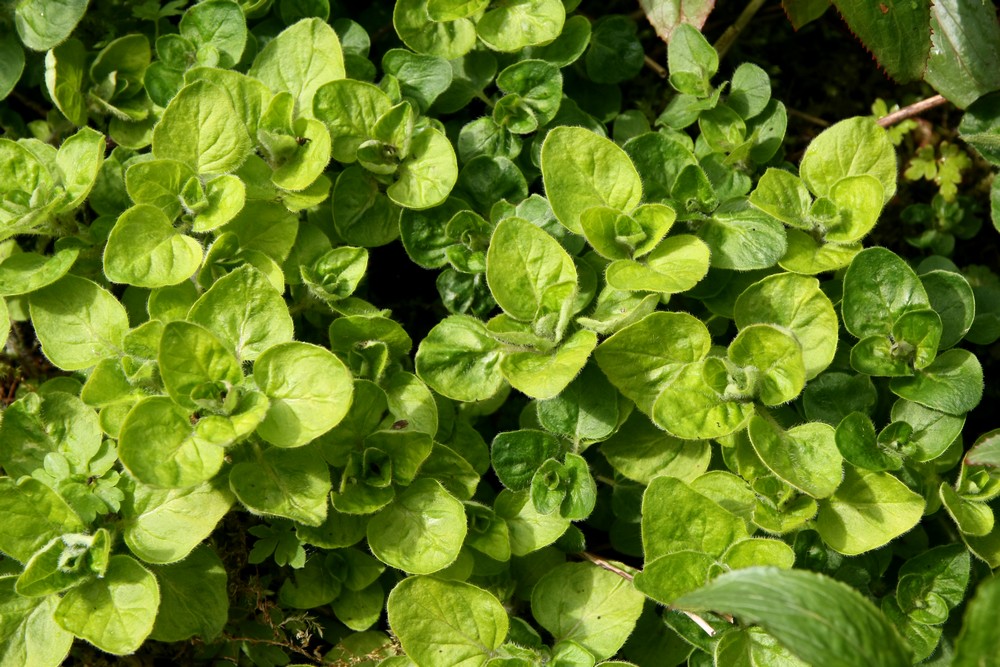
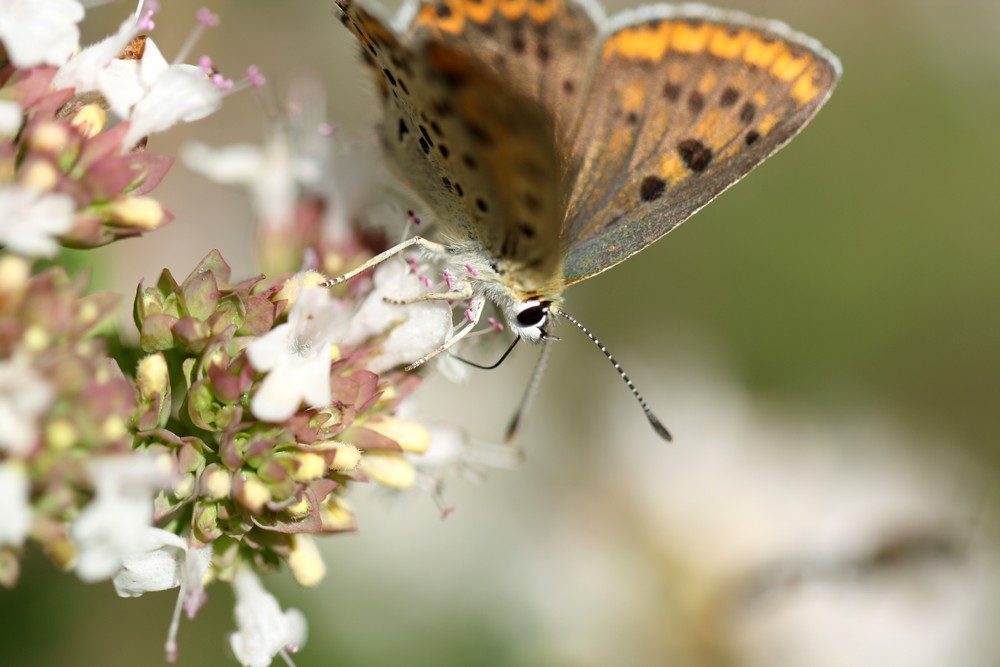
Note that although oregano is native to the Mediterranean basin, my Ardennes garden hosts both the standard species and the golden variety (in a clayey, poorly drained bed, and its hardiness somewhat challenged) and they thrive beautifully. They have even spread freely for years. Nature's ways are inscrutable! I would also add that the flowers are visited by many small butterflies.
In the same category, we find thyme, Thymus citriodorus ‘Aureus’. Its tiny golden leaves are a delight, complemented by a lovely lemony fragrance.
3) Bright variegateds
Among those that play the variegated card, we note the beautiful presence of Origanum vulgare ‘County Cream’ and Thymus microphylla ‘Variegata’ with cream-edged foliage.
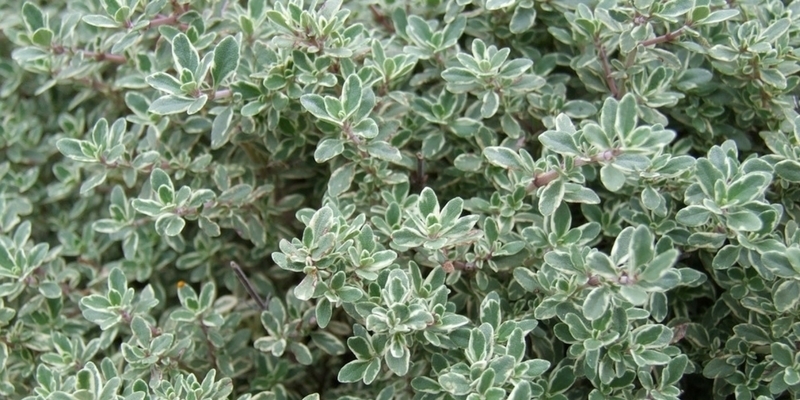
If you prefer yellow, you will be charmed by Thymus citriodorus ‘Variegated’, a variety of lemon thyme with small leaves, as well as by certain sages such as ‘Icterina’ with green leaves edged and variegated in yellow. Want more colour and contrast? Turn to Sage ‘Tricolor’ with foliage marginate in green, pink, and white, or to Mentha suaveolens ‘Variegata’ with beautiful white variegations on a green background.
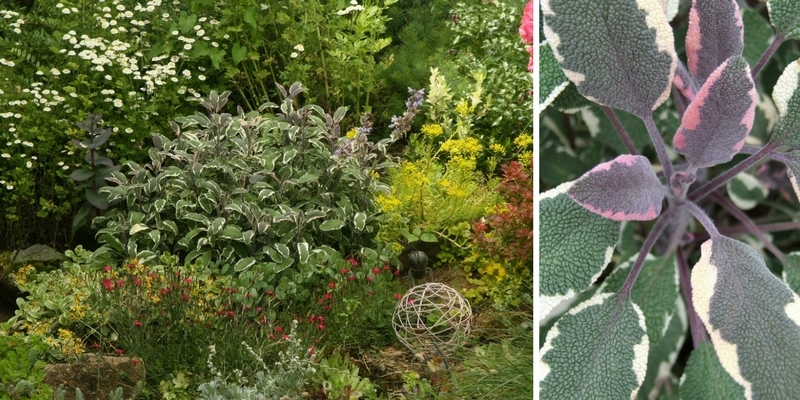
I know, mints have a bad reputation, and planting them in a flower bed might seem risky. They are known to be invasive, but they are merely wanderers. Equipped with their little bundles, they roam between plants, and young shoots emerge where there is space. In other words, if they have competition, they will be more docile. The choice is vast for this family, especially regarding the scents emanating from the leaves: green mint, Moroccan, peppermint, chocolate, bergamot, crisped, lemon... Don't deprive yourself!
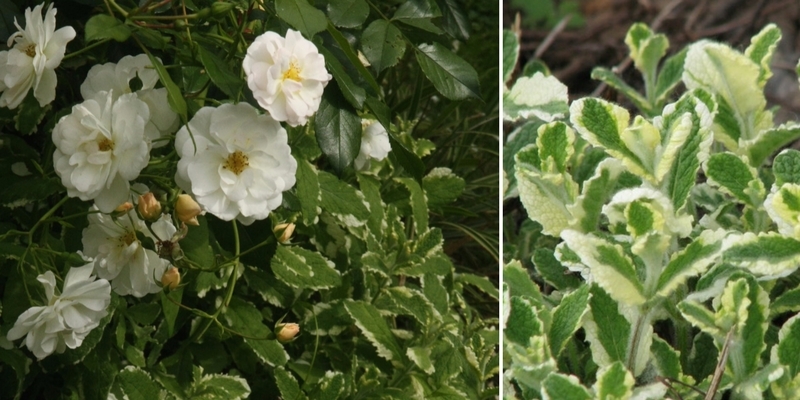
4) The greys, perfect for highlighting other plants
Santolines (Santolina chamaecyparissus) are distinguished by their fineness and the beautiful silver colour of their foliage. The variety ‘Edward Bowles’ offers an elegant grey-green combination and cream-white flowers that pair wonderfully with nepeta, stipa, white yarrow, and some Allium sphaerocephalon. Santoline flowers are also very melliferous. The tufts can be easily pruned into balls, providing structure in the garden.
5) Graphics for a touch of lightness
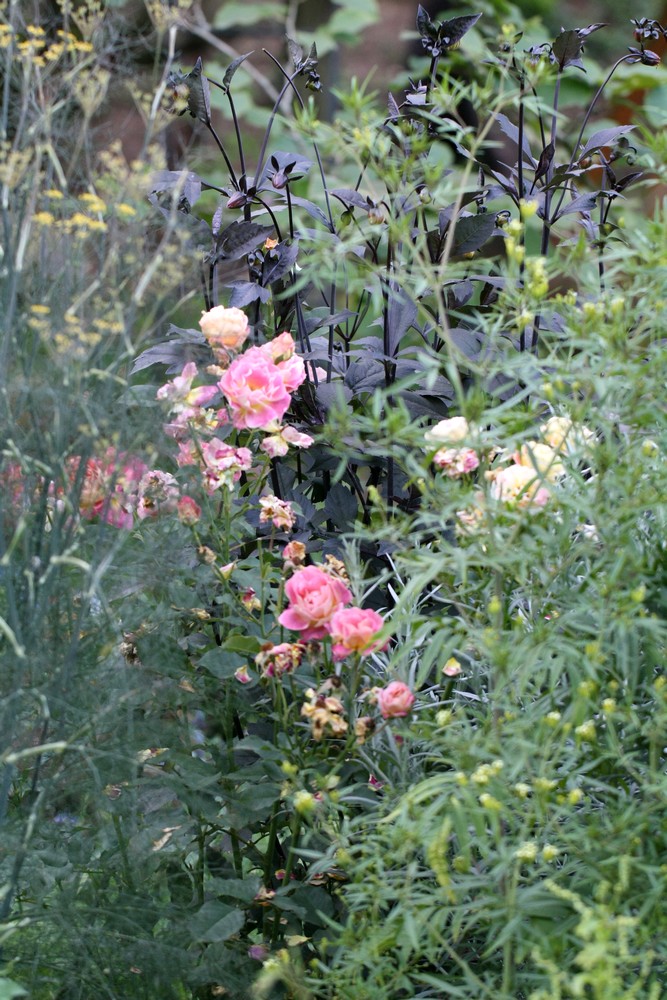
In life as in flower beds, we always need a bit of lightness. The green fennel (Foeniculum vulgare) or the bronze variety (Foeniculum vulgare ‘Giant Bronze’) form beautiful "mists". Their airy appearance is perfect for lightening a generous floral composition. Here, accompanied by the rose ‘Prieuré de Saint-Côme’, the dahlia ‘Twinings after Eight’, and Tagetes minuta.
Why not try it with Lysimachia purpurea ‘Beaujolais’ and the purple orach mentioned earlier: the union is divine as well.
Note that you will still need to choose them carefully based on the conditions you can offer them. It is evident that thyme, in clayey and poorly drained soil, will not last long, just as chives and parsley will struggle to thrive in dry soil. Pay attention to exposure as well! Finally, be aware that some of these aromatics are annuals but self-seed like orach, for example.
And you, do you grow any of these beautiful aromatics with atypical foliage or unique colourful inflorescences? Which are your favourites?
In a garden, aromatic plants are often gathered in the same spot. This is convenient for harvesting, but one can also view things from another perspective. Indeed, the flowers and foliage of some of these plants are so ornamental that they integrate perfectly into flower beds. A wide range is available to us: mints, fennel, […]
Agapanthus in pots require regular and appropriate care: watering, fertilising, and pruning are essential actions to ensure their beautiful and long-lasting graphic flowering. However, after a few years, they can become cramped and start to languish. Symptoms include: flowers becoming smaller and stems shorter, yellowing foliage that regenerates more slowly, a hollowing out of the centre of the rootstock, and more frequent watering becoming less effective... Once the diagnosis is made, it's time for surgery! With a knife and some elbow grease, in just 10 minutes, your agapanthus will be revitalised for another four years. When and how should you divide your agapanthus? We’ll tell you everything.

Agapanthus 'Pitchoune Blue', a compact variety suitable for pot cultivation (photo credit: Sapho)
Division should be done at the end of winter
Whether your agapanthus is deciduous or evergreen, it should be divided at the end of winter or the beginning of spring (ideally from March to April). The temperatures are still cool, the days are short, and the growth of evergreen agapanthus is slowed down, making it the optimal time to intervene. You might say, "it also works at the end of summer, from mid-August to early October when the plant is no longer producing flower stems!" That’s true, but the rootstock will need to heal during autumn and winter, when its vegetative activity is at its lowest, and that’s not ideal.
Carefully remove the plant and clean the roots
First, remove the plant from its pot. If the rootstock is very old and roots are protruding from the top of the pot, cut as many roots as possible that are coming out of the bottom of the pot, turn it upside down, and tap it several times to release the root ball. Be careful with terracotta pots, as they are more fragile than plastic pots and roots adhere more easily to the porous wall, so proceed with care. You can slide a long knife blade between the root ball and the pot to detach the roots from the wall. Once the rootstock is extracted, untangle as many roots as possible by hand. Cut away any old black roots and scrape off the old compost.
Cut at the heart and slice into 2, 3, 4...
Equip yourself with a long knife (ideally a bread knife) whose blade has been cleaned and disinfected beforehand. Then, cut into 2, 3, 4, 5... But be careful, if you want a plant that will flower again this year, divide the rootstock into 2 to avoid any stress. If, on the other hand, you want to replant in several pots, in the garden, and share with your neighbour, you can divide it into as many pieces as possible. As long as you cut and keep a piece of rootstock with a root, a rhizome, and a bud, you can produce enough to replant throughout the neighbourhood.
Repot immediately and water generously
Once the rootstock is cut in two, apply wood ash to promote healing and prevent rot. Then repot it immediately in the same pot, adding rich compost mixed with some slow-release fertiliser. Water generously and store your agapanthus in a cool, well-lit room. New leaves will quickly develop, followed later in the season by flower stems.
If you have divided a lot, repot the fragments of rootstock in a pot or a cell, cut the roots in half, and also trim the foliage of the evergreen varieties by half. Water and then closely monitor daily watering during hot weather. Your "babies" can be replanted after 5 to 7 weeks.
What not to do!
If, like me, you had the great foresight to plant your agapanthus in a beautiful bulbous pot... then don’t even try to remove it: it’s impossible! The mass of roots formed prevents the plant from coming out. What to do? Break that beautiful pot or sacrifice the plant? That’s more akin to butchery than division, but the best option is to slice the plant into small pieces to extract it from its pot. The lesson to be learned? Don’t plant directly in a bulbous pot, but in a straight horticultural pot, inserted into a bulbous pot!
Agapanthus in pots require regular and appropriate care: watering, fertilising, and pruning are essential actions to ensure their beautiful and long-lasting graphic flowering. However, after a few years, they can become cramped and start to languish. Symptoms include: flowers becoming smaller and stems shorter, yellowing foliage that regenerates more slowly, a hollowing out of the […]
A bank is, by definition, a sloped terrain exposed to the harshness of the elements where rain and wind weaken and erode the soil. If the soil remains bare, runoff can cause significant damage: flooding, landslides, and sometimes even mudslides. Fortunately, some groundcover plants thrive in these challenging conditions and manage to stabilise banks quickly and sustainably, thus limiting erosion. Discover the 5 best essential groundcover bushes for landscaping a bank!
On a rocky bank - Lavender (Lavandula angustifolia Hidcote)
Known primarily for its medicinal and melliferous properties, lavender is an outstanding plant for stabilising AND beautifying a bank. It withstands wind, sun, and drought, and its roots penetrate rocky and calcareous soils, stabilising them sustainably. It is the perfect plant for a stony, steep bank exposed to the sun.
Plant it at the top of the slope, which corresponds to the driest part. Count at least 3 plants per m² for dense and rapid coverage. While lavender lives long, it requires annual pruning to maintain a compact and sturdy habit, so don’t forget to shear it back by a third once the flowers have faded.
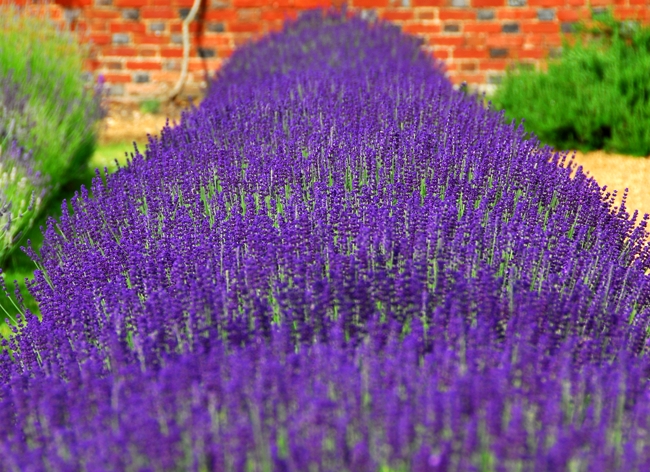 Lavender 'Hidcote Blue'
On an unmaintained bank - St. John's Wort (Hypericum calycinum)
St. John's Wort is a good soil stabiliser that tolerates all soil conditions but requires relative moisture to grow and spread quickly. You either love or hate its large golden flowers that bloom all summer, but one must acknowledge that it is one of the few groundcover bushes that spreads quickly and with great ease.
Plant it preferably at the bottom of a slope in full sun or partial shade. Count between 3 to 5 plants per m² (3 plants for 3L pots and 5 plants for young plants) for rapid coverage. By the following year after planting, its stump will form a network of stoloniferous roots and the plant will spread quickly. There’s no need to plant on a membrane; St. John's Wort covers and smothers everything in its path.
 Hypericum calycinum (Source Pinterest)
On a shady bank - Bush Honeysuckle (Lonicera pileata)
Bush honeysuckles (Lonicera pileata and L. nitida) are creeping shrubs that possess a very effective root system for consolidating banks in shade and partial shade. Lonicera pileata has the advantage of growing quickly and laterally, thus hugging the ground and layering itself from time to time. It resists cold and drought as long as it is planted in partial shade.
Plant it from the bottom to the top of a shaded bank. Count 1 to 3 plants per m², or even 4 plants per m² if they are in pots for very rapid coverage. As it ages, its branches will tend to rise, so be sure to shear it back annually with hedge trimmers.
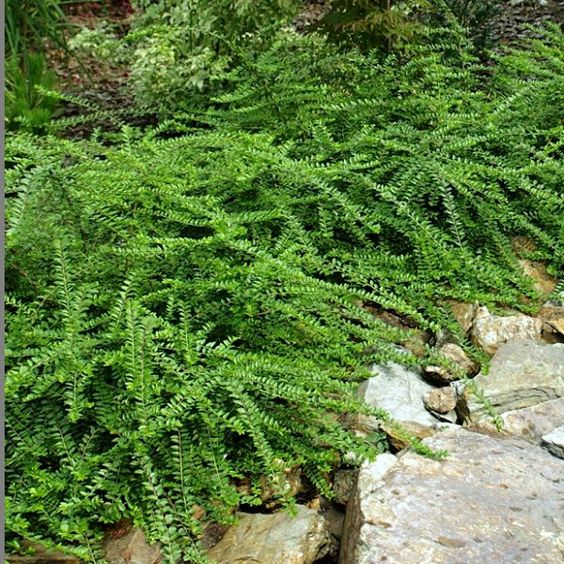 Lonicera pileata (Source Pinterest)
On a heavy and wet bank - Dogwood (Cornus stolonifera Flaviramea)
In heavy, sticky soil like freshly excavated clay from a construction site, decorative dogwoods (Cornus stolonifera, C. sericea, or C. Alba) thrive particularly well. They grow in all waterlogged soils and do not fear clay soils, unlike many groundcover shrubs.
Plant it at the bottom of a partially shaded or sunny bank. Count 1 to 3 plants per m² maximum for rapid coverage. After 3 years of planting, shear it back to 30 cm above the ground at the end of winter, both to obtain beautiful branches that will turn yellow the following winter and to prevent it from growing too tall. With age, Cornus stolonifera takes on a bushy form and loses its groundcover character that it exhibits when young.
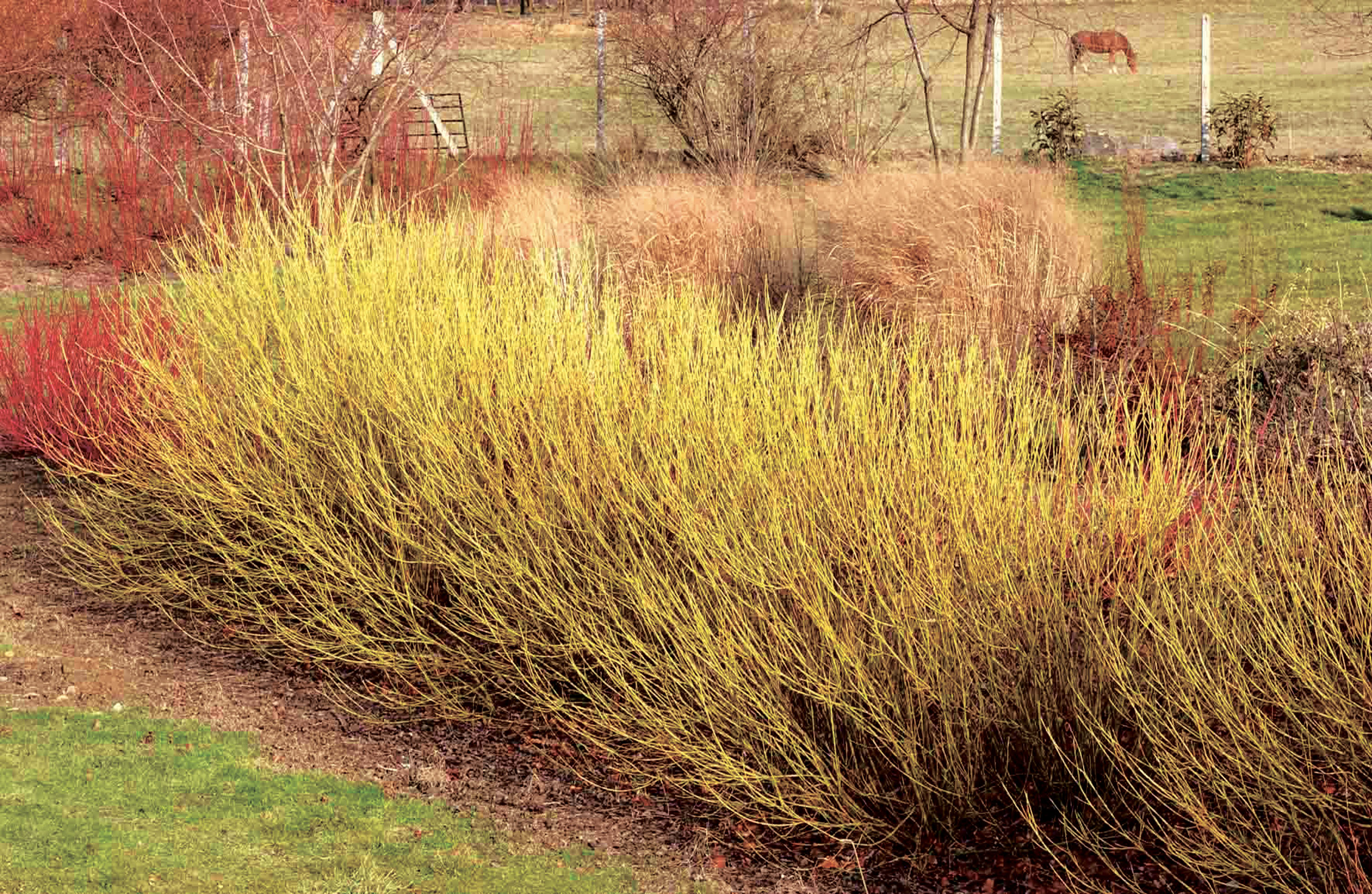 Cornus stolonifera Flaviramea
On a very steep bank - Groundcover Rose Emera
They are thought to be fragile and delicate, but roses have powerful roots that go deep into the ground and stabilise the terrain perfectly. Groundcover roses are favourites, particularly the Emera rose, for quickly covering a very steep terrain. This rose, both fast-growing, sturdy, and highly floriferous, can cover 1 m² within the first year of planting.
Plant it from the bottom to the top of a bank and count 1 to 2 plants per m² on average. During the first year of planting, monitor watering, especially in summer. While it grows quickly, the Emera rose requires water in its first year, particularly in summer, to establish its root system. Installing a membrane (preferably biodegradable) is essential on a very steep bank and will help the rose settle in more quickly.
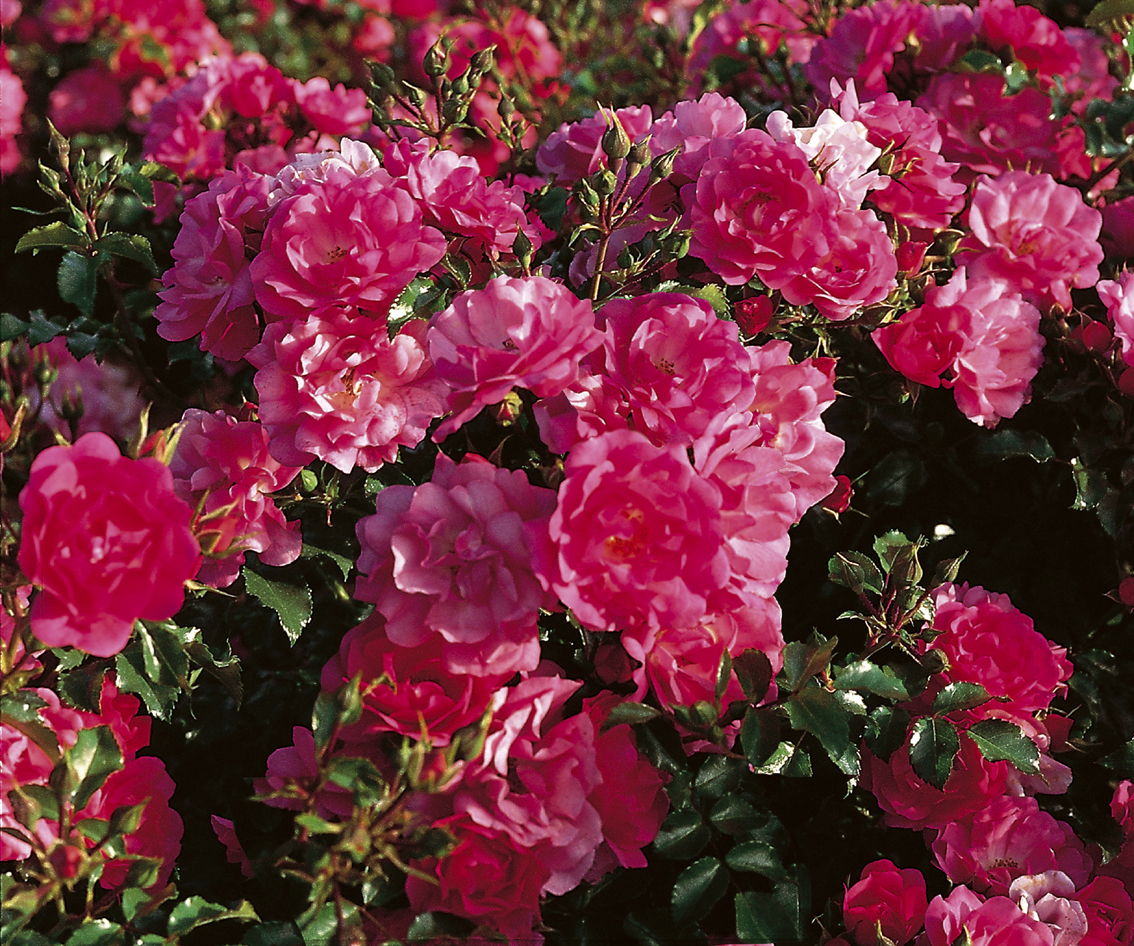 Rose Emera
A bank is, by definition, a sloped terrain exposed to the harshness of the elements where rain and wind weaken and erode the soil. If the soil remains bare, runoff can cause significant damage: flooding, landslides, and sometimes even mudslides. Fortunately, some groundcover plants thrive in these challenging conditions and manage to stabilise banks quickly […]
We are always on the lookout for THE perennial groundcover that blooms all summer long, the one whose flowering lasts for several months, the perennial that never stops blooming, the one that adorns and borders a path throughout the summer. The one that shines brightly on a sunny bank or simply the one that is adorned with flowers all summer in a pot on the terrace and blooms continuously until late autumn. Here are the 5 best long-flowering groundcover plants that you absolutely must have in your garden.
1) Delosperma 'Wow Hot Pink'
This is indeed a succulent similar to those that can be admired while strolling along the Atlantic coast, growing on dunes or at the foot of cliffs. The comparison stops there as Delosperma 'Hot Pink' is derived from a Japanese breeding called "Wheels of Wonder" and selected for its cold resistance and, of course, its long flowering. Are your perennials dying of thirst in summer? Plant Delosperma! Do your perennials wilt in summer due to drought? Plant Delosperma! This succulent groundcover has the merit of growing AND blooming throughout the summer. It flowers from June in warm regions and extends its flowering until the end of September. It doesn't care whether it rains or not to produce flowers; regardless of the weather, its flowering is uninterrupted for 4 months. If, like me, you have a sunny terrace and are not a fan of daily watering, plant Delosperma. If you have a sunny, stony, and dry bank, Delosperma is waiting for you.
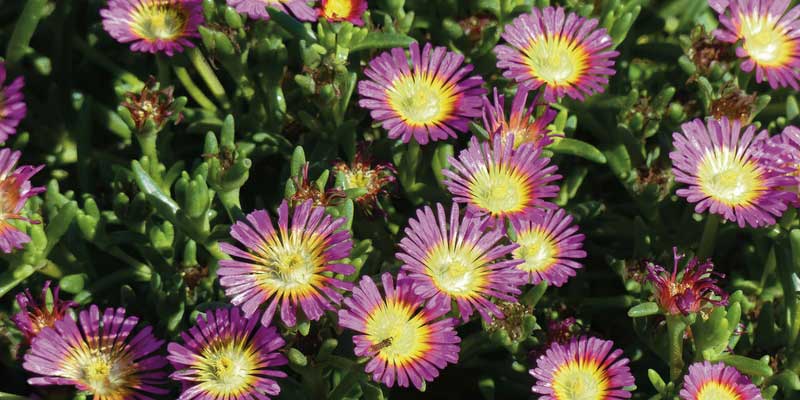 Delosperma Wheels of Wonder Hot Pink
2) Alchemilla mollis
This is THE classic of cool gardens, the essential and indestructible perennial that borders the most beautiful mixed borders with its round, plicate leaves that catch dew droplets in the early morning. It is this same perennial that blooms in an anise green mist that gracefully complements the precious flowers of bleeding hearts in spring or punctate campanulas in summer. Its flowering is long and its flowers succeed each other between spring and summer. They start in May and last until September-October. It will only be slowed down by the summer heat, but don't worry, a cut back of the flowers in summer gives it a boost and induces a resurgence of flowers in September.
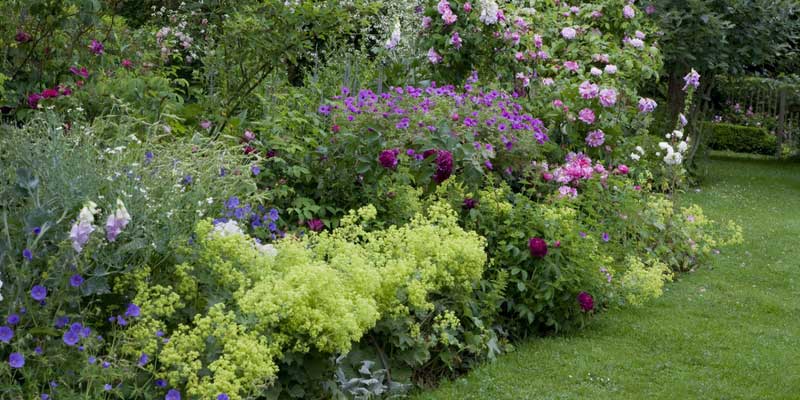 Alchemilla mollis at the edge of a classic mixed border with hardy geraniums, lychnis, and peonies in the background, along with Crambe cordifolia and roses (photo: Biosphoto / NouN)
3) Nepeta 'Walker's Low'
To be honest, it was difficult to choose between Nepeta 'Walker's Low', N. 'Six Hill Giant', and N. 'Purrsian Blue' as all three bloom for a long time. However, 'Walker's Low' wins by a narrow margin as it blooms continuously from May to October and does not need to be sheared like 'Six Hill Giant'. Is it worth mentioning that it is easy to grow and thrives in sunny, well-drained soils, whether rich or poor? The only thing one might reproach it for is its aromatic foliage. Not because it smells bad, quite the opposite, but because it has the unfortunate tendency to attract neighbourhood cats that come to roll in the clumps and ruin the flowers!
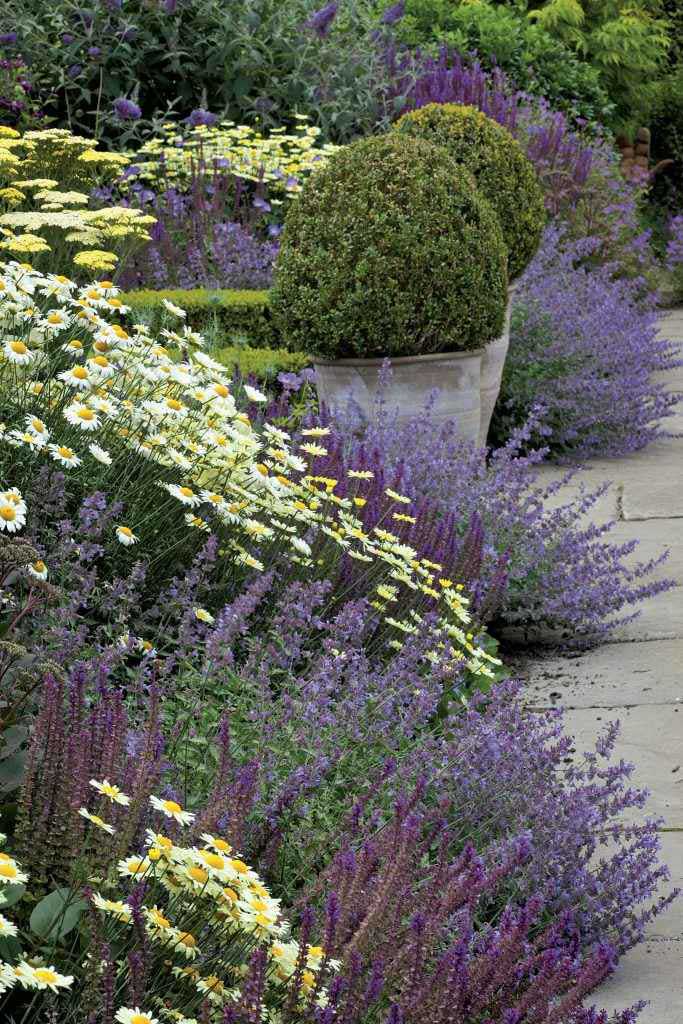 Nepeta racemosa 'Walker's Low' at the edge of a bed in duo with Anthemis 'Sauce Hollandaise' (photo: GAP/ Elke Borkowski)
4) Persicaria 'Needham's Form'
Beware, you might just become a fan of this groundcover perennial, which should not be confused with Persicaria affinis Darjeeling Red, which is also a groundcover and floriferous. That’s why I won’t tell you that it covers the ground so well that weeds don’t dare to touch it. I won’t mention that its Himalayan origins give it exceptional cold resistance. I won’t even tell you that it blooms for a good 6 months of the year and that it’s not uncommon (even in the north when it doesn’t freeze too hard) to see flowers until December. I will also refrain from saying that when planted in moist soil in a bright spot, it is adorned with countless little candy-pink beads that look wonderful with ferns, hostas, horsetails, or Hakonechloa. No, I won’t say any of that.
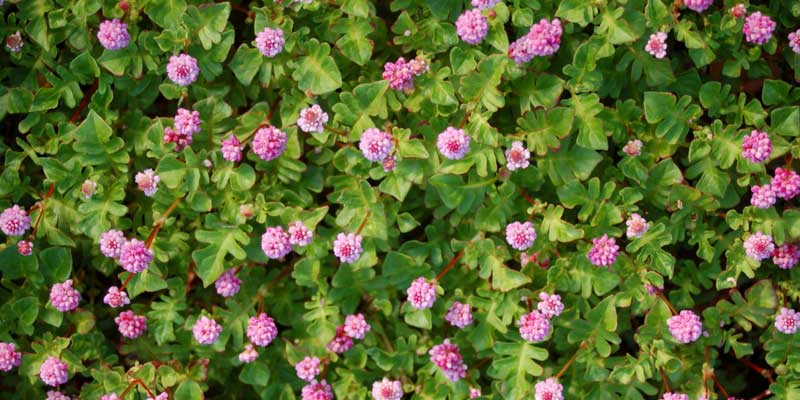 Persicaria Needham's Form, here it is grown too much in the shade and its flowering suffers. Planted more in the light, it blooms almost twice as much.
5) Geranium 'Rozanne'
It’s no surprise that hardy geranium Rozanne is by far the best long-flowering groundcover perennial of all time. Yes, it tolerates dry soils, yes, it grows in both sun and partial shade, and yes, it is hardy and content with little. How long does this wonder bloom? About 6 months! More or less, as in some regions, flowering can start as early as June and extend until December. In "normal" regions, it will bloom from July to November, and there's no need to cut off the flowers to improve its flowering; it is self-cleaning.
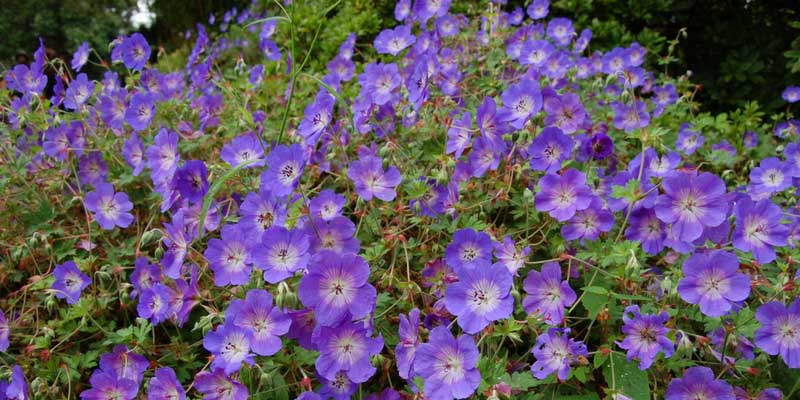
We are always on the lookout for THE perennial groundcover that blooms all summer long, the one whose flowering lasts for several months, the perennial that never stops blooming, the one that adorns and borders a path throughout the summer. The one that shines brightly on a sunny bank or simply the one that is […]
Evergreen groundcovers are a valuable aid in the garden. They help combat adventive plants, reduce soil dehydration, and fight erosion. Besides these proven functional qualities, these plants cover a wide range of uses in the garden. And since functional doesn't have to mean ugly, here are the 10 best evergreen groundcovers to have in your garden.
1 - For shade: Pachysandra terminalis
Yes, I could have mentioned ivy, epimediums, Chrysospleniums, Ophiopogons... But if I had to name just one for shade, Pachysandra terminalis is an excellent candidate. While it grows very slowly in the first few years, it's only to establish its root system and develop at an astonishing speed in the following years. It doesn't run; it gallops. Its glossy foliage, perfect all year round, and its white flowers make it an excellent perennial for cool woodlands, let's be clear!
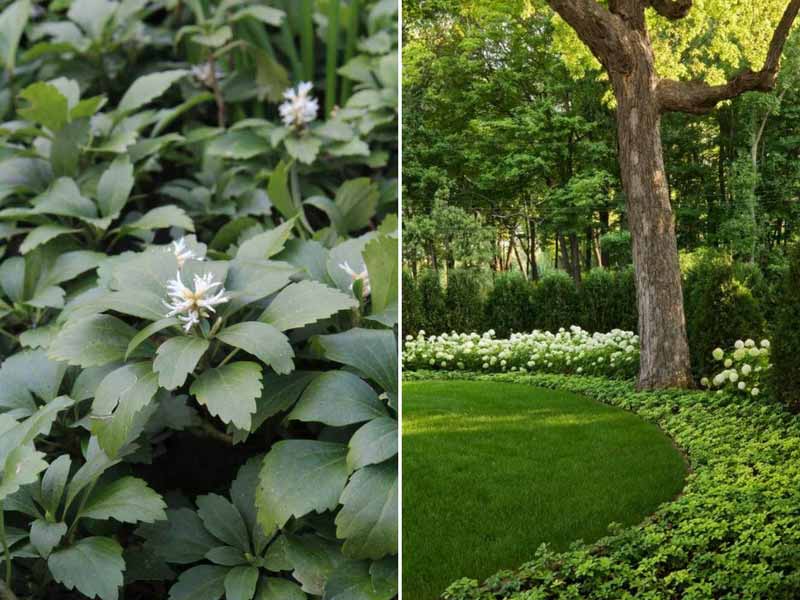
Pachysandra in bloom in spring / Pachysandra terminalis growing at the edge of a tree (source: Pinterest)
2 - For clay soils: Ajuga reptans Catlin's Giant
Ajuga reptans (or "creeping bugle") is one of those perennials that withstand Siberian winters and grow without issue with their feet in the clay, which shows just how tough it is. Its only flaw is that it loves moisture. Heavy soils, yes, but cool or even damp. When it gets what it desires, its stems form stolons like a strawberry plant and quickly colonise.
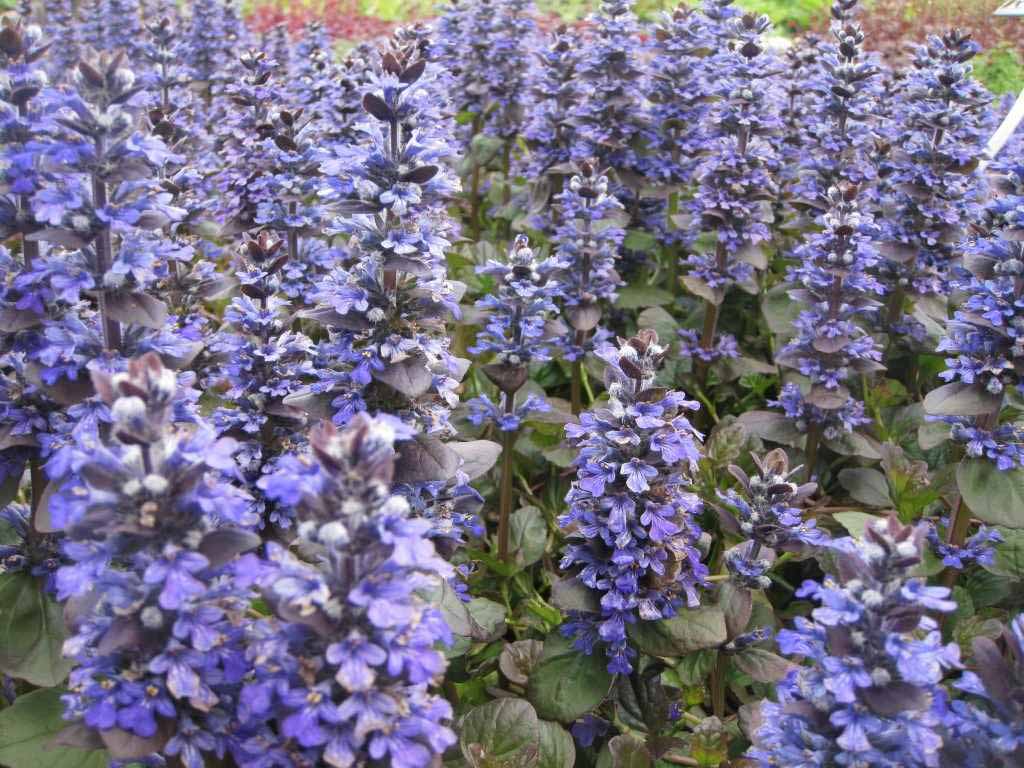
Ajuga reptans Catlin's Giant with its superb bronze foliage and blue spikes.
3 - For arid corners: Stachys byzantina
Have you always wanted to pet a bear's ears but never could? Close your eyes and stroke the velvety foliage of Stachys byzantina. You'll feel like you're petting a bear... or a rabbit, depending on your perspective. Behind this undeniably soft foliage lies a tenacious perennial that grows without flinching under blazing sun and colonises surfaces thanks to creeping stems that root themselves. Use it at the edge or in rockeries with Armeria, euphorbias, lavenders, or carnations.
Stachys byzantina / Stachys in bloom, mixed with purple fennel, euphorbia, and rosemary - source: Pinterest
4 - For growth speed: Lesser Periwinkle (Vinca minor Atropurpurea)
I'm not talking about the greater periwinkle (Vinca major) with its bland foliage and chaotic growth, but its smaller sister, Vinca minor Atropurpurea, which is more refined. With finer leaves, it produces a string of small flowers whose often paler centre gives it a bicoloured appearance. As vigorous as its larger sister, it dresses semi-shaded borders with great class and restraint. Its stems elongate and root themselves here and there, so one single plant can spread and cover several square metres in just 2-3 years.
Vinca minor atropurpurea (Source: Pinterest)
5 - For calcareous soils: Thyme
No, Thyme is not just an herb confined to the edges of the vegetable garden. It is also, and above all, an excellent groundcover plant for calcareous and dry soils. It is used at the edge of a mineral path in gravel or on rocky slopes. However, not all are evergreen; opt for Thymus serpyllum or, for something more original, the stunning semi-evergreen Thymus pseudolanuginosus.
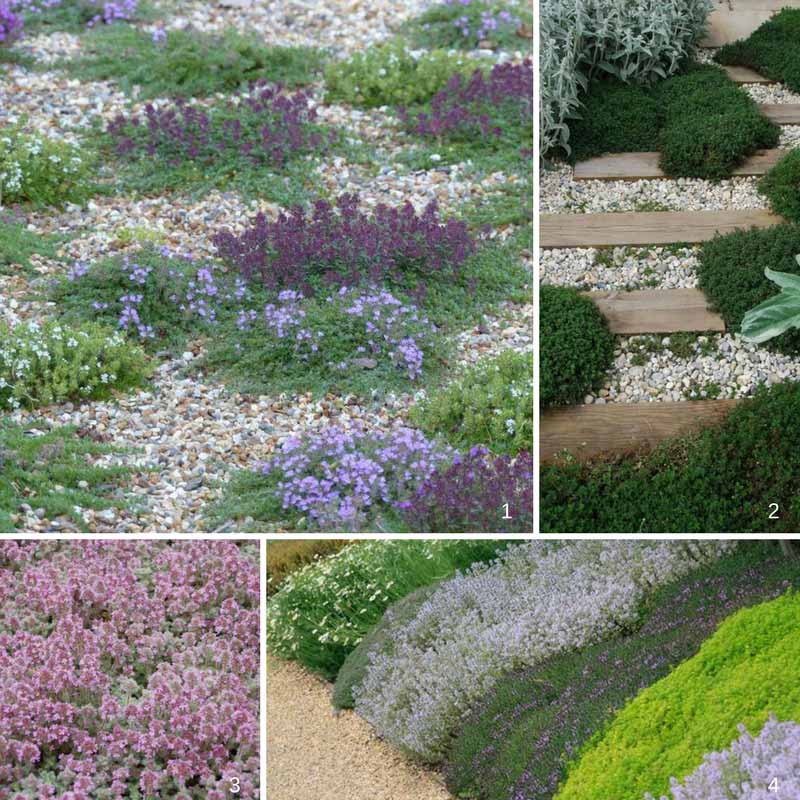
1) Thyme in bloom in early summer / 2) Thyme bordering a mineral path alongside Stachys byzantina (source: Pinterest) - 3) Thymus pseudolanuginosus - 4) Carpet of thyme on a calcareous slope (source: Pinterest)
6 - For early flowering: heather (Erica x darleyensis)
The advantage of heathers is that they thrive in challenging regions, in arid heaths swept by winds, on limestone cliffs, or at the edge of woodlands, so it's impossible to say, "Oh no, I gave up on heather; it won't grow in my garden!" Therefore, you can plant it almost anywhere in your garden, and it will grow at varying speeds. But its main asset lies in its early winter flowering, and neither frost nor a bit of snow will stop it from blooming.
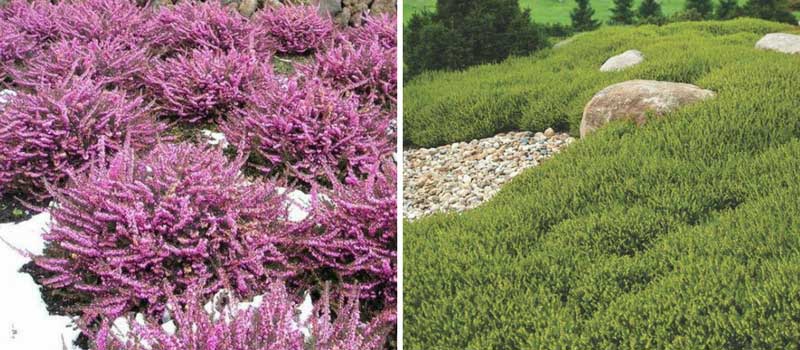
Erica darleyensis Red October in bloom despite the snow - Erica darleyensis forming an impenetrable carpet, no need to plant it on a tarp! (Source: Pinterest)
7 - For its fragrance: Sarcococca hookeriana humilis
At first glance, it's not the size of the flowers that impresses in Sarcococca, as they are insignificant, but rather its sweet fragrance with floral and citrus notes that lasts a good part of winter. Then, it's its lovely glossy foliage and ability to grow in shade, even under trees, that appeals. Finally, this small groundcover shrub slips along the edge of a shaded path and suckers to form lovely colonies over time.
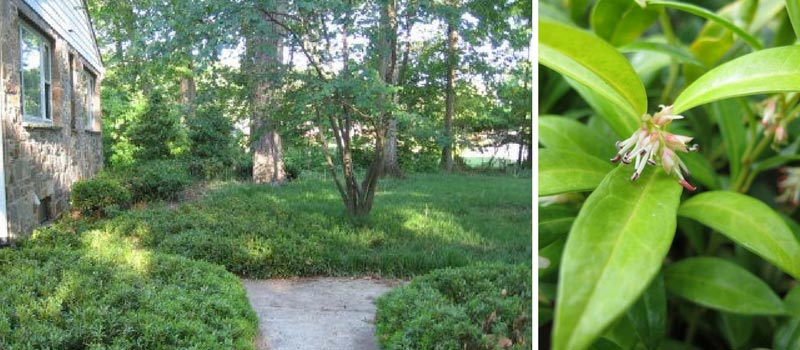
Sarcococca hookeriana humilis in bloom. How can such small flowers exude such a fragrance? A mystery! / Sarcococca hookeriana var. humilis at the edge of woodlands (Source: Pinterest)
8 - For its abundant flowering: Phlox subulata
When thinking of flowering groundcovers, Phlox doesn't immediately come to mind. And when thinking of Phlox, one primarily thinks of Phlox paniculata known for its beautiful coloured panicles in summer. However, Phlox subulata deserves to be better known and planted because its flowering is simply stunning. This small groundcover transforms into a colourful mass from early spring. It literally becomes covered in flowers, to the point that when exposed to full light, in well-drained, rich soil, the foliage disappears beneath the flowers for three solid weeks.
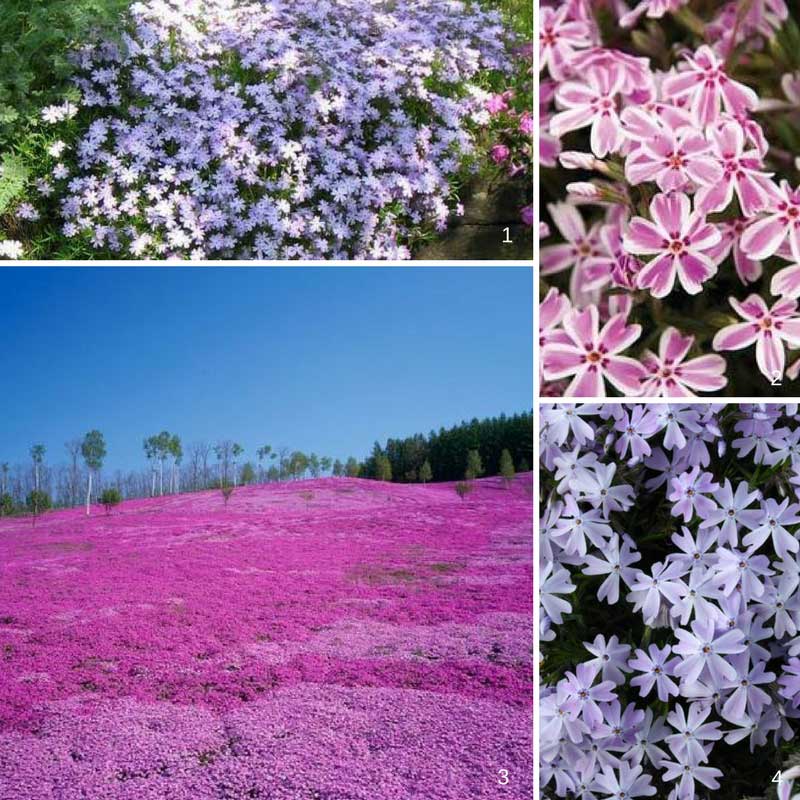
1 and 4) Phlox subulata Emerald Cushion - 2) Phlox subulata Candy Stripe - 3) The Japanese have appreciated Phlox subulata for a long time and plant it in masses on hillside slopes. You either love it or hate it, but after a dreary winter, it wakes you up! (Source: Pinterest)
9 - For decorative fruit in winter: Cotoneaster Coral Beauty
It's not that I'm a huge fan of cotoneasters, but one must acknowledge at least one thing: they are the kings of fruiting. When winter comes and the light intensity decreases, the small orange-red berries take on intense colours, making winter seem less dreary. Moreover, birds feast on their providential berries in winter, so keep that in mind!
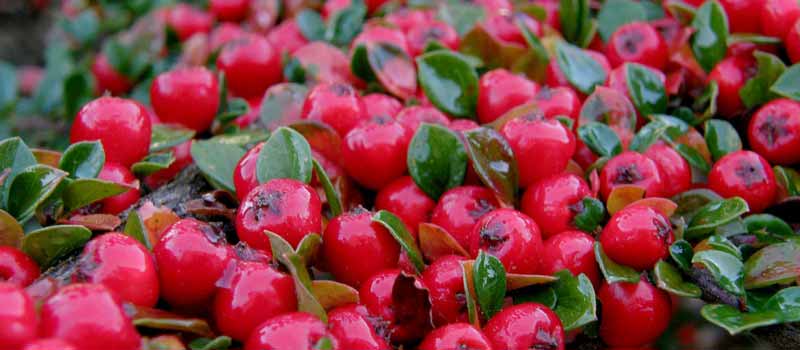 Cotoneaster suecicus Coral Beauty in fruit in autumn[/caption>
10 - For all the reasons: Geranium macrorrhizum Spessart
It was nearly impossible to finish a top 10 of the best evergreen groundcovers without mentioning Geranium macrorrhizum Spessart. It is the ultimate groundcover that grows everywhere, in sun or shade, in clay or clay-limestone soils. It is one of the few that grows in dry shade, on slopes, along paths, at the foot of trees or roses. It spreads its rhizomes across the ground and suffocates everything in its path, even ivy, which speaks to its robustness. It grows slowly but surely, has foliage with a questionable scent but blooms profusely and for a long time in spring. And when the cold arrives, its foliage turns copper and red, it may wither but does not disappear, revealing its dense network of rhizomes. It’s the best, and it’s my favourite (objectively speaking!).
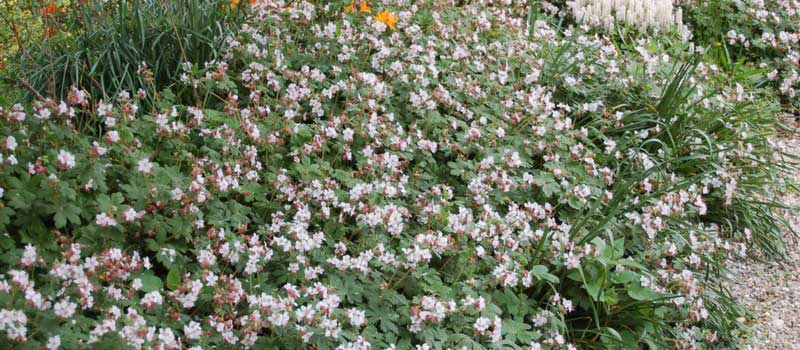 Geranium macrorrhizum 'Spessart' on my slope in spring.[/caption>
And you, which is your best evergreen groundcover? Tell us why!
Evergreen groundcovers are a valuable aid in the garden. They help combat adventive plants, reduce soil dehydration, and fight erosion. Besides these proven functional qualities, these plants cover a wide range of uses in the garden. And since functional doesn’t have to mean ugly, here are the 10 best evergreen groundcovers to have in your […]
Let's be clear: I'm not a fan of anglicisms, but one must admit that mixing languages can be a good thing! Indeed, talking about "seedheads" [pronounced siiid-h-aide-z] is much more elegant and poetic than talking about "infrutescences", or — worse yet! — "dead stems" for perennials and grasses, don't you think? I, for one, am campaigning to introduce this lovely word into vocabulary of French gardeners.
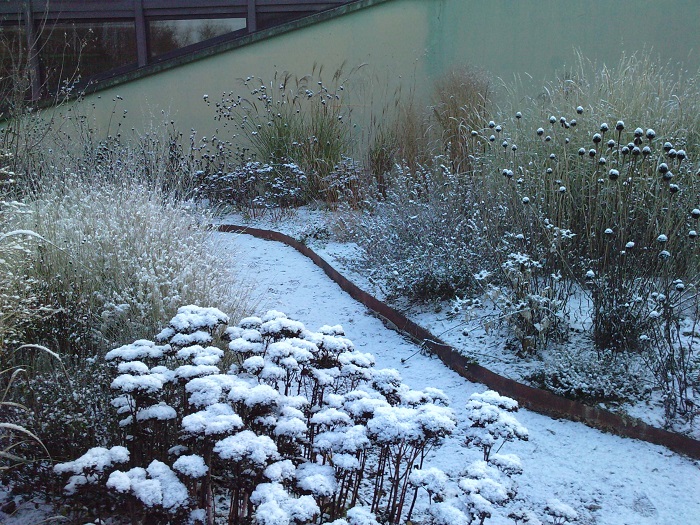
Perennial and grass bed in winter, made attractive by seedheads left standing and covered with fresh snow.
Popularised by vogue for so-called "prairie" gardens and by plantings of Piet Oudolf, "seedheads" refers to fruiting structures and winter architectural features of perennials and some shrubs which, when thoughtfully combined, create naturalistic tableaux in sepia tones, enhanced by low light, mist or hoar frost in autumn and winter: each day brings a different, unpredictable effect, which is part of garden's beauty at this time of year. Ingrid and Michael told me yesterday that their hellebores were already in flower at their place... here, not far from the north, that's not the case yet: never mind, I never tire of admiring subtle details of seedheads I left in place during autumn tidy-up.
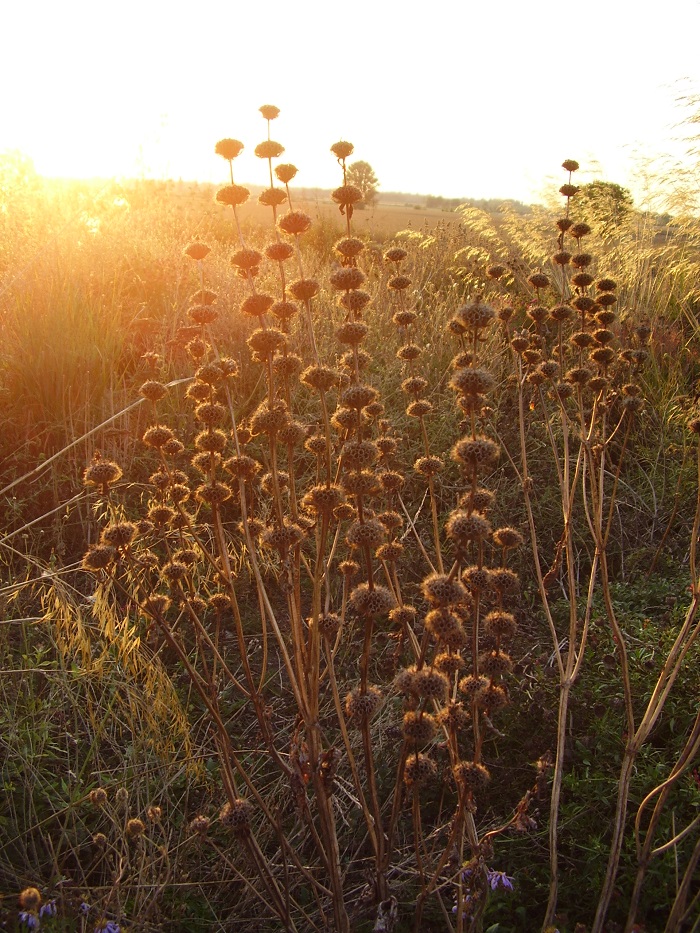
A superb specimen of Phlomis tuberosa, perfectly spent, seems literally to glow in late-afternoon autumn sun.
Inspired by books by Piet Oudolf and Noel Kingsbury such as Le Jardin de Vivaces et de Graminées (Bordas, out of print), then Jardins d'Avenir (éditions du Rouergue) and Jardins d'Automne et d'Hiver (original title: Seedheads, by Noel Kingsbury with photographs by Jo Whitworth, éditions du Rouergue), I experimented extensively in my garden on edge of Maritime Flanders, less than 20 km from North Sea coast, with varying success... Rain and especially wind really test sturdiness of stems that have lost their life, and my soil, less sandy and richer than typical Dutch gardens, makes stems less resilient. In hindsight, only handful of perennial varieties manage to retain decorative impact in my garden through whole winter, and it's mainly in November and December that seedheads look their best. Here is a gallery of portraits.
I particularly love seedheads of Aster macrophyllus 'Twilight', ever-changing: small tawny pom-poms disintegrate as seeds fly, leaving floral receptacles with silvery sheen. At about 60 cm tall, it withstands wind well.
One of all-round champions: Phlomis! This is true Phlomis samia, with branched inflorescences finer than those of Phlomis russeliana, but with same graphic effect from regularly spaced verticillasters along stem. Phlomis seedheads are among most architectural and most durable.
Not thought of often enough, but seed pods of Siberian iris, dark brown, are quite attractive and very long-lasting. A nice bonus to make up for fleeting June flowering!
One of my more recent discoveries: dried inflorescences of autumn aconite seem sturdy and long-lived, another advantage over delphiniums!
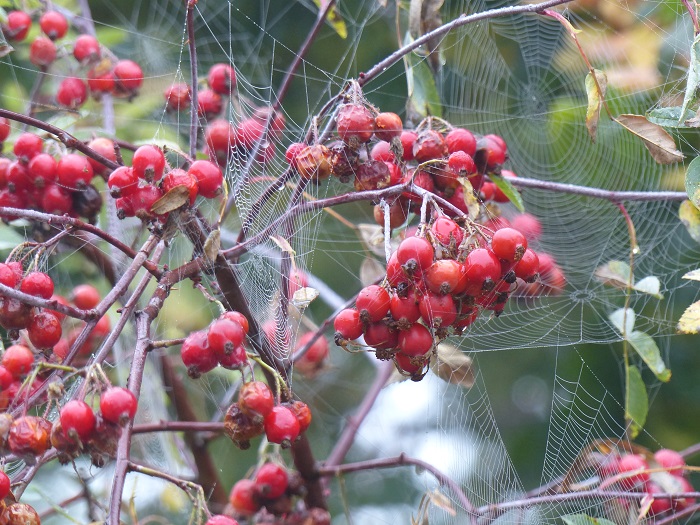
Not only "dry fruits" decorate autumn garden: there are also fleshy fruits such as rounded hips of Rosa glauca, or abundant fruit of ornamental apple trees.
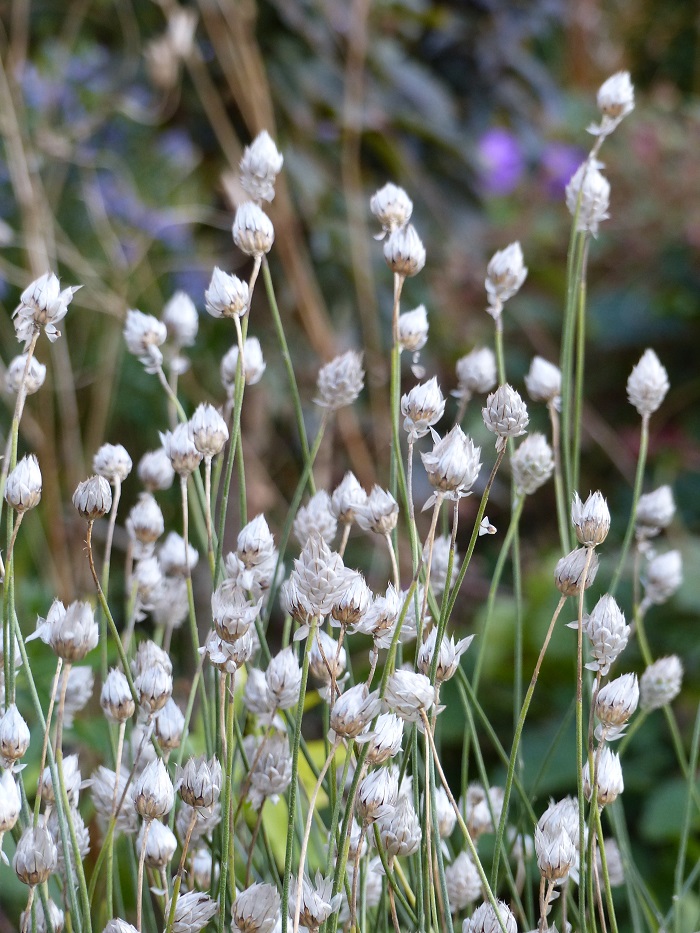
Fruits of Cupid's dart (Catananche caerulea), in silvery clusters, sit alongside its metallic-blue summer flowers in original, harmonious display. After flowering they extend plant's interest for a few weeks before dispersing in December winds.
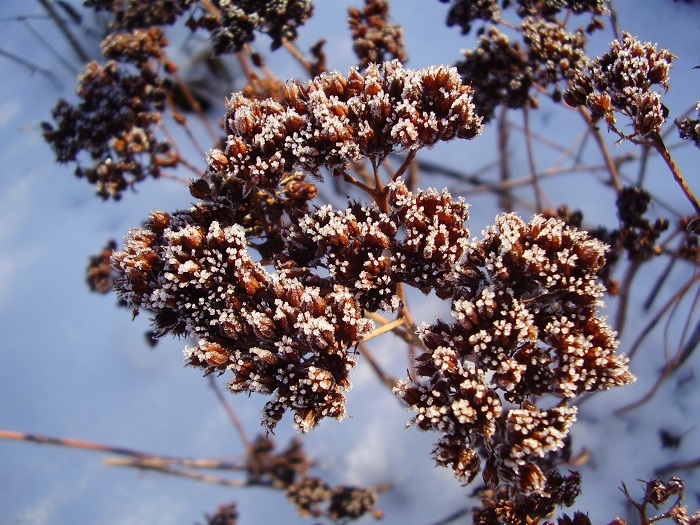
Large sedums like 'Matrona' are fail-safe. Their shape is impeccable year-round and their inflorescences pick up hoar frost beautifully in winter.
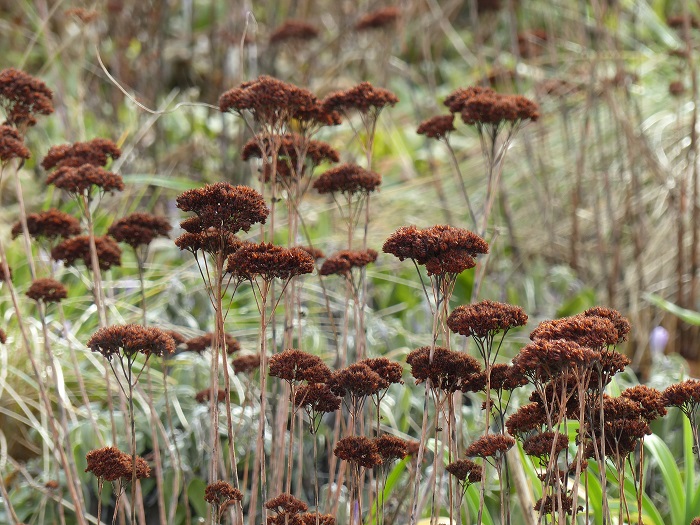
Sedum 'Herbstfreude' is simply indispensable.
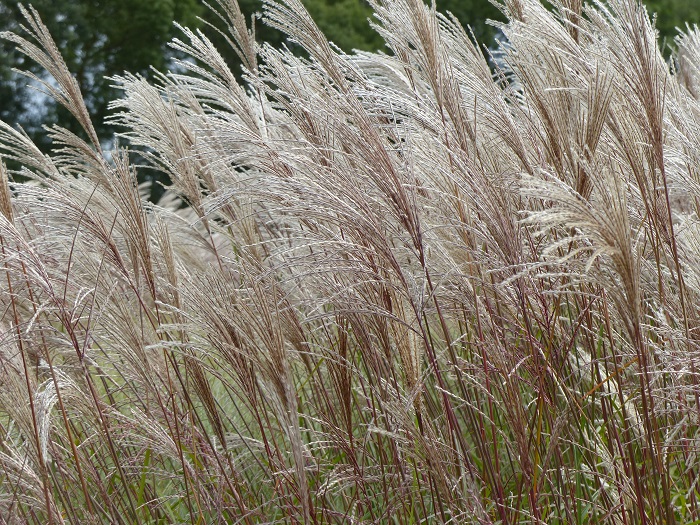
Of course, how could one not mention Miscanthus, here variety 'Malepartus'? Their plumes with diamond-like sheen remain attractive until I have to cut them back in January to make way for new growth.
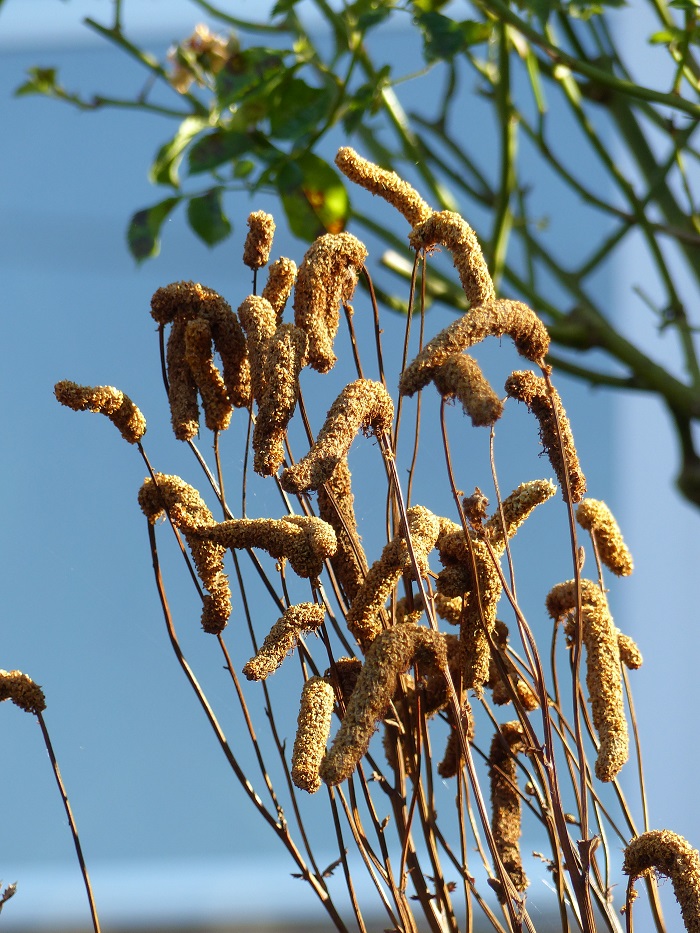
Spent flowers of large Asian burnet, Sanguisorba hakusanensis, suggest little caterpillars embarking on conquest of air! As pretty as they are, these seedheads are short-lived and last at most six weeks on plant, after which I cut plant back.
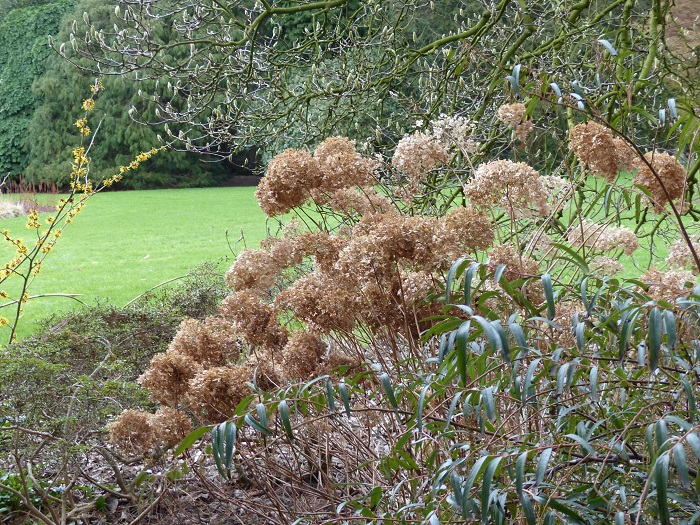
Dried inflorescences of hydrangeas are classic choices; they lose none of their roundness and opulence when spent, turning rich shades of green before browning. Here, Hydrangea arborescens 'Annabelle' photographed at Kalmthout Arboretum in Belgium.
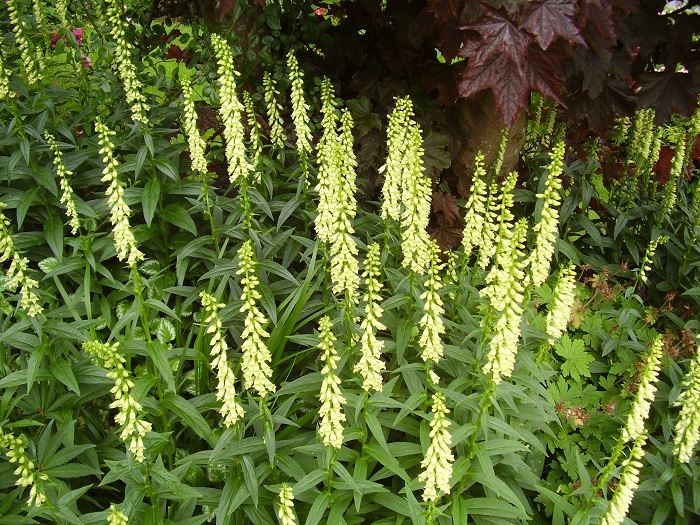
Yellow foxglove, Digitalis lutea, flowers in pale-yellow spikes in July. A true perennial living 5–10 years, easy to combine and happy everywhere except acidic soil. Given long ago by gardening friend, it quickly became one of my favourites, especially for quality of its seedheads.
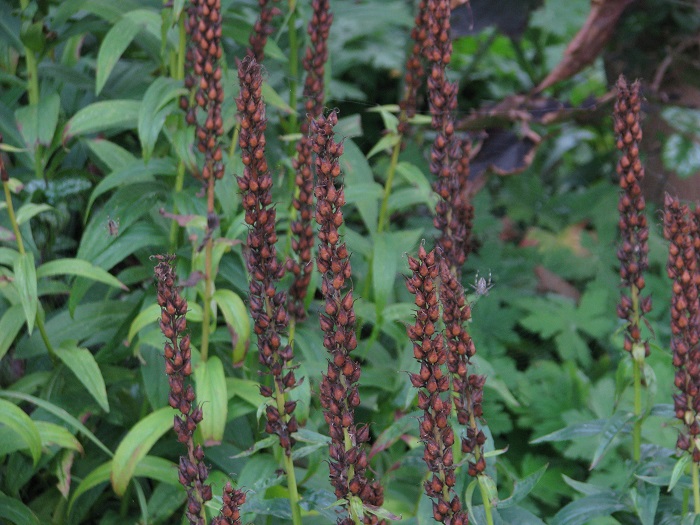
Spikes of Digitalis lutea are by far sturdiest of all. They stand upright from August through March. I tuck them in everywhere to give structure and movement to winter borders.
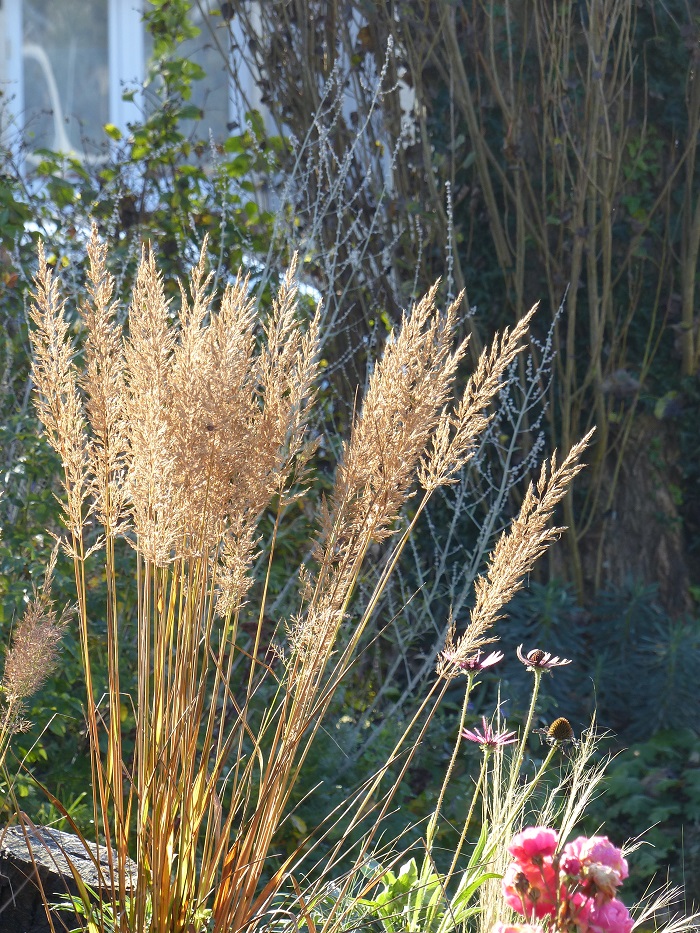
Calamagrostis brachytricha, the "diamond grass", is an excellent autumn and winter grass, with good habit and remarkable way of catching the light.
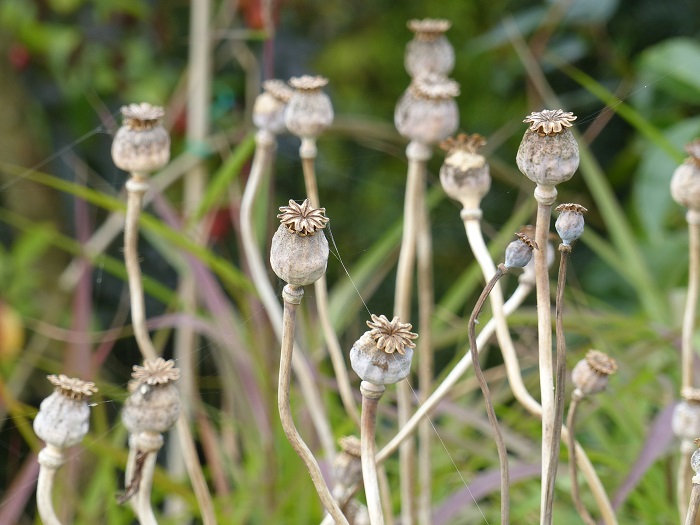
Poppy capsules are decorative from early August and last as long as wind and rain, which attack stem base, spare them. I sometimes "reinforce" them with small stake slipped into hollow stem.
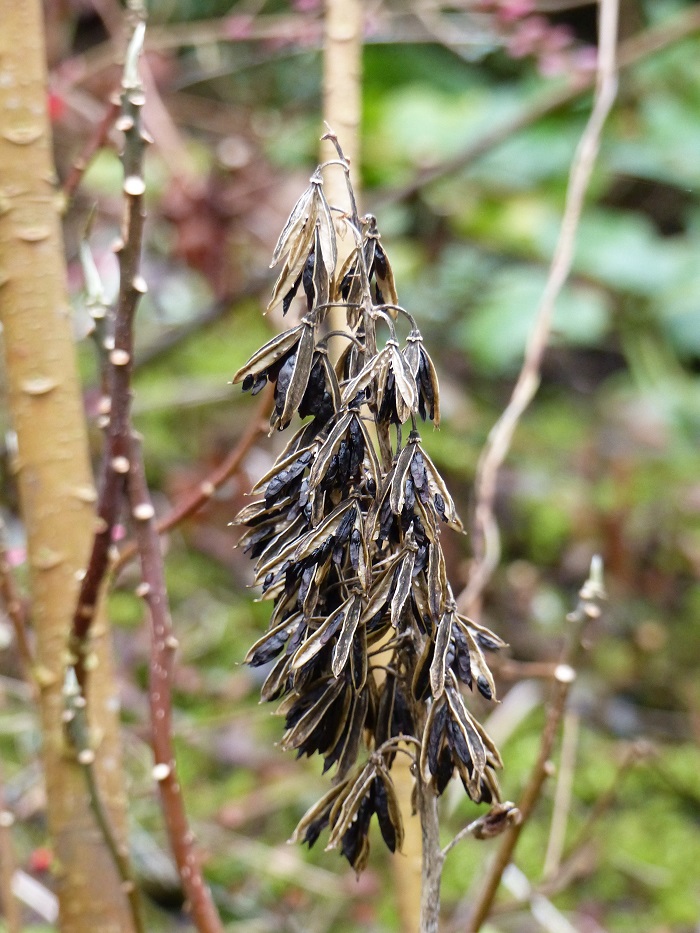
And finally... Can you guess which plant this inflorescence belongs to?
Let’s be clear: I’m not a fan of anglicisms, but one must admit that mixing languages can be a good thing! Indeed, talking about “seedheads” [pronounced siiid-h-aide-z] is much more elegant and poetic than talking about “infrutescences”, or — worse yet! — “dead stems” for perennials and grasses, don’t you think? I, for one, am […]
Your Gunnera manicata has displayed stunningly large and impressive leaves all summer? Well, it’s high time to protect it if you haven’t already! Why, when, and how? We’ll tell you everything!
It flaunts its bodybuilder foliage all summer... but at the slightest breeze, it shivers and catches a cold! Yes, the Brazilian Gunnera is a delicate little being that deserves attention in winter, or you may not enjoy the spectacle of its large lush leaves the following year. So now, before the severe frosts of January, is the time to protect this creature from the cold.

Gunnera manicata in July.
Step 1: Cut the leaves
First, cut all the leaf stems (the petioles) down to the bud to expose the central bud of the plant. Use a machete, or if not available, pruning shears to cut the petioles. Don’t forget to wear gloves; the petioles are prickly!
Step 2: Protect and pamper the bud
What to do with the dead leaves accumulating in the garden? A thermal protection for the Gunnera, of course! Place a thick layer of dead leaves at the base and over the bud. Don’t hesitate to cover the bud with at least 30 cm of dead leaves. It may seem thick, but remember that they will compress during winter. And it’s this large bud that ensures the plant’s longevity. If it is damaged by frost, the plant will die or struggle to survive (and may die the following season). So, don’t skimp on the thickness of dead leaves. If you don’t have dead leaves, straw, flax shavings, or wood chips will do the trick.
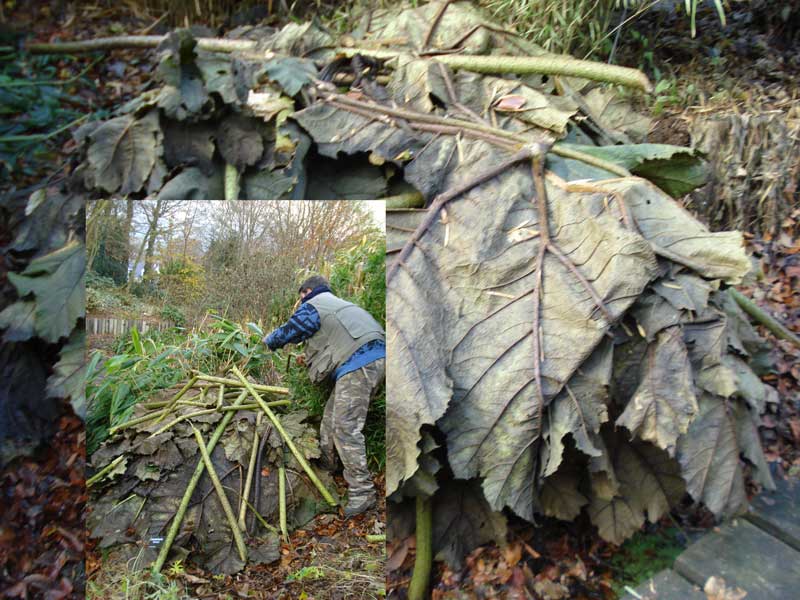
The stump of the Gunnera is covered with dead leaves and then covered with its own leaves.
Step 3: Cover and let it rest all winter
The leaves of the plant that you have cut down serve as protection against moisture. Recut them by separating the lamina from the petiole. Place the lamina upside down on the protection; they will shield against rain and limit the degradation of the dead leaves. Finally, place the heavy petioles on top to hold and stabilise against winter storms!
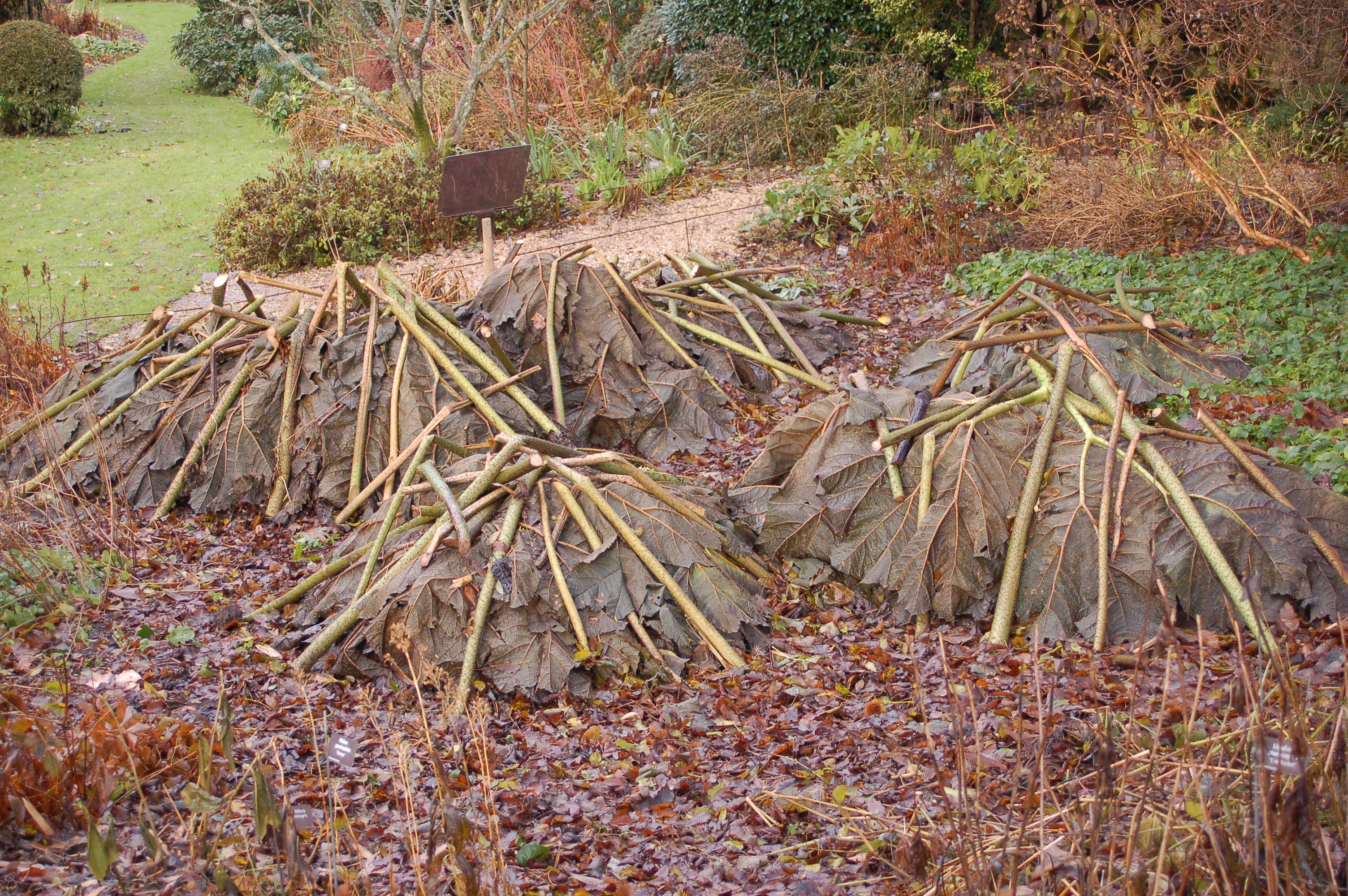
Winter protection for the Gunneras.
Step 4: Don’t touch anything!
It may sound silly, but when the end of winter arrives, we are tempted to remove all those dead leaves to let the plant "breathe." We even see new shoots emerging, so why not clear them from this layer of old, unsightly leaves?
Removing the protection when the plant starts to grow is the best way to damage, or even nullify, the protective work done before winter. The heat released by the decomposition of the dead leaves + the lengthening days = early stimulation that encourages the plant to produce its new leaves, even when morning frosts persist. The young tender leaves develop in a warm cocoon and harden as they grow and reach the surface. As a result, they emerge earlier but are acclimatised and better equipped against late frosts. So leave the protection in place until May; the dead leaves will continue to decompose and provide all the necessary nutrients for an explosive growth of your Gunnera’s foliage.
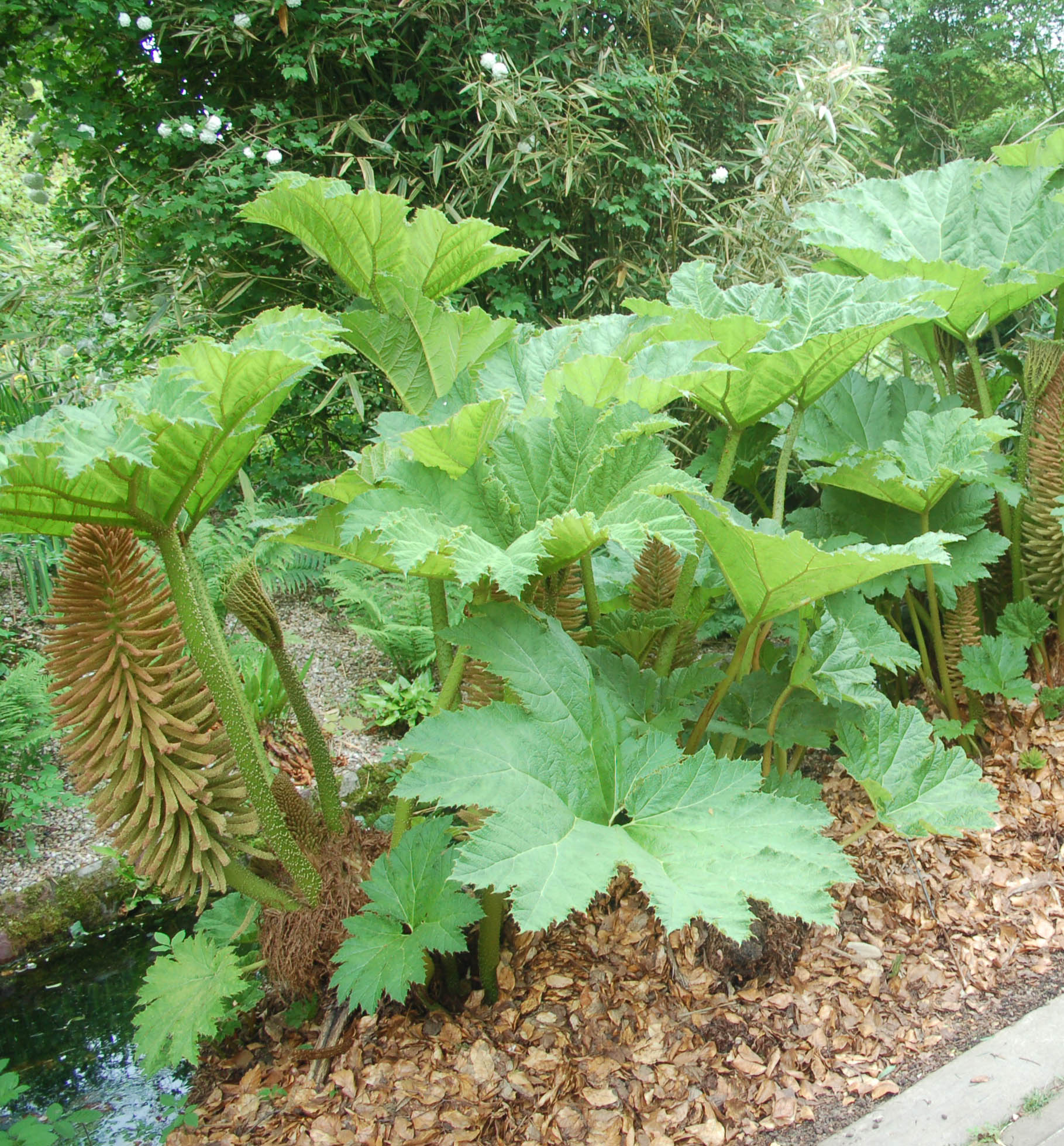 Decomposed dead leaves make excellent compost to give a boost at the start of the growing season.
Your Gunnera manicata has displayed stunningly large and impressive leaves all summer? Well, it’s high time to protect it if you haven’t already! Why, when, and how? We’ll tell you everything! It flaunts its bodybuilder foliage all summer… but at the slightest breeze, it shivers and catches a cold! Yes, the Brazilian Gunnera is a […]
Let's be honest. Creating a perennial border is fairly easy. Making it successful is a little less so.
Aside from plants' adaptation to soil and exposure, there is also the question of colour, just as tricky! On that point, I will humbly abstain: I have lost count of the times I have moved plants grumbling "too purple!", "too red!", "too yellow!". So today I suggest we explore shapes… by offering a selection of perennial plants that, when combined, will produce striking contrasts, essential to avoid boredom. Indeed, plays of harmony and contrast with shapes are what truly create a border's composition and framework. After all, colour schemes are only "finishing touches" that will dress the border at a later stage 😉
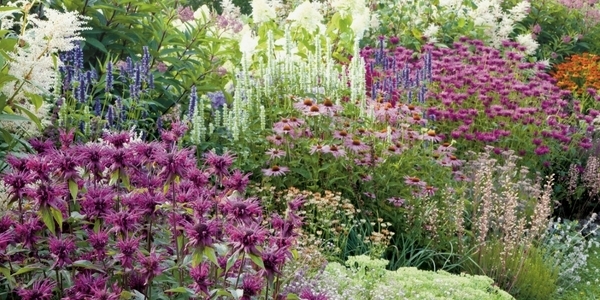
Vertical forms: reaching for the sky!
Often graphic, these plants provide verticality and form a genuine link between sky and earth. They are perfect for enlivening a border that is a little too monotonous. There are varieties to suit all garden styles and sizes.
In well-drained soil, don't hesitate to plant Eremurus or Foxtail lily: relatively little known, it is a tuberous perennial with a very architectural habit. In the Veronica family, Veronicastrum virginicum are quite exceptional, proudly bearing their fine spikes like candelabra. Spectacular Kniphofias add an exotic touch and are unrivalled for warming up a border. For a more traditional, English-style garden, think of Delphiniums or Larkspurs. In shade or part shade, Cimicifugas are very effective. In a slightly "wild" vein, I also like Liatris spicata or Blazing star, which is furthermore very melliferous.
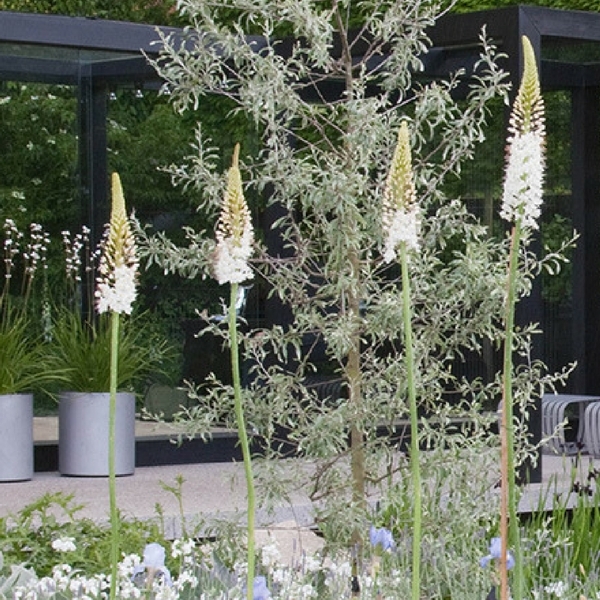
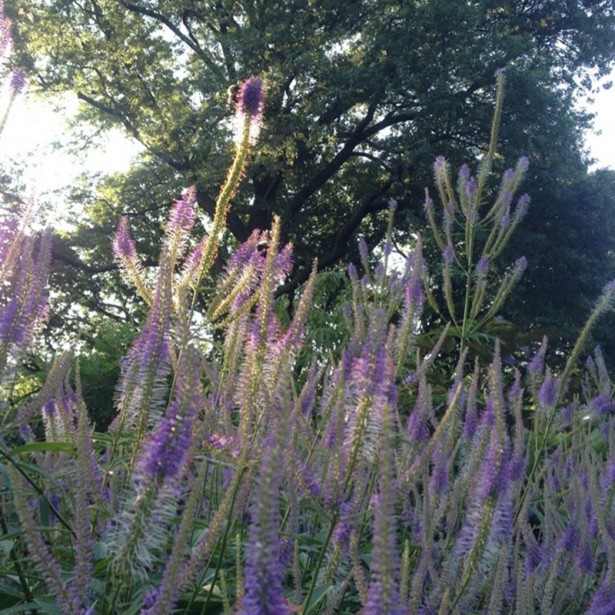
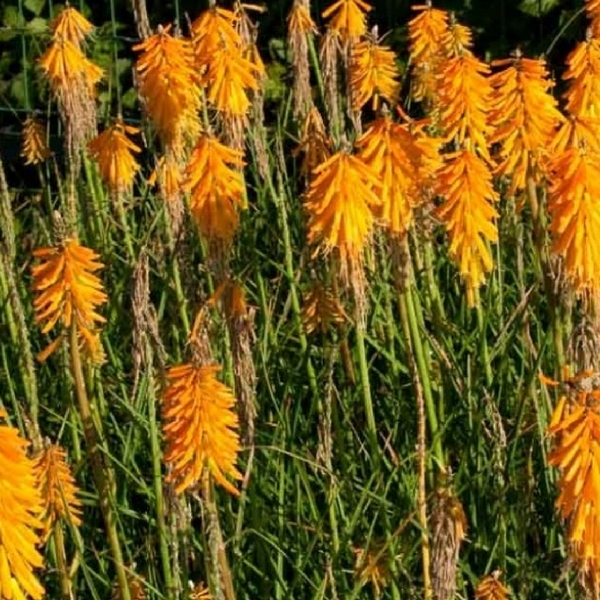
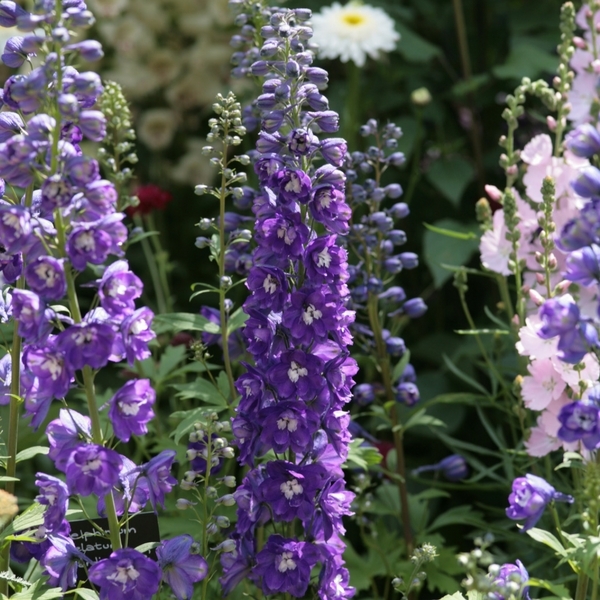
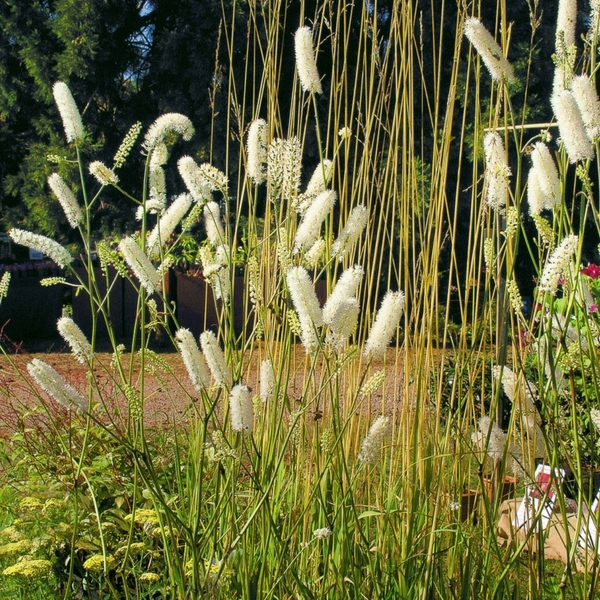
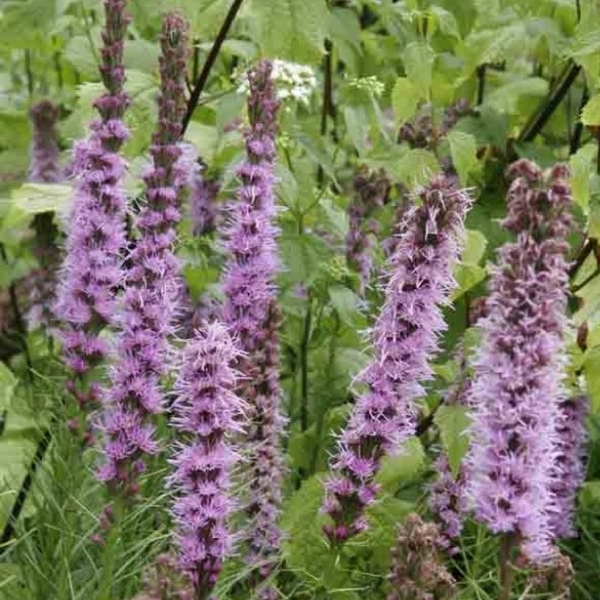
Pom-poms… more or less round
When thinking of spherical shapes, ornamental alliums are the first to come to mind. We all know 'Globe Master' and 'Purple Sensation'. They certainly make an impact! But there are many others: Pompon dahlias, globe thistles, and among the smaller, slightly less round types (great in drifts), Allium sphaerocephalon or round-headed garlic and the adorable Knautias and Sanguisorba 'Chocolate Tip'.
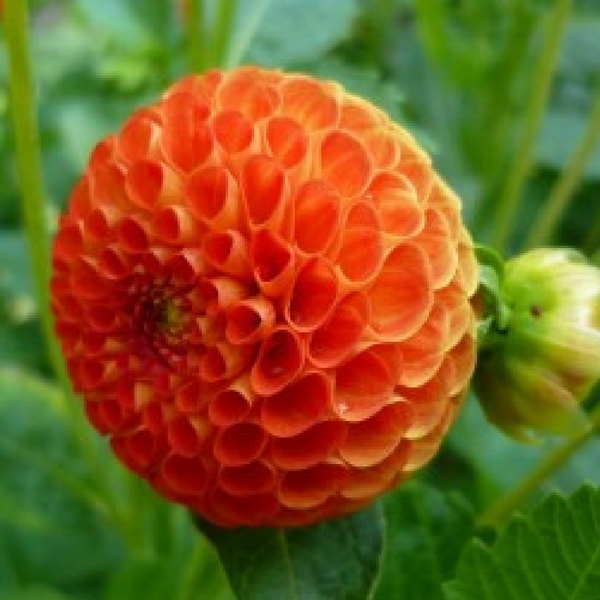
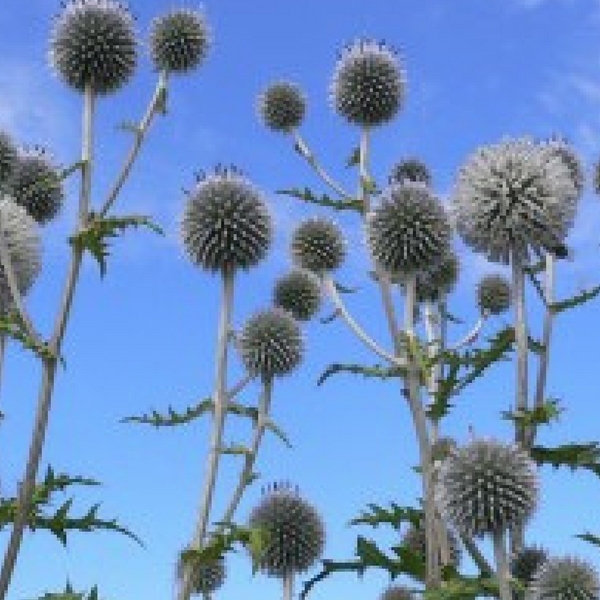
Stars: "Big star" or Milky Way
No need to be perceptive to guess that Asteraceae are, by nature, made to shine. Asters are my favourites in this respect. They have the advantage of being very diverse and can display either large flowers (such as the remarkable Aster pyrenaeus 'Lutetia') or spread a host of small stars like a Milky Way, as with the charming Aster 'Chloé'.
But as their flowering is rather late, the border can be complemented with other species such as Leucanthemums or oxeye daisies: simple but natural, Rudbeckias, very sunny, or Echinaceas, those fine Americans… In shade, Astrantia (which is not an Asteraceae but an Apiaceae) is perfect and offers a more refined style.
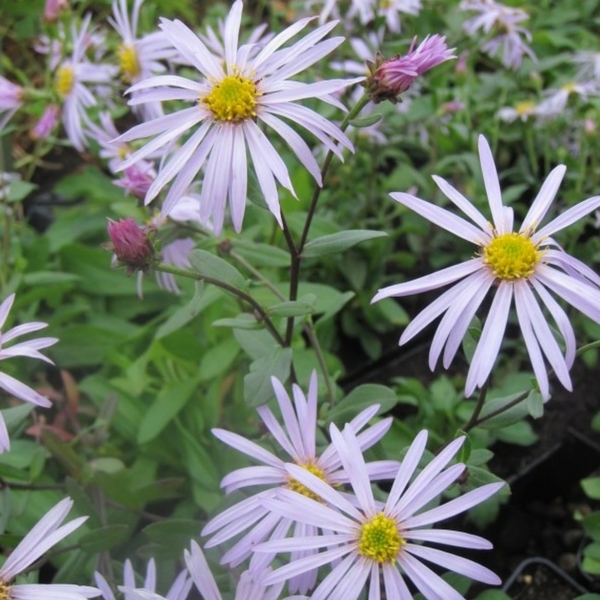
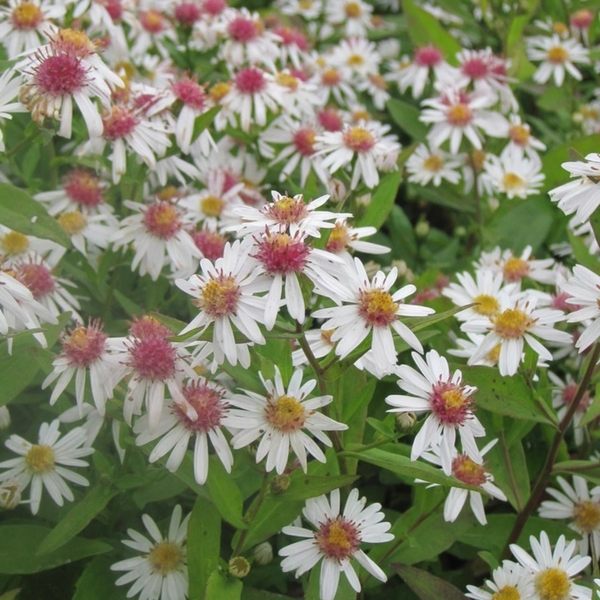
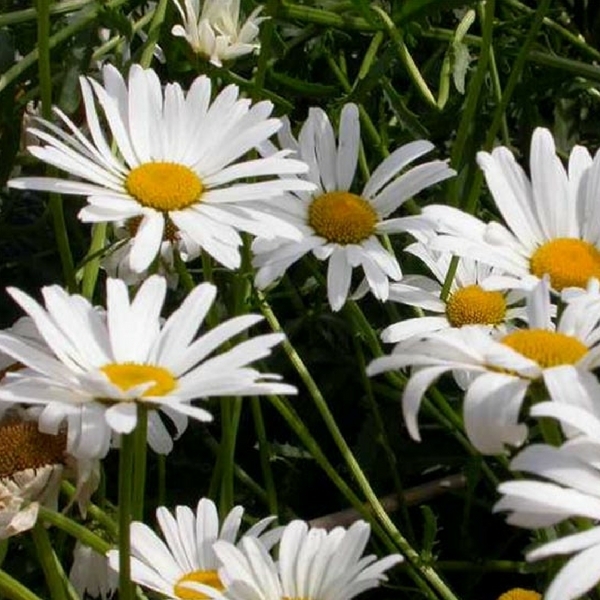

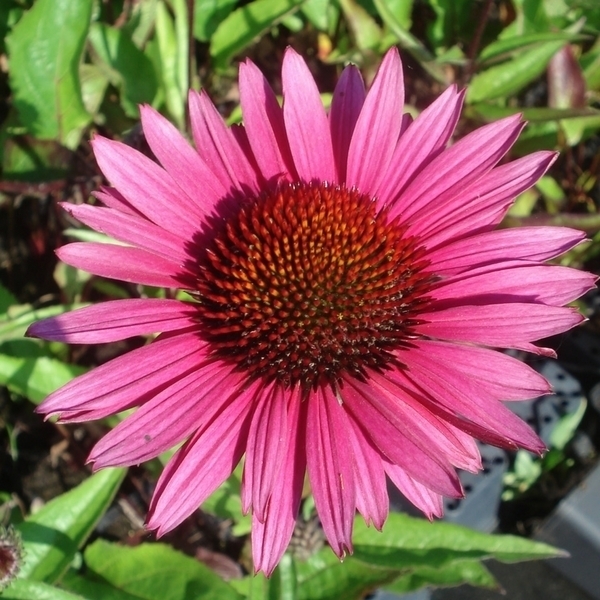
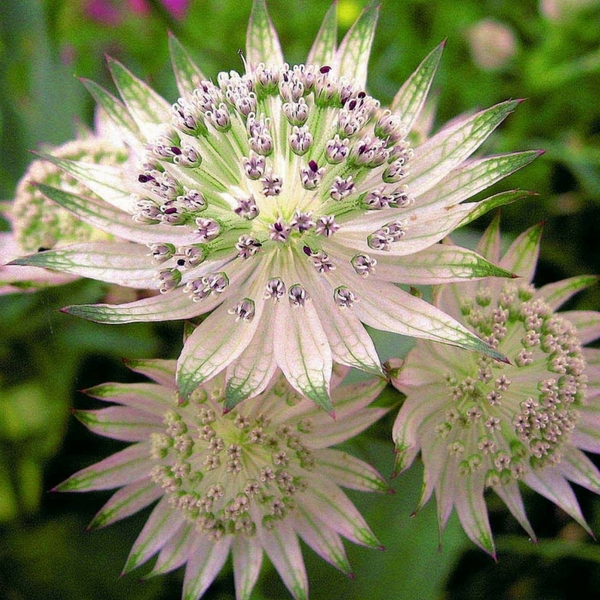
The airy ones: light mist, soft clouds or cotton candy
Whether they form a light haze, gentle plumes or generous "cotton candy" flowerheads, airy-looking perennials are precious. Depending on their size, they can be placed at the back or edge of borders but also as delicate curtains. Their suppleness and lightness complement more compact or rigid shapes very well. Very popular, Buenos Aires verbena is part of this group but needs no introduction… and others deserve your attention too.
Among the lightweights are Gypsophilas ('White Festival' is a marvel) and Thalictrums. Astilbes and Filipendulas are notable for their cloud-like inflorescences that can evoke cotton candy when pink… Still rather rare in gardens, Sanguisorbas hakusanensis and obtusa are charming as well!
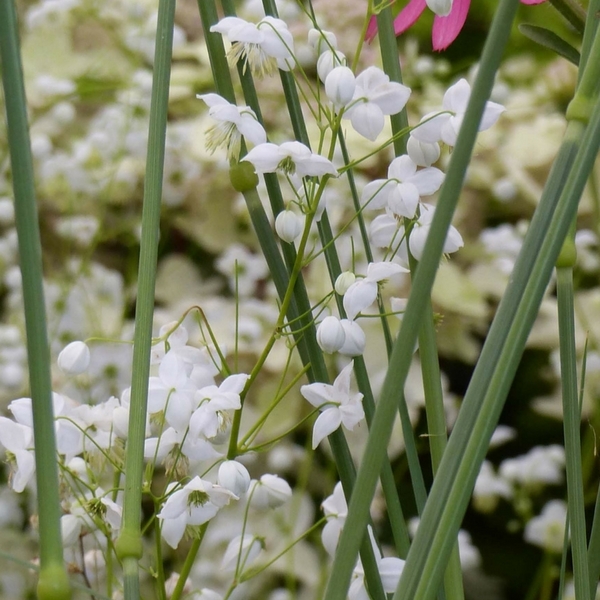
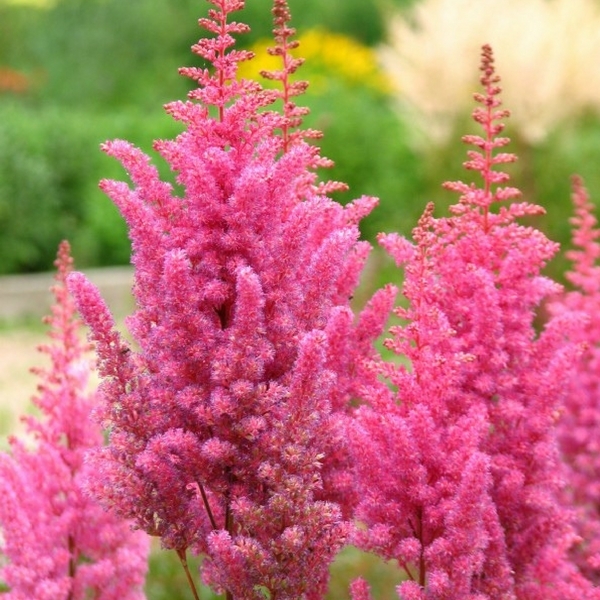
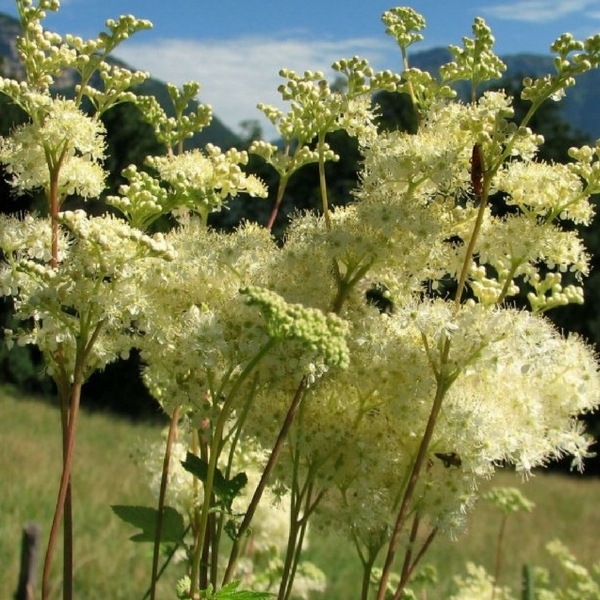
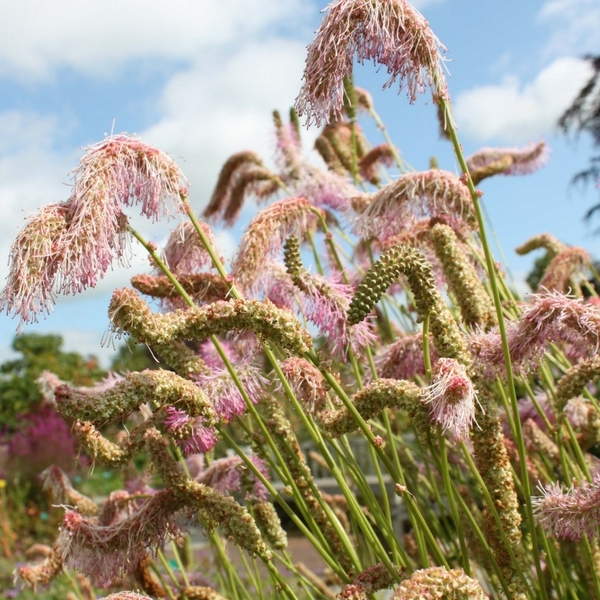
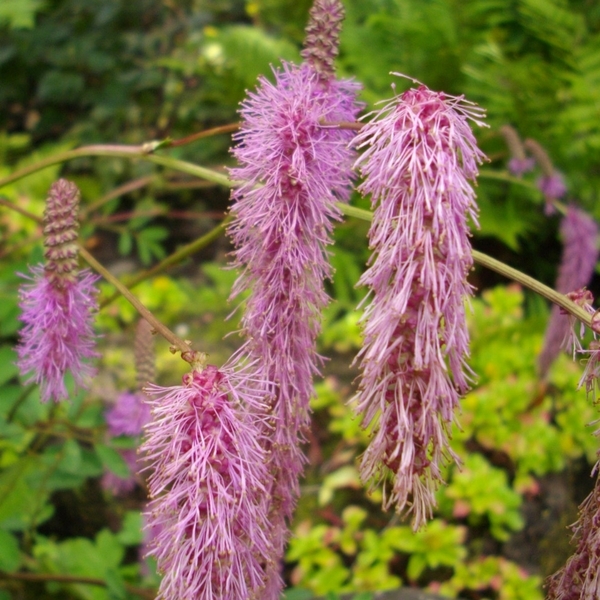
The tousled ones — delightfully whimsical in a border!
What better way to catch the eye than a touch of fantasy? Plants with tousled flowers have plenty of that. We love their slightly extravagant look, always in good taste… provided they are used in moderation. A few examples: Monardas, certain varieties of Alliums and the highly horticultural forms of oxeye daisy.
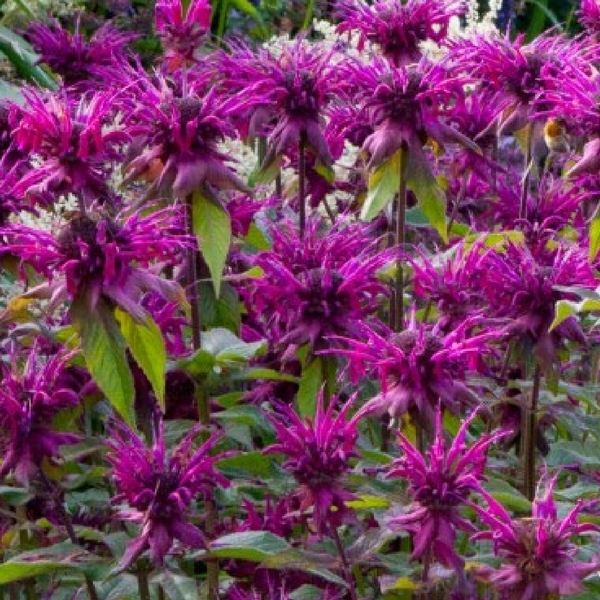
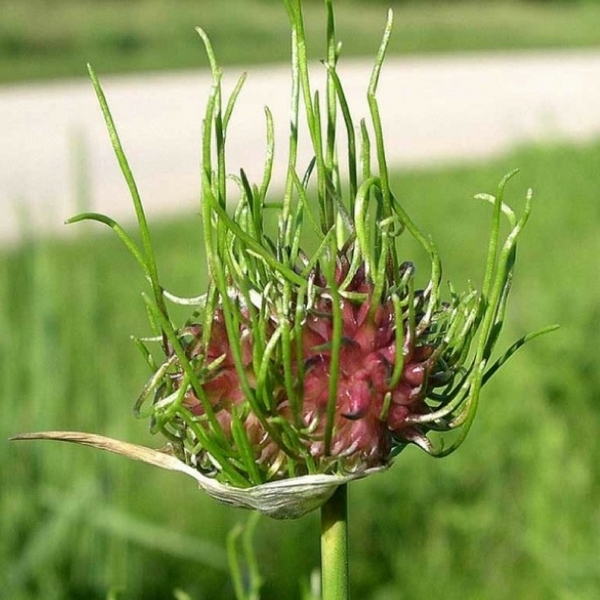
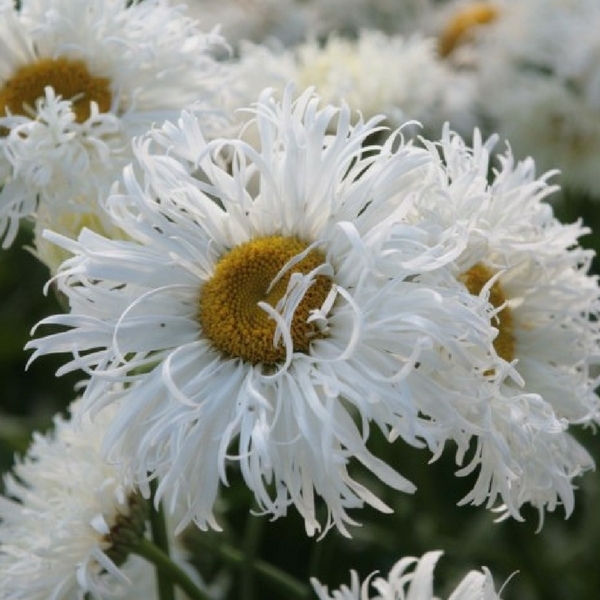
And you, what are your favourite plants for composing beautiful, varied and dynamic borders?
For further reading, discover our advice sheet: "How to create a beautiful perennial border"
Let’s be honest. Creating a perennial border is fairly easy. Making it successful is a little less so. Aside from plants’ adaptation to soil and exposure, there is also the question of colour, just as tricky! On that point, I will humbly abstain: I have lost count of the times I have moved plants grumbling […]
Between the shimmering foliage and decorative fruiting bodies, autumn has treated us to exceptional colours this year. And the colours still linger, thanks to the very last flowering of the season, that of Isodon longituba, also known as Rabdosia longituba. If you are not familiar with it yet, here is an introduction and some tips on how to grow it well...
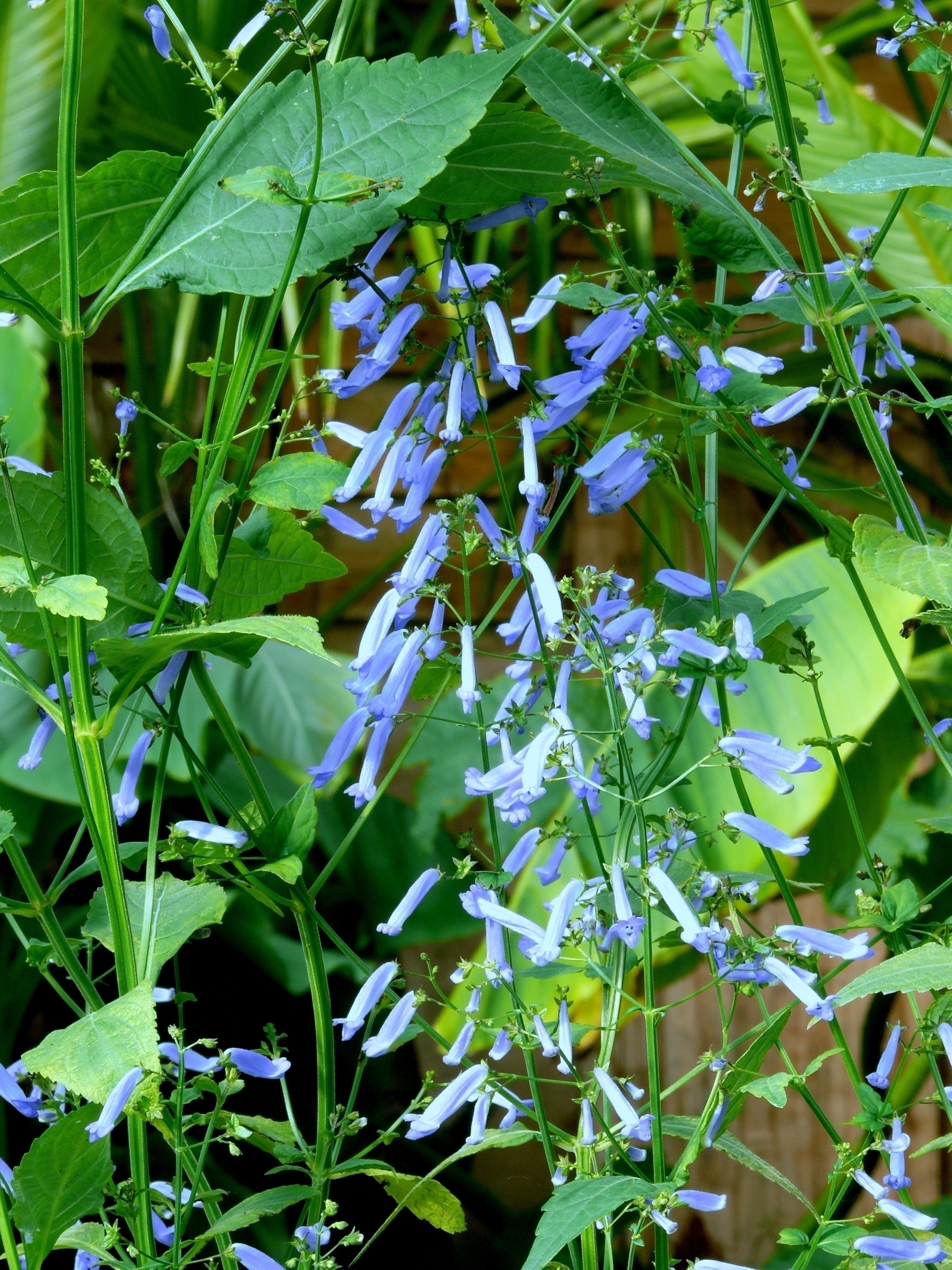
This large Japanese perennial, native to the island of Honshu, is the last perennial in the garden to flower. This attractive exotic, seldom seen in our gardens, belongs to the family of sages. Exotic in the way the bush forms, literally covered with a cloud of intensely electric-blue tubular flowers, an intensity rarely seen in other perennials, Isodon remains easy to use.
Although its exotic appearance contrasts with other plants in the garden, it is a perennial to use with sages or grasses in a naturalized garden or in a large pot on a terrace. Easy to grow, it likes bright situations and thrives in any good garden soil, as straightforward as a sage or a lobelia.
It does, however, require a warm, sheltered position — not because it is fragile, but so its flowers can reach maturity. Its late flowering occurs between late October and early November, by which time frost is already affecting many regions. And as with many herbaceous perennials, its flower buds are damaged from −2 to −3°C.
The planting site must therefore be chosen with great care: position it ideally facing south or west, in a spot sheltered from winds, among other plants, to give it the best thermal insulation. If, on the other hand, you live in a mild climate the issue will not arise and you can plant it wherever you wish.
Late to flower in autumn, it is also late to restart in spring. It is often one of the last to re-emerge... no need to worry! Nevertheless, as with many late perennials, its young leaves appear at the time when slugs are most active. So keep a close eye on it around April and do not hesitate to scatter some slug pellets around the stump as a preventive measure.
Between the shimmering foliage and decorative fruiting bodies, autumn has treated us to exceptional colours this year. And the colours still linger, thanks to the very last flowering of the season, that of Isodon longituba, also known as Rabdosia longituba. If you are not familiar with it yet, here is an introduction and some tips […]
Temperatures are cooling, light is turning golden and veiled by first autumn mists; in the distance, star-shaped flowers of autumn asters shine across beds, blooming in large clumps where summer flowers have faded. The genus Aster includes several hundred species and varieties, the range is such that choosing can often be difficult. Discover our short guide to help you choose, combine and grow them successfully.
1) Choosing: natural or sophisticated, a question of taste and style!
-
For naturalistic, wild scenes: Aster cordifolius and Aster ericoides
Aster cordifolius and Aster ericoides are meadow perennials par excellence: they withstand wind without collapsing, their foliage remains free from powdery mildew and their light but sturdy branching bears clouds of small flowers in mid-autumn. They form a shrub 80 cm to 1 m high to which large grasses such as Miscanthus or Pennisetum are traditionally paired.
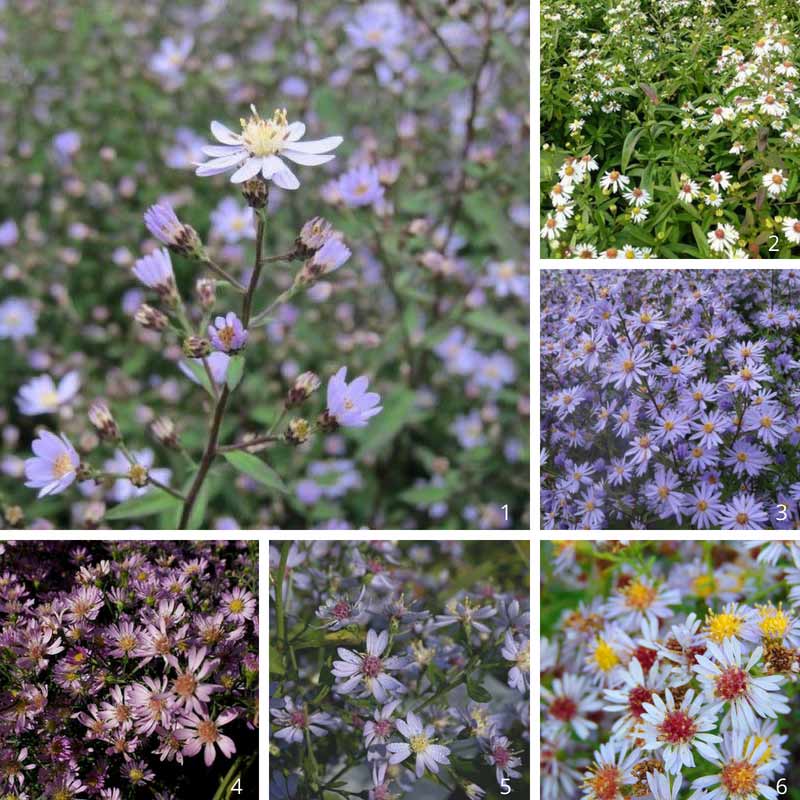
1) Aster cordifolius Blutenregen 2)Aster ericoides Herbstmyrte 3) Aster cordifolius Blue Heaven 4) Aster ericoides Blue Wonder 5) Aster cordifolius Ideal 6) Aster ericoides Lovely
-
For mixed borders: Aster novi-belgii and Aster novae-angliae
The most exuberant and colourful asters belong to the novi-belgii and novae-angliae groups, which form large, colourful clumps in mid-autumn. On average, their height ranges from 70 cm to 1.2 m, making them excellent candidates for the back of borders, but unfortunately vulnerable to wind. It is not uncommon to see them flop like cereal crops after heavy rain. Prevent this by inserting branched canes at least 50 cm tall into clumps in August. Later hidden by flower heads, this discreet framework will support the clumps more flexibly than traditional bamboo. You can also pinch them in May to keep them more compact and well-branched.
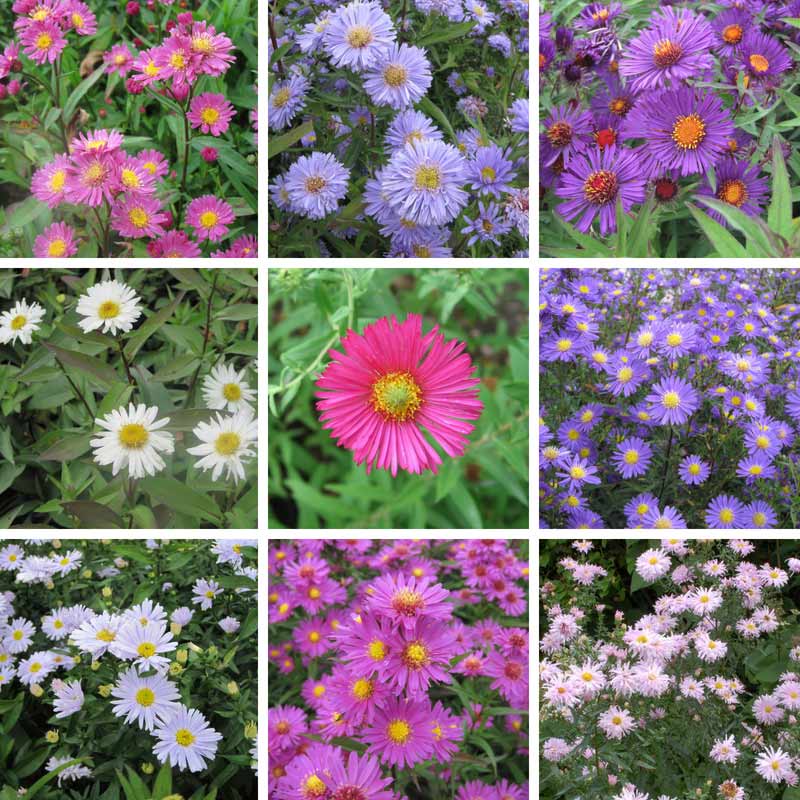
from top to bottom and from left to right: Aster novae angliae-Andenken an Paul Gerber - Aster novi-belgii Marie Ballard - Aster novae-angliae Violetta - Aster novi-belgii Weisses Wonder - Aster novae-angliae Alma Potschke - Aster novi-belgii Schone von Dietlikon - Aster novi-belgii Porzellan - Aster novi-belgi Karminkupel - Aster novi-belgii Fellowship
-
For neat, well-behaved borders: Aster dumosus
There are enough dwarf aster varieties that you need not look elsewhere to fill autumn borders. The best for compactness and abundant flowering are Aster dumosus. They do not exceed 40 cm in height (20 cm for the most compact) and their growth habit is relatively restrained. Plant them in borders or at the foot of shrubs and space them 20–25 cm apart at planting.
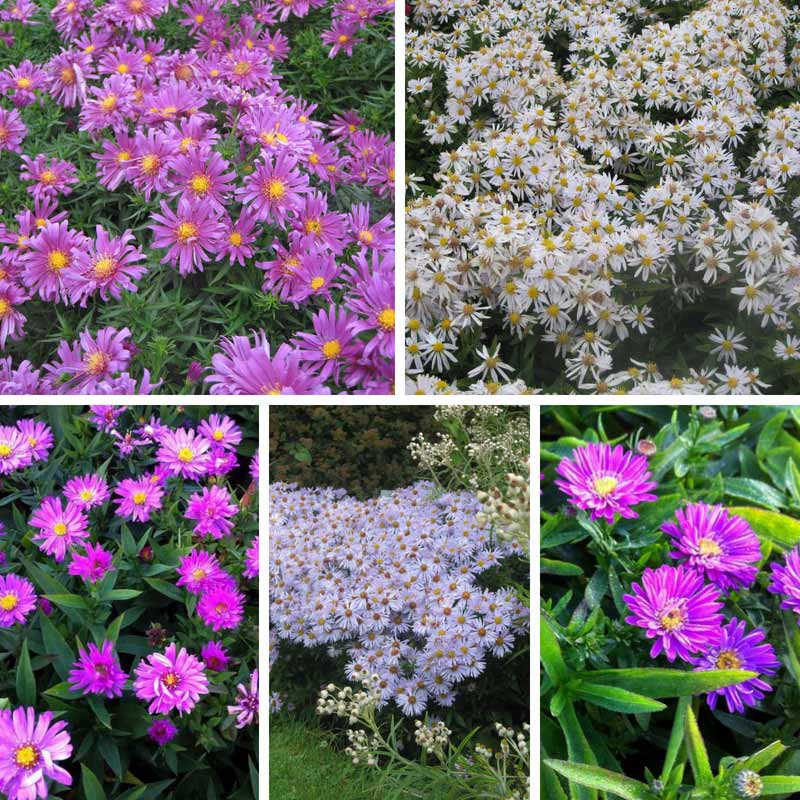
From top to bottom and from left to right: Aster dumosus Tonga, Kristina, Rosenwichtel, Silberblaukissen and Starlight
2) Combining asters: rules for good neighbourliness
Asters are perennials that are easy to combine, but while some are known to take over borders and overwhelm less vigorous companions, others are so large they collapse at the merest gust of wind.
-
Group the most vigorous together
Very vigorous varieties (Aster novi-belgii, novae-angliae and ageratoides) can occupy several square metres in a few years and smother surrounding plants. Grow them either in large, monochrome drifts where they can self-manage, or with small, colourful shrubs such as dogwoods (Cornus alba 'Siberian Pearls', Cornus alba 'Sibirica'...) or Physocarpus ('Lady in Red', 'Diable d'Or').
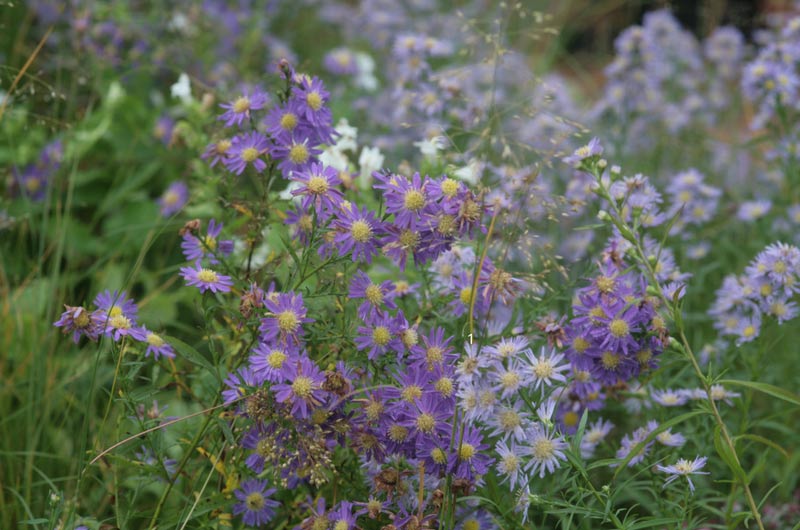
Aster novi-belgii in a mix
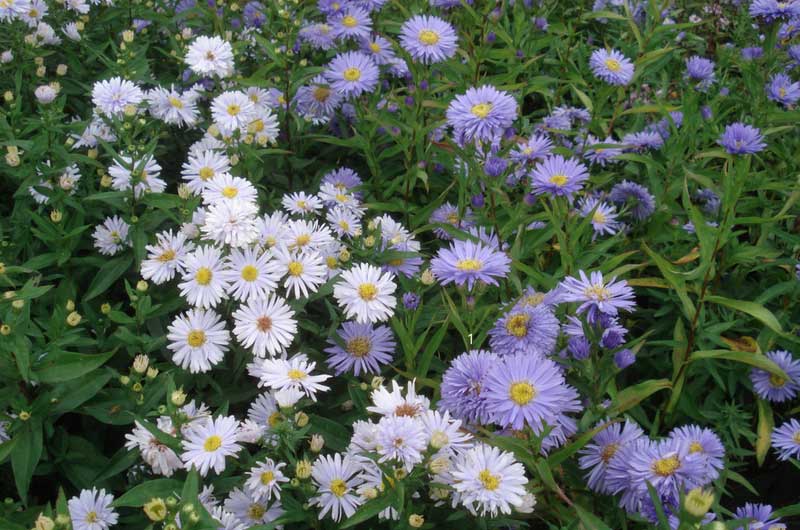
Lovely, soft pairing between the delicate, translucent flowers of Aster Porcelain and the large double mauve flowers of Aster Marie Ballard.
-
Charming duos with wild-looking perennials
Asters love the company of Japanese anemones, which naturally weave their roots into the clumps and mingle with the large, slightly stiff asters. Aster ericoides and Aster cordifolius also pair well with sedums, whose flowering they extend. They combine nicely with large structural perennials such as agastache, artemisias, persicarias or Cimicifuga. Finally, a happy autumn marriage is with grasses: mix a few Panicum, Miscanthus or Pennisetum into your aster clumps for a very sophisticated meadow effect.
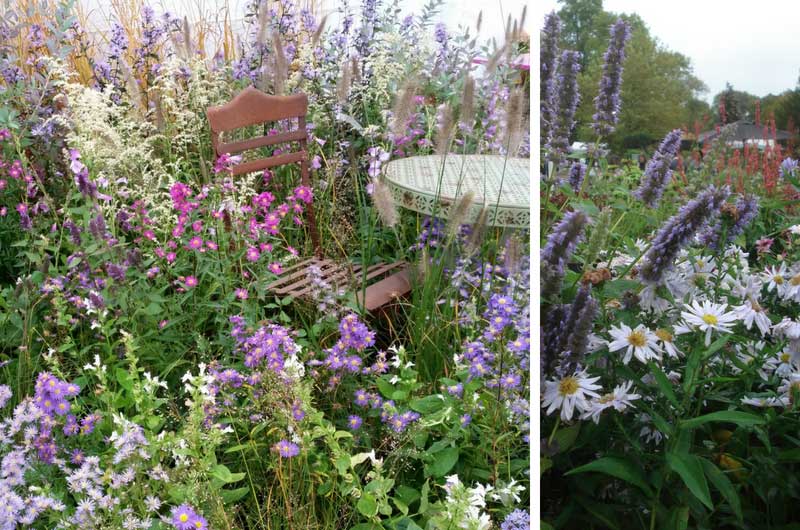
Asters mixed with artemisias and pennisetums - Pairing between agastache 'Blue Fortune' and Aster-novi-belgii 'Porcelaine'
3) How to succeed with asters? Sun and light soil
Large Aster novi-belgii and Aster novae-angliae prefer full sun. Good garden soil is all they need to be happy. They do not mind compact, clay soils provided the soil stays cool in summer. As they send out suckers relentlessly, they eventually become bare in the centre: it is then necessary to divide clumps every three years or so, in spring or in autumn after flowering.

Other asters prefer a light, cool but never waterlogged soil. All, however, like open, airy positions; avoid planting them in borders enclosed by trees or walls, where risk of powdery mildew will be greater, asters need air to flower abundantly and to keep foliage healthy. As you have probably understood, asters are easy perennials, very hardy and undemanding; like phlox or persicarias, they are indispensable perennials for late-season colour in the garden.
And you, what are your favourite varieties, your best combinations, your tips and tricks for keeping asters healthy all season long?
For more information, discover our complete guide to Asters
Temperatures are cooling, light is turning golden and veiled by first autumn mists; in the distance, star-shaped flowers of autumn asters shine across beds, blooming in large clumps where summer flowers have faded. The genus Aster includes several hundred species and varieties, the range is such that choosing can often be difficult. Discover our short […]
In its September issue, Gardens Illustrated dedicates several pages to hardy geraniums and presents the 21 best varieties.
Among this curated selection, there are many British cultivars, of course, but also excellent varieties available in our catalogue: the must-have 'Rozanne', my personal favourite: the hardy geranium 'Clos du Coudray', as well as 'Lilac Ice', 'Sirak', 'Dragon Heart', 'Tiny Monster', 'Carol', 'Orion', and 'Havana Blues'.
Here they are in pictures:
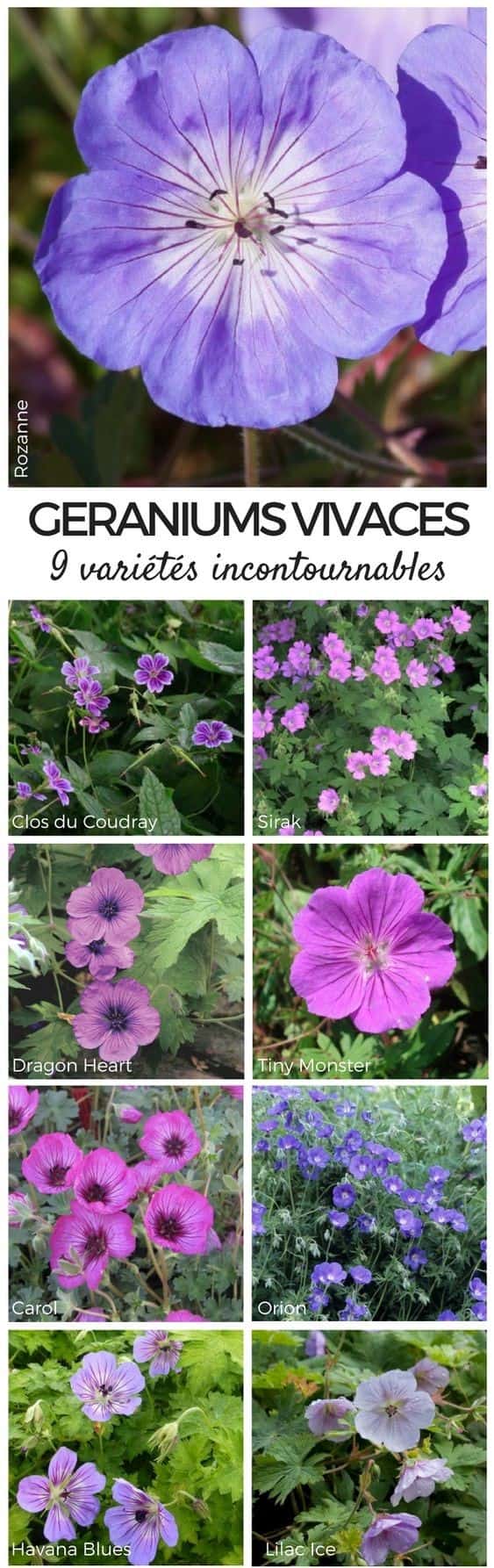
The ideal time to plant them in the garden will be here very soon. Which ones will you choose?
In its September issue, Gardens Illustrated dedicates several pages to hardy geraniums and presents the 21 best varieties. Among this curated selection, there are many British cultivars, of course, but also excellent varieties available in our catalogue: the must-have ‘Rozanne’, my personal favourite: the hardy geranium ‘Clos du Coudray’, as well as ‘Lilac Ice’, ‘Sirak’, […]
I have boundless admiration for naturalistic landscapers such as Gilles Clément, Piet Oudolf and Noël Kingsbury. Beyond their sumptuous creations, they have also rehabilitated wild plants, long dismissed as “weeds”.
In my modest garden, for lack of great skill, natural gardening is built in a mathematical way:
- by subtraction: half of the plot is left as a natural meadow; I cut wide paths with a mower as inspiration strikes to form large islands of grass and wild flowers. Mostly oxeye daisy, dandelion and plenty of sorrel grow there. Let’s be positive: if not breathtakingly beautiful, it’s ecological and authentic!
- by addition, inviting my favourite wild plants into perennial beds, chosen for stature or flowering.
In my top 5 most remarkable wild plants are:
-
Wild teasel — Dipsacus fullonum
Be patient: this large biennial only offers its thistle-like flowers in second year after sowing. Plants can reach up to two metres, making them very architectural. Commonly called “Birds’ Cabaret” or Fuller's teasel, its large leaves hold water, creating welcome bird watering stations in mid-summer. In autumn, goldfinches feast on the seeds provided. I also grow its cousin, the "cultivated teasel" (Dipsacus sativus); I obtained seeds via the magazine "la Hulotte" which has helped conserve this variety. Once used in textile industry to card wool, it almost vanished.
Do not deprive yourself of these handsome plants: though similar to thistles, they are not invasive. They self-seed easily, of course, but young seedlings are easily removed with a hoe.
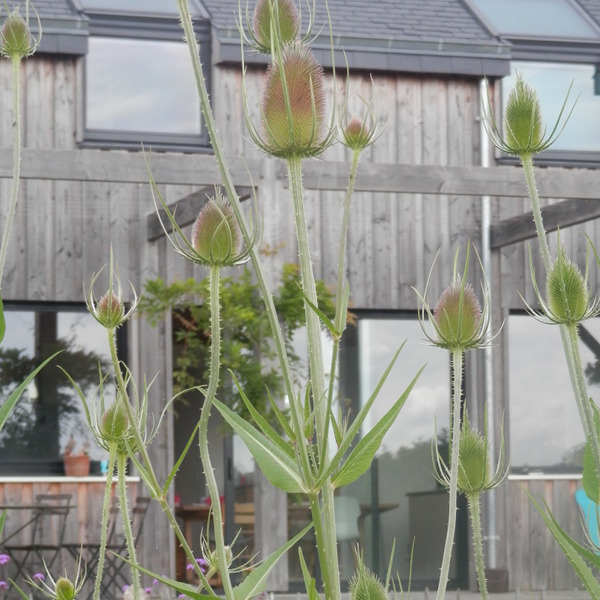
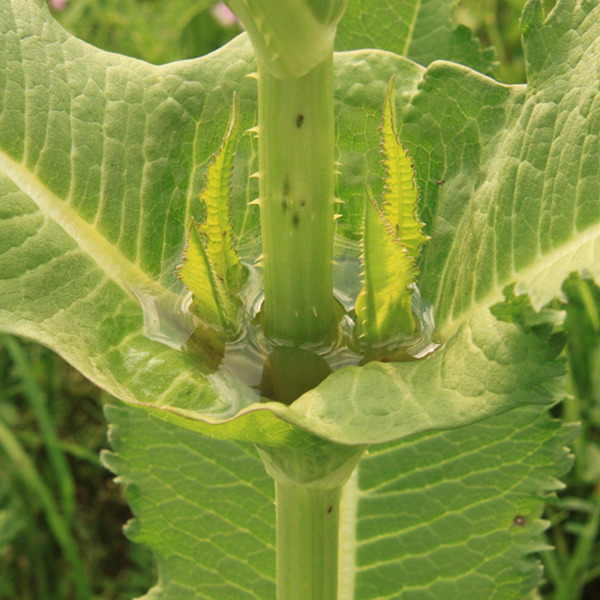
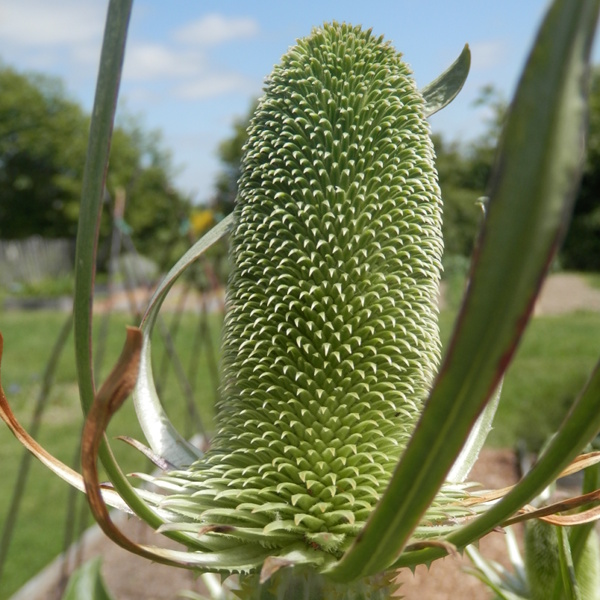
Wild chervil — Anthriscus sylvestris
I love everything about it: its cut leaves, pretty stems and white umbels of flowers. I let it settle in beds while keeping it under control, because it can become a little invasive. If you do not have it, you will struggle to find it in trade, it is so common. Please consider replacing it with the horticultural variety 'Ravenswing', which is similar and offers magnificent dark purple foliage, or with sweet chervil (Myrrhis odorata), also very interesting for both ornamental aspect and aniseed flavour.
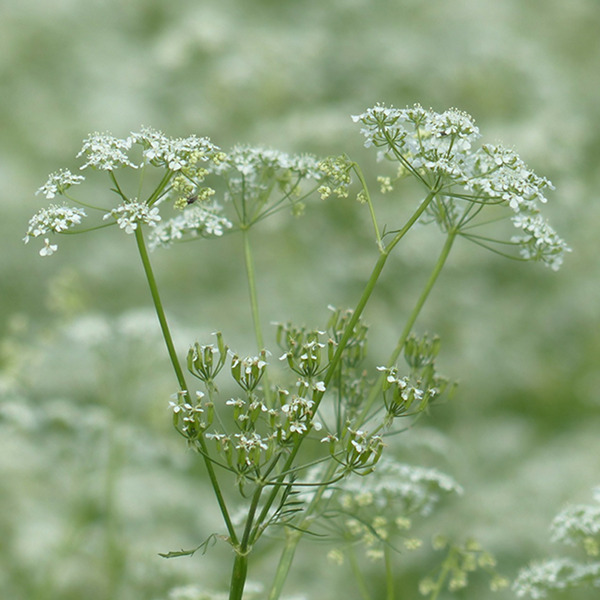
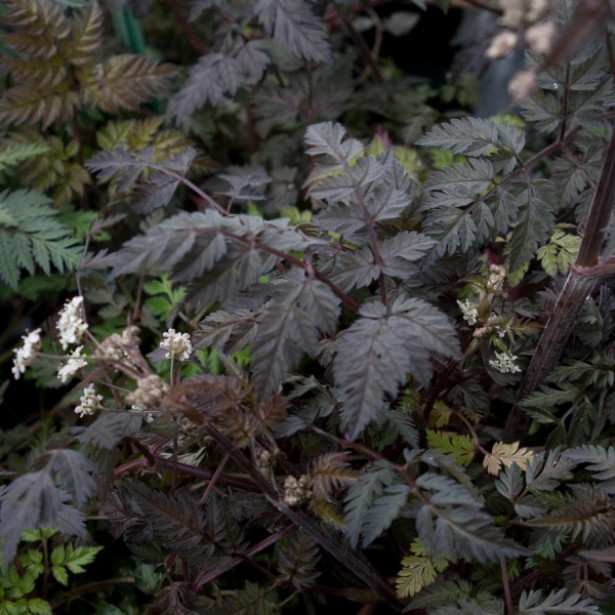
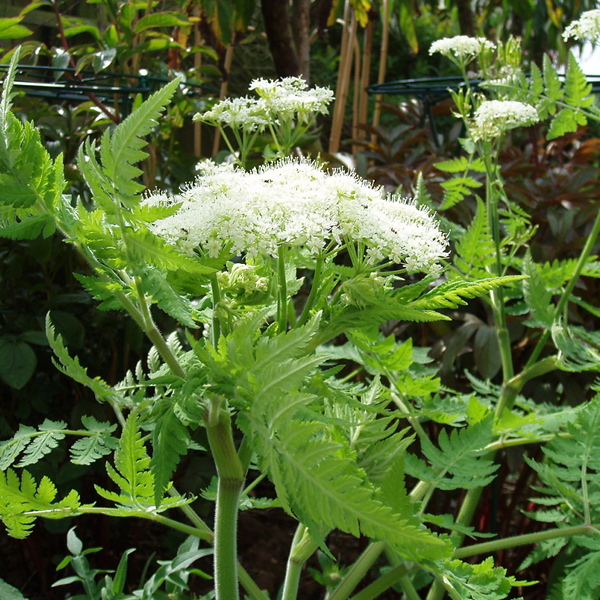
Mullein — Verbascum thapsus
Also known as Candle of Our Lady or Saint-Fiacre's herb, mullein produces large rosettes of downy leaves from which tall flowering spikes bearing yellow flowers emerge. I have several plants descended from the single specimen I found in my meadow: when I discovered it I carefully transplanted it into a bed. Since then it has produced many offspring. If you cannot find one locally, I recommend silver mullein - Verbascum bombyciferum, a close relative that resembles it closely!
Foxglove — Digitalis purpurea
Called “Lady’s Glove”, this handsome Scrophulariaceae lines road and path edges with its generous pink, purple-tinged flowering. It grew on the bank beside our garden before we arrived and I naturally let it settle. Together with horticultural foxgloves, it makes a beautiful backdrop in a bed, perfect with roses. Beware: it is toxic; if you have children, it is wise to ask them not to touch it.
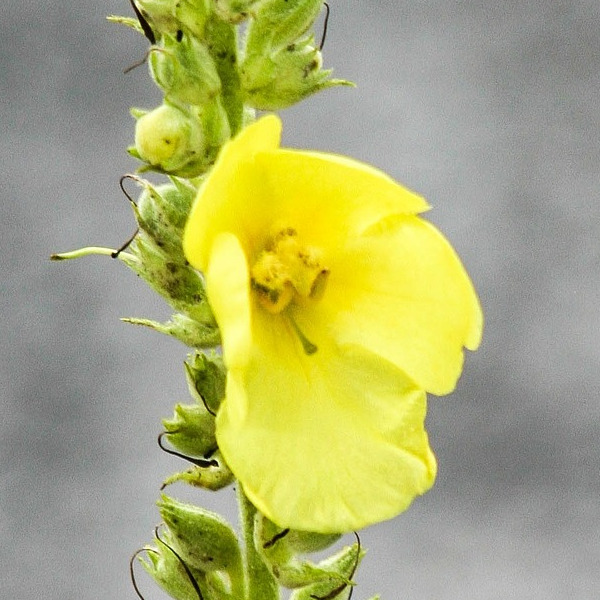
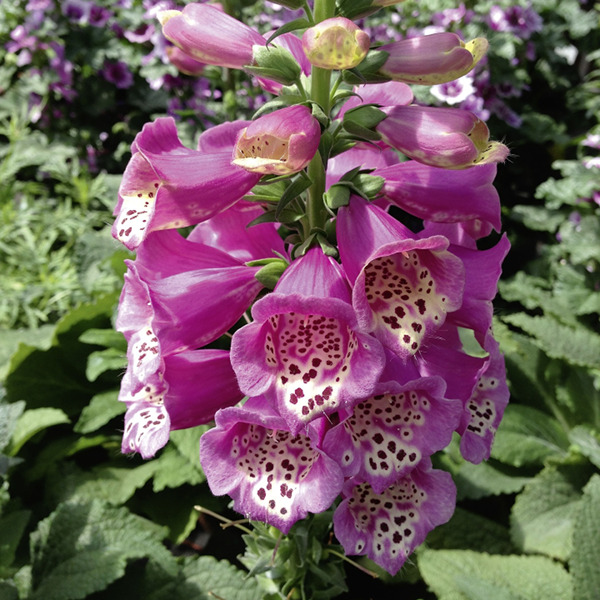
-
Common mallow — Malva sylvestris
My common mallow was given by a friend who grows edible and medicinal plants; it is actually a Mauritanian mallow but very close to the wild species. She promised that once established it would be faithful. The original plant is gone, but before it disappeared it produced plentiful offspring which I let grow wherever they do not bother me. It is a very floriferous plant with handsome purple flowers, really easy to grow and much loved by bees. A reliable choice!
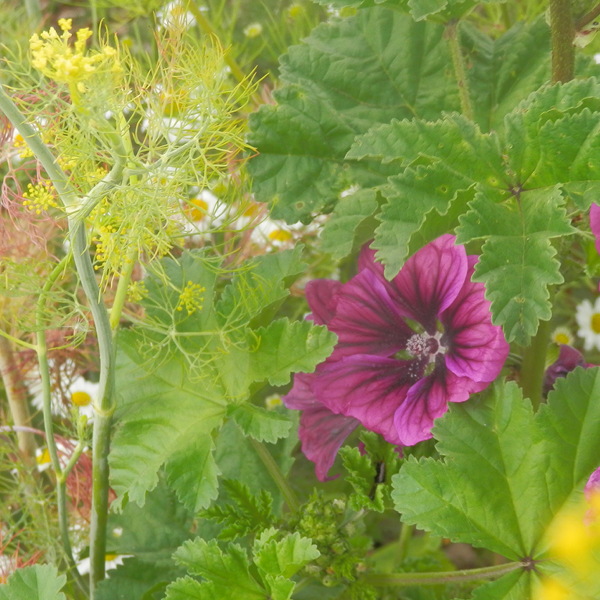
I have boundless admiration for naturalistic landscapers such as Gilles Clément, Piet Oudolf and Noël Kingsbury. Beyond their sumptuous creations, they have also rehabilitated wild plants, long dismissed as “weeds”. In my modest garden, for lack of great skill, natural gardening is built in a mathematical way: In my top 5 most remarkable wild plants […]