Cookies help us to offer you a personalised browsing experience and to measure our audience. You can configure them at any time and consult our privacy policy.
This website uses cookies to improve your experience when browsing the website. Of these, cookies classified as necessary are stored on your browser because they are essential for the basic functionality of the website to work. We also use third-party cookies to help us analyse and understand how you use this website. These cookies will only be stored on your browser with your consent. You also have the option of refusing these cookies. However, deactivating some of these cookies may have an effect on your browsing experience.
Marketing
These cookies may be used by third-party companies to establish a profile of your interests and offer you relevant advertising on other websites. They do not directly store personal data but are based on the unique identification of your browser and your Internet device. Rejecting these cookies will not necessarily mean you are less targeted by advertisements, only that they will be less targeted.
Name
Description
Lifetime
Essentials
These cookies are essential for the sound operation of our site and will make it unusable if deactivated. They do not store any personal identification information.
Name
Description
Lifetime
Analysis & Performance
These cookies enable us to monitor the number of visits and the source of enquiries in order to measure and improve the performance of our site. They also help us identify the most and least visited pages in order to improve our content. The data linked to these cookies is collated and anonymised.
Does this plant fit my garden?
Set up your Plantfit profile →
Filter
Sort by:
Display
1result
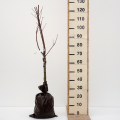
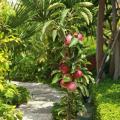
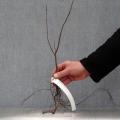
Our range of Fruit Trees with root balls, for quick establishment and planting from November to March. A fruit tree sold with a root ball is field-grown, lifted during dormancy with its soil ball wrapped in hessian that protects the rootlets. This packaging reduces transplant shock, encourages rooting and uses less plastic compared to container-grown plants. Fruit trees (apple trees, pear trees, plum trees, cherry trees...) will form, depending on the rootstock and training method, proper trees 2 to 6 metres tall, to integrate into the orchard, vegetable garden or as a fruiting hedge.
Practical advice: dig a hole twice as wide as the root ball, position the graft union above soil level, water thoroughly then mulch; carry out formative pruning in late winter and water during the first season in dry weather. For further reading, also consult our guide "How to plant a fruit tree?"
Our range of Fruit Trees with root balls, for quick establishment and planting from November to March. A fruit tree sold with a root ball is field-grown, lifted during dormancy with its soil ball wrapped in hessian that protects the rootlets. This packaging reduces transplant shock, encourages rooting and uses less plastic compared to container-grown plants. Fruit trees (apple trees, pear trees, plum trees, cherry trees...) will form, depending on the rootstock and training method, proper trees 2 to 6 metres tall, to integrate into the orchard, vegetable garden or as a fruiting hedge.
Practical advice: dig a hole twice as wide as the root ball, position the graft union above soil level, water thoroughly then mulch; carry out formative pruning in late winter and water during the first season in dry weather. For further reading, also consult our guide "How to plant a fruit tree?"
In temperate climates, pruning of spring-flowering shrubs (forsythia, spireas, etc.) should be done just after flowering.
Pruning of summer-flowering shrubs (Indian Lilac, Perovskia, etc.) can be done in winter or spring.
In cold regions as well as with frost-sensitive plants, avoid pruning too early when severe frosts may still occur.
The harvesting period indicated on our website applies to countries and regions in USDA zone 8 (France, England, Ireland, the Netherlands).
In colder areas (Scandinavia, Poland, Austria...) fruit and vegetable harvests are likely to be delayed by 3-4 weeks.
In warmer areas (Italy, Spain, Greece, etc.), harvesting will probably take place earlier, depending on weather conditions.
The sowing periods indicated on our website apply to countries and regions within USDA Zone 8 (France, UK, Ireland, Netherlands).
In colder areas (Scandinavia, Poland, Austria...), delay any outdoor sowing by 3-4 weeks, or sow under glass.
In warmer climes (Italy, Spain, Greece, etc.), bring outdoor sowing forward by a few weeks.
The planting period indicated on our website applies to regions in USDA Zone 9a (East Coast and Midlands: Dublin, Wexford, Waterford, Kilkenny, Portlaoise). It will vary depending on where you live:
On the west coast and in the north-west (Galway, Limerick, Sligo, Donegal, Westport), delay planting by 1 to 2 weeks in spring and bring it forward by 1 to 2 weeks in autumn compared to the dates given, preferably choosing periods without strong winds.
In the inland hills and plateaus (Wicklow Mountains, Macgillycuddy’s Reeks, Connemara, Killarney), it is best to plant in spring (April–May) or autumn (September–October), avoiding periods of waterlogged soil in winter and strong winds, which pose the main risk to newly planted trees in these areas.
The flowering period indicated on our website applies to regions in USDA Zone 9a, such as the East Coast and Midlands, including Dublin, Wexford, Waterford, Kilkenny and Portlaoise.
This will vary depending on where you live:
On the west coast and in the northwest (Galway, Limerick, Sligo, Donegal and Westport), it will be delayed by one to two weeks compared to the given dates, due to stronger Atlantic winds and less spring sunshine.
In the inland hills and plateaus (the Wicklow Mountains, the Macgillycuddy's Reeks, Connemara and Killarney), flowering will be delayed by two to three weeks. Flowering mainly occurs between May and July, with the limiting factors being less frost and more of the excessive humidity, strong winds and lack of sunshine that are characteristic of these areas.