Olea europaea - Olive
Olea europaea - Olive
Olea europaea - Olive
Olea europaea - Olive
Olea europaea - Olive
Olea europaea - Olive
Olea europaea - Olive
Olea europaea - Olive
Olea europaea
Common olive
The olive tree arrived in great condition! It is truly magnificent! What's more, I was well advised on planting, so I'm delighted. As I've placed it indoors in a somewhat shaded spot, I bought a horticultural light, hoping it will keep it looking its best! I'm delighted.
SG, 14/10/2025
Back-to-school special offer!
Get €10 off for every €50 you spend! And get up to €40 off on a single order.
How does it work?
1. Shop your favourites
Add your favourite plants to your basket. For every €50 you spend (excluding delivery charges, store credit and the plastic-free option), you’ll receive a €10 voucher.
€50 spent = €10 voucher
€100 spent = €20 voucher
€150 spent = €30 voucher
€200 spent = €40 voucher
2. Place your order
Once your basket reaches one of the spending thresholds, place your order. You can even choose your delivery date!
3. Receive your voucher
As soon as your order has been shipped, you’ll receive an email containing your personal voucher code and its value.
4. Use it on your next order
Your voucher is valid for 90 days from the date you receive it. It can be used once only, on a new order worth at least the value of the voucher, excluding delivery charges.
Please note: Vouchers can be combined with other offers, but cannot be split or refunded.
Home or relay delivery (depending on size and destination)
Important: You may be charged customs duties by your country’s customs authorities upon delivery.
Schedule delivery date
and select date in basket
This plant carries a 24 months recovery warranty
More information
We guarantee the quality of our plants for a full growing cycle, and will replace at our expense any plant that fails to recover under normal climatic and planting conditions.

Does this plant fit my garden?
Set up your Plantfit profile →
Description
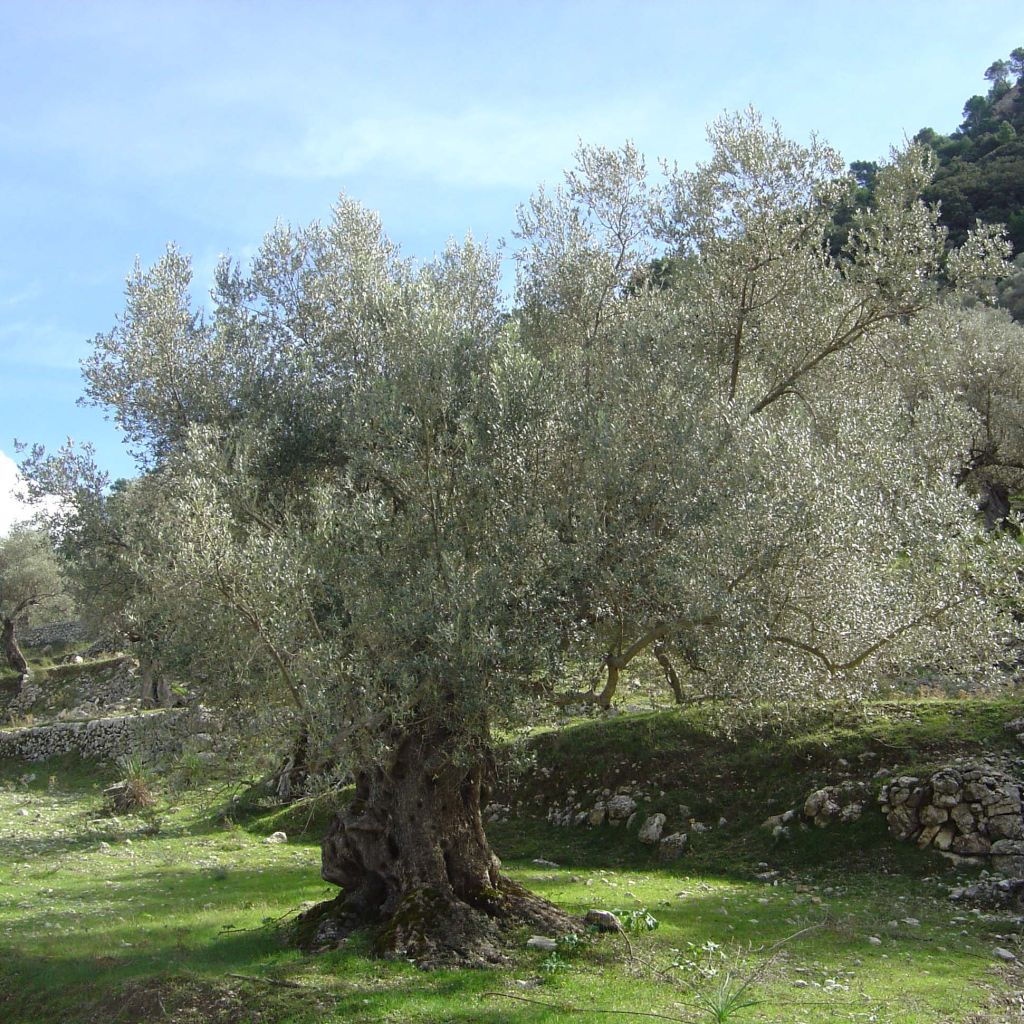
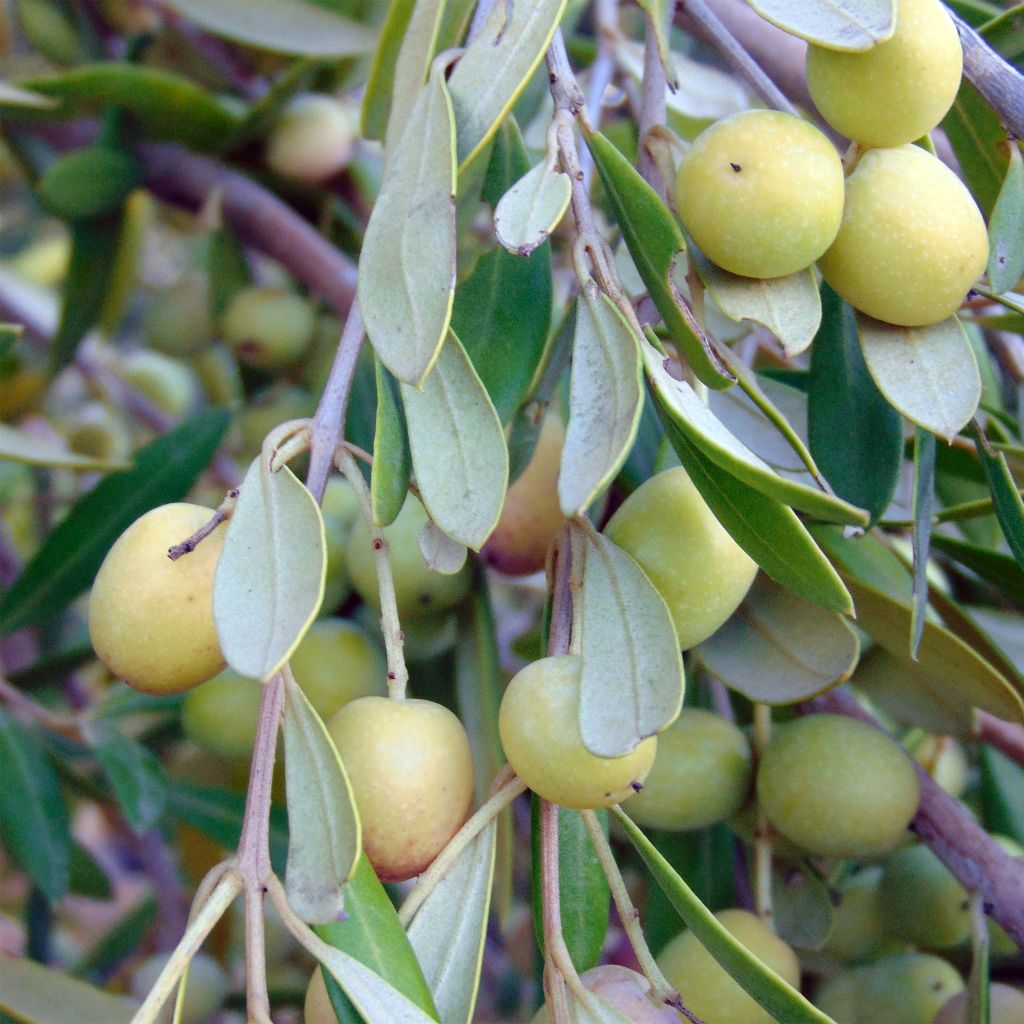
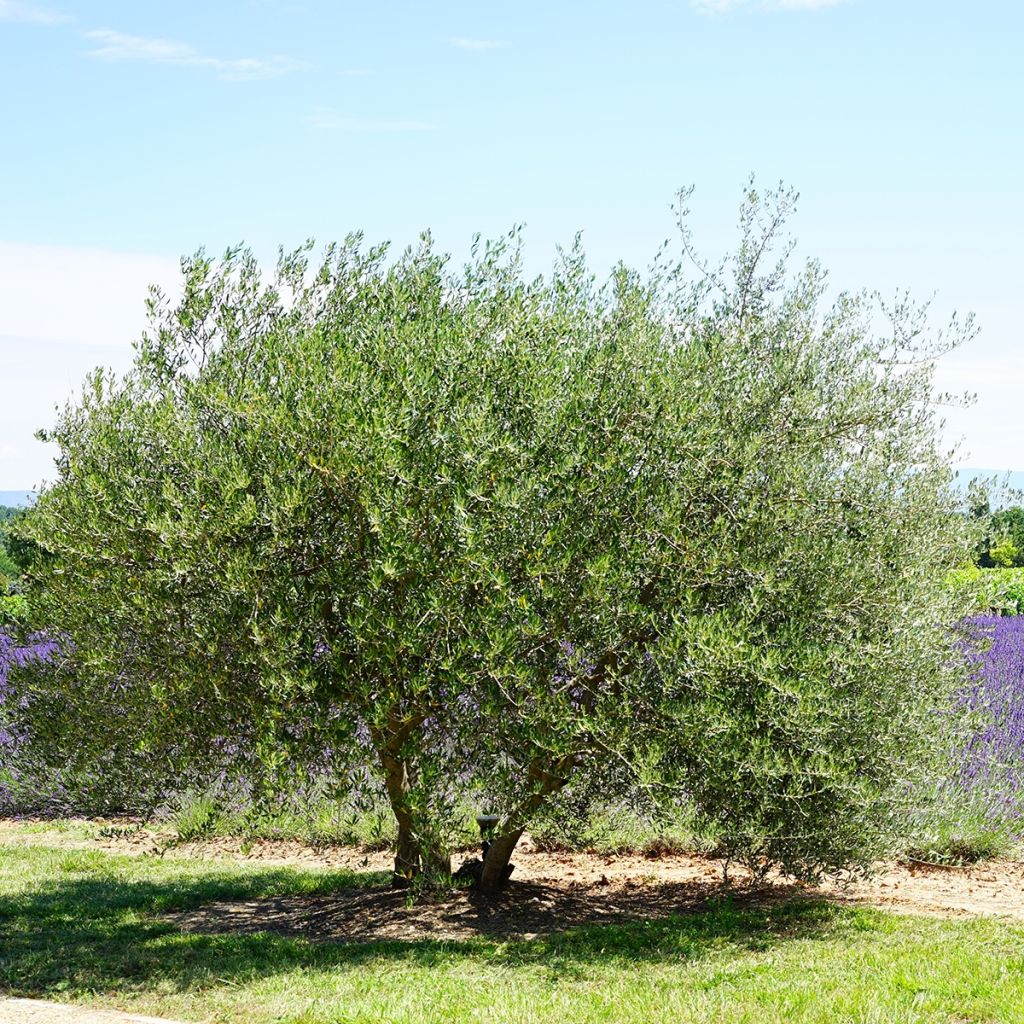
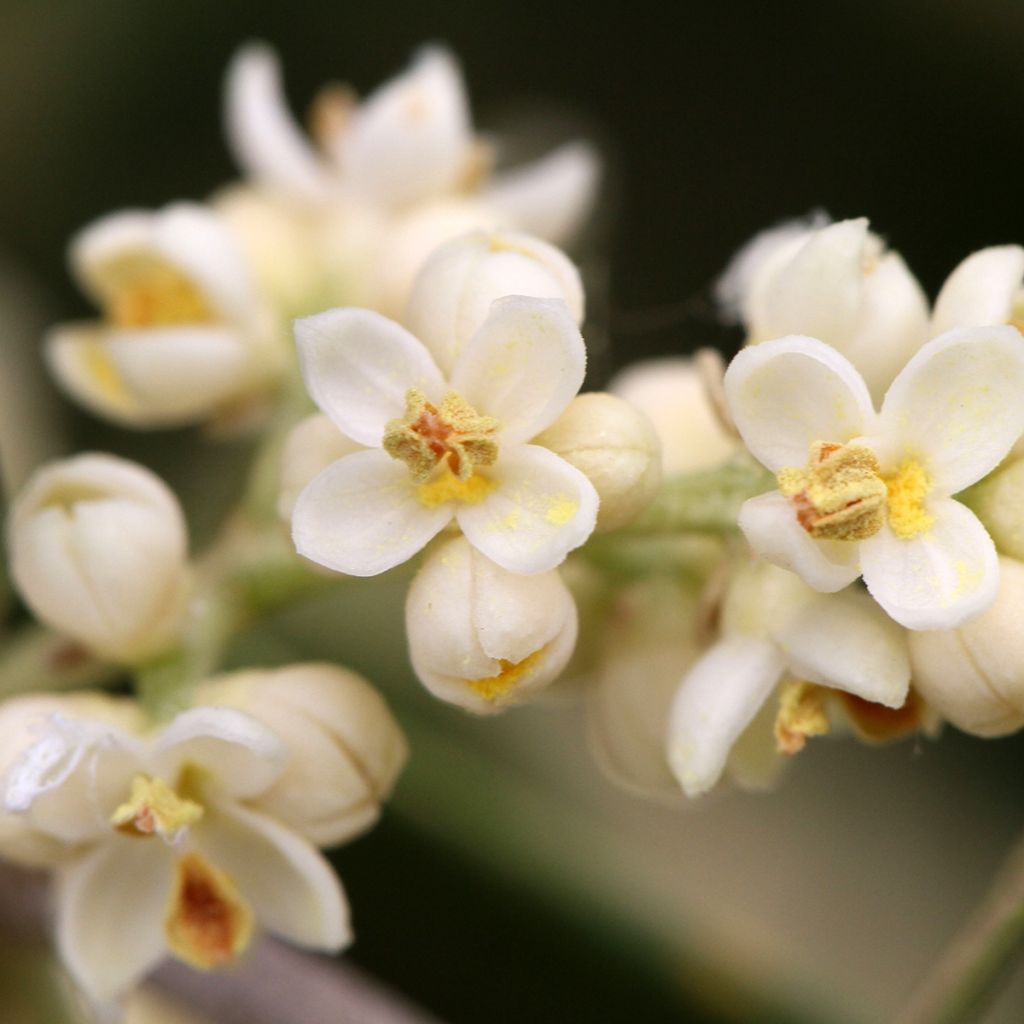
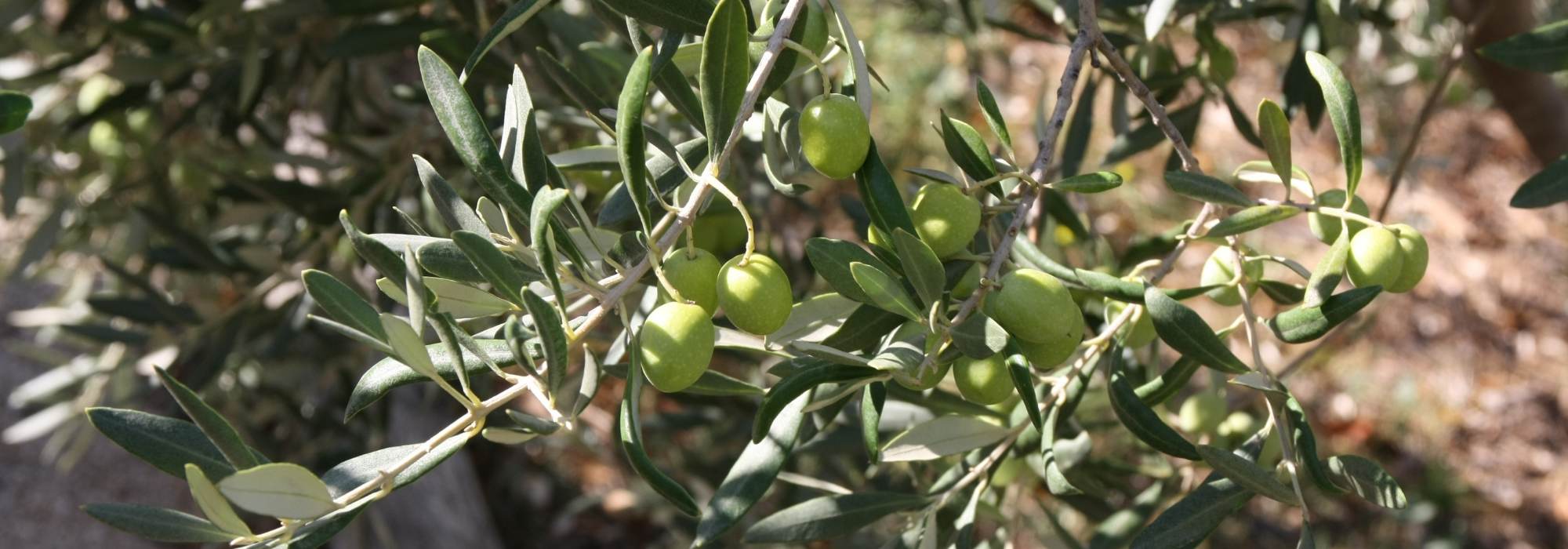
The presence of Olea europaea all around the Mediterranean, dates back to ancient times, one could say to the flood. Both an ornamental tree and a functional tree, it is inseparable from the Mediterranean landscape, just like the fig tree, the evergreen oak, the pomegranate tree and the vine. Its silhouette is instantly recognisable: a sturdy and knotty trunk as it ages, a bushy and spreading crown, dressed in grey-green evergreen foliage with a silver underside, rustling in the wind. Spring covers it with countless small yellow-cream flowers, adding to its charm. Fruiting occurs after ten years, in the form of green olives that ripen to black. The fruit has an extremely bitter taste, making it inedible in its current state. It is very resistant to drought and appreciates well-drained, even rocky soils, but cannot tolerate temperatures below -12°C (10.4° F). This small tree can be grown in a large pot, provided it is protected during winter.
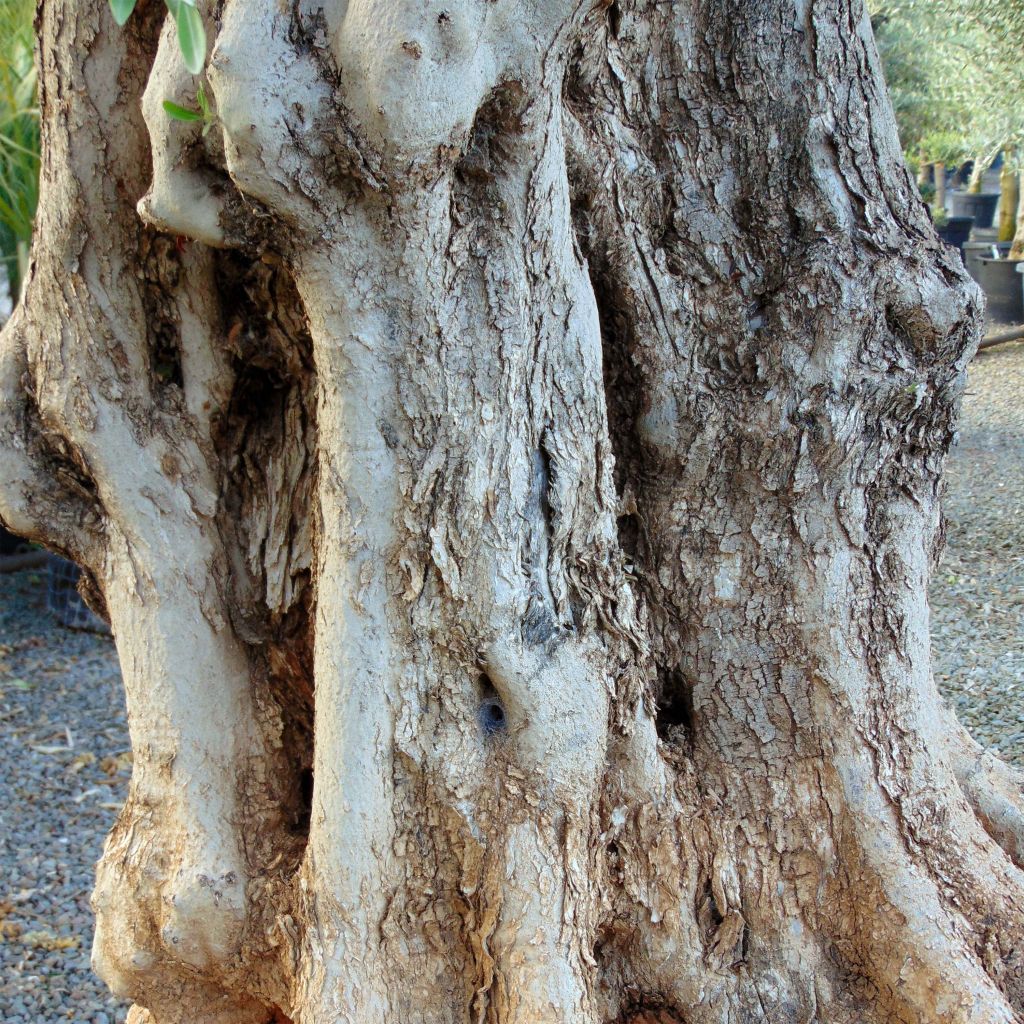
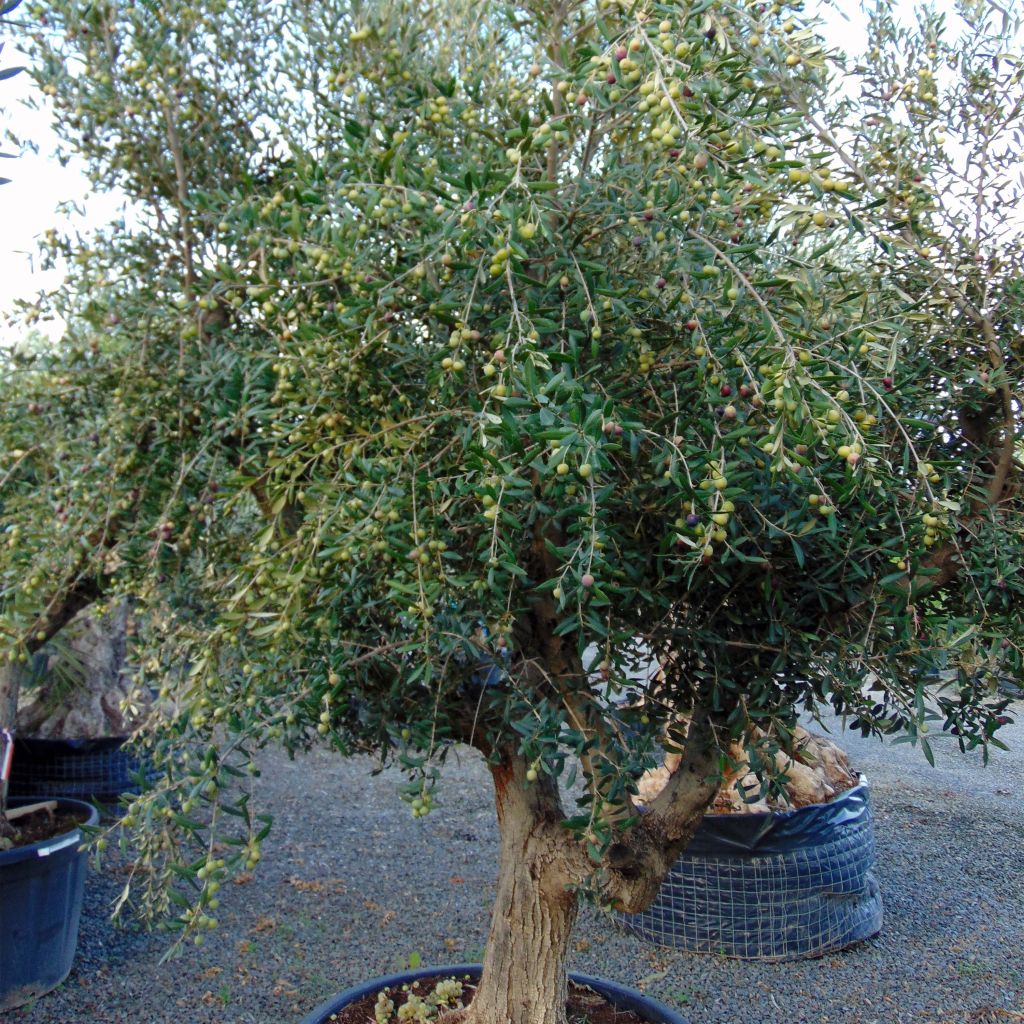
Olea europaea or common olive tree belongs to the Oleaceae family, it is the most represented species within this family which counts nearly 25, all showing exceptional longevity. This small evergreen tree reaches about 9 m (29.5 ft) in height, after many years of cultivation. But in its young age, its growth is rapid, and fruiting occurs after around 10 years. Its picturesque habit can adopt many fanciful silhouettes: spreading branches, with a single trunk or multiple trunks, cracked and rough bark with multiple scars left by time. Its evergreen foliage is composed of opposite, entire and elliptical leaves, which are leathery and sprinkled with scale-like hairs. The leaves are more or less narrow, and measure 3 cm to 9 cm (1.2 in to 3.5 in) long. They cover branches dotted with peltate scales. Their colour is a mixture of green and grey, with the underside of the leaves being downy and silver. The very brief flowering takes place for one week at the end of spring. The flowers, white or yellowish, are grouped in axillary panicles. The fruits, the olives, are fleshy drupes with hard stones, 5 mm to 4 cm (0.2 in to 1.6 in) long, green then black at maturity. Its bark is grey and smooth when young, and cracks with age, while the tree emits shoots at the base of the trunk.
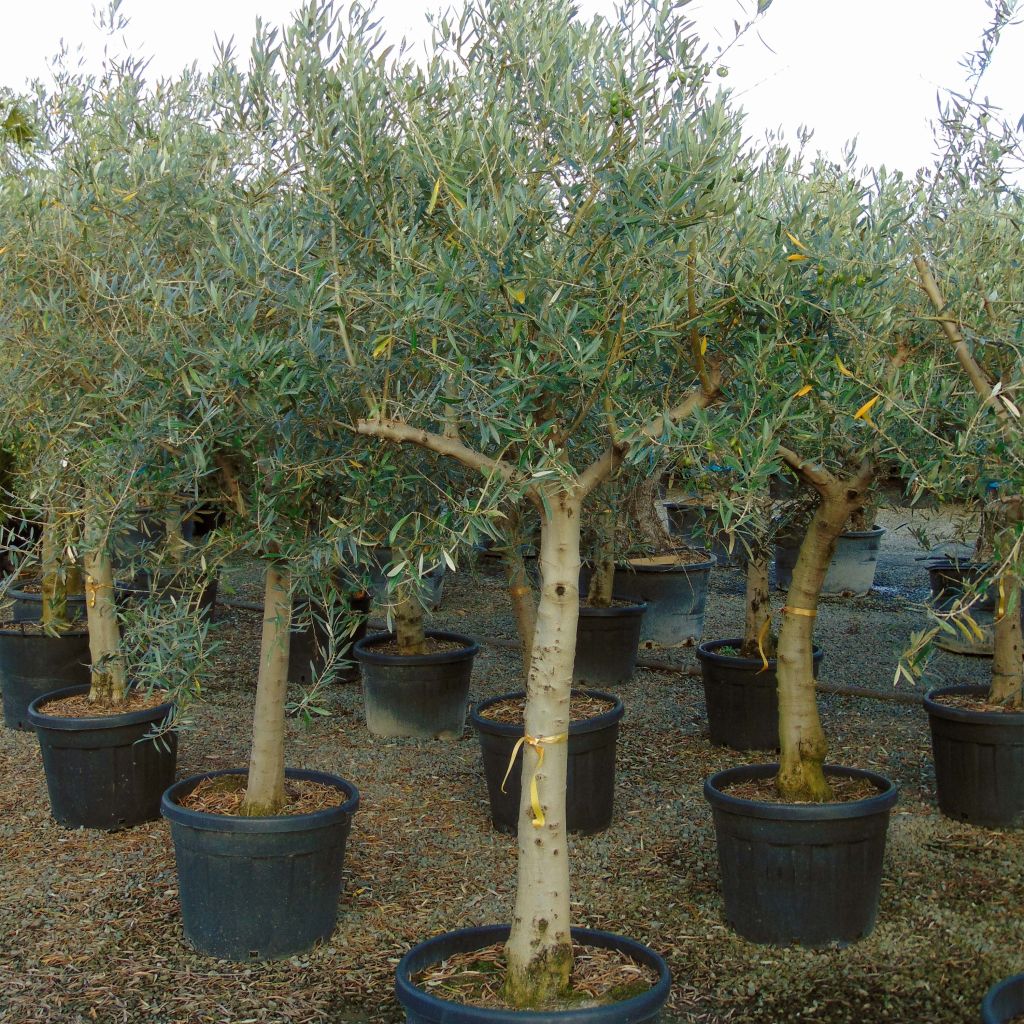
The Common Olive tree is perfectly adapted to the Mediterranean climate, but its distribution range extends northward depending on summer rainfall, which seems to be a determining factor. Once well established, this tree withstands moderate freezing of around -10° C to -12° C (14° F to 10.4° F), in well-drained soil, but it needs drought in summer to properly ripen its wood. In warmer areas, it can be planted as a solitary tree, surrounded by daylilies, agapanthus or iris, santolina, cyclamen, Muscaris, lonicera nitida, or covered with a climbing rose (for example, 'Senateur Lafolette'). It can also be planted in a windbreak hedge with laurel trees, bay laurel, evergreen oaks, strawberry trees, and myrtles. In an orchard, plant alongside almond trees, quince trees, flowering or fruiting apple trees, and plum trees. In colder regions, plant it in large pots, which can be sheltered in winter.
A very old tree: the Olive tree named "The King of Kings" in Roquebrune-Cap-Martin, in the Alpes-Maritimes, has a stump with a circumference of 20 m (65.6 ft), which encompasses the surrounding rocks; it is estimated to be 1000 to 2000 years old.
Olea europaea - Olive in pictures
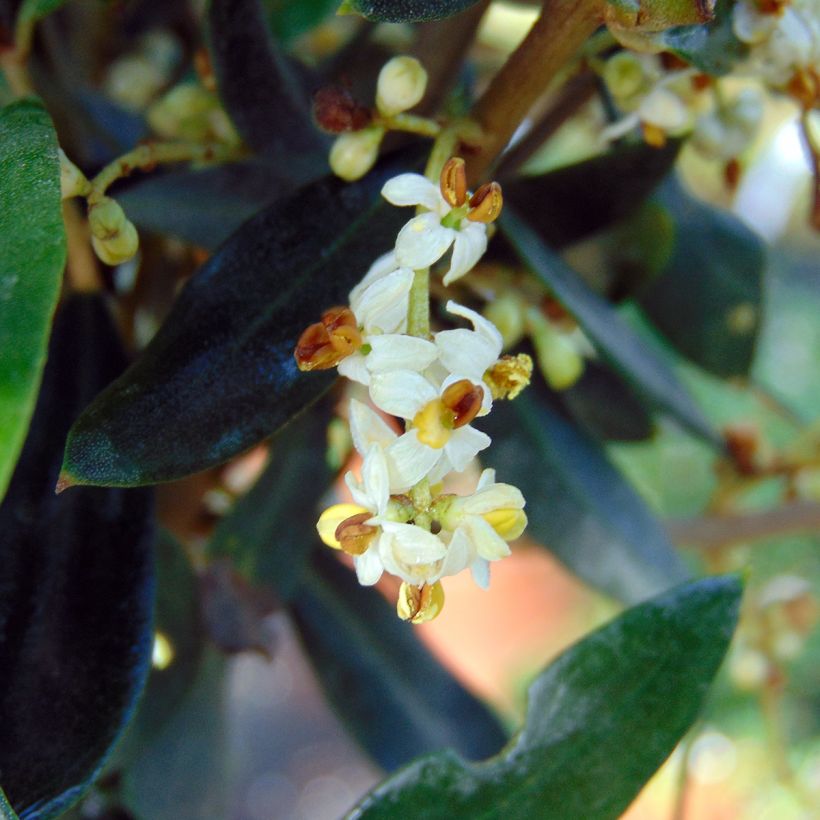
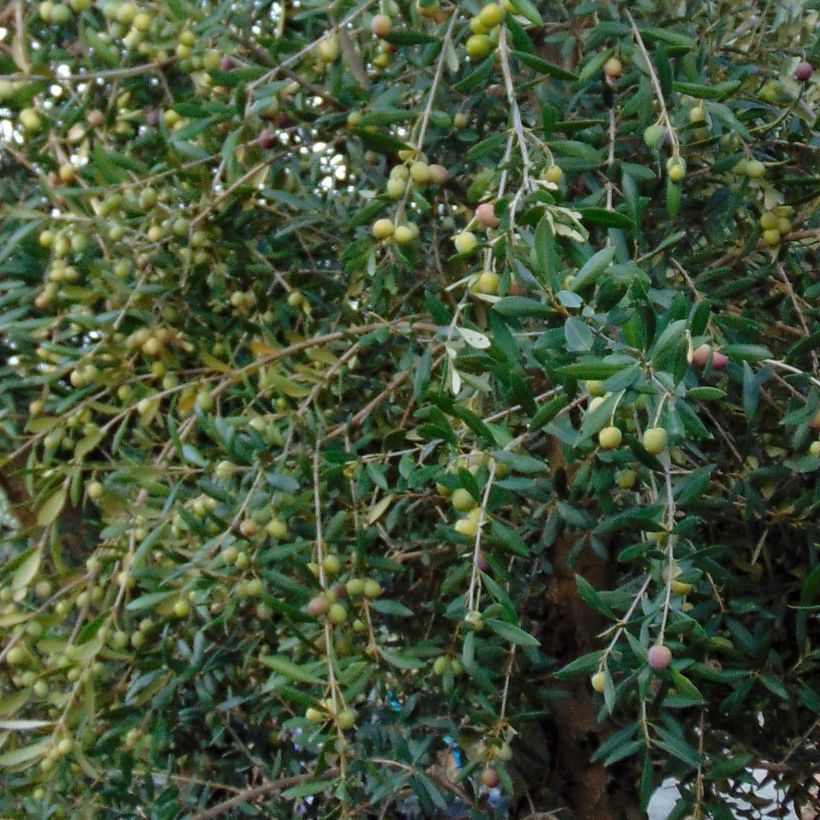
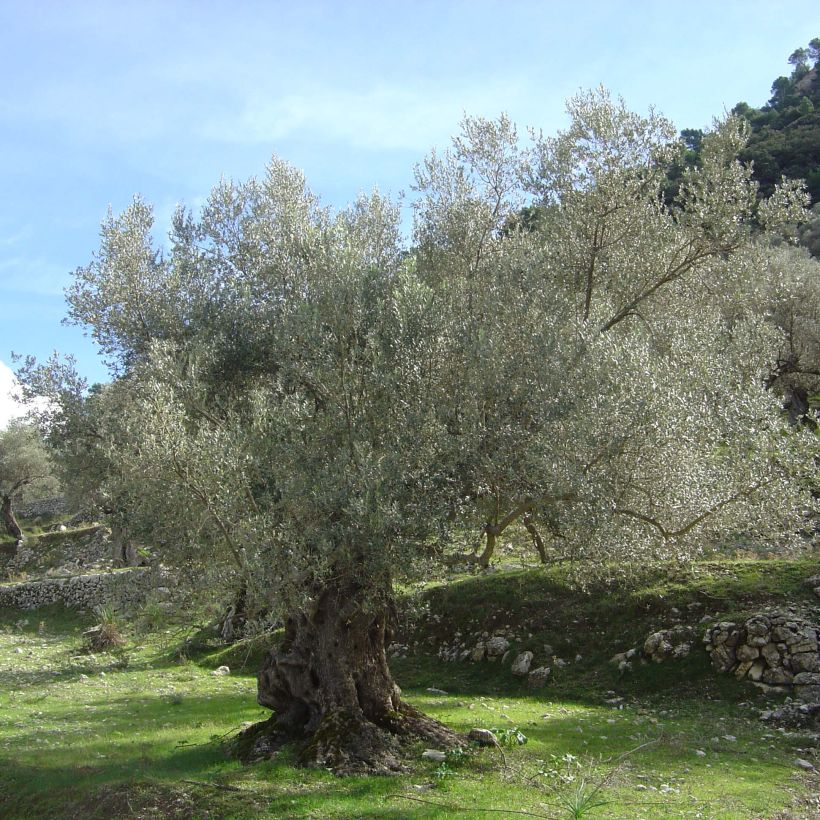
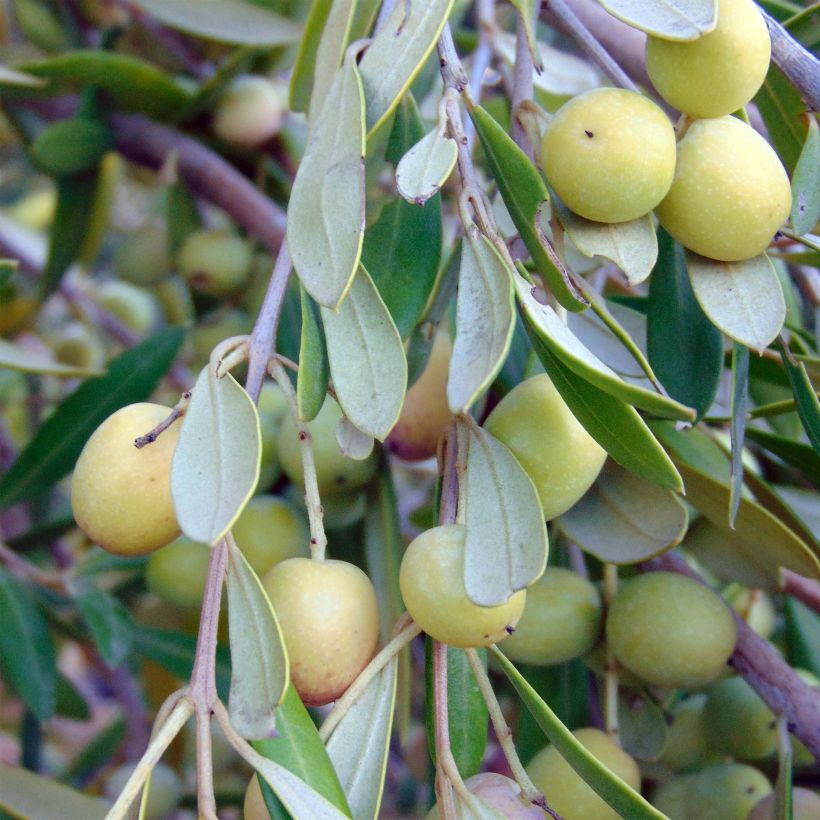
Plant habit
Flowering
Foliage
Safety measures
Botanical data
Olea
europaea
Oleaceae
Common olive
Mediterranean
atteinterespiratoire
Cette plante peut entraîner des symptômes allergiques.
Evitez de la planter si vous ou vos proches souffrez de rhinite saisonnière ("rhume des foins").
Davantage d'informations sur https://plantes-risque.info
Planting and care
Plant Olea europaea in spring, as young plants are particularly sensitive to cold. Well-established plants that are a few years old can withstand short frosts of around -10° C to -12° C (14° F to 10.4° F). If you plant the olive tree in open ground, dig a basin around the tree. Do not plant it in the middle of a short grass meadow, as it would suffer from regular watering that would cause root asphyxiation and rot. The common olive tree can thrive in ordinary soil, even limestone and rocky soil, but it must be permeable and well-drained. It can perfectly tolerate summer drought, sometimes at the expense of the harvest. It also requires a sunny location sheltered from cold winds, especially outside the area where it is traditionally cultivated.
For an olive tree grown in a pot, place a draining layer of soil, sand, and small stones at the bottom. Repot every 2 or 3 years.
Use a 2.5 m (8.2 ft) tall stake to ensure a straight habit for the tree as it grows. Adjust the height of the stake according to the size of your olive tree in the case of container cultivation.
Diseases and pests: there are many, but rarely deadly.
The Olive Fruit Fly is particularly troublesome for fruit production. Olive trees can also be bothered by thrips, black scale (often accompanied by sooty mould), bark beetle and olive moth.
Olive tree diseases are not lethal and can be easily treated or disappear on their own. However, there is one exception to the rule: a fungal disease called root rot that attacks the roots and then spreads throughout the branches.
Planting period
Intended location
Care
Planting & care advice
-
-
-
-
-
-
-

-
-
, onOrder confirmed
Reply from on Promesse de fleurs
Recently viewed products
Haven't found what you were looking for?
Hardiness is the lowest winter temperature a plant can endure without suffering serious damage or even dying. However, hardiness is affected by location (a sheltered area, such as a patio), protection (winter cover) and soil type (hardiness is improved by well-drained soil).
In temperate climates, pruning of spring-flowering shrubs (forsythia, spireas, etc.) should be done just after flowering.
Pruning of summer-flowering shrubs (Indian Lilac, Perovskia, etc.) can be done in winter or spring.
In cold regions as well as with frost-sensitive plants, avoid pruning too early when severe frosts may still occur.
The harvesting period indicated on our website applies to countries and regions in USDA zone 8 (France, England, Ireland, the Netherlands).
In colder areas (Scandinavia, Poland, Austria...) fruit and vegetable harvests are likely to be delayed by 3-4 weeks.
In warmer areas (Italy, Spain, Greece, etc.), harvesting will probably take place earlier, depending on weather conditions.
The sowing periods indicated on our website apply to countries and regions within USDA Zone 8 (France, UK, Ireland, Netherlands).
In colder areas (Scandinavia, Poland, Austria...), delay any outdoor sowing by 3-4 weeks, or sow under glass.
In warmer climes (Italy, Spain, Greece, etc.), bring outdoor sowing forward by a few weeks.
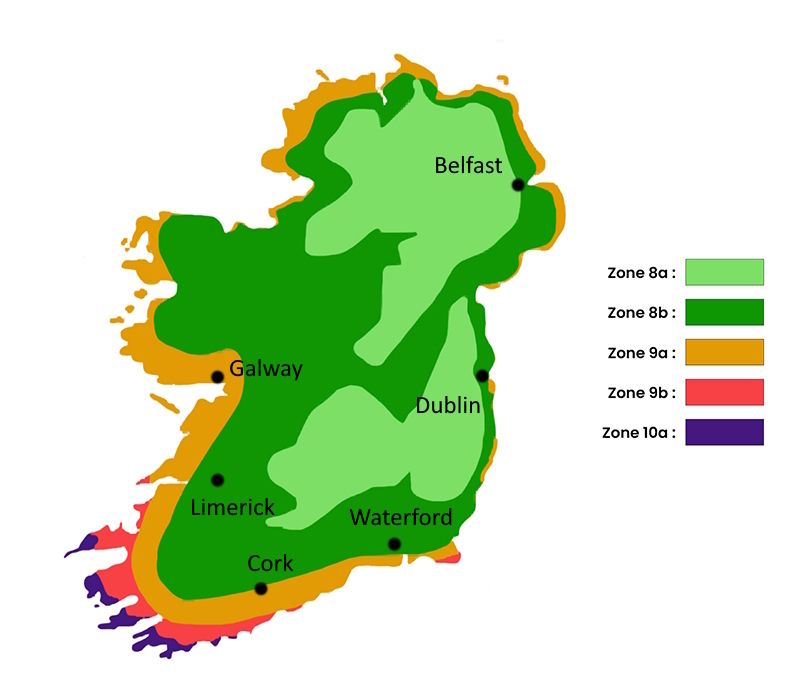
The planting period indicated on our website applies to regions in USDA Zone 9a (East Coast and Midlands: Dublin, Wexford, Waterford, Kilkenny, Portlaoise). It will vary depending on where you live:
- On the west coast and in the north-west (Galway, Limerick, Sligo, Donegal, Westport), delay planting by 1 to 2 weeks in spring and bring it forward by 1 to 2 weeks in autumn compared to the dates given, preferably choosing periods without strong winds.
- In the inland hills and plateaus (Wicklow Mountains, Macgillycuddy’s Reeks, Connemara, Killarney), it is best to plant in spring (April–May) or autumn (September–October), avoiding periods of waterlogged soil in winter and strong winds, which pose the main risk to newly planted trees in these areas.
The flowering period indicated on our website applies to regions in USDA Zone 9a, such as the East Coast and Midlands, including Dublin, Wexford, Waterford, Kilkenny and Portlaoise.
This will vary depending on where you live:
- On the west coast and in the northwest (Galway, Limerick, Sligo, Donegal and Westport), it will be delayed by one to two weeks compared to the given dates, due to stronger Atlantic winds and less spring sunshine.
- In the inland hills and plateaus (the Wicklow Mountains, the Macgillycuddy's Reeks, Connemara and Killarney), flowering will be delayed by two to three weeks. Flowering mainly occurs between May and July, with the limiting factors being less frost and more of the excessive humidity, strong winds and lack of sunshine that are characteristic of these areas.
Shipping country and language
Your country of residence may be:
Your country of residence is:
For a better user experience on our website, you can select:
Your shipping country:
-
 Austria
-
 Belgium
-
 Bosnia & Herzegovina
-
 Bulgaria
-
 Croatia
-
 Cyprus
-
 Czechia
-
 Denmark
-
 Estonia
-
 Finland
-
 France
-
 Germany
-
 Greece
-
 Hungary
-
 Iceland
-
 Ireland
-
 Italy
Italy
-
 Latvia
-
 Liechtenstein
-
 Lithuania
-
 Luxembourg
-
 Malta
Malta
-
 Netherlands
-
 Poland
-
 Portugal
-
 Romania
-
 Serbia
-
 Slovakia
-
 Slovenia
-
 Spain
Spain
-
 Sweden
-
 Switzerland
Language:
-
French
-
 English
-
Spanish
-
Italian
-
German
-
Portuguese
-
Dutch
-
Finnish
My Account
Hello
My wish lists
My cart
Log in / Register
Existing customer?
This form is protected by reCAPTCHA - the Google Privacy Policy and Terms of Service apply.
New customer?
Create an account to track your orders, access our customer service and, if you wish, make the most of our upcoming offers.