Further reading…
Fancy strong contrasts in garden? Against pastel harmonies of Unicorn, saturated crimsons of Dark Acadomia, or teal blues of Transformative Teal, primary colour trend plays with cyan, magenta and yellow, a striking trio of the three base colours of the colour wheel. Elementary, almost childish, this colour mix divides opinion, but can fit into different styles. Judge for yourself with these pairing ideas!
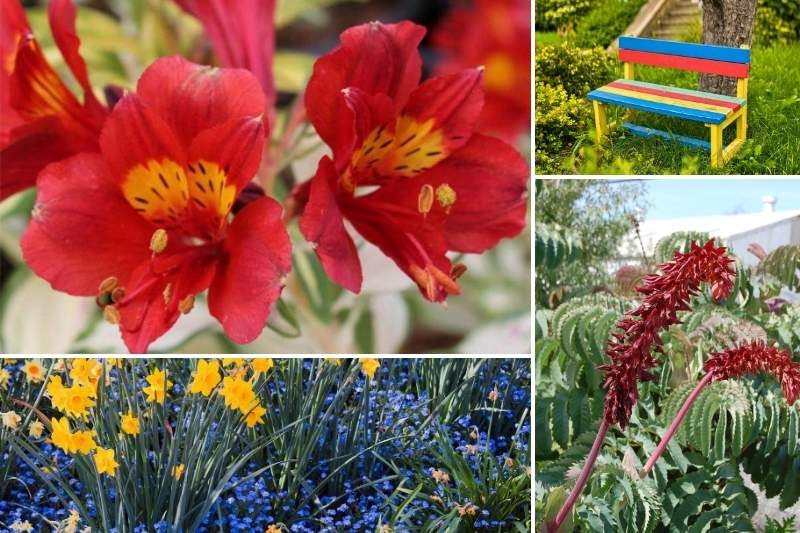
Primary colours: how to use them well ?
Red, blue and yellow flowerings are among most common in garden. Combining them is quite rare, most gardeners preferring harmonies, tonal ranges or colour gradients, or complementary pairings between two colours.
To avoid gaudy, unflattering and slightly cold combinations, finesse is required, pairing vermilion to crimson reds, very pale yellows to more orangey golds, gentian blues to periwinkle blues.
Surround these vivid colours with golden, bluish or purplish foliage. All variegated foliage or bicolour flowerings will help diffuse these strong-contrast tones. Finally, <strong:white, added in small touches in flowers or on foliage also helps attenuate this primary trio, as does play of green flowerings…
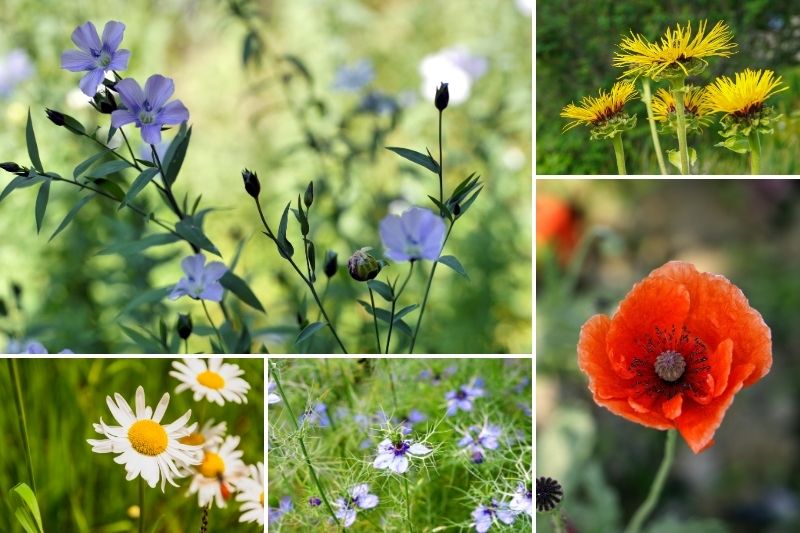
Freshness in the country garden
A cottage garden is a place where all colours often meet in a joyful jumble.
In this example, we bring together simple plants that will produce a very natural, refreshing effect in a country border. We will combine wildflowers, grandmother’s garden plants and cottage-garden plants.
For blues, try cornflower, flax, nigella, chicory, forget-me-nots, campanulas, heliotropic for its fragrance, and China aster 'King Size Mid Blue' for late season. All these plants are delightful and very effective.
Yellows here are provided by generous perennials such as Leucanthemum (large daisy) combining whiteness, mullein with grey‑green foliage, and inulas with more golden tones. One can equally seek paler yellows from charming hollyhocks, or bicolours with Anthemis.
For the red wave, opt for poppies and oriental poppies, spring tulips, sweet williams, peonies and cosmos.
Surround them with a few plants of wild fennel, very airy with greenish flowers, and a few white thalictrums to blur the effect.
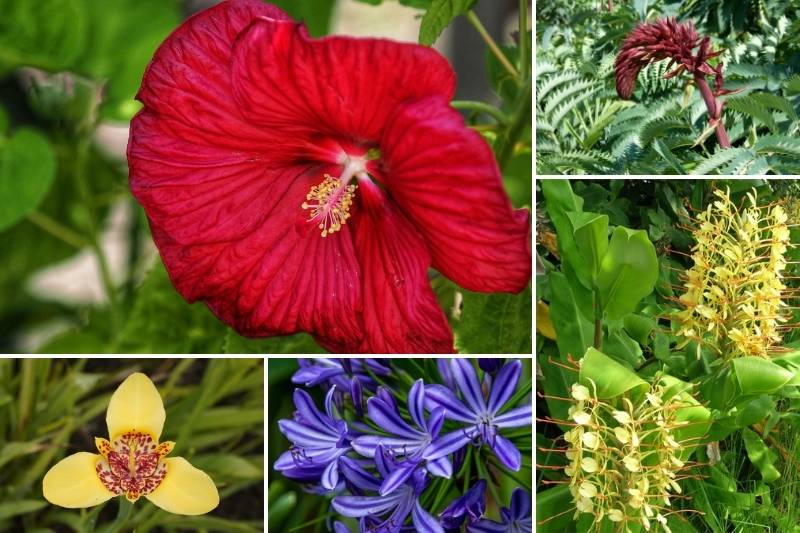
A surprising trio in an exotic garden
Yellow and red, warm colours, are musts in exotic or tropical gardens. Putting them near blue tempers them, while keeping spirit of that foreign garden alive.
Think of Protea 'Clark's Red' or Leucadendron 'Devil's Bush' for magenta notes in mild‑winter regions, elsewhere yellow or red Alstroemerias and Kniphofias for the yellow.
Plant together, as in example illustrated below, a common Rose mallow, agapanthus, a fine Hedychium gardenarium, yellow and red Tigridia, a Melianthus with strange reddish‑brown inflorescences. Blue will be represented, besides agapanthus, by a beautiful passion flower, an Abutilon vitifolium or some Canary viper's buglosses with giant spikes.
To avoid leaving area bare once summer season has passed, plant among these exotic beauties some evergreen foliage, perennials, grasses and a few shrubs: Taiwan Schefflera, evergreen ferns, and a Daphniphyllum, perfect in semi‑shade. A Pennisetum setaceum 'Rubrum' or an Uncinia rubra 'Everflame' are best placed in full sun.
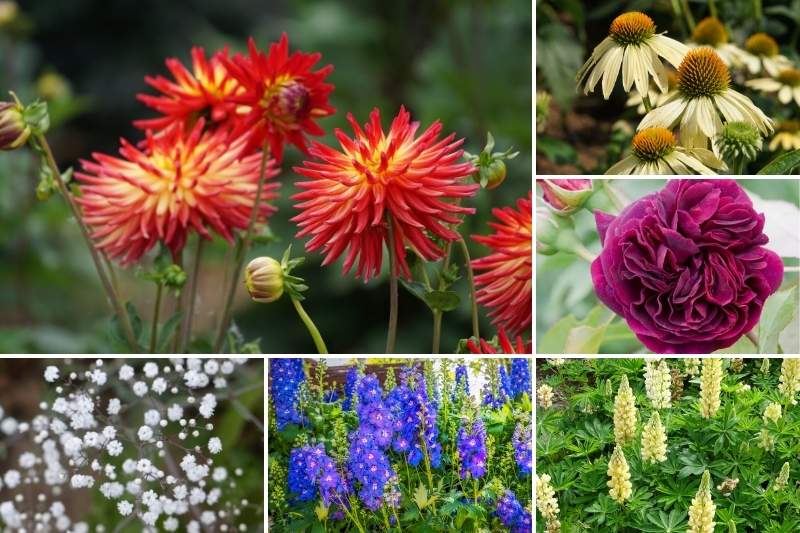
Colour explosion in the cutting garden
It’s easy to compose a cutting garden with countless plants in blue, yellow and red shades.
Depending on bouquet preferences, place summer perennials side by side with dahlias, blue delphiniums and yellow lupins. Don’t hesitate to combine very different plants here: old roses, eccentric love lies bleeding, capge gooseberry, a few annuals such as zinnias and antirrhinums, all‑yellow solidagos and greenish alchemillas, graceful sweet peas, thistles, narcissi and tulips for spring bouquets, Cosmos 'Lemonade' and 'Rubenza'… choices are endless!
A joyfully colourful area around the play zone
Blue, red, yellow… a little like Rubik’s Cube or building blocks, don’t you think?
Near swing, pétanque pitch, children’s den or tipi, the play area can be designed around these three colours they love. Recreate their naïve, playful world, again based on yellow, red and blue as ultra‑cheerful emblems.
Choose robust plants able to withstand children’s rough play… and of course that won’t hurt or tempt them (avoid ornamental red berries that are toxic, such as those of heavenly bamboo or holly).
Physocarpus, blue hibiscus like Hibiscus syriacus 'Azurii', plumbago as climbing, herbaceous salvias, rosemary… Brooms and St John’s wort are also tough and will resist occasional ball throws. Some sunny achilleas with flat flowerheads, such as 'Golden Plate' or paler 'Desert Eve Yellow' are musts to bring cheer to the play area.
Finally add a few fluffy plants so children can play safely during summer such as Lagurus ovatus, those soft childhood ears, or simply lavender they will enjoy touching and smelling!
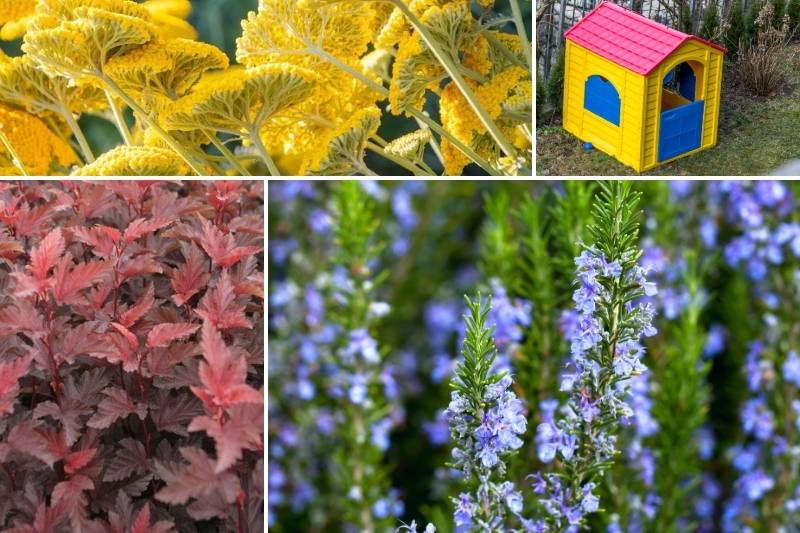
Find inspiration on the "Primary Shock" in our trend booklet!
All major garden trends for 2026 are here: Garden: What are five major trends for 2026?
See our tips on Colour Inspiration page for many more pairing ideas.
Attracted to yellow, blue and red flowers? Here are some of our articles on the finest representatives:
- Red hydrangea: best varieties
- Most beautiful passion flowers with red blooms
- 6 red‑flowered peonies
- 10 essential spring bulbs with yellow flowers
- 5 yellow‑flowered oleanders for bright garden
- 7 yellow‑flowered Alstroemerias
- Blue Ceanothus: most beautiful varieties
- 7 blue salvias to adopt in garden
- 8 climbing flowers you must have in garden
Fancy strong contrasts in garden? Against pastel harmonies of Unicorn, saturated crimsons of Dark Acadomia, or teal blues of Transformative Teal, primary colour trend plays with cyan, magenta and yellow, a striking trio of the three base colours of the colour wheel. Elementary, almost childish, this colour mix divides opinion, but can fit into different […]
Making a garden resilient, stronger in the face of the repeated heatwaves our countries now suffer, is one of the challenges of the Chaparral garden, which draws on flora from extreme climates, such as those found in New Mexico or California. The multiple heatwaves of summer 2026 confirm this reality and will certainly steer us towards undemanding plants that are also hardy in our winters. Discover this new type of garden, inherently waterwise, low-maintenance and very promising.
What is a chaparral?
Chaparro is a Spanish word referring to several oak species (Quercus ilex, holm oak, but also Quercus coccifera and sometimes cork oak). The term also covers less well-known species such as Castela tortuosa, a shrub native to arid areas of Mexico and southern United States.
Chaparral is nothing more than an area of scrub and shrubs, forming a specific ecosystem in Mediterranean climates. It generally resembles a stand of holm oaks, in other words a garrigue or maquis, terms and landscapes more familiar to us. The name in Spanish denotes a biome found mainly from Mexico to California, and in Europe around the Mediterranean such as Andalusia or Sardinia. These areas are wooded, populated by shrubs and undershrubs able to withstand very hot conditions.
Plants able to grow in chaparral are often sclerophyllous (small, leathery leaves covered by a protective cuticle), sharing unique adaptations to this dry environment: deep roots, grey-green leaves that reflect light, and essential oils that limit evaporation.

We imagined three scenes to reproduce, in spirit, this ultra-resilient type of landscape. You can create a single area of the garden that receives particularly strong summer sun, or treat the whole garden in this style, provided you live in temperate valleys or mild zones of the country.
Adapting the chaparral to a dry exotic garden
A dry garden can create a sublime scene with exceptional plants.
Here we play with a palette of blue-tinged foliage using plants surprisingly resistant to short frosts in winter, not exceeding −10°C. The tree poppy, a Californian and Mexican plant with wonderful white flowers, and the Mexican blue palm for an original backdrop, have proven able to withstand very dry summers. Once well established, Romneya poses no real hardiness issues. A Yucca pallida joins them to form that superb silvery-blue base, accompanied by an agave hardy enough such as Agave parryi or Agave montana.
A Mediterranean perennial, Euphorbia pithyusa, a Balearic spurge that stays low, and a Mexican-origin plant, Mathiasella bupleuroides 'Green Dream' with jade-green flowers, naturally fit among these plants. We bring in chartreuse and blue-green tones for a duet of colours evoking Mediterranean aridity.
NB: this blue planting can easily be part of a blue garden, located in the sunniest, driest part of the garden!
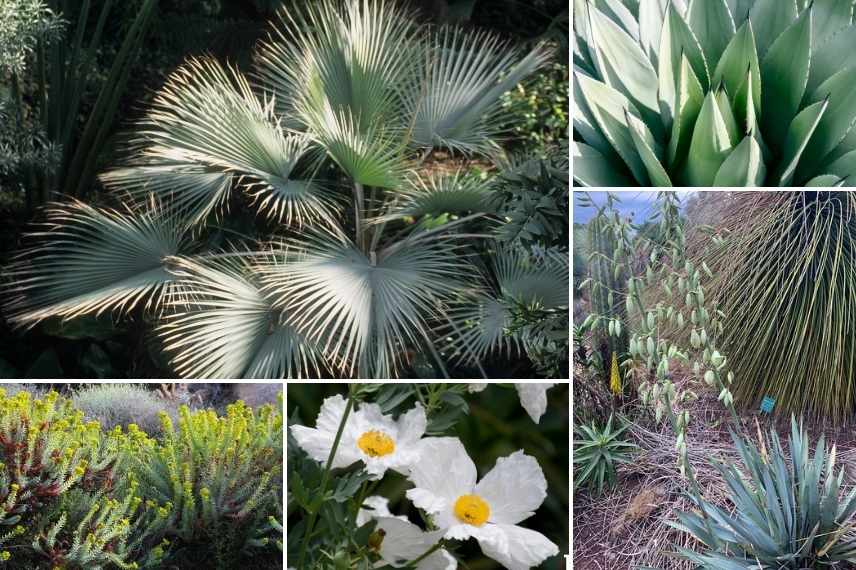
Transport yourself to Lanzarote
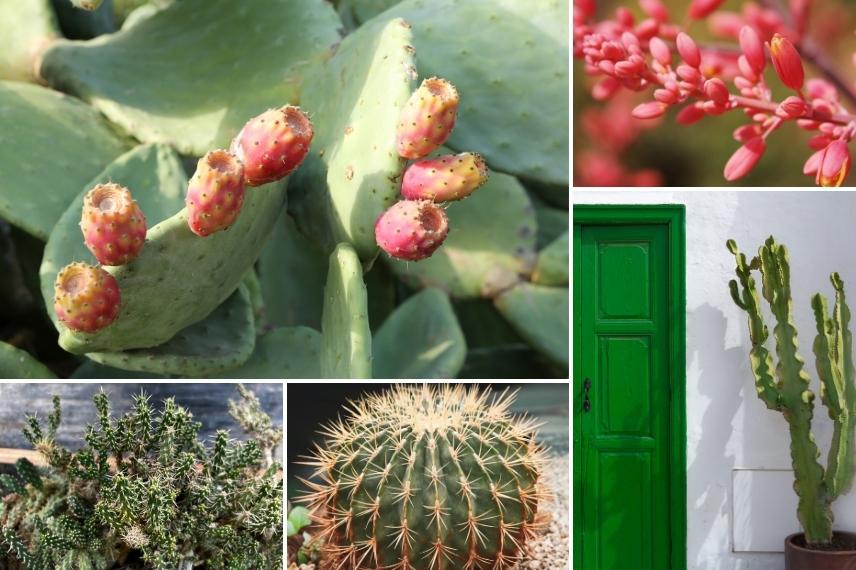
Lanzarote's cactus gardens are exceptionally photogenic. On this volcanic archipelago grow sclerophyllous plants with small leathery leaves adapted to drought, and spiny cacti. Drawing inspiration from them, while carefully selecting cacti cold-hardy enough for our winters, allows creation of a unique area within a dry garden, ready to face repeated summer heat spikes. Ensure perfect drainage, as this type of garden cannot tolerate any standing moisture in winter.
A prickly pear, well adapted to sea spray, is interesting for its slightly greater hardiness (down to around −15°C for some) and its unique habit with large spiny pads. Plant them liberally; choices include Opuntia scheeri or Opuntia engelmannii var. rastrera, among many others. In this distinctive setting, succumb to oddity of Cylindropuntia kleiniae, a cousin of opuntias, quite cold-hardy and producing a beautiful magenta summer bloom. Complement the area with a Hesperaloe parviflora and an Echinocactus grusonii, the golden barrel cactus often seen on the island.
This type of garden is intended for warm, mild regions of the country with less severe winters and dry summers.
Use pumice or black volcanic stones to simulate island soils and to ensure drainage. Finishing touch? a whitewashed house with green shutters to reproduce another characteristic of this island close to African coasts.
... or to landscape a poor, unproductive slope
A south-facing, dry and unproductive slope can also be transformed into a resilient space by imitating the chaparral, an ecosystem adapted to extreme conditions.
To turn poor soil into a semi-desert rockery, favour low, hardy shrubs such as cistus (Cistus), a California lilac like the ceanothus ' Pacific Wave' or its groundcover form (C. thyrsiflorus 'Repens'), a prostrate rosemary and some sempervivums. These plants, with deep roots and leathery or fleshy leaves, tolerate drought and poor soils perfectly. Add a golden thyme, and some sages (such as Canary Island sage 'Lancelot'), aromatic plants that will scent the garden while attracting pollinators.
Once established, these plants require little watering and maintenance. Their dense foliage will protect soil from erosion and limit growth of weeds that are unwanted on the slope. A mineral mulch will help conserve moisture and enhance the slope's natural appearance. A few ochre or orange boulders placed here and there will also help evoke Californian or Andalusian maquis while enhancing the area.
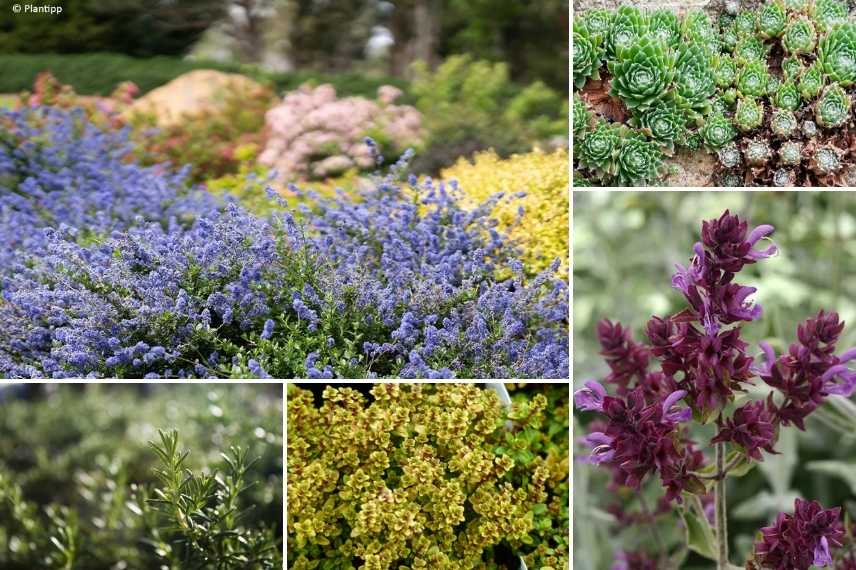
Discover our selection of succulents and perennials on our "Dry garden" page online, and our inspiration in the trend booklet 2026!
Since Beth Chatto, the dry garden movement has increasingly been seen among landscapers and in gardening magazines and books. We cover it in detail in Designing a dry exotic garden, Laying out a gravel garden, the Californian-style garden and the garrigue garden, as well as strong trends recently seen at the Chelsea Flower Show in London, such as the antipodal garden and the sand garden.
Find all garden trends for 2026 in: What are the five major trends for 2026?
Making a garden resilient, stronger in the face of the repeated heatwaves our countries now suffer, is one of the challenges of the Chaparral garden, which draws on flora from extreme climates, such as those found in New Mexico or California. The multiple heatwaves of summer 2026 confirm this reality and will certainly steer us […]
The idea for this personal take came to me from a thought I had at a recent plant swap. While a charming lady was offering some perennial plants, I asked her straight out: 'What colour are the flowers?' — 'Yellow,' she replied. And I retorted, rather bluntly: 'Oh no, no yellow for me.' I immediately felt bad, finding myself oddly rude and not very respectful. If she reads this article, may she forgive me, because yellow is one of the most radiant colours there is! Proof in pictures…
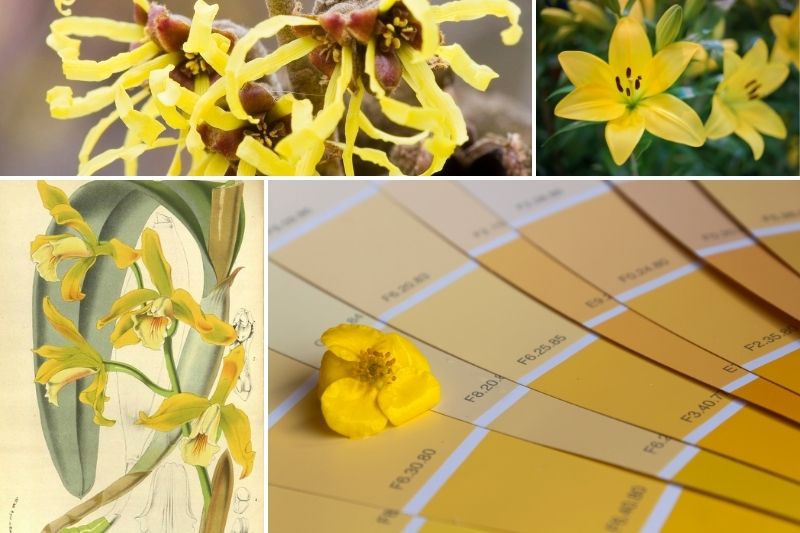
Yellow in the garden: why such hostility?
One could almost speak of a divisive colour in the garden, so much does yellow provoke either rejection or genuine passion. Even though it evokes the image of the sun and is a symbol of cheerfulness and dynamism, it is one of the colours gardeners often shun. Yet yellow is the colour of wonderful shrubs and blooms such as winter-flowering mimosa or Laburnum, those delightful yellow laburnum arches in spring that usually win unanimous praise.
This lack of enthusiasm even shows up, I find when looking into the subject, in our articles at Promesse de fleurs, where we address yellow flowering far less than the popular themes of blue, pink or white gardens.
Yellow has a bad reputation in many fields. It is rarely chosen as a dominant colour in décor. A primary colour with blue and red, yellow stands apart in our plant choices, and some refuse even to have a single yellow flower in their beds. Is that because it is associated with certain weeds (dandelion, sow-thistle, buttercup, celandine and others) or because it is said to be hard to pair? I would lean towards the latter reason, to which I return below.
In art, it was one of the major colours of the Fauvist movement, brought to its height by Vincent Van Gogh with his vivid yellow blocks on sunflowers or by Klimt.
But, once associated with the sacred, yellow declined from the Middle Ages, gradually evolving into a negative symbol, until it became the colour of the yellow Star of David. Even language turned on it with a few unflattering expressions, such as a forced laugh or the "Yellow Peril". In the West, offering yellow roses long signified infidelity and, more broadly, separation. Yellow therefore evokes deceit and betrayal, whereas it carries a very positive connotation in the East.
Yellow and yellows
Yet there is not one yellow but many yellows, just like the gradients in all colours.
From very pale, almost white yellow to saffron yellow, it is a wide spectrum! Let us set aside yellow or golden foliage here, which is generally better accepted by many gardeners.
St John's-wort, forsythia, mahonia: the vivid yellow of these shrubs, often considered mundane, may be one reason for the contempt shown towards yellow. Or is it still too closely associated in our minds with 1970s gardens that featured rather unnatural yellow roses, almost artificial chrysanthemums and overly gilded conifers? Finally, some summer bedding displays seen in parks or roundabouts, at times almost garish, put many people off…
Unless the lemon-yellow of the few adventitious weeds mentioned earlier puts us off this delightful colour. But it is more likely the difficulty of combining yellow flowers well with other garden blooms that makes us hesitate to use it. In short: people often fear that saturated yellow will jar with other plants in the garden.
My favourite yellow flowers
I am one of those who do not plant too many yellow flowers in the garden. My view has nevertheless evolved with my wanderings through English gardens that dare, in some cases, a monochrome yellow garden, less common than the famous white garden at Sissinghurst. Marvels can be found there, as at Burton Agnes Hall.
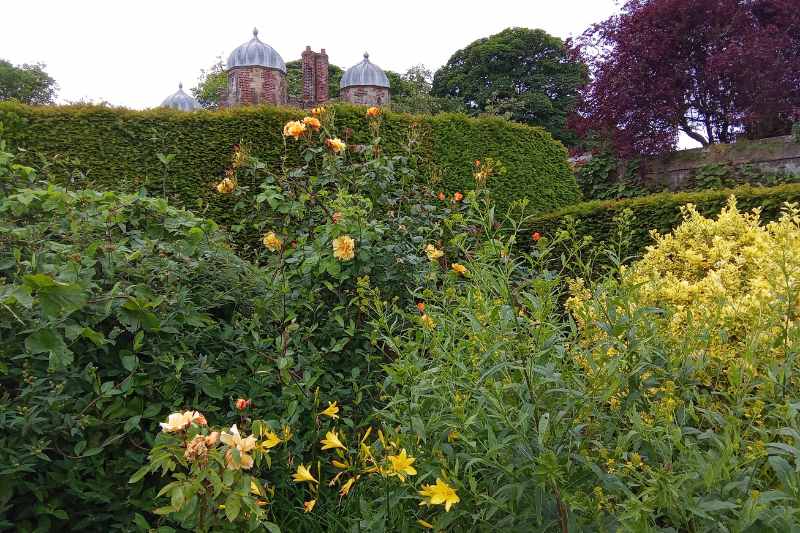
For my part, special mention goes to pale and pastel yellow blooms that are so easy to pair. Light, creamy, butter, anise, straw or slightly apricot yellows actually harmonise with many garden flowers: all blues, pinks and oranges, mauves and purples, from pale lavender to plum. They are found in some old or species roses like 'Mermaid', many honeysuckles, oleander luteum 'Plenum', Liriodendron, some magnolias and exquisite Michelia, of great delicacy, and many other shrubs and perennial plants.
I admit that brilliant yellow is also the colour of spring! Daffodils are its true ambassadors. And if you do not want to incorporate yellow elsewhere in the garden throughout the year, spring is a real opportunity to punctuate the early fine days with a Banks' rose, some sunlit tulips and other bulbs or chartreuse-flowered euphorbias, or an azalea 'Harvest Moon' that pair wonderfully with the many blue and white spring blooms.
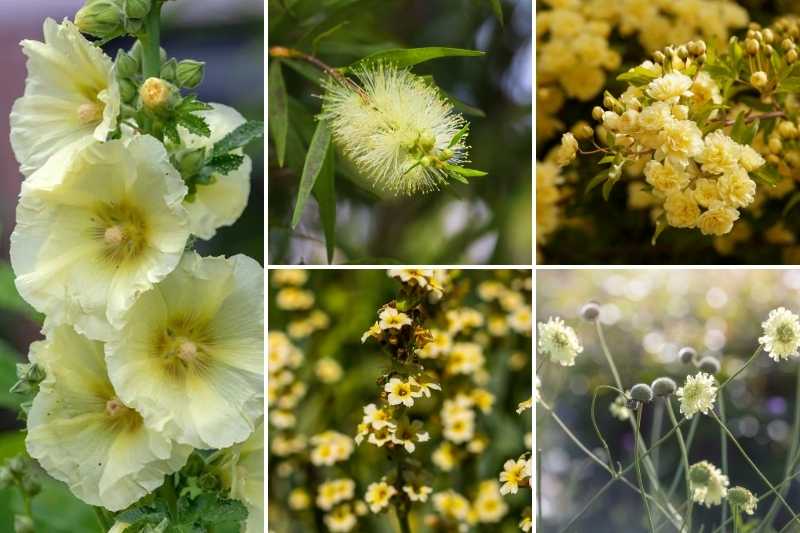
Using yellow: how not to go wrong?
I also like to see brighter yellow blooms parade through summer beds, in a naturalistic planting with rudbeckias or sunlit achilleas, in English hot borders that blend all warm colours of the colour wheel. It is also perfect in exotic gardens, alongside orange blooms, with which it creates a beautiful gradient. Finally, many marginal or aquatic plants flower in yellow, making them excellent choices for water gardens or pond edges, enhanced by yellow-flag iris, ligularias, yellow water lilies and a few touches of purple foliage. Last option for this much-maligned yellow: it is a standout colour in dry gardens, appearing alongside senecios, Helychrisum and other succulent plants paired with greyed and silvery foliage and some blue or orange blooms.
My final tip: avoid adding yellow blooms to beds that are already richly coloured (except in a naturalistic context). The result can be a garish effect not in the best taste. It's better to stick to a successful two-colour combination, or three colours, and play with contrasting foliage or work in gradients. Introduce it in small doses, unless aiming for a monochrome garden — to me, that is the best way to exalt it!
Not convinced? Still hesitating? Do you tend to use yellow mainly in handsome winter-flowering shrubs? What are your experiences with yellow in the garden? Tell us how you use it, and feel free to comment to continue this age-old debate about yellow in the garden.
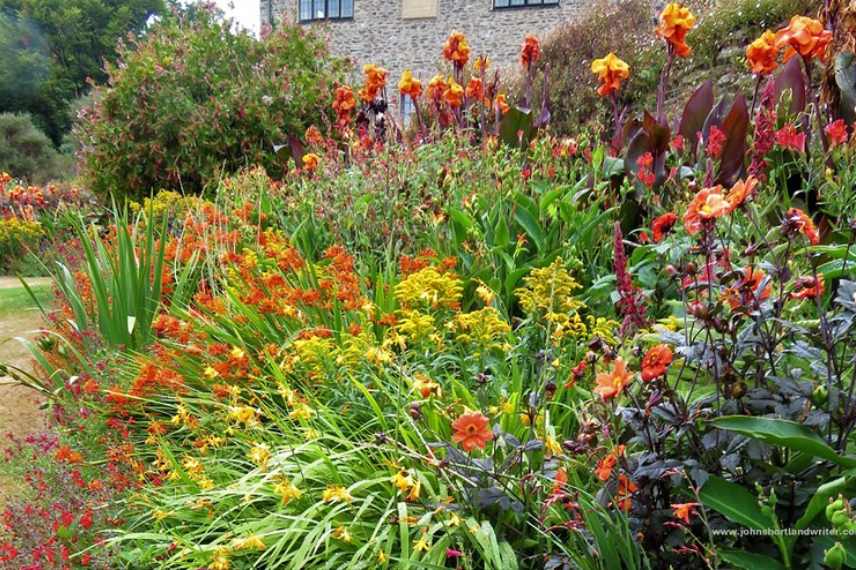
a successful trilogy of yellow, orange and purple
Further reading…
Top up your ideas with tips and inspiration from the editorial team in our dedicated section on the Yellow garden. On our online shop, discover our wide range of yellow-flowering shrubs, as well as our yellow roses, and our yellow-flowering bulbs.
Leïla tackled this subject in How to pair yellow flowers in the garden? and Michaël in Toning down yellow flowers in the garden.
And if, like me, you enjoy history and the symbolism of colours, add French author Michel Pastoureau's work on the colour yellow to your summer reading: Yellow: A History of a Colour, published by Points in France.
The idea for this personal take came to me from a thought I had at a recent plant swap. While a charming lady was offering some perennial plants, I asked her straight out: ‘What colour are the flowers?’ — ‘Yellow,’ she replied. And I retorted, rather bluntly: ‘Oh no, no yellow for me.’ I immediately […]
There are materials that do us good. Cork, from the tree that bears its name, is one of them, and it has been making a notable comeback in our lives for several years now. A renewable, 100% natural, ecological material, cork is not used only to seal our best vintages.
The possibilities offered by this natural material are many and its recycling concerns us all.

Cork: a bio-based, ancestral and innovative material
Cork comes from the bark of the cork oak (Quercus suber), a tree growing around the Mediterranean, mainly in Portugal, and also in Spain, Italy, France, Algeria and Morocco. It has been exploited primarily in Europe since the 17th century, but its qualities were known to the Romans and Greeks, who began making cork stoppers to better preserve wine or oil in amphorae (clay or resin stoppers having proved limited). It was Dom Pierre Pérignon, a Benedictine monk well known in the Champagne world, who is said to have popularised the use of cork.
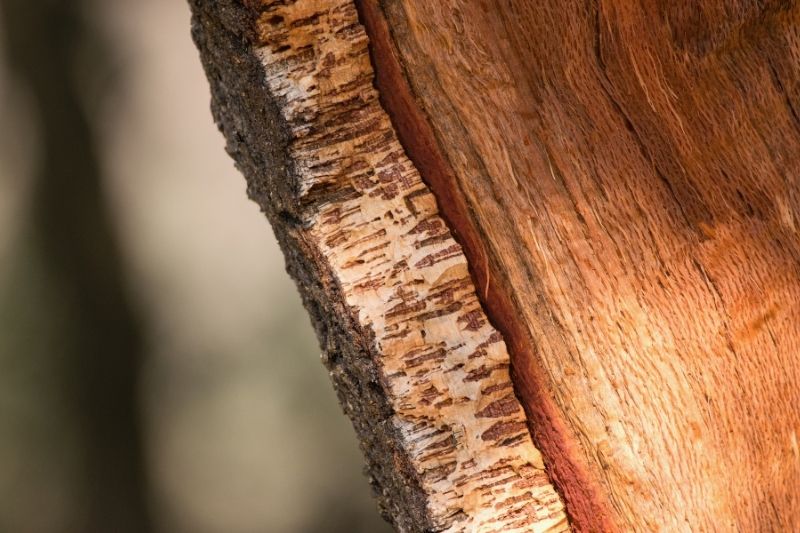
Only the bark – referred to as suberified bark – is harvested. The tree is not cut down; only its very thick cork bark, up to 25 cm thick, is removed using a special axe, without damaging the cambium (living tissue beneath the cork).
The tree therefore remains alive. The cork oak is able to regenerate its bark after each harvest, allowing sustainable exploitation over decades. It is also fire-resistant: after each fire, frequent in these Mediterranean regions, it reconstitutes its bark… like a vegetal phoenix or a Terminator of the forests!
Properties and uses of cork
Given all its qualities, cork has many uses beyond making stoppers. It is a technical material widely used in the marine sector for boat decks because of its rot-resistant properties, in leather goods to make soles, shoes and small items, and as an accessory for numerous decorative items, jewellery and furniture. Light yet flexible, impermeable and insulating, attractive and watertight, it has also become a material of choice for thermal and acoustic insulation. The construction industry also uses it as an effective moisture barrier, accounting for 14% of its use. The wine industry remains its main outlet, representing 69% of consumption. It uses the protective and breathable qualities of cork as well as its density to produce high-quality stoppers.

Production and extraction
Portugal, the world’s leading cork exporter, is the undisputed leader in production (50% of the total). Suberaies, the name given to cork oak forests, account for nearly a quarter of the country’s woodlands, with a strong concentration in the Alentejo region. Portuguese cork represents 50% of world production. Portugal and Spain alone cover more than half of the exploited areas.
France produces a smaller but high-quality quantity, in specific areas (Corsica, Pyrénées-Orientales, Var and Landes). The cork sector in France produces 3 billion cork stoppers per year, out of 14 billion worldwide.
It must be understood that cork forests and plantations in Portugal and other Mediterranean countries are ecosystems in their own right. Cork cultivation relies on patient, extensive management of natural areas.
Furthermore, knowing that one tonne of cork absorbs 2 tonnes of CO2, and that global production is 300,000 tonnes per year, there is no need to do the maths to grasp the ecological value of this resource.
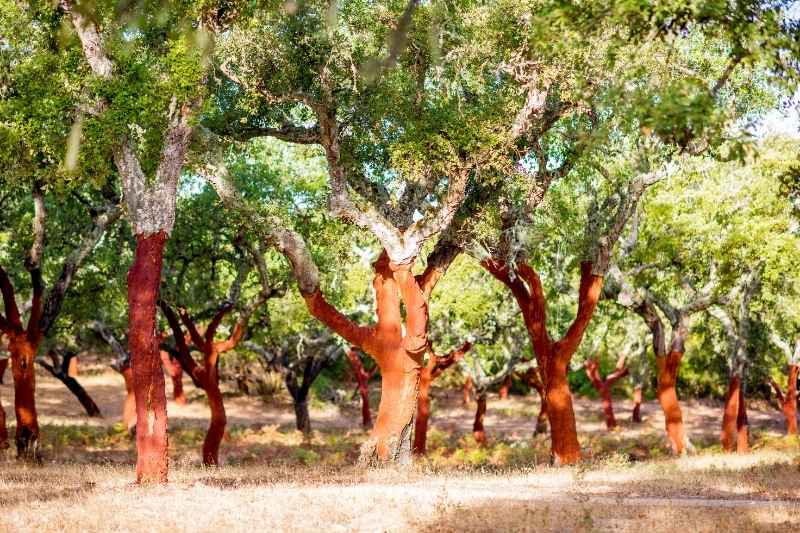
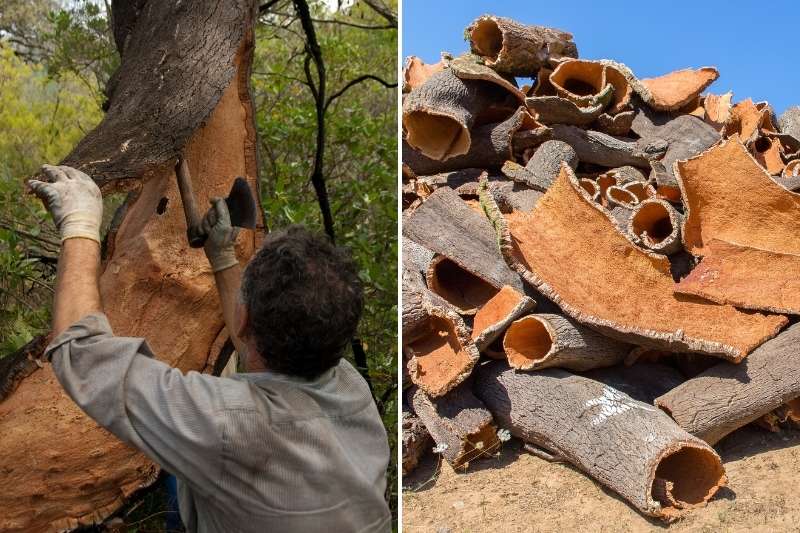
Extraction is done manually on the trunk when the tree is mature, at least 25 years old, by cutting or "lifting" the bark in large slabs. This is known as the debarking or lifting operation, carried out during the sap-rise period, from May to August. The first harvest produces so-called "male" cork, of lower quality, very thick and too hard, which will be sent for grinding. The bark renews naturally every 12 years approximately, on trees living on average 200 years. Each cork oak can thus be "scalped" around fifteen times in its life, producing so-called "female" cork, a noble, excellent-quality material. The cork slabs are air-dried for six months. Harvested cork has a very long shelf life, close to 100 years!
Cork recycling: an eco-friendly civic act within everyone's reach
France, as the world’s second-largest wine consumer, has a role to play.
A 100% plant-based product, cork stoppers can be recycled, but they are not classed as packaging. They therefore cannot be put in the yellow recycling bin. They must be dropped off at a local collection point. Household waste centres, town halls, supermarkets, organic shops, wine merchants and sometimes schools are all places where precious stoppers can be returned.
Fewer people know that many local, regional and national associations take part in collections to support charitable causes.
Options in France include Recycliege France, Planetliege (site of the French Cork Federation), and regional waste management organisations such as Smitcom.
Once collected, stoppers are sent to specialised recycling plants where they receive specific treatment. Ground, they become granules, which are then turned into boards or blocks to make other objects, including new stoppers, or used for energy recovery.
Avoid putting cork stoppers in the compost. Although biodegradable, they decompose rather slowly and, in that case, should not be bonded with glue or plastic, as some new commercial stoppers are. These must be thrown in the household refuse bin.
Sorting cork: a well-established process
Each year more than 60 million cork stoppers are recycled in France out of a consumption of 3 billion cork-sealed bottles.
In this area, prevention and information are major issues for this circular economy in order to promote a reflex in our daily habits: collect cork stoppers together at home rather than throwing them one by one in the bin.
At European level, there is a recycling code for cork, FOR51. It identifies products made from natural cork without any agglomerate or synthetic substitute.
Be careful not to confuse 100% cork stoppers with cork-look stoppers, which are agglomerates of synthetic materials and glue: these must not go in the yellow recycling bin!
Cork in the garden: why not consider it?
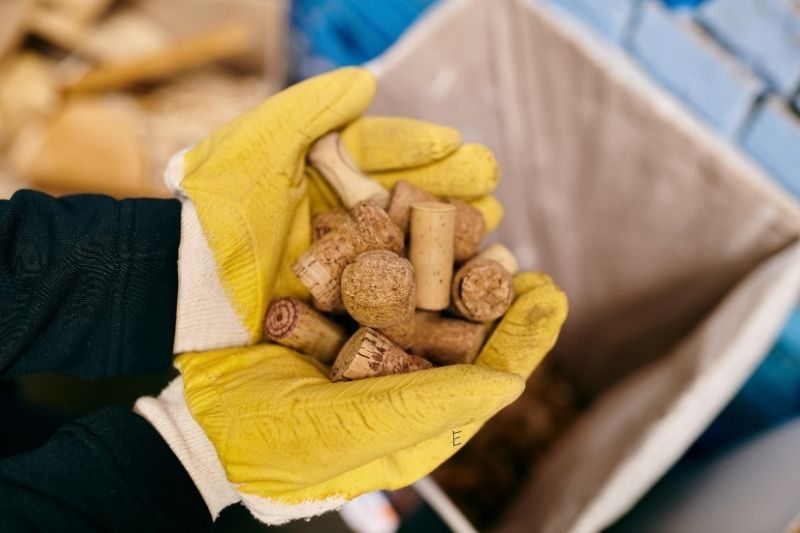
An insulating material in summer and winter, therefore thermoregulating… Now, doesn't that sound good for our plants? Cork stoppers are indeed one of the original but proven recycling options for our potted plants. For drainage or insulation against the cold, once cut into small pieces (yes, you have to get your hands a little dirty), 100% cork stoppers prove to be precious and economical allies, replacing clay pebbles. Placed under pots, they protect those left on terraces and balconies in winter.
Our cork stoppers can also find a second life and be upcycled very prettily and easily for Christmas. The natural material and colour of cork pair perfectly with pine cones and wood to decorate the home for the festive season. Keep it in mind!

Further reading…
Cork is venturing into the space industry! Discover this surprising article on the aeronautical potential of cork from a small French company.
Two websites to consult: Planète Liège and the Mediterranean Cork Institute (IML), which provide much more information on their comprehensive sites.
This video shows the cork stopper manufacturing process in a Portuguese factory.
There are materials that do us good. Cork, from the tree that bears its name, is one of them, and it has been making a notable comeback in our lives for several years now. A renewable, 100% natural, ecological material, cork is not used only to seal our best vintages.The possibilities offered by this natural […]
In recent years, as our planet warms inexorably, many of us have been looking for ways to adapt our gardens gradually to a new era. The Antipodean garden is one answer for gardeners, encouraging a turn towards the remarkable potential of plants from extreme climates, such as southern plants.
Let’s see how to use certain succulent plants formerly thought suitable only for southern regions, and integrate them into different garden types, from dry rockeries to Mexican-style settings.
Origin of the Antipodean garden
Last year, one of the stands at the RHS Chelsea Flower Show surprised many: right in central London, this temporary garden staged a landscape straight out of the South African bush. The Karoo Succulent Garden, conceived by landscape designer Katie Lewis and botanist Ernst van Jaarsveld, offered a sublime scene of exceptional succulents, remarkable spiny shrubby plants, Aloes, collections of Haworthia and Gasteria amid mineral chaos… A genuine plea and reflection on the garden of the future, this Antipodean garden showcased only plants native to South Africa, resilient, capable of surviving severe droughts and adapted to the region’s grand yet arid and hostile Karoo environment.

Top right, Sarcocolon crassicaule grows in the Little Karoo
On a dry rockery by the sea
Our coasts, from the Channel to the Atlantic and of course the Mediterranean, offer an ideal climate for these plants from the Cape. Take inspiration from the sublime jardin d'Èze near Nice. Many plants from Mexico are grown there, but also South African plants such as Aloes and various types of euphorbias.
For example, you can group in very warm exposure, without them complaining, Cape-origin plants such as Aloe ferox, Delosperma cooperi and an Euphorbia caerulescens. Aloe remains very architectural even after flowering, its orange flower spikes enhancing the garden in winter and spring. The spreading Delosperma will flower mauve continuously all summer. The euphorbia brings a lovely green, succulent touch to a rockery. Add other perennials that tolerate strong light, very free-draining soil and have sufficient hardiness in this coastal context: Euryops pectinatus or Euryops evansii, Protea, trailing Plumbago, for a blue, unexpected late-summer display, etc.
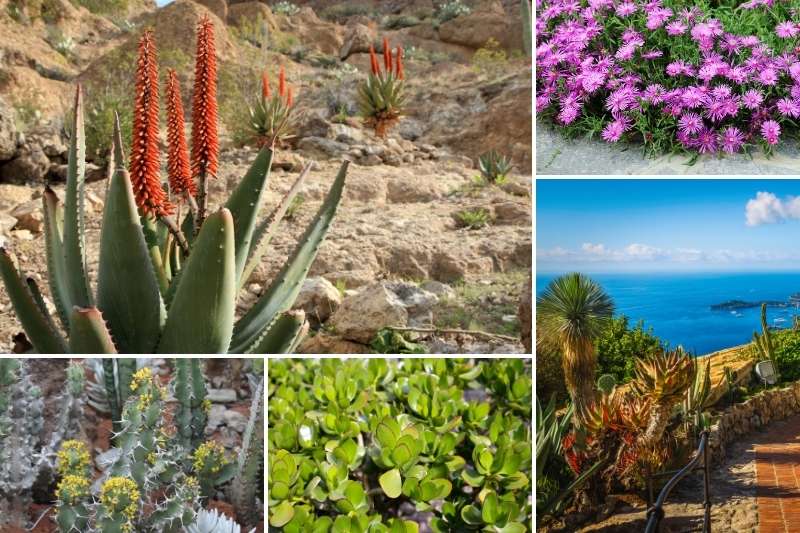
In a Mediterranean garden or a dry garden without watering
The dry garden, arguably one of the gardens of the future, is precisely the type suited to these South African plants that grow locally in poor, arid soils. Inviting these Antipodean plants into our gardens in the Mediterranean or in regions with mild winters is a great way to refresh the plant palette of gardens designed without watering.
Ramified shrubs such as the Tylecodon wallichii, a superb plant related to crassulas, which eventually forms a small trunk bearing leaves clustered at the top, a South African heather, Erica arborea, or the Cape heather Phylica ericoides make perfect companions in this Mediterranean yet wild setting. A very striking aloe with a dragon-like appearance, Aloe dichotoma (quiver tree), will make a sensation once its trunk has developed. All these plants appreciate a perfectly free-draining, poor and light substrate. Better-known plants such as Sansevieria (snake plant), also native to South Africa, can be grown in pots to bring their incomparable architectural form.
Flowering of the various South African shrubs and undershrubs, southern‑hemisphere timing aside, tends to occur in winter or spring. So add a few summer-interest plants to bring colourful touches to this unusual world, such as diascias (annual or perennial) and the shrubby Cape mallow (Anisodontea capensis) which can flower until frosts and will require, unlike the other plants, a little watering while it establishes.
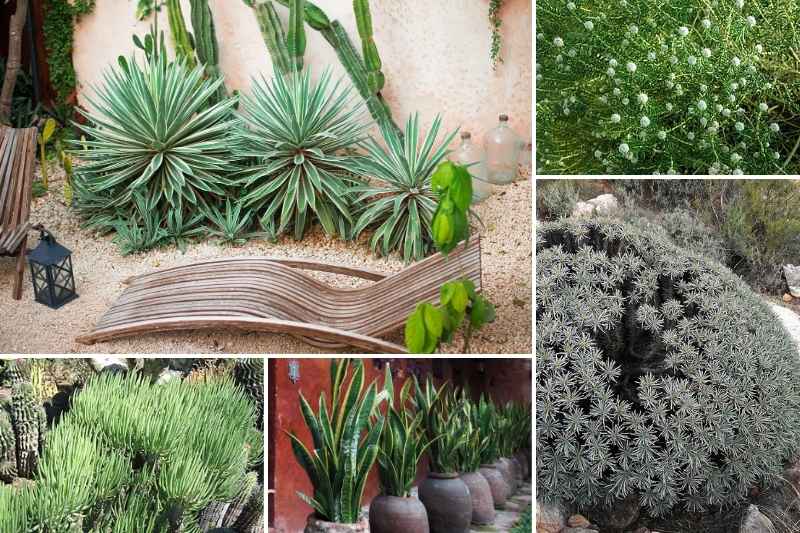
In a sheltered patio, like in Mexico, or on a sunny balcony!
Although unaffected by scorching sun, succulent plants and other South African natives lack hardiness in our hemisphere. They must therefore be potted in some regions where they might suffer, especially from winter damp.
So why not evoke a South American patio to dream of distant horizons from a sheltered, very sunny patio, courtyard or terrace? Then simply bring them indoors to a warm living room for winter months.
Think again of easy-care plants, provided their low watering needs and a warm exposure are respected. Here we plant in attractive glazed pots a Senecio serpens 'Blue Chalk', or 'Dwarf Blue', a Haworthia fasciata 'Big Band', also called zebra plant, delightful for its ultra-compact habit and characteristic stripes on its fleshy foliage.
Consider bright paints applied to walls or to pots, such as orange, terracotta, turquoise and green to accompany your plants in this decidedly colourful patio and reinforce the South American vibe. The plants mentioned can just as easily be placed on a small south- or west-facing balcony in town, provided you remember to overwinter them at home from late autumn to spring.
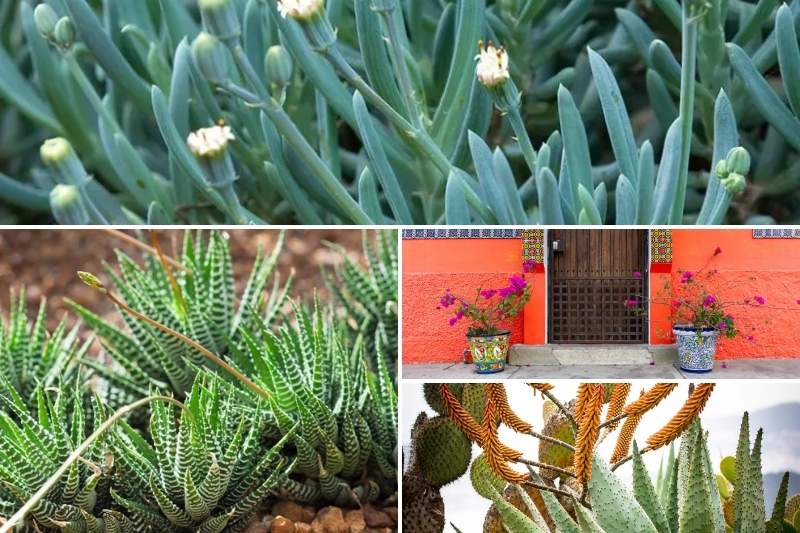
Discover our selection of succulents on our "Jardin des antipodes" page online, and our inspiration in the trendbook 2026!
Southern atmospheres are popular: we have covered this theme in several articles: Alexandra talks about her botanical trip to South Africa, our advice on planting and growing southern plants, and our inspiration sequence Exotisme austral.
To keep up with the trends for 2026, also check our topic Garden: what are the five major trends for 2026?
In recent years, as our planet warms inexorably, many of us have been looking for ways to adapt our gardens gradually to a new era. The Antipodean garden is one answer for gardeners, encouraging a turn towards the remarkable potential of plants from extreme climates, such as southern plants.Let’s see how to use certain succulent […]
From 19 to 23 May 2026, the Chelsea Flower Show once again set the tone for tomorrow's garden trends in the grounds of the Royal Hospital Chelsea in London. The event organised by the Royal Horticultural Society (RHS) unveiled an edition centred on calm and wellbeing. Far from spectacular displays, the award-winning gardens favoured enveloping atmospheres, soft planting palettes, the omnipresence of water and shelter spaces. Health, biodiversity, knowledge transfer and adaptation to climate change were the guiding themes of the 2026 edition. Discover the gardens that impressed judges and public alike this year!
Gold medal and Chelsea Garden of the Year: The CPRE Garden: On the Edge
Overall winner of the 2026 edition, The Campaign to Protect Rural England Garden: 'On the Edge', created by Sarah Eberle, highlights neglected spaces on city fringes that are nonetheless vital for biodiversity. The emerges from planting, her hand touching a pool while her willow hair extends into a dry-stone wall. Around her spreads planting inspired by the British countryside, mixing hornbeam (Carpinus betulus), blackthorn (Prunus spinosa), dogwood (Cornus sanguinea) and holly (Ilex aquifolium). A poetic garden that recalls value of ordinary spaces often threatened by urbanisation.

Gold medal and Best Small Show Garden: Addleshaw Goddard: Flourish in the City
With Addleshaw Goddard: Flourish in the City, Joe and Laura Carey celebrate hidden green oases at heart of London. Inspired by #Humanise movement and capital's status as a "National Park City", this garden combines water features, Portland stone and recycled materials to imagine a more welcoming city. Planting mixes Saxifraga × urbium (London Pride), pines, plantains and mulleins in shades of purple, pink and lemon yellow. A concentrated set of ideas to reintroduce nature into urban landscape.
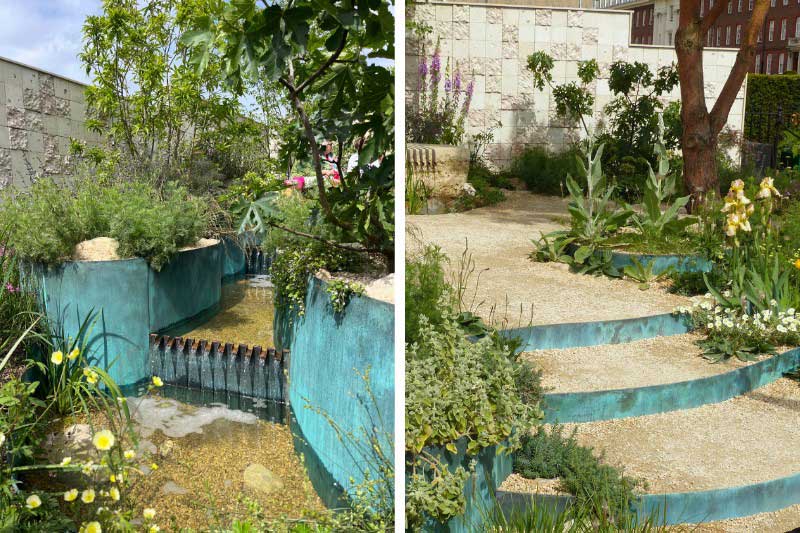
Silver medal and People's Choice Show Garden: Parkinson's UK - A Garden for Every Parkinson's Journey
Designed by Arit Anderson as place of respite for people with Parkinson's and their loved ones, Parkinson's UK - A Garden for Every Parkinson's Journey won visitors' hearts. A sculptural stream accompanies the route and provides sensory landmarks through movement and sound of water. Tulips, peonies, roses and white foxgloves (Digitalis purpurea 'Alba') mark different sequences of garden, designed around energy, rest and night.
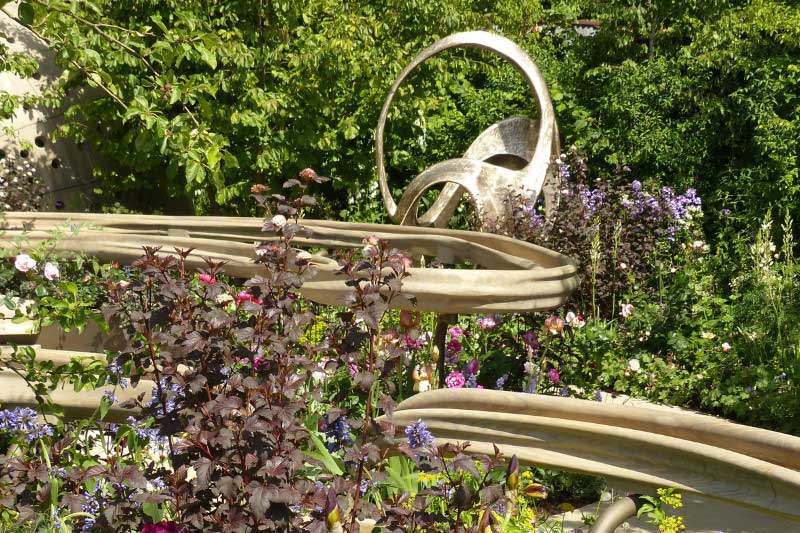
Silver medal and People's Choice Balcony Garden: Alzheimer's Society - Microbes and Minds Garden
Exploring links between gut microbiome and brain health: that is Tina Worboys' challenge with Alzheimer's Society's: Microbes and Minds Garden. Inspired by traditional English orchards, garden is organised around a central apple tree symbolising fermentation of cider vinegar. Forget-me-nots (Myosotis sylvatica), Roman chamomile (Chamaemelum nobile), cow parsley (Anthriscus sylvestris) and chives (Allium schoenoprasum) reinforce this gentle, natural atmosphere.
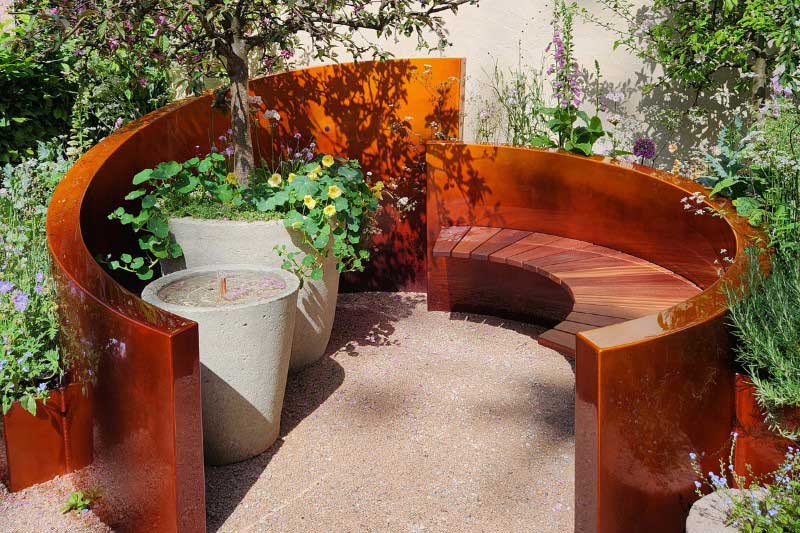
Gold medal and Best Houseplant Display: An Ode To Endurance
Impossible to ignore success of houseplants at Chelsea this year. With An Ode To Endurance, Natalia Drezek and Jinhyun Ahn pay tribute to species that survive in most hostile environments. Staged in discomfort of living room, Brachychiton rupestris, monkey tail cactus (Cleistocactus colademononis), Kalanchoe beharensis, Euphorbia ingens and Aeonium arboreum reveal sculptural beauty of arid-climate plants.
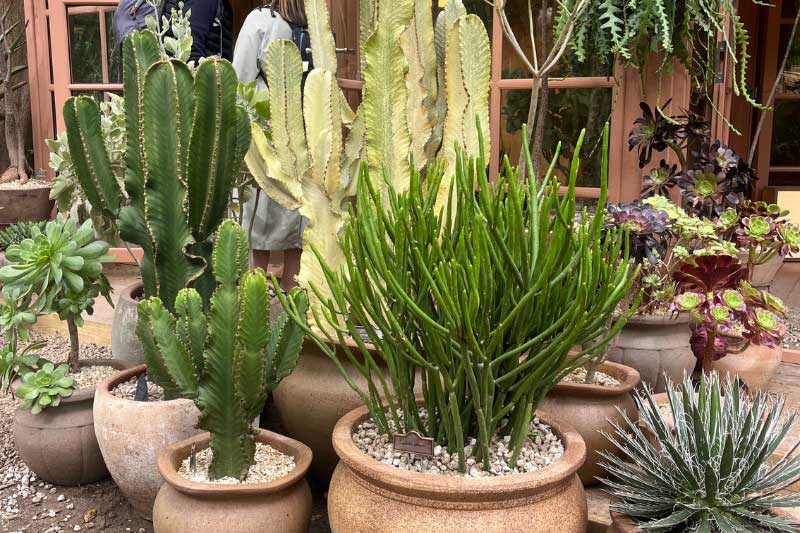
Our team's favourites
Heading to Australia with Journey Beyond the Tracks: From Adelaide to Perth, a small garden by Max Parker-Smith awarded a silver-gilt medal. Inspired by famous Indian Pacific train, it celebrates dramatic landscapes of South and Western Australia through planting of eucalypts, grevilleas, callistemons, hakeas and anigozanthos (kangaroo paws).
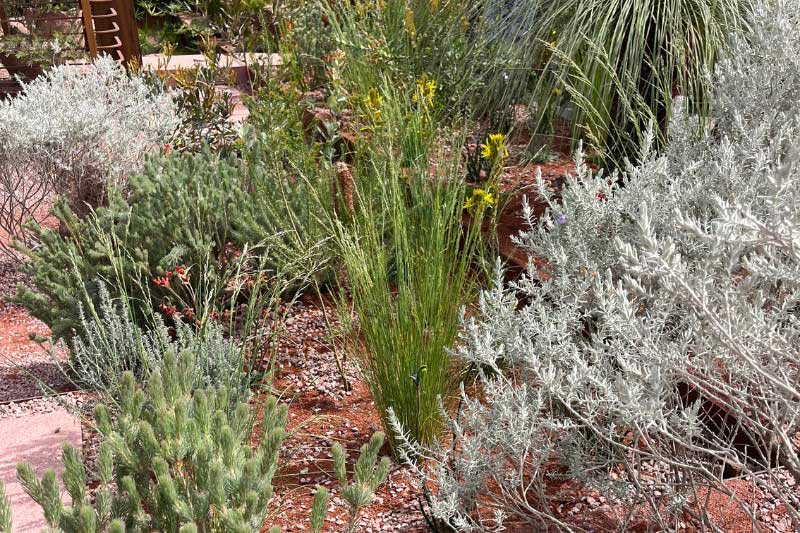
From 19 to 23 May 2026, the Chelsea Flower Show once again set the tone for tomorrow’s garden trends in the grounds of the Royal Hospital Chelsea in London. The event organised by the Royal Horticultural Society (RHS) unveiled an edition centred on calm and wellbeing. Far from spectacular displays, the award-winning gardens favoured enveloping […]
Every spring, Royal Horticultural Society grounds in heart of London become stage for finest horticultural innovations at Royal Horticultural Society, during the Chelsea Flower Show. Among event highlights, "Plant of the Year" prize recognises most remarkable new plants, selected for originality, garden merits and appeal to gardeners. Our team visited the show to see finalists and winners of the 2026 edition. Let’s discover the results!
Plant of the Year 2026: Hosta 'Red Ninja'
This is a genuine little revolution in world of hostas! World's first red-variegated hosta, Hosta 'Red Ninja' was one of stars of Chelsea Flower Show 2026. Its large leaves show an intense crimson-red centre edged with dark green, a colouring unprecedented in this genus until now dominated by shades of green, blue and cream. Even more surprising, this spectacular hue does not fade after spring but persists through much of season. In late summer, delicate lavender flowers rise above foliage, adding to elegance of this compact perennial (35 cm height, about 50 cm spread) yet exceptional plant.
Another trait appreciated by judges: unlike many hostas, its colouring intensifies with a few hours of gentle sun.
Red hostas have long been breeder's dream and, for first time, a true red hosta whose colouring appears durable has been achieved. Jury was right: this is a genetic advance visible at a glance.
Our view: a bold creation likely to quickly win over collectors and enthusiasts of unusual foliage.
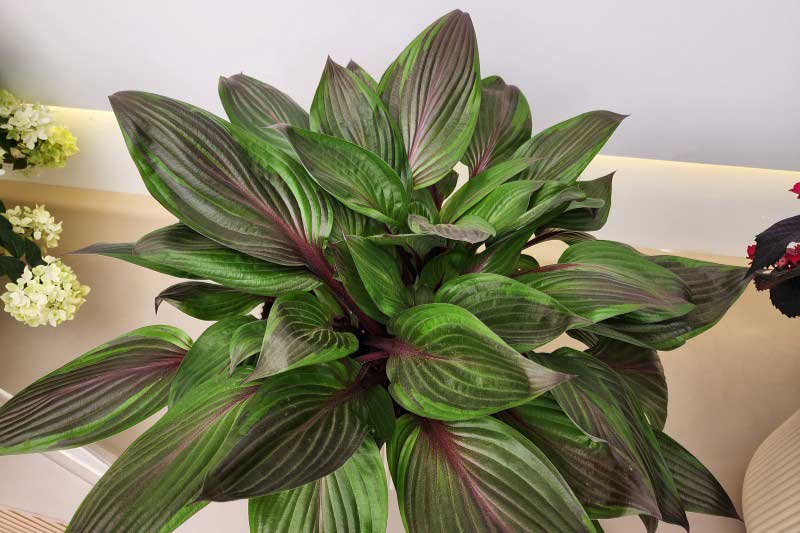
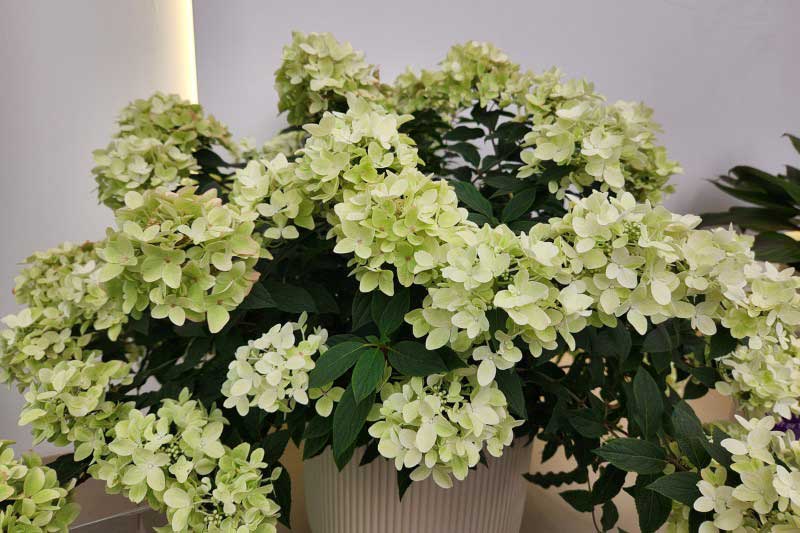
Second place: Hydrangea paniculata 'Groundbreaker Ruby'
Innovation also features in this hydrangea that breaks the mould. 'Groundbreaker Ruby' belongs to first series of Hydrangea paniculata that are truly groundcover. An unprecedented trait for panicle hydrangeas, usually upright. Its low, spreading habit forms a dense carpet about 40 cm high, covered for nearly 100 days with flowers that develop from white through pink to ruby red.
Easy to grow, undemanding in maintenance and particularly suited to small gardens, borders, banks or pot culture, it opens new uses for panicle hydrangeas. Our view: a plant set for a long-lasting career!
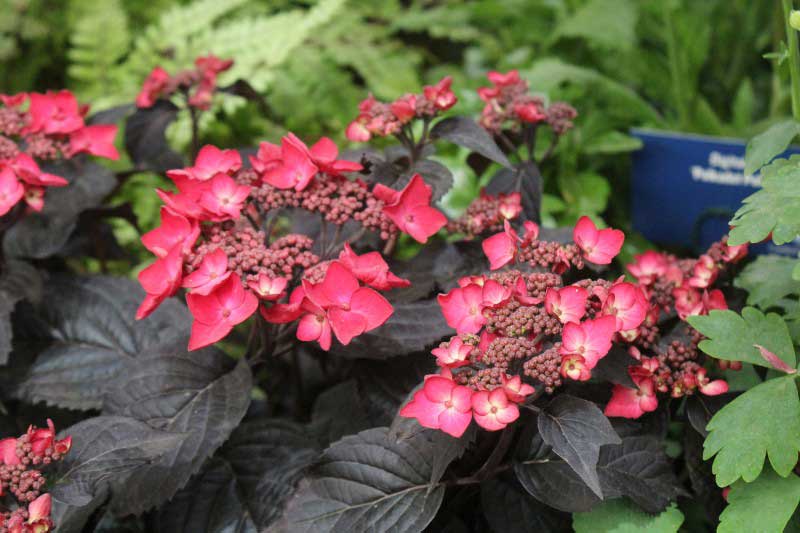
Third place: Hydrangea 'Velvet Night Red Lace'
A true drama queen of Chelsea Flower Show 2026, Hydrangea 'Velvet Night Red Lace' pairs almost velvety, near-black red foliage with lacy, bright carmine-red flowers. Result of long breeding work on more than 12,000 seedlings, 'Velvet Night Red Lace' stands out for a striking contrast rarely seen among hydrangeas. Its flat, delicately sculpted inflorescences shine against a dark, glossy foliage mass, offering a novel play of contrasts in hydrangeas.
Even out of flower, its dark foliage retains strong ornamental interest, providing presence in borders as well as in containers. A variety that perfectly illustrates current enthusiasm for coloured foliage and plants with high visual impact.
Our view: it has immediate theatrical appeal that makes stars on social media as well as in show gardens.
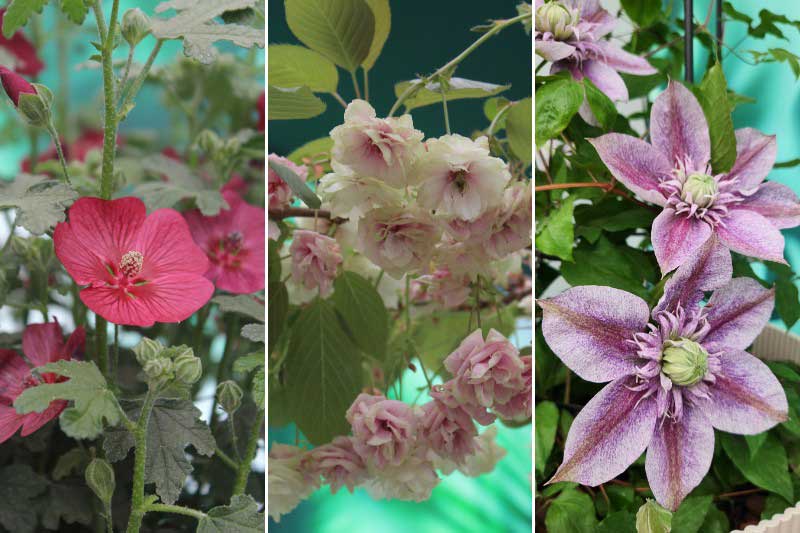
Team favourites
Beyond official winners, several new plants particularly caught our eye under the Grand Pavilion.
Anisodontea 'Carnival Lights Candy Apple' lit up the Grand Pavilion with its bright raspberry-red flowering, a colour still rare in anisodonteas. Its large, satiny flowers, finely veined, stand out against soft green, slightly velvety foliage. Its relaxed, bushy habit, covered in buds and blooms, promises a very long flowering season.
Prunus 'Sumaura Fugenzo' impressed with its absolutely irresistible display! We were won over by its pendulous clusters of very double flowers, with delicately crumpled petals. Initially cream with greenish tint, they develop to soft pink then deeper tones, evoking little pom-poms suspended from the branches. A variety both romantic and refined.
Clematis 'Minamo-no-Yousei' ranks among most beautiful new introductions seen this year. Its large star-shaped flowers, dusted with lavender, pink and silver, are enhanced by an untidy, almost anemone-like centre. A delicate, sophisticated bloom of great elegance. Japanese breeders continue to produce clematis of incredible finesse!
Antirrhinum 'Shiryu Kiss' reinvents snapdragon with generous flowering in a gradient of bright pinks. On the same spikes mix candy-pink, bubblegum-pink and fuchsia, all lit by a cream-white throat. A fresh, luminous variety that brings lightness to borders.
Other finalists
Among other new introductions noted by the jury were Dicentra 'Passion Hearts', clematis 'Nurse Queen', Euphorbia × martini 'Walberton's Little Treasure', Pittosporum 'Green Mound', as well as several promising roses such as 'Amirose' or 'Watford Forever'.
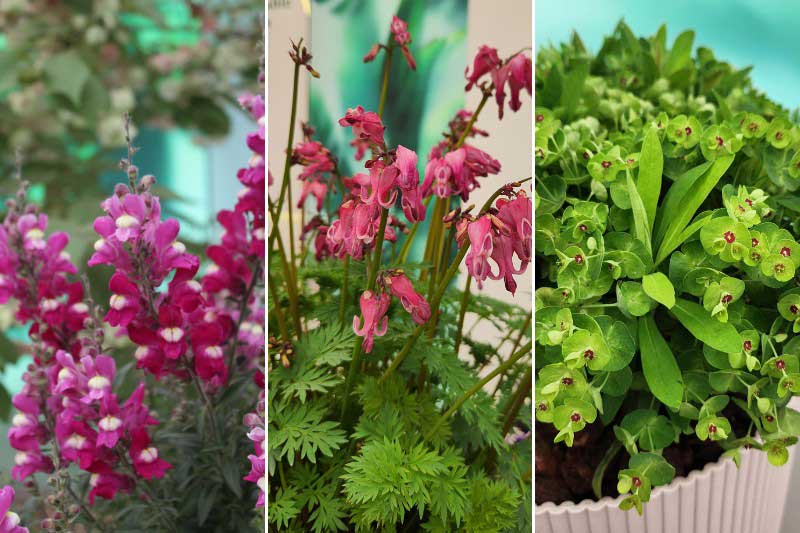
What the 2026 shortlist reveals
As every year, these selections reflect dynamism of international horticultural innovation and offer a good preview of plants likely to make an impact in gardens over coming seasons. According to our promesse de fleurs experts, there is some distancing from race for ever-bigger or more spectacular flowers. Breeders now seem to seek plants distinguished by foliage colour or novel habits, more versatile and interesting over extended periods. This is a trend observed for several years at Chelsea Flower Show and fits well with evolution of contemporary gardens.
Every spring, Royal Horticultural Society grounds in heart of London become stage for finest horticultural innovations at Royal Horticultural Society, during the Chelsea Flower Show. Among event highlights, “Plant of the Year” prize recognises most remarkable new plants, selected for originality, garden merits and appeal to gardeners. Our team visited the show to see finalists […]
Are you watching colour trends, and do you like to experiment not only indoors but also in your garden or on your terrace?
The very latest is Transformative Teal, often described as teal or turquoise. Some plants naturally display this colour, mainly in their foliage and more rarely in their flowers. This <strong shade that sits between blue and green can be used in the garden with a few colourful pots set against a more neutral palette.
See how to introduce this teal outside the home!
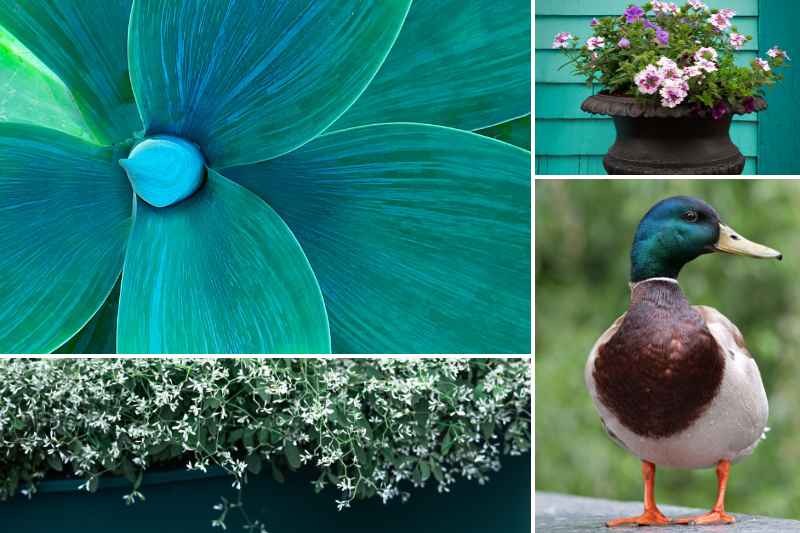
What is this new trend? How to use it in the garden?
Blue and green are cool colours on the colour wheel. Combining the two gives a very aquatic note, which can almost seem artificial in a garden setting. The English term 'teal' appears from the 1950s in interior design, where it is most often seen. This blue‑green is the colour that highlights the eyes of teals, the small freshwater ducks. Here, the expression 'bleu canard' seems best to express this intense shade.
It is mainly foliage that approaches this colour, described in botany as a glaucous blue: it is often found in hostas, many blue‑tinged conifers or some perennials, and in the pruinose leaves of certain shrubs. Among the rare flowers, look to distant beauties such as the Chilean Puya or the Asian Strongylodon macrobotrys.
The most flattering combinations for flowers or pots are white, very soft yellows and orange or brick tones, as well as all shades flirting with chartreuse green (see green flowers).
Avoid saturating the scene with overly cool tones like grey or silver; instead, enliven it with neighbouring colours on the colour wheel such as sulphur yellow, acid green or jade green.
Finally, rely on accessories: choose glazed pots in matching hues to reflect the light effectively, or furniture and seating in aniseed tones.
In an exotic‑style garden
This is perhaps the easiest way to reveal the subtleties of teal, since the exotic plant palette – tropical or dry exotic – offers several options for sunny areas. With centre stage given to the extraordinary flowers of Puya berteroniana, Puya alpestris or the jade vine in the least frost‑prone gardens, and the white spikes on glaucous foliage of some Yucca (notably Yucca aloifolia or Yucca rostrata), count on the striking blue‑green foliage of Melianthus major and the bluer, greyer leaves of Eucalyptus and Pinus parviflora. A bicolour arum, white and green, Zantedeschia 'Green Goddess' planted in sufficiently cool soil will wrap the scene in its refreshing trumpets.
In a dry exotic garden, an unusually blue senecio, Senecio serpens 'Dwarf Blue', can take pride of place and nearly steal the show from Dasylirion, such as Dasylirion glaucophyllum.
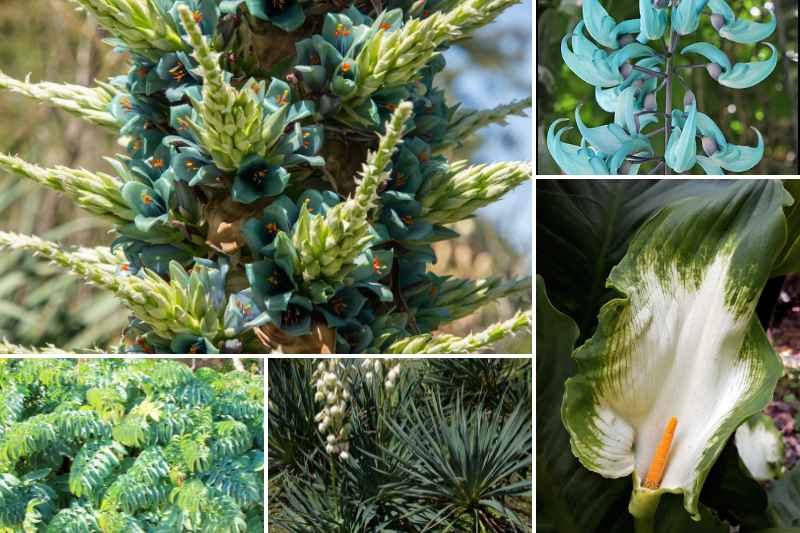
In a mixed border or English garden
Different mood, different style: a cottage‑style garden planted with large borders is also well suited to playing the teal note, as several attractive perennials carry this almost turquoise shade, often in a lighter tone. Representative plants include Mertensia maritima (also called oysterleaf), Crambe beloved in cottage gardens, rue (Ruta graveolens) and Cerinthe major.
A few selected flowers in soft tones, from white to mauve‑pink, will provide the necessary link so the planting does not slip into a dull bluish monochrome: catananche for a rustic touch, Erigeron karvinskianus, mauve or white hosta spikes, etc.
Bring in almond‑green and yellow‑greens such as the downy Ballota pseudodictamnus or the inflorescences of giant Cephalaria. A graceful grass such as Sesleria nitida will add the lightness suited to this ambience.
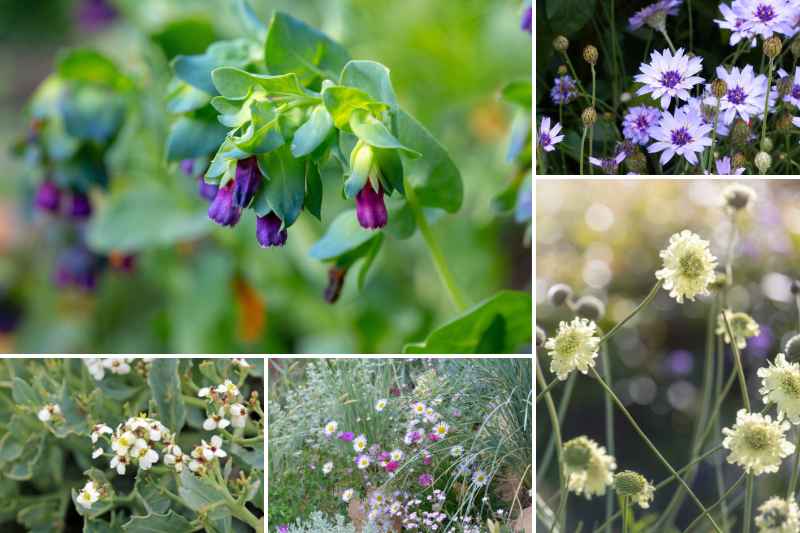
In a pot garden of succulents
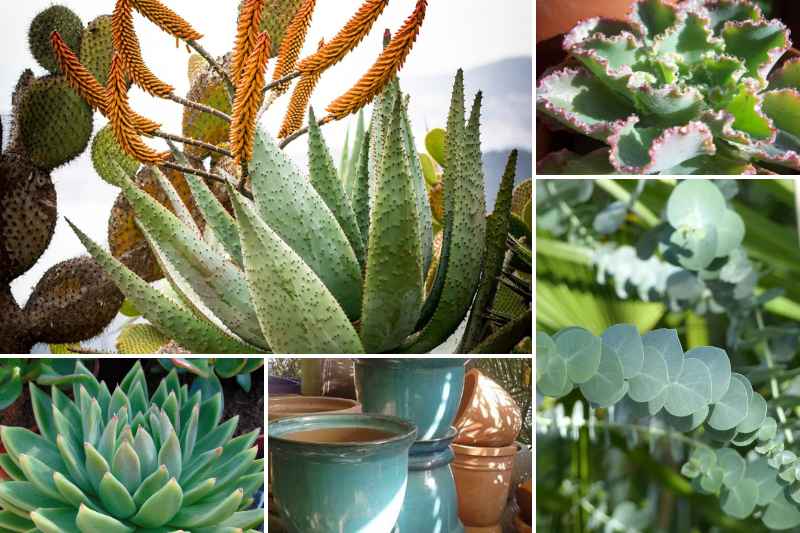
Here, opt for tone‑on‑tone plants in matching pots. The result is perfect on a south‑facing balcony or a terrace that basks in hot summer sun. Many cacti and succulents have that characteristic pruinose blue that protects them from heat. Start with agaves and some handsome echeverias, such as Echeveria 'Miranda', Echeveria peacockii 'Urban Orange' and Echeveria 'Blue Curls'. Don't forget Euphorbia x pseudovirgata 'Redwing' 'Charam' with its bluish young shoots.
An aloe completes this mini dry garden perfectly, for example Aloe marlothii, or, for small spaces, a dwarf aloe such as 'Aloe nain' (Aloe aristata).
Terracotta pots, raw or glazed, will provide either a flattering orange contrast or a very chic monochrome. In this small world, adding a few orange blooms is perfect: Bulbine or dwarf day‑lilies, for example.
In shade for an aquatic feel
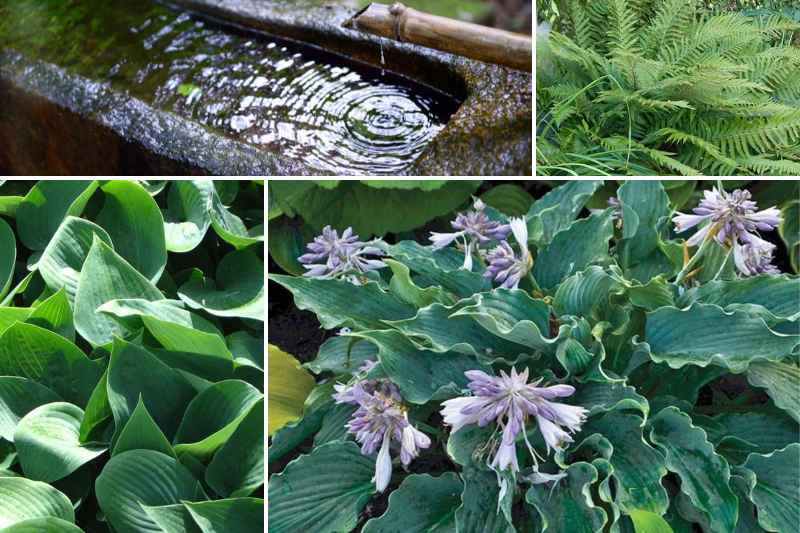
It is in shade or partial shade that glaucous green holds up best against heat in certain perennials such as hostas. There they show colours whose subtle nuances are especially highlighted in standout varieties like Hosta 'Canadian Blue', Hosta 'Drinking Gourd' and Hosta 'Waterslide' with greyer tones. Add some equally bluish sedges (Carex 'Bunny Blue'), evergreen ferns (Polystichum polyblepharum), white flower spikes to pair ideally with astilbes, a water trough used as a drinking bowl or fountain… and enjoy this very relaxing atmosphere.
Discover many more plants to achieve this turquoise palette in our "Transformative Teal" selection online, and in our 2026 trend booklet!
Do you love blue and green in the garden? Great — we explain everything you need to know about designing a blue garden and using blue in Elevate your garden with indigo blue. Marion also shares useful tips in How to create the illusion of water with plants?
Are you watching colour trends, and do you like to experiment not only indoors but also in your garden or on your terrace?The very latest is Transformative Teal, often described as teal or turquoise. Some plants naturally display this colour, mainly in their foliage and more rarely in their flowers. This <strong shade that sits […]
Had enough of that crystal-clear water that reveals pond bottom? Find the ballet of your fish in healthy water painfully lacking in dramatic suspense? This guide is for you. Here is the foolproof method to sabotage your aquatic ecosystem, encourage filamentous algae proliferation and turn your garden into a disaster zone even dragonflies will carefully avoid.
Location: choose worst possible spot
To ruin your pond from the start, location is crucial. Insist on a spot exposed to full sun from morning till night, with no shade whatsoever. Excessive heat will reduce oxygen levels and turn pond into a boiling pea soup where only algae will thrive. To perfect the disaster, place pond directly under a weeping willow or an old resinous tree. Massive build-up of fallen leaves and acidic needles will create a layer of toxic sediment at the bottom, ideal for acidifying water and clogging pump in record time.
Also make sure to dig perfectly vertical, smooth banks, with no depth shelves. That guarantees marginal plants will never take root and any creature falling in will stay trapped on the bottom.
Filtration: be minimalist (or completely absent)
Filtration is often considered the lungs of a pond; so atrophy it as much as possible. Opt for a grossly undersized filter, rated for a volume half of yours, to ensure water remains perpetually loaded with suspended particles. To save a few pennies on electricity, feel free to switch the system off every night. This fatal gesture will annihilate beneficial bacteria colonies that need a constant oxygen flow to convert ammonia into nitrates. Finally, if you must clean filter sponges, use chlorinated tap water rather than pond water, to be sure of obliterating every trace of biological life in the filter.

For fauna and flora: aim for chaos!
An overstocked pond is a doomed pond, so do not hesitate: introduce twenty Koi carp where wisdom would suggest only two. These magnificent fish are genuine waste factories that will saturate water with organic matter faster than you can say “eutrophication”. On feeding, be generous and overfeed them several times a day, even if food floats uneaten. These decaying pellets are perfect fertiliser for feeding algae. As for oxygenating plants, ignore them completely, since they might have the audacity to purify water and compete with your beloved green algae.
To perfect this chaos, do not hesitate to add invasive exotic species to your pond (EEE – species classified as invasive). These newcomers will choke your pond in fifteen days while eradicating local biodiversity for a complete ecological disaster.

Maintenance: procrastinate with passion
Secret of a failed pond lies in total ignorance of water's chemical parameters. Never use a test kit: pH, GH (water hardness) or nitrites are abstract concepts to you? Good. When water level falls in summer, top up abruptly with icy, chlorine-rich tap water, ideally in mid-afternoon to provoke a memorable thermal shock for your charges. Let muck accumulate at pond bottom for years without ever using a vacuum or natural products. This black sludge, seat of anaerobic fermentations, will eventually release foul-smelling gases that give your garden that much-sought-after marsh aroma.
Winter: art of the finishing blow
When frost sets in, let pond surface seal airtight under a thick layer of ice without ever installing an anti-freeze dome or an aerator. This method is radical: it prevents gas exchanges, trapping decomposition gases beneath the surface while depriving what little life remained of oxygen. And if you see fish struggling under the ice, do not resist temptation to give heavy blows to the frozen surface. The shock waves thus created are extremely effective at bursting fish swim bladders.

Real advice for serious readers
If you read this article in horror, you have grasped the essential! For a successful pond, simply do the exact opposite of everything just mentioned! A good location, robust filtration, sensible stocking of fish and regular maintenance will turn your pond, pool or water garden into an inexhaustible source of joy and a major boon for biodiversity.
For more genuine advice, read these articles and fact sheets:
- Creating my garden pond by Virginie Douce
- Create a natural pond
- Maintaining a garden pond through the seasons
- Find all our aquatic and marginal plants on our site.
- And all our books on pond and water garden design
Had enough of that crystal-clear water that reveals pond bottom? Find the ballet of your fish in healthy water painfully lacking in dramatic suspense? This guide is for you. Here is the foolproof method to sabotage your aquatic ecosystem, encourage filamentous algae proliferation and turn your garden into a disaster zone even dragonflies will carefully […]
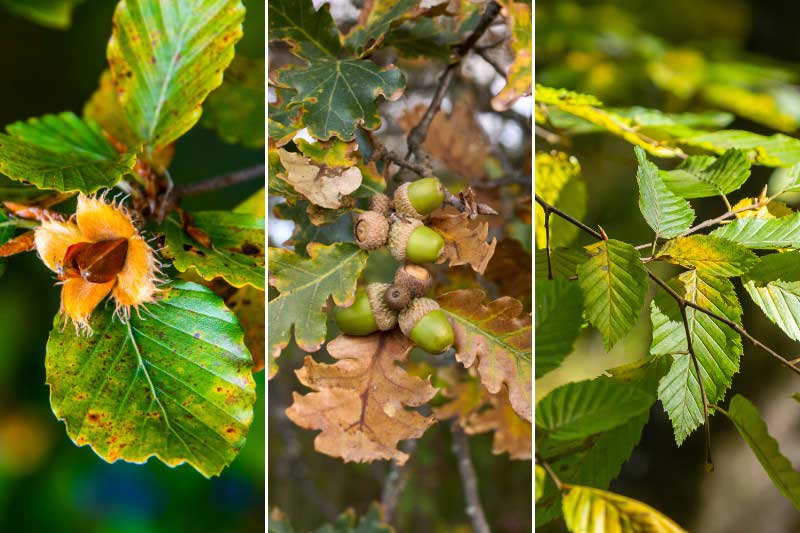
Beeches, oaks, but also hornbeams and chestnuts are already losing their leaves in summer well before autumn arrives, in August, but sometimes as early as mid‑July. This unusual phenomenon gives forests an early autumn appearance… and our gardens a prematurely autumnal look, with a carpet of dead leaves already covering the ground. Two heatwaves, a significant water deficit and parched soil have weakened these trees, causing premature leaf drop. A visible symptom of water stress and climate disruption, browning is now observed each summer with increasing frequency. Which species are most sensitive? Sun‑scorched leaves on trees, leaf yellowing in summer — does this early browning mean the tree will die? And above all, what can be done to mitigate these effects? We explain.
Why do tree leaves turn yellow in the middle of August?
August 2025 spared little vegetation. In many regions, notably Nouvelle‑Aquitaine, trees began to defoliate well ahead of time. This phenomenon is not due to an early season but to physiological stress caused by extreme climatic conditions.
In summer, foliage would normally display a deep green, fuelled by chlorophyll that captures solar energy and enables the tree to build reserves via photosynthesis. But repeated heatwaves, combined with ever drier soils, deeply disrupt this cycle.
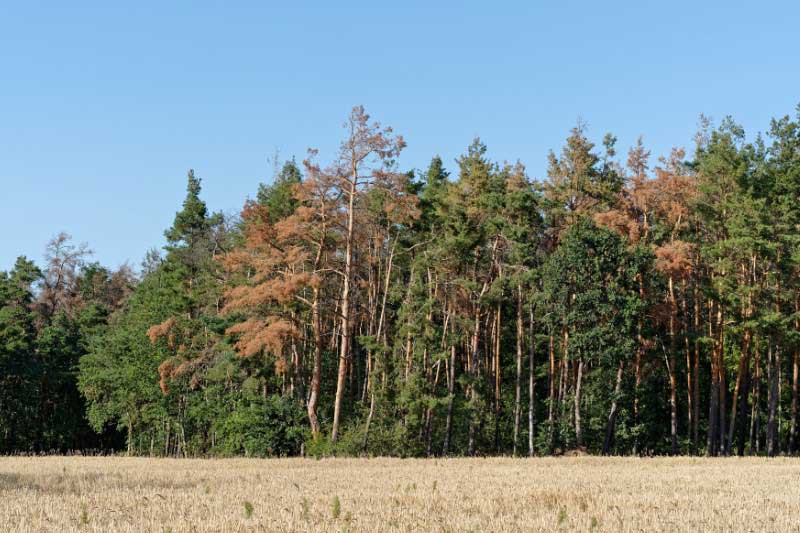
The figures are telling: over the 2021–2023 period, an estimated 8% of trees in French forests (living or standing dead for less than five years) were physiologically affected — some 186 million trees out of 2,270 million. This is not an isolated incident: IGN (National Institute of Geographic and Forest Information) also reports a 54% increase in tree mortality between 2012 and 2022.
And this is only the beginning. Projections indicate that by 2050, summer droughts will last on average two to four months, compared with two months currently, having more lasting effects on soils. If warming continues, some regions could face up to 39 additional drought days per year, and in the south soils could remain dry for seven to eight consecutive months.
In France, native species, adapted for millennia to a temperate climate, struggle to keep pace with this disruption. Some adapt partially, others show clear signs of exhaustion.
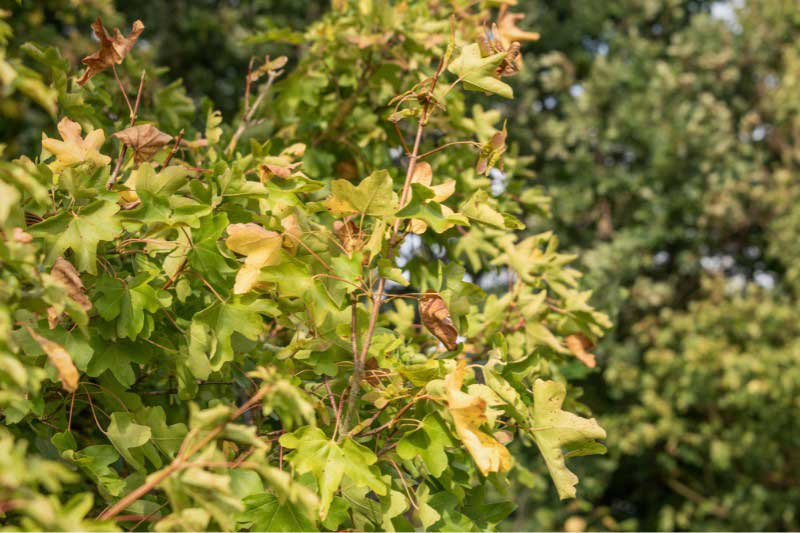
Lack of water, combined with very high temperatures, forces trees to close their stomata to limit water loss. This survival reflex halts photosynthesis and leads to a rapid loss of vigour. Leaves deprived of water and nutrients brown, dry out and fall. The phenomenon of leaves yellowing in summer is not natural: it is a defence mechanism to reduce evaporative surface area. This is known as water stress.
Certain species, such as beech, are particularly vulnerable: they suffer leaf scorch, bark lesions and even micro‑cracks that block sap rise or cause embolisms (air bubbles). All these troubles interrupt water functioning, compromise photosynthesis — and weaken the tree in the long term.

What happens after premature leaf drop?
When a tree loses its leaves as early as summer, it enters a kind of early dormancy, as if self‑protecting in a critical situation. This defence mechanism reduces its water and energy needs, but has medium‑ and long‑term consequences.
1. Photosynthesis stopped = reserves not replenished
Normally, leaves remain active until autumn to produce sugars via photosynthesis. These sugars reinforce root reserves, essential to survive winter and restart in spring. Summer defoliation prevents this process. The tree therefore enters the cold season with insufficient reserves, making it more vulnerable to disease, frost or pest attacks.
2. Growth halted
Without leaves, the tree can no longer grow in height or diameter. Over several successive seasons this results in slowed development, a thinner crown and a progressive decline in vitality.
3. Risk of long‑term weakening
If the stress episode is isolated, the tree can recover, especially if well established. But if stress recurs (as increasingly happens), the tree has no time to rebuild its reserves and weakens progressively. This process can take several years before leading to total decline.
4. Delayed consequences visible in spring
A tree that lost its leaves in August may appear alive in winter but fail to leaf out in the following spring, or do so only partially. This lack of foliage then reflects internal exhaustion, often irreversible.
Does this mean the tree will die?
Not necessarily, but it is worrying. Early browning and defoliation are signs of acute stress, not an irreversible sentence. However, if these episodes repeat year after year, they can cause lasting weakening, loss of carbon reserves, reduced resistance to pests and an increased risk of mortality.
Most sensitive species
Not all species respond the same way to these extreme climatic episodes. Some are more vulnerable than others:
- The beech (Fagus sylvatica): one of the most affected species. Native to humid, temperate climates, it quickly suffers from lack of water and heat stress. Browning of its foliage is common in summer, even in dense forest. Leaf deficit — the proportion of missing foliage compared with normal — rose from about 15% between 1997 and 2003 to nearly 35% between 2017 and 2023. This increase illustrates a worrying trend, even if the species sometimes shows the ability to recover when conditions improve.
- Oaks (Quercus robur, Q. petraea): among them, the pedunculate oak (Quercus robur) proves more sensitive to summer water stress, while the sessile oak and downy oak display better resistance. However, repeated weakening makes them more vulnerable to pests such as jewel beetles or certain pathogenic fungi. They account for nearly 25% of France’s forest area — a significant share.
- The hornbeam (Carpinus betulus) and the chestnut (Castanea sativa): these too show weakness from the end of summer, with premature leaf drop during prolonged drought.
- Conifers such as spruce: poorly adapted to dry summers, they suffer marked weakening, often exploited by pests such as bark beetles.
This reflects a general deterioration affecting all tree categories. It is estimated that one third of oaks (sessile and pedunculate), two thirds of beeches, 60% of firs at low and mid altitudes, and 90% of spruces may no longer be able to develop in their current zones by 2050.
What can be done?
Faced with this situation, several actions can be considered:
- Plant species better adapted to conditions
In the current context, it makes sense to rethink species choices without abandoning local vegetation. Some species show better tolerance to repeated summer droughts. It is advisable to favour resilient but diverse species, and adapt plantings to local pedoclimatic conditions: soil type, aspect, water‑holding capacity, altitude…
Among species better suited to dry conditions are downy oak, the Atlas cedar, and the European nettle tree, as well as Mediterranean species such as Aleppo pine or the holm oak. These species can resist heat when planted in suitable exposures and climates. Species such as Japanese pagoda tree (Styphnolobium japonicum) or the Siberian elm (Ulmus pumila) also show good adaptive capacity.
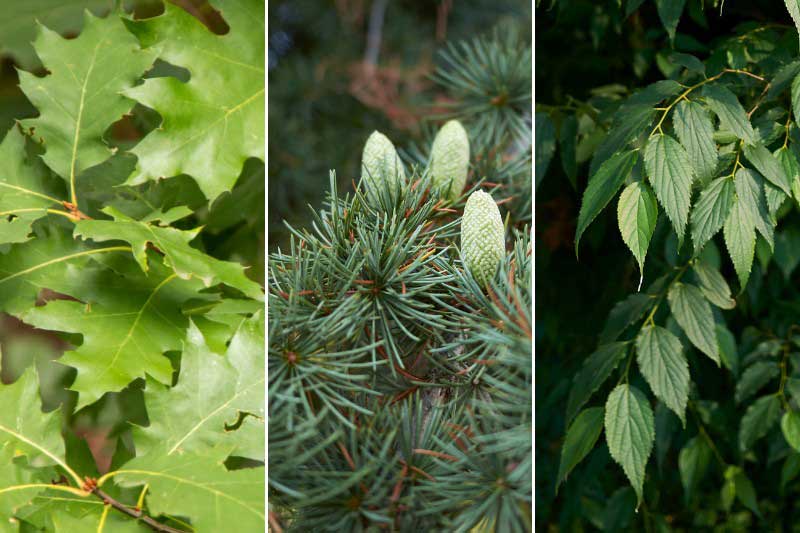
- Encourage plant biodiversity: diversifying species is an effective strategy to strengthen overall resilience. Mixed stands (species with different root systems and needs) cope better with climatic hazards.
- Preserve the soil: living soil rich in organic matter retains water better. Mulch, leave dead leaves in place and avoid soil compaction — simple but effective measures.
- Limit interventions during stress periods: avoid heavy pruning, transplanting or applications of nitrogenous fertilisers in mid‑summer. Do not rush to prune or fell a stressed tree: with time and improved conditions it can sometimes recover.
Beeches, oaks, but also hornbeams and chestnuts are already losing their leaves in summer well before autumn arrives, in August, but sometimes as early as mid‑July. This unusual phenomenon gives forests an early autumn appearance… and our gardens a prematurely autumnal look, with a carpet of dead leaves already covering the ground. Two heatwaves, a […]
Mulching, "it's brilliant", they say, "it protects soil, it retains moisture, it feeds the earth". Mmm… If you're here, it's because you don't want to do what everyone else does. You want sulky plants, dry soil and an army of very happy slugs.
Here is the foolproof method to turn a simple, effective technique into a proper garden disaster.
Mistake No. 1: pick the wrong timing
The secret to a failed mulch starts with the calendar. To eliminate any chance of growth, two options are open to you:
- The "fridge" option: spread a thick layer of straw over soil that is still frozen at the start of spring. Congratulations! You have just trapped the cold in the ground. Your plants will wait until July to realise winter is over.
- The "Gobi Desert" option: wait until soil is dry, cracked and hard as concrete in the middle of July. Lay your mulch on top. Now, even if it rains, water will remain on the surface and your soil will stay desperately arid. It's neat, it's dry, it's dead.

Mistake No. 2: smother plants with love
Think about building a magnificent "volcano" of mulch that climbs up trunks of your shrubs or wraps tightly around tomato stems.
The result: stagnant moisture against bark or stem. It’s an open door for fungi and collar rot. If your plant doesn't collapse within three weeks, you haven't used enough material.

Mistake No. 3: choose the worst materials
To fail at mulching, choice of ingredients is crucial. Don't pick what suits the job, pick what annoys:
- Fresh grass clippings in a 20 cm layer: it's the absolute best! They'll ferment, heat up (literally cook your plants) and give off landfill-like odours.
- The almost non-existent mulch: sprinkle a pathetic 1 cm of straw for fear of overdoing it. This ridiculous layer will hold neither water nor weeds, and will do absolutely nothing except decorate.
- The "surprise" mulch: use the weeds you just pulled out, especially if they've already gone to seed. You're gifting yourself ten times the weeding work in future. An investment for the future!
- Pine bark on the vegetable patch: perfect for preventing you from planting or sowing. And it will stick around for ages...
Mistake No. 4: induce a "nitrogen hunger"
Want to starve your plants without using chemicals? It's possible! Use a very carbon-rich mulch (like fresh wood chippings or excess cereal straw) on poor soil.
Soil microorganisms will throw themselves at this wood to break it down. To do so, they'll strip all available nitrogen from the soil, leaving only crumbs for your poor lettuces, which will all turn yellow. This is what gardeners call nitrogen deficiency. It's cruel, but technically brilliant.

Mistake No. 5: create a pest hotel complex
A good failed mulch is one that favours your enemies.
- Never check what is happening under the mulch. Let slugs and snails breed there with impunity.
- Water in short bursts, just enough to wet the mulch but not the soil. You will create a warm sponge on the surface, perfect for moulds, while roots underneath will die of thirst.

The real tips: a moment of clarity
If by mistake you wanted to succeed at mulching, do exactly the opposite: mulch on soil that is warmed, weeded and moist. Always leave a few centimetres of clearance around the stem. And above all, vary materials according to plant needs (dry "brown" material for longevity, fresh "green" material to feed, but always sparingly).
Fortunately, it's never too late to do things properly. If you prefer to pamper your soil rather than make its life miserable, find all the good practices in our advice sheet: Mulching: why and how?
Mulching, “it’s brilliant”, they say, “it protects soil, it retains moisture, it feeds the earth”. Mmm… If you’re here, it’s because you don’t want to do what everyone else does. You want sulky plants, dry soil and an army of very happy slugs. Here is the foolproof method to turn a simple, effective technique into […]
Some trees and plants from far‑flung lands, from the baobab to our venerable oak, have been regarded as sacred for millennia. Peoples from different regions have chosen certain members of the world’s flora for their spiritual significance or the legends they tell. To this day they continue to attach powerful symbolism to them.
Why? Which trees and plants are these mythical specimens adored by so many cultures? I suggest discovering a few on each continent, among the most emblematic on our planet.
Le Ginkgo biloba
This tree with its unique, bilobed foliage, like thousands of tiny fans, and its sublime golden autumn colours, is one of Asia’s emblematic sacred trees. Long before Hiroshima — which made it famous worldwide for surviving the blast — this symbol of resilience was known in Japan for its exceptional longevity, even its apparent immortality. It is said that Ginkgo biloba can live for more than 1,000 years. Some ginkgos in Asia have even been dated to nearly 800 years, a record for this “fossil” tree and sole representative of its botanical family, the Ginkgoaceae.
It is one of those venerated trees planted in front of Buddhist, Taoist and Shinto temples. It is said that Confucius once taught his philosophy beneath one of the planet’s oldest specimens, at Sungkyunkwan in South Korea. In Japanese tradition, the ginkgo wards off evil spirits, and it is also known for medicinal virtues and its natural fire‑resistant quality, a symbol of protection.
Rediscovered for landscaping about thirty years ago because of its ease of cultivation and rapid growth, it is increasingly seen in gardens, both as the typical form, Ginkgo biloba, and in dwarf varieties suitable for containers. It also lends itself well to bonsai training.
Today it is also widely planted for another reason: science is closely studying its interesting properties in research into cognitive disorders.
Read more at: Ginkgo biloba: why does this tree fascinate so many gardeners? and 5 great ideas for pairing ginkgo.

African and Indian ficus
Let us now travel to the African continent. Ficus sycomorus, which I saw myself at the Botanical Garden of Palermo, is one of Africa’s majestic trees, a classic “palaver tree”, alongside the baobab and the banyan, which are also sacred.
An African fig tree, remarkable for its stemless flowering and fruiting, arising directly from trunk and old branches. Once fertilised by wasps, the flowers (sycones, another botanical peculiarity) become small round figs, grey‑green to pinkish‑orange. As with our Mediterranean fig, it is not strictly a fruit but a pseudocarp.
Often simply called sycamore, Egyptian fig or Pharaoh’s fig in ancient Egypt, it belongs to family Moraceae. Found in Africa, it is also widespread in Near and Middle East, notably in Israel and Yemen, where it is still cultivated for its figs.
Mentioned in Old and New Testaments (Zacchaeus story), associated with Egyptian female deities (Hathor, Nut or Isis), Ficus sycomorus is one of the world’s oldest trees, venerated as a tree of life. Numerous representations have been found in tombs and on papyri; the Egyptians used its rot‑resistant wood to make sarcophagi and many everyday objects.
This age‑old sycamore also represents a tree of benefits, providing vital shade in hot countries, beneficial through abundance of fruit, and above all indicating presence of water, source of life.
Planted near graves, sycamores are still attributed a link between heaven and earth, true connections between the two worlds.

Another sacred Ficus is the banyan or banian (Ficus benghalensis), native to India, where it grows wild across the subcontinent. Remarkable for its vast spread, it is recognisable by spectacular aerial roots that descend from the crown to reach the ground, take root and proliferate. Its gigantism makes it hard to photograph; it is Bali’s cosmic sacred tree and a symbol of wisdom throughout Asia, its roots creating an immutable link between earth, people and the divine. Offerings are often left around banyans in Asia. Different religious traditions (Hinduism, Buddhism, Jainism) ascribe varied attributes to it, but it remains a powerful symbol for communities, serving as refuge, landmark, spiritual anchor and meeting place.

Holly
Common holly (Ilex aquifolium), with evergreen leaves and bright red berries, holds a sacred place in many traditions worldwide. Often relegated to defensive hedging, holly has symbolised eternal life, protection and rebirth since antiquity, thanks to its evergreen foliage in winter. Celtic pagan culture revered it as a protective tree, able to drive away evil spirits and to purify places. It was often associated with the winter solstice, a time when its berries, symbols of fertility, shone in the sleeping landscape.
In Christian tradition, holly is linked to Christ’s crown of thorns, its red berries evoking shed blood. At Christmas it decorates homes with its reddened berries during dark season. The Romans presented holly branches at the Saturnalia, festivals marking renewal of the year. In folk magic holly is used for protection against spells and to attract luck. Its wood, reputedly rot‑resistant, was also used to make sacred objects.
Note: holly in English (“holly”) does not share etymological origin with “holy” (sacred), but their similar sounds and holly’s role in pagan then Christian traditions have strengthened its symbolic association with the sacred. Thus this plant, already protective in European cultures, became a “holy” emblem of winter festivities, notably at Christmas.

Cordyline and taro
Oceania is no stranger to sacred legends about its plants, found across the Pacific islands. According to an ancient Polynesian origin myth of plants, the taro (Colocasia esculenta) was born from a man’s feet and his lungs became the leaves. The plant called elephant’s ear is therefore more than an edible root to island inhabitants.
Cordyline fruticosa, a tropical, very colourful plant ubiquitous in hedges and villages, is also sacred: it was planted before houses and principal priests’ dwellings to drive away evil spirits; it was taken aboard canoes to bless sailors and long Pacific crossings. Its leaves had many practical uses — making waistcloths, roofing houses, cooking food — and its roots are edible. Called Ti in Hawai‘i and Auti in Tahitian, this plant with magical powers is consecrated to Lono, god of the fields, and widely used in religious ceremonies. It is still regarded as protective, judging by its presence around houses, and is much used in leaf crowns and necklaces that beautify Polynesian culture, adorning heads and bodies and welcoming visitors.

The lotus
Another plant with strong sacred connotations is the Asian species Nelumbo nucifera, the sacred lotus, which transports us to Asia.
Growing in full sun with roots in muddy water, the lotus symbolises purity arising from chaos and filth. Legend has it that the muddier the water it grows in, the purer and more beautiful its flowers. This purity is linked in Buddhist culture to purity of body and soul, and also to rebirth and spiritual elevation, like the flower rising above the water well above the leaves.
Its aura is not confined to India, its native land where it holds true sacred status. Vietnam has adopted it as national emblem, Macao even depicts it floating on water on its flag, and Egypt considers it a national flower.
Although the Egyptian lotus — actually a water lily — belongs to two other species (Nymphea lotus and Nymphea caerulea), it is likewise an aquatic plant and regarded as one of the oldest revered plants in the world: adored in pharaonic Egypt, the “sesen” was painted on tomb frescoes and bas‑reliefs, on papyri and used as a capital motif on “lotiform” temple columns. Opening with the sun and closing in the evening as it sinks beneath the water, it was associated with god Ra, symbolising creation, rebirth, the sun and therefore life. The blue lotus (Nymphaea caerulea), very fragrant, was used to perfume temples and as offerings to the gods.
Asian Nelumbo nucifera and the Egyptian lotus water lily are among the most deeply rooted sacred symbols worldwide, spanning distinct cultures and religions. The lotus’s many representations, and its symbolism of beauty, purity, fertility and divinity, make it a sacred flower in Buddhism and Taoism. In Asia, Buddha is often depicted seated on a lotus. Hatha yoga even borrowed from this plant the famous lotus posture used in Buddhist meditation. Among Hindus, creator god Brahma is said to have been born from a Nelumbo nucifera flower. Oriental temples are still preceded by lotus ponds, and the lotus throne is a common pedestal in Asian art.

The pawpaw (Asiminier)
We finish this sacred selection on the American continent. This tree with an oddly exotic common name (Pawpaw) is entirely hardy and has been cultivated for centuries in the northern and eastern United States and in Canada, in fact long before colonists arrived on the New World. The Anishinaabeg, Indigenous Algonquin peoples of Quebec and Ontario, gave the plant its Latin name Asimina triloba, probably derived from an Indigenous name.
Endemic to the whole eastern United States, the pawpaw was deeply rooted in Native American culture, serving not only as food but being closely associated with medicine, myths and spiritual meaning, notably as a symbol of patience and connection with nature.
For the Shawnee of Ohio, as for many Indigenous peoples, nature is inseparable from spirituality. Pawpaws, as nourishing and medicinal plants found at many sacred sites, were naturally integrated into rituals. The trees’ growth cycle symbolised renewal, connection to ancestors and balance between the physical and spiritual worlds. Pawpaw fruits likely featured in prayer and offering rites and were used as trade goods.
The Shawnee still see in these trees a symbol of connection between generations and their lands, even after forced displacement in the 19th century. The pawpaw remained a living reminder of cultural heritage.
This “poor man’s banana” or “northern mango”, as Québeckers call it, has a distinctive flavour that cannot easily be compared to familiar European fruits —
Belonging to family Annonaceae, which includes several tropical forest trees such as ylang‑ylang, custard apple and sugar‑apple, the pawpaw is unique in growing in temperate regions.

Go (much) further...
Many other plants and trees are considered sacred, often associated with immortality by peoples. They come from the oldest civilisations and traditions: the yew, the olive and the asphodel in the Mediterranean, the kapok tree (Ceiba) in South America, Commiphora myrrha (the myrrh of the Magi) in the Near East, the baobab, Cyperus papyrus in Egypt, sacred bamboo, the ash or the oak closer to home… They are all still linked to pagan or religious rites around the world.
For further reading for enthusiasts of botany and history like me: learn much more about the mythical sycamore in this fascinating Tela Botanica paper; there is much to say about the lotus, a millennia‑old plant with multiple sacred connotations… This article on the symbols of ancient Egypt should enthral you.
To conclude, publisher Eyrolles released in 2024 a beautiful book, "Arbres sacrés du monde - Science, légendes et usages autour de 25 essences, A marvellous anthropological exploration for connecting with the wisdom of trees" by Aurélie Valtat, which inspired me to buy it while researching this topic. I highly recommend it if you wish to continue this fascinating journey through the world’s trees.
At Delachaux et Niestlé you can find Histoires d'arbres - Des sciences aux contes by Philippe Domont, forest engineer, published in 2014. And, to write this article, I joyfully revisited one of my old favourites (the best!), Mythologies of the World by Roy Willis, original English edition 1993. It contains rich material and insights into the connections between humans and plants since time immemorial.
Some trees and plants from far‑flung lands, from the baobab to our venerable oak, have been regarded as sacred for millennia. Peoples from different regions have chosen certain members of the world’s flora for their spiritual significance or the legends they tell. To this day they continue to attach powerful symbolism to them.Why? Which trees […]
Bali, the island of the Gods, is a unique place in the Indonesian archipelago. A paradisiacal vision of distant horizons, it has inspired many landscapers seeking exoticism and refinement in the garden. The Balinese garden is one of the current trends to explore for gardeners looking for paradise on earth!
By opting for plants that withstand climatic conditions of our northern-hemisphere gardens, the Balinese garden becomes an atypical inspiration to adapt at home, interesting for dedicated, sheltered areas. Let’s see how to deploy lush foliage that transports us to the ends of the earth, from water garden to enclosed garden and poolside areas.

Design codes of the Balinese garden: colours and decorative elements
Anyone who has visited Bali knows this tiny Hindu enclave within vast Indonesia gathers architectural and natural treasures that have made it an extremely popular destination in recent years.
It can be described as a concentrate of nature, impressive rice terraces, but also a pervasive mineral quality due to its volcanic character, and a spirituality combined with a unique aesthetic. Everything here is refinement, and gardens hide, behind lush greenery, stone statues, omnipresent deities receiving daily offerings. Decorative elements also come from dark stone, local basalt, and polished black pebbles. Water in ponds or fountains, wooden terraces, rattan, bamboo or exotic wood furniture, carved Indian doors are all invitations to simulate, at home, an entrance to a second imaginary garden. Lava stone and basalt can easily be replaced by slate, schist, or suitable ceramics. Large pots and basins punctuate the spaces, and where possible a canopy adds an Asian spirit. The contrast between green foliage and dark mineral is often enhanced by a brightly coloured Balinese parasol with fringes. Finally, a mobile evoking sound of local gamelan (traditional Balinese orchestra) completes the Balinese atmosphere.

The jungle garden
This garden, essentially made up of foliage, fits perfectly with Balinese garden where lush foliage takes precedence over flowering, which is present but remains secondary to plant abundance.
The Balinese garden integrates perfectly into an exotic or jungle garden: choose a sheltered part of the garden to transform into a Balinese green lounge, where hardy palm trees, giant ferns, Tetrapanax and other plants suited to our harsher climates will take place, planted en masse around a few perennials chosen for their XXL foliage or dissected leaves: evergreen ferns such as Asplenium scolopendrium and Matteuccia struthiopteris, Cyathea medullaris, variegated Arundo donax 'Variegata', and Petasites with large leaves. Here and there plant some Crinum asiaticum bulbs in damp soil to add delicate blooms.
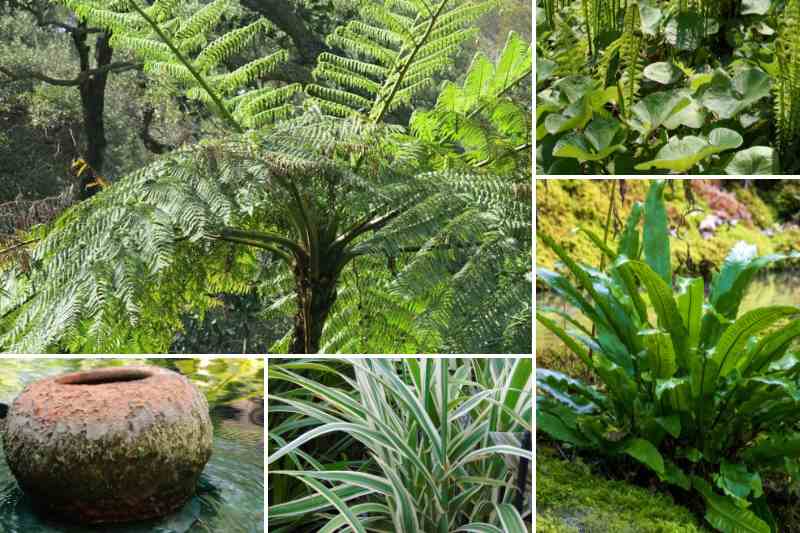
Around a pool in a seaside garden
Framing a reserved garden area such as a pool is a great way to imagine being in Bali. Tropical plants from the island are too tender for our climate, so choose substitutes to recreate Balinese postcard. In our example, simplicity is expressed with evergreen plants required around pool, and splendid foliage.
Banana trees, cordylines, bamboo palm provide the structure, enhanced by Coleus in aniseed tones such as 'Copinto Caipirinha' or 'Margarita' and a black-leaved Colocasia.
Be sparing in contemporary layouts with three or four plants maximum and slightly more generous in a denser garden. Here, Balinese parasol and wooden sun lounger become must-have accessories for hot summer days.

In a sheltered garden with mild climate
This is certainly the most suitable place to establish a Balinese garden, especially if you live on the Brittany and Atlantic coasts, benefiting from sufficient humidity to approach island’s humid tropical climate, or around the Mediterranean basin by adapting some plants. You can enjoy plants with beautiful foliage, a little tender but that will survive mild winters in these regions or that can be planted in large pots: Alpinia zerumbet 'Variegata', showy variegated gingers, replacing colours of local Cordylines. A queen palm (Syagrus romanzoffiana), a frangipani (Plumeria obtusa) chosen for its delicacy and intoxicating fragrance can join the scene.
In Mediterranean areas, a traveler's tree and tropical palm trees can even be considered! Also think of a beautiful exotic climber such as pink bignonia and some ismenes for an extra exotic touch.
By planting densely, you recover the jungle effect described above. Decorative elements complete scene such as an ornate door or a painted shutter, and a bamboo chime.
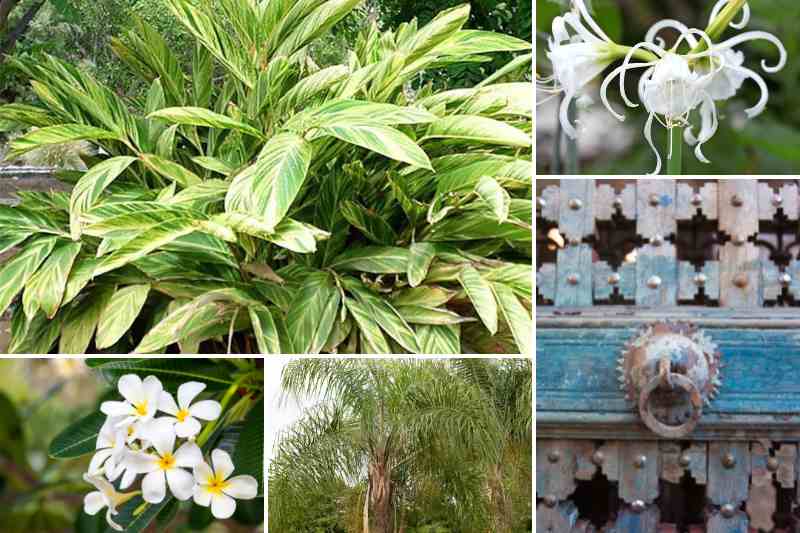
Water garden in the Balinese style
Water is omnipresent in Bali and in its finest gardens. You can easily imagine a Balinese garden centred on a water scene, whether a mini-pond or larger wet area. Plant species that like damp soil or can be partly submerged such as papyrus, lotus (Nelumbo nucifera) and water lilies are perfect. Arums, rodgersias and ligularias work well with their large foliage to infuse tropical atmosphere beyond their white or yellow blooms. For a larger area add a Gunnera, Brazilian rhubarb, impressive once established, or Astilboides tabularis. Here we like variegated foliage of Fatsia japonica 'Spider Web' near the water to add more exceptional foliage.
Decor is important here too: a single Hindu statuette, some pebbles or black paving and a rain chain are perfect!
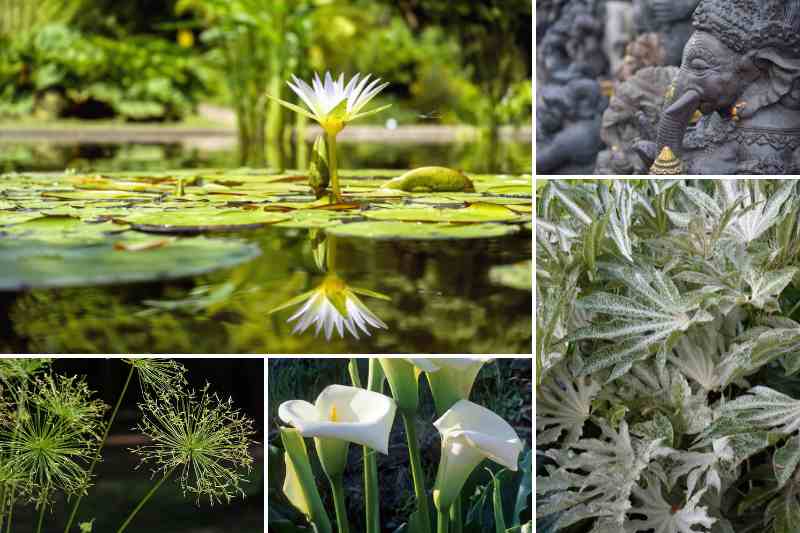
Tropical escape in a courtyard, patio or walled garden
These very sheltered spots allow installation of plants that would not survive elsewhere. Presence of walls creates microclimate beneficial to Balinese garden. Selection below suits a sunny spot, and all these plants also grow well in pots and can be overwintered if necessary.
By replacing Cordyline fruticosa found in Bali with Cordyline banksii, equally colourful but hardier, you bring maximum colour, enhanced for example by bright red or pink of a common Rose mallow that performs well in a pot when substrate is kept moist. Beside them an essential banana, Musa 'Basjoo', interesting for cold tolerance and eventual size, or large unicolour cannas that also bring exotic feel. A compact climber can also slip in, such as Gloriosa rothschildiana. Bring out a Monstera or bird of paradise from the living room for summer and install a small temporary fountain to perfect tropical ambience.
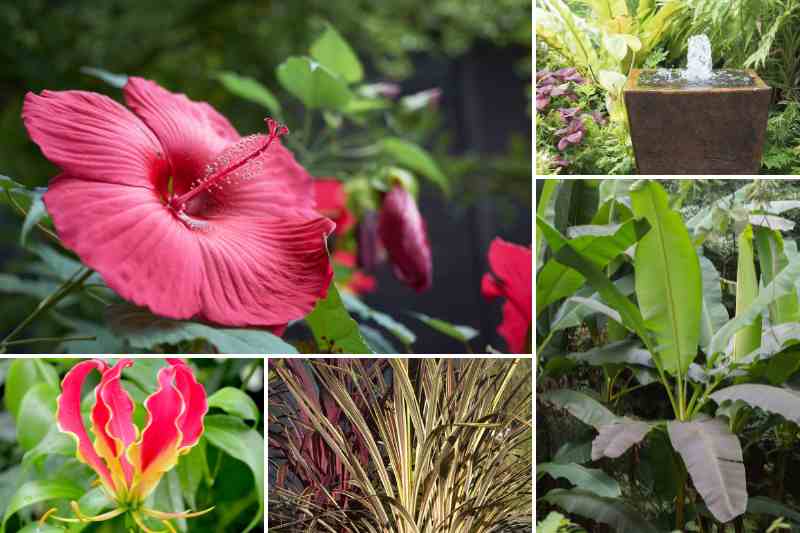
Find Find our selection of plants suited to exotic spirit on our online nursery as well as our Balinese Garden inspiration page in our 2026 trend booklet !
Do you enjoy these lush, transporting atmospheres? Discover other inspiring scenes in these articles that address the theme:
- Design a garden inspired by Madeira, the island of flowers
- A banana tree in a small garden? our tips for integrating it well
- How to create a tropical atmosphere in a small garden?
- How to create a refreshing oasis in the garden or on the terrace?
And all our tips to create at home an atmosphere of exotic or tropical gardens:
Bali, the island of the Gods, is a unique place in the Indonesian archipelago. A paradisiacal vision of distant horizons, it has inspired many landscapers seeking exoticism and refinement in the garden. The Balinese garden is one of the current trends to explore for gardeners looking for paradise on earth!By opting for plants that withstand […]
Terraces, courtyards, patios and small bohemian balconies are the new stars of summer! This very colourful "boho" trend that has invaded our interiors and wardrobes also appears in our summer green retreats. It matches the sunny cheerfulness of a season when we spend a lot of time outdoors.
Let’s take inspiration from the gypsy world to prepare bright alcoves on balconies, terraces and inner courtyards from the first fine days, with planting ideas and decorative elements. We explore this Boho Patio in three scenes easy to recreate at home!
Boho Patio codes
The bohemian atmosphere dresses itself in vivid, deep and variegated colours that answer one another, but also in associations of warm tones in the blooms: intense reds, deep violets, Indian pinks and spicy oranges, not forgetting bicoloured flowers. Bluish, golden or purplish foliage helps to reinforce this playful mood, bringing red or variegated splashes.
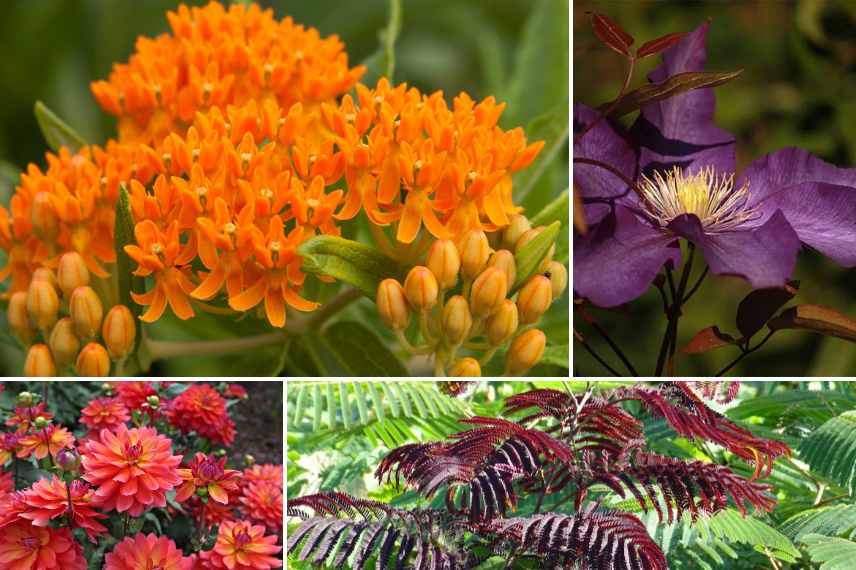
This mixed-up planting borrows from gypsy culture a festive, hybrid universe that laughs at convention and pairs a whole spectrum of colours, provided they are warm and bright.
This style is also based on improvisation, like manouche music, and on bold accents. This temperament appears in the garden in temporary scenes created especially for the summer months, and in the accumulation of mismatched small objects (side tables, stools, small cushions, etc.).
On the décor side, important for dining and relaxation areas, have fun with mismatched pairings: rustic furniture repainted turquoise or green, rattan chairs, fabric pouffes, Provençal floral and ethnic patterns juxtaposed with strong colours: turquoise, pink, orange and bright yellow. The advantage of this bohemian décor is that you can mix disparate objects and accessories, using what you already have at home or stored in the attic, to give them a second life: bring out granny’s lace and embroidery for the summer, macramé and trimmings, old rattan armchairs, baskets and fruit crates, airy curtains. In a joyful mix of materials, the décor is done!

On a sun-drenched terrace
Terrace or balcony are often west- or south-facing. They can be radically transformed into an ultra-cheerful cocoon with sun-tolerant plants that do well in pots. Explore a plant colour palette ranging from saffron yellow to violet for a truly bohemian vibe.
Alstroemerias 'Indian Summer', orange and yellow contrasting against bronze foliage, will look stunning alongside Coreopsis 'Cosmic Eye', a bright yellow spotted with purple, or the pretty all-yellow 'Full Moon Madness'. Add other long-flowering plants such as a common Rose mallow 'Pink Passion' with giant flowers and dark purple foliage, and provide more foliage interest with a pomegranate that can be grown in a pot, such as Punica granatum 'Nana', whose brilliant flowers will pair beautifully with the other perennials. For snacking at aperitif time, invite, for example, the surprising cherry tomatoes 'Akoya', whose fruits turn almost black.
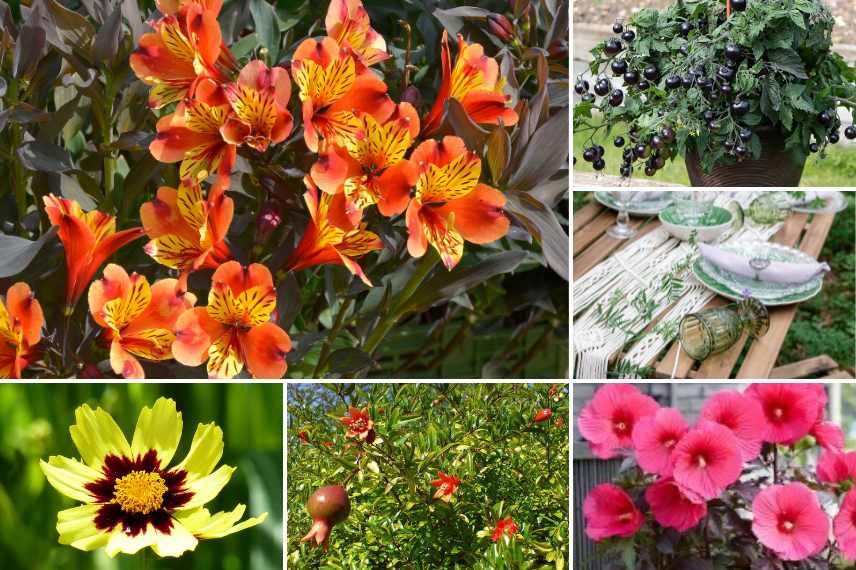
In a semi-shaded urban patio
Small city courtyards benefit from focusing on colour and variegated or golden foliage to lift them out of the shade. In a semi-shaded patio receiving enough light and warmth in summer, opt for sunny flowers and a few "indestructibles":
Hosta 'The King', Hakonechloa macra and an Aucuba japonica 'Crotonifolia' for their golden and variegated foliage (Aucuba will reward you with pretty red berries a little earlier) together with the bold flowers of Hibiscus syriacus 'Hibisa rosada', and the Peruvian lily 'Duc d'Anjou'.
The bohemian spirit will also be present in accessories, essential in less bright areas and in smaller spaces.
Beyond plants, bring colour without fearing the boldest mixes. Dare genre-mixing: antique rug + Italian ceramics + small disparate or oversized objects and a cosy bench, etc. Here, the evening atmosphere will be especially worked on: lanterns, paper lanterns and candles, and don’t forget a crochet throw in these patios that are often cooler at night.
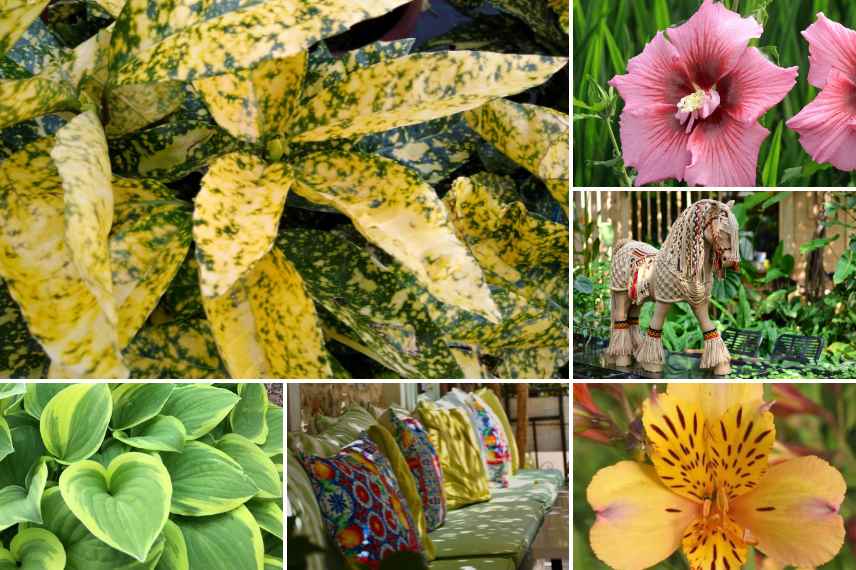
Garden refuge as an improvised alcove
This bohemian trend can also be expressed in a corner of the garden used as an improvised summer retreat.
In front of a shed, garden shelter or at the foot of a fine tree from which a rattan chair is hung, set up a summer hideaway using bohemian codes. A temporary terrace, improvised with clip-together wooden decking tiles readily available from DIY stores, is easy to install. In summer it becomes a true green cocoon perfect for relaxing on a garden sofa made of a few stacked pallets or large pouffes, in a fairground style.
Here, a few colourful annuals join the party: multicoloured zinnias and orange calendulas (marigolds) sown in pots in spring, or beds of African marigold 'Mango Tango' around the area, as well as sun-loving perennials such as the charming Delosperma 'Ocean Sunset Orange Glow'. Count on two striking pots of dahlias with evocative names, the fiery 'Bohemian Spartacus' and the more restrained compact 'Melody Gipsy', for a long and remarkable display. Sunflowers 'Mongolian Giant' will bring pep and height, while a pot of basil 'Everleaf Emerald Tower' will be handy for salads at barbecues or sunny lunches.
Gather your most colourful pots, bring in lace, hangings, vintage crockery and cushions: job done!
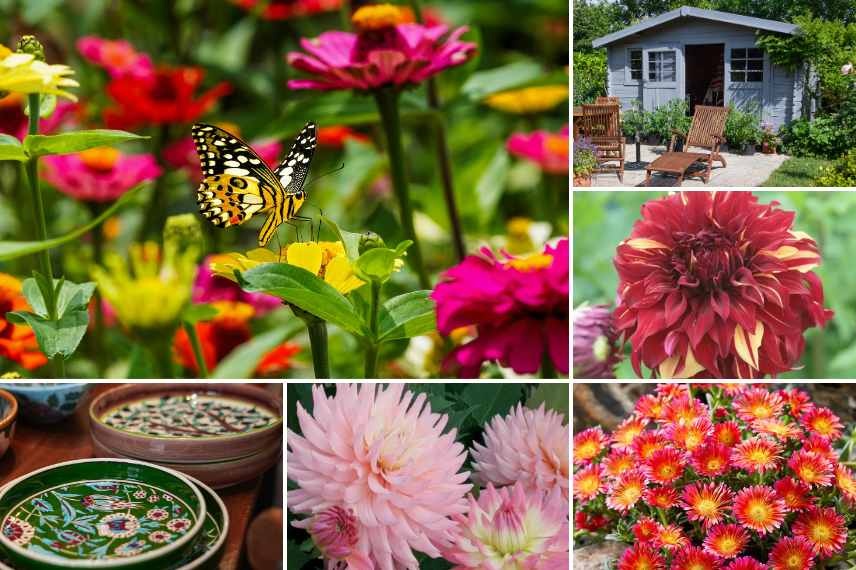
Discover other plants ideal for composing this bohemian green décor on a terrace in our "Boho Patio" selection online and in our trend booklet!
Feeling the bohemian spirit? Find our advice on creating a bohemian garden, and our inspirational sequences: Catalane and Peach Raspberry.
This Boho Patio trend also draws on recycling second‑hand objects. Explore our topics to let your creativity run free: Decor idea: plants in unusual containers; How to make a planter from a pallet?; Recycling in the garden and How to use and properly integrate terracotta pots in the garden?
Terraces, courtyards, patios and small bohemian balconies are the new stars of summer! This very colourful “boho” trend that has invaded our interiors and wardrobes also appears in our summer green retreats. It matches the sunny cheerfulness of a season when we spend a lot of time outdoors. Let’s take inspiration from the gypsy world […]
Here’s a distinctive trend emerging in outdoor spaces, and not only among landscapers fond of conceptual gardens or in coastal areas! While a sand garden is particularly suited to coastal gardens, it proves to be an undemanding, on-trend garden, halfway between a gravel garden and a dry garden, perfectly in tune with current climate upheavals.
We invite you to discover it in three scenes that demonstrate its aesthetic appeal and sunny atmosphere!
Sand garden: a landscaping trend between frugality and aesthetics
Far from the image of the traditional Japanese zen garden with raked gravel or pale sand, the sand garden imposes itself as a new version of the garden. It retains a sense of serenity but transposes it into a warmer register, where maintenance and watering are reduced to an absolute minimum. It answers a need created by climate change: how to introduce more Mediterranean plants into northern regions? Even if rising temperatures allow it, the problem of waterlogged winter soils, often fatal to these plants, remains. The sand garden is one solution, providing effective drainage.
It is a functional garden, still experimental globally, which showcases plants that ripple in the wind, like a reminder of a sea that is not always present. It also emphasises contrasting materials and textures, often using Corten steel as a support, woven willow in tontines or sculptures, large stones or retaining walls.
Undemanding plants grow in a substrate made up of a thick layer of sand. They therefore need to draw water from deep down to survive. For this reason we choose the most drought-tolerant plants and xerophilous plants, those whose taproot systems mean they will withstand heatwave summers.
We also seek to enhance the golden aspect of the sand using a palette of warm tones available to us, both in plants and materials. Plants will generally be low-growing, mat-forming or supple, also incorporating some greyed foliage to reinforce the impression of warmth.
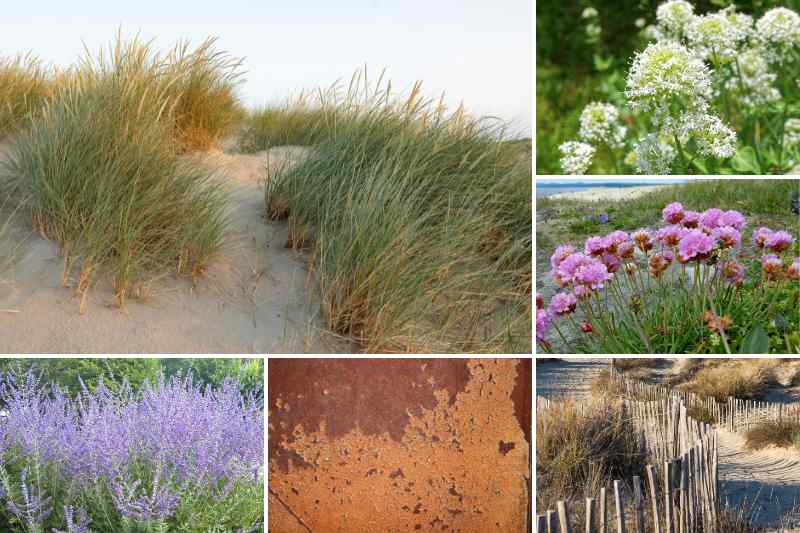
A holiday feel
Coastal gardens, and especially those located right on the coastline, are difficult to plant because of the omnipresence of sand on site. They are perfectly suited to the constraints of a sand garden. In a beach-return spirit, the focus is fully on the sand-and-beach duo, taking inspiration from the dune ecosystem.
Essential plants: valerian, Lagurus ovatus and oyat (Ammophila arenaria), Armeria maritima 'Vesuvius' (sea thrift), sandwort, Erigeron glaucus 'Sea Breeze' or Erigeron karvinskanius, sand carnations, Perovskia, blue fescue, sea holly (Eryngium maritimum), milk thistle, etc.
To bring back vegetal blond tones, use wooden slats as decking, mini sand fences, and pair with coppery accents such as a brazier, useful for summer evenings.
Our tip: take care not to multiply beach clichés. Restrict decoration to sand alone, without superfluous additions of pebbles, shells or other seaside trimmings to avoid caricature. Plants create the scene, not the other way round!
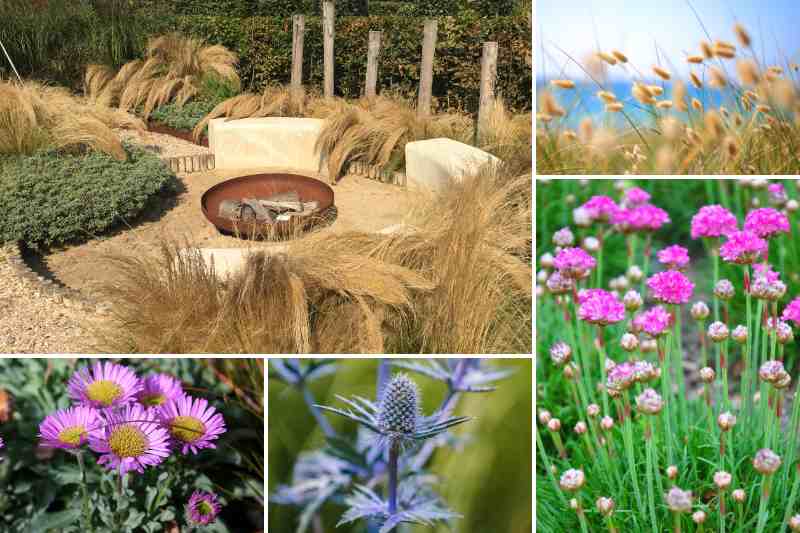
Contemporary sand garden
At the opposite end from the dune garden that naturally links to its environment, the idea of undemanding plants and sand also evokes minimalism and the mineral feel of modernist gardens. The sobriety of the sand, combined with an appropriate plant palette, allows creation of a sand garden that suggests a coast not necessarily nearby, in perfect harmony with contemporary architecture.
Here, colour is conceived in monochrome, or in white/black, white/mauve or purple and green duos, to name a few pertinent combinations. Plants are chosen for their prostrate habit, their original textures or the shapes of their inflorescences. Greyed tones for foliage are also favoured to blend well with often anthracite outdoor furniture. Corten steel, used for boards or attractive windbreaks, stands out as a material that enhances the sand’s sheen, as does brick, which can serve as a path.
Essential plants: silver santolina, Artemisia 'Powis Castle', Ballota pseudodictamnus, medium to tall grasses such as coppery Carex (Carex testacea), the movement of Hordeum jubatum, graphic silhouettes (Cordylines, Yuccas) on flat ground, and low to medium plants as on a shaped sand mound (sea thrift, creeping gypsophila, wild thyme, etc.).
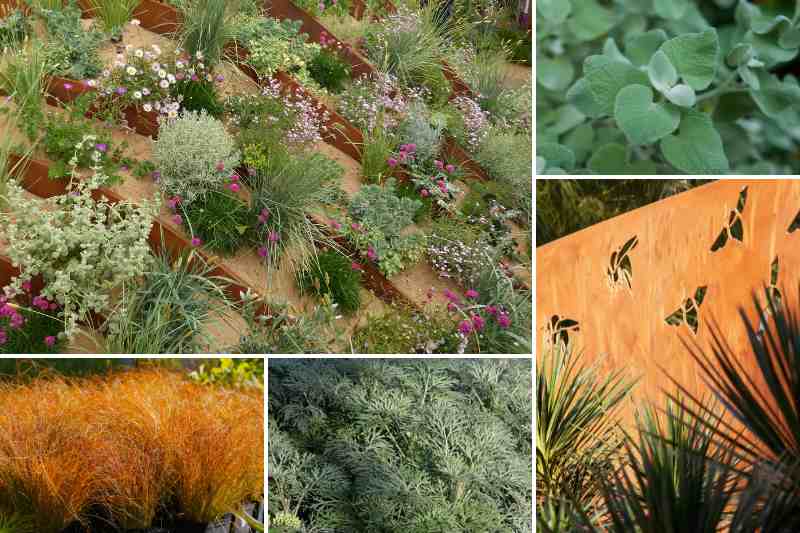
South African atmosphere
One attractive idea with the sand garden is to travel to an arid, heat-baked world. You can plant stunning perennials and ultra-resilient grasses and lean towards a Californian vibe, or, as here, a South African feel.
Let’s take inspiration from Léon Kluge’s work, the world-renowned South African landscaper, at Domaine de Chaumont-sur-Loire in France: few plants for a spectacular effect in this full-sun garden. The scene draws from the African bush, where red sand and oversized stylised baobab sculptures mainly make up the decor, with waves of Stipa tenuifolia and torch lilies. At home, imagine tall red-willow tontines or large woven willow spheres to add volume and blend into this atmosphere.
Key plants: succulents and light grasses (Aloes, Euphorbia myrsinites, Stipas, Sesleria argentea, Lomandra longifolia), and perennials with sunny yellow to orange blooms (Kniphofias, Euryops pectinatus, bulbines, Leonotis leonurus, gazanias…). Plants native to South Africa, Patagonia or Tasmania are favoured, some tolerating down to -8°C in sheltered conditions.
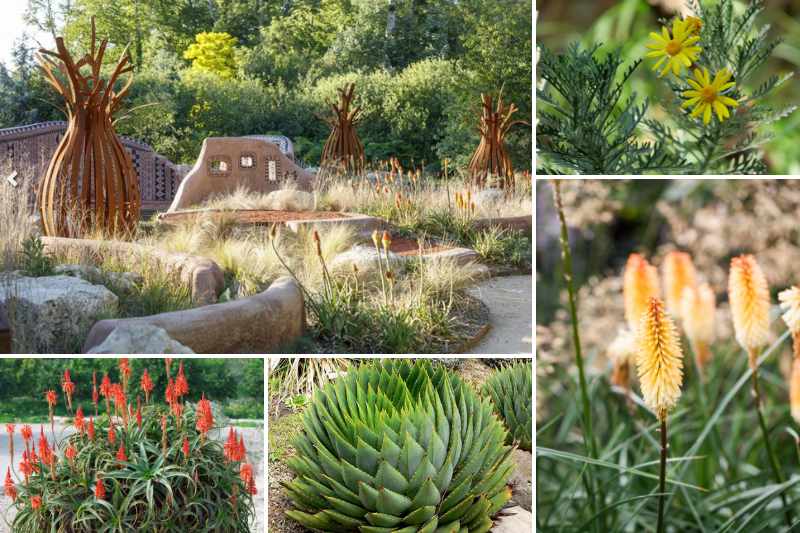
The naturalistic garden and the English garden also draw on this avant-garde technique, and we could just as well have developed scenes in these two worlds, which lend themselves to experimentation currently being carried out notably across the Channel.
Find our selection of plants suited to the Sand Garden spirit on our online nursery as well as on our inspiration page in the 2026 Trend Book !
Do you enjoy these distinctive atmospheres? Discover other inspiring scenes in related worlds:
Here’s a distinctive trend emerging in outdoor spaces, and not only among landscapers fond of conceptual gardens or in coastal areas! While a sand garden is particularly suited to coastal gardens, it proves to be an undemanding, on-trend garden, halfway between a gravel garden and a dry garden, perfectly in tune with current climate upheavals.We […]
Garden, rarely short of inspiration, suggests enticing colour trends each year to imagine new borders.
For romantics who favour softness and pastel tones in the garden, here is the Unicorn trend, a new hue devised by promesse de fleurs, blending graduated and iridescent shades from pink to straw-yellow.
What exactly is the Unicorn colour for the garden?
Inspired by the legendary white, pure animal, the "Unicorn in the garden" trend actually draws on the enchanted world of childhood, which associates pink and yellow hues, through to mauve, as if straight from a fairytale.
The garden introduces these fairy-like, very girly notes — powdered and old-rose tones, marshmallow to lavender, touched with very soft yellows — to create a decidedly romantic atmosphere. This garden universe aims to be both poetic and very feminine, approaching a "cotton candy" aesthetic but more subtle, with less acidity and more pastel nuances.
Among plants ticking all boxes of this subtle palette are many perennial plants and shrubs softly salmon, apricot and butter-fresh shaded, tones that catch the light and recall gentle spring colours.
We suggest some planting combination ideas for different garden styles and enticing borders!
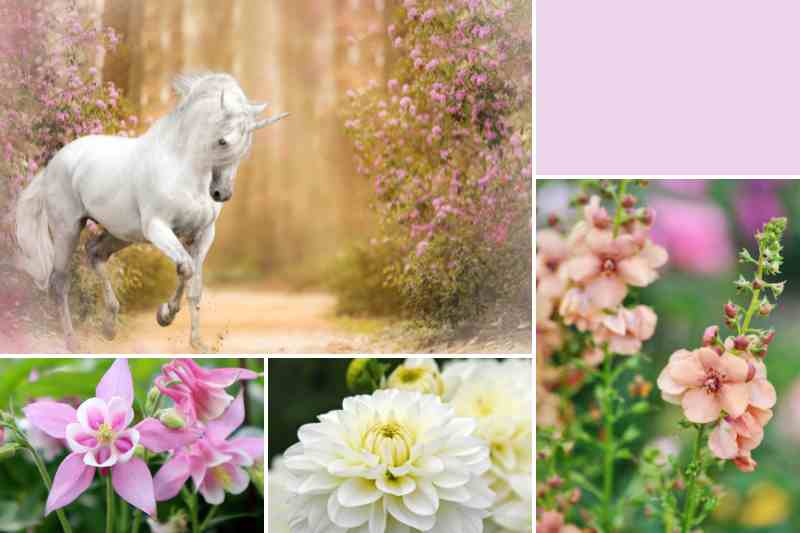
In a cottage garden
This border, both rustic and sophisticated, remains very natural thanks to soothing colours from pink to apricot, with a well-measured touch of yellow. It suits a south- or west-facing position.
Here we showcase an intersectional peony Scrumdidleyumptious, indispensable in a country garden for its elegance. As its flowering is fleeting, we surround it with some long-flowering perennials and shrubs: an old-fashioned rose such as the heirloom 'Pénélope', statices and apricot wallflowers. A large drift of Coreopsis 'Uptick Cream' adds further softness…
Also consider adding a few Verbascum 'Jackie' or 'Southern Charm' in a blotting-paper pink that will make you swoon! Also think of adding some olive-green or greyed foliage.
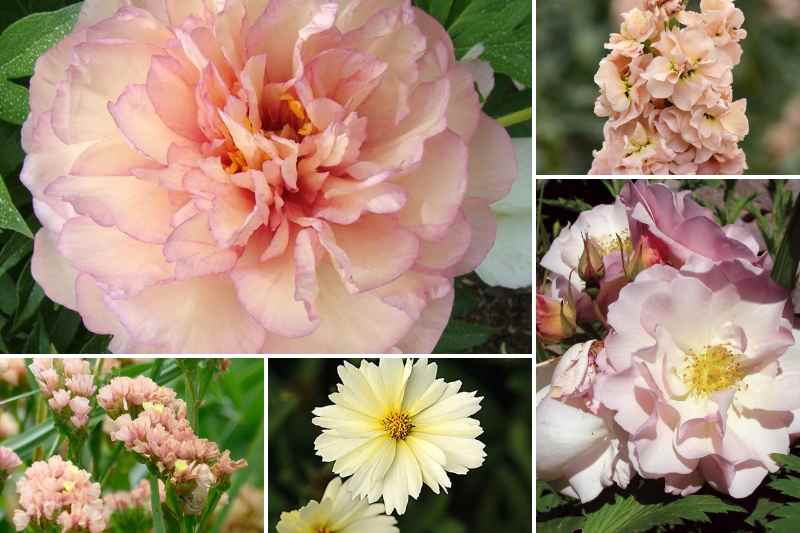
In a spring border
A gradient of soft colours will awaken garden in early fine days with these pastel blooms. Gather in a sunny or semi-shaded border a few favourites admired for their simplicity and grace: a Michelia 'Fairy Lime', a small magnolia with evergreen foliage and delicate cream-yellow flowers with a hint of pink, Astrantia 'Florence' for a mauve bloom a little later around June, and hardy geraniums as groundcover such as Geranium 'Katherine Adele', flowering for months from May, nicely veined with dark pink. Another charming small shrub, Japanese quince Chaenomeles 'Falconnet Charlet', will bring salmon tones in March–April alongside the Michelia. A silvery evergreen foliage, for example that of Santoline chamacyparissus if border is in full sun, is an essential complement to the soft ambience.
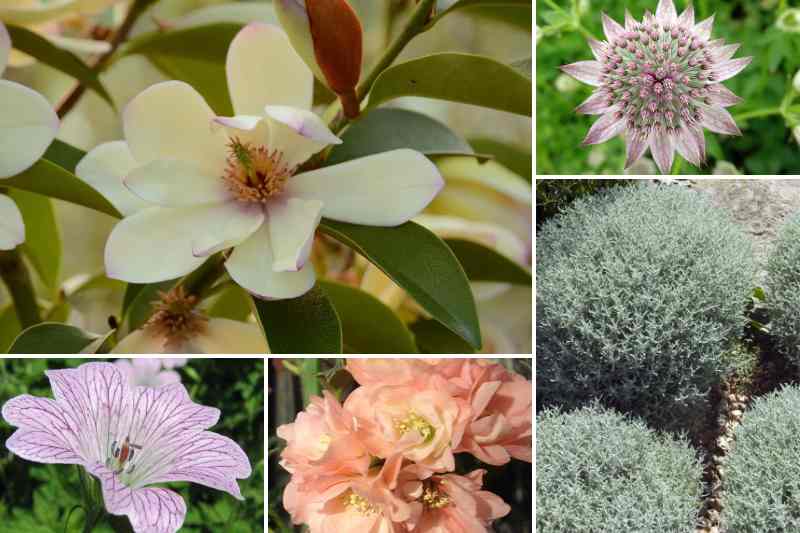
In a secret garden
In the intimate, often shadier setting of a secret garden, invite pale luminous yellow blooms to combine with a few pastel tones, from pearly pink to iridescent mauve.
Rely on a base of climbers to screen views and some supple ornamental grasses, perfect here: Chinese fountain grass orientale 'Karley Rose', a very fragrant yellow star jasmine (Trachelospermum asiaticum), Thalictrum delavayi 'Splendide', tall and lilac-pink, and two thoroughly voluble climbers: Akebia quinata chosen in a superb bicolour form 'Cream Form', and a persistent Holboellia latifolia. To enliven the base of climbers earlier in the season, plant in autumn a few bulbs of pink or pale-blue grape hyacinths like 'Baby's Breath', some miniature daffodils and Greek anemones 'Charmer'.
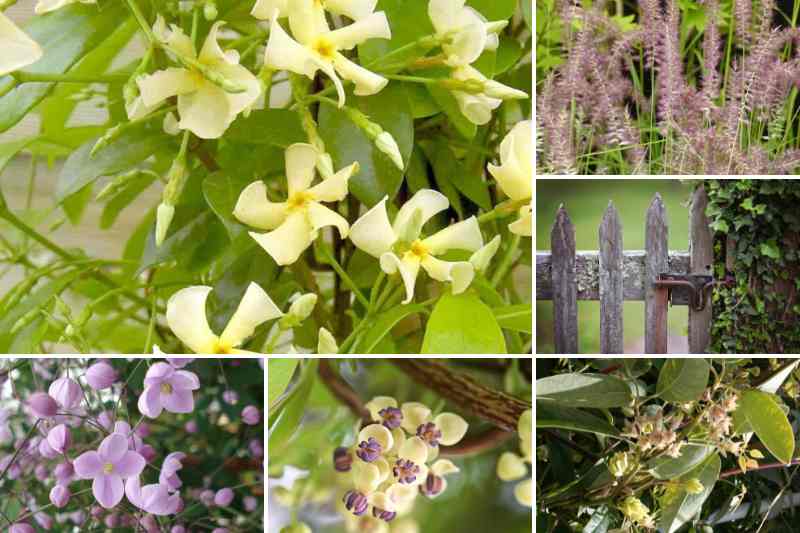
In a bohemian garden
The bohemian garden that explores a wide palette of plants also fits perfectly with the Unicorn garden universe. Ultra-soft, soothing colours will be gathered in the joyful mix and abundance of the bohemian garden! It's a garden that comes alive best in summer, in a profusion of flowers and foliage.
Here we've chosen sorbet tones, old-rose and vanilla-yellow to evoke the Unicorn trend. A honeysuckle skilfully blends pink and yellow, double-flowered hollyhocks 'Chater's Double' and a climbing rose 'Papi Delbard' play the apricot notes, delightful gladioli, 'Blue Tropic', and dwarf alstroemerias 'Pitchoune Lucas' reveal a desaturated mauve. In sun, add a few pom-pom dahlias 'Isa's Favorite', preceded in spring by late double tulips 'Charming Lady'. Add a base of foliage to bridge to summer, such as common sage and a dwarf abelia: charm guaranteed!
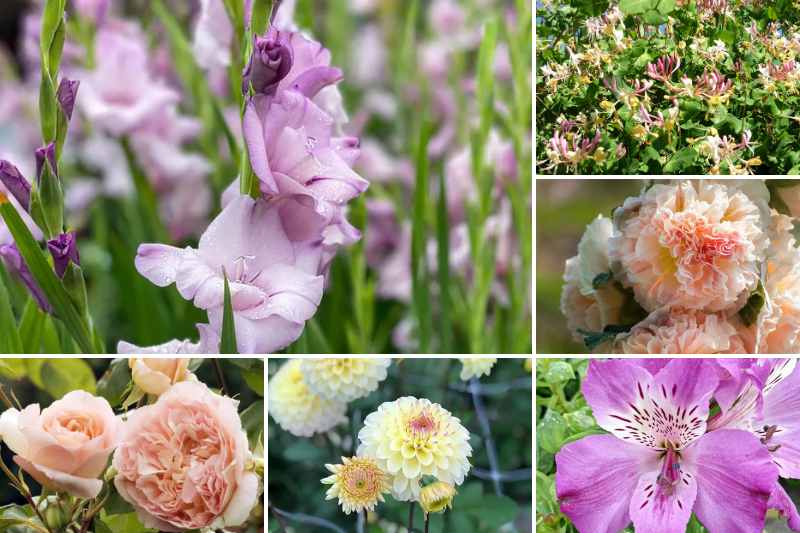
Find our selection of plants in the Unicorn spirit on our online nursery as well as our inspiration in the Trendbook 2026!
Do you love these very soft garden tones? Discover other inspirational scenes in these closely related colour universes:
- Peach Fuzz: Colour of the Year 2024
- Soft on-trend colour: how to lay out a nude garden?
- Pinkish Lemon: the new zesty garden trend
- "Coffee colour" inspiration
- and Rose and khaki inspiration for a soft, on-trend garden.
Garden, rarely short of inspiration, suggests enticing colour trends each year to imagine new borders.For romantics who favour softness and pastel tones in the garden, here is the Unicorn trend, a new hue devised by promesse de fleurs, blending graduated and iridescent shades from pink to straw-yellow. What exactly is the Unicorn colour for the […]
Growing carrots is deadly boring. Where's thrill of digging up a root the size of a toothpick or a fossilised beetroot? If you're fed up with neighbours flaunting perfectly straight harvests and turnips like showroom models, welcome: this is sanctuary of deliberate failure.
This "zero-success" guide explores art of veg-patch sabotage. By dissecting every fatal mistake — from concrete-like soil to erratic watering — we'll highlight, by way of contrast, real soil needs, importance of thinning and moisture management.
Prepare soil fit for a car park
If you want root vegetables to suffer, treat veg patch like motorway construction site. Golden rule? Do not loosen soil under any circumstances. Leave it compacted, ideally with consistency of sun-dried breeze block.
The more stones, weed roots and hard clods, the better the challenge for your carrots and parsnips. Consider every obstacle a test of strength for your patch.
- Desired effect: the "Alien Carrot". Hitting a stone or a dense clod makes root split, fork or curl back on itself. Result? Forked carrots that look like extraterrestrial creatures with too many legs. Terrifying, unsellable, perfect.
- Why it fails: root seeks path of least resistance. If it must muscle through concrete, it either exhausts itself or deforms completely.
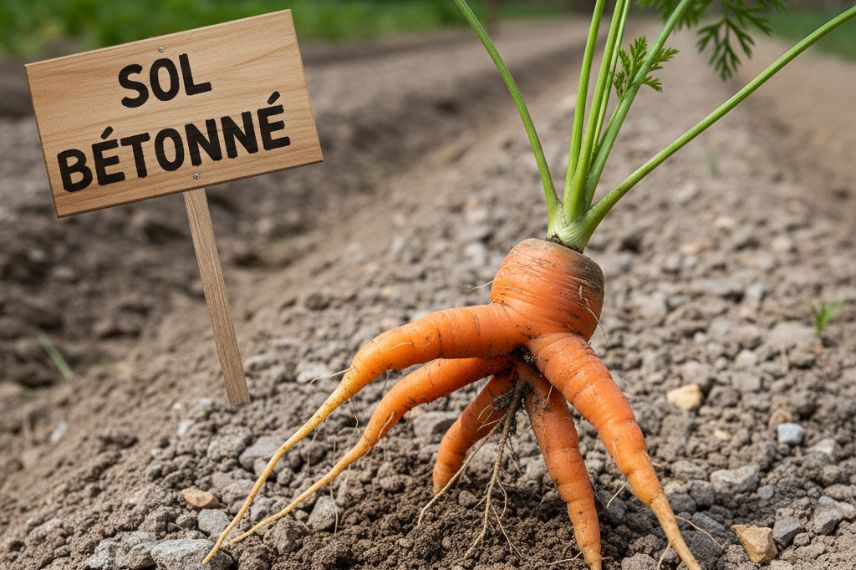
Real advice (for those who actually want to eat)
To avoid this fiasco, serious gardeners favour loose, deep soil. Before sowing, fork over soil to aerate without inverting. Ideal is a well-draining substrate: mix of fine soil and sand. The fewer obstacles, the straighter root will grow to success.
Sow as if throwing confetti
Gardening is solitary pastime, so why deny same solitude to vegetables? For exemplary failure, forget Swiss precision. Grab seed packet and empty it in one sharp shake over 10 cm². Close quarters is conviviality! The tighter they are, the more they'll have to tell each other jokes while waiting to wither.
And above all, once seedlings appear, resist temptation to thin out. Why choose who gets to live? Let jungle law take its course.
- Desired effect: fighting for every millimetre of soil and every sunbeam, your carrots and radishes will remain mere wires. Expect threadlike, tangled roots utterly ridiculous on plate.
- Why it fails: without space, root cannot widen. It wastes energy in fierce competition for nutrients, producing harvest that looks more like bowl of vermicelli than vegetables.
Real advice (for those who actually want to eat)
To harvest anything but disappointment, respect each plant's living space. Spacing rule is simple: a radish needs 3 cm to flourish, while a carrot requires at least 8 cm from neighbour to become fleshy.
Water... or don't, be guided by mood
Secret to inedible harvest? Apply emotional instability to watering. Don't be that dull gardener who checks moisture every evening. Instead practise thermal and water shock method.
Wait until soil resembles Death Valley, with cracks wide enough to lose keys. Once carrot plants are begging on their knees, go big: trigger biblical flood with hose. Move from Sahara to Atlantic in under two minutes.
- Desired effect: after sudden influx of water following long drought, root cells swell too quickly and... skin splits. Results are cracked, scarred vegetables and, for radishes, flavour so sharp it could fuel a rocket.
- Why it fails: lack of water makes root fibrous and hard (the famed "wood"), while sudden excess causes fissures that invite disease and pests.
Real advice (for those who actually want to eat)
Key to tender, sweet root is consistency. To avoid water stress, better to water moderately but regularly than to drown weekly. Good mulch also helps maintain steady moisture without turning patch into marsh.
Overdoing nitrogen
Want root vegetables? Narrow-minded idea! Aim for jungle instead. Use ultimate weapon: fresh manure spread generously just before sowing. The smell alone boosts chances of sabotaging harvest.
Message to plant is clear: "Forget what's underground, put all energy into leaves!"
- Desired effect: carrot tops a metre high, so dense a cat could hide in them. But at harvest suspense collapses: dangling from that royal mop is tiny, hairy root, puny and disappointing.
- Why it fails: nitrogen fuels foliage. In excess (especially fresh), it burns young roots and encourages plant to show off above ground. Fresh manure also attracts carrot fly like magnet. Double failure, winning combo!
Real advice (for those who actually want to eat)
Root vegetables are thrifty creatures that hate direct nitrogen. To succeed, they need potassium (for root development) and phosphorus. Ideally sow into soil that received well-rotted compost previous year. This is known as "second cropping": let hungry crops (tomatoes, squashes) deplete nitrogen in year N, then sow roots in year N+1.

Summary of "worst practices" vs reality
| Action | Worst practices (Failure) | Reality (Success) |
|---|---|---|
| Soil | Compacted, clayey, stony soil. | Deep, light, loose soil. |
| Sowing | Packet emptied in bulk, no thinning. | Row sowing and respecting distances. |
| Water | Alternating desert / sudden flooding. | Stable, regular moisture. |
| Fertiliser | Fresh manure (too much nitrogen). | Well-rotted compost (potash & phosphorus). |
Growing carrots is deadly boring. Where’s thrill of digging up a root the size of a toothpick or a fossilised beetroot? If you’re fed up with neighbours flaunting perfectly straight harvests and turnips like showroom models, welcome: this is sanctuary of deliberate failure. This “zero-success” guide explores art of veg-patch sabotage. By dissecting every fatal […]
Among the colour trends of the year that spark the imaginations of our most creative gardeners, Dark Academia offers an immersion into garnet, purples, crimsons and plum, edging toward an almost-black depth. These bold, dark tones originate from a baroque aesthetic, that of the hushed and mysterious world of old libraries and the hit series Wednesday.
In the garden, adopting such a romantic and melancholic palette requires a neat setting and scenes with subtle harmonies to soften the sombre colour and the intensity of the blooms and foliage.
Here are three borders imagined for you with this new trend in mind, updated for today!
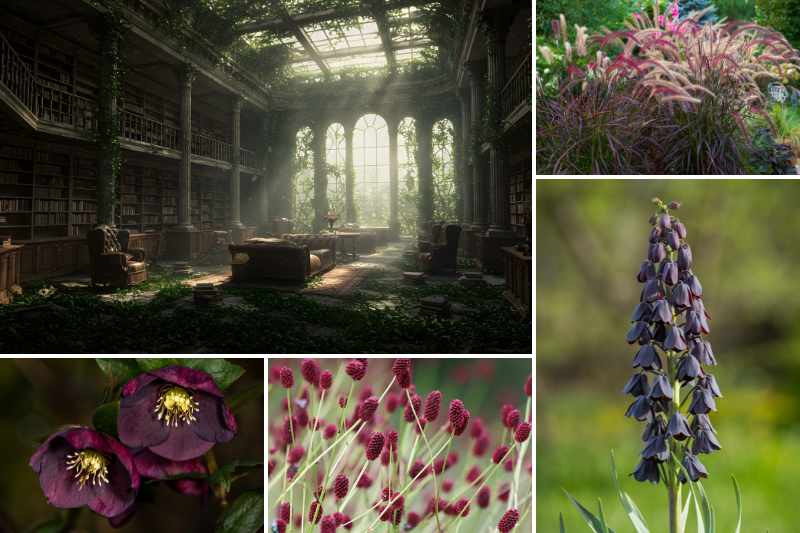
How to pair it with the garden?
The dark tones, from purple to black, should always be used with great care in plantings. They can overwhelm the eye and, if misused, impart a mood that is too sombre for a garden.
We therefore often pair them with a few neutral, diaphanous touches, drawing from the palette of white, pearly, cream and green blooms, as well as bronzy, greyed foliage. Don’t forget light, ribboned foliage, iridescent or variegated to diffuse the light around the deeper tones.
Some plants are thus particularly useful, especially those that work in a pointillist manner with their inflorescences, such as some grasses and airy perennials or the plush plants. In small doses, they instantly lighten the colour composition of a border.
A naturalistic scene: the poetry of black flowers and wild grasses
Dark-toned flowers can certainly suit a section of the garden treated as a large meadow or flowering border. In this case, favour beautiful wildflowers, such as Scabiosa 'Chile Black', and Cirsium rivulare 'Atropurpureum'. A mass of Penstemon with purplish flowers such as the variety 'Raven' will visually support the border, enriching it with a multitude of blooms right through to frosts.
The perfect accompaniment to temper, without masking, the depth of purple tones will simply come from a few very light grasses such as the Hordeum jubatum, or taller Panicum, or airy fennel. In mild climates, opt without hesitation for the Pennisetum setaceum 'Rubrum'. The presence of statice (Limonium latifolium) with tiny pale mauve flowers softens the scene and brings the essential gentleness to the dark colours.
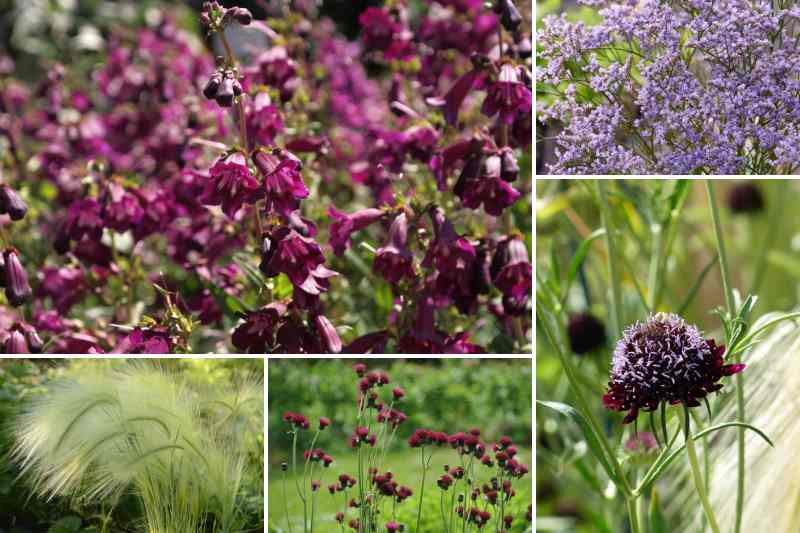
Clockwise from top left: Penstemon 'Raven', statice, Scabiosa 'Chile Black', Cirsium rivulare 'Atropurpureum' and Hordeum jubatum
A shrub border between lilac and burgundy
Around two fine shrubs chosen, one for its burgundy flowering with double blossoms—the lilac 'Charles Joly'—the other for its striking heart-shaped foliage, Cercis canadensis 'Forest Pansy', invite a few perennials in the same warm tones, and greyed foliage for softness. In our example, the lightness of the purplish inflorescences of a purple Eupatorium sits beside the delicate lavender-grey of a refined poppy (Papaver rhoeas 'Amazing Grey'), and the utterly graceful verticality of double-flowered hollyhocks 'Chater's Violet'.
Pensée to include some soft, greyed and silvery foliage such as Artemisia ludoviciana (Valerie Finnis) that will thread at the foot of the shrubs, and respond to the romantic colours of the poppies.
N.B. : other shrubs just as spectacular in their purple hues would work brilliantly in this border, such as certain varieties of the famous smoke tree (Cotinus coggygria) and its wispy summer flowering, a black elder, a physocarpus or Magnolia 'Black Tulip' for a poetic spring effect.
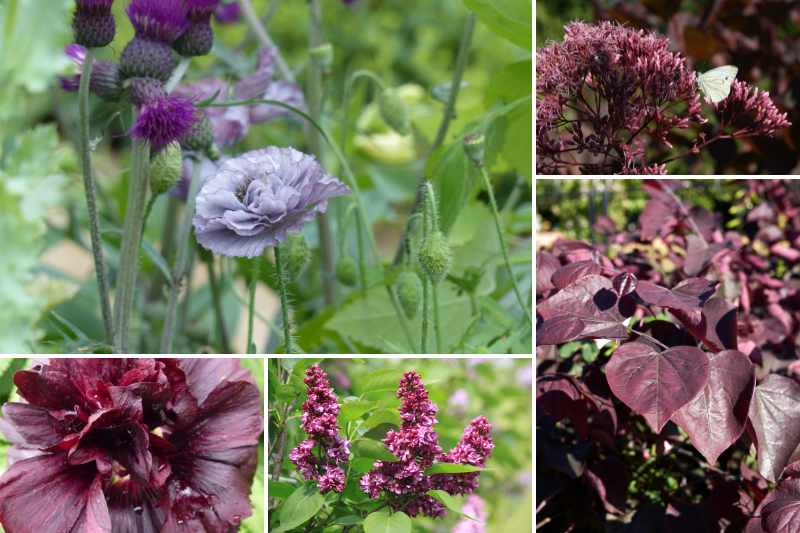
Velvety sophistication in partial shade
The two previous moods are envisaged in sunny settings. The purple-to-chocolate hues can also be used in a bright partial shade in the garden. In that case, work on an enveloping ambience, softening the dark impression with discreet touches of chartreuse green, together with pearly and iridescent whites.
The purple flowers of Hellebores will be the stars of this corner, with infinite grace and a very long flowering season, akin to botanical cousins such as Helleborus foetidus and its pistachio flowers. Invest here in a few purple foliage plants, such as Strobilanthes anisophyllus 'Brunetthy', a magnificent almost-black shrub, whose pale pink late-spring flowers contrast nicely, and a groundcover with marbled leaves like Trillium cuneatum and a mass of black Ophiopogons. Finally, for a touch of volume in the scene, use the assets of an oak-leaved hydrangea: distinctive foliage that clings on well into winter, taking crimson autumn tones, and white, anise-scented flowers, ranging from white through pink, in spectacular yet light panicles.
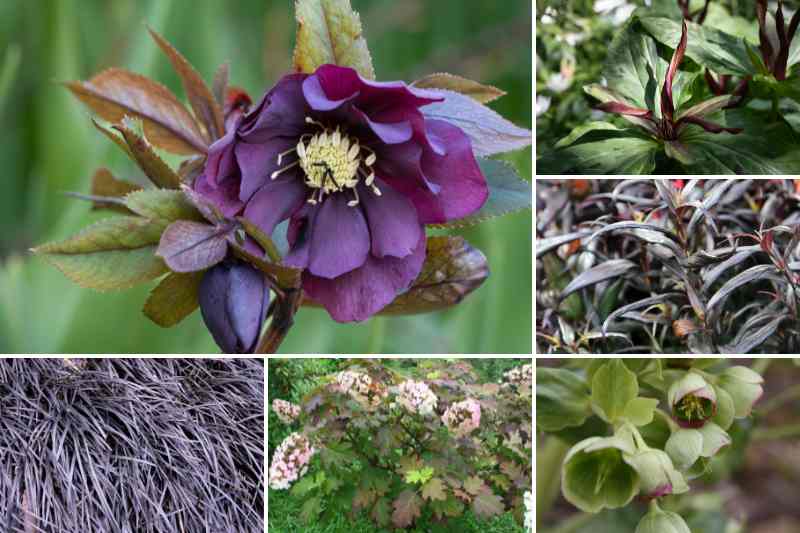
To refine this baroque ambience, why not insert one or two refined accessories: a latticed frame with a beautiful gilded patina or a mirror to reflect the light, a romantic vintage metal lantern or a statue representing a poet, an angel or a muse? A stone bench will also invite sitting and resting.
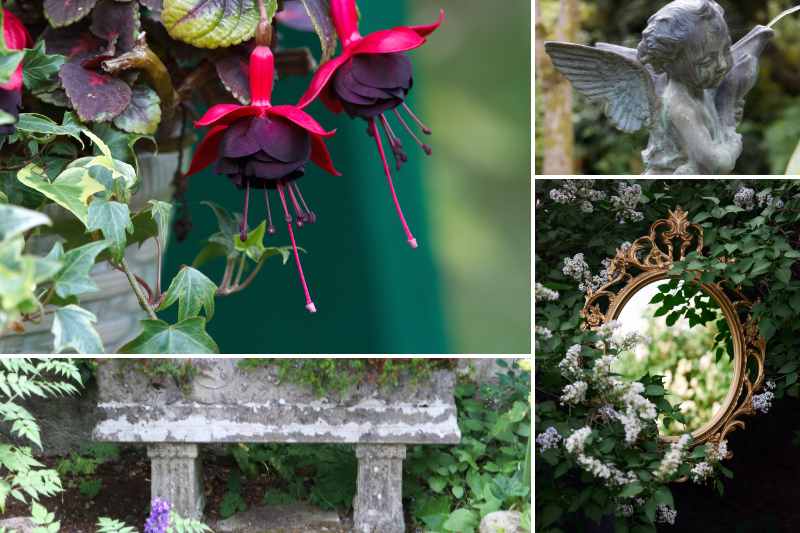
Discover our selection of plants in the Dark Academia spirit on our online nursery, as well as inspiration in the Trend Notebook 2026!
Also read on the topic: How to combine black-flowered perennials? ; 6 border ideas for a red/purple garden, Purple foliage: how to use it and pair it in the garden, and Pairing red or purple flowers.
Among the colour trends of the year that spark the imaginations of our most creative gardeners, Dark Academia offers an immersion into garnet, purples, crimsons and plum, edging toward an almost-black depth. These bold, dark tones originate from a baroque aesthetic, that of the hushed and mysterious world of old libraries and the hit series […]
Frankly, aren't you fed up with being buried under apple harvests so abundant that even your neighbours no longer want to open their door? If the prospect of baking yet another homemade tart with your own plums sends you into a cold sweat, it's high time to take back control of your garden by learning delicate art of horticultural sabotage. This guide promises to turn any vigorous pear tree into a pathetic pile of dead wood in just three radical steps.
Of course, for twisted minds who would actually like to fill their baskets, simply take this manual literally and do exactly the opposite of our advice.
Choose the worst possible moment!
The secret to a spectacular failure lies above all in your timing: if you prune at the right moment, you risk strengthening the tree, which would be a total failure for our mission. For successful sabotage, aim for peak sap flow, ideally when the tree is in flower; not only is it pleasing to see petals fall like snow beneath your pruning shear, but it also ensures the tree will exhaust its precious reserves for nothing.
If you miss the spring window, turn to the "Thermal Shock" technique: wait for a polar freeze overnight, around -10°C, before bringing out your tools. By opening tree tissues in severe cold, you prevent any healing and let the frost burst the wood cells, thus creating splendid permanent necroses.
Finally, to perfect the job, don't forget golden rule of moisture: the more it rains, the merrier. Fungal spores and bacteria are poor swimmers, so make life easy for them by offering gaping wounds under driving rain. It's a free pass to all cryptogamous diseases in neighbourhood, which will happily settle into your orchard.

The real advice
If, by strange fit of kindness, you want your trees to survive, know that pome fruit trees (apple, pear trees) are generally pruned only during full dormancy (winter, but when frost-free), and stone fruit trees (cherries, plums) just after harvest to avoid excessive gum loss.
Wield your tools with artistic negligence
Once you've chosen worst possible moment, it's time to use the most unsuitable equipment. For optimal result, forget shiny pruning shears and embrace liberating rust philosophy. Bring out grandad's old pruning shear, the one that hasn't seen a sharpening stone since 1998 World Cup: if blade is so blunt it no longer cuts but happily crushes wood fibres, you're on right track. A crushed branch is a branch that never heals, offering unlimited playground for bacteria.
In spirit of generosity, also practise disease sharing. Why confine a nice canker or grey rot to single apple tree when you can spread it across whole orchard? By stubbornly refusing to disinfect your blades between trees, you become vector of a magnificent, supportive parasite community. It's the all-you-can-eat buffet: what tree A has, tree B will receive free of charge via your filthy blade.
Finally, let your creativity run wild with "Free Style" cutting angle. Ignoring bevel rule is excellent way to create little stagnant pools on each cut surface. By cutting square or, better, towards bud, you turn every wound into tiny watering hole for fungi and wood-boring insects. After all, why let water run off naturally when you can invite it to settle and rot wood from inside?

The real advice
Those who care about their fruit will tell you that cutting tool must be razor-sharp for a clean cut and disinfected with 70% alcohol between each subject. They also recommend always cutting on a slant (about 45°), away from bud, so rainwater runs well clear of sensitive area.
Practice "Chainsaw Massacre" pruning
Here is where your misunderstood artist soul comes into play. To turn a fruit tree into sterile abstract sculpture, forget delicacy.
Start with radical method of wild topping. Why let central leader rise gracefully towards sky when you can lop it off at two metres? By cutting top, you force tree into absolute panic: it will respond by producing forest of vertical shoots (the water shoots) that will drain all energy and never deliver a single apple. Chaos guaranteed, and that's exactly what we're after.
Continue with strategy of total darkness. A well-maintained tree often looks like light well, but we aim for impenetrable jungle vibe. Carefully leave all dead wood and crossing branches in centre of trunk. By preventing air and sun from circulating, you create warm, humid microclimate at tree core, ideal for raising colonies of aphids and mosses.
Finally, to finish your masterpiece, practise systematic removal of spurs. These short, stubby buds are future fruit, so sworn enemies. Cut them mercilessly thinking they are useless protrusions. By contrast, keep long, smooth, vertical shoots that reach for clouds: they look magnificent, consume all sap and have wonderful trait of never, ever producing fruit.
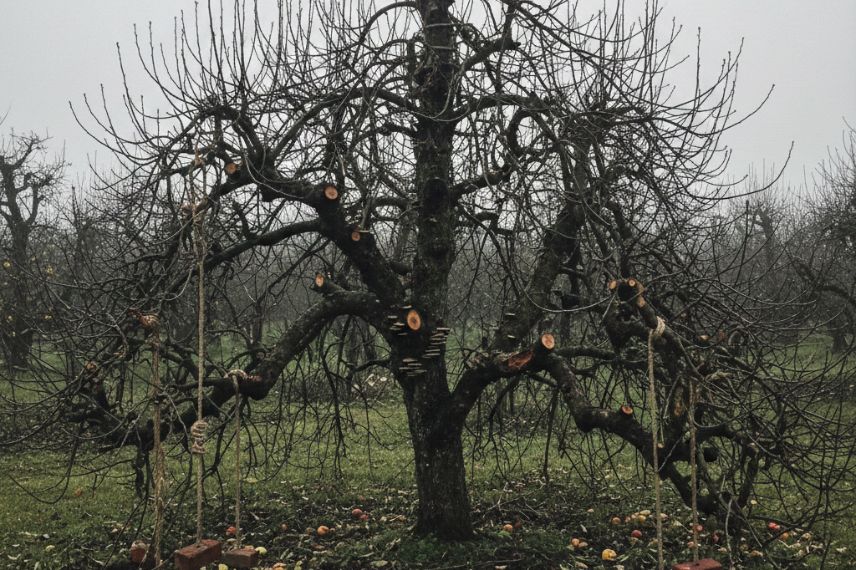
The real advice
For those who prefer harvests to disasters: good pruning involves thinning centre to let light through and encouraging horizontal branches (those that bear fruit). Aim to preserve fruit buds (the spurs) while limiting vigour of vertical water shoots.
Comparison table: real vs fake
| Pruning action | "Sabotage" objective (wrong move) | Harvest objective (truth) |
|---|---|---|
| Timing | During freeze (-10°C) or in torrential rain. | In dry conditions, frost-free, during dormancy. |
| Tool condition | Rusty, blunt and covered in last year's dried sap. | Blade sharpened (clean cut) and disinfected with alcohol. |
| Structure | Keep dense centre to create fungus nest. | Open tree centre to let light through (daylight shaft). |
| Cutting angle | Straight or sloping towards bud to retain moisture. | On a slant (45°), away from bud to shed water. |
| Fate of vigorous shoots | Leave them to grow vertically to the sky. | Remove or bend to favour fruiting. |
Frankly, aren’t you fed up with being buried under apple harvests so abundant that even your neighbours no longer want to open their door? If the prospect of baking yet another homemade tart with your own plums sends you into a cold sweat, it’s high time to take back control of your garden by learning […]
Discover exclusively our Garden Trends 2026 booklet identified by our experts! Green Generation, Retro Garden or Augmented Garden, we reveal five emerging trends that are reinventing garden practices and imaginations. Drawing on its monitoring, Promesse de fleurs shares a forward-looking perspective and field observations of tomorrow's garden.
Green generation
Millennials: new plant-loving tribe born on Instagram! Aged 28 to 44, often city-dwellers, they have turned houseplants into an art of living. Ficus lyrata, Calathea, Alocasia, Colocasia and Monstera – houseplants are becoming icons, iconic organic design pieces. Plants here become emotional, identity markers and graphic. This green frenzy is hyper-connected, Instagrammable, viral yet deeply emotional.
It’s called "Plant Parenting": 33% of Millennials talk to their plants, 19% give them a name, 29% consider them sentient beings.
People collect spectacular foliage (Monstera 'Thai Constellation', Caladium, Begonias 'Rex'), style interiors and share urban jungle on TikTok (#planttok) or Instagram (#urbanjungle, 8M posts).

Nostalgic Garden
Here is a distinctly regressive, comforting gardening trend! In the face of global uncertainty and at a time when AI generates artificial worlds, the garden evokes a nostalgic vogue reflecting a deep desire for reassurance and tenderness. People sow, take cuttings, forage and arrange homemade bouquets. Retro flowers enjoy a second youth. Double ranunculus, gladioli but above all dahlias (+12% sales) and peonies (+37%) at Promesse de fleurs, which are exploding on social networks, are the star flowers of this vintage wave. The craze for seeds has sparked a revival of cut-flower varieties, straight from garden to vase! Statice, everlasting flowers, oxeye daisies, snapdragons and phlox are already part of our collection of over 1,500 varieties of flower seeds.
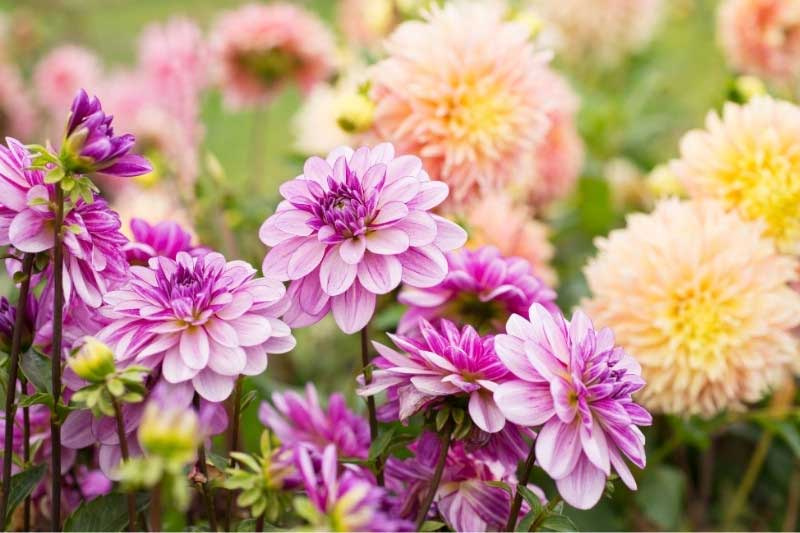
Nomadic Escapes
The garden becomes itinerant, mixed, adaptive, a mirror of a world on the move. 42% of recent landscaping projects draw direct inspiration from distant cultures. They combine a longing for elsewhere with climate-consciousness, are nomadic in their evocations, resilient in their choices and economical with water. Sales of hardy succulents have risen 45% in Europe since 2023, a sign that these plants from elsewhere resonate with very local concerns. Trends spotted include:
- Balinese Garden: tropical luxuriance and sacred lotus (85k posts #lotusgarden) inspired by tropical sanctuaries of Southeast Asia.
- Antipodean Garden: euphorbias, crassulas, aloes or senecios acclimatised to extremes evoke landscapes of southern Africa.
- Chaparral Garden: Dasylirion longissimum, Echinocactus grusonii, blue Mexican palm, Opuntia cacanapa 'Ellisiana'... Species from semi-desert areas of California or Mexico shape a graphic, sun-soaked and radically frugal garden.
- Sand Garden : on 20 cm of pure sand, Gypsophila 'Rosea', blue fescue, Lomandra 'White Sands', silver santolina or Salvia 'Caradonna' create carefree scenes with no watering or feeding. Inspired by Peter Korn and climate-resilient gardens, this new-generation dry garden combines lightness, robustness and modernity.

Sanctuary Garden
In response to hyperconnectivity, the garden becomes an emotional refuge, an open-air cocoon where people slow down, wrap themselves up and breathe. Throws, cushions, natural materials, deep seating… domestic comfort is transposed into a calming plant-filled setting.
- Japandi: fusion of Japanese minimalism and Scandinavian softness, inspiring sober, vegetal, meditative atmospheres. Japanese maple 'Bloodgood', black Ophiopogon, Pittosporum tobira 'Nana', Arisaema consanguineum, Clematis 'Pistachio' flourish within a contemplative, low-maintenance garden. (+160% searches for "Japandi garden" in 3 years).
- Chill Soft: soft design, velvety palette, flowing ornamental grasses such as Pennisetum 'Lumen Gold', Perovskia 'Prime Time', Panicum 'Hot Rod'… The garden becomes fluid, sensory and enveloping.
- Boho Patio : bohemian terraces, bright colours and gypsy spirit. Giant sunflowers, dahlias, purslanes, red popcorn maize, and black pomegranate settle in for a sunny, joyful garden for lazing and impromptu partying.
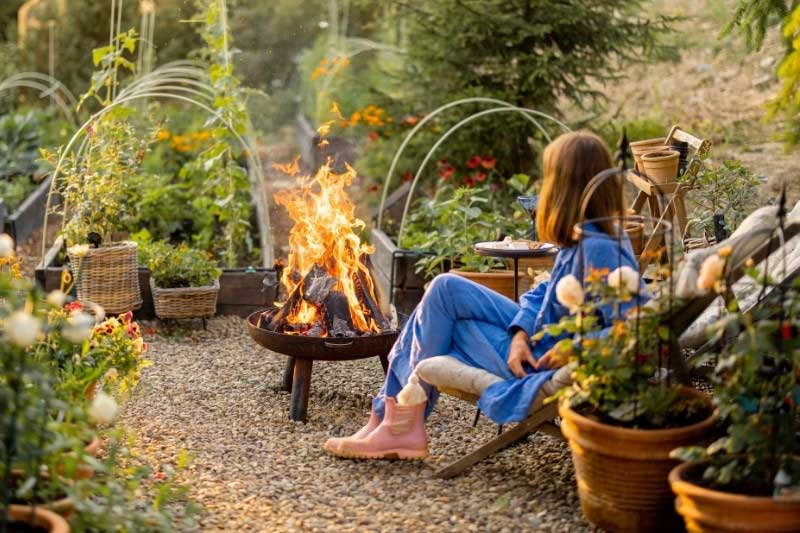
Augmented Garden
The garden is entering the era of assisted gardening: tutorials, apps, connected devices, AI…
Cordless tools are becoming mainstream, mini-greenhouses are appearing in cities, and social networks popularise gardening techniques.
Uninhibited and autonomous, the garden appeals to a new urban generation. 40% of urban households are already equipped with an intelligent device.
Our podcast Branché au jardin has accumulated 18,000 listens, and our Plantfit app has 80,000 users.

Colours 2026
Emotional hues, between mineral freshness, dark romanticism and pastel dream.
- Transformative Teal: between muted blue and aquatic green, this refined, mineral hue establishes itself as the colour of 2026. It evokes deep waters and is embodied by Eucalyptus ‘Baby Blue’, Agave americana, Senecio serpens 'Dwarf Blue', or Dasylirion glaucophyllum.
- Cloud Dancer : a vapoury, restful, almost silent white, crowned Pantone's colour of the year. A chromatic antidote to saturation, Agapanthus 'Ever White', Hydrangea 'FlowerWOW', Iris 'Glacier' and Clematis 'Guernsey Flute' soothe the eye.
- Dark Academia : dramatic romanticism with Victorian accents. Purple, garnet and misty mauve blooms and wine-coloured foliage create a dark, sophisticated atmosphere. Dianthus 'Sooty', Rose 'Charles de Mills', Poppy 'Lauren’s Grape' and Lupin 'Masterpiece' embody this poetic gloom.
- Unicorn: an iridescent pastel breath on the border of digital dream. Apricot sorbet, frosted lavender, sky blue or vanilla yellow compose a dreamlike, joyfully offbeat garden populated by Wallflower ‘Classic Apricot’, Delphinium ‘Misty Lavender’, Rose ‘Koko Loko’.

Discover exclusively our Garden Trends 2026 booklet identified by our experts! Green Generation, Retro Garden or Augmented Garden, we reveal five emerging trends that are reinventing garden practices and imaginations. Drawing on its monitoring, Promesse de fleurs shares a forward-looking perspective and field observations of tomorrow’s garden. Green generation Millennials: new plant-loving tribe born on […]
You dream of a lush vegetable garden on your balcony or terrace, but achieving success seems far too conventional? Why aiming for abundant harvests when you could join the prestigious circle of "frustration growers"?
In this article, we present to you 6 foolproof tips for failing at your container garden. These 100% absurd tips will transform your balcony into a joyful botanical disaster. Of course, if you do the exact opposite, you might just harvest vegetables worthy of a Michelin-starred chef... but where's the fun in that?
Take notes and get ready to turn your balcony or terrace into a true laboratory of improbable and memorable gardening experiments!
Lesson 1: Choose your plants poorly!
Basil, strawberries, leeks, cacti... Plant everything you can find, regardless of whether these plants prefer shade, full sun, or even an arid desert. After all, a cactus and a lettuce are pretty much the same thing, right?
Don't stop there: completely ignore care sheets or seed labels. Seasons? A lazy gardener's invention. So, plant your tomatoes in the middle of December for guaranteed dramatic effect, and why not some radishes in the height of summer? It will add a lovely touch of unpredictability to your balcony.
Bonus tip: if a plant doesn't grow, blame the wind or your neighbours. After all, why should it be your fault?
The real advice: choose plants suited to your space, exposure (sun or shade), and the season. Herbs like basil or parsley are perfect for beginners!
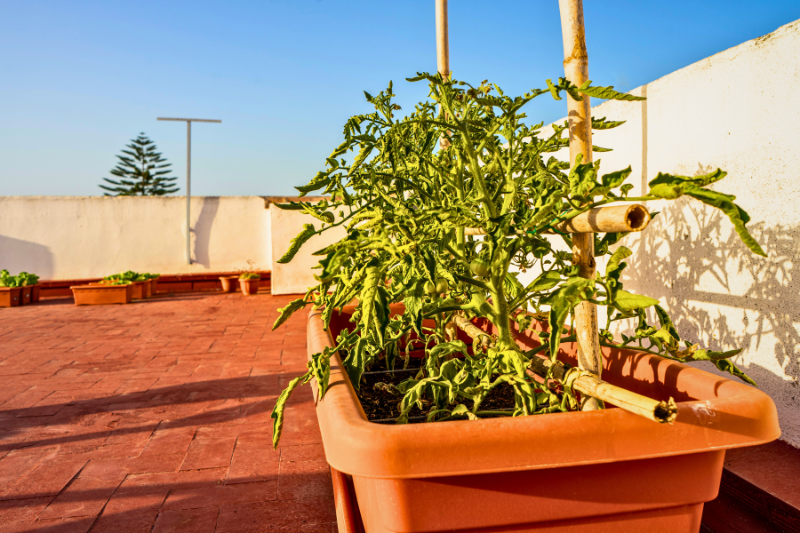
Lesson 2: Water blindly, or better yet, not at all!
Gardening is complicated enough, so why bother with thoughtful watering? Opt for the "Russian roulette of watering" method. One day, drown your plants in a spa-worthy bath (or a municipal pool), and then let them ponder their thirst for three weeks. Plants love these emotional rollercoasters... well, in theory.
Be creative: a blast of cold water at dawn, a day where you completely forget their existence, and a light mist of lukewarm water just before a heatwave. It's a great way to test their resilience... and your patience.
Bonus tip to perfect this method: don't bother learning the specific needs of each plant. A succulent and a basil plant? Same battle! Don't all plants have the same taste for water? (Spoiler: no, not at all.)
The real advice: consistency is key. Adjust watering to the needs of each plant. And a small watering can with a fine spout is better than your neighbour's hose.
Lesson 3: Completely ignore container size
Disregard container size! Do you have a lovely mint plant? Plant it in a tiny pot, ideally the size of a thimble. After all, why give it room to thrive when you can force it to become a minimalist artist? In contrast, your strawberry plant deserves to dream big: put it in a giant container designed for a palm tree. After all, it needs to compensate for its limited growth ambitions.
Consistency? Too boring. Logic? The sworn enemy of fun! Imagine carrots in a gratin dish or tomatoes in a bonsai planter. Nothing like surprising your plants (and their root systems). At least you'll be sure your garden looks like no other.
Bonus tip: don't bother with drainage holes or suitable materials. Who said plants needed well-aerated soil? Aim for originality, and let your plants live their best (and last?) life.
The real advice: plants need space to grow. Choose suitable containers and think about drainage (hello, small stones or clay balls at the bottom!).
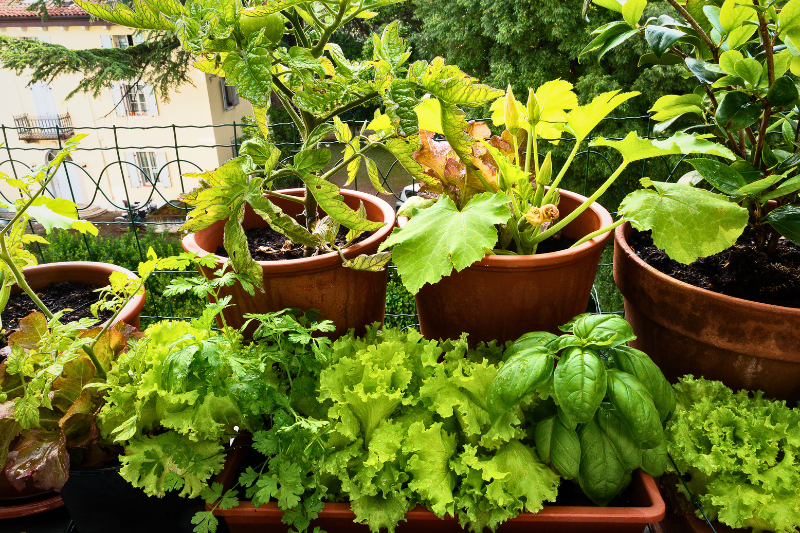
Lesson 4: Use the most dubious soil possible
Do you really want to be original? Forget the classic potting soil, far too mainstream. Instead of investing in a rich, suitable substrate, go on an adventure and collect unexpected treasures: construction sand found on the sidewalk, dusty soil gathered during your last mountain trek, or rubble salvaged from an alley. It's a true ode to diversity... or at least, to improvisation.
The idea is simple: the more sterile, compact, and hostile the mix, the better! Why settle for nutrient-rich soil when your vegetables can experience extreme survival? You could even spice up the experience by adding a bit of gravel to remind them of the joys of a stony desert.
And above all, don't forget to proclaim your love for innovation loudly: "Here, we plant boldly, not scientifically!" Sure, your plants might wonder why they are condemned to grow in soil that could just as well be used to build a highway. But isn't that the essence of experimentation?
The real advice: good potting soil is essential for a container garden. Invest in a special potting soil or enrich it with compost.
Lesson 5: Let Mother Nature do all the work
Once your seeds are carefully sown (or randomly thrown, let's be honest), take a deep breath and solemnly declare: "From now on, it's you and me, universe!" Then, proudly walk away from your plants and let them face their fate. Why waste your time checking on their condition? After all, they are plants; they know how to grow on their own, right? (Spoiler: no, not at all.)
No need to water them regularly, monitor if weeds are choking them, or check if insects are nibbling their leaves. All of that is detail! Plants are big and strong; they will manage without your help, just like in the wild. What you might forget is that a balcony or terrace has little in common with a lush jungle where ecosystems self-regulate. Here, if you do nothing, your plants will do exactly the same: nothing at all... except die.
Bonus tip: to perfect this "zero maintenance" method, completely ignore signs of distress. A plant that is yellowing, wilting, or seems to be crying for help? Look away with a stoic expression. It's a life lesson for them and a great opportunity for you to practice emotional detachment.
The real advice: a garden, even on a balcony, requires a minimum of maintenance. Remove dead leaves, watch for pests, and give a little love to your plants.
Lesson 6: Ignore space requirements
Why limit yourself to reality? In your mind, your 2-square-metre balcony is probably as vast as the plains of the Midwest. So go wild: plan for ten tomato plants, three courgettes, a row of strawberries, and while you're at it, a cherry tree. It doesn't matter that your space is more suited to a camping chair than a budding farm.
Be bold: stack your pots, layer your planters, and why not hang containers from the ceiling (never mind if you can no longer open the door). Did you dream of an abundant garden? Just play Tetris with your plants. Sure, your plants will have to fight for every inch of sun or air, but isn't that how the greatest champions are born?
Bonus tip: completely forget that a courgette needs plenty of space to spread out. Plant it in a small pot wedged between a geranium and a basil plant. Watch the chaos: the leaves will wrap around the other plants, and it will be a true botanical battlefield on your terrace.
The real advice: think about the space needed for each plant and how they grow. Opt for a few well-spaced crops suited to your balcony or terrace rather than a true plant traffic jam!
You dream of a lush vegetable garden on your balcony or terrace, but achieving success seems far too conventional? Why aiming for abundant harvests when you could join the prestigious circle of “frustration growers”? In this article, we present to you 6 foolproof tips for failing at your container garden. These 100% absurd tips will […]
At the end of each year, it's an opportunity to reflect on the favourite plants of the editorial team, those that have marked our gardens, terraces, and interiors with their beauty, originality, or ease of cultivation. Behind each favourite, there is a gardener's story, a meeting with a plant that has found its place and transformed a patch of greenery into a true source of inspiration.
In this article, the editorial team shares its top plant picks for 2025, from characterful trees and shrubs to floriferous perennials, not forgetting the graphic houseplants and lesser-known species that deserve to be recognised. This selection is guided by a passion for gardening, a desire to share useful tips, and to help you find the plant that will make your heart race.
Ingrid: the Cercis canadensis 'Ruby Falls'
This year, my choice is the Cercis canadensis 'Ruby Falls', a dwarf weeping redbud that offers a poetic presence in my bordering terrace bed. Planted in partial shade, it boasts heart-shaped leaves of a deep purple mixed with green, which seem to cascade along its drooping branches. In spring, its violet-pink flowers emerge on the still bare wood, bringing unexpected colour before the young red leaves unfurl. In autumn, this foliage takes on bronze and copper hues before falling.
I particularly love the contrast of its purple foliage with that of the surrounding plants, especially the bright green and violet-blue flowers of a nearby Hardy geranium 'Rozanne'. Alongside them, my Greater celandine, more spontaneous, naturally brightens the base of the shrub with its light green foliage. A little further away, a Acer palmatum ‘Bloodgood’, with its reddish-brown foliage, echoes the Ruby Falls. This chromatic continuity, from the purple of the Cercis to the darker hue of the maple, gives a gentle coherence to the bed and creates a visual depth where the light catches differently depending on the seasons.
This little Canadian redbud easily finds its place in a garden, thanks to its weeping habit and compact size. Its good hardiness makes it simple to cultivate, as long as the soil retains some moisture in summer. At my place, it quickly integrated into the bed, bringing softness to this part of the garden without ever overshadowing the neighbouring perennials.
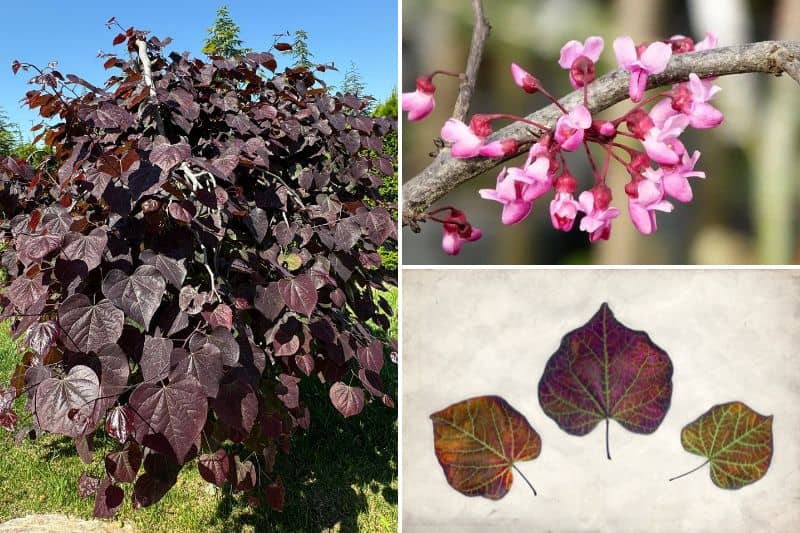
Virginie: the Begonia 'Rex Escargot'
My heart undoubtedly leans towards the Begonia 'Rex Escargot'. What makes it truly special? This variety lives up to its name: each leaf spirals and seems to form a small snail shell, hypnotic and wildly graphic. We love its artistic touch with its unique colour contrasts: a blend of greens, silver, and chocolate.
With its velvety foliage, spiralled patterns, and unprecedented colours, it marks the strong return of indoor begonias, which are increasingly appealing due to their original aesthetics and diverse foliage. Long relegated to grandmothers' balconies or forgotten greenhouses, begonias now rank among the top 5 most sought-after plants for our interiors. Right in line with the major trend of decorative begonias, this variety stands out as a vintage icon brought back to life. Easy to cultivate (as long as you respect its preference for ambient humidity and filtered light), it adapts perfectly to all our interiors.
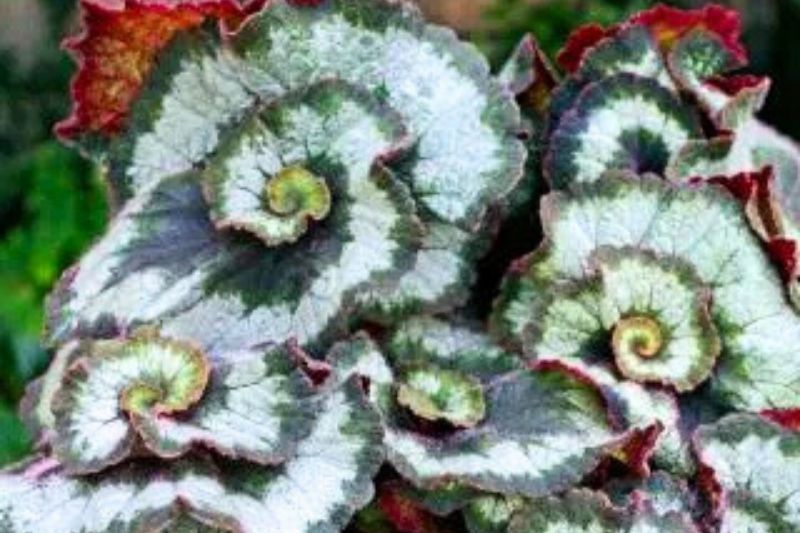
Olivier: the Hyssopus officinalis
"You, who are very sentimental, will surely appreciate this plant!" And bam! I was handed, without further ado, a clump of earth, from which only a few meagre green shoots emerged. Of course, I knew a bit about hyssop, as I have been passionate about medicinal plants since my studies. Moreover, it held a prominent place in medieval herb gardens. However, in my heavy soil, I remained… sceptical about its future. So, I decided to try it in a large container alongside my other Mediterranean plants, botanical cousins: thyme, sage, rosemary, and lavender.
Hyssopus officinalis is a dwarf undershrub (you can use that as a somewhat original insult), ideal for very sunny spots and dry or calcareous soils. And, in just one season, mine has thrived. I particularly love its flowers, a lovely violet-blue, which bloom from July to September and are highly appreciated by pollinating insects, including butterflies. Known as "sacred herb" by the ancient Greeks, this aromatic plant can reach up to 50 cm in height and has very fragrant leaves. It is cultivated for its medicinal properties (infusion for bronchial issues and digestion) and to flavour various dishes such as salads and soups. In short, if you have a spot left in your herb garden: give hyssop a try!
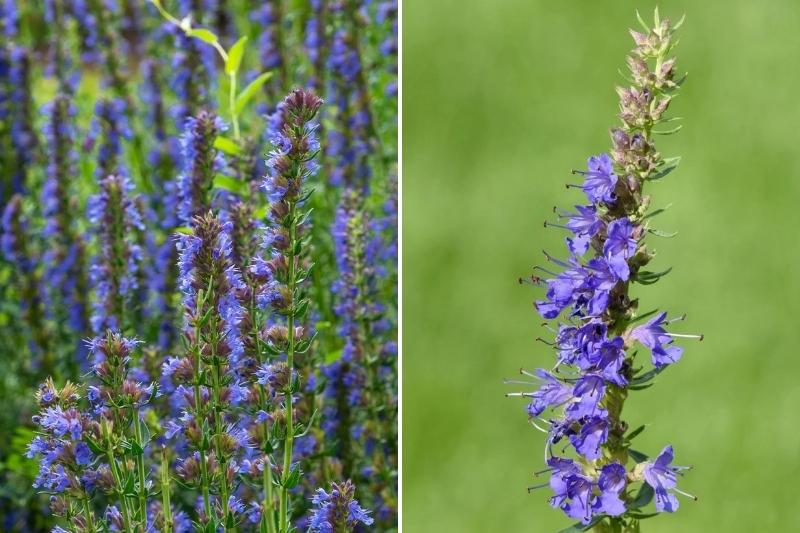
Sophie: the Westringia fruticosa
I have chosen the Westringia fruticosa, also known as Australian rosemary, as my plant pick for 2025, because it embodies the perfect companion plant, one that simplifies gardening! With its slight resemblance to rosemary, it has that familiar and sunny charm that immediately sets the tone. In my southern garden, amidst gauras, agapanthus, Leucophyllums, and lavender, it has settled in as if it has always belonged there. Its evergreen and silvery foliage captures the light, its naturally well-defined silhouette adds elegance, and its impressive resistance to heat, wind, and drought makes it a reliable choice, as I know it can thrive without any care. It tempers the exuberance of the blooms, highlights the volumes, and its light and delicate flowering brings just the right amount of freshness. What I love is its easy-going nature and its clean and bright appearance all year round.
With its 1 to 1.5 m in height and the same in spread, the Westringia fruticosa easily finds its place in the garden. Its delicate flowering extends from spring to autumn, returning in waves. It withstands light frosts down to -5 °C without flinching, sometimes even more in well-drained soil, making it perfectly suited for southern gardens, sheltered areas, and coastal climates. To thrive sustainably, it primarily requires a well-drained soil, preferably light, poor, and stony, where water never stagnates, an essential condition to preserve its longevity and natural vigour.
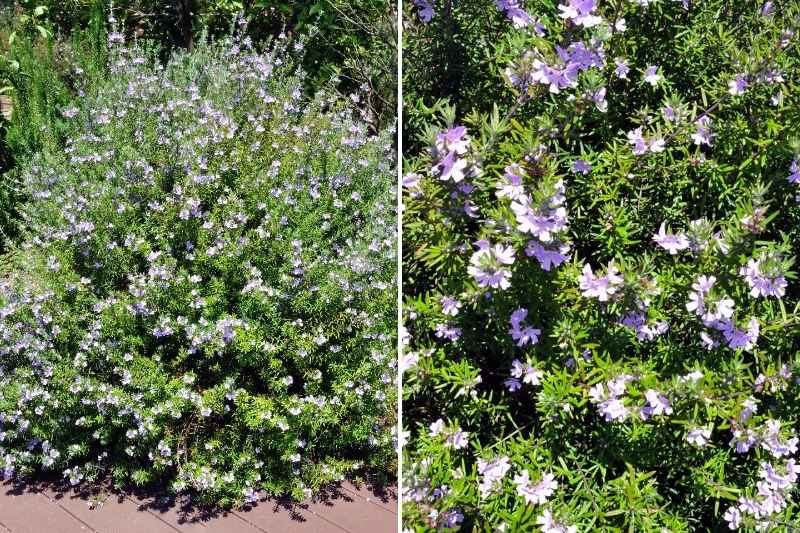
Gwenaëlle: the Protea 'Pink Ice'
Every year, when we choose our plant of the year to share with you, I always hesitate, as several plants in my garden could claim a spot on this podium. This year, there’s no hesitation… Drumroll… It’s my Protea 'Pink Ice', brought back from Madeira in 2022, that wins all the votes! The tiny plant I bought at the flower market in Funchal and lovingly planted has seen it all, and it’s the only one of the three plants to have survived. Growing it in a greenhouse and repotting it as it grew, it suffered, two years ago, from my carelessness as a gardener when, in the middle of summer, I forgot to ventilate the greenhouse. As a result, one of the two main branches completely cooked, throwing it somewhat off balance. But, with care, it continued to grow, forming new branches to my great satisfaction. What a surprise it was in September to see three buds appear, slowly but surely transforming into those sublime pink inflorescences I had been patiently waiting for in early November.
Proteas, native to South Africa, are considered delicate plants due to their very low hardiness. Of course, I protect it in winter, wrapping it up and watching it like a hawk. I also only water it with room temperature rainwater and have provided it with an acidic and light substrate. I’m not sure I’ll plant it in the garden for a few more years, in which case I’ll need to find it a particularly sheltered spot. The arrival of these large fluffy flowers is such a spectacle that I recommend it to all gardeners who love exotic plants, as this plant literally transports me elsewhere!
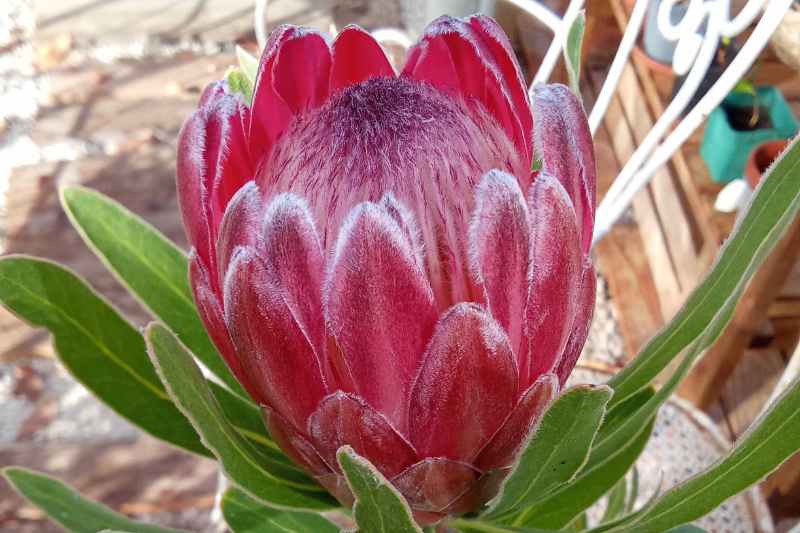
Pascale: the Sedum ‘Thunderhead’
I admit, I was long among the detractors of sedums. Perhaps because these plants always seemed a bit dull and unremarkable in the beds. And then, what’s the point of growing these succulent plants at home, in a region where drought was hardly an issue? Climate change has decided otherwise, and the heatwave has taken its toll on other plants I cherished… Not to mention the numerous cultivars of stonecrop that offer new cultivation perspectives.
The Sedum ‘Thunderhead’ is one of the pleasant surprises. This variety has literally swept away my prejudices about sedums, thanks to its presence and vigour. From spring, its robust dark stems stand proudly, bearing very fleshy bluish-green foliage. But it’s at the end of summer that the magic happens: the dense and enormous flower heads bloom in a deep purplish-red, lasting until early winter. As these flowers, perched on purple stems, are highly melliferous and nectariferous, they attract swarms of pollinators.
And in winter, this sedum continues to put on a show with its dry inflorescences. I’ve even taken a few to enhance a bouquet of dried flowers and herbs. And already, the next spring shoots are emerging from the ground.
Paired with my beloved heucheras, this stonecrop has found its place in my semi-shaded bed. But elsewhere, it could bask in the sun all summer long.
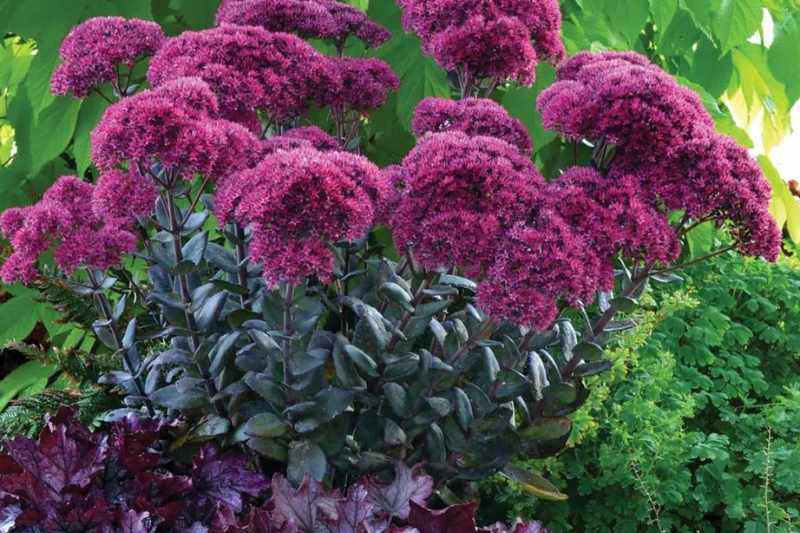
Elisabeth: the Monstera deliciosa, 25 years of cohabitation with my "philo"
Some stories last, enduring through moves, neglect, and trends. The one I’m about to tell is that of my Monstera deliciosa, my big "philo". It’s 25 years old, and it’s a green giant, a delicious monster clinging to the wall of my living room like a reminder of beautiful holidays in Spain.
Embracing its kitsch nature, it’s a bit of a grandmother’s plant, a symbol of the 70s, the spirit of bygone interiors. One might find this Monstera outdated, with its veranda plant look and postcard charm. Yet, it’s precisely this slightly old-fashioned air that makes it endearing. It signifies comfort and nostalgia.
If this houseplant had a CV, the first line would read: "Survival Expert". I forget to water it for three weeks? No problem, it will halt its growth, and that’s that. A bit of drastic pruning in anticipation of a move? It will sulk, but it will recover. It’s the ideal green plant for busy (or lazy) people; I don’t judge, I’ve lived through both.
Despite its 25 springs, "philo" has never deigned to flower. Because yes, this plant is capable of flowering! And even fruiting! Apparently, its fruits are deliciously edible. It might be lacking some geranium fertiliser, or perhaps it sulks because my living room isn’t humid enough, or too warm. Unless it’s just being a diva. It’s a whimsical creature: its leaves, sometimes smooth, sometimes holey like Swiss cheese, tell the story of its moods. Its support, doubled with bamboo and securely fastened to the wall with a battalion of strings, has become an original element of my décor. Over time, the inhabitants of the house hardly notice it anymore. Visitors, however, never miss the opportunity to comment: “But it’s huge!” or “How old is this monster?” And I confess its age with barely concealed pride.
Why do I love it (and why you might adopt it too)? First, because it endures. Even cats can’t really kill it — at least not mine, despite its efforts and persistence. Secondly, because it’s terribly photogenic: its large, cut leaves and vines bring a little bit of South American jungle into the home. And it’s a true conversation starter. “Do you think it will flower one day?” “How do we give it a more classic shape?”… With it, we learn patience; I still hope it will flower.
My Monstera deliciosa is not “just a plant”. It’s a life companion, a silent witness to my troubles, joys, successes, and also my losses. It’s a rock, a stubborn presence you can count on. And that’s precisely why I love it.
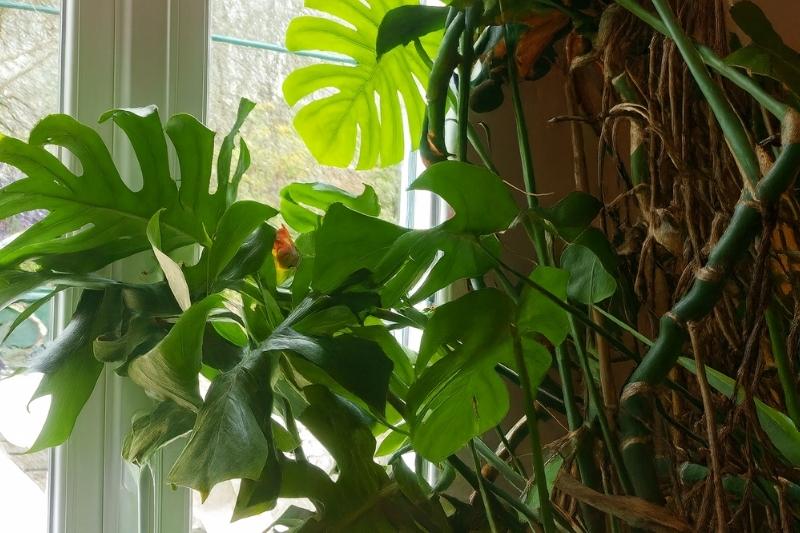
Aurélien: the Winecup or Callirhoe involucrata
If you appreciate mallows, lavateras, and other Anisodontea, then you’ll surely fall for their perennial and ground-cover cousin, the winecup (Callirhoe involucrata)!
Far less common in gardens, this Mexican species produces fine creeping stems with deeply lobed leaves, which weave between neighbouring plants without bothering them in the least. It reaches about 60 cm in diameter and 20-30 cm in height. The plant can easily be forgotten until large corollas of saturated fuchsia pink appear throughout the summer. Despite their ultra-vibrant hue, they blend effortlessly, in joyful whimsy, with blues, purples, or grey foliage: shrubby sages, immortelles, and perennial verbenas, or even yuccas will make excellent companions to create a Mediterranean atmosphere or a garden that requires no watering.
Frugal, floriferous, and quite resistant to drought once established, the winecup has many qualities and will thrive in any well-drained soil, preferably calcareous. North of the Loire, a spot in a rock garden or a sloped bed facing south will make it happy, possibly with the addition of some coarse sand or gravel to improve water drainage. In good conditions, it can be expected to withstand, despite its Central American origins, temperatures down to about -12/-15°C. A lovely addition to your borders that you won’t see everywhere!
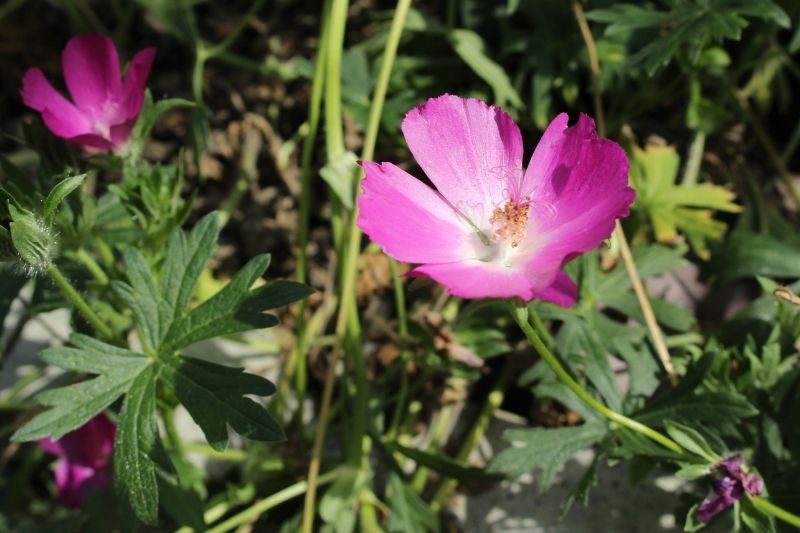
At the end of each year, it’s an opportunity to reflect on the favourite plants of the editorial team, those that have marked our gardens, terraces, and interiors with their beauty, originality, or ease of cultivation. Behind each favourite, there is a gardener’s story, a meeting with a plant that has found its place and […]
After chocolaty, enveloping Mocha Mousse of 2025, the Pantone Color Institute makes a clear break by, for the first time, naming a shade of white as "Color of the Year". Cloud Dancer (Pantone 11-4201) is a soft, airy, subtly luminous white. This colour speaks of soothing, visual desaturation, a need for clarity. Air, in a world saturated with information, content and stimuli! Cloud Dancer acts like a pause, a reset for cluttered minds. Discover how to transpose this chromatic trend to the garden and which plants and combinations embody this vegetal whiteness in your compositions!
Cloud Dancer: white amid the tumult
Cloud Dancer (Pantone 11-4201) reads like a chromatic antidote to saturation. An airy, muffled shade, it is a soft white, a “lofty white”, milky and calming that blurs and reprogrammes, in contrast to the sensual, earthy tones of recent years. “Classic”, “timeless”, “essential” — applied to the garden, Cloud Dancer calms contrasts, becomes a white of silence, a white of pause: a whisper of calm in a noisy world, as the brand puts it. It expresses a desire to start again from a simple, clean, luminous base, allowing the mind to wander, according to the Pantone Color Institute.
It is a breathing white, organic and soft, carrying a sense of serenity and renewal. It inspires a light garden where chalky tones or off‑white shades dominate. Ethereal flowerings and downy foliage are cultivated. It fits the trend for contemplative gardens and low‑stimulus atmospheres.

How to pair it?
Cloud Dancer’s vapoury whiteness, soft as a breath and subtly milky, opens up endless combinations. It reveals textures, soothes contrasts and creates visual breathing spaces. It forms a clear, calming base that showcases surrounding palettes. In a minimalist garden it brings coherence and a sense of calm. In more expressive scenes it plays a chromatic moderator, tempering vivid colours, revealing dark foliage and softening transitions. It also works very well in accents within bolder schemes: it will provide a chic contrast with near‑black tones, warm browns or very pale, almost smoked violets. For a particularly poetic pairing, combine it with sea‑greens, grey‑blues, beiges, very pale pinks or muted mauves. The “veil of light” effect is immediate. Cloud Dancer is a neutral white that invites serenity and mental calm.
Here are three variations to inspire you!
Also find our selection of Cloud Dancer plants in our online nursery.
Smoky cloud
When eyes rest on this soft, vapoury shade, the mind calms instantly. Cloud Dancer evokes diffuse light of a clear morning, the discreet lift of freshly laundered linen on the breeze. To recreate that celestial sensation in a garden, imagine an airy scene where white mixes with silver and soft greens. An atmosphere refreshed like a blank page that breathes — soft, silent.
The cut, silver foliage of Artemisia 'Powis Castle' provides the through‑line, its vapoury texture unifying the scene. In this floating setting, Gaura ‘Whirling Butterflies’ appears in white touches that echo the tall, frosted spikes of Salvia farinacea ‘Cirrus White’ and lavender ‘Edelweiss’. The Eryngium ‘Magical White Lagoon®’ slices through delicately with its pearly white thistles, electrifying the ethereal composition. These diffuse whites are gently contrasted by the grey‑blue flowerings of Perovskia ‘Blue Spire’ and by Papaver rhoeas 'Amazing Grey' in a very subtle smoked mauve, while the blue‑tinged foliage of the fescue ‘Elijah Blue’ extends the misty effect. Together, these shades form a palette of blended pastels and muted tones, like a cloud of smoke suspended in the air.
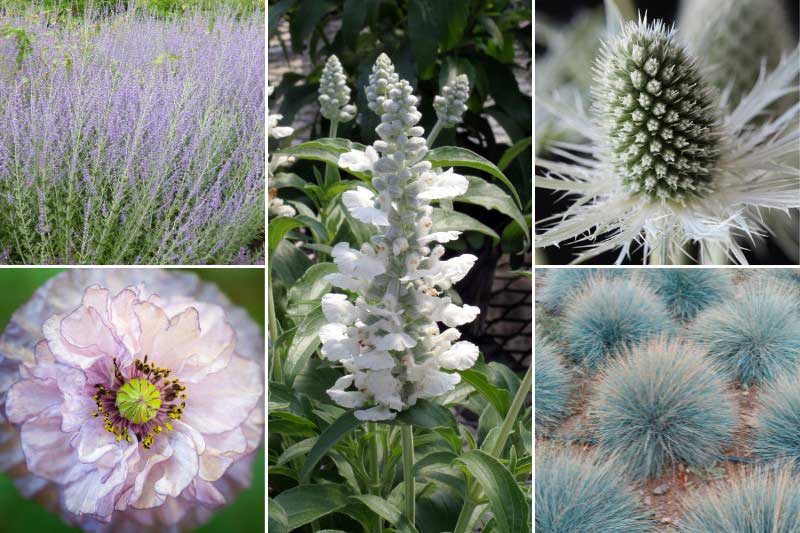
Caramel cream
Cloud Dancer also embodies softness, the breath of freshly washed linen, the clarity of morning light. It suits a cocoon garden where floral whiteness soothes. Foliage is delicate, flowerings elegant and barely tinted. In this more floriferous variation, white is enveloping. It settles into the material, laid on warm foliage to create a muffled, comforting atmosphere. At the heart of the composition, Clematis ‘Guernsey Flute’ bears champagne‑flute‑shaped buds that open into large, satin‑sheen white corollas, almost couture. It climbs lightly, bringing verticality without stiffness.
At its base, Banksia rose 'Purezza', in its rustic form, unfurls cascades of semi‑double creamy white blooms, almost ivory. Thornless, it plays the romantic card, wrapping neighbours in gentleness. The very abundant globular inflorescences of Hydrangea arborescens ‘FlowerWOW’ bring a round, mossy density that is reassuring.
Meanwhile, azalea 'REPETITA White', with its repeat flowering, punctuates the scheme with repeated white touches. Introduce warm, silky foliage such as Carex comans ‘Bronze Form’, with bronze and caramel highlights: a natural base that warms the whiteness without disturbing it.
Finally, one or two heucheras ‘Caramel’ add golden brown accents, like brown sugar sprinkled on white moss. These pairings create a garden that soothes without boring.
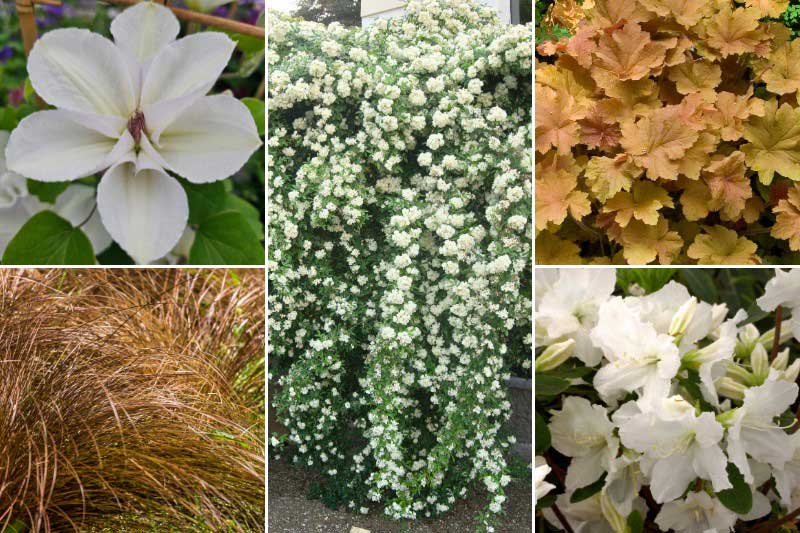
Mineral calm
Inspired by Japanese gardens, this variation evokes a return to essentials, where Cloud Dancer becomes a base for sober lines, a reflection on empty space and vegetal silence. This palette revives contrast between luminous white and deep tones, finely chiselled textures and pure forms. Few varieties, carefully chosen, for a chic, calming effect. Agapanthus ‘Ever White’, with glossy strap‑like green foliage, raises its almost calligraphic white umbels. An Iris germanica ‘Glacier’ adds a more sensual note with its wavy, ice‑white petals highlighted by a pale lemon beard. The spider lily ‘Zwanenburg’ (Hymenocallis), with its long, cut‑out white flowers, stands out for its freer form.
To temper these graphic silhouettes, introduce Pinus mugo ‘Mops’, a dwarf conifer with rounded, compact, evergreen habit whose dark green foliage provides calm punctuation in the composition. Ophiopogon planiscapus ‘Nigrescens’, with its nearly black foliage, creates a radical contrast.
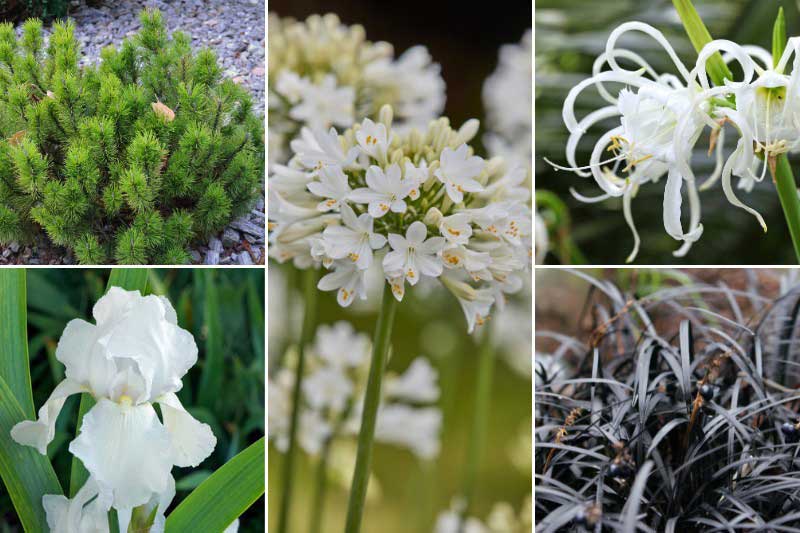
After chocolaty, enveloping Mocha Mousse of 2025, the Pantone Color Institute makes a clear break by, for the first time, naming a shade of white as “Color of the Year”. Cloud Dancer (Pantone 11-4201) is a soft, airy, subtly luminous white. This colour speaks of soothing, visual desaturation, a need for clarity. Air, in a […]
The French jury of the 2025 Saint-Fiacre Prize has made its decision, and its Coup de Cœur goes to 400 Plants You Won't See in Your Neighbour's Garden published by Ulmer. Our friendly colleague Aurélien Davroux presents a work that responds to a growing desire among gardeners: the urge to embrace diversity to transform their garden into a unique, personal, original, and resilient space.
Let’s embrace diversity!
As a reminder, the Saint-Fiacre Prize is a literary award given by horticultural journalists. Since 1971, it has recognised "a work in French addressing themes of gardening, gardens, or the plant world".
Aurélien Davroux's book, "The 400 Plants You Won't See in Your Neighbour's Garden", is a breath of fresh air that invites gardeners to break away from landscape uniformity by exploring less common varieties. Choosing diversity also creates a stronger garden: by varying species, it becomes naturally more resilient to diseases and climate change. Drawing on his experience, this horticultural engineer offers an inspiring and practical guide, encouraging the creation of surprising and ecologically stable gardens.
Although the 400 plants may not be the most common, they are perfectly accessible through specialised nurseries, turning their potential acquisition into a delightful "treasure hunt". The book also stands out for its light and humorous tone — notably illustrated by a hilarious "treatise on neighbourology" — which, combined with the author's botanical expertise, makes this book a true gem.
A few questions to the author

From the genesis of the book to the award
Receiving the "Coup de Cœur" from the Jury at the 2025 Saint-Fiacre Prize is a recognition of the quality of this work in horticultural publishing. Aurélien Davroux shares his reaction and the origin of this bold editorial idea.
Promesse de fleurs: Were you surprised to be nominated for the Saint-Fiacre Prize, and even more so to receive the Jury's "Coup de Cœur"?
Aurélien Davroux: I knew my book had been promoted by Ulmer, but it was still a lovely surprise and an immense pleasure.
Promesse de fleurs: A work that is both useful and surprising. Where did this original idea come from?
Aurélien Davroux: During discussions between Ulmer and Promesse de Fleurs, an idea was proposed by Pascal Griot, who said: "Why not talk about plants that you can't find at your neighbour's?" (editor's note: the very essence of our online nursery). Ulmer then chose me to write it, and from there, we tried to define the plants we wanted to present and how to organise them into three main parts, then into categories. The book discusses amazing plants, but none that are impossible to find or complicated — except for a few here and there: there has to be something for everyone, even the most passionate! It is certainly the opposite of an elitist book. However, it is also good to explain why we don't see them at our neighbour's: due to conformity, convenience, or ignorance. The average gardener cannot know all the botany and horticultural varieties. But we can present them. That is the purpose of my book.
Humour at the service of botany
Promesse de fleurs: The book also stands out for its light tone. Bringing a touch of humour to a gardening book is not common. Was this an initial intention of yours?
Aurélien Davroux: Very quickly, I had the ambition to introduce a quirky tone. Ulmer actually gave me free rein. The challenge was to integrate humour without risking offending anyone or going overboard. So, I sought a guiding thread to avoid monotony. Upon reflection, I remembered the "Memento for Comic Strip Artists" that Gotlib included in his Rubriques-à-brac, which presented the different archetypes of cartoonists. It made me laugh out loud! That’s why, in all modesty, I drew inspiration from it for my Treatise on Neighbourology: a carousel of neighbour archetypes (and we are all someone's neighbour!). Drawing from my own experiences and those of my friends, I wrote this little treatise, which I placed at the beginning of the book, establishing an analogy between the neighbour and the cultivation of a plant. My second source of absurd inspiration comes from Terry Pratchett, the British author of comic fantasy, who enjoyed adding humorous footnotes.
Why is this Guide to Original Plants an Ideal Gift?
Promesse de fleurs: For the end-of-year holidays, this could make a lovely gift. What are the strengths of your book?
Aurélien Davroux: Are you looking for a plant book that stands out from the ordinary, or do you want to convince a reluctant person who doesn't like encyclopaedias? Why not my book?
Promesse de fleurs: Any new works in preparation?
Aurélien Davroux: Not at the moment, but I am thinking about it.
The 2025 Saint-Fiacre Prize
As a reminder, the prestigious *2025 Saint-Fiacre Prize for adults was awarded to the work The Words of the Art of Gardening by Marie-Hélène Benetière and Alain Le Toquin, published by Delachaux & Niestlé. This prize, which annually honours reference works, confirms the horticultural and educational value of this title. Meanwhile, The Wild Square, by Anne-Hélène Dubray and Sarah Loulendo (Éditions L'agrume), won the Saint-Fiacre Youth Prize for its playful and educational approach.
*Awarded by the French Association of Garden and Horticulture Journalists (AJJH) and supported by Valhor (French interprofessional organisation for horticulture, floristry, and landscaping).
The French jury of the 2025 Saint-Fiacre Prize has made its decision, and its Coup de Cœur goes to 400 Plants You Won’t See in Your Neighbour’s Garden published by Ulmer. Our friendly colleague Aurélien Davroux presents a work that responds to a growing desire among gardeners: the urge to embrace diversity to transform their […]
Theine and caffeine sometimes need to be avoided in diet. People suffering from digestive disorders and acid reflux — the well-known GERD — must especially find alternatives to coffees and teas they used to drink. Others prefer beverages not sourced from other side of the planet as part of an eco-responsible approach, while pregnant or breastfeeding women look for stimulant-free products.
Which flavours come closest to coffee and tea? While chicory immediately springs to mind when discussing alternatives to these two timeless drinks, there are a few others to discover. Here are best coffee- and tea-substitutes without caffeine or theine for people who are intolerant or sensitive, or for anyone seeking new flavours.
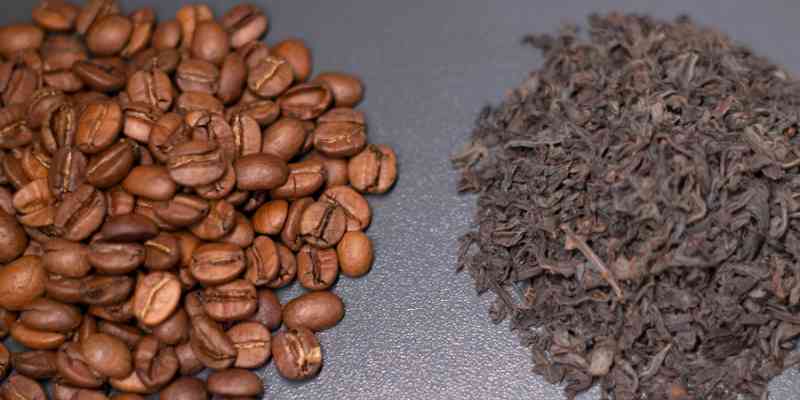
Coffee alternatives: not so recent after all!
Even if in 2025 some millennials — and sometimes a bit of a hipster, to be frank — have taken a shine to coffee substitutes, it was mainly during darker periods of history that people tried to replace coffee. Notably during second world war, when alternatives were sought in a period of extreme shortage. At that time people turned mainly to chicory, but also to cereals or nuts such as acorns, bran, barley or rye.
Even earlier, in 1895, Postum was born in United States — a drink made from roasted bran with molasses added. Concerns about coffee’s side effects already existed at that time. Postum was widely consumed during second world war in America and then Canada, and within Mormon communities that avoid coffee.
Coffee substitutes
There are actually rather few substitutes that recreate same sensation as a piping-hot cup of coffee, because flavour is often quite distant. Roasting stage is a trick to restore black colour and toasted aromas that simulate espresso.
Chicory
I will always remember Leroux chicory packets at my Breton grandparents’ — ahead of their time! And yet brand originates in north of France and is one of region’s strong emblems alongside endives or beer.
Chicory is THE drink that replaced coffee on millions of French breakfast tables in 1950s, although it had been consumed since late 19th century. From a pretty perennial plant with blue flowers, Cichorium intybus var. sativum, chicory is made from roots that are roasted. Soluble chicory has gradually been developed alongside ground chicory for convenience, then a liquid version, a little sweeter, and more recently organic chicory.
Characteristic is bitterness and slightly caramelised note. It is a soluble powder to dilute in boiling water or milk, to which sugar may be added to taste, as with coffee.
NB: For the record, chicory was already cultivated in ancient Egypt and Greece, roasting roots to extract powerful flavour, and Napoleonic era elevated it to stardom thanks to blockade on coffee imports from England!
Be careful not to buy blends of coffee and chicory if you are intolerant. Of course you can make own blend at home if you just want to reduce caffeine dose!
My view: you must appreciate its bitter side — pure chicory is very strong on palate. It may be closest substitute to coffee for morning coffee-with-milk (which tones down bitterness) and interesting for price, remaining cheaper than some options but still economical for fans of long coffees.

Roasted cereals
These are very interesting options that aim to mimic coffee through roasting process that produces malty, toasted, bitter and more or less full-bodied or earthy aromas. Best known and easiest to find is barley coffee, but specialist shops also stock spelt coffee or rye coffee. Advantage of these products is they are from organic supply chains and generally artisanal and local (many currently sourced in Brittany). They are prepared like coffee in various machines (percolator, filter coffee maker, French press, moka pot…).
Orzo coffee
This is one of most ambitious substitutes for replacing caffeine, and the one Italians adopted during embargo imposed on Fascist Italy in second world war, hence name (Italian caffè d’orzo, literally barley coffee).
My view: I enjoy the coffee ritual — espresso cup, black colour and slight crema when prepared in a percolator. Flavour is not comparable with coffee, so don’t expect same thing, as it is much lighter. It reminds me of filter coffee. For caffeine-intolerant people or those with stomach issues, it is one of my best allies, leaving pleasant aftertaste.
NB: ready-made mixes combining chicory, barley, rye, acorns and/or figs are also available in shops or online.

Substitutes made from flower seeds, fruits… or kernels
Unlike chicory, these come from seeds or nuts:
Lupin coffee
This is one of locally grown alternatives recently developed in France, and for longer in Italy and Germany, made from seeds inside lupin pods, that superb perennial from legume family. Again, very old consumption dating back to ancient Egypt!
Flavour may be closest to coffee. It is roasted to varying degrees depending on brand, giving more or less chocolatey and toasted notes. Peculiarity? Grind is coarser than coffee, so use less — between 20 and 50% less — than usual coffee powder quantities because it expands more.
My view: it has a bit more “body” than barley coffee, with a stronger taste. It doesn’t work well in percolator, so I use my small Turkish coffee pot, a cezve!
NB: avoid for people allergic to peanuts or soy.
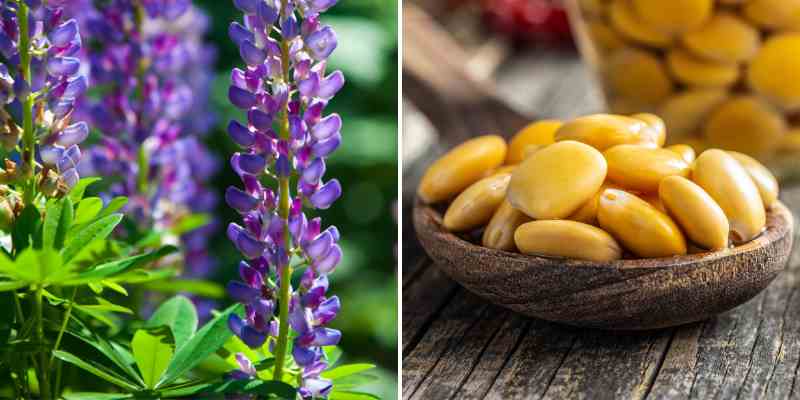
Acorn coffee
Recipes and videos now appear on wild food sites. Yet this coffee substitute also emerged during second world war. Process involves drying, shelling, then washing and boiling several times and finally roasting the “almonds” inside acorns before grinding — and it must be done correctly because oak acorns are naturally toxic to humans. If you make it yourself after a walk in woods, be sure to follow steps carefully to remove very toxic tannins contained in oak fruits.
Date-kernel coffee
…or rather coffee from date pits! More complicated to make at home unless you live in Mediterranean fringe countries, as you need to crack dates and grind pits, so not easy — but date-pit coffee is now an option to consider. It has advantage of valorising this plant waste.
It’s a newer option found in organic shops where pits are roasted and ground. It’s said to have caramelised flavour. Of course it is least local of coffee substitutes.
My view: I haven’t tried it yet, put off a little by price per pack (around €15 for 200 g, though cheaper online). If you know it, feel free to leave opinion in comments!

Tea alternatives
For tea lovers who prefer lighter brews such as infusions or decoctions, and who can no longer drink theine for health reasons, several aromatic alternatives are also worth trying.
Rooibos
Little known a few years ago, rooibos — “red bush” in Dutch — has established itself as most interesting alternative to replace tea. First because flavoured rooibos (vanilla, almond, red fruits, etc.) can surprisingly resemble tea. Second because it is completely free of theine. Finally because like green tea it contains antioxidants.
Its red colour gives nickname red tea or African tea, though it is not tea at all, as soon as you open packet. Native to South Africa, rooibos comes from small shrub Aspalathus linearis, of legume family, growing in sandy soils around Cape. Stems and fine acidular leaves are used, which are crushed and sometimes fermented.
It is prepared like tea by infusing crushed stems sold loose or in bags.
Specialist tea merchants offer natural rooibos and a wide range of flavoured varieties. Wooded flavour is appealing for those used to black teas.
My view: best of tea substitutes, widely distributed and now available in very large range.
NB: honeybush from Cyclopia or “honey bush”, another South African plant, is milder and sweeter.
Sobacha or buckwheat infusion
Again a roasted cereal: buckwheat used as tea substitute. From long Japanese tradition (soba means buckwheat in Japanese), this infusion made from roasted buckwheat seeds has very pale yellow colour and distinct buckwheat notes. Sometimes called buckwheat tea by extension, although technically an infusion.
Price seems high compared with other alternatives listed here, but more affordable if you buy buckwheat seeds in shop and prepare by toasting seeds yourself.

Mugicha: barley infusion
Here again roasted barley, this time in a lighter version closer to an infusion. Steeping time is longer, about 10 minutes. From Japanese tradition (drunk in cooler regions), it suits those who mainly enjoy green or very light teas.
Moringa
Moringa is a life tree native to India. Name also refers to infusion made from tree leaves. Flavour is very grassy, close to matcha. However it has a stimulating, energising effect.
Teas lowest in theine
For those sensitive to theine, consider teas naturally lower in theine such as Kukicha with iodised, minty taste (made from stems), or Bancha, astringent, produced from mature leaves picked late, or Hojicha, a roasted green tea with woody notes. Lapsang Souchong teas, interesting for pronounced smoky flavour, are smoked. Jasmine white tea is another option.
Golden milk or golden latte
I mentioned this recently in article about uses of turmeric in cooking. Originating in India, this drink does not try to resemble any theined or caffeinated brew. Here softness and indulgence take centre stage, perfect to replace cosy tea moment in winter. It has become my favourite winter snack: milk, turmeric, cinnamon and honey — delicious.

Good to know
- Beware of mate and matcha: they contain as much or more theine/caffeine than many other drinks!
- Theine content does not depend on tea colour (black, green, white) but on leaf processing and notably leaf “youth” (first leaves of harvest are richest in theine, while more mature leaves contain less)
- So-called decaffeinated or de-theined teas and coffees undergo chemical-solvent treatments… avoid!
- For people sensitive to theine, it is still possible to partially and naturally “de-thein” drink by discarding first infusion water after about 30 seconds.
Further reading
Learn more about rooibos in this excellent National Geographic article: Rooibos, the “miracle” infusion from South Africa.
Have you tried any of these alternatives? Tell us about it!
Theine and caffeine sometimes need to be avoided in diet. People suffering from digestive disorders and acid reflux — the well-known GERD — must especially find alternatives to coffees and teas they used to drink. Others prefer beverages not sourced from other side of the planet as part of an eco-responsible approach, while pregnant or […]
Have you ever felt that your houseplants improve your well-being and mood? What if we told you that scientific data has shown that indoor plants have effects on stress, mood, attention, and perception of the quality of spaces? This should inspire you to green up your home and office!

The recognised psychological impact of green plants
The impact of green plants on morale and concentration is now widely recognised. According to several scientific studies, simply caring for or observing indoor plants reduces stress and improves mood. Indeed, the colour green, a symbol of regeneration and balance in chromotherapy (colour therapy), acts as a calming signal for the brain.
But their effect is not limited to colour: repotting a plant, gently watering its soil, or brushing against a velvety leaf activates tactile and olfactory sensations that soothe the nervous system. These simple actions allow for the release of accumulated tension, for example, after a day at work.
By cultivating and caring for these plants, one also develops a sense of responsibility and satisfaction that contributes to emotional balance.

Plants in the office: a source of concentration
A bare office can feel cold or impersonal; adding some foliage changes the perception and truly transforms the atmosphere. A study conducted in the UK and the Netherlands showed that an office adorned with greenery could boost an employee's productivity by about 15%. The observed employees felt more focused, found the air more pleasant, and unconsciously perceived, through these plants, a sign of consideration and care that enhanced their motivation and job satisfaction.

An aesthetic asset to personalise your rooms
From an aesthetic perspective, indoor green plants bring a living and evolving decorative dimension. Unlike inanimate objects, they change with the seasons, grow, sometimes flower, and introduce a natural dynamic that continually refreshes the space.
Their foliage, whether graphic, variegated, or trailing, plays with light and shadows, adding relief and depth to an interior. They thus transform a too-static decoration into a welcoming and warm space. They structure volumes and enliven neglected corners. For example, a Monstera with spectacular foliage draws the eye, while a Ficus or a Pilea adds a graphic touch.
These plants break the overly rigid lines of furniture and rooms in our interiors, bringing volume and texture contrast that enriches the decoration, thus contributing to a sense of well-being at home.
Oxygen-producing plants: a real but often overestimated effect
We know that green plants produce oxygen through photosynthesis and absorb carbon dioxide. Moreover, research, such as that conducted by NASA, has shown that some green plants even absorb certain pollutants, notably the peace lily (Spathiphyllum) or Chlorophytum (Spider Plant). However, the amounts of oxygen produced in the scale of a living room or office are actually low compared to the volume of air. A very large number of plants would be needed to achieve a complete renewal of the oxygen in a room.
But that doesn't mean their presence is useless! Indoor plants improve psychological comfort, slightly increase ambient humidity, and promote a more pleasant atmosphere, which indirectly contributes to a sense of freshness and well-being.
Choosing your indoor green plants wisely
For a lasting and harmonious effect, select plants suited to the light levels of each room and the time you can realistically dedicate to them. Here are some examples:
- In a bright room, a Ficus or an Areca palm (Areca) will thrive and give a tropical look.
- For less bright corners, a Zamioculcas or a Sansevieria remains decorative without too much maintenance.
- Ferns and Calathea appreciate a more humid atmosphere. They are perfect for a well-lit bathroom.
- If you are often away or very busy, an Aloe vera or a Pothos (Epipremnum) will be perfect, as they are low-maintenance in terms of watering and care. In contrast, a Calathea, a Boston fern, or an Orchid requires regular attention.
Tip: Also consider the style of your interior and the size of the plants to create a balanced ensemble.

Creating a refreshing ambience with plants
The arrangement of plants also plays a role in their aesthetic and soothing effect. Varying heights, combining pots made of wood, terracotta, or metal (or according to your interior decor), and associating foliage with different shapes adds relief. Placing a large specimen near a window, a small pot on a shelf, or a hanging plant from the ceiling creates an impression of naturalness and movement. Caring for these plants becomes a relaxing routine that helps slow down and savour your environment.
Integrating indoor plants is therefore an effective way to enhance creativity, concentration, and quality of life on a daily basis.
Have you ever felt that your houseplants improve your well-being and mood? What if we told you that scientific data has shown that indoor plants have effects on stress, mood, attention, and perception of the quality of spaces? This should inspire you to green up your home and office! The recognised psychological impact of green […]
Each late summer brings its share of bulbs for spring colour, to irresistibly brighten our gardens. At this time of year we are often busy seeking the gems among these essential bulbs that will, in turn, lift us out of winter torpor in a few months. Our teams set out each year in search of new arrivals to appeal to the most discerning among you, from frilled tulips to charming early bulbs.
Here are some spring bulbs entering the Promesse de fleurs catalogue this season. Rare tulips, hardy irises, black hyacinths… Discover the 7 spring bulbs to plant this autumn with our tips on how to pair them harmoniously.
Tulipa viridiflora 'Blushing Artist': a play of light with pastel notes
Belonging to the large viridiflora family, these beautiful green-flamed tulips, 'Blushing Artist', are among its finest representatives! Not only does it stand out for its pastel colours, combining cream, pink and green in striations, but it also bears variegated leaves edged with cream, of interest in borders or for collectors.
This elegant fluted tulip grows to about 40 cm tall, which predisposes it equally to border plantings, pot culture or a long border. It flowers well in partial shade as in sun, but partial shade enhances its pale colours even more, and it is considered a late tulip, blooming in early May.
We recommend it either for mass planting in an attractive pot display where the delicacy of its hues will strike a chord, or paired with another 'flamed' tulip such as 'Spring Green', or in a border with perennials like Lunaria annua 'Alba'.
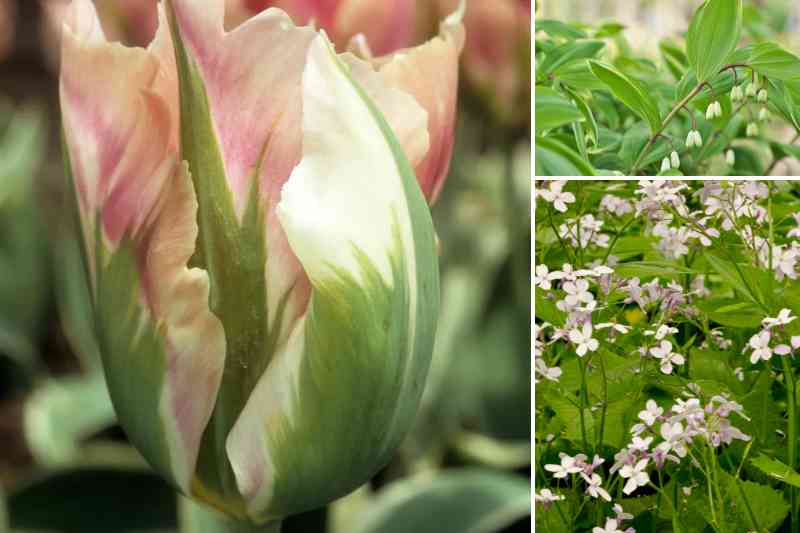
Read also: Tulipa viridiflora : the most popular.
Hyacinth 'Midnight Sky': a captivating darkness
Hyacinths lovers and fans of unusual flowering will not be disappointed by this variety, one of the darkest in the genus. 'Midnight Sky' certainly lives up to its name, intriguing with violet hues on the edge of black. It also has the particularity of being fairly resistant to rodents, and releases a subtle, sweet fragrance, especially in the late afternoon sun.
It prefers humus-bearing soils, well-drained, and a full sun or partial shade exposure. It can also be forced indoors to flower as early as February.
We find it stunning in a large container on a terrace or balcony, paired with a few other bulbs in fresh, bright tones that contrast nicely, such as early mini daffodils with yellow centres, like 'Sun Disc' or Topolino, and tri-colour pansies, creating a violet and pale butter-yellow two-tone display.
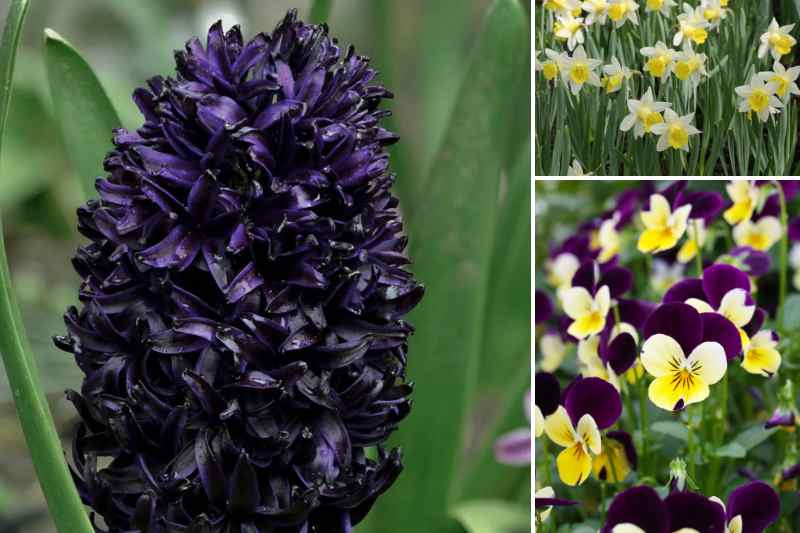
Tecophilaea cyanocrocusvar. Leichtlinii: the blue crocus, jewel of sun-drenched rockeries
Also known as the blue crocus of Chile, here is a neat little bulb that we love! Tecophilaea cyanocrocus is a small crocus perfectly suited to dry, sun-drenched rockeries. Growing to a maximum height of 10 cm, it forms pretty tufts and displays its charming sky-blue flowers with a strongly marked white throat, on slender blue-green linear foliage.
A must for this spring bulb: perfectly drained soil, or it will rot. Note that the blue crocus of Chile dislikes scorching summers or temperatures that are too cold (it will still tolerate down to -5°C under good cultivation conditions) and is among bulbs reserved for experienced gardeners.
For its early-season flowering, between February and March, it will enliven a rock garden of alpine type or a scree garden, or join a stone trough, surrounded by sedums and Pulsatilla that will take over, followed in turn by the deep blue bloom of Alpine aquilegia.
Read also: 6 bulbs easy to naturalise.
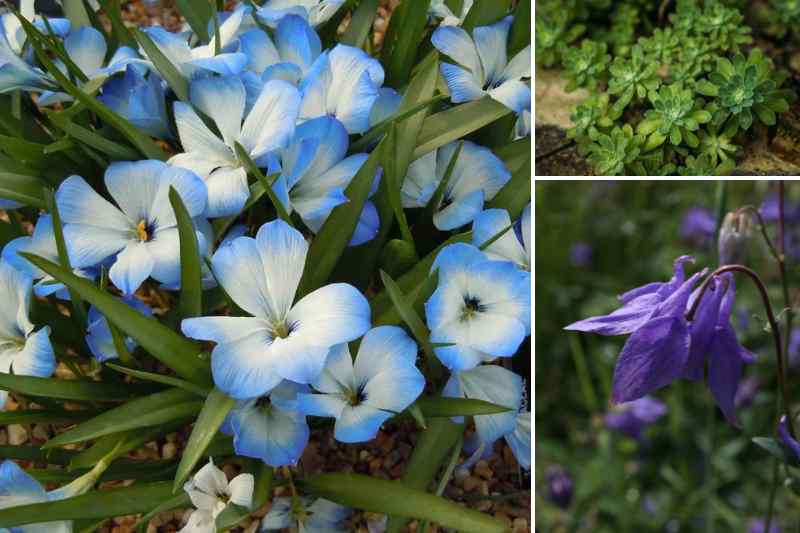
Allium cernuum 'White Dwarf': a wild charm for natural borders
What a delightful crowd-pleaser with this pendulous ornamental onion! Here is the white version of Allium cernuum, an onion with a similarly pendulous head, which adds to its charm, much like its Bulgaria-loving cousin.
Emerging with its foliage in spring, it is in summer that the Allium cernuum 'White Dwarf' rewards us with its small, white, pendant umbels on curved stems for many weeks. This pure white bloom, formed by around twenty small flowers, is also melliferous.
Adopt this original and compact ornamental onion if you want to fill gaps in natural, English-style, or cottage-style borders. It will be perfectly complemented by a handful of taller Galtonias, scabious and Allium millenium, in a rosy-mauve harmony, and by the light foliage of grasses such as Pennisetums or Stipas.
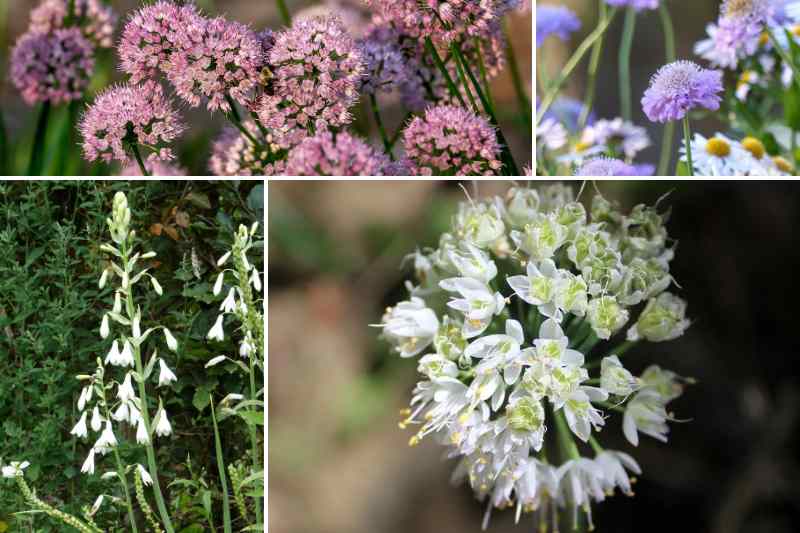
Tulipa 'Striped Crown': the sophisticated legacy of tulipomania
Let us finish this selection with another very beautiful tulip, in pink tones this time, with 'Striped Crown'. This tulip is part of full-season tulips, blooming in April, a little earlier or later in the month depending on exposure. It is distinguished by its specific form, in the Coronet group of tulips, with petals that are tweaked and curled.
Its shape, its cream colour enlivened with raspberry pink, varying with bulbs, its originality aimed at reproducing the striped motifs of Dutch tulips from the 17th-century tulipmania... All of this prefigures 'Striped Crown' joining a small, sophisticated, and precious garden at the foot of spring-flowering shrubs, but also a well-presented pot where you may prefer to let it dominate without other flowers. You can also simply grow it to use in unique bouquets. Like all tulips, give it well-drained soil so you can enjoy it again year after year.
Read also: Tulipomania: when a tulip was worth the price of a house
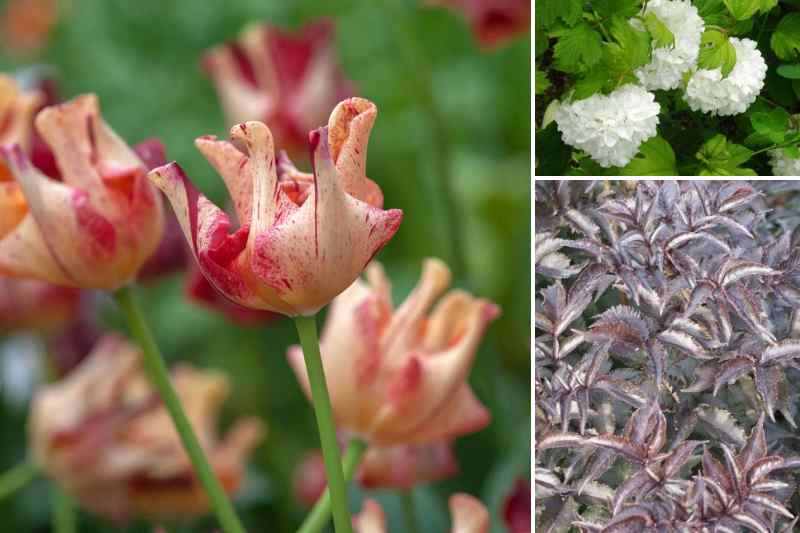
Each late summer brings its share of bulbs for spring colour, to irresistibly brighten our gardens. At this time of year we are often busy seeking the gems among these essential bulbs that will, in turn, lift us out of winter torpor in a few months. Our teams set out each year in search of […]
The moon, a celestial body of all fantasies, has long been the subject of controversy regarding its effects on plants. There are those who swear by lunar calendars for sowing, planting, pruning, or mowing the lawn, and those who do not believe in it at all. We know the effects of the moon on our good old planet Earth, particularly its attraction on ocean currents with the tides. It is even said to have some effects on humans, their sleep, or their moods… but does it really affect our gardens, and if so, to what extent? The most reputable magazines include a lunar calendar in their pages, so… fact or fiction, myth or reality?
I wanted to get to the bottom of it and find out once and for all if the moon truly exerts a real influence on plants. To do this, I carried out sowing and planting on very different days to draw my own conclusions. Intrigued by the results? Here they are!

What do the moon's movements in the sky tell us?
Let’s start at the beginning, namely what books or popular belief tell us about the rotation and gravitational pull of the moon, and what is scientifically proven. While the moon is subject to controversy, it remains a fact that our only satellite moves in the sky. The fundamental principle of gardening in harmony with the moon is based on its position in the sky.
However, it can be confusing to distinguish between the waxing or ascending moon and other subtleties, and it is essential to understand three distinct factors:
The phases of the moon
Easy to spot with the naked eye, we can identify four main phases of the Moon (actually eight if we count the intermediate crescents), marked by the four quarters of the Moon. These phases are due to the relative positions of the Moon-Earth-Sun axis, which determines the portion of the Moon illuminated by the Sun as seen from Earth: the new moon, when it is not illuminated at all by the Sun and becomes almost invisible; the first quarter, in the shape of a crescent opening to the left; the full moon, when it is completely illuminated by the Sun; and the last quarter of the moon, where it forms a crescent opening to the right, before disappearing completely to restart the lunar cycle with the new moon. This lunar cycle lasts about 29.5 days.
These phases inform what is referred to as the waxing and waning moon in "lunar" language:
- Waxing moon: the period when the illuminated part of the moon we see increases, from the new moon to the full moon;
- Waning moon: the period when the illuminated part of the moon decreases: from the full moon to the new moon.
Scientifically speaking, we can assert that these phases influence the amount of nocturnal moonlight. Some gardeners believe that this increased light during the waxing moon stimulates the growth of the aerial parts of plants, while the diminishing light is favourable for root growth. To date, however, no scientific study has proven this.
The position of the Moon relative to the Earth: perigee and apogee
The Moon orbits the Earth in an elliptical path, meaning its distance from our planet varies. When it is closest to the Earth (about 357,000 km), it is referred to as perigee, and when it is farthest away (an additional 50,000 km or so), it is called apogee.
These variations in distance could influence the gravitational force exerted by the Moon on the Earth, and thus on plants, but certainly to a minimal extent… In the case of high tides, for example, there is a clear link with the phases of the full moon or new moon, and not with perigee or apogee. Note: perigee is considered detrimental in lunar gardening.
The ascending and descending movement of the Moon on the horizon
The ascending and descending movements of the Moon are due to its inclined orbit around the Earth. This time, we refer to what is called the tropic rhythm of the moon: the height of the lunar trajectory relative to the celestial equator differs. The human eye can distinguish this over several days, observing that the moon is higher or lower on the horizon.
These phases inform what is referred to as the ascending and descending moon:
- Ascending or rising moon: the period when the position of the Moon in the sky is higher each day compared to the horizon.
- Descending moon: the period when the Moon appears to descend lower in the sky each night.
The ascending moon, associated with rising sap, is said to be favourable for sowing, harvesting, and grafting, while the stronger growth during the descending moon, associated with descending sap, is said to be favourable for roots, soil work, planting, transplanting, and pruning.
Some see a correlation with zodiac constellations.
Some even see a link here with the moon's trajectory through the twelve zodiac constellations (where, from Gemini—the highest constellation—to Scorpio, the moon is descending), and attribute to each of the four elements related to the zodiac a correlation with flower days (air), leaf days (water), fruit days (fire), and root days (earth). Each type of day is thus said to favour the growth of a specific part of plants.
Again, there is no irrefutable proof, but biodynamics refers to this in its guidelines as a planning tool.

My experience with the Moon
On my part, I admit that before starting my little experiment, I had no preconceived notions. The Moon is, to me, a fascinating celestial body, particularly for its influence on tides and the luminous power it exerts when it approaches a perfect circle. However, I had not really delved into the subject, despite years of gardening experience. To avoid any influence, I carried out sowing, planting, and propagation at times that suited me, without consulting any calendar, but diligently noting all my actions in a small notebook for future reference.
What interested me most was to find out whether it was more beneficial to plant or sow during supposedly favourable lunar phases, or not.
I therefore carried out several sowings in spring, including various annual ornamental flowers (sweet peas, daisies, balsam, and poppies) and a few vegetables (lettuce, parsley, coriander, and Swiss chard). During this same period, I planted some perennials (lobelias, hostas, epimediums…) while meticulously noting the intervention dates. I then transplanted the same plants at different times to see if it affected their ability to thrive. Finally, to complete this little lunar test, I conducted a hydrangea propagation test this summer.
In terms of sowing, I encountered issues with a few flowers at the beginning, due to either the bad weather in March or the poor quality of the seeds, as some sowings did not take at all, like an initial batch of sweet peas.
This summer, as my various trials bore fruit (finally… their flowers), I consulted an online lunar calendar to find out when I had sown or planted, and I evaluated the success rate of each of my trials. I simply checked in detail my blind tests: whether the moon was ascending or descending, waxing or waning, and what type of day it was (fruit, root, leaf, or flower).
The verdict? Well… no lunar miracle on my part… my plants thrived regardless of the lunar phase, except for one failed sowing at the beginning, regardless of whether the moon was ascending, waxing, or not. Unfortunately, none of my blind sowings and plantings coincided with a "lunar node," so I cannot comment on that. Almost a disappointment, as all this was starting to intrigue me and make me want to believe…
And its influence on the weather?
The moon has often been mentioned in popular sayings associating it with weather forecasts, which were the only possible ones for centuries, alongside observations of clouds or animal behaviour, in a time not so long ago without screens!
Here are a few French sayings that I found to be the least far-fetched. Do they hold true?
"Mow your hay: when the moon comes into the water, in three days it will be fine"
"Ringed moon, assured rain"
"When the moon has its ring, water will fall"
or "Pale moon in the evening, in the morning it will rain well".
This is another topic for discussion, which I invite you to continue here, based on your own observations of the sky…
So, are you tempted to plan your gardening tasks using a lunar calendar or not? If we must consider the weather and the whims of the moon, one might say we can no longer garden. Ultimately, everyone has their own method, as long as we enjoy gardening, right? But sharing experiences in this area is always interesting. Please feel free to share your trials and experiences with us!
I’ll leave the final word to Olivier de Serres, who claimed in the 16th century that "a man who is too lunar [consulting the moon] fills not his basket with fruits"...
The moon, a celestial body of all fantasies, has long been the subject of controversy regarding its effects on plants. There are those who swear by lunar calendars for sowing, planting, pruning, or mowing the lawn, and those who do not believe in it at all. We know the effects of the moon on our […]
When we go shopping or peel an apple, we don't really think about the origins of the various fruits that grace our tables, as they are such a part of our daily lives. Yet, if they could speak, they would tell us the incredible journey that brought them to us, from the earliest times!
These juicy and fragrant fruits that we enjoy throughout the year mostly appeared long ago in distant lands, although some arrived on our old continent more recently.
As I shared the epic of vegetables in a previous episode, I invite you this summer to continue this tasty journey into the colourful world of our most familiar fruits.

Origin of fruits: the continents that they originate from
There are nearly 150 different fruits in the world... and thousands of varieties. While we associate some with a national culture, the vast majority come from countries, or even distant continents. Some, like cherries or pears, have two distinct origins. Here are the distribution areas and origins* of some of the most consumed fruits today, by continents and major regions of the world:
- America: pineapple (Brazil), avocado (Mexico), tomato - botanically a fruit! - (Mexico and Central America), papaya (Central America), guava (Central America and Brazil).
- Asia: pear, peach, apricot, kiwi, and orange (China), banana (Southeast Asia), lemon and mango (India), pomegranate (Central Asia, Afghanistan).
- Middle East: fig (Turkey), date (Mesopotamia), pomegranate (Iran), cherry (Anatolia).
- Europe: apple (Caucasus), pear (Europe and Asia Minor), grape (Middle East and Europe), strawberry (Europe and North America), grape (Caucasus and Southern Europe).
- Africa: watermelon, melon.
* This distribution lists fruits native to countries that were later introduced to other regions of the world, before becoming naturalised in some.
Fruits through time and cultures
Wild berries, ancestors of our blackberries and raspberries, were an important part of the diet of hunter-gatherers and were consumed by prehistoric humans long before agriculture developed.
But one of the oldest cultivated fruits in humanity is considered to be the fig. It is believed to be the first fruit to have been domesticated, even before cereals in some regions of the present-day Middle East. Excavations in the Jordan Valley, in the Jericho region of the West Bank, have uncovered carbonised figs dating back to around 9000 BC. Dates were also cultivated from antiquity.
In the Middle Ages and the Renaissance, fruit cultivation developed in Europe and Asia. In European monasteries, the creation of the kitchen garden with the medieval enclosed garden played a crucial role in the preservation and development of fruit cultivation, particularly of apple, quince, and cherry trees. The medieval orchard is associated with the lost paradise, and many illuminations depict it. Fruits like apple, pear, and grape made their way to the tables. The Crusades and later the great maritime expeditions would enrich the diversity of available fruits. This was a time when fruits were often consumed in dried form, allowing for longer preservation (figs, apples, apricots, plums, and cherries).
During the Renaissance, trade introduced new varieties of grapes, enriching European viticulture. The Crusades also facilitated the introduction of citrus trees to Europe, significantly transforming eating habits. Horticulturists and later fruit growers made decisive advances in fruit-growing techniques (grafting, cultivation on trellises, and the creation of fruit shapes, hardening under glass), leading to the fruit heritage as we know it today.
Photo Wikimedia Commons
Discovering three iconic fruits: pear, melon, and strawberry
Among the wide array of fruits available to us today, I have chosen to talk about three fruits that have now become part of our consumption habits.
Pear: millennia of know-how and innovations
A common fruit today, the pear is counted among around sixty species, and nearly 2000 varieties worldwide!: Comice, Conference, Williams, Passe Crassane, or Guyot... to name just a few of the most common in our markets.
It is actually one of the oldest fruits cultivated in the Northern Hemisphere, and its history dates back millennia.
Originating in Asia, the pear later made its way to Europe. In China, where writings dating back to the 5th century BC mention it, it has been cultivated for over 5000 years. Remains and seeds of pears (Pyrus communis) have been found in the lake dwellings of present-day Switzerland and in prehistoric Neolithic sites. While it appears in Egyptian and Greek civilizations, it was the Romans who first developed and improved this fruit by practising early grafting. By 50 AD, there were already 35 different species.
The pear established its presence in Europe from the Middle Ages, but at that time it was little appreciated, often cooked, and had various unflattering names (anguish pear or rosy stone). Quintinie (1626-1688) truly gave it its letters of nobility: King Louis XIV was fond of it (well... mainly to decorate his gala tables), and it was from the 17th century that cross-breeding began, with quince trees. Improvements in fruit cultivation techniques then allowed for the production of higher quality pears, much more melting, contributing to their growing popularity among both nobles and commoners. Five hundred species were already recorded during Quintinie's time, including the stars of the era, Bon Chrétien or Cuisse-Madame.
The Williams pear was born in 1796, the Conference pear was named in 1885, and the Angelys pear, one of the latest, was born in 1998. It is now marketed under the name Angys®, a product of Angevin research from INRAE (hurray!), resulting from a cross between Doyenné du Comice and Doyenné d'Hiver.
Asian pears (Pyrus pyrifolia) and their descendants are crunchy-fleshed fruits, like the Nashi, while our common European pear trees (Pyrus communis), descended from wild pear trees in the mountainous regions of the Caspian Sea, produce tender and juicy fruits. Even today, we distinguish between "knife pears" for raw tasting, melting pears, and "cooking pears," much like with apples. The main edible species come from Pyrus pyrifolia. In Asia, there are nearly 3000 varieties from Pyrus pyrifolia, Pyrus ussuriensis, and Pyrus bretshneideri, some of which are hardy to below -30°C.
The sixth favourite fruit of the French, available all year round in our markets, and in world-renowned recipes like pear Belle Hélène, this fruit continues to charm us. Notably, the largest producer of pears in the world is once again... China, with a production of 16.5 million tonnes of pears. Strangely, 50% of the pears consumed in France are imported, knowing that our main producing regions are the Loire and Val-de-Loire regions.
Apricot: from Tibet to Provence
Its botanical name, Prunus armeniaca, mistakenly attributed by Carl von Linné, would suggest an Armenian origin for the apricot tree. This is not the case, as this highly appreciated summer fruit, associated with the Mediterranean basin, actually originated on the foothills of the Himalayas, between Turkestan, Tibet, and Manchuria, just like our good old peach. This wild ancestor of the modern apricot tree was introduced much further east, indeed passing through Armenia, via the Silk Road. The apricot arrived in the West in already improved forms, as the Chinese had been cultivating it for millennia. It conquered Greece and the Roman Empire at the very beginning of the Christian era. The Romans named it praecoquum, meaning the early fruit, and later Punum armeniacum, in reference to its introduction in Armenia. The name apricot would not appear in the French language until the 16th century, borrowed from the Spanish albaricoque, which itself derives from the Arabic al-barqūq.
It was the Moors who, in the 8th century, brought the apricot to Spain. It was not until the 16th century that this fruit gradually began to be appreciated. The good King René, who inherited the kingdoms of Naples and Sicily, is said to have introduced the apricot tree to Anjou a century earlier, around 1435. During the Middle Ages, it had a poor reputation, thought to cause fever. It took time before the apricot was consumed raw, as we do today by biting into the sun-warmed fruit right from the tree. Quintinie himself reserved it exclusively for cooked preparations like jams or compotes. It wasn't until the 18th century that its cultivation expanded in the southern regions of France, and more and more varieties began to emerge.
The modern apricot has thus been cultivated in our regions for less than 500 years. Today, the main apricot-growing areas are still the Mediterranean basin, with France being the 17th largest producer by volume. Turkey, the world's leading producer, primarily produces dried apricots from varieties particularly suited for drying.
(oil on wood panel, circa 1630; Rennes Museum) - Photo Wikimedia Commons
Melon: an unloved fruit turned summer star
The orange-fleshed melon, bursting with sugar and sunshine that we enjoy in France in the heart of summer (Cucumis melo), originating from Africa and Asia, also has a fascinating history. Cultivated since antiquity in Egypt and Mesopotamia, it was then appreciated for its seeds as much as for its flesh. It appears, along with watermelon, in tomb frescoes. The Romans, likely the ones who introduced it to Europe, knew it but often preferred watermelon (Cucumis citrullus), finding it rather bland. At that time, the melon was actually considered more of a vegetable and was often consumed cooked and salted or in salads.
In the year 800, Charlemagne mentions it among the recommended plants in the Capitulaire de Villis, using the name given to it by the Greeks, "pepon" ('cooked by the sun).
This delicate fruit began to acclimatise in Europe thanks to the development of greenhouses, starting in the 17th century, which allowed it to be hastened and consumed year-round, as demanded by the nobility. It became larger and tastier. In France, the melon, like other fruits or vegetables, still had a poor reputation, often perceived by doctors as a dangerous food, causing indigestion due to its harmful juices, the "succum pessimum". Several popes even died from excessive consumption, as was said of Clement VIII. This reputation gradually faded in the 18th century, where an author like Marc-Antoine Girard de Saint-Amand made a flattering description in a poem full of finesse: The Melon. Voltaire even crowned it "the masterpiece of summer." Since 1780, the cantaloupe melon, round and with orange flesh, from the summer residence of the popes of Cantaluppi, became known in French gardens. The Marquise de Sévigné and later Alexandre Dumas became ambassadors of the Cavaillon melon, the former for her adoration of this Provençal fruit, the latter for having it delivered to him until his death as a life annuity in exchange for books!
Greenhouse and cloche cultivation methods improved, and the large melon cloche appeared in the 18th century, still used today by those fortunate enough to possess one. It became a fruit that signified a high social status.
Although few writings confirm it factually, it is often said that melons, due to their increasing market value and popularity, became targets of theft when grown in enclosed and monitored gardens, particularly in Europe during the 17th and 18th centuries.
Today, the melon is enjoyed worldwide and is cultivated in open fields or greenhouses in many regions. France is one of the leading producers in Europe, with Provence and Charente renowned for the quality of their melons. Charentais melons, recognisable by their orange flesh and wrinkled skin, are prized for their sweet and fragrant flavour. The Cavaillon melon remains a summer staple. In France, we are the thirteenth largest producer of melons globally, but we must import them (mainly from Spain and Morocco) for our summer consumption.
As for yellow melons or sweet melons, they are associated with Spain, where they are widely consumed. These melons, also known as Santa Claus melons or 'Piel de Sapo' melons (toad skin), have a green speckled skin and a very refreshing white or green flesh. They are primarily cultivated in the Spanish regions of Murcia, Andalusia, and Valencia.
The new hybrids and exotic fruits
Most of our fruits date back to very ancient times, but some fruits only appeared late in our kitchens and on our tables. These are mainly exotic fruits that our palates began to discover and appreciate at the dawn of the 20th century, such as the kiwi, originally from China but cultivated in New Zealand since the early 20th century, and only becoming popular in Europe from the 1960s, or the lychee, which appeared in Europe as early as the 18th century thanks to colonial imports. The prickly pear, now available in some markets, had remained relatively unknown in the West since Christopher Columbus.
Since the 1970s and 80s, other fruits have appeared on the market, born from the hybridization of two species, horticultural selections, genetic manipulations, or natural mutations. Some are still little known, such as the boysenberry or blackberry-raspberry, a cross between a raspberry and a wild bramble, and the caseille or cassisberry, another cross of red fruits between a blackcurrant and a gooseberry. The aprium, born from the (American) love affair between a plum and an apricot tree, the pluot, another hybrid between plum and apricot, are other laboratory discoveries. Citrus fruits are not left out, with notably the tangelo (or Minneola), a hybrid of a mandarin and a grapefruit, less acidic and sweeter than a pomelo. The Americans, who have also developed pink blueberries (like 'Pink Lemonade'), are often behind these more or less fanciful genetic discoveries...
All these new fruits are proof that fruit innovation has not yet said its last word in adapting, among other things, to the new global climate challenges.
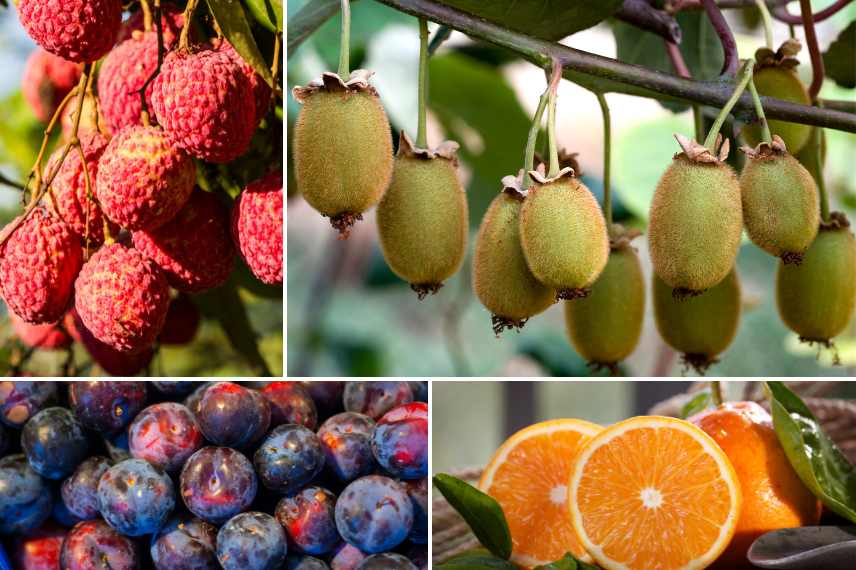
Heirloom and forgotten fruits
We are also currently witnessing the rediscovery of forgotten fruits like quince, medlar, jujube, or persimmon, often brought back to the forefront by chefs or organic orchards. Would you like to learn more about these ancient fruits? Browse our articles and recipes:
- Growing the male dogwood for its fruits
- The jujube tree: planting, pruning, and caring for
- How to make quince jelly? and How to harvest and store quinces?
- How to harvest and store medlar?
- How to harvest and store persimmons?
- Physalis: sowing, cultivation, harvest
- The beech nut: an edible fruit to discover.
Further reading: some useful books and websites
For botanists or history enthusiasts and those passionate about local and ancient fruit varieties, I recommend the following works (in French):
- The ABCs of Fruits, Antoine Jacobsohn. Flammarion Editions. 1997. A condensed source of information by the head of the King's Kitchen Garden.
- Astonishing Stories of Fruits. Bertrand Dumont. MultiMondes Editions. 2022.
- Fruits from Here and Elsewhere: Insights into the History of Some Fruits Consumed in Europe. Marie-Pierre Ruas. Omniscience Editions. 2016. A bible that will delight history enthusiasts.
- Rediscovered Fruits, Heritage of Tomorrow. History and diversity of ancient species from the Southwest. Evelyne Leterme and Jean-Marie Lespinasse. Rouergue Editions. Redouté Prize 2008. Another extensive book.
- And a historical detective novel by Michèle Barrière, Murder in the King's Kitchen Garden, about the famous thefts of melons at Versailles: a delightful summer read.
Several associations and organisations allow for further learning about the origin and conservation of fruits:
- The Apple Crunchers, who have been advocating for the preservation of regional fruit varieties for years.
- Forgotten Fruits: a network that contributes to the promotion and preservation of fruit heritage.
- The National Centre for Pomology, an association dedicated to the conservation, study, and promotion of fruit varieties, particularly ancient and local varieties.
To extend this reading, discover the ancestral history of the fig in this excellent article by Alain Bonjean in the Chronicles of Vegetal. You will learn all about the genomes of the apricot in this publication from INRAE. And Eric Birlouez tells you much more about the apricot's journey in his podcast on France Inter...
Finally, listen to a delightful segment, In the Intimacy of History: The Pear, an Erotic Fruit, narrated by historian Clémentine Portier-Kaltenbach.
.
When we go shopping or peel an apple, we don’t really think about the origins of the various fruits that grace our tables, as they are such a part of our daily lives. Yet, if they could speak, they would tell us the incredible journey that brought them to us, from the earliest times!These juicy […]
Father's Day is fast approaching, and with it that age-old question: what to give a dad who loves spending time in his garden? To celebrate gardener dads properly, nothing beats a carefully chosen gift that reflects their passion for gardening. Unusual plants, practical tools, well-thought-out accessories or nature-inspired decorative items: gift ideas are plentiful for Father's Day. Here are our favourites to delight every garden-loving dad.
Give rare plants for Father's Day
For a dad passionate about botany or simply curious about new things, giving a rare plant is both an original and meaningful gesture. Some uncommon species add a touch of originality to the garden while piquing the gardener's interest.
For shady gardens, consider Hosta with unusual and decorative foliage (notably Hosta 'Big Daddy' and why not 'Obi-One Kenobi' or 'Jurassic Park ®' for a cinema-loving dad?), ferns with unusual shapes (such as the original Dragon's-tail fern), or a Corydalis 'Craigton Blue' with delicate electric-blue flowers.
For sunny gardens, consider graphic Eryngium, warm-toned daylilies, or Kniphofia with blazing flower spikes. Some garden orchids tolerate sun and partial shade provided the soil stays cool and offer unusual flowering, perfect for summer borders. And don't forget roses for collector dads.
For a graphic effect, consider tree ferns, a Japanese dogwood for its striking blossom, an Aralia with divided leaves or a Japanese maple with changing colours. These plants are both attractive, long-lasting and often little-known, perfect for enriching the collection of an experienced or passionate gardener.
If your dad is more of a vegetable-garden enthusiast, consider perennial vegetables, still rare in our gardens, and dwarf fruit trees.
Choosing a plant suited to his garden is giving a living gift that grows, flowers and changes with the seasons… much more than a simple object, it's a lasting gesture.
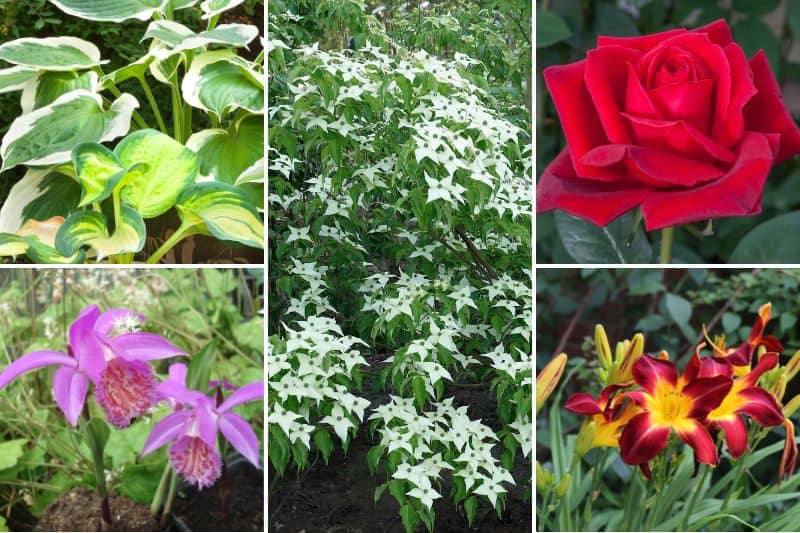
Choose quality gardening tools as a gift
A well-chosen tool is a useful, durable gift that accompanies the gardener through the seasons. For a dad who likes to care for his plantings, a precision pruning shear, a forged spade or a Japanese hoe are safe bets. It's also the perfect opportunity to replace a worn or less ergonomic tool with a more comfortable and effective model, such as a aerating fork. Prefer tools with steel heads and wooden handles, both sturdy and pleasant to use. Today you can also find very beautiful garden tools, both aesthetic and technical, in copper or bronze.
You can also think of gardening accessories, such as a tool apron or a comfortable kneeling pad, which will make gardening easier for your dear dad. These are practical gifts designed to last and provide real comfort in the garden.

Gift an inspiring gardening book
Father's Day also coincides with the arrival of summer, and the heat that fills the garden often forces the gardener to rest. It's the ideal moment to give a gardening book to browse quietly in a shady spot, lying in a hammock or a deckchair while the garden breathes.
Some titles encourage reflection. For a dad keen to adapt his garden to the climate, All Plants That Tolerate Drought is a book that helps rethink the garden to make it more resilient to increasingly hot summers.
Other books offer regular guidance, such as the book The Garden Month by Month, which guides the gardener step by step with simple, practical advice, whatever the season.
These are lasting gifts that are kept, annotated and sometimes passed on. Gifting a book also gives time for oneself and inspiration.
Create a personalised garden gift box for Father's Day
A bespoke gift box is a thoughtful present, easy to create and personalise. It can revolve around a theme such as sowing pollinator-friendly flowers, vegetable-garden maintenance or plants useful to pollinators. You can tuck in a few plants, some packets of seeds, a comfortable pair of gardening gloves, a garden notebook, or even a book or a small illustrated guide. Add slate plant labels and a restorative hand cream for a thoughtful touch. It's also a lovely way to give several small useful items, neatly presented, for a gardening dad.
Gift an indoor plant
Not all dads have a garden, but that doesn't stop them having green fingers (or simply wanting to add greenery to their home). A well-chosen indoor plant can transform a corner of a room, a desk or a windowsill into a little island of nature.
Consider gifting an elegant fern, a Ficus with a graphic habit, or a Sansevieria, robust and easy to care for. For a more original effect, think of a Zamioculcas, an Asplenium nidus or a Calathea with decorative, moving foliage. Some dads will also appreciate a ready-to-place terrarium, a decorative mini greenhouse or a potted herb to keep near the kitchen. It's a simple way to bring a bit of nature indoors, even in an apartment, and to give a living, decorative and lasting gift.
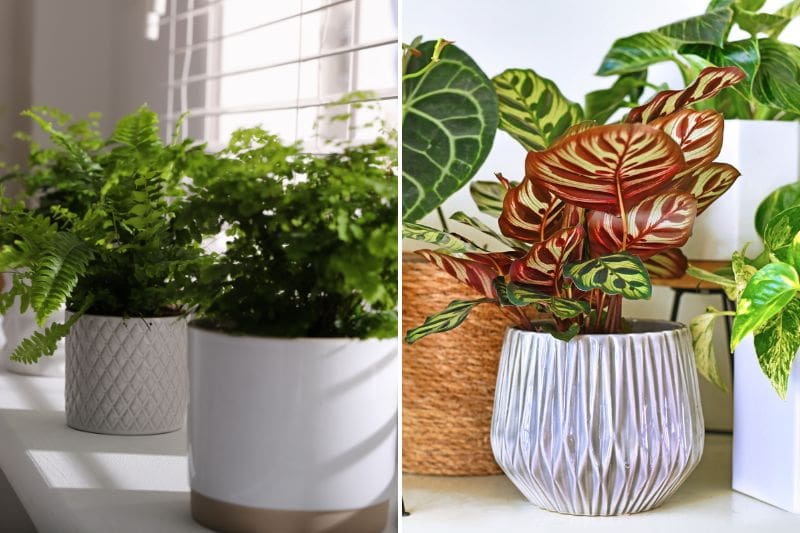
Give a plantable seed card for a new dad
The idea is simple: make a card from paper or papier-mâché into which you mix some flower seeds or herb seeds. Decorate the card as you wish, with drawings or little messages for dad. Afterwards, the lucky recipient can cut out and plant the card in the ground or a pot. Once in place and well watered, the seeds germinate and flower, becoming a living memento of the shared moment.
It's a perfect gift idea for children who want to take part in their own way. The card can also accompany a plant or a tool. A small gesture that takes root in the heart as much as in the soil.
→ Find our detailed tutorial: "How to make a plantable card?".
And why not simply share a moment in the garden?
Sometimes the most beautiful gift you can give is time together. A morning hoeing side by side, an afternoon planting a new specimen together, sowing vegetable seeds or simply sipping a coffee on a bench while watching things grow. The garden is also a place of connection and passing on, a space where you can give your time, your presence, your memories. On Father's Day, a sincere gesture sometimes carries more weight than a perfect present.

The entire promesse de fleurs team wishes all dads a happy Father's Day!
Father’s Day is fast approaching, and with it that age-old question: what to give a dad who loves spending time in his garden? To celebrate gardener dads properly, nothing beats a carefully chosen gift that reflects their passion for gardening. Unusual plants, practical tools, well-thought-out accessories or nature-inspired decorative items: gift ideas are plentiful for […]
For centuries, vegetables have travelled across continents, carried by explorers, merchants, and botanists. Aubergines, potatoes, celery, cabbages, carrots, and other parsnips… The vegetables so familiar in our everyday cooking often come from the antipodal cells, or at least from distant territories. We learn in our history classes that tomatoes and corn were brought to us from America. But what do we really know about the epic journey of our vegetables?
From Antiquity to modern hybridizations, vegetables from Asia and the Near East or native to America, I invite you on a spatio-temporal journey to the four corners of our planet. You may discover what the oldest vegetable in the world is, which vegetables are the most consumed today worldwide, and some tasty tales about their history and how they reached us!

Origin of vegetables: the continents that gave birth to them
Three major regions of the world are the source of most of the vegetables that make up our diet today: the Near East, Asia, and the Americas. It is important to note that when we refer to this origin, we are talking about the geographical areas where these vegetables were cultivated, not where the vegetable was recorded as a wild plant. This sometimes explains the discrepancies we notice regarding the origin of certain vegetables (a good example being the unresolved debate about the aubergine, which is said to be either Chinese or Indian).
Here are the origins of some of the most commonly used vegetables today, by continent and major regions of the world:
- America: tomato (Mexico and Central America), bean, squash and courgette (Mexico), potato (Peru and Bolivia), pepper (Central America), sweet potato (Peru), corn (Mexico)
- Asia: aubergine and cucumber (India), spinach (Persia), garlic, shallot and onion, carrot, cucumber, turnip, crosne (Japan)
- Near East: pea* (Fertile Crescent), radish, lentil, chickpea, rocket, and cabbage, which was likely domesticated there.
- Middle East: carrot (Afghanistan), onion (Iran and Afghanistan)
*(often accepted as one of the oldest vegetables in the world, its cultivation dating back 7,000 to 10,000 years)
Europe and Africa are also the cradle of several vegetables in our daily lives. Cabbage, fennel, Swiss chard, parsnip, broad bean, and many salads like lamb's lettuce (from Sicily and Sardinia), escarole or chicory for Europe, beetroot and artichoke coming from North Africa.
While all these vegetables were brought back by the great expeditions of the 15th and 16th centuries or by the Arab conquest (the Silk Road and the Incense Route concerned not food, but spices, fabrics, and precious woods), they underwent a slow evolution, being domesticated and then hardened in regions with climates very different from their areas of origin.
Vegetables through time: a brief timeline of an announced success
The consumption of vegetables is documented in numerous ancient writings and manuscripts across different cultures and eras, but also through paintings and still lifes from the Renaissance onwards. Archaeologists have thus identified the pantry of our distant ancestors, historians have investigated their introduction, and naturalists and botanists have studied their acclimatization in our countries.
As we learn it in school, nomadic man did not cultivate; he was a hunter-gatherer. When he settled down, around 10,000 BC, he began to domesticate certain animals… and to plant! The first centres of settlement in the Near East, what is called the Fertile Crescent (corresponding to Iran, Iraq, and Turkey) report the cultivation of cereals such as barley (Hordeum vulgare), then wheat, oats, and rye. Considered the first cultivated food, barley was indeed on the menu of our Mediterranean ancestors.
Ancient Egypt, which has left us numerous testimonies of its dietary practices in its temples, tombs, and papyri, cultivated cabbage and cucumber, as well as chickpeas and, more surprisingly, radishes, as well as the nut sedge (papyrus) which was consumed. It was a predominantly vegetarian people.
Closer to us, in ancient Rome, we were able to identify the vegetables that the inhabitants of Pompeii ate: peas, broad beans, and lentils encountered in Egypt, thus many legumes, but vegetables such as cabbage, leek, onions, and asparagus also already appeared. All these vegetables are mentioned by Columella, a Roman agronomist, and by Pliny the Elder in his Natural History.

Later still, in the Middle Ages, many manuscripts recount the vegetables that graced the tables: mostly leafy vegetables, such as spinach, orache, and borage, root vegetables (chervis, parsnip, carrots, turnips…) and so-called perpetual or perennial vegetables. There is still much evidence of legumes such as chickpeas and lentils. The beetroot makes its appearance, and Charlemagne attempts to impose it in the vegetable garden. He includes it in his Capitulare de Villis and recommends it as a vegetable crop for the Empire. Medieval cuisine often consisted of all these vegetables, consumed in the form of soups, broths, pies, and stews, with meats, game, and fish reserved for the noble classes.
The Age of Discoveries in the 15th and 16th centuries further enriched this mapping of vegetables. The discovery of the Americas by Christopher Columbus in 1492 led to the introduction of many new vegetables to Europe, such as tomatoes, potatoes, corn, peppers, and squash, to name just a few. These vegetables from the New World literally fascinated our old continent. They graced the tables of monarchs and European courts, ensuring the splendour of banquets during the Renaissance, and later integrated into European cuisines in the modern era.
Subsequently, we witnessed the acclimatization of these vegetables growing in warm climates, adapting them to our regions, our humidity, and our four seasons. The greenhouses that developed from the 18th century onwards allowed for an unprecedented boom in market gardening. Farmers gradually began to produce many types of vegetables throughout the year, increasing both diversity and productivity.
Aubergine, carrot, and artichoke: three domesticated vegetables under the microscope
Alexandra has already explored the fascinating history of certain vegetables in My Vegetable Garden Comes from Afar, such as potatoes, tomatoes, or squashes. I will complete this list by discussing here the aubergine, carrot, and artichoke, three vegetables rich in flavour and colour... well... not all at the beginning!
- Aubergine
The Aubergine (Solanum melongena L), long referred to as the madman's apple or the apple of Sodom in the 14th century, had a rather poor reputation before becoming this much-loved summer vegetable in Mediterranean, Lebanese, and Asian cuisine. It was said to be dangerous, as it was associated, as was the tomato, with belladonna, which belongs to the same botanical family, the nightshades. It was attributed with fevers, epileptic fits, and those who ate it were even said to lose their sanity.
Aubergines were thus, like some other vegetables, initially considered ornamental plants in Europe, but soon gained popularity as food in southern Europe. They are documented in cultivation around 500 BC in India and Burma. The white aubergines are believed to be the oldest cultivated forms. In India, Burma, and China, mentions of light or white varieties can be found in ancient texts, as early as the 5th century.
They are still called "eggplants" in English because they resembled… chicken eggs!
It was the Arabs who discovered it in the Middle Ages and brought it from Asia, likely from India in the 15th century. They named it "al-bâdinjân", introduced it into the Mediterranean basin, and quickly adopted it through their trade with the Arab world. The aubergine passed through North Africa, then Spain, and into other Maghreb countries. However, it was the Italians who truly popularised it in the 19th century. It would then be more consumed in Spain and Italy, as well as in Greece. The aubergine would not appear in markets in northern France until the mid-19th century.
The aubergine remains widely consumed in the Middle East, where it is the star of iconic dishes like baba ghanoush in Lebanon, or Imam bayildi in Turkey, for example. In Turkey, where aubergine jam is a specialty, it is also consumed sweet, and in Andalusia, cooked with honey as a dish, the aubergine regains its status as a fruit, as botanically it is indeed one.
The aubergine is now among the top 7 most cultivated vegetables in the world, with over 60 million tonnes produced annually. The global production of aubergine is primarily Chinese and Indian, with China accounting for about 63% of global production and India about 24%. It remains predominantly consumed in Asia. Today, there are no fewer than 341 varieties of aubergines listed in the official catalogue!
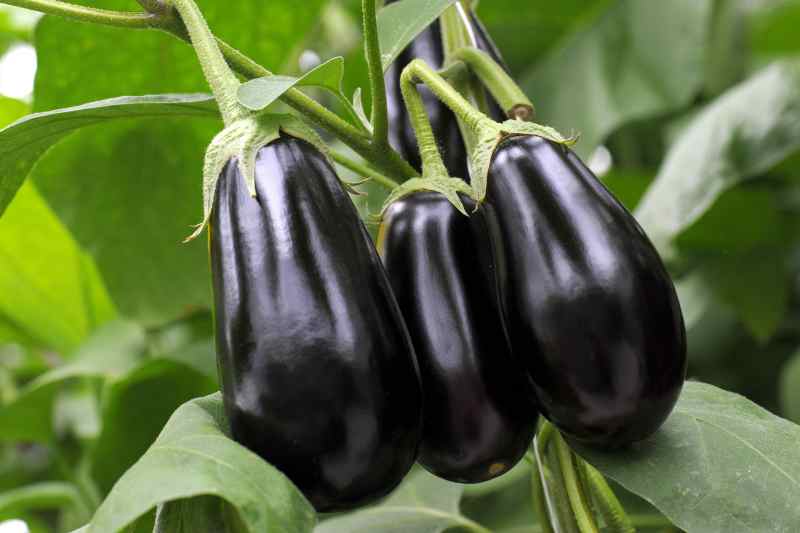
- Carrot
Iran is credited with a developed culture of the carrot (Daucus carota), but it is in Afghanistan that it is said to have appeared in the 10th century, quite recently in fact. It was initially produced in Europe, mainly in Spain, and after crossing the Pyrenees, it arrived in France, then Italy in the 14th century.
Yellow, white, and red carrots, ancestors of the orange carrot, delighted the royal tables of Europe in this colour until the Renaissance. Like other vegetables or fruits that gradually changed colour, the carrot originally had whitish hues. It was the Dutch who, in the 17th century, through numerous hybridizations, transformed this pale carrot into an increasingly orange one.
We now find yellow and purple carrots on the stalls, a curious turnaround! Fashion and trends...

- Artichoke
The artichoke (Cynara scolymus), a symbol of Brittany for us, originates... from the Mediterranean basin, specifically North Africa. It is nothing other than a domesticated wild thistle! It was probably already consumed in Antiquity by the Egyptians and the Berbers, in its wild form, the cardoon (Cynara cardunculus).
It is from this species that the cultivated artichoke is obtained through selection. It reached Italy in the 1st century under the Roman Empire, where it was mainly used, like in Greece, for its medicinal properties. It was during the Renaissance, around 1644, that it was truly popularised and cultivated in aristocratic gardens, particularly in Naples and Sicily. It was then credited with digestive and even aphrodisiac properties. It appeared in France thanks to Catherine de Medici, who introduced it to royal gardens in the 16th century. Louis XIV adored this vegetable… La Quintinie cultivated five different varieties.
It was not until the early 19th century that the artichoke became popular, thanks to the creation of the famous large Camus de Bretagne. It thus became a significant market gardening crop in Brittany, Provence, and the Loire Valley. There are several varieties, such as the Gros vert de Laon, the purple artichoke of Provence, or the poivrade—which appeared later—a small tender variety often consumed raw or in oil. The artichoke remains an emblematic vegetable of Mediterranean cuisine, found stuffed, in barigoule, or Roman-style.
Italy, Spain, and Egypt are now among the three main producers of artichokes in the world, far ahead of France.
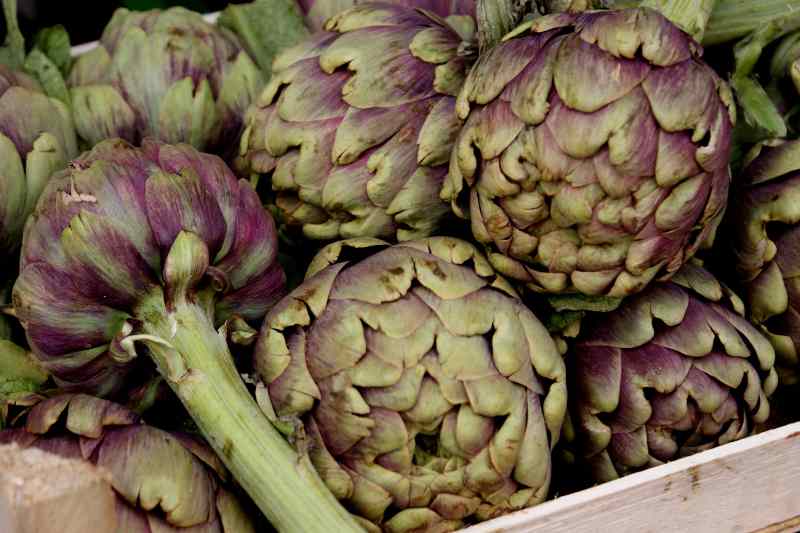
The 'new vegetables'
While we often think that all our vegetables are ancient, some have only recently appeared in our gardens and on our stalls, particularly with the globalization of food, the rise of organic produce, and new consumption habits (gluten-free, vegetarianism).
Among the vegetables that have recently arrived in our gardens and markets are exotic vegetables, but not only...
- Chayote (or christophine), a cucurbit from Central America, widely used in Caribbean and Reunion cuisines, now well acclimatisated and cultivated in France, in the mild Atlantic zone or in the south.
- Kale – making a comeback since the 2010s, a star of health diets. It is now widely cultivated in urban, organic, and alternative gardens.
- Romanesco cabbage arrived in our markets in the 1990s.
- Sweet potato: it was rare just 30 years ago and is now ubiquitous in markets, even cultivated in the southwest of France. Some varieties are adapted to the French climate.
- The yacon (earth pear): Originating from South America, it is still marginal but is entering organic circuits and AMAPs (Associations for the Maintenance of Peasant Agriculture). Its taste is sweet, similar to that of the Jerusalem artichoke.
Also added to this list is black radish, an ancient vegetable rehabilitated by modern cuisine and wellness trends. Long relegated to herbalism, it is now reappearing in winter salads and detox plates. These vegetables reflect the plant renaissance of the 21st century, between exoticism and culinary innovations.
We are also witnessing the rediscovery of forgotten vegetables such as chervis, orache, helianthi, crosne, or even cardoon, and herbs like wild garlic, often brought back to the forefront by chefs or organic gardens.
21st-century agriculture has also seen the emergence of hybrid or crossbred vegetables, such as broccolini (a cross between broccoli and kai-lan), or kalette (kale + Brussels sprout), reflecting our growing taste for plant innovation, but also the need to adapt to new climatic conditions.
These vegetables that might never have existed!
Finally, there are also vegetables that never came to be... and those that could have remained unknown in Europe.
We will thus try to consume the tuber of the Dahlia, brought to France in 1802 from Mexico via Spain. This plant was cultivated, used decoratively in flowering tiaras, but also consumed by the Aztecs for centuries. Botanist André Thouin thought he could use it here, somewhat like the potato, as the tuber had a floury consistency. But its peppery taste did not appeal to the testers of the time, and thus it was relegated in 1804 (to our great delight) as the only ornamental plant!
Some of the vegetables we cherish today almost didn't make it into our kitchens. The potato and the tomato are good examples; the former long deemed unfit for consumption, indigestible, only good for feeding animals, and supposedly transmitting the plague, while the latter retained its image as a toxic plant for a long time. It was only adopted by the French from 1731, and by the Germans even later, around 1870. These plants, labelled as poisonous, were also the fate of some fruits, but we will return to this in a future article.
Further reading
I highly recommend one of the books that recently received the French Saint-Fiacre Prize 2024: "Tour de France of Fruits and Vegetables" by Noémie Vialard and Stéphane Houlbert, as well as History of Vegetables: From Origins to the Dawn of the 21st Century, by Michel Pitrat and Claude Foury.
If you are wandering in Anjou, visit the gardens of Puygirault, a unique place that traces the evolution of the vegetable garden from the earliest times.
Want to discover heirloom vegetables? Check out our articles and recipes on the subject:
- 9 Heritage Vegetables to Grow in the Vegetable Garden
- Jerusalem Artichoke: A Forgotten Vegetable to Rediscover
- Chervis, an Easy-to-Grow Forgotten Perennial Vegetable
- Borage Leaf Soup: A Simple and Tasty Recipe
- Orache in the Kitchen: Plant-Based Recipes of an Ancient Vegetable to Rediscover
- Helianthi: How to Harvest, Store, and Cook It?
Find an interesting article from National Geographic on a thermopolium discovered intact in Pompeii.
The Cluny Museum inspires us with its medieval recipes!
For centuries, vegetables have travelled across continents, carried by explorers, merchants, and botanists. Aubergines, potatoes, celery, cabbages, carrots, and other parsnips… The vegetables so familiar in our everyday cooking often come from the antipodal cells, or at least from distant territories. We learn in our history classes that tomatoes and corn were brought to us […]
Albino plants, with their immaculate appearance and lack of green pigment, captivate with their uniqueness as much as they intrigue. Why do some plants arise without chlorophyll, and how do they manage – or fail – to survive? Between genetic mystery and conservation challenges, these botanical curiosities offer us a fascinating window into the limits and adaptations of life. In this article, we will explore their origins, their unique functioning, and the issues related to their preservation.
What is an albino plant?
Albino plants are vegetals exhibiting a total or partial absence of chlorophyll, the green pigment that plays an essential role in photosynthesis. This pigment is crucial for capturing sunlight energy and converting it into chemical energy, allowing the plant to produce the sugars necessary for its growth: this is photosynthesis. Without chlorophyll, these plants find themselves unable to produce their own food (or at least partially), which poses significant challenges for their survival.
Appearance and characteristics
- White or translucent leaves and stems: the absence of chlorophyll gives albino plants a striking white or slightly translucent appearance, as other natural pigments (such as carotenoids or anthocyanins) may also be absent or greatly reduced.
- Leaves tinged with yellow or pale pink: in some cases, albino plants retain a small amount of other pigments that give them a slightly different coloration, such as shades of yellow or pink.
- Limited or non-existent growth: most albino plants die shortly after germination, as they cannot produce the energy necessary for development.
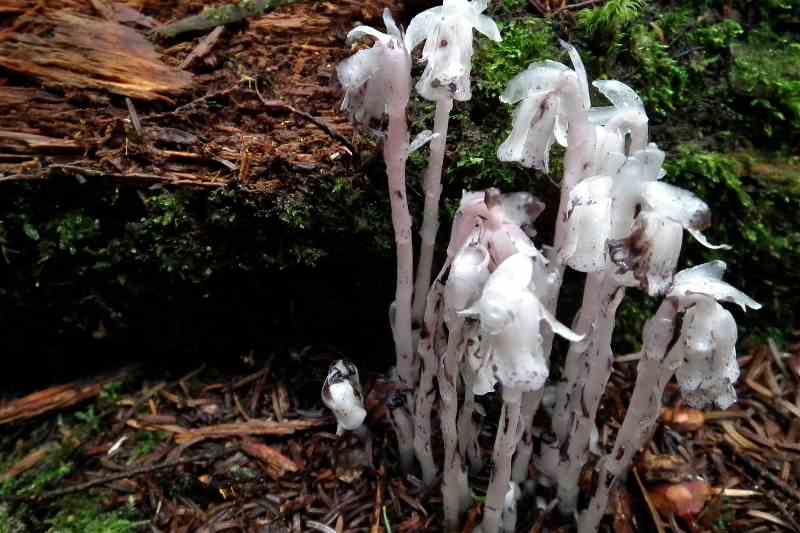
Comparison with albinism in animals
Albinism in plants and animals shares similarities, notably a genetic mutation affecting pigment production. However, the impacts of this condition differ significantly.
- In animals, the absence of melanin (the pigment responsible for skin, fur, or feather colour) leads to increased sensitivity to sunlight and camouflage issues, but they can generally survive.
- In plants, albinism is far more debilitating: without chlorophyll, an albino plant cannot perform photosynthesis, which directly compromises its ability to survive.
Prevalence in nature: an exceptional case
Albinism is an extremely rare phenomenon in the plant kingdom. Indeed, for a plant to become albino, it requires:
- A specific genetic mutation affecting the genes responsible for chlorophyll production.
- That this mutation is not immediately fatal during germination.
In nature, natural selection quickly eliminates albino plants, as they cannot develop independently.
The causes of albinism in plants
Genetic origin
Plant albinism is often linked to mutations in the genes responsible for chlorophyll synthesis. These mutations prevent the plant from producing this essential green pigment, resulting in a lack of coloration and an inability to perform photosynthesis.
- Genetic mutation: an alteration in the genes coding for the enzymes necessary for chlorophyll production leads to a total or partial absence of this pigment. These mutations can occur spontaneously or be inherited from parents.
- Specific cross-breeding cases: in certain species, genetic crossings between individuals carrying recessive mutations can give rise to albino plants. For example, in nurseries or hybridization projects, it is not uncommon to observe albino seedlings among varieties of vegetables, fruit trees, or orchids. However, these plants often survive only a very short time without human assistance.
Environmental factors
In addition to genetic mutations, external elements can also influence plant pigmentation.
- Environmental stress: extreme conditions, such as sudden temperature changes, excessive light exposure, or prolonged drought, can disrupt chlorophyll production processes. These conditions do not cause true genetic albinism but can lead to a temporary reduction in pigmentation.
- Diseases and pathogens: certain fungal or bacterial infections can alter the health of the plant and lead to leaf discolouration, mimicking the effect of albinism.
- Exposure to chemicals: certain weedkillers, pesticides, or pollutants can disrupt the biological mechanisms of plants and inhibit chlorophyll synthesis. These chemical impacts can cause temporary or permanent loss of pigmentation.
The consequences of albinism in plants
As mentioned earlier, albinism has major consequences for plants, as the absence of chlorophyll deprives them of their ability to perform photosynthesis. This incapacity places them in a situation of great vulnerability. Many albino plants die quickly after germination, unable to meet their energy needs. However, in some cases, they can rely on a "mother plant" or shared root systems for nourishment. This is the case for albino sequoias, which depend entirely on nutrients transferred by the roots of normal trees to survive, unlike normal plants, which can thrive due to their autonomy.
There are, however, notable exceptions. Some specific albino plants, such as Monotropa uniflora (the "ghost plant" or Indian pipe), circumvent their dependence on photosynthesis by establishing a symbiosis with mycorrhizal fungi. These fungi provide them with the necessary nutrients by tapping into the underground network of surrounding plants. This type of relationship, called mycoheterotrophy, allows these albino plants to survive and thrive despite their pigmentation defect.
This energy dependence of so-called albino plants on other plants or organisms, combined with the fragility of their state, makes their preservation difficult, especially in nature where habitat destruction further exacerbates their vulnerability.
However, these challenges come with interesting opportunities, particularly in the field of scientific research. Albino plants intrigue researchers seeking to better understand the genetic mutations responsible for their condition and their impact on plant metabolism. In horticulture, efforts are being made to maintain or even "save" certain albino varieties, for example, by using techniques such as controlled environment cultivation.
Famous examples of albino plants
Albino sequoias are probably the most fascinating examples of albino plants in nature. These rare trees, primarily located in California, survive thanks to a unique system of shared roots with normal sequoias. This underground network allows them to absorb the nutrients necessary for their survival, a dependency strategy that intrigues botanists and symbolises the interconnectedness of ecosystems.
In the horticultural world, partially albino plants, such as certain varieties of philodendrons, like Monstera deliciosa 'Variegata', have become extremely sought after. Their unique appearance, with marbled white or cream leaves, makes them prized objects for enthusiasts of slightly unusual tropical plants.
But, even within our flora, albino plants can be found. One of the most well-known cases is that of the bird's-nest orchid (Neottia nidus-avis), a European orchid devoid of chlorophyll. Like the Indian pipe, this plant derives its energy from the decomposition of organic matter in the soil, thanks to an association with mycorrhizal fungi.
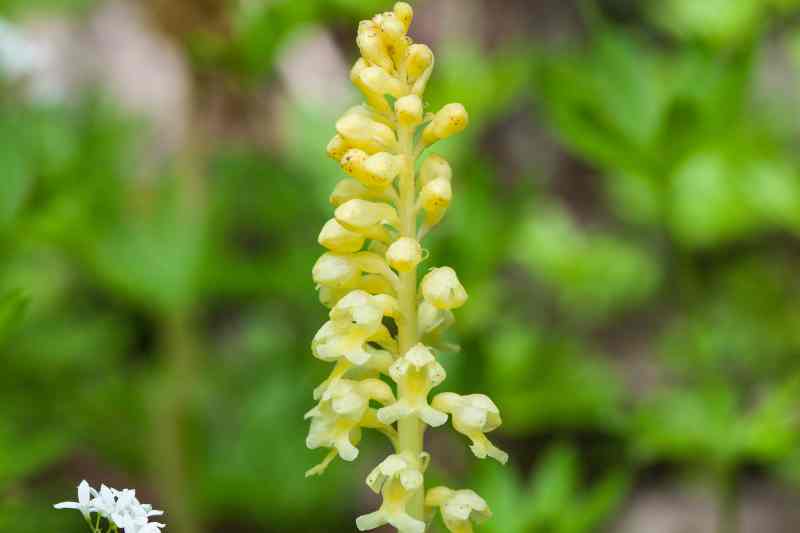
Some tips on growing albino houseplants
Growing albino plants, or partially albino varieties, requires special attention. These plants should be placed in a bright environment, but especially without direct sunlight, to avoid burning the white parts of their leaves, which are particularly sensitive. Their metabolism being less efficient, they also require rich, well-drained soil, as well as appropriate fertilization to compensate for their reduced ability to produce energy.
In an ethical approach, it is also essential to respect their natural conservation. For enthusiasts, this means avoiding the collection of albino specimens from their natural habitat, as they are rare and vulnerable.
Albino plants, with their immaculate appearance and lack of green pigment, captivate with their uniqueness as much as they intrigue. Why do some plants arise without chlorophyll, and how do they manage – or fail – to survive? Between genetic mystery and conservation challenges, these botanical curiosities offer us a fascinating window into the limits […]
Ah, the amaryllis! This star of Christmas and the festive season, with its large, spectacular trumpet-shaped flowers bursting like fireworks in your living room. But why strive to succeed in its cultivation when you can risk doing exactly what you shouldn't? Follow these absurd tips to ensure your amaryllis or Hippeastrum ends up sadly… and discover in the process what you should really do. How to make an amaryllis bloom (and rebloom)? Oh dear, certainly not by following these "tips".
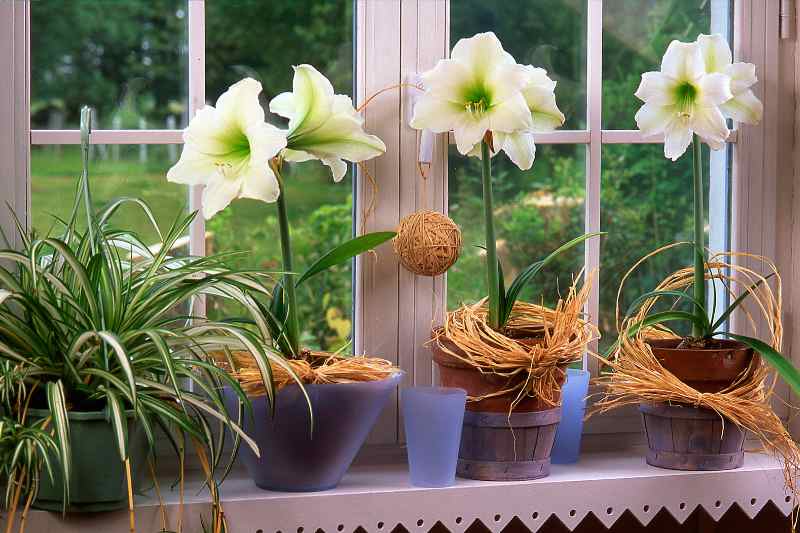
Lesson 1: Plant your bulb… upside down
What better way to prove that the amaryllis is a robust plant than to challenge it with a botanical puzzle? Imagine that poor bulb, planted upside down, its roots pointing to the sky and its leaves desperately trying to break through a compact layer of soil. Fun, right? Not for the bulb, anyway.
And let's be honest, roots are a bit overrated, aren't they? Why give them the comfort of spreading out in soft potting mix when you can turn them into underground Olympic endurance athletes? And what about the satisfaction of discovering, several weeks later, that nothing has grown? The suspense is thrilling!
What to do: plant your bulb with the tip facing upwards, leaving about a third of the bulb above the soil. The roots should be comfortably nestled in the potting mix, ready to work.
Lesson 2: Water it as if it were a water lily
After all, why settle for a plant when you can transform its pot into a miniature pond? The bucolic charm of a little swamp in your living room: the amaryllis bulb happily bathing in stagnant water, perhaps accompanied by some mushrooms, maybe even a colony of mosquitoes if you're lucky. A true painting worthy of Monet!
Let's be honest, who needs flowers when you can watch an aquatic biotope form before your eyes? And then, what suspense to see if the bulb rots before or after the mould appears.
What to do: water moderately. Only add water when the potting mix is dry to the touch. Amaryllis do not like to paddle, especially at the bulb level, which risks rotting.
Lesson 3: Leave it in a dark, cold corner
Why give your amaryllis a bright spot when a dark, cold corner will do just as well? Closet, cellar, or unheated garage: choose the gloomiest place possible to test its ability to photosynthesise in total darkness.
Your poor bulb will shiver in the dark, dreaming of a ray of sunshine it will never see. If it could speak, it would probably say, "Why me?" No light, no warmth, no growth… but what a perfect recipe for a stagnant, sad pot!
What to do: place your amaryllis in a bright, warm spot. A temperature of around 20 °C and a bath of natural light will make all the difference.
Lesson 4: Cut its leaves as soon as they appear
After all, what are leaves anyway? Just green things that take up space and spoil the view of the magnificent flowers, right? So, snip, snip, as soon as they poke their heads out. Your amaryllis, somewhat bewildered, will desperately try to produce new leaves while you tirelessly cut them. You'll end up with a stylishly "bald" plant, but certainly not any flowers.
Photosynthesis? Pfft, what's the point… Does your plant really need leaves to gather energy and prepare for its next flowering? Probably not. Yet, without its foliage, your bulb will be as productive as a phone without a battery.
What to do: leaves are essential for the bulb to accumulate energy. Leave them alone until they fade.
Lesson 5: Forget to give it a well-deserved rest
Why worry about your amaryllis's needs? Producing flowers is its job, right? So no breaks, no holidays: keep watering it, exposing it to light, and expect flowers all year round, as if it were an automatic beauty dispenser. The result: a weary bulb that silently rebels by refusing to rebloom, or worse, completely withers away. Well done, you've turned a majestic plant into a lifeless decorative object. Good job!
What to do: after flowering, let the leaves continue to grow and fertilise the bulb regularly. Then, give it a break of two to three months in a cool, dry place. It will come back in great shape!
Must-read for genuine advice
- How to make an amaryllis bulb bloom again?
- Amaryllis: planting, growing, and caring for: Virginie tells you everything!
- The best varieties of Amaryllis to decorate your home.
Ah, the amaryllis! This star of Christmas and the festive season, with its large, spectacular trumpet-shaped flowers bursting like fireworks in your living room. But why strive to succeed in its cultivation when you can risk doing exactly what you shouldn’t? Follow these absurd tips to ensure your amaryllis or Hippeastrum ends up sadly… and […]