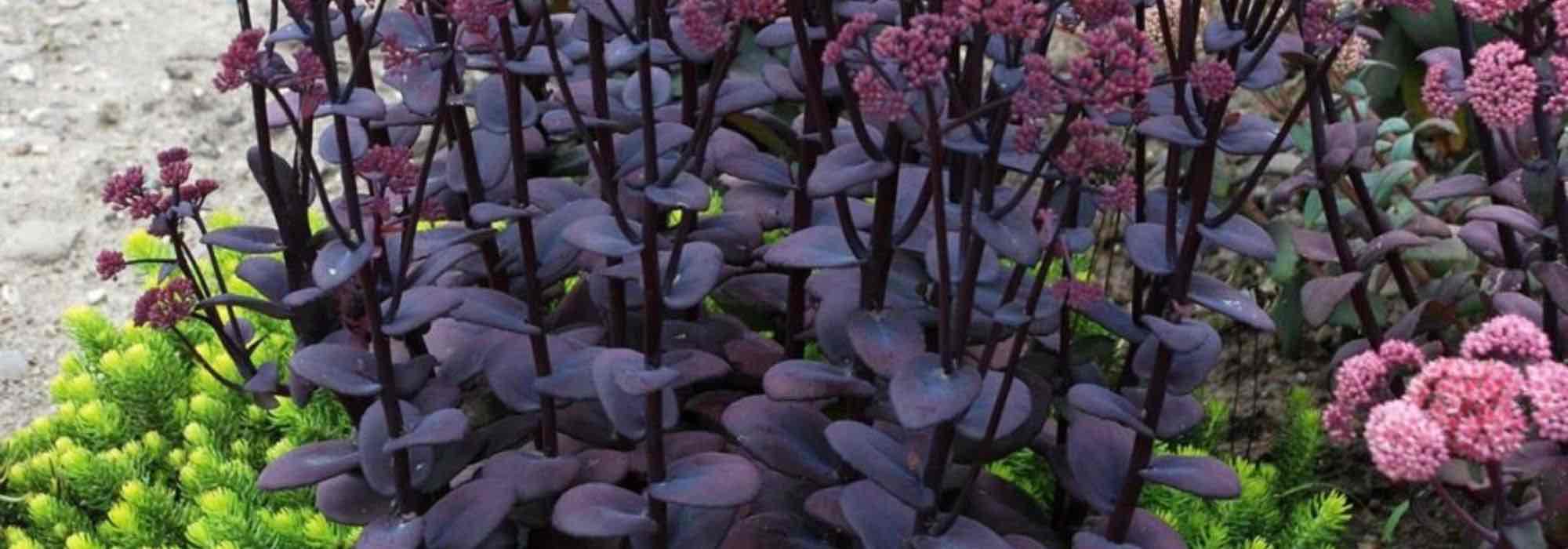
Purple foliage: how to use and combine it in the garden?
Make the most of purple foliage to enhance your borders
Contents
In gardening, purple foliage stands out as enigmatic jewels, adding visual depth and a touch of mystery to outdoor spaces. Their rich, captivating hues, the result of a seemingly endless palette of shades ranging from deep violet to almost black purple, offer a host of opportunities for gardeners. That said, making the most of this decorative foliage and pairing it harmoniously is essential to create displays sometimes striking, sometimes soothing. Discover how purple foliage can transform the appearance of your flower beds, which plant can fuel your creativity and which plants to pair them with for a colourful, vibrant and balanced garden.

Purple, symbols and shades
Purple is obtained by mixing red and blue. From these two primary colours comes this deep, rich hue, often associated with royalty, nobility and wealth. In different cultures, purple symbolises power, wisdom and creativity. It also takes on a spiritual character, evoking inner peace and meditation.
In the garden, this hue suggests elegance, even sophistication and offers a striking contrast with green foliage or blue sky, not to mention the many interesting combinations it allows. Used well, it can create a sense of balance and serenity in your beds. Sometimes a plant’s name hints at the colour, such as Corylus maxima ‘Purpurea’, Acer palmatum ‘Dissectum Atropurpureum’ or Heuchera ‘Forever Purple’, though many others give no clue. Furthermore, there are many shades of purple: so deep it looks almost black (Heuchera ‘Dark Secret’), with violet tones (Penstemon digitalis ‘Dark Towers’), silvery (Heuchera ‘Little Cuties Sugar Berry’), bluish (Sedum ‘Sunsparkler Blue Pearl’) or greyed (Salvia officinalis ‘Purpurascens’), to name but a few. Feel free to select leaf colour in our online nursery search filters to see how wide the palette of purple foliage is.
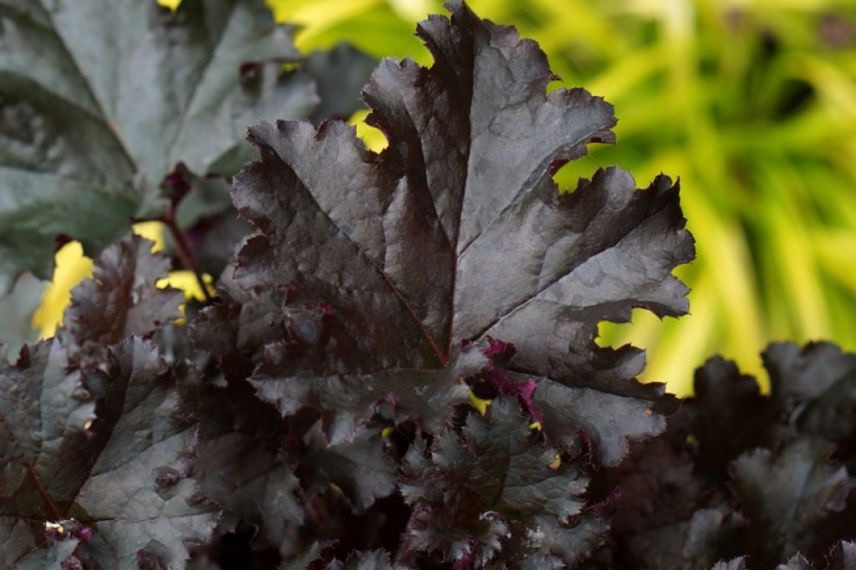
Heuchera ‘Dark Secret’, almost black foliage
Read also
6 ideas for red/purple garden bordersRole and visual impact of purple foliage in the garden
Every garden should work with different shades of foliage. If green remains the dominant colour, purple offers a strong and alluring contrast that, like blue, adds depth, draws the eye away and creates dimension while making other colours stand out.
Depending on the size of the plant, purple foliage can serve as a focal point: an Acer ‘Bloodgood’ among green foliage immediately takes on a different dimension and draws the eye. Depending on the nature of the purple and the combinations chosen, the atmosphere can be calming, evoke mystery or invite contemplation. Take care, however, not to overuse it, as you risk a flat, dark and gloomy result, particularly in the shadier areas of the garden where lighter tones such as soft green, golden or variegated should remain predominant, purple appearing only in small touches intended to create surprises and relief. Also bear in mind that some purple-leaved plants tend to turn green if they do not receive sufficient light.
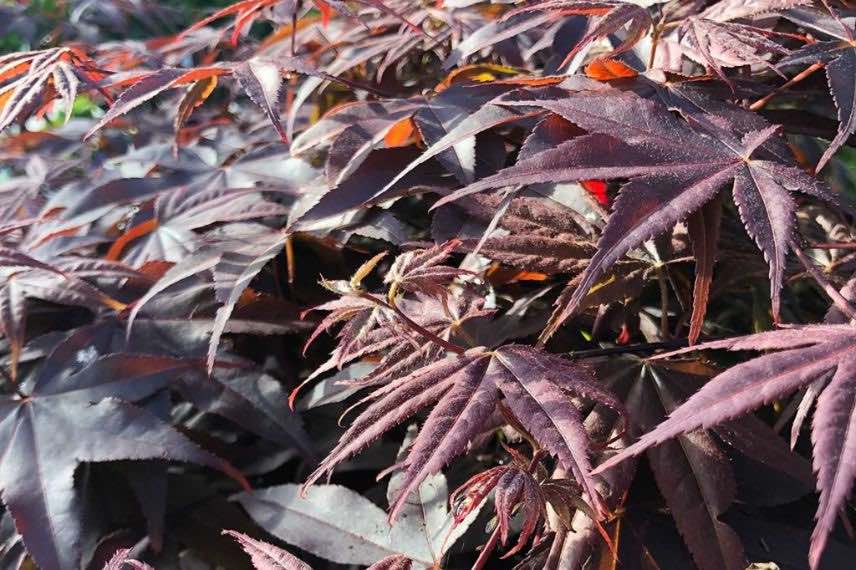
Foliage of Acer ‘Bloodgood’ in summer
Purple-leaved plants
Trees and shrubs
Several varieties of Elders combine purple foliage that provides a backdrop for stunning white or pink flowering, such as the popular Sambucus ‘Black Lace’. Cotinus also offer a fine range of purple foliage, such as Cotinus ‘Grace’ or its cousin ‘Lilla’, whose modest size makes it suitable for the smallest gardens. Silk tree comes in several dark-leaved varieties, including Albizia ‘Summer Chocolate’ or ‘Evey’s Pride’. Callicarpa ‘Pearl Glam’ offers a striking combination of purple foliage and bright purple berries. The list could go on with certain varieties of Berberis, crape myrtle, Weigelia, Loropetalum, Pittosporum, Judas tree, Hydrangea, Physocarpus, Japanese maples and many more…
→ Découvrez all our trees and shrubs with purple foliage.
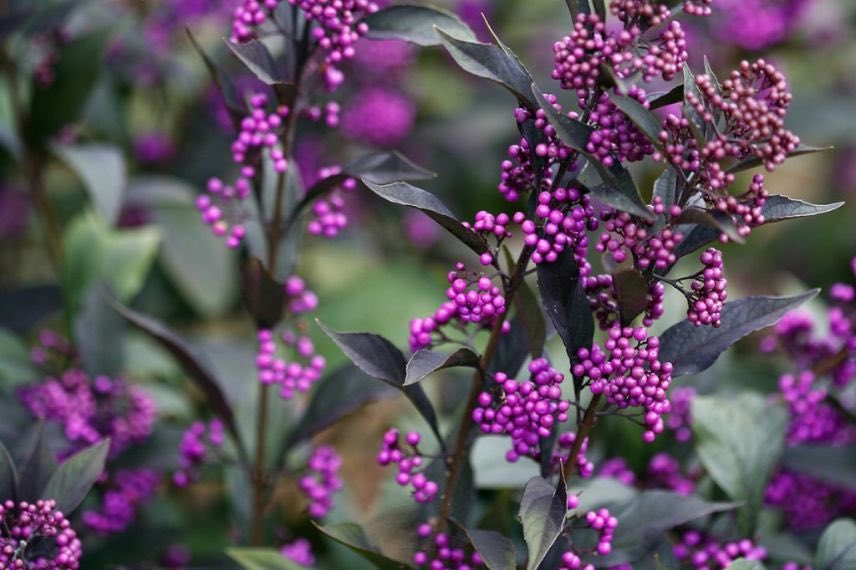
Callicarpa ‘Pearl Glam’ showcases its bright purple berries against dark purple foliage
Perennials
Many perennials also have purple foliage. In Heucheras, Acaena and Phormium, it is usually evergreen and so creates a permanent display. Deciduous foliage is not to be outdone, with, for example, some Sedum, Lobelia, Penstemon, Actaea or hardy geraniums, not forgetting grasses such as big blue stem ‘Blackhawks’ or the purple sugar cane. Chinese fountain grass ‘Rubrum’ has very attractive purple foliage, but it is a frost-tender species to be used as an annual.
→ Toutes our perennials with purple foliage.
Read also
7 purple leaved treesCombining and harmonising purple
Purple is a colour that works very well in the garden, provided it is used sparingly and placed next to plants whose tones either showcase it or harmonise with it in a pleasing way. Depending on choices, the combination can feel more or less invigorating, fresh, calming or vibrant. Below I suggest some examples and ideas for you to try and develop in your own borders.
Purple and yellow: an energetic duo
Purple and yellow are complementary colours and therefore work really well together, bringing a burst of vitality to the garden. For example, use a shrub such as a Cotinus ‘Royal Purple’ set against yellow blooms: intense with Hemerocallis citrina or a pale creamy tone such as Achillea ‘Hymne’, for instance. This pairing can also be achieved with an ornamental grass such as Deschampsia ‘Tatra Gold’, whose golden foliage provides contrast both in colour and texture. As a bonus, your border will glow in autumn when your Cotinus turns red–orange and the grass takes on a parchment hue. You can enrich the composition with a grey groundcover such as Stachys byzantina or opt for the deep green of a heather ‘Kramer’s Rote’, which also brightens winter with its pink flowers.
Elegance of purple and white
Placed beside white, purple appears intensified and serves to make the white look purer. This kind of pairing creates an elegant, calming atmosphere, suggesting a sense of freshness and purity. Aim, for example, for Loropetalum ‘Black Pearl’, whose foliage is almost black thanks to its deep purple. Small in stature, it can enhance a small garden with its vivid pink flowers. In mild climates it is evergreen; plant white-flowering perennials at its feet such as Iberis sempervirens or hardy geraniums ‘Album’ to provide a lovely setting. If space allows, place this duo beside a large Deutzia with green leaves and white flowers, such as Deutzia ‘Pride Of Rochester’.
Vibrant mix of purple and orange
Very on-trend and modern, the pairing of purple and orange creates a bold visual impact, evoking energy and warmth in the garden. Physocarpus ‘Diabolo’ displays dark purple foliage with bronze–orange hints and is topped by pretty white pompom flowers. It pairs perfectly with Crocosmia ‘Zambesi’, whose yellow–orange shades edged with a stronger rim stand out beautifully against their neighbour. Other suitable choices include Achillea ‘Terracotta’ or Geum ‘Totally Tangerine’, or try a shrub sage such as ‘California Sunset’. You can set the group on a carpet of green or variegated foliage or push the theme further with a Sedum ‘Dragon Blood’ or a Geranium ‘Black’n White Army’.
Sobriety of purple and grey
Grey pairs with every colour, so it is ideal alongside purple. By setting a strong colour against a more neutral tone you create an interesting visual contrast between vibrant hues and softer shades, the overall effect being subtle without being dull. Imagine a pairing of Berberis ‘Atropurpurea’, whose foliage reddens in autumn and whose spring flowers are pale yellow, or a Phormium ‘Purpureum’ with a lavender ‘Richard Gray’ or an Helichrysum italicum with metallic tones — all of which are drought-tolerant. You can invert the proportions by choosing a grey-leaved shrub such as Caryopteris ‘Sterling Silver’ or Pyrus salicifolia ‘Pendula’, emerging from a carpet of Sempervivum ‘Chick Charms’ or Sedum ‘Jose Aubergine’.
Foliage play in shade
Although purple foliage can tend to fade and green up in shade, some plants are perfectly suited to that exposure and retain their tones. They help energise woodland scenes and, placed beside lighter-leaved plants, create patterns of shadow and light that mimic natural dappled light under trees. Interplant, for example, Heuchera ‘Plum Royal’ and ‘Binoche’ among varieties with green, golden or silver foliage. Add contrast of foliage and silhouette using variegated and golden Carex, Hakonechloa, graphic ferns, Lamium and Hosta. Introduce a purple-leaved shrub too, such as Acer palmatum ‘Dissectum Garnet’, which then becomes the focal point of your scheme.
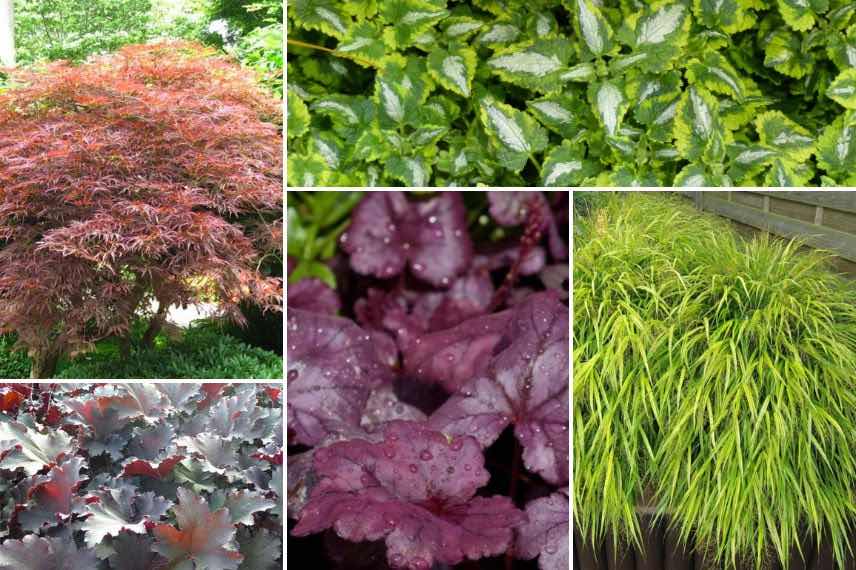
In shade, intense purple foliage and golden foliage. Clockwise: Acer Dissectum Garnet, Lamium maculatum ‘Ann Greenaway’, Heuchera ‘Plum Royal, Heuchera ‘Binoche’
- Subscribe!
- Contents
This form is protected by reCAPTCHA - the Google Privacy Policy and Terms of Service apply.

































Comments