Further reading…
Fancy strong contrasts in garden? Against pastel harmonies of Unicorn, saturated crimsons of Dark Acadomia, or teal blues of Transformative Teal, primary colour trend plays with cyan, magenta and yellow, a striking trio of the three base colours of the colour wheel. Elementary, almost childish, this colour mix divides opinion, but can fit into different styles. Judge for yourself with these pairing ideas!
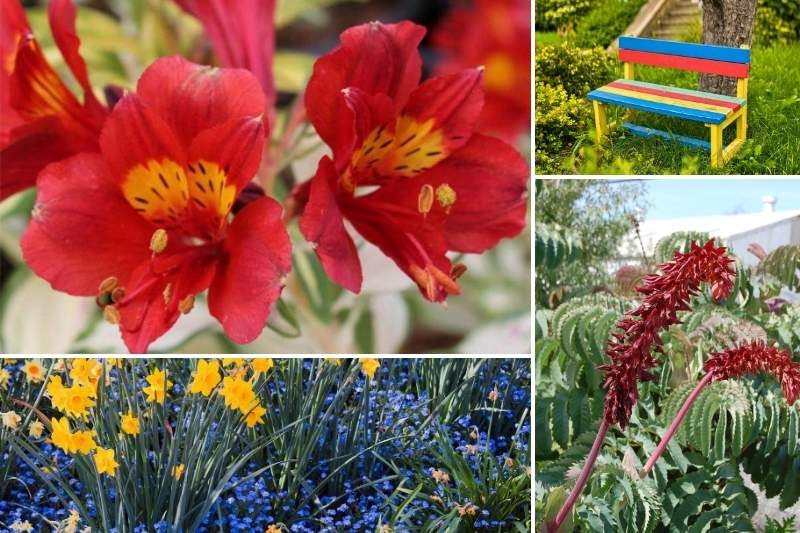
Primary colours: how to use them well ?
Red, blue and yellow flowerings are among most common in garden. Combining them is quite rare, most gardeners preferring harmonies, tonal ranges or colour gradients, or complementary pairings between two colours.
To avoid gaudy, unflattering and slightly cold combinations, finesse is required, pairing vermilion to crimson reds, very pale yellows to more orangey golds, gentian blues to periwinkle blues.
Surround these vivid colours with golden, bluish or purplish foliage. All variegated foliage or bicolour flowerings will help diffuse these strong-contrast tones. Finally, <strong:white, added in small touches in flowers or on foliage also helps attenuate this primary trio, as does play of green flowerings…
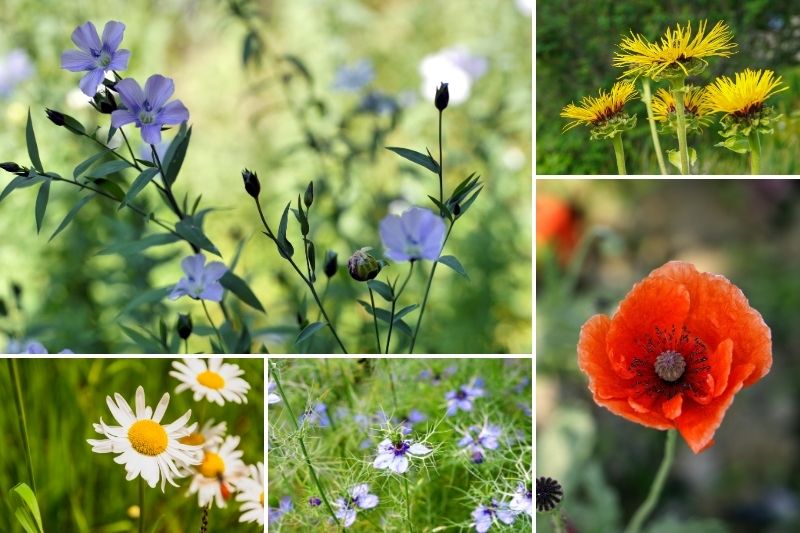
Freshness in the country garden
A cottage garden is a place where all colours often meet in a joyful jumble.
In this example, we bring together simple plants that will produce a very natural, refreshing effect in a country border. We will combine wildflowers, grandmother’s garden plants and cottage-garden plants.
For blues, try cornflower, flax, nigella, chicory, forget-me-nots, campanulas, heliotropic for its fragrance, and China aster 'King Size Mid Blue' for late season. All these plants are delightful and very effective.
Yellows here are provided by generous perennials such as Leucanthemum (large daisy) combining whiteness, mullein with grey‑green foliage, and inulas with more golden tones. One can equally seek paler yellows from charming hollyhocks, or bicolours with Anthemis.
For the red wave, opt for poppies and oriental poppies, spring tulips, sweet williams, peonies and cosmos.
Surround them with a few plants of wild fennel, very airy with greenish flowers, and a few white thalictrums to blur the effect.
A surprising trio in an exotic garden
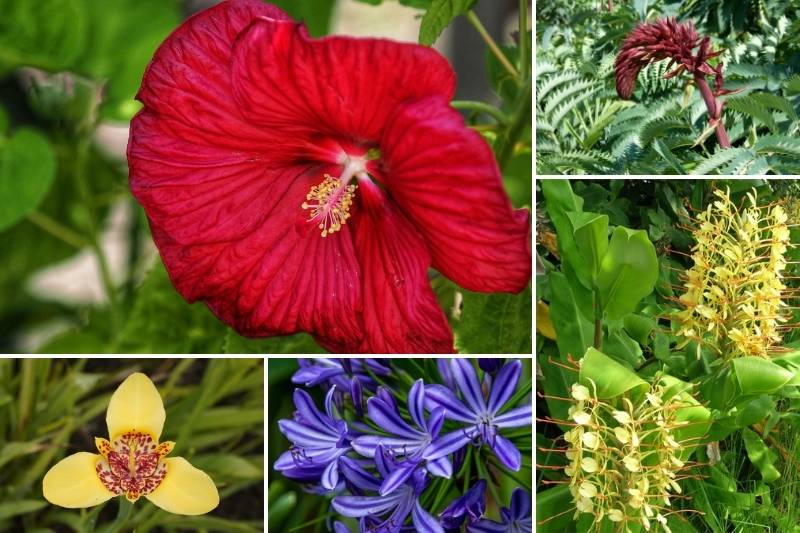
Yellow and red, warm colours, are musts in exotic or tropical gardens. Putting them near blue tempers them, while keeping spirit of that foreign garden alive.
Think of Protea 'Clark's Red' or Leucadendron 'Devil's Bush' for magenta notes in mild‑winter regions, elsewhere yellow or red Alstroemerias and Kniphofias for the yellow.
Plant together, as in example illustrated below, a common Rose mallow, agapanthus, a fine Hedychium gardenarium, yellow and red Tigridia, a Melianthus with strange reddish‑brown inflorescences. Blue will be represented, besides agapanthus, by a beautiful passion flower, an Abutilon vitifolium or some Canary viper's buglosses with giant spikes.
To avoid leaving area bare once summer season has passed, plant among these exotic beauties some evergreen foliage, perennials, grasses and a few shrubs: Taiwan Schefflera, evergreen ferns, and a Daphniphyllum, perfect in semi‑shade. A Pennisetum setaceum 'Rubrum' or an Uncinia rubra 'Everflame' are best placed in full sun.
Colour explosion in the cutting garden
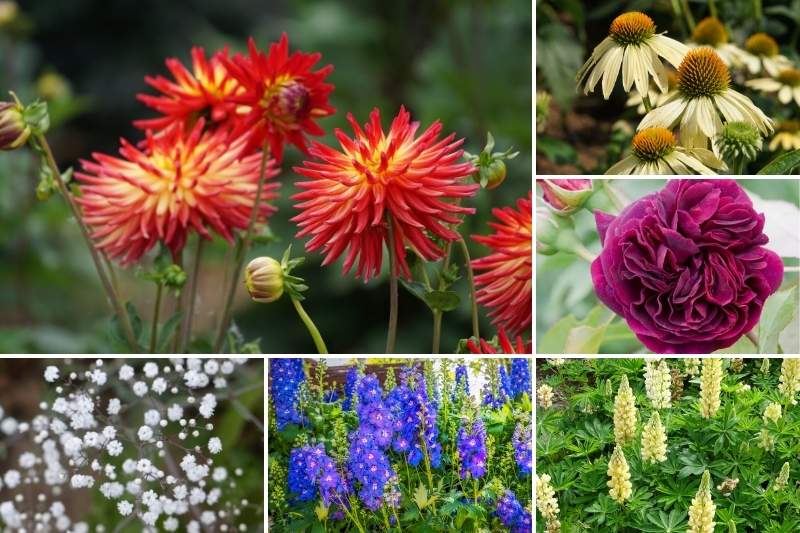
It’s easy to compose a cutting garden with countless plants in blue, yellow and red shades.
Depending on bouquet preferences, place summer perennials side by side with dahlias, blue delphiniums and yellow lupins. Don’t hesitate to combine very different plants here: old roses, eccentric love lies bleeding, capge gooseberry, a few annuals such as zinnias and antirrhinums, all‑yellow solidagos and greenish alchemillas, graceful sweet peas, thistles, narcissi and tulips for spring bouquets, Cosmos 'Lemonade' and 'Rubenza'… choices are endless!
A joyfully colourful area around the play zone
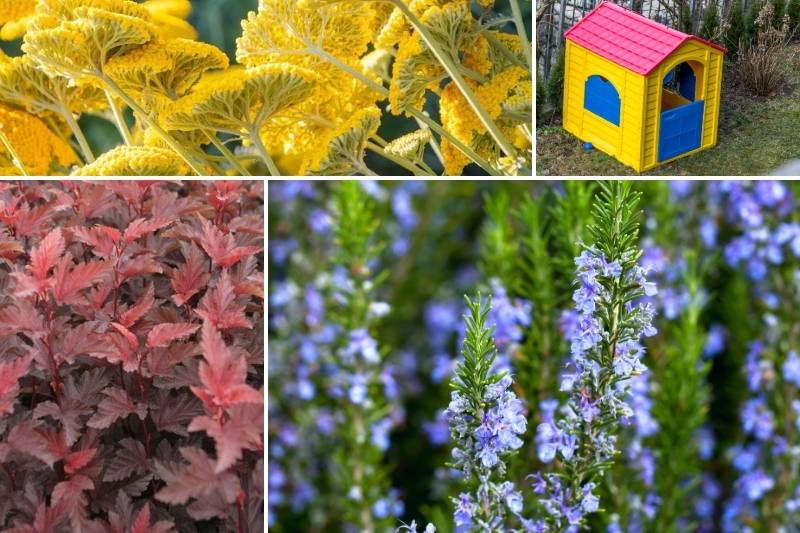
Blue, red, yellow… a little like Rubik’s Cube or building blocks, don’t you think?
Near swing, pétanque pitch, children’s den or tipi, the play area can be designed around these three colours they love. Recreate their naïve, playful world, again based on yellow, red and blue as ultra‑cheerful emblems.
Choose robust plants able to withstand children’s rough play… and of course that won’t hurt or tempt them (avoid ornamental red berries that are toxic, such as those of heavenly bamboo or holly).
Physocarpus, blue hibiscus like Hibiscus syriacus 'Azurii', plumbago as climbing, herbaceous salvias, rosemary… Brooms and St John’s wort are also tough and will resist occasional ball throws. Some sunny achilleas with flat flowerheads, such as 'Golden Plate' or paler 'Desert Eve Yellow' are musts to bring cheer to the play area.
Finally add a few fluffy plants so children can play safely during summer such as Lagurus ovatus, those soft childhood ears, or simply lavender they will enjoy touching and smelling!
Find inspiration on the "Primary Shock" in our trend booklet!
All major garden trends for 2026 are here: Garden: What are five major trends for 2026?
See our tips on Colour Inspiration page for many more pairing ideas.
Attracted to yellow, blue and red flowers? Here are some of our articles on the finest representatives:
- Red hydrangea: best varieties
- Most beautiful passion flowers with red blooms
- 6 red‑flowered peonies
- 10 essential spring bulbs with yellow flowers
- 5 yellow‑flowered oleanders for bright garden
- 7 yellow‑flowered Alstroemerias
- Blue Ceanothus: most beautiful varieties
- 7 blue salvias to adopt in garden
- 8 climbing flowers you must have in garden
Fancy strong contrasts in garden? Against pastel harmonies of Unicorn, saturated crimsons of Dark Acadomia, or teal blues of Transformative Teal, primary colour trend plays with cyan, magenta and yellow, a striking trio of the three base colours of the colour wheel. Elementary, almost childish, this colour mix divides opinion, but can fit into different […]
Making a garden resilient, stronger in the face of the repeated heatwaves our countries now suffer, is one of the challenges of the Chaparral garden, which draws on flora from extreme climates, such as those found in New Mexico or California. The multiple heatwaves of summer 2026 confirm this reality and will certainly steer us towards undemanding plants that are also hardy in our winters. Discover this new type of garden, inherently waterwise, low-maintenance and very promising.
What is a chaparral?
Chaparro is a Spanish word referring to several oak species (Quercus ilex, holm oak, but also Quercus coccifera and sometimes cork oak). The term also covers less well-known species such as Castela tortuosa, a shrub native to arid areas of Mexico and southern United States.
Chaparral is nothing more than an area of scrub and shrubs, forming a specific ecosystem in Mediterranean climates. It generally resembles a stand of holm oaks, in other words a garrigue or maquis, terms and landscapes more familiar to us. The name in Spanish denotes a biome found mainly from Mexico to California, and in Europe around the Mediterranean such as Andalusia or Sardinia. These areas are wooded, populated by shrubs and undershrubs able to withstand very hot conditions.
Plants able to grow in chaparral are often sclerophyllous (small, leathery leaves covered by a protective cuticle), sharing unique adaptations to this dry environment: deep roots, grey-green leaves that reflect light, and essential oils that limit evaporation.

We imagined three scenes to reproduce, in spirit, this ultra-resilient type of landscape. You can create a single area of the garden that receives particularly strong summer sun, or treat the whole garden in this style, provided you live in temperate valleys or mild zones of the country.
Adapting the chaparral to a dry exotic garden
A dry garden can create a sublime scene with exceptional plants.
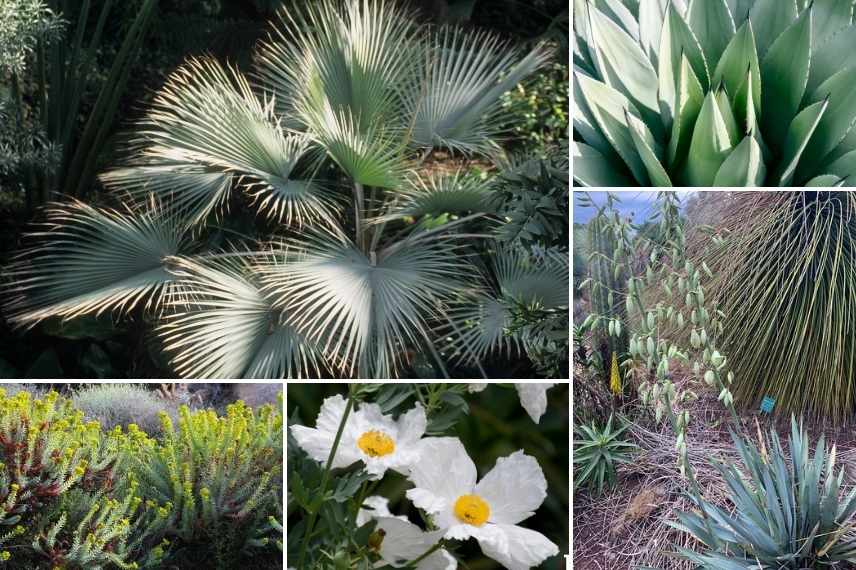
Here we play with a palette of blue-tinged foliage using plants surprisingly resistant to short frosts in winter, not exceeding −10°C. The tree poppy, a Californian and Mexican plant with wonderful white flowers, and the Mexican blue palm for an original backdrop, have proven able to withstand very dry summers. Once well established, Romneya poses no real hardiness issues. A Yucca pallida joins them to form that superb silvery-blue base, accompanied by an agave hardy enough such as Agave parryi or Agave montana.
A Mediterranean perennial, Euphorbia pithyusa, a Balearic spurge that stays low, and a Mexican-origin plant, Mathiasella bupleuroides 'Green Dream' with jade-green flowers, naturally fit among these plants. We bring in chartreuse and blue-green tones for a duet of colours evoking Mediterranean aridity.
NB: this blue planting can easily be part of a blue garden, located in the sunniest, driest part of the garden!
Transport yourself to Lanzarote
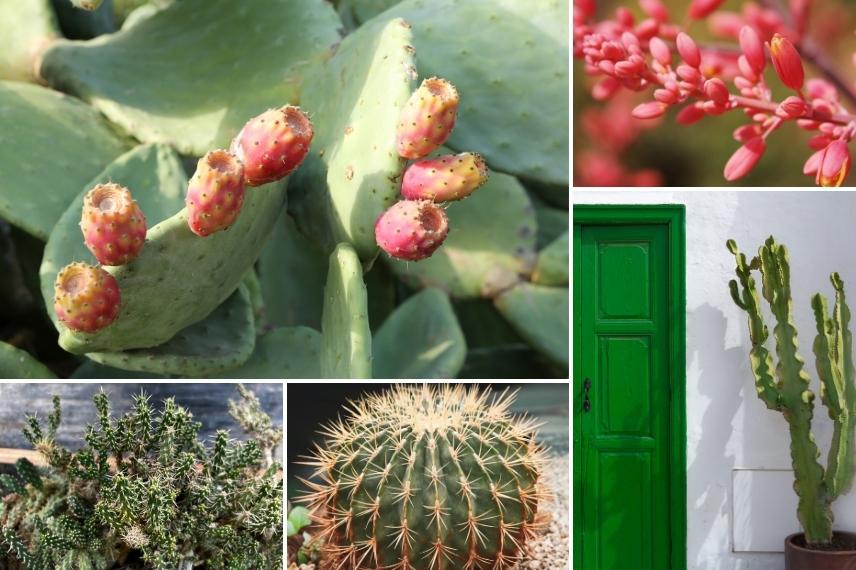
Lanzarote's cactus gardens are exceptionally photogenic. On this volcanic archipelago grow sclerophyllous plants with small leathery leaves adapted to drought, and spiny cacti. Drawing inspiration from them, while carefully selecting cacti cold-hardy enough for our winters, allows creation of a unique area within a dry garden, ready to face repeated summer heat spikes. Ensure perfect drainage, as this type of garden cannot tolerate any standing moisture in winter.
A prickly pear, well adapted to sea spray, is interesting for its slightly greater hardiness (down to around −15°C for some) and its unique habit with large spiny pads. Plant them liberally; choices include Opuntia scheeri or Opuntia engelmannii var. rastrera, among many others. In this distinctive setting, succumb to oddity of Cylindropuntia kleiniae, a cousin of opuntias, quite cold-hardy and producing a beautiful magenta summer bloom. Complement the area with a Hesperaloe parviflora and an Echinocactus grusonii, the golden barrel cactus often seen on the island.
This type of garden is intended for warm, mild regions of the country with less severe winters and dry summers.
Use pumice or black volcanic stones to simulate island soils and to ensure drainage. Finishing touch? a whitewashed house with green shutters to reproduce another characteristic of this island close to African coasts.
... or to landscape a poor, unproductive slope
A south-facing, dry and unproductive slope can also be transformed into a resilient space by imitating the chaparral, an ecosystem adapted to extreme conditions.
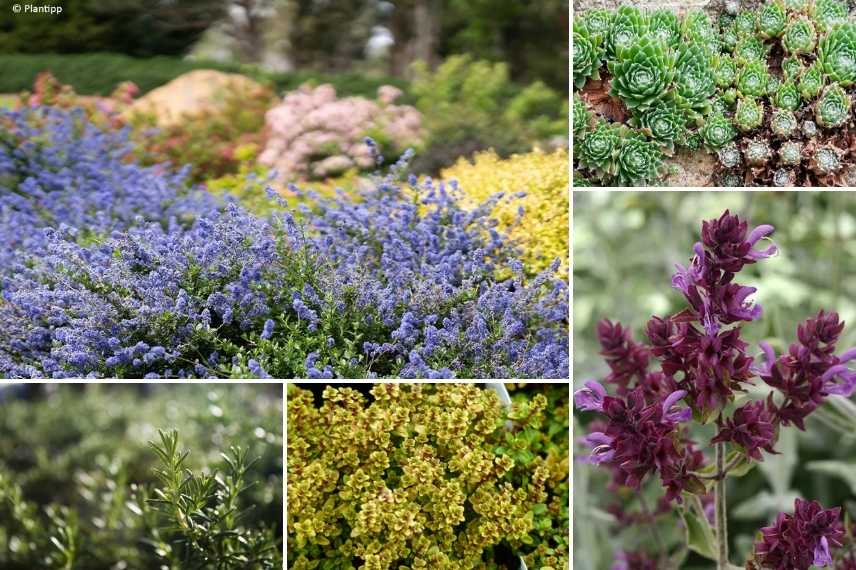
To turn poor soil into a semi-desert rockery, favour low, hardy shrubs such as cistus (Cistus), a California lilac like the ceanothus ' Pacific Wave' or its groundcover form (C. thyrsiflorus 'Repens'), a prostrate rosemary and some sempervivums. These plants, with deep roots and leathery or fleshy leaves, tolerate drought and poor soils perfectly. Add a golden thyme, and some sages (such as Canary Island sage 'Lancelot'), aromatic plants that will scent the garden while attracting pollinators.
Once established, these plants require little watering and maintenance. Their dense foliage will protect soil from erosion and limit growth of weeds that are unwanted on the slope. A mineral mulch will help conserve moisture and enhance the slope's natural appearance. A few ochre or orange boulders placed here and there will also help evoke Californian or Andalusian maquis while enhancing the area.
Discover our selection of succulents and perennials on our "Dry garden" page online, and our inspiration in the trend booklet 2026!
Since Beth Chatto, the dry garden movement has increasingly been seen among landscapers and in gardening magazines and books. We cover it in detail in Designing a dry exotic garden, Laying out a gravel garden, the Californian-style garden and the garrigue garden, as well as strong trends recently seen at the Chelsea Flower Show in London, such as the antipodal garden and the sand garden.
Find all garden trends for 2026 in: What are the five major trends for 2026?
Making a garden resilient, stronger in the face of the repeated heatwaves our countries now suffer, is one of the challenges of the Chaparral garden, which draws on flora from extreme climates, such as those found in New Mexico or California. The multiple heatwaves of summer 2026 confirm this reality and will certainly steer us […]
The idea for this personal take came to me from a thought I had at a recent plant swap. While a charming lady was offering some perennial plants, I asked her straight out: 'What colour are the flowers?' — 'Yellow,' she replied. And I retorted, rather bluntly: 'Oh no, no yellow for me.' I immediately felt bad, finding myself oddly rude and not very respectful. If she reads this article, may she forgive me, because yellow is one of the most radiant colours there is! Proof in pictures…
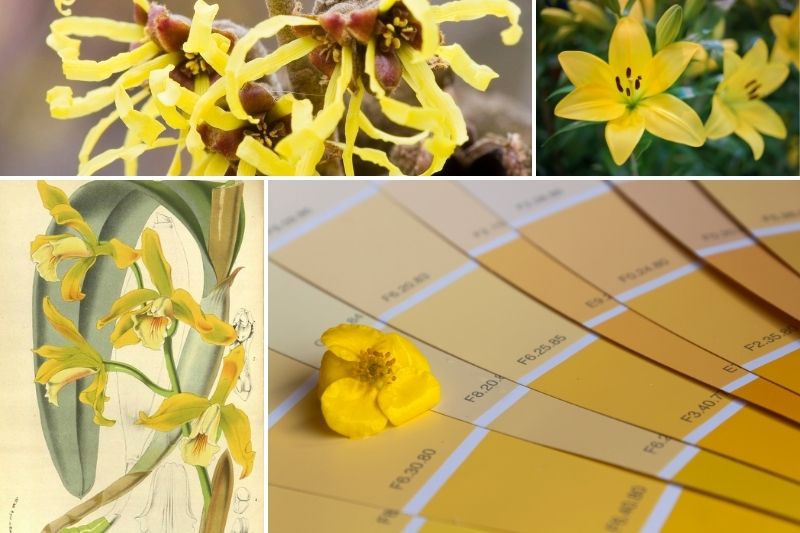
Yellow in the garden: why such hostility?
One could almost speak of a divisive colour in the garden, so much does yellow provoke either rejection or genuine passion. Even though it evokes the image of the sun and is a symbol of cheerfulness and dynamism, it is one of the colours gardeners often shun. Yet yellow is the colour of wonderful shrubs and blooms such as winter-flowering mimosa or Laburnum, those delightful yellow laburnum arches in spring that usually win unanimous praise.
This lack of enthusiasm even shows up, I find when looking into the subject, in our articles at Promesse de fleurs, where we address yellow flowering far less than the popular themes of blue, pink or white gardens.
Yellow has a bad reputation in many fields. It is rarely chosen as a dominant colour in décor. A primary colour with blue and red, yellow stands apart in our plant choices, and some refuse even to have a single yellow flower in their beds. Is that because it is associated with certain weeds (dandelion, sow-thistle, buttercup, celandine and others) or because it is said to be hard to pair? I would lean towards the latter reason, to which I return below.
In art, it was one of the major colours of the Fauvist movement, brought to its height by Vincent Van Gogh with his vivid yellow blocks on sunflowers or by Klimt.
But, once associated with the sacred, yellow declined from the Middle Ages, gradually evolving into a negative symbol, until it became the colour of the yellow Star of David. Even language turned on it with a few unflattering expressions, such as a forced laugh or the "Yellow Peril". In the West, offering yellow roses long signified infidelity and, more broadly, separation. Yellow therefore evokes deceit and betrayal, whereas it carries a very positive connotation in the East.
Yellow and yellows
Yet there is not one yellow but many yellows, just like the gradients in all colours.
From very pale, almost white yellow to saffron yellow, it is a wide spectrum! Let us set aside yellow or golden foliage here, which is generally better accepted by many gardeners.
St John's-wort, forsythia, mahonia: the vivid yellow of these shrubs, often considered mundane, may be one reason for the contempt shown towards yellow. Or is it still too closely associated in our minds with 1970s gardens that featured rather unnatural yellow roses, almost artificial chrysanthemums and overly gilded conifers? Finally, some summer bedding displays seen in parks or roundabouts, at times almost garish, put many people off…
Unless the lemon-yellow of the few adventitious weeds mentioned earlier puts us off this delightful colour. But it is more likely the difficulty of combining yellow flowers well with other garden blooms that makes us hesitate to use it. In short: people often fear that saturated yellow will jar with other plants in the garden.
My favourite yellow flowers
I am one of those who do not plant too many yellow flowers in the garden. My view has nevertheless evolved with my wanderings through English gardens that dare, in some cases, a monochrome yellow garden, less common than the famous white garden at Sissinghurst. Marvels can be found there, as at Burton Agnes Hall.
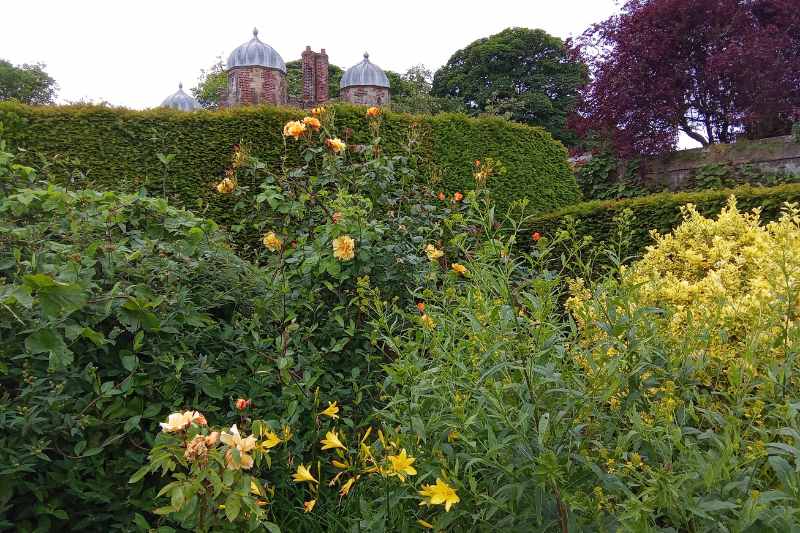
For my part, special mention goes to pale and pastel yellow blooms that are so easy to pair. Light, creamy, butter, anise, straw or slightly apricot yellows actually harmonise with many garden flowers: all blues, pinks and oranges, mauves and purples, from pale lavender to plum. They are found in some old or species roses like 'Mermaid', many honeysuckles, oleander luteum 'Plenum', Liriodendron, some magnolias and exquisite Michelia, of great delicacy, and many other shrubs and perennial plants.
I admit that brilliant yellow is also the colour of spring! Daffodils are its true ambassadors. And if you do not want to incorporate yellow elsewhere in the garden throughout the year, spring is a real opportunity to punctuate the early fine days with a Banks' rose, some sunlit tulips and other bulbs or chartreuse-flowered euphorbias, or an azalea 'Harvest Moon' that pair wonderfully with the many blue and white spring blooms.
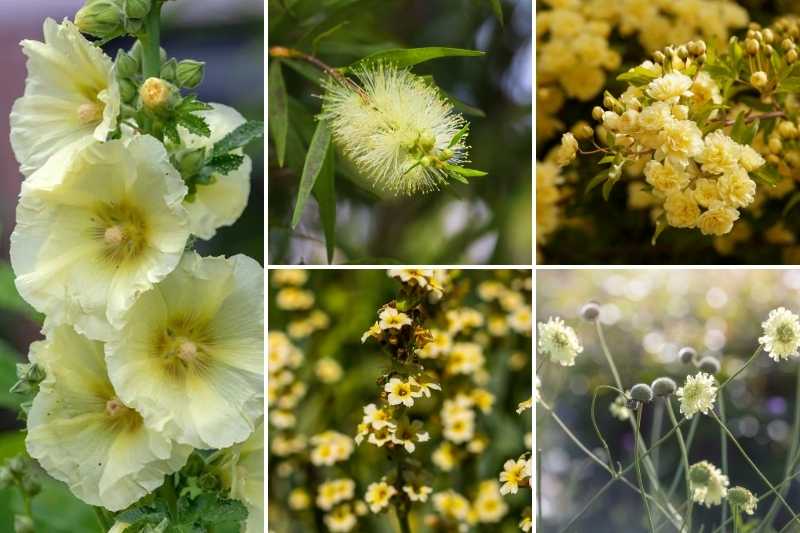
Using yellow: how not to go wrong?
I also like to see brighter yellow blooms parade through summer beds, in a naturalistic planting with rudbeckias or sunlit achilleas, in English hot borders that blend all warm colours of the colour wheel. It is also perfect in exotic gardens, alongside orange blooms, with which it creates a beautiful gradient. Finally, many marginal or aquatic plants flower in yellow, making them excellent choices for water gardens or pond edges, enhanced by yellow-flag iris, ligularias, yellow water lilies and a few touches of purple foliage. Last option for this much-maligned yellow: it is a standout colour in dry gardens, appearing alongside senecios, Helychrisum and other succulent plants paired with greyed and silvery foliage and some blue or orange blooms.
My final tip: avoid adding yellow blooms to beds that are already richly coloured (except in a naturalistic context). The result can be a garish effect not in the best taste. It's better to stick to a successful two-colour combination, or three colours, and play with contrasting foliage or work in gradients. Introduce it in small doses, unless aiming for a monochrome garden — to me, that is the best way to exalt it!
Not convinced? Still hesitating? Do you tend to use yellow mainly in handsome winter-flowering shrubs? What are your experiences with yellow in the garden? Tell us how you use it, and feel free to comment to continue this age-old debate about yellow in the garden.
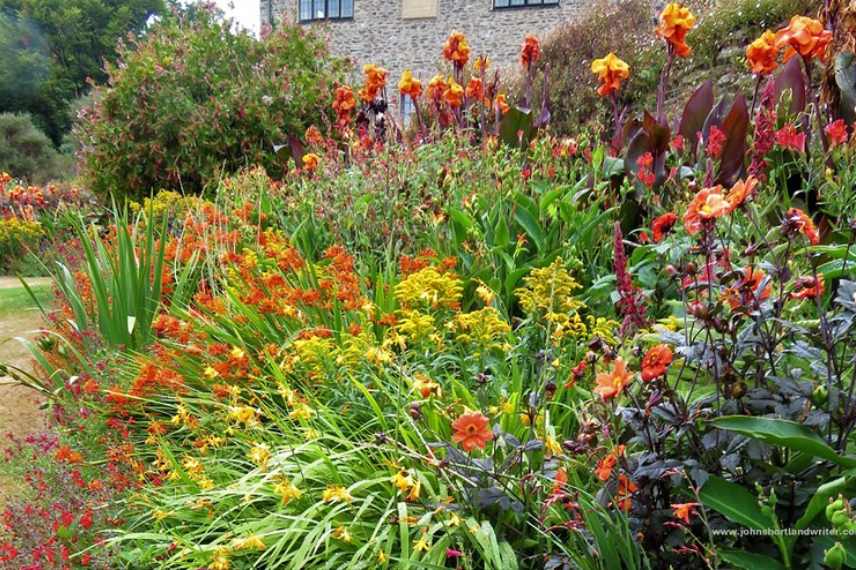
a successful trilogy of yellow, orange and purple
Further reading…
Top up your ideas with tips and inspiration from the editorial team in our dedicated section on the Yellow garden. On our online shop, discover our wide range of yellow-flowering shrubs, as well as our yellow roses, and our yellow-flowering bulbs.
Leïla tackled this subject in How to pair yellow flowers in the garden? and Michaël in Toning down yellow flowers in the garden.
And if, like me, you enjoy history and the symbolism of colours, add French author Michel Pastoureau's work on the colour yellow to your summer reading: Yellow: A History of a Colour, published by Points in France.
The idea for this personal take came to me from a thought I had at a recent plant swap. While a charming lady was offering some perennial plants, I asked her straight out: ‘What colour are the flowers?’ — ‘Yellow,’ she replied. And I retorted, rather bluntly: ‘Oh no, no yellow for me.’ I immediately […]
In recent years, as our planet warms inexorably, many of us have been looking for ways to adapt our gardens gradually to a new era. The Antipodean garden is one answer for gardeners, encouraging a turn towards the remarkable potential of plants from extreme climates, such as southern plants.
Let’s see how to use certain succulent plants formerly thought suitable only for southern regions, and integrate them into different garden types, from dry rockeries to Mexican-style settings.
Origin of the Antipodean garden
Last year, one of the stands at the RHS Chelsea Flower Show surprised many: right in central London, this temporary garden staged a landscape straight out of the South African bush. The Karoo Succulent Garden, conceived by landscape designer Katie Lewis and botanist Ernst van Jaarsveld, offered a sublime scene of exceptional succulents, remarkable spiny shrubby plants, Aloes, collections of Haworthia and Gasteria amid mineral chaos… A genuine plea and reflection on the garden of the future, this Antipodean garden showcased only plants native to South Africa, resilient, capable of surviving severe droughts and adapted to the region’s grand yet arid and hostile Karoo environment.

Top right, Sarcocolon crassicaule grows in the Little Karoo
On a dry rockery by the sea
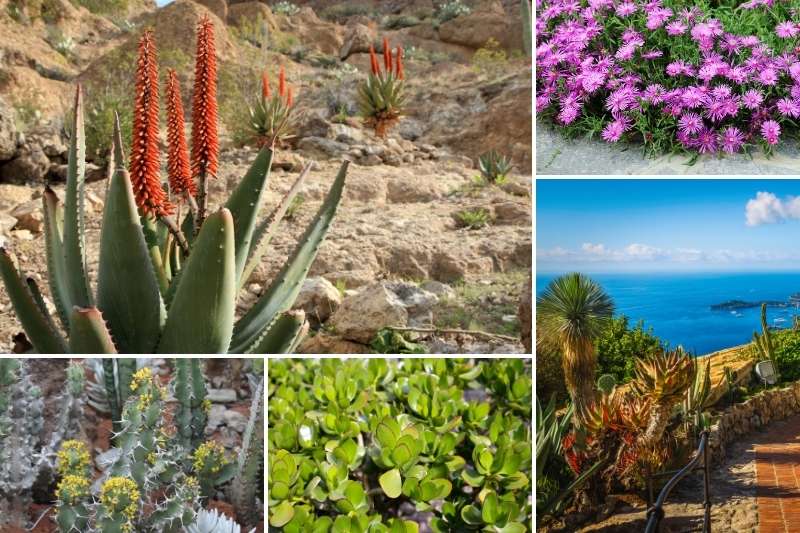
Our coasts, from the Channel to the Atlantic and of course the Mediterranean, offer an ideal climate for these plants from the Cape. Take inspiration from the sublime jardin d'Èze near Nice. Many plants from Mexico are grown there, but also South African plants such as Aloes and various types of euphorbias.
For example, you can group in very warm exposure, without them complaining, Cape-origin plants such as Aloe ferox, Delosperma cooperi and an Euphorbia caerulescens. Aloe remains very architectural even after flowering, its orange flower spikes enhancing the garden in winter and spring. The spreading Delosperma will flower mauve continuously all summer. The euphorbia brings a lovely green, succulent touch to a rockery. Add other perennials that tolerate strong light, very free-draining soil and have sufficient hardiness in this coastal context: Euryops pectinatus or Euryops evansii, Protea, trailing Plumbago, for a blue, unexpected late-summer display, etc.
In a Mediterranean garden or a dry garden without watering
The dry garden, arguably one of the gardens of the future, is precisely the type suited to these South African plants that grow locally in poor, arid soils. Inviting these Antipodean plants into our gardens in the Mediterranean or in regions with mild winters is a great way to refresh the plant palette of gardens designed without watering.
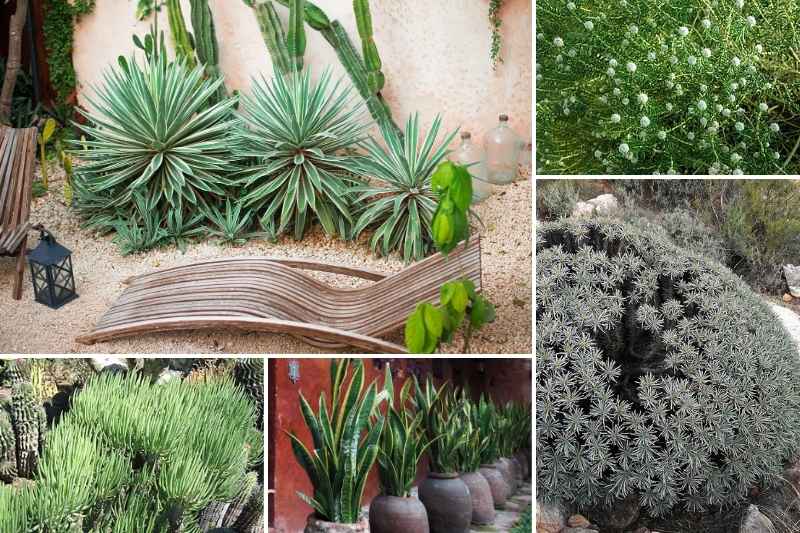
Ramified shrubs such as the Tylecodon wallichii, a superb plant related to crassulas, which eventually forms a small trunk bearing leaves clustered at the top, a South African heather, Erica arborea, or the Cape heather Phylica ericoides make perfect companions in this Mediterranean yet wild setting. A very striking aloe with a dragon-like appearance, Aloe dichotoma (quiver tree), will make a sensation once its trunk has developed. All these plants appreciate a perfectly free-draining, poor and light substrate. Better-known plants such as Sansevieria (snake plant), also native to South Africa, can be grown in pots to bring their incomparable architectural form.
Flowering of the various South African shrubs and undershrubs, southern‑hemisphere timing aside, tends to occur in winter or spring. So add a few summer-interest plants to bring colourful touches to this unusual world, such as diascias (annual or perennial) and the shrubby Cape mallow (Anisodontea capensis) which can flower until frosts and will require, unlike the other plants, a little watering while it establishes.
In a sheltered patio, like in Mexico, or on a sunny balcony!
Although unaffected by scorching sun, succulent plants and other South African natives lack hardiness in our hemisphere. They must therefore be potted in some regions where they might suffer, especially from winter damp.
So why not evoke a South American patio to dream of distant horizons from a sheltered, very sunny patio, courtyard or terrace? Then simply bring them indoors to a warm living room for winter months.
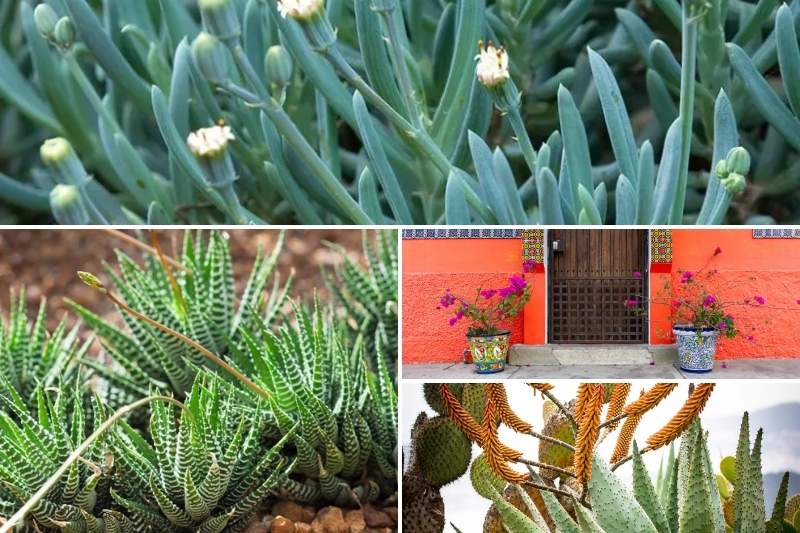
Think again of easy-care plants, provided their low watering needs and a warm exposure are respected. Here we plant in attractive glazed pots a Senecio serpens 'Blue Chalk', or 'Dwarf Blue', a Haworthia fasciata 'Big Band', also called zebra plant, delightful for its ultra-compact habit and characteristic stripes on its fleshy foliage.
Consider bright paints applied to walls or to pots, such as orange, terracotta, turquoise and green to accompany your plants in this decidedly colourful patio and reinforce the South American vibe. The plants mentioned can just as easily be placed on a small south- or west-facing balcony in town, provided you remember to overwinter them at home from late autumn to spring.
Discover our selection of succulents on our "Jardin des antipodes" page online, and our inspiration in the trendbook 2026!
Southern atmospheres are popular: we have covered this theme in several articles: Alexandra talks about her botanical trip to South Africa, our advice on planting and growing southern plants, and our inspiration sequence Exotisme austral.
To keep up with the trends for 2026, also check our topic Garden: what are the five major trends for 2026?
In recent years, as our planet warms inexorably, many of us have been looking for ways to adapt our gardens gradually to a new era. The Antipodean garden is one answer for gardeners, encouraging a turn towards the remarkable potential of plants from extreme climates, such as southern plants.Let’s see how to use certain succulent […]
Are you watching colour trends, and do you like to experiment not only indoors but also in your garden or on your terrace?
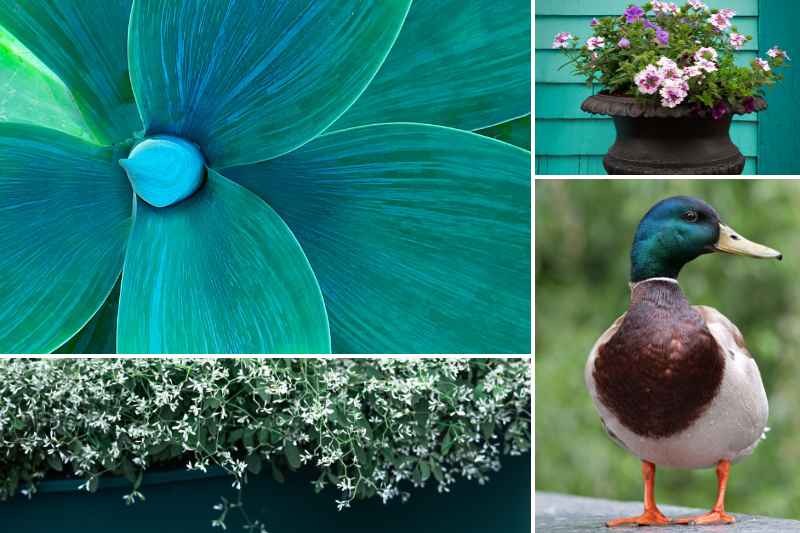
The very latest is Transformative Teal, often described as teal or turquoise. Some plants naturally display this colour, mainly in their foliage and more rarely in their flowers. This <strong shade that sits between blue and green can be used in the garden with a few colourful pots set against a more neutral palette.
See how to introduce this teal outside the home!
What is this new trend? How to use it in the garden?
Blue and green are cool colours on the colour wheel. Combining the two gives a very aquatic note, which can almost seem artificial in a garden setting. The English term 'teal' appears from the 1950s in interior design, where it is most often seen. This blue‑green is the colour that highlights the eyes of teals, the small freshwater ducks. Here, the expression 'bleu canard' seems best to express this intense shade.
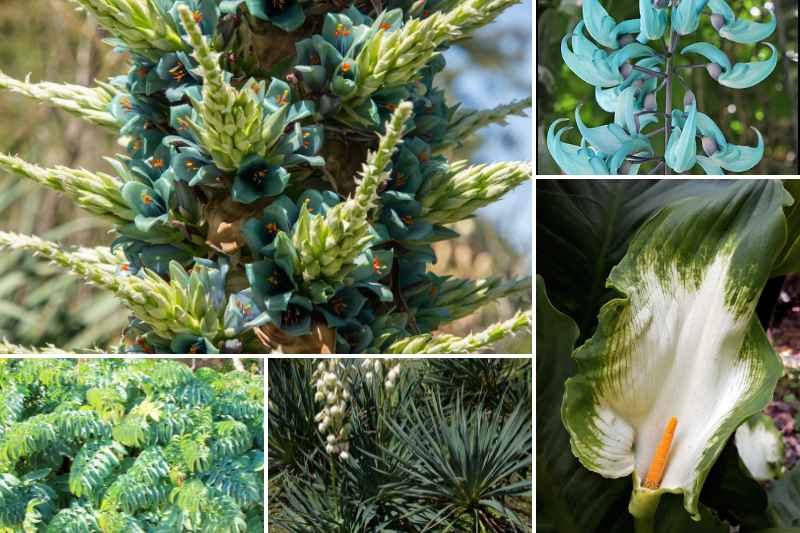
It is mainly foliage that approaches this colour, described in botany as a glaucous blue: it is often found in hostas, many blue‑tinged conifers or some perennials, and in the pruinose leaves of certain shrubs. Among the rare flowers, look to distant beauties such as the Chilean Puya or the Asian Strongylodon macrobotrys.
The most flattering combinations for flowers or pots are white, very soft yellows and orange or brick tones, as well as all shades flirting with chartreuse green (see green flowers).
Avoid saturating the scene with overly cool tones like grey or silver; instead, enliven it with neighbouring colours on the colour wheel such as sulphur yellow, acid green or jade green.
Finally, rely on accessories: choose glazed pots in matching hues to reflect the light effectively, or furniture and seating in aniseed tones.
In an exotic‑style garden
This is perhaps the easiest way to reveal the subtleties of teal, since the exotic plant palette – tropical or dry exotic – offers several options for sunny areas. With centre stage given to the extraordinary flowers of Puya berteroniana, Puya alpestris or the jade vine in the least frost‑prone gardens, and the white spikes on glaucous foliage of some Yucca (notably Yucca aloifolia or Yucca rostrata), count on the striking blue‑green foliage of Melianthus major and the bluer, greyer leaves of Eucalyptus and Pinus parviflora. A bicolour arum, white and green, Zantedeschia 'Green Goddess' planted in sufficiently cool soil will wrap the scene in its refreshing trumpets.
In a dry exotic garden, an unusually blue senecio, Senecio serpens 'Dwarf Blue', can take pride of place and nearly steal the show from Dasylirion, such as Dasylirion glaucophyllum.
In a mixed border or English garden
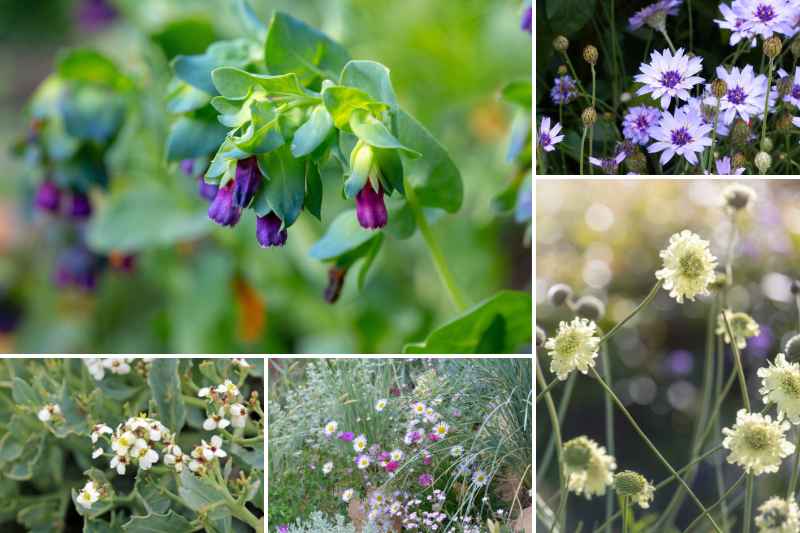
Different mood, different style: a cottage‑style garden planted with large borders is also well suited to playing the teal note, as several attractive perennials carry this almost turquoise shade, often in a lighter tone. Representative plants include Mertensia maritima (also called oysterleaf), Crambe beloved in cottage gardens, rue (Ruta graveolens) and Cerinthe major.
A few selected flowers in soft tones, from white to mauve‑pink, will provide the necessary link so the planting does not slip into a dull bluish monochrome: catananche for a rustic touch, Erigeron karvinskianus, mauve or white hosta spikes, etc.
Bring in almond‑green and yellow‑greens such as the downy Ballota pseudodictamnus or the inflorescences of giant Cephalaria. A graceful grass such as Sesleria nitida will add the lightness suited to this ambience.
In a pot garden of succulents
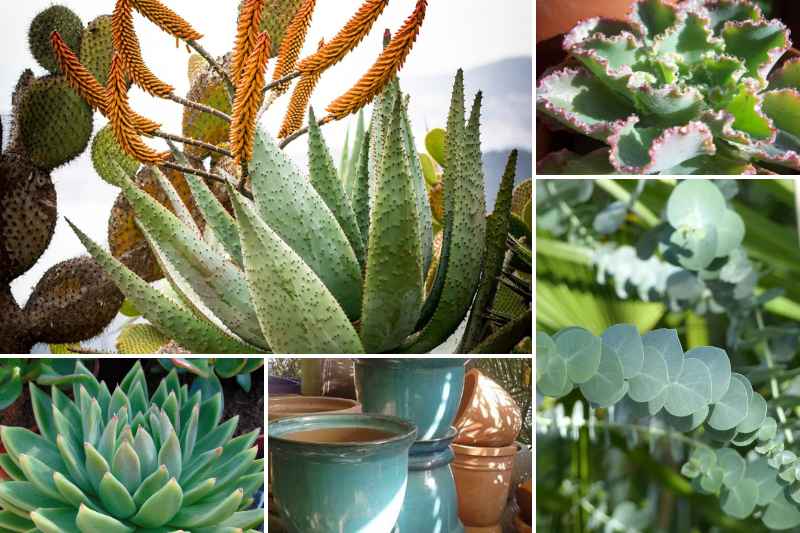
Here, opt for tone‑on‑tone plants in matching pots. The result is perfect on a south‑facing balcony or a terrace that basks in hot summer sun. Many cacti and succulents have that characteristic pruinose blue that protects them from heat. Start with agaves and some handsome echeverias, such as Echeveria 'Miranda', Echeveria peacockii 'Urban Orange' and Echeveria 'Blue Curls'. Don't forget Euphorbia x pseudovirgata 'Redwing' 'Charam' with its bluish young shoots.
An aloe completes this mini dry garden perfectly, for example Aloe marlothii, or, for small spaces, a dwarf aloe such as 'Aloe nain' (Aloe aristata).
Terracotta pots, raw or glazed, will provide either a flattering orange contrast or a very chic monochrome. In this small world, adding a few orange blooms is perfect: Bulbine or dwarf day‑lilies, for example.
In shade for an aquatic feel
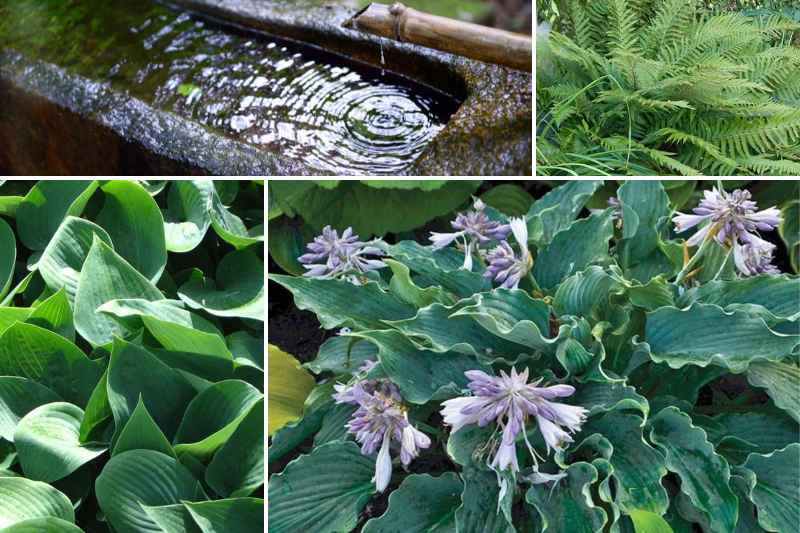
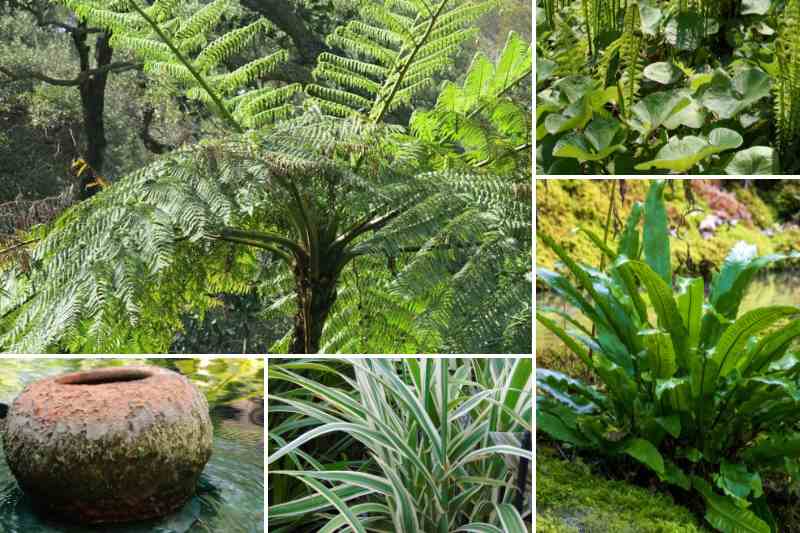
It is in shade or partial shade that glaucous green holds up best against heat in certain perennials such as hostas. There they show colours whose subtle nuances are especially highlighted in standout varieties like Hosta 'Canadian Blue', Hosta 'Drinking Gourd' and Hosta 'Waterslide' with greyer tones. Add some equally bluish sedges (Carex 'Bunny Blue'), evergreen ferns (Polystichum polyblepharum), white flower spikes to pair ideally with astilbes, a water trough used as a drinking bowl or fountain… and enjoy this very relaxing atmosphere.
Discover many more plants to achieve this turquoise palette in our "Transformative Teal" selection online, and in our 2026 trend booklet!
Do you love blue and green in the garden? Great — we explain everything you need to know about designing a blue garden and using blue in Elevate your garden with indigo blue. Marion also shares useful tips in How to create the illusion of water with plants?
Are you watching colour trends, and do you like to experiment not only indoors but also in your garden or on your terrace?The very latest is Transformative Teal, often described as teal or turquoise. Some plants naturally display this colour, mainly in their foliage and more rarely in their flowers. This <strong shade that sits […]
Bali, the island of the Gods, is a unique place in the Indonesian archipelago. A paradisiacal vision of distant horizons, it has inspired many landscapers seeking exoticism and refinement in the garden. The Balinese garden is one of the current trends to explore for gardeners looking for paradise on earth!
By opting for plants that withstand climatic conditions of our northern-hemisphere gardens, the Balinese garden becomes an atypical inspiration to adapt at home, interesting for dedicated, sheltered areas. Let’s see how to deploy lush foliage that transports us to the ends of the earth, from water garden to enclosed garden and poolside areas.

Design codes of the Balinese garden: colours and decorative elements
Anyone who has visited Bali knows this tiny Hindu enclave within vast Indonesia gathers architectural and natural treasures that have made it an extremely popular destination in recent years.
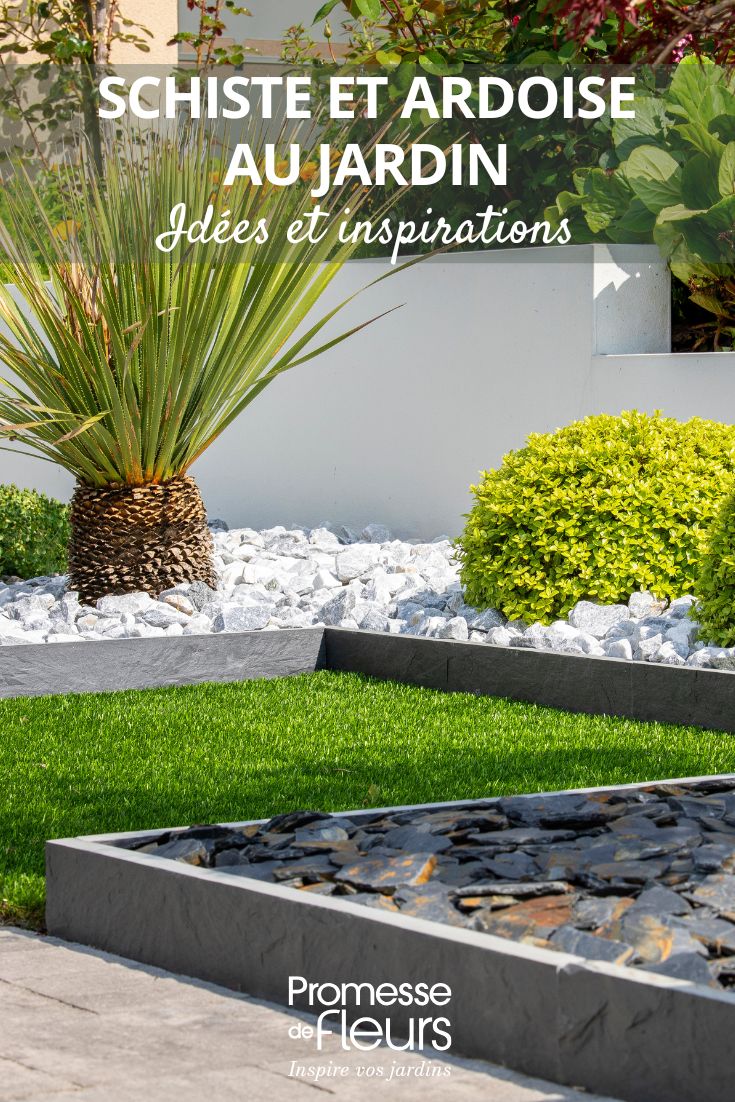
It can be described as a concentrate of nature, impressive rice terraces, but also a pervasive mineral quality due to its volcanic character, and a spirituality combined with a unique aesthetic. Everything here is refinement, and gardens hide, behind lush greenery, stone statues, omnipresent deities receiving daily offerings. Decorative elements also come from dark stone, local basalt, and polished black pebbles. Water in ponds or fountains, wooden terraces, rattan, bamboo or exotic wood furniture, carved Indian doors are all invitations to simulate, at home, an entrance to a second imaginary garden. Lava stone and basalt can easily be replaced by slate, schist, or suitable ceramics. Large pots and basins punctuate the spaces, and where possible a canopy adds an Asian spirit. The contrast between green foliage and dark mineral is often enhanced by a brightly coloured Balinese parasol with fringes. Finally, a mobile evoking sound of local gamelan (traditional Balinese orchestra) completes the Balinese atmosphere.

The jungle garden
This garden, essentially made up of foliage, fits perfectly with Balinese garden where lush foliage takes precedence over flowering, which is present but remains secondary to plant abundance.
The Balinese garden integrates perfectly into an exotic or jungle garden: choose a sheltered part of the garden to transform into a Balinese green lounge, where hardy palm trees, giant ferns, Tetrapanax and other plants suited to our harsher climates will take place, planted en masse around a few perennials chosen for their XXL foliage or dissected leaves: evergreen ferns such as Asplenium scolopendrium and Matteuccia struthiopteris, Cyathea medullaris, variegated Arundo donax 'Variegata', and Petasites with large leaves. Here and there plant some Crinum asiaticum bulbs in damp soil to add delicate blooms.
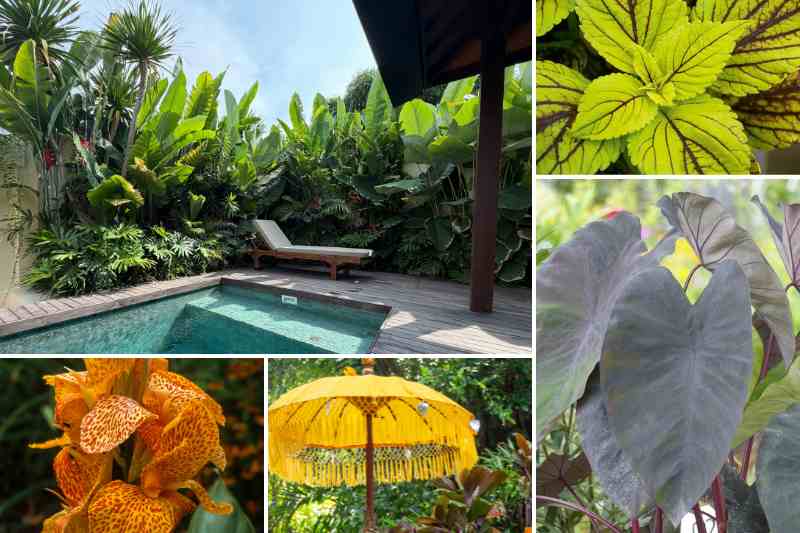
Around a pool in a seaside garden
Framing a reserved garden area such as a pool is a great way to imagine being in Bali. Tropical plants from the island are too tender for our climate, so choose substitutes to recreate Balinese postcard. In our example, simplicity is expressed with evergreen plants required around pool, and splendid foliage.
Banana trees, cordylines, bamboo palm provide the structure, enhanced by Coleus in aniseed tones such as 'Copinto Caipirinha' or 'Margarita' and a black-leaved Colocasia.
Be sparing in contemporary layouts with three or four plants maximum and slightly more generous in a denser garden. Here, Balinese parasol and wooden sun lounger become must-have accessories for hot summer days.
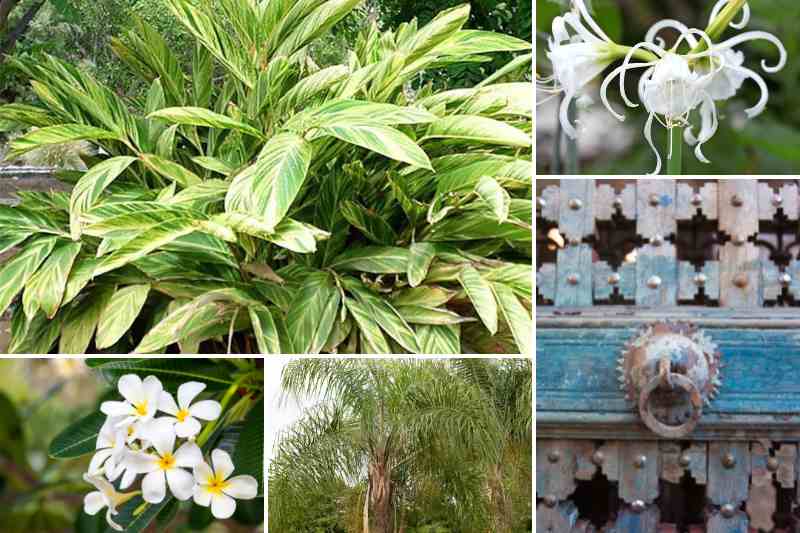
In a sheltered garden with mild climate
This is certainly the most suitable place to establish a Balinese garden, especially if you live on the Brittany and Atlantic coasts, benefiting from sufficient humidity to approach island’s humid tropical climate, or around the Mediterranean basin by adapting some plants. You can enjoy plants with beautiful foliage, a little tender but that will survive mild winters in these regions or that can be planted in large pots: Alpinia zerumbet 'Variegata', showy variegated gingers, replacing colours of local Cordylines. A queen palm (Syagrus romanzoffiana), a frangipani (Plumeria obtusa) chosen for its delicacy and intoxicating fragrance can join the scene.
In Mediterranean areas, a traveler's tree and tropical palm trees can even be considered! Also think of a beautiful exotic climber such as pink bignonia and some ismenes for an extra exotic touch.
By planting densely, you recover the jungle effect described above. Decorative elements complete scene such as an ornate door or a painted shutter, and a bamboo chime.
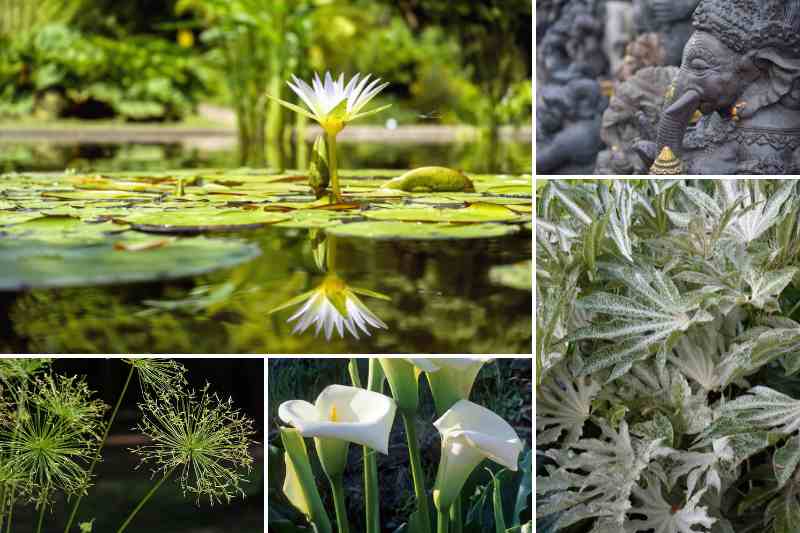
Water garden in the Balinese style
Water is omnipresent in Bali and in its finest gardens. You can easily imagine a Balinese garden centred on a water scene, whether a mini-pond or larger wet area. Plant species that like damp soil or can be partly submerged such as papyrus, lotus (Nelumbo nucifera) and water lilies are perfect. Arums, rodgersias and ligularias work well with their large foliage to infuse tropical atmosphere beyond their white or yellow blooms. For a larger area add a Gunnera, Brazilian rhubarb, impressive once established, or Astilboides tabularis. Here we like variegated foliage of Fatsia japonica 'Spider Web' near the water to add more exceptional foliage.
Decor is important here too: a single Hindu statuette, some pebbles or black paving and a rain chain are perfect!
Tropical escape in a courtyard, patio or walled garden
These very sheltered spots allow installation of plants that would not survive elsewhere. Presence of walls creates microclimate beneficial to Balinese garden. Selection below suits a sunny spot, and all these plants also grow well in pots and can be overwintered if necessary.
By replacing Cordyline fruticosa found in Bali with Cordyline banksii, equally colourful but hardier, you bring maximum colour, enhanced for example by bright red or pink of a common Rose mallow that performs well in a pot when substrate is kept moist. Beside them an essential banana, Musa 'Basjoo', interesting for cold tolerance and eventual size, or large unicolour cannas that also bring exotic feel. A compact climber can also slip in, such as Gloriosa rothschildiana. Bring out a Monstera or bird of paradise from the living room for summer and install a small temporary fountain to perfect tropical ambience.
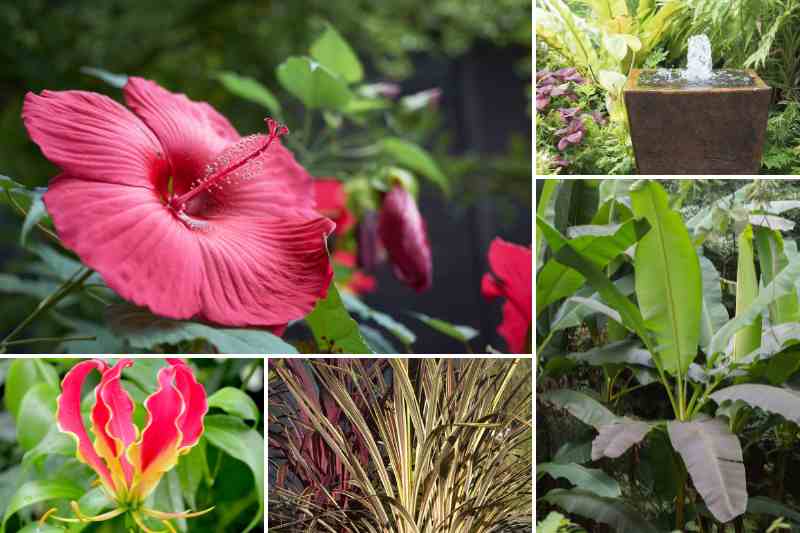
Find Find our selection of plants suited to exotic spirit on our online nursery as well as our Balinese Garden inspiration page in our 2026 trend booklet !
Do you enjoy these lush, transporting atmospheres? Discover other inspiring scenes in these articles that address the theme:
- Design a garden inspired by Madeira, the island of flowers
- A banana tree in a small garden? our tips for integrating it well
- How to create a tropical atmosphere in a small garden?
- How to create a refreshing oasis in the garden or on the terrace?
And all our tips to create at home an atmosphere of exotic or tropical gardens:
Bali, the island of the Gods, is a unique place in the Indonesian archipelago. A paradisiacal vision of distant horizons, it has inspired many landscapers seeking exoticism and refinement in the garden. The Balinese garden is one of the current trends to explore for gardeners looking for paradise on earth!By opting for plants that withstand […]
Terraces, courtyards, patios and small bohemian balconies are the new stars of summer! This very colourful "boho" trend that has invaded our interiors and wardrobes also appears in our summer green retreats. It matches the sunny cheerfulness of a season when we spend a lot of time outdoors.
Let’s take inspiration from the gypsy world to prepare bright alcoves on balconies, terraces and inner courtyards from the first fine days, with planting ideas and decorative elements. We explore this Boho Patio in three scenes easy to recreate at home!
Boho Patio codes
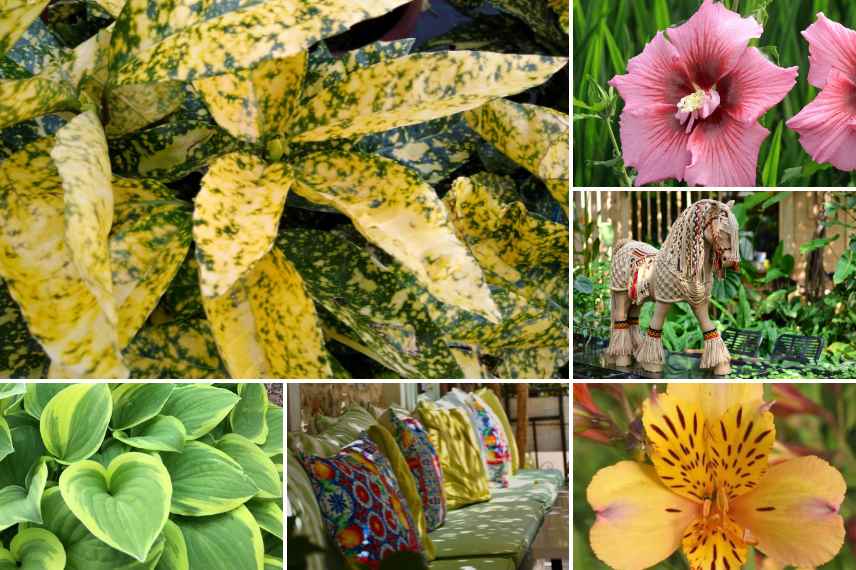
The bohemian atmosphere dresses itself in vivid, deep and variegated colours that answer one another, but also in associations of warm tones in the blooms: intense reds, deep violets, Indian pinks and spicy oranges, not forgetting bicoloured flowers. Bluish, golden or purplish foliage helps to reinforce this playful mood, bringing red or variegated splashes.
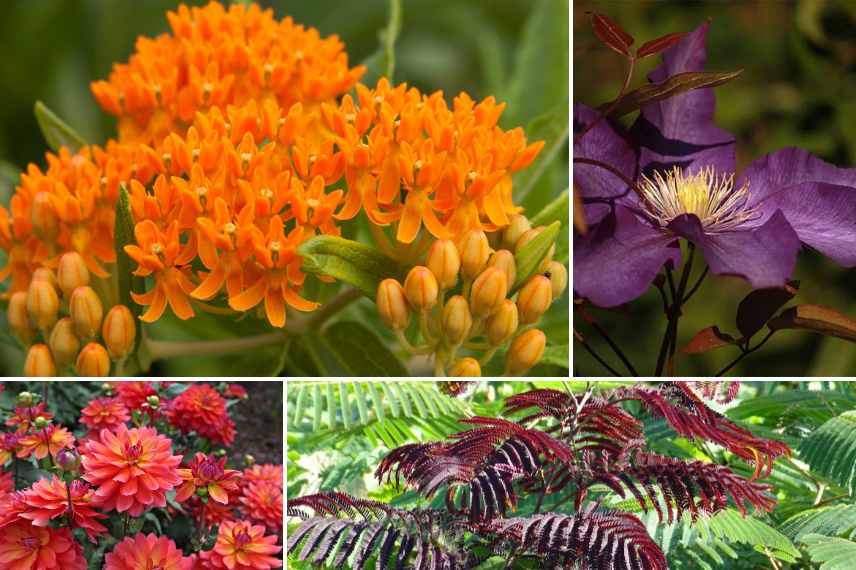
This mixed-up planting borrows from gypsy culture a festive, hybrid universe that laughs at convention and pairs a whole spectrum of colours, provided they are warm and bright.
This style is also based on improvisation, like manouche music, and on bold accents. This temperament appears in the garden in temporary scenes created especially for the summer months, and in the accumulation of mismatched small objects (side tables, stools, small cushions, etc.).
On the décor side, important for dining and relaxation areas, have fun with mismatched pairings: rustic furniture repainted turquoise or green, rattan chairs, fabric pouffes, Provençal floral and ethnic patterns juxtaposed with strong colours: turquoise, pink, orange and bright yellow. The advantage of this bohemian décor is that you can mix disparate objects and accessories, using what you already have at home or stored in the attic, to give them a second life: bring out granny’s lace and embroidery for the summer, macramé and trimmings, old rattan armchairs, baskets and fruit crates, airy curtains. In a joyful mix of materials, the décor is done!

On a sun-drenched terrace
Terrace or balcony are often west- or south-facing. They can be radically transformed into an ultra-cheerful cocoon with sun-tolerant plants that do well in pots. Explore a plant colour palette ranging from saffron yellow to violet for a truly bohemian vibe.
Alstroemerias 'Indian Summer', orange and yellow contrasting against bronze foliage, will look stunning alongside Coreopsis 'Cosmic Eye', a bright yellow spotted with purple, or the pretty all-yellow 'Full Moon Madness'. Add other long-flowering plants such as a common Rose mallow 'Pink Passion' with giant flowers and dark purple foliage, and provide more foliage interest with a pomegranate that can be grown in a pot, such as Punica granatum 'Nana', whose brilliant flowers will pair beautifully with the other perennials. For snacking at aperitif time, invite, for example, the surprising cherry tomatoes 'Akoya', whose fruits turn almost black.
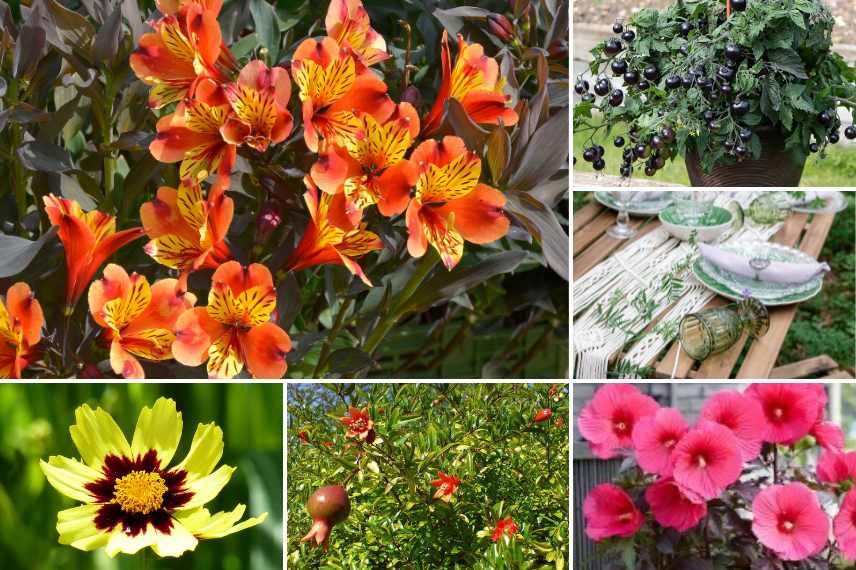
In a semi-shaded urban patio
Small city courtyards benefit from focusing on colour and variegated or golden foliage to lift them out of the shade. In a semi-shaded patio receiving enough light and warmth in summer, opt for sunny flowers and a few "indestructibles":
Hosta 'The King', Hakonechloa macra and an Aucuba japonica 'Crotonifolia' for their golden and variegated foliage (Aucuba will reward you with pretty red berries a little earlier) together with the bold flowers of Hibiscus syriacus 'Hibisa rosada', and the Peruvian lily 'Duc d'Anjou'.
The bohemian spirit will also be present in accessories, essential in less bright areas and in smaller spaces.
Beyond plants, bring colour without fearing the boldest mixes. Dare genre-mixing: antique rug + Italian ceramics + small disparate or oversized objects and a cosy bench, etc. Here, the evening atmosphere will be especially worked on: lanterns, paper lanterns and candles, and don’t forget a crochet throw in these patios that are often cooler at night.
Garden refuge as an improvised alcove
This bohemian trend can also be expressed in a corner of the garden used as an improvised summer retreat.
In front of a shed, garden shelter or at the foot of a fine tree from which a rattan chair is hung, set up a summer hideaway using bohemian codes. A temporary terrace, improvised with clip-together wooden decking tiles readily available from DIY stores, is easy to install. In summer it becomes a true green cocoon perfect for relaxing on a garden sofa made of a few stacked pallets or large pouffes, in a fairground style.
Here, a few colourful annuals join the party: multicoloured zinnias and orange calendulas (marigolds) sown in pots in spring, or beds of African marigold 'Mango Tango' around the area, as well as sun-loving perennials such as the charming Delosperma 'Ocean Sunset Orange Glow'. Count on two striking pots of dahlias with evocative names, the fiery 'Bohemian Spartacus' and the more restrained compact 'Melody Gipsy', for a long and remarkable display. Sunflowers 'Mongolian Giant' will bring pep and height, while a pot of basil 'Everleaf Emerald Tower' will be handy for salads at barbecues or sunny lunches.
Gather your most colourful pots, bring in lace, hangings, vintage crockery and cushions: job done!
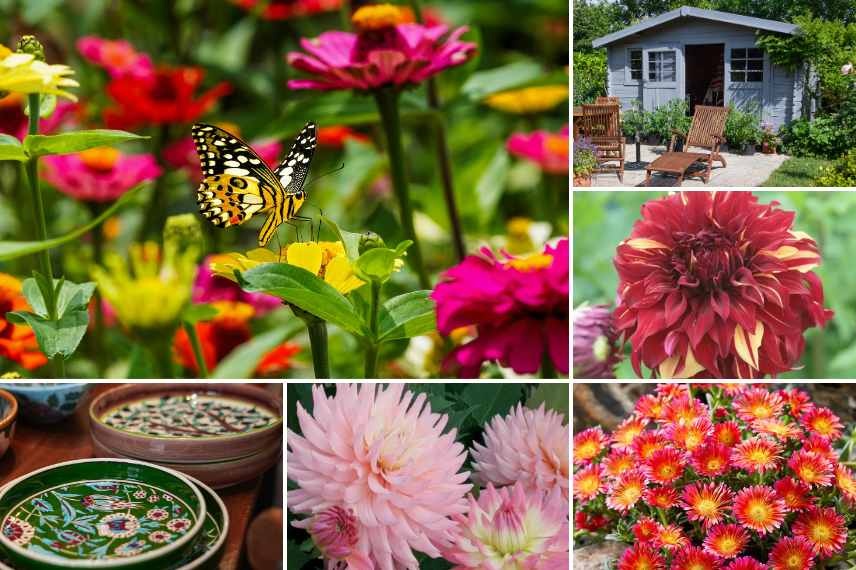
Discover other plants ideal for composing this bohemian green décor on a terrace in our "Boho Patio" selection online and in our trend booklet!
Feeling the bohemian spirit? Find our advice on creating a bohemian garden, and our inspirational sequences: Catalane and Peach Raspberry.
This Boho Patio trend also draws on recycling second‑hand objects. Explore our topics to let your creativity run free: Decor idea: plants in unusual containers; How to make a planter from a pallet?; Recycling in the garden and How to use and properly integrate terracotta pots in the garden?
Terraces, courtyards, patios and small bohemian balconies are the new stars of summer! This very colourful “boho” trend that has invaded our interiors and wardrobes also appears in our summer green retreats. It matches the sunny cheerfulness of a season when we spend a lot of time outdoors. Let’s take inspiration from the gypsy world […]
Here’s a distinctive trend emerging in outdoor spaces, and not only among landscapers fond of conceptual gardens or in coastal areas! While a sand garden is particularly suited to coastal gardens, it proves to be an undemanding, on-trend garden, halfway between a gravel garden and a dry garden, perfectly in tune with current climate upheavals.
We invite you to discover it in three scenes that demonstrate its aesthetic appeal and sunny atmosphere!
Sand garden: a landscaping trend between frugality and aesthetics
Far from the image of the traditional Japanese zen garden with raked gravel or pale sand, the sand garden imposes itself as a new version of the garden. It retains a sense of serenity but transposes it into a warmer register, where maintenance and watering are reduced to an absolute minimum. It answers a need created by climate change: how to introduce more Mediterranean plants into northern regions? Even if rising temperatures allow it, the problem of waterlogged winter soils, often fatal to these plants, remains. The sand garden is one solution, providing effective drainage.
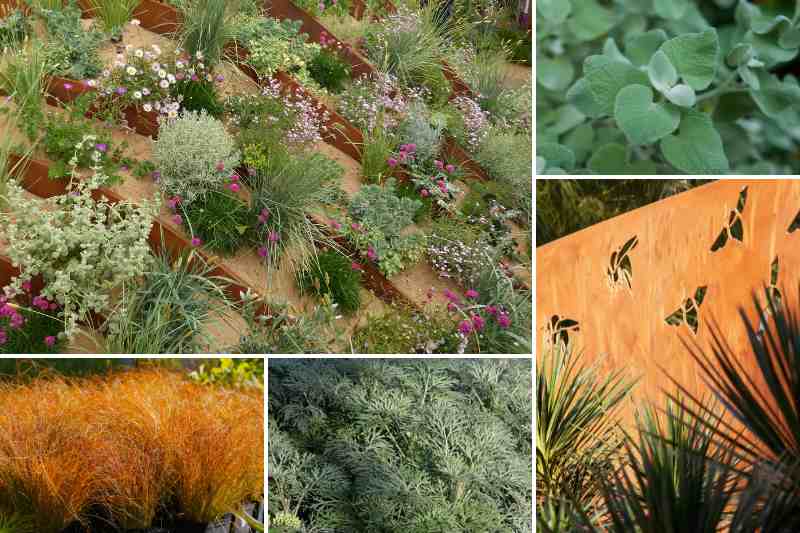
It is a functional garden, still experimental globally, which showcases plants that ripple in the wind, like a reminder of a sea that is not always present. It also emphasises contrasting materials and textures, often using Corten steel as a support, woven willow in tontines or sculptures, large stones or retaining walls.
Undemanding plants grow in a substrate made up of a thick layer of sand. They therefore need to draw water from deep down to survive. For this reason we choose the most drought-tolerant plants and xerophilous plants, those whose taproot systems mean they will withstand heatwave summers.
We also seek to enhance the golden aspect of the sand using a palette of warm tones available to us, both in plants and materials. Plants will generally be low-growing, mat-forming or supple, also incorporating some greyed foliage to reinforce the impression of warmth.
A holiday feel
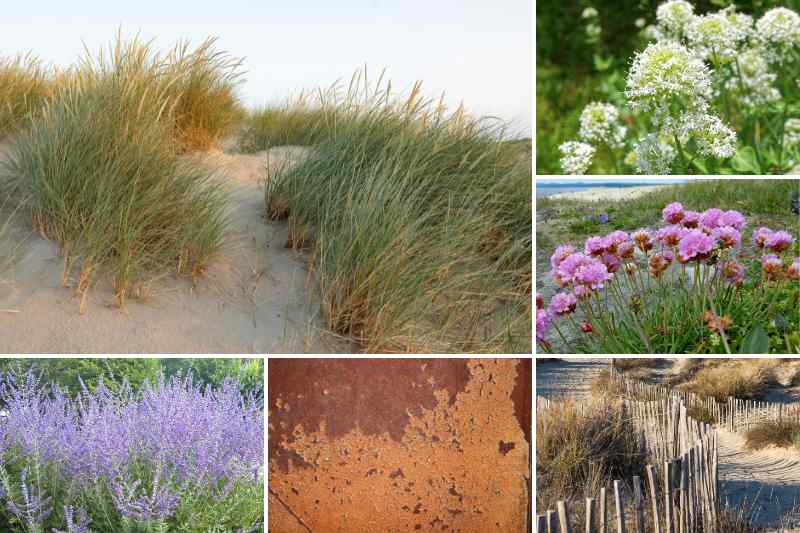
Coastal gardens, and especially those located right on the coastline, are difficult to plant because of the omnipresence of sand on site. They are perfectly suited to the constraints of a sand garden. In a beach-return spirit, the focus is fully on the sand-and-beach duo, taking inspiration from the dune ecosystem.
Essential plants: valerian, Lagurus ovatus and oyat (Ammophila arenaria), Armeria maritima 'Vesuvius' (sea thrift), sandwort, Erigeron glaucus 'Sea Breeze' or Erigeron karvinskanius, sand carnations, Perovskia, blue fescue, sea holly (Eryngium maritimum), milk thistle, etc.
To bring back vegetal blond tones, use wooden slats as decking, mini sand fences, and pair with coppery accents such as a brazier, useful for summer evenings.
Our tip: take care not to multiply beach clichés. Restrict decoration to sand alone, without superfluous additions of pebbles, shells or other seaside trimmings to avoid caricature. Plants create the scene, not the other way round!
Contemporary sand garden
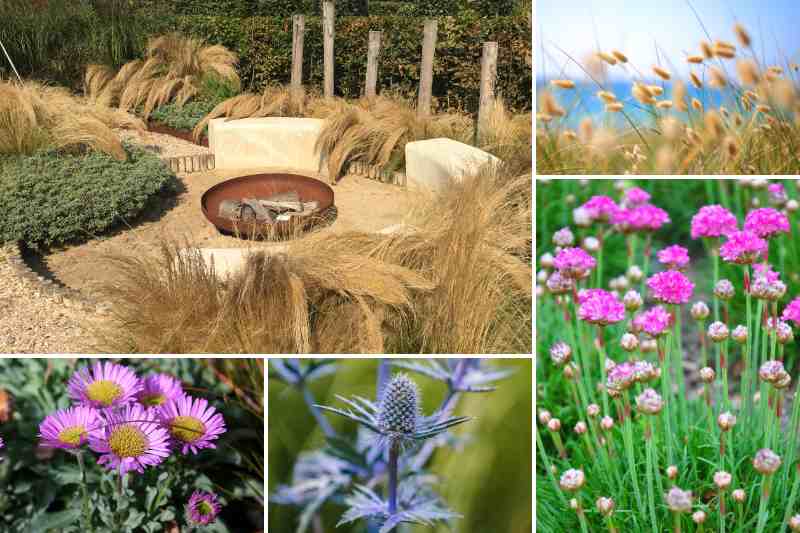
At the opposite end from the dune garden that naturally links to its environment, the idea of undemanding plants and sand also evokes minimalism and the mineral feel of modernist gardens. The sobriety of the sand, combined with an appropriate plant palette, allows creation of a sand garden that suggests a coast not necessarily nearby, in perfect harmony with contemporary architecture.
Here, colour is conceived in monochrome, or in white/black, white/mauve or purple and green duos, to name a few pertinent combinations. Plants are chosen for their prostrate habit, their original textures or the shapes of their inflorescences. Greyed tones for foliage are also favoured to blend well with often anthracite outdoor furniture. Corten steel, used for boards or attractive windbreaks, stands out as a material that enhances the sand’s sheen, as does brick, which can serve as a path.
Essential plants: silver santolina, Artemisia 'Powis Castle', Ballota pseudodictamnus, medium to tall grasses such as coppery Carex (Carex testacea), the movement of Hordeum jubatum, graphic silhouettes (Cordylines, Yuccas) on flat ground, and low to medium plants as on a shaped sand mound (sea thrift, creeping gypsophila, wild thyme, etc.).
South African atmosphere
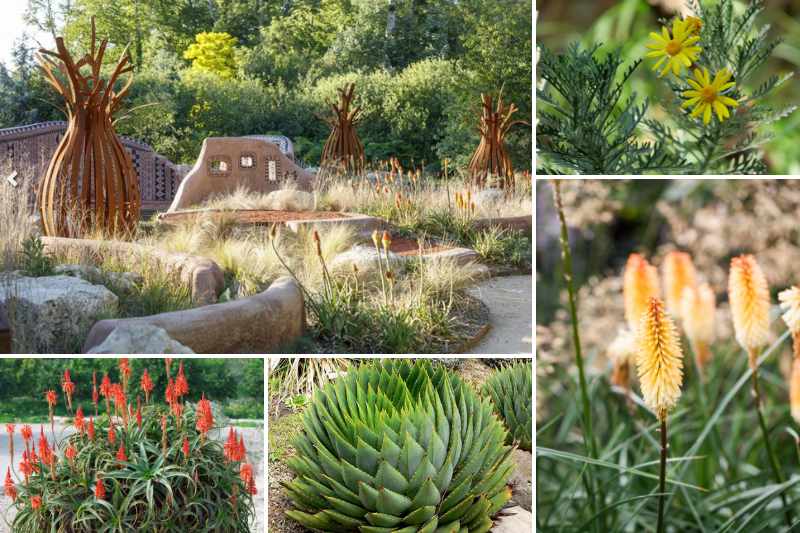
One attractive idea with the sand garden is to travel to an arid, heat-baked world. You can plant stunning perennials and ultra-resilient grasses and lean towards a Californian vibe, or, as here, a South African feel.
Let’s take inspiration from Léon Kluge’s work, the world-renowned South African landscaper, at Domaine de Chaumont-sur-Loire in France: few plants for a spectacular effect in this full-sun garden. The scene draws from the African bush, where red sand and oversized stylised baobab sculptures mainly make up the decor, with waves of Stipa tenuifolia and torch lilies. At home, imagine tall red-willow tontines or large woven willow spheres to add volume and blend into this atmosphere.
Key plants: succulents and light grasses (Aloes, Euphorbia myrsinites, Stipas, Sesleria argentea, Lomandra longifolia), and perennials with sunny yellow to orange blooms (Kniphofias, Euryops pectinatus, bulbines, Leonotis leonurus, gazanias…). Plants native to South Africa, Patagonia or Tasmania are favoured, some tolerating down to -8°C in sheltered conditions.
The naturalistic garden and the English garden also draw on this avant-garde technique, and we could just as well have developed scenes in these two worlds, which lend themselves to experimentation currently being carried out notably across the Channel.
Find our selection of plants suited to the Sand Garden spirit on our online nursery as well as on our inspiration page in the 2026 Trend Book !
Do you enjoy these distinctive atmospheres? Discover other inspiring scenes in related worlds:
Here’s a distinctive trend emerging in outdoor spaces, and not only among landscapers fond of conceptual gardens or in coastal areas! While a sand garden is particularly suited to coastal gardens, it proves to be an undemanding, on-trend garden, halfway between a gravel garden and a dry garden, perfectly in tune with current climate upheavals.We […]
Garden, rarely short of inspiration, suggests enticing colour trends each year to imagine new borders.
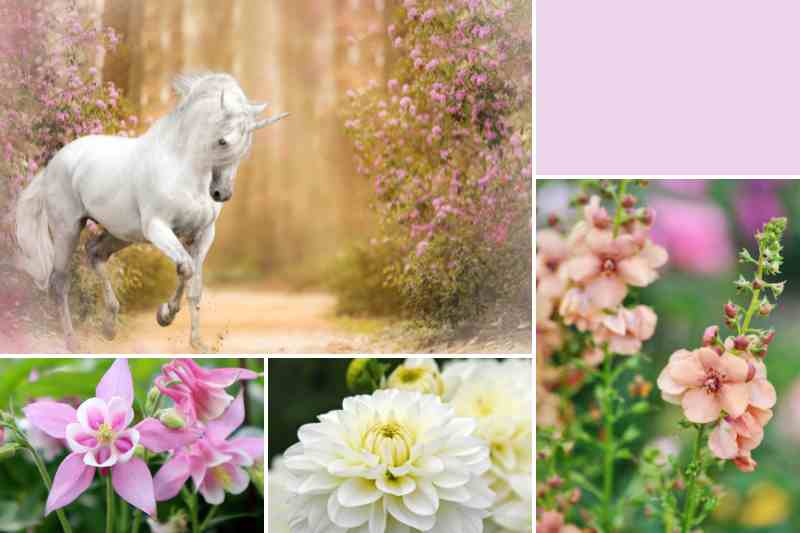
For romantics who favour softness and pastel tones in the garden, here is the Unicorn trend, a new hue devised by promesse de fleurs, blending graduated and iridescent shades from pink to straw-yellow.
What exactly is the Unicorn colour for the garden?
Inspired by the legendary white, pure animal, the "Unicorn in the garden" trend actually draws on the enchanted world of childhood, which associates pink and yellow hues, through to mauve, as if straight from a fairytale.
The garden introduces these fairy-like, very girly notes — powdered and old-rose tones, marshmallow to lavender, touched with very soft yellows — to create a decidedly romantic atmosphere. This garden universe aims to be both poetic and very feminine, approaching a "cotton candy" aesthetic but more subtle, with less acidity and more pastel nuances.
Among plants ticking all boxes of this subtle palette are many perennial plants and shrubs softly salmon, apricot and butter-fresh shaded, tones that catch the light and recall gentle spring colours.
We suggest some planting combination ideas for different garden styles and enticing borders!
In a cottage garden
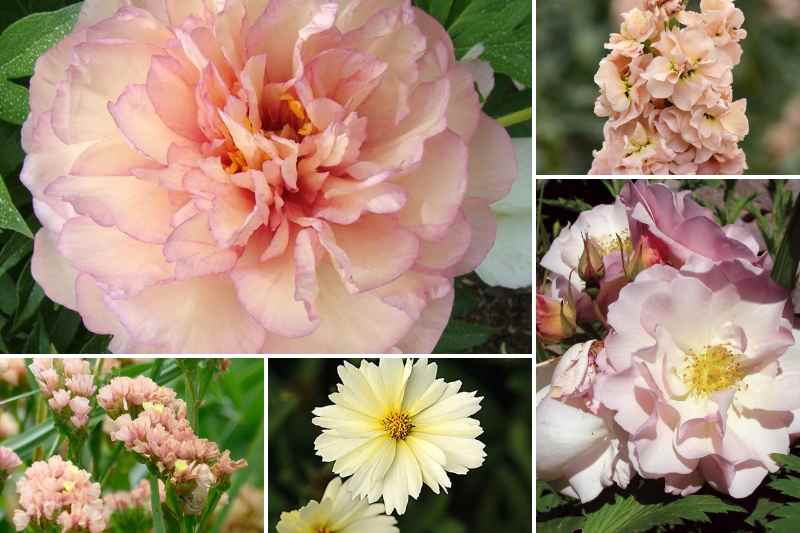
This border, both rustic and sophisticated, remains very natural thanks to soothing colours from pink to apricot, with a well-measured touch of yellow. It suits a south- or west-facing position.
Here we showcase an intersectional peony Scrumdidleyumptious, indispensable in a country garden for its elegance. As its flowering is fleeting, we surround it with some long-flowering perennials and shrubs: an old-fashioned rose such as the heirloom 'Pénélope', statices and apricot wallflowers. A large drift of Coreopsis 'Uptick Cream' adds further softness…
Also consider adding a few Verbascum 'Jackie' or 'Southern Charm' in a blotting-paper pink that will make you swoon! Also think of adding some olive-green or greyed foliage.
In a spring border
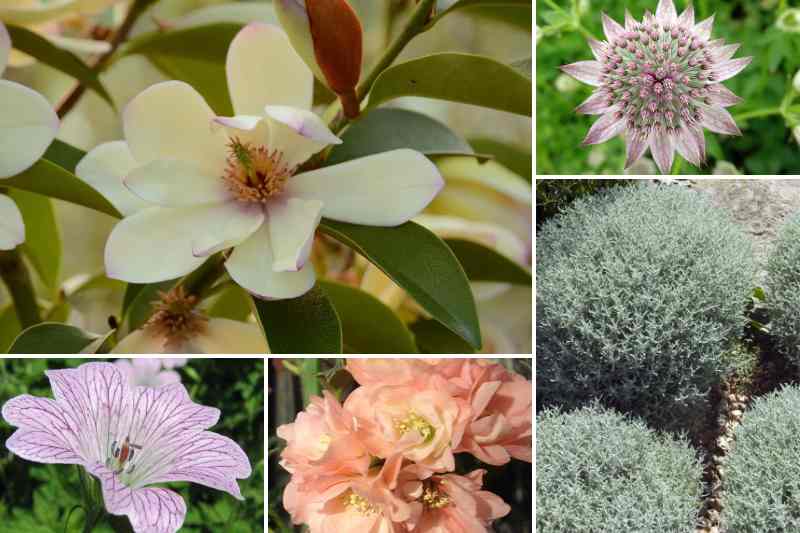
A gradient of soft colours will awaken garden in early fine days with these pastel blooms. Gather in a sunny or semi-shaded border a few favourites admired for their simplicity and grace: a Michelia 'Fairy Lime', a small magnolia with evergreen foliage and delicate cream-yellow flowers with a hint of pink, Astrantia 'Florence' for a mauve bloom a little later around June, and hardy geraniums as groundcover such as Geranium 'Katherine Adele', flowering for months from May, nicely veined with dark pink. Another charming small shrub, Japanese quince Chaenomeles 'Falconnet Charlet', will bring salmon tones in March–April alongside the Michelia. A silvery evergreen foliage, for example that of Santoline chamacyparissus if border is in full sun, is an essential complement to the soft ambience.
In a secret garden
In the intimate, often shadier setting of a secret garden, invite pale luminous yellow blooms to combine with a few pastel tones, from pearly pink to iridescent mauve.
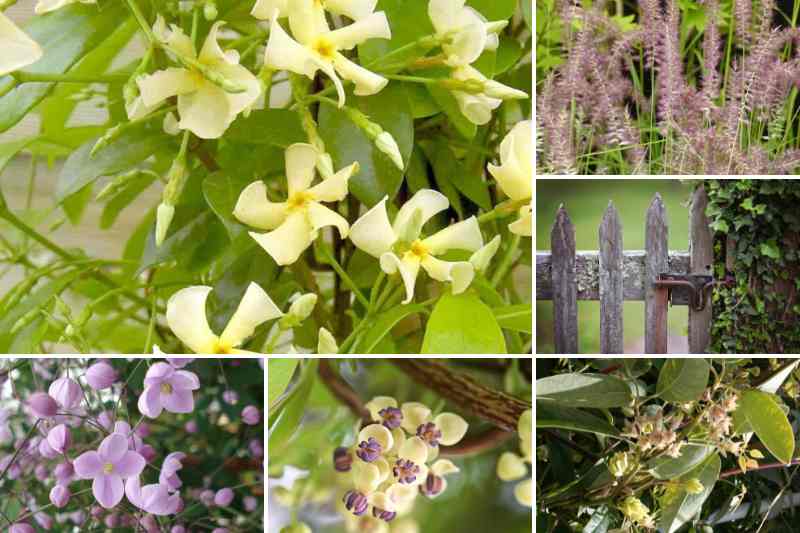
Rely on a base of climbers to screen views and some supple ornamental grasses, perfect here: Chinese fountain grass orientale 'Karley Rose', a very fragrant yellow star jasmine (Trachelospermum asiaticum), Thalictrum delavayi 'Splendide', tall and lilac-pink, and two thoroughly voluble climbers: Akebia quinata chosen in a superb bicolour form 'Cream Form', and a persistent Holboellia latifolia. To enliven the base of climbers earlier in the season, plant in autumn a few bulbs of pink or pale-blue grape hyacinths like 'Baby's Breath', some miniature daffodils and Greek anemones 'Charmer'.
In a bohemian garden
The bohemian garden that explores a wide palette of plants also fits perfectly with the Unicorn garden universe. Ultra-soft, soothing colours will be gathered in the joyful mix and abundance of the bohemian garden! It's a garden that comes alive best in summer, in a profusion of flowers and foliage.
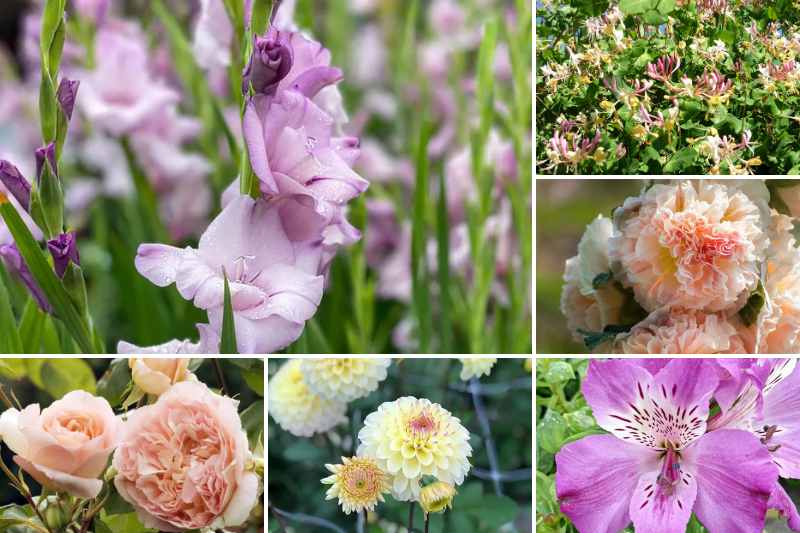
Here we've chosen sorbet tones, old-rose and vanilla-yellow to evoke the Unicorn trend. A honeysuckle skilfully blends pink and yellow, double-flowered hollyhocks 'Chater's Double' and a climbing rose 'Papi Delbard' play the apricot notes, delightful gladioli, 'Blue Tropic', and dwarf alstroemerias 'Pitchoune Lucas' reveal a desaturated mauve. In sun, add a few pom-pom dahlias 'Isa's Favorite', preceded in spring by late double tulips 'Charming Lady'. Add a base of foliage to bridge to summer, such as common sage and a dwarf abelia: charm guaranteed!
Find our selection of plants in the Unicorn spirit on our online nursery as well as our inspiration in the Trendbook 2026!
Do you love these very soft garden tones? Discover other inspirational scenes in these closely related colour universes:
- Peach Fuzz: Colour of the Year 2024
- Soft on-trend colour: how to lay out a nude garden?
- Pinkish Lemon: the new zesty garden trend
- "Coffee colour" inspiration
- and Rose and khaki inspiration for a soft, on-trend garden.
Garden, rarely short of inspiration, suggests enticing colour trends each year to imagine new borders.For romantics who favour softness and pastel tones in the garden, here is the Unicorn trend, a new hue devised by promesse de fleurs, blending graduated and iridescent shades from pink to straw-yellow. What exactly is the Unicorn colour for the […]
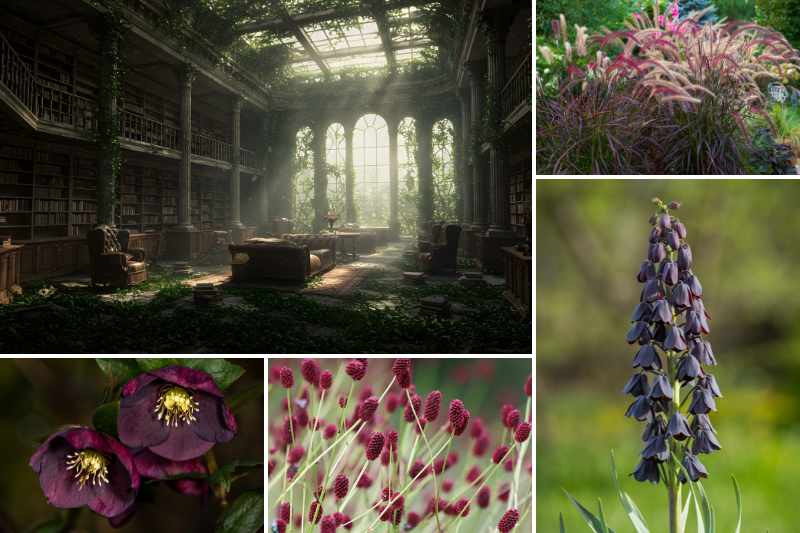
Among the colour trends of the year that spark the imaginations of our most creative gardeners, Dark Academia offers an immersion into garnet, purples, crimsons and plum, edging toward an almost-black depth. These bold, dark tones originate from a baroque aesthetic, that of the hushed and mysterious world of old libraries and the hit series Wednesday.
In the garden, adopting such a romantic and melancholic palette requires a neat setting and scenes with subtle harmonies to soften the sombre colour and the intensity of the blooms and foliage.
Here are three borders imagined for you with this new trend in mind, updated for today!
How to pair it with the garden?
The dark tones, from purple to black, should always be used with great care in plantings. They can overwhelm the eye and, if misused, impart a mood that is too sombre for a garden.
We therefore often pair them with a few neutral, diaphanous touches, drawing from the palette of white, pearly, cream and green blooms, as well as bronzy, greyed foliage. Don’t forget light, ribboned foliage, iridescent or variegated to diffuse the light around the deeper tones.
Some plants are thus particularly useful, especially those that work in a pointillist manner with their inflorescences, such as some grasses and airy perennials or the plush plants. In small doses, they instantly lighten the colour composition of a border.
A naturalistic scene: the poetry of black flowers and wild grasses
Dark-toned flowers can certainly suit a section of the garden treated as a large meadow or flowering border. In this case, favour beautiful wildflowers, such as Scabiosa 'Chile Black', and Cirsium rivulare 'Atropurpureum'. A mass of Penstemon with purplish flowers such as the variety 'Raven' will visually support the border, enriching it with a multitude of blooms right through to frosts.
The perfect accompaniment to temper, without masking, the depth of purple tones will simply come from a few very light grasses such as the Hordeum jubatum, or taller Panicum, or airy fennel. In mild climates, opt without hesitation for the Pennisetum setaceum 'Rubrum'. The presence of statice (Limonium latifolium) with tiny pale mauve flowers softens the scene and brings the essential gentleness to the dark colours.
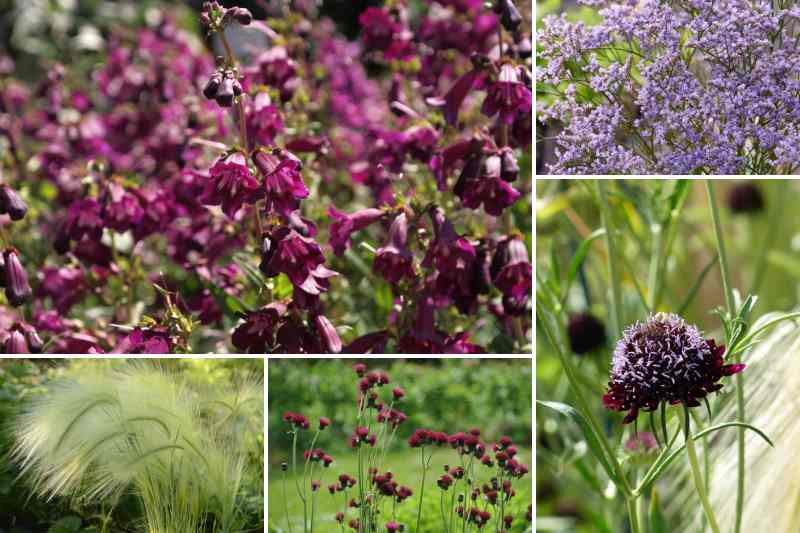
Clockwise from top left: Penstemon 'Raven', statice, Scabiosa 'Chile Black', Cirsium rivulare 'Atropurpureum' and Hordeum jubatum
A shrub border between lilac and burgundy
Around two fine shrubs chosen, one for its burgundy flowering with double blossoms—the lilac 'Charles Joly'—the other for its striking heart-shaped foliage, Cercis canadensis 'Forest Pansy', invite a few perennials in the same warm tones, and greyed foliage for softness. In our example, the lightness of the purplish inflorescences of a purple Eupatorium sits beside the delicate lavender-grey of a refined poppy (Papaver rhoeas 'Amazing Grey'), and the utterly graceful verticality of double-flowered hollyhocks 'Chater's Violet'.
Pensée to include some soft, greyed and silvery foliage such as Artemisia ludoviciana (Valerie Finnis) that will thread at the foot of the shrubs, and respond to the romantic colours of the poppies.
N.B. : other shrubs just as spectacular in their purple hues would work brilliantly in this border, such as certain varieties of the famous smoke tree (Cotinus coggygria) and its wispy summer flowering, a black elder, a physocarpus or Magnolia 'Black Tulip' for a poetic spring effect.
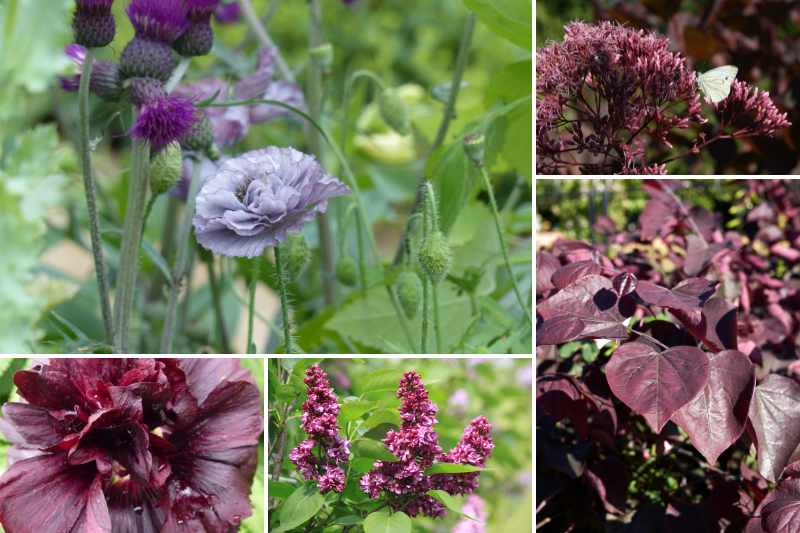
Velvety sophistication in partial shade
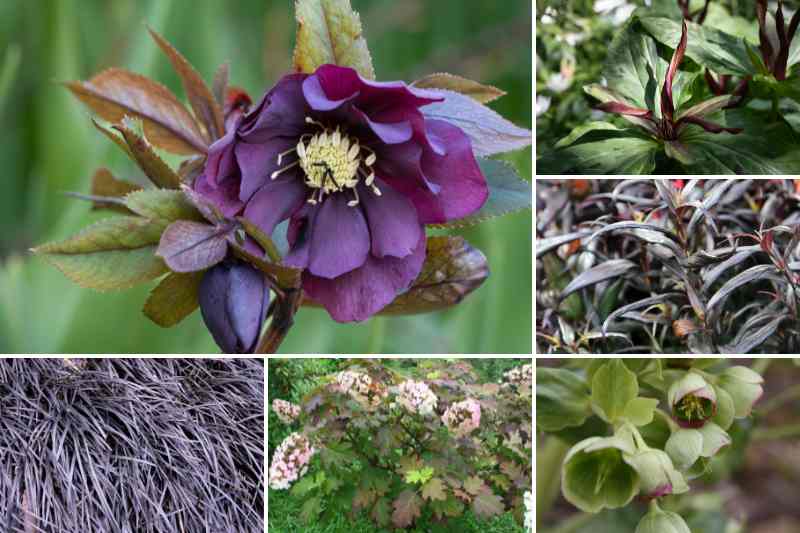
The two previous moods are envisaged in sunny settings. The purple-to-chocolate hues can also be used in a bright partial shade in the garden. In that case, work on an enveloping ambience, softening the dark impression with discreet touches of chartreuse green, together with pearly and iridescent whites.
The purple flowers of Hellebores will be the stars of this corner, with infinite grace and a very long flowering season, akin to botanical cousins such as Helleborus foetidus and its pistachio flowers. Invest here in a few purple foliage plants, such as Strobilanthes anisophyllus 'Brunetthy', a magnificent almost-black shrub, whose pale pink late-spring flowers contrast nicely, and a groundcover with marbled leaves like Trillium cuneatum and a mass of black Ophiopogons. Finally, for a touch of volume in the scene, use the assets of an oak-leaved hydrangea: distinctive foliage that clings on well into winter, taking crimson autumn tones, and white, anise-scented flowers, ranging from white through pink, in spectacular yet light panicles.
To refine this baroque ambience, why not insert one or two refined accessories: a latticed frame with a beautiful gilded patina or a mirror to reflect the light, a romantic vintage metal lantern or a statue representing a poet, an angel or a muse? A stone bench will also invite sitting and resting.
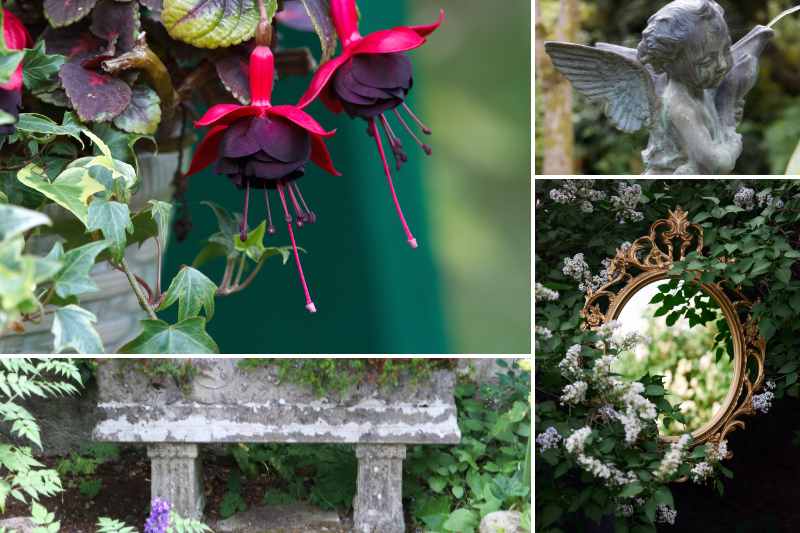
Discover our selection of plants in the Dark Academia spirit on our online nursery, as well as inspiration in the Trend Notebook 2026!
Also read on the topic: How to combine black-flowered perennials? ; 6 border ideas for a red/purple garden, Purple foliage: how to use it and pair it in the garden, and Pairing red or purple flowers.
Among the colour trends of the year that spark the imaginations of our most creative gardeners, Dark Academia offers an immersion into garnet, purples, crimsons and plum, edging toward an almost-black depth. These bold, dark tones originate from a baroque aesthetic, that of the hushed and mysterious world of old libraries and the hit series […]
Discover exclusively our Garden Trends 2026 booklet identified by our experts! Green Generation, Retro Garden or Augmented Garden, we reveal five emerging trends that are reinventing garden practices and imaginations. Drawing on its monitoring, Promesse de fleurs shares a forward-looking perspective and field observations of tomorrow's garden.
Green generation
Millennials: new plant-loving tribe born on Instagram! Aged 28 to 44, often city-dwellers, they have turned houseplants into an art of living. Ficus lyrata, Calathea, Alocasia, Colocasia and Monstera – houseplants are becoming icons, iconic organic design pieces. Plants here become emotional, identity markers and graphic. This green frenzy is hyper-connected, Instagrammable, viral yet deeply emotional.
It’s called "Plant Parenting": 33% of Millennials talk to their plants, 19% give them a name, 29% consider them sentient beings.
People collect spectacular foliage (Monstera 'Thai Constellation', Caladium, Begonias 'Rex'), style interiors and share urban jungle on TikTok (#planttok) or Instagram (#urbanjungle, 8M posts).

Nostalgic Garden
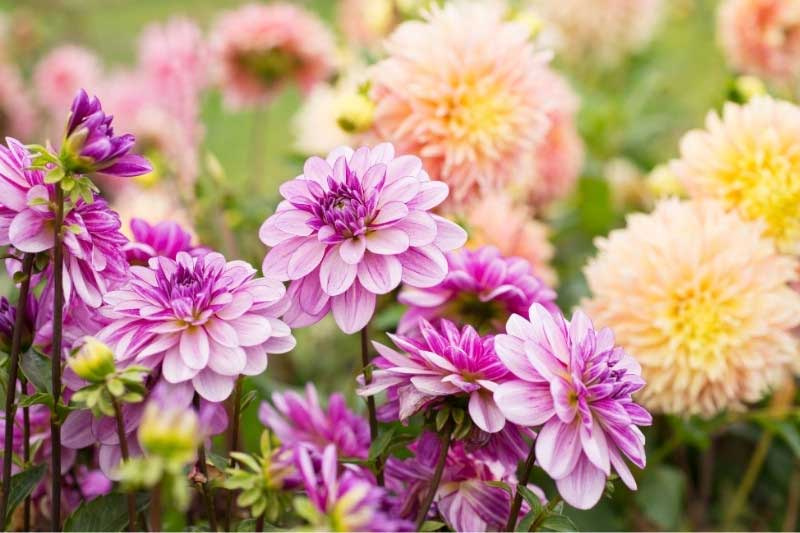
Here is a distinctly regressive, comforting gardening trend! In the face of global uncertainty and at a time when AI generates artificial worlds, the garden evokes a nostalgic vogue reflecting a deep desire for reassurance and tenderness. People sow, take cuttings, forage and arrange homemade bouquets. Retro flowers enjoy a second youth. Double ranunculus, gladioli but above all dahlias (+12% sales) and peonies (+37%) at Promesse de fleurs, which are exploding on social networks, are the star flowers of this vintage wave. The craze for seeds has sparked a revival of cut-flower varieties, straight from garden to vase! Statice, everlasting flowers, oxeye daisies, snapdragons and phlox are already part of our collection of over 1,500 varieties of flower seeds.
Nomadic Escapes
The garden becomes itinerant, mixed, adaptive, a mirror of a world on the move. 42% of recent landscaping projects draw direct inspiration from distant cultures. They combine a longing for elsewhere with climate-consciousness, are nomadic in their evocations, resilient in their choices and economical with water. Sales of hardy succulents have risen 45% in Europe since 2023, a sign that these plants from elsewhere resonate with very local concerns. Trends spotted include:
- Balinese Garden: tropical luxuriance and sacred lotus (85k posts #lotusgarden) inspired by tropical sanctuaries of Southeast Asia.
- Antipodean Garden: euphorbias, crassulas, aloes or senecios acclimatised to extremes evoke landscapes of southern Africa.
- Chaparral Garden: Dasylirion longissimum, Echinocactus grusonii, blue Mexican palm, Opuntia cacanapa 'Ellisiana'... Species from semi-desert areas of California or Mexico shape a graphic, sun-soaked and radically frugal garden.
- Sand Garden : on 20 cm of pure sand, Gypsophila 'Rosea', blue fescue, Lomandra 'White Sands', silver santolina or Salvia 'Caradonna' create carefree scenes with no watering or feeding. Inspired by Peter Korn and climate-resilient gardens, this new-generation dry garden combines lightness, robustness and modernity.

Sanctuary Garden
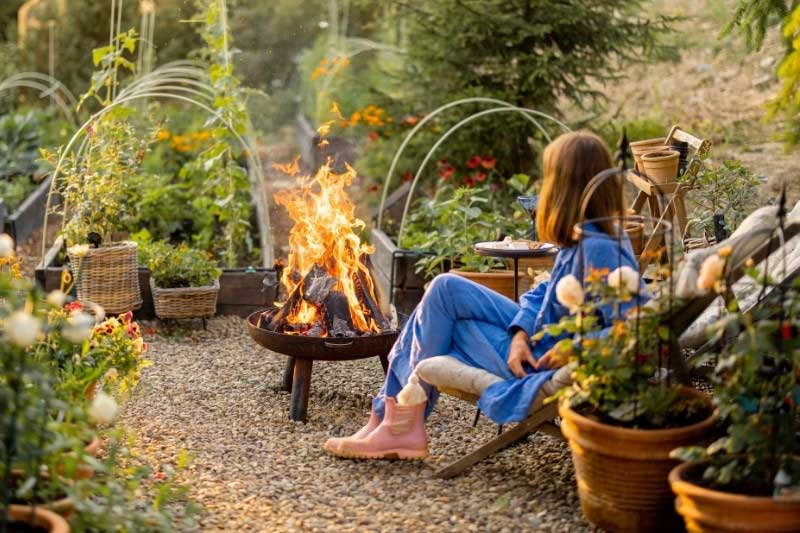
In response to hyperconnectivity, the garden becomes an emotional refuge, an open-air cocoon where people slow down, wrap themselves up and breathe. Throws, cushions, natural materials, deep seating… domestic comfort is transposed into a calming plant-filled setting.
- Japandi: fusion of Japanese minimalism and Scandinavian softness, inspiring sober, vegetal, meditative atmospheres. Japanese maple 'Bloodgood', black Ophiopogon, Pittosporum tobira 'Nana', Arisaema consanguineum, Clematis 'Pistachio' flourish within a contemplative, low-maintenance garden. (+160% searches for "Japandi garden" in 3 years).
- Chill Soft: soft design, velvety palette, flowing ornamental grasses such as Pennisetum 'Lumen Gold', Perovskia 'Prime Time', Panicum 'Hot Rod'… The garden becomes fluid, sensory and enveloping.
- Boho Patio : bohemian terraces, bright colours and gypsy spirit. Giant sunflowers, dahlias, purslanes, red popcorn maize, and black pomegranate settle in for a sunny, joyful garden for lazing and impromptu partying.
Augmented Garden
The garden is entering the era of assisted gardening: tutorials, apps, connected devices, AI…
Cordless tools are becoming mainstream, mini-greenhouses are appearing in cities, and social networks popularise gardening techniques.
Uninhibited and autonomous, the garden appeals to a new urban generation. 40% of urban households are already equipped with an intelligent device.
Our podcast Branché au jardin has accumulated 18,000 listens, and our Plantfit app has 80,000 users.

Colours 2026
Emotional hues, between mineral freshness, dark romanticism and pastel dream.
- Transformative Teal: between muted blue and aquatic green, this refined, mineral hue establishes itself as the colour of 2026. It evokes deep waters and is embodied by Eucalyptus ‘Baby Blue’, Agave americana, Senecio serpens 'Dwarf Blue', or Dasylirion glaucophyllum.
- Cloud Dancer : a vapoury, restful, almost silent white, crowned Pantone's colour of the year. A chromatic antidote to saturation, Agapanthus 'Ever White', Hydrangea 'FlowerWOW', Iris 'Glacier' and Clematis 'Guernsey Flute' soothe the eye.
- Dark Academia : dramatic romanticism with Victorian accents. Purple, garnet and misty mauve blooms and wine-coloured foliage create a dark, sophisticated atmosphere. Dianthus 'Sooty', Rose 'Charles de Mills', Poppy 'Lauren’s Grape' and Lupin 'Masterpiece' embody this poetic gloom.
- Unicorn: an iridescent pastel breath on the border of digital dream. Apricot sorbet, frosted lavender, sky blue or vanilla yellow compose a dreamlike, joyfully offbeat garden populated by Wallflower ‘Classic Apricot’, Delphinium ‘Misty Lavender’, Rose ‘Koko Loko’.

Discover exclusively our Garden Trends 2026 booklet identified by our experts! Green Generation, Retro Garden or Augmented Garden, we reveal five emerging trends that are reinventing garden practices and imaginations. Drawing on its monitoring, Promesse de fleurs shares a forward-looking perspective and field observations of tomorrow’s garden. Green generation Millennials: new plant-loving tribe born on […]
The reasons to discover gardens, parks, and arboretums in our country are numerous: besides a green escape often close to home, or much further away when travelling, gardens provide opportunities for often surprising encounters and inspire us as each garden is unique. A journey into the infinitely green, from which we emerge with valuable advice and ideas. The diverse typologies transport us from the French garden to the English landscape park or the Japanese and exotic gardens.
Why is it so important to visit gardens? I will elaborate in this short article and provide some tips on how to find and visit them at the right time.
For the tranquillity they provide
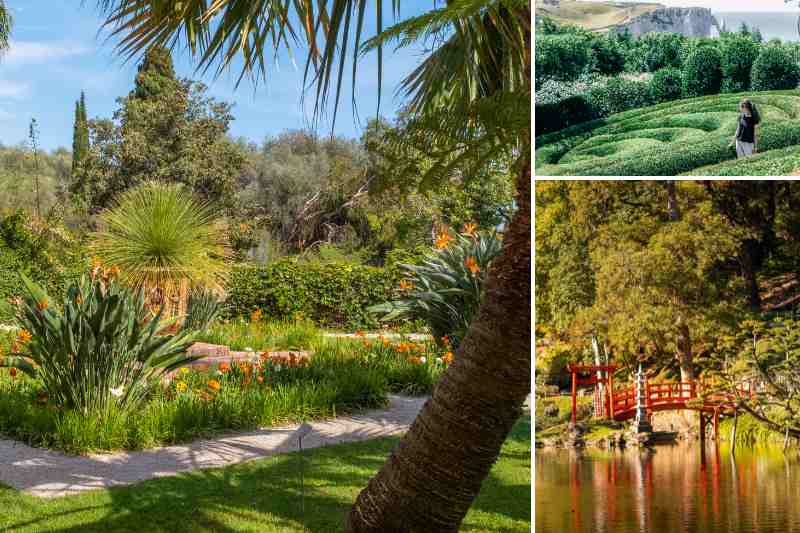
Gardens, like forests, are places where we disconnect from our daily lives. The greenery, scents, and sounds allow us to escape and bring us peace. Their tranquillity offers immediate relaxation, which often lasts for the rest of the day!
For the beauty of gardens
What could be more delightful than wandering through gardens where everything is designed for the pleasure of the eyes? Visiting gardens, whether they are parks, plant gardens, botanical gardens, arboretums, public gardens, or private gardens, allows us to see plants that we may not necessarily cultivate at home. It is an opportunity to learn more about the vast world of plants and to marvel at the interplay of colours and the art of combining them.
Even if our own gardens are often smaller, visiting gardens provides us with insights into creating our own little green paradises. Visiting gardens nearby also helps us better understand the plants that thrive locally in our regions and how to showcase them.
All the plants are lovingly cared for, expertly maintained by dedicated teams in public gardens and by passionate gardeners who often conduct the tours themselves.
Strolling through a harmony of greenery, blooms, and fragrances, awakens all our senses and allows us to leave after one, two, or three hours of visiting with images in our minds, having recharged our batteries…
If we visit gardens in a completely different region, or even another country, we discover a different flora, very refreshing, sometimes translatable to another climate.
For the encounters we make
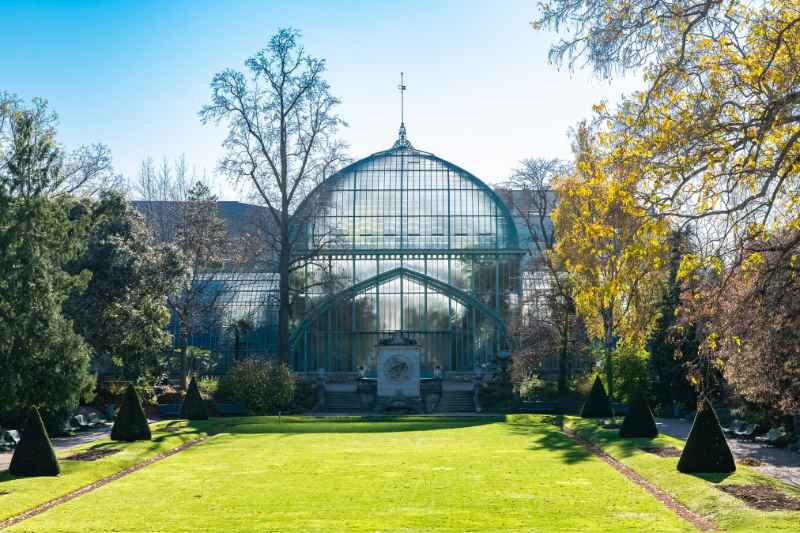
When visiting a private garden, you are not only exploring an extraordinary living space, but you also meet its owners who have often spent decades shaping their garden. It has thus become a place that reflects their personality, conducive to visits, but this process goes further, allowing for a moment of sharing with each visitor.
Some gardeners accompany you throughout the visit, explaining why they made certain choices of plants, how they have expanded the spaces over the years, while others prefer to step back and let you explore the garden freely, reuniting at the end for a friendly debrief.
Most of the gardens I have visited have sparked fascinating discussions… among passionate people! It is this human connection that I find, beyond the gardens themselves, admirable: in public gardens, gardeners are always available, pausing their work for a few minutes to enlighten you about a flower, tree, or bush you may not know, to talk about their work, or to explain the plantings the team is busy with.
In a private garden, we share tips about good nurseries in the area that we may not know, as they are a bit further from our usual circles, we discuss gardening associations we frequent, we talk about our cultivation issues with certain plants, we exchange ideas on current pruning… in short, we pass on a wealth of information and recreate the world around this environment that amazes us so much.
And when, as happened when I visited Mireille's garden, the visit stretches on, it can even lead to beautiful friendships between one-time visitors…

For inspiration
Visiting gardens is also stepping into worlds where creativity is often at play. Whether in a public or private garden, the arrangements are always a source of inspiration: the interplay of plant associations, of course, their colours, forms, and textures, the shape of the beds, the integration of a wet area, but also ideas to pick up along the way such as homemade path borders made of stones or wood, decorative ladders, cute tipis, treehouses, beautifully showcased vintage furniture, and much more.
Just for these delightful finds that enchant the DIY enthusiast within us, it is worthwhile to visit a garden!
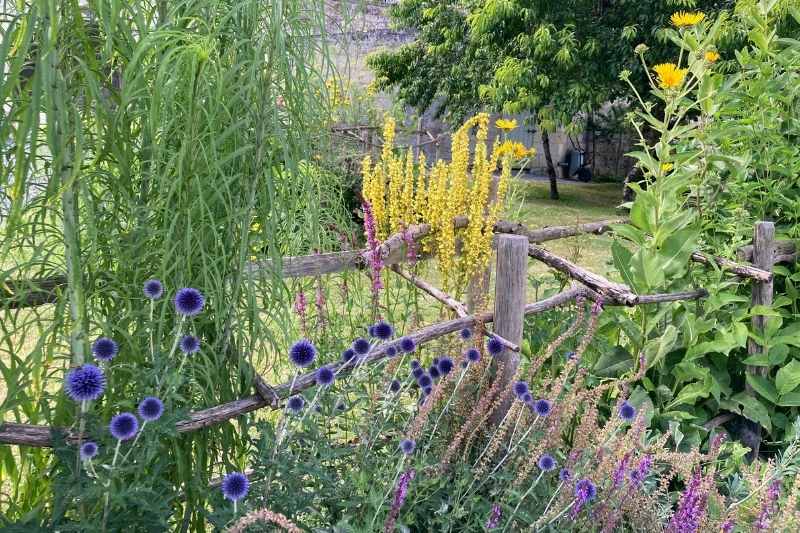
The best times to visit gardens
Most gardens open for visits in France from April to October, a peak period for many plants, with some (rare) open all year round, particularly public gardens and plant gardens. January and February are generally months when gardens take a break from visits, but it is always advisable to check in advance on their websites to avoid disappointment (I experienced this myself this summer with a private garden that closed mid-July to reopen… next spring; my disappointment was great).
Of course, gardens featuring primarily acidic soil plants with azaleas and rhododendrons are best visited in April and May, while romantic gardens overflowing with roses are best between May and June, and grass gardens like Jardin Plume or gardens featuring many autumn foliage and maples are best visited at the end of the season, around October.
In France and Europe, do not miss the European Heritage Days, which provide an opportunity to discover certain gardens that open only for this occasion. They take place on the third weekend of September each year, for the past forty years! A filter with the word "garden" on the Ministry of Culture's website allows you to select only the gardens offering visits (free or guided, paid or free).
The other key moment, and certainly the most popular for visits, is June, a blessed month in our northern hemisphere for floral richness at this time of year. This is why the French Rendez-vous aux jardins!, the botanical counterpart of the heritage days, takes place over three days (with Friday traditionally reserved for schools), every first weekend of June. Initiated by the Ministry of Culture 21 years ago, the garden weekends propose a different theme each year and are promoted by the DRAC of each region. More than 2000 gardens now open their doors in France. After "the five senses in the garden" this year, the next edition in 2025 will take place from June 6 to 8 and will focus on the theme 'stone gardens - gardens of stone'.
Finally, a little earlier each year in May, do not miss the Open Gardens for Neurodon: the Federation for Brain Research organises a weekend to raise funds for research. This mainly concerns gardens in western France and Languedoc-Roussillon, but also a few others (more information and the map of gardens in this link), at a very accessible price.
How to find open gardens to visit in my department or region?
The advantage of gardens is that every city has at least one green space of interest. In the countryside, you often have access to gardens or vegetable patches just a few kilometres from home. Even if they are well-known, here are some useful sites to find beautiful gardens to visit near or far:
- The remarkable gardens: these are gardens labelled for their remarkable elements, particularly historical, botanical, and their plant heritage. There are many in most departments of France and overseas. There are nearly 480 in mainland France and overseas territories, and about thirty in Belgium (Wallonia). There is plenty to explore!
- Another option is the eco-garden labelled gardens committed to ecological management of green tourism.
- Gardening associations, park and garden associations, and horticultural societies are well-known and offer, for a modest membership fee, several garden visits throughout the year (in addition to a generally very interesting programme). Research online by typing "gardening associations" or "gardeners' associations" along with your department, and you will find gardens that may be unknown to you. Each region has gardening associations where many volunteers are active. Discover those in your department. For the Pays de la Loire, there is ASPEJA, which organises many activities including garden visits, as well as the JASPE association that brings together gardens from Sarthe and Mayenne, and other gardening associations in smaller municipalities (visit your town hall or its website to learn about all the associations!).
- The local press is a treasure trove for finding gardens to visit. Articles can help you discover more confidential gardens, often private gardens, true gems.
- Do not hesitate to visit tourist offices when you are travelling in France: they all have brochures and leaflets on the most beautiful gardens in the area.
- Some nurseries offer, in addition to their range of plants, beautiful trial or experimental gardens showcasing the plants they produce. Here in Anjou, I particularly like the one at Plantagenet nurseries, and in Morbihan, the nursery of Prahor. Inquire at nurseries in your region.
- It is worth noting that more and more gardens are accessible to people with reduced mobility, often with adapted paths, albeit a bit more restricted. Therapeutic gardens are beautiful places, particularly designed for people with disabilities.
At Promesse de fleurs, we provide you with monthly ideas for garden visits in our blog section: Garden visits, gardener portraits! It is constantly updated with visits conducted by our editorial team. We highlight beautiful gardens that are well-known in France and abroad, as well as more confidential gardens that also deserve a visit.
And you, what are you doing next weekend?
The reasons to discover gardens, parks, and arboretums in our country are numerous: besides a green escape often close to home, or much further away when travelling, gardens provide opportunities for often surprising encounters and inspire us as each garden is unique. A journey into the infinitely green, from which we emerge with valuable advice […]
I set off in early June for a trip to the north of England, where I hadn't returned for (too) many years. It was in this region bordering Scotland that, as a teenager, I met my English pen pal and her family, who instilled in me a love for the English language and guided my choice of studies towards fascinating linguistic studies. I wanted to combine this pilgrimage with visits to gardens, a passion now deeply rooted in my life.
Amidst the lakes and typical heaths of the north, hiking and garden visits filled the days. In early June, the gardens were abundant, much more than I had imagined, and several things caught my attention. If, like me, you have eyes only for the English garden, follow me to this country where the garden reigns supreme.

Yorkshire and its gardens: an absolute dream
In preparing for this trip, I had to make decisions about certain visits and forgo others. North England is indeed teeming with gardens, just like the rest of the country. Travelling from the west coast (the Lake District, a region of lakes in Cumbria) to the east coast (the York North Moors National Park) and down to Derbyshire, I had identified a few gardens with the help of beautiful books on the subject (The Gardens of England and Gardens of England) and by consulting various English websites listing all the beautiful places not to be missed, notably that of the RHS.
With a garden a day, the enchantment worked every time, as the gardens shared the English spirit but each had a different personality.
Notably, the Hall, this small castle or large manor typical of England, gives a unique spirit to each garden. Its architecture leaves its mark on the place, just like the Walled gardens (brick-walled gardens), where the most beautiful mixed-borders are gathered.
I preferred modest-sized gardens, as I have a taste for this type of garden. To name just a few, the gardens of Holker Hall, Burton Agnes Hall, and Newby Hall were true favourites, but the large estate of Chatsworth, a bit further down in Derbyshire, much appreciated by the English and tourists, also deserves a little detour, just like the famous Levens Hall and its topiaries in Cumbria.
The colour palette
At this end of spring, the English gardens display absolutely charming shades, all the nuances of white, blue, pink, mauve, and purple. It is this palette that acts everywhere, subtly enchanting us. The tonal variations are very well crafted, and the harmony that emerges is the result of a precise work of chromatic nuances of a distinctly British elegance.
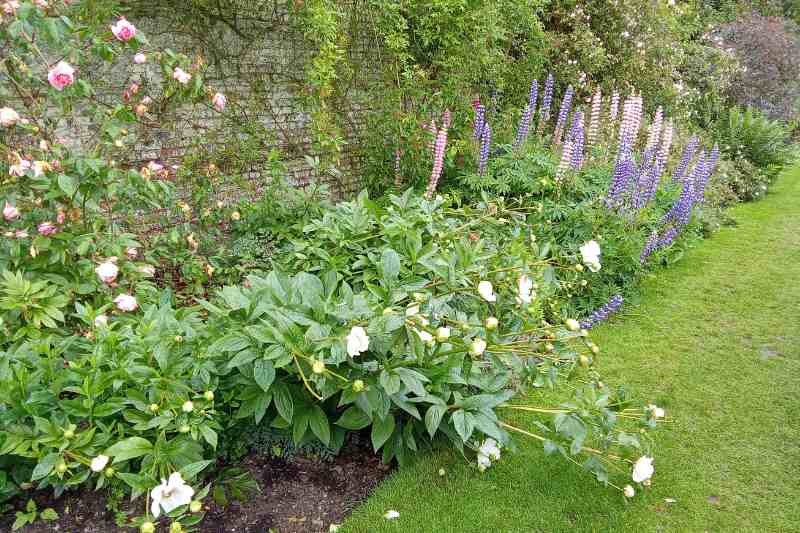
Many gardens also feature monochromatic subspaces, a great specialty across the Channel, as seen here at Burton Agnes Hall, which includes a very successful yellow garden, blending blooms in a range of soft to vibrant yellows, with golden foliage, and offering views of the stunning Elizabethan manor.
Finally, in the Lake District, we see many ericaceous plants, as the soil here is conducive to their establishment. They are still in full bloom, like rhododendrons and azaleas. This gives, for example, in the garden of Holehird gardens, a more pronounced range of colours, equally attractive.
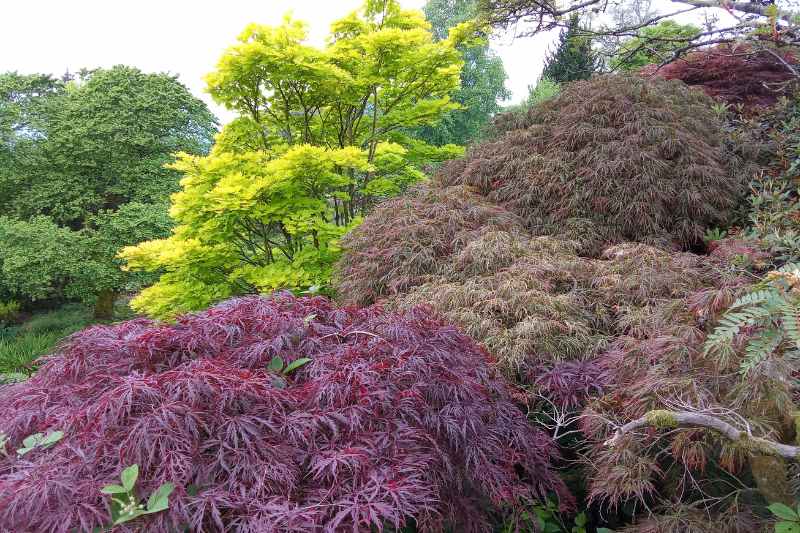
Mixed borders and key plants of the English garden
Throughout the gardens visited, certain perennial plants invariably reappear in the mixed borders and the walled gardens, absolutely stunning in their mastery and precision. The crambe, columbine, and astrantia, sanguisorba, cardoon, Oriental poppy, as well as Alliums, peonies still in bloom, roses, giant Thalictrums, and extravagant lupins!
The hostas that I see in most gardens are simply breathtaking here, enormous and in all colours, teasing you...

The ornaments of English gardens
Strolling through English gardens also means discovering a thousand details to inspire beautiful arrangements back home. If the English are great lovers of benches and seats, they multiply them at will in their gardens, providing the perfect resting spot with views not to be missed. I love them all: wooden, wrought iron, painted, with a vintage look, often Victorian style or in the Arts & Crafts movement.
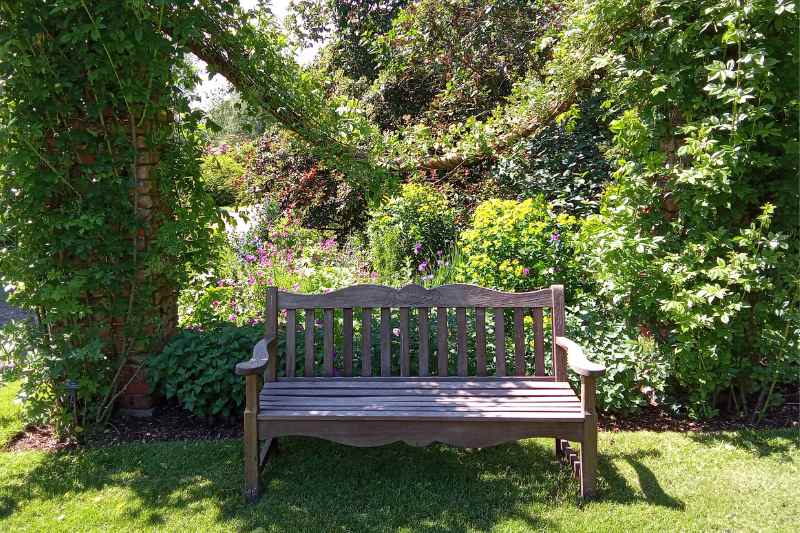
I also love the supports placed everywhere to help sweet peas and other wonders climb, as well as the obelisks that add incredible charm to all these gardens. The largest gardens willingly use structures, like in our country, these constructions designed to enhance the garden, such as kiosks. Below, at the estate of Chatsworth, you can find these follies in the wild garden, as well as divine arches leading up the hill to the vast vegetable garden.
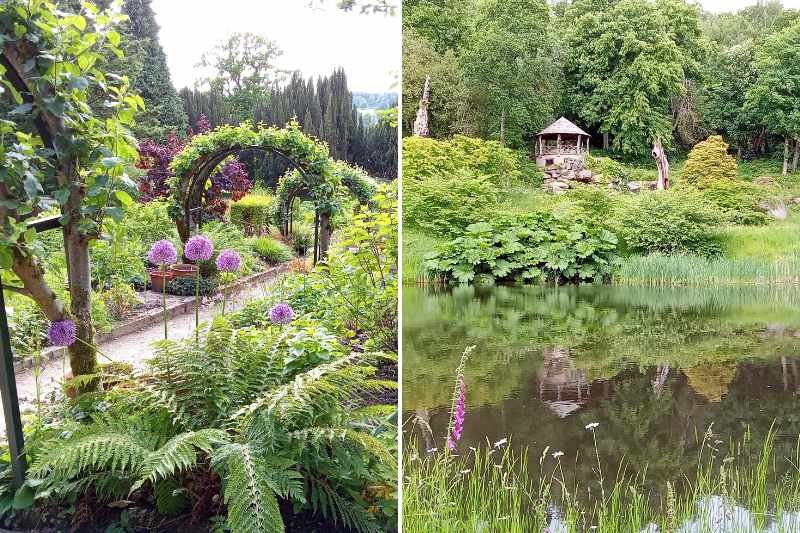
Mulching, no mulching
Surprisingly, English flowerbeds are little or not mulched at all. Well… not like we do in France. The horde of gardeners in each garden partly explains this, as they do considerable work all year round, continuously weeding and tracking down every adventive. The black soil, rich in humus, results from a thick layer of decomposed mulch, which the plants love.
Close mowing… or differentiated mowing!
One of my biggest surprises was the treatment of the grassy areas. England has long been known for its passion for the famous English lawn, a true pride of gardeners in large estates or private gardens. The lawn holds great aesthetic value here, symbolising the opulence of the owners for centuries. It is one of the essential elements of the English garden, beautifully highlighting the planted scenes. During my visit to a first garden on the heights of Lake Windermere, I was astonished to hear a lawnmower buzzing while I was admiring the lush, perfectly manicured carpet of the walled garden. The gardener had just started mowing, even though the green and soft carpet looked like a billiard table!
Conversely, English gardens have evolved with the times and are also adopting more ecological methods applied to large spaces. In the vast gardens or parks, often found in all the beautiful estates visited, there are now large areas treated with differentiated management: tall grasses coexist with more manicured areas, and this no longer shocks anyone... and that's a good thing!
The garden of Haddon Hall surprised me the most, with, in an area I would call prestigious, just in front of the manor, two wide strips of unmown grass in the main driveway. Surprising, isn't it?

Borders with precision
Where does this feeling of elegance, harmony, and order come from when visiting an English garden? Beyond the lawns, fine and regular carpets, maintained both by human hands and the frequent, beneficial rains, it must be said that the precise borders are a common denominator in all the gardens visited. They add this admirable precision, counterbalanced by the opulence of the plants. The edges of the flowerbeds are so neat that not a blade of grass protrudes onto the soil.
While discussing with a team of gardeners at the York Gate gardens, one of them confessed to me that the borders are redone every week! In such spaces where the flowerbeds abound, I thought they must do nothing else, since on 4000 m², they barely finish this laborious and meticulous task before having to start again! But this does not diminish the British calm, present here even in the gardens.
The rigor of these neat borders is sometimes balanced by the exuberance of a sprawling perennial, like a geranium that escapes, thereby softening an aspect that can sometimes seem almost unreal...
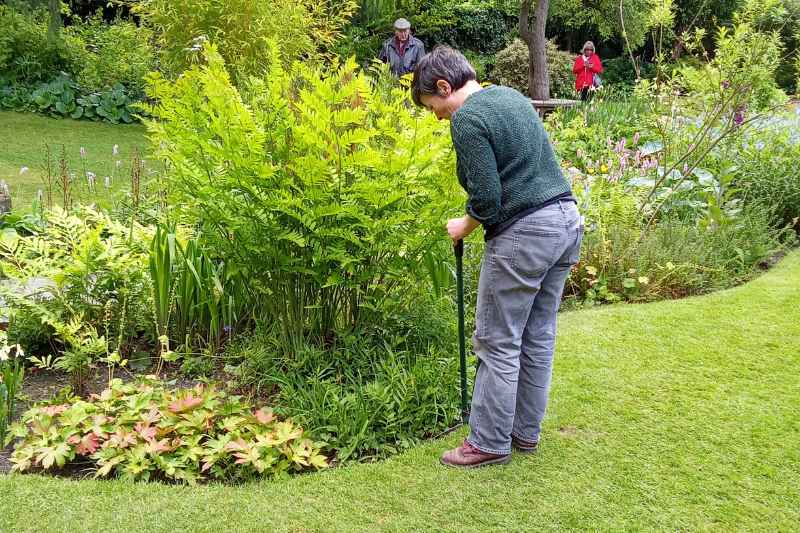
My advice: The Halls and castles are worth a visit in their own right, which does add a bit to the price of the garden, of course... If you have the time, don't hesitate to visit some private gardens as well. You can visit many during the summer period in England! And treat yourself to a lunch or an afternoon tea in all the tea rooms that are an integral part of the gardens in this country: the food is excellent, local, in a very British atmosphere, with superb decor...
I set off in early June for a trip to the north of England, where I hadn’t returned for (too) many years. It was in this region bordering Scotland that, as a teenager, I met my English pen pal and her family, who instilled in me a love for the English language and guided my […]
Flower Island, Atlantic Garden or the island of eternal spring… Madeira is beautifully named, and I have long wanted to explore this gem, known for its extraordinary richness of flora. Last year, I finally treated myself to a week of botanical relaxation on this enchanting island. After a three-hour flight from Nantes and a spectacular landing, Madeira is a wonderful destination for any plant enthusiast! With virtually no time difference, we are plunged into a completely tropical atmosphere.
At the beginning of spring, I invite you to soak up greenery and colour on these charming volcanic lands. My travel diary takes you on this first episode to the renowned gardens of the capital, Funchal!

Madeira, who are you?
This floating garden stretches over a small volcanic rock of 60 km by 25, covering 750 km². Madeira is part of a Portuguese archipelago consisting of four main islands, located a few thousand kilometres from the Portuguese coast. Set in the middle of the Atlantic Ocean, the archipelago belongs more broadly to what is known as Macaronesia, which includes the Azores, the Canary Islands, and Cape Verde. It is situated at a latitude roughly level with Marrakech. It is the most densely populated island, as the other islands are practically uninhabited.
A dream island, renowned for the mildness of its climate, but especially for the incredible beauty of its lush vegetation, with grand gardens and flora growing along the roads. Knowing that a third of its area is situated above 1000 m, with Pico Ruivo reaching 1861 m, one immediately understands that this is a dream setting for hiking.
Its subtropical climate is characterised by a low thermal amplitude: as a result, plants grow all year round between 15 and 27°C, with these temperatures dropping as one ascends to the island's many peaks. Humidity is high, giving it a humid subtropical climate. Finally, winds are blocked in the centre by mountains, protecting the south and east, with the eastern tip being even arid. Depending on where you are on the island, the perception of heat and humidity will be quite different.
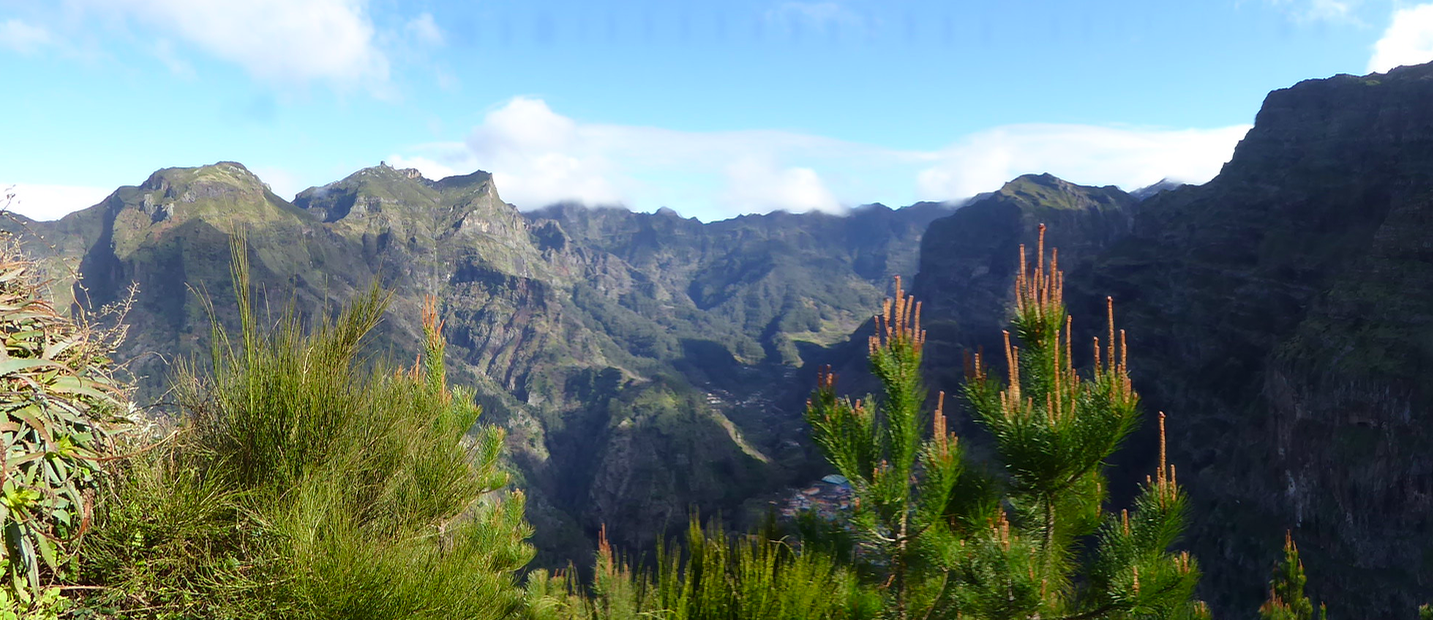
The city of Funchal, the island's capital, features numerous quintas, large mansions with sumptuous gardens, which can be visited from the outside, and two must-see gardens located on the heights of the city:
The Monte Palace tropical garden
Formerly a luxury hotel, Monte Palace is located between 475 and 570 m above sea level over the city of Funchal. It boasts no less than 10,000 species of plants across seven hectares, a must-visit for tourists who often access it via the cable car.
Here, an atmosphere is created with an Eastern influence thanks to the omnipresent red colour, with water appearing everywhere in the form of lakes, waterfalls emerging from caves, or ponds with koi carp, but the garden mixes styles, featuring fountains and Buddhist or very classical sculptures, while inviting ancient azulejos and Manueline-style doors. The overall effect is almost eclectic, but the profusion of plants and the tropical ambiance ensure an extraordinary change of scenery!
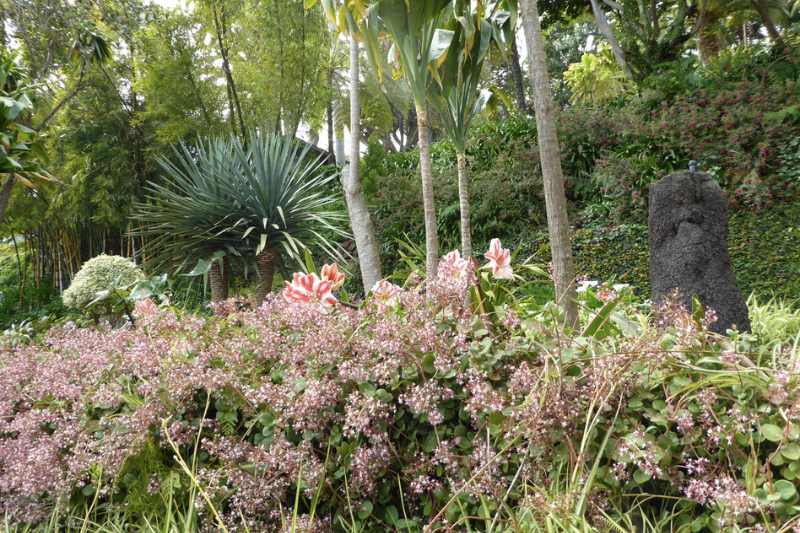
- The laurisilva: a large area at the entrance showcases the island's endemic flora. Descending a long avenue, one discovers the primary forest, the island's indigenous plants. This place is dense and wild, with few people wandering there, yet it immerses us in the island's interior, providing impressions of the many hikes Madeira has to offer.
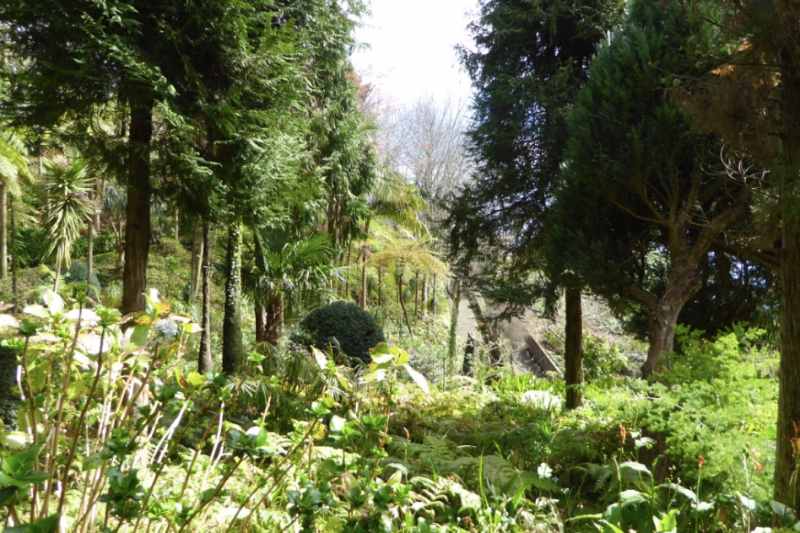
- The oriental garden
It is impossible to overlook it, as it is at the heart of the incredible decor of Monte Palace. The red colour serves as a common thread, and the plants are not all those one might expect in a Japanese garden when hundreds of clivias catch the eye, but the exuberance is total, and the viewpoints are always different, as one descends the hill...
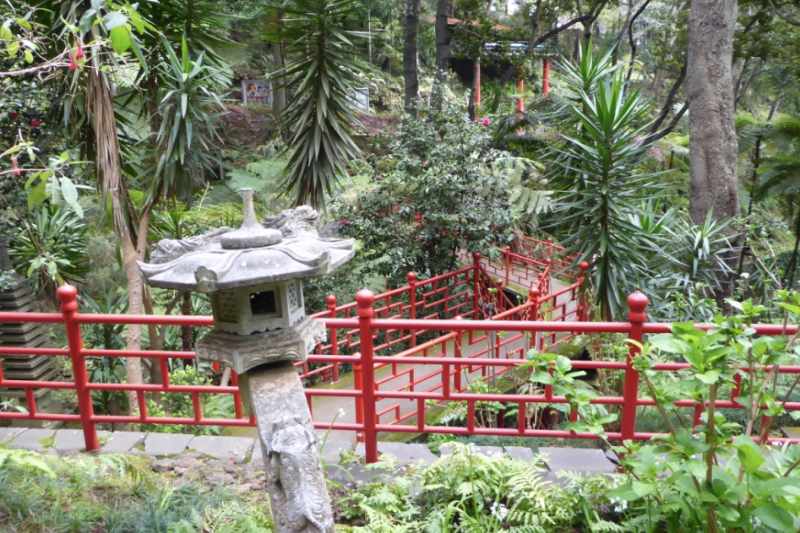
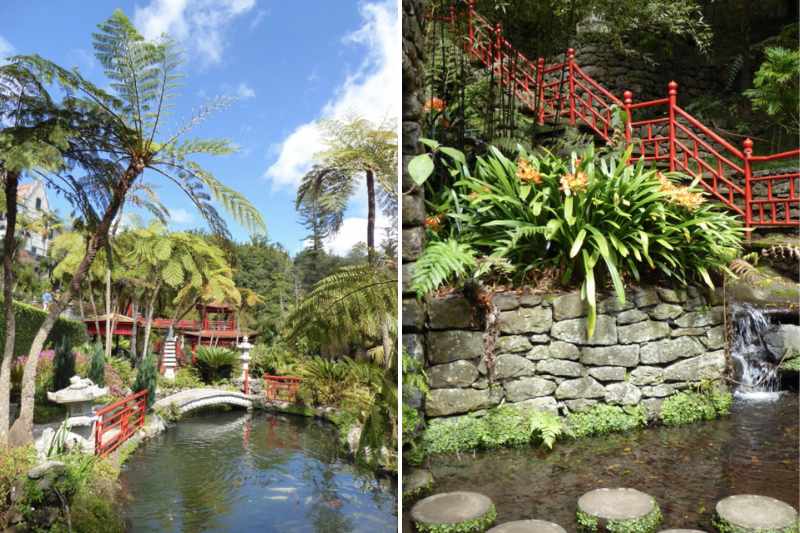
The collection of cycads
One of the areas features an exceptional collection of Cycadales, these plants that are halfway between ferns and palms, but belong to the gymnosperm family, like Ginkgo or conifers. They are true living fossils, with pinnate leaves, the most well-known among us being the Cycas revoluta. Here, one is left speechless in front of the enormous Encephalartos natalensis (part of the zamia family) and their prominent cones!

The orchids
An orchid nursery continues to amaze at the end of the path. They are countless, in shades of yellow, orange, white, or pink... Even without being an expert, one cannot help but be captivated by the extravagant shapes of their flowers and the exoticism they convey.
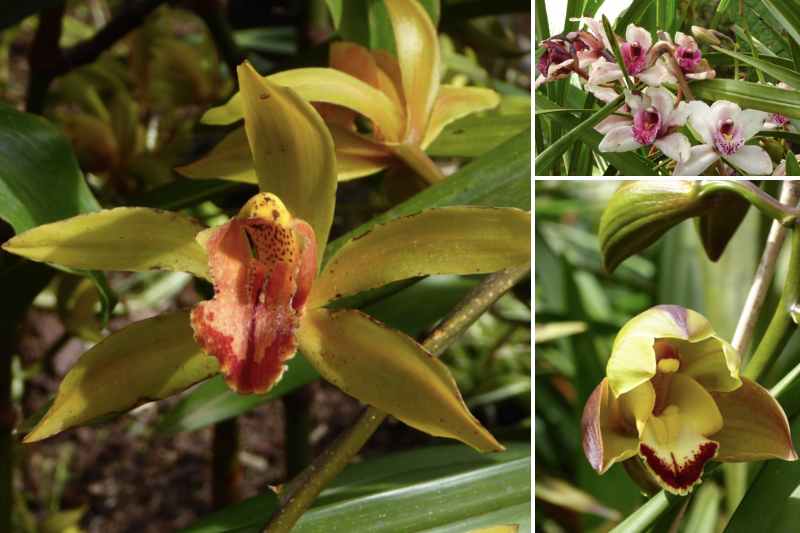
The botanical garden
A little lower than its illustrious neighbour, the Jardim Botânico is the other garden in Funchal not to be missed. Very different in atmosphere, it is like suspended at 300 m above sea level. In my opinion, the two gardens truly complement each other, and it would be a shame to favour one over the other.
The property visible at the entrance belonged to the Reid family, a famous family that built its fortune on Madeira wine, the origin of Reid’s Palace in Funchal, one of the most luxurious hotels in the world. Here, 3.5 hectares await exploration, with 3,000 exotic plants to marvel at: here shade plants, there a garden of cacti and succulents, in the centre a choreographed display of plants, and lower down, elegant palms…
- The shade garden
For me, this area was a delight, a perfect tropical tableau with large leaves and a few grand blooms, even if it was a bit early in the season to enjoy it at its peak.
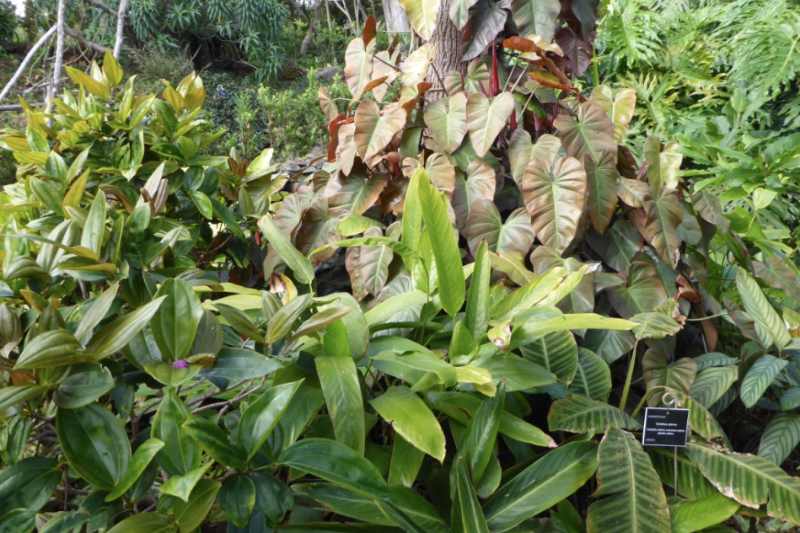
The garden reveals an extraordinary botanical diversity. One can see Crinums, clivias, amaryllis, and especially many beautiful foliage plants like tree ferns, Sphaeropteris cooperi (syn. Cyathea cooperi), graceful ferns (Niphidium crassifolium), epiphytic plants that colonise tree trunks, and colocasias! The plants find here the best conditions to grow: warmth and humidity, hence this profusion of vegetation.
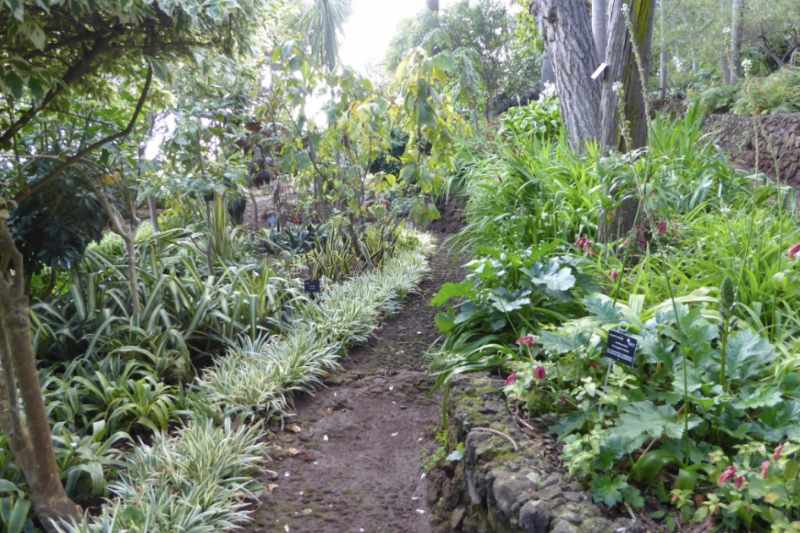
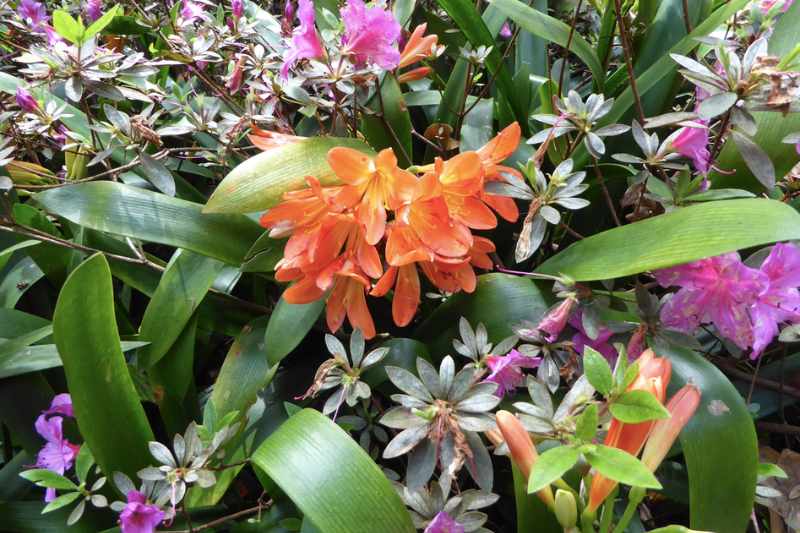
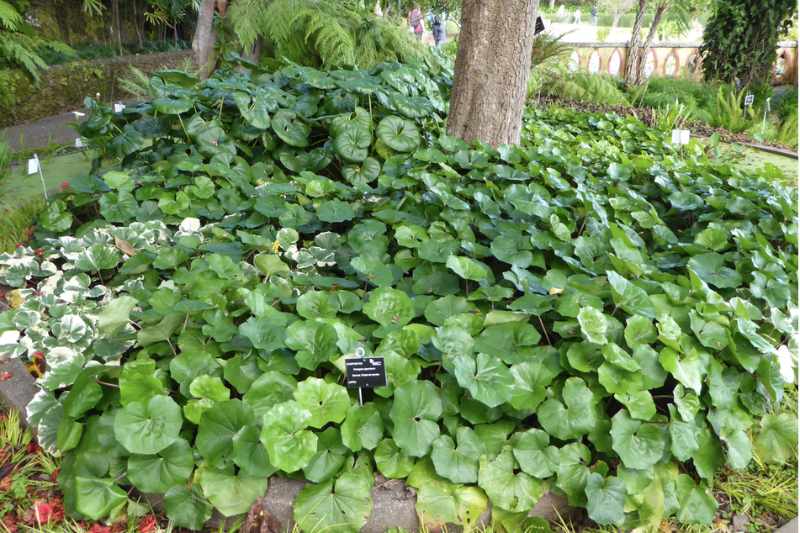
- The succulent garden
Certainly one of the places that amazed me the most, as the shapes, textures, and colours of this garden within a garden are fascinating!
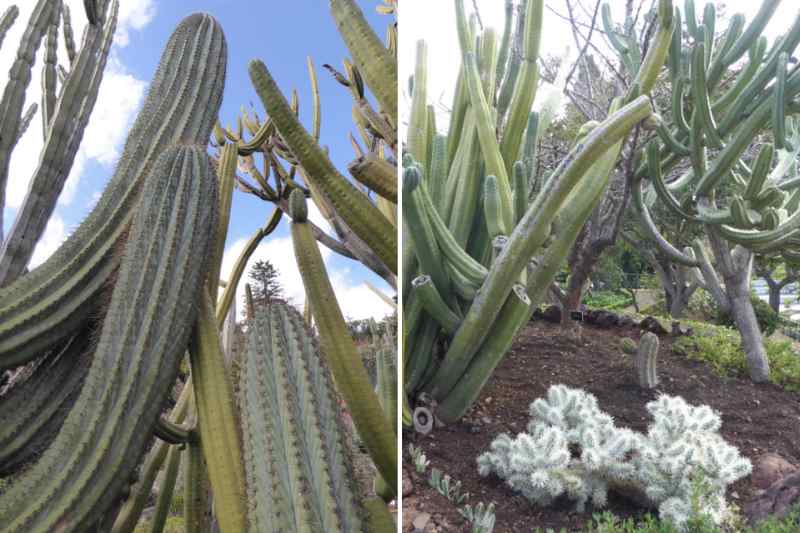
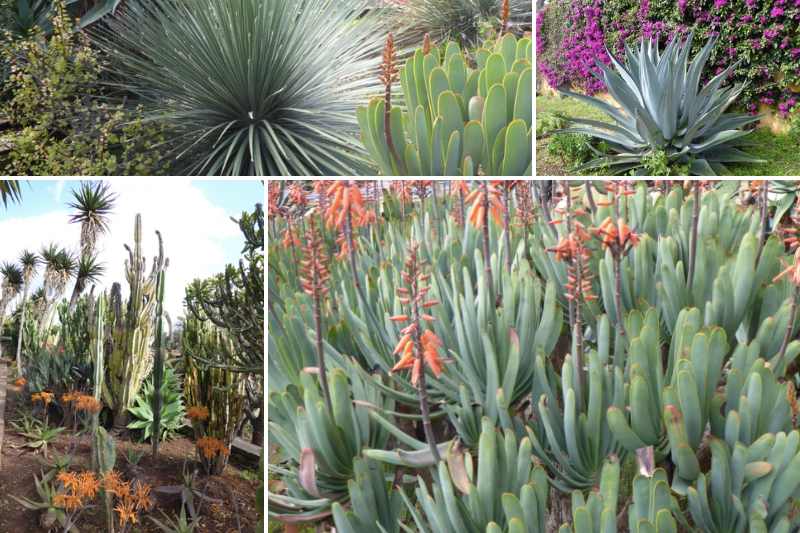
- The choreographed flowerbeds
This is one of the island's postcards: this large terrace offers a view of the bay of Funchal and an unobstructed view of the ocean, serving as the garden's belvedere. It consists of a large flowerbed in the shape of a rectangular checkerboard composed of several squares, where a series of green and purple plants are geometrically planted, resulting in a spectacular outcome. This is not the area I preferred, far from it. It even contrasts with the wild aspect of some areas of the garden, but one can admire the meticulous work of the gardeners.
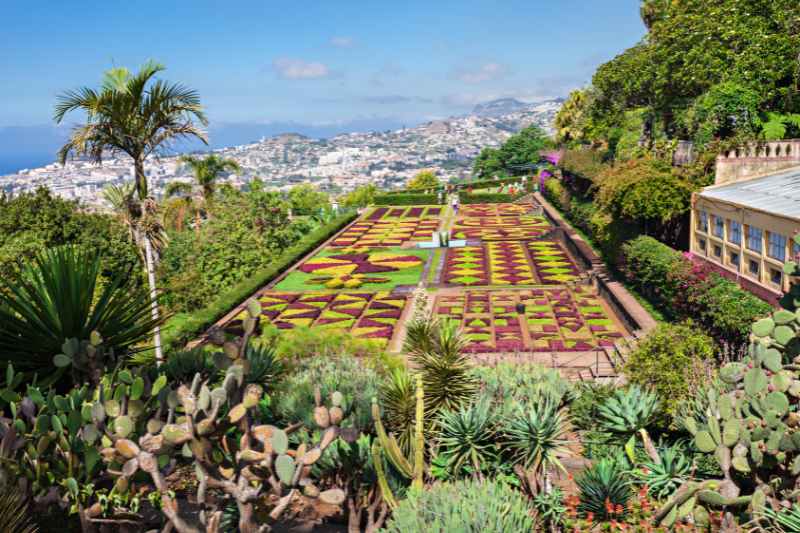
But the botanical garden of Funchal still holds many wonders, such as the palm section, to be discovered at leisure, or the strelitzia, the birds of paradise, which are also emblematic...
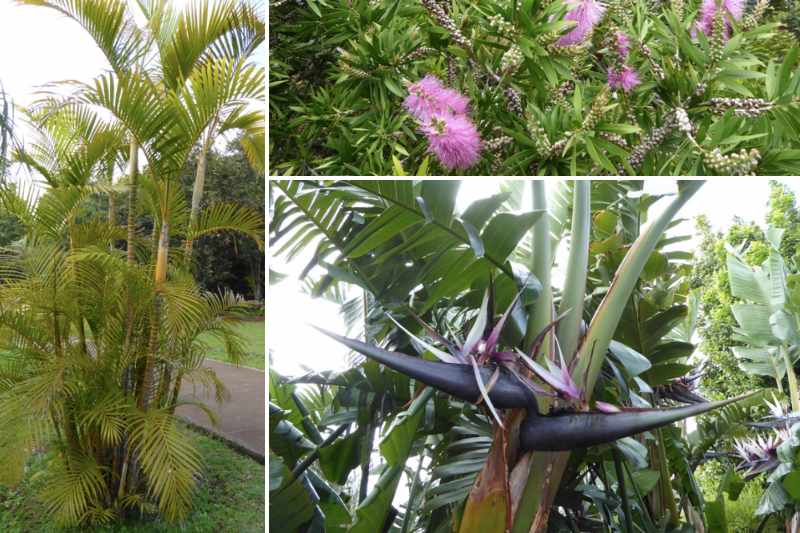
Learn more
Monte Palace Tropical Garden, open daily except 25 December from 9:30 am to 6 pm, entry 12.50 euros
Botanical Garden, open daily except 25 December, from 9 am to 6 pm, entry 6 euros
Flower Island, Atlantic Garden or the island of eternal spring… Madeira is beautifully named, and I have long wanted to explore this gem, known for its extraordinary richness of flora. Last year, I finally treated myself to a week of botanical relaxation on this enchanting island. After a three-hour flight from Nantes and a spectacular […]
Flower of celebration par excellence, Amaryllis suffers, in the eyes of some, from a somewhat outdated image. Let's be honest, when we think about it, it's often the picture of a bright red flower, a bit too high up, blooming like the bell of a gramophone that sticks in our minds...
The Amaryllis as seen by the sceptics!
It often perfectly matches the traditional colours of Christmas, but it would be a shame to keep this caricatured image and confine this flower to that period!
Why? Because:
- the Amaryllis is a valuable plant for brightening our homes all winter,
- its flowers come in a wide range of colours and last a long time,
- new varieties offer very interesting flower shapes, suitable for many styles of decoration...
- children love to follow its daily progress... which easily occupies them for 2 minutes a day while waiting for Father Christmas
Here are a few staging ideas that will prove to you that not only can the Amaryllis have style, but it can also be used in the home until spring!
Amaryllis are perfect for decorating the home at Christmas. Create atmospheres with the double Marilyn Amaryllis or the Benfica Amaryllis
Very chic, Amaryllis offer clean lines that suit classic or minimalist interiors. Opt for simple, refined varieties like 'Royal Velvet' (left photo), Christmas Gift or Amputo
Sophisticated flowers (like those of the Papilio Amaryllis or Rio Negro) fit perfectly in a natural setting.
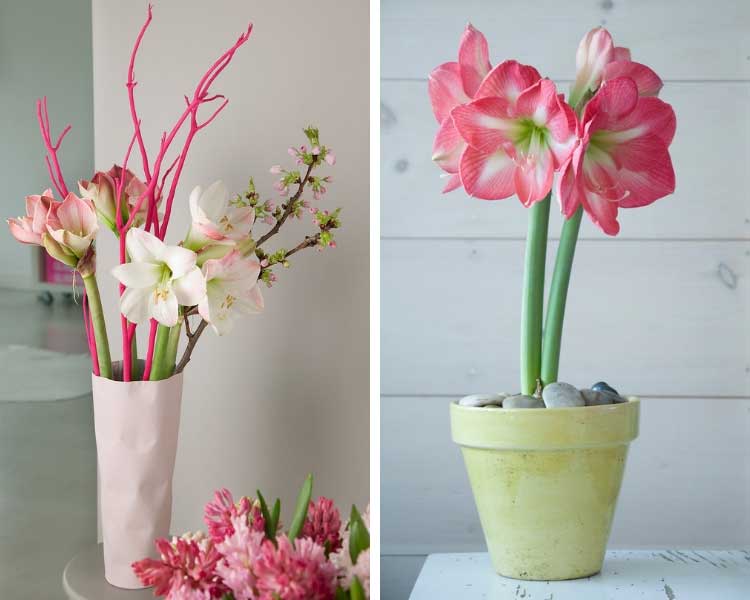
The Amaryllis is also a perfect flower for bringing spring into the home and creating "girly" scenes. Dare to use pink and varieties with striated petals like candy canes, such as the Estella Amaryllis, Sweet Nymph, Pink Surprise, Gervase or even Apple Blossom...</
Some little tips to showcase your Amaryllis:
- stage them: to shine in society, your Amaryllis need to be highlighted. For this, at home, provide a rather plain background that will enhance the elegance of their flowers. On your festive table, this could be a simple tablecloth or, at home, a coloured wall.
- accompany them: Amaryllis are sometimes criticised for their somewhat artificial look: compensate by adding natural elements like decorative branches (dogwoods are perfect, as well as holly or willow when it shows its catkins).
- carefully choose the container that holds them: the star is your Amaryllis! Opt for either a neutral pot or vase that will fade into the background, or a container that matches the desired atmosphere (earth, zinc, pot covered with simple kraft paper for natural settings, soft colours for spring...)
I hope you are now reconciled with Amaryllis! For everything you need to know about their planting and care, feel free to consult our advice sheets: "Planting an Amaryllis in a pot for indoors" and "Amaryllis: how to care for, bloom and rebloom".
Flower of celebration par excellence, Amaryllis suffers, in the eyes of some, from a somewhat outdated image. Let’s be honest, when we think about it, it’s often the picture of a bright red flower, a bit too high up, blooming like the bell of a gramophone that sticks in our minds… It often perfectly matches […]
A few years ago, I had the opportunity to do some woofing (volunteering) in the Hautes-Alpes with a willow grower – basket maker, and participated in the harvest of willow – I have wonderful memories of a field filled with a multitude of young plants of willows in vibrant colours, red – orange – yellow... a magnificent sight! I learned to make baskets from willow and discovered that living willow hedges or huts can be a stunning decorative element in a garden.
What is referred to as "willow" is Salix intended for weaving. Willow is interesting because it is very flexible and strong. It has long, slender branches that are weakly ramified and easy to weave. It is a deciduous plant: if you create a hut or a hedge from willow, it will be more open in winter, allowing views through the branches. Willow also has the advantage of providing beautiful wood and light, tender green foliage. There are many different species and varieties used for basketry, selected based on their colour and characteristics.
You can do a lot with willow! Sculptures, huts, hedges, arbors, tipis, borders... It is truly possible to have fun and create original elements! Basketry is a beautiful way to combine art and gardening. A few willow objects in a garden add a lot of charm, with a unique and creative touch.
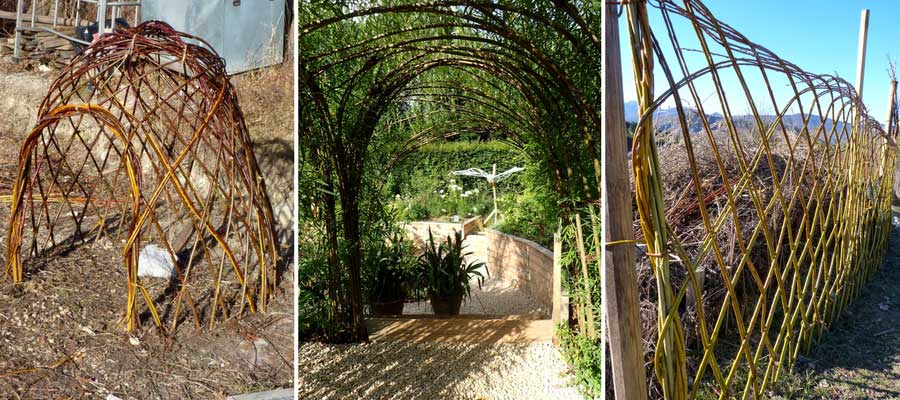
Examples of living willow creations
How to create a living willow hedge?
A living willow hedge is ideal for separating different areas of the garden or creating a boundary along the edge of a property. Very aesthetic, it adorns itself with tender green foliage in spring, and in autumn-winter, this disappears to beautifully reveal the colour of the wood and the detail of the weaving. The advantage is that you can create a custom hedge, with the height you desire, and personalise it.
Willow is a plant that does not like drought: living willow basketry is therefore more suited to soils that remain relatively cool in summer. Willow also prefers deep soils. Some willow producers sell long stems intended for the creation of a hedge. They should measure between 1 and 2 metres in length, depending on the desired height of the hedge. If you do not plant them immediately, you can temporarily keep the stems (for about two weeks) by placing them outside in a shaded spot, with the base of the stems in water. The varieties that seem most suitable for living basketry are Salix alba 'Vitellina' and Salix fragilis.
 A living willow hedge. The stems are woven two by two, crossing alternately over and under another pair of stems. (photo: Hugues-Mircea Paillet)
Plant between autumn and the end of winter, when the plant is in its dormant phase and no longer has leaves. We recommend weaving the stems two by two for added strength, although a single stem weaving may suffice for a small project.
- To plant a hedge, you should start by working the soil to loosen it while adding some well-decomposed compost. Work the area to about thirty centimetres in width and depth.
- Place a stake at each end of the hedge, then intermediate stakes spaced a few metres apart. Use a string line to ensure you plant straight.
- Stretch two horizontal wires between the stakes (at the top and in the middle) to provide stability to the hedge.
- Plant the willow stems along the string line, with the buds facing upwards. You can plant them in pairs for a small project, but we recommend grouping them in fours for a proper hedge. They should be buried 20 to 30 cm in the soil.
- Weave by taking one stem (if you planted them in pairs) or two stems (if they are in fours) each time. Cross the stems, placing them alternately underneath and then above each other. The space – the void – between the stems should form diamonds. You can secure the stems each time they cross by tying them with a raffia or willow tie.
- When you reach the end of a row (at a stake), secure the stems to the stake and then go back in the opposite direction and continue weaving.
- Water generously.
Continue to water during the first year. Willow is a fast-growing plant: it is advisable to prune it each year, in winter and possibly in summer. You can apply mulch at the base to limit weeding and keep the soil cool.
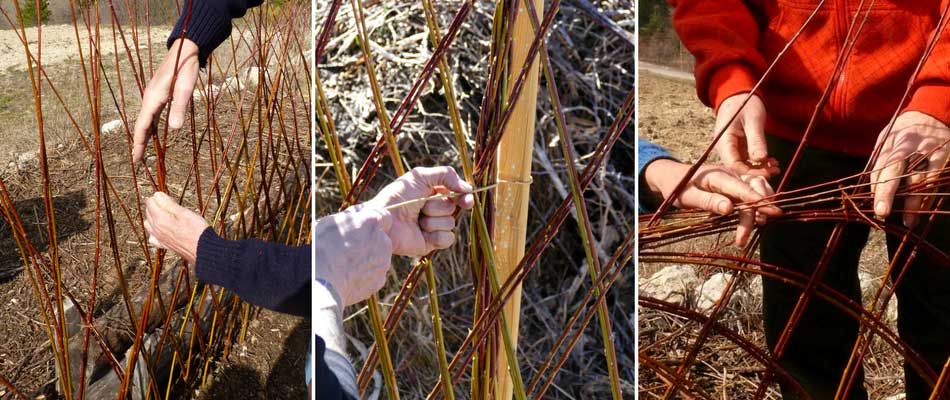 Different stages of weaving a living willow hedge (photos: Hugues-Mircea Paillet)
Further reading...
- Our range of willows and our pre-woven willows
- To discover all the techniques: "I Weave Living Willow - 10 Models to Create in Your Garden" - Terre Vivante
- Discover the basketry and weaving magazine - The Creative Link
- The website of Tresselavie, which offers training and workshops in basketry
- The website of the association The Possible Willow Grove
A few years ago, I had the opportunity to do some woofing (volunteering) in the Hautes-Alpes with a willow grower – basket maker, and participated in the harvest of willow – I have wonderful memories of a field filled with a multitude of young plants of willows in vibrant colours, red – orange – yellow… […]
Ornamental grasses have, for a few years now, their moment in the sun. And it is well deserved! Natural, airy, these wind-born beauties, look good for at least nine months out of twelve, often presenting a very different appearance as the seasons change. They are now essential in many gardens, and the horticulturists know this well, offering new varieties each year that join an already extensive range. It is therefore tricky to navigate, especially when you are just beginning to take an interest!
So here is a small selection of perennials grasses: 10 safe bets, ideal for taking your first steps into the world of "wild grasses"!
1) Calamagrostis acutiflora Karl Foerster
It is certainly one of the best-known grasses… and justified, it’s a real dependable performer! Very ornamental, this Calamagrostis offers glossy green foliage in spring and turns gold in winter. Tall and slender, it plants tall plume-like spikes, rose-bronze, in late summer. Upright as an I-beam, but not stiff, this grass does not take up much space and truly structures a border. It also has the good habit of swaying with a gentle nonchalance… a gentle nonchalance it can share with the gardener because maintenance is minimalist. In short, a concentrate of everything we love about grasses!
In the garden, it’s planted in a border, with the full range of perennials for naturalistic gardens. Of rapid growth, it is also very suitable for forming attractive screens
- Height - width: 2 m x 50 cm
- Soil: all types
- Exposure: sun, partial shade
- Hardiness: down to -15°C
- Pruning: cut back in March - April
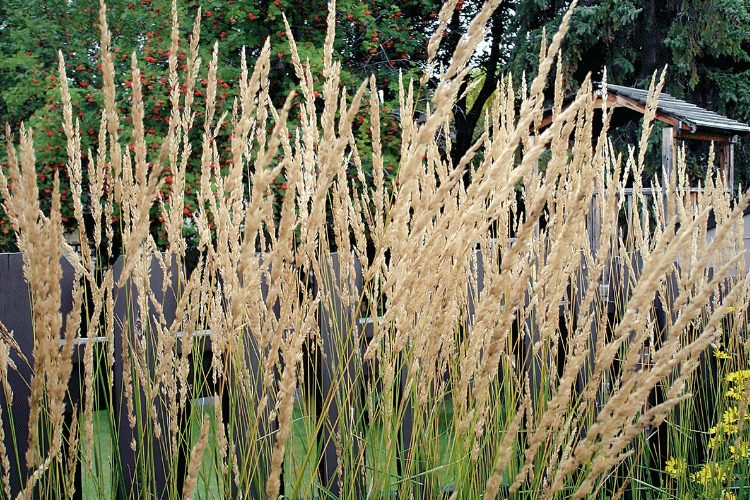
Calamagrostis acutiflora Karl Foerster
2) Carex oshimensis Everest
Bright, this carex captivates with its blue-green foliage, lightly edged with cream white, depending on exposure. Its leaves, slightly arching, give it a supple silhouette. Perfect in a border or in large pots, it grows happily in the dry shade under trees. Evergreen, it would benefit from year-round presence and will be a good companion for spring bulbs, the silvery foliage of Brunnera, for example. Graphical, it can even be planted in mass in modern gardens or in contemporary planters.
- Height - width: 30 cm x 35 cm
- Soil: cool to moist, but tolerates occasional drought
- Exposure: all, with a preference for partial shade
- Hardiness: down to -15°C
- Pruning: unnecessary, prune if needed
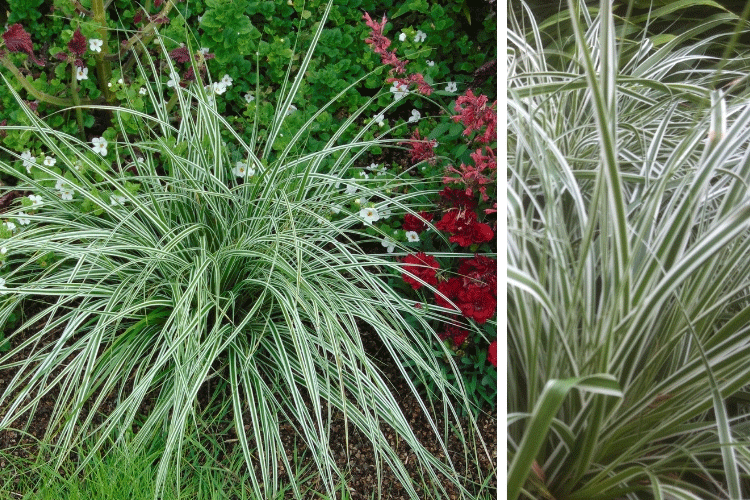
Carex oshimensis Everest® - Oshima Sedge
PS: Some readers of this blog are particularly attentive, so I should point out that the carex, botanically, is not a grass, but a Cyperaceae (not to be confused with the Cupressaceae, by the way!). Nevertheless, its fine foliage makes it common to include it in the grasses category.
3) Deschampsia caespitosa Goldschleier
This pretty variety will delight all those who love lightness and a natural look. Spectacular, this tufted grass forms a compact clump of green, very fine leaves. Evergreen, they remain present throughout the year. In late summer, they bear elegant, loose panicles, golden-yellow subtly silvered.
It is a bright grass that is very easy to use and whose appearance evokes the vast plains of wild meadows. Its translucence is very appealing in a border, and its golden then silver hue, at the end of flowering, contrasts particularly well behind dark plants.
- Height - width: 1 m x 80 cm
- Soil: rather moist, even heavy
- Exposure: sun, light shade
- Hardiness: down to -15°C
- Pruning: cut back only the dry flowering stems in March - April… and do nothing if you wish to allow spontaneous self-seeding
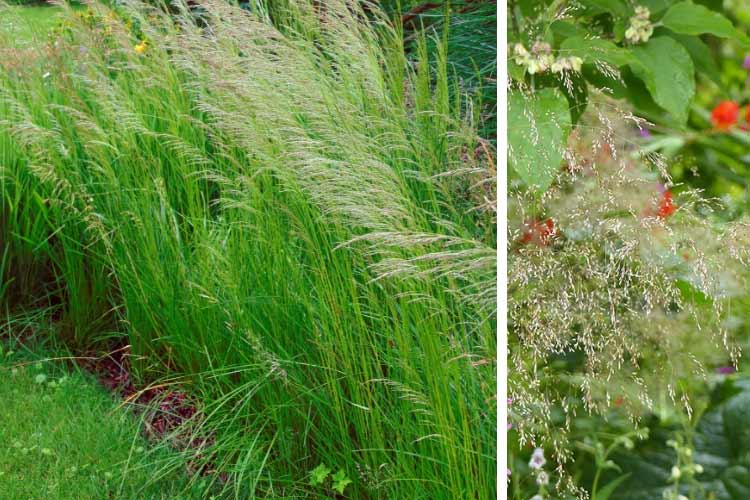
Deschampsia caespitosa Goldschleier
4) Blue Fescue Elijah Blue
This variety is an improved version of the classic blue fescue (Festuca glauca). Its tint, surprising to the uninitiated, takes on superb steel-blue highlights that further enhance its appeal. It flowers in early summer and then bears, on slender stems, fine silvery panicles.
Undemanding, it is a low-growing grass that forms fairly dense hemispherical tufts. It is perfect for difficult spots as it tolerates dry and poor soils. It is also the most durable variety!
Delightful in a border, this fescue can also be used to create “drifts” of blue grass. Its colour, unusual, is easier to pair than it seems. It enhances both greens and pinks and purples… In the garden or in a pot, do not hesitate to mix it with heathers or with Heucheras too!
- Height - width: 25 cm x 25 cm
- Soil: dry, poor
- Exposure: sun, light shade
- Hardiness: down to -15°C
- Pruning: cut back the flowering stems and, if needed, shorten the fine foliage in late February
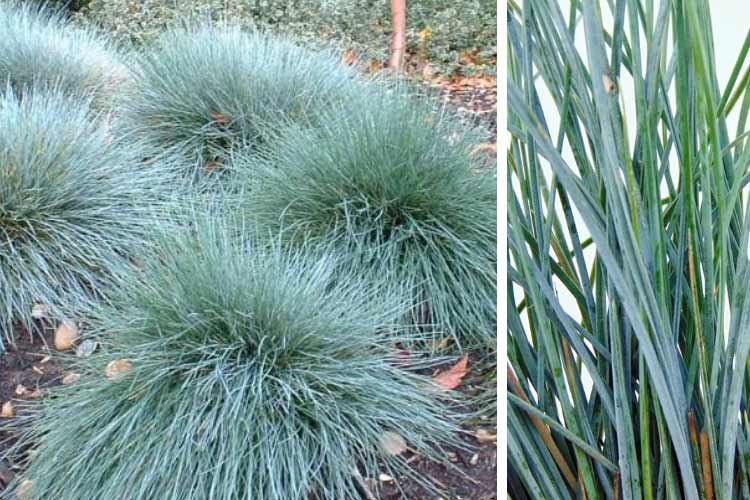
Blue Fescue Elijah Blue - Festuca glauca
5) Hakonechloa macra All Gold
Hakonechloa macra All Gold is a very decorative Japanese grass that stands out for the graphic quality and brightness of its foliage. It forms a large cushion of arching leaves, giving it a cascading look. It is a shade- and partial-shade-loving plant that thickens slowly and can live for many years in moist soil. In the garden, save it for woodland-style settings where it will pair wonderfully with Japanese maple trees, hostas, ferns…
- Height - width: 40 cm x 50 cm
- Soil: humus-rich, cool to moist
- Exposure: shade, partial shade
- Hardiness: down to -15°C
- Pruning: unnecessary… it is a nearly self-cleaning grass; the old foliage detaches very easily as the next shoots arrive in spring.
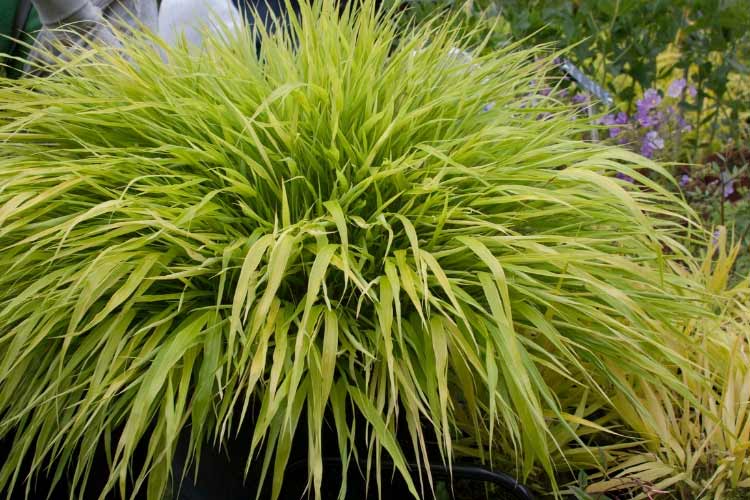
Japanese Forest Grass - Hakonechloa macra All Gold
6) Molinia arundinacea Transparent
Do you know many plants that stand out for their transparency? Here is one! Mist-like, this tall evergreen grass with arching leaves shines with the delicacy of its golden flowering and the slender stems that bear them. Preferring clayey and moist soils, this Molinia grows quickly. Architectural, graphical, it pairs with almost anything and will also benefit from the rays of a setting sun. Despite its height, the panicles form a very light cloud; you can plant it at the border of a border and pair it with plants in bright colours (Dahlia, Rudbeckia, Helianthus…) to temper the colours and bring a more natural touch.
- Height - width: 1.80 m x 60 cm
- Soil: humus-rich, cool to moist
- Exposure: shade, partial shade
- Hardiness: down to -15°C
- Pruning: cut back only the dry flowering stems in March - April
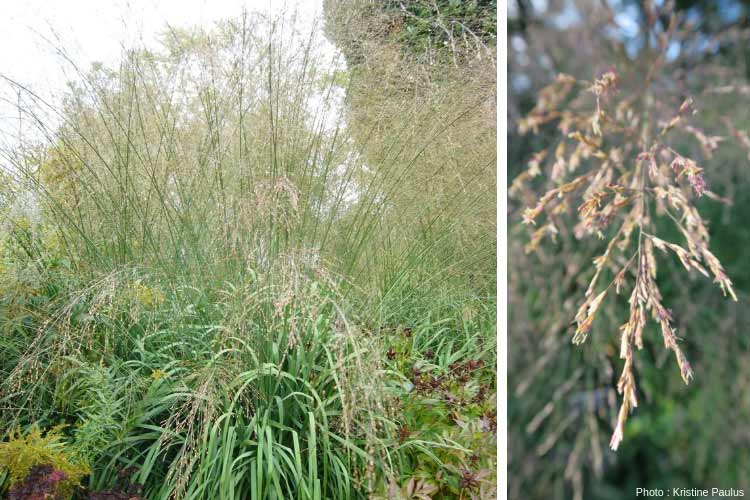
Molinia caerulea ssp arundinacea Transparent
7) Miscanthus sinensis Gracillimus
True "best-seller", highly regarded in contemporary gardens, this Miscanthus or Eulalia is also the oldest. Suffice to say, it has stood the test of time! It forms a handsome clump of very fine leaves, edged by a white central vein. Its flowering, quite late, occurs at the end of September. Then pretty plume-like inflorescences appear, coppery while the foliage turns gold.
This Miscanthus is also very versatile. It can be planted as a specimen, in a border with autumn-flowering perennials and even as a hedge. Also know that it is a plant that can be useful: its leaves, chopped, make an excellent mulch.
- Height - width: 1.80 m x 60 cm
- Soil: rich, cool, but well-drained
- Exposure: sun
- Hardiness: down to -15°C
- Pruning: cut back in March - April
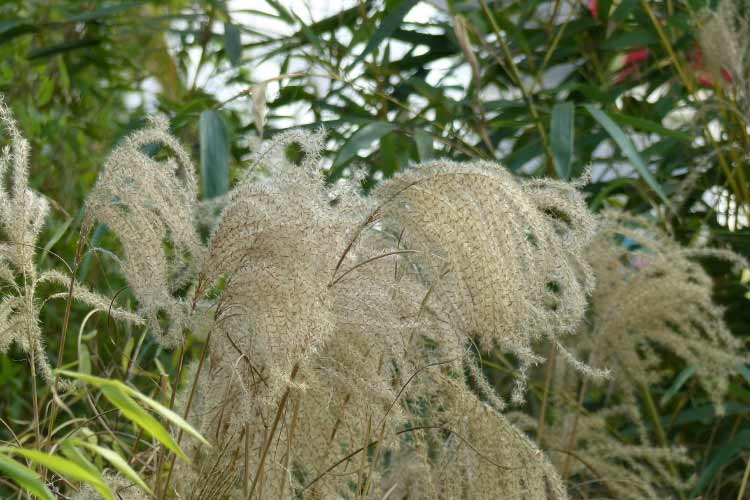
Miscanthus sinensis Gracillimus - Eulalia
8) Panicum virgatum Rehbraun
This Panicum virgatum (often called the “Switch Grass”) is an excellent variety. It stands upright and its foliage and flowers take on vibrant red and orange hues in late summer. Truly spectacular, this North American native grass also shows great tolerance. It withstands both drought and wet conditions… and boasts remarkable hardiness. In the garden, pair it with other grasses or plant it with shrubs showing autumn colours (Berberis, Euonymus fortunei 'Red Cascade'…), it will be perfect to complete the scene.
- Height - width: 1.20 m x 50 cm
- Soil: tolerant
- Exposure: sun
- Hardiness: down to -15°C
- Pruning: cut back in March - April
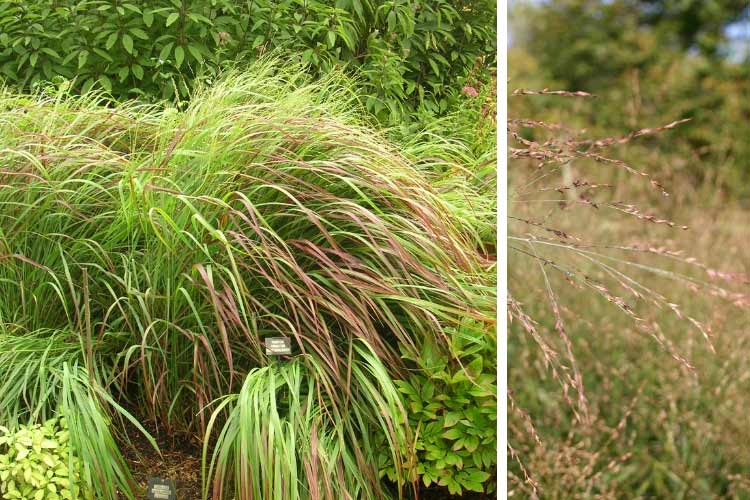
Switch Grass Panicum virgatum Rehbraun
9) Pennisetum alopecuroides Hameln
This fountain grass variety is a must-have! Medium-sized (about 50 cm tall), it forms a compact tuft of narrow leaves. It shows, in late summer and autumn, a flowering of gentle cream-white spikes turning brown at maturity. Its ornamental interest lasts into winter, especially when frost dresses its pretty seed-heads. Versatile and easy to grow, Pennisetum 'Hameln' can be used over large areas, as a ground-cover, or at the border. In a border, it is striking with perennials a little wild such as Echinacea, Gaura, or Verbena bonariensis. And like all autumn-flowering grasses, it is perfect with Asters.
- Height - width: 50 cm x 50 cm
- Soil: tolerant provided it is well-drained
- Exposure: sun
- Hardiness: down to -15°C
- Pruning: cut back in March - April
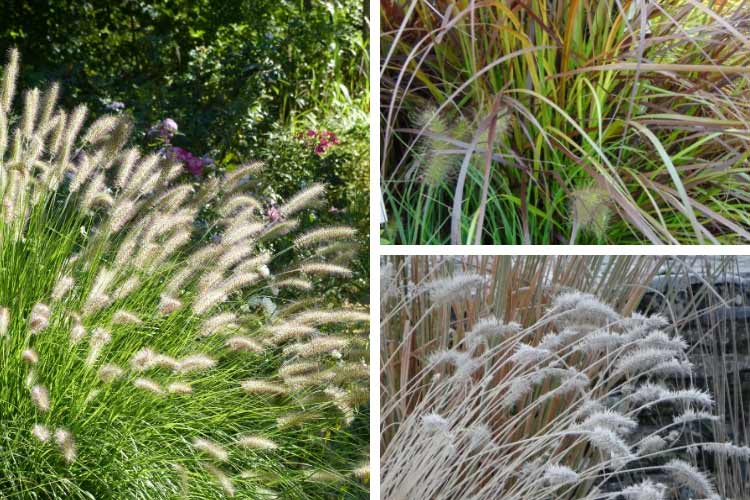
Pennisetum alopecuroides Hameln
10) Stipa gigantea
In the Stipa family, we know well the “angel hair” (Stipa tenuifolia), but much less its very tall sister: Stipa gigantea. Spectacular, this giant oat shines with its height (about 200 cm) and the lightness of its flowering. It forms a dense tuft of very fine blue-green leaves topped in summer by delicate purple-silver awns that turn gold. Native to the Mediterranean basin, this grass grows well almost anywhere and fears only two things: waterlogged soils in winter and climates too harsh. In the garden, it is ideal for introducing verticality and pairs very well with summer perennials such as Echinops, Gaura, or Verbena bonariensis, and with shrubs that colour beautifully in autumn (Berberis, Euonymus fortunei 'Red Cascade'…), it will be perfect to complete the scene.
- Height - width: 2 m x 1 m
- Soil: tolerant provided it is well-drained
- Exposure: sun
- Hardiness: down to -10°C
- Pruning: cut back only the dry flowering stems in March - April
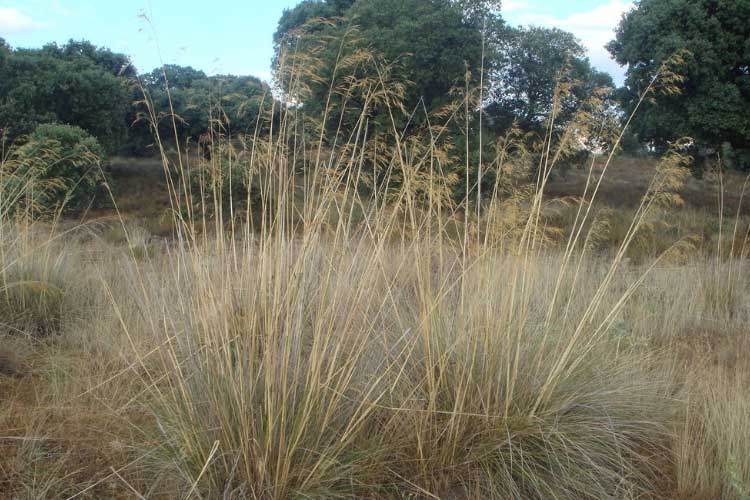
Stipa gigantea - Giant Stipa
→ Watch Stipa gigantea in our video 'Grasses for Summer'
If this shortlist has made you want to learn more about grasses, don’t hesitate to explore the different guides and tips we have dedicated to them on Promesse de fleurs, in the garden!
Ornamental grasses have, for a few years now, their moment in the sun. And it is well deserved! Natural, airy, these wind-born beauties, look good for at least nine months out of twelve, often presenting a very different appearance as the seasons change. They are now essential in many gardens, and the horticulturists know this […]
The exotic-style garden is attracting an increasing number of gardeners. Bamboo, palm trees, and banana plants are among the most popular plants for creating scenes that evoke the tropical jungle, but there are many others! To make this dream accessible and sustainable, both outdoors and even in cold climates, there is only one option: to choose truly hardy plants that can withstand winter's harshness. Here is a small selection of our favourite plants (bushes and perennials)!
1) Trachycarpus fortunei, known as "Hemp Palm" - Hardiness: -18 °C
No, palm trees are not just on the Croisette… they can also be found in northern France, for example, with the Trachycarpus fortunei, which can withstand temperatures down to -18 °C. This ability to face the cold comes from its mountainous origins (China and Japan) as well as the thick fibre that protects its trunk. It can reach heights of 8 to 10 metres and prefers rich, light soil, thriving in full sun or partial shade.
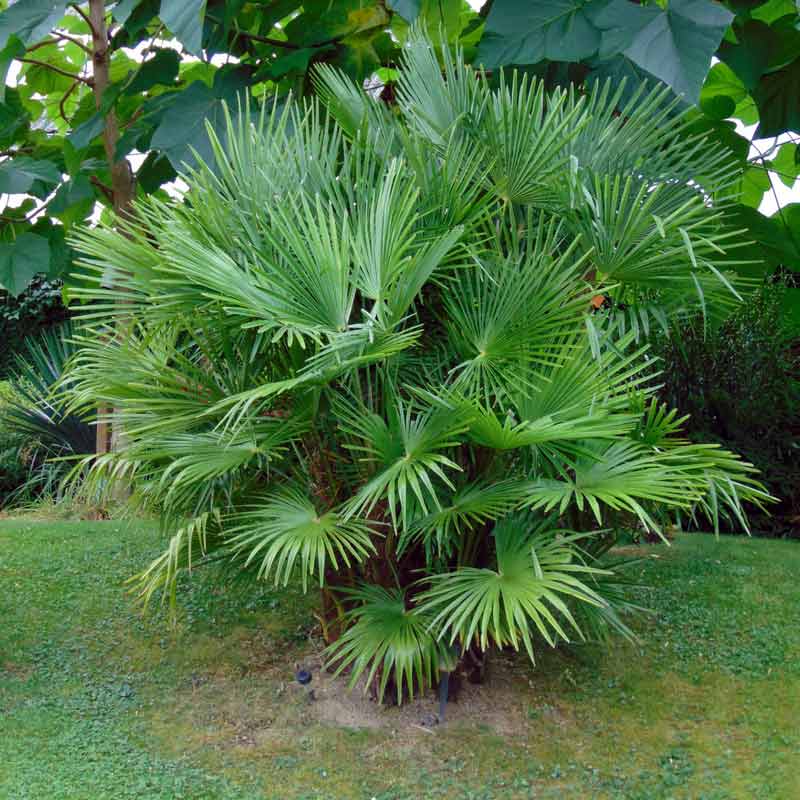
2) The Banana plant or Musa basjoo - Hardiness: -12 °C to -15 °C
The Musa basjoo is an outdoor banana plant, hardy, also known as the "Japanese Banana". It is a valiant plant that generally does not produce fruit but displays its large decorative leaves each year. It can grow over 2 metres tall, and even more if you ensure it receives what it needs: regular watering and rich soil. Its only weakness lies in poor wind resistance. If you don’t want its leaves to be turned into sad little brooms, it is essential to protect it by planting it in a sheltered area or a walled space.
Slightly less hardy but still quite resilient, also discover the Sikkim banana (or Sikkim Banana) Red Tiger, a variety with graphic leaves, light green with a purple underside, elegantly striped with burgundy.
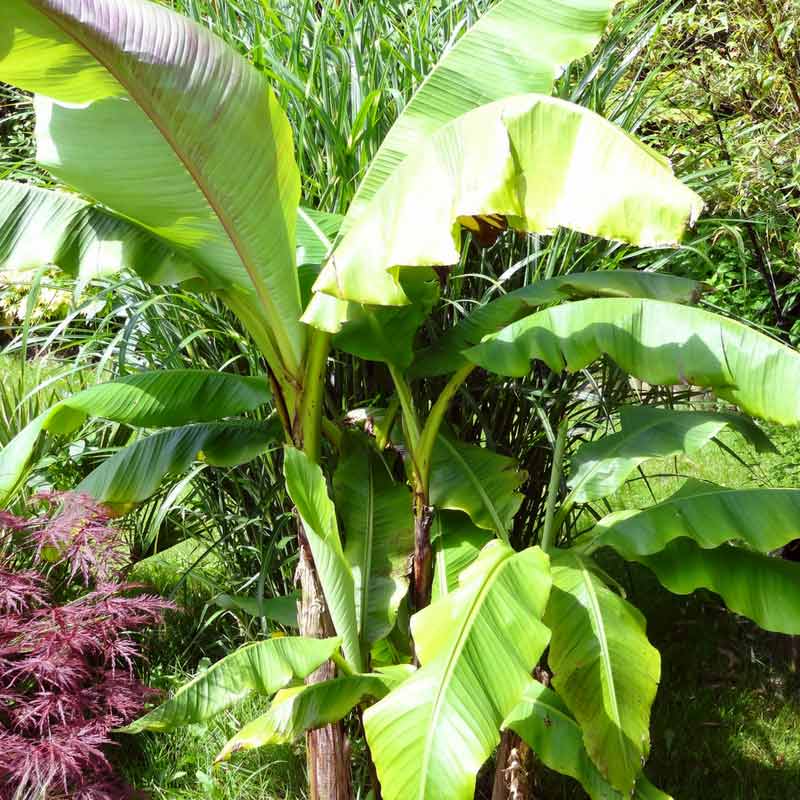
3) Bamboos: Phyllostachys vivax and Fargesia robusta - Hardiness: -20 °C and -15 °C
Bamboos are among the classics of exotic gardens, but their hardiness varies greatly depending on the species and varieties. Among the most spectacular, we particularly like the Phyllostachys vivax 'Huangwenzhu', a giant bamboo (running… plan for a rhizome barrier) that can grow its green canes striped with yellow to over 10 metres tall. Fast-growing, it will quickly form a small forest. Relatively smaller in size (4 to 5 metres tall) and non-running, the Fargesia robusta is better suited for small gardens. It features long green leaves and bright green culms.
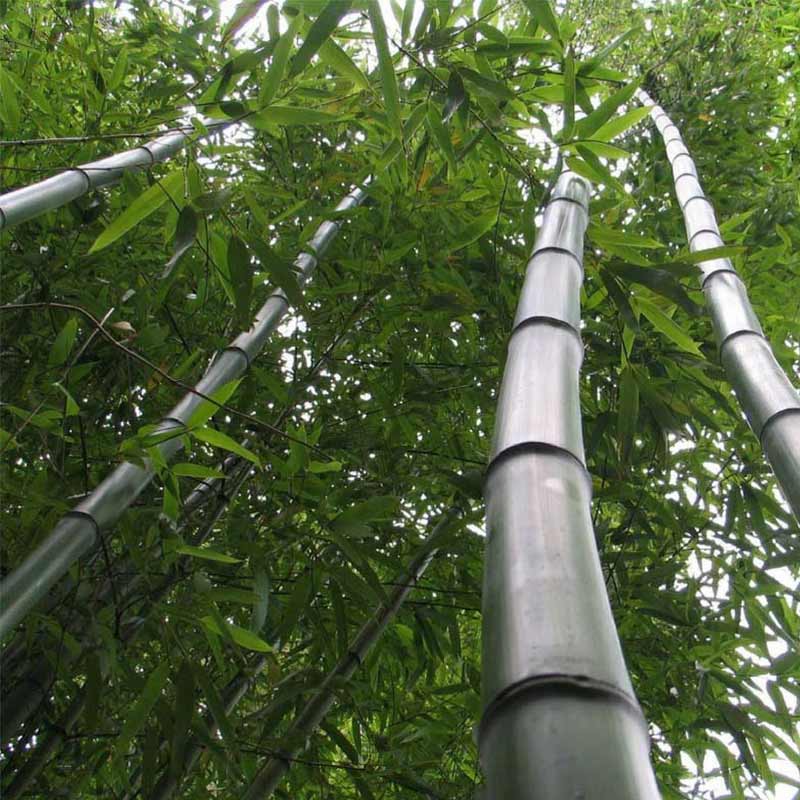
4) Fatsia japonica Spider's Web - Hardiness: -15 °C
The Fatsia japonica 'Spider's Web' is a shrub with a unique personality! About 2 metres tall, this Aralia showcases dark green, evergreen foliage splashed with cream-white. Its palmate leaves can reach up to 20 cm in diameter. In summer, they are topped with round white flowers that later turn into decorative black berries. This shrub thrives in shade or partial shade, in cool soil.
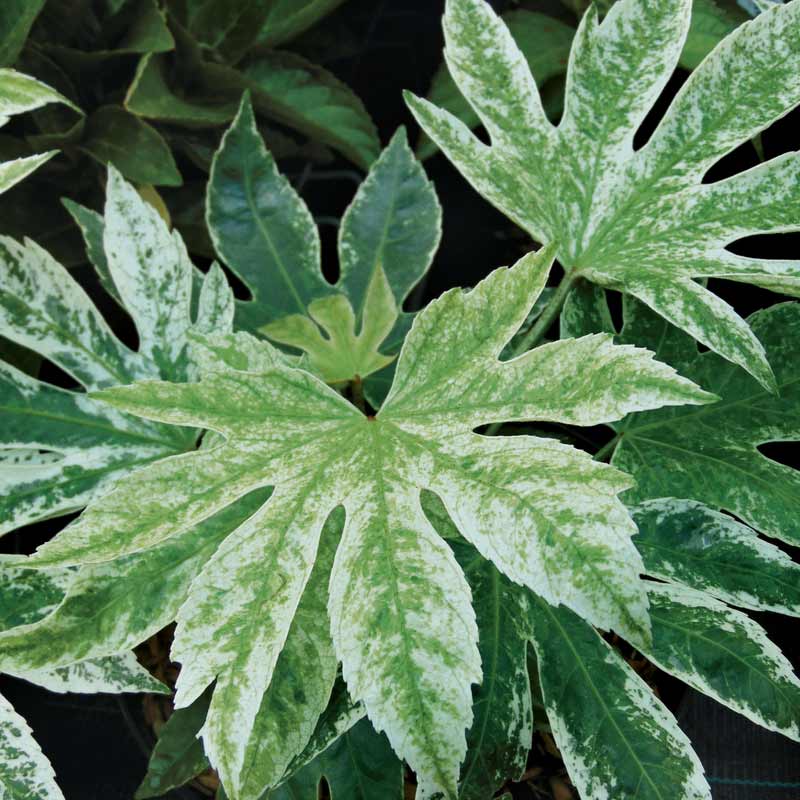
5) Tetrapanax papyrifera Rex, Rice Paper Plant - Hardiness: -10 °C
Halfway between a shrub and a perennial, Tetrapanax papyrifera 'Rex' is an exuberant plant that captivates with the XXL size and cut shape of its leaves that spread out like a parasol. Native to China and Japan, it is a rhizomatous plant, like bamboo, that tends to spread and may require a rhizome barrier. It grows in non-burning sun or partial shade, in fertile and rather cool soil. Its loose habit and Asian charm make this plant a perfect complement to bamboos.
Note that the aerial parts of this plant are destroyed at -5 °C, but it will regrow from the rootstock above -10 °C, once well established.
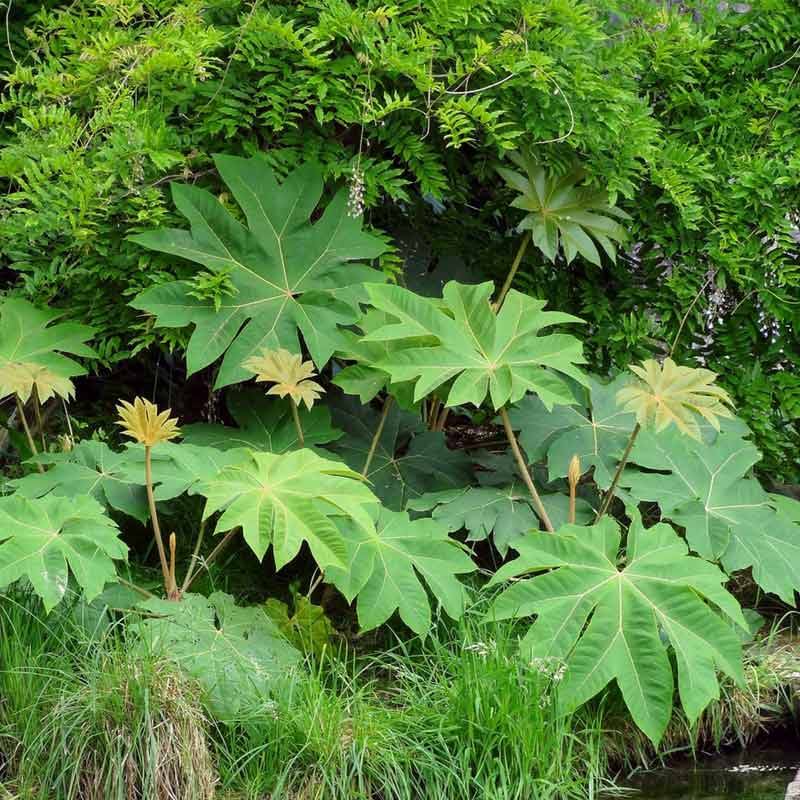
6) Colocasia Pink China - Elephant Ear - Hardiness: -10 °C to -12 °C
Lush, the Colocasia 'Pink China' stands out for the heart-shaped form and the colour of its large foliage: a lovely soft blue-green that contrasts with the pink of its petioles. Well known to houseplant enthusiasts, this colocasia can be grown in the garden, provided you mulch it to protect it during winter. It is planted in full sun or partial shade, in cool, humus-rich soil, and appreciates regular watering in summer.
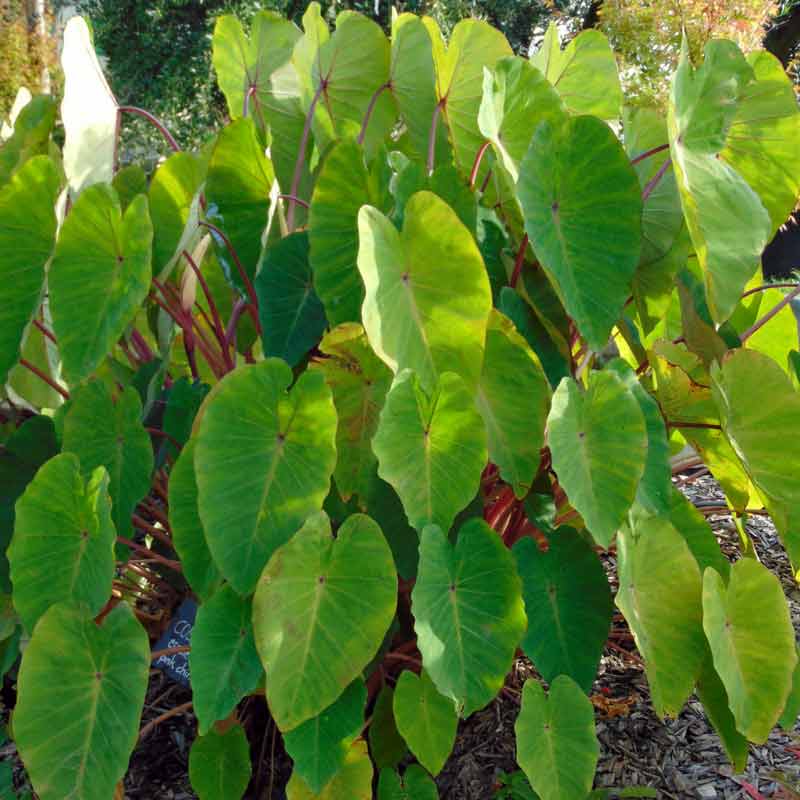
7) Astilboides tabularis - Hardiness: -20 °C
The Astilboides tabularis (sometimes called Rodgersia tabularis) is a spectacular woodland plant that stands out for its large, entire, rounded leaves, about 60 cm in diameter. It quickly forms a clump that can reach 1 metre high and 70 cm wide, or even more if the soil suits it. Its generous foliage is accompanied, in early summer, by light, creamy-white spikes of flowers. It is an ideal perennial for shade, thriving in rich, cool, but well-drained soils.
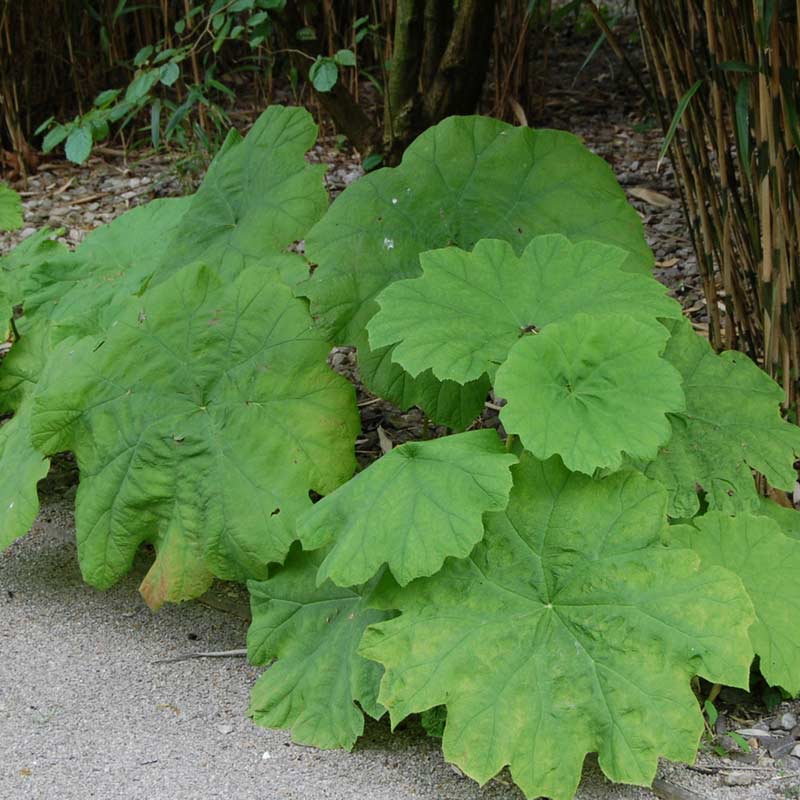
8) Dryopteris wallichiana, Large golden-scaled fern - Hardiness: -15 °C
Majestic, Dryopteris wallichiana is a large fern that unfurls a remarkable cut foliage highlighted by a black vein in spring. Of tall stature (1 to 1.5 metres high) and beautiful appearance, it somewhat resembles tree ferns, especially as its short basal trunk develops with age. It is a variety that is quite easy to cultivate, thriving in deep, very rich humus soil. It will look stunning in a border and can be accompanied by another hardy fern: the Eastern Ostrich Fern (Matteuccia orientalis).
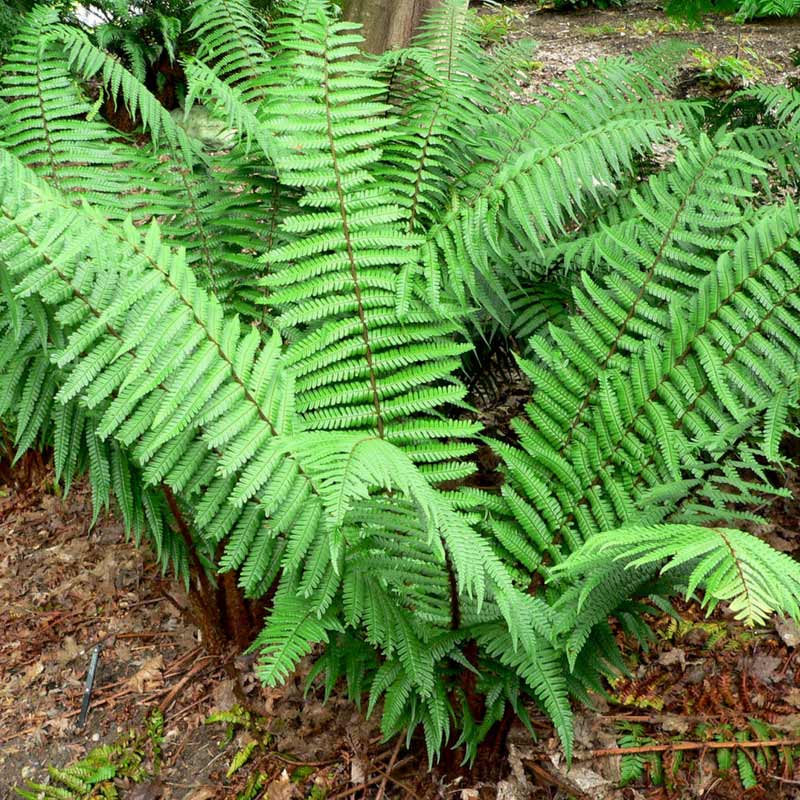
9) Hosta Empress Wu
Hostas are well known for their hardiness and ability to grow in shade or partial shade. While some fit easily into classic borders, others offer such abundant foliage that they easily find their place in a tropical-looking garden. This is the case for the giant Hosta 'Empress Wu', certainly the largest variety that can reach 1.3 metres in all directions in just a few years and displays magnificent blue-green foliage. It is a perennial that requires nourishment and water to express its full potential.
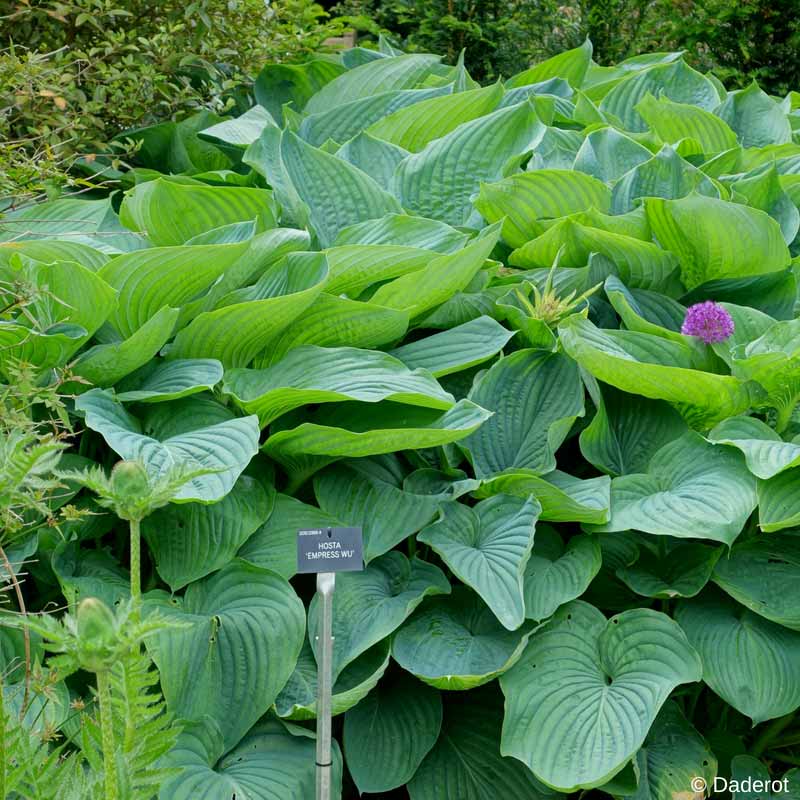
10) Begonia grandis evansiana - Hardiness: -15 °C
Begonias are not just for window boxes: Begonia grandis evansiana, a botanical species, perennial and resistant down to -18 °C here is proof! Its heart-shaped green foliage forms a beautiful bushy clump about 80 cm high and 50 cm wide, adorned throughout the summer with numerous small pink flowers borne on reddish stems. It can be grown in the ground or in pots, ideally in partial shade and in rich, cool soil.
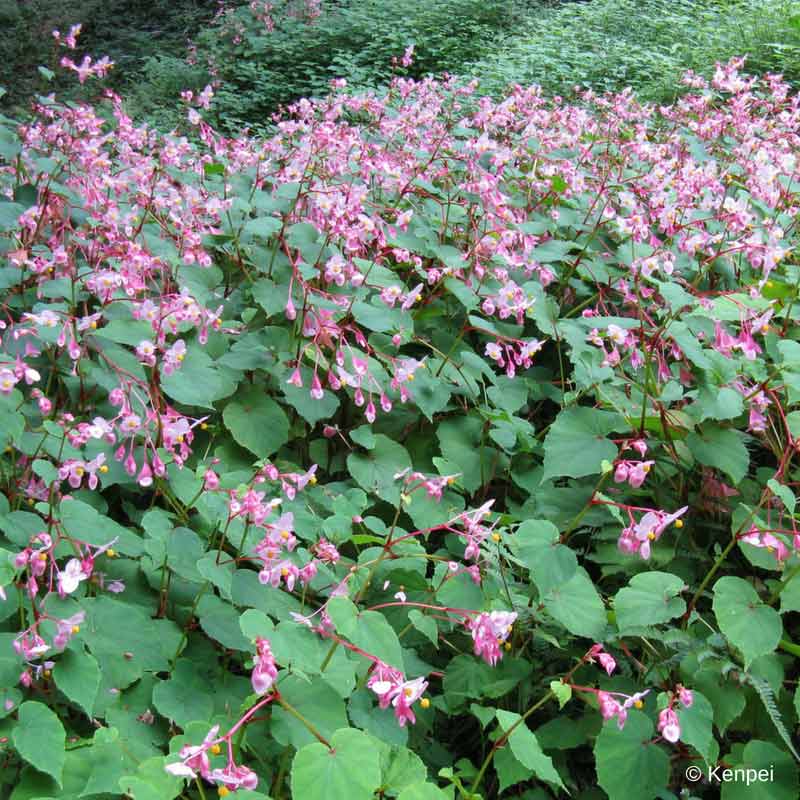
The exotic-style garden is attracting an increasing number of gardeners. Bamboo, palm trees, and banana plants are among the most popular plants for creating scenes that evoke the tropical jungle, but there are many others! To make this dream accessible and sustainable, both outdoors and even in cold climates, there is only one option: to […]
I had the opportunity to learn basketry a few years ago while volunteering with a basketmaker who grows willow. This technique, which consists of weaving plants, is an art accessible to everyone and requires little in the way of resources (and few tools)... Especially as plants suitable for weaving are easy to find in the wild! There is something quite fascinating about assembling the rods, passing them over and under one another, and watching an object gradually take shape. Basketry is a task of patience. It is a craft that is disappearing, and basketmakers have become quite rare in France, because the craft is time-consuming and therefore costly... However, for personal use it is still possible to have fun weaving willow!

Basketry consists of weaving rods by passing them from one side to the other around fixed vertical rods that serve as uprights (photo Marthe Lelievre)
Various uses in the garden
Basketry is often used to make willow baskets, but you can also create many items for the garden: a nest box for birds, supports for climbing plants, partitions to separate different parts of the garden, small edging for flowerbeds... Hedges, screens, arbors, pergolas, tipis, playhouses for children... Just let your imagination run free! Basketry makes it possible to create genuine works of art and plant sculptures. Possibilities are endless, and woven objects fit easily into garden furniture.
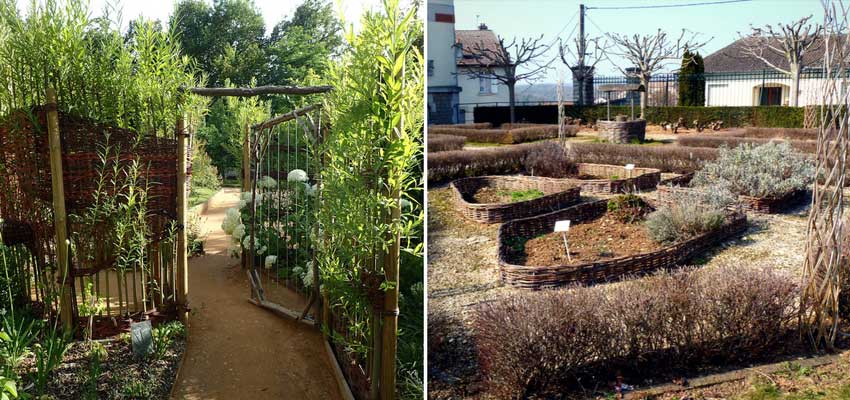
Willow fits easily into garden settings! Left, in the garden "A la recherche du lupin blanc", at Chaumont-sur-Loire Garden Festival (2017). Right, in front of Ecole Nationale de vannerie de Fayl-Billot (photo Ji-Elle).
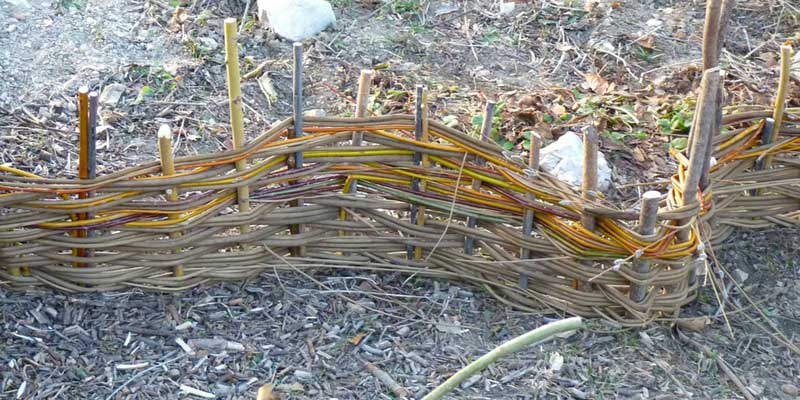
A small willow edging can be integrated into a garden to define flowerbeds, for example (photo: Hugues-Mircea Paillet)
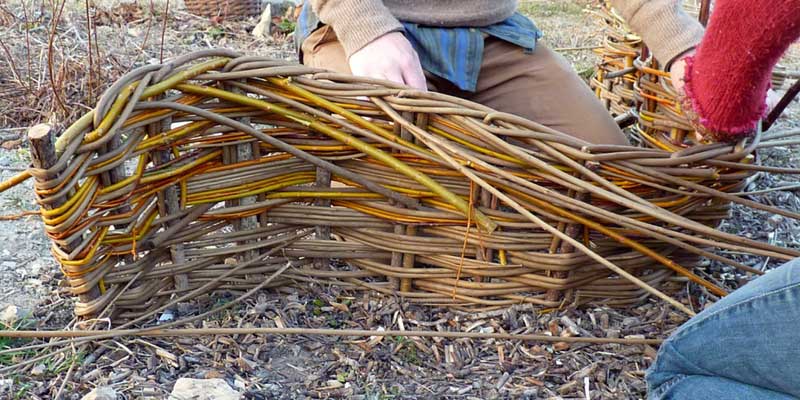
Weaving a willow edging (photo: Hugues-Mircea Paillet)
Grow your own willow?
The willow rods used for basketry are actually branches of willow intended for weaving. It is perfectly possible to grow willow for this purpose. Many varieties exist, which allows you to obtain different colours! Species commonly used are Salix triandra, Salix purpurea, Salix alba and Salix viminalis, and one of the best varieties for basketry is Salix triandra 'Noir de Villaines'. Willow multiplies very easily by propagation by cuttings, and many willow growers and basketmakers sell cuttings. Feel free to grow willow: besides providing material for weaving, it can be used for medicinal purposes (its bark contains salicylic acid, close to aspirin), for RCW (mulch) or as a rooting stimulant to help your cuttings take root (willow water can replace rooting hormone). Plant preferably at the end of winter, around March, in deep soil that stays relatively cool in summer. You can also buy willow rods ready for weaving directly from basketmakers! You can find raw, natural willow rods and rods from which the bark has been removed to obtain a white-coloured rod.
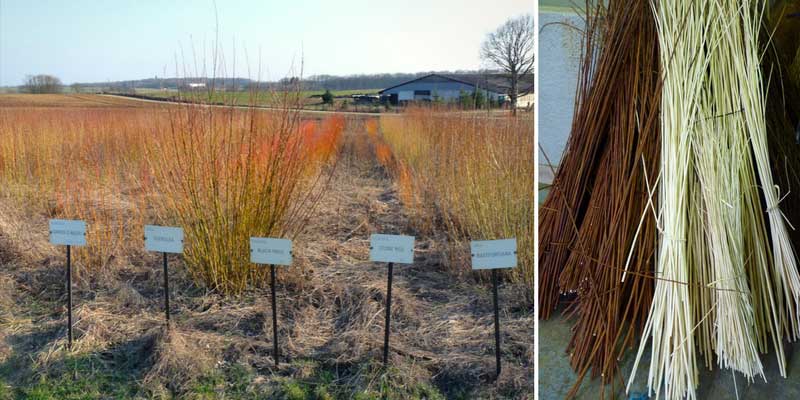
A willow bed: willow cultivation intended for basketry (photo Ji-Elle) / Bundles of willow rods ready for weaving (photo Marthe Lelievre). White rods are peeled willow, from which bark has been removed.
... or harvest it in the wild?
You can easily find wild willow suitable for weaving. Species used for basketry (Salix alba, S. purpurea, S. viminalis and S. triandra) grow wild in France, mainly along watercourses. You can look for and harvest them. Choose the longest, straightest, relatively thin branches. And although willow is by far the most used species in basketry, many other plants can be used! These include hedge clematis, dogwood (Cornus sanguinea), hazel, honeysuckle, hops and rush, to name a few. You can even mix several species to obtain different colours, for example by using some dogwood branches within a willow structure.
Harvesting is done from late November–early December through to February, when the plant is dormant (leaves have fallen and sap has not yet risen).
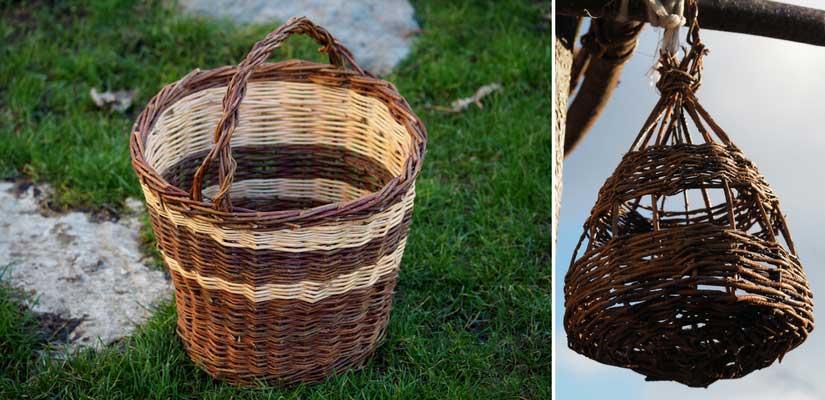
A basket I made / a nest box for birds
Further reading...
Basketry is a somewhat technical art... If you are interested, many basketmakers offer workshops or training! Also discover books written on the subject.
- La Vannerie Sauvage, by Bernard Bertrand, published by Editions de Terran. A superb book in two volumes that explains how to weave wild plants. Each volume comes with a DVD.
- Ecole Nationale d'Osiériculture et de Vannerie in Fayl-Billot, unique of its kind, offers courses that prepare students for the profession of basketmaker.
- Website of Tresselavie, which offers workshops and training
- Website of L’Oseraie du possible, a basketmakers' collective
I had the opportunity to learn basketry a few years ago while volunteering with a basketmaker who grows willow. This technique, which consists of weaving plants, is an art accessible to everyone and requires little in the way of resources (and few tools)… Especially as plants suitable for weaving are easy to find in the […]
Large conifers are essential trees for structuring and balancing a garden in both winter and summer. Their rapid or slow growth, their evergreen or deciduous needles, their decorative cones, and their varied silhouettes are all ornamental criteria that affirm the character of a garden and give it its visual identity. Conifers "sign" the landscapes, highlight the architecture of buildings, and set the tone for a contemporary, Japanese, or more classic garden.
To clarify things a bit and to give you some ideas at the start of this year, I present my 5 favourite large conifers. Choose according to your style, your space, and let your desires guide you.
1) Atlas Blue Cedar (Cedrus libani ssp. atlantica ‘Glauca’), for a classic, "French-style" garden
Among large conifers, the Blue Cedar is surely one of the most commonly planted species in our gardens. Quite hardy, easy to cultivate, and low-maintenance, this large conifer with a very spreading habit creates a breathtaking spectacle on its own. Almost as tall as it is wide (about 15-20 m high and 10-15 m wide), the Atlas Cedar has a pyramidal shape that broadens over time to become tabular. Its lateral branches, adorned with bluish needles that blend with the sky, form a harmonious fan-shaped silhouette that is easily identifiable from afar.
Thanks to this remarkable landscape structure, it is easy to understand why this conifer is often planted in isolation, usually standing proudly in the middle of a large lawn, thus enhancing the surrounding landscape or the architecture of a home. A minimum garden area of 2000 m² is required to appreciate the spreading silhouette of this tree. And there’s no need to plant other trees nearby; its presence is so imposing that it constitutes a strong focal point in the garden. Allow a planting distance of at least 20 m from a house or another tree. Slow-growing in its juvenile stage (a bit faster as an adult), this conifer only forms its definitive silhouette after several decades, so patience is required!
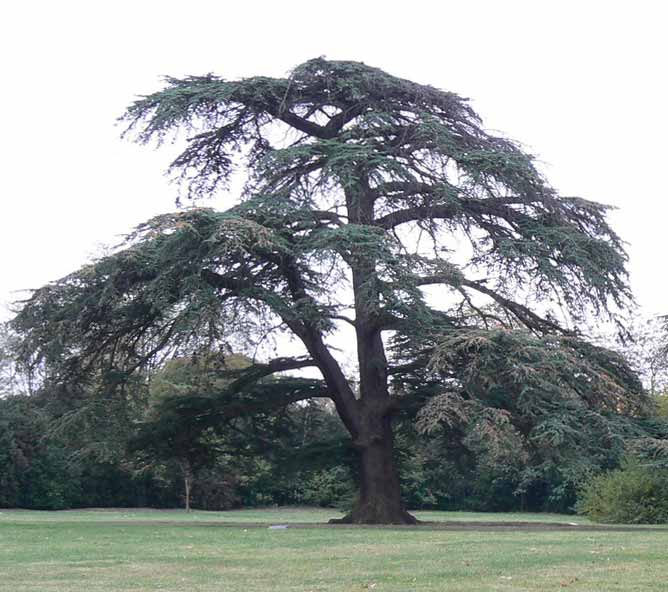
An old specimen of Atlas Blue Cedar in the middle of a large park. If the lower branches are not pruned, the tree branches more easily and offers this striking tabular shape.
NB: Despite its species name "libani," this Cedar does not originate from Lebanon but from Morocco, where it thrives in the Atlas Mountains. The Atlas Cedar is a geographically isolated subspecies of the Cedar of Lebanon that has evolved independently from its original species.
2) Chinese Sequoia (Metasequoia glyptostroboides), for a natural, fresh, and humid garden
Despite its evocative name, this conifer is not a giant, unlike its American cousins Sequoiadendron giganteum and Sequoia sempervirens. The first thing you notice about this conifer is its trunk. Channelled, deeply fissured, and sometimes swollen, it looks like it came straight out of a fantasy tale. Also very decorative, its light foliage, a lovely fresh apple green, turns tawny in autumn. Like the larch, Metasequoia is a deciduous conifer. There’s no need to collect its leaves: its fine needles decompose very quickly and make excellent compost.
Native to China, this pyramidal conifer reaches heights of 25 to 35 m in our gardens. This may still seem quite tall, but this conifer has the advantage of adapting to its environment. It is only when planted in isolation that it can reach a spread of about 10 m, but as soon as it grows near other trees, its shape narrows and its trunk elongates to grow taller. Thus, it can easily be integrated into a large border without occupying too much ground space. It thrives in acidic, fresh, even humid, and rich soils. It is under these conditions that its growth is rapid, growing 50 cm to over a metre per year.
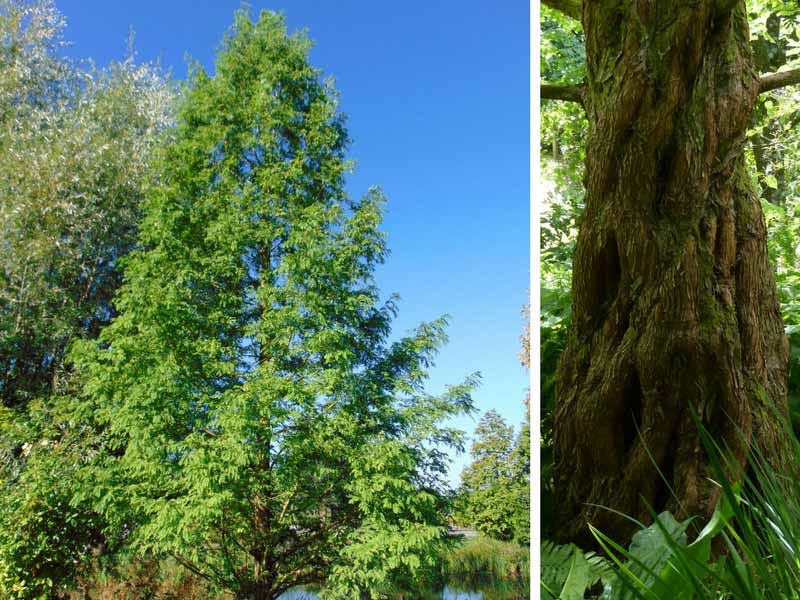
On the left, the Metasequoia with its light branches. On the right, the trunk.
NB: Do not confuse Metasequoia with Taxodium. Growing in wet areas, with a similar trunk appearance and deciduous foliage, these two conifers are very similar in appearance. How to distinguish them? The Metasequoia has opposite foliage (alternate on the Taxodium) and does not produce pneumatophores.
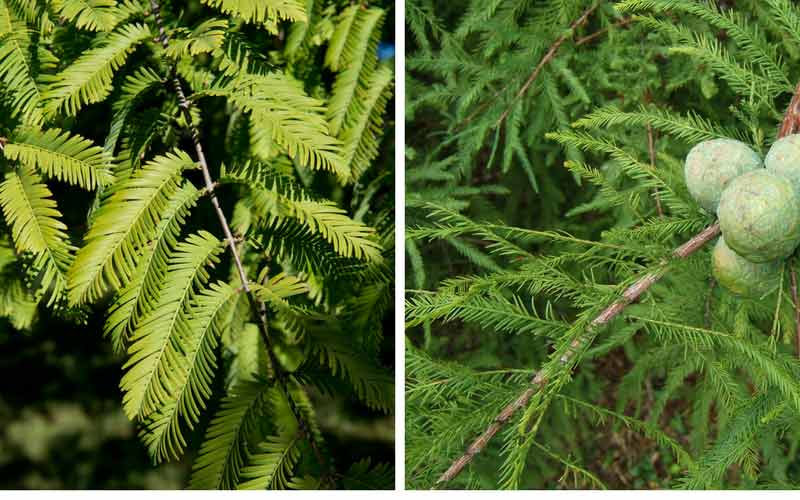
On the left, a branch of Metasequoia; on the right, a branch of Taxodium.
3) Scots Pine (Pinus sylvestris), for a contemporary garden with a southern accent
This is the common pine that grows in many European forests. Close to the Landes Pine (Pinus pinaster), with which it shares the same broad and often twisted silhouette when mature, the Scots Pine prefers the cold and is better suited to northern regions than its southern cousin.
While its silhouette is initially pyramidal, it gradually changes shape as it ages, broadening to form this parasol-like shape that is so striking in our northern gardens, casting a light shade. Unlike most conifers, the branches of the Scots Pine allow light (and rainwater) to pass through, and its roots descend deeply into the soil, keeping the ground cool at its base. To the question "can plants be planted at its base?", the answer is yes! Many ericaceous plants (Camellias, Rhododendrons, Pieris…) can thrive near this pine.
Its growth is initially slow (while it establishes its root system) but accelerates after a few years. It can thus grow by 1 metre per year and easily reach between 6 and 8 metres high in just 10 years! Plant it in poor, well-drained, and deep soil, and you will have an elegant conifer with an original silhouette.
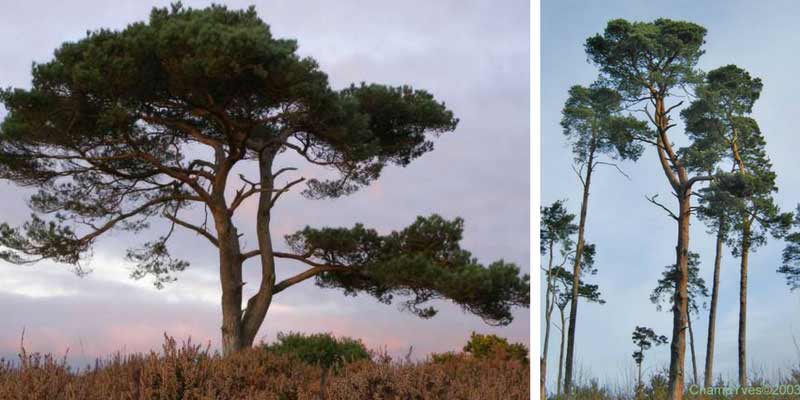
Depending on the training size, exposure, and climate, the Scots Pine will have a different appearance. On the left, exposed to the sun and without training, the very broad branches offer a parasol shape that is so striking (Source: Jim Champion - flickr). On the right, at the edge of a tree, the trunk of this pine, cleared of its branches, offers a more upright shape (Source: Jean Yves Bernoux, ChampYves).[/caption>
4) Giant Sequoia (Sequoiadendron giganteum) for an exotic garden with primitive accents
As its name suggests, the giant sequoia is an imposing tree. Admittedly, its brother Sequoia sempervirens, with a record height of 115 m, easily surpasses it, but with a maximum height of 85 m and a trunk circumference of almost 30 m, the Sequoiadendron holds its own. While it averages 50 m high in our gardens, this conifer primarily grows in height and does not hinder the growth of other plants. Its initially pyramidal to conical silhouette becomes more upright over time. Its trunk, covered in a magnificent thick reddish fibrous bark, widens and becomes bare as it ages, leaving a tuft of branches at the top that provides a light shade.
A true focal point in the garden, the Giant Sequoia should be planted in a strategic location. Allow a planting distance of at least 50 m from a house to have the necessary space to appreciate its monumental structure. With a rapid growth rate, ranging from 50 cm to 1 metre in height annually, this conifer becomes imposing in the garden in no time. In just 10 years, it reaches 10 m high and 30 to 40 m high after 50 years! It is also the conifer with the greatest longevity, as it can live for over 3000 years in its native California. It is a conifer that transcends time and is passed down from generation to generation.
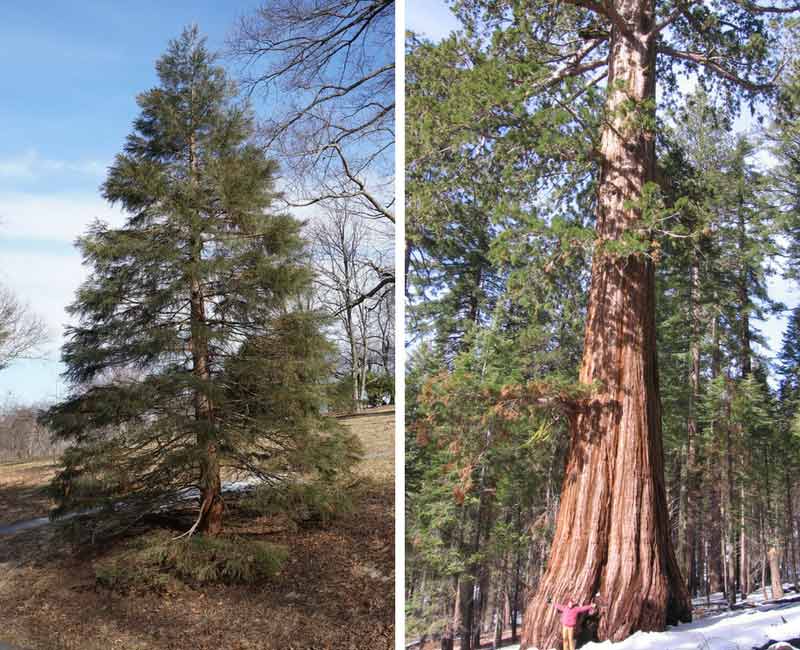 This young specimen on the left is only a few years old. On the right, an adult specimen aged several centuries growing in a forest in the Sierra Nevada (Source: Wikipedia).[/caption>
5) Maidenhair Tree (Ginkgo biloba) for a colourful Asian garden
Among large conifers, the Ginkgo, with its 25-30 m height, is undoubtedly not the most imposing in the garden, but it is certainly not the least spectacular! Its graphic, highly decorative foliage is instantly recognisable thanks to its fan shape. Apple green in spring, the foliage turns entirely golden yellow in autumn before falling, revealing the tree's full ornamental potential.
Erect in its youth, its spread increases with age, and it can extend to over 9 m in diameter if planted in isolation. When associated with other trees or planted in partial shade within a large border, its width will be more modest, and the tree will tend to maintain its upright shape. Easy to cultivate, it requires deep and rather cool soil. Like the giant sequoia, its remarkable longevity allows it to exceed 1000 years.
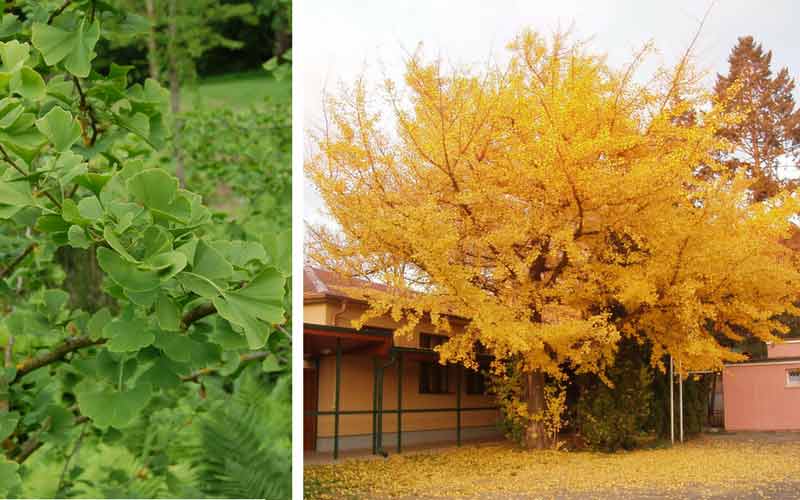 On the left, the characteristic foliage of the Ginkgo. On the right, the tree reveals its golden yellow attire in autumn (Source: Wikipedia).
NB: Like conifers, Ginkgo is classified within the gymnosperms. While genetically it is close to them, taxonomically it is distanced. This is why botanists have classified it in a neighbouring order: the Ginkgoales.
Large conifers are essential trees for structuring and balancing a garden in both winter and summer. Their rapid or slow growth, their evergreen or deciduous needles, their decorative cones, and their varied silhouettes are all ornamental criteria that affirm the character of a garden and give it its visual identity. Conifers “sign” the landscapes, highlight […]
Making a Christmas crown is not complicated! You can create beautiful, unique, and varied compositions simply by using what you can find in the garden at this time of year and a touch of creativity.
For this crown, I used an old metal hanger that I shaped into a circle. I didn't invent anything; it's a very practical tip that I sometimes use, and I'm happy to share it with you. Follow this step-by-step guide to easily create a beautiful, natural, and original Christmas crown (or Advent crown) with minimal resources.
1. THE NECESSARY MATERIALS

- a metal hanger,
- a spool of black wire,
- a pair of scissors,
- pruning shears (to trim branches if needed),
- evergreen branches (thuja, juniper, yew, boxwood, eucalyptus...) that are well-furnished and as long as possible,
- hips, small pine cones, a few hazel aments...
2. MAKING A BEAUTIFUL NATURAL CROWN: STEP BY STEP
To start your Christmas crown:
- Form a circle with the hanger.
- Take the first branch and secure it with a piece of wire to the base of the hanger's hook.
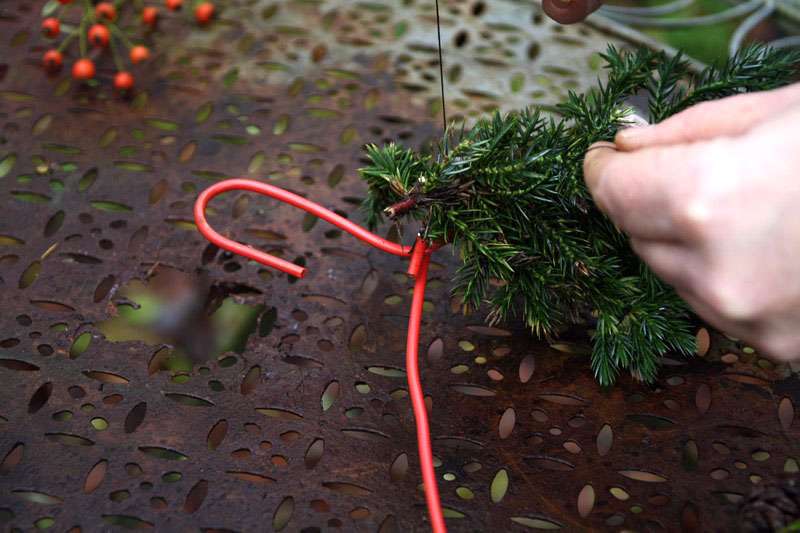
- Slide a second branch just a few centimetres under the first. Tie them together with a piece of wire and do the same for the following branches.
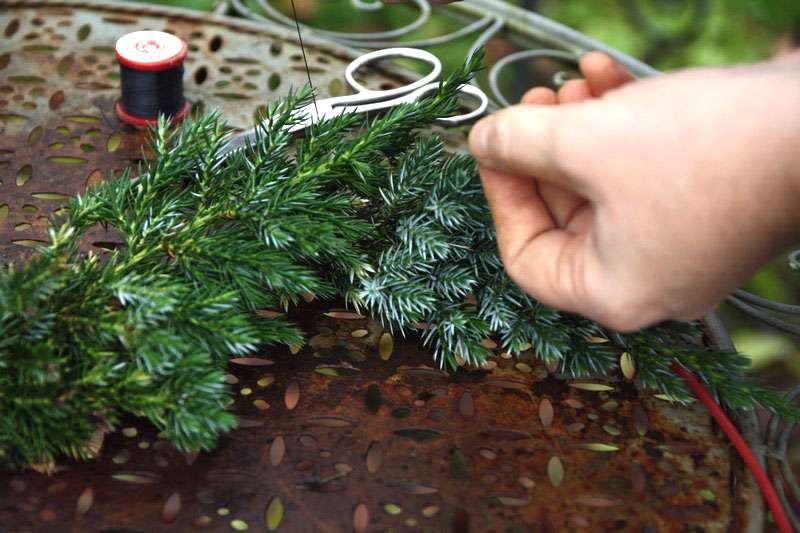
- When the branches cover the entire hanger, tie the wire from the spool (still at the base of the hanger's hook) and wrap the spool all the way around. This operation helps to solidify the whole structure and achieve a harmonious shape. You can make several passes; the more, the better for inserting decorations. Once finished, tie a knot, again at the hook, to ensure everything holds well.
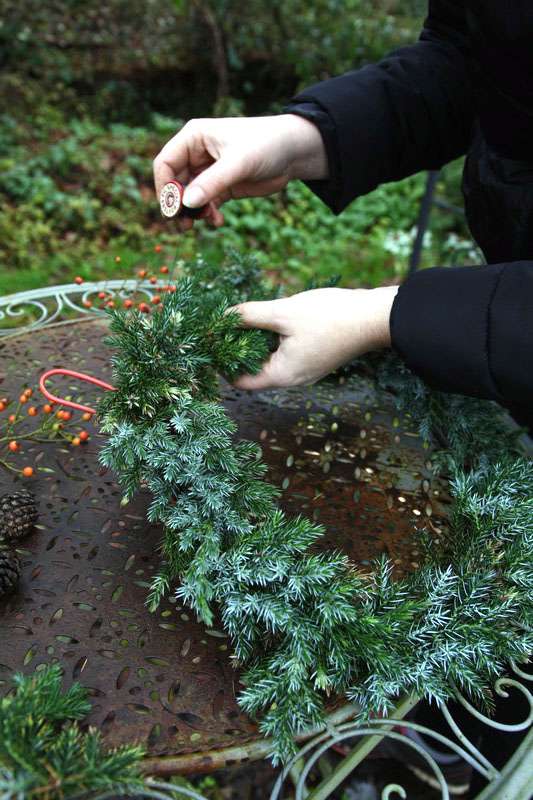 There you go, you have your base! It could very well remain as it is; it's simple and very elegant. You could also tie a ribbon at the hook.

- From now on, it's time for creativity... You will need to tie a piece of wire to the small stem of the pine cones (or simply wrap it around their base) to attach them to the crown. Then, insert bunches of hips and hazel aments.
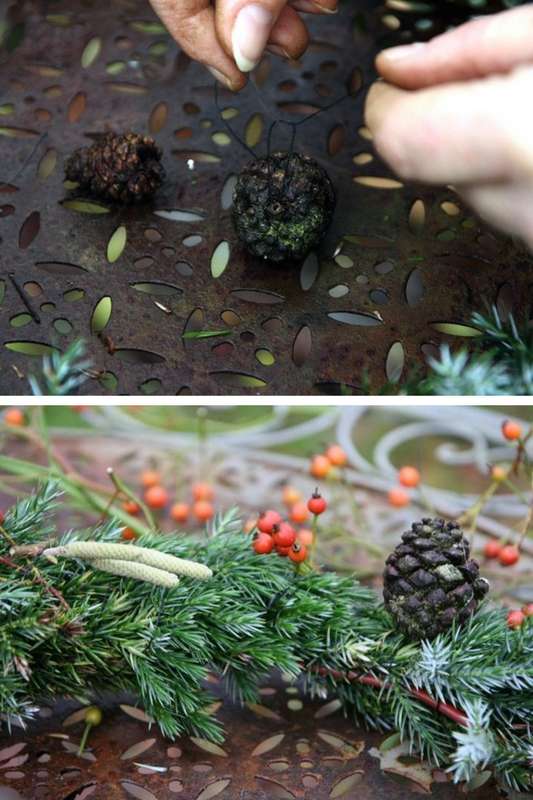
- When you are satisfied, all that's left is to place it wherever you like. The hook of the hanger can be folded down for more discretion.
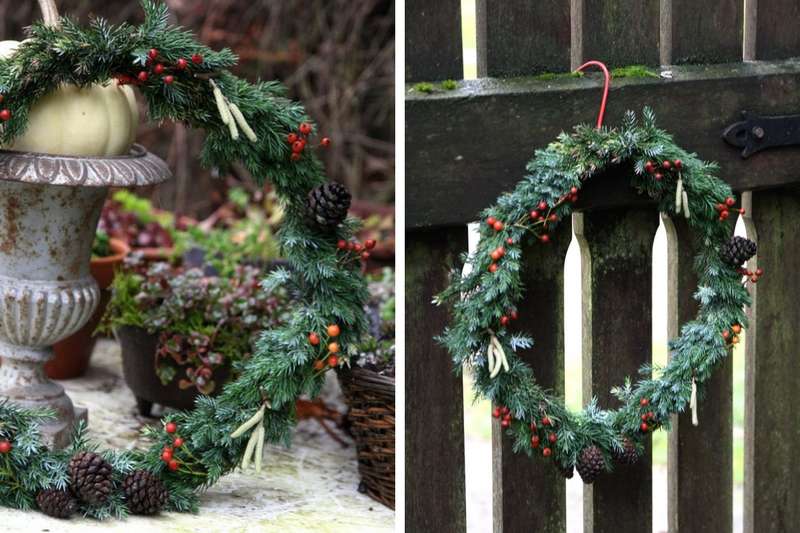
3. TIPS
- For the base of the crown, I like to use branches of Juniperus squamata 'Blue Star'. I love its bluish colour; the branches are flexible and last well over time. The only downside is that I don't have long branches, but that's not a big deal. You can use thuja or yew; they work very well too.
- Also, make sure to have branches of the same thickness; otherwise, your crown won't be uniform.
- The wire should be dark in colour to remain discreet.
- Hips can be replaced with symphorine berries or small ornamental apple fruits... if the birds have left any!
- This crown will be perfect for adorning an outdoor door or simply placed on a garden table.
Find Michaël's article for decorating your Christmas table in the same spirit: "5 tips and tricks for decorating your table for Christmas on a budget".
Discover Olivier's gift ideas for a successful Christmas 2021.
Check out our tutorial to create a stunning Christmas crown with hips.
Making a Christmas crown is not complicated! You can create beautiful, unique, and varied compositions simply by using what you can find in the garden at this time of year and a touch of creativity. For this crown, I used an old metal hanger that I shaped into a circle. I didn’t invent anything; it’s […]
Now more than ever in winter, the need for light and colour is felt. To ensure a colourful display in the heart of the dreary season, decoratively-wooded trees and bushes are a top-notch solution to combat winter melancholy. They offer an endless range of interesting colours and textures: coral red, fluorescent orange, milky white are all beneficial colours to incorporate into gardens in the heart of winter. Some species boast smooth or sometimes cracked bark, while others peel in parchment-like strips, creating an irresistible urge to pull at the small piece of bark that reveals lovely bright colours.
If, like me, you are sensitive to the lack of light in winter and are looking for any means to bring colour to your garden during this season, then read this top 5 of the best decoratively-wooded bushes and adopt these essential species that are a must-have in a winter garden.
1 - Betula utilis jacquemontii (Himalayan Birch)
This is the classic of winter gardens to the point that one wonders if decoratively-wooded is synonymous with birch. But do not confuse it with the warty birch (Betula pendula), which is also a common and widely planted species but whose bark is significantly less striking than that of the Himalayan birch.
Long planted in gardens and then neglected, the Himalayan birch has made a comeback in contemporary gardens over the past decade, and rightly so. First of all, its white bark is the only one that illuminates the back of flower beds with such intensity. Next, its light branches provide a gentle shade in gardens, allowing for easy planting of small bushes or perennials at its base. Finally, whether planted alone or in a cluster of three in the back of a flower bed, it offers a very interesting focal point. Landscape architects are not mistaken, and they increasingly use it in contrast with rounded forms (boxwood, trimmed bush honeysuckle) or integrate it into naturalistic flower beds to enhance an atmosphere with unreal and dreamlike accents.
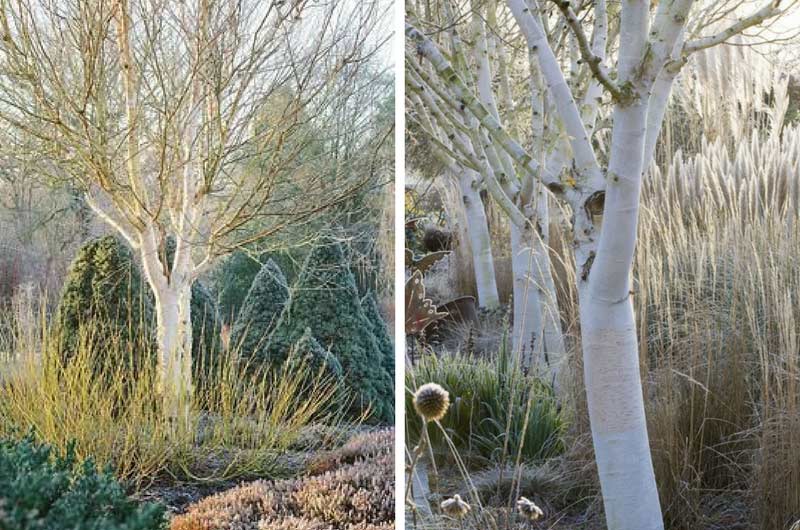 On the right, placed in front of a screen of dark-leaved conifers, the immaculate wood of the Himalayan birch contrasts beautifully. On the left, in a wilder context, the silver spikes of large grasses (Miscanthus and Cortaderia) enhance the striking colour of the bark. (Source Pinterest)
What you should know additionally : Adopt this birch without moderation in your gardens but please, do not top it as some do in winter to drastically reduce its height; it distorts its silhouette and makes it ugly! Instead, opt for coppiced forms at planting, which offer a wider habit but whose branching grows less high than a single specimen that can shoot up.
2- Acer davidii ‘Viper’ (Snake Bark Maple)
The large family of maples includes some species whose ornamental wood is a pure marvel in winter, and this is the case with snake bark maples. Several species are listed under this name, including Acer capillipes, A. pennsylvanicum, A. rufinerve, A. tegmentosum, and numerous hybrids derived from these species.
But of all the snake bark maples, Acer davidii ‘Viper’ remains my favourite! Its bicoloured green-orange wood striped with white is particularly precious in winter. And it is when the foliage has fallen and the light is low that we best appreciate its graphically striped and luminous wood. Lacking bark, this maple is coated with a whitish wax that accumulates on the wood to protect it from the external environment (sunburn, fungi) and becomes intensely luminous when temperatures drop.
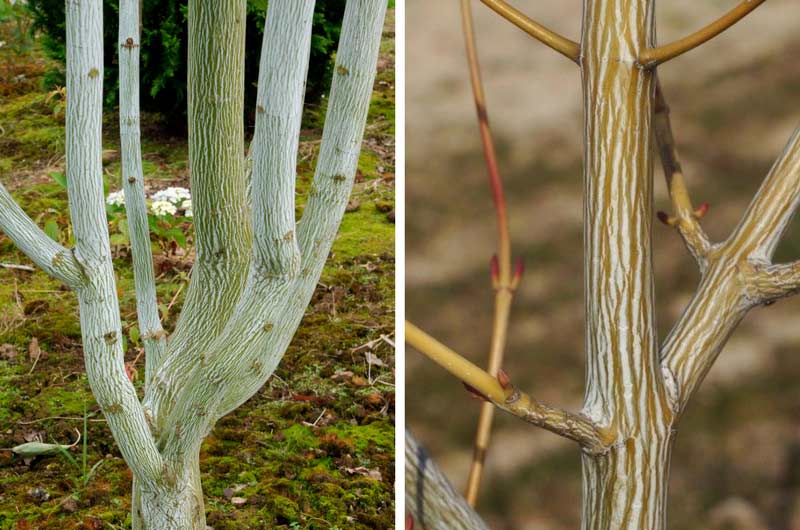 The striped and mottled bark of Acer davidii ‘Viper’ takes on an orange hue with the first frosts. (Source Hortival Diffusion)
What you should know additionally : Beyond its ornamental qualities, it is also for its cultural qualities that it remains my favourite. Unlike hybrids and some other species, Acer davidii is easier to cultivate than other “snake bark”, it does not require an acidic soil and even tolerates a bit of lime. But where it is interesting is that it tolerates heavy and cool soils well and is less susceptible to verticillium wilt than other species, tempting, isn’t it?
3- Cornus sanguinea ‘Winter Beauty’ (Decorative Wood Dogwood)
It is impossible to talk about decorative wood without mentioning dogwoods. I am referring to Cornus alba, sericea, sanguinea, and stolonifera, which form small bushy shrubs and reveal their colour in the heart of winter. These shrubs are obviously essential as they withstand everything! Pruning, cold, heavy, clayey, and humid soils, sun; they only fear the overly draining and dry soils of Mediterranean gardens, but apart from that, we can say they are almost indestructible. They have so many qualities that they have been planted everywhere, becoming a bit too common or even banal.
However, among the dozens of varieties of decorative wood dogwoods, there are a few gems worth discovering. I could mention Cornus ‘Bâton Rouge’ (Pierre's favourite) C. alba ‘Siberian Pearls’ or even C. alba ‘Ivory Halo’, but the one that gives me the most satisfaction is Cornus sanguinea ‘Winter Flame’. First of all, because it is one of the few shrubs to possess bright orange wood, almost fluorescent tinged with red at the tips of the young branches. This colour, quite rare and precious among shrubs with coloured wood, allows for lovely combinations in warm and vibrant shades that one might not dare to make in another season. In light soil, it forms the prettiest duo with Carex testacea Prairie Fire, and in heavy soil, it pairs best with Carex oshimensis 'Evercream'.
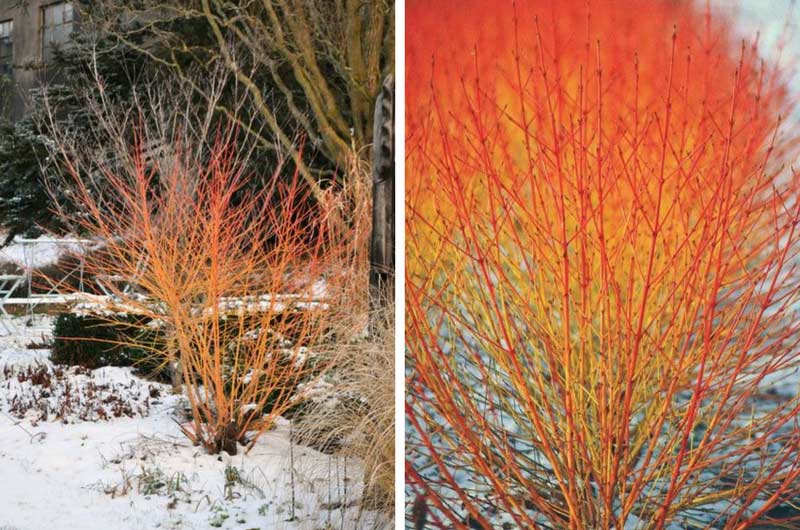 It is in the heart of winter, when the shrub is completely bare, that the spectacle is at its peak. Plant Cornus sanguinea near a bay window to feel the benefits of its warm colour. (Source Pinterest)
What you should know additionally : While all decorative wood dogwoods require spring pruning to maintain beautiful colours in winter, Cornus sanguinea does not need annual pruning. Old wood retains its vibrant colour much longer than its other cousins, C. alba or C. sericea. If it becomes too large, you can still prune it every year, but otherwise, pruning every three years is more than enough to regenerate its wood and maintain beautiful colours. To learn more about pruning decorative wood dogwoods, don’t forget to read Virginie’s article "Dogwood, Decorative Wood Cornus: Planting and Pruning"
4- Prunus serrula (Tibetan Cherry)
Sometimes Prunus serrula (Wood Cherry) is confused with Prunus serrulata (Flowering Cherry), two distinct shrubs that have little in common. Prunus serrulata is the famous Japanese cherry that stands out in spring in gardens and on city sidewalks with its spectacular but fleeting pink flowering.
Prunus serrula is characterised not by its rather discreet flowering but by its shiny and lustrous bark, whose mahogany-red hue with caramel reflections is one of the most beautiful to admire in the garden in winter. It is when it peels that the bark is most interesting, as beneath this dead skin, the new bark is so shiny that it reflects light and seems to shine in the sun.
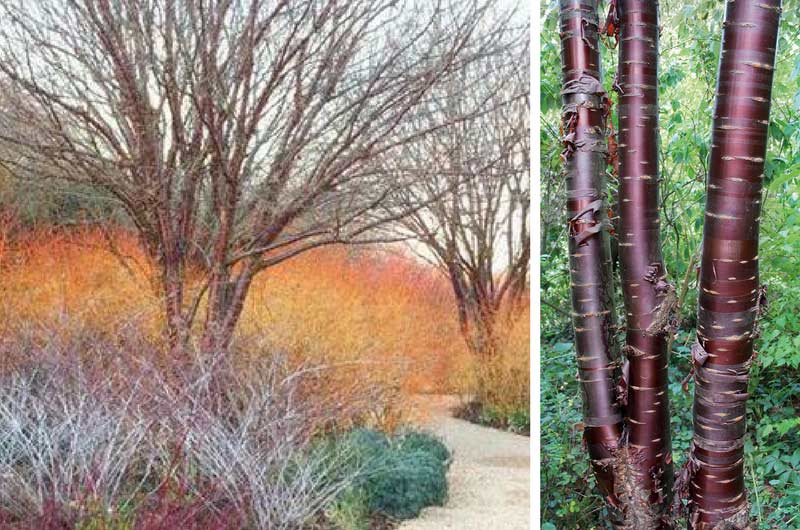 On the left, in this 100% winter scene, the yellow-orange wood of Cornus sanguinea 'Midwinter' highlights the dark silhouette of Prunus serrula. In the foreground, the white wood of Rubus tibetanus contrasts with the mahogany bark of the tree (Source Pinterest). On the right, the cleaned bark of Prunus reveals sublime satin colours.
What you should know additionally : Prunus serrula does not retain such a beautiful and vibrant bark all year round. During summer and early winter, it can become dull and sometimes green, especially when the shrub is planted too much in the shade. While one is often tempted to remove the bark by peeling it off, one risks tearing the sapwood; this deep bark conducts crude sap from the roots to the leaves, and this action can have long-term detrimental effects on the tree. To clean a tree's bark, the solution is simple and involves a stiff-bristled brush, warm soapy water, and elbow grease! Brushing the trunk of the Tibetan cherry once or twice a year with soapy water is the best way to maintain a brilliant bark without damaging the tree, just so you know!
5- Acer palmatum Senkaki (Sango Kaku)
While Japanese maples reward us with stunning graphic and colourful foliage, some, like Senkaki (the Japanese call it Sango Kaku), also boast exceptional wood. It must be said that in summer, its palmate foliage, light green with golden hues, does not suggest such beauty at the end of the season. Already in autumn, its tawny orange foliage is striking, but it is when the shrub begins to shed its leaves that we witness one of the most beautiful leaf-fall displays ever performed by a Japanese maple.
Once its leaves have fallen, the Senkaki maple reveals spectacular wood, tinted a coral red that is almost supernatural. And once again, the cold will enhance the intensity of the hue, making the branches bright red when it freezes. Add to this a lovely upright and very light silhouette, and you have an essential Japanese maple for a winter garden.
Is it more sensitive or more difficult to cultivate than another Japanese maple? The answer is no, it requires acidic, well-draining soil, a bright but not scorching exposure in summer. If you are unsure whether you can provide it with good growing conditions, know that it also does well in pots.
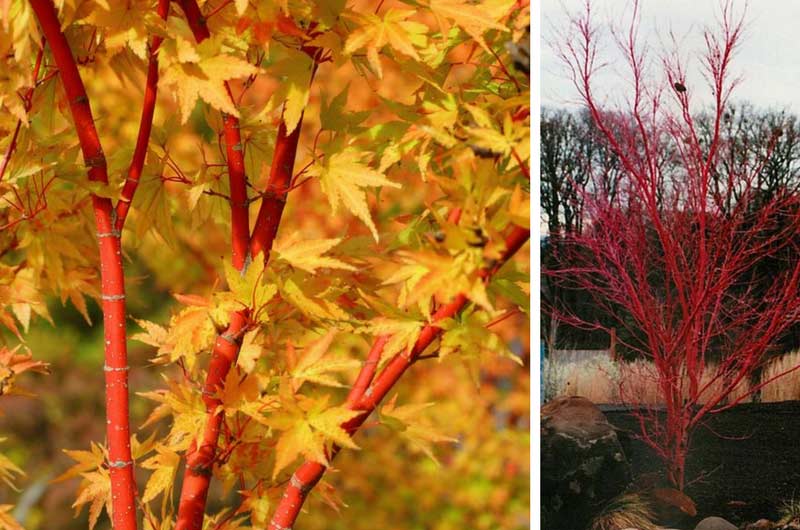 On the left, Acer palmatum Senkaki, with its superb autumn foliage, begins to reveal a coral bark. On the right, in the heart of winter, the bark becomes a much more intense red. (Source Pinterest)
What you should know additionally : Planted alone, this maple retains all its charm. Resist the temptation to associate it with decorative wood dogwoods; they have the same type of bark and also have an upright habit, and you risk creating a dull scene where the maple and dogwood blend together. It is in a zen or mineral garden that the Senkaki maple offers the best potential. This is the shrub that one would typically plant in a minimalist setting, paired with beautiful rocks and a few scattered grasses at the entrance of a house, near the front door, or on a terrace.
Are you interested in creating a winter garden and want to go further? Feel free to revisit Ingrid's article where she introduced one of her favourite books: "Winter Gardens: A Season Reinvented" by Cédric Pollet
And discover Olivier's tips for a beautiful garden even in winter:Now more than ever in winter, the need for light and colour is felt. To ensure a colourful display in the heart of the dreary season, decoratively-wooded trees and bushes are a top-notch solution to combat winter melancholy. They offer an endless range of interesting colours and textures: coral red, fluorescent orange, milky white are […]
Peony or Paeonia continues to enchant us with its large flowers in various shapes and colours. This is what makes it so charming!
Its generous flowering in spring is accompanied by great ease of cultivation, excellent hardiness, and good resistance to diseases... not to mention that some varieties are delightfully fragrant. It is a beauty with a captivating charm that, although it does not bloom for long, returns faithfully for many years.
HERBACEOUS PEONIES, SHRUB PEONIES, AND HYBRIDS
- The herbaceous peonies (Paeonia lactiflora) are the most well-known. I particularly love them for their longevity and easy-going nature. A staple of traditional gardens, they thrive in both old and contemporary gardens. Personally, I prefer them simple or semi-double, or even with an anemone heart if I fancy a touch of whimsy. They blend quite well into the decor of my naturalistic garden. Well, I admit, I also have some doubles. In fact, one of them comes from my great-grandmother's garden, passed down from mother to daughter, from gardener to gardener. Suffice it to say, I cherish it!
- The shrub or tree peonies (Paeonia suffruticosa) form majestic bushes with large flowers adorned with a lovely bouquet of golden stamens. They grow very slowly, but what a spectacle after a few years! I started planting them five years ago. First, a Paeonia delavayi var. lutea from a seedling, a gift from a friend, which I patiently waited for three years. I particularly admire its young copper-tinted foliage in spring, finely cut, and its pure yellow flowers. Another shrub peony joined the garden last year, namely Paeonia suffruticosa 'Charming Garden', but this one has yet to bloom. I shall be patient!
- Finally, the Itoh hybrids are the result of cross-breeding between a herbaceous and a shrub peony. They are characterised by exceptional robustness and traits from both parent types. The flowering period is extended, the beauty of the foliage lasts all season, and the colour palette is varied. I haven't planted any yet, but it won't be long.
A MULTITUDE OF SHAPES AND COLOURS
Peony flowers can be classified into several categories, knowing that the boundary between them is not always clear. Moreover, the shape and colour of the flowers can vary from year to year depending on climatic conditions and soil quality.
That said, we distinguish between singles (P. 'Flame'), Japanese (P. 'Neon'), anemones (P. 'Gay Paree'), crowns (P. 'Félix Crousse'), globular (P. 'Karl Rosenfield'), semi-doubles (P. 'Golden Treasure' and 'Lilac'), and doubles (P. 'Coral Sunset' and 'Sarah Bernardt').
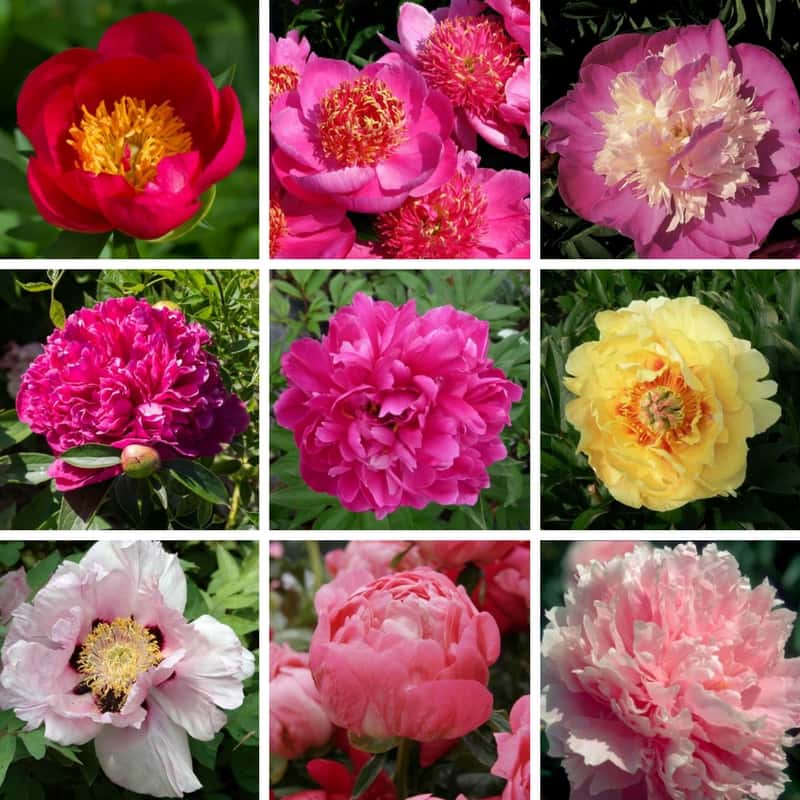
From left to right and top to bottom: Paeonia ‘Flame’ - Paeonia lactiflora ‘Neon’ - Paeonia ‘Gay Paree’ - Paeonia lactiflora ‘Felix Crousse’ - Paeonia lactiflora ‘Karl Rosenfield’ - Paeonia itoh ‘Garden Treasure’ - Paeonia ‘Lilac’ - Paeonia ‘Coral Sunset’ - Paeonia ‘Sarah Bernardt’
FRAGRANT FLOWERS
Peonies are renowned for their fragrance. They are famous in perfumery for their scents reminiscent of rose or lily of the valley. However, not all of them are fragrant! Generally, double-flowered peonies are more aromatic than single-flowered ones, but there are many exceptions. Among the varieties with the most remarkable fragrance are: ‘Myrtle Gentry’, ‘Alice Crousse’, ‘White Cap’, ‘Duchesse de Nemours’, and ‘Alice Harding’.
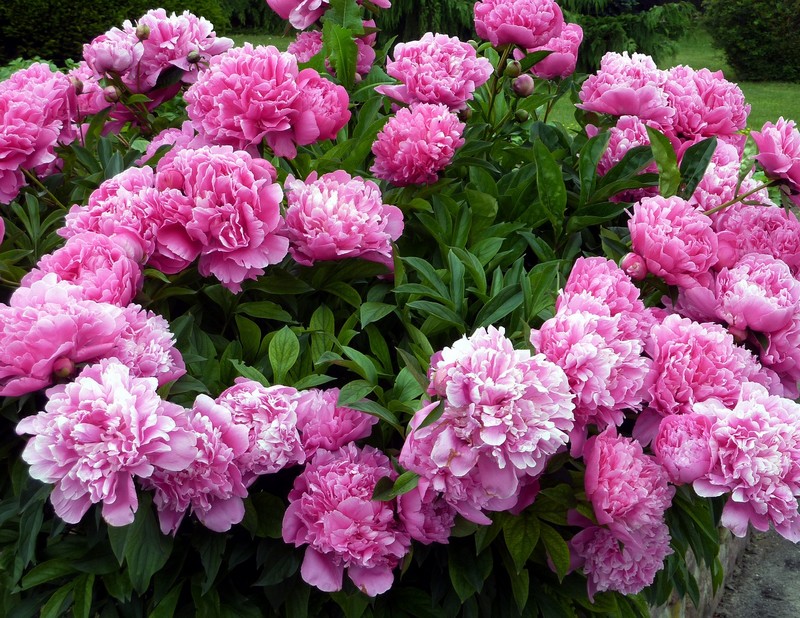
By the way, my ancestor's peony smells divine! When I sense rain approaching, I pick a bouquet to enjoy the flowers and their fragrance in the house.
WHERE DO PEONIES THRIVE?
The hardiness of peonies is no myth! They are not afraid of the cold and, with a few exceptions, they grow wild at altitudes where frosts are common. At worst, a few branches may suffer, but they will regrow beautifully the following spring. However, late frosts can impact flowering. I experienced this issue this spring, with frosts in May while the buds of my Paeonia delavayi var. lutea were already well-formed. Sheltered near a wall, most of its buds turned black, and a few survivors produced somewhat deformed flowers. In the rest of the garden, the herbaceous peonies simply did not bloom.
Choosing the right location is key to successful planting. Peonies thrive in the sun, otherwise, flowering may suffer. However, the ideal exposure varies depending on your geographical location. In Mediterranean regions, it is better to avoid full sun in the early afternoon. An east or southeast exposure is preferable. Similarly, in areas where late frosts are common (like mine in the Ardennes), prefer a west exposure to prevent the first rays of morning sun from causing too rapid a thaw, which can affect the quality of flowering. Elsewhere, full sun exposure is recommended. Note that a minimum of half a day of sun is necessary for good flowering.
Remember that peonies dislike waterlogged soils, so it is important to plant them in well-drained soil. In my clay soil, I have added plenty of humus (homemade compost, horse manure... an 8-year-old vintage from my farmer neighbours), as well as wood chips over the years to improve the soil. You can also add gravel or pumice at the bottom of the planting hole. These are greedy plants that do not appreciate competition. Mix good quality compost or well-decomposed manure into the planting soil. Be careful not to bury them too deeply: 2 to 3 cm of soil should cover the buds, no more! Finally, they do not like being moved, so choose the location of your new acquisition carefully; otherwise, it may sulk for 2 or 3 years before blooming again.
After that, maintenance consists of removing dead wood and dry or damaged parts when the buds start to swell in late winter for the shrub types, and simply cleaning the dry parts in March for the herbaceous types. A piece of cake!
TIPS FOR GOOD FLOWERING
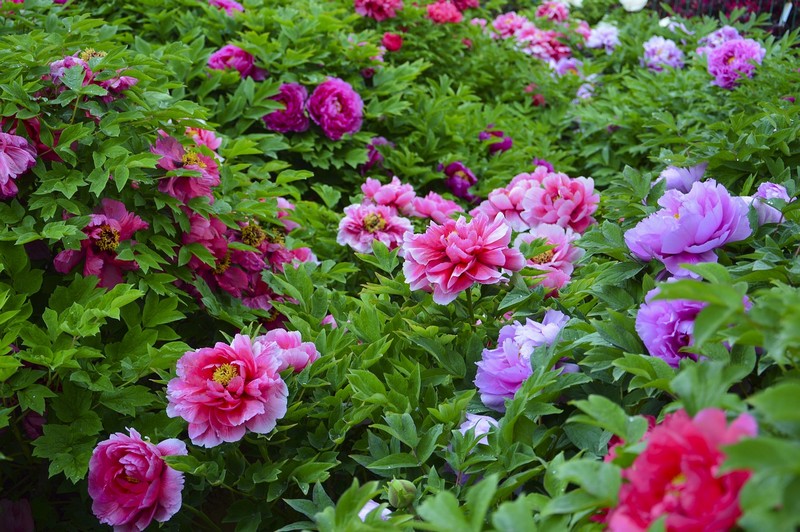
The first flowering of herbaceous peonies can occur between the first and third year after planting. This depends on the size of the plant. If it has one root and one eye, it will easily take three years to bloom. However, if it has four to five roots with three or four well-swollen eyes, there is a good chance it will bloom in the first spring if planted under good conditions.
The same goes for shrub peonies, but the probability of flowering is slightly lower in the first two years.
An application of humus is necessary every autumn. I spread a good amount of well-decomposed manure all around the plant. Then I bury it in the following spring during weeding. Peonies appreciate a potash boost that encourages flowering. However, be aware that nitrogen should be limited as it weakens the foliage and promotes the development of botrytis. Choose a fertiliser accordingly, or do as I do, a bit of wood ash each spring, and you're good to go!
Some peonies with fragile stems and particularly heavy flowers need support. This comes in the form of a metal circle with stakes to drive into the ground. Once the foliage develops, the device is completely hidden. It's simple and effective!
SUCCESSFUL PAIRINGS
Peonies lend themselves well to planting in borders or mixed beds. I find them wonderful with smaller flowers that highlight them, such as Cirsium rivulare ‘Atropurpureum’ or hardy geraniums, but also with irises, lupins, Centaurea montana, poppies, roses, alchemilla, delphiniums, alliums, and anthemis for an English garden, romantically appealing, or even with colourful foliage, particularly the purple of Sambucus nigra ‘Black Beauty’ or ‘Black Lace’.
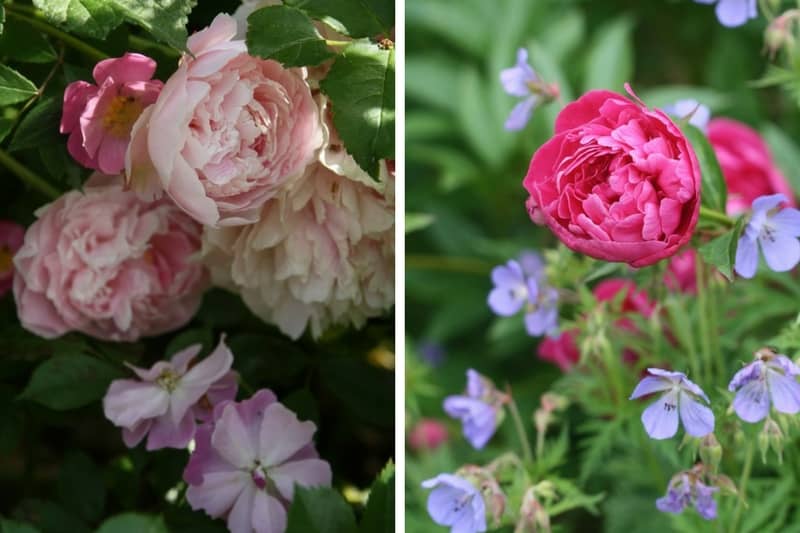
Paeonia lactiflora 'Sarah Bernardt' with the rose 'Lavender Dream' - Paeonia lactiflora from my ancestor with the Geranium pratense 'Mrs Kendall Clark'[/caption>
In my garden, the peonies ‘Bowl of Beauty’, ‘Springfield’, and ‘Do Tell’ are always very much admired by my visitors. They are surrounded by a variety of hardy geraniums, creating a very natural tableau.
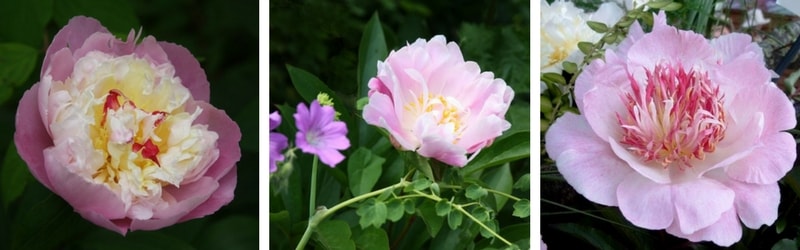 From left to right: Paeonia lactiflora 'Bowl of Beauty' - Paeonia lactiflora 'Springfield' - Paeonia lactiflora 'Do Tell'
And you, tell me, what are your favourite peonies?
Peony or Paeonia continues to enchant us with its large flowers in various shapes and colours. This is what makes it so charming! Its generous flowering in spring is accompanied by great ease of cultivation, excellent hardiness, and good resistance to diseases… not to mention that some varieties are delightfully fragrant. It is a beauty […]
Light grows lower and shadows lengthen, mornings are wrapped in mist and the damp in the air makes us shiver gently when stepping outside... as Sophie rightly pointed out, no doubt about it, autumn is here! In the garden, opulent blooms of perennials slowly give way to autumn colours of trees and shrubs... All perennials? No! A few stubborn autumn-flowering plants refuse to give up the limelight: the persistence of these late-flowering perennials won't yield until first hard frosts, and some may hold centre stage throughout October and even until late November in the best years.
In my medium-sized garden (700 m²), these perennials that extend the season are particularly precious for keeping borders attractive all year round, because I cannot afford to plant many trees and shrubs with coloured autumn foliage or even ornamental berry-bearing shrubs. Discover my top 5 late-flowering perennials every garden should have!
1) Cimicifugas
Certainly, they take up a bit of room and while their culture is not particularly difficult, they are not always easy to please. In my garden, they struggle with repeated summer droughts, which are not rare even in the far north! They are nevertheless superb when offered a good, humus-bearing soil that does not dry out too much in summer, in dappled shade beneath large trees, and even in sun so long as the soil stays cool. For the grace of its spikes of white flowers as much as for the delicacy of its sweet scent, I persist in keeping Cimicifuga or Actaea 'White Pearl' in good shape each summer with generous watering using collected rainwater. It therefore ranks among oldest plants in my garden (planted long before I was old enough to have a driving licence to roam nursery aisles on my own!). In my garden, it starts flowering late September to early October and finishes around All Saints' Day. Some may prefer purple-leaved varieties such as 'Atropurpurea', 'Brunette', 'James Compton' or 'Pink Spike' with vaguely pink spikes, but I like the elegance of its apple-green foliage when it emerges in spring far too much to want another!
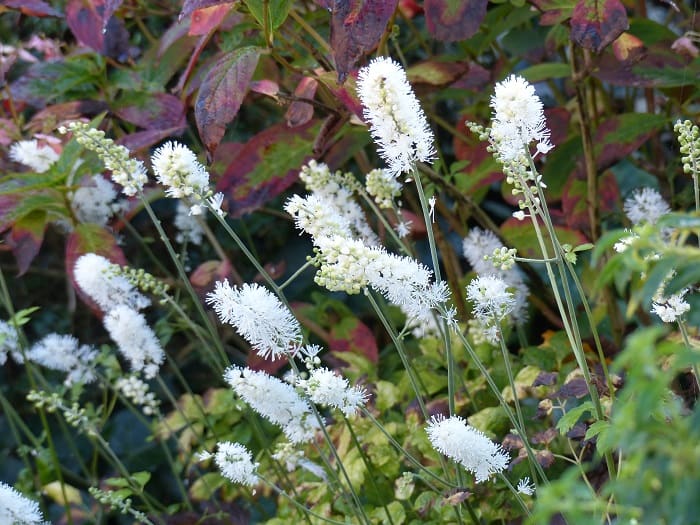
2) Japanese anemones
And above all one of them, the indomitable 'Honorine Jobert'. Its flowering starts in August, reaches its peak in September and will not stop before the end of the month. Still going strong some 140 years after its discovery by nurseryman Lemoine of Nancy, this venerable Lady of the garden recovers much better from dry spells than my Cimicifuga! Given to me by a fellow enthusiast years ago, I could no longer imagine my garden without this plant. Among its cousins, some flower earlier, from July–August, but then they do not last quite as long into autumn. If you prefer pink, do look at 'September Charm', 'Pamina' or 'Prinz Heinrich' for a shorter habit.
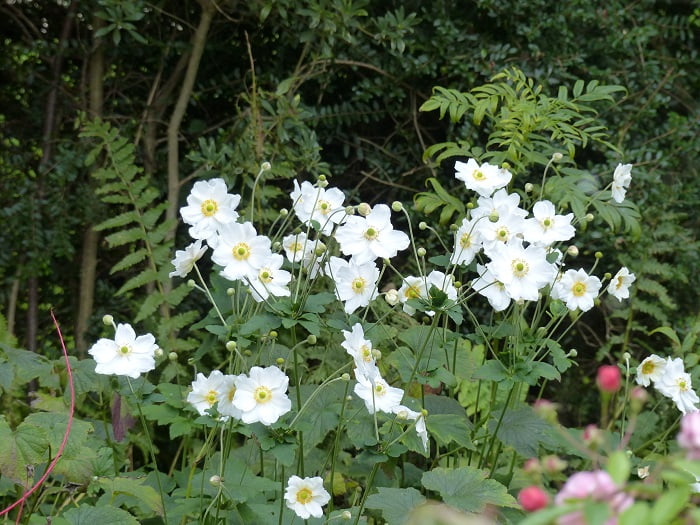
3) Asters
There are countless varieties and by collecting them one can easily have asters in flower from March to November. As I do not have the space required for that obsession (though the desire is certainly there!), I make do with a few well-placed clumps in strategic positions in beds where they take over from summer-flowering perennials. I have set aside the New England hybrids, too tall for my beds, but could not do without Aster ericoides such as 'Pink Star' and even less without the rarer Aster ageratoides 'Ezo Murasaki' with its seemingly endless flowering. Besides, those two are never sick! In shade, I once had Aster divaricatus that I probably unfairly pulled out at some point to replace with a rarity that did not last. That was probably a mistake I will have to put right one day!
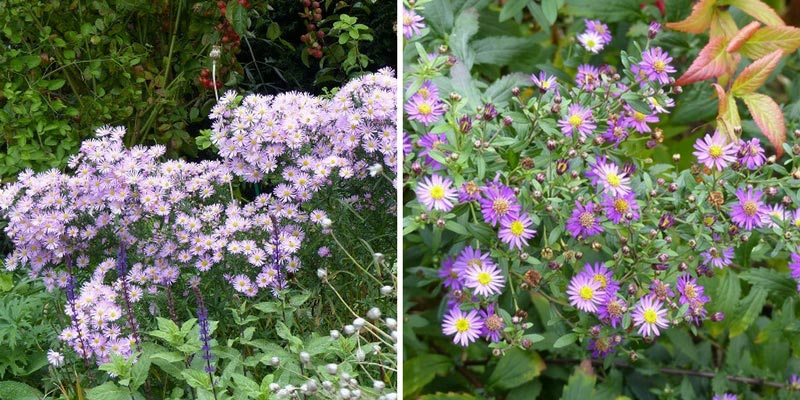
4) Fuchsia magellanica
Shrub or perennial, that is not the point... These hardy fuchsias that form real hedges in Ireland and Brittany are truly hardy and when frost is severe they regrow from the crown, their flowering then starting just a little later (late July). Once again, it is one of the very first plants I grew and I still keep the original stock of Fuchsia magellanica 'Ricartonii' from my grandmother. Fuchsias still suffer from that "grandmother's plant" image, which is highly unfair given the qualities of these shrubby perennials: hardy and easy to grow in sun or shade, they ask for almost nothing in return for their generous, elegant flowering. As icing on the cake, golden-leaved ('Aurea') and variegated ('Versicolor') forms exist. I also found at Saint-Jean-de-Beauregard the rare white and variegated form called 'Sharpitor'. If you dislike the characteristic pink-and-purple contrast, you can always opt for Fuchsia magellanica var. molinae, with pale pink-white flowers, and its variant 'Hawkshead' with pure white flowers tinged green at the tips. Tireless, only cold can halt their flowering!
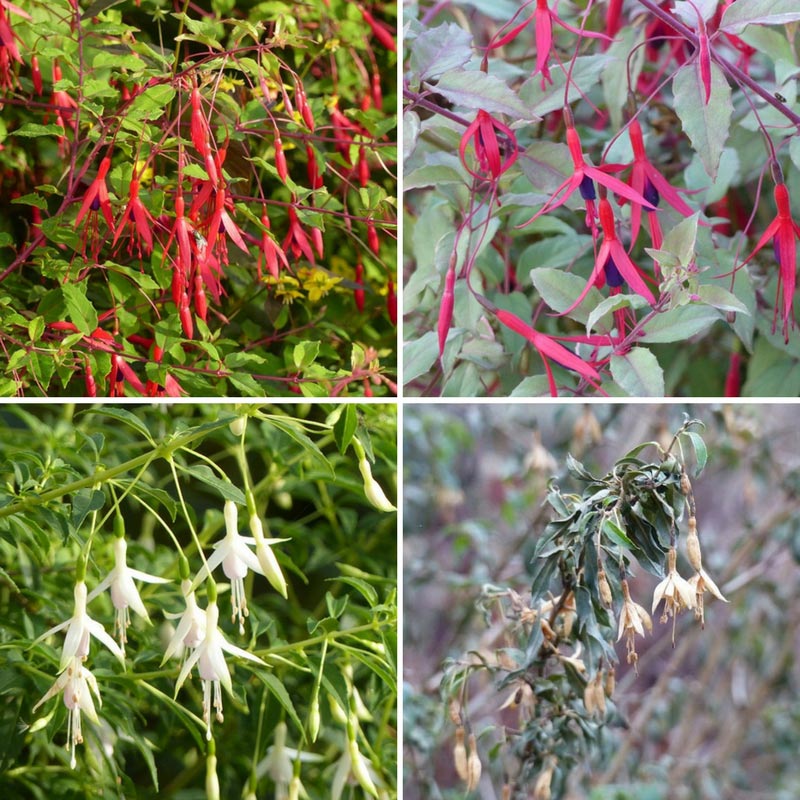
5) Persicarias
Having late flowering in a small garden is good, having long AND late flowering is even better! And that's precisely what persicarias (Persicaria amplexicaulis, formerly Polygonum) bring. Graphic, colourful spikes appear from July for the earliest varieties, and nothing can stop them thereafter! If they spread too much, you can cut them back as often as you like and they will come back all the stronger. I have seen them thrive in poor sandy soils, in dry chalky soils as well as in heavy clay. In short, they are foolproof and I love them all and there will certainly be one to suit you too! If you struggle to choose, I would still recommend 'Blackfield' deep claret-red, 'Alba' white and very free-flowering, 'Firedance' with more orange tones, 'Inverleith' which stays dwarf, and 'Rosea' old-rose, as among the best. New varieties appear regularly and are also well worth trying.
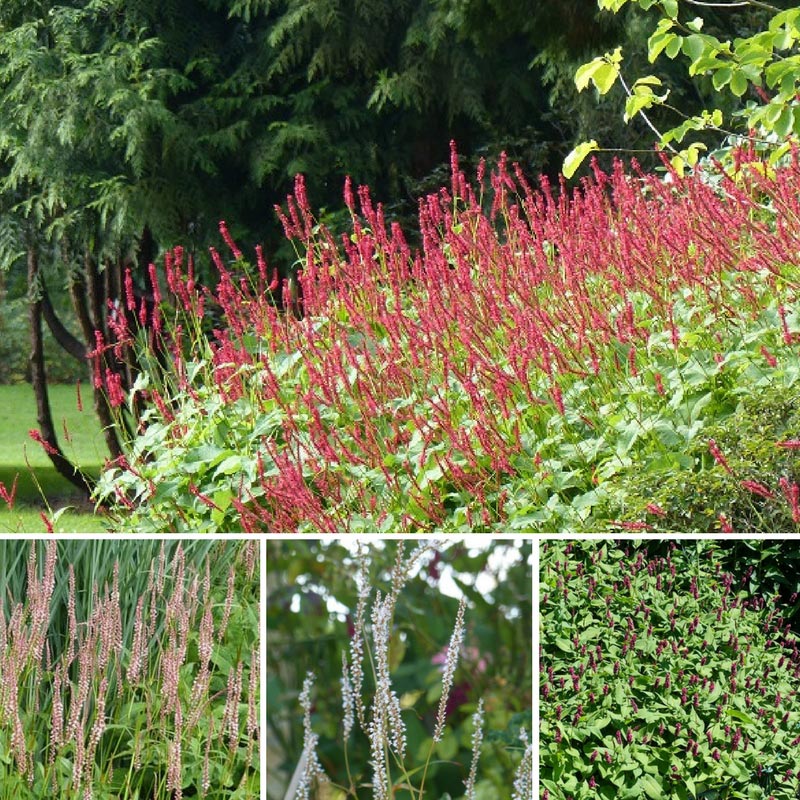
...Bonus: Diamond grass
Which modern, serious gardener can still make a garden without ornamental grasses? Almost all are beautiful in autumn, and even beyond, enhanced by mist, hoar frost and low-angle light, but if one stands out it is the famous "diamond grass" (Calamagrostis brachytricha), queen of autumn grasses. Its panicles appear only in September and show superb iridescent shades under autumn sunrays that look like diamond sparkles. At 70–80 cm tall and able to grow in any soil, in sun or shade, it remains a plant too little known yet foolproof.
True, I could also have told you about a Miscanthus, but its autumn colours would have competed with those of the shrubs! 😉
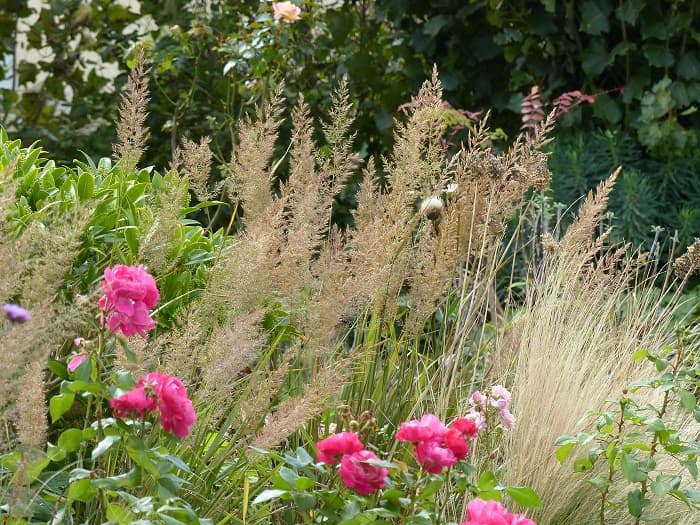
Light grows lower and shadows lengthen, mornings are wrapped in mist and the damp in the air makes us shiver gently when stepping outside… as Sophie rightly pointed out, no doubt about it, autumn is here! In the garden, opulent blooms of perennials slowly give way to autumn colours of trees and shrubs… All perennials? […]
Hoping you have followed Michael's advice on failing to plant your perennials, let’s now explore how to fail at colour combinations to ruin the few plants that may have survived in your garden!
Lesson 1: Do not consider the background to test the chameleon theory.
It goes without saying that it is better to plant a white clematis against a white background. According to the very zen abstract concept "less is more", this allows you to distinguish, among other things, the thickness of the air between the flower and its support, especially if you have the brilliant idea of systematically removing the leaves that appear. This idea came to me during a visit to a conceptual exhibition describing the ascent of Mont Blanc by polar bears.
It goes without saying that you will achieve the same result with red flowers on a brick wall or a band of Ophiopogon planiscapus ‘Nigrescens’ along a black paving border.
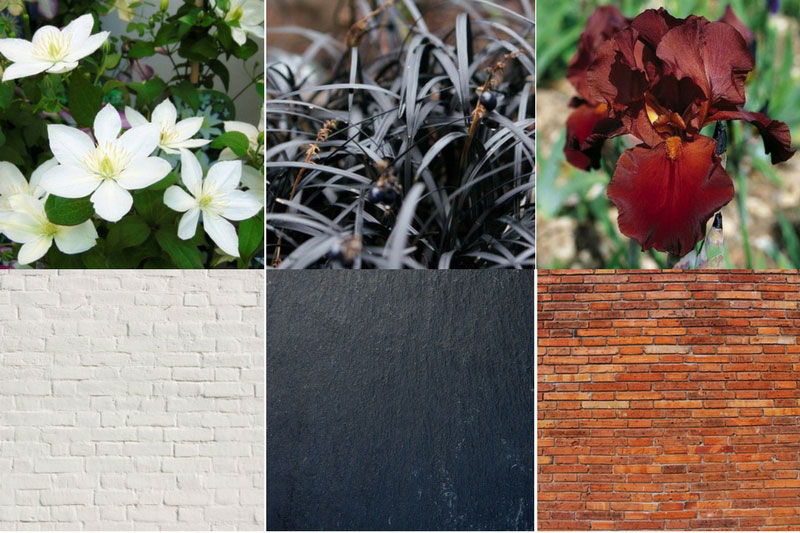 In these three cases, the chameleon theory works perfectly... You can, if you feel like it, regularly repaint your wall to test it with numerous plants!
We often forget to integrate architecture and external elements into colourful plantings. But if you really don’t understand contemporary art, think about this.
Do you like grasses? Why not integrate them with rattan furniture whose colour harmonises with the stems and flowers?
You also do not plant the same plants depending on whether the path is paved with bricks, black slate slabs, or yellow gravel.
If your neighbour's wall is blue, why not play Van Gogh by using yellow-green flowers like euphorbias, with a curtain of Foeniculum vulgare behind Achillea filipendula?
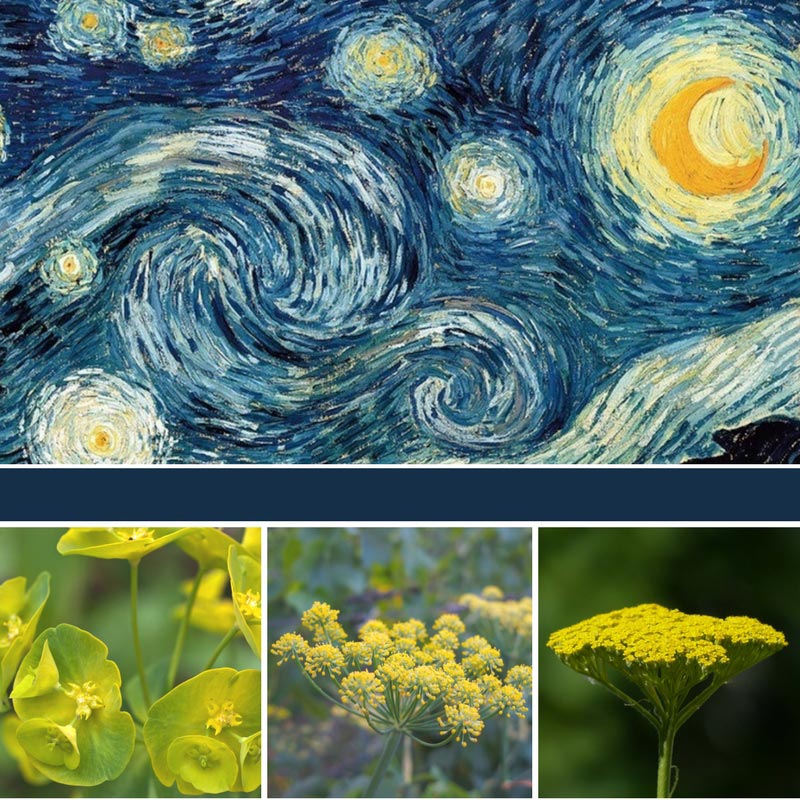 "Starry Night" Vincent van Gogh - Euphorbia, Foeniculum vulgare, Achillea filipendulina
By integrating the surrounding architecture, you make it an ally, which makes the garden appear larger than it actually is and more harmonious. The two go hand in hand, and distinguishing the home from the outside is, I hope, a Western concept that belongs to the past.
Lesson 2: Avoid yellow, orange, and red
It is well known that strong colours can only attract vulgar people, even if it must be acknowledged that those who dress in Desigual never get sauce stains on their dresses.
Nothing beats Laura Ashley wallpaper catalogues for finding inspiration that will transform your garden into a sweet shop that only Euro Disney can rival. ‘Let it go’ from these garish dahlias, and the garden finally regains its deserved calm.
Come on, you’re not going to let yourself be fooled by these outdated ideas, are you?
Of course, subtle colours have their place. But nothing beats strong colours, carefully balanced to awaken your sleepy flowerbeds.
Step out of your baby pink - boy blue cocoon and embark on an adventure. Of course, the usual compositions are reassuring but unfortunately often uninspiring.
This does not mean you should banish your favourite colours. It’s simply about warming them up a bit. A mauve agapanthus may be stunning, but if you plant thirty of them side by side, the scene borders on a funeral atmosphere. Just add five or six sulphur-yellow flowers, and Jesus rises from the dead.
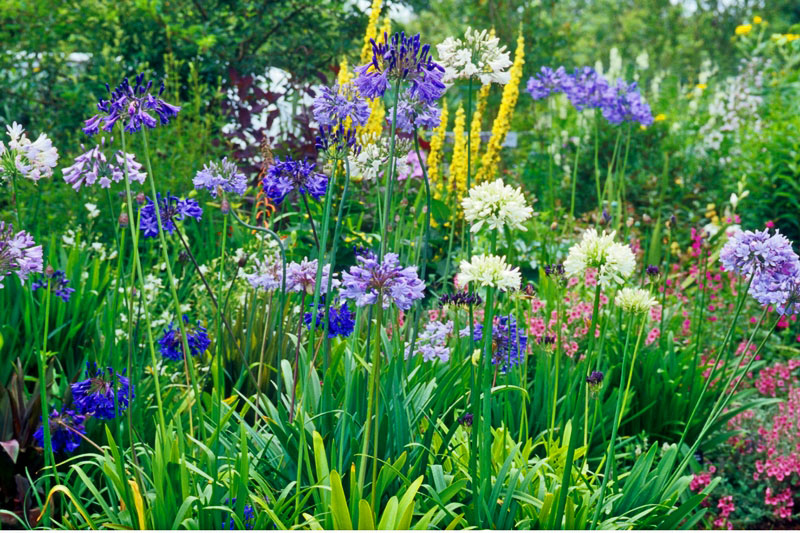 Try this simple test: with your hand, cover the yellow spikes of the Verbascum. Isn’t it immediately more boring? Photo: John Swithinbank – MAP
No, red, yellow, and orange are not vulgar. You just need to know how to balance their intensity and quantity. Autumn will not say otherwise.
Lesson 3: Colours allow for a low-maintenance garden
The eye is inevitably drawn to bright colours.
A red moves forward while a blue recedes.
If you plant many red flowers in your small garden, you will feel it is tiny, and it seems that from then on, the maintenance work is reduced to its simplest expression. Thanks to the shrinking red.
However, if you are one of those who believe that a little effort in the garden constitutes the daily oxygen bubble that allows you to recharge, apply this principle: you will gain depth if you place blue or mauve flowers at the back of the small garden, as these colours open up space. From your conservatory window, you will feel like you are in Versailles (don’t dream, I’m only talking about perspective).
Conversely, to minimise maintenance in a large garden, you can try endless masses of pale flowers. The eye glides over these large uniform expanses as if there were nothing interesting to look at, an empty space devoid of meaning. And it is well known that emptiness requires no maintenance.
Garden enthusiasts will prefer this alternative: plant small groups of strong colours at respective distances that will act as exclamation points guiding the visitor on their walk. A book needs punctuation to exist. The same goes for the garden.
Lesson 4: An excess of pure colours keeps mothers-in-law at bay
Use primary colours above all. It will save you a flight to Rio in February. And in doing so, you will compete with the Chinese, of whom it is said that the Great Wall is the only human achievement visible from the moon.
More seriously, do not be fooled by the term 'primary' or 'pure' when talking about a colour. By definition, they cannot be obtained by mixing and therefore share nothing with their neighbours.
Leave the 'pure' to the painters and mix instead tertiary colours made up of several tones. Once again, autumn colours provide the best example.
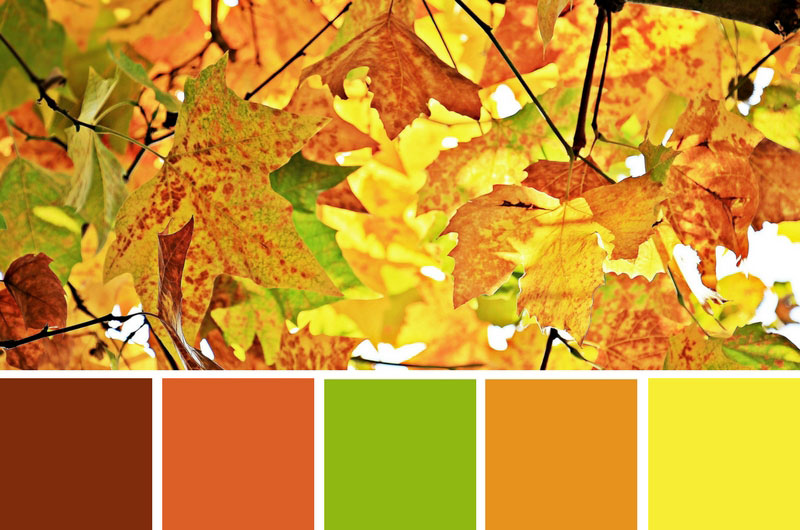
Red, yellow, and orange then juxtapose seamlessly as each incorporates a bit of the other two in varying doses. A tomato red, for example, is slightly orange and will therefore pair much better with an orange flower. Replace it with a garance red (bluish), and things become complicated.
Lesson 5: If you are afraid of failing with colours, don’t use any.
In this case, follow the adage: light colours in full sun and dark colours in the shade.
Everything disappears, and you enter the fourth dimension. Absence of form, absence of sound, the interstellar void that perhaps opens the door to unsuspected worlds.

Come on, let’s get back down to Earth and leave Mr Spock to explore unknown galaxies.
You do not garden the same way in the shade or in the sun, in Lille or in Singapore. You may love pastel colours where white, mauve, and pink are mixed in varying doses. All this works wonderfully at latitudes where greyness is common or in flowerbeds sheltered by the shadow of a wall.
In this case, these subtle shades awaken because the slightest detail, the slightest variation in intensity is easily noticeable.
Transpose the whole thing to the sun, and nothing works. Strong light flattens or burns these pretty tones into an infamous wash that the eye can no longer distinguish.
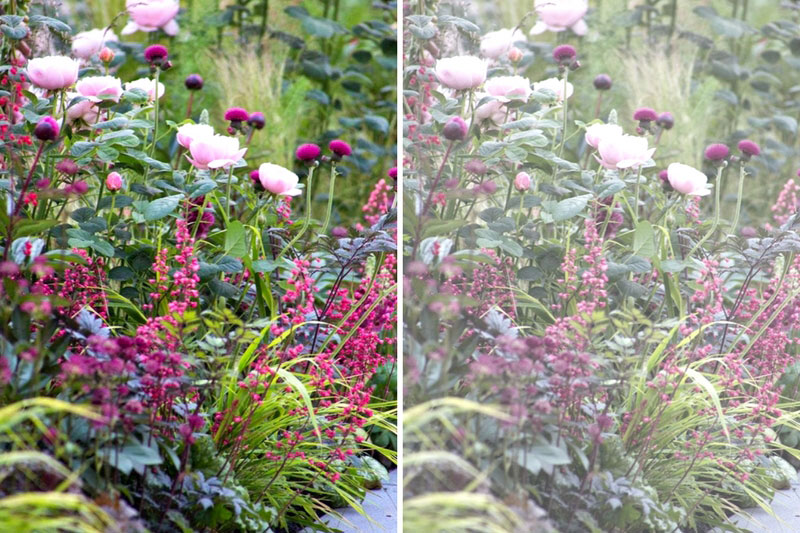 the same flowerbed, with different lighting
Do I really need to explain why the high nobility of a dark purple flower completely fades in the shade? You will have understood, the eye likes to be stimulated, or it gets bored.
In the same vein, when you create a monochrome flowerbed, the big mistake would be to use identical values. You need to vary the saturation: use light and dark shades of the same colour grouped in patches, creating areas of shadow and light as if a cloud partially obscured the sun.
Lesson 6: To master colour in the garden, you must integrate all the rules of the colour wheel
... and have attended a series of 20 lectures on Impressionist painters and perfectly understood the law of simultaneous contrast of colours as stated by chemist Chevreul. Only then will you possibly begin to succeed with colour in the garden.
 Michel Eugène Chevreul and his colour wheel
Come on, loosen up a bit. Rules are made to be broken, especially if they were not stated by you.
The garden is a matter of personal taste, and as long as you feel good there… don’t change a thing.
However, if you happen to visit a place where the mix of colours attracts you and makes you think, "I would like to do this or that at home, but I don’t know where to start", then you are ready to explore a fascinating world that requires only a pinch of prior knowledge, a bit of feeling, and just the right amount of whimsy.
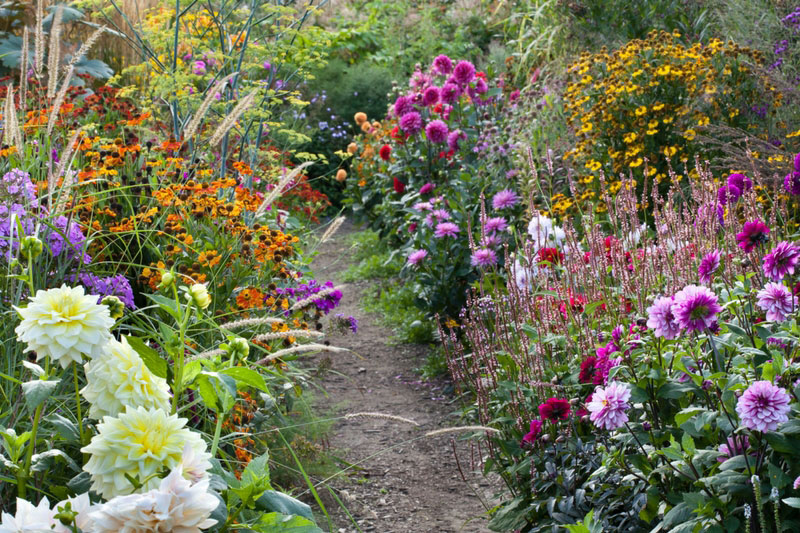 Photo: GAP - Robert Mabic
The rest is just a matter of trials, successes, and (un)controlled slip-ups. But isn’t that the very definition of gardening?
Hoping you have followed Michael’s advice on failing to plant your perennials, let’s now explore how to fail at colour combinations to ruin the few plants that may have survived in your garden! Lesson 1: Do not consider the background to test the chameleon theory. It goes without saying that it is better to plant […]
We all have dreams. More or less ambitious, more or less realistic: a cabin by the Arcachon basin, a chalet in Switzerland, a villa in the Seychelles, or, more simply, a garden shed.
And I am convinced that I share this dream with all gardeners who do not yet have one.
Where the problem lies is that whether made of cedar, Douglas fir, or custom-built, even the simplest garden shed can quickly become expensive. This explains why we often have to turn to wood or metal shelters that are not too costly, but are unsightly or terribly ordinary, which, as you will agree, is enough to spoil a garden.
The solution? Personalise, decorate, and integrate! Here are 6 simple and easy-to-implement ideas that will allow you to transform a "cheap" garden shed into a truly charming cabin.
1) Facades: get out the paint and brushes
Wood is a noble and durable material that ages beautifully over time… when it is of good quality. This is rarely the case with the most common shelters. It is often recommended to stain garden chalets, which generally makes them shiny and gives them a Swiss look, certainly, but not necessarily in keeping with the region or the overall ambiance of the garden. Instead of this solution, opt for a good exterior wood paint: colour immediately adds style!
Choosing a colour is very personal. However, I recommend avoiding shades that quickly become tiresome, such as candy pink, purple, and orange (the latter guarantees a construction site cabin effect!).
Green can be interesting, but don’t expect it to serve a "camouflage" function. Unless you truly fall into military patterns (and even then), it doesn’t work!
Neutral shades, from off-white to mouse grey, are elegant and suit classic gardens well.
 A beautiful example of successful "customisation" - Blog: La source d'Angele
Black, rarely used, is very versatile: it evokes the cabins once painted with waste oil (never do this!) and Scandinavian houses. It fits perfectly in contemporary spaces, just like bright red, which is very dynamic and can also remind one of the Basque Country when mixed with white.
Very girly, pale pink, as well as all soft and pastel colours, are perfect in romantic gardens with an English charm… But be reasonable, otherwise, beware of the dollhouse effect 😉
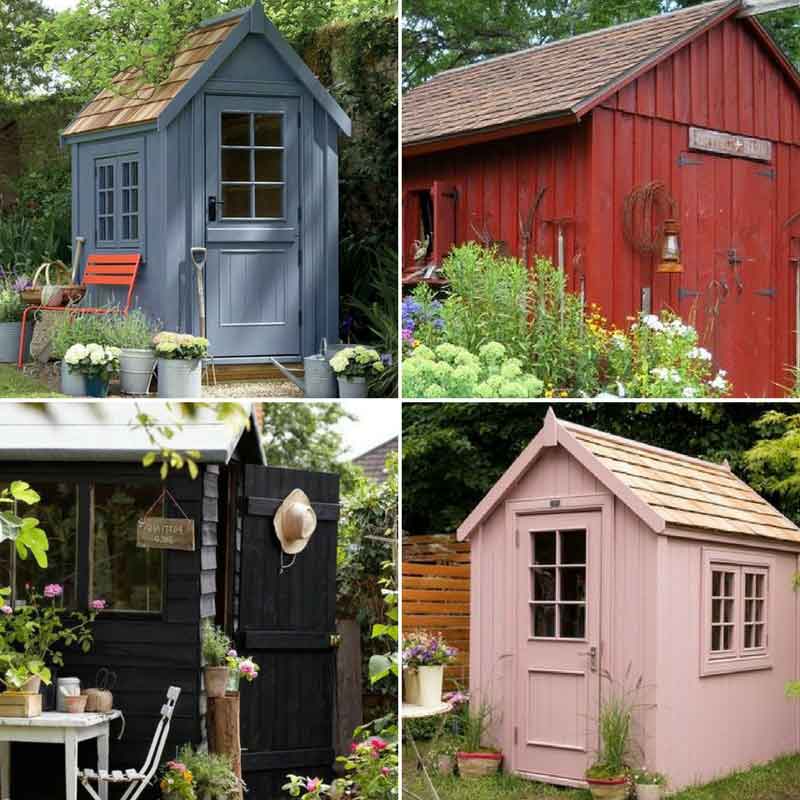 Blue, red, black, or pink... Everything is possible to personalise a tool shed
Small painting tip: on pine, there can sometimes be a rise of resin that forms stains: remember to apply a special undercoat for exotic and resinous woods before painting.
2) Shelter roof: improve the existing
The cheapest garden shelters often come with simple bitumen sheets as roof protection. I’ll tell you: it’s ugly and fragile. Don’t hesitate to spend a few extra euros on bitumen shingles. They provide a more durable protection and, by mimicking tiles or slates, offer a more aesthetic appearance.
While you’re at it, add gutters to collect rainwater; it’s essential!
The more handy among you can also embark on creating a green roof. Although this is not something to improvise (you must ensure that your shelter's structure is strong enough to support the weight of the waterlogged substrate as well as a possible layer of snow), it is much easier than it seems and immediately gives a little hobbit house vibe!
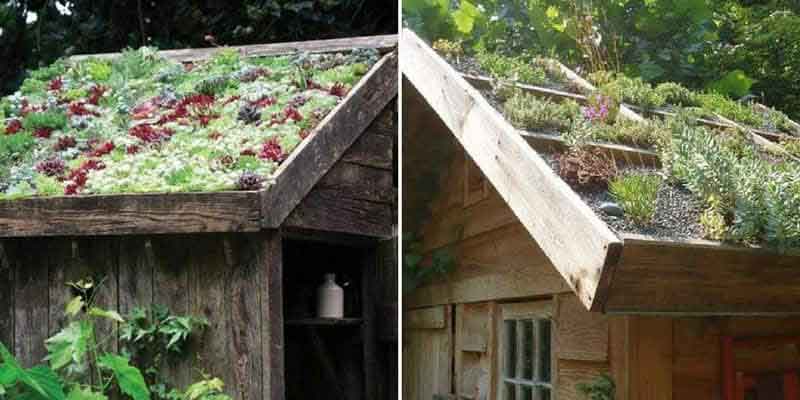 Green roofs - Photos: Pinterest
3) Add some decorative elements
To perfect the personalisation of your shelter, don’t hesitate to add a little decorative touch. Once again, anything is possible: a planter at the window; some zinc pots, an outdoor bouquet, a pretty wicker wreath hung at the entrance, or even your favourite number painted with a stencil... If your shelter doesn’t have a window, you can easily create a faux one!
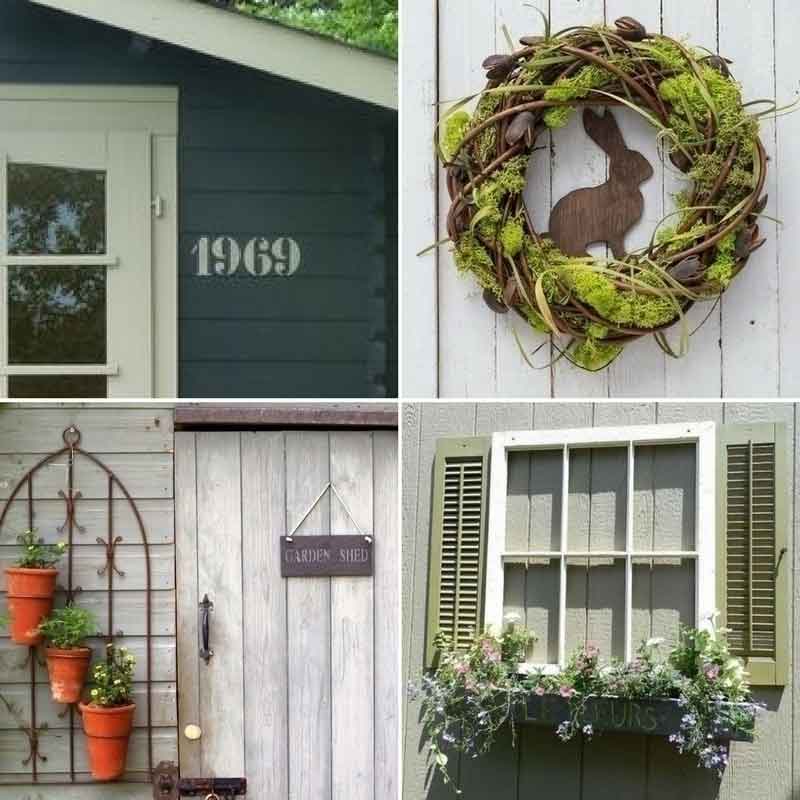 Clever and recycled storage, a potting table... organise and personalise the interior of your garden shed - Photos: Pinterest
4) Give it a terrace and even a mini pergola
The immediate environment of your shelter plays a significant role in its integration. Rather than planting it in the middle of the lawn, add a small terrace. Made of wood or paved, it will look great, especially if you accompany it with large pots and place a chair or a bench there. Then complete with large beds of perennials... Voilà, it’s no longer just a garden shed, but a lovely refuge, almost a second home!
For those who do early sowing, it may be interesting to attach one or several frames on the south side to protect your cuttings and young plants from the cold.
Finally, to give personality to your cabin, nothing is better than a mini pergola or an arch attached to the facade. It will "break" the ordinary look of the cabin and can host a clematis, a honeysuckle, or even a climbing rose with a delightful fragrance.
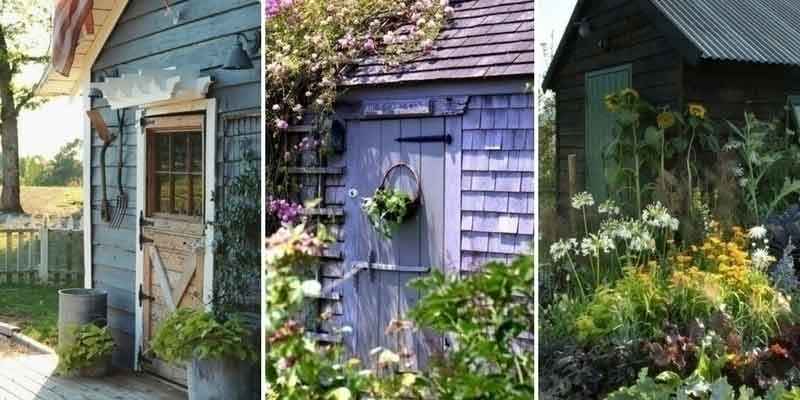 A mini-terrace, a climbing rose, or a generous bed of perennials: accompany your garden shed! Photos: Pinterest
5) Don’t neglect the interior layout of your cabin
The garden cabin can serve multiple functions: storing tools, pots, etc., but also, when spacious enough, serving as a sowing and potting workshop. As with all small spaces, it is crucial to plan suitable storage and optimise every inch to work comfortably. Here are some ideas that I hope will inspire you.
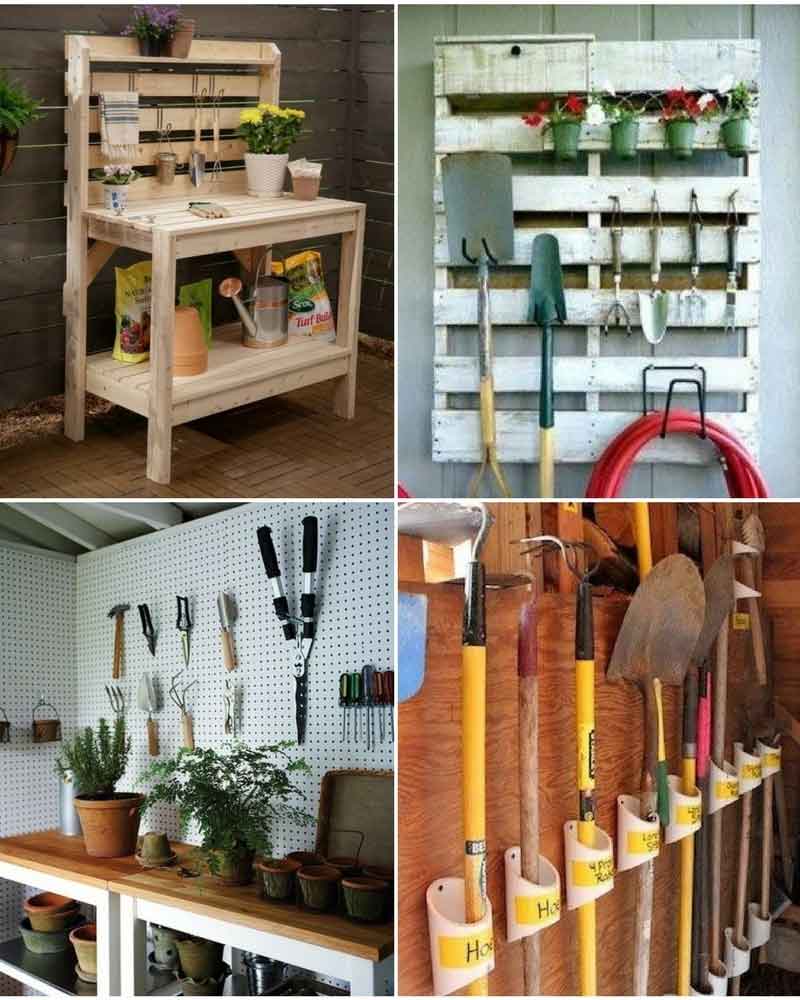 Clever and recycled storage, a potting table... organise and personalise the interior of your garden shed - Photos: Pinterest
6) A truly hideous garden shed? Drown it in vegetation
Sometimes, we must admit, none of this is possible or sufficient. This is often the case with metal or resin shelters that still serve their purpose. In this case, opt for the complete camouflage option by planting around a hornbeam, a hedge of bamboo, or giant miscanthus. Another option is to double it with trellises that will be covered with vigorous climbing plants. This last solution will also help regulate the temperature, which is often high in summer in this type of shelter!
And you, how have you integrated your "garden chalet"? Any tips or ideas to share? Leave us a comment!
PS: All these ideas have been gathered from Pinterest, where you can find them, along with many others, on our boards!
We all have dreams. More or less ambitious, more or less realistic: a cabin by the Arcachon basin, a chalet in Switzerland, a villa in the Seychelles, or, more simply, a garden shed. And I am convinced that I share this dream with all gardeners who do not yet have one. Where the problem lies […]
All gardeners know foxgloves (Digitalis purpurea), sometimes called "Lady's Gloves" because of the shape of their flowers. They send up long spikes towards the sky, so laden with little bells they bend their backs. These lovely biennials self-seed abundantly wherever the wind takes them… But who knows their perennial cousins? I must confess I have a soft spot for the latter, particularly for two of them.
In my garden these varieties have returned faithfully for several years, spreading slowly and some are even sterile, which removes any risk of volunteer seedlings. To grow them successfully, plant preferably in partial shade, although they can do perfectly well in sun as long as the soil stays cool. Their flowering will charm you for years and will bring verticality and harmony from late spring. I would add that the evergreen foliage of these foxgloves is spared the voracity of garden slugs and that their flowers are a true cornucopia for pollinators!
So, without further ado, I invite you to meet my favourite perennial foxgloves.
1) Digitalis lutea and 'Glory of Roundway' : slender and graceful
The foxglove ‘Glory of Roundway’ is a wild beauty that attracts my visitors' admiration with its charming apricot-pink bells. Trying to be economical, I had planted only one pot at the time, which I later regretted because it really spreads slowly. So I recommend planting it in groups of at least three if you want a good clump quickly. It is a sterile hybrid obtained from the no less delicate Digitalis lutea with similar inflorescences but soft yellow. The latter will need to be staked because of the slenderness of its tall stems.
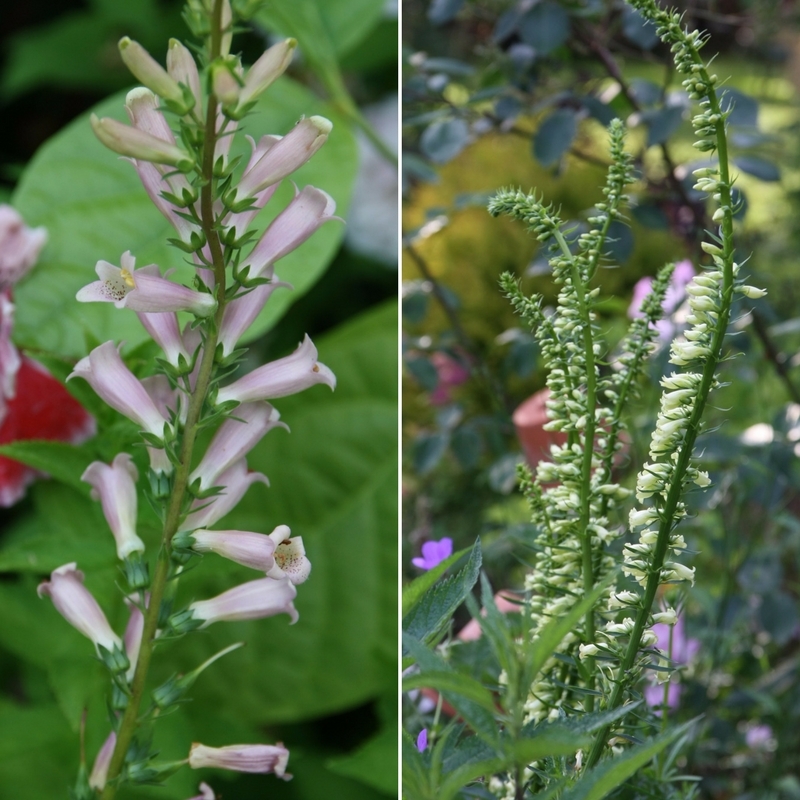
Digitalis 'Glory of Roundway' and lutea
Loyal companions for years and fabulous partners for the queen of flowers, these two varieties bring the lightness and elegance I cannot do without in my natural garden. The generous lutea self-seeds a little to my great pleasure. Finally, and not least, it tolerates some lime in the soil. Isn't that wonderful? Undoubtedly, they are my favourites.
2) Digitalis grandiflora ‘Carillon’ : dwarf and compact
Placed at the front of a border, Digitalis grandiflora ‘Carillon’ is absolutely delightful with its fresh butter hue. I love pairing yellow and white, whether among foliage or between flowers and even both. Especially as it is a combination that works wonders in shady corners. Paired with Geum rivale and blue-leaved hostas like ‘Halcyon’, on a carpet of Lysimachia nummularia ‘Aurea’, the combination is divine! This small foxglove, with its stocky habit, requires no support. It is also a perfect candidate for small gardens. So don't miss out!
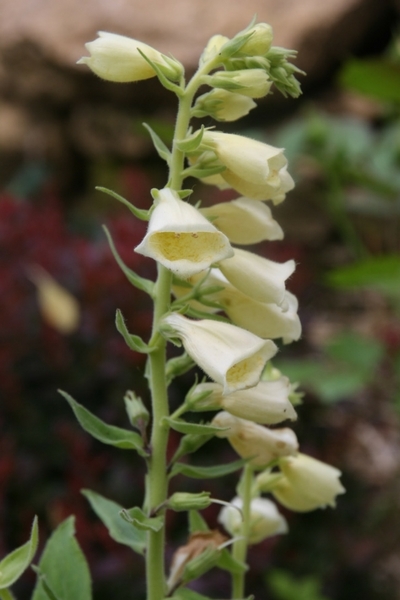
Digitalis grandiflora 'Carillon'
3) Digitalis mertonensis : an uncommon colour
Digitalis mertonensis offers flowers in a pretty old-rose shade. Plump, they are noticeable from afar. Its stems are robust and need no support. In my garden it is well surrounded: a carpet of Pulmonaria ‘Mrs Moon’ brightens the corner while awaiting its beautiful flowering, which will be accompanied by purple heucheras and hardy geraniums. Persicaria amplexicaulis ‘Rosea’ and Aster ‘Ezo Murasaki’ will then take over.
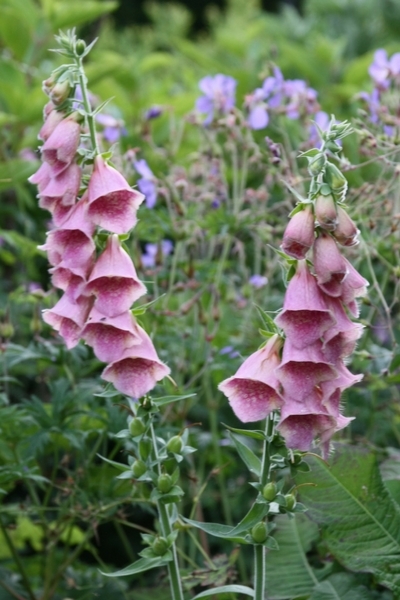
Digitalis mertonensis
4) Digitalis ferruginea : the originality of a giant
Perfectly at ease in sun, the incredible Digitalis ferruginea or rust-coloured foxglove always surprises with its verticality (1.80 m tall — nothing less). Up close, it is the shape of its flowers, with very marked, hairy lower lips, and its uncommon yellow-brown colour that catch the eye. More summer-flowering, it blooms later than other foxgloves, prolonging the pleasure. Planted in drifts, it creates a splendid effect, especially under the low rays of an evening. Accompany it with Echinacea purpurea, Angelica gigas and other summer beauties!
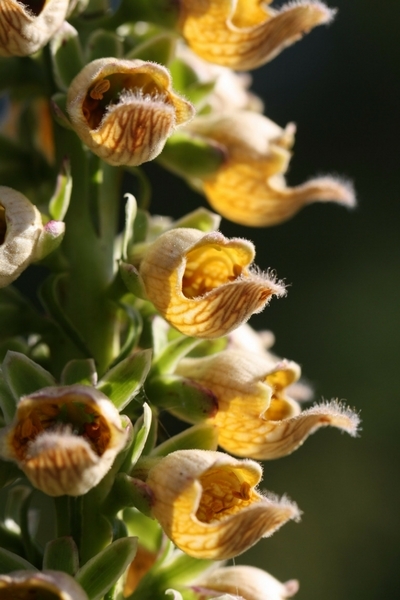
Digitalis ferruginea ‘Gelber Herold’
These latter foxgloves are considered short-lived perennials but they self-seed (if conditions suit them), which allows them to always keep their little place in the garden. However, for this to happen you must not cut the flower spikes as soon as flowering has finished.
One more thing — do not move foxgloves, take my word for it, their taproot does not like it at all! Read between the lines: I've tried (several times even... because once is really not fun) and I regretted it.
Give verticality and originality to your gardens with these beautiful perennial foxgloves — you won't regret it!
All gardeners know foxgloves (Digitalis purpurea), sometimes called “Lady’s Gloves” because of the shape of their flowers. They send up long spikes towards the sky, so laden with little bells they bend their backs. These lovely biennials self-seed abundantly wherever the wind takes them… But who knows their perennial cousins? I must confess I have […]
In a garden, aromatic plants are often gathered in the same spot. This is convenient for harvesting, but one can also view things from another perspective. Indeed, the flowers and foliage of some of these plants are so ornamental that they integrate perfectly into flower beds.
A wide range is available to us: mints, fennel, rosemary, orach, chives, hyssop, oregano, sages, thyme, lavenders, sorrel, etc. Obviously, this list is not exhaustive. I would like to introduce you to my favourite plants and my preferred combinations.
1) Purple: the embodiment of elegance
Purple foliage brings elegance and originality to the garden. Notably, we can distinguish:
- The red orach (Atriplex hortensis rubra), perfect both in salads and in flower beds where it adds a lovely touch of whimsy. In the garden, it is ideal for creating dynamic colour reminders in the beds.
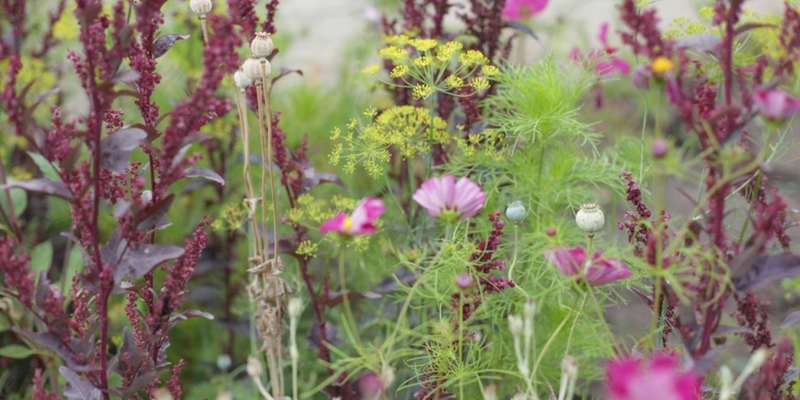
-
Some varieties of sorrel are equally impressive, just look: Rumex ‘Purpurea’ or Purple Sorrel with reddish-purple foliage and 'Sanguineus’ with green leaves veined in red are particularly attractive. In my garden, the latter pairs wonderfully with Heuchera 'Purple Petticoats' and Ajuga reptans ‘Black Scallop’.
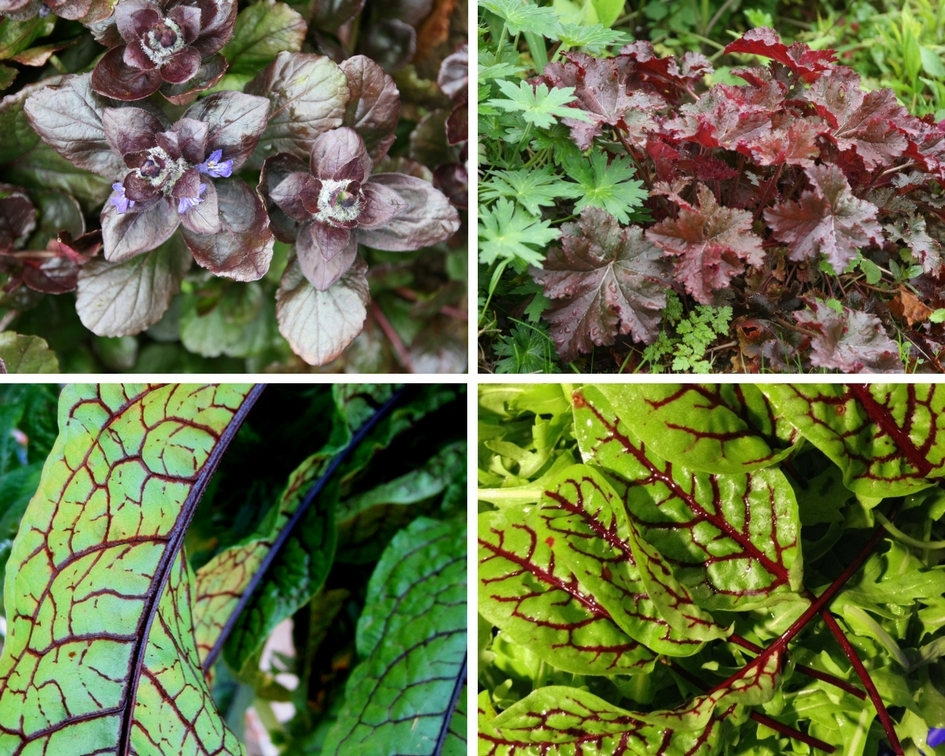
-
Medicinal sages exhibit various foliage variations. Salvia officinalis ‘Purpurescens’ stands out with its young shoots of a purplish hue. When paired with lavender and wormwood (‘Powis Castle’ for example), it creates a stunning effect.
2) Yellow and gold, perfect for breaking monotony
I really enjoy the vibrancy of yellow foliage. Some even flirt with fluorescence in spring, like that of the Golden Oregano or Origanum vulgare ‘Aureum’.
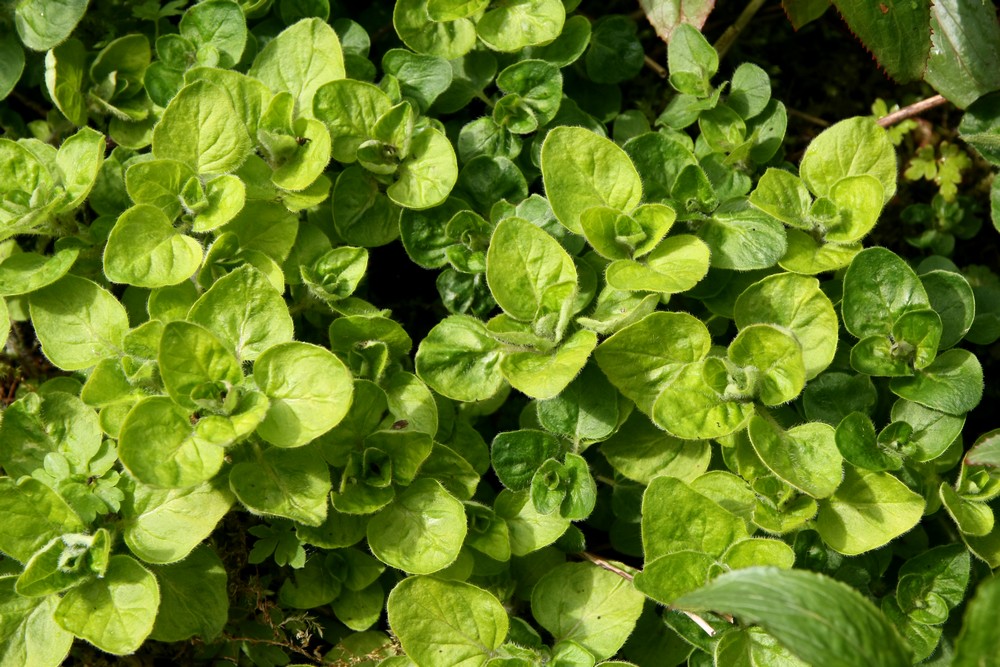
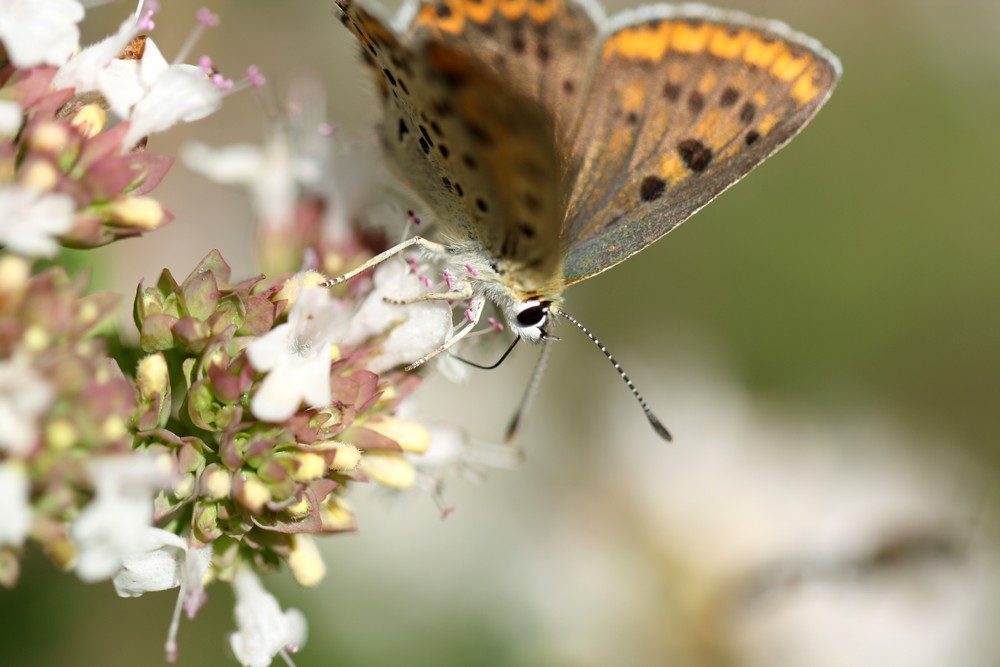
Note that although oregano is native to the Mediterranean basin, my Ardennes garden hosts both the standard species and the golden variety (in a clayey, poorly drained bed, and its hardiness somewhat challenged) and they thrive beautifully. They have even spread freely for years. Nature's ways are inscrutable! I would also add that the flowers are visited by many small butterflies.
In the same category, we find thyme, Thymus citriodorus ‘Aureus’. Its tiny golden leaves are a delight, complemented by a lovely lemony fragrance.
3) Bright variegateds
Among those that play the variegated card, we note the beautiful presence of Origanum vulgare ‘County Cream’ and Thymus microphylla ‘Variegata’ with cream-edged foliage.
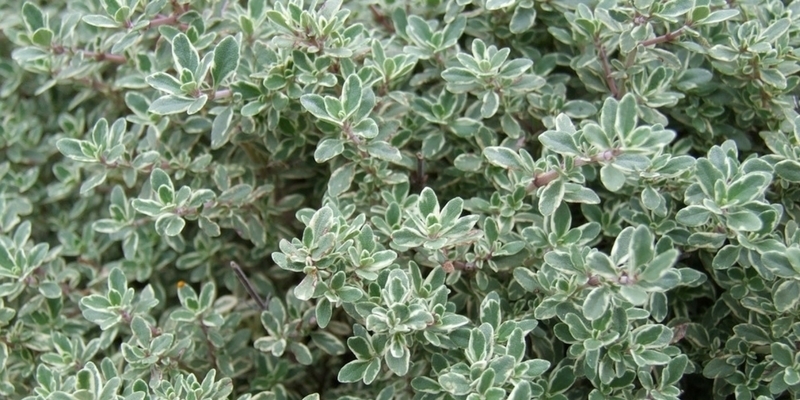
If you prefer yellow, you will be charmed by Thymus citriodorus ‘Variegated’, a variety of lemon thyme with small leaves, as well as by certain sages such as ‘Icterina’ with green leaves edged and variegated in yellow. Want more colour and contrast? Turn to Sage ‘Tricolor’ with foliage marginate in green, pink, and white, or to Mentha suaveolens ‘Variegata’ with beautiful white variegations on a green background.
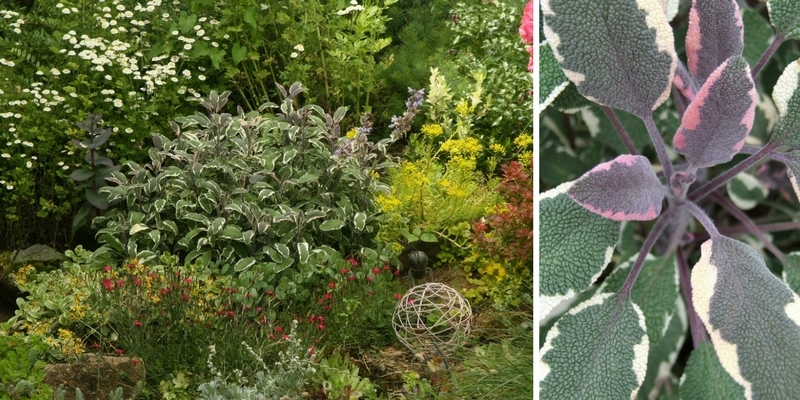
I know, mints have a bad reputation, and planting them in a flower bed might seem risky. They are known to be invasive, but they are merely wanderers. Equipped with their little bundles, they roam between plants, and young shoots emerge where there is space. In other words, if they have competition, they will be more docile. The choice is vast for this family, especially regarding the scents emanating from the leaves: green mint, Moroccan, peppermint, chocolate, bergamot, crisped, lemon... Don't deprive yourself!
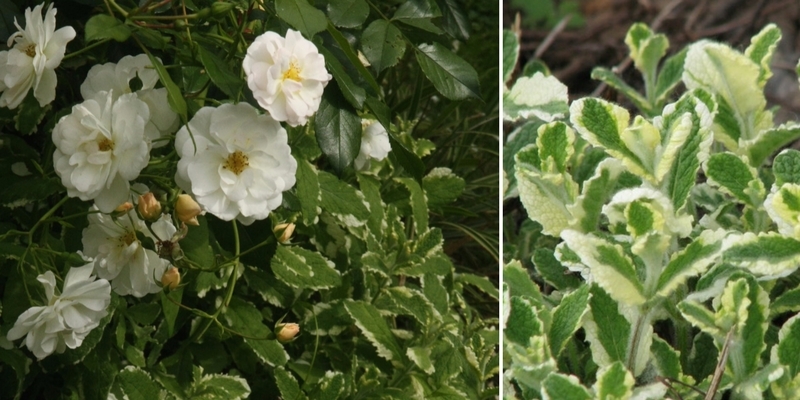
4) The greys, perfect for highlighting other plants
Santolines (Santolina chamaecyparissus) are distinguished by their fineness and the beautiful silver colour of their foliage. The variety ‘Edward Bowles’ offers an elegant grey-green combination and cream-white flowers that pair wonderfully with nepeta, stipa, white yarrow, and some Allium sphaerocephalon. Santoline flowers are also very melliferous. The tufts can be easily pruned into balls, providing structure in the garden.
5) Graphics for a touch of lightness
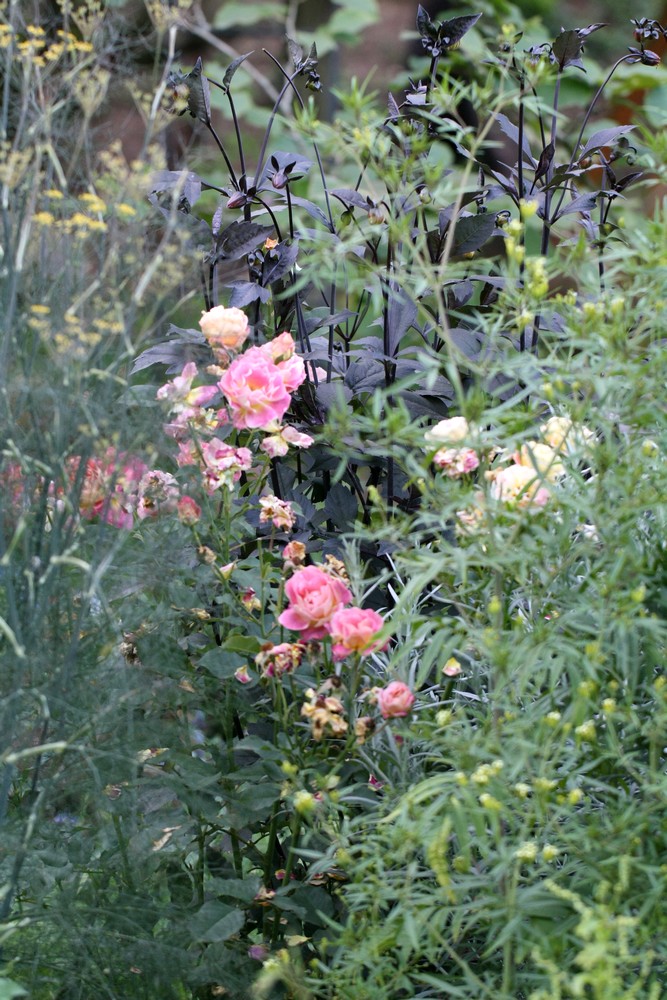
In life as in flower beds, we always need a bit of lightness. The green fennel (Foeniculum vulgare) or the bronze variety (Foeniculum vulgare ‘Giant Bronze’) form beautiful "mists". Their airy appearance is perfect for lightening a generous floral composition. Here, accompanied by the rose ‘Prieuré de Saint-Côme’, the dahlia ‘Twinings after Eight’, and Tagetes minuta.
Why not try it with Lysimachia purpurea ‘Beaujolais’ and the purple orach mentioned earlier: the union is divine as well.
Note that you will still need to choose them carefully based on the conditions you can offer them. It is evident that thyme, in clayey and poorly drained soil, will not last long, just as chives and parsley will struggle to thrive in dry soil. Pay attention to exposure as well! Finally, be aware that some of these aromatics are annuals but self-seed like orach, for example.
And you, do you grow any of these beautiful aromatics with atypical foliage or unique colourful inflorescences? Which are your favourites?
In a garden, aromatic plants are often gathered in the same spot. This is convenient for harvesting, but one can also view things from another perspective. Indeed, the flowers and foliage of some of these plants are so ornamental that they integrate perfectly into flower beds. A wide range is available to us: mints, fennel, […]
Whether it is shared or belongs to your neighbour, the effect of a wall in the garden is largely the same. It imposes itself forcefully, highlights the potential crampedness of the space, and often presents a rather gloomy face. And if it is built from unsightly concrete blocks and blocks the sun, the urge to grab a heavy sledgehammer is not far off. This ultimate solution should be forgotten (unless the wall is yours), so here are some ideas to work with, dress up, or take advantage of a wall in the garden.
If, like me, you are always on the lookout for the latest trends, I am sure you are already thinking of “green walls”. They create stunning displays and are an excellent option if you have the right budget. Indeed, vertical gardening is not something you can improvise: it requires quite advanced techniques. I’m sorry to burst your bubble, but it is expensive, and even more so if the installation is poorly managed, as you will have to replace the plants, which may perish from either lack or excess of water or fertiliser.
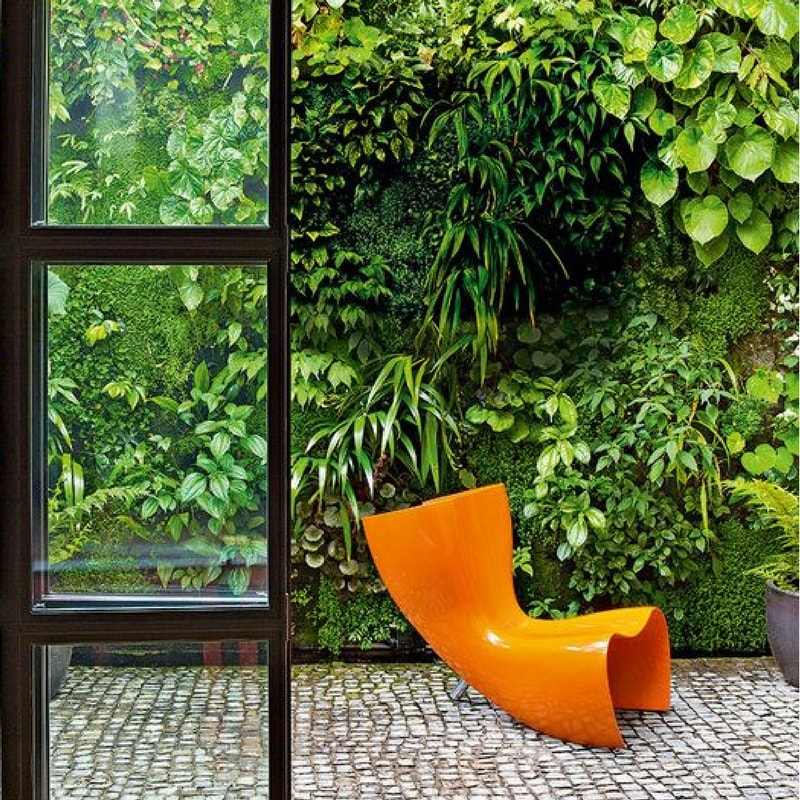 Green wall - Source: Pinterest
So I suggest we focus on simple, realistic, and easy-to-implement solutions.
Planting a bed in front of the wall
The first solution to break the massive effect of a wall is to use it as a backdrop. If it is rather attractive (the charm of old stones…), its presence will soon be balanced by the plants. Shrubs and perennials are classic choices. You just need to choose them well according to the exposure. If the wall blocks the sun, you can opt for heather soil shrubs, Hostas, ferns, Epimediums… If it is south-facing, it will retain heat, allowing you to plant some tender varieties. Unfortunately, this option is only feasible in larger gardens...
Climbing plants: champions of ascent
Climbing plants are a natural choice when it comes to greening a wall. They should be the first option that comes to mind, especially since they occupy minimal ground space.
Whether they climb the structure on their own using their climbing roots (Virginia creeper, ivy…) or need a little assistance, anything is possible. Honeysuckles, clematis, climbing hydrangeas, Akebia... the choices are vast. Don’t hesitate to combine them to create a lush tapestry that will bloom with flowers throughout the seasons.
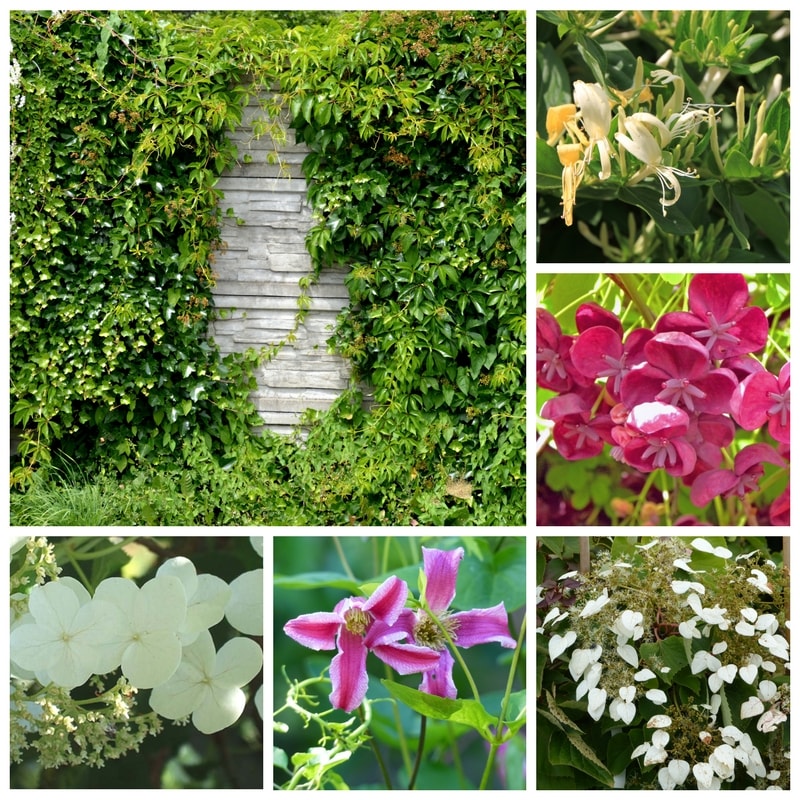 Greening a wall: Honeysuckle, Akebia quinata rosea, Schizophragma, Clematis 'Etoile Rose', climbing hydrangea
Regarding installation, I have given up on commercial trellises (too expensive or unattractive) in favour of metal cables (from the Gripple brand). I can do whatever I want with them; they are discreet and incredibly sturdy. If you are a bit handy and creative, go ahead and invent your own supports!
Focus on wood and create the illusion
To disguise an unsightly wall, wood is a material of choice. Its natural appearance pairs well with plants and gives a touch of countryside charm to even the most urban gardens. It is relatively easy to implement and not too costly if you opt for a species like Douglas fir.
To counter the feeling of enclosure, one solution is to create the illusion of openings. Cleverly placed and integrated into the vegetation, garden mirrors can be truly stunning.
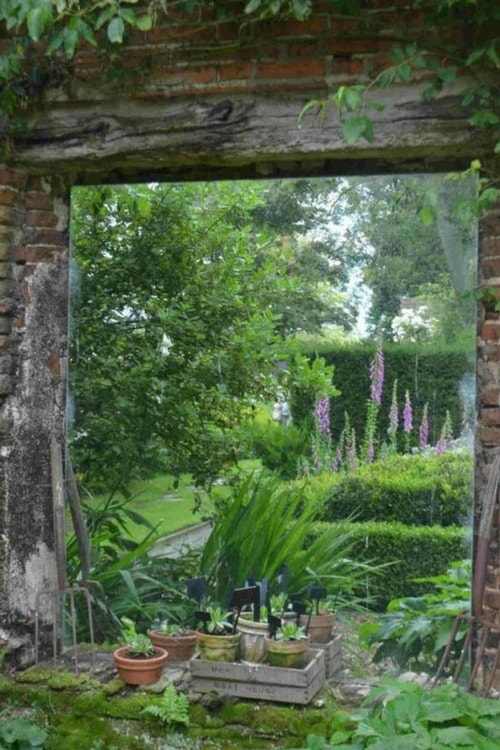 A beautiful effect of openness thanks to a mirror (Source: Pinterest)
In the category of trompe-l'œil, simulating the presence of a shed, as done by Isabelle Olikier or Hugues Peuvergne, will also have a lovely effect. Some wood, a reclaimed door and window… a few weekends of work and you’re done!
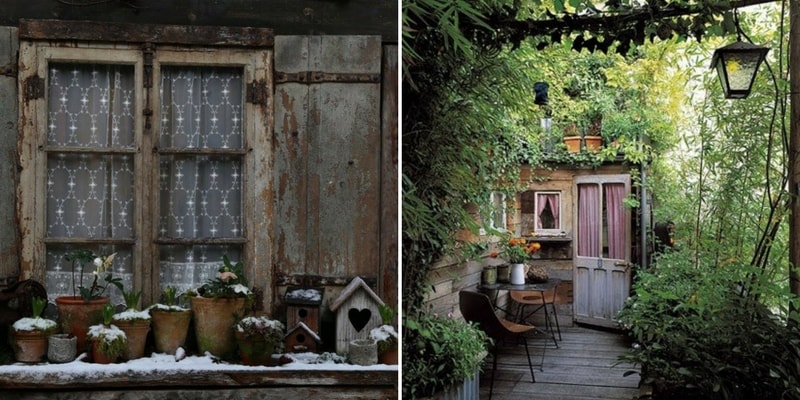 Two examples of trompe l'œil: the shed by Isabelle Olikier and the shelter by Hugues Peuvergne (Photo Pinterest)
Bring in some colour!
Solid colours are very energising in a small garden or terrace. They set the tone without hesitation and complement modern-style gardens well. Bright orange, deep red, Klein blue, sunny yellow, or Indian pink… anything is possible as long as you remain consistent with the overall atmosphere of the garden and choose your furniture wisely.
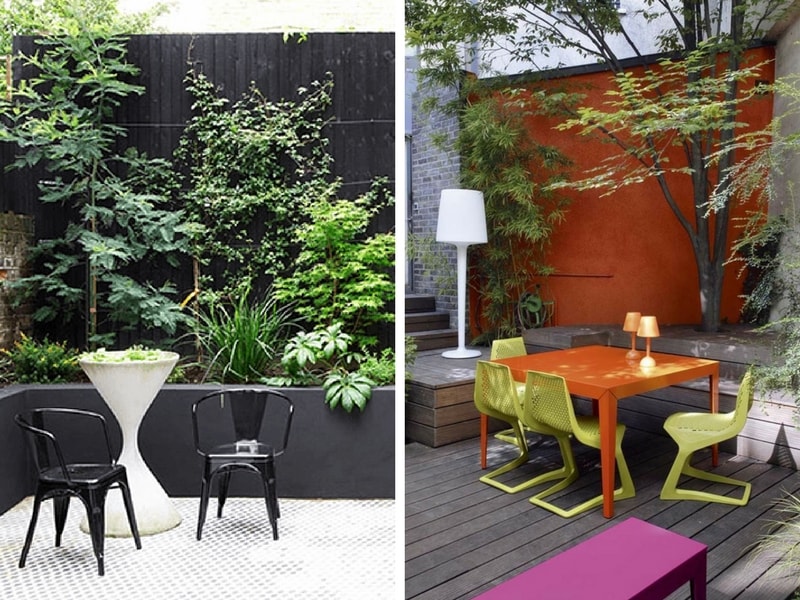 Two examples of colourful walls - Source: Pinterest
Black often puts people off. I love it. It adds a very chic and contemporary touch and truly highlights the foliage: don’t banish it from your palette, even in the shade!
White is very versatile: paired with blue and Mediterranean perennials, it transports you to Mykonos. With hydrangeas, you find yourself in Brittany! Paired with a hint of beige, it also suits white gardens. However, avoid it in less sunny regions, as you may find it looking pale for nine months of the year.
But perhaps you have a good artistic flair: why not animate the wall with a lovely drawing? If not, consider reaching out to people like Claire Delahaye, a landscape designer (Slowgarden), who masters the art of murals:
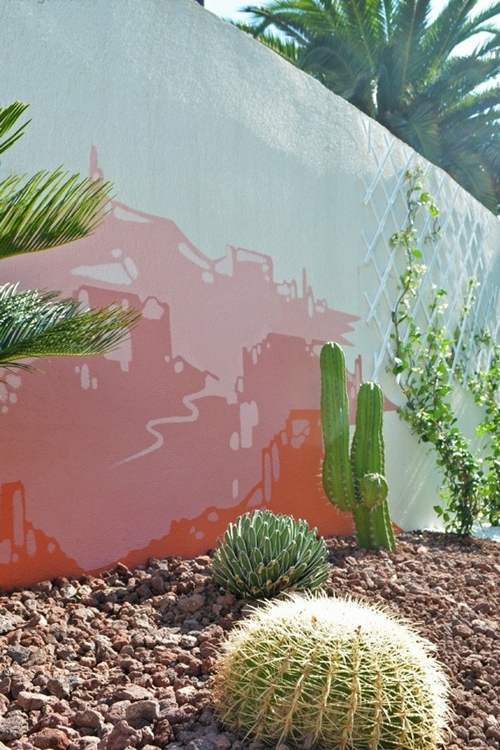 Mural - Photo: Slow garden
Finally, if you, like me, have a practical mindset, know that a south-facing wall is ideal for supporting a pergola, a lovely summer kitchen, or a greenhouse… the latter will benefit from the thermal mass of the stone to maintain a gentle warmth.
Most of these images were sourced from Pinterest… It is a true treasure trove of ideas. Don’t hesitate to sign up and follow our boards!
Whether it is shared or belongs to your neighbour, the effect of a wall in the garden is largely the same. It imposes itself forcefully, highlights the potential crampedness of the space, and often presents a rather gloomy face. And if it is built from unsightly concrete blocks and blocks the sun, the urge to […]
Let's be clear: I'm not a fan of anglicisms, but one must admit that mixing languages can be a good thing! Indeed, talking about "seedheads" [pronounced siiid-h-aide-z] is much more elegant and poetic than talking about "infrutescences", or — worse yet! — "dead stems" for perennials and grasses, don't you think? I, for one, am campaigning to introduce this lovely word into vocabulary of French gardeners.
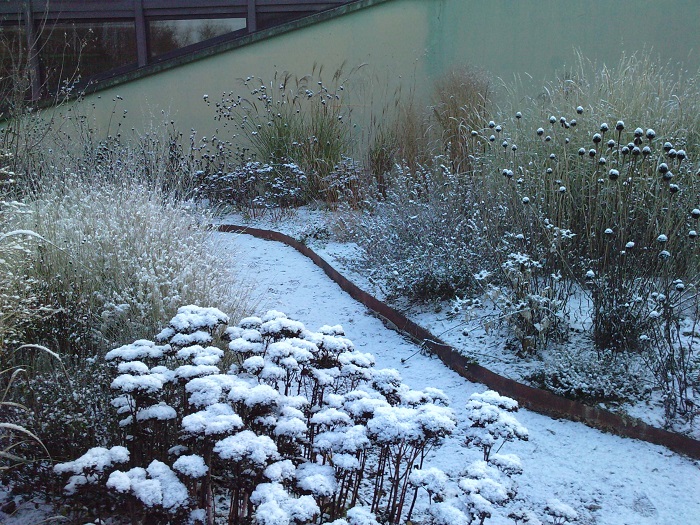
Perennial and grass bed in winter, made attractive by seedheads left standing and covered with fresh snow.
Popularised by vogue for so-called "prairie" gardens and by plantings of Piet Oudolf, "seedheads" refers to fruiting structures and winter architectural features of perennials and some shrubs which, when thoughtfully combined, create naturalistic tableaux in sepia tones, enhanced by low light, mist or hoar frost in autumn and winter: each day brings a different, unpredictable effect, which is part of garden's beauty at this time of year. Ingrid and Michael told me yesterday that their hellebores were already in flower at their place... here, not far from the north, that's not the case yet: never mind, I never tire of admiring subtle details of seedheads I left in place during autumn tidy-up.
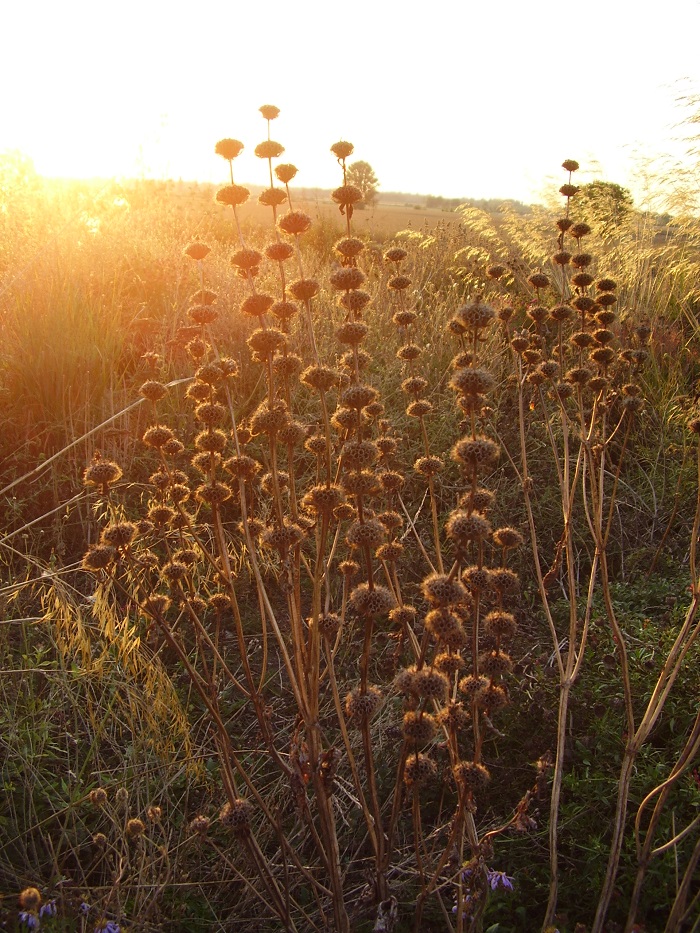
A superb specimen of Phlomis tuberosa, perfectly spent, seems literally to glow in late-afternoon autumn sun.
Inspired by books by Piet Oudolf and Noel Kingsbury such as Le Jardin de Vivaces et de Graminées (Bordas, out of print), then Jardins d'Avenir (éditions du Rouergue) and Jardins d'Automne et d'Hiver (original title: Seedheads, by Noel Kingsbury with photographs by Jo Whitworth, éditions du Rouergue), I experimented extensively in my garden on edge of Maritime Flanders, less than 20 km from North Sea coast, with varying success... Rain and especially wind really test sturdiness of stems that have lost their life, and my soil, less sandy and richer than typical Dutch gardens, makes stems less resilient. In hindsight, only handful of perennial varieties manage to retain decorative impact in my garden through whole winter, and it's mainly in November and December that seedheads look their best. Here is a gallery of portraits.
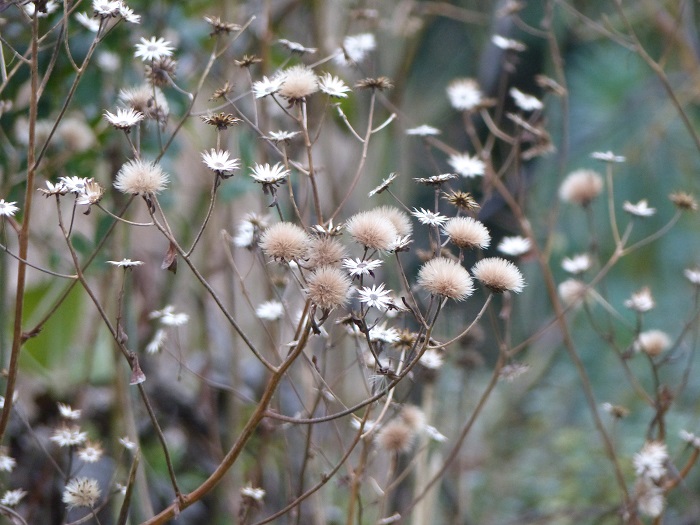
I particularly love seedheads of Aster macrophyllus 'Twilight', ever-changing: small tawny pom-poms disintegrate as seeds fly, leaving floral receptacles with silvery sheen. At about 60 cm tall, it withstands wind well.
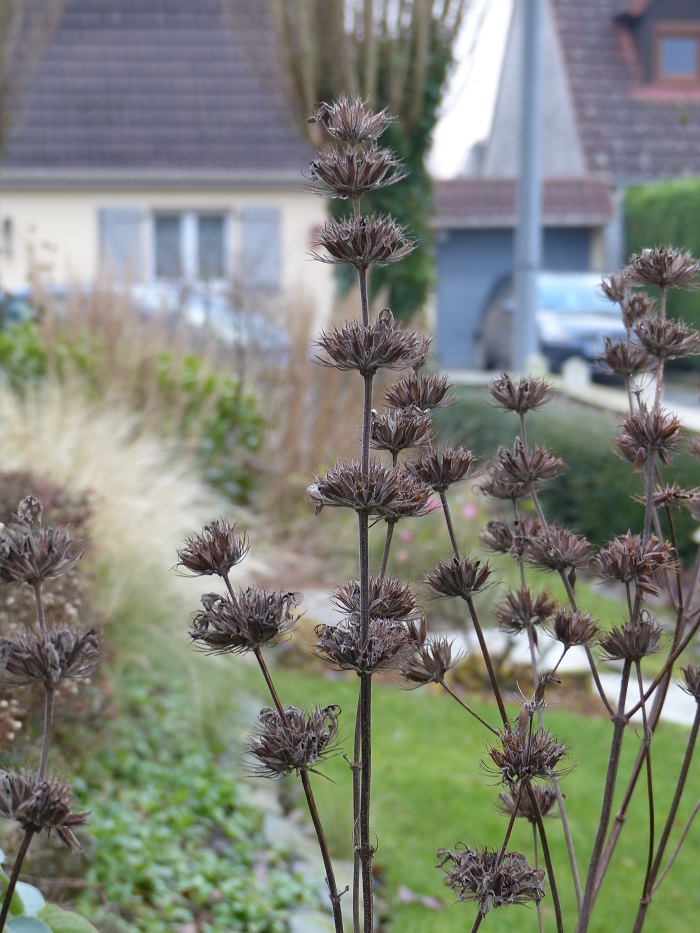
One of all-round champions: Phlomis! This is true Phlomis samia, with branched inflorescences finer than those of Phlomis russeliana, but with same graphic effect from regularly spaced verticillasters along stem. Phlomis seedheads are among most architectural and most durable.
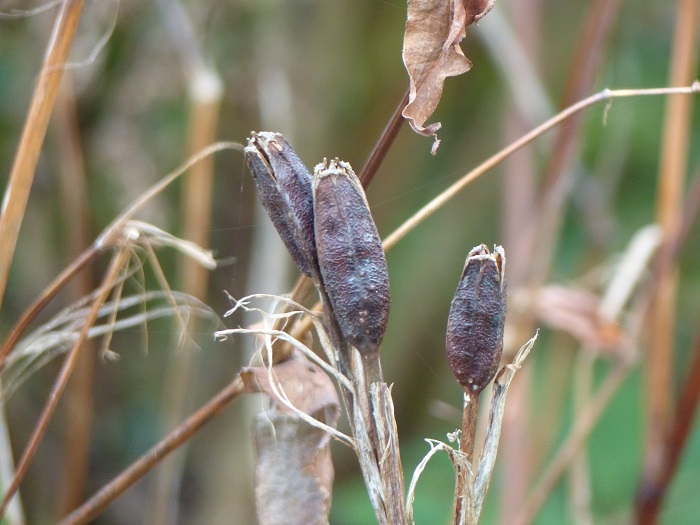
Not thought of often enough, but seed pods of Siberian iris, dark brown, are quite attractive and very long-lasting. A nice bonus to make up for fleeting June flowering!
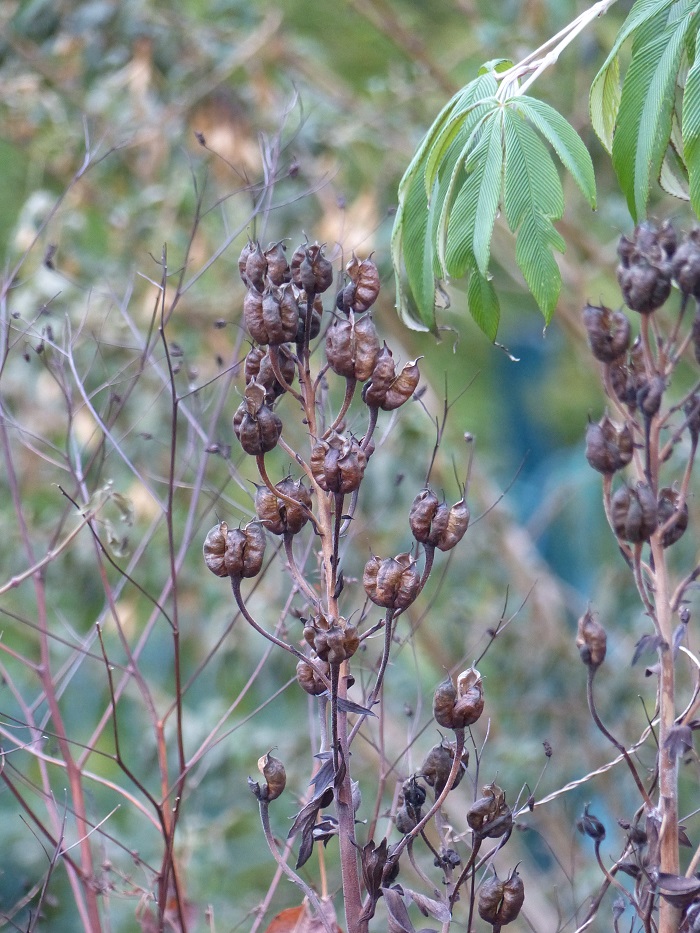
One of my more recent discoveries: dried inflorescences of autumn aconite seem sturdy and long-lived, another advantage over delphiniums!
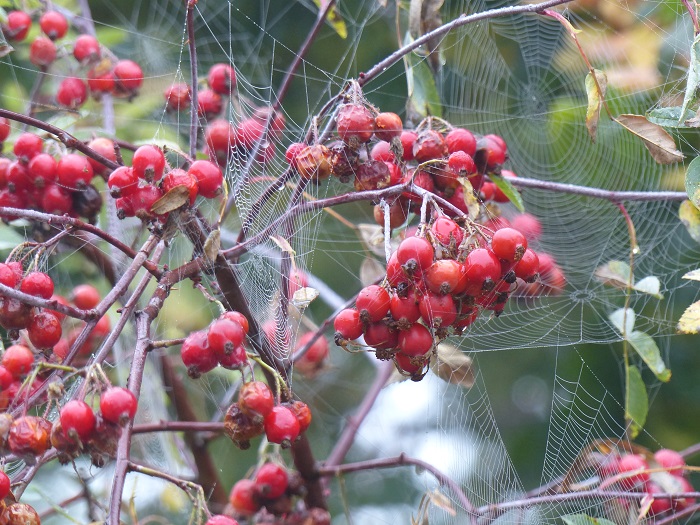
Not only "dry fruits" decorate autumn garden: there are also fleshy fruits such as rounded hips of Rosa glauca, or abundant fruit of ornamental apple trees.
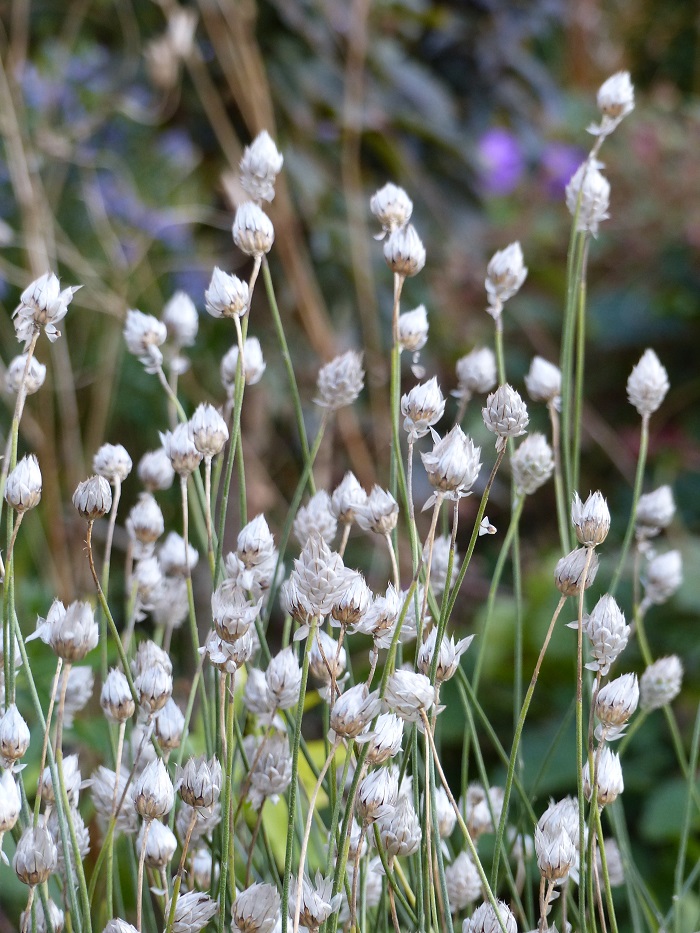
Fruits of Cupid's dart (Catananche caerulea), in silvery clusters, sit alongside its metallic-blue summer flowers in original, harmonious display. After flowering they extend plant's interest for a few weeks before dispersing in December winds.
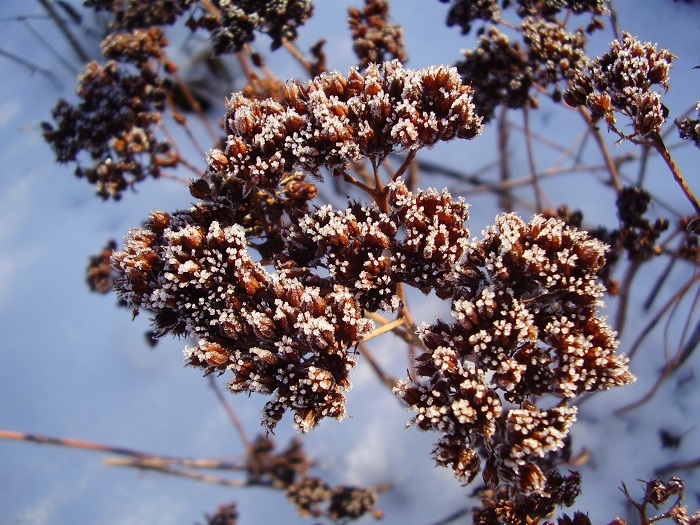
Large sedums like 'Matrona' are fail-safe. Their shape is impeccable year-round and their inflorescences pick up hoar frost beautifully in winter.
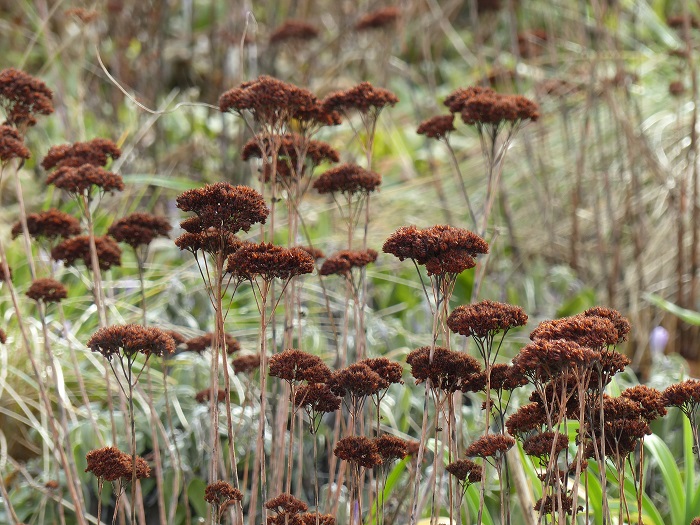
Sedum 'Herbstfreude' is simply indispensable.
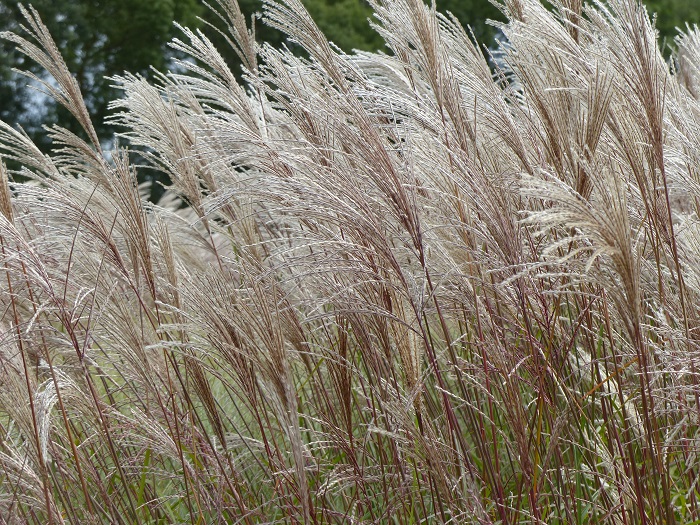
Of course, how could one not mention Miscanthus, here variety 'Malepartus'? Their plumes with diamond-like sheen remain attractive until I have to cut them back in January to make way for new growth.
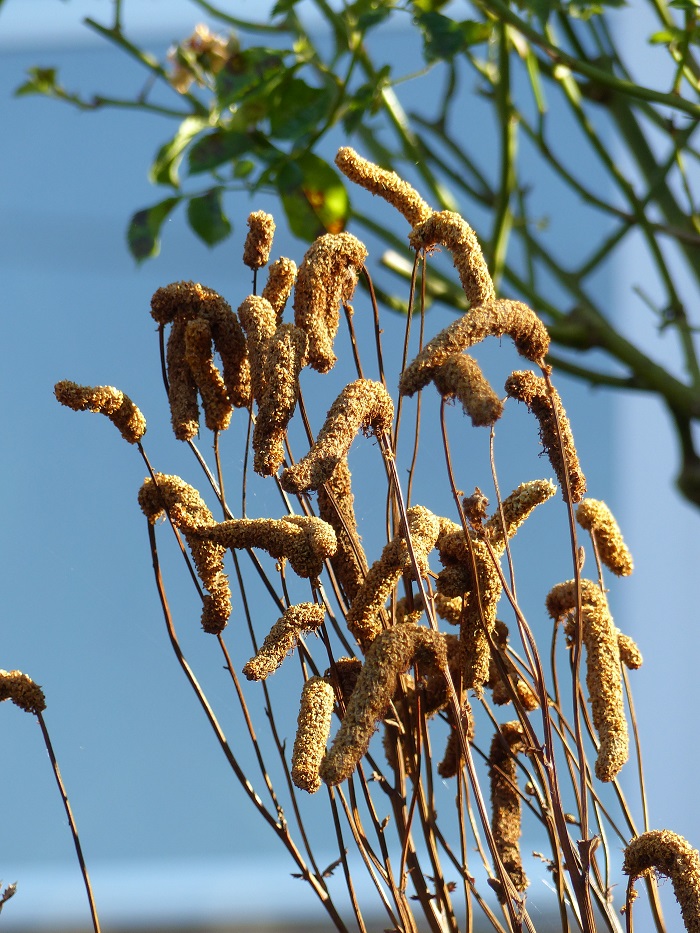
Spent flowers of large Asian burnet, Sanguisorba hakusanensis, suggest little caterpillars embarking on conquest of air! As pretty as they are, these seedheads are short-lived and last at most six weeks on plant, after which I cut plant back.
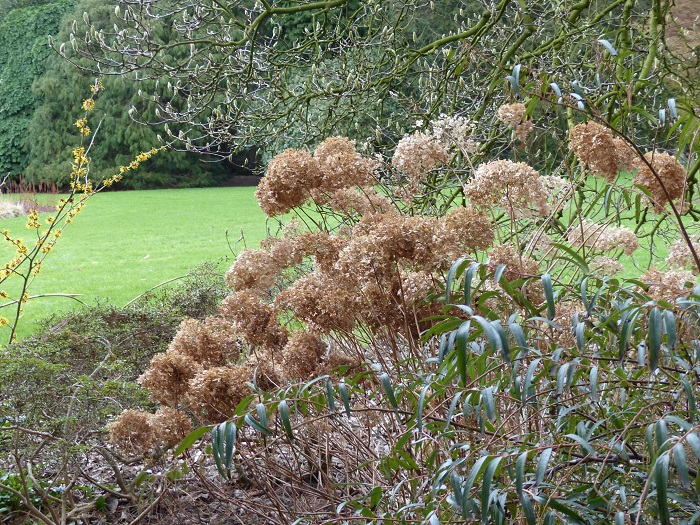
Dried inflorescences of hydrangeas are classic choices; they lose none of their roundness and opulence when spent, turning rich shades of green before browning. Here, Hydrangea arborescens 'Annabelle' photographed at Kalmthout Arboretum in Belgium.
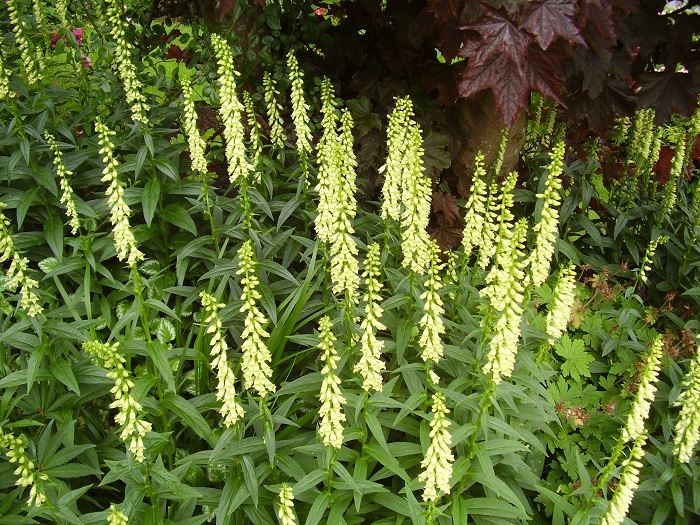
Yellow foxglove, Digitalis lutea, flowers in pale-yellow spikes in July. A true perennial living 5–10 years, easy to combine and happy everywhere except acidic soil. Given long ago by gardening friend, it quickly became one of my favourites, especially for quality of its seedheads.
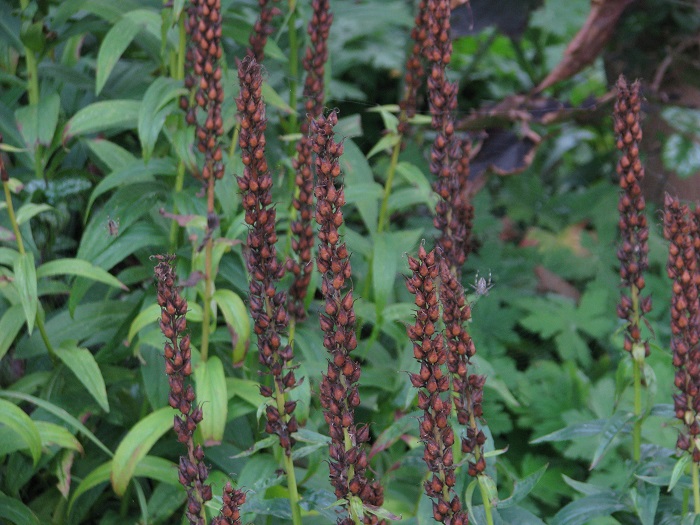
Spikes of Digitalis lutea are by far sturdiest of all. They stand upright from August through March. I tuck them in everywhere to give structure and movement to winter borders.
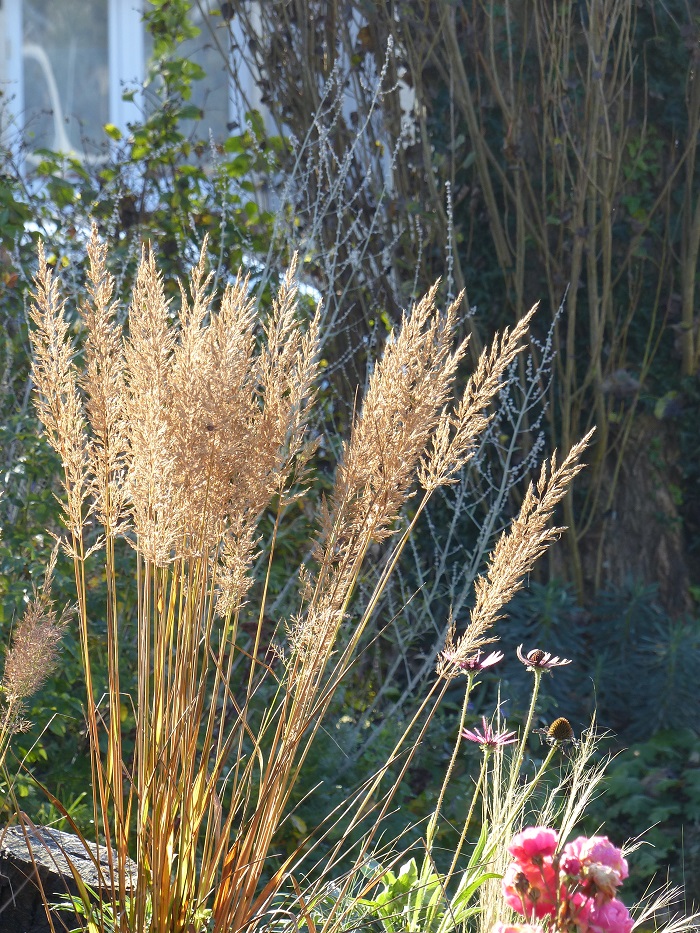
Calamagrostis brachytricha, the "diamond grass", is an excellent autumn and winter grass, with good habit and remarkable way of catching the light.
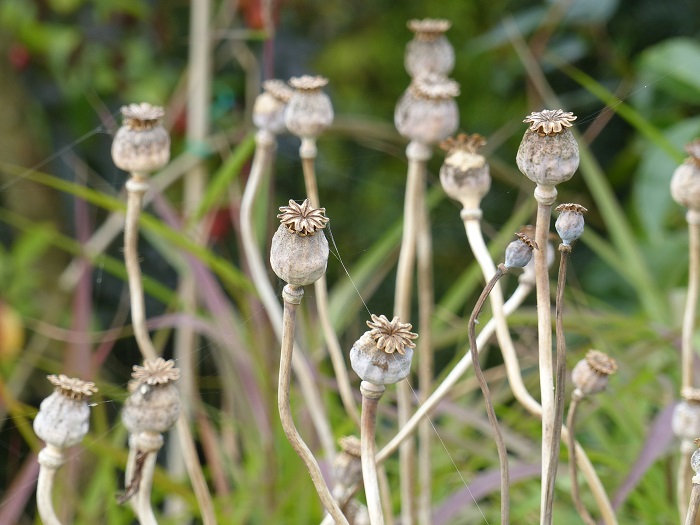
Poppy capsules are decorative from early August and last as long as wind and rain, which attack stem base, spare them. I sometimes "reinforce" them with small stake slipped into hollow stem.
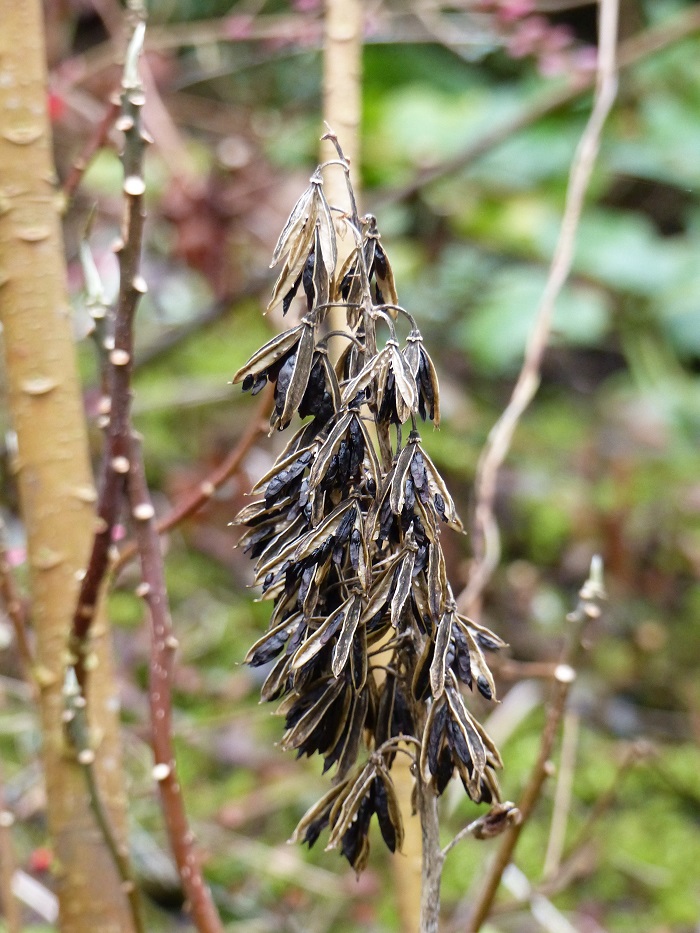
And finally... Can you guess which plant this inflorescence belongs to?
Let’s be clear: I’m not a fan of anglicisms, but one must admit that mixing languages can be a good thing! Indeed, talking about “seedheads” [pronounced siiid-h-aide-z] is much more elegant and poetic than talking about “infrutescences”, or — worse yet! — “dead stems” for perennials and grasses, don’t you think? I, for one, am […]
The question may seem odd, but at a time when we seek to limit the time spent in the garden and avoid heavy gardening chores, one might wonder: should we still plant bamboo in our gardens?
On the side of its detractors, criticism abounds, and they see this plant as a hindrance to gardening, an invader that colonises flowerbeds, a conqueror that takes advantage of absence to impose its dominance over the rest of the garden. According to these same detractors, bamboo grows too quickly, constantly sheds its leaves, and grows in a disorderly manner. In short, it is a mundane bush that grows too much and requires constant pruning.
Its admirers, on the other hand, are full of praise and see bamboo as an excellent evergreen plant that does not lose its foliage in winter and is perfect as a privacy screen or windbreak. An exotic plant with a Japanese aesthetic and a graceful, lightweight silhouette that rustles and undulates with the slightest breeze. An architectural plant with stiff, colourful culms and elegant branching.

Not just one bamboo, but many bamboos
Generally, people think of bamboo as if there were only one variety. However, bamboos are highly diverse, ranging from the small Arundinaria pumila, barely 20 cm tall, to the monstrous Phyllostachys edulis, which reaches over 20 m. Bamboos comprise several hundred species and varieties. To clarify, horticulturists have grouped them into two subfamilies: the running types, which spread and colonise if not contained, and the clumping or cespitose types, which thicken from the base and grow more modestly.
In the running family, we find the star of them all, Phyllostachys, followed by Semiarundinaria, Pleioblastus, Sasa, Chimonobambusa, Shibatea...
In the clumping (non-running) family, the most famous is Fargesia, followed by Yushania, Chusquea, Thamnocalamus, Indocalamus...
How to choose?
It’s child’s play, and the determining question boils down to are you ready to arm yourself with a spade to dig a trench 50 cm deep?
If the answer is yes, digging a trench is the necessary chore that allows you to install a rhizome barrier and thus stop the growing expansion of running bamboos. This "barrier" is simply a sufficiently thick PVC film to stop underground rhizomes and contain them. How to install this famous BAR (rhizome barrier)? It’s simple: dig a trench all around your bamboo, in the desired shape and length. Place your BAR slanted outward so that the rhizomes are guided and slide upwards. Leave it protruding by 10 cm, then backfill while compacting.
This is an essential chore if you wish to create a hedge of Phyllostachys or if you want to plant large bamboos in isolation or in a flowerbed. This way, you will access a great diversity of bamboos.
My favourites: Phyllostachys aureosulcata 'Aureocaulis' for its fluorescent yellow culms, Semiarundinaria fastuosa 'Viridis' for its spectacular and exotic appearance, and Sasa tessellata for its exotic foliage that reminds me of Asia.
If the answer is no, one word of advice: plant clumping bamboos! In other words, non-running bamboos that are unlikely to wander into your neighbour's garden and turn yours into a wild forest. Fargesias, which are increasingly available in the market, are the best candidates! They are perfect for pot cultivation, especially all varieties of Fargesia murielae and are interesting in small gardens where space is limited. However, they do have some drawbacks: they are more expensive, grow much slower (count at least 5 years to obtain a well-furnished plant), are smaller (measuring between 1.5 and 3 m), and do not offer the same diversity of shape and colour as running species.
My favourites: Fargesia murielae 'Jumbo' for its dense and compact habit, Fargesia robusta for its impressive size, and Fargesia nitida Great Wall for the unique colour of its culms.
In summary, if you are a fan of cool and relaxing gardening and digging a trench seems like an insurmountable chore, opt for non-running bamboos. For others, don’t hesitate for a second to plant and mix running and non-running bamboos. Finally, know that there are forums dedicated to bamboos where experts and enthusiasts share valuable advice on "Boo": http://lesbambous.fr/forum/
The question may seem odd, but at a time when we seek to limit the time spent in the garden and avoid heavy gardening chores, one might wonder: should we still plant bamboo in our gardens? On the side of its detractors, criticism abounds, and they see this plant as a hindrance to gardening, an […]
Let's be honest. Creating a perennial border is fairly easy. Making it successful is a little less so.
Aside from plants' adaptation to soil and exposure, there is also the question of colour, just as tricky! On that point, I will humbly abstain: I have lost count of the times I have moved plants grumbling "too purple!", "too red!", "too yellow!". So today I suggest we explore shapes… by offering a selection of perennial plants that, when combined, will produce striking contrasts, essential to avoid boredom. Indeed, plays of harmony and contrast with shapes are what truly create a border's composition and framework. After all, colour schemes are only "finishing touches" that will dress the border at a later stage 😉
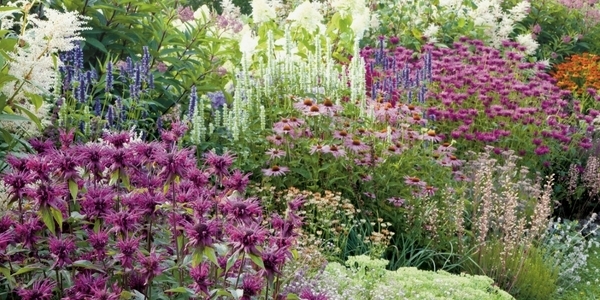
Vertical forms: reaching for the sky!
Often graphic, these plants provide verticality and form a genuine link between sky and earth. They are perfect for enlivening a border that is a little too monotonous. There are varieties to suit all garden styles and sizes.
In well-drained soil, don't hesitate to plant Eremurus or Foxtail lily: relatively little known, it is a tuberous perennial with a very architectural habit. In the Veronica family, Veronicastrum virginicum are quite exceptional, proudly bearing their fine spikes like candelabra. Spectacular Kniphofias add an exotic touch and are unrivalled for warming up a border. For a more traditional, English-style garden, think of Delphiniums or Larkspurs. In shade or part shade, Cimicifugas are very effective. In a slightly "wild" vein, I also like Liatris spicata or Blazing star, which is furthermore very melliferous.
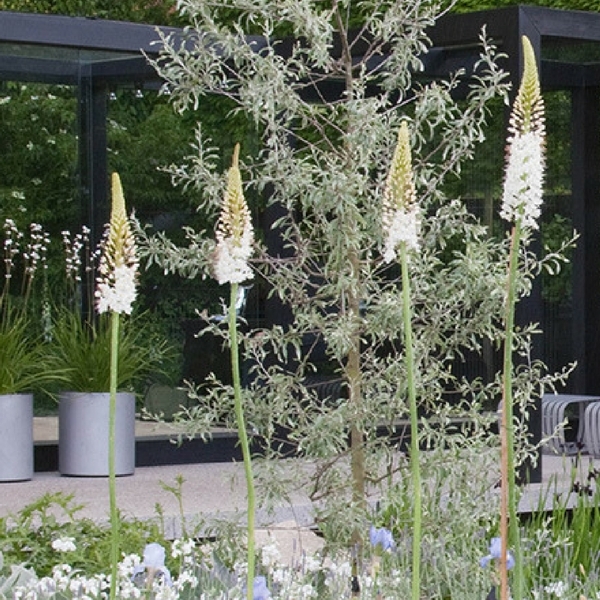
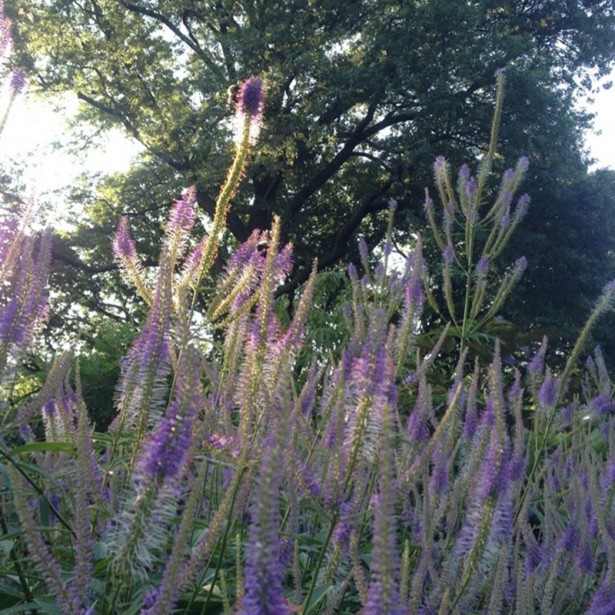
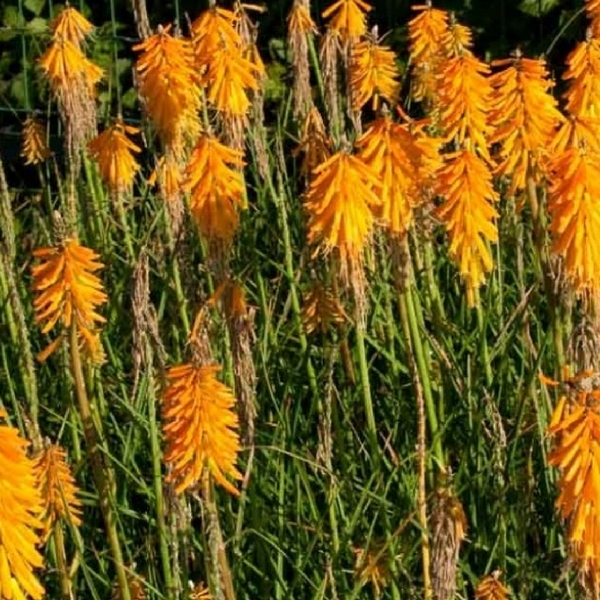
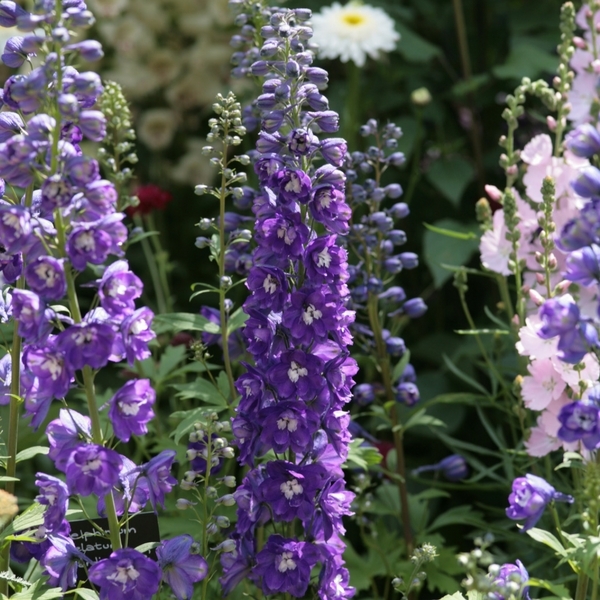
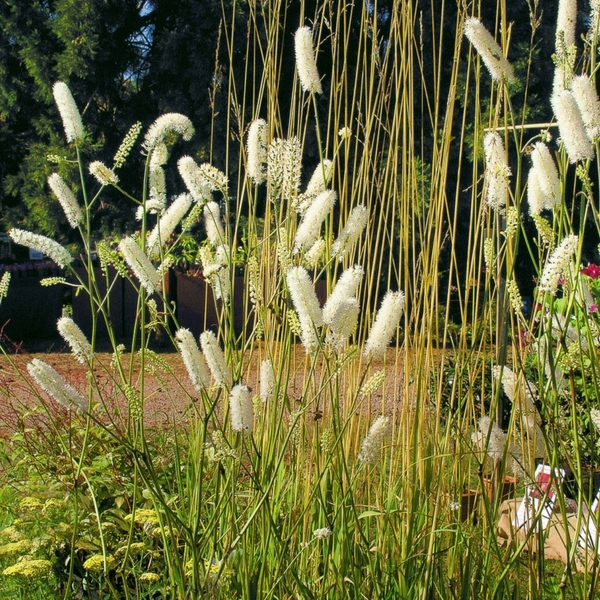
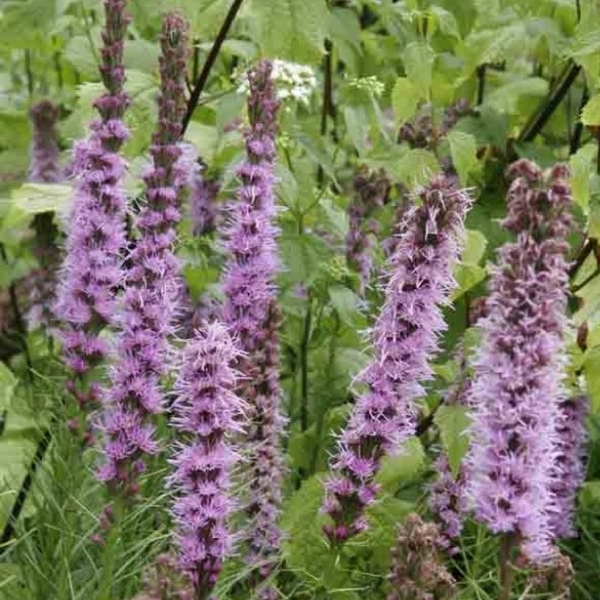
Pom-poms… more or less round
When thinking of spherical shapes, ornamental alliums are the first to come to mind. We all know 'Globe Master' and 'Purple Sensation'. They certainly make an impact! But there are many others: Pompon dahlias, globe thistles, and among the smaller, slightly less round types (great in drifts), Allium sphaerocephalon or round-headed garlic and the adorable Knautias and Sanguisorba 'Chocolate Tip'.
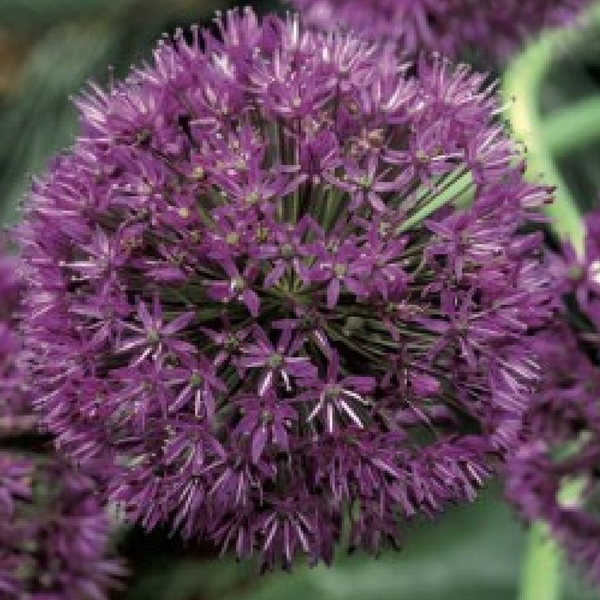
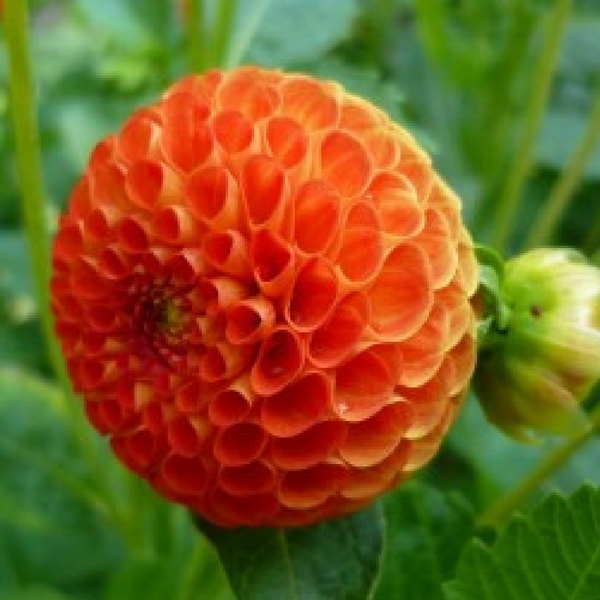
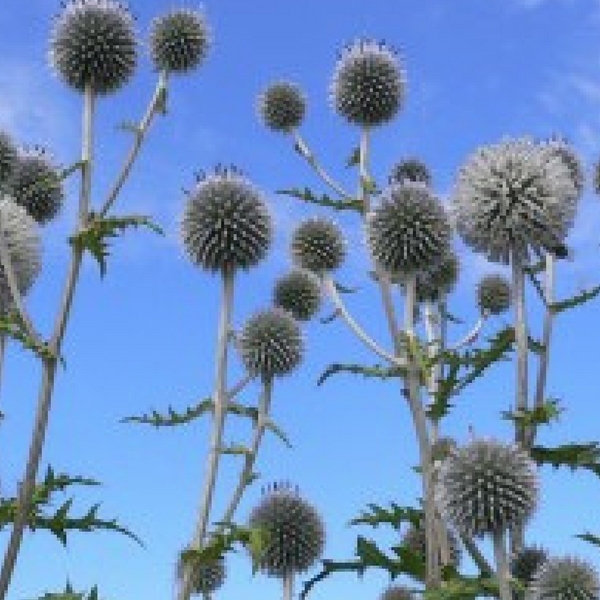
Stars: "Big star" or Milky Way
No need to be perceptive to guess that Asteraceae are, by nature, made to shine. Asters are my favourites in this respect. They have the advantage of being very diverse and can display either large flowers (such as the remarkable Aster pyrenaeus 'Lutetia') or spread a host of small stars like a Milky Way, as with the charming Aster 'Chloé'.
But as their flowering is rather late, the border can be complemented with other species such as Leucanthemums or oxeye daisies: simple but natural, Rudbeckias, very sunny, or Echinaceas, those fine Americans… In shade, Astrantia (which is not an Asteraceae but an Apiaceae) is perfect and offers a more refined style.
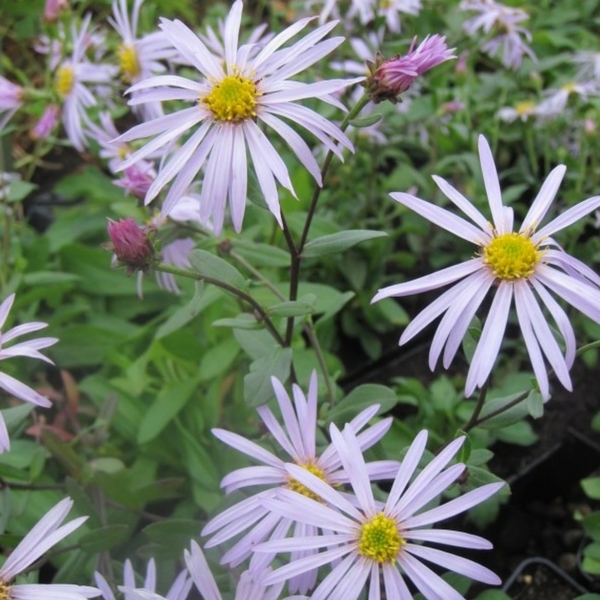
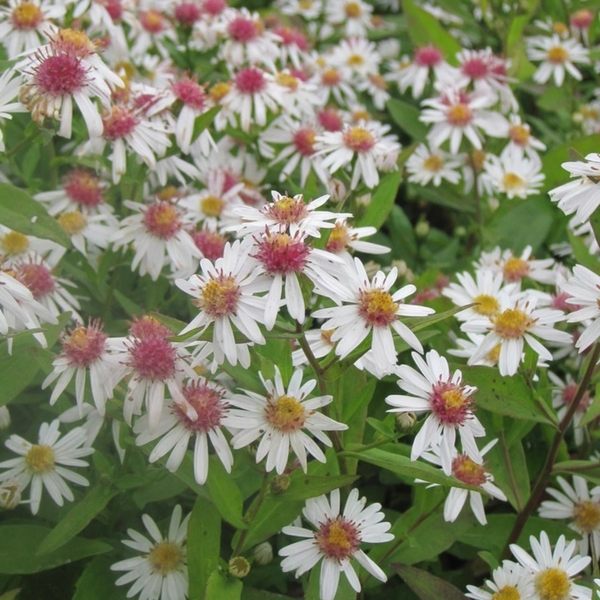
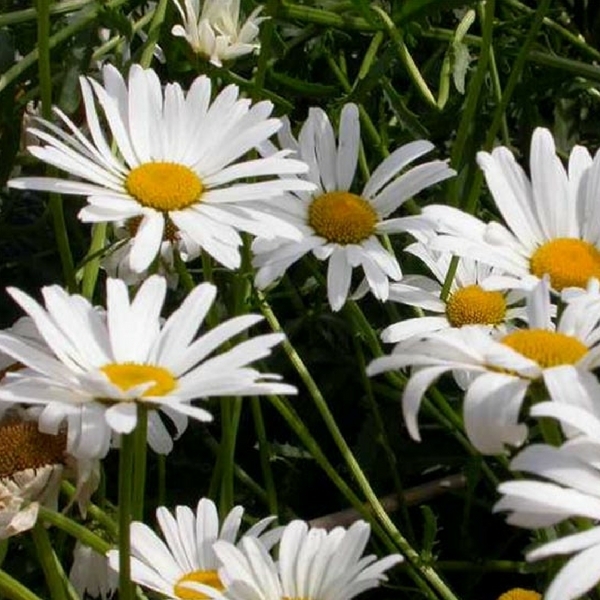

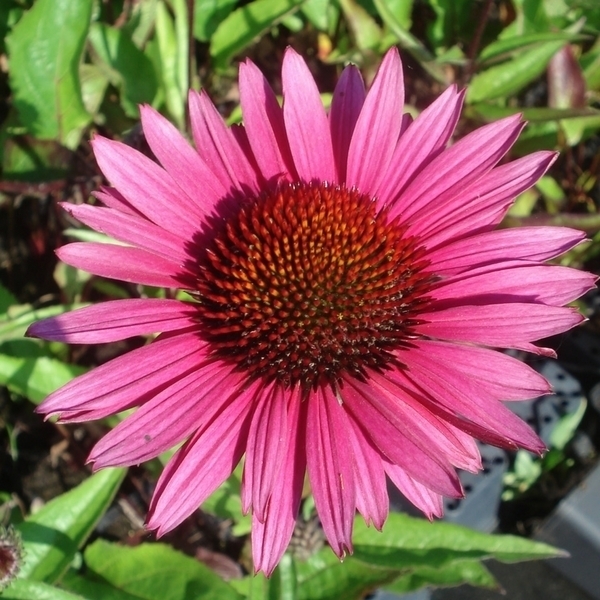
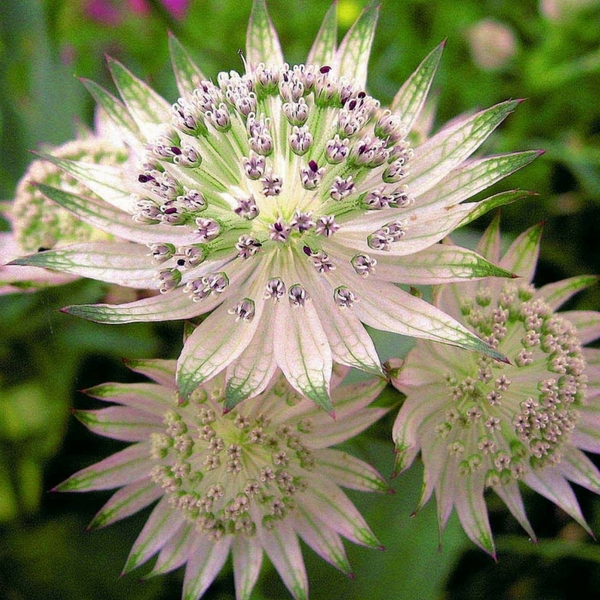
The airy ones: light mist, soft clouds or cotton candy
Whether they form a light haze, gentle plumes or generous "cotton candy" flowerheads, airy-looking perennials are precious. Depending on their size, they can be placed at the back or edge of borders but also as delicate curtains. Their suppleness and lightness complement more compact or rigid shapes very well. Very popular, Buenos Aires verbena is part of this group but needs no introduction… and others deserve your attention too.
Among the lightweights are Gypsophilas ('White Festival' is a marvel) and Thalictrums. Astilbes and Filipendulas are notable for their cloud-like inflorescences that can evoke cotton candy when pink… Still rather rare in gardens, Sanguisorbas hakusanensis and obtusa are charming as well!
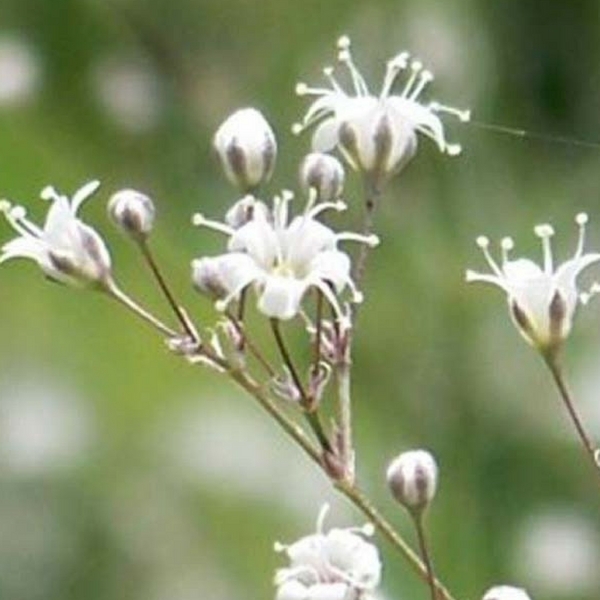
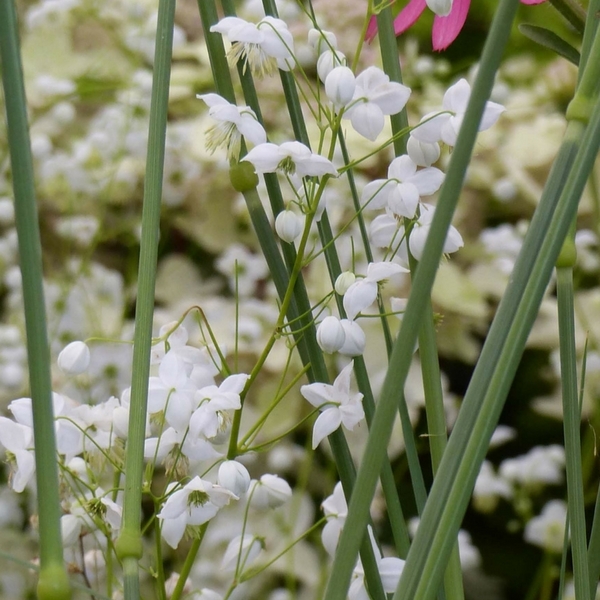
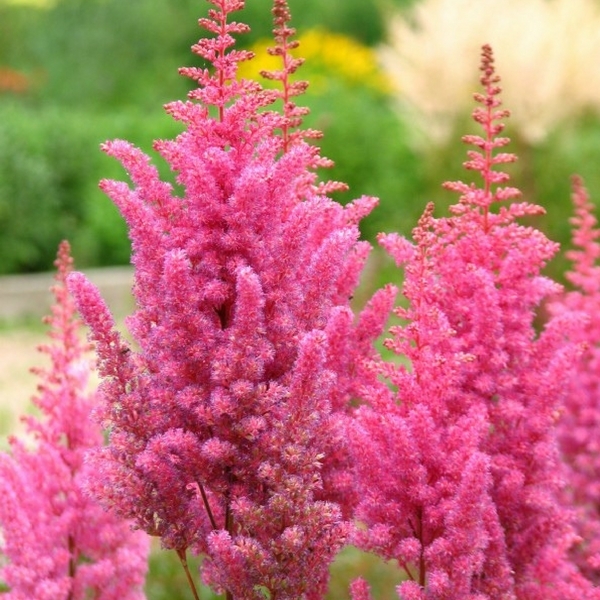
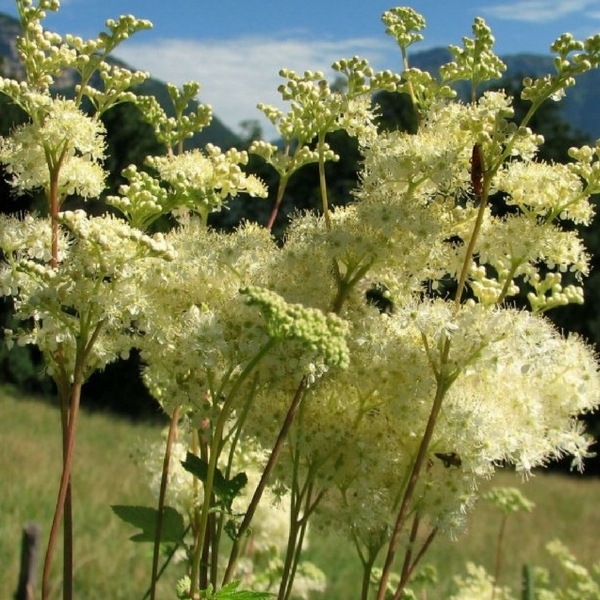
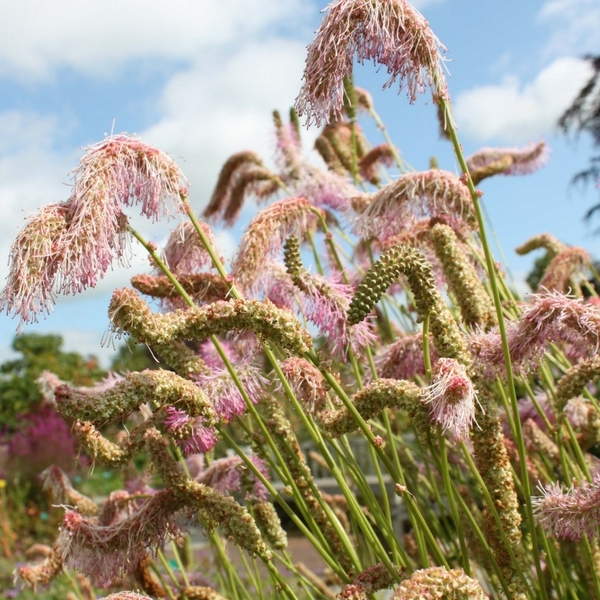
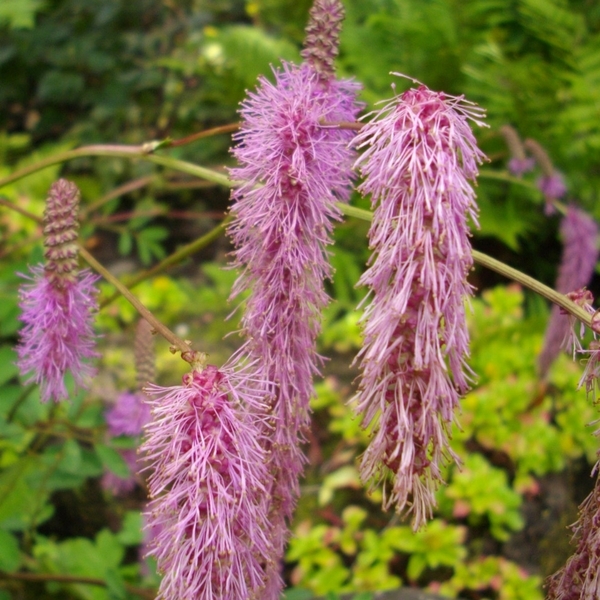
The tousled ones — delightfully whimsical in a border!
What better way to catch the eye than a touch of fantasy? Plants with tousled flowers have plenty of that. We love their slightly extravagant look, always in good taste… provided they are used in moderation. A few examples: Monardas, certain varieties of Alliums and the highly horticultural forms of oxeye daisy.
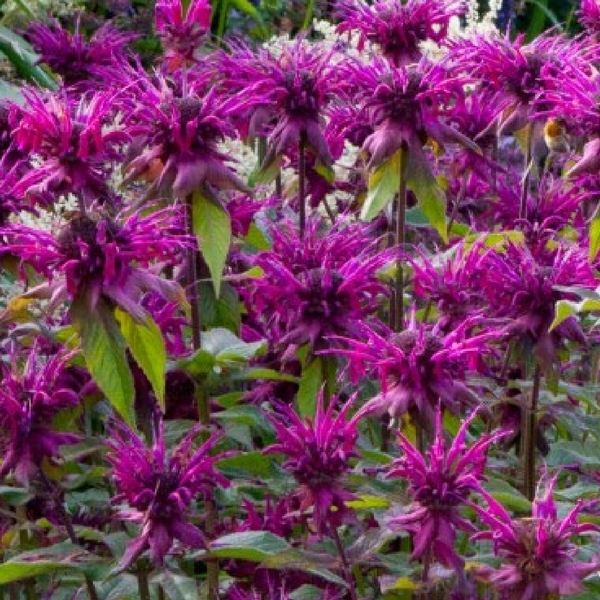
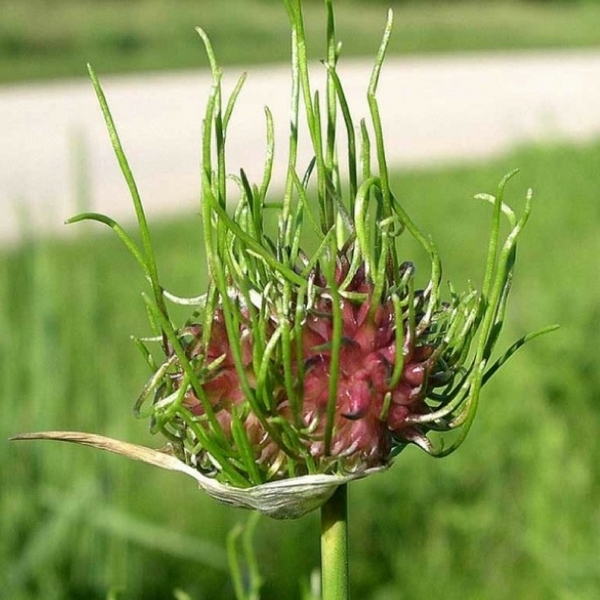
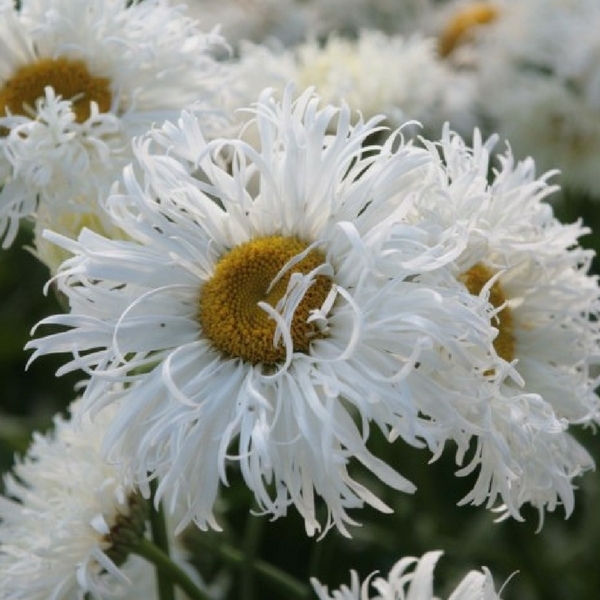
And you, what are your favourite plants for composing beautiful, varied and dynamic borders?
For further reading, discover our advice sheet: "How to create a beautiful perennial border"
Let’s be honest. Creating a perennial border is fairly easy. Making it successful is a little less so. Aside from plants’ adaptation to soil and exposure, there is also the question of colour, just as tricky! On that point, I will humbly abstain: I have lost count of the times I have moved plants grumbling […]
Between the shimmering foliage and decorative fruiting bodies, autumn has treated us to exceptional colours this year. And the colours still linger, thanks to the very last flowering of the season, that of Isodon longituba, also known as Rabdosia longituba. If you are not familiar with it yet, here is an introduction and some tips on how to grow it well...
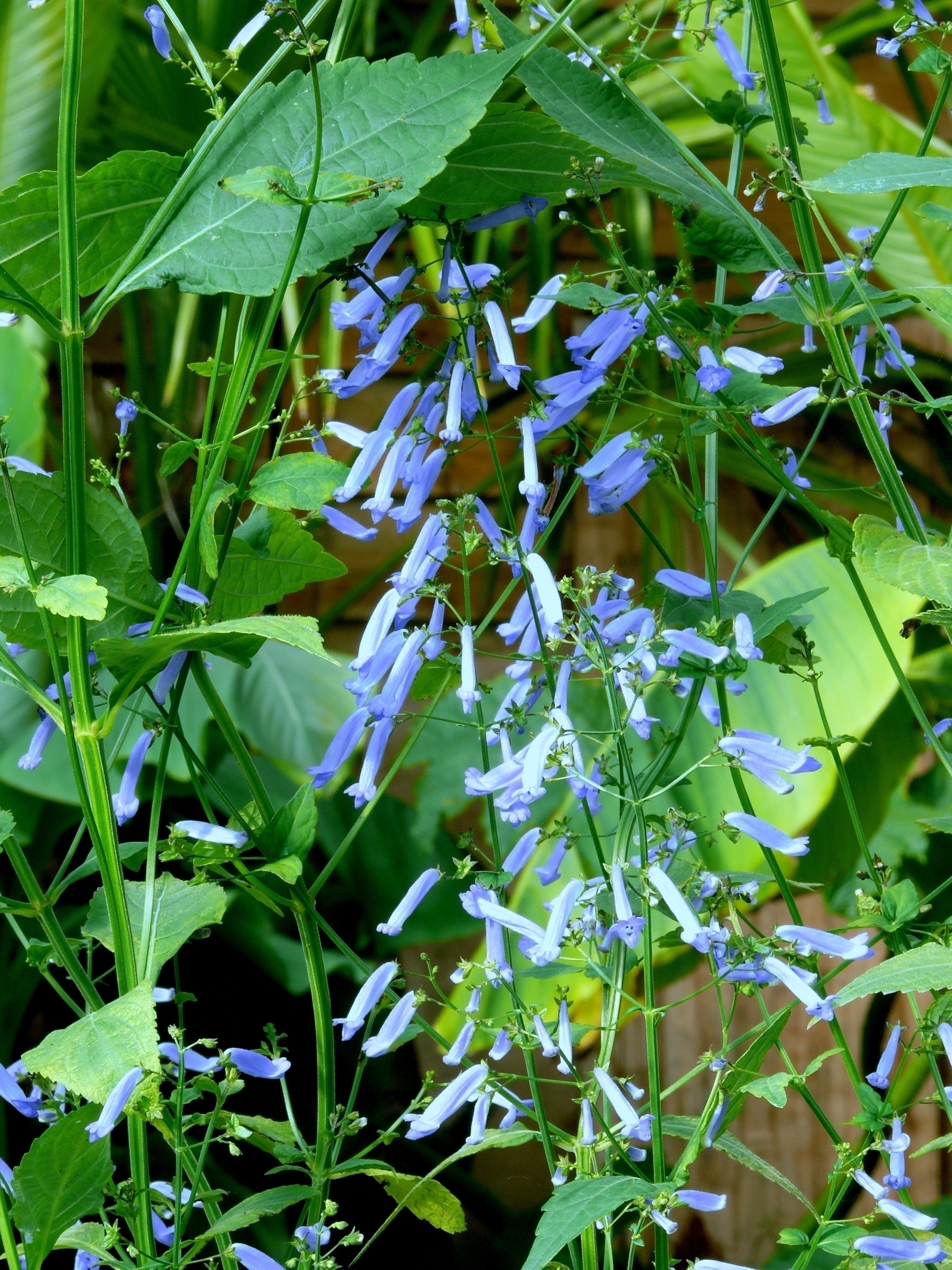
This large Japanese perennial, native to the island of Honshu, is the last perennial in the garden to flower. This attractive exotic, seldom seen in our gardens, belongs to the family of sages. Exotic in the way the bush forms, literally covered with a cloud of intensely electric-blue tubular flowers, an intensity rarely seen in other perennials, Isodon remains easy to use.
Although its exotic appearance contrasts with other plants in the garden, it is a perennial to use with sages or grasses in a naturalized garden or in a large pot on a terrace. Easy to grow, it likes bright situations and thrives in any good garden soil, as straightforward as a sage or a lobelia.
It does, however, require a warm, sheltered position — not because it is fragile, but so its flowers can reach maturity. Its late flowering occurs between late October and early November, by which time frost is already affecting many regions. And as with many herbaceous perennials, its flower buds are damaged from −2 to −3°C.
The planting site must therefore be chosen with great care: position it ideally facing south or west, in a spot sheltered from winds, among other plants, to give it the best thermal insulation. If, on the other hand, you live in a mild climate the issue will not arise and you can plant it wherever you wish.
Late to flower in autumn, it is also late to restart in spring. It is often one of the last to re-emerge... no need to worry! Nevertheless, as with many late perennials, its young leaves appear at the time when slugs are most active. So keep a close eye on it around April and do not hesitate to scatter some slug pellets around the stump as a preventive measure.
Between the shimmering foliage and decorative fruiting bodies, autumn has treated us to exceptional colours this year. And the colours still linger, thanks to the very last flowering of the season, that of Isodon longituba, also known as Rabdosia longituba. If you are not familiar with it yet, here is an introduction and some tips […]