Roses have always been the undisputed stars of gardens, symbolising both love and beauty. However, for these queens of the garden to bloom their petals splendidly, planting requires special care. One of the most common and effective methods is planting bare root roses, a technique that promises vigorous growth and abundant flowering. In this article, we will detail the crucial steps to successfully plant your bare root rose supplied in a pot of substrate, from soaking methods to the secrets of perfect watering. Follow our guide to transform your garden into a haven of resplendent roses!
Bare root rose or potted? It’s all Greek to me
" Don't you order your roses bare root? - Well, yes. Look! - Oh no, these are potted. - Yes, but they are still bare root... just potted. - Oh. Well, if I were you, I would have bought bare root plants in pots. - Oh, very funny! That's clever...."
Bare root roses delivered with a pot of substrate surrounding them represent an excellent option for all gardeners. This proposal combines the advantages of the two most commonly used plant delivery types: bare root and containerised.
When a rose (or another plant) is delivered bare root, it means it is shipped without soil around the roots. This process has several advantages, including reduced transport costs and better recovery of the plant once planted. However, it requires that the plant be planted quickly after receipt to minimise stress and the risk of root desiccation.
The addition of a pot of potting soil around the roots during transport offers a clever compromise. This pot hydrates the roots during transit, thereby reducing transport-related stress and increasing the chances of successful recovery. It also allows gardeners to gain a little time (but don’t take too long!) before needing to plant their new rose.

When to order? When to plant?
Bare root roses are generally available for purchase between November and March, which coincides with their dormancy period. This helps to minimise stress on the plant and increases the chances of successful recovery once planted. The best time to plant these roses is also during their dormancy, when the plant is less likely to suffer from thermal shock or water stress.
How to plant a bare root rose bush?
First, unpack the pot by removing the plastic that holds it in place. When you do this, you may take some substrate on your feet or even in your boots: this is perfectly normal (it happens to me every time too!) and in any case, you don’t really need it anymore. However, you can keep it to bring to the planting if your soil is very heavy.
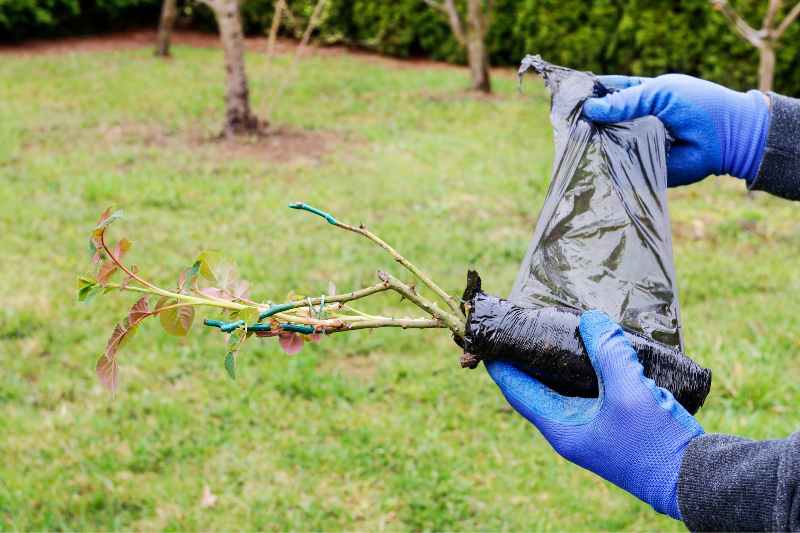
- Choosing the location: Select a well-sunny spot with well-drained soil. Roses prefer at least six hours of direct sunlight each day.
- Inspecting the roots: First, carefully inspect the roots of your rose. Remove any damaged or rotten parts with sharp, disinfected pruning shears. Healthy roots are essential for good recovery of the plant.
- Hydration and soaking: Soak the roots of the rose in a bucket of water for a few hours to hydrate them. You can also proceed with soaking the roots. This operation involves soaking the roots in a mixture of soil, preferably clay, compost or manure, and water, all forming a thick mud. This step promotes recovery and root growth by improving contact between the roots and the soil.
- Preparing the planting hole: Dig a hole large enough to accommodate the spreading roots of the plant, generally 50 cm deep and 60 cm wide is sufficient.

- Soil amendment: Mix the removed soil with well-decomposed compost to improve the soil, providing essential nutrients to the plant.
- Placing the rose: Position your rose in the middle of the hole, ensuring the roots are well spread out. The grafting point, identifiable as a swelling at the base of the stem, should be level with the soil or slightly above (see picture below).

- Backfilling and tamping: Fill the hole with the enriched soil and compost mixture, lightly tamping down by hand to eliminate air pockets.
- Watering: Water thoroughly immediately after planting to establish good contact between the roots and the soil.
- Mulching: Apply a layer of mulch such as straw or wood chips to retain moisture and limit weed growth.
- Post-planting care: Keep the soil moist but not waterlogged during the first few weeks, and consider applying a rose-specific fertiliser when the first signs of growth appear.
Roses have always been the undisputed stars of gardens, symbolising both love and beauty. However, for these queens of the garden to bloom their petals splendidly, planting requires special care. One of the most common and effective methods is planting bare root roses, a technique that promises vigorous growth and abundant flowering. In this article, […]
Planting trees to combat climate change may seem like a very simple solution. Fortunately, it is!
At a time when more trees are being cut down than planted, every tree you can plant in your garden will prove beneficial in various ways.
One of the causes of climate change is the excessive release of carbon dioxide (CO2), so the most obvious solution that comes to mind is to plant trees, as they absorb this CO2.
Why planting trees?
Plants in general, but trees in particular, have an incredible capacity to absorb CO2. This is simply a result of photosynthesis. The tree absorbs CO2 from the air and transforms it into carbon and oxygen. The oxygen is released into the air for our benefit, while the carbon is stored and gradually released. Forests thus represent the second largest carbon sink after the oceans.
But that's not all; trees are also useful for:
- regulating temperature and humidity: they are true living air conditioners;
- filtering wind and dust, thereby improving air quality;
- fixing certain pollutants such as pesticides or heavy metals;
- improving soil by adding biomass (wood, leaves...) and combating erosion.

Which trees to plant to combat climate change?
1) Native trees first
There are two huge advantages to planting native species:
- they are perfectly adapted to the climate and soil
- they nourish and provide shelter for local wildlife
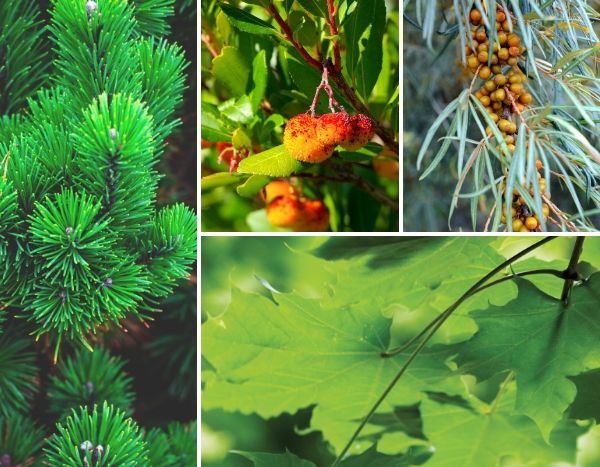
The list of native trees is long, but here are a few examples:
- For the North: Field Maple, Glutinous Alder, Downy Birch, Common Hornbeam, Male Dogwood, Common Ash, Holly, Trembling Aspen, Field Elm...
- For the South: Strawberry Tree, Montpellier Maple, Corsican Alder, Chestnut, Olive, Holm Oak...
- For the mountains: Hop Hornbeam, Mountain Elm, Mountain Pine...
- For the Coast: Tamarisk, Sea Buckthorn, Bohemian Olive, Maritime Pine, Field Maple...
2) Natives, but not only...
Some natives are suffering from climate change while others, more exotic or southern species, seem to be making their way north. For instance, Pines, across all species, are suffering from repeated attacks by Pine Processionary caterpillars. Meanwhile, Common Beech, spruces, and even Pectinate Fir can no longer withstand our hot and dry summers. All these trees have also become less resistant to diseases.
On the other hand, some trees are seeing their original range shift. This is not surprising: it has always been the case! Plants grow where they thrive best. This is why we have issues with certain invasive exotic plants that turn out to be more suited than natives in some natural environments. Or the fact that oak forests are regaining ground over beech forests as they did... only two thousand years ago.
Some examples of trees that have adapted to climate change
- Holm Oak - Quercus ilex: once confined to the Mediterranean climate, it is now moving further north. It now thrives along the Atlantic coast up to Brittany and will continue its progression towards the centre.
- Turkey Oak - Quercus cerris: previously only found in the southeast of the country, it is now moving categorically north, even reaching Belgium...
- Pubescent Oak - Quercus pubescens: a species particularly adapted to drought that has been thriving in recent years.
- Montpellier Maple - Acer monspessulanum: often found in nature alongside Holm Oak, it is following the same trend, progressing up to Vendée.
- Flowering Ash - Fraxinus ornus: a cousin of Common Ash but significantly less sensitive to ash dieback, it is gradually moving away from its native Corsica and Maritime Alps to further north.
- Pride of India - Koelreuteria paniculata: native to China and Korea, this tree proves to be perfectly resistant to drought and urban pollution.
- Maritime Pine - Pinus pinaster: originally found around the Mediterranean and along the coast, it continues its spread westward and northward.
- Black Locust - Robinia pseudoacacia: this exotic tree is gradually becoming the "king of the forest". It withstands heat, drought, and flooding and is adapted to poor soils as it has the ability to fix nitrogen. It is thus gradually taking the place of other tree species.
For your information: the National Forestry Office is currently conducting trials of Bornmuller Fir (Abies bornmuelleriana) in forests, a species more suited to drought than Pectinate Fir. Meanwhile, in Belgium, trials are being conducted in forests with Turkey and Pubescent Oaks and even... Corsican Pines.
General characteristics of trees resistant to climate change
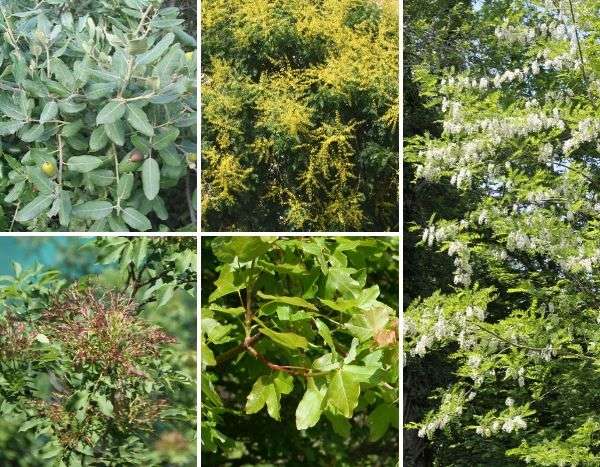
Trees that exhibit natural resistance to drought and high summer temperatures often share common characteristics:
- Small and numerous leaves: the larger the leaf, the more water evaporates. Small leaves are thus a result of adaptation to drought;
- Waxy and/or fuzzy foliage: if the leaf is thick or equipped with small hairs, it will retain water more effectively;
- Next, it is important to check the tree's region of origin: if it originates from the Scandinavian taiga, it is likely to suffer in summer... Conversely, mediterranean and central European species will be particularly well-suited.
In conclusion
Due to the accelerating climate changes in recent decades, we will need to reassess our approach regarding native species adapted to regions. Some, whose survival requires moisture and distinct seasons, will disappear in favour of less water-demanding species that do not require harsh winters. In any case, planting trees will be beneficial as long as we choose species that can thrive optimally with minimal care. So in conclusion: let’s plant trees!
To learn more
Some researchers express doubts about the effectiveness of tree planting to combat climate change. In reality, it is mainly the notion that CO2 is the sole culprit of climate change that they question, as well as the belief that we will (according to them) need even more agricultural land to feed the population. The ideal would also be to stop deforestation rather than just replanting a few trees here and there. If you wish to learn more and form your own opinion on the matter, read this article (in French): Forests: a solution to the climate crisis?
And if you haven't seen it yet, here are the main results of our survey on climate change and gardening.
Planting trees to combat climate change may seem like a very simple solution. Fortunately, it is! At a time when more trees are being cut down than planted, every tree you can plant in your garden will prove beneficial in various ways. One of the causes of climate change is the excessive release of carbon […]
If there is one plant that is the subject of tons of misconceptions, it is the climbing ivy or Hedera helix. It all seems to have started with Pliny the Elder in the first century AD, who saw this charming climber only as a destroyer of walls and trees, even going so far as to label it a “tree executioner.”
He must have been in a bad mood the day he came up with such nonsense... because, I assure you, ivy, this beautiful native climbing plant, does not deserve this ire, this categorical rejection.
So let’s debunk 5 misconceptions about ivy!
1) Ivy is a parasitic plant that kills trees
The only notion that is not false in this phrase, which we hear or read everywhere, is: “ivy is a plant.”
It is not a parasite, as the tree merely serves as a support. Ivy does not “suck” nutrients from your tree because its climbing roots are only used to cling on. It has its own roots and performs its own photosynthesis. Therefore, it does not need to parasitise anyone to survive.
And ivy does not kill your trees!
When I lead nature walks, as soon as we pass under old picturesque trees, I am often told: “Yes, but sir, my tree died just after being invaded by that ivy pest!”
I then reply: “ivy only used your tree as a support because it was no longer growing in width as it was itself at the end of its life or at least quite old.”
In reality, ivy can live for many years, sometimes several hundred, so it often survives after the death of its support. This is why people think that ivy has killed the tree when, in fact, the tree has simply died of old age and ivy has outlived it.

Ivy protects the trunk from frost, excessive moisture, and even some nibblers like deer. Some compounds produced by ivy even have fungicidal properties, which helps reduce the risk of fungal disease for the tree. Moreover, ivy flowers at a different time than its support: there is therefore no competition for pollination. The leaves of ivy fall and enrich the soil at a different time than the foliage of the supporting tree, which is another benefit for the latter. Ivy will not “take the sun” from the tree either, as it will only grow on the main trunk and some large branches. In short, this is not parasitism but rather mutualism, as both parties benefit.
Did you know? Ivy continues to grow after the death of the tree. While this combines two extremely rich environments for biodiversity: ivy + standing dead wood, it can become a source of danger as ivy will provide a foothold for the wind while the dead wood can break at any moment. It’s up to you to decide whether such an association is worth keeping in the garden or if it should be pruned back.
2) Ivy eats houses
No. Ivy does not damage sound walls. Even on walls in poor condition, all it will do is slightly degrade the joints. But above all, it provides physical protection against moisture and will improve the base of the walls. It offers thermal insulation during winter and summer, which is not insignificant, as it can gain (or lose) two to three degrees for our interiors.
However, two caveats: do not let ivy climb too high to your tiles. They could be displaced by vines passing underneath them. Also, be cautious with earth walls; ivy may take this for “true” earth and allow its roots to grow inside.

3) Ivy attracts spiders
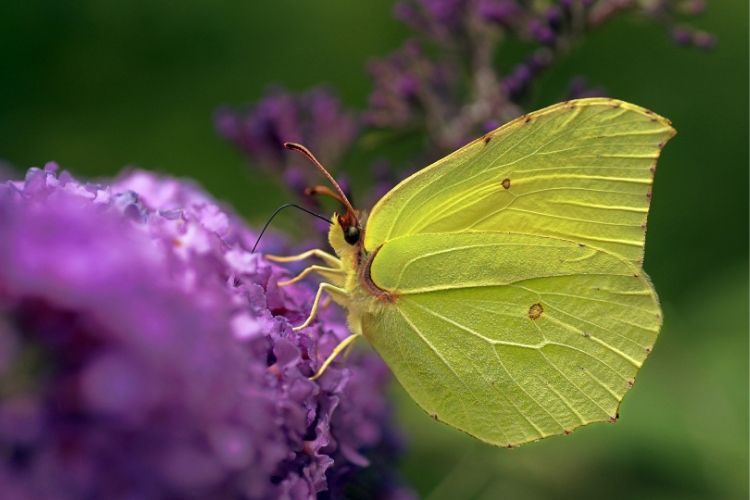
And? Did you know it also attracts a host of insects, particularly the last pollinators of the season, as ivy is one of the last to flower, around October, in nature or the garden? The insects associated with or living off ivy are extremely numerous: wild bees, hymenoptera, hoverflies, flies, rose beetles, and even butterflies. The Clouded Yellow, a butterfly in sharp decline, enjoys hibernating within ivy, and it is not alone. It’s no surprise, then, that spiders are also very present...
Ivy also provides shelter and food for many birds: sparrows, blackbirds, tits, thrushes... The berries are particularly rich in lipids and help frugivorous and omnivorous birds survive in winter. Ivy also serves for the nesting of the Wren, kinglets... and as roosts for some raptors like the Tawny Owl or the Long-eared Owl.
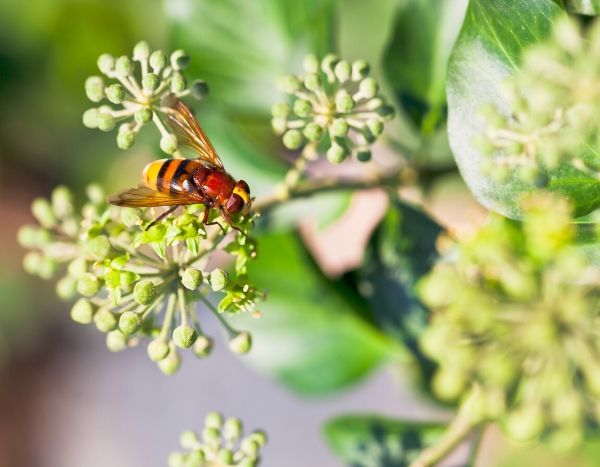
Ivy also nourishes certain mammals such as dormice, martens, the hazel dormouse, and even... provides shelter for some bats.
Removing ivy means eliminating an entire ecosystem!
4) Ivy is sad
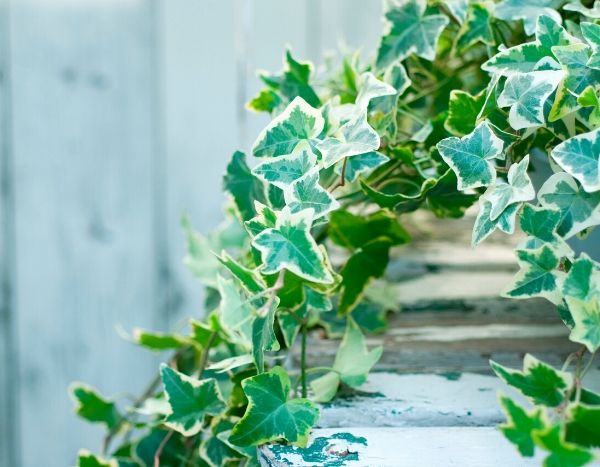
No. Or perhaps we have different definitions of sadness... Ivy, as we have seen above, is teeming with life but is also a plant that remains attractive all year round thanks to its evergreen foliage. Ivy is cheerful because there are superbly coloured varieties: variegated with cream, white or yellow or with more or less lobed foliage. It can be used as ground cover, in topiary, to dress up unsightly elements or fencing... Ivy has a thousand and one uses in the garden.
5) Ivy is useless
Come on... In addition to everything we have already discussed, ivy serves many purposes:
- It protects the soil in forests or your garden by creating a cover that maintains moisture and a certain coolness. It thus helps reduce soil erosion and protects soil fauna.
- It is a medicinal plant known since ancient times: antitussive, antispasmodic, purgative, and used in anti-cellulite ointments. However, be careful not to ingest the berries, which are toxic.
- Ivy is capable of purifying the air, particularly by capturing dust or other large particles.
- You can even make laundry detergent from it thanks to the saponins contained in the leaves.
- ...or crowns to adorn the heads of our children.

Conclusion
Therefore, ivy is much more than just a simple climber. It has numerous aesthetic and ecological benefits. It can be planted as ground cover, to dress up unsightly elements, or to brighten up a wall. It proves to be a resilient plant, grows quickly in the shadiest spots, and is very easy to propagate. In short, let your ivy thrive, or better yet, plant some! A symbol of longevity among the Celts, it is certain that ivy will outlive you...
Finally, discover our complete guide on ivy!
If there is one plant that is the subject of tons of misconceptions, it is the climbing ivy or Hedera helix. It all seems to have started with Pliny the Elder in the first century AD, who saw this charming climber only as a destroyer of walls and trees, even going so far as to […]
You may have noticed this summer that, with the nice weather, naturalists have made a bit of a comeback, particularly on social media... And, as every year, a certain category of them has taken a stand against an exotic plant. This year, it’s the Buddleia, known as the “butterfly bush,” that is particularly the subject of their ire. Invasive? Dangerous for butterflies?
The debate is simple, classic, but effective:
“You’re nothing but villains who are killing nature!” (the botanists to the horticulturists)
“That’s not even true!” (the horticulturists to the botanists)
Welcome to the playground! And here I am, right in the middle, trying to calm the troops from both camps.
The debate on the Butterfly bush, in detail
We are hearing, reading, and seeing more and more articles, Facebook posts, or television reports on the subject: “Buddleias kill butterflies because the nectar contains caffeine.” These publications generally share a common trait: they treat information superficially and do not delve into the details, all while, of course, citing no sources...
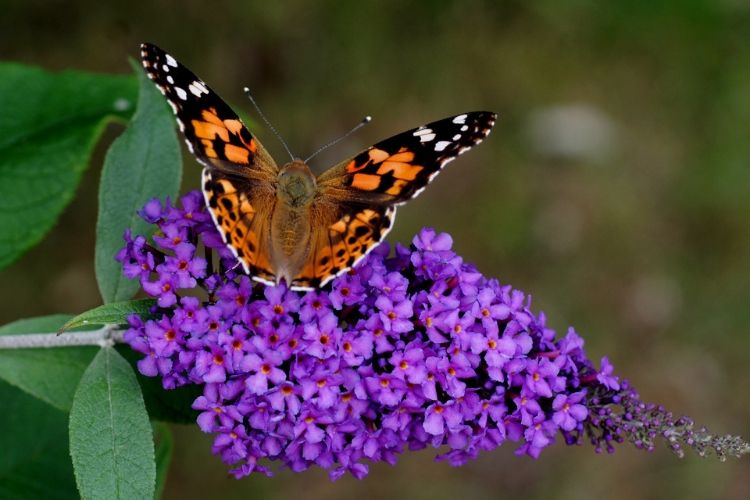
As it stands, it seems that the nectar of Buddleia flowers contains a substance similar to caffeine that could irresistibly attract butterflies, which may end up exhausting themselves and ultimately dying.
I have taken care to write this sentence in the conditional. Indeed, for nearly twenty years, I have heard everything about this plant. Most of the facts (which I will outline below) are established, while one point remains eternally subject to debate: the infamous toxicity of the flowers that has the effect of “drugging” butterflies.
Interestingly, whenever we talk about this potential toxicity of Buddleia flowers, no one mentions any serious scientific publication. Notice how amusing that is...
Scientifically established facts
- Buddleia davidii, the type species, is an invasive plant, an EEE for Exogenous Invasive Species. It tends to thrive in areas disturbed by humans, as it is a bush that prefers poor, stony, and somewhat disturbed soils (it is native to the arid mountains of China): spoil heaps, railway edges, industrial wasteland, abandoned old car parks… but also in particularly vulnerable natural environments such as the silicicolous lawns of Normandy. This is normal, as it is a pioneer species that “prepares the ground” for other plants to establish later. We have other plants in our native flora that can perform this type of work, but Buddleia is remarkably effective since it has a short lifespan: hence its invasive character. Once other plants grow on the substrate created by Buddleia over time, they will shade it, and Buddleia, primarily a light-loving species, will disappear. Vegetation can then develop to the climax, the ultimate evolution of a natural environment: an oak forest, for example. The only downside is that Buddleia does indeed take the place of a useful native plant for wildlife, particularly for insects that have mostly co-evolved with endemic species. For the record, an exotic plant is always less interesting for feeding the larvae and adults of insects.
Nota bene: if you have the type species at home and are concerned about its invasive nature: prune the bush heavily just before seed formation! The problem will be solved.
- Buddleia contains aucubin and other toxic terpenoids by ingestion in its leaves and stems. This is why nothing and no one consumes the leaves. This is the second argument put forward by naturalists: “If butterflies lay eggs on Buddleia, the caterpillars won’t be able to feed.” In fact, this would be a gross misunderstanding of lepidopterans and especially a denial of millions of years of evolution. A butterfly is genetically programmed to lay eggs only on the plant or family of plants that its offspring need. And nowhere else! However, it is true that if in your garden you only have a closely mown lawn, a hedge of thujas, and… a single Buddleia: well, butterflies won’t be able to lay eggs. So, you will have butterflies the first year on your bush and then… nothing. In a garden with a greater profusion of plants, butterflies will quickly visit the flowers of Buddleia and then go lay eggs on nearby plants depending on the butterfly species: nettle, bramble, grasses, buckthorn, legumes, brassicas, umbellifers…
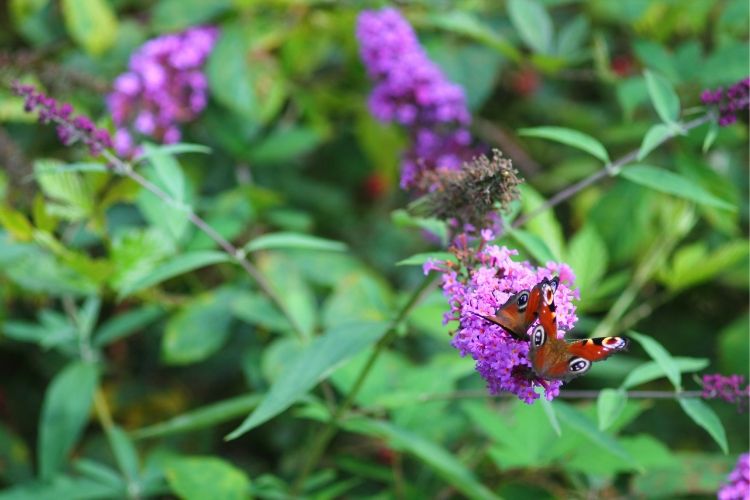
Nota bene: some sources mention that the caterpillar of the Death's-head Hawkmoth and that of the White Butterbur Hawk-moth have adapted to feed on Buddleia leaves in the absence of their true host plants. "Nature always finds a way..."
- The nectar of Buddleia davidii, although produced in quantity, is low in sugar compared to other flowers. It is therefore less nourishing for insects. Note that only lepidopterans with a proboscis can feed on this nectar. Some bumblebees manage to cut the corolla to access some of it. You may also occasionally see a few hoverflies and even one or two wild bees on the flowers, but that is rarer.
- The majority of Buddleia davidii varieties sold commercially are sterile, contrary to what public opinion seems to think. So there’s no need to berate the poor person stacking pallets in your local garden centre for selling Buddleias. Only the type species is invasive, and it is no longer for sale.
- Other species and hybrids of Buddleia pose no problems: B. globosa, B. alternifolia, B. nivea…
What to replace Buddleia with?
If you wish to act on the principle of precaution and avoid planting a “butterfly bush,” then do so! But replace it with native or semi-native plants (Eastern Europe) and leave wild areas in your garden where you will intervene very little. This way, you can truly do your part to try to save what remains of butterflies and avoid falling into general hypocrisy. The classic example being the Sunday moralists who will scold you for having a Chinese plant in your garden but who eat tomatoes in winter, drive a diesel 4X4, and fly four times a year. In short, they are often just big talkers... Let them talk and let’s move forward!
As a conclusion
I do not cast stones at naturalists. Far from it... Their fight is just and necessary. In reality, if they sometimes seem to be acting in bad faith or downright sectarian: it is primarily out of necessity! For decades, no one has listened to them on environmental issues. They have therefore decided to adopt a more easily understandable language for the general public by using simple and precise advice, here in our example: “Do not plant and uproot all Buddleias!” Given what is happening these days, they have no choice but to raise their voices, and too bad if in the process other Buddleias will suffer...
However, it is essential to take the information circulating without a filter on the internet with a grain of salt and to do your own research. Perhaps the nectar is indeed a drug. Perhaps not... This information has been circulating for years, immediately denied by another research team, and then no... or maybe... it depends... In short, we are still only at the speculation stage.
I have personally conducted surveys on diurnal and semi-nocturnal lepidopterans (like the Hummingbird Hawkmoth) for three years at my home. I have observed a significant increase in the number of butterflies as well as greater diversity in species. Yet, I still have a Buddleia. But it is surrounded by several areas of paradise for insects, as I have planted numerous native (or non-native) plants and left some wild areas. So, this bush doesn’t seem so bad after all.
As I write these lines, I see only one Red Admiral on my "butterfly bush" while a wild fennel, a beautiful patch of oregano, an Eryngium planum, and an Hylotelephium spectabile seem to be "the place to be" for lepidopterans at the moment.
I encourage you to also embark on the study of butterflies or insects in general, to draw your own conclusions, and to maintain a critical mind no matter what happens.
You may have noticed this summer that, with the nice weather, naturalists have made a bit of a comeback, particularly on social media… And, as every year, a certain category of them has taken a stand against an exotic plant. This year, it’s the Buddleia, known as the “butterfly bush,” that is particularly the subject […]
Agapanthus are spectacular flowers often found in seaside gardens, particularly along the West Coast and in Brittany. In summer, they display beautiful blue, white, or mauve flowers in umbels that are both graphic and elegant.
As a worry-free perennial, the Agapanthus thrives in full sun in ordinary, well-drained soil that is not too dry in summer. Its lightness and ease of cultivation are real assets for creating a flowering bed or a pot.
Historically, their use in gardens was limited by their lack of hardiness and the small number of varieties... Today, Agapanthus now come in many varieties, and some even show good cold resistance, which presents another challenge: choice!
To help you, here is a selection of 7 reliable Agapanthus that will suit all gardens, regardless of their size, style, or climate.
Agapanthus Navy Blue (Midnight Star): the hardy one
The Agapanthus 'Navy Blue', also known as Agapanthus ‘Midnight Star’, is one of the most popular Agapanthus. This variety ranks at the top for best rating and best seller at Promesse de Fleurs, and you'll soon see why!
Its light umbels bear an intense navy blue. They appear abundantly from July to August. Its light green ribbon-like foliage is deciduous, but this variety is one of the hardiest Agapanthus, with a resistance down to -10°C in well-drained soil.
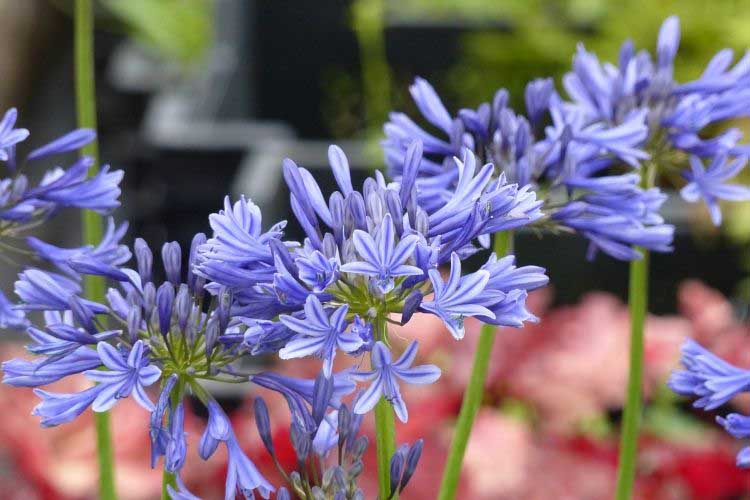
The hardy and popular Agapanthus Navy Blue
Vigorous and medium-sized, reaching 60 cm in height and 40 cm in spread, it adapts well both in pots and as a border plant.
→ To learn more about this variety, check out our article: "Agapanthus 'Navy Blue': a cold-resistant beauty"
Agapanthus Blue Giant: the iconic giant
The Agapanthus Blue Giant is a must-have perennial in Brittany! Often planted, it is valued for its very large dark blue flowers measuring 18 cm in diameter that can reach up to 1.5 meters in height. Its height makes it a remarkable plant for borders and backdrops. It creates significant, elegant vertical lines. You can also enjoy its beautiful large flowers as cut flowers.
Vigorous and robust with fleshy roots, it withstands temperatures down to -12°C.
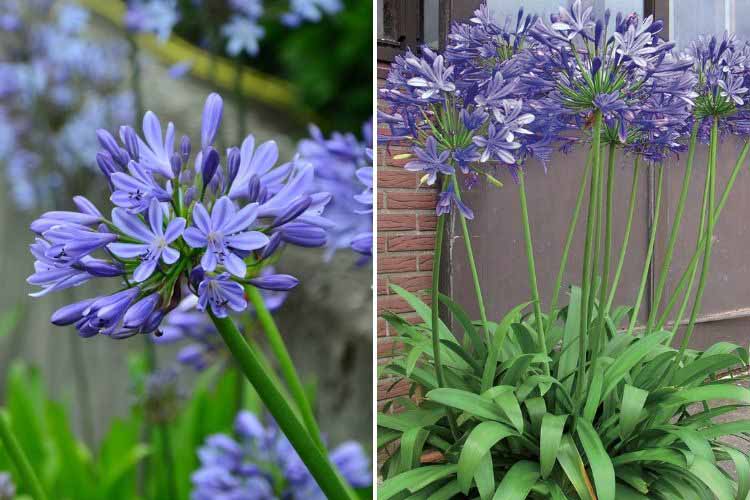
The Agapanthus Blue Giant reaches great heights
Agapanthus Albus: the essential one
Ideal for white gardens, the Agapanthus umbellatus Albus, also known as Agapanthus africanus albus, is distinguished by its white flowering. Its umbels of 15 cm in diameter rise to 1 meter above a ribbon-like semi-evergreen foliage. The umbels consist of snow-white flowers shaped like campanulas. Not very hardy, it tolerates temperatures down to -5°C, limiting its use to mild climates.
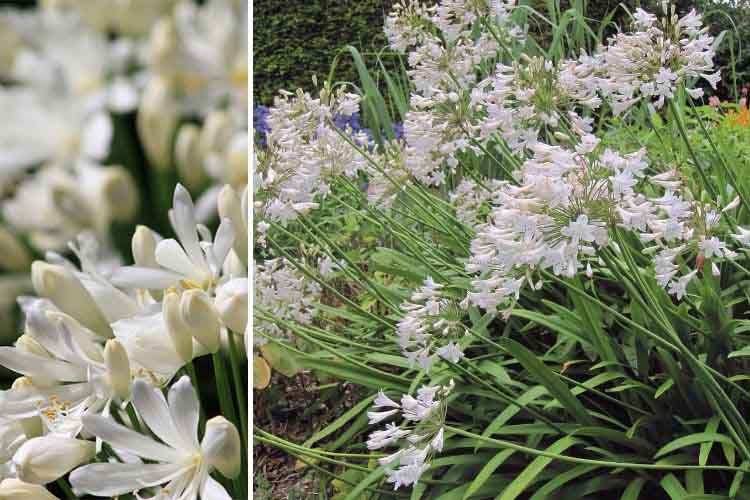
The white-flowered Agapanthus: Agapanthus albus
Agapanthus Royal Velvet: the new star
Original and recent, the Agapanthus Royal Velvet is a new star among Agapanthus due to its intense, trendy colour described as 'ultra violet'. It produces a stunning effect with its unique umbels of 10 to 12 cm in diameter, featuring a deep violet colour streaked with very dark blue-violet. The umbels rise to 80 cm above the ground, clearly above the (deciduous) foliage that forms a lovely clump. The elegance of the Agapanthus Royal Velvet is undeniable!
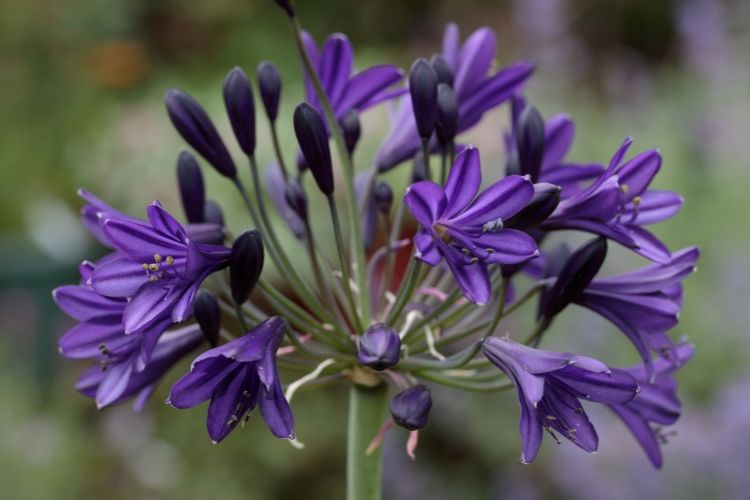
The Agapanthus Royal Velvet, a new variety with ultra violet flowers
Its intensely coloured flowers make it ideal for contemporary gardens as well as for exotic scenes featuring orange flowers like kniphofias, cannas, or hemerocallis.
In addition to its original colour, this variety boasts many advantages with its abundant flowering, robustness, and cold resistance down to -10°C.
Agapanthus Double Diamond: the compact one with double flowers
Recent, the Agapanthus Double Diamond is a variety that combines two qualities: a compact habit and generous flowering. Its main asset lies in its pure white double trumpet-shaped flowers. Grouped in umbels, they measure 10 cm in diameter and appear above a clump of persistent leaves in mild climates. Its compact habit (35 cm high and 30 cm wide) makes it ideal for pots, on terraces or balconies, as well as for borders in areas where winters are not too cold, as it does not tolerate temperatures below -5°C.
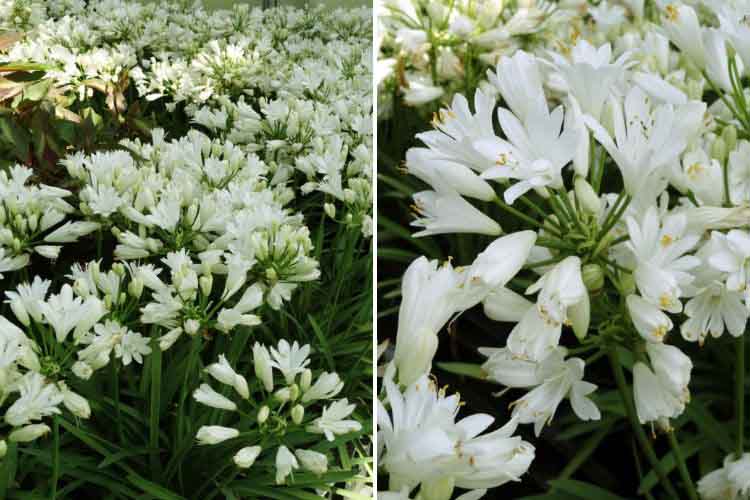 The Agapanthus Double Diamond, a small variety with generous double flowers
Agapanthus Twister: the bicolour
The Agapanthus Twister is an original variety appreciated for its bicoloured flowers. Large, up to 18 cm in diameter, its umbels consist of white flowers with a dark blue base. These two-coloured flowers provide a certain dynamism while blending the softness of the shades, accentuated by the green-grey foliage. Medium-sized, this Agapanthus reaches 60 cm in height and 50 cm in width, making it ideal for the middle of borders, behind ground-cover plants, and it can also be grown in large pots.
Finally, the Agapanthus Twister can be planted in many climates as it is one of the hardiest Agapanthus, tolerating temperatures down to -12°C.
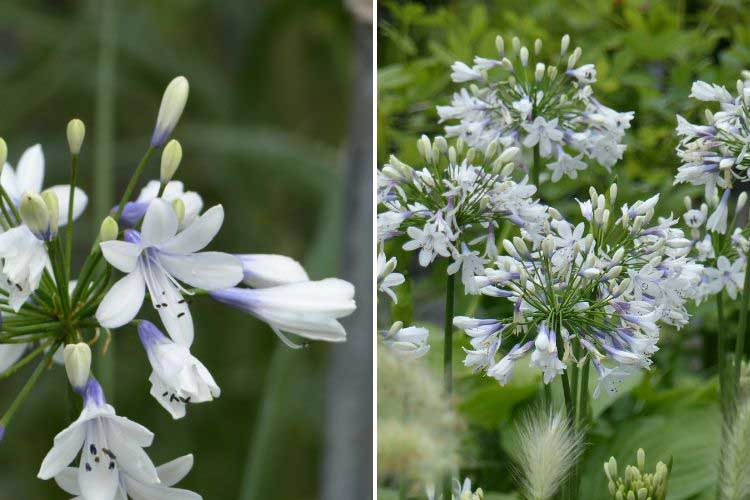
The Agapanthus Twister: bicoloured flowers, white and blue
Agapanthus Pitchoune Blue: the perfect cute pot plant
The Agapanthus Pitchoune Blue lives up to its name. All cute and small, this compact variety measures only 50 cm in height and 50 cm in width. Dwarf, it is perfect for border planting but also for pot cultivation, allowing it to be brought indoors for protection in winter, as it is not very hardy and only tolerates -5°C.
Although small, the Pitchoune Blue variety stands out for its abundant flowering. It pleasantly blooms in an overseas blue above persistent ribbon-like foliage. In the garden, it can be associated with or replaced by its "little sister" with white flowers, Pitchoune White, which offers the same qualities.
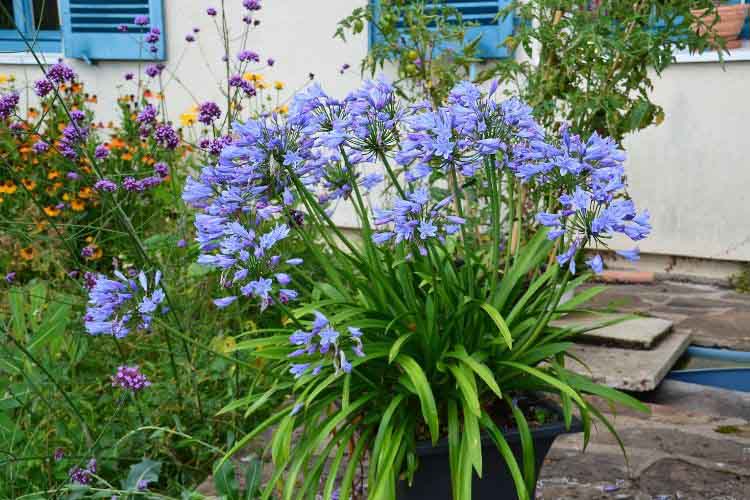
The Agapanthus Pitchoune Blue, a reliable choice, ideal for pots
Do you have other varieties to recommend? Feel free to share their names with us in the comments!
Agapanthus are spectacular flowers often found in seaside gardens, particularly along the West Coast and in Brittany. In summer, they display beautiful blue, white, or mauve flowers in umbels that are both graphic and elegant. As a worry-free perennial, the Agapanthus thrives in full sun in ordinary, well-drained soil that is not too dry in […]
Thistles, as a whole, are often associated with the field thistle (Cirsium arvense), a species more feared than appreciated. Consequently, they are relatively rarely planted in gardens. However, ornamental thistles are low-maintenance, easy to grow, and, above all, they are unmatched for adding interest to a somewhat flat flowerbed, even into winter thanks to the striking structure of their inflorescences that last for many months.
Here are our favourite "thistles" along with some ideas for pairing them.
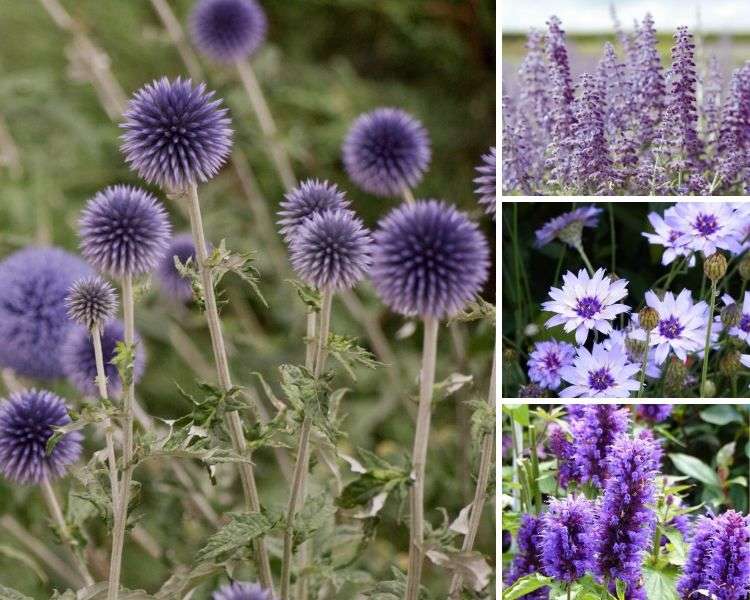
Echinops ritro, Globe Thistle or Azure Globe
Hardy and unassuming like a camel, this perennial thistle is distinguished by its blue flowering, which is remarkable from a distance. It features green foliage with silvery highlights, spiny, from which small globe-shaped flowers emerge from July to September.
- Growing conditions: in full sun in any well-drained soil, even poor or dry - hardiness: -20 °C
Echinops are easy to pair, particularly in summer beds where perennials and grasses mingle. They are also perfect for creating a lovely blue colour scheme, here with Echinops ritro, Perovskia Lacey Blue, Catananche caerulea, and Agastache Blue Boa.
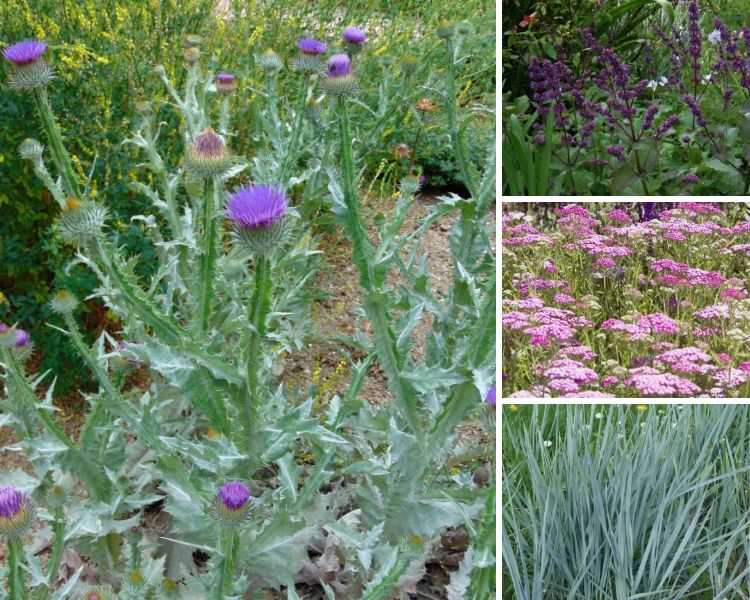
Onopordum acanthium, Cotton thistle
Monumental, the Onopordum acanthium (or nervosum) is a biennial plant that produces large purple-pink flowers reaching up to 2 metres high in July. They are perched on a hairy stem, which is adorned with greyish foliage armed with formidable thorns. Its growth is simply astonishing as it requires very little.
- Growing conditions: in full sun in any soil, even dry and calcareous - hardiness: -15 °C
More than just a companion, Onopordum acanthium is a standout. With its tall stature and graphic silhouette, it easily steals the show from surrounding plants. Nevertheless, to highlight it, feel free to pair it with Salvia verticillata Purple Rain, Achillea millefolium Lilac Beauty, and Elymus magellanicus.
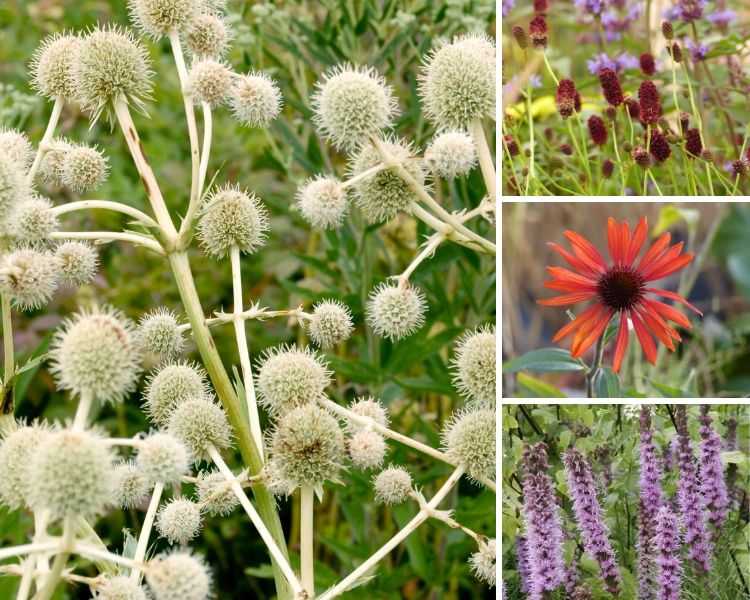
Eryngium yuccifolium, Yucca-leaved eryngium
Simply charming, this American eryngo is distinguished by its somewhat waxy, long leaves with sharp tips, as well as by its flowering. Carried on branched stems, its flowers appear in July, they are numerous, spherical, and a lovely greyish white. In a flowerbed, it is an excellent graphic plant that quickly forms a clump 1.5 metres high and 60 centimetres wide, ideal for adding a touch of white to summer beds.
- Growing conditions: in full sun in well-drained soil - hardiness: -15 °C
The yucca-leaved eryngo is the perfect plant to enliven a somewhat "flat" flowerbed. The shape of its flowers contrasts beautifully with vertically-oriented plants like agastaches, salvias, liatris, or other American perennials like echinaceas, heleniums, or the lovely Canadian Burnet. Here it is paired with Sanguisorba Red Thunder, Echinacea Hot Summer, and Liatris spicata.
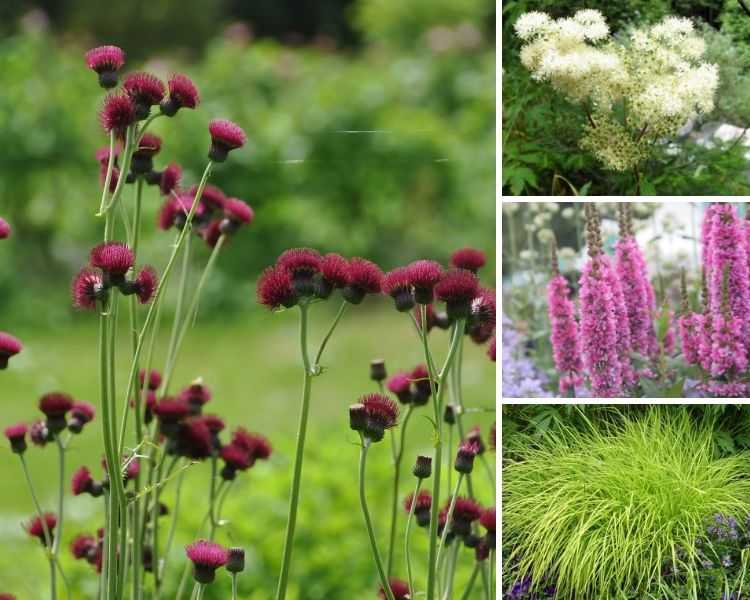
Cirsium rivulare Atropurpureum, River thistle
This thistle, perfect for heavy and moist soils, is appealing due to its purple-red flowering that begins in June. Its flowers, about 3 cm in diameter, are borne on tall branched stems that can reach a height of one metre. Graphic yet somewhat wild, this river thistle is a blessing for waterlogged soils and also for pollinating insects as its flowers are melliferous.
- Growing conditions: in full sun or partial shade in fairly rich, cool to moist soil - hardiness: -15 °C
Versatile, this thistle suits all styles of gardens: modern, English, or natural. It pairs well with Astrances, Japanese Anemones, Astilbes, Veronica, and with all grasses suited to cool or moist soils like Carex, Deschampsias, and Molinies. You can also combine it with Filipendula ulmaria, Lythrum salicaria Robert, and Carex elata Aurea.
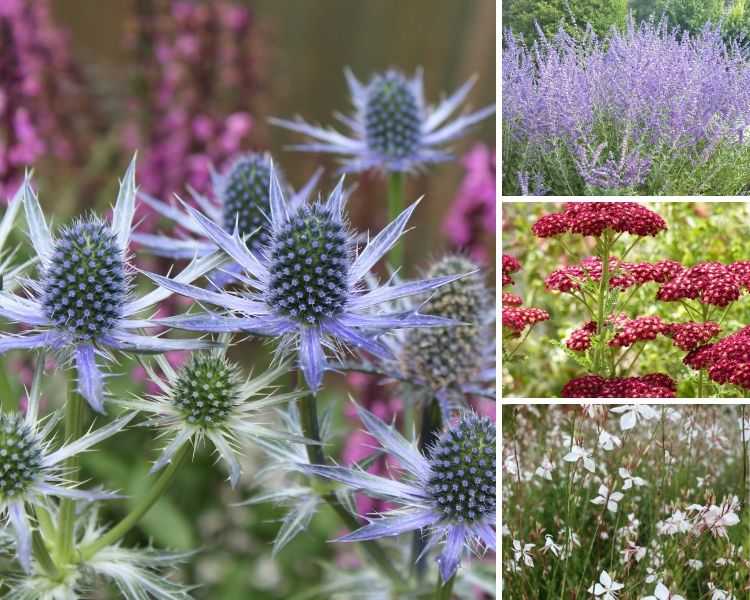
Eryngium Jos Eijking®, Blue flower eryngium
The Eryngium Jos Eijking® is a magnificent blue thistle that shines with its cobalt blue hue but also with the graphic nature of its conical inflorescences crowned with finely cut bracts. Its average height (70 cm tall and 30 cm wide) is more than compensated by its colour, which ensures an extraordinary presence that will undoubtedly attract all eyes in the garden.
- Growing conditions: in full sun in well-drained soil, even dry - hardiness: -15 °C
Stunning in a flowerbed where all shades of blue are represented, this eryngo will shine even brighter if you add a touch of bright yellow (with Crocosmia Buttercup, for example).
For a calmer and more restful atmosphere, opt for white with Gaura lindheimerii, blue with Perovskia Blue Spire, and elevate it all with a note of Achillea Red Velvet.
Berkheya purpurea, Purple African thistle
Large daisy-like mauve flowers with a purple centre perched on threatening spiny stems… here is the Berkheya purpurea! Curious, this perennial native to South Africa is quite hardy and particularly interesting in well-draining soil, though not too dry. We love it for its originality but especially for its 10 cm diameter flowers and its silvery-grey, downy foliage.
- Growing conditions: in full sun in well-drained soil but not too dry - hardiness: -10 °C
Perfect for a gravel garden, Berkheya pairs well with many perennials, but why not combine it with agapanthus (also native to South Africa) like Agapanthus Enigma, Monarda fistulosa Menthifolia, and to echo its dark heart, Pennisetum alopecuroides Black Beauty.
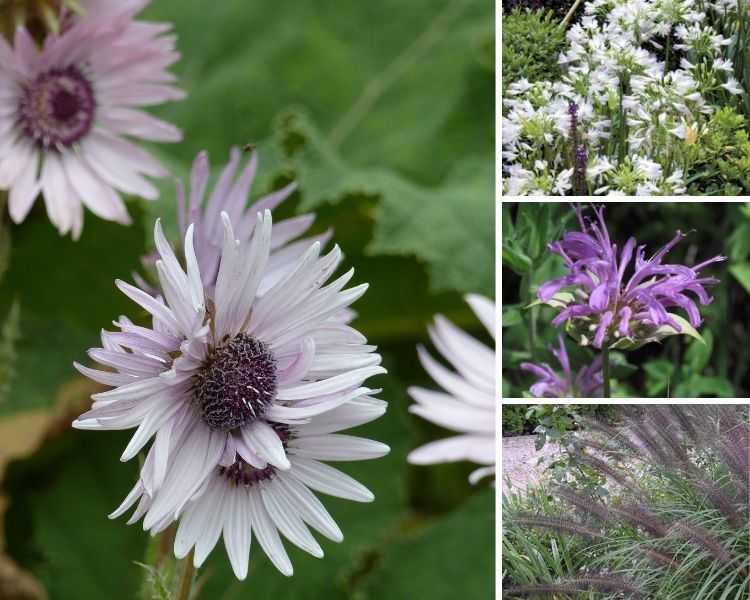
What about you? Do you have any thistles in the garden? What are your favourite varieties? Let us know in the comments!
Thistles, as a whole, are often associated with the field thistle (Cirsium arvense), a species more feared than appreciated. Consequently, they are relatively rarely planted in gardens. However, ornamental thistles are low-maintenance, easy to grow, and, above all, they are unmatched for adding interest to a somewhat flat flowerbed, even into winter thanks to the […]
The sunny days are fast approaching, and you realise that your garden or terrace looks rather sad? Do you have an unsightly wall to hide, a view to forget, or a boring fence? Or perhaps you simply want some colour... and quickly!
Here’s a selection of 10 annual climbing plants with ultra-rapid growth, perfect for creating a floral decor in the blink of an eye for the season. These lianas climb any support you provide and can also weave into bushes to enhance or prolong their flowering. The icing on the cake is that they require little ground space and are very easy to grow!
Ipomoea, sound the trumpets!
Ipomoea is a climbing liana that climbs on its own. Valued for its extremely easy cultivation and generous flowering that occurs without interruption from summer to frost.
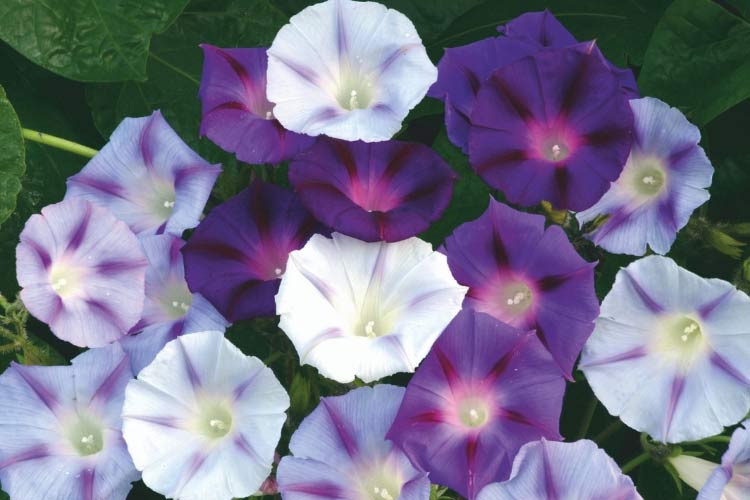
Its trumpet-shaped flowers come in a variety of colours: white, blue, mauve, purple, red... some are even striped or come in elegant shades. They open in the early morning and close in the afternoon, at the height of the heat. The leaves, a vibrant green, are heart-shaped.
- Height: 2.5 metres to over 6 metres depending on growing conditions.
- Requirements: heat and rich soil that remains cool. Full sun exposure, sheltered from the wind.
- Uses: in the ground, in pots (terrace, balcony). Can be used as a groundcover.
To learn everything about Ipomoeas, check our plant sheet : Ipomoeas, sowing, planting, cultivation and maintenance.
Sweet Pea, the fragrance plus
Who hasn’t succumbed to the delicacy of sweet pea? This climber flowers from June to September, with blooms in various colours, bright or more pastel. They can be white, pink, red, purple, salmon, and some are even bicoloured. Their sweet fragrance is another of their assets, filling the house if you cut a few stems to make bouquets (this also encourages the plant to produce new flowers!).
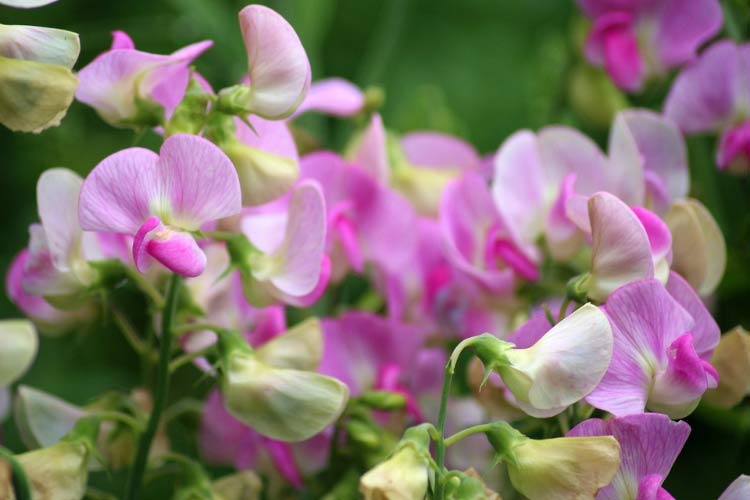
The Sweet Pea attaches itself to its support with fine but sturdy tendrils. The foliage, green with bluish highlights, is light and elegant.
- Height: 1.5 to 2 metres
- Requirements: a rich, deep but drained soil, in the sun.
- Uses: in the ground, in pots.
Learn everything with our sheet on the Sweet Pea, its cultivation, care, and uses.
Nasturtium, for the garden and the kitchen
Perhaps the easiest of the annual climbers, the Nasturtium is very popular. Impossible to miss, it is perfect for beginner gardeners. From May-June until the first frosts, it displays rounded and generous foliage, above which exotic-looking funnel-shaped flowers in red, yellow, or orange bloom continuously. No need to stake it, the petiole of the leaves wraps around the first support it encounters. If it finds none, the plant then forms a colourful groundcover.
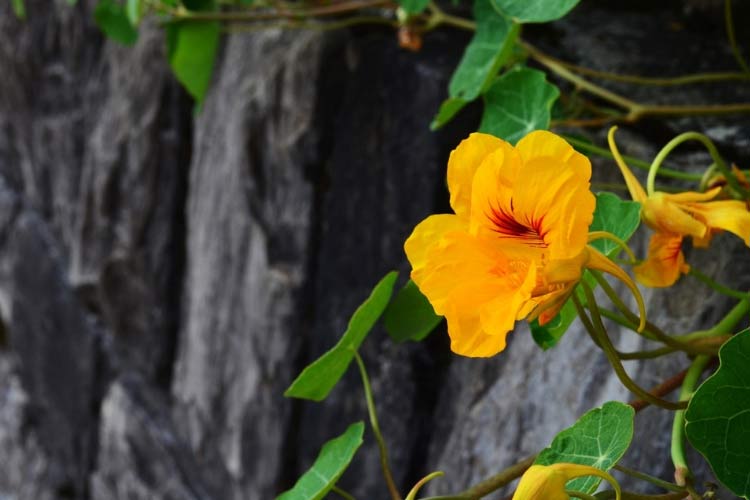
Hanging, the plant eventually cascades from its container. All parts of the plant are edible and add a spicy note to salads. The leaves are also rich in vitamin C! Aphids are fond of nasturtiums, which helps prevent them from colonising other plants, a very useful asset near a vegetable garden.
- Height: 3 to 4 metres
- Requirements: any soil that is not too rich to poor, even dry. Sun or partial shade exposure. Tolerates maritime climate.
- Uses: in the ground, in pots, hanging, vegetable garden (to contain aphids). Can also be used as a groundcover.
Discover our tips for Planting, sowing, and maintaining the Nasturtium.
The Spanish Bean, beautiful and good!
If the Spanish Bean can be used in the vegetable garden, it is also for its ornamental value that it is used in the garden. Its abundant and fresh green foliage creates a beautiful screen. In summer, cluster flowers at the tips of the stems adorn this tall climber. Red, orange, white, pink, and even bicoloured, they appear in abundance and give way to elongated pods, delicious if harvested while still young.
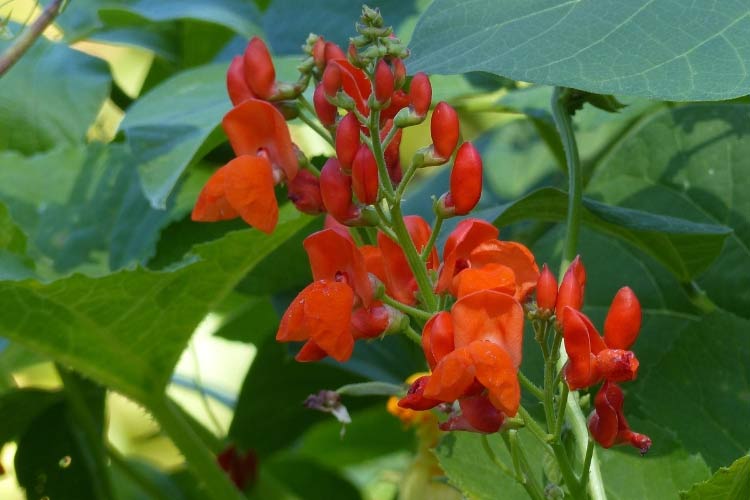
The large beans they contain are also edible. Like all beans, this one climbs on its own, so a suitable support must be provided for its size. Its cultivation is very easy to achieve.
- Height: 3 to 5 metres
- Requirements: a loose, fresh, well-drained soil, in the sun.
- Uses: ornamental garden, in the ground. In the vegetable garden. In pots, to create an aesthetic screen on a terrace.
Cobaea, a bygone charm
A perennial climber, grown as an annual in our climates, Cobaea displays lush foliage, green with bluish highlights. The flowers, bell-shaped with curled edges, bloom in greenish hues before turning cream-white to blue depending on the variety. Supported by long peduncles that make them droop, they seem to observe the gardener. The flowering is quite late and may not occur until August, but it lasts until the first frosts.
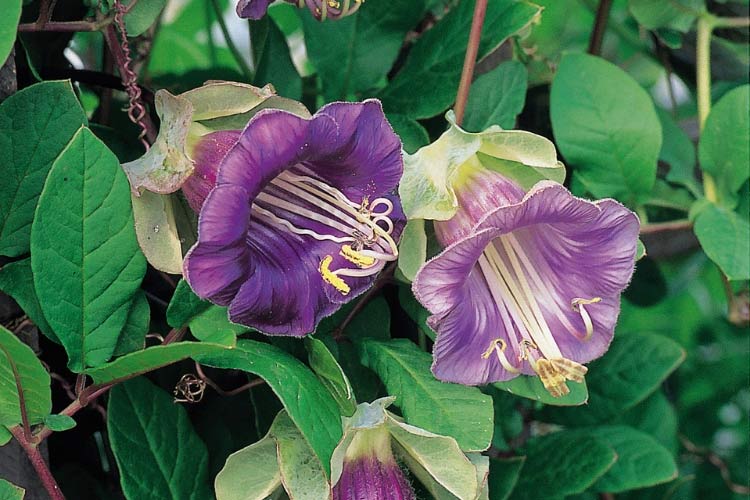
Easy to grow, it wraps around its support on its own. This lovely climber with undeniable charm adds a retro touch to the garden.
- Height: 3 to 4 metres
- Requirements: any fertile soil that does not dry out, in sunny or partially shaded exposure.
- Uses: in the ground in the garden or in pots on a patio, courtyard, or balcony.
Mina lobata, an exotic look with warm tones
A perennial climber behaving like an annual in our latitudes, the Mina lobata, known as "Indian plume," is a very original liana. Its foliage is thick and abundant, with 3 lobes, already offers decorative interest. It highlights the inflorescences, with numerous upright spikes of tubular flowers that evolve from bright red to orange, then to a bright yellow, finishing in cream. The different colours coexist on the plant from July to frost.
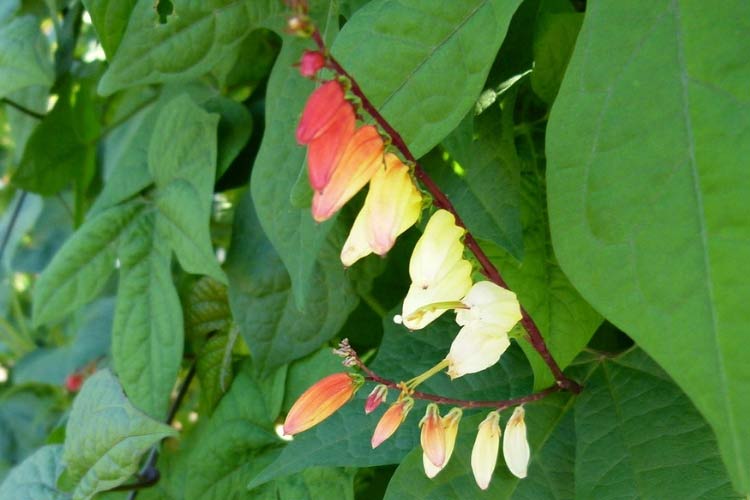
From a distance, the plant resembles a chandelier adorned with hundreds of candles. Up close, the arrangement of the flowers gives the impression of admiring a headdress of Indian feathers. Its exotic look never goes unnoticed! Simple to grow, the plant wraps around its support and self-seeds easily without becoming invasive. You can try to keep it from one year to the next by placing it in a pot that you shelter during the bad season.
- Height: 2 to 3 metres
- Requirements: any moderately fertile and well-drained soil, in a sunny and very warm location.
- Uses: ideal for an exotic atmosphere, both in the ground and in pots on a very bright terrace.
Black-eyed Susan, voluptuousness and exuberance
A frost-sensitive perennial, the Black-eyed Susan should be treated as an annual when planted in the garden. In pots, you can winter it to try to keep it. This very floriferous climber displays, from June to frost, flowers in various shades of orange or yellow with a centre resembling a black eye, which has earned it its name. Melliferous, this climber attracts pollinators. The dark green foliage is heart-shaped and provides a beautiful backdrop for the flowering.
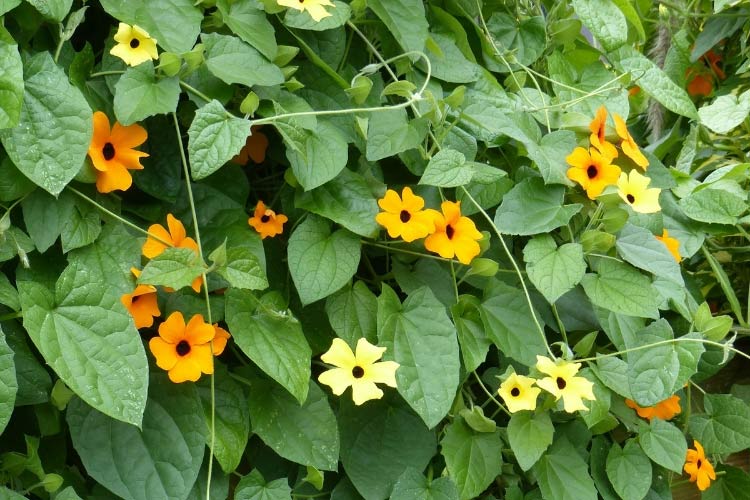
The Black-eyed Susan climbs on its own, entwining its voluble stems around any support, but it can also spread through the flowerbed and serve as a flowering groundcover or elegantly cascade from a hanging basket.
- Height: 2 m
- Requirements: rich and humus-bearing soil, well-drained, in full sun or partial shade. Shelter from strong winds.
- Uses: flowerbeds, pots, greenhouses, hanging baskets.
To learn everything, check our sheet "Black-eyed Susan: sowing, planting, and care"
Lofos, a "climbing snapdragon"
The Lofos (known as Lophospermum by botanists) is a perennial that does not withstand the cold. Both light and showy, it blooms from summer to frost in shades of red, pink, or  white. The tubular flowers resemble those of foxgloves or snapdragons and adorn a narrow, triangular foliage with distinctly toothed edges. Green with grey highlights, it adds to the decorative interest.
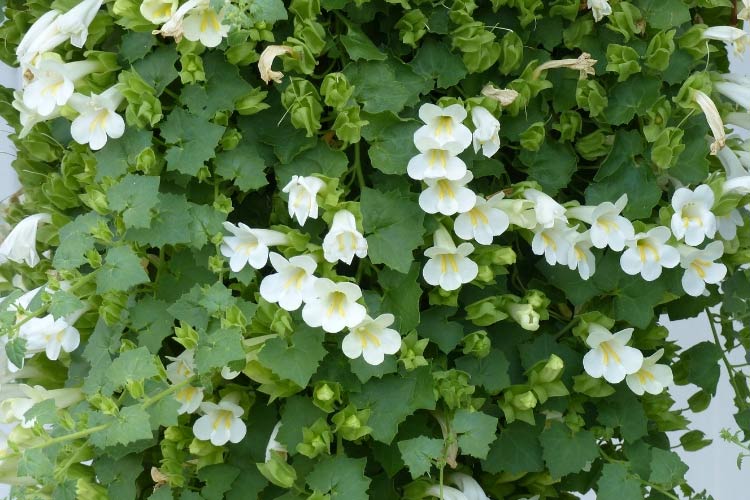
In regions with mild winters, the plant can regrow from the stump even if the aerial parts disappear. However, it is more realistic to consider it as an annual or to plant it in a pot to place in a conservatory during the bad season.
- Height: 3 metres (for the same spread)
- Requirements: drained, fresh to moderately dry soil, in bright but not scorching exposure (partial shade possible).
- Uses: in the garden, as a climber but also as a groundcover or in hanging baskets. In a not too hot conservatory in summer.
Clitoria, a blue pea full of femininity
Increasingly used, the Blue Pea or Clitoria ternata is a short-lived perennial and frost-sensitive plant that is part of the climbing perennials used as annuals to quickly decorate the garden. Its perennial character can be found by cultivating it in a pot in a conservatory.
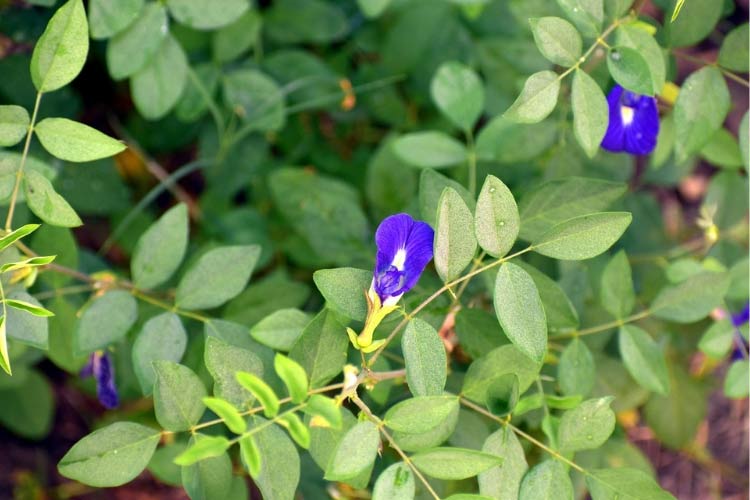
From a green, pinnate foliage emerge suggestive-shaped flowers that have earned it its name. They are a deep blue with a white throat tinged with yellow, appearing in abundance from July to September, sometimes longer depending on weather conditions. Melliferous, this climber is appreciated by bees and butterflies. The beans that follow the flowers are said to have aphrodisiac properties. Easy to grow, its original and tropical look is sure to make an impression.
- Height: 3 metres
- Requirements: rich, fresh but drained soil. Non-burning sunny exposure or partial shade.
- Uses: in the ground, to climb a large bush, a trellis, a fence…or in a pot for a terrace. In a conservatory, it behaves like a perennial.
Dolichos, it accumulates the assets
The Dolichos or Lablab is a climber whose every part offers ornamental interest. Also called "Indian Pea," its generous foliage, green tinged with burgundy highlights adds beautiful depth. From July to September, it is dotted with flowers similar to those of sweet peas, in shades of pink and lilac, and slightly fragrant.
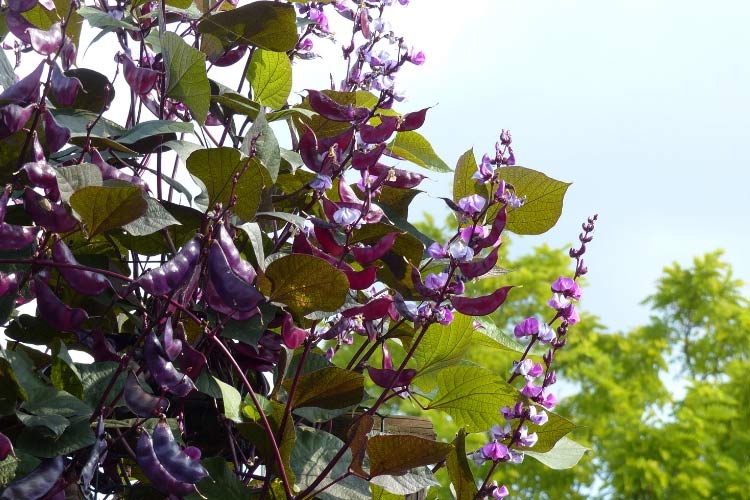
Melliferous, this liana welcomes many butterflies and other pollinators. Shiny purple pods then adorn the plant for a decorative effect that lasts late into autumn. Easy to grow and with very rapid growth (the flowers open about 5 weeks after sowing), this climber that climbs on its own is essential for creating a stunning decorative display!
- Height: 3 to 5 metres
- Requirements: any drained soil, even dry and calcareous, in sunny and warm exposure.
- Uses: in the garden, in hot and dry places. In pots, on a patio or terrace.
The sunny days are fast approaching, and you realise that your garden or terrace looks rather sad? Do you have an unsightly wall to hide, a view to forget, or a boring fence? Or perhaps you simply want some colour… and quickly! Here’s a selection of 10 annual climbing plants with ultra-rapid growth, perfect for […]
Autumn is a particularly colourful season in the garden but the flamboyant shades unfortunately do not last long. Soon gardens will go to sleep and we will all, from March, be on the lookout for the first spring blooms... provided we were foresighted enough and planted in time! To enjoy the very first flowers of spring in the garden, here is my selection of 7 early perennial plants to plant in autumn.
Brunnera Diane's Gold
This perennial Siberian bugloss is a real gem for shady, cool areas of the garden. It bears heart-shaped foliage, chartreuse green that retains its pretty golden tones from spring through to the frosts. From April to June, it is adorned with a cloud of small, delicate bright-blue flowers. Easy to grow, it only needs soil that stays cool to spread and form a luminous carpet. In the garden it establishes easily under trees, at the base of hedges or as an edging for beds where it will add an elegant touch.
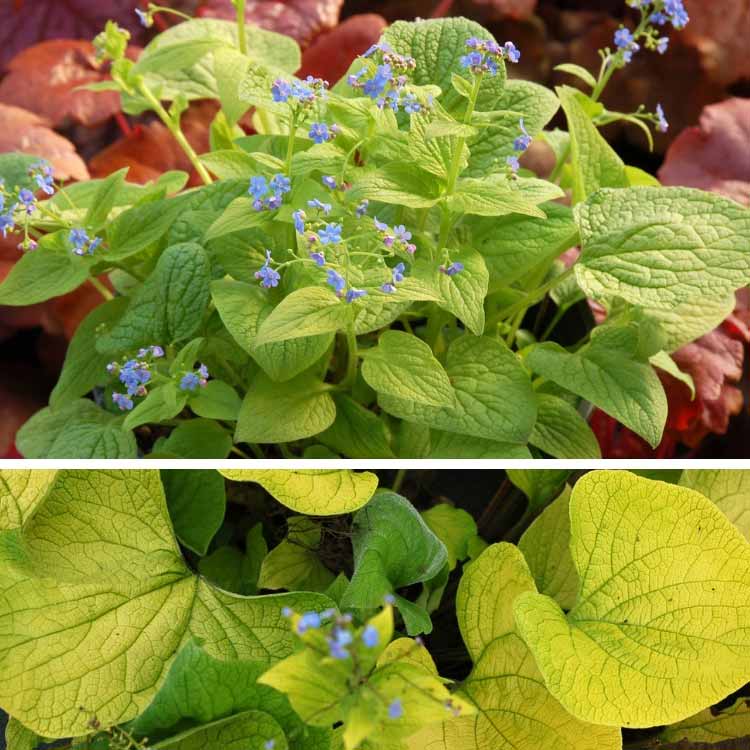
Brunnera macrophylla Diane's Gold - Siberian bugloss
Pachyphragma macrophylla
This perennial is probably the first to flower: from March it produces a multitude of charming small white flowers. It is a hardy plant that also has the advantage of establishing quickly and spreading gradually, without being overly invasive. In shade or partial shade and in rich, even heavy, soil, it forms attractive, persistent carpets studded with white in early spring. Charming with spring bulbs, with bleeding hearts or with Hostas, this woodland plant is also ideal for dressing neglected spots in the garden.
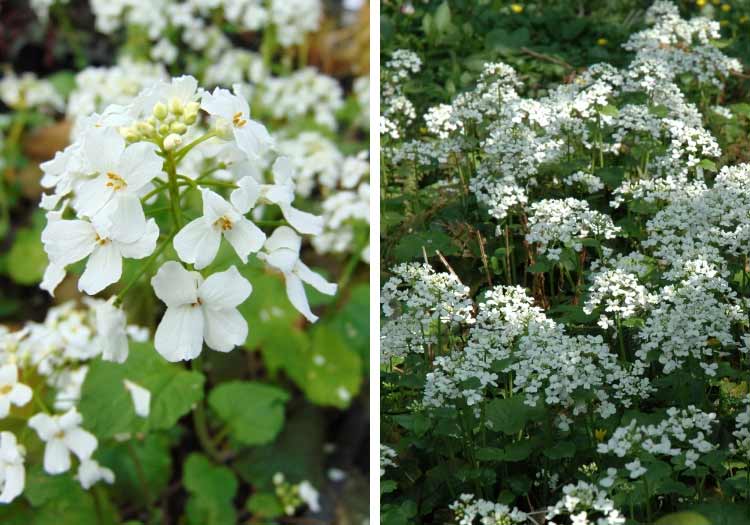
Pachyphragma macrophyllum
Disporopsis pernyi
If you like Solomon's seal, you will love this woodland perennial! Perfect for dry shade, from April to May it bears charming flower spikes bearing small cream-white bell-shaped flowers tinged with green. Growth is fairly slow, but once established it forms such a dense carpet that it can rival weeds. In the garden it will find a place under trees, with epimediums for example, on a bank or in a shaded rockery.
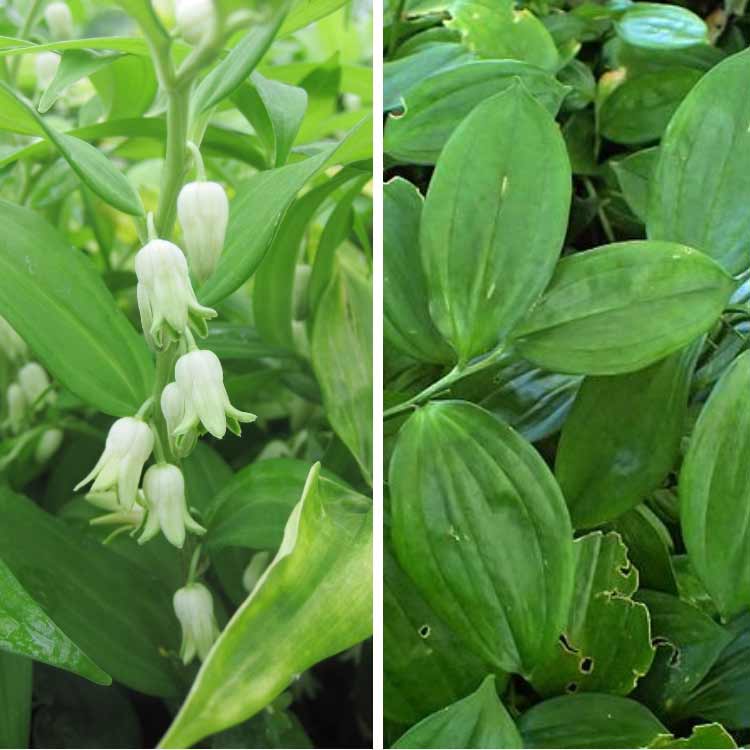
Disporopsis pernyi
Bergenia Dragonfly Angel Kiss
Bergenias need no introduction, so well known are they for their toughness! Nevertheless, this variety deserves attention: compact and very floriferous, it displays remarkable evergreen foliage: dark green that flushes red in winter. In spring, in April–May, it is topped by pale pink, semi-double flowers which create a very attractive display. Very easy to grow and hardy, this bergenia can be planted in pots on a terrace or balcony as well as in the garden.
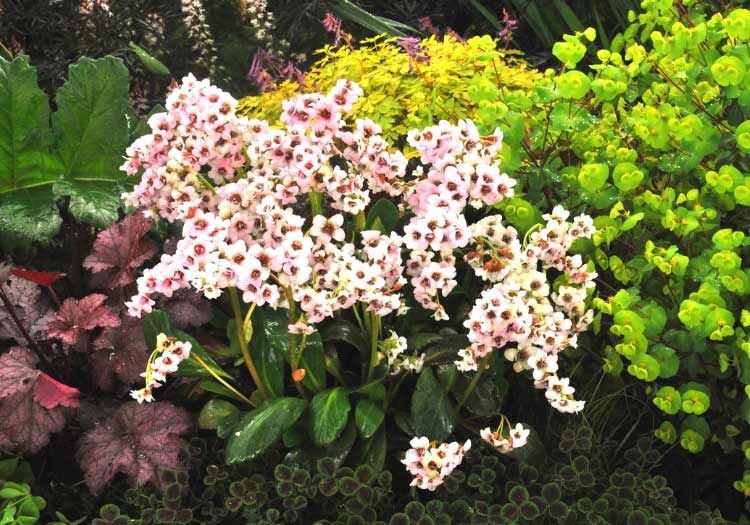
Bergenia Dragonfly Angel Kiss
Comfrey Sky Blue Pink
And no, comfrey is not only used to make manures and decoctions! It is also a vigorous groundcover perennial that can be very ornamental. The 'Sky Blue Pink' variety is proof of that. From April to June it bears white and blue flowers washed with pink above evergreen foliage. Almost indestructible, this plant withstands difficult conditions and grows very well in dry shade.
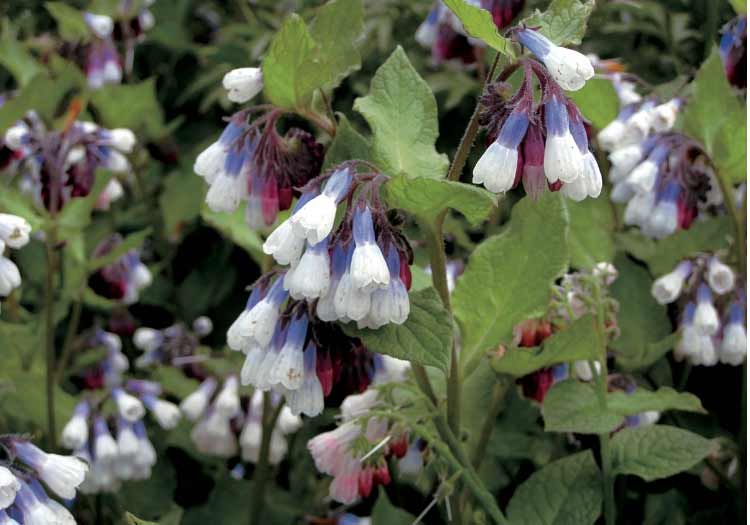
Large-flowered comfrey - Symphytum Sky Blue Pink
Epimedium Sphinx Twinkler
With exquisitely delicate flowers and colourful foliage, this epimedium—or Warley bishop's hat—has everything to please. Rhizomatous and spreading, it makes an excellent evergreen groundcover for shade and partial shade. In spring, in April–May, it unfurls delicate sulphur-yellow flowers suspended on slender stems. It's a delight, but don't be fooled by appearances: it is indeed a robust plant that coexists perfectly with tree and shrub roots.
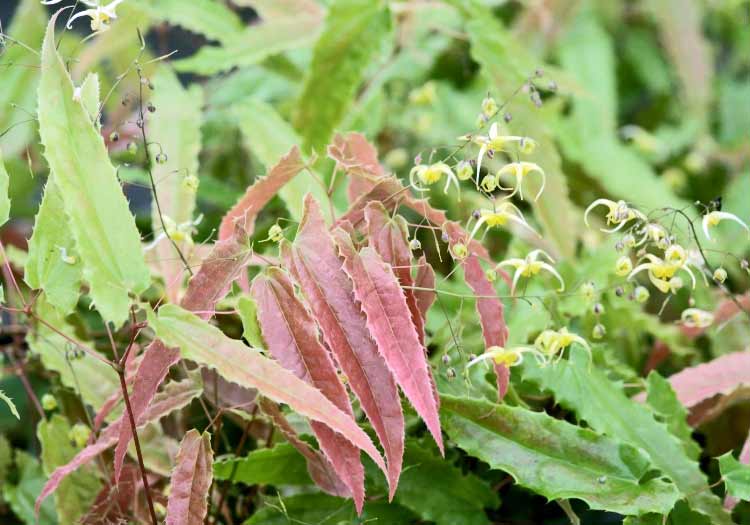
Warley bishop's hat - Epimedium Sphinx Twinkler
Ajuga Chocolate Chip
A devilishly effective groundcover, this creeping bugle produces small narrow chocolate-coloured leaves from spring to winter. In May–June short spikes of intense lavender-blue rise, striking in appearance. It is planted in partial shade in fairly cool soil and shows good resilience. This ajuga is ornamental, but can be very useful for replacing lawn on small areas or for filling large gaps in paving.
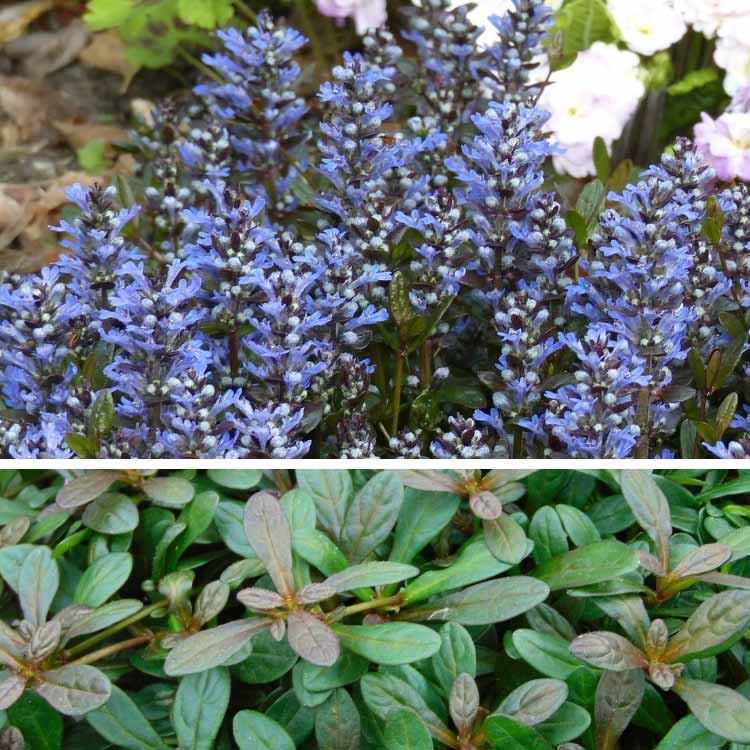
Creeping bugle - Ajuga tenorii Chocolate Chip (Valfredda)
Autumn is a particularly colourful season in the garden but the flamboyant shades unfortunately do not last long. Soon gardens will go to sleep and we will all, from March, be on the lookout for the first spring blooms… provided we were foresighted enough and planted in time! To enjoy the very first flowers of […]
You may have noticed that last spring, articles became scarcer on the blog... To be honest, we experienced what we modestly call "a period of rapid growth", which means it was hot, very hot indeed! To tell you the truth, it felt like all the gardeners in France and beyond had decided to frantically place orders. Let’s just say that everyone was on deck, and even the boss was preparing the parcels. As a domino effect, those who were, like me, a bit "hidden" behind their advice sheets found themselves responding to emails from worried, even desperate gardeners facing their dying plants. This sometimes challenging experience was rich in lessons, as I can confidently say I now know how our clients manage to kill their plants in their gardens!
Here’s how they go about it!
1) They use acidic soil, pure, preferably
Using acidic or heather soil, we agree, starts from a good intention: to provide an appropriate substrate for acidophilous plants (like Japanese Maples, rhododendrons, hydrangeas...), which need a soil with an acidic tendency (pH between 4 and 6.5) to thrive. It’s also a logical approach because in the term "heather soil plants," there is "heather soil." Finally, if the local garden centre sells it, it must be good to use! Well, believe it or not, it’s not, because heather soil is a substrate that seems to have been invented to kill plants.
Indeed, heather soil, which contains a significant amount of blonde peat, is certainly acidic but it is also very low in nutrients. Moreover, when it is soaked it often retains too much moisture, and when it is dry, it is nearly impossible to rehydrate; water just runs off it and does not penetrate the heart of the plant. As a result, it is impossible to properly water a plant in pure heather soil. And worst of all, the plant that manages to grow will just struggle and eventually die due to a lack of substantial nutrients!
2) They water every day, a little... or every day, a lot... or not at all.
80% of replanting issues are due to overwatering or underwatering.
The problem is that an overwatered plant shows roughly the same signs as a plant that is not watered enough: wilting leaves that dry out and eventually fall off. Faced with these symptoms, the first reflex of inexperienced gardeners is to water again, more often and more abundantly... until death ensues, or nearly. Those who do not water generally do not speak up: they often realise their neglect when it is really too late and no rescue measures are feasible. In truth, I think they feel a bit ashamed.
Our advice for proper watering is simple: to know if your plant needs watering, touch the soil! If the soil is damp and your finger comes out muddy, it has too much water, so stop watering. If, on the contrary, your finger comes out dry and without soil, water it; it is too dry! The ideal is to keep the soil always fresh and loose, where your finger comes out slightly damp with a bit of soil stuck to it. And the hotter and drier it is, the more you should not water, but check the moisture at the base of the plant. Also consider your plants' needs: a lavender plant does not need constantly moist soil, while butterbur, planted in regular soil, does.

3) They install frost-sensitive plants... where it freezes, hard and often.
The notion of hardiness sometimes leads to very personal interpretations, bordering on the fanciful. For many gardeners, a hardy plant is a robust plant (a bit like our grandparents' furniture... so far, so good) capable of withstanding Siberian cold, everywhere in France (that’s where things go awry). Indeed, there are several degrees of hardiness, and a plant will not react the same way in all gardens... as its age, exposure, soil type, and drainage also matter.
It frequently happens that optimistic gardeners living in harsh climates like Alsace, the Vosges, or Aveyron realise their exotic garden dreams with a plethora of callistemons, Musa basjoo, or Gunnera... Generally, they call us in spring to report the failure of their plant. And, of course, we can do nothing!
To avoid this type of inconvenience, take the time to read the information contained in the plant sheets: hardiness is clearly indicated! And to learn all about hardy plants and the concept of hardiness, feel free to consult our complete guide.
4) In pots and containers, they use garden soil and rely on the sky for watering.
Sometimes it works. Often, it does not.
Growing plants in pots may seem simpler. In reality, it is not that easy. Not only do you need suitable containers, but you also need, above all, a quality substrate.
What could be better than garden soil? Indeed, when it is rich and light, it works. When it is heavy, a bit suffocating, or stony and very draining, it’s a whole different story. In pots, plants must make do with little: a reduced volume of soil and the water that you are willing to give them through watering. Moreover, their root system is inevitably a bit constrained. These plants are therefore more sensitive to potential nutrient and water shortages. To have beautiful potted plants, the quality of the substrate is crucial! Instead of digging who knows where to beautify your balcony or terrace, invest in quality, nutrient-rich compost that retains water well. If possible, choose from professional quality ranges (like Klasmann), and use it pure, without trying to make improbable mixtures like: Aunt Brigitte's garden soil + the sand from the nearby construction site + the old geranium compost from the neighbour below.
Regarding watering, do not rely on rainwater. Even if it floods your garden, it is unlikely to be sufficient to meet the essential needs of your potted plants. Why? Because, often, the leaves form a barrier that prevents rainwater from penetrating the soil, and then, because pots, unlike garden soil, do not retain moisture for long. Potted plants must therefore be watered, without excess, but as soon as they need it (see above) and especially, all year round, even in winter, after a severe frost or if the weather is dry.
5) They plant quickly (and poorly), in concrete-like soil or, conversely, overly worked and fertilised soil.
We trust our clients, but, as we know our plants well, some failures leave us puzzled. To get to the bottom of it, we ask for a photo of the dying plant, in situ. Let’s just say that we have a collection of images that could open a genuine little museum of gardening horrors: perennials planted in compact soil, visibly as hard as concrete, understorey plants in stony soil, shrubs planted in the lawn with just a hole the size of the pot dug...
Conversely, some go to great lengths and fertilise with wheelbarrows of manure, sometimes fresh. The road to hell is paved with good intentions.
Let’s remind ourselves once and for all: apart from a few very greedy vegetables like squashes, plants do not need such inputs. And when a plant likes rich soils, we are talking about humus-rich soil... rich in humus that will be the result of the slow decomposition of balanced compost, good leaf mulch, or green waste... but, under no circumstances, brutal fertilisations or those too rich in nitrogen that, on the contrary, weaken them by making them grow too quickly or, at worst, burn their roots.
Plants, to thrive, need a welcoming environment: soil, more or less rich (but never too much) and at least well loosened. You need to dig a comfortable hole, wide enough for it to spread its roots. Remember, in this regard, to gently untangle the root hairs before planting. This simple gesture will allow the rootlets to make contact with their new soil. Also, be mindful of competition: if we advise planting in weeded soil, it’s not just to make you sweat; it’s to allow your little newcomers to gather strength before having to make their place in the sometimes hostile environment of the garden!
6) They plant rhododendrons in calcareous soil, agaves in wet soil...
Who knows why, but multi-recidivist plant killers all have one thing in common: they dream of what they cannot grow at home, like hydrangeas in calcareous soil, Gunneras, or a shrimp willow in dry soil, agaves in wet soil. The problem is that they take action and plant anyway (sometimes adding heather soil, see point 1...). Inevitably, at best, the plant struggles fighting against chlorosis or root rot, at worst, it dies. It’s usually at this point that they call customer service for a replacement (yes, I assure you!).
Errare humanum est, perseverare diabolicum.
If a type of plant does not suit your soil or climate, stop insisting and adopt "The right plant in the right place" as your mantra!
As with hardiness, the information regarding the type of soil required to grow the plants is included in the descriptions of our plants. Read them, take them into account, or take some time to consult a reference book like "All the plants, for all desires and all situations" by Didier Willery.
7) They fall for a perennial or a shrub without knowing exactly where to place it
A slight variation on the previous point, this mistake is often made by experienced gardeners whose garden is already bursting at the seams... because they too often fall for... a new, charming variety, a rare species, or a crush during a plant fair. Three clicks and 48 hours later, these same gardeners are wandering the garden, the new addition in hand, looking for a little spot. It’s usually after 20 minutes of wandering that they find a few square centimetres to squeeze it in. Along the way, they will have forgotten its requirements and, despite their experience, they will have planted a shade plant in full sun (or vice versa). The plant may not necessarily die, but its foliage may look sad or it may not flower... which will undoubtedly earn us a little remark!
Moral: not planting a plant in the right place is not just the domain of beginners. Experienced gardeners can do it just as well...
8) They plant on the day of delivery, even in heatwaves or severe cold... or they wait, a long time
Our plants are delivered all year round, in pots or containers. Weather conditions mean they sometimes arrive at an inopportune time: severe cold, intense heat, or waterlogged soil... Some even plant anyway, pulling out the ice pick and headlamp (it gets dark early in winter). Let’s just say that this compromises their establishment.
We also sell plants in vegetative rest (we explain why in this article), with no visible signs of life or just a few small leaves. I won’t dwell on those who angrily throw them in the compost (they are rare... and I believe they are among those cases where we can do nothing) but will focus on anxious gardeners who, even when conditions are ideal, are afraid to plant such small "things" in the garden and decide to let them "harden off." Once again, letting plants grow comes from a good intention. The problem is twofold: the pots in which the plants are sold quickly become too small, nutrients deplete rapidly, and, above all, potted plants need almost daily watering! Result: the plants die. My advice: do not necessarily plant as soon as you receive them, but plant as soon as possible!
Please, we no longer want to hear "I know it’s hardy, but I’m going to wait until after the Ice Saints to put it in the garden" or "I’m ordering now, I know it’s not the right time, so I’ll keep it in a pot and plant in October"... or promise us to: 1) repot the plant in a much larger pot, 2) use good compost, 3) ensure regular watering whenever necessary until planting in the ground.
Finally, as a side note, know that no, keeping plants in a garage during your holidays, even with the light on, is not possible!
9) They prune, without knowing why or how, but they prune!
For some, it’s an obsession: pruning is a must. It doesn’t matter when, why, or how; nothing must stick out, so they chop away. If the shrub is of the friendly type (hornbeam, boxwood, Lonicera nitida...), things generally go well. Where pruning becomes problematic is:
- when they prune down to the ground shrubs that cannot tolerate it (like Japanese maples, daphnes, forsythias...),
- when they prune at the wrong time: at the end of winter for spring-flowering shrubs or at the end of spring for summer or autumn-flowering shrubs.
To be completely honest, poor pruning or excessive pruning rarely kills a plant, but this massacre with shears will deprive you of blooms and cause the shrub to lose the harmony of its natural shape, which is somewhat similar!
Remember: pruning a shrub is not always necessary. If you don’t know how to prune, do nothing without informing yourself!

10) They worry
"Don’t worry, it just got a bit hot, give it some water" "Yes, it will grow, I assure you" "No, white spots are not a serious disease", "It’s just a pest, there are many this year."
No, you are not in a paediatrician's office, but at the customer service of Promesse de Fleurs. Like young parents, gardeners develop all sorts of anxieties. They are particularly afraid of diseases.
However, many "diseases" like powdery mildew on a young Aster or Monarda plant, a bit of Marsonia on rose leaves are like a cold in kindergarten: normal and benign. There’s no need to rush to the sprayer; treating in full sun, for example, will do more harm than good. Remember, plants are like children: they need to be raised in good conditions to grow well; they need love... but let them live their lives; nothing is worse than being overindulged or overly sheltered!
You may have noticed that last spring, articles became scarcer on the blog… To be honest, we experienced what we modestly call “a period of rapid growth”, which means it was hot, very hot indeed! To tell you the truth, it felt like all the gardeners in France and beyond had decided to frantically place […]
Ornamental grasses have, for a few years now, their moment in the sun. And it is well deserved! Natural, airy, these wind-born beauties, look good for at least nine months out of twelve, often presenting a very different appearance as the seasons change. They are now essential in many gardens, and the horticulturists know this well, offering new varieties each year that join an already extensive range. It is therefore tricky to navigate, especially when you are just beginning to take an interest!
So here is a small selection of perennials grasses: 10 safe bets, ideal for taking your first steps into the world of "wild grasses"!
1) Calamagrostis acutiflora Karl Foerster
It is certainly one of the best-known grasses… and justified, it’s a real dependable performer! Very ornamental, this Calamagrostis offers glossy green foliage in spring and turns gold in winter. Tall and slender, it plants tall plume-like spikes, rose-bronze, in late summer. Upright as an I-beam, but not stiff, this grass does not take up much space and truly structures a border. It also has the good habit of swaying with a gentle nonchalance… a gentle nonchalance it can share with the gardener because maintenance is minimalist. In short, a concentrate of everything we love about grasses!
In the garden, it’s planted in a border, with the full range of perennials for naturalistic gardens. Of rapid growth, it is also very suitable for forming attractive screens
- Height - width: 2 m x 50 cm
- Soil: all types
- Exposure: sun, partial shade
- Hardiness: down to -15°C
- Pruning: cut back in March - April
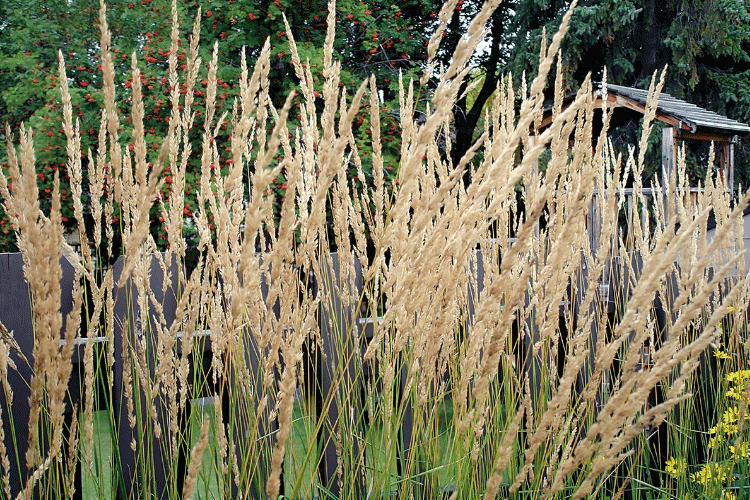
Calamagrostis acutiflora Karl Foerster
2) Carex oshimensis Everest
Bright, this carex captivates with its blue-green foliage, lightly edged with cream white, depending on exposure. Its leaves, slightly arching, give it a supple silhouette. Perfect in a border or in large pots, it grows happily in the dry shade under trees. Evergreen, it would benefit from year-round presence and will be a good companion for spring bulbs, the silvery foliage of Brunnera, for example. Graphical, it can even be planted in mass in modern gardens or in contemporary planters.
- Height - width: 30 cm x 35 cm
- Soil: cool to moist, but tolerates occasional drought
- Exposure: all, with a preference for partial shade
- Hardiness: down to -15°C
- Pruning: unnecessary, prune if needed
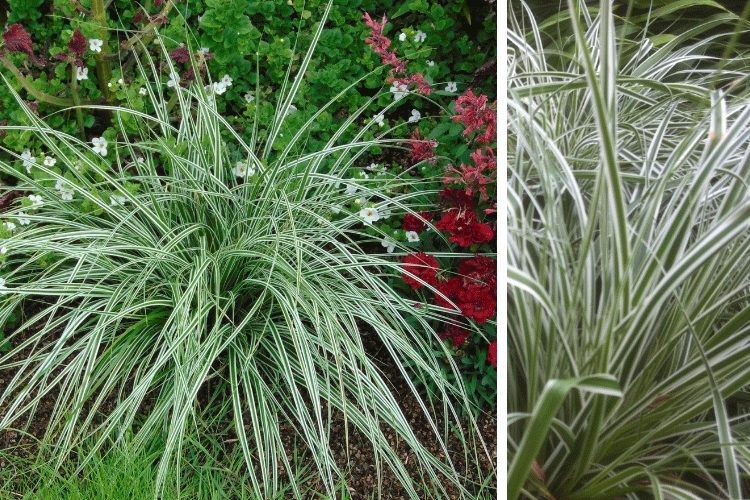
Carex oshimensis Everest® - Oshima Sedge
PS: Some readers of this blog are particularly attentive, so I should point out that the carex, botanically, is not a grass, but a Cyperaceae (not to be confused with the Cupressaceae, by the way!). Nevertheless, its fine foliage makes it common to include it in the grasses category.
3) Deschampsia caespitosa Goldschleier
This pretty variety will delight all those who love lightness and a natural look. Spectacular, this tufted grass forms a compact clump of green, very fine leaves. Evergreen, they remain present throughout the year. In late summer, they bear elegant, loose panicles, golden-yellow subtly silvered.
It is a bright grass that is very easy to use and whose appearance evokes the vast plains of wild meadows. Its translucence is very appealing in a border, and its golden then silver hue, at the end of flowering, contrasts particularly well behind dark plants.
- Height - width: 1 m x 80 cm
- Soil: rather moist, even heavy
- Exposure: sun, light shade
- Hardiness: down to -15°C
- Pruning: cut back only the dry flowering stems in March - April… and do nothing if you wish to allow spontaneous self-seeding
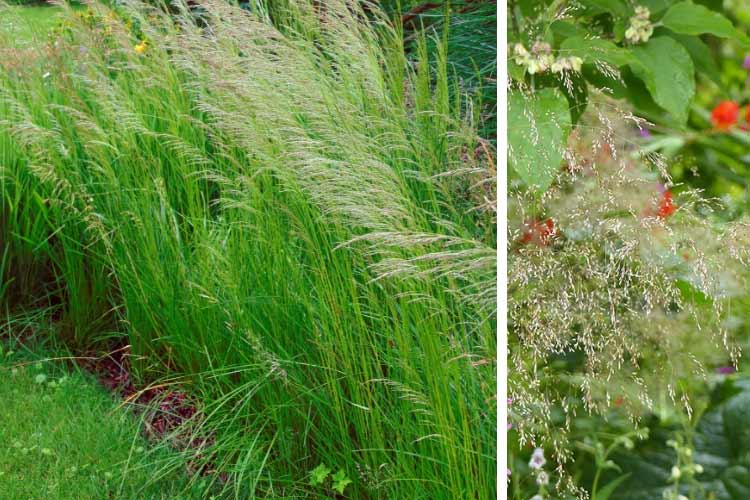
Deschampsia caespitosa Goldschleier
4) Blue Fescue Elijah Blue
This variety is an improved version of the classic blue fescue (Festuca glauca). Its tint, surprising to the uninitiated, takes on superb steel-blue highlights that further enhance its appeal. It flowers in early summer and then bears, on slender stems, fine silvery panicles.
Undemanding, it is a low-growing grass that forms fairly dense hemispherical tufts. It is perfect for difficult spots as it tolerates dry and poor soils. It is also the most durable variety!
Delightful in a border, this fescue can also be used to create “drifts” of blue grass. Its colour, unusual, is easier to pair than it seems. It enhances both greens and pinks and purples… In the garden or in a pot, do not hesitate to mix it with heathers or with Heucheras too!
- Height - width: 25 cm x 25 cm
- Soil: dry, poor
- Exposure: sun, light shade
- Hardiness: down to -15°C
- Pruning: cut back the flowering stems and, if needed, shorten the fine foliage in late February
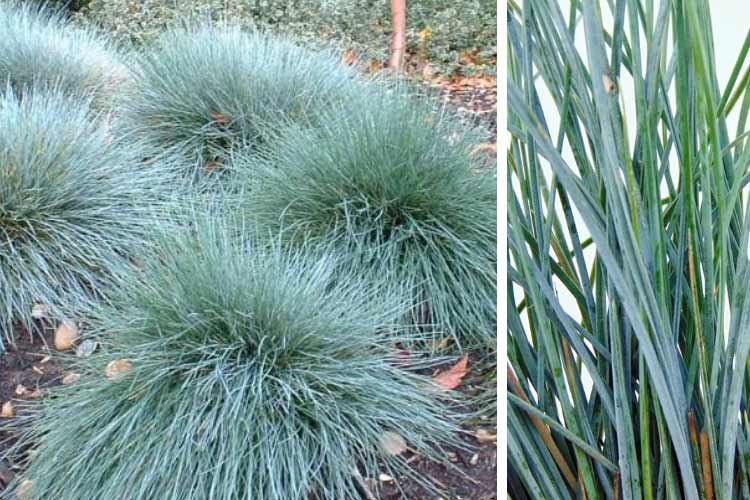
Blue Fescue Elijah Blue - Festuca glauca
5) Hakonechloa macra All Gold
Hakonechloa macra All Gold is a very decorative Japanese grass that stands out for the graphic quality and brightness of its foliage. It forms a large cushion of arching leaves, giving it a cascading look. It is a shade- and partial-shade-loving plant that thickens slowly and can live for many years in moist soil. In the garden, save it for woodland-style settings where it will pair wonderfully with Japanese maple trees, hostas, ferns…
- Height - width: 40 cm x 50 cm
- Soil: humus-rich, cool to moist
- Exposure: shade, partial shade
- Hardiness: down to -15°C
- Pruning: unnecessary… it is a nearly self-cleaning grass; the old foliage detaches very easily as the next shoots arrive in spring.
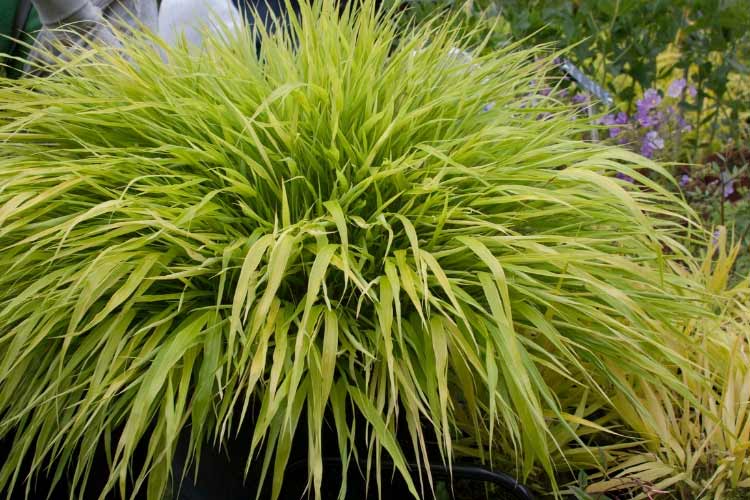
Japanese Forest Grass - Hakonechloa macra All Gold
6) Molinia arundinacea Transparent
Do you know many plants that stand out for their transparency? Here is one! Mist-like, this tall evergreen grass with arching leaves shines with the delicacy of its golden flowering and the slender stems that bear them. Preferring clayey and moist soils, this Molinia grows quickly. Architectural, graphical, it pairs with almost anything and will also benefit from the rays of a setting sun. Despite its height, the panicles form a very light cloud; you can plant it at the border of a border and pair it with plants in bright colours (Dahlia, Rudbeckia, Helianthus…) to temper the colours and bring a more natural touch.
- Height - width: 1.80 m x 60 cm
- Soil: humus-rich, cool to moist
- Exposure: shade, partial shade
- Hardiness: down to -15°C
- Pruning: cut back only the dry flowering stems in March - April
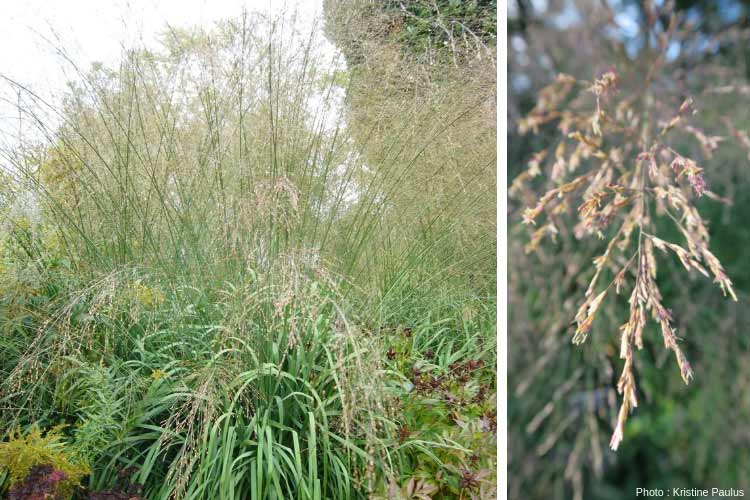
Molinia caerulea ssp arundinacea Transparent
7) Miscanthus sinensis Gracillimus
True "best-seller", highly regarded in contemporary gardens, this Miscanthus or Eulalia is also the oldest. Suffice to say, it has stood the test of time! It forms a handsome clump of very fine leaves, edged by a white central vein. Its flowering, quite late, occurs at the end of September. Then pretty plume-like inflorescences appear, coppery while the foliage turns gold.
This Miscanthus is also very versatile. It can be planted as a specimen, in a border with autumn-flowering perennials and even as a hedge. Also know that it is a plant that can be useful: its leaves, chopped, make an excellent mulch.
- Height - width: 1.80 m x 60 cm
- Soil: rich, cool, but well-drained
- Exposure: sun
- Hardiness: down to -15°C
- Pruning: cut back in March - April
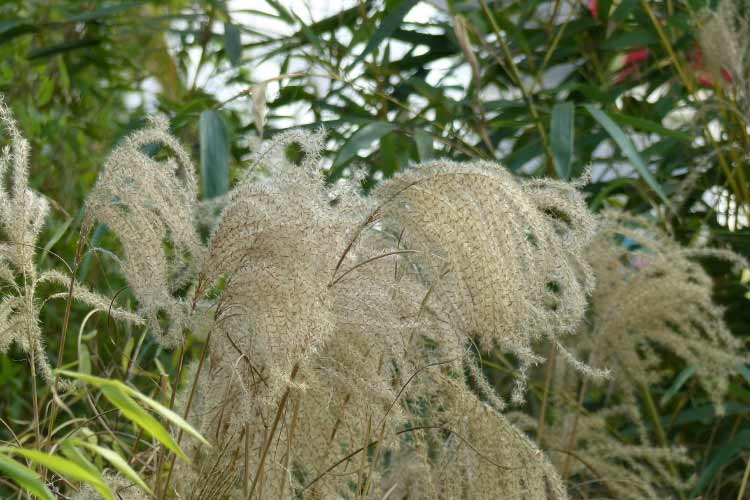
Miscanthus sinensis Gracillimus - Eulalia
8) Panicum virgatum Rehbraun
This Panicum virgatum (often called the “Switch Grass”) is an excellent variety. It stands upright and its foliage and flowers take on vibrant red and orange hues in late summer. Truly spectacular, this North American native grass also shows great tolerance. It withstands both drought and wet conditions… and boasts remarkable hardiness. In the garden, pair it with other grasses or plant it with shrubs showing autumn colours (Berberis, Euonymus fortunei 'Red Cascade'…), it will be perfect to complete the scene.
- Height - width: 1.20 m x 50 cm
- Soil: tolerant
- Exposure: sun
- Hardiness: down to -15°C
- Pruning: cut back in March - April
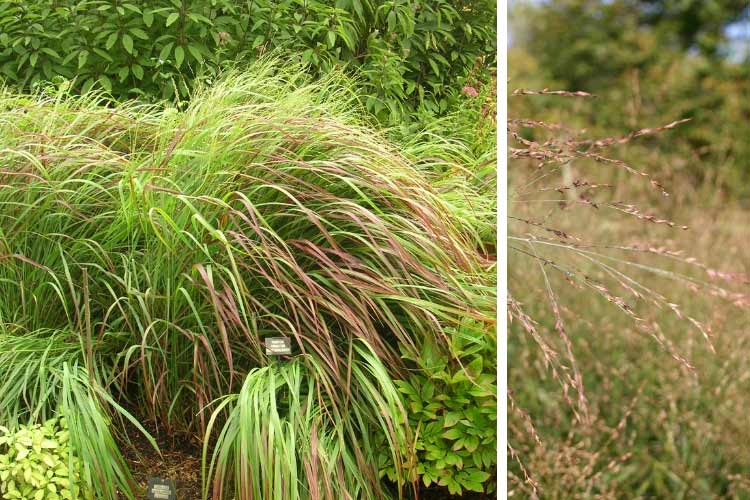
Switch Grass Panicum virgatum Rehbraun
9) Pennisetum alopecuroides Hameln
This fountain grass variety is a must-have! Medium-sized (about 50 cm tall), it forms a compact tuft of narrow leaves. It shows, in late summer and autumn, a flowering of gentle cream-white spikes turning brown at maturity. Its ornamental interest lasts into winter, especially when frost dresses its pretty seed-heads. Versatile and easy to grow, Pennisetum 'Hameln' can be used over large areas, as a ground-cover, or at the border. In a border, it is striking with perennials a little wild such as Echinacea, Gaura, or Verbena bonariensis. And like all autumn-flowering grasses, it is perfect with Asters.
- Height - width: 50 cm x 50 cm
- Soil: tolerant provided it is well-drained
- Exposure: sun
- Hardiness: down to -15°C
- Pruning: cut back in March - April
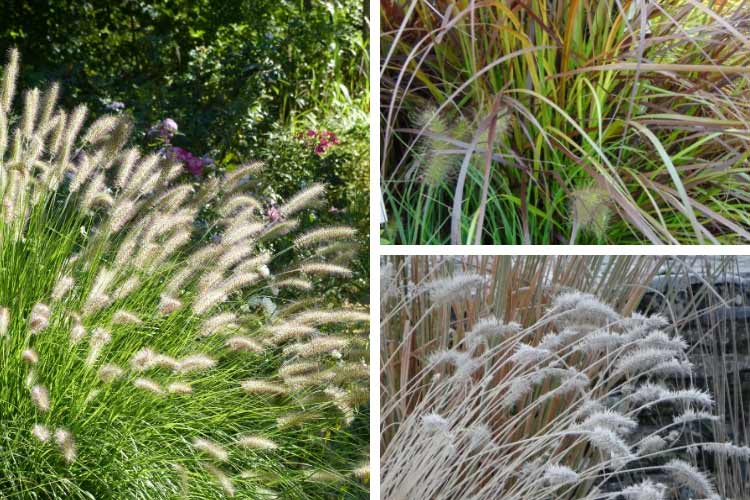
Pennisetum alopecuroides Hameln
10) Stipa gigantea
In the Stipa family, we know well the “angel hair” (Stipa tenuifolia), but much less its very tall sister: Stipa gigantea. Spectacular, this giant oat shines with its height (about 200 cm) and the lightness of its flowering. It forms a dense tuft of very fine blue-green leaves topped in summer by delicate purple-silver awns that turn gold. Native to the Mediterranean basin, this grass grows well almost anywhere and fears only two things: waterlogged soils in winter and climates too harsh. In the garden, it is ideal for introducing verticality and pairs very well with summer perennials such as Echinops, Gaura, or Verbena bonariensis, and with shrubs that colour beautifully in autumn (Berberis, Euonymus fortunei 'Red Cascade'…), it will be perfect to complete the scene.
- Height - width: 2 m x 1 m
- Soil: tolerant provided it is well-drained
- Exposure: sun
- Hardiness: down to -10°C
- Pruning: cut back only the dry flowering stems in March - April
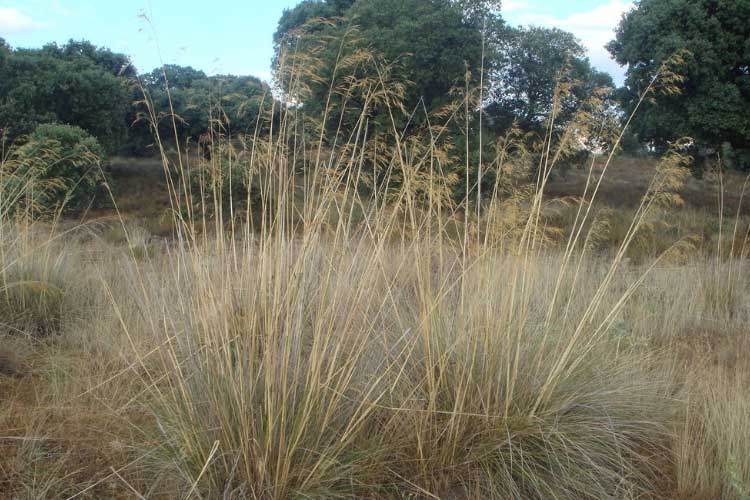
Stipa gigantea - Giant Stipa
→ Watch Stipa gigantea in our video 'Grasses for Summer'
If this shortlist has made you want to learn more about grasses, don’t hesitate to explore the different guides and tips we have dedicated to them on Promesse de fleurs, in the garden!
Ornamental grasses have, for a few years now, their moment in the sun. And it is well deserved! Natural, airy, these wind-born beauties, look good for at least nine months out of twelve, often presenting a very different appearance as the seasons change. They are now essential in many gardens, and the horticulturists know this […]
Only those who have had the pleasure of living in a house with a garden for the first time can understand the immense joy felt when walking on "their" lawn... Wow! This pleasure is soon accompanied, after a week, by a worried furrowed brow (usually just one), as the grass in question grows at lightning speed and one must find a way to trim it, a mower... And when it comes to choosing a mower, faced with the dozens and dozens of brands and models available on the shelves, it must be acknowledged that the novice gardener is not having an easy time.
So, to enlighten you, we asked a professional who is also a gardener: Philippe Asseray, author, journalist, and gardening expert for the brand Honda.

What criteria should be considered when choosing a mower?
So, THE criterion to consider when choosing is the seller! Not their dazzling smile or Rambo-like muscles, but the geographical proximity of their shop and workshop. Common sense dictates that one should go to a specialist in garden machinery. There is a good chance that their expertise in mowers is broader than that of a supermarket seller. Plus, in case of an issue with your machine, they might be able to come to your home and even lend you a mower while yours is being repaired...
Petrol mower or electric mower?
A petrol mower operates with a petrol engine, while an electric mower obviously runs on an electric motor, powered by household electricity via a cumbersome extension lead (the famous extension), or by a built-in battery.
The petrol mower is ideal for large areas (over 1000 m2) or gardens with many trees and flower beds to navigate around. No issues with autonomy, just refill and off you go, and no risk of getting tangled up in the extension lead, or even cutting it. However, it is a heavy machine that requires handling hydrocarbons, is noisier, and starting it by pulling a starter cord can deter some (even though it has greatly improved over the past decade).
Equally effective, the electric mower is lighter, quieter (ideal for maintaining good neighbourly relations), and starts with no effort at the push of a button (two, in fact, for safety!). However, its range is limited by the length of the extension lead or the battery life. It is therefore more suited to modestly sized lawns.
Discover the Selectos selection: A comparison of the best electric lawn mowers.
Push mower, self-propelled... What's the difference?
Very common in the mower world, these two terms are often misused...
A push mower is actually a "push" machine. This means that its engine drives the rotation of the blade, period. You have to push the machine to make it move. This is not a problem with an electric mower, but it quickly becomes so with a heavy mower, especially if the terrain is sloped or uneven.
A self-propelled mower, on the other hand, is a machine whose engine drives not only the rotation of the blade but also two of the wheels of the device, like most cars. You do not have to push the mower, as a handle control activates the forward motion. It goes without saying that these mowers are much easier to use, especially if they have a variable speed control to adjust the speed based on the shape or layout of the garden... And thus the term is often misused, as it is usually the rear wheels that are driven. It would be more accurate to say self-propelled...
Is cutting width important?
Yes and no... The smallest mowers work with a cutting width of 28 to 30 cm, while the largest have a cutting width of 53 to 56 cm. Besides the fact that you need to choose a mower that can fit and navigate throughout your garden, you should know that, for the same area, you will spend much less time mowing with a wide mower than with a tiny machine. But nothing prevents you from mowing a lawn the size of a football pitch (Go Blues!) with a very small mower, even if it means spending your weekends doing so, just as nothing prevents you from mowing a small garden with a large self-propelled mower, even if it means spending a lot of time manoeuvring... A matter of compromise that depends on the individual.

Collection, ejection, mulching?
Once the grass is cut, mowers offer several ways to handle it:
- collecting it in a bag or basket at the back of the mower (ideal for those who, like me, practice the art of home composting with green waste);
- ejecting it to the back or side (great for mowing quickly without worrying about the cut grass, and therefore particularly suitable for areas treated like a meadow);
- or even shredding it on the spot according to the principle of mulching (no waste to manage and no unsightly clumps on the lawn).
Some mowers only offer one of these options. This inevitably limits their use. I cannot recommend enough those that offer all three, or at least collection and mulching. Models that allow switching from one mode to another with a simple lever are my preference, as there is no obturator to find and set up. Versatility guaranteed!
What are the main innovations in mowers?
Robots are invading our gardens! Not those from Star Wars, but rather those strange devices that, like flies on a window, move randomly across a lawn as flat as a carpet. I am, of course, referring to robotic mowers. Not really an innovation, as I was trying out the first models in the 1990s, but it must be acknowledged that these mowers are becoming increasingly popular. They are certainly not cheap, like robot vacuums for the home, but with the advantage that there is nothing to empty on the mower...
Grin is an Italian mower brand that offers another innovation in conventional machines: a specific deck and blade that shred the grass and eject it onto the ground... Mulching then? Not at all, as with Grin mowers, it is not necessary to mow often to only cut a small part of the grass blades. You can mow once a week like with your usual mower... and even on wet grass. So, you are not obliged to mow more frequently...

What precautions for a hassle-free mower?
Regardless of the mower used, and whatever method of handling the cut grass is chosen, it is essential to clean the deck of your machine after each use (brushing and/or water jet) to remove all the debris stuck to it, which can disrupt the grass ejection and even completely block the ejection port (this is referred to as clogging). If using a collection bag or basket, it is important to clean the vents well, as this is the sine qua non condition for optimal filling.
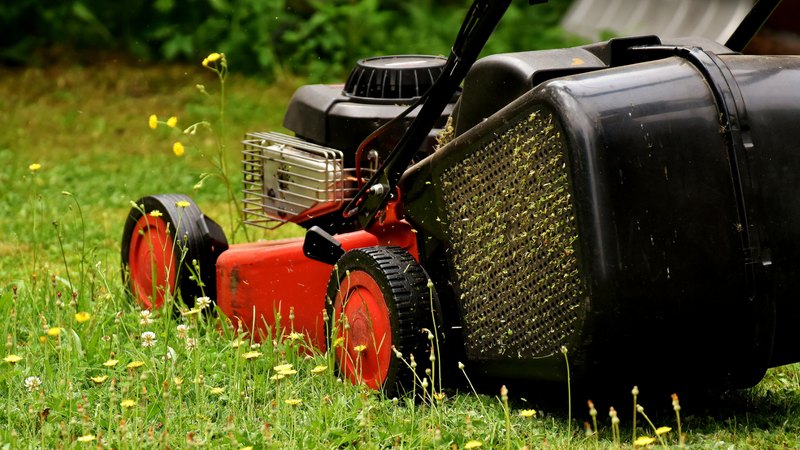
Also, discover our other articles:
Only those who have had the pleasure of living in a house with a garden for the first time can understand the immense joy felt when walking on “their” lawn… Wow! This pleasure is soon accompanied, after a week, by a worried furrowed brow (usually just one), as the grass in question grows at lightning […]
The exotic-style garden is attracting an increasing number of gardeners. Bamboo, palm trees, and banana plants are among the most popular plants for creating scenes that evoke the tropical jungle, but there are many others! To make this dream accessible and sustainable, both outdoors and even in cold climates, there is only one option: to choose truly hardy plants that can withstand winter's harshness. Here is a small selection of our favourite plants (bushes and perennials)!
1) Trachycarpus fortunei, known as "Hemp Palm" - Hardiness: -18 °C
No, palm trees are not just on the Croisette… they can also be found in northern France, for example, with the Trachycarpus fortunei, which can withstand temperatures down to -18 °C. This ability to face the cold comes from its mountainous origins (China and Japan) as well as the thick fibre that protects its trunk. It can reach heights of 8 to 10 metres and prefers rich, light soil, thriving in full sun or partial shade.
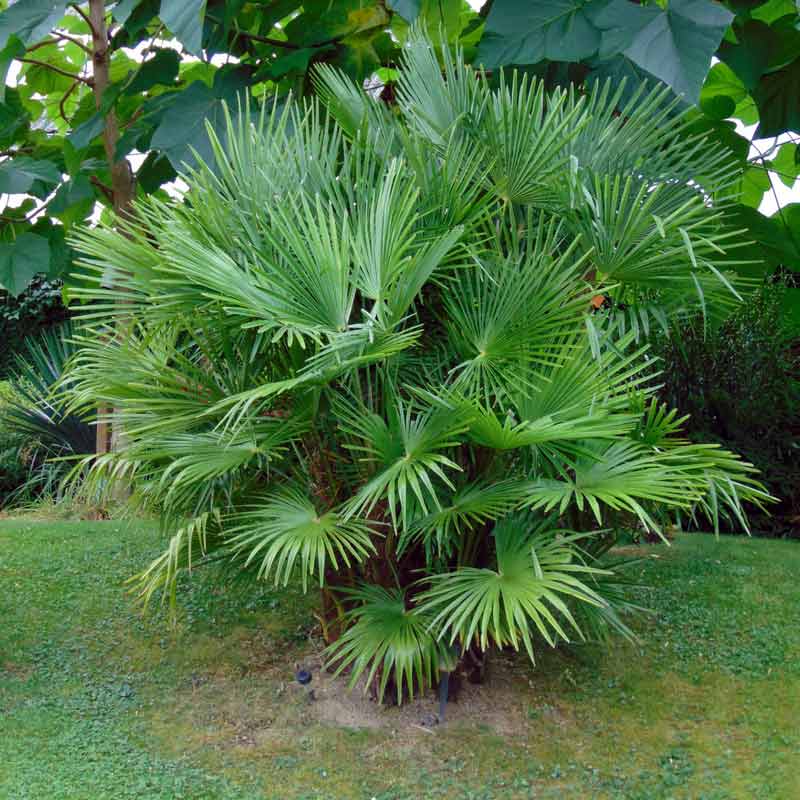
2) The Banana plant or Musa basjoo - Hardiness: -12 °C to -15 °C
The Musa basjoo is an outdoor banana plant, hardy, also known as the "Japanese Banana". It is a valiant plant that generally does not produce fruit but displays its large decorative leaves each year. It can grow over 2 metres tall, and even more if you ensure it receives what it needs: regular watering and rich soil. Its only weakness lies in poor wind resistance. If you don’t want its leaves to be turned into sad little brooms, it is essential to protect it by planting it in a sheltered area or a walled space.
Slightly less hardy but still quite resilient, also discover the Sikkim banana (or Sikkim Banana) Red Tiger, a variety with graphic leaves, light green with a purple underside, elegantly striped with burgundy.
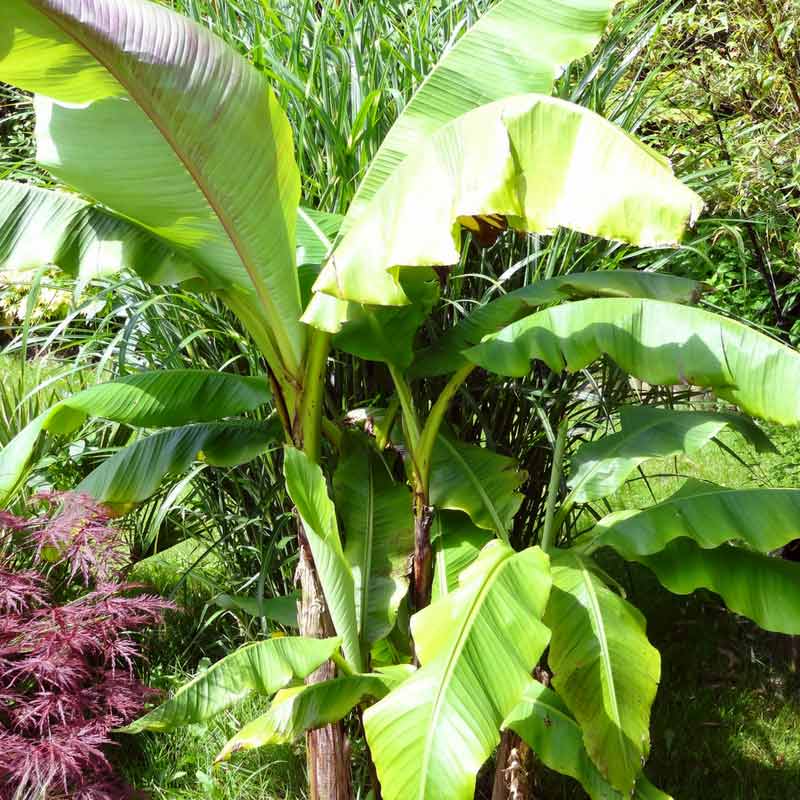
3) Bamboos: Phyllostachys vivax and Fargesia robusta - Hardiness: -20 °C and -15 °C
Bamboos are among the classics of exotic gardens, but their hardiness varies greatly depending on the species and varieties. Among the most spectacular, we particularly like the Phyllostachys vivax 'Huangwenzhu', a giant bamboo (running… plan for a rhizome barrier) that can grow its green canes striped with yellow to over 10 metres tall. Fast-growing, it will quickly form a small forest. Relatively smaller in size (4 to 5 metres tall) and non-running, the Fargesia robusta is better suited for small gardens. It features long green leaves and bright green culms.
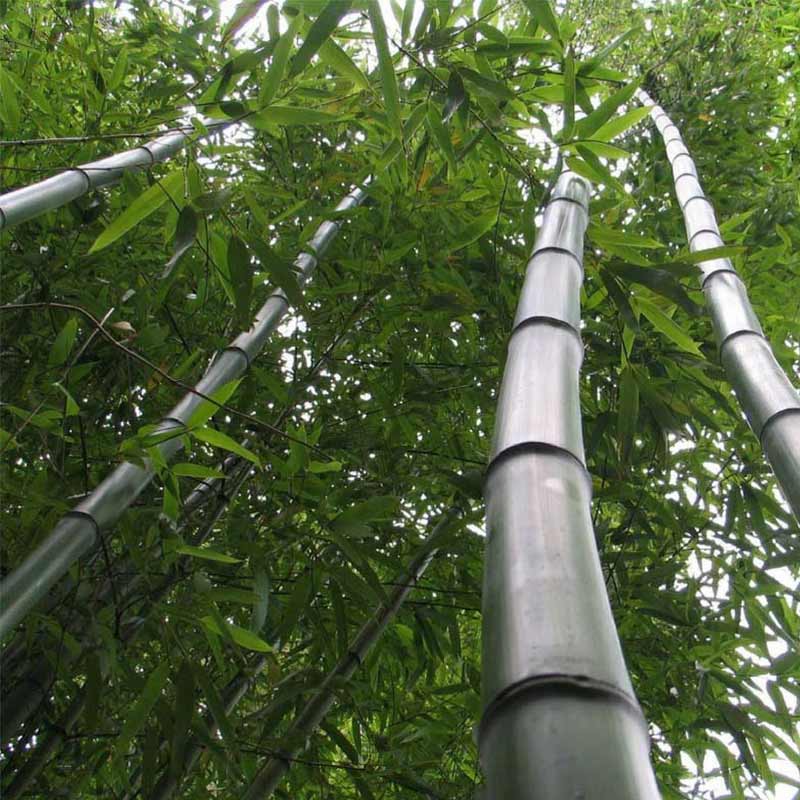
4) Fatsia japonica Spider's Web - Hardiness: -15 °C
The Fatsia japonica 'Spider's Web' is a shrub with a unique personality! About 2 metres tall, this Aralia showcases dark green, evergreen foliage splashed with cream-white. Its palmate leaves can reach up to 20 cm in diameter. In summer, they are topped with round white flowers that later turn into decorative black berries. This shrub thrives in shade or partial shade, in cool soil.
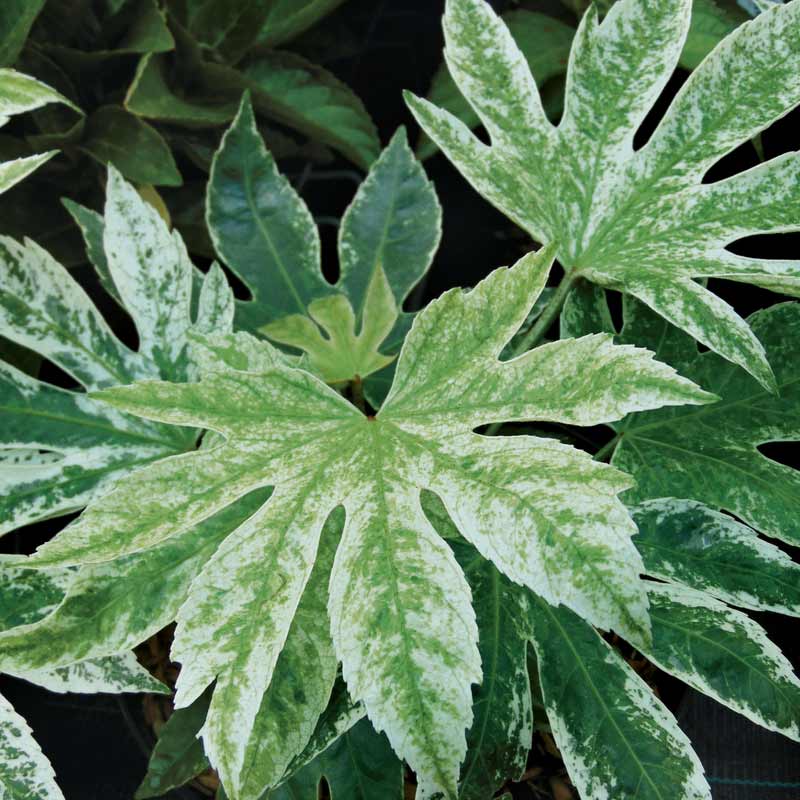
5) Tetrapanax papyrifera Rex, Rice Paper Plant - Hardiness: -10 °C
Halfway between a shrub and a perennial, Tetrapanax papyrifera 'Rex' is an exuberant plant that captivates with the XXL size and cut shape of its leaves that spread out like a parasol. Native to China and Japan, it is a rhizomatous plant, like bamboo, that tends to spread and may require a rhizome barrier. It grows in non-burning sun or partial shade, in fertile and rather cool soil. Its loose habit and Asian charm make this plant a perfect complement to bamboos.
Note that the aerial parts of this plant are destroyed at -5 °C, but it will regrow from the rootstock above -10 °C, once well established.
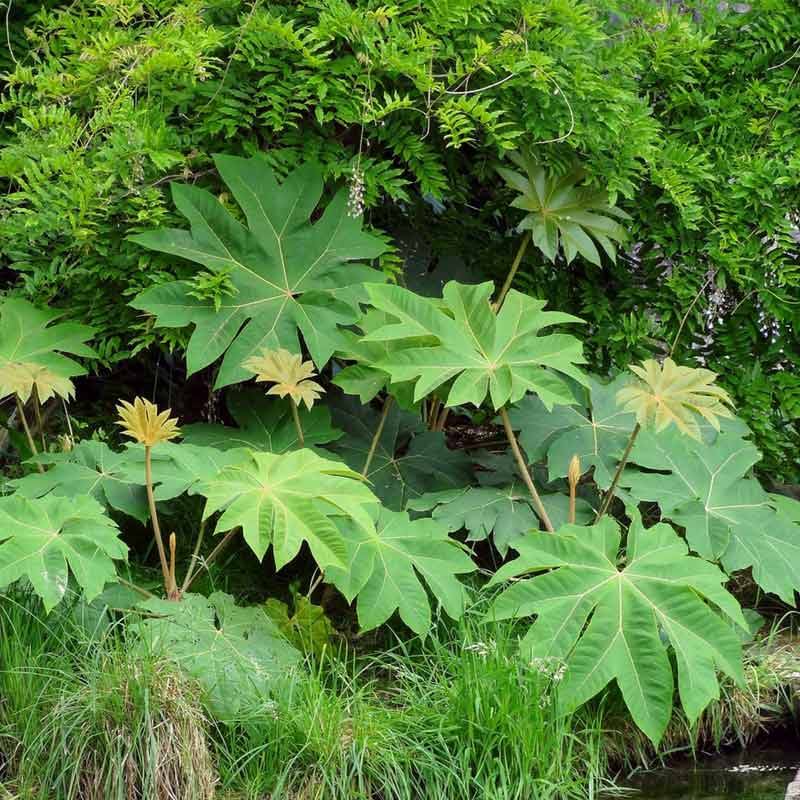
6) Colocasia Pink China - Elephant Ear - Hardiness: -10 °C to -12 °C
Lush, the Colocasia 'Pink China' stands out for the heart-shaped form and the colour of its large foliage: a lovely soft blue-green that contrasts with the pink of its petioles. Well known to houseplant enthusiasts, this colocasia can be grown in the garden, provided you mulch it to protect it during winter. It is planted in full sun or partial shade, in cool, humus-rich soil, and appreciates regular watering in summer.
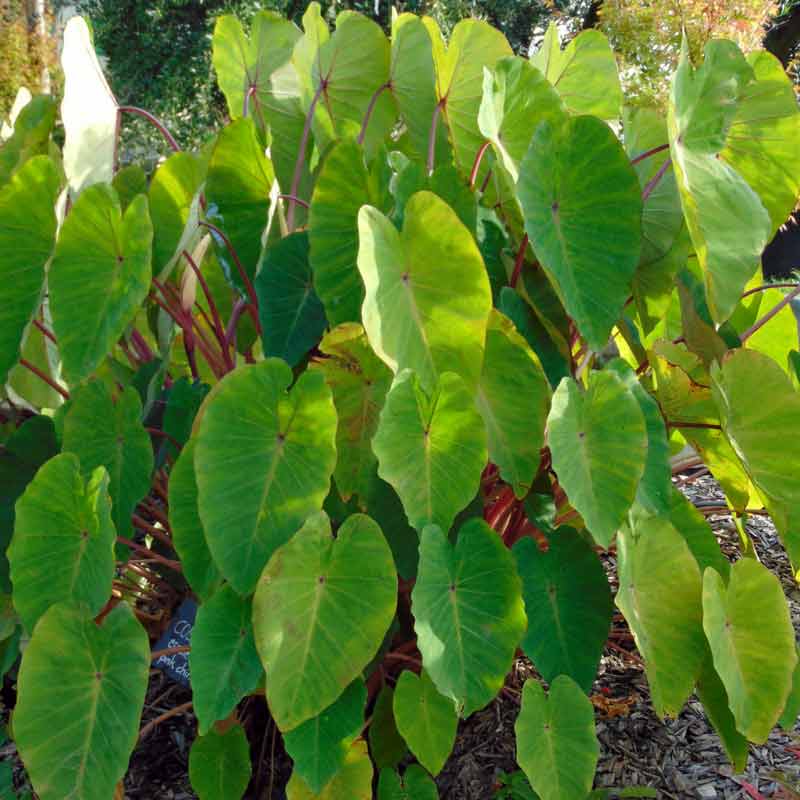
7) Astilboides tabularis - Hardiness: -20 °C
The Astilboides tabularis (sometimes called Rodgersia tabularis) is a spectacular woodland plant that stands out for its large, entire, rounded leaves, about 60 cm in diameter. It quickly forms a clump that can reach 1 metre high and 70 cm wide, or even more if the soil suits it. Its generous foliage is accompanied, in early summer, by light, creamy-white spikes of flowers. It is an ideal perennial for shade, thriving in rich, cool, but well-drained soils.
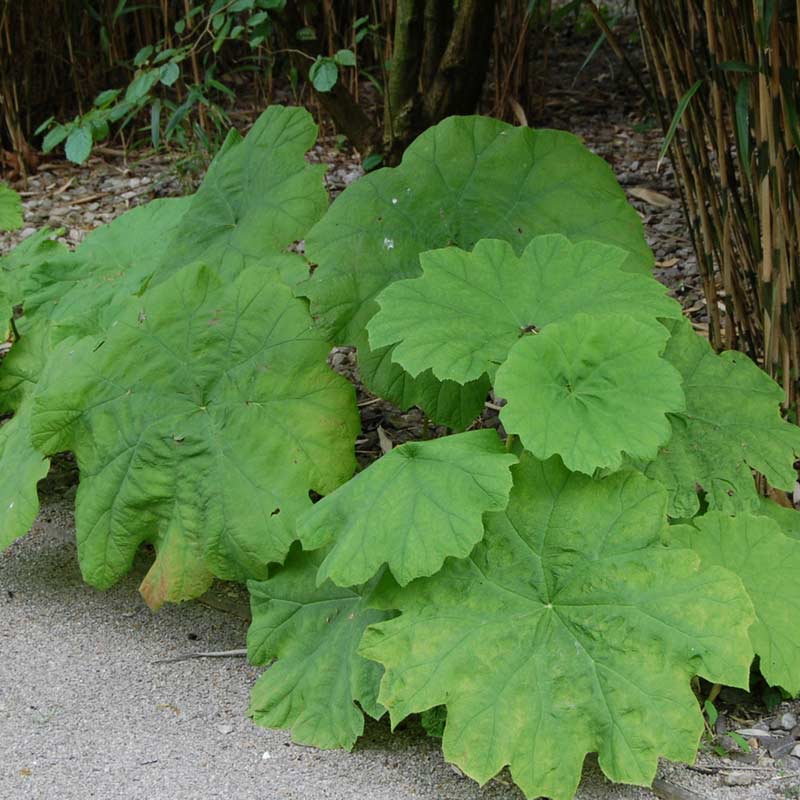
8) Dryopteris wallichiana, Large golden-scaled fern - Hardiness: -15 °C
Majestic, Dryopteris wallichiana is a large fern that unfurls a remarkable cut foliage highlighted by a black vein in spring. Of tall stature (1 to 1.5 metres high) and beautiful appearance, it somewhat resembles tree ferns, especially as its short basal trunk develops with age. It is a variety that is quite easy to cultivate, thriving in deep, very rich humus soil. It will look stunning in a border and can be accompanied by another hardy fern: the Eastern Ostrich Fern (Matteuccia orientalis).
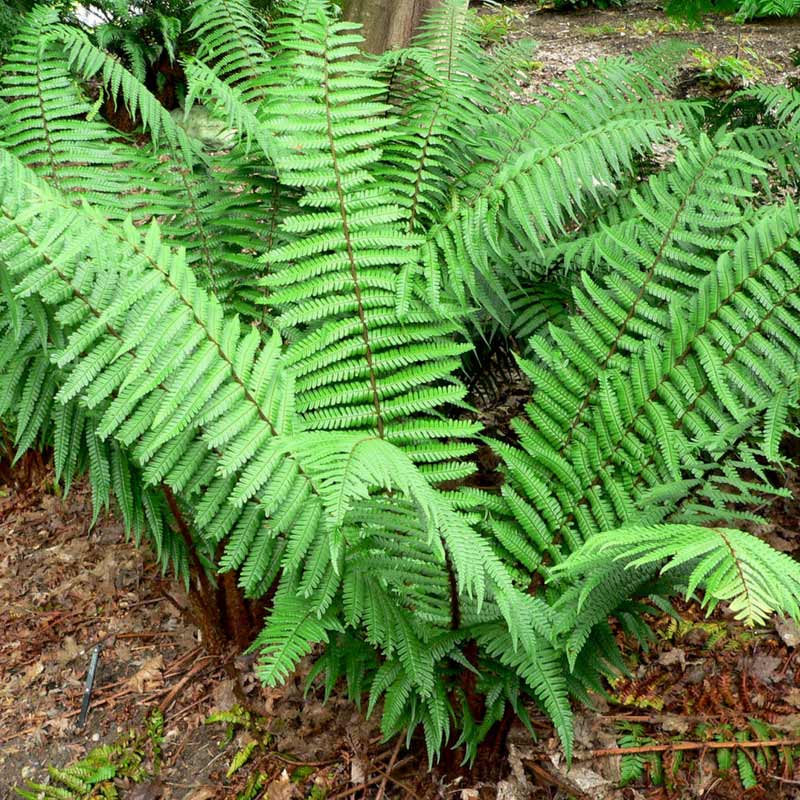
9) Hosta Empress Wu
Hostas are well known for their hardiness and ability to grow in shade or partial shade. While some fit easily into classic borders, others offer such abundant foliage that they easily find their place in a tropical-looking garden. This is the case for the giant Hosta 'Empress Wu', certainly the largest variety that can reach 1.3 metres in all directions in just a few years and displays magnificent blue-green foliage. It is a perennial that requires nourishment and water to express its full potential.
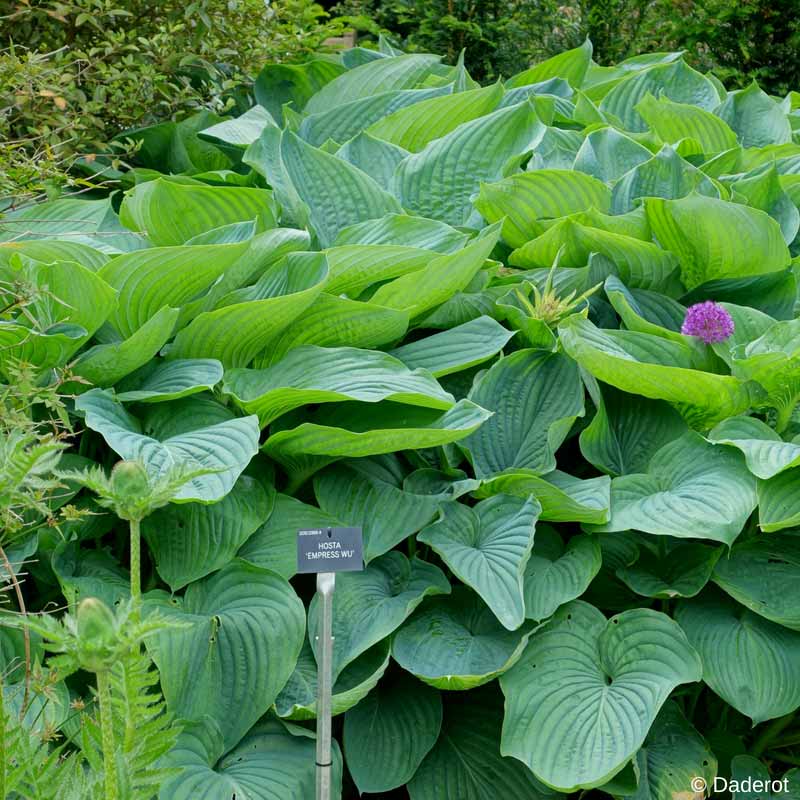
10) Begonia grandis evansiana - Hardiness: -15 °C
Begonias are not just for window boxes: Begonia grandis evansiana, a botanical species, perennial and resistant down to -18 °C here is proof! Its heart-shaped green foliage forms a beautiful bushy clump about 80 cm high and 50 cm wide, adorned throughout the summer with numerous small pink flowers borne on reddish stems. It can be grown in the ground or in pots, ideally in partial shade and in rich, cool soil.
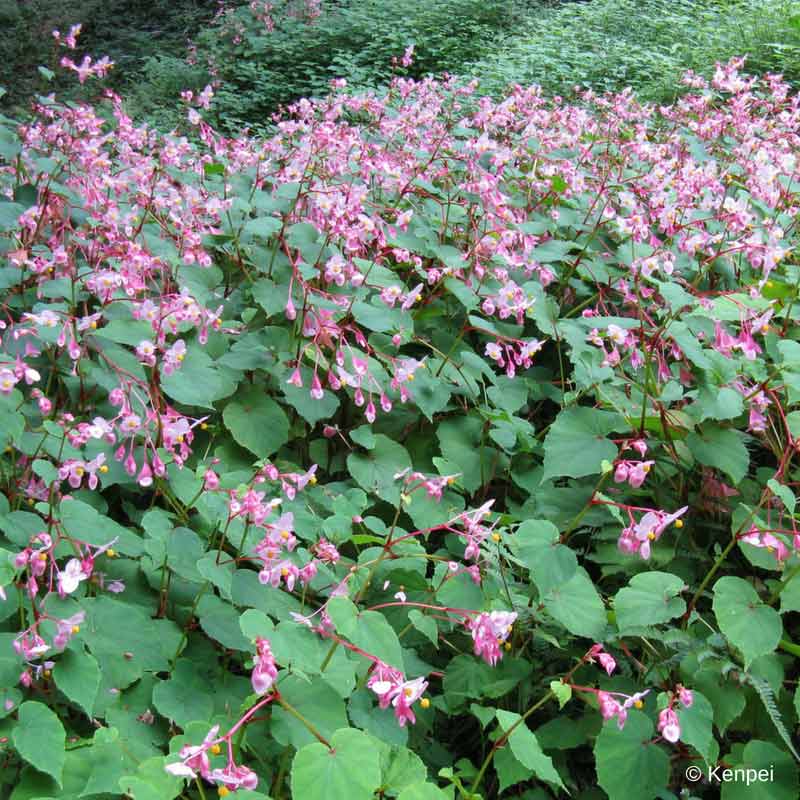
The exotic-style garden is attracting an increasing number of gardeners. Bamboo, palm trees, and banana plants are among the most popular plants for creating scenes that evoke the tropical jungle, but there are many others! To make this dream accessible and sustainable, both outdoors and even in cold climates, there is only one option: to […]
Large conifers are essential trees for structuring and balancing a garden in both winter and summer. Their rapid or slow growth, their evergreen or deciduous needles, their decorative cones, and their varied silhouettes are all ornamental criteria that affirm the character of a garden and give it its visual identity. Conifers "sign" the landscapes, highlight the architecture of buildings, and set the tone for a contemporary, Japanese, or more classic garden.
To clarify things a bit and to give you some ideas at the start of this year, I present my 5 favourite large conifers. Choose according to your style, your space, and let your desires guide you.
1) Atlas Blue Cedar (Cedrus libani ssp. atlantica ‘Glauca’), for a classic, "French-style" garden
Among large conifers, the Blue Cedar is surely one of the most commonly planted species in our gardens. Quite hardy, easy to cultivate, and low-maintenance, this large conifer with a very spreading habit creates a breathtaking spectacle on its own. Almost as tall as it is wide (about 15-20 m high and 10-15 m wide), the Atlas Cedar has a pyramidal shape that broadens over time to become tabular. Its lateral branches, adorned with bluish needles that blend with the sky, form a harmonious fan-shaped silhouette that is easily identifiable from afar.
Thanks to this remarkable landscape structure, it is easy to understand why this conifer is often planted in isolation, usually standing proudly in the middle of a large lawn, thus enhancing the surrounding landscape or the architecture of a home. A minimum garden area of 2000 m² is required to appreciate the spreading silhouette of this tree. And there’s no need to plant other trees nearby; its presence is so imposing that it constitutes a strong focal point in the garden. Allow a planting distance of at least 20 m from a house or another tree. Slow-growing in its juvenile stage (a bit faster as an adult), this conifer only forms its definitive silhouette after several decades, so patience is required!
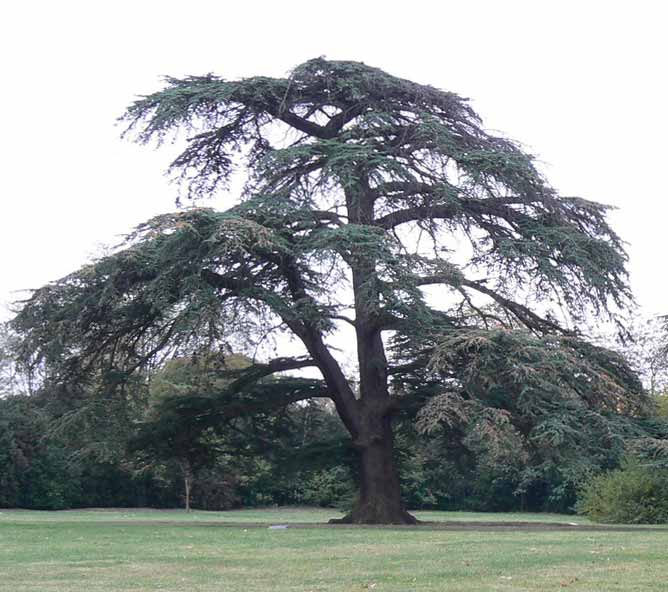
An old specimen of Atlas Blue Cedar in the middle of a large park. If the lower branches are not pruned, the tree branches more easily and offers this striking tabular shape.
NB: Despite its species name "libani," this Cedar does not originate from Lebanon but from Morocco, where it thrives in the Atlas Mountains. The Atlas Cedar is a geographically isolated subspecies of the Cedar of Lebanon that has evolved independently from its original species.
2) Chinese Sequoia (Metasequoia glyptostroboides), for a natural, fresh, and humid garden
Despite its evocative name, this conifer is not a giant, unlike its American cousins Sequoiadendron giganteum and Sequoia sempervirens. The first thing you notice about this conifer is its trunk. Channelled, deeply fissured, and sometimes swollen, it looks like it came straight out of a fantasy tale. Also very decorative, its light foliage, a lovely fresh apple green, turns tawny in autumn. Like the larch, Metasequoia is a deciduous conifer. There’s no need to collect its leaves: its fine needles decompose very quickly and make excellent compost.
Native to China, this pyramidal conifer reaches heights of 25 to 35 m in our gardens. This may still seem quite tall, but this conifer has the advantage of adapting to its environment. It is only when planted in isolation that it can reach a spread of about 10 m, but as soon as it grows near other trees, its shape narrows and its trunk elongates to grow taller. Thus, it can easily be integrated into a large border without occupying too much ground space. It thrives in acidic, fresh, even humid, and rich soils. It is under these conditions that its growth is rapid, growing 50 cm to over a metre per year.
On the left, the Metasequoia with its light branches. On the right, the trunk.
NB: Do not confuse Metasequoia with Taxodium. Growing in wet areas, with a similar trunk appearance and deciduous foliage, these two conifers are very similar in appearance. How to distinguish them? The Metasequoia has opposite foliage (alternate on the Taxodium) and does not produce pneumatophores.
On the left, a branch of Metasequoia; on the right, a branch of Taxodium.
3) Scots Pine (Pinus sylvestris), for a contemporary garden with a southern accent
This is the common pine that grows in many European forests. Close to the Landes Pine (Pinus pinaster), with which it shares the same broad and often twisted silhouette when mature, the Scots Pine prefers the cold and is better suited to northern regions than its southern cousin.
While its silhouette is initially pyramidal, it gradually changes shape as it ages, broadening to form this parasol-like shape that is so striking in our northern gardens, casting a light shade. Unlike most conifers, the branches of the Scots Pine allow light (and rainwater) to pass through, and its roots descend deeply into the soil, keeping the ground cool at its base. To the question "can plants be planted at its base?", the answer is yes! Many ericaceous plants (Camellias, Rhododendrons, Pieris…) can thrive near this pine.
Its growth is initially slow (while it establishes its root system) but accelerates after a few years. It can thus grow by 1 metre per year and easily reach between 6 and 8 metres high in just 10 years! Plant it in poor, well-drained, and deep soil, and you will have an elegant conifer with an original silhouette.
Depending on the training size, exposure, and climate, the Scots Pine will have a different appearance. On the left, exposed to the sun and without training, the very broad branches offer a parasol shape that is so striking (Source: Jim Champion - flickr). On the right, at the edge of a tree, the trunk of this pine, cleared of its branches, offers a more upright shape (Source: Jean Yves Bernoux, ChampYves).[/caption>
4) Giant Sequoia (Sequoiadendron giganteum) for an exotic garden with primitive accents
As its name suggests, the giant sequoia is an imposing tree. Admittedly, its brother Sequoia sempervirens, with a record height of 115 m, easily surpasses it, but with a maximum height of 85 m and a trunk circumference of almost 30 m, the Sequoiadendron holds its own. While it averages 50 m high in our gardens, this conifer primarily grows in height and does not hinder the growth of other plants. Its initially pyramidal to conical silhouette becomes more upright over time. Its trunk, covered in a magnificent thick reddish fibrous bark, widens and becomes bare as it ages, leaving a tuft of branches at the top that provides a light shade.
A true focal point in the garden, the Giant Sequoia should be planted in a strategic location. Allow a planting distance of at least 50 m from a house to have the necessary space to appreciate its monumental structure. With a rapid growth rate, ranging from 50 cm to 1 metre in height annually, this conifer becomes imposing in the garden in no time. In just 10 years, it reaches 10 m high and 30 to 40 m high after 50 years! It is also the conifer with the greatest longevity, as it can live for over 3000 years in its native California. It is a conifer that transcends time and is passed down from generation to generation.
 This young specimen on the left is only a few years old. On the right, an adult specimen aged several centuries growing in a forest in the Sierra Nevada (Source: Wikipedia).[/caption>
5) Maidenhair Tree (Ginkgo biloba) for a colourful Asian garden
Among large conifers, the Ginkgo, with its 25-30 m height, is undoubtedly not the most imposing in the garden, but it is certainly not the least spectacular! Its graphic, highly decorative foliage is instantly recognisable thanks to its fan shape. Apple green in spring, the foliage turns entirely golden yellow in autumn before falling, revealing the tree's full ornamental potential.
Erect in its youth, its spread increases with age, and it can extend to over 9 m in diameter if planted in isolation. When associated with other trees or planted in partial shade within a large border, its width will be more modest, and the tree will tend to maintain its upright shape. Easy to cultivate, it requires deep and rather cool soil. Like the giant sequoia, its remarkable longevity allows it to exceed 1000 years.
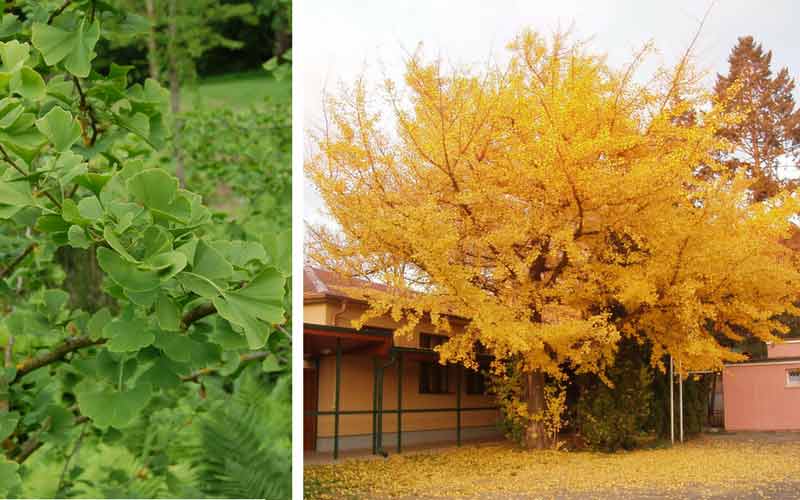 On the left, the characteristic foliage of the Ginkgo. On the right, the tree reveals its golden yellow attire in autumn (Source: Wikipedia).
NB: Like conifers, Ginkgo is classified within the gymnosperms. While genetically it is close to them, taxonomically it is distanced. This is why botanists have classified it in a neighbouring order: the Ginkgoales.
Large conifers are essential trees for structuring and balancing a garden in both winter and summer. Their rapid or slow growth, their evergreen or deciduous needles, their decorative cones, and their varied silhouettes are all ornamental criteria that affirm the character of a garden and give it its visual identity. Conifers “sign” the landscapes, highlight […]
Tulips are, among the spring flowering bulbs, the easiest to succeed with: well-sized, standardized bulbs that are almost always homogeneous in quality; they are the easy bulbs par excellence; and yet, it is just as easy, with a little attention, to fail at planting them.
Follow our meticulously established guide, based on the author's extensive first-hand experience with various failures, and also, let’s thank them in passing, the help of many inventive clients who, by phone or email, have vigorously explained their little secrets leading to failure.
Lesson number 1: to fail with your tulips, plant them in late spring or summer
Living in Flanders, I regularly spend weekends (cultural) in Amsterdam, and I have always been amazed to see, in May-June, a plethora of tulip bulbs for sale at the Amsterdam flower market… For a long time, I wondered what that could yield. So I eventually tried planting Dutch tulips in late spring, among other local crops.
The result was quite pitiful: a third of the bulbs did not start, the rest bloomed roughly at the same time as my dahlias, and most of my bulbs did not survive the following winter.
Grandma and popular wisdom say: "tulips should be planted in autumn, preferably in September or October."

Tulips should be planted in autumn!
Series of tests conducted at the nursery nuance this result: tulip bulbs establish better if planted in autumn; results are respectable for winter planting, but become frankly random from March-April onwards.
So, to fail with your tulips, plant them whenever you think of it, in April-May when they are blooming at your neighbour's and it makes you green with envy. The result will be, at best, mediocre.
Proposed variant for distracted and lazy gardeners: buy them in autumn, forget them in the garage for a year and plant them the following autumn, guaranteed failure at 95%! We often advise clients who call us in January after finding a packet of bulbs wickedly hidden by the cleaner at the back of the shed to plant immediately: flowering will be slightly delayed, but quite acceptable.
Lesson number 2: to fail with your tulips, sort your bulbs very ri-gou-rous-ly (and throw them all away)… or don’t sort them at all!
While the first lesson was suited to lazy, procrastinating Latin gardeners like me, the second is aimed at neat freaks, preferably with a background from across the Rhine.
Cultivated tulip bulbs are mechanically harvested by machines with sorts of harrows. It’s not extraordinarily poetic, but effective (and it’s what allows you not to pay ten euros per bulb).

Mechanical harvesting of tulip bulbs
In the process, many bulbs lose their little protective copper-coloured skin (of no importance), and some end up slightly scraped, sometimes superficially nicked, without any detrimental consequence on the bulb's recovery.
On the other hand, mould is a very serious enemy of the tulip bulb: during autumn, bulbs, especially if stored in humid conditions, tend to develop a layer of mould. If this damage is superficial, a quick wipe will remove it, and recovery will be perfect. However, if this mould reaches the inside of the bulb (signal: the mould doesn’t come off with a quick wipe), particularly at the root plate, the bulb has no chance of recovery. Worse: the mould may spread to other nearby tulip bulbs. This is why we manually sort all our tulip bulbs during packaging; also the reason why it is advised to plant tulips in September or October: bulbs are, at that time, practically free from mould attacks.
So, to fail with your tulips, throw away all the bulbs for non-compliance before planting… Or conversely, leave a packet of bulbs lying around in a humid place, and, with a bit of luck, the bulbs will mould within a few weeks.
Lesson number 3: to fail with your tulips, plant them in an unsuitable place: deep shade, marsh, extremely heavy soil, or rocky areas where nothing grows
The tulip, true to its Ottoman origins, loves sun and fairly well-drained soils, which do not retain too much water, but are relatively rich, to allow the bulb to replenish its reserves after flowering.
It blooms on the reserves accumulated by the bulb, even if the growing conditions are poor, so it is difficult to fail the first year. However, if the conditions are sufficiently bad, the bulb will not be able to properly replenish its reserves after flowering: thus, by the second year, the flowers will be weak or absent.
If the bulb is planted in complete shade (less than two hours of sun per day), the flowers will be weak.
If the bulb is planted in very heavy and wet soil, some bulbs may rot from the first year, the rest in subsequent years.
If the tulip is planted in excessively dry soil in spring, the tulips will be stunted, with early yellowing of the foliage, and will not return.
Note: there’s no need to try to fail your tulips by planting them in very acidic or calcareous soil: tulip bulbs tolerate all pH levels, you will not fail them with this classic method.
For technical enthusiasts, it is interesting to note that not all tulips have the same resistance to difficult conditions.
The botanical tulips (small tulips that maintain a distant relationship with their natural ancestors) are ultra-tough. They last for many years even in shaded heavy soil. They naturalise as soon as conditions are suitable. Very difficult to fail, a challenge!
The old horticultural tulips (e.g.: Lily-flowering, Triumph) are quite sturdy. They last about 3 years in poor growing conditions, 7 to 10 years in good growing conditions. Difficult to fail.
The double tulips (peony-flowered tulips) are generally fragile, lasting 2 to 5 years depending on growing conditions. Quite easy to fail.
In summary, to fail your tulip plantings:
- If you live in the northern half of France: plant recent double-flowered varieties in heavy, wet soil in a very shaded position. And if the winter is dry, water abundantly to ensure failure.
- If you live in the south: plant the same varieties in poor, stony soil, without any watering, and cross your fingers for a very dry spring, a guarantee of failure.
Lesson number 4: to fail with your tulips, plant them upside down, or too deep, or not deep enough
Tulips have a top (the small point) and a bottom (the flat area from which the roots will emerge); if planted upside down, point down and roots up, they will struggle to emerge…. To be honest, I must admit, I have never actually tried this method. But I know it works, having dealt with a furious client about the poor quality of our bulbs. He had carefully planted his bulbs upside down…
Variants of failure:
- Maniac version: planting your bulbs too deep (result: stunted tulips… or even no tulips at all). This is a classic method that requires effort; you need to dig deep, about thirty centimetres, but it is worth it: you end up with rather ridiculous-looking tulips.
- Lazy version: planting your bulbs too shallow (bulb almost at the surface), a method that is very economical in time and effort, which is why I like it so much. However, it is more random; sometimes tulips settle in well despite everything, who knows why.
To properly plant your tulips, here’s what a good gardener would write:
- Make a hole 4 times the diameter of the bulb (about 20 cm)
- Fill a quarter of the hole (the height of one bulb) with loose soil, or even potting soil or soil mixed with coarse river sand if you have heavy soil. This effectively extends the number of years of flowering.
- Place the bulb, point up, at the bottom of the hole (about 15 cm)
Cover with soil. If you haven’t made a mistake in these complicated calculations, the bulb should be covered with twice its height of soil (a good 10 cm).
So, to fail with your tulip plantings, plant them upside down, far too deep, at least 20 cm deep, or too shallow, less than 5 cm, in uncompacted soil.
Lesson number 5: how to fail the re-flowering of tulips: early digging or mowing, famine or death by thirst
Nature is poorly made: tulips in the garden need a little attention just when you stop taking care of them, after flowering, when these sublime beauties fade and turn into unsightly stems and leaves that are more or less yellowish.
The post-flowering period, generally April-May or May-June, is when tulip bulbs replenish their reserves to be able to bloom again the following year: they need their foliage, a bit of water (especially if they are planted in pots), and appreciate some fertiliser. You can safely cut the flower stems, but a good gardener does not cut the foliage before it has completely yellowed. On the contrary, they will stimulate it, with a bit of fertiliser, and water in case of spring drought. The said good gardener also plants, in front of or among their tulips, spring-flowering perennials, like brunneras for example, which help to mask the unsightly foliage of tulips after flowering, without having to cut it prematurely.
So, you guessed it, to prevent your tulips from re-flowering properly, you need to thwart this regeneration. The simplest way is to mow immediately after flowering over your tulip bed: the bulbs will not re-flower, or very little. And if you repeat the mowing after flowering the second year, you will eliminate the last survivors.
Note: it was traditional among old gardeners to dig up tulip bulbs at the end of spring to replant them in early autumn. This custom has fallen out of favour, as it does not significantly improve their lifespan. In theory, digging and storing in trays reduces the risk of fungal disease (like fusarium); in practice, there is generally more risk related to poor storage conditions (excessive humidity, presence of rodents, etc.) than to leaving them in the ground in a properly drained garden. In short: leaving your bulbs in the ground will not significantly increase your chances of failing them.
In summary, to prevent tulips from re-flowering in the second year, mow your beds immediately after planting.
* * *
As a special bonus to reward readers who have had the patience to skim through all these many lines:
Bonus gift: how to create an ugly tulip bed?
You can succeed in growing tulips, and still easily end up with a very ugly result. It’s very easy; here are some little tricks from a specialist to help you:
- Mix a lot of non-complementary colours
It is often said that a beautiful bed plays on two colours, a maximum of 3. If you mix bulbs of 4 or 5 non-complementary colours, you will generally achieve a garish result that will remind you of your grandmother's plant mail-order catalogues (no, we won’t name names!).
- Plant several varieties side by side without mixing them
You randomly acquire the magnificent collection of tulips "Carnival of Venice" from Promesse de fleurs (our best seller for 30 years), and instead of mixing the 5 matching varieties of this collection for a harmonious result, plant each variety separately. Even better: instead of planting naturally, that is to say, a bit irregularly, make nice straight planting lines, just like in the vegetable garden. The result will be… strange!
- Plant insufficiently dense
Experienced gardeners plant tulips quite densely for a nice group effect. Without necessarily planting in large numbers, a nice effect can be achieved with 10 bulbs planted in a "potato" shape over 20 cm2, or even with 5 bulbs grouped in "clumps" in the same large planting hole, with a spacing of about ten cm between bulbs.
You read on promessedefleurs.com that you can plant a hundred tulip bulbs per m2, at least 50, and your mother-in-law boasts with her beds of 150 tulips per m2. But since you’re not easily fooled, and you know the generally dishonest mercantile spirit of Promesse de fleurs and your mother-in-law's reckless spending when it comes to anything other than your birthday gift, you scoff and plant your bulbs economically, 10 bulbs per m2; it sounds good, and it makes… one bulb every 40 cm.
Bravo!
The result will be bizarrely ugly: you will have the vision of a small forest of stems (tulip stems are always unsightly). And if you combine this with the previous advice, I promise you that neighbours and passers-by will stop in front of your garden to contemplate your bed.
I promise you this, as I still vividly remember, despite the time that has passed, a sort of gathering of giggling neighbours one day in front of the magnificent first flowering of my very first tulip bed.

Tulips are, among the spring flowering bulbs, the easiest to succeed with: well-sized, standardized bulbs that are almost always homogeneous in quality; they are the easy bulbs par excellence; and yet, it is just as easy, with a little attention, to fail at planting them. Follow our meticulously established guide, based on the author’s extensive […]
A bank is, by definition, a sloped terrain exposed to the harshness of the elements where rain and wind weaken and erode the soil. If the soil remains bare, runoff can cause significant damage: flooding, landslides, and sometimes even mudslides. Fortunately, some groundcover plants thrive in these challenging conditions and manage to stabilise banks quickly and sustainably, thus limiting erosion. Discover the 5 best essential groundcover bushes for landscaping a bank!
On a rocky bank - Lavender (Lavandula angustifolia Hidcote)
Known primarily for its medicinal and melliferous properties, lavender is an outstanding plant for stabilising AND beautifying a bank. It withstands wind, sun, and drought, and its roots penetrate rocky and calcareous soils, stabilising them sustainably. It is the perfect plant for a stony, steep bank exposed to the sun.
Plant it at the top of the slope, which corresponds to the driest part. Count at least 3 plants per m² for dense and rapid coverage. While lavender lives long, it requires annual pruning to maintain a compact and sturdy habit, so don’t forget to shear it back by a third once the flowers have faded.
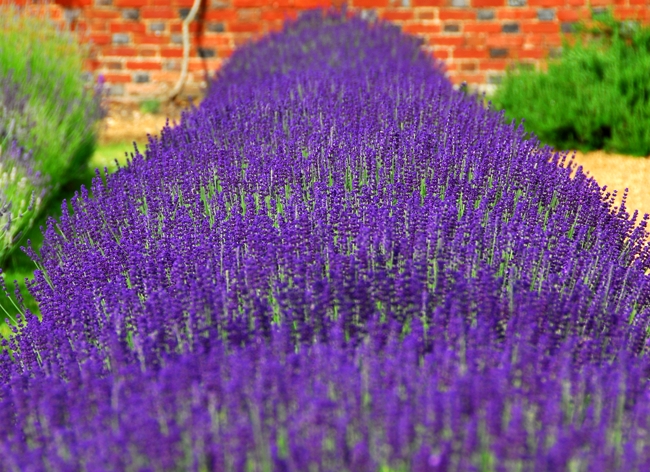 Lavender 'Hidcote Blue'
On an unmaintained bank - St. John's Wort (Hypericum calycinum)
St. John's Wort is a good soil stabiliser that tolerates all soil conditions but requires relative moisture to grow and spread quickly. You either love or hate its large golden flowers that bloom all summer, but one must acknowledge that it is one of the few groundcover bushes that spreads quickly and with great ease.
Plant it preferably at the bottom of a slope in full sun or partial shade. Count between 3 to 5 plants per m² (3 plants for 3L pots and 5 plants for young plants) for rapid coverage. By the following year after planting, its stump will form a network of stoloniferous roots and the plant will spread quickly. There’s no need to plant on a membrane; St. John's Wort covers and smothers everything in its path.
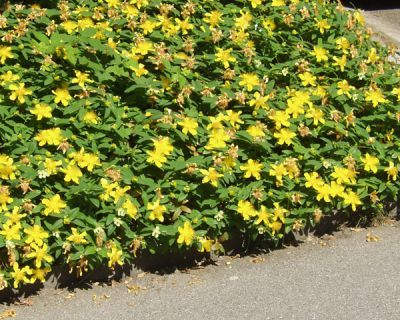 Hypericum calycinum (Source Pinterest)
On a shady bank - Bush Honeysuckle (Lonicera pileata)
Bush honeysuckles (Lonicera pileata and L. nitida) are creeping shrubs that possess a very effective root system for consolidating banks in shade and partial shade. Lonicera pileata has the advantage of growing quickly and laterally, thus hugging the ground and layering itself from time to time. It resists cold and drought as long as it is planted in partial shade.
Plant it from the bottom to the top of a shaded bank. Count 1 to 3 plants per m², or even 4 plants per m² if they are in pots for very rapid coverage. As it ages, its branches will tend to rise, so be sure to shear it back annually with hedge trimmers.
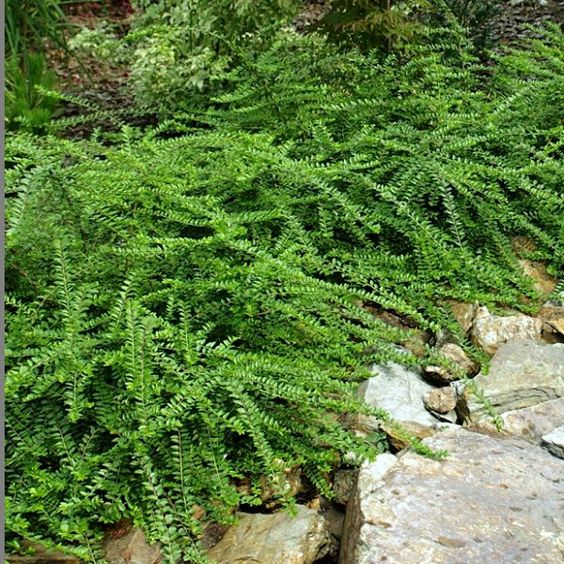 Lonicera pileata (Source Pinterest)
On a heavy and wet bank - Dogwood (Cornus stolonifera Flaviramea)
In heavy, sticky soil like freshly excavated clay from a construction site, decorative dogwoods (Cornus stolonifera, C. sericea, or C. Alba) thrive particularly well. They grow in all waterlogged soils and do not fear clay soils, unlike many groundcover shrubs.
Plant it at the bottom of a partially shaded or sunny bank. Count 1 to 3 plants per m² maximum for rapid coverage. After 3 years of planting, shear it back to 30 cm above the ground at the end of winter, both to obtain beautiful branches that will turn yellow the following winter and to prevent it from growing too tall. With age, Cornus stolonifera takes on a bushy form and loses its groundcover character that it exhibits when young.
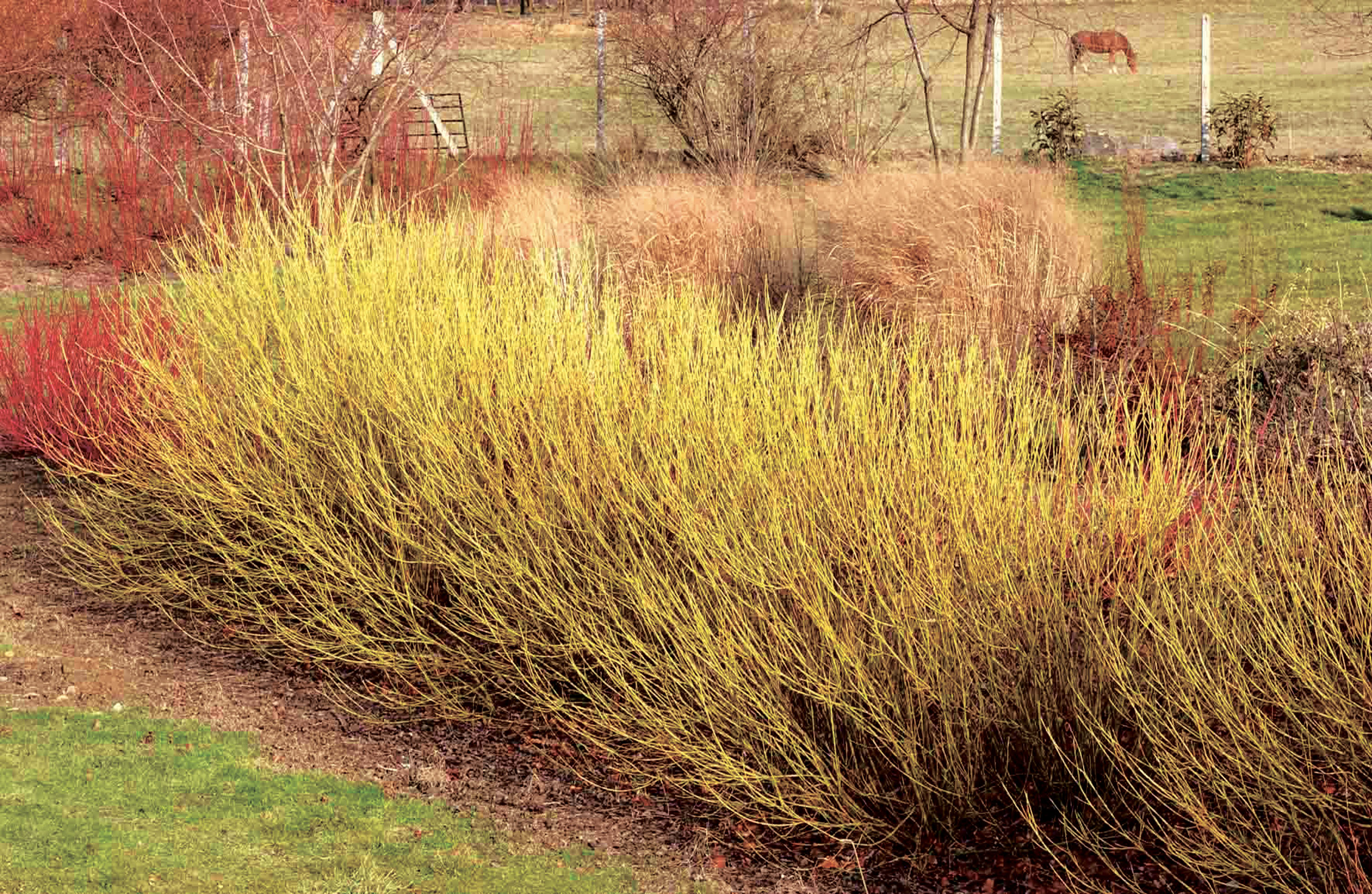 Cornus stolonifera Flaviramea
On a very steep bank - Groundcover Rose Emera
They are thought to be fragile and delicate, but roses have powerful roots that go deep into the ground and stabilise the terrain perfectly. Groundcover roses are favourites, particularly the Emera rose, for quickly covering a very steep terrain. This rose, both fast-growing, sturdy, and highly floriferous, can cover 1 m² within the first year of planting.
Plant it from the bottom to the top of a bank and count 1 to 2 plants per m² on average. During the first year of planting, monitor watering, especially in summer. While it grows quickly, the Emera rose requires water in its first year, particularly in summer, to establish its root system. Installing a membrane (preferably biodegradable) is essential on a very steep bank and will help the rose settle in more quickly.
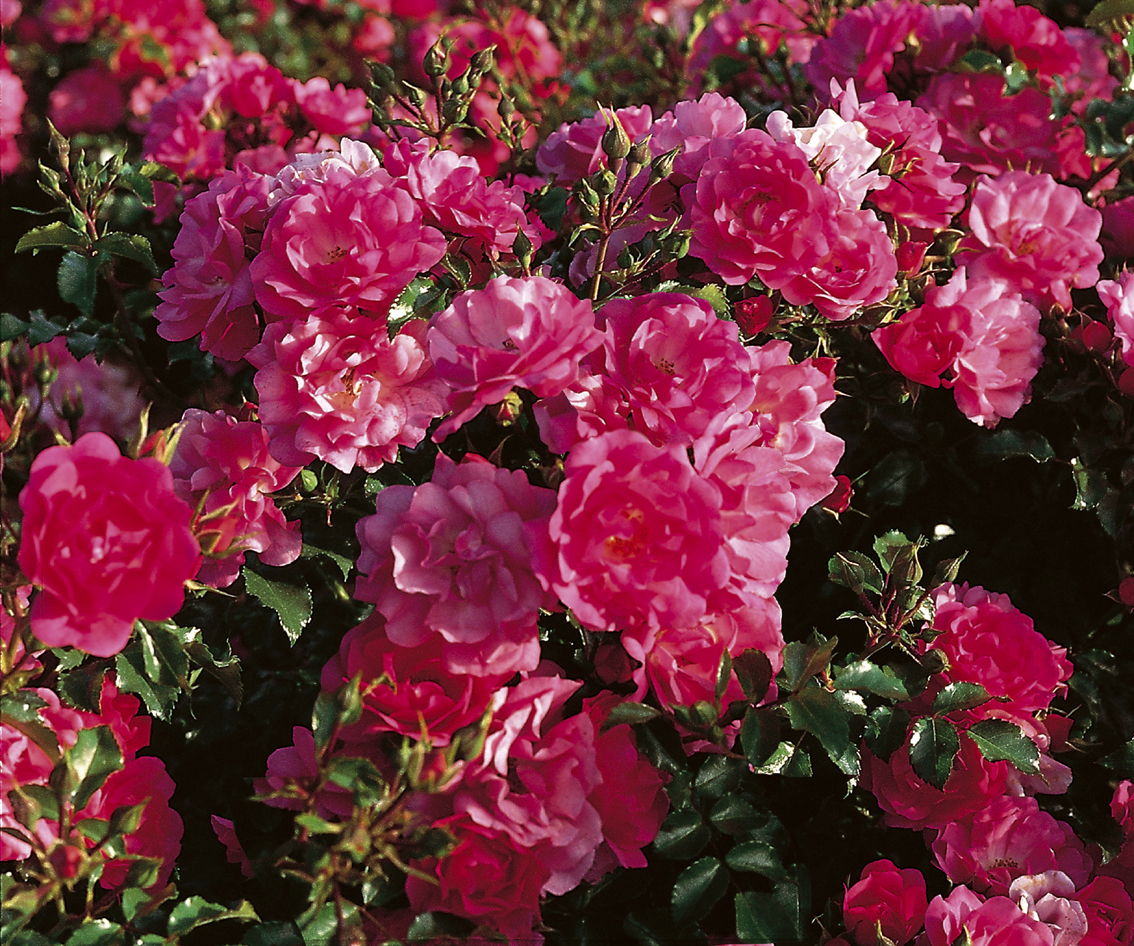 Rose Emera
A bank is, by definition, a sloped terrain exposed to the harshness of the elements where rain and wind weaken and erode the soil. If the soil remains bare, runoff can cause significant damage: flooding, landslides, and sometimes even mudslides. Fortunately, some groundcover plants thrive in these challenging conditions and manage to stabilise banks quickly […]
We are always on the lookout for THE perennial groundcover that blooms all summer long, the one whose flowering lasts for several months, the perennial that never stops blooming, the one that adorns and borders a path throughout the summer. The one that shines brightly on a sunny bank or simply the one that is adorned with flowers all summer in a pot on the terrace and blooms continuously until late autumn. Here are the 5 best long-flowering groundcover plants that you absolutely must have in your garden.
1) Delosperma 'Wow Hot Pink'
This is indeed a succulent similar to those that can be admired while strolling along the Atlantic coast, growing on dunes or at the foot of cliffs. The comparison stops there as Delosperma 'Hot Pink' is derived from a Japanese breeding called "Wheels of Wonder" and selected for its cold resistance and, of course, its long flowering. Are your perennials dying of thirst in summer? Plant Delosperma! Do your perennials wilt in summer due to drought? Plant Delosperma! This succulent groundcover has the merit of growing AND blooming throughout the summer. It flowers from June in warm regions and extends its flowering until the end of September. It doesn't care whether it rains or not to produce flowers; regardless of the weather, its flowering is uninterrupted for 4 months. If, like me, you have a sunny terrace and are not a fan of daily watering, plant Delosperma. If you have a sunny, stony, and dry bank, Delosperma is waiting for you.
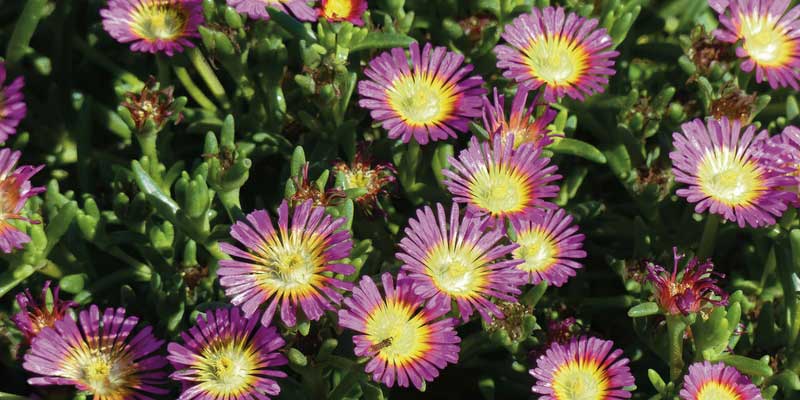 Delosperma Wheels of Wonder Hot Pink
2) Alchemilla mollis
This is THE classic of cool gardens, the essential and indestructible perennial that borders the most beautiful mixed borders with its round, plicate leaves that catch dew droplets in the early morning. It is this same perennial that blooms in an anise green mist that gracefully complements the precious flowers of bleeding hearts in spring or punctate campanulas in summer. Its flowering is long and its flowers succeed each other between spring and summer. They start in May and last until September-October. It will only be slowed down by the summer heat, but don't worry, a cut back of the flowers in summer gives it a boost and induces a resurgence of flowers in September.
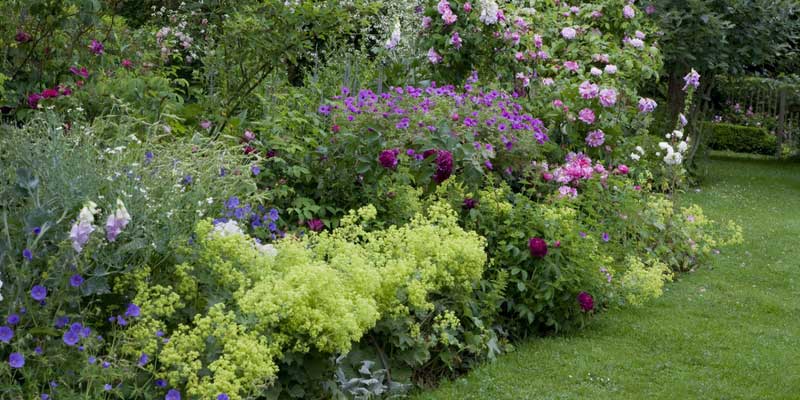 Alchemilla mollis at the edge of a classic mixed border with hardy geraniums, lychnis, and peonies in the background, along with Crambe cordifolia and roses (photo: Biosphoto / NouN)
3) Nepeta 'Walker's Low'
To be honest, it was difficult to choose between Nepeta 'Walker's Low', N. 'Six Hill Giant', and N. 'Purrsian Blue' as all three bloom for a long time. However, 'Walker's Low' wins by a narrow margin as it blooms continuously from May to October and does not need to be sheared like 'Six Hill Giant'. Is it worth mentioning that it is easy to grow and thrives in sunny, well-drained soils, whether rich or poor? The only thing one might reproach it for is its aromatic foliage. Not because it smells bad, quite the opposite, but because it has the unfortunate tendency to attract neighbourhood cats that come to roll in the clumps and ruin the flowers!
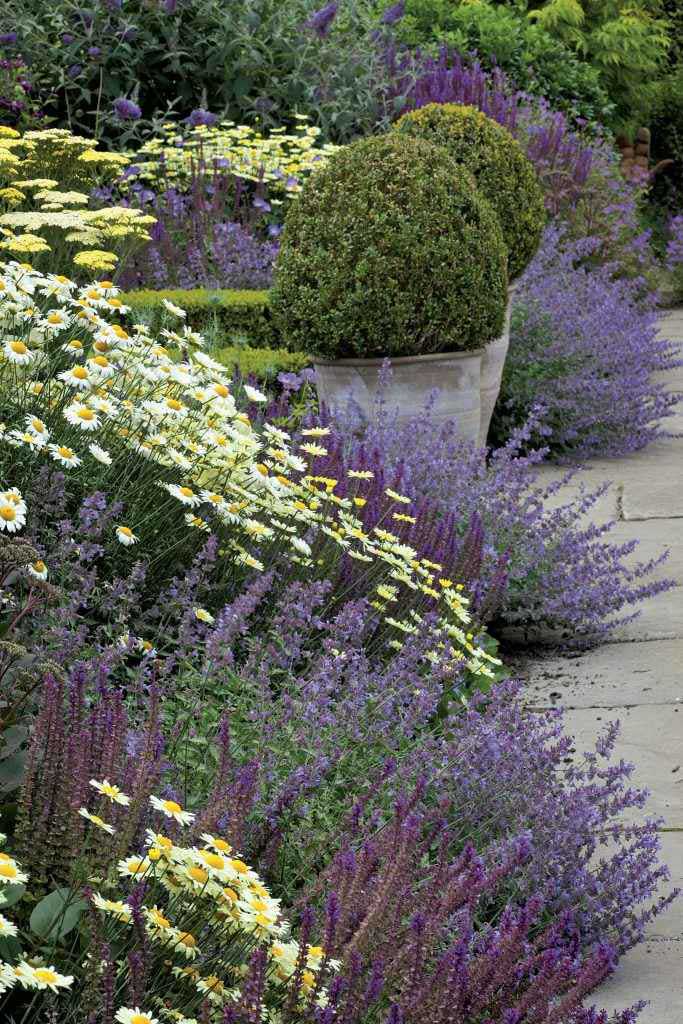 Nepeta racemosa 'Walker's Low' at the edge of a bed in duo with Anthemis 'Sauce Hollandaise' (photo: GAP/ Elke Borkowski)
4) Persicaria 'Needham's Form'
Beware, you might just become a fan of this groundcover perennial, which should not be confused with Persicaria affinis Darjeeling Red, which is also a groundcover and floriferous. That’s why I won’t tell you that it covers the ground so well that weeds don’t dare to touch it. I won’t mention that its Himalayan origins give it exceptional cold resistance. I won’t even tell you that it blooms for a good 6 months of the year and that it’s not uncommon (even in the north when it doesn’t freeze too hard) to see flowers until December. I will also refrain from saying that when planted in moist soil in a bright spot, it is adorned with countless little candy-pink beads that look wonderful with ferns, hostas, horsetails, or Hakonechloa. No, I won’t say any of that.
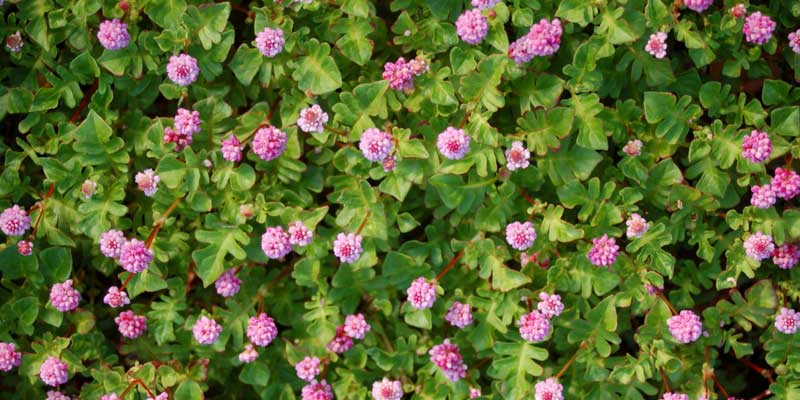 Persicaria Needham's Form, here it is grown too much in the shade and its flowering suffers. Planted more in the light, it blooms almost twice as much.
5) Geranium 'Rozanne'
It’s no surprise that hardy geranium Rozanne is by far the best long-flowering groundcover perennial of all time. Yes, it tolerates dry soils, yes, it grows in both sun and partial shade, and yes, it is hardy and content with little. How long does this wonder bloom? About 6 months! More or less, as in some regions, flowering can start as early as June and extend until December. In "normal" regions, it will bloom from July to November, and there's no need to cut off the flowers to improve its flowering; it is self-cleaning.
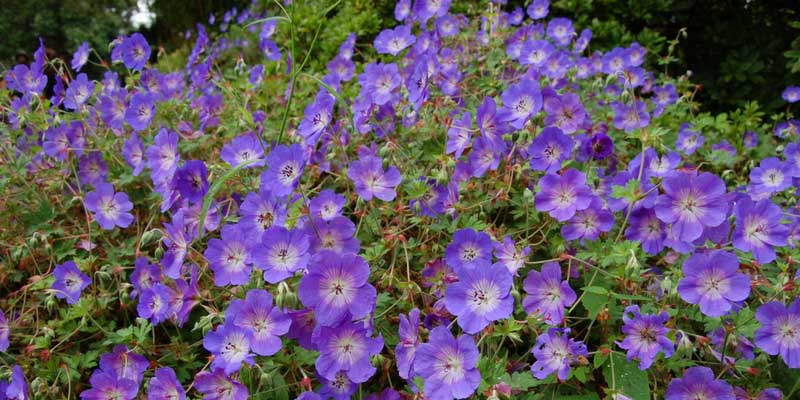
We are always on the lookout for THE perennial groundcover that blooms all summer long, the one whose flowering lasts for several months, the perennial that never stops blooming, the one that adorns and borders a path throughout the summer. The one that shines brightly on a sunny bank or simply the one that is […]
Evergreen groundcovers are a valuable aid in the garden. They help combat adventive plants, reduce soil dehydration, and fight erosion. Besides these proven functional qualities, these plants cover a wide range of uses in the garden. And since functional doesn't have to mean ugly, here are the 10 best evergreen groundcovers to have in your garden.
1 - For shade: Pachysandra terminalis
Yes, I could have mentioned ivy, epimediums, Chrysospleniums, Ophiopogons... But if I had to name just one for shade, Pachysandra terminalis is an excellent candidate. While it grows very slowly in the first few years, it's only to establish its root system and develop at an astonishing speed in the following years. It doesn't run; it gallops. Its glossy foliage, perfect all year round, and its white flowers make it an excellent perennial for cool woodlands, let's be clear!
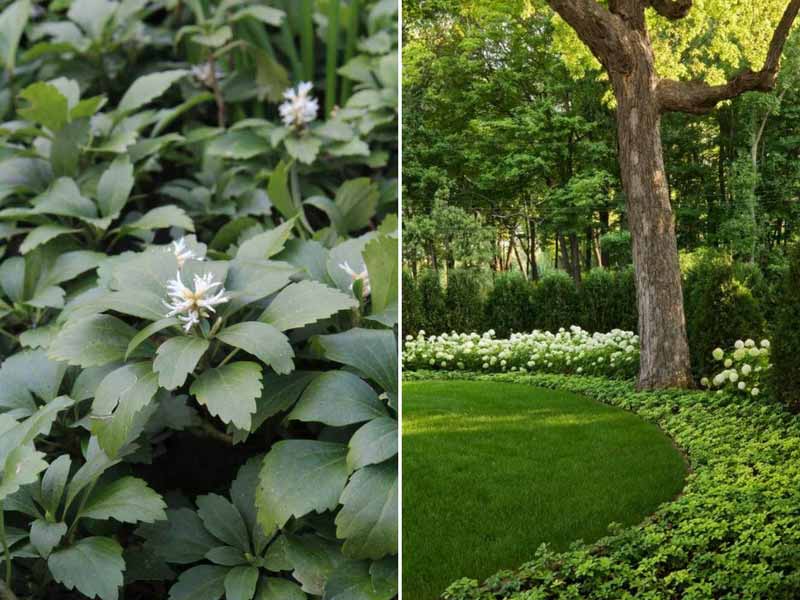
Pachysandra in bloom in spring / Pachysandra terminalis growing at the edge of a tree (source: Pinterest)
2 - For clay soils: Ajuga reptans Catlin's Giant
Ajuga reptans (or "creeping bugle") is one of those perennials that withstand Siberian winters and grow without issue with their feet in the clay, which shows just how tough it is. Its only flaw is that it loves moisture. Heavy soils, yes, but cool or even damp. When it gets what it desires, its stems form stolons like a strawberry plant and quickly colonise.
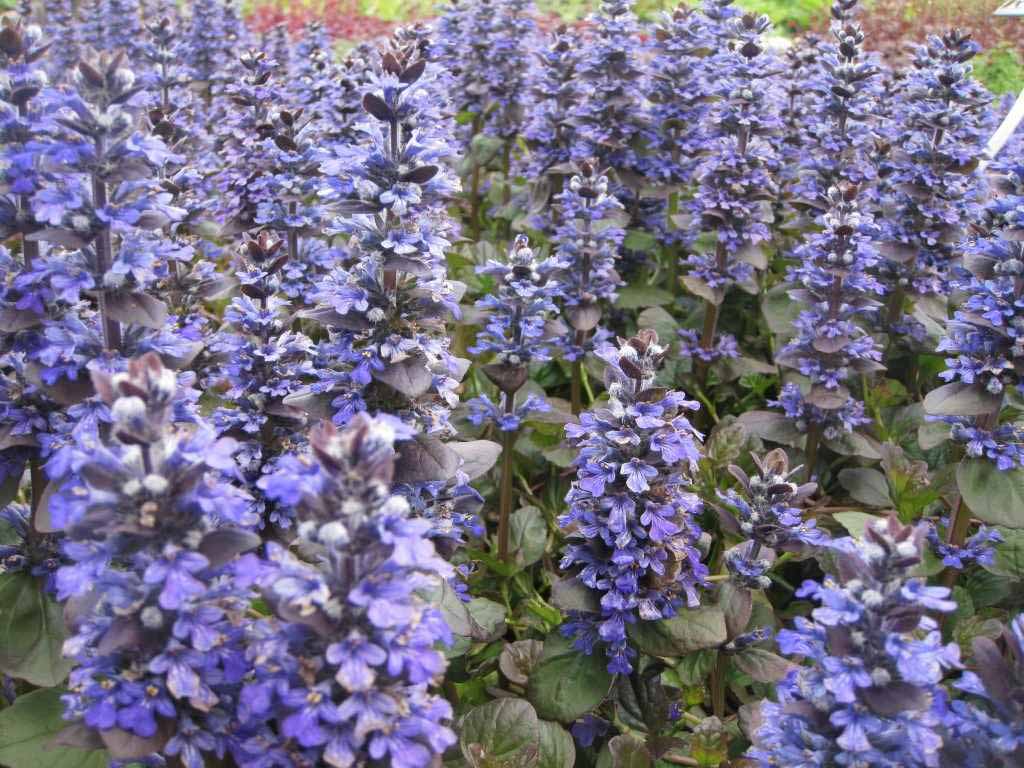
Ajuga reptans Catlin's Giant with its superb bronze foliage and blue spikes.
3 - For arid corners: Stachys byzantina
Have you always wanted to pet a bear's ears but never could? Close your eyes and stroke the velvety foliage of Stachys byzantina. You'll feel like you're petting a bear... or a rabbit, depending on your perspective. Behind this undeniably soft foliage lies a tenacious perennial that grows without flinching under blazing sun and colonises surfaces thanks to creeping stems that root themselves. Use it at the edge or in rockeries with Armeria, euphorbias, lavenders, or carnations.
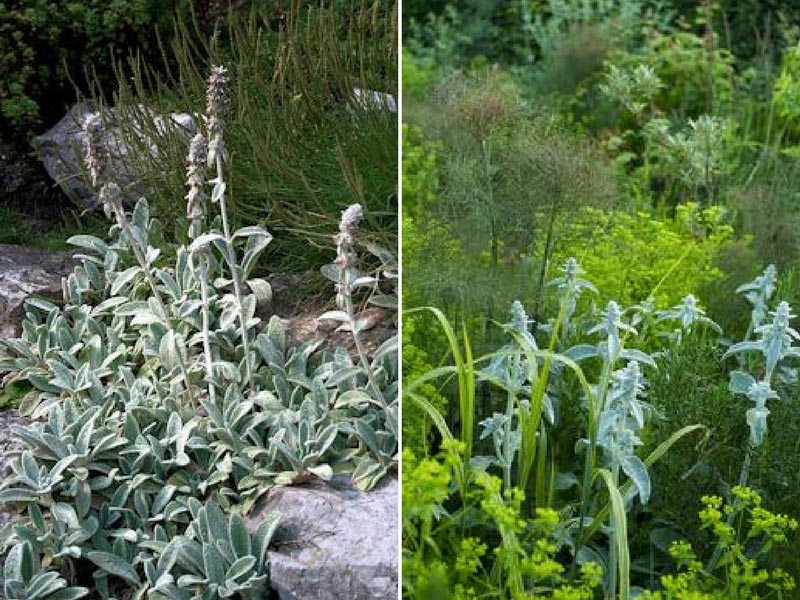
Stachys byzantina / Stachys in bloom, mixed with purple fennel, euphorbia, and rosemary - source: Pinterest
4 - For growth speed: Lesser Periwinkle (Vinca minor Atropurpurea)
I'm not talking about the greater periwinkle (Vinca major) with its bland foliage and chaotic growth, but its smaller sister, Vinca minor Atropurpurea, which is more refined. With finer leaves, it produces a string of small flowers whose often paler centre gives it a bicoloured appearance. As vigorous as its larger sister, it dresses semi-shaded borders with great class and restraint. Its stems elongate and root themselves here and there, so one single plant can spread and cover several square metres in just 2-3 years.
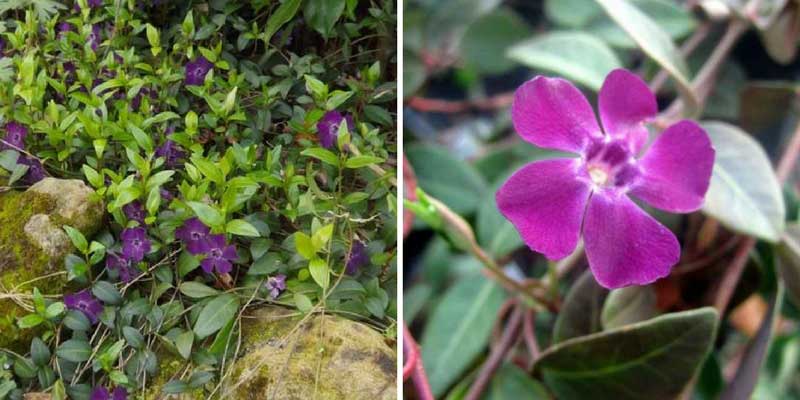
Vinca minor atropurpurea (Source: Pinterest)
5 - For calcareous soils: Thyme
No, Thyme is not just an herb confined to the edges of the vegetable garden. It is also, and above all, an excellent groundcover plant for calcareous and dry soils. It is used at the edge of a mineral path in gravel or on rocky slopes. However, not all are evergreen; opt for Thymus serpyllum or, for something more original, the stunning semi-evergreen Thymus pseudolanuginosus.
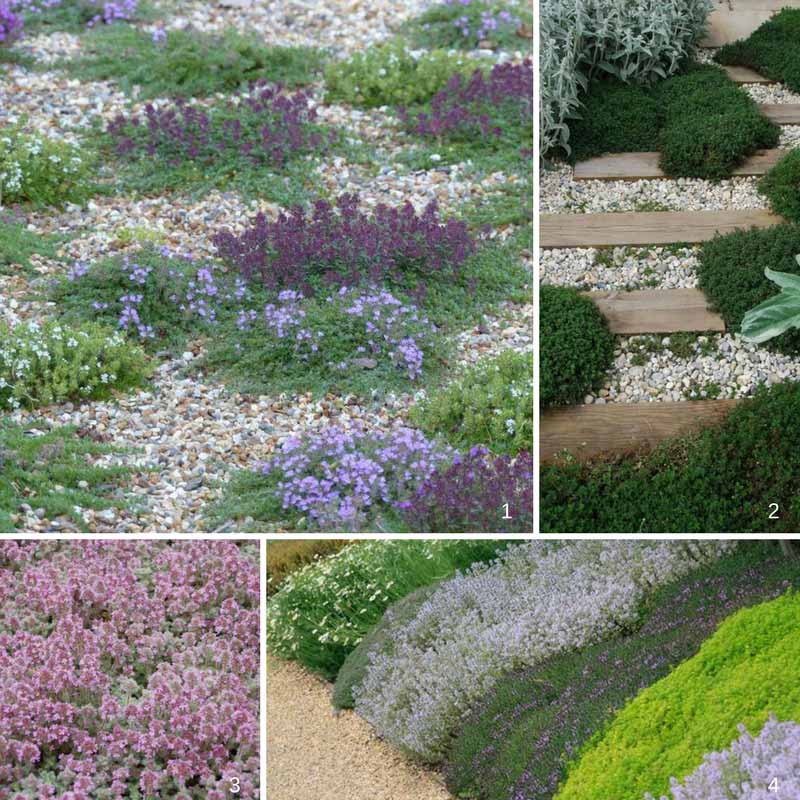
1) Thyme in bloom in early summer / 2) Thyme bordering a mineral path alongside Stachys byzantina (source: Pinterest) - 3) Thymus pseudolanuginosus - 4) Carpet of thyme on a calcareous slope (source: Pinterest)
6 - For early flowering: heather (Erica x darleyensis)
The advantage of heathers is that they thrive in challenging regions, in arid heaths swept by winds, on limestone cliffs, or at the edge of woodlands, so it's impossible to say, "Oh no, I gave up on heather; it won't grow in my garden!" Therefore, you can plant it almost anywhere in your garden, and it will grow at varying speeds. But its main asset lies in its early winter flowering, and neither frost nor a bit of snow will stop it from blooming.
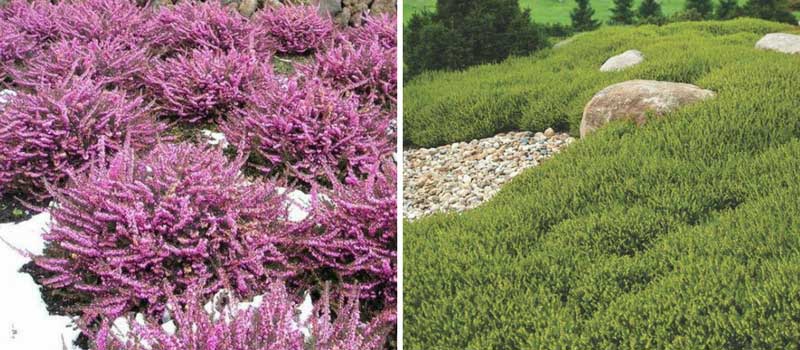
Erica darleyensis Red October in bloom despite the snow - Erica darleyensis forming an impenetrable carpet, no need to plant it on a tarp! (Source: Pinterest)
7 - For its fragrance: Sarcococca hookeriana humilis
At first glance, it's not the size of the flowers that impresses in Sarcococca, as they are insignificant, but rather its sweet fragrance with floral and citrus notes that lasts a good part of winter. Then, it's its lovely glossy foliage and ability to grow in shade, even under trees, that appeals. Finally, this small groundcover shrub slips along the edge of a shaded path and suckers to form lovely colonies over time.
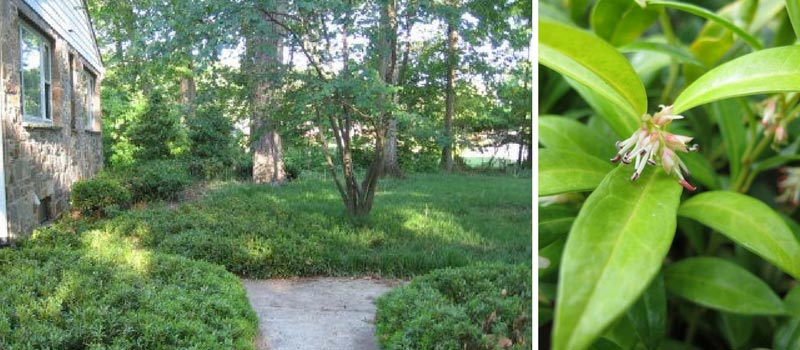
Sarcococca hookeriana humilis in bloom. How can such small flowers exude such a fragrance? A mystery! / Sarcococca hookeriana var. humilis at the edge of woodlands (Source: Pinterest)
8 - For its abundant flowering: Phlox subulata
When thinking of flowering groundcovers, Phlox doesn't immediately come to mind. And when thinking of Phlox, one primarily thinks of Phlox paniculata known for its beautiful coloured panicles in summer. However, Phlox subulata deserves to be better known and planted because its flowering is simply stunning. This small groundcover transforms into a colourful mass from early spring. It literally becomes covered in flowers, to the point that when exposed to full light, in well-drained, rich soil, the foliage disappears beneath the flowers for three solid weeks.
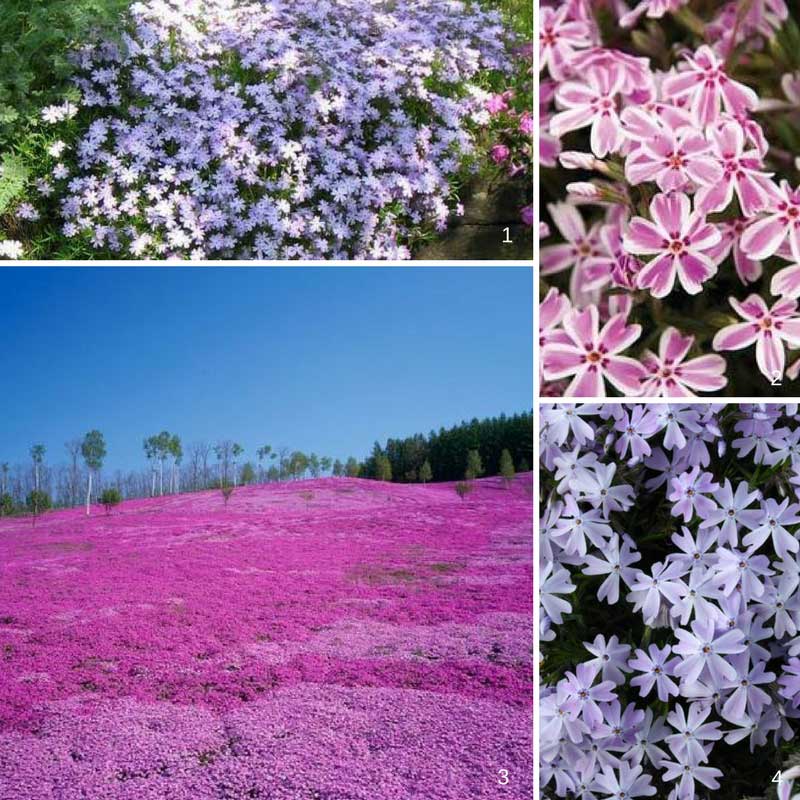
1 and 4) Phlox subulata Emerald Cushion - 2) Phlox subulata Candy Stripe - 3) The Japanese have appreciated Phlox subulata for a long time and plant it in masses on hillside slopes. You either love it or hate it, but after a dreary winter, it wakes you up! (Source: Pinterest)
9 - For decorative fruit in winter: Cotoneaster Coral Beauty
It's not that I'm a huge fan of cotoneasters, but one must acknowledge at least one thing: they are the kings of fruiting. When winter comes and the light intensity decreases, the small orange-red berries take on intense colours, making winter seem less dreary. Moreover, birds feast on their providential berries in winter, so keep that in mind!
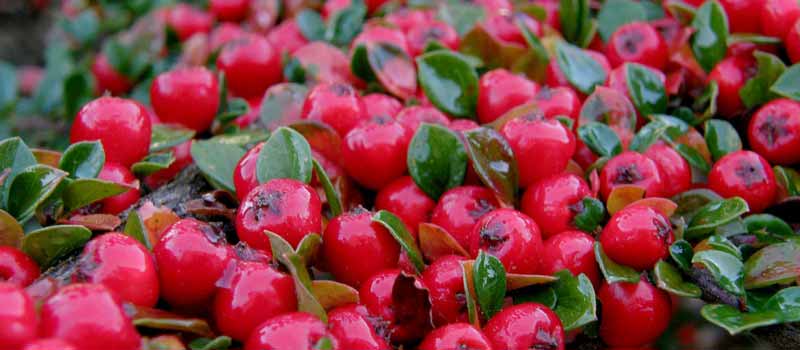 Cotoneaster suecicus Coral Beauty in fruit in autumn[/caption>
10 - For all the reasons: Geranium macrorrhizum Spessart
It was nearly impossible to finish a top 10 of the best evergreen groundcovers without mentioning Geranium macrorrhizum Spessart. It is the ultimate groundcover that grows everywhere, in sun or shade, in clay or clay-limestone soils. It is one of the few that grows in dry shade, on slopes, along paths, at the foot of trees or roses. It spreads its rhizomes across the ground and suffocates everything in its path, even ivy, which speaks to its robustness. It grows slowly but surely, has foliage with a questionable scent but blooms profusely and for a long time in spring. And when the cold arrives, its foliage turns copper and red, it may wither but does not disappear, revealing its dense network of rhizomes. It’s the best, and it’s my favourite (objectively speaking!).
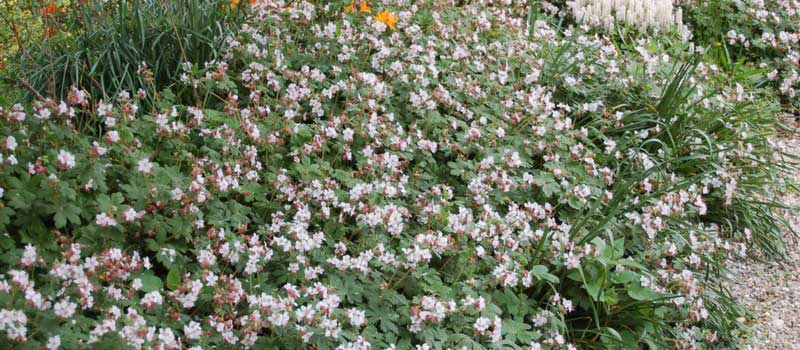 Geranium macrorrhizum 'Spessart' on my slope in spring.[/caption>
And you, which is your best evergreen groundcover? Tell us why!
Evergreen groundcovers are a valuable aid in the garden. They help combat adventive plants, reduce soil dehydration, and fight erosion. Besides these proven functional qualities, these plants cover a wide range of uses in the garden. And since functional doesn’t have to mean ugly, here are the 10 best evergreen groundcovers to have in your […]
The question may seem odd, but at a time when we seek to limit the time spent in the garden and avoid heavy gardening chores, one might wonder: should we still plant bamboo in our gardens?
On the side of its detractors, criticism abounds, and they see this plant as a hindrance to gardening, an invader that colonises flowerbeds, a conqueror that takes advantage of absence to impose its dominance over the rest of the garden. According to these same detractors, bamboo grows too quickly, constantly sheds its leaves, and grows in a disorderly manner. In short, it is a mundane bush that grows too much and requires constant pruning.
Its admirers, on the other hand, are full of praise and see bamboo as an excellent evergreen plant that does not lose its foliage in winter and is perfect as a privacy screen or windbreak. An exotic plant with a Japanese aesthetic and a graceful, lightweight silhouette that rustles and undulates with the slightest breeze. An architectural plant with stiff, colourful culms and elegant branching.

Not just one bamboo, but many bamboos
Generally, people think of bamboo as if there were only one variety. However, bamboos are highly diverse, ranging from the small Arundinaria pumila, barely 20 cm tall, to the monstrous Phyllostachys edulis, which reaches over 20 m. Bamboos comprise several hundred species and varieties. To clarify, horticulturists have grouped them into two subfamilies: the running types, which spread and colonise if not contained, and the clumping or cespitose types, which thicken from the base and grow more modestly.
In the running family, we find the star of them all, Phyllostachys, followed by Semiarundinaria, Pleioblastus, Sasa, Chimonobambusa, Shibatea...
In the clumping (non-running) family, the most famous is Fargesia, followed by Yushania, Chusquea, Thamnocalamus, Indocalamus...
How to choose?
It’s child’s play, and the determining question boils down to are you ready to arm yourself with a spade to dig a trench 50 cm deep?
If the answer is yes, digging a trench is the necessary chore that allows you to install a rhizome barrier and thus stop the growing expansion of running bamboos. This "barrier" is simply a sufficiently thick PVC film to stop underground rhizomes and contain them. How to install this famous BAR (rhizome barrier)? It’s simple: dig a trench all around your bamboo, in the desired shape and length. Place your BAR slanted outward so that the rhizomes are guided and slide upwards. Leave it protruding by 10 cm, then backfill while compacting.
This is an essential chore if you wish to create a hedge of Phyllostachys or if you want to plant large bamboos in isolation or in a flowerbed. This way, you will access a great diversity of bamboos.
My favourites: Phyllostachys aureosulcata 'Aureocaulis' for its fluorescent yellow culms, Semiarundinaria fastuosa 'Viridis' for its spectacular and exotic appearance, and Sasa tessellata for its exotic foliage that reminds me of Asia.
If the answer is no, one word of advice: plant clumping bamboos! In other words, non-running bamboos that are unlikely to wander into your neighbour's garden and turn yours into a wild forest. Fargesias, which are increasingly available in the market, are the best candidates! They are perfect for pot cultivation, especially all varieties of Fargesia murielae and are interesting in small gardens where space is limited. However, they do have some drawbacks: they are more expensive, grow much slower (count at least 5 years to obtain a well-furnished plant), are smaller (measuring between 1.5 and 3 m), and do not offer the same diversity of shape and colour as running species.
My favourites: Fargesia murielae 'Jumbo' for its dense and compact habit, Fargesia robusta for its impressive size, and Fargesia nitida Great Wall for the unique colour of its culms.
In summary, if you are a fan of cool and relaxing gardening and digging a trench seems like an insurmountable chore, opt for non-running bamboos. For others, don’t hesitate for a second to plant and mix running and non-running bamboos. Finally, know that there are forums dedicated to bamboos where experts and enthusiasts share valuable advice on "Boo": http://lesbambous.fr/forum/
The question may seem odd, but at a time when we seek to limit the time spent in the garden and avoid heavy gardening chores, one might wonder: should we still plant bamboo in our gardens? On the side of its detractors, criticism abounds, and they see this plant as a hindrance to gardening, an […]
Temperatures are cooling, light is turning golden and veiled by first autumn mists; in the distance, star-shaped flowers of autumn asters shine across beds, blooming in large clumps where summer flowers have faded. The genus Aster includes several hundred species and varieties, the range is such that choosing can often be difficult. Discover our short guide to help you choose, combine and grow them successfully.
1) Choosing: natural or sophisticated, a question of taste and style!
-
For naturalistic, wild scenes: Aster cordifolius and Aster ericoides
Aster cordifolius and Aster ericoides are meadow perennials par excellence: they withstand wind without collapsing, their foliage remains free from powdery mildew and their light but sturdy branching bears clouds of small flowers in mid-autumn. They form a shrub 80 cm to 1 m high to which large grasses such as Miscanthus or Pennisetum are traditionally paired.
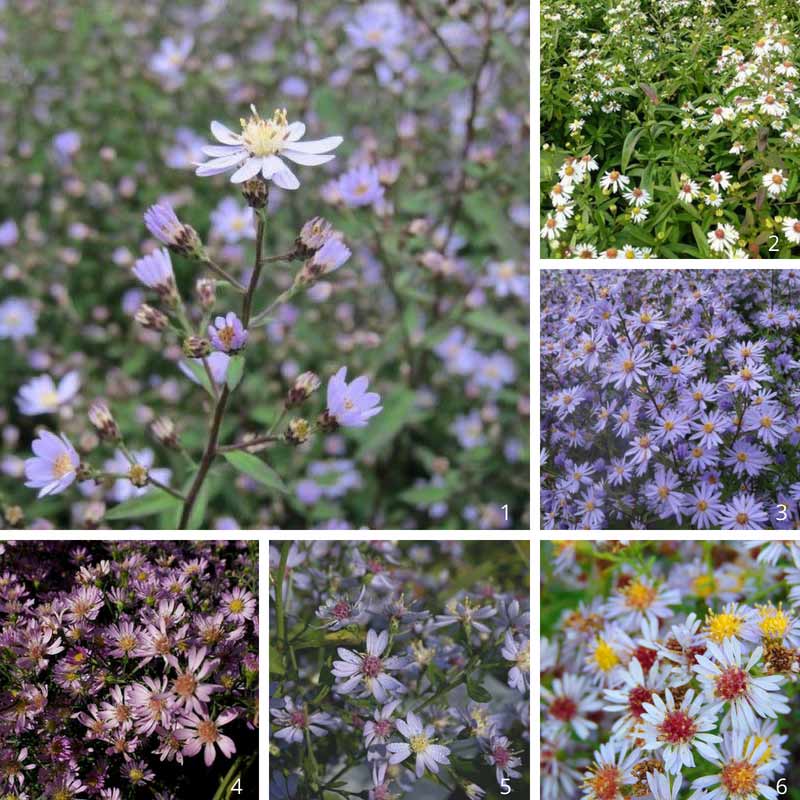
1) Aster cordifolius Blutenregen 2)Aster ericoides Herbstmyrte 3) Aster cordifolius Blue Heaven 4) Aster ericoides Blue Wonder 5) Aster cordifolius Ideal 6) Aster ericoides Lovely
-
For mixed borders: Aster novi-belgii and Aster novae-angliae
The most exuberant and colourful asters belong to the novi-belgii and novae-angliae groups, which form large, colourful clumps in mid-autumn. On average, their height ranges from 70 cm to 1.2 m, making them excellent candidates for the back of borders, but unfortunately vulnerable to wind. It is not uncommon to see them flop like cereal crops after heavy rain. Prevent this by inserting branched canes at least 50 cm tall into clumps in August. Later hidden by flower heads, this discreet framework will support the clumps more flexibly than traditional bamboo. You can also pinch them in May to keep them more compact and well-branched.
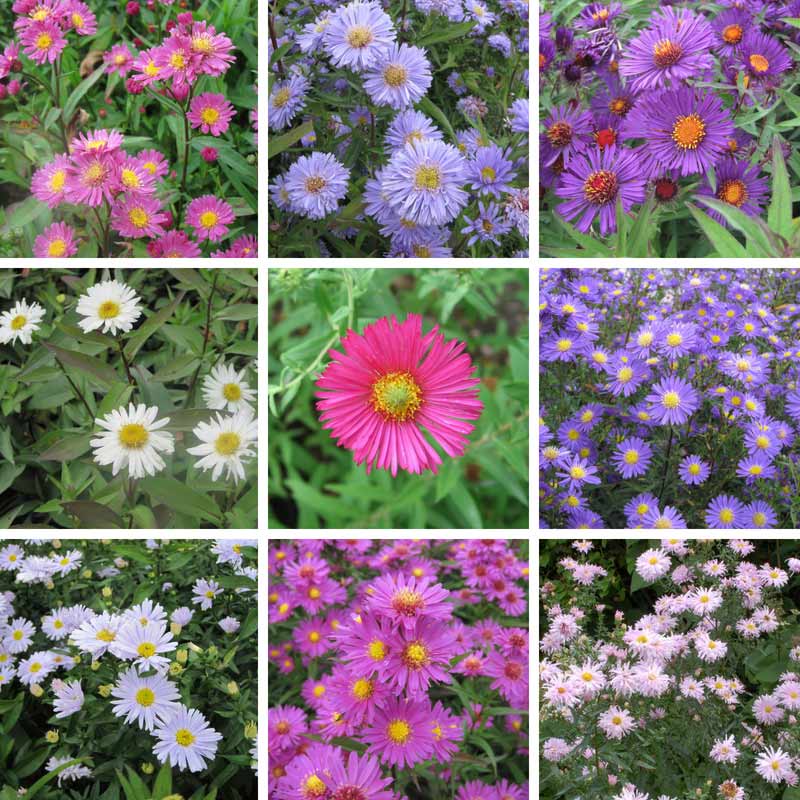
from top to bottom and from left to right: Aster novae angliae-Andenken an Paul Gerber - Aster novi-belgii Marie Ballard - Aster novae-angliae Violetta - Aster novi-belgii Weisses Wonder - Aster novae-angliae Alma Potschke - Aster novi-belgii Schone von Dietlikon - Aster novi-belgii Porzellan - Aster novi-belgi Karminkupel - Aster novi-belgii Fellowship
-
For neat, well-behaved borders: Aster dumosus
There are enough dwarf aster varieties that you need not look elsewhere to fill autumn borders. The best for compactness and abundant flowering are Aster dumosus. They do not exceed 40 cm in height (20 cm for the most compact) and their growth habit is relatively restrained. Plant them in borders or at the foot of shrubs and space them 20–25 cm apart at planting.
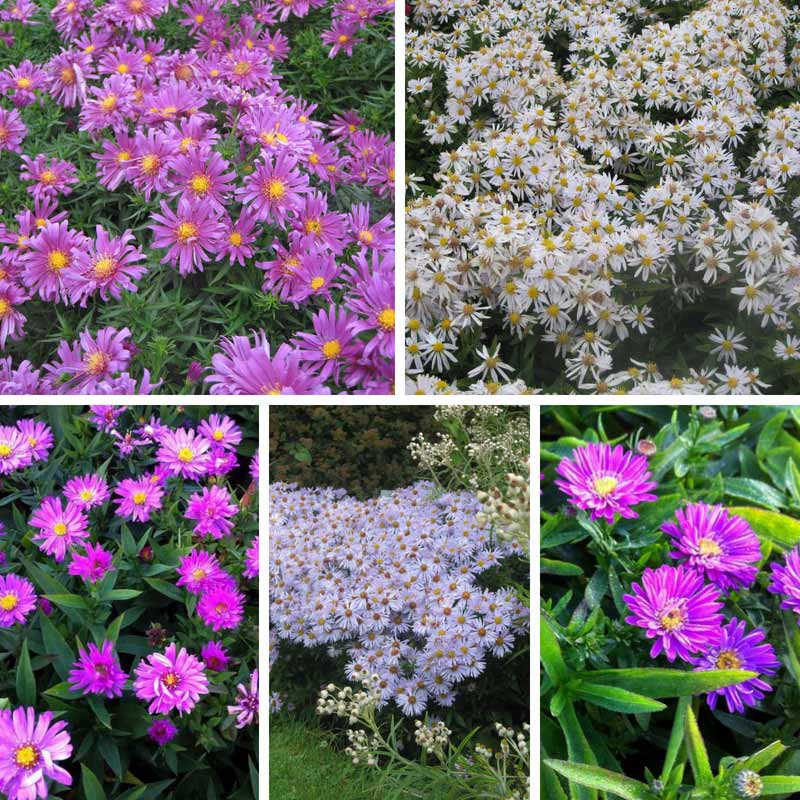
From top to bottom and from left to right: Aster dumosus Tonga, Kristina, Rosenwichtel, Silberblaukissen and Starlight
2) Combining asters: rules for good neighbourliness
Asters are perennials that are easy to combine, but while some are known to take over borders and overwhelm less vigorous companions, others are so large they collapse at the merest gust of wind.
-
Group the most vigorous together
Very vigorous varieties (Aster novi-belgii, novae-angliae and ageratoides) can occupy several square metres in a few years and smother surrounding plants. Grow them either in large, monochrome drifts where they can self-manage, or with small, colourful shrubs such as dogwoods (Cornus alba 'Siberian Pearls', Cornus alba 'Sibirica'...) or Physocarpus ('Lady in Red', 'Diable d'Or').
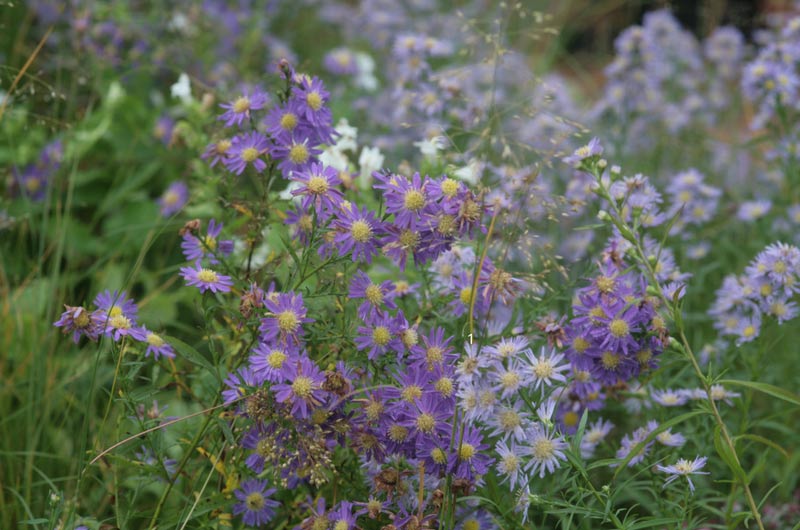
Aster novi-belgii in a mix
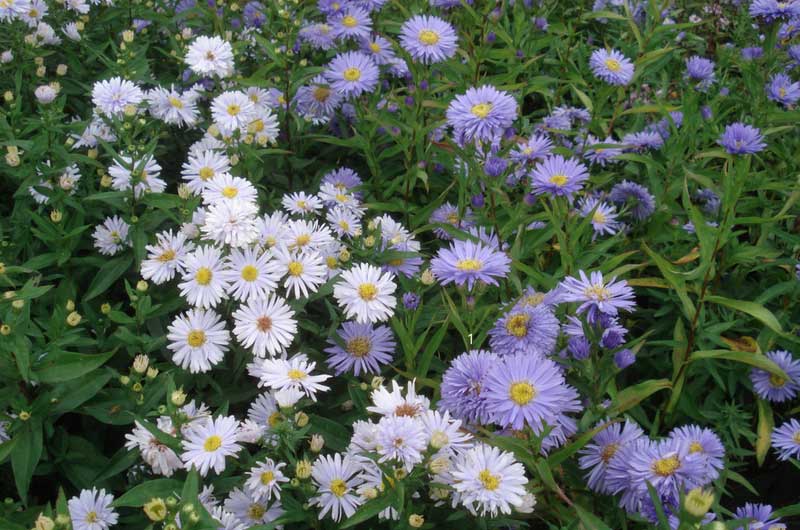
Lovely, soft pairing between the delicate, translucent flowers of Aster Porcelain and the large double mauve flowers of Aster Marie Ballard.
-
Charming duos with wild-looking perennials
Asters love the company of Japanese anemones, which naturally weave their roots into the clumps and mingle with the large, slightly stiff asters. Aster ericoides and Aster cordifolius also pair well with sedums, whose flowering they extend. They combine nicely with large structural perennials such as agastache, artemisias, persicarias or Cimicifuga. Finally, a happy autumn marriage is with grasses: mix a few Panicum, Miscanthus or Pennisetum into your aster clumps for a very sophisticated meadow effect.
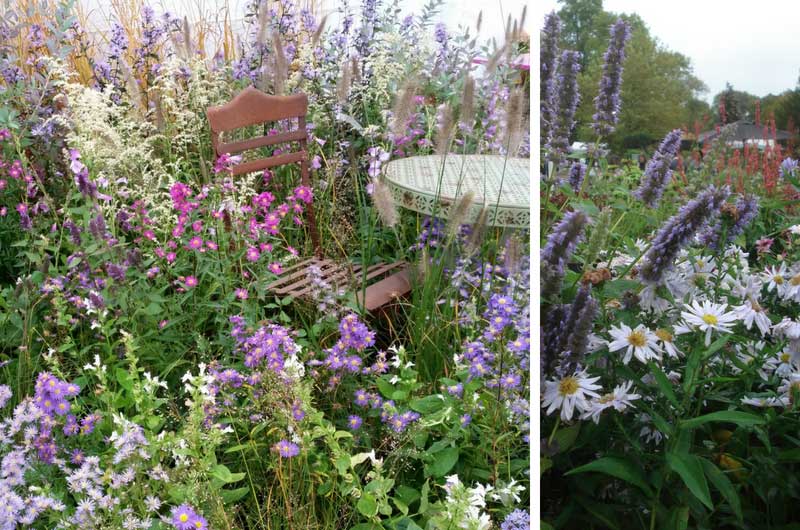
Asters mixed with artemisias and pennisetums - Pairing between agastache 'Blue Fortune' and Aster-novi-belgii 'Porcelaine'
3) How to succeed with asters? Sun and light soil
Large Aster novi-belgii and Aster novae-angliae prefer full sun. Good garden soil is all they need to be happy. They do not mind compact, clay soils provided the soil stays cool in summer. As they send out suckers relentlessly, they eventually become bare in the centre: it is then necessary to divide clumps every three years or so, in spring or in autumn after flowering.

Other asters prefer a light, cool but never waterlogged soil. All, however, like open, airy positions; avoid planting them in borders enclosed by trees or walls, where risk of powdery mildew will be greater, asters need air to flower abundantly and to keep foliage healthy. As you have probably understood, asters are easy perennials, very hardy and undemanding; like phlox or persicarias, they are indispensable perennials for late-season colour in the garden.
And you, what are your favourite varieties, your best combinations, your tips and tricks for keeping asters healthy all season long?
For more information, discover our complete guide to Asters
Temperatures are cooling, light is turning golden and veiled by first autumn mists; in the distance, star-shaped flowers of autumn asters shine across beds, blooming in large clumps where summer flowers have faded. The genus Aster includes several hundred species and varieties, the range is such that choosing can often be difficult. Discover our short […]
A light mist enveloped the garden this morning... After a surprise heatwave, is autumn already showing its first signs? Anyway, I won't talk about the weather, but about a topic just as vast: tulips! It's the start of the bulb planting season, and the question arises: which tulip to choose from the hundreds of varieties offered in catalogues?
Of course, there’s personal taste to consider, and with 3000 varieties registered and new additions each year, it can be said that when it comes to tulip bulbs, there’s something for everyone! To help you navigate, successive generations of horticulturists have grouped the various varieties into groups or families of tulips, each responding to specific botanical and aesthetic criteria (more or less) precise, as well as usage: depending on the flowering period, your soil, or the style of your garden, you will turn to specific families in which you will seek the most beautiful to your eyes... Discover some tips and landmarks.
1) Choosing tulips according to flowering time
The tulip is one of the most beautiful and famous of the spring-flowering bulbs. Its colours, often vivid and sometimes subtle, brighten the first days of fine weather or, conversely, awaken the sometimes still grey days of early spring. Fortunately, the horticultural classification of tulips also corresponds to the flowering calendar! It is therefore very easy to navigate, and by combining varieties from several families, you can achieve up to 2 months of continuous flowering... what more could you ask for? Of course, the chronological markers on flowering dates provided are not "an exact science" and should be nuanced by the climatic variations observed regionally and from year to year.
In bloom from March-April, the early tulips
- As their name suggests, early single tulips and early double tulips, including the famous hybrids 'Murillo', are among the first to bloom, from early April. They rarely exceed 35cm in height and are thus sturdy enough to withstand bad weather.
- They are, however, preceded by certain botanical species and their hybrids. Among the botanical tulips, there are wild species, although they have unfortunately often disappeared from their natural habitat, with a flowering period that is not uniform and extends from March to June depending on the species. From early to mid-March, you can count on Tulipa tarda, Tulipa humilis and its many varieties, Tulipa clusiana, Tulipa turkestanica... and many others that are rarer! These rarely exceed 10 to 15cm in height.
- The botanical tulips from the greigii group, with marbled black foliage, kaufmanianna or "water lily tulips", and the excellent fosteriana ('Purissima', 'Madame Lefeber', 'Orange Emperor'...) have vivid and varied colours, measuring 20 to 30cm in height, 40cm for fosteriana, they bloom from late March to early April and thus precede the "early" tulips by a little.
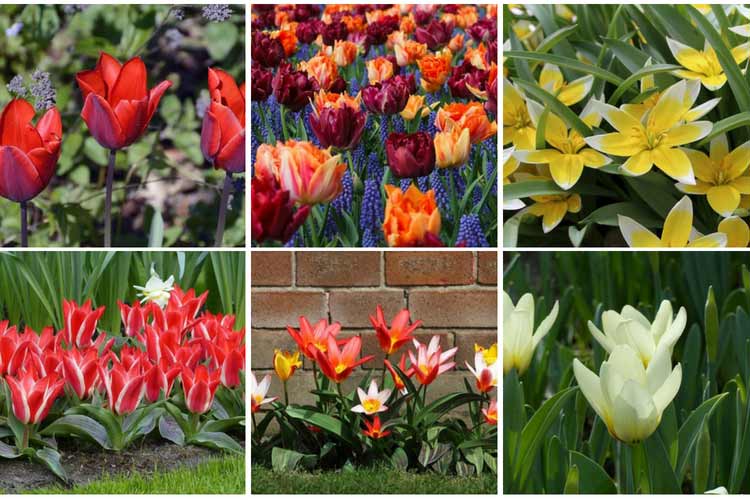 Early single tulip 'Couleur Cardinal' - Early double tulips 'David Teniers' and 'Willem van Oranje' (Murillo) - Tulipa tarda - Greigii tulip 'Plaisir' - Kaufmanniana tulips - Fosteriana tulip 'Concerto'[/caption>
April flowering, the heart of the tulip season
- The Triumph tulip, aptly named, was obtained by crossing an early single tulip and a late tulip, and blooms just in time in April. Triumph tulips now form one of the largest and most diverse groups. 'Attila', 'Princess Irene', 'Shirley', 'Gavota', 'Negrita'... are among the best-known and most appreciated. With an average height of between 40 and 50cm, varieties from this group offer great possibilities for use, in beds as well as in pots and as cut flowers.
- To obtain even more choices in tulips blooming in April, it is also possible to "pick" from the neighbouring groups of parrot tulips and lily-flowered tulips, whose varieties share only their shape. Some are indeed derived from natural mutations of 'Triumph' tulips and have thus changed shape while retaining the same flowering time, such as 'Princess Irene Parrot' for example. 'Ballerina', with orange lily-shaped flowers and a fragrance, also always blooms in the second half of April in my garden.
- The tallest of the "botanical tulips", those measuring about 30cm high, are also in bloom in April: Tulipa praestans, Tulipa whittallii, and the rare and beautiful Tulipa orphanidea 'Flava', to name just a few.
 Triumph tulip 'In Love' - Triumph tulip 'Princess Irene' - Parrot tulip 'Irene Parrot' - Lily-flowered tulip 'Ballerina' - Tulip praestans 'Shogun' - Tulipa orphanidea 'Flava'[/caption>
In bloom from late April to mid-May, the late tulips
- The "Darwin" tulips, with large flowers appearing in late April on strong stems that are 50 to 60cm long, are excellent reliable and sturdy garden varieties, always spectacular, but not always to everyone's taste with their pure and contrasting colours ranging from yellow to red, highlighted by a large black heart at the base of the petals ('Apeldoorn', 'Golden Apeldoorn'...).
- The late single tulips, also called "cottage" or "long-stemmed" tulips, reaching 60cm in height or more, and their counterparts, the late double tulips or "peony-flowered" like 'Angélique', bloom in early May. They are the undisputed queens of bouquets! Many varieties are indeed French creations developed for the production of very high-quality cut flowers in the South: 'Avignon', 'Dordogne', 'Ollioules', and of course 'Roi du Midi' are among them.
- The "original" tulips: frilly parrot tulips, elegant lily-flowered tulips, delicate lace or fringed tulips, and fascinating viridiflora tulips like 'Groenland' or 'Spring Green' with flowers striped with a central green band, should be planted in well-maintained beds as these horticultural creations are not always the most resilient.
- Tulipa sprengeri: the exception that confirms the rule, this highly sought-after botanical tulip is always the last to bloom, in June! Its red-orange flowers with slightly pointed petals are both unexpected, elegant, and spectacular. Very rare, it naturalises easily in the sun, provided it is never disturbed by soil work.
 Darwin tulip 'Apeldoorn' - Darwin tulips 'Van Eijk' - Late single tulip 'Avignon' - Late double tulip 'Fantasy Lady' - Parrot tulip 'Blue Parrot' - Tulipa sprengeri[/caption>
2) Choosing tulips according to your soil type
While they thrive in all soils, tulips prefer rich, loose, well-drained soils, warm in summer, without stagnant moisture in winter, with a neutral to alkaline pH (calcareous).
- In a "good garden soil", black and rich, loamy or clay-loamy, as long as there is drainage, all fantasies are allowed, choose at your leisure! You can even leave the bulbs in the ground over winter, without any qualms, except for the most fanciful varieties, your tulip bulbs will return more numerous year after year. If this is the case in your garden, go directly to point 3!
- In heavy clay soil, "sticky" and clinging to fingers and tools... it’s a different story! You can only grow tulips in beds with enriched and amended soil with compost and sand, well worked each year, and on the condition of lifting the bulbs at the end of flowering before drying them for replanting the following autumn. Even doing this, some varieties exhaust themselves faster than others, and you will need to buy new bulbs more often. Of course, you can always circumvent the problem by planting the most precious varieties in pots!
 If you have very heavy clay soil, waterlogged in winter, prefer tulips in pots!
- In dry and light soil, sandy, poor, or if your soil is calcareous and shallow, as well as in rockeries, turn to botanical tulips. They take up little space, naturalise, and do not degenerate. Due to their wide range of origin, there is always a species whose growing conditions in nature will be close to those of your garden.
 In dry and light soil, poor in nutrients, or in rockeries, small botanical tulips will be your best allies!
3) Choosing tulips according to your garden style
Obvious, you might say? Once you’ve passed the filters of flowering time and soil, you still have to pass a subjective filter, that of your style and your tastes! Classic or contemporary, natural, mineral, small, large, English, French... there's a tulip for almost every garden style, except perhaps the traditional Japanese garden! Not to mention that their possibilities for association are exponential....
- In a contemporary style garden, opt for tulips with well-defined shapes, clean and elegant lines, such as lily-flowered tulips like 'White Triumphator', simple varieties with perfect shapes like 'Maureen', and viridiflora like 'Spring Green'. Add contrast with the black of 'Reine de la Nuit' or 'Fontainebleau' and even 'Dream Touch' for a classic black and white combination. It’s often overlooked, but botanical tulips can also fit well in this style of garden: look towards Tulipa polychroma or Tulipa whittallii whose shapes remind me of some great works of contemporary architecture...
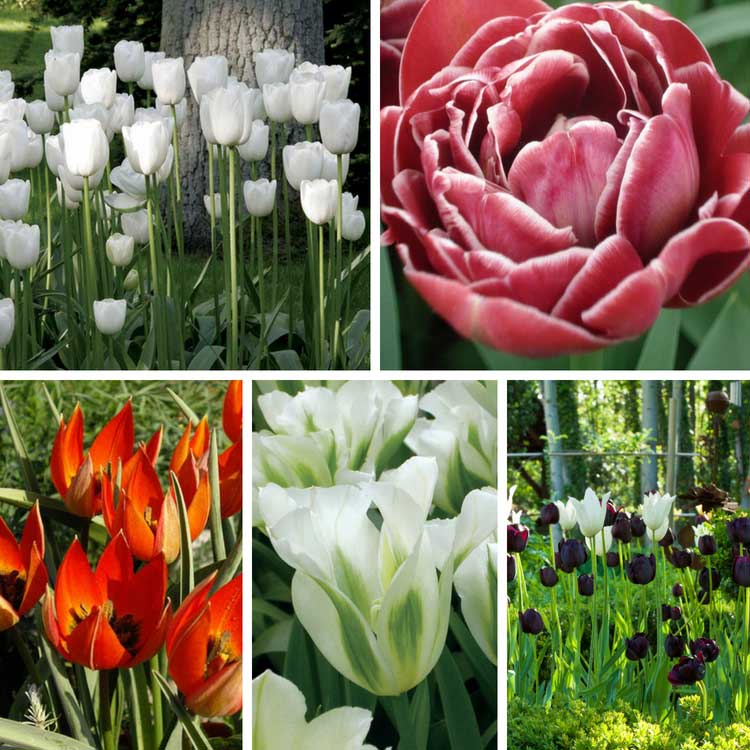 Tulip 'Maureen' - Tulip 'Dream Touch' - Tulipa whittallii - Viridiflora tulip 'Spring Green' - Contrasting tulips: 'White Triumphator' and 'Reine de la Nuit'
- In a romantic style garden, the frills of double flowers, triples, quadruples! The charm of soft colours, pink, mauve, lilac, spotted, the lace of fringed tulips... By combining early and late varieties, it’s easy to have double tulips in bloom for weeks. The eternal 'Angélique' and the precious 'Diamant Bleu' are must-haves to accompany the lesser-known 'Daytona' and 'Huis ten Bosch' in lace, 'Silver Parrot', 'Burgundy'... in a setting of forget-me-nots and fragrant lilacs!
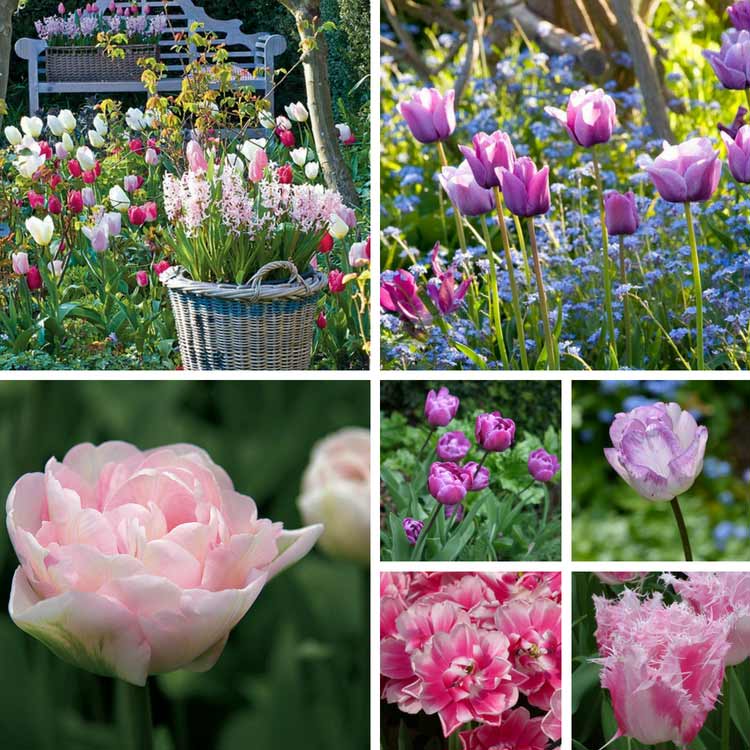 Tulips 'Jazz', 'Synada Amor', 'Page Polka', 'Christmas Dream' and 'Flaming Purissima' create a romantic atmosphere with pink hyacinths - Tulips and Myosotis - Double tulip 'Angélique' - Tulip 'Diamant Bleu' - Triumph tulip 'Shirley' - Early double tulip 'Columbus' - Fringed tulip 'Huis ten Bosch'
- In a natural or naturalistic garden, who said that only perennials and grasses should have a place? The lightness of botanical tulips like Tulipa turkestanica, Tulipa bakeri 'Lilac Wonder', Tulipa clusiana will naturally impose themselves, if I may say so! However, more classic and even almost sophisticated tulips, if well used, planted at controlled densities, will blend in with the brilliance of the greatest virtuosos! For yes, alongside the rose, the tulip is indeed one of the most virtuosic genera we can cultivate in our gardens...
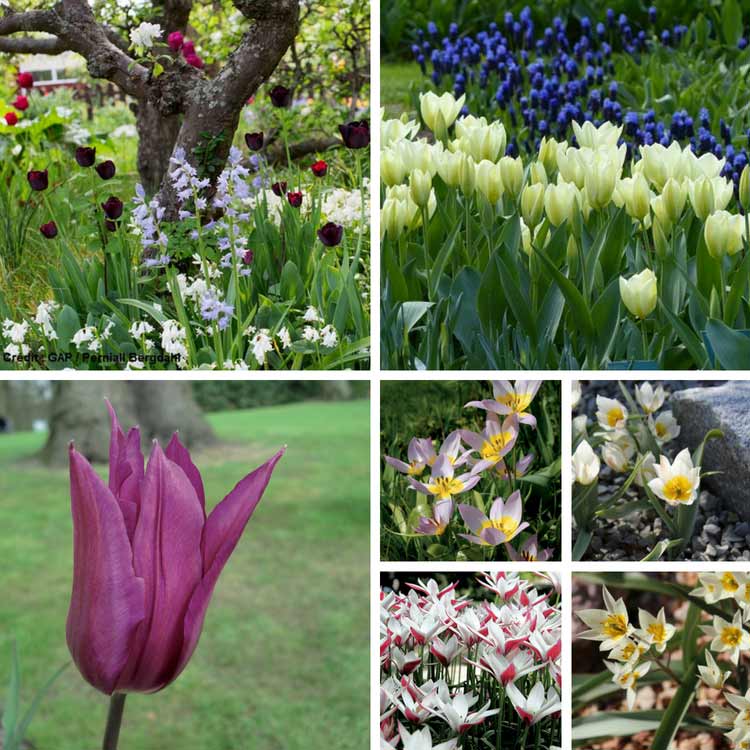 Planted sparsely, these 'Reine de la Nuit' tulips respect a natural effect alongside wood hyacinths - Fosteriana tulips 'Purissima' with Muscari latifolium - Tulip 'Burgundy' - Tulipa bakeri 'Lilac Wonder' - Tulipa polychroma - Tulipa clusiana 'Peppermint Stick' - Tulipa turkestanica
A light mist enveloped the garden this morning… After a surprise heatwave, is autumn already showing its first signs? Anyway, I won’t talk about the weather, but about a topic just as vast: tulips! It’s the start of the bulb planting season, and the question arises: which tulip to choose from the hundreds of varieties […]
In its September issue, Gardens Illustrated dedicates several pages to hardy geraniums and presents the 21 best varieties.
Among this curated selection, there are many British cultivars, of course, but also excellent varieties available in our catalogue: the must-have 'Rozanne', my personal favourite: the hardy geranium 'Clos du Coudray', as well as 'Lilac Ice', 'Sirak', 'Dragon Heart', 'Tiny Monster', 'Carol', 'Orion', and 'Havana Blues'.
Here they are in pictures:
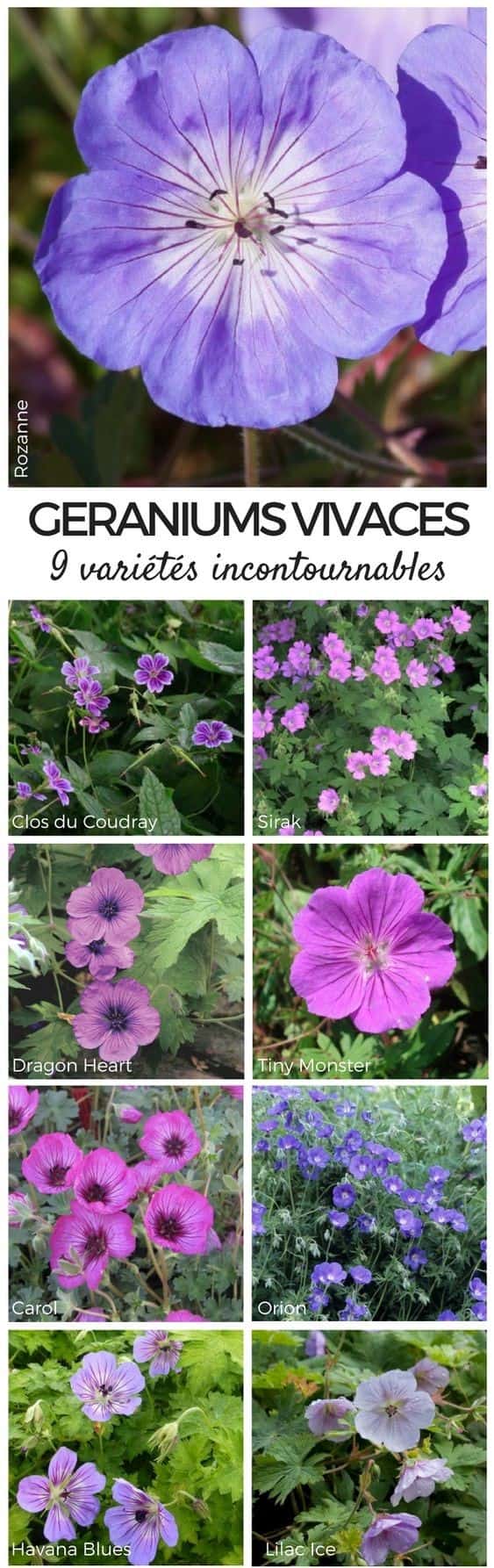
The ideal time to plant them in the garden will be here very soon. Which ones will you choose?
In its September issue, Gardens Illustrated dedicates several pages to hardy geraniums and presents the 21 best varieties. Among this curated selection, there are many British cultivars, of course, but also excellent varieties available in our catalogue: the must-have ‘Rozanne’, my personal favourite: the hardy geranium ‘Clos du Coudray’, as well as ‘Lilac Ice’, ‘Sirak’, […]
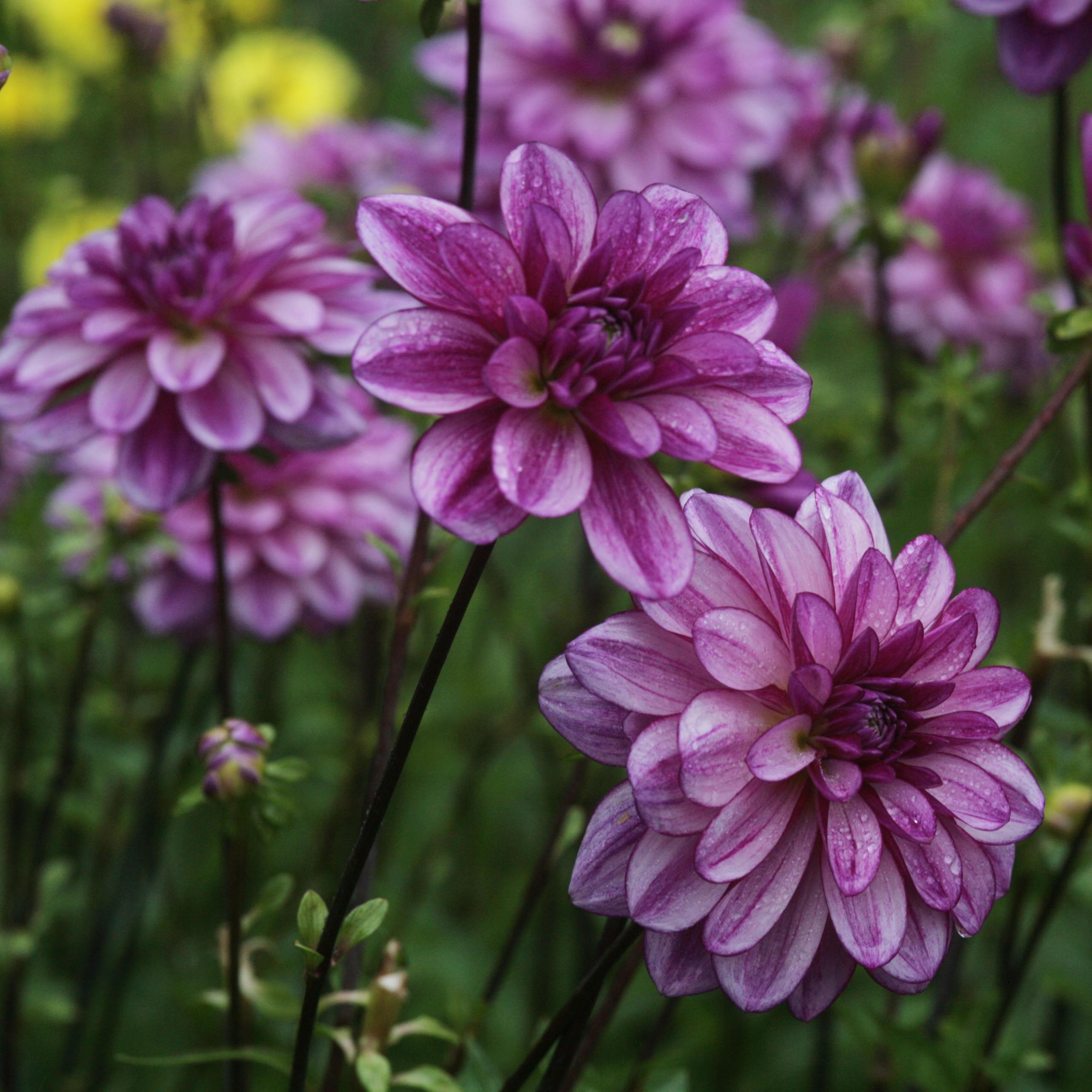 About dahlias, it used to be simple, almost black and white :
- either you cautiously sided with the majority and hated them,
- or you more or less proudly owned your taste for this 'grandmother's flower' and were, at best, seen as eccentric, at worst, as tacky.
Those days are over! The dahlia has finally come out of disfavour and confirmed its big comeback.
And if I applaud, it’s because justice has been done: easy to grow, it offers profuse, long-lasting flowering, it is as splendid in the garden as in a cut flower arrangement, it comes in a multitude of shapes and colours... and above all, it suits every garden style.
3 (modern) ways to use dahlias in the garden :
Traditionally planted in « mixed borders » and in unassuming spots, such as vicar's gardens or around vegetable plots, dahlias are equally perfect in many different settings, because they can also:
1) Pep up and colour expanses of grasses in naturalistic beds
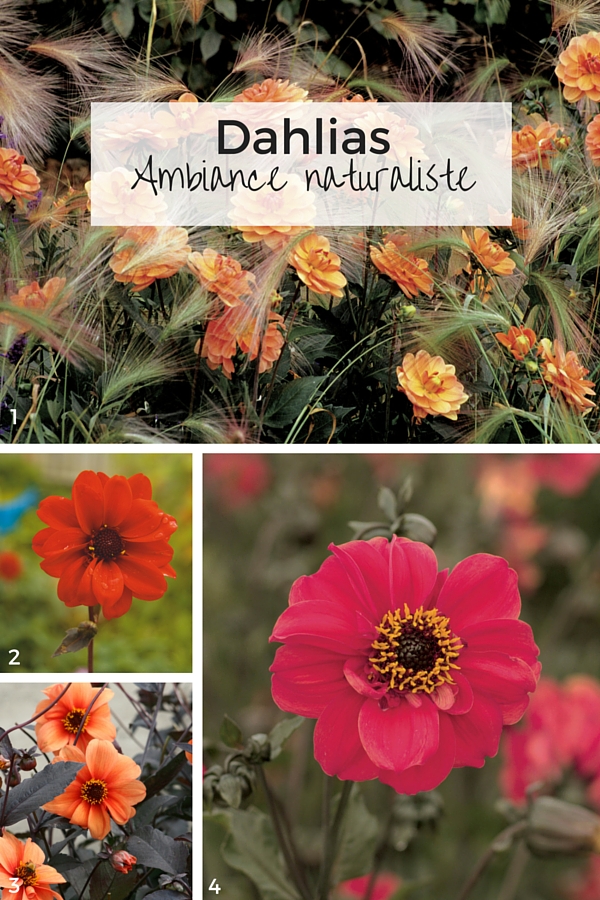
In order: Dr Ph. Riedell - Bishop of Landaff - Catherine Deneuve - Bishop of Canterbury
2) Shine with pure radiance within elegant white gardens...
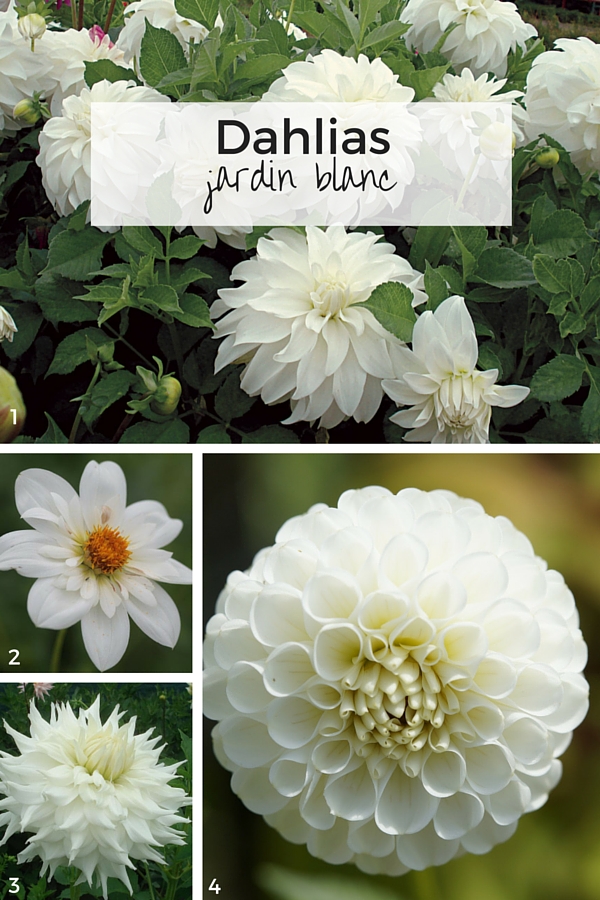
In order: Lady Liberty - Bride's Bouquet - Klondyke - White Pompon
3) Surprise with their whimsy, draw the eye with the precision of their geometry and mesmerise with their mystery in bold, modern, graphic scenes :
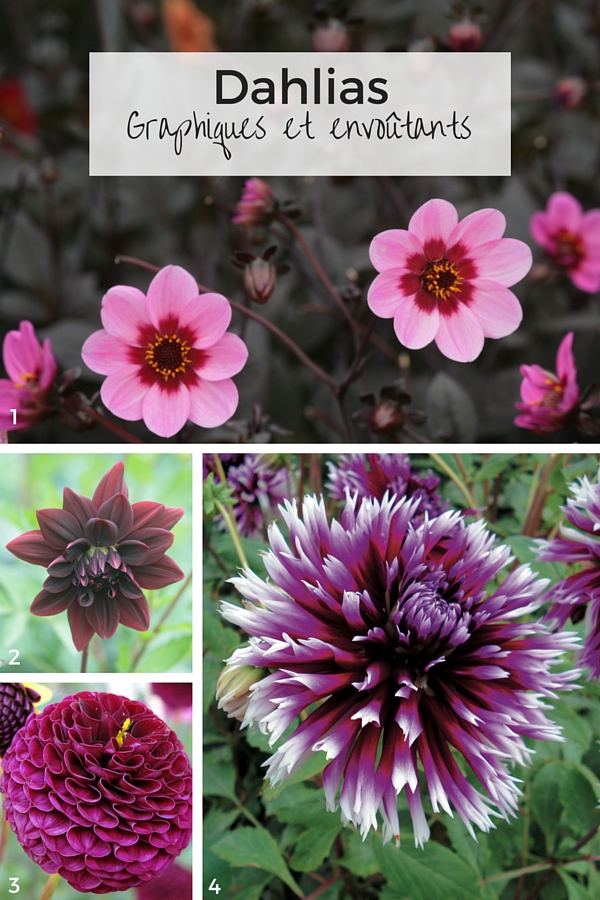
In order: Happy single Juliet - Sam Hopkins – Rocco – Clair Obscur
And while some regret that you have to lift them in autumn, I see this rather as an advantage: it’s an excellent opportunity to divide them (very handy when gardening budget is inversely proportional to garden size), but also to change their position each year and so vary the pleasures. Note that this operation isn’t always necessary in mild climates. Protected under a thick mulch, they can quite happily remain in the ground.
As you’ve probably gathered, this year, for us, it’s « all out for dahlias! » (they’ve been pre-sprouting in the greenhouse for a few days; I’m eagerly awaiting their awakening).
And you? Dahlias in your garden? What are your favourite varieties? Your reliable performers and your favourite picks?
PS: As an anecdote, I had left to my future mother-in-law (love of risk...) the task of choosing my wedding bouquet. Two hours before the ceremony, when it was presented to me, I thought I’d faint: it was largely made up of cactus dahlias, chick-yellow to boot! The village florist, ordered to make another bouquet with what he had to hand and in 15 minutes flat, must still remember it… Only fools never change their minds, right?
Growing dahlias :
Our advice sheets: Succeeding with your Dahlias - How to grow beautiful dahlias - Dividing dahlias
Admire dahlia collections :
- at the Parc Floral de Paris (75) - France’s largest dahlia competition
- at the Parc Floral d'Orléans-La Source (45) – from August to October
- at the Lycée nature de Coutances (50) - Dahlias and Gardens festival in September
About dahlias, it used to be simple, almost black and white : – either you cautiously sided with the majority and hated them, – or you more or less proudly owned your taste for this ‘grandmother’s flower’ and were, at best, seen as eccentric, at worst, as tacky. Those days are over! The dahlia has finally […]
It's not too late to plant tulips! In fact, that's my plan for this weekend in the garden, encouraged by the beautiful weather... Every year, I try a new colour harmony in my "sanctuary" bed of annuals and biennials, but I've also scattered a few hundred among clumps of perennials that I don't dig up each year. Over time, I've been able to identify the best varieties for my garden: the most reliable and easiest to pair, along with a few "favourites" for which I willingly forgive a shorter lifespan... Here’s my "Top 15" list of tulips from my garden:
1. Discovered in the "Carnival of Venice" collection years ago, I can't do without it! Solid as a rock, the Triumph tulip 'Jan Reus' multiplies and returns more beautiful each spring in all the spots in the garden where I've planted it. I love its deep, powerful red-brown colour, which has a sober elegance and pairs well with any other colour.
Triumph tulip 'Jan Reus'
2. Undoubtedly one of the best white tulips, 'Purissima' is an early variety, with its large goblet-shaped flowers appearing as early as April. When in full sun, they open completely, revealing a grey-blue stigma set against a bright yellow halo. Close to its wild origins, this tulip from the fosteriana group is very, very hardy. If you adopt it, it will never disappoint you.
Fosteriana tulip 'Purissima'
3. The Triumph tulip 'Barcelona' is a mid-season variety, vigorous and quite tall, with beautiful bright pink flowers radiating brightness. I've had it in place for 10 years alongside the purple 'Negrita' and the black-purple 'Queen of the Night', accompanied by large clumps of bleeding hearts (Dicentra spectabilis) and the young, tender green foliage of daylilies as a backdrop.
Triumph Tulip 'Barcelona'
4. Speaking of which, here’s the famous black tulip 'Queen of the Night': a classic often imitated, never equalled. Long stems for bouquets or as second and background plants in beds where its dark colour enhances the depth effect. Mid-late flowering, it blooms between the "Triumph" and the very late varieties like the lily-flowered or viridiflora tulips.
Late single tulip 'Queen of the Night'
5. The botanical tulip Whittallii, a group of tetraploid clones with large brick-orange flowers in the species Tulipa orphanidea, is a beautiful specimen for a wild tulip, standing at 30 cm tall. Its slender stems elegantly bend under the weight of the very graphic flowers, with pointed tepals arranged in a cup shape. Perfect in a warm corner of the garden, near the acid green and spring-like euphorbias, for example.
Tulipa orphanidea Whittallii (botanical)
6. The lily-flowered tulip 'White Triumphator', the perfect embodiment of chic. Its height, well-rounded shape, and the purity of its colour give it an incomparable presence. Late-flowering, I love to plant it alongside other late white bulbs like 'Thalia' or 'Piper's End' daffodils and Ornithogalum magnum with spike-like flowers to vary the forms. In my garden, I have to replant it a bit more often than the others, but it's worth it!
Lily-flowered tulip 'White Triumphator'
7. From the same group as the previous one, the elegant 'Ballerina' is unmatched for brightening up a spring bed. Its slender carrot-orange lily flowers, held high and fragrant, I don't hesitate to sprinkle them in the heart of pink-purple or blue-lilac harmonies to satisfy a colour appetite cruelly sharpened by the winter months.
Lily-flowered tulip 'Ballerina'
8. The Triumph tulip 'Negrita', with its large violet-purple flowers, is absolutely essential for creating a white-pink-purple gradient like in the "clair-obscur" harmony. A bit shorter on the stem than the other tulips of this season, it also adds dynamism to the combinations by varying the heights.
Triumph tulip 'Negrita'
9. I am literally melting for the caramel-orange colour of the tulip 'Cairo'. It’s a recent variety that has quickly gained popularity among gardeners, and it's easy to see why. This robust mid-season tulip, with its large well-formed flowers and wide rounded tepals, brings a true novelty in its colour, a blend of orange with a hint of brown pigments.
Triumph tulip 'Cairo'
10. Like a blue diamond, or rather amethyst, the double tulip 'Blue Diamond' is an excellent ambassador for this rare and elegant "blue" colour, unique among tulips. Despite its double petals making it a bit more demanding, it’s a proven variety, and its flowers are not too heavy to droop towards the ground at the first rain.
Late double tulip 'Blue Diamond'
11. 'Menton', as its name suggests, is a French variety grown in the South for producing very high-quality cut flowers. In the garden, it’s an extremely robust variety that delights me every spring with very large flowers of an impossible-to-define salmon colour.
Long-stem tulip 'Menton'
12. I don't know of a purer pink colour among tulips than that of 'China Pink', which makes it very precious to me despite its somewhat fragile nature. Not to mention the unparalleled refinement of the shape of its flowers. Each flower is a condensed essence of spring freshness!
Lily-flowered tulip 'China Pink'
13. I was surprised to find myself loving the tulip 'Ballade' after using it in a harmony of mauve and lilac tones. As much for its pink-lilac colour edged in white and -once in a while- its elegant lily flower shape, I particularly appreciate its robustness and longevity.
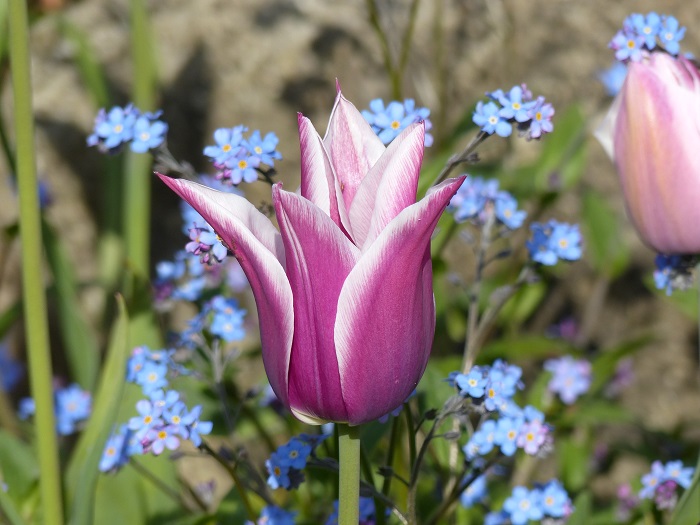
Lily-flowered tulip 'Ballade'
14. I still wonder what made me plant the tulip 'Fontainebleau' the first time, but I have come to appreciate its purple-black colour with a white edge, as it has not chosen to exhaust itself and disappear from the garden. By a happy coincidence, it fits well into a slightly more graphic atmosphere than the rest of my garden, with yuccas and grasses, far from the other colourful tulip varieties.
Triumph tulip 'Fontainebleau'
15. And to finish, a great originality with the variety 'Yellow Crown', with the soft colour of true butter yellow, and tepals folded in on themselves, making each flower resemble an origami creation. Although I planted them "just out of curiosity", I was surprised, and indeed delighted to see these tulips return faithfully every year since.
Tulip 'Yellow Crown'
It’s not too late to plant tulips! In fact, that’s my plan for this weekend in the garden, encouraged by the beautiful weather… Every year, I try a new colour harmony in my “sanctuary” bed of annuals and biennials, but I’ve also scattered a few hundred among clumps of perennials that I don’t dig up […]
Who has not noticed after several years of planting that the beneficial shade of the tree, once so small, became increasingly dense, while the nearby plants dwindled in favour of the tree in question?
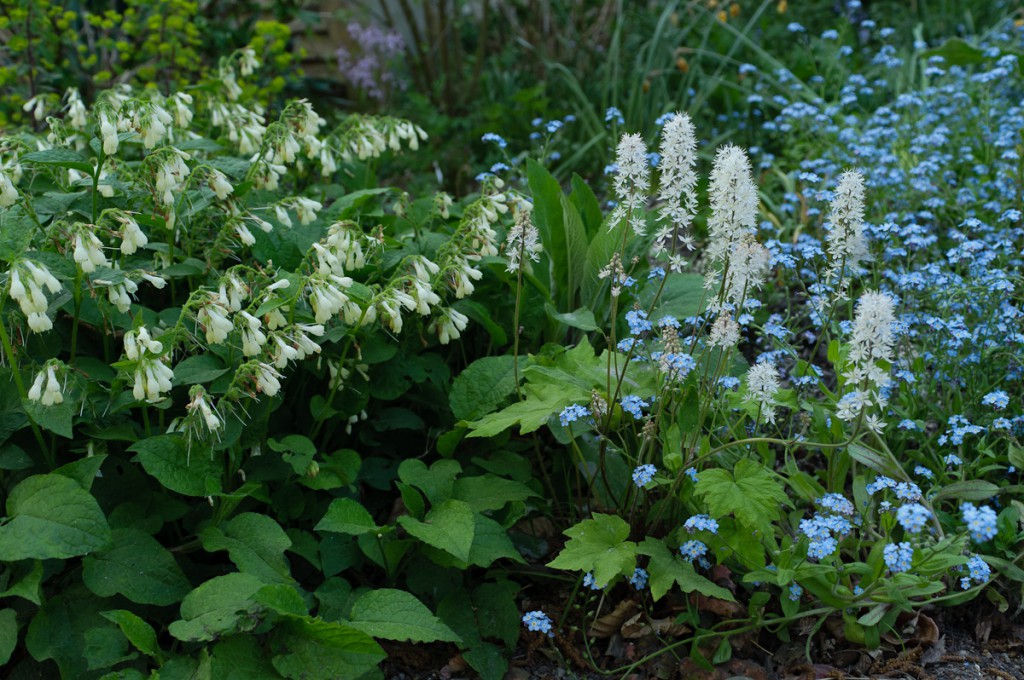
Tiarellas and large-flowered comfrey
While in winter, light and water penetrate at the base of trees, by early summer, the soil, colonised by roots, dries out and light only sporadically reaches it, a condition known as dry shade. Perennial plants have developed various strategies to thrive in these challenging conditions; Geranium macrorrhizum and large-flowered comfrey (Symphytum grandiflorum) anchor themselves in the soil with a few large roots, while their rhizomes spread out, exploring the surface and re-rooting whenever conditions are favourable. Acanthus mollis "vegetates" in summer and takes advantage of autumn and winter rains to flourish. The Podophyllum peltatum, on the other hand, boasts lush foliage in spring and enters dormancy in mid-summer when moisture becomes scarce.
In these challenging conditions, these plants will need water during the first year of planting to develop a robust root system. By the second year, they will require no further maintenance and will form beautiful carpets in the dry shade of trees.
Who has not noticed after several years of planting that the beneficial shade of the tree, once so small, became increasingly dense, while the nearby plants dwindled in favour of the tree in question? Tiarellas and large-flowered comfrey While in winter, light and water penetrate at the base of trees, by early summer, the soil, […]
For many years, hellebores were limited to the traditional white Christmas Rose, but for over a decade now, numerous varieties with vibrant colours have emerged. Here is a selection of the most beautiful varieties currently in bloom in our greenhouses.
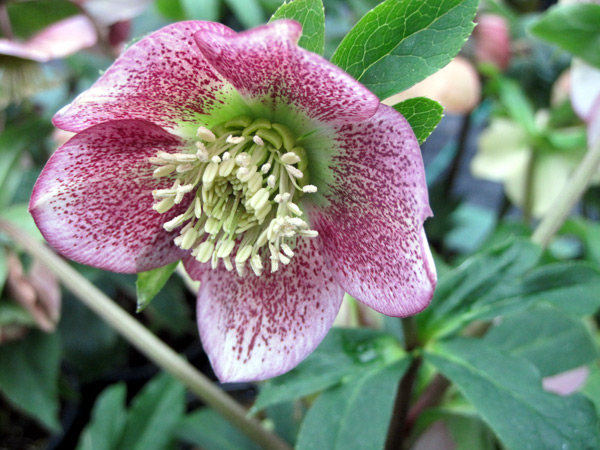
Oriental Hellebore guttatus Pink
The most popular and colourful hellebores are derived from cross-breeding and selection of the Oriental Hellebore, and now almost all colours and flower shapes are available. They are as easy to cultivate as the Christmas Rose (Helleborus niger), but bloom a little later, around March-April, and require a partially shaded position and rich, humus-rich soil.
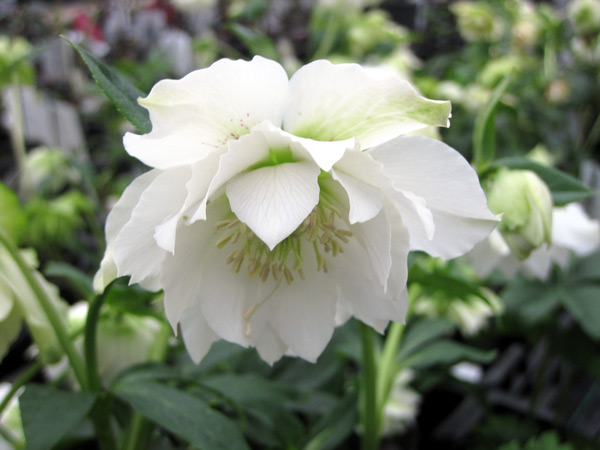
Oriental Hellebore Double White
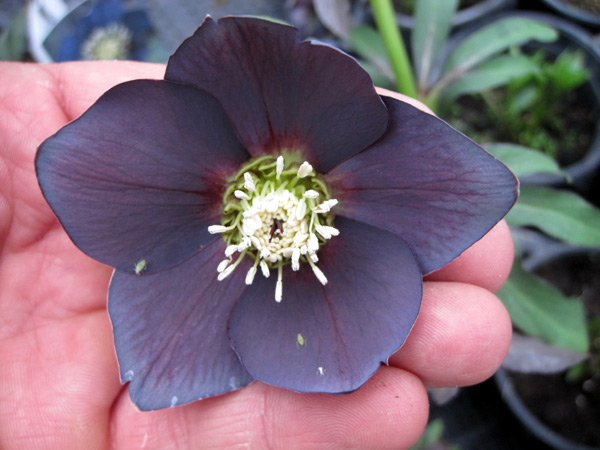
Oriental Hellebore Black
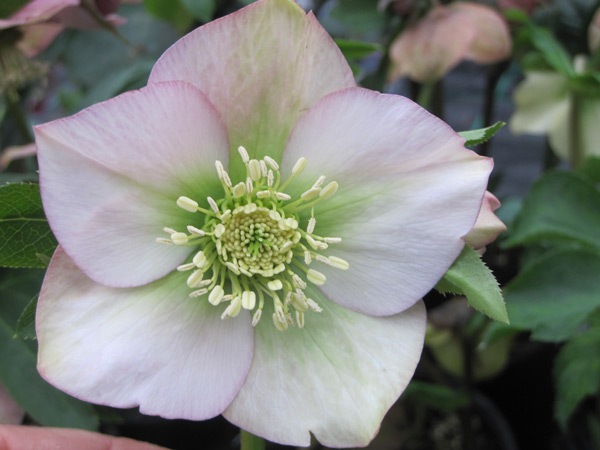
Oriental Hellebore Apricot
At first glance, the name of this variety is a bit misleading; just observe the underside of the petals to understand why it was named this way.
Oriental Hellebore Apricot, in this variety it is not the inside of the flower but the outside that makes it unique.
Oriental Hellebore White with Red Centre
While the Oriental Hellebores are renowned for their flowers, the hellebores sternii and nigercors, both resulting from inter-species cross-breeding, are known for their ornamental leaves and great adaptability. Indeed, these hellebores have evergreen leaves, often variegated with grey and silver, and both tolerate drying and calcareous soils. The (x) sternii hellebores are the result of crossing the Corsican Hellebore (Helleborus argutifolius) and the Livid Hellebore (Helleborus lividus) from the island of Majorca. They therefore cope very well with heat, draining and drying soils but are a bit more sensitive to cold than the Oriental Hellebores; they are primarily cultivated for their colourful and graphic leaves. They should be planted in a shady rockery or a dry, mineral bed, with botanical tulips and small gramineous perennials: fescues, carex, ophiopogon.
Hellebore sternii Remi
The hellebores (x) nigercors are the result of crossing the Christmas Rose (Helleborus niger) and the Corsican Hellebore (Helleborus argutifolius). They are similar in every way to the sternii hellebores, with the only difference being that they are hardier but also have flowers, often large, in a wide range of white and pink shades; some varieties, like Candy Love, even appear bicoloured.
Hellebore nigercors Magic Leaves (Detail of the flower: here the petals are white and lime green)
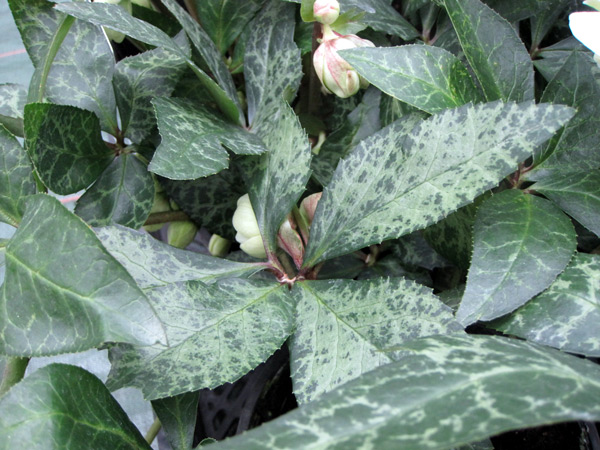
Hellebore nigercors Magic Leaves (Detail of the foliage)
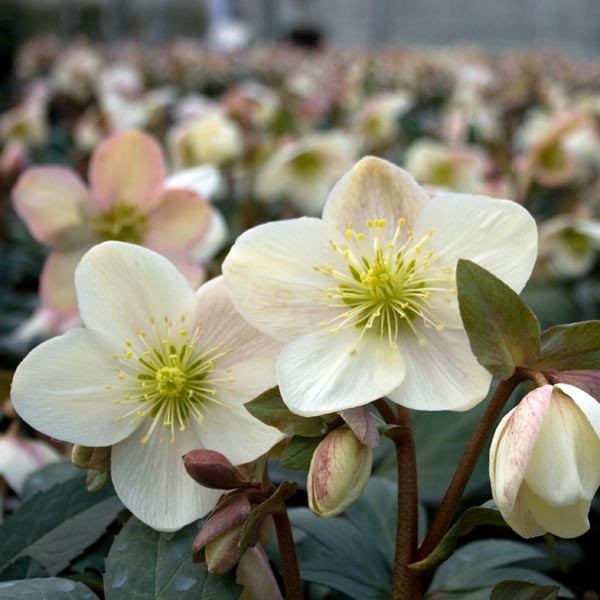
Hellebore nigercors Candy Love, the most floriferous hybrid at the moment. Its flowers, initially white, gradually turn pink in a wide range of shades.
From north to south, from the dry Mediterranean climate to the humid oceanic climate, hellebores will be chosen and planted according to the nature of the soil and the type of climate. The Oriental Hellebores are not afraid of cold or heavy soils, making them well-suited for a good part of the northern France. The hellebores sternii, on the other hand, thrive in heat and calcareous soils and are a bit less hardy than the Orientals, making them better suited for the southern France. As for the hellebores nigercors, they are very adaptable and accept almost all climates, without excessive heat, calcareous conditions, or cold!
For many years, hellebores were limited to the traditional white Christmas Rose, but for over a decade now, numerous varieties with vibrant colours have emerged. Here is a selection of the most beautiful varieties currently in bloom in our greenhouses. The most popular and colourful hellebores are derived from cross-breeding and selection of the Oriental […]
The Geranium Catherine Deneuve is a new variety that, contrary to appearances, is extraordinarily floriferous.
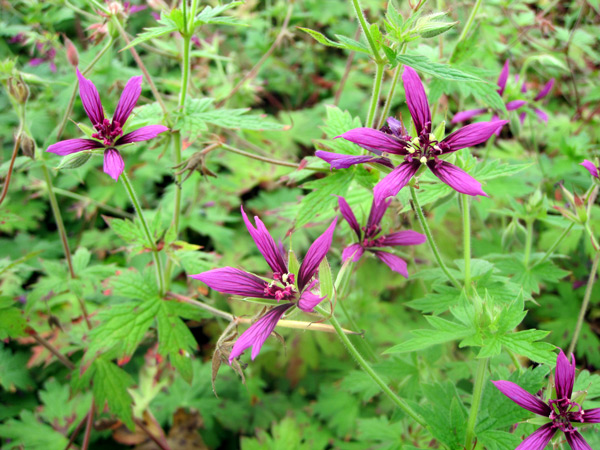
Geranium Catherine Deneuve
In flower since June, this hardy geranium continues to surprise me. With its star-shaped flowers, I initially thought, upon seeing it in a photo, that it was derived from a geranium (x) oxonianum, resembling the very classic Geranium oxonianum f. thurstonianum (a variety once widely used in the shady corners of mixed borders and gradually replaced by more floriferous hybrids).
However, upon examining it more closely, I was pleasantly surprised to discover that this selection is derived from geranium psilostemon, the parent of the famous Geranium 'Patricia' and G. 'Dragon Heart', a rather enticing detail considering the floribundity of these geraniums. Finally, while cultivating it, I find that this new geranium, perhaps slightly less floriferous than the previously mentioned varieties, has an astonishingly long flowering period. In flower since June, the inflorescences keep renewing, and last year it was still in bloom in November!
The small size of the flowers certainly explains this performance; its reduced petals require fewer resources, allowing the plant to exhaust itself less quickly and renew its flowers more rapidly. It strikes a perfect balance between flower size, abundance, and flowering duration—truly a wonderful new addition that deserves its place in our gardens.
The Geranium Catherine Deneuve is a new variety that, contrary to appearances, is extraordinarily floriferous. In flower since June, this hardy geranium continues to surprise me. With its star-shaped flowers, I initially thought, upon seeing it in a photo, that it was derived from a geranium (x) oxonianum, resembling the very classic Geranium oxonianum f. […]
At the start of autumn, landscapes are marked by the presence of colourful bushes here and there. Upon closer inspection, it is not the flowers that catch the eye at this time of year, but rather the fruits. Certain botanical families, such as the Rosaceae, which include the hawthorns lining our roads, are even specialists in fruiting. But they are not the only ones! Many other families boast ornamental fruit shrubs. These are valuable allies for adding colour and life to the garden at the end of the season and can be used as hedges, in borders, or as standalone specimens.
Here is my personal, though not exhaustive, selection of the best ornamental fruit shrubs for autumn.
1) Ornamental Apple Trees
We love ornamental apple trees for their abundance of flowers in spring, but also for the profusion of fruits that follows in autumn. As big as cherries, edible but only appreciated by birds, they display very colourful fruits, green, yellow, orange, or ruby red, depending on the varieties.
Hardy and easy to care for, these decorative apple trees are not demanding. They thrive in full sun and ordinary soil, although they prefer rich, deep, loose, and cool soils.
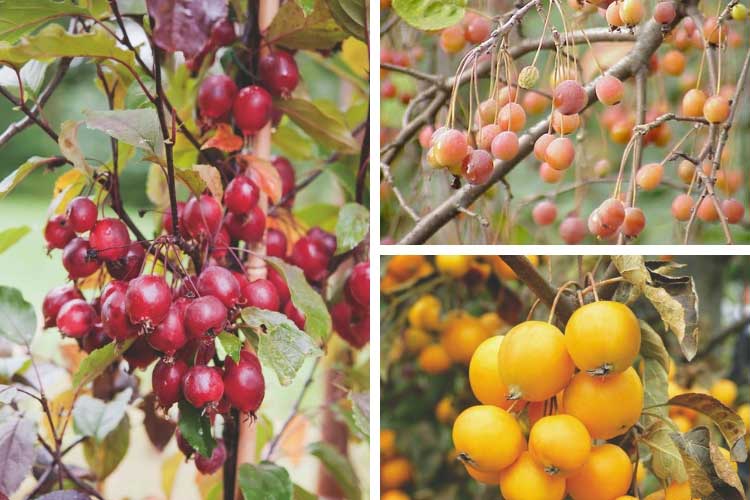 The fruits of Malus Red Obelisk and Malus Golden Hornet (after and before frost): two very interesting varieties!
2) Sorbus Trees
Very famous, the rowan tree (Sorbus aucuparia) is a small tree that literally covers itself with clusters of small bright red fruits at the end of the season. They persist on the tree for quite a while and feed the thrushes. Less common in cultivation, the Kashmir rowan (Sorbus cashmiriana) is almost unnoticed in gardens, as its spring flowering is quite discreet. But this is not the case with its superb milky white fruits, which appear from September to November!
Both of these rowans can be planted in any soil, fresh to moderately dry, acidic, neutral to slightly calcareous, but well-drained. They prefer full sun but will tolerate partial shade.
 The fruits of the very famous rowan tree (Sorbus aucuparia) / The fruits of Sorbus cashmiriana, the rarer variety
3) Cornus Kousa
Much better known for its large flower bracts, Japanese dogwood (Cornus kousa) produces beautiful pink fruits, resembling lychees. This hardy shrub grows perfectly well in our climates. However, it particularly enjoys rich, slightly acidic, cool, well-drained soils and light shade in hot climates.
 The decorative fruits of Cornus kousa
4) Clerodendron
It is when covered with its small fruits the size of currants that we understand why this shrub has been named "the tree of turquoises" (Clerodendrum trichotomum). Dark blue when ripe (more than turquoise…), its fruits sit on a pink-red calyx, like pearls in their settings.
Also known as "Clergy Tree" or "Tree of Fortune", this shrub requires very little maintenance. It can be planted in partial shade or full sun, in fresh, well-drained soil. Left to grow freely, it is perfect for hedging. Trained as a tree, it will form a remarkable specimen when isolated.
 The berries of the Clerodendron are like pearls in their setting
5) Viburnums
Viburnums include a large number of fruit-bearing varieties, among which the Viburnum opulus or Guelder rose, much better known for its spring white flowers than for its autumn orange-red fruits. By the way, do not expect anything from the "snowball" viburnum (Viburnum opulus 'Roseum'), its flowers are beautiful but sterile and therefore do not produce any fruits.
Equally interesting for its evergreen foliage and ivory-white flowers, the Viburnum (x) hillieri 'Winton' is a true marvel in autumn when its elongated, intense red fruits appear.
Rather accommodating, viburnums adapt to a fairly wide range of soils. They thrive best in rich soil that remains cool in summer but well-drained in winter. Partial shade is ideal for their exposure.
 Viburnum opulus and Viburnum (x) hillieri 'Winton'
6) Callicarpa
The Callicarpa, known as the "candy tree" is a shrub that has made its fruits its trademark! It is remarkable from the beginning of autumn when its small flowers give way to a multitude of small purple balls, a very rare colour in the plant world. It reaches its peak in winter when it is completely bare.
In the garden, whether in borders or hedges, it should be planted in full sun (to encourage fruiting) except in hot climates where it will be more comfortable in partial shade. This shrub prefers rather cool, rich soil, but a bit of compost and a good layer of mulch allow it to be grown almost anywhere in France.
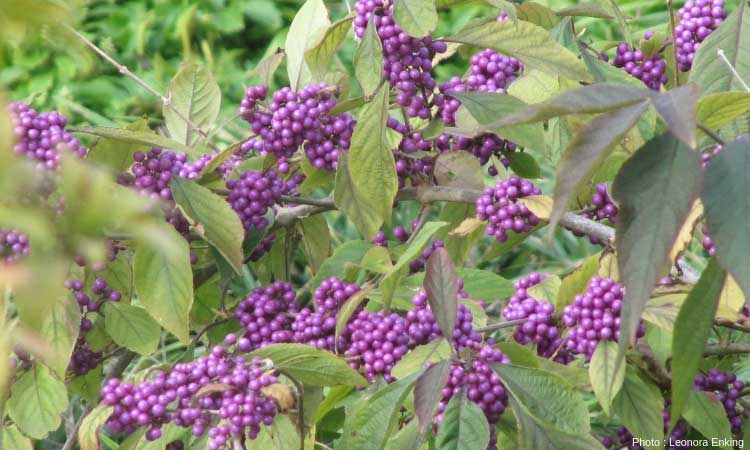 Callicarpa bodinieri 'Profusion' is a small shrub that remains discreet for much of the year, waking up in autumn to offer beautiful purple fruits
7) Decaisnea Fargesii
In the realm of bizarre and original fruiting, the Decaisnea fargesii stands out with its funny turquoise pods in autumn. You won’t be surprised to learn that it is also called the "blue bean tree"! This small shrub, native to China, with its tropical plant appearance, is well adapted to our cold climate. In spring, it produces cream-yellow flowers that transform in autumn into fleshy pods containing flat black seeds. They are surrounded by a translucent flesh with a surprising taste (a mix of watermelon and banana…), as it is indeed edible!
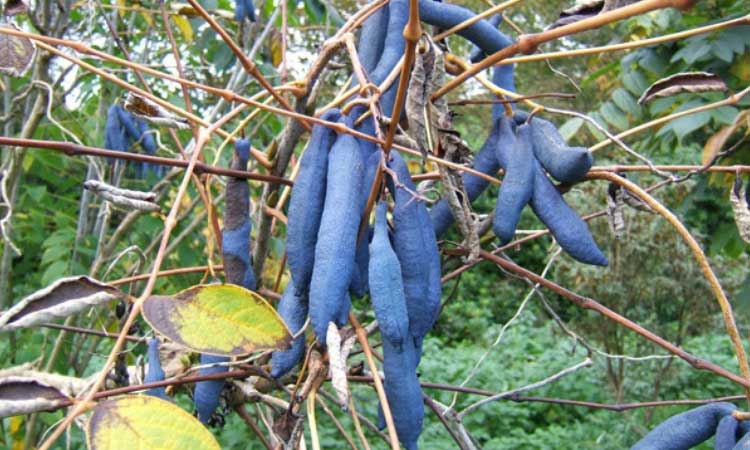 Decaisnea fargesii or "blue bean tree": a true curiosity in the garden!
8) Euonymus Phellomanus
While all these shrubs display beautiful spring or summer flowers, there is one shrub that, like the Callicarpa, showcases dazzling fruiting in autumn. This is the Euonymus phellomanus. This large spindle tree bears a multitude of candy-pink fruits. They gently release small orange-red seeds in early autumn. Hardy, it thrives in ordinary, humus-rich soil that is not too dry to fresh. Full sun or partial shade will suit it perfectly.
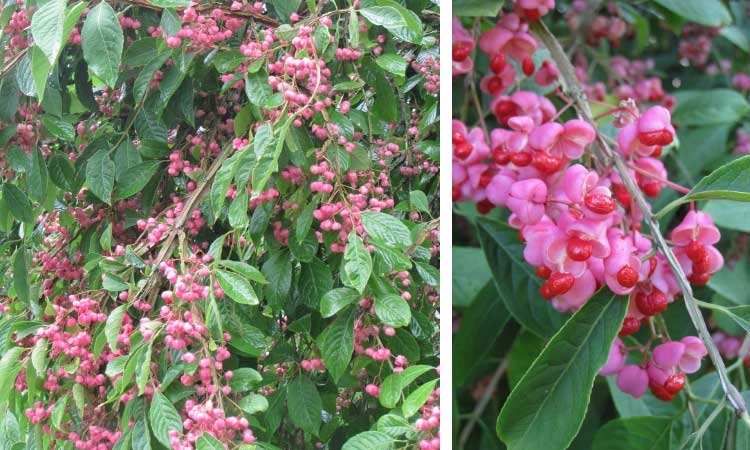 Euonymus phellomanus, remarkable fruits
All these shrubs contribute to the ornamental appeal of the garden in autumn and winter, but they also play a very important ecological role. A large number of bird and insect species feed on their berries in autumn and winter. This ecological niche is a valuable ally for the garden as it harbours many predators that, come spring, feast on snails, slugs, and various worms, thus preventing the gardener from having to resort to the indiscriminate use of various products.
At the start of autumn, landscapes are marked by the presence of colourful bushes here and there. Upon closer inspection, it is not the flowers that catch the eye at this time of year, but rather the fruits. Certain botanical families, such as the Rosaceae, which include the hawthorns lining our roads, are even specialists […]
This large and beautiful grass, unknown to the general public, closely resembles the very famous blue wheat, also known as Leymus arenarius. They share many similarities, including an upright habit, metallic blue foliage, and floral spikes, with one significant difference: Elymus magellanicus is a tufted grass, meaning that unlike blue wheat, it does not produce suckers and does not invade the beds in which it is planted.
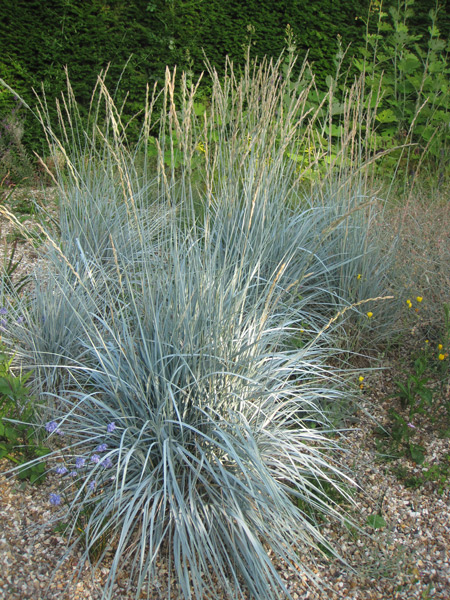
Elymus magellanicus is a solitary grass; it does not like to be smothered by other large perennials, preferring well-drained soils and sunny exposures.
This original grass does not produce suckers but self-seeds; it modestly colonises beds, but on one hand, its young seedlings can be easily uprooted, and on the other hand, to prevent its spread, it is always possible to cut its floral spikes. It thus possesses all the ornamental qualities required for gardens without the drawbacks that can be associated with invasive varieties.
For beautiful colour combinations, plant a carpet of Festuca glauca 'Elijah Blue' at its base, place a Perovskia 'Blue Spire' behind it, and scatter bulbs of Allium moly (with yellow flowers) to provide a lovely contrast.
This large and beautiful grass, unknown to the general public, closely resembles the very famous blue wheat, also known as Leymus arenarius. They share many similarities, including an upright habit, metallic blue foliage, and floral spikes, with one significant difference: Elymus magellanicus is a tufted grass, meaning that unlike blue wheat, it does not produce […]
Small summer scene in the late afternoon: Allium sphaerocephalon is the last ornamental garlic to bloom in the garden. Here, it is paired with the yellow flowers of Asphodeline liburnica, creating a wonderful contrast while remaining elegantly discreet. It is worth noting that it thrives particularly well in warm situations, in well-draining soil.
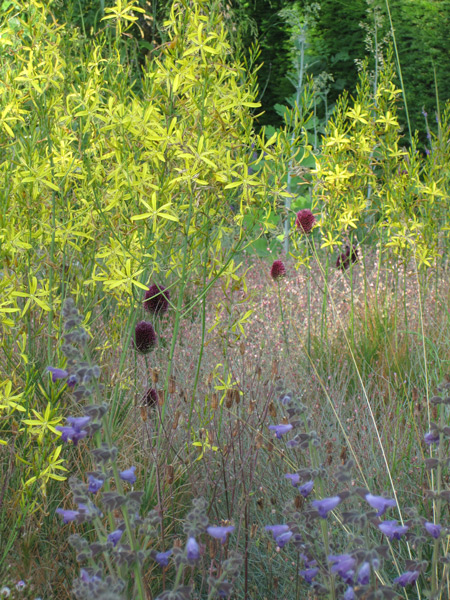
The flowers of Asphodeline liburnica open in the late afternoon when temperatures drop.
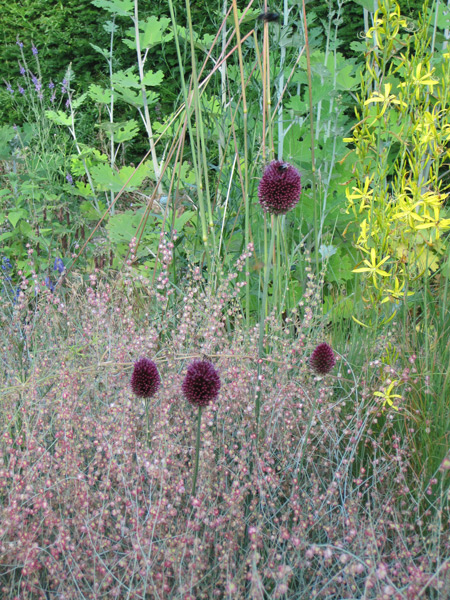
Allium sphaerocephalon
A tip for successfully growing Allium sphaerocephalon in heavy soil: Plant the bulbs directly on a bed of gravel and replace the soil with pure sand; the bulb will be above water in winter and protected from rot.
Small summer scene in the late afternoon: Allium sphaerocephalon is the last ornamental garlic to bloom in the garden. Here, it is paired with the yellow flowers of Asphodeline liburnica, creating a wonderful contrast while remaining elegantly discreet. It is worth noting that it thrives particularly well in warm situations, in well-draining soil. A […]
Goat's Beard is a striking perennial, featuring large and long white inflorescences that perfectly structure the backgrounds of dark and cool borders. Known to gardeners, this perennial holds a curious secret that only the initiated are aware of.
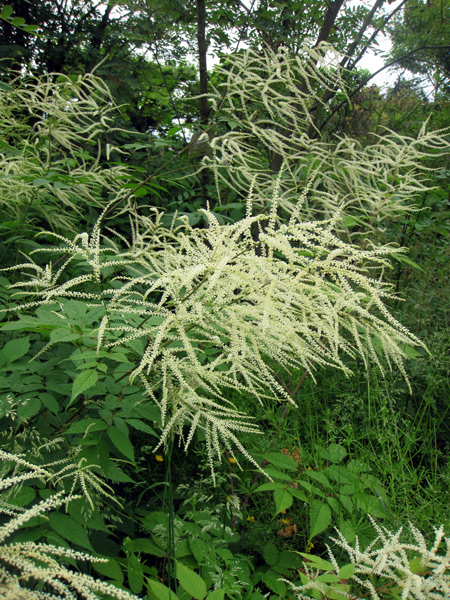
Goat's Beard in bloom in our gardens
This plant, known in Latin as Aruncus dioicus, is a dioecious species, meaning it has either male or female plants. It is not the only plant with this characteristic; many kiwis and palms, for example, are dioecious, but among herbaceous perennials, this phenomenon is rare, and what is even rarer is to observe dimorphism.
Indeed, male and female specimens are quite distinct, and it was by chance, while weeding one day at the base of a large stump, that I noticed these small inflorescences. What I initially took for a lack of maturity in the stems was simply the "natural appearance" of a male flower.
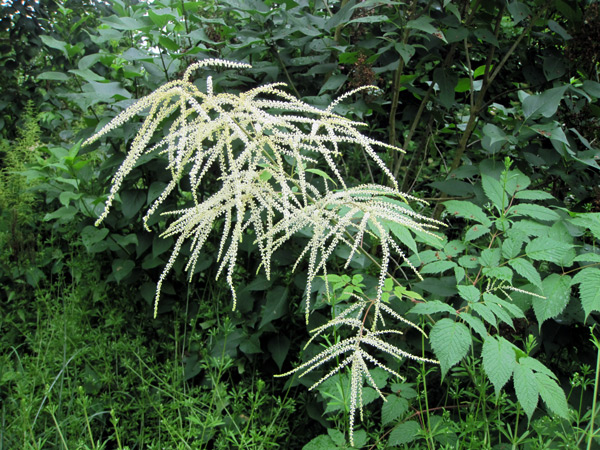
Female inflorescence of Aruncus dioicus
Speaking of appearance, and without intending to be sexist, the male flowers, with their small, dense, and poorly defined spikes, could benefit from emulating their graceful and slender companions. Shorter in stature, the male spikes measure about 1m, compared to 1.5m or more for the opposite sex. They are more compact, cylindrical in shape, fuller, and bloom 1 to 2 weeks later.
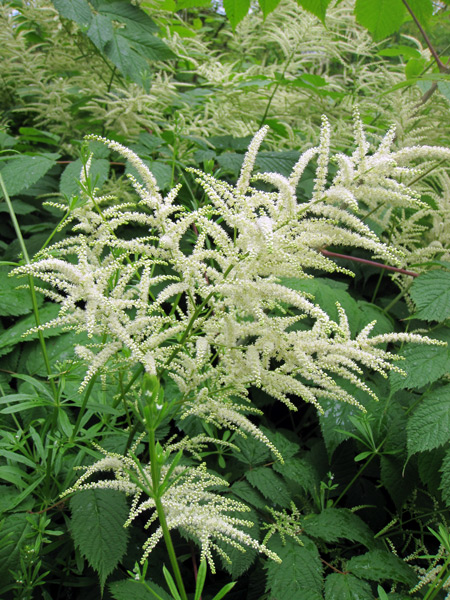
Male inflorescence of Aruncus dioicus
To see the differences in more detail, here is what the sexual organs look like:
Female flowers are identifiable by their bifid stigma
Males bear a large number of pistils
From sowing, it takes 3-4 years before the first flowers can be observed, but curiously, most seedlings are female, which is again quite rare, as it is often the opposite for many other dioecious species. Now that you know the secret, you will appreciate the beautiful structure of the inflorescences but won't be able to resist observing them up close!
Goat’s Beard is a striking perennial, featuring large and long white inflorescences that perfectly structure the backgrounds of dark and cool borders. Known to gardeners, this perennial holds a curious secret that only the initiated are aware of. This plant, known in Latin as Aruncus dioicus, is a dioecious species, meaning it has either male […]
We often talk about gentian blue or meconopsis blue, but hardy geraniums also boast a palette of blue that would make the most beautiful gentians blush. Here’s a small selection of the most stunning blue geraniums at the moment.
There are the all-rounders, suitable for all exposures and versatile in their uses. They thrive almost anywhere, flowering profusely for long periods; they are just as comfortable in a wild garden mixed with alliums and grasses as they are in a mixed border at the foot of an English rose or "arranged" among a selection of perennials in a gradient of blue with a hint of gold.
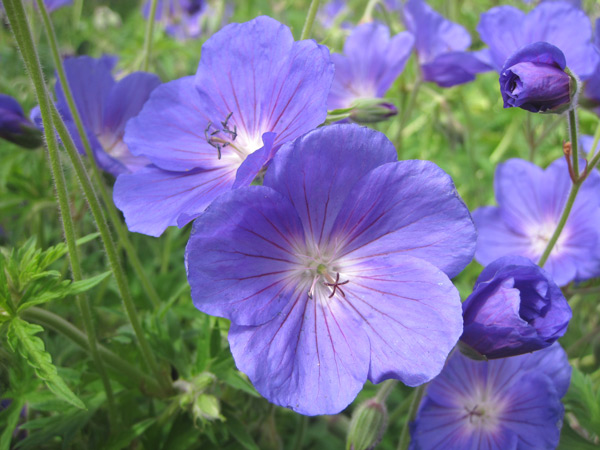
Geranium Orion
Geranium (x) magnificum
Geranium Johnson's Blue
Geranium pratense Mrs Kendall Clark[/caption>
Then there are the hidden ones; carpeting under a tree in cool shade or cascading down a bank among periwinkles, elf flowers, and campanulate squills, they can even thrive in dry shade, flowering infrequently but for long periods and often self-seeding well to form beautiful colonies. Geranium sylvaticum
Geranium nodosum
And then there are the thrifty ones; they require little. Little water, little food, but plenty of sun. They thrive among yarrow, campanulas, and lavenders in a dry meadow garden or a scree garden, and they even grow in calcareous soils. Geranium Philippe Vapelle
 Geranium renardii Tcschelda, a new introduction with beautifully veined flowers
Among the cultivars, hybrids, and wild species, there is something for every taste and, above all, for every use—how can one resist? A tip to showcase them even more: plant them in masses, at about 5-6 plants per square metre, but with a touch of pale yellow plants; the best choices are Scabiosa ochroleuca, Phlomis russeliana, Alchemilla mollis, or the magnificent Nepeta govaniana; the contrast is striking!
We often talk about gentian blue or meconopsis blue, but hardy geraniums also boast a palette of blue that would make the most beautiful gentians blush. Here’s a small selection of the most stunning blue geraniums at the moment. There are the all-rounders, suitable for all exposures and versatile in their uses. They thrive almost […]
Veronica umbrosa Georgia Blue floods the borders of the rockery with blue gentian flowers.
This Veronica forms a true carpet of flowers in April.
This small Veronica with blue gentian flowers blooms for about a month, from mid-March to mid-April depending on the year. Normally it is creeping, but as here, when planted at the foot of a small shrub (Betula nana) it tends to climb. Apart from being a hardy, creeping and extremely floriferous perennial, the appeal lies in its ease of cultivation. Here, it grows in sun in a rockery, but in the same rockery it is planted in dry shade, in cool partial shade, and it grows well in any of these situations.
For spectacular flowering it, however, requires plenty of light. Plants grown in shade flower little, but for a long time, the flowers come one after another until autumn, whereas those in the sun flower abundantly for much of spring and reflower sometimes timidly in autumn.
It is very beautiful when grown in isolation, as it spills down a low wall or a slope. In pairing it works very well with shrub roses and hardy geraniums, but it is with Narcissus 'Toto' (small-growing Narcissus) with cream-coloured flowers that its blue flowers stand out best.
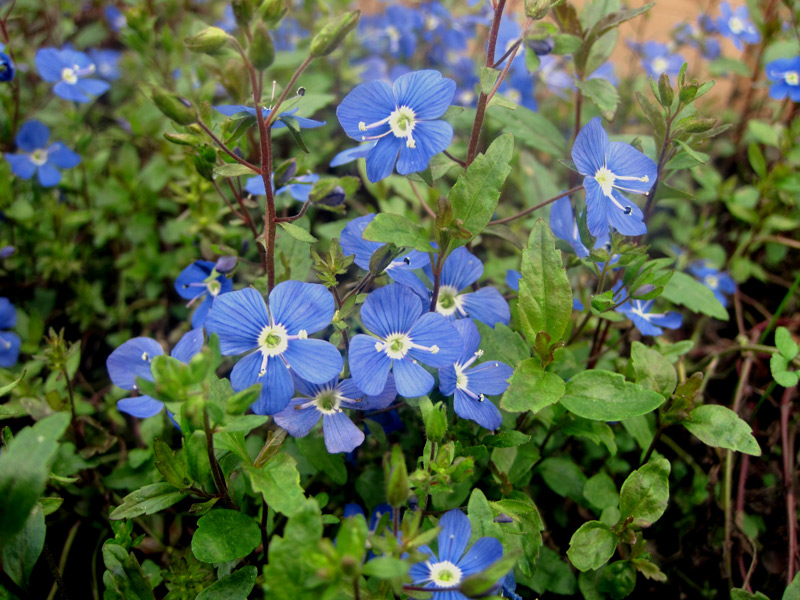
A white 'eye' spots the Veronica flower.
Veronica umbrosa Georgia Blue floods the borders of the rockery with blue gentian flowers. This small Veronica with blue gentian flowers blooms for about a month, from mid-March to mid-April depending on the year. Normally it is creeping, but as here, when planted at the foot of a small shrub (Betula nana) it tends to […]
We are familiar with the elegant flowering of Cornus kousa and florida, the colourful wood of Cornus alba, and the splendid branches of Cornus controversa, but in this world of giants, there hides the small, the diminutive Cornus canadensis.
 The Cornus of Canada flowers in the undergrowth from May.
Known to seasoned gardeners for many years, this little dogwood often goes unnoticed and struggles to find its place among its larger siblings. It is true that one should not look up to appreciate its prolific white flowering, but rather down at the ground.
Standing about twenty centimetres tall, the Cornus canadensis, as it is aptly named in French, is an undershrub, often classified among perennials. It flowers and fruits like a Japanese dogwood, but the resemblance ends there, as it does not form wood but herbaceous stems, capable of suckering in the soil like an Epimedium or a Pachysandra, provided the soil is cool and rich in humus; otherwise, it will spread less quickly.
It flowers from May to July and then produces small fruits, about the size of a small strawberry, in candy pink. But that’s not all: its bright green foliage suddenly turns mahogany red when the nights grow cooler. And to the question of whether it is hardy here, I would respond with another question: is it cold in Canada during winter?
Michael
We are familiar with the elegant flowering of Cornus kousa and florida, the colourful wood of Cornus alba, and the splendid branches of Cornus controversa, but in this world of giants, there hides the small, the diminutive Cornus canadensis. The Cornus of Canada flowers in the undergrowth from May. Known to seasoned gardeners for many […]