
Geranium magnificum Rosemoor

Geranium magnificum Rosemoor

Geranium magnificum Rosemoor

Geranium magnificum Rosemoor

Geranium magnificum Rosemoor

Geranium magnificum Rosemoor
Geranium magnificum Rosemoor
Geranium x magnificum Rosemoor
Magnificent Cranesbill, Hardy Geranium
Hardy geranium Rosemoor, very good, thank you.
Nath44, 09/05/2025
Back-to-school special offer!
Get €10 off for every €50 you spend! And get up to €40 off on a single order.
How does it work?
1. Shop your favourites
Add your favourite plants to your basket. For every €50 you spend (excluding delivery charges, store credit and the plastic-free option), you’ll receive a €10 voucher.
€50 spent = €10 voucher
€100 spent = €20 voucher
€150 spent = €30 voucher
€200 spent = €40 voucher
2. Place your order
Once your basket reaches one of the spending thresholds, place your order. You can even choose your delivery date!
3. Receive your voucher
As soon as your order has been shipped, you’ll receive an email containing your personal voucher code and its value.
4. Use it on your next order
Your voucher is valid for 90 days from the date you receive it. It can be used once only, on a new order worth at least the value of the voucher, excluding delivery charges.
Please note: Vouchers can be combined with other offers, but cannot be split or refunded.
Home or relay delivery (depending on size and destination)
Important: You may be charged customs duties by your country’s customs authorities upon delivery.
Schedule delivery date
and select date in basket
This plant carries a 12 months recovery warranty
More information
We guarantee the quality of our plants for a full growing cycle, and will replace at our expense any plant that fails to recover under normal climatic and planting conditions.
Does this plant fit my garden?
Set up your Plantfit profile →
Description
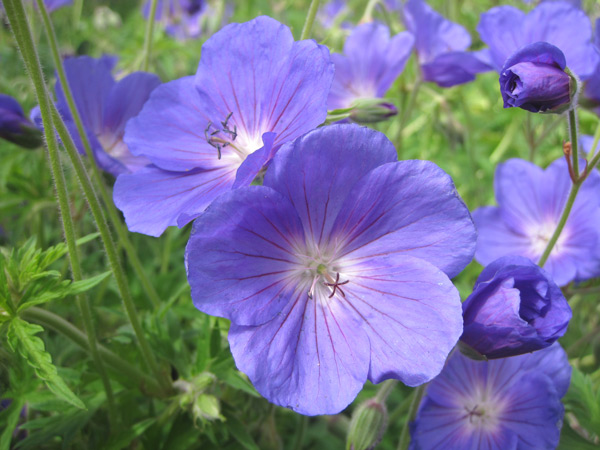
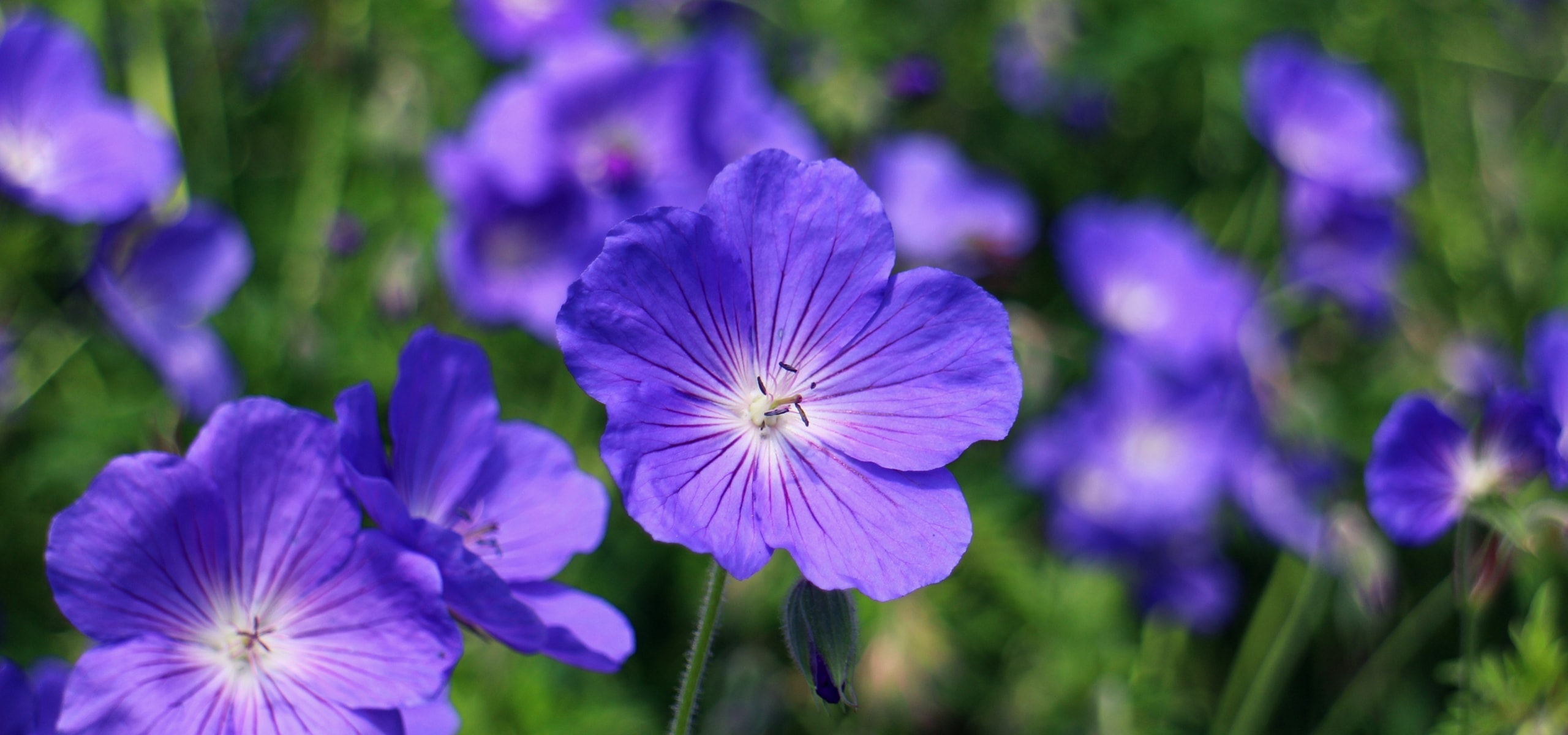
Le Geranium x magnificum 'Rosemoor', si bien nommé géranium magnifique, séduit par ses grandes fleurs d'un bleu violacé intense, sa vigueur et son beau feuillage d'automne. Cette variété se distingue aussi par sa floraison particulièrement généreuse. Robuste et bien rustique, c'est une très bonne plante pour les massifs de vivaces, les bordures ou les lisières de sous-bois claires.
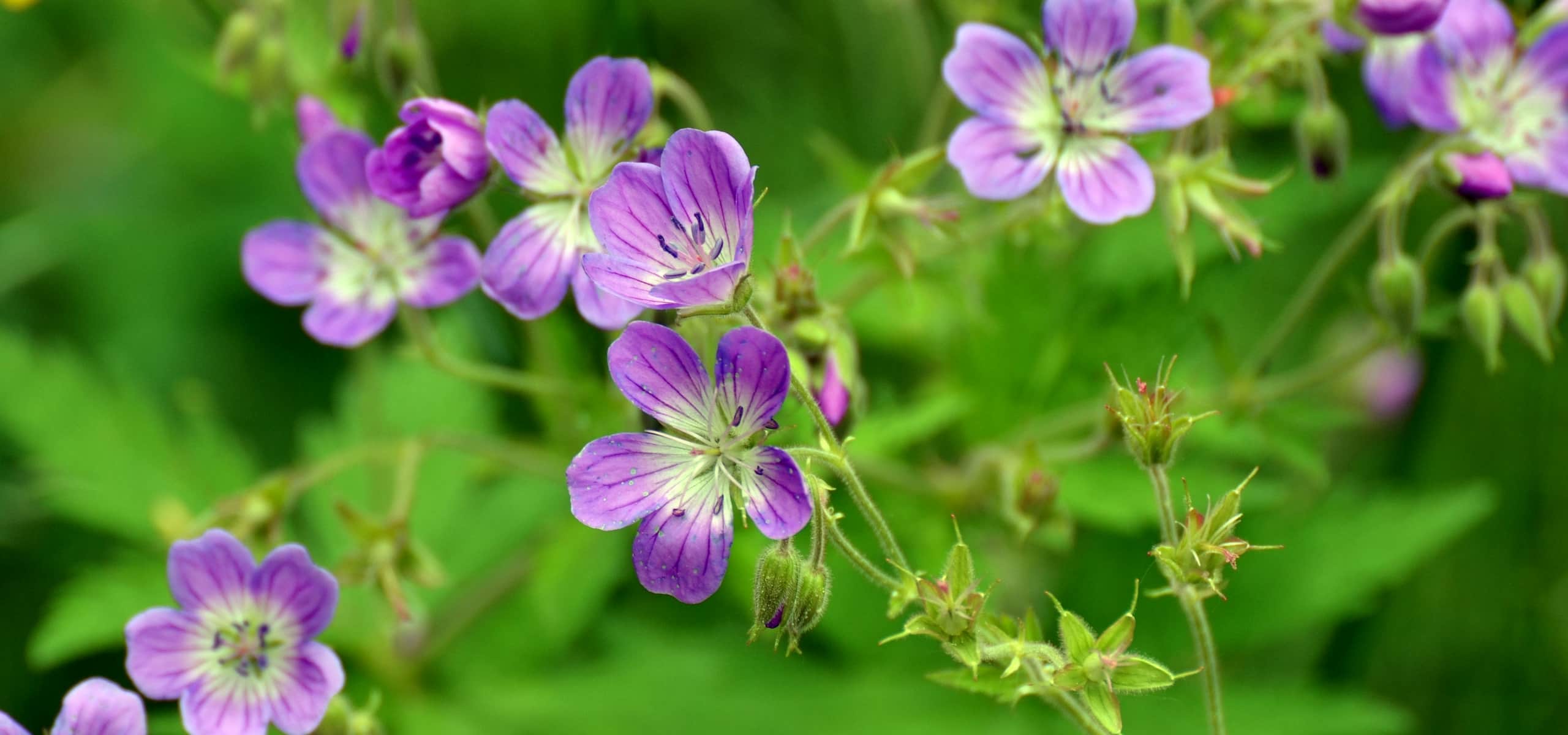
Appartenant à la famille des Géraniacées, le Geranium x magnificum est issu d'un croisement entre le Geranium ibericum et le Geranium platypetalum, sélectionné au jardin RHS de Rosemoor au Royaume-Uni. Les qualités horticoles de cet hybride lui ont valu l'obtention du RHS Award of Garden Merit. 'Rosemoor' a été sélectionné par le pépiniériste allemand Dr Hans Simon, dans sa pépinière de vivaces située à Marktheidenfeld, en Bavière, et introduit dans le commerce horticole en 1997. Ce cultivar a reçu trois étoiles, soit la meilleure appréciation « excellente variété », lors de la Staudensichtung allemande de 2004. La plante se développe en une touffe opulente, dense et buissonnante à partir de sa souche rhizomateuse. De croissance rapide, elle présente une végétation dressée et ramifiée qui atteint 50 à 60 cm de hauteur pour une envergure équivalente à maturité. Les tiges portent un feuillage profondément lobé, velu, d'un vert moyen lumineux qui dégage un parfum léger au froissement. Ce feuillage prend de superbes teintes pourprées et cuivrées à l'approche de l'automne. La floraison a lieu de fin mai à juillet, selon les régions. Elle prend la forme de fleurs en coupes de 4 à 5 cm de diamètre, affichant un coloris bleu-violet intense nervuré de pourpre foncé qui capte la lumière. Les fleurs, regroupées en ombelles lâches, se renouvellent pendant plusieurs semaines, attirant de nombreux insectes pollinisateurs. La souche résiste jusqu'à -20 °C. Toute la végétation aérienne disparaît en hiver puis ressort de terre au printemps.
Le Geranium x magnificum 'Rosemoor' convient à tous les types de jardins, depuis le jardin sauvage, en passant par le jardin de curé, jusqu'aux massifs de plantes plus soignés. Il est absolument charmant au pied des rosiers arbustifs. Pour composer une scène équilibrée, associez-le à des vivaces telles que la campanule à feuilles de pêcher Campanula persicifolia, d'autres géraniums vivaces aux ports complémentaires, notamment 'Johnson's Blue', 'Rozanne' et 'Patricia', ainsi qu'à des pivoines de Chine.

Geranium magnificum Rosemoor in pictures


Flowering
Foliage
Plant habit
Botanical data
Geranium
x magnificum
Rosemoor
Geraniaceae
Magnificent Cranesbill, Hardy Geranium
Cultivar or hybrid
Planting and care
Geranium x magnificum 'Rosemoor' is best planted in autumn, or in spring outside periods of frost. Position it in a sunny but not scorching spot, or in bright partial shade; the latter option protects the flower colour from the burning midday rays. It requires an ordinary soil, rich in humus, moist but well drained, as an excess of stagnant water in winter is detrimental to its longevity. Add mature compost at planting and mulch the stump to preserve soil moisture during summer. During the first year, keep up regular watering to support growth; thereafter, established plants tolerate short dry periods. At the end of flowering, prune the clump back to soil level if the foliage collapses, which stimulates the appearance of fresh new foliage and encourages a second flowering.
Planting period
Intended location
Care
Planting & care advice
-
-

-
-

-
-
-
-
-
, onOrder confirmed
Reply from on Promesse de fleurs
Recently viewed products
Haven't found what you were looking for?
Hardiness is the lowest winter temperature a plant can endure without suffering serious damage or even dying. However, hardiness is affected by location (a sheltered area, such as a patio), protection (winter cover) and soil type (hardiness is improved by well-drained soil).
In temperate climates, pruning of spring-flowering shrubs (forsythia, spireas, etc.) should be done just after flowering.
Pruning of summer-flowering shrubs (Indian Lilac, Perovskia, etc.) can be done in winter or spring.
In cold regions as well as with frost-sensitive plants, avoid pruning too early when severe frosts may still occur.
The harvesting period indicated on our website applies to countries and regions in USDA zone 8 (France, England, Ireland, the Netherlands).
In colder areas (Scandinavia, Poland, Austria...) fruit and vegetable harvests are likely to be delayed by 3-4 weeks.
In warmer areas (Italy, Spain, Greece, etc.), harvesting will probably take place earlier, depending on weather conditions.
The sowing periods indicated on our website apply to countries and regions within USDA Zone 8 (France, UK, Ireland, Netherlands).
In colder areas (Scandinavia, Poland, Austria...), delay any outdoor sowing by 3-4 weeks, or sow under glass.
In warmer climes (Italy, Spain, Greece, etc.), bring outdoor sowing forward by a few weeks.
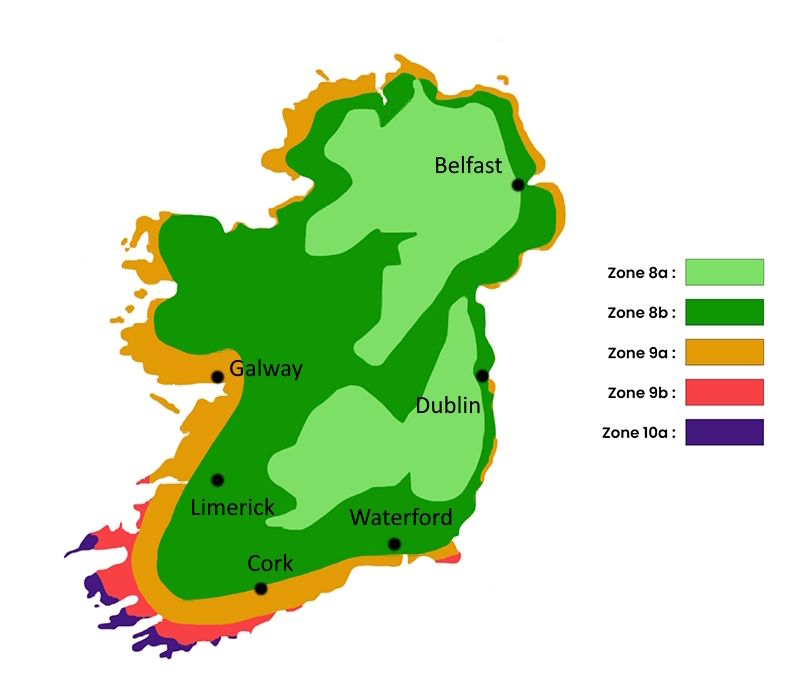
The planting period indicated on our website applies to regions in USDA Zone 9a (East Coast and Midlands: Dublin, Wexford, Waterford, Kilkenny, Portlaoise). It will vary depending on where you live:
- On the west coast and in the north-west (Galway, Limerick, Sligo, Donegal, Westport), delay planting by 1 to 2 weeks in spring and bring it forward by 1 to 2 weeks in autumn compared to the dates given, preferably choosing periods without strong winds.
- In the inland hills and plateaus (Wicklow Mountains, Macgillycuddy’s Reeks, Connemara, Killarney), it is best to plant in spring (April–May) or autumn (September–October), avoiding periods of waterlogged soil in winter and strong winds, which pose the main risk to newly planted trees in these areas.
The flowering period indicated on our website applies to regions in USDA Zone 9a, such as the East Coast and Midlands, including Dublin, Wexford, Waterford, Kilkenny and Portlaoise.
This will vary depending on where you live:
- On the west coast and in the northwest (Galway, Limerick, Sligo, Donegal and Westport), it will be delayed by one to two weeks compared to the given dates, due to stronger Atlantic winds and less spring sunshine.
- In the inland hills and plateaus (the Wicklow Mountains, the Macgillycuddy's Reeks, Connemara and Killarney), flowering will be delayed by two to three weeks. Flowering mainly occurs between May and July, with the limiting factors being less frost and more of the excessive humidity, strong winds and lack of sunshine that are characteristic of these areas.
Shipping country and language
Your country of residence may be:
Your country of residence is:
For a better user experience on our website, you can select:
Your shipping country:
-
 Austria
-
 Belgium
-
 Bosnia & Herzegovina
-
 Bulgaria
-
 Croatia
-
 Cyprus
-
 Czechia
-
 Denmark
-
 Estonia
-
 Finland
-
 France
-
 Germany
-
 Greece
-
 Hungary
-
 Iceland
-
 Ireland
-
 Italy
-
 Latvia
-
 Liechtenstein
-
 Lithuania
-
 Luxembourg
-
 Malta
-
 Netherlands
-
 Poland
-
 Portugal
-
 Romania
-
 Serbia
-
 Slovakia
-
 Slovenia
-
 Spain
-
 Sweden
-
 Switzerland
Language:
-
French
-
 English
-
Spanish
-
Italian
-
German
-
Portuguese
-
Dutch
-
Finnish
My Account
Hello
My wish lists
My cart
Log in / Register
Existing customer?
This form is protected by reCAPTCHA - the Google Privacy Policy and Terms of Service apply.
New customer?
Create an account to track your orders, access our customer service and, if you wish, make the most of our upcoming offers.