
Dahlia Gordon Huston
Dahlia Gordon Huston
Dahlia Décoratif informel Gordon Huston
Back-to-school special offer!
Get €10 off for every €50 you spend! And get up to €40 off on a single order.
How does it work?
1. Shop your favourites
Add your favourite plants to your basket. For every €50 you spend (excluding delivery charges, store credit and the plastic-free option), you’ll receive a €10 voucher.
€50 spent = €10 voucher
€100 spent = €20 voucher
€150 spent = €30 voucher
€200 spent = €40 voucher
2. Place your order
Once your basket reaches one of the spending thresholds, place your order. You can even choose your delivery date!
3. Receive your voucher
As soon as your order has been shipped, you’ll receive an email containing your personal voucher code and its value.
4. Use it on your next order
Your voucher is valid for 90 days from the date you receive it. It can be used once only, on a new order worth at least the value of the voucher, excluding delivery charges.
Please note: Vouchers can be combined with other offers, but cannot be split or refunded.
This plant carries a 6 months recovery warranty
More information
We guarantee the quality of our plants for a full growing cycle, and will replace at our expense any plant that fails to recover under normal climatic and planting conditions.
Does this plant fit my garden?
Set up your Plantfit profile →
Description
Le Dahlia 'Gordon Huston' est un dahlia décoratif qui séduit par ses grandes fleurs doubles rose tendre, animées de reflets corail et orangés vers le centre. Les pétales larges se recourbent et s’ordonnent avec une certaine souplesse, ce qui leur confère un aspect moins rigide que celui des dahlias décoratifs formels. Sa floraison estivale prolongée, ses hautes tiges et son coloris doux et chaleureux font merveille dans les massifs et les bouquets de fin d’été.
Ce dahlia appartient à la famille des Astéracées. C’est une vivace à racines tubéreuses : toutes ses parties aériennes disparaissent sous l’effet des premières gelées, mais les tubercules permettent à la plante de repartir au printemps s’ils ont été conservés hors gel. Les dahlias cultivés forment un ensemble horticole complexe qui ne se rattache pas à une seule espèce sauvage ; le genre Dahlia est originaire du Mexique à la Colombie. 'Gordon Huston' a été obtenu par N. Earle Huston, un obtenteur canadien de Colombie-Britannique connu pour sa lignée de dahlias portant le nom Huston. Ce cultivar a été proposé parmi ses introductions de 1979. Les classifications nord-américaines actuelles le classent comme un dahlia de taille moyenne au sens des concours, à fleurs décoratives informelles et à coloris clair mélangé. Au jardin, la plante développe au printemps une touffe de tiges vertes et ramifiées qui atteint près de 1,30 m de hauteur pour 70 à 80 cm de largeur. Le feuillage vert moyen, découpé en folioles dentées, forme une masse assez fournie sous les tiges florales. Les fleurs sont des capitules entièrement doubles. Ils se composent de pétales rose pâle marqués d’orange sur leurs côtés, cette coloration s’élargissant vers le centre ; un mélange de rose tendre, corail et saumon. Les fleurs atteignent couramment 18 à 20 cm de diamètre. Elles apparaissent au mois de juillet puis se renouvellent jusqu’aux premières gelées si les fleurs fanées sont régulièrement retirées. Les tiges florales étaient déjà signalées comme bien solides lors des premiers essais, un avantage pour la fleur coupée. Cette variété possède un beau palmarès : avant sa diffusion commerciale, elle avait obtenu de bons résultats dans plusieurs jardins d’essai nord-américains et reçu un Achievement Award de l’American Dahlia Society en 1978.
Au jardin, ce dahlia 'Gordon Huston' se plante dans les massifs ensoleillés, les plates-bandes à l'anglaise, dans un jardin de curé et dans un carré de fleurs à couper. Ses grosses fleurs seront allégées par des floraisons plus fines, des graminées et des asters. On peut l’associer à la Sanguisorba 'Red Thunder', à l'Aster × frikartii 'Mönch', au Panicum virgatum 'Shenandoah' et au Selinum wallichianum. Les tons pourpres, les bleus lavande et les rouges brunis de ces plantes accompagnent le rose corail du dahlia et composent un massif coloré jusqu’en automne

Plant habit
Flowering
Foliage
Botanical data
Dahlia
Gordon Huston
Asteraceae
Cultivar or hybrid
Planting and care
Plant Dahlia 'Gordon Huston' from March to May depending on the climate, once the risk of hard frost has passed; starting it off in a pot under cover brings flowering forward. Choose a very bright spot sheltered from the prevailing winds. Work a fertile soil to a good depth and incorporate well-rotted compost. The soil must retain enough water to feed its vigorous growth while draining excess quickly: a clay soil is suitable during the growing season if it is not waterlogged. Put a stake in place at planting time so as not to damage the tubercles later. Water sparingly before emergence, then regularly during dry spells. After the first frost, prune the stems and then lift the tubercles. Leave them to dry and store them in a cool, dry, frost-free place. In regions with very mild winters and in perfectly drained ground, a thick mulch will protect them from frost. Clumps are divided in spring, keeping one viable bud on each division.
Planting period
Intended location
Care
Planting & care advice








This item has not been reviewed yet - be the first to leave a review about it.
Haven't found what you were looking for?
Hardiness is the lowest winter temperature a plant can endure without suffering serious damage or even dying. However, hardiness is affected by location (a sheltered area, such as a patio), protection (winter cover) and soil type (hardiness is improved by well-drained soil).
In temperate climates, pruning of spring-flowering shrubs (forsythia, spireas, etc.) should be done just after flowering.
Pruning of summer-flowering shrubs (Indian Lilac, Perovskia, etc.) can be done in winter or spring.
In cold regions as well as with frost-sensitive plants, avoid pruning too early when severe frosts may still occur.
The sowing periods indicated on our website apply to countries and regions within USDA Zone 8 (France, UK, Ireland, Netherlands).
In colder areas (Scandinavia, Poland, Austria...), delay any outdoor sowing by 3-4 weeks, or sow under glass.
In warmer climes (Italy, Spain, Greece, etc.), bring outdoor sowing forward by a few weeks.
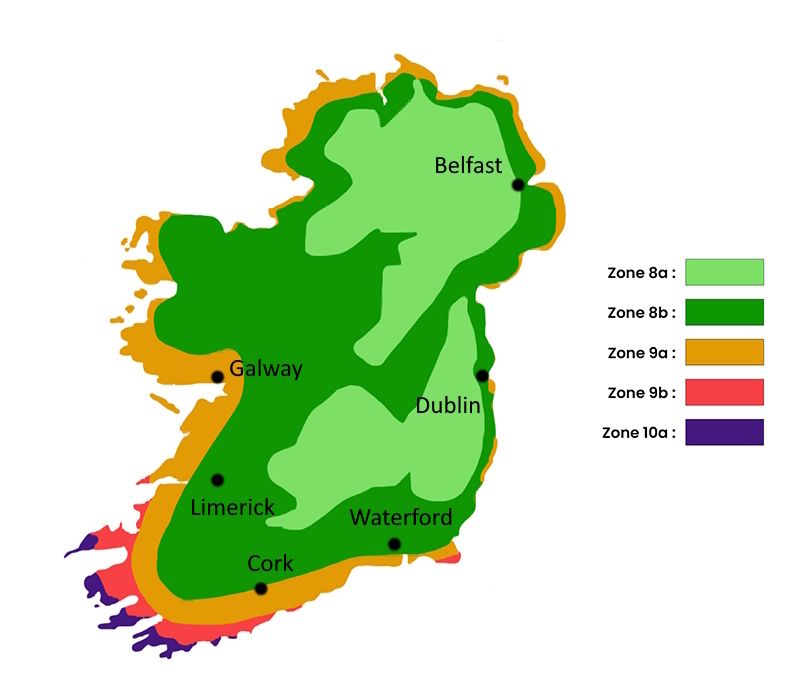
The planting period indicated on our website applies to regions in USDA Zone 9a (East Coast and Midlands: Dublin, Wexford, Waterford, Kilkenny, Portlaoise). It will vary depending on where you live:
- On the west coast and in the north-west (Galway, Limerick, Sligo, Donegal, Westport), delay planting by 1 to 2 weeks in spring and bring it forward by 1 to 2 weeks in autumn compared to the dates given, preferably choosing periods without strong winds.
- In the inland hills and plateaus (Wicklow Mountains, Macgillycuddy’s Reeks, Connemara, Killarney), it is best to plant in spring (April–May) or autumn (September–October), avoiding periods of waterlogged soil in winter and strong winds, which pose the main risk to newly planted trees in these areas.
The flowering period indicated on our website applies to regions in USDA Zone 9a, such as the East Coast and Midlands, including Dublin, Wexford, Waterford, Kilkenny and Portlaoise.
This will vary depending on where you live:
- On the west coast and in the northwest (Galway, Limerick, Sligo, Donegal and Westport), it will be delayed by one to two weeks compared to the given dates, due to stronger Atlantic winds and less spring sunshine.
- In the inland hills and plateaus (the Wicklow Mountains, the Macgillycuddy's Reeks, Connemara and Killarney), flowering will be delayed by two to three weeks. Flowering mainly occurs between May and July, with the limiting factors being less frost and more of the excessive humidity, strong winds and lack of sunshine that are characteristic of these areas.
The harvest period stated on our website applies to regions in USDA zones 8b to 9a (East, South-East and southern coast: Eastern Leinster, County Wexford and County Waterford, Cork region: Dublin, Wexford, Waterford, Kilkenny, Cork). It will vary depending on where you live:
- In the Midlands and the inland plains: the Middle Shannon Valley, Westmeath, Offaly, Longford, Cavan and Monaghan (Athlone, Mullingar, Tullamore, Longford, Cavan, Monaghan), in USDA zones 8a to 8b, the harvest will be delayed by 1 to 2 weeks compared with the dates given. Far from the moderating influence of the sea, these plains experience late frosts right up until the end of spring. The heavy, peaty soils warm slowly here, and damp patches form pockets of frost. Wait until the soil has dried out and warmed up before planting, and protect young plants with a fleece on clear nights.
- In the Atlantic West and North-West: Kerry, Clare, Galway, Connemara, Mayo, Sligo and Donegal (Killarney, Ennis, Galway, Westport, Sligo, Letterkenny), in USDA zones 8b to 10a, the harvest will be delayed by 1 to 3 weeks compared with the dates given. Summers here are cloudier, rainier and windier than in the east, which slows down ripening and encourages late blight and other fungal diseases. Kerry and Clare are at the lower end of the range, whilst Mayo and Donegal, which are cooler and more exposed, are at the upper end. However, the mild coastal winters mean that leafy vegetables and root vegetables can be harvested at dates close to those indicated, or even earlier: shelter crops from the wind with hedges and grow heat-loving plants in greenhouses or polytunnels.
- In the highlands, above 200 m: the Wicklow Mountains, Macgillycuddy’s Reeks, the Galtee and Comeragh ranges, the Twelve Bens in Connemara and the Donegal highlands, in USDA zones 7b to 8a, the harvest will be delayed by 2 to 4 weeks compared with the dates given, depending on the altitude, taking care to beat the first early frosts, which may occur as early as the start of autumn. Wind, constant damp and late frosts lasting into early summer significantly shorten the growing season. Opt for sheltered, south-facing slopes, early-maturing varieties and growing under cover.
Depending on your garden’s aspect, these variations can range from one to two weeks. A frost-prone valley floor delays the harvest, whilst a south-facing wall brings it forward.
Shipping country and language
Your country of residence may be:
Your country of residence is:
For a better user experience on our website, you can select:
Your shipping country:
-
 Austria
-
 Belgium
-
 Bosnia & Herzegovina
-
 Bulgaria
-
 Croatia
-
 Cyprus
-
 Czechia
-
 Denmark
-
 Estonia
-
 Finland
-
 France
-
 Germany
-
 Greece
-
 Hungary
-
 Iceland
-
 Ireland
-
 Italy
-
 Latvia
-
 Liechtenstein
-
 Lithuania
-
 Luxembourg
-
 Malta
-
 Netherlands
-
 Poland
-
 Portugal
-
 Romania
-
 Serbia
-
 Slovakia
-
 Slovenia
-
 Spain
-
 Sweden
-
 Switzerland
Language:
-
French
-
 English
-
Spanish
-
Italian
-
German
-
Portuguese
-
Dutch
-
Finnish
-
[pl]
My Account
Hello
My wish lists
My cart
Log in / Register
Existing customer?
This form is protected by reCAPTCHA - the Google Privacy Policy and Terms of Service apply.
New customer?
Create an account to track your orders, access our customer service and, if you wish, make the most of our upcoming offers.