Populus alba Richardii - White Poplar
Populus alba Richardii - White Poplar
Populus alba Richardii
White Poplar, Silver-leaved Poplar, Abele, Abbey, Dutch Beech, Silver-leaved Poplar, White Asp
Back-to-school special offer!
Get €10 off for every €50 you spend! And get up to €40 off on a single order.
How does it work?
1. Shop your favourites
Add your favourite plants to your basket. For every €50 you spend (excluding delivery charges, store credit and the plastic-free option), you’ll receive a €10 voucher.
€50 spent = €10 voucher
€100 spent = €20 voucher
€150 spent = €30 voucher
€200 spent = €40 voucher
2. Place your order
Once your basket reaches one of the spending thresholds, place your order. You can even choose your delivery date!
3. Receive your voucher
As soon as your order has been shipped, you’ll receive an email containing your personal voucher code and its value.
4. Use it on your next order
Your voucher is valid for 90 days from the date you receive it. It can be used once only, on a new order worth at least the value of the voucher, excluding delivery charges.
Please note: Vouchers can be combined with other offers, but cannot be split or refunded.
Home or relay delivery (depending on size and destination)
Important: You may be charged customs duties by your country’s customs authorities upon delivery.
Schedule delivery date,
and select date in basket
This plant carries a 24 months recovery warranty
More information
We guarantee the quality of our plants for a full growing cycle, and will replace at our expense any plant that fails to recover under normal climatic and planting conditions.
Does this plant fit my garden?
Set up your Plantfit profile →
Description
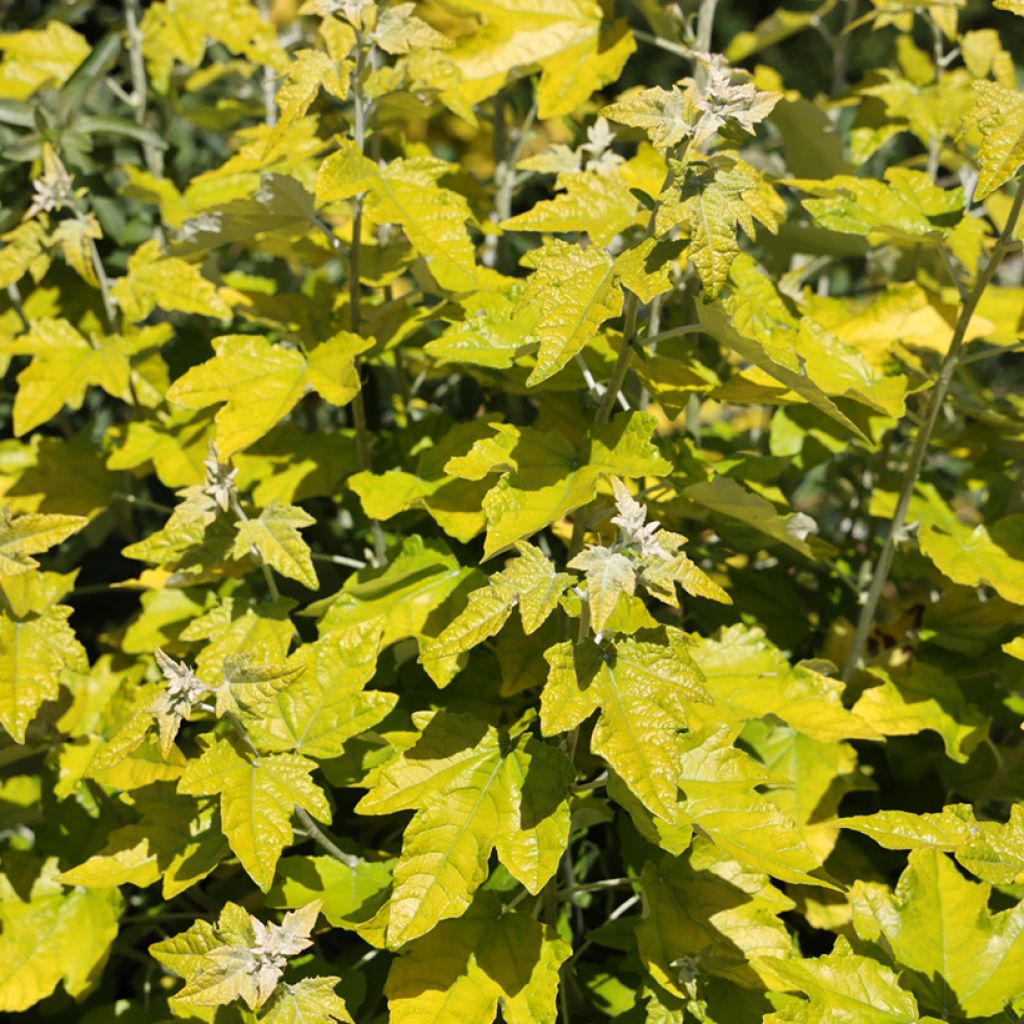
Populus alba 'Richardii' is a variety of the White Poplar that is easily recognized by its foliage. Golden-green on the upper side, the leaves have a white down on the underside and create a dynamic scene when the wind moves them. Fast-growing, it forms a small to medium-sized tree with a silver-grey bark that is quite ornamental. It is very hardy and adapts to most non-acidic soils. This variety appreciates moisture, but it is capable of withstanding drought once well established.
The Poplar is the most well-known member, along with the Willow, of the Salicaceae family. The Populus genus includes 35 species native to temperate and cold zones of the northern hemisphere. Populus alba is native to central and southern Europe, as well as western and central Asia. It is a large, fast-growing tree (13 m in 20 years) that can reach up to 30 m in height at maturity and live up to 400 years for exceptional specimens. Capable of forming a trunk of 1 m in diameter by the age of 50, it produces abundant suckers, sometimes up to 20 m from the trunk. Its species name comes from the white felting that covers the underside of the young leaves (alba = white in Latin).
Populus alba 'Richardii' is an old variety, first presented at the International Exhibition of Chelsea in 1921, organized by the prestigious Royal Horticultural Society (RHS) of London. However, this White Poplar is significantly less vigorous than the botanical species. In 20 years, it will reach approximately 8 m in height and 4 m in width, and at maturity, around the age of 50, it will reach 12, or even 15 m in height and 9 m in spread. The tree forms an open crown, more or less irregular and spreading, unless severely pruned every winter, in which case it will be possible to give it a wide, conical silhouette that is more regular. Its trunk is covered with a rather ornamental silver-grey bark, but it is its foliage that attracts attention. The small, 5 to 10 cm leaves, are divided into three main lobes and often two smaller ones. Their trident shape is pleasing to the eye, and their colour even more so. The young leaves have a particularly attractive golden yellow colour, while the underside is whitish. The young branches are also white. Gradually, as the season progresses, the leaves tend to turn yellow-green, with several stages coexisting on the tree. Similarly, yellow and green coexist on the same leaf blade, so that the foliage has a variable overall appearance. This dynamic colour is reinforced by the action of the wind, which enjoys orienting the leaves in one direction and then another like a mobile. The result is a shimmering scene that is quite fascinating and highly decorative. As the Poplar is a dioecious plant, there are male trees and female trees. The male trees produce small red catkins in spring (March-April), which are the most decorative, although relatively discreet, while the female catkins are greenish.
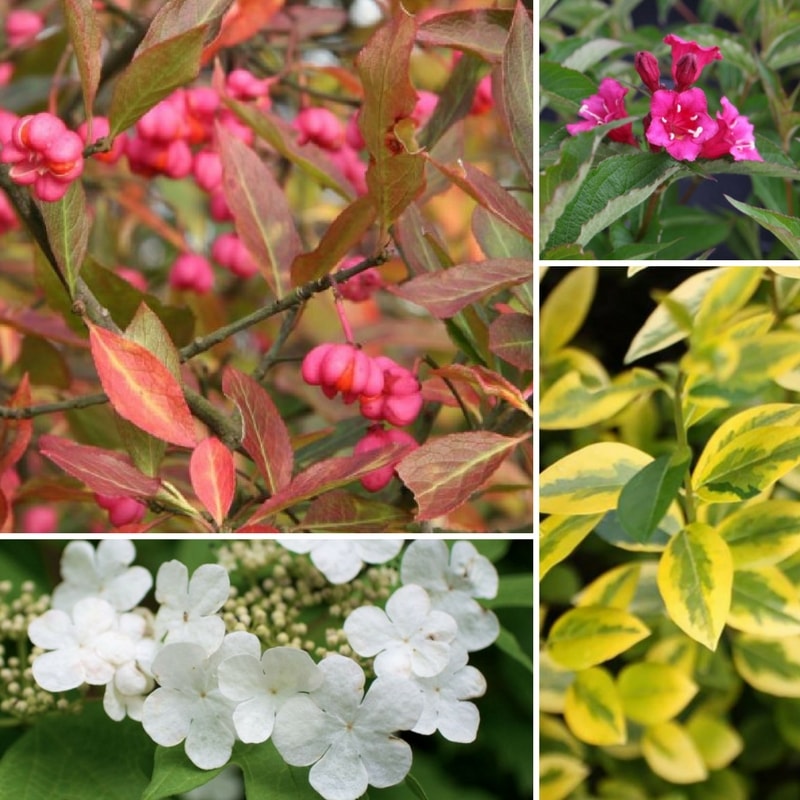
The White Poplar 'Richardii' is an interesting tree for the movement effect it brings to a garden with the slightest gust of wind that stirs the leaves at the end of their flexible petiole. Pair it with other woody plants with colourful foliage such as Sambucus nigra 'Black Beauty' (Gerda), a large shrub with magnificent dark purple cut foliage that will contrast admirably with the yellow of the Poplar. Green foliage will also be interesting in this scene, for example that of Amelanchier canadensis 'October Flame', whose abundant white star-shaped spring blooms are truly attractive. But the best is yet to come in autumn, when its foliage explodes in shades of red and orange, creating a superb effect alongside the Poplar and Elderberry. An Oakleaf Hydrangea (Hydrangea quercifolia) will provide the finishing touch, with its large leaves and deep red autumn colours, not to mention its generous summer flowering in panicles, sometimes huge depending on the variety.

Plant habit
Flowering
Foliage
Planting and care
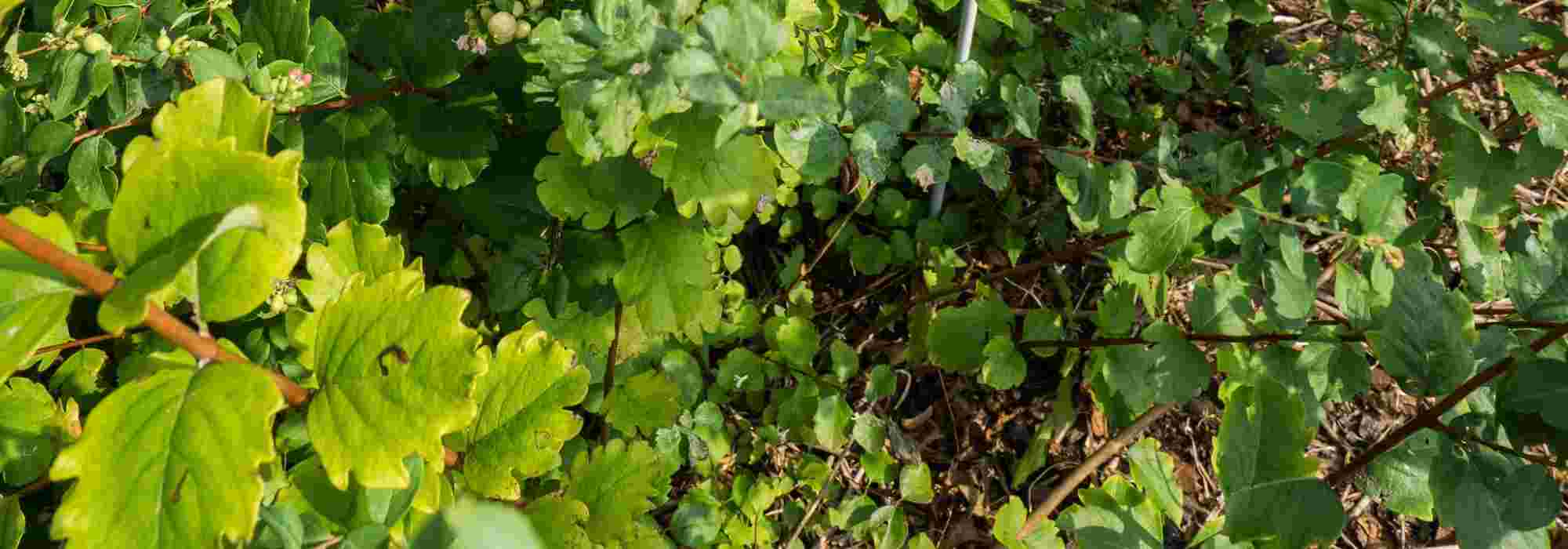
Plant Populus alba 'Richardii' in neutral to limestone soil, loose and light, or even clayey and heavy. It likes moist to wet soils, such as riverbanks, but tolerates relatively dry areas better than other species, even tolerating salt spray and slightly salty soils. However, it does require a sunny exposure.
Plant it away from buildings, as its root system is very developed. Also, be aware that this tree tends to sucker. Dig a hole 50 cm in all directions and add leaf compost or non-acidic potting soil to the existing soil. Soak the root ball in a bucket for 20 minutes, place it in the hole, fill it back up and water abundantly. During the first two years, it is important to water it regularly to promote root growth, afterwards, only during dry periods.
If necessary, prune regularly to limit its spreading before the start of the growing season, removing diseased or dead wood and crossed branches.
Planting period
Intended location
Care
Planting & care advice
-

-
-
-
-
-
-

-
This item has not been reviewed yet - be the first to leave a review about it.
Recently viewed products
Haven't found what you were looking for?
Hardiness is the lowest winter temperature a plant can endure without suffering serious damage or even dying. However, hardiness is affected by location (a sheltered area, such as a patio), protection (winter cover) and soil type (hardiness is improved by well-drained soil).
In temperate climates, pruning of spring-flowering shrubs (forsythia, spireas, etc.) should be done just after flowering.
Pruning of summer-flowering shrubs (Indian Lilac, Perovskia, etc.) can be done in winter or spring.
In cold regions as well as with frost-sensitive plants, avoid pruning too early when severe frosts may still occur.
The harvesting period indicated on our website applies to countries and regions in USDA zone 8 (France, England, Ireland, the Netherlands).
In colder areas (Scandinavia, Poland, Austria...) fruit and vegetable harvests are likely to be delayed by 3-4 weeks.
In warmer areas (Italy, Spain, Greece, etc.), harvesting will probably take place earlier, depending on weather conditions.
The sowing periods indicated on our website apply to countries and regions within USDA Zone 8 (France, UK, Ireland, Netherlands).
In colder areas (Scandinavia, Poland, Austria...), delay any outdoor sowing by 3-4 weeks, or sow under glass.
In warmer climes (Italy, Spain, Greece, etc.), bring outdoor sowing forward by a few weeks.
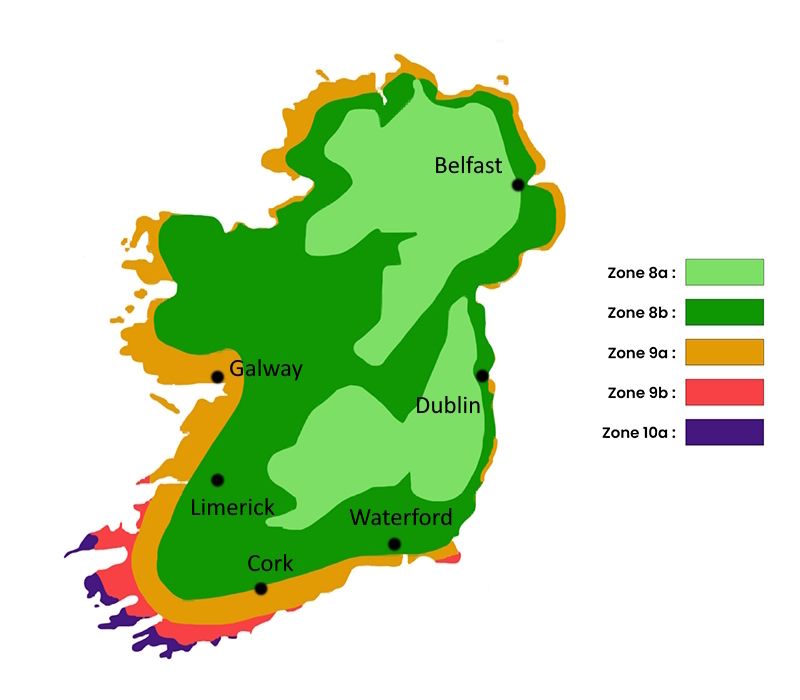
The planting period indicated on our website applies to regions in USDA Zone 9a (East Coast and Midlands: Dublin, Wexford, Waterford, Kilkenny, Portlaoise). It will vary depending on where you live:
- On the west coast and in the north-west (Galway, Limerick, Sligo, Donegal, Westport), delay planting by 1 to 2 weeks in spring and bring it forward by 1 to 2 weeks in autumn compared to the dates given, preferably choosing periods without strong winds.
- In the inland hills and plateaus (Wicklow Mountains, Macgillycuddy’s Reeks, Connemara, Killarney), it is best to plant in spring (April–May) or autumn (September–October), avoiding periods of waterlogged soil in winter and strong winds, which pose the main risk to newly planted trees in these areas.
The flowering period indicated on our website applies to regions in USDA Zone 9a, such as the East Coast and Midlands, including Dublin, Wexford, Waterford, Kilkenny and Portlaoise.
This will vary depending on where you live:
- On the west coast and in the northwest (Galway, Limerick, Sligo, Donegal and Westport), it will be delayed by one to two weeks compared to the given dates, due to stronger Atlantic winds and less spring sunshine.
- In the inland hills and plateaus (the Wicklow Mountains, the Macgillycuddy's Reeks, Connemara and Killarney), flowering will be delayed by two to three weeks. Flowering mainly occurs between May and July, with the limiting factors being less frost and more of the excessive humidity, strong winds and lack of sunshine that are characteristic of these areas.
Shipping country and language
Your country of residence may be:
Your country of residence is:
For a better user experience on our website, you can select:
Your shipping country:
-
 Austria
-
 Belgium
-
 Bosnia & Herzegovina
-
 Bulgaria
-
 Croatia
-
 Cyprus
-
 Czechia
-
 Denmark
-
 Estonia
-
 Finland
-
 France
-
 Germany
-
 Greece
-
 Hungary
-
 Iceland
-
 Ireland
-
 Italy
Italy
-
 Latvia
-
 Liechtenstein
-
 Lithuania
-
 Luxembourg
-
 Malta
Malta
-
 Netherlands
-
 Poland
-
 Portugal
-
 Romania
-
 Serbia
-
 Slovakia
-
 Slovenia
-
 Spain
Spain
-
 Sweden
-
 Switzerland
Language:
-
French
-
 English
-
Spanish
-
Italian
-
German
-
Portuguese
-
Dutch
-
Finnish
My Account
Hello
My wish lists
My cart
Log in / Register
Existing customer?
This form is protected by reCAPTCHA - the Google Privacy Policy and Terms of Service apply.
New customer?
Create an account to track your orders, access our customer service and, if you wish, make the most of our upcoming offers.