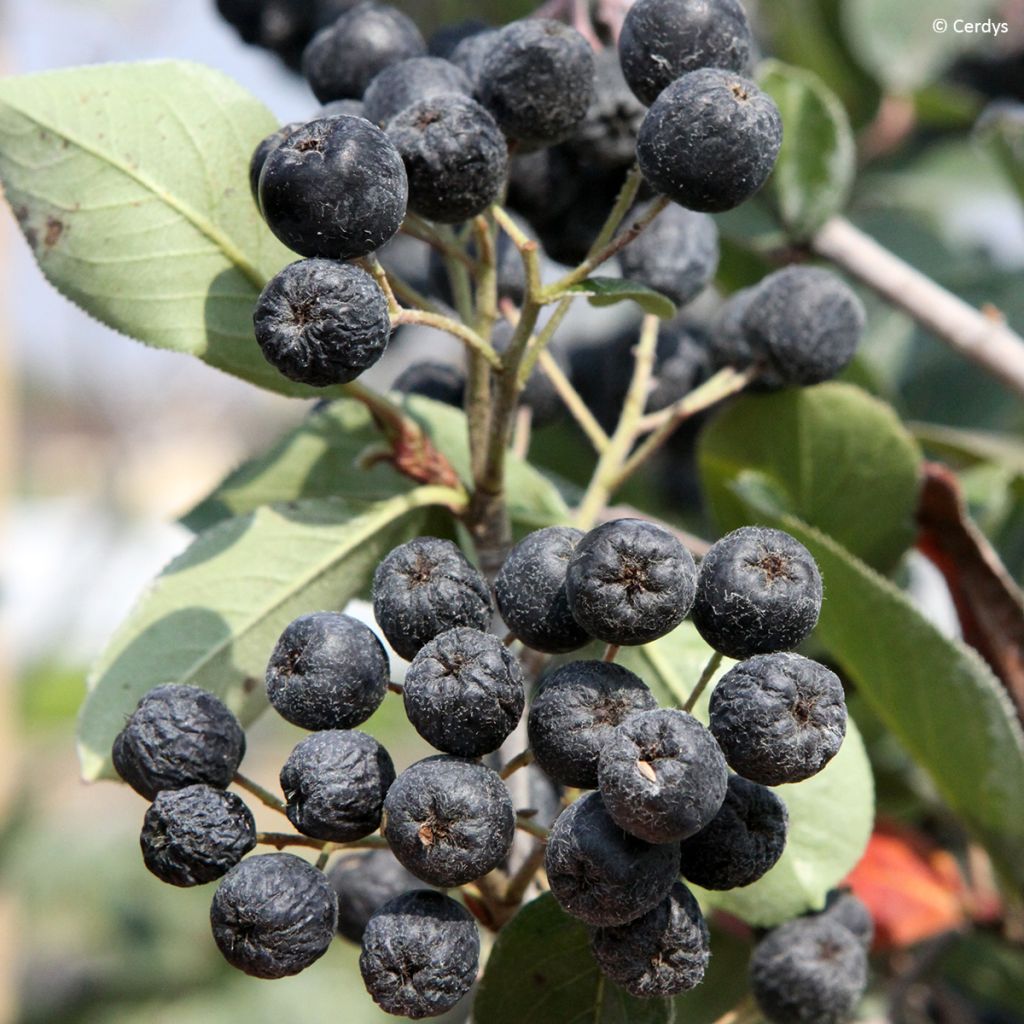
Aronia prunifolia Rubina
Aronia prunifolia Rubina
Aronia x prunifolia Rubina
Purple Chokeberry, Black Chokeberry
Plant arrived broken in several places. Some fresh damages, due to too rough handling during transportation, others not, prior to packaging, like a beautiful fork cracked in two. I had to cut back the plant very low, the 50 cm plant is now at 5 cm. Big disappointment as I lost 1 year of growth, but Aronia plants are tough so it should bounce back without too much trouble.
Olivier, 09/03/2025
Back-to-school special offer!
Get €10 off for every €50 you spend! And get up to €40 off on a single order.
How does it work?
1. Shop your favourites
Add your favourite plants to your basket. For every €50 you spend (excluding delivery charges, store credit and the plastic-free option), you’ll receive a €10 voucher.
€50 spent = €10 voucher
€100 spent = €20 voucher
€150 spent = €30 voucher
€200 spent = €40 voucher
2. Place your order
Once your basket reaches one of the spending thresholds, place your order. You can even choose your delivery date!
3. Receive your voucher
As soon as your order has been shipped, you’ll receive an email containing your personal voucher code and its value.
4. Use it on your next order
Your voucher is valid for 90 days from the date you receive it. It can be used once only, on a new order worth at least the value of the voucher, excluding delivery charges.
Please note: Vouchers can be combined with other offers, but cannot be split or refunded.
Home or relay delivery (depending on size and destination)
Important: You may be charged customs duties by your country’s customs authorities upon delivery.
Schedule delivery date,
and select date in basket
This plant carries a 12 months recovery warranty
More information
We guarantee the quality of our plants for a full growing cycle, and will replace at our expense any plant that fails to recover under normal climatic and planting conditions.
Description
The Aronia prunifolia 'Rubina' is a hybrid variety of the prune-leaved aronia, a cross between the Aronia prunifolia 'Viking' and a Russian aronia berry. This bush, whose "super-fruits" are highly consumed in Asia, bears clusters of high nutritional value, resembling large blueberries or blackcurrants, which are harvested when ripe in September-October. Slightly astringent when fresh, they can make delicious jellies, pastries, fruit syrups, or jams. Its foliage is highly decorative, changing from green to purple, red, and yellow in autumn. Its spring flowers are white and melliferous. Very hardy, it can be grown in full sun or partial shade in deep, moist soil, preferably non-chalky.
'Rubina' is a distant cousin of roses, plum trees, and blackberries, a member of the vast rose family. Native to Canada and the northeastern United States, aronia plants are highly cold-resistant and thrive in cool, slightly acidic soils. They are now extensively planted in Eastern European countries to meet the demand of the Asian market.
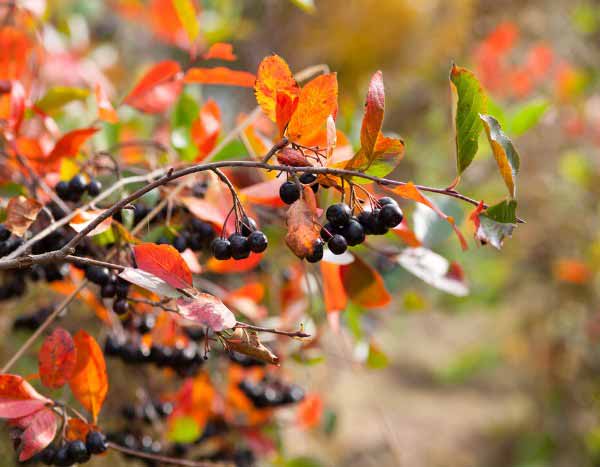
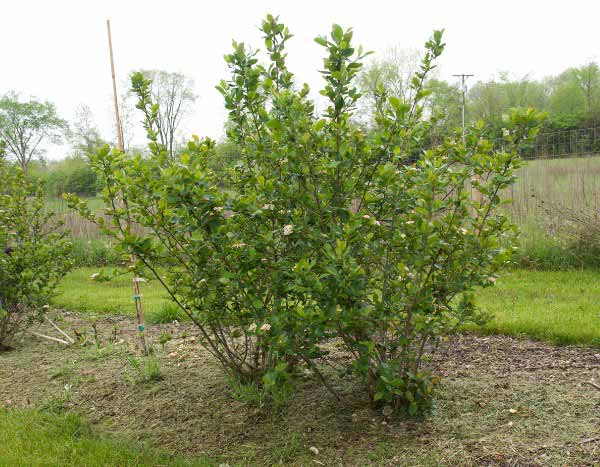
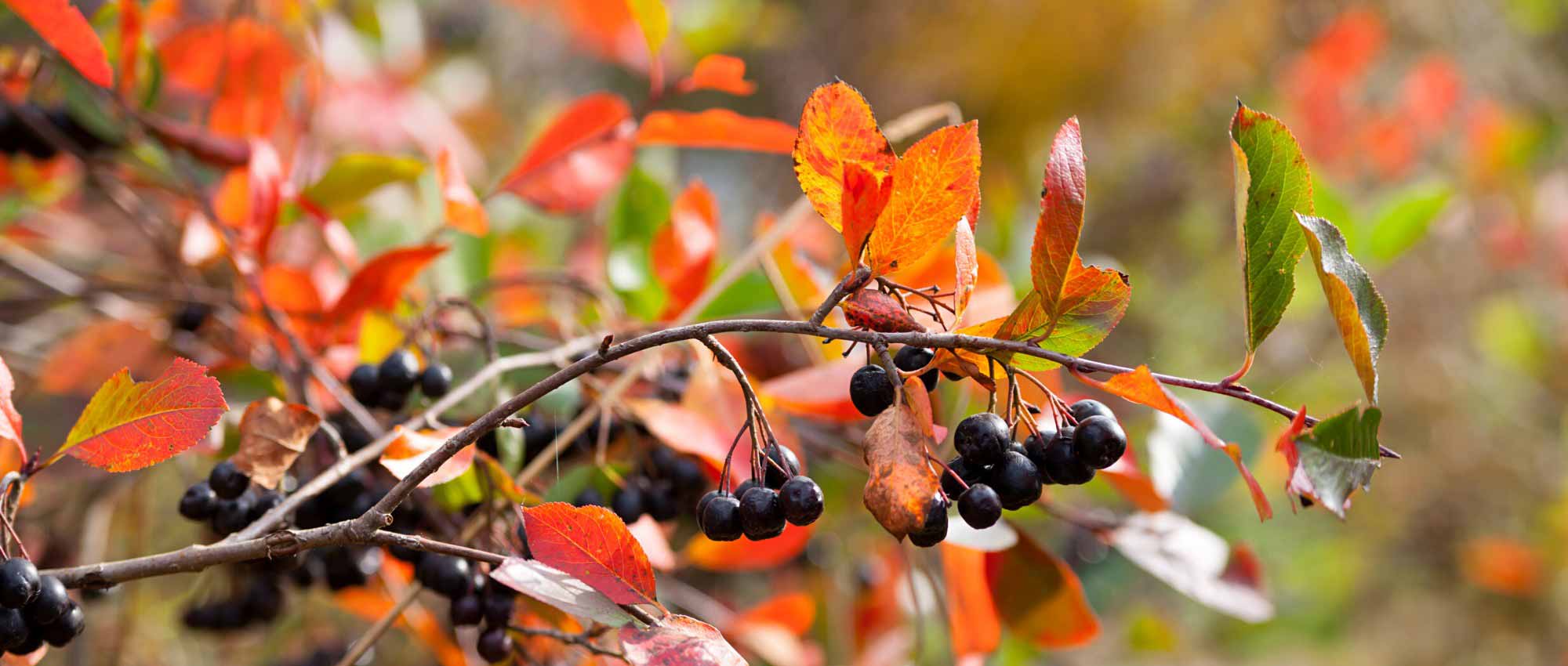
'Rubina' forms a sparsely branched, open-growing bush reaching approximately 2m in height and 1.25m in width, sometimes more depending on growing conditions. It exhibits slow growth in its early years. Its bark is smooth and reddish-brown. It bears alternate, simple, ovate, finely toothed leaves measuring 4 to 5cm in length, with a glossy dark green colour that blazes in autumn, adopting various shades of orange, copper, crimson red, and violet. In April-May, it produces white flowers dotted with pale pink, measuring 2cm in diameter. Gathered in corymbs, there are numerous, highly fragrant, and melliferous. They give way to clusters of round fruits, measuring 1.5cm in diameter, initially green-purple and becoming blackish-purple and shiny as they ripen, while the peduncles turn red. This fruiting, slightly acidic, juicy, and rich in antioxidants, persists throughout winter if not consumed by birds. 'Rubina' is a self-fertile variety: a single plant is sufficient for a bountiful harvest.
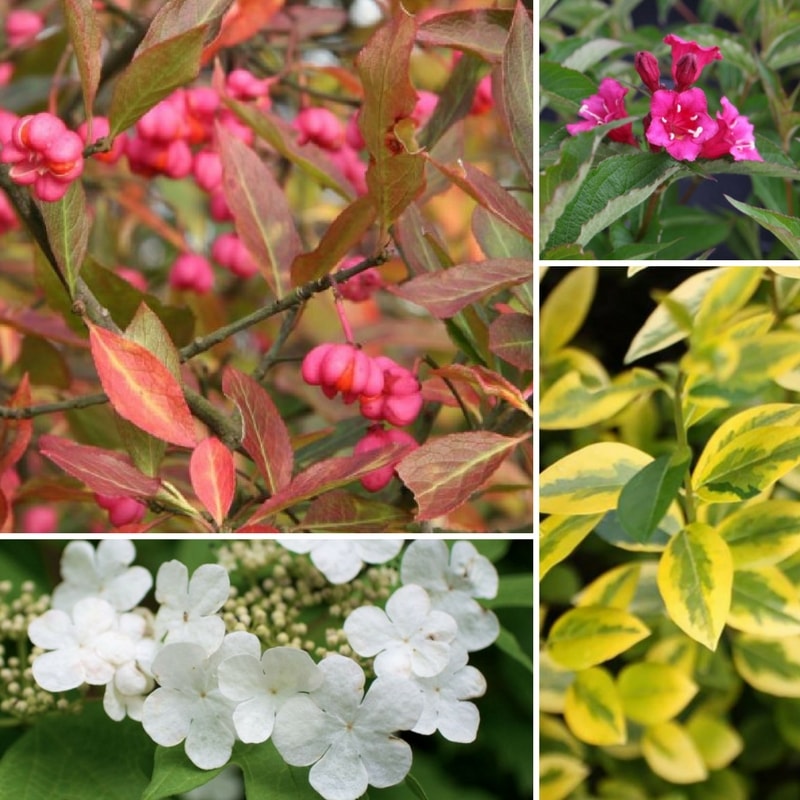
Naturally resistant to diseases and pests, Aronia is an excellent bush, both hardy, ornamental, and undemanding. While it can tolerate poor soils, it will thrive best in non-chalky, cool, deep, slightly acidic soil. It can be planted individually in a free, countryside, hedgerow hedge, or large shrub borders. To achieve a spectacular mass effect, plant it in groups of 3 to 6 plants of the same variety. This 'Rubina' aronia pairs well in a hedge that is both beautiful and edible with other small fruit bushes, foliage or flowering, such as apple trees, ornamental plum and cherry trees, male cornel, hedge honeysuckle, serviceberries, Goumi, anemone trees, May berries, sea buckthorn, Goji, and blueberries. A perfect combination for creating vitamin-packed cocktails for the whole family!
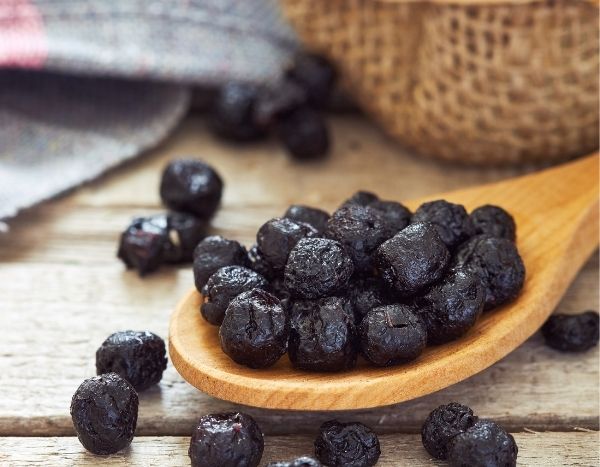
The Aronia fruits can be consumed fresh, cooked, in jams, or as juice, which can be mixed, for example, with cranberry juice and apple juice. Chinese pharmacopoeia attributes medicinal properties and beneficial health effects to the berries of this Aronia fruit variety. The richness in polyphenols, especially anthocyanins, B and C vitamins (3 times more than oranges), minerals, and fibres make the Aronia berry one of the most nutritionally attractive small fruits.
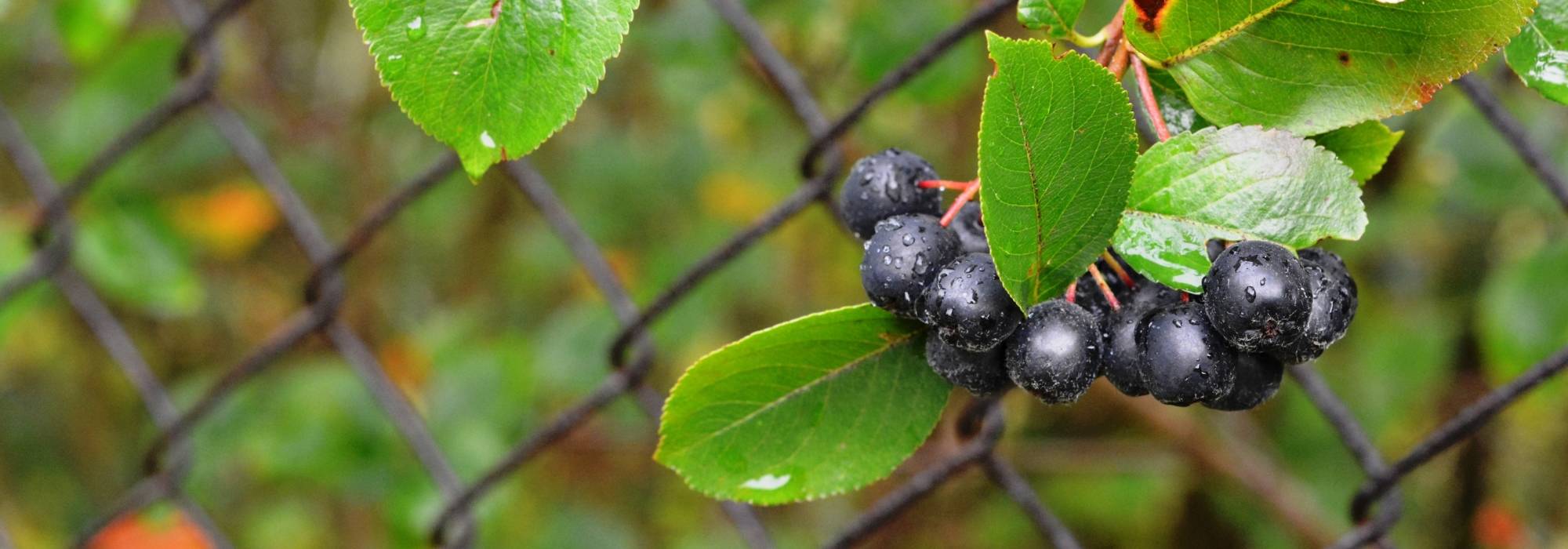
Aronia prunifolia Rubina in pictures
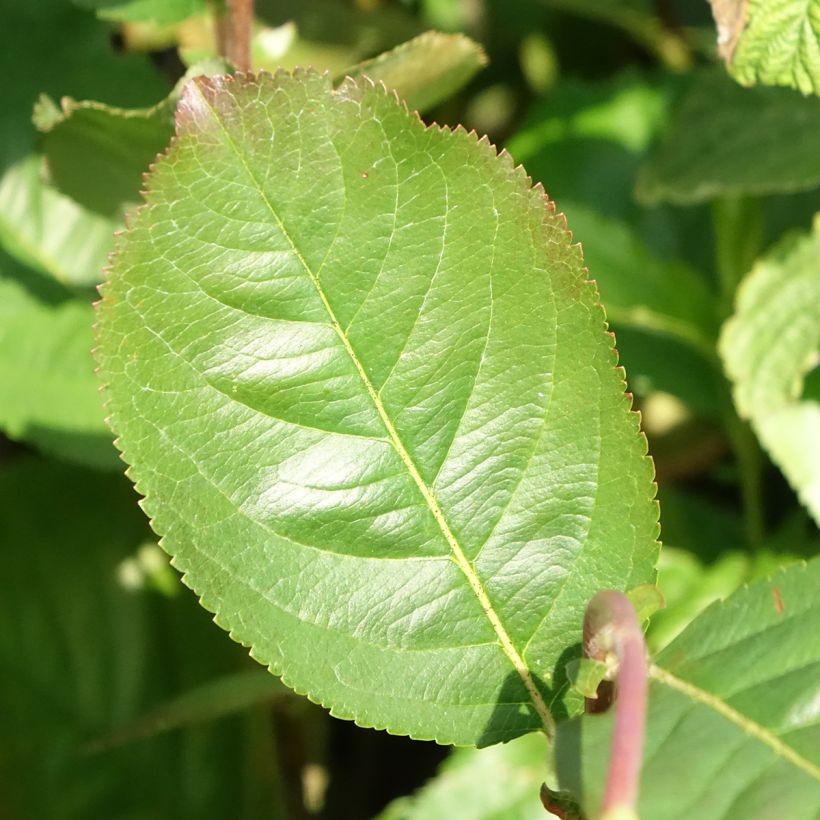
Plant habit
Fruit
Flowering
Foliage
Botanical data
Aronia
x prunifolia
Rubina
Rosaceae
Purple Chokeberry, Black Chokeberry
Cultivar or hybrid
Planting and care
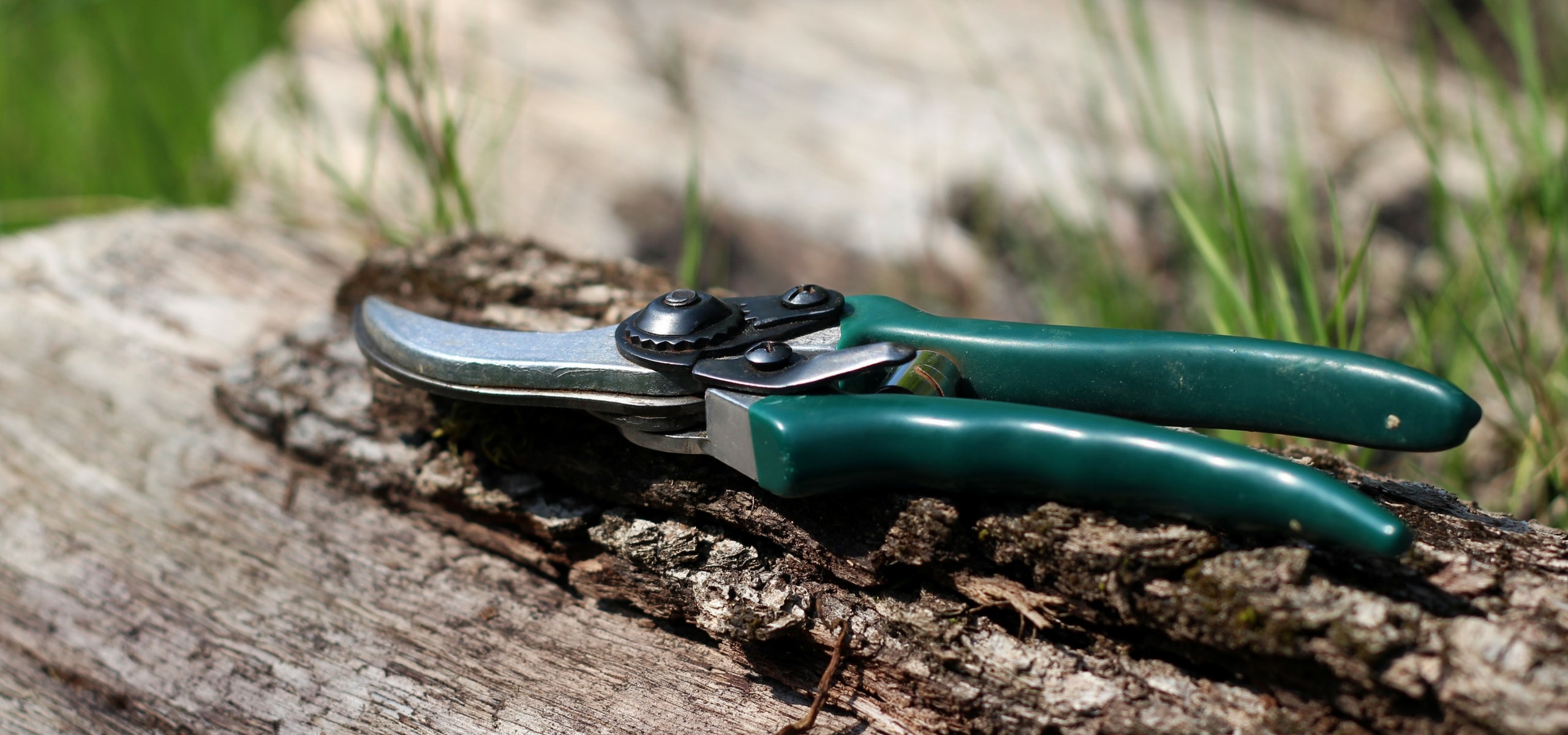
The Aronia prunifolia Rubina is preferably planted in good, fertile, non-chalky garden soil in early autumn. While it is relatively tolerant, it prefers deep, moist to wet, light and slightly acidic soils. Plant it in a sunny, non-burning, or semi-shaded location. The colours are dull in the shade, and the fruiting is less abundant and flavourful. The hardiness of this bush is excellent, even in wet soil. Mulch and water wells are needed to help it establish, especially in the first summers. Remove excess suckers that hinder fruiting. Prune the oldest branches at the end of winter. It is naturally resistant to diseases and parasites but can sometimes be susceptible to rust.
Planting period
Intended location
Care
Planting & care advice
-
-
-
-
-

-
-
-

-
, onOrder confirmed
Reply from on Promesse de fleurs
Recently viewed products
Haven't found what you were looking for?
Hardiness is the lowest winter temperature a plant can endure without suffering serious damage or even dying. However, hardiness is affected by location (a sheltered area, such as a patio), protection (winter cover) and soil type (hardiness is improved by well-drained soil).
In temperate climates, pruning of spring-flowering shrubs (forsythia, spireas, etc.) should be done just after flowering.
Pruning of summer-flowering shrubs (Indian Lilac, Perovskia, etc.) can be done in winter or spring.
In cold regions as well as with frost-sensitive plants, avoid pruning too early when severe frosts may still occur.
The harvesting period indicated on our website applies to countries and regions in USDA zone 8 (France, England, Ireland, the Netherlands).
In colder areas (Scandinavia, Poland, Austria...) fruit and vegetable harvests are likely to be delayed by 3-4 weeks.
In warmer areas (Italy, Spain, Greece, etc.), harvesting will probably take place earlier, depending on weather conditions.
The sowing periods indicated on our website apply to countries and regions within USDA Zone 8 (France, UK, Ireland, Netherlands).
In colder areas (Scandinavia, Poland, Austria...), delay any outdoor sowing by 3-4 weeks, or sow under glass.
In warmer climes (Italy, Spain, Greece, etc.), bring outdoor sowing forward by a few weeks.
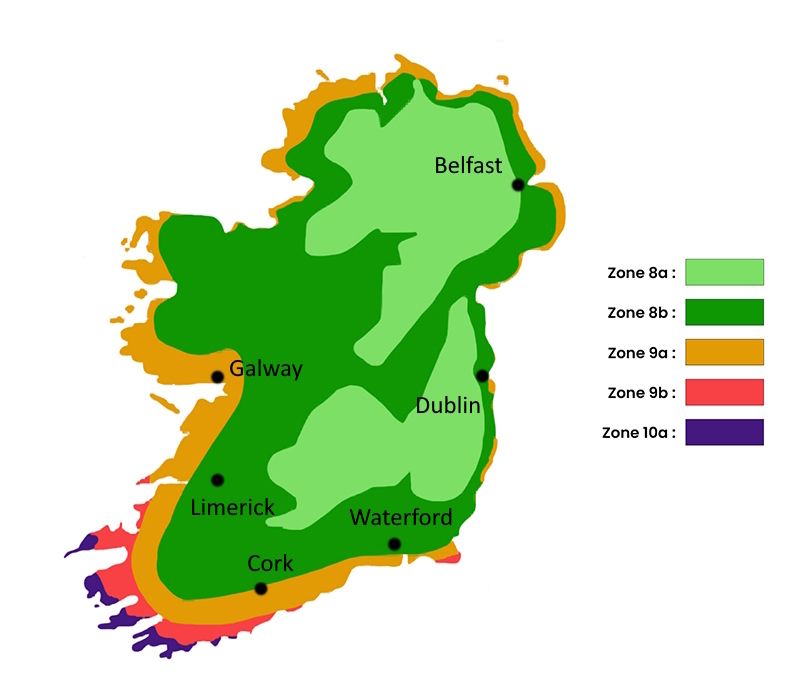
The planting period indicated on our website applies to regions in USDA Zone 9a (East Coast and Midlands: Dublin, Wexford, Waterford, Kilkenny, Portlaoise). It will vary depending on where you live:
- On the west coast and in the north-west (Galway, Limerick, Sligo, Donegal, Westport), delay planting by 1 to 2 weeks in spring and bring it forward by 1 to 2 weeks in autumn compared to the dates given, preferably choosing periods without strong winds.
- In the inland hills and plateaus (Wicklow Mountains, Macgillycuddy’s Reeks, Connemara, Killarney), it is best to plant in spring (April–May) or autumn (September–October), avoiding periods of waterlogged soil in winter and strong winds, which pose the main risk to newly planted trees in these areas.
The flowering period indicated on our website applies to regions in USDA Zone 9a, such as the East Coast and Midlands, including Dublin, Wexford, Waterford, Kilkenny and Portlaoise.
This will vary depending on where you live:
- On the west coast and in the northwest (Galway, Limerick, Sligo, Donegal and Westport), it will be delayed by one to two weeks compared to the given dates, due to stronger Atlantic winds and less spring sunshine.
- In the inland hills and plateaus (the Wicklow Mountains, the Macgillycuddy's Reeks, Connemara and Killarney), flowering will be delayed by two to three weeks. Flowering mainly occurs between May and July, with the limiting factors being less frost and more of the excessive humidity, strong winds and lack of sunshine that are characteristic of these areas.
Shipping country and language
Your country of residence may be:
Your country of residence is:
For a better user experience on our website, you can select:
Your shipping country:
-
 Austria
-
 Belgium
-
 Bosnia & Herzegovina
-
 Bulgaria
-
 Croatia
-
 Cyprus
-
 Czechia
-
 Denmark
-
 Estonia
-
 Finland
-
 France
-
 Germany
-
 Greece
-
 Hungary
-
 Iceland
-
 Ireland
-
 Italy
Italy
-
 Latvia
-
 Liechtenstein
-
 Lithuania
-
 Luxembourg
-
 Malta
Malta
-
 Netherlands
-
 Poland
-
 Portugal
-
 Romania
-
 Serbia
-
 Slovakia
-
 Slovenia
-
 Spain
Spain
-
 Sweden
-
 Switzerland
Language:
-
French
-
 English
-
Spanish
-
Italian
-
German
-
Portuguese
-
Dutch
-
Finnish
My Account
Hello
My wish lists
My cart
Log in / Register
Existing customer?
This form is protected by reCAPTCHA - the Google Privacy Policy and Terms of Service apply.
New customer?
Create an account to track your orders, access our customer service and, if you wish, make the most of our upcoming offers.