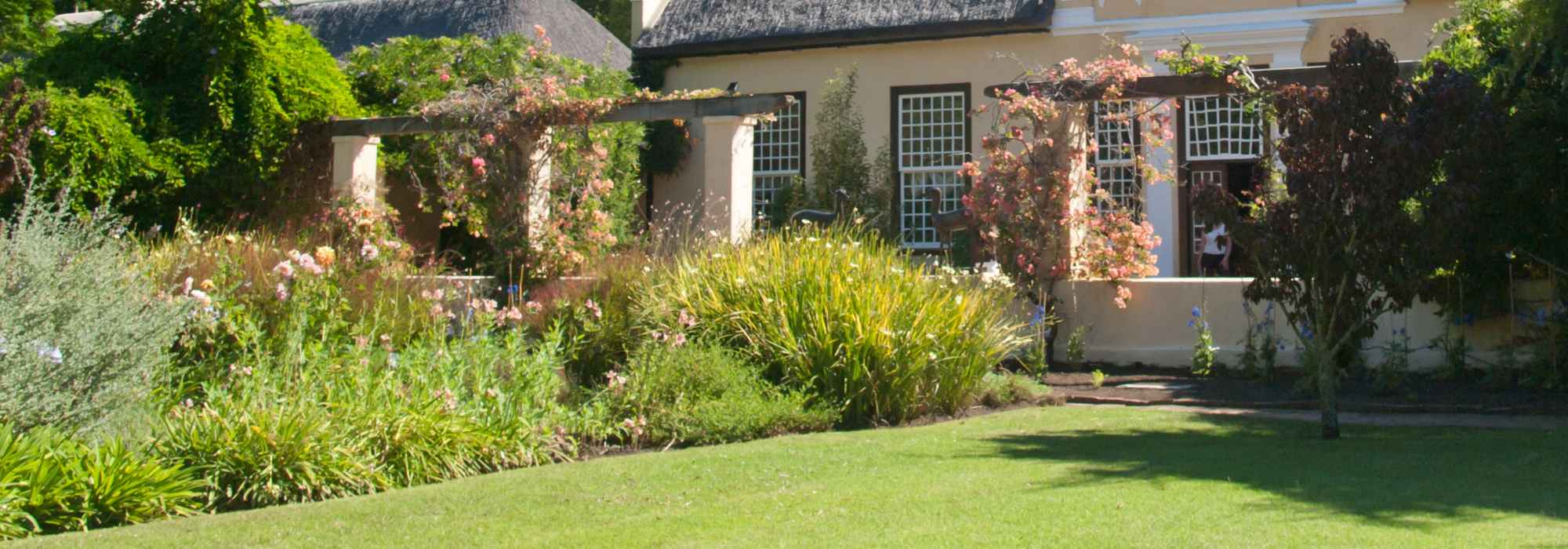
Soft, on-trend colours: how to design a 'nude' garden?
...and invite softness into the garden!
Contents
Among colour trends that have been around for several years, “nude” is now established across many fields, including gardens. This slightly pink-tinged champagne colour is sheer delicacy suitable for the most romantic gardens.
Discover our ideas for properly integrating pastel shades in cream, champagne and flesh tones drawing on the subtlest blooms and some foliage, to transform or create new enveloping beds, or to compose a wider garden scheme and enjoy its soothing effect.

The spirit of "Nude" in the garden
When applied in the garden, the Nude aims to be completely relaxing. First through its very soft colours, but also through shapes of foliage and the lightness of blooms, since much use is made of climbing plants and ornamental grasses, for example, which add to serenity with their opalescent tones.
These nude tones, a skilful blend of iridescent pink and beige, are perfect colours for a specific kind of garden: the city garden or small urban garden. As well as having a calming effect on how we view the garden, these pale colours visually enlarge the space, which is what one seeks to achieve in small gardens often enclosed by walls.
But the nude colours of certain flowers, even of some foliage, are also very much at home in a contemporary garden for the softness they bring to lines that can sometimes be a little stark, in a natural garden for the simplicity of certain wildflowers and grasses, and of course perfectly suited to a romantic garden!
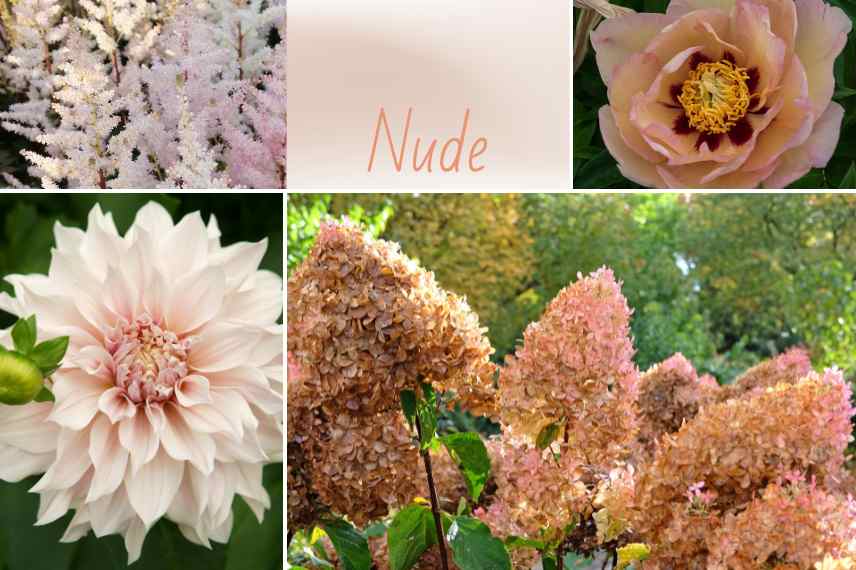
The nude colour appears on a large number of flowers and foliage. Here, one finds the pearly pink of Astilbe arendsii ‘Bumalda’, the very soft apricot of the Itoh peony ‘Pastel Splendor’, the silky Dahlia ‘Café au Lait’ and the late‑summer flowering of Hydrangea paniculata.
Nude garden plant palette
Under the English term nude (which means ‘naked’, incidentally), one thinks of diaphanous, powdery tones evoking flesh. It is a blend of pink and greige, sometimes bordering on peach tones.
In the floral realm, since it is often the blooms that will impart this nude note, choose all tones between pale pink and pink‑orange, pale peach and very light apricot, cream and pale parchment‑yellow on flowers and foliage, often variegated or beginning as whitish‑pink (there are many) and developing over time.
Some azaleas and rhododendrons take on these pastel shades, such as Rhododendron ‘Inkarho Brasilia‘ (leaning towards pink‑orange), ‘Horizon ‘Monarch‘, ‘Golden Torch‘, ‘Inkarho Bernstein‘, or the dwarf rhododendron ‘Dusty Miller’: all hover between pale yellow, pink and peach, giving that irresistible powdered‑pink, champagne‑tinged look.
Not forgetting camellias that charm in this group of part‑shade, acid‑soil plants such as Camellia ‘Botanyuki’ — cream with a pearlescent sheen — ‘High Fragrance’ or ‘Virginia Robinson’.
Many peonies feature nude blooms that transform their large flowers, such as the sublime peony ‘Madame Calot’, the tree peony ‘Xue Ta’, the Itoh peony ‘Pastel Splendour’, or the Paeonia lactiflora ‘Reine Wilhelmine’.
Among larger shrubs, the irreplaceable oleander ‘Angiolo Pucci’, as well as winter or spring viburnums and some Japanese quince such as Chaenomeles cathayensis. Some American hydrangeas take on pinkish, slightly reddened tones — just perfect!
Don’t forget roses that offer nude tones across many beautiful cultivars: shrub rose ‘Princesse Astrid de Belgique’, old rose ‘Perle d’Or’, ‘Jardin des Tuileries’, dwarf rose ‘Sweet Dreams’, groundcover rose ‘Aspirin Rose’, ‘Isabelle Autissier’, and many more…
Many perennials wear very soft pastel colours, such as the wonderful foxglove ‘Suttons Apricot’, Astilbes (‘Bumalda‘, ‘Bressingham‘, ‘Pink Lightning‘ and ‘Rosa Perle‘), Achillea millefolium ‘Apfelblüte’, colourful arum Zantedeschia aethiopica ‘Pink Flamingo’, Pimpinella major ‘Rosea’, Linaria ‘Peachy’, or the timeless Dahlia ‘Café au Lait’. Early and late tulips also join this non‑exhaustive list, such as ‘Peace Flame’ — completely on tone.
Count on hellebores showing the finest ‘nude’ flowers: Helleborus orientalis ‘Apricot’, ‘Apricot Spotted’, or helleborus orientalis ‘Magic Apricot guttatus’. Some climbers with an almost pearly tone will also fit perfectly to add height, such as Clematis armandii ‘Apple Blossom’.
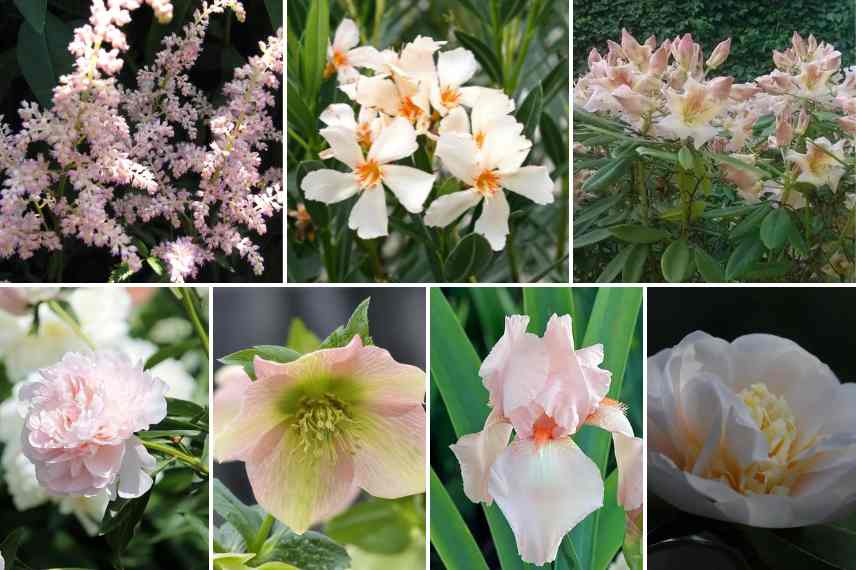
Astilbe arendsii ‘Rosa Perle’, oleander ‘Angiolo Pucci’, Rhododendron ‘Inkarho Bernstein’, peony ‘Madame Calot’, apricot hellebore, garden iris ‘Flamant rose’ and Camellia ‘Botanyuki’
Irises are a marvellous source for recreating the nude palette in the garden. There are many that show that champagne, iridescent side, including ‘Flamant Rose’, ‘Peach Frost’, ‘Frappé’, ‘Poesie’, ‘Qualified’, ‘Coralina‘, ‘Bewitchment’, and ‘Comes The Dawn’.
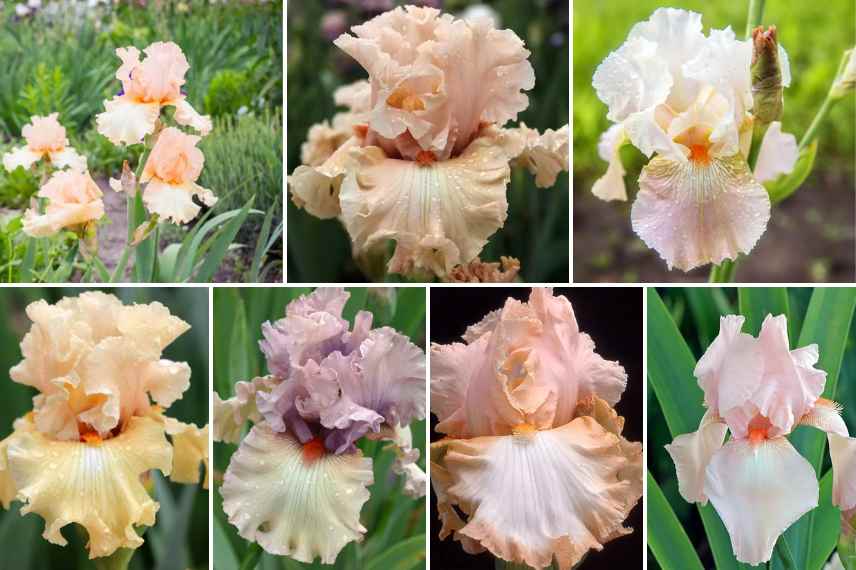
Iris germanica: ‘Qualified’, ‘Coralina’, ‘Frappé’, ‘Comes The Dawn’, ‘Bewitchment’, ‘Peach Frost’ and ‘Flamant Rose’
As for foliage, fewer options, but there are still shrubs and grasses of interest in their bud burst or autumn colour change. Look towards ornamental grasses and the typical colour of their feathery or silky inflorescences, and their culms taking on a tawny hue in winter: Molinia arundinacea ‘Windsaule’, Muhlenbergia capillaris, the very light inflorescences of many Panicum offering a slightly pink cloud, Miscanthus, etc.
Shrimp tones, notably the willow of the same name (Salix integra ‘Flamingo’), less fashionable now but offering a colour between white, green and pink, fit perfectly into the nude trend. Also consider Nandina domestica ‘Twilight’, Acanthus ‘Tasmanian Angel’, and Acer pseudoplatanus ‘Simon‑Louis Frères’, which play with variegated foliage.
→ My tip: to find gems in these unique colours, search using keywords: champagne, Peach, or Apple Blossom.
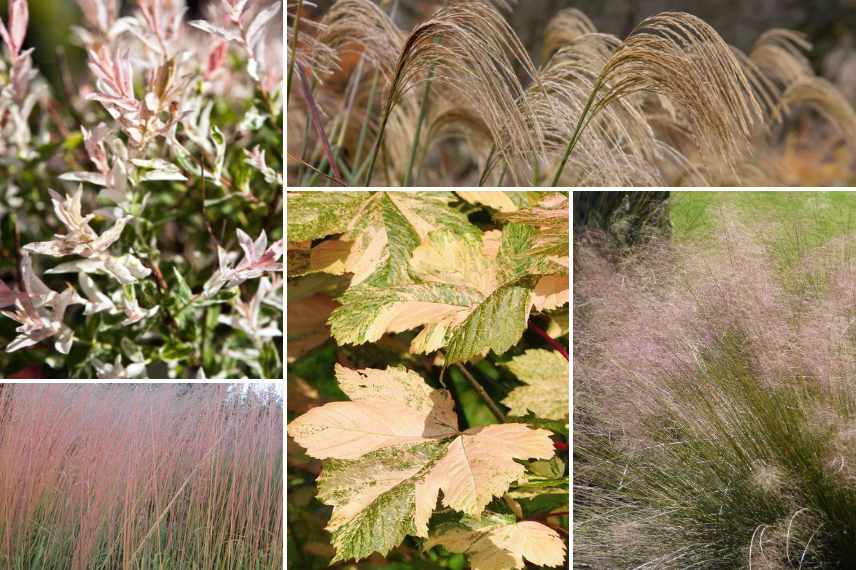
Salix integra ‘Flamingo’, Miscanthus nepalensis, Molinia arundinacea ‘Windsaule’, Acer pseudoplatanus ‘Simon‑Louis Frères’ and Muhlenbergia capillaris
→ Also read: 10 perfect plants for a private and calming garden and doudou plants, as well as our inspiration page for the nude garden!
Perfect pairings
This garden, based on very soft pale pink and cream hues, pairs with all other cream tones, as well as white and orange. Without ever forcing the effect, as greenery should also be abundant to showcase these powdery tones. Consider pairing two close tones, one supporting the other, for example two astilbes such as ‘Bressingham Beauty’ and the Astilbe simplicifolia ‘Pink Lightning’. Orange will enliven the whole scheme (from peach to salmon-pink and coral), and harmonises with the apricot effect.
To prevent these milky colours becoming too washed-out, take care to lift the composition with fairly abundant foliage, either through singular shapes or through colouring, from silvery tones to aniseed hues with darker leaves. Dare a little sophistication with purple foliage: it literally elevates this nude palette by offering a truly beautiful contrast!
Also consider the complementary colour to these vanilla tones: purple. Used in small touches and on light, almost pointillist inflorescences, it vitalises the softness of the nude garden without overpowering it.
Finally, as with the white garden or pink garden, consider using variegated flower or leaf colours, as well as green flowers that provide a subtle harmony.
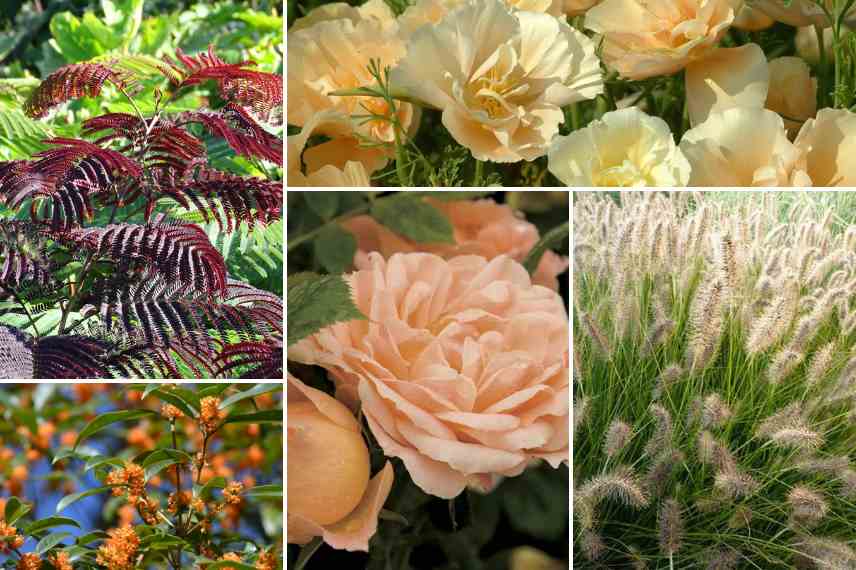
A single touch of purple, here an Albizia julibrissin ‘Summer Chocolate’, and a more orange osmanthus aurantiacus (bottom left), enhance the pastel character provided by California poppies, a rose ‘Sweet Dreams’ and Chinese fountain grass.
Nude garden through the seasons
Don’t want a garden in those pale tones all year round? Then choose one or two spring borders that will welcome brighter days with the utmost softness and delicacy after winter’s chill. It is the season when powdery hues show at their best, sunshine still gentle but present enough.
By combining slightly apricot-coloured tulips with a few perennials or shrubs bearing white flowers washed with pink, such as viburnums or ornamental Prunus, you will create, as in our example below, a perfect ode to nature’s awakening.
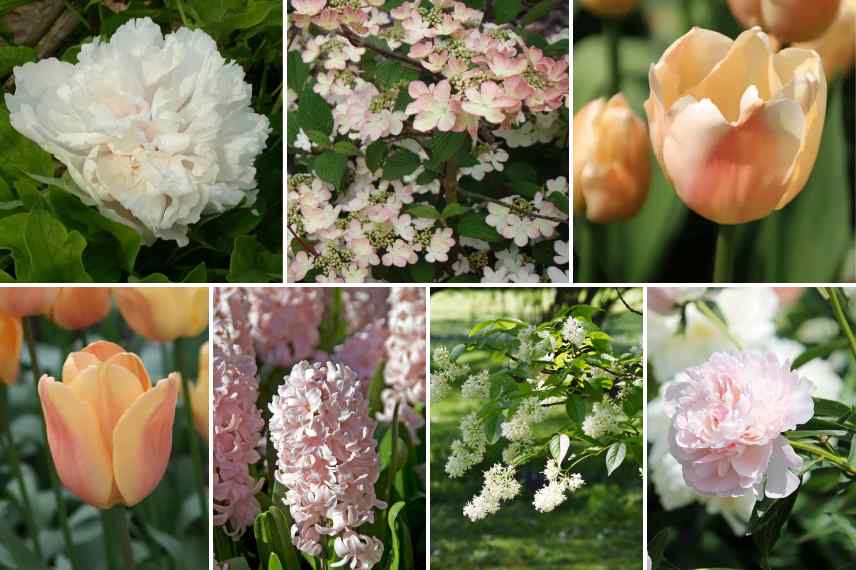
Tree peony ‘Xue Ta’, Viburnum plicatum ‘Kilimanjaro’, tulips ‘Apricot Pride’ and ‘Apricot Foxx’, hyacinth ‘China Pink’, Staphylea colchica and peony ‘Madame Calot’
In summer, many combinations are possible, for example a mix of dahlia, a peach-toned rose, Alcalthea diaphanes, upright Verbascum and marbled or purple heucheras to anchor nude tones and complete them with their airy blooms.
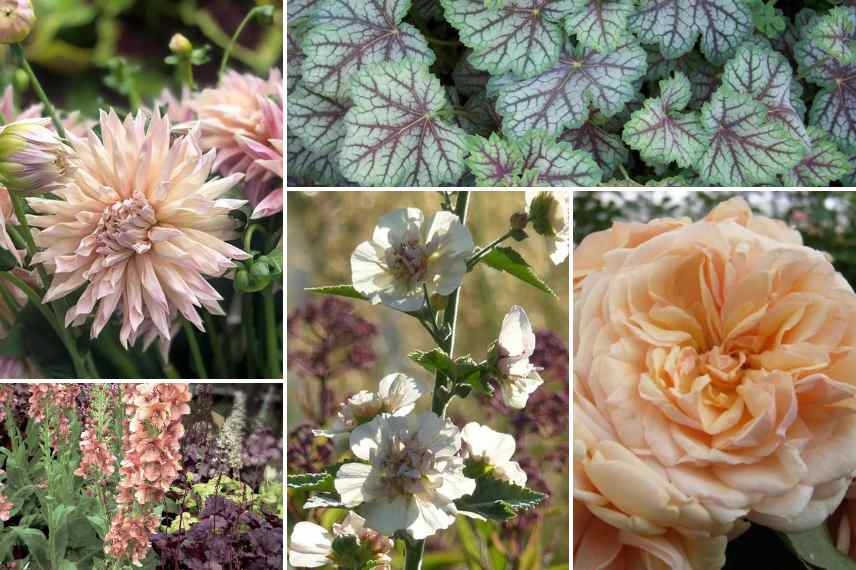
Dahlia ‘Café de Paris’, Verbascum ‘Jackie’, Alcalthea ‘Parkallee’, rose ‘Morabito’ and heucheras.
The same border could evolve in autumn by adding to the previous composition a substantial grass such as Mulhenbergia, an Abelia for long flowering and a few Hydrangea paniculata for their sublime colour changes at season’s end.
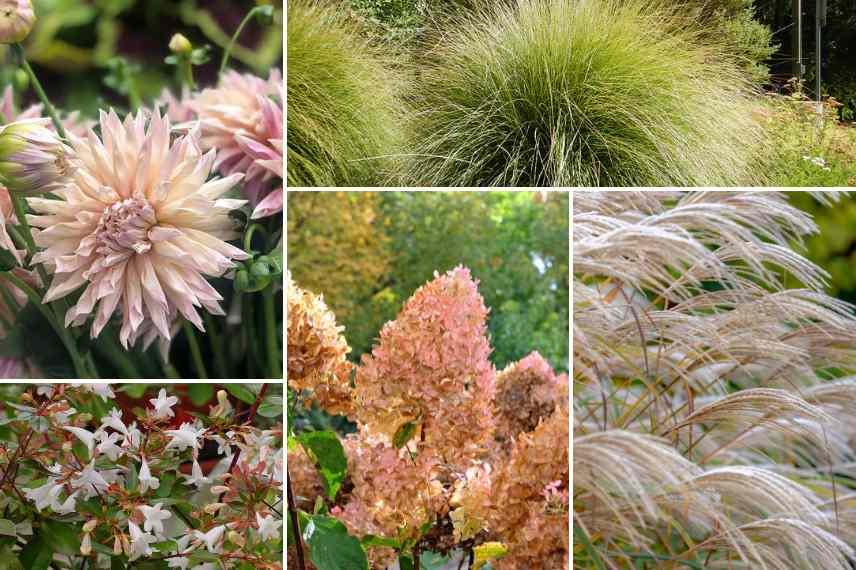
Dahlia ‘Café de Paris’, Mulhenbergia rigens, Abelia grandiflora, Hydrangea paniculata ‘Phantom’ and Miscanthus sinensis
Winter and its low, grey sky is also a time of year when softened colours can emerge in the garden, in silvery-pink tones. These will give garden a cocooning, hushed atmosphere as days begin to lengthen. Consider adding one or two striking bark specimens to enhance spaces!
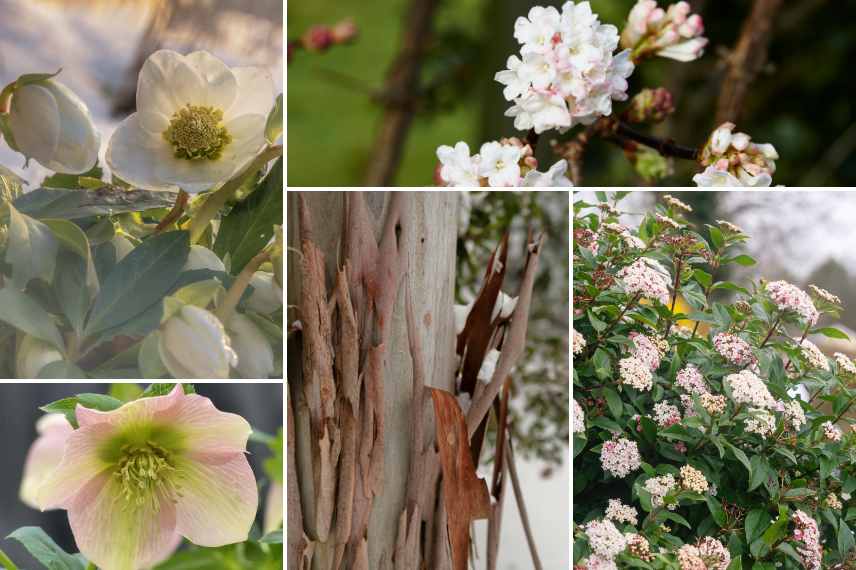
Helleborus niger, Viburnum bodnantense, Helleborus ‘Apricot’, eucalyptus bark, and laurustinus (Viburnum tinus)
Fine-tune décor
No — a nude garden will not be adorned with naked statues or classical sculptures in the French formal or Italianate style!
When it comes to materials, furniture and décor, opt for terracotta which harmonises so well with nude tones and is often seen in decor magazines. Orange in pottery is ideal, as with the use of terracotta, because it provides the right backing, warms and adds body to pastel flowers while also supporting them. Avoid pots in colours that are too washed-out.
Blue and green also suit it well, especially shades close to turquoise or celadon, which could be chosen for a pair of large planters, for example. Purple, as a partner colour on the colour wheel, used sparingly will act as an accent.
Layout tips
Drawing on raw-material codes of the bohemian garden, use hammocks sparingly, glass demijohns to add harmonious green reflections, glass and metal lanterns, corten steel for its coppery hue, perfect alongside peachy blooms, exotic woods with warm orangey tones such as acacia, or rattan, Chinese paper lanterns or woven seagrass lanterns, etc.
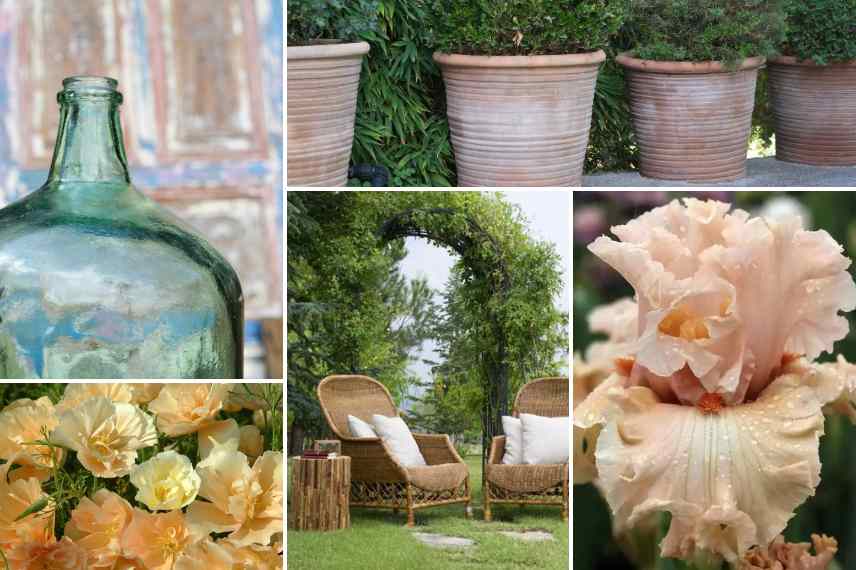
Demijohns for green colour and glass shine, terracotta pots and beautiful rattan seats highlight delicacy of California poppies ‘Champagne’ and Iris ‘Coralina’
- Subscribe!
- Contents
This form is protected by reCAPTCHA - the Google Privacy Policy and Terms of Service apply.

































Comments