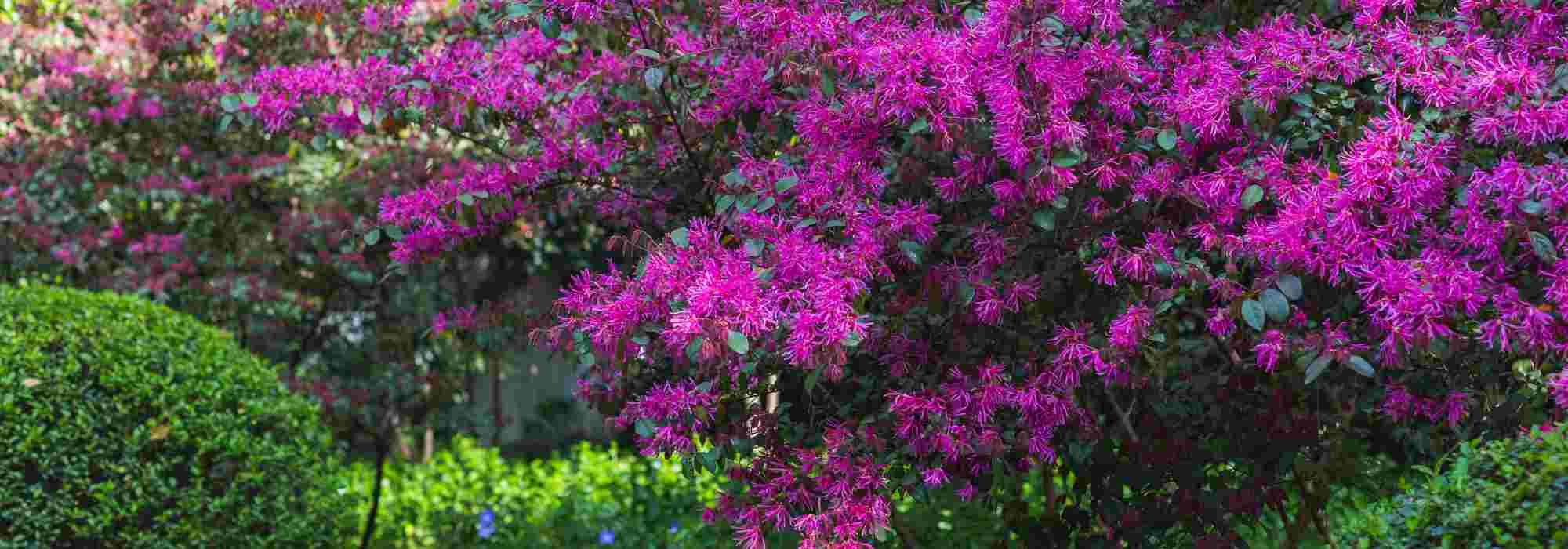
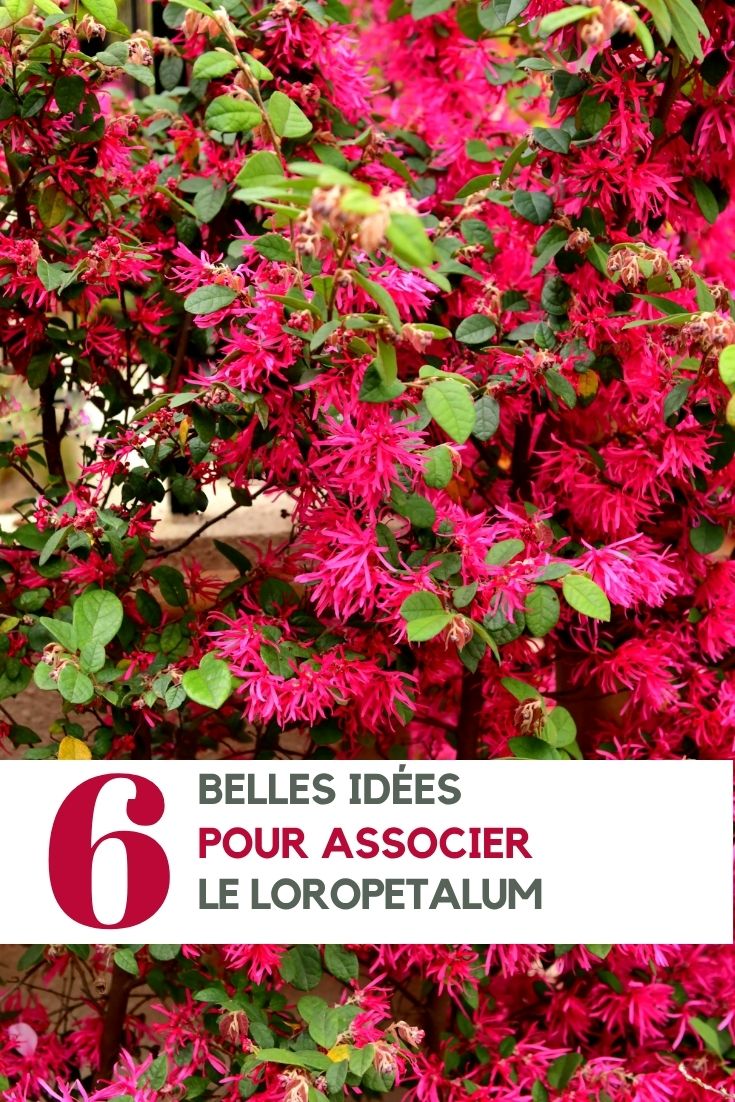
How to pair Loropetalum?
6 beautiful ideas to showcase this magnificent shrub
Contents
Hollyhock in a nutshell
Purple foliage of Loropetalum is a must for anyone wanting to add contrast to their garden. Its spidery flowering, similar to that of witch-hazel with which it shares the same botanical family, is so delicate that it benefits from being paired with unusual plants. It also often reblooms in summer or autumn and requires little care.
You bought a Loropetalum, charmed by its foliage, and don’t know how best to combine it in a border? These ideas should help.
Here are 6 scenes you can easily recreate at home!

In contrast to zesty foliage or flowering
Burgundy to purple shades pair well with anise-green tones. The tangy green brightens purple foliage, which can look a little dull. A pairing of these two colours is a fail-safe way to combine with Loropetalum. We are spoilt for choice among the green flowers and chartreuse foliage, and here we suggest some perennial plants and shrubs that will thrive in the same growing conditions, namely bright partial shade, moist, slightly acidic soil.
Beside a Loropetalum ‘Hot Spice’, group at least one other evergreen such as Coprosma ‘Marble Queen’ in mild climates, which brightens with its marbled foliage, and Nandina domestica ‘Lemon Lime’. For foliage, play with that of the alchemillas, whose flowering will coincide with that of Loropetalum, and a Helleborus foetidus, with its charming recurved green flowers. Include some spring-flowering plants in pink-red tones, such as columbines ‘Crimson Star‘, ‘Ruby Port’ or ‘Nora Barlow‘ to follow on from Loropetalum’s flowering. For extended flowering into summer, plant a few bulbs such as dwarf Aster ageratoides ‘Harry Schmidt’.
This scene is perfect in the garden for the transition from late winter to spring!
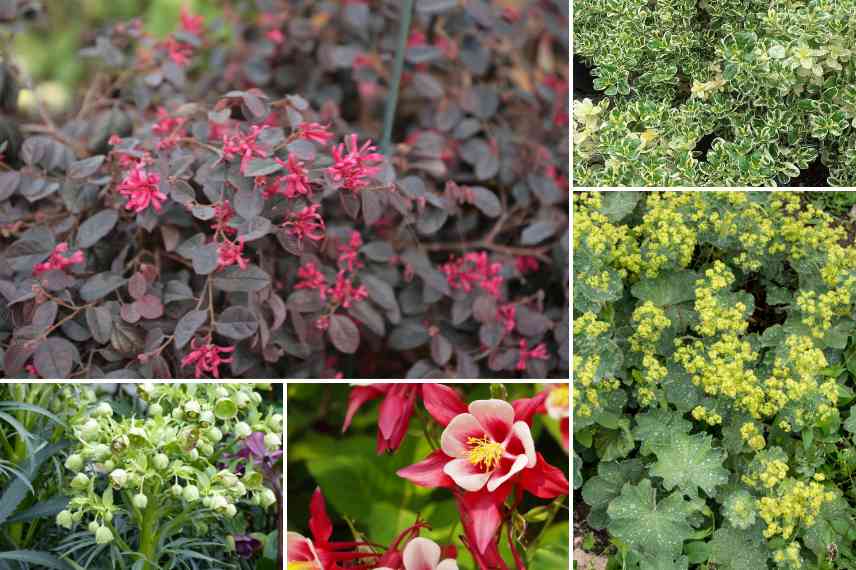
Clockwise from top left: Loropetalum ‘Hot Spice’, Coprosma ‘Marble Queen’, Alchemilla mollis, Aquilegia ‘Crimson Star’ and Helleborus foetidus ‘Sopron’
Read also
Loropetalum: planting, pruning and careIn a pot on the terrace
Different varieties available on the market remain modest in size, making most Loropetalum ideal candidates for container growing. Its evergreen nature is clearly a major asset for this use. Just take care to place it on a balcony or terrace sheltered from cold winds, given its overall moderate hardiness. On a small space it is particularly interesting to introduce distinctive foliage colours and shapes, and to incorporate other evergreen or semi-persistent foliage.
For example, surround Loropetalum ‘Ruby Snow’, which bears white flowers on purple foliage, with a dwarf honeysuckle whose mauve to purple flowering often occurs at the same time, such as ‘Chic et Choc‘. Beside them, add some attractive foliage, such as that of Pittosporum ‘Midget’, which stays neatly ball-shaped in its container, and the airy quality of Stipa tenuifolia. To complete this soft scheme, a small Japanese maple such as Acer palmatum ‘Ornatum’ will, over the years, add some height and a spreading silhouette. Its finely cut foliage and colours ranging from bronze through orange to purple are particularly appreciated, blending perfectly each season with ‘Ruby Snow”s purple foliage.
Each of these plants can be grown in containers on small balconies as well as on medium-sized terraces.
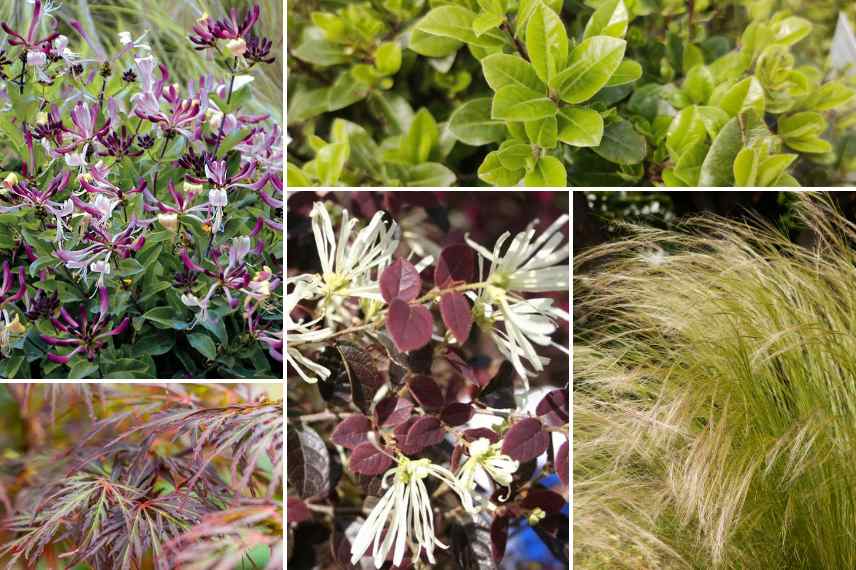
Clockwise from top: Lonicera ‘Chic et Choc’, Pittosporum tenuifolium ‘Midget’, Stipa tenuissima, Loropetalum ‘Ruby Snow’ and Acer palmatum ‘Ornatum’
In a "winter garden" to warm the garden
A trend from England invites us to think of the garden as a winter setting, for the full palette of colours that flowering and bark bring in the cold season. With its persistence and bold colours, flowering from February, a Loropetalum chinense var rubrum has a rightful place in a border where other winter radiances are invited, such as a Hamamelis x intermedia ‘Diane’ or ‘Jelena‘, with graceful orange-red filaments that will flower from January, and dogwoods with decorative bark such as a Cornus alba ‘Magic Flame’.
Some perennials will be included, such as oriental hellebores to dress the ground with their grace in shades from white to pink, even almost black. Here we have chosen a double, pink-speckled hellebore, Helleborus ‘Double Blanc Guttatus’, but there is a wide range to choose from among oriental hellebores. They have the advantage of flowering for a long time, accompanying successive blooms. Also consider a Japanese quince, such as the striking ‘Kinshiden‘ with cream-and-green flowers, to support Loropetalum flowering around March.
Take the opportunity to place all this beauty in view of a remarkable bark such as that of a Betula septentrionalis, a Prunus serrula (Tibetan cherry) or an Acer griseum, if you have any in the garden.
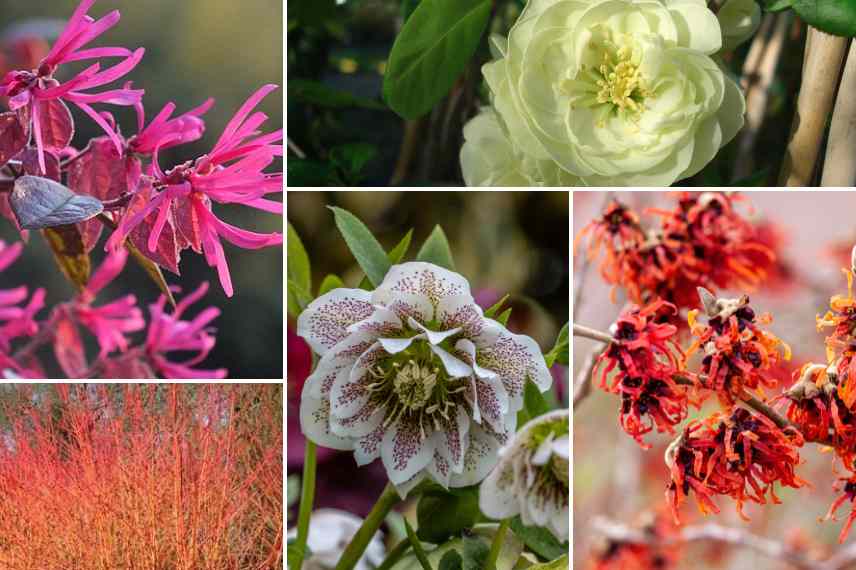
Clockwise: Loropetalum rubrum, Chaenomeles ‘Kinshiden’, Hamamelis ‘Diane’, oriental hellebore, and decorative-barked dogwood ‘Magic Flame’
Read also
Choosing a LoropetalumIn a white garden or a shrubby border in white-and-yellow tones
If purple is more often associated with loropetalum, the type species, Loropetalum chinense, and some more compact cultivars such as the ‘Carolina Moonlight’ variety, or ‘Ruby Snow’ mentioned above when grown in a pot, stand out with a delicate white flowering, infused with green at the heart of the flower. Surrounding them with white, cream to pale-yellow blooms will provide a radiant, very bright display from late winter, like an ode to the first days of spring.
For example, plant in partial shade or non-scorching sun a Loropetalum chinense (one of the taller specimens) surrounded by a Garry eliptica, with long, drooping cream inflorescences, and a long-flowering botanical camellia with evergreen foliage such as Camellia transnokoensis. A few shrubs with delicate pale-yellow flowers on bare wood — Chimonanthus praecox, Corylopsis pauciflora, and Edgeworthia chrysantha — will make a beautiful companion. If deciduous, the Edgeworthia will develop an attractive winter silhouette over the years and interesting foliage for the rest of the season.
All shrubs mentioned here remain modest in size and prefer neutral to acidic soil, which makes it possible to design this bed in a small garden, urban garden or enclosed garden.
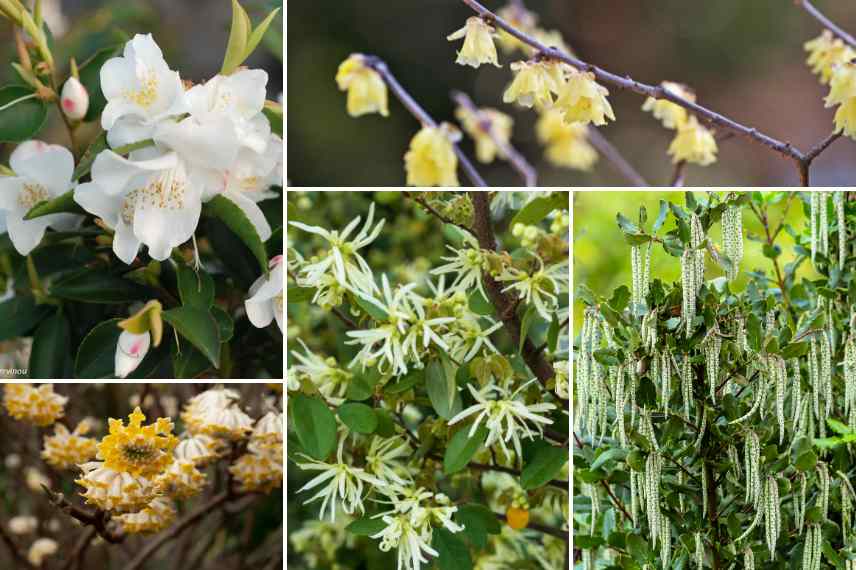
Clockwise from top: Camellia transnokoensis; Chimonanthus praecox; Garry eliptica; Loropetalum chinense; and Edgeworthia chrysantha
In a Japanese garden
Loropetalum, with its rounded, flared silhouette, fits well with Japanese garden aesthetic. Its purple foliage works wonders with that of Japanese maples with bronze- or gold-foliage such as ‘Orange Lace‘, whose colouring changes with the seasons. Here is a suggestion featuring a purple Loropetalum ‘Plum Gorgeous’, with a spreading habit, which can also adapt to an acid-soil border in part shade, in which case plant around it several shrubs for heather soil.
A Azalea serpyllifolium, botanical and dwarf, delightful with small leaves and pale pink spring flowering, will provide soft tones that contrast with the bold purple Loropetalum. Pair it with a larger azalea, such as ‘Jolie Madame‘, to add volume to the group.
Around them, plant a Fatsia japonica, some ferns such as Coniogramme emeiensis or a few clumps of black ophiopogons and liriope for staggered flowering in late summer, together with a variegated Pieris, ‘Pieris japonica ‘Little Heath Variegata’, and a Skimmia japonica ‘Rubella’ whose flowering shades echo the Loropetalum. Ideally, plant a small cloud-pruned conifer (Ilex crenata, yew…) or a dwarf pine to emphasise the Japanese atmosphere. You can also include in this large border a small hydrangea that changes colour in autumn, such as ‘Daredevil’ with its sublime hues echoing the Loropetalum.
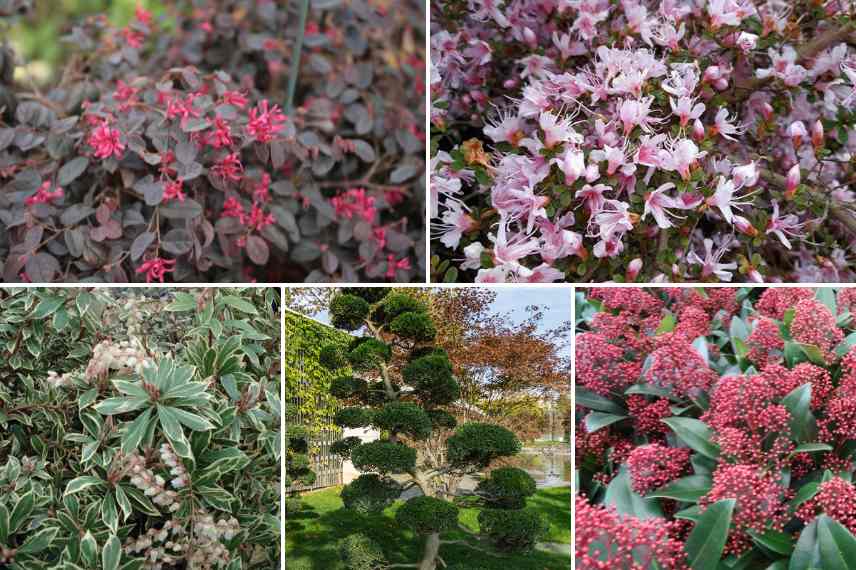
Clockwise from top: Loropetalum ‘Plum Gorgeous’, Azalea serpyllifolium, Skimmia japonica ‘Rubella’, cloud-pruned Ilex crenata and Pieris ‘Little Heath Variegata’
In a tone-on-tone border
Try a Loropetalum in an all-pink-and-mauve planting, for an enchanting tone-on-tone spring display. It’s a Loropetalum with intensely pink flowers, the Loropetalum chinense ‘Ming Dynasty’, and a Judas tree that will dazzle with spectacular pink blooms, on bare wood in April for Cercis siliquastrum. Around them, a myriad of pink flowers appearing at the same time are essential: Mistress tulips planted in drifts, a pink creeping bugle groundcover to provide a cheerful small groundcover, purple heucheras that will flower later with delicate blooms, etc. A few Bletilla striata ‘Purple’ or ‘Blue Dragon‘ will take over from May or June.
Consider adding some mid-summer flowering, for example Alstroemeria ‘Mauve Majesty’ to ensure a long flowering period into autumn.
This beautiful bed will be particularly at home in a pink garden.
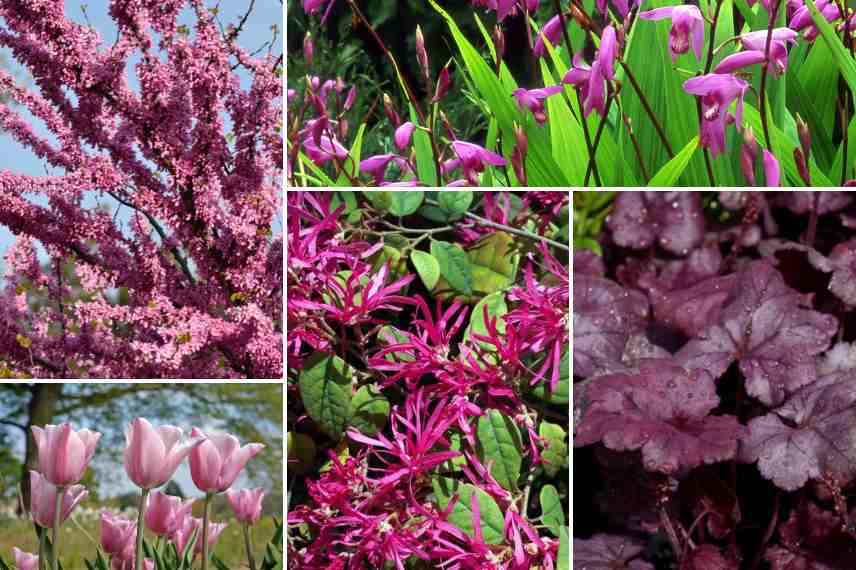
Clockwise from top: Cercis siliquastrum, Bletilla striata ‘Purple’, heucheras ‘Plum Royal’, Loropetalum ‘Ming’ and tulips ‘Mistress Mystic’
Useful resources
- Sow hollyhocks now! Don't miss Michaël's tips for successful sowing!
- Discover our tutorial: How to prepare a hollyhock infusion?
- How to harvest and store your hollyhock seeds? Our advice
- Discover our collections of annual young plants, available as seeds or as potted young plants
- Black flowers in the garden, discover Alcea rosea 'Nigra' and its dark companions, it's fascinating!
A word from our expert
Hollyhock or Alcea is a beautiful perennial plant often grown as a biennial, indispensable in country gardens and has become the symbol of Île de Ré where it thrives along walls, in the lanes of Saint Martin, well sheltered from the wind. This tall, graceful plant lifts all summer from June to September its immense floral spikes, often exceeding 2 m in height, adorned with flowers in open cups or in very double, ruffled pompon forms showing colours from pastel to the darkest tones. In the language of flowers, hollyhock signifies simple love!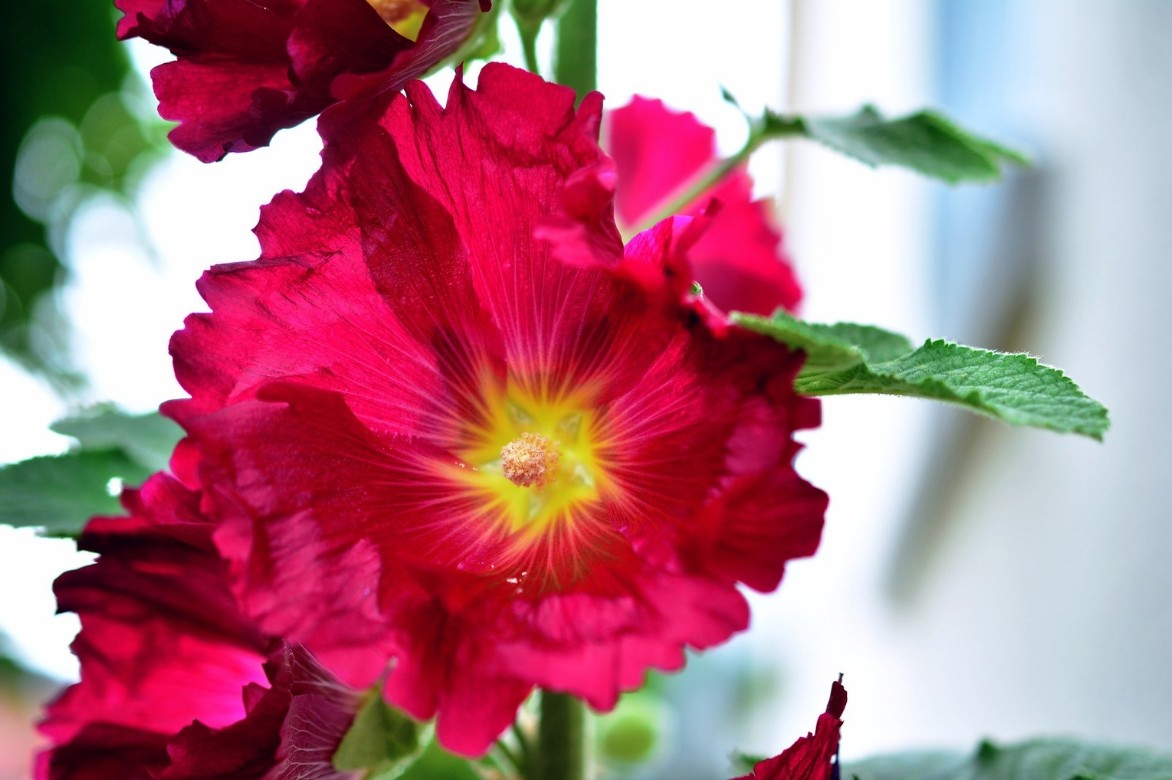 Double hollyhock or single-flowered, black, blackcurrant or powder-pink hollyhocks, all are ideal to bring verticality and a wildly romantic touch to the back of borders, or to the walls of a cottage walled garden against which they lean.
One of the easiest to grow, it adapts to ordinary soils, tolerates drought, likes warm, sheltered situations and self-seeds very easily in the most unexpected places.
Edible, hollyhock can be enjoyed in salads or in jams.
Discover all our varieties of hollyhocks in bucket or in seeds, how to collect and harvest hollyhock seeds and how to prune hollyhocks!
Double hollyhock or single-flowered, black, blackcurrant or powder-pink hollyhocks, all are ideal to bring verticality and a wildly romantic touch to the back of borders, or to the walls of a cottage walled garden against which they lean.
One of the easiest to grow, it adapts to ordinary soils, tolerates drought, likes warm, sheltered situations and self-seeds very easily in the most unexpected places.
Edible, hollyhock can be enjoyed in salads or in jams.
Discover all our varieties of hollyhocks in bucket or in seeds, how to collect and harvest hollyhock seeds and how to prune hollyhocks!
- Subscribe!
- Contents
This form is protected by reCAPTCHA - the Google Privacy Policy and Terms of Service apply.

































Comments