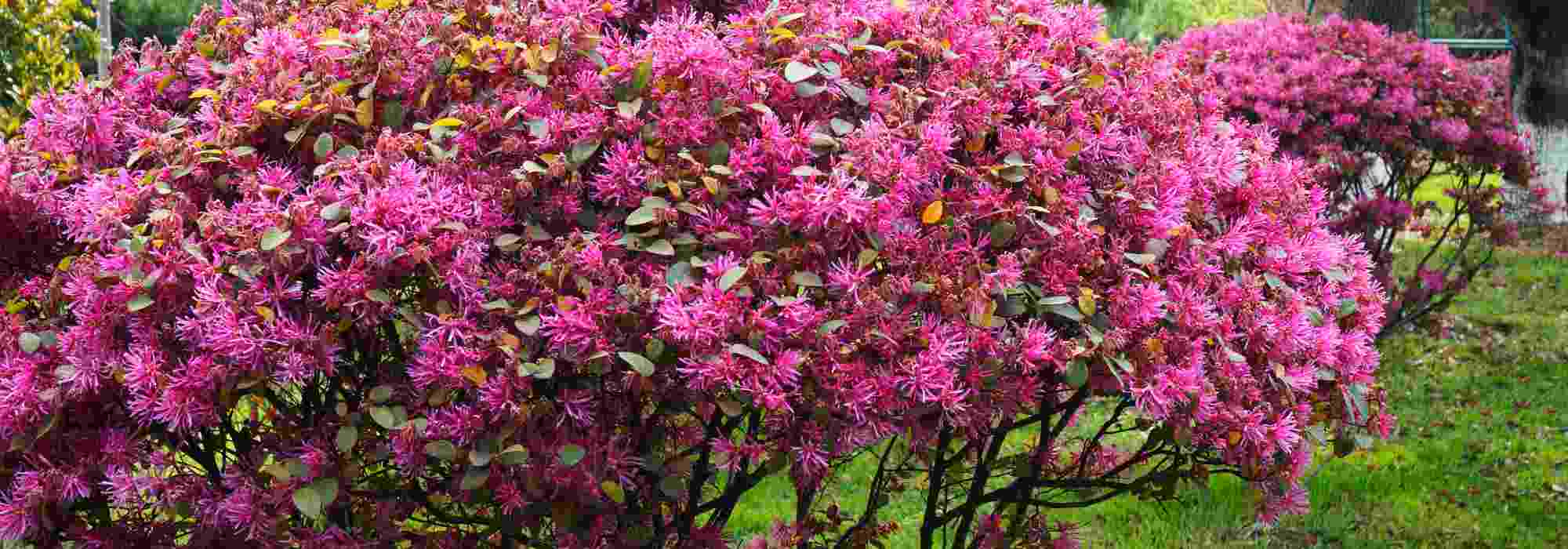
Choosing a Loropetalum
Our buying guide
Contents
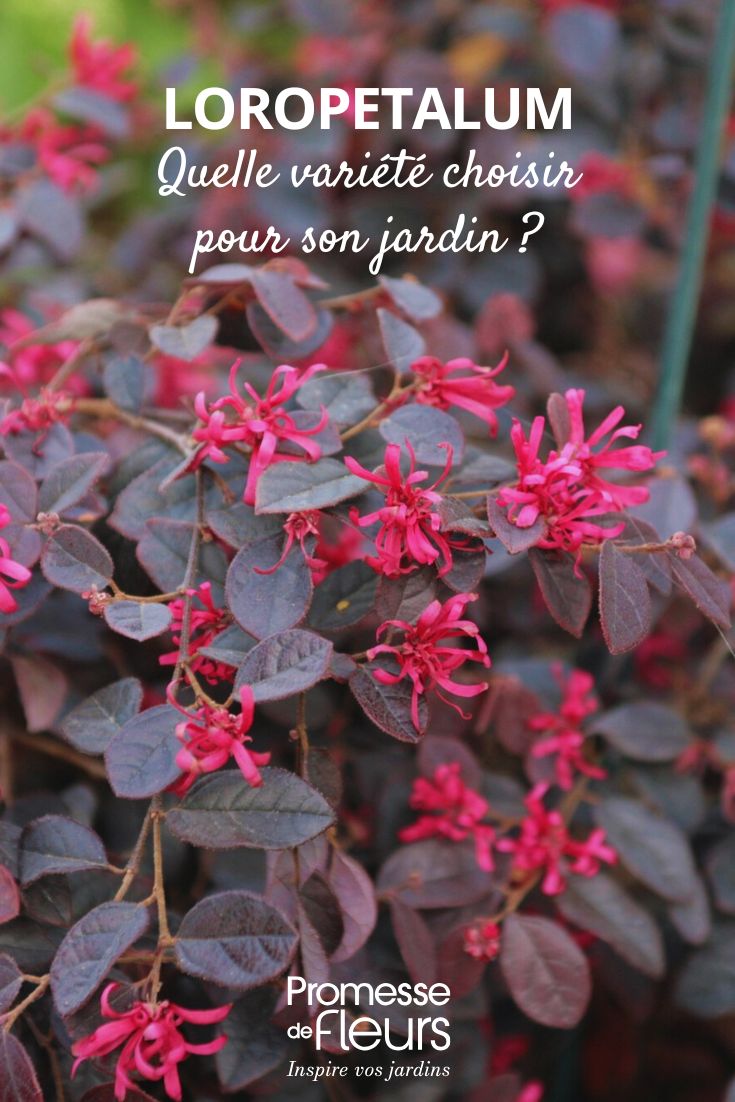
Generally purple-leaved and evergreen, Loropetalum is a compact shrub with many great qualities! Choosing one depends mainly on size, habit and colour of its distinctive ribbon-like blooms, but also on foliage, which in some varieties remains green. We’ll help you choose the best Loropetalum for your garden!
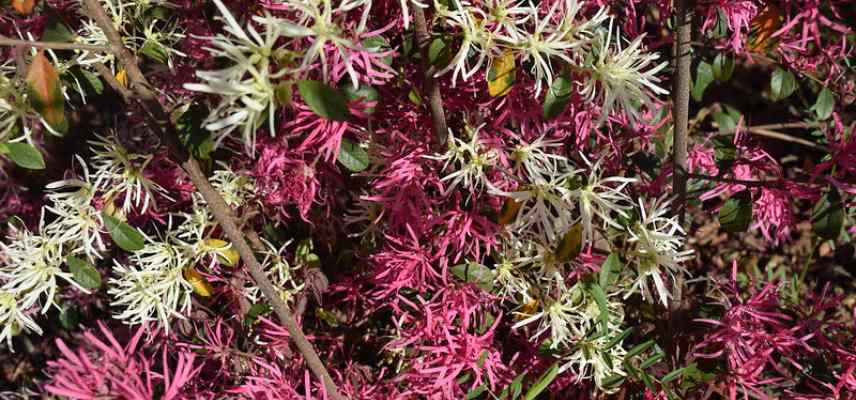
With white or pink flowers, Loropetalums also stand out for other features (©Stephanie Harvey)

Depending on size
Size is certainly the first criterion that will catch your attention, because the Loropetalum, of which the Chinese species is most used in landscaping, exhibit a range of heights. From compact to very tall, they become true trees in their natural range* in North‑East Asia, but remain under 3 metres here, most growing 1 m–1.50 m tall.
Compact Loropetalums
They reach under 1 m in height, and are better suited to planting in a large container on a terrace for evergreen foliage year‑round, or to small spaces such as city gardens.
- ‘Plum Gorgeous‘ : does not exceed 1 metre in height and spreads to around 1.50 m.
- ‘Ruby Snow‘ : 80 cm tall with a smaller spread
- ‘Snow Mound’ (syn. ‘Snow Muffin’) : dwarf variety practical for balconies (80 cm tall) with white flowers
- ‘Ever Red‘ : with red flowers, also very compact, 80 cm tall with only a slightly larger spread.
Large Loropetalums
If you are looking for large shrubs at maturity, these grow up to 2 metres, sometimes more depending on growing conditions:
- Type species, Loropetalum chinense, easily grows to 2 m, sometimes even 3 m in optimal conditions.
- ‘Fire Dance‘, often seen approaching 2 m in height
- ‘Pipa’s Red‘ reaching at maturity 1.50 m tall with 1.75 m spread
- ‘Ming Dynasty‘, one of the largest, can reach 2 m in height, with Indian pink flowers
- ‘Daybreak’s Flame’ can also grow to 1.80–2 m.
*N.B.: Loropetalum lanceum and Loropetalum subcordatum are two species less commonly seen in ornamental cultivation, becoming small trees reaching up to 10–12 metres in height in their natural habitat, but generally remaining more modest in cultivation.
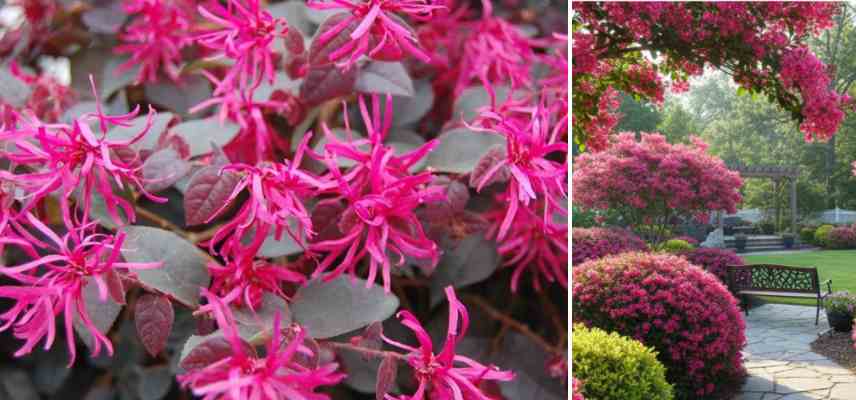
‘Plum Gorgeous’ on the left
Read also
Loropetalum: planting, pruning and careAccording to the colour of the flowers
All Loropetalum flower in late winter or spring. They will be earlier or later depending on severity of winter. Three flowering colours are distinguished among Loropetalum.
Pink-flowered Loropetalum
These are the most common and numerous. Their flowers create a striking contrast with the darkest foliage.
- ‘Pipa’s Red‘ : a lovely variety with bright Indian pink flowers, slightly purplish
- ‘Fire Dance‘, widely grown and among the largest, its flowers are vivid fuchsia pink
- ‘Burgundy’, with pretty pale pink flowers
- ‘Ming Dynasty‘ : flowers almost purplish-pink on attractive foliage with bronze shoots that become green.
- ‘Plum Gorgeous‘ : flowers so intensely pink they are almost red! Divine on dark purple foliage.
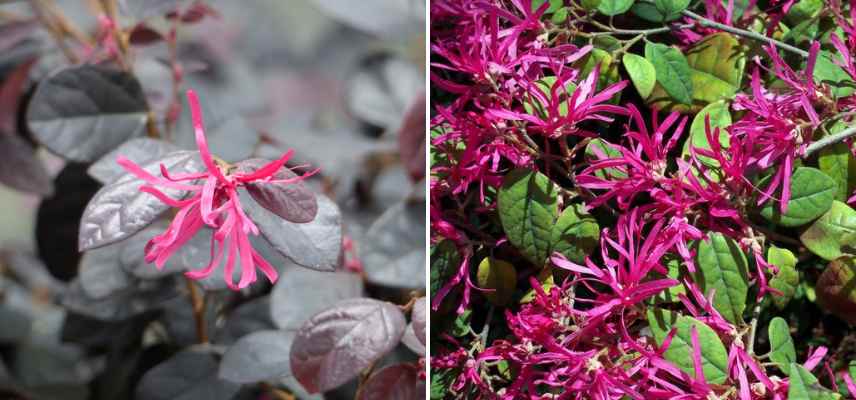
Loropetalum ‘Pipa’s Red’ and ‘Ming Dynasty’
Red-flowered Loropetalum
In Loropetalum these tend to be very bright pink rather than true red. Two varieties are notable:
- Loropetalum chinense var. rubrum ‘Blush’, perhaps closest to a magenta red; its bronze-red foliage turns olive green as it matures.
- Loropetalum chinense var. rubrum ‘Ever Red’ : very dark purple foliage year-round, and strap-like flowers crimson raspberry-red.
- ‘Plum Gorgeous‘ and ‘Fire Dance‘ flirt with red, as explained above.
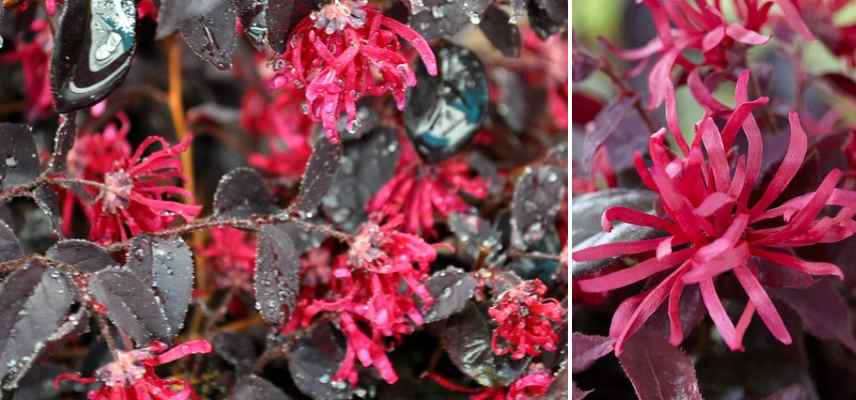
Loropetalum ‘Ever Red’ (® The Green Nursery and Garden Shop)
White-flowered Loropetalum
In these Loropetalum, flowers are either white or cream, often with a greenish calyx that gives them an elegant appearance. They can easily be included in a mixed border or a white garden.
Species type, Loropetalum chinense, is rightly prized for its pure white flowering on green foliage.
Also found:
- ‘Carolina Moonlight’, 1.20 m tall with a slightly larger spread, offers slender cream-white petals.
- ‘Ruby Snow’, one of the few white-flowered varieties with purple foliage
- ‘Snow Muffin’, not exceeding 90 cm in height, has olive-green foliage and entirely white flowers.
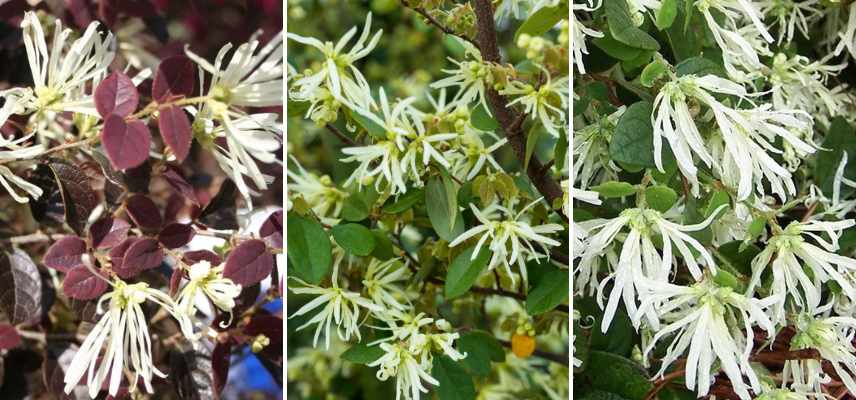
‘Ruby Snow’, Loropetalum chinense and ‘Carolina Moonlight’
♥ Note that some varieties repeat more lightly in late summer or autumn if shrub hasn’t been pruned in spring. For example, ‘Carolina Moonlight’.
Depending on its habit
Loropetalum’s silhouette means it will be used differently: when it is spreading, in a border or as a specimen, or as an informal hedge when it is more upright or shrub-shaped. Most Loropetalum are distinguished by their horizontal, spreading habit, often wider than tall, especially sought after in Japanese-style garden layouts.
- ‘Ming Dynasty‘ is rounder, growing like a bush, while ‘Fire Dance’ offers a ball-shaped habit;
- ‘Pipa’s Red‘, ‘Carolina Moonlight’ and ‘Rubra’ display a spreading habit;
- ‘Daybreak’s Flame’ is notable for its broad, slightly trailing habit.
My advice: I give several pairing ideas based on this shrub’s varied habits in: How to pair Loropetalum?
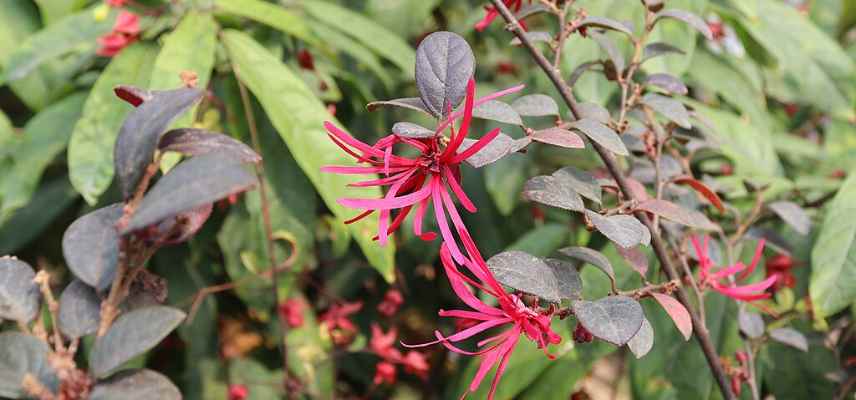
Branches of Loropetalum are often arched, giving a spreading, supple silhouette, very attractive (photo Hải Vũ Thanh, Wikimedia Commons).
Read also
How to pair Loropetalum?Depending on foliage colour
Purple foliage of Loropetalum is often welcomed into gardens. Some, including type species, also have green leaves. Note that young coppery shoots often green up during summer, may become darker, and also darken in winter cold.
Green-leaved Loropetalum
- Loropetalum chinense var. chinense displays green foliage and white flowering: a classic of great elegance;
- Loropetalum chinense ‘Daybreak’s Flame’, with pale green leaves (pink at bud burst period), variegated with cream, giving a luminous aspect;
- Loropetalum chinense ‘Snow Mound’: bright green foliage, abundant white flowers, and a compact, rounded habit.
- For a darker green, note Loropetalum chinense ‘Bungundy’
Purple-foliaged Loropetalum
Often the most sought-after for ornamental qualities, these are the varieties most representative of species L. chinense. ‘Plum Gorgeous‘, with red flowering, is among the most beautiful purple-foliaged cultivars.
Loropetalum with darkest foliage
These are almost black in appearance!
- ‘Zhuzhou’ may be the darkest, with purple undertones;
- ‘Black Pearl‘, this black pearl is indeed very close to black — actually a very dark purple; its bright pink flowers provide strong contrast;
- ‘Rouge de la Majorie‘, part of medium-sized loropetalums growing like a bush (1.30 m tall), bears very dark purple leaves;
- ‘Ever Red’ also bears particularly dark foliage;
- ‘Purple Diamond’, with purple leaves that darken further in summer. It has very bright pink flowers.
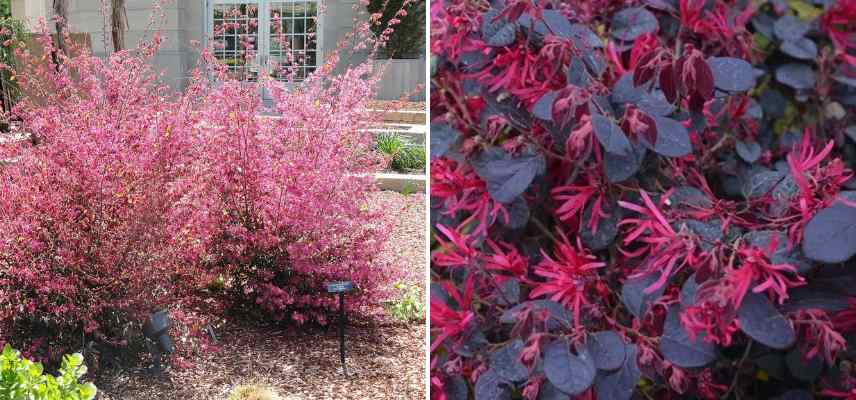
Zhuzhou on left (©Wikimedia Commons) and Black Pearl on right
Loropetalum with changing foliage
Also note some loropetalums whose foliage shifts between spring and summer. Such is ‘Burgundy’, whose leaves emerge pink then turn green (flowering is pink).
Pipa’s Red: its foliage is bronze-purple, remaining very dark.
According to its hardiness
Some Loropetalum are a little hardier than others (the Loropetalum chinense ‘Zhuzhou’ is regarded as the hardiest, tolerating cold better than other varieties), but they should always be considered frost-tender shrubs, which will suffer below -10°C (and below -5°C when young). This is why they are often planted in mild climates.
In any case, Loropetalum should be planted in a sheltered spot in the garden, or against a wall.
‘Fire Dance’ and ‘Black Pearl’ are also among the hardiest.
Depending on its fragrance and melliferous aspect
Belonging to Hamamelidaceae, Loropetalum’s spidery flowering closely resembles that of Hamamelis. It is slightly scented, a little more pronounced in Loropetalum chinense ‘Rubra’, ‘Fire Dance’ and in the type species. Fragrance remains subtle, but their melliferous value is real, as they offer a source of nectar early in the season.
Loropetalums therefore attract both butterflies and bees, producing valuable nectar as winter ends, contributing greatly to garden biodiversity.
Depending on soil type
They are recommended to be planted in acidic to neutral soil because they do not tolerate calcareous conditions. They are indeed often seen in ericaceous plant beds, alongside rhododendrons or camellias. No variety truly tolerates calcareous soil, but the species and ‘Fire Dance’ are sometimes successfully grown in slightly amended soil (a leaf mould helps).
Loropetalum mainly need well-prepared, well-drained soil; otherwise they suffer during winter in overly wet and/or overly compacted soil. Pay particular attention to this crucial point when planting. If your soil is unsuitable, consider pot planting.
- Subscribe!
- Contents
This form is protected by reCAPTCHA - the Google Privacy Policy and Terms of Service apply.

































Comments