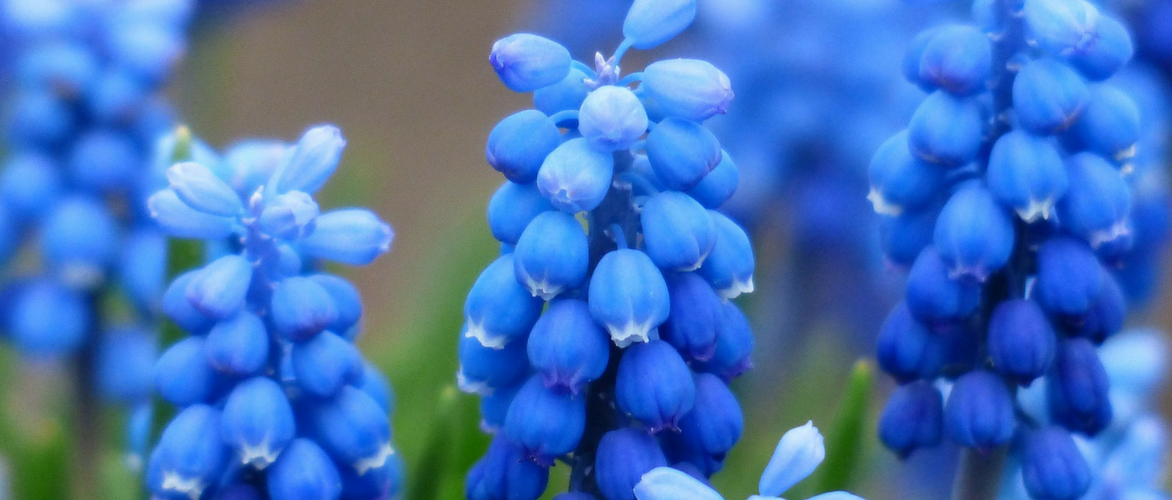
Muscari: planting, growing advice and care
Contents
Muscari in a nutshell
- In spring, its intense blue or white flowers are a must in the garden
- It tolerates both full sun and partial shade
- Low-maintenance and very hardy, Muscari is highly cold-resistant (down to -25°C)
- It naturalizes very quickly
- It can be grown in pots or as large flowering carpets
A word from our expert
Muscari, also called grape hyacinth, is a pretty little spring bulb, easy to grow, perfectly hardy and able to grow anywhere without requiring care. A sign of spring’s arrival, its clusters of intense blue or white flowers bloom from March to May and are indispensable in every garden. From the classic Muscari armeniacum or Armenian grape hyacinth to Muscari aucheri White Magic, to M. botryoides, via bicoloured muscaris such as Muscari neglectum or the curious tasselled Muscari, Muscari comosum, this must-have for untended gardens grows equally well in full sun or shade. When planted in well-drained soil, it naturalises easily, forming over the years very floriferous carpets and attractive early-spring foregrounds in beds.
You can never plant enough of these inexpensive little spring bulbs that slip in anywhere — in pots or flowerbeds, along path edges or in large naturalized carpets, in woodland at the foot of trees, in rockeries, scattered across the lawn or in Japanese-style or more minimalist gardens. This prolific bulbous plant has a knack for adding a touch of freshness and showcasing all other spring bulbs alongside which it prospers, such as narcissi, daffodils, wood anemones, hyacinths, tulips…
Discover our collection of Muscaris ranging from sky blue to pure white and pale pink, available in small to very large sizes to create beautiful spring planters or to flower the garden from the first year of cultivation.

Botany
Botanical data
- Latin name Muscari
- Family Hyacinthaceae
- Common name cluster hyacinth, grape muscari, cluster hyacinth
- Flowering March to May
- Height 0.15 to 0.60 cm
- Sun exposure Sun, Partial shade
- Soil type All
- Hardiness down to -25 °C
The Muscari, also called cluster hyacinth, is a plant of family Hyacinthaceae / Liliaceae. This small perennial bulbous plant, native to mountains of south-eastern Europe, Armenia, as well as Turkey and the Caucasus, grows naturally at woodland edges or on rocky slopes at altitude.
From its mountain origins, Muscari has retained excellent hardiness. Able to withstand severe frosts, it acclimatises easily and tolerates temperatures down to -25 °C in our regions, depending on species. Beneath its graceful appearance, it is a hardy plant that, in addition to great cold resistance, copes well with drought and shade.
Genus comprises about 30 species of perennial bulbous plants including the classic Muscari armeniacum or Armenian muscari, Muscari aucheri (or Tubergenianum), the botryoids, Muscari azureum with foliage shorter than other muscari species, some bicoloured-flowered muscaris such as Muscari latifolium, Muscari neglectum and Muscari macrocarpum, and the curious tufted muscari (Muscari comosum or ‘Plumosum’).
Muscari forms clumps, more or less erect depending on species, reaching up to 60 cm in height, with a spread of about 30 cm for the largest varieties. In two to three seasons the original central bulb produces bulblets that expand slowly but surely. Once well established in a freely draining soil, it will flower for a good ten years, provided bulbs are divided every 3–4 years to maintain the plant. Very prolific if left undisturbed, Muscari naturalises easily beneath deciduous hedges, in borders and in lightly mown meadows. Muscaris also self-seed freely, forming floral, fragrant carpets within a few years.
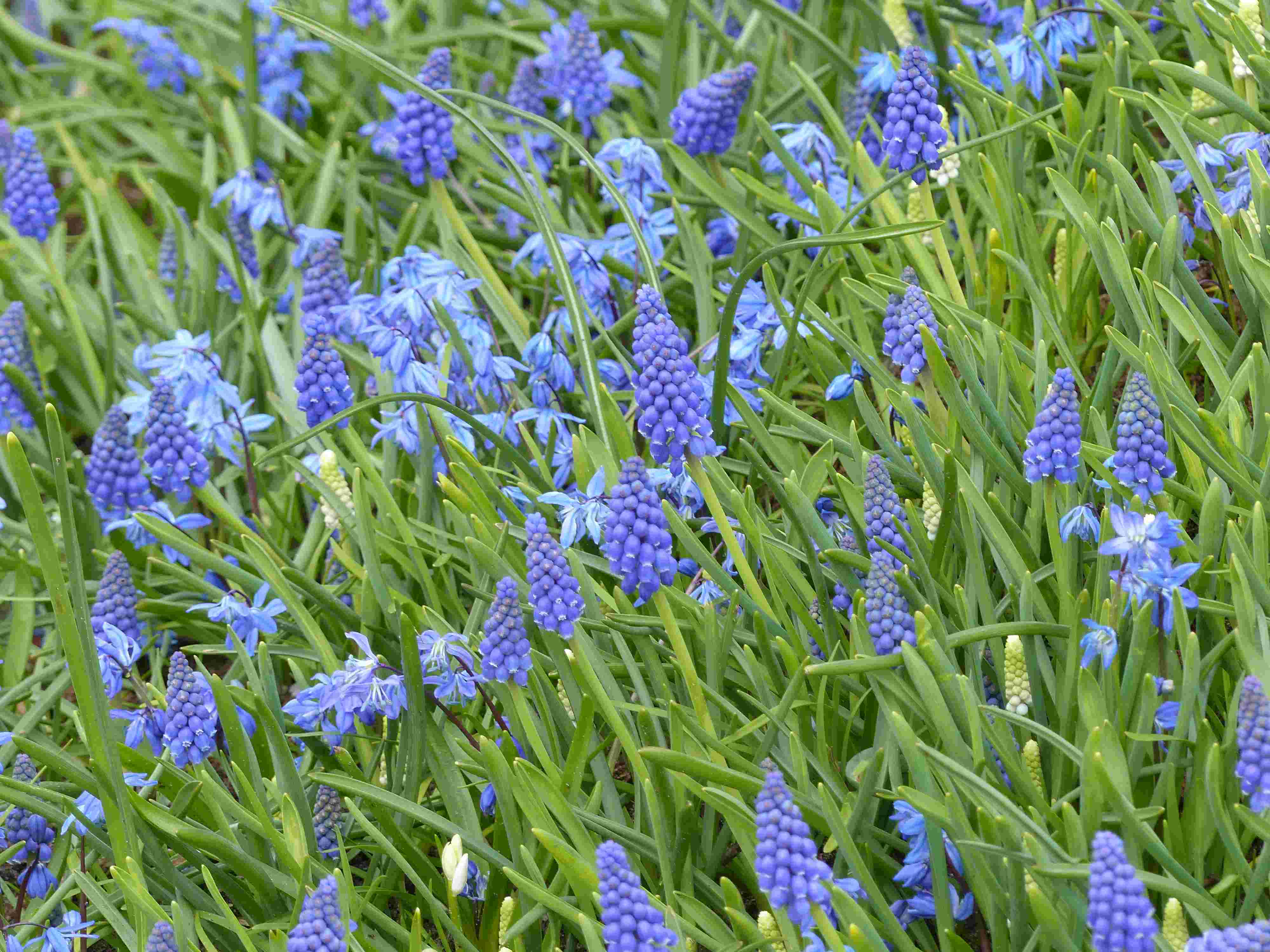
Muscaris also self-seed freely, forming floral, fragrant carpets
From the first days of spring, Muscari displays its luminous flowers resembling a miniature hyacinth. It forms waves of sky-blue or pure white carried by grassy tufts of fresh green. When the bulb is mature and well developed, after two years each rosette produces in spring 3 to 5 upright, graceful flower stalks, 10 to 60 cm tall. For several weeks from March to May these leafless stems bear 20 to 40 small drooping flowers gathered into terminal conical inflorescences that are non-toxic. Flower clusters measure from about ten to thirty centimetres in height and up to 5 cm wide for the largest calibres. Packed like grapes, each bell’s tepals measure only a few millimetres and form a small bell with a often narrowed mouth. Inflorescence appearance varies with species and varieties. Muscari armeniacum ‘Blue Spike’, a spectacular variety, bears very double flowers on a luxuriant spike recalling a hyacinth. Muscari comosum ‘Plumosum’ is notable for its lilac plume-like inflorescences made of purple filaments; the type species presents spikes of small bell-shaped flowers topped by a little plume of ultramarine to violet filaments. Muscari ‘Mountain Lady’ bears unusual sky-blue flowers topped with a small tuft of white flowers.
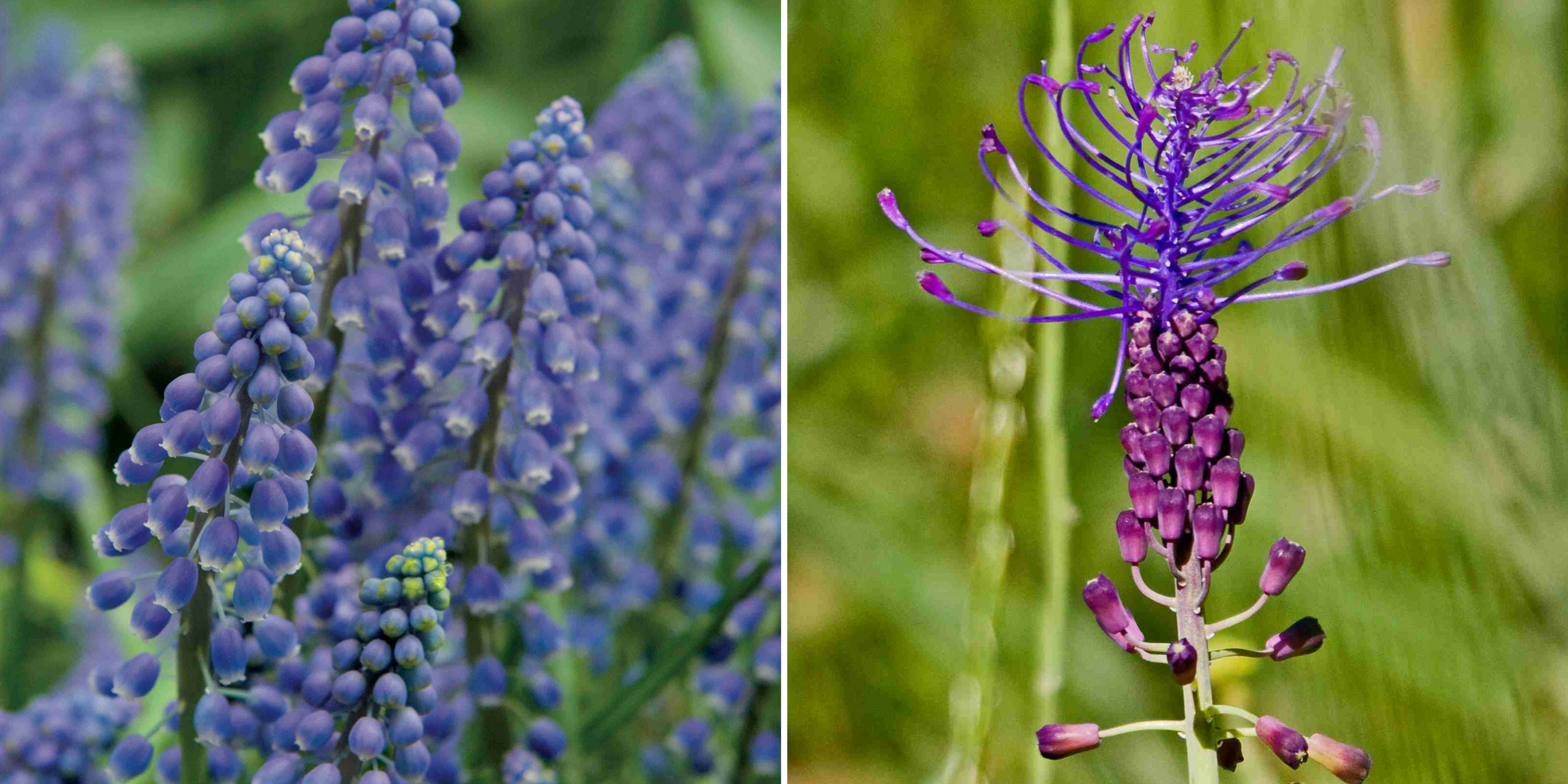
Muscari armeniacum and Muscari comosum ‘Plumosum’ with plume-like inflorescences
These small flowers, mostly intense blue, bright blue, sky, cobalt or purplish, can sometimes be white or pale pink, an unusual colour for muscari. Muscari takes its Latin name from musk, a scent often very strong and heady given off by many Muscari flowers, M. aucheri ‘White Magic’ being one of the most fragrant. These intensely azure, powder-pink or pure white cones also make charming little fresh bouquets.
Muscari neglectum and Muscari azureum bear bicoloured little bells striped or margined with bluish white. In others, the clusters themselves are bicoloured: those of Muscari macrocarpum pass from purplish-brown in bud to lemon-yellow at maturity, Muscari latifolium shows a crown of flowers of deeper colour than those at the spike’s summit, which are sterile. Only lower flowers set seed. Much visited by pollinating insects, after pollination faded flowers produce trigonous fruits that release tiny black seeds which reseed very easily.
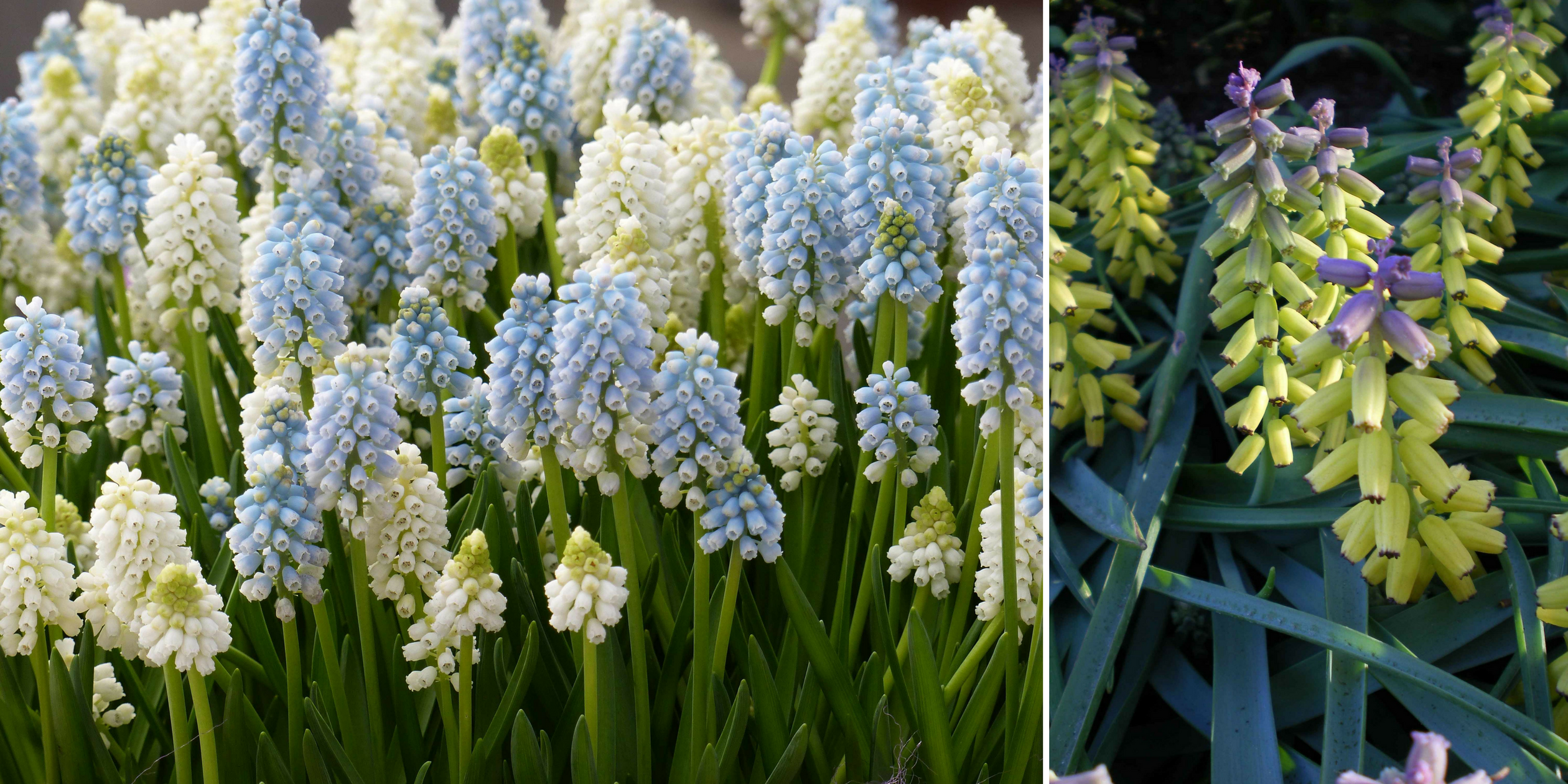
Some varieties such as Muscari ‘Ocean Magic’ offer magnificent shades of blue, Muscari macrocarpum surprising contrasts
In Muscari, foliage generally appears before the inflorescence: the growth cycle begins at the end of summer, with a few leaves emerging and persisting all winter. At the start of spring other leaves emerge from a basal rosette of green and foliage develops with flowering. 6 to 30 cm long, fleshy, narrow, linear, often folded mid-length or spatulate, leaves recall those of snowdrops or, finer and more slender as in Muscari neglectum, resemble grass leaves. Light green to greyish green, they are sometimes shorter than the stem and form a nest of greenery from which the often intense-coloured flower spikes stand out. In summer leaves yellow and plant enters dormancy. Deciduous, foliage disappears after flowering and returns in autumn.
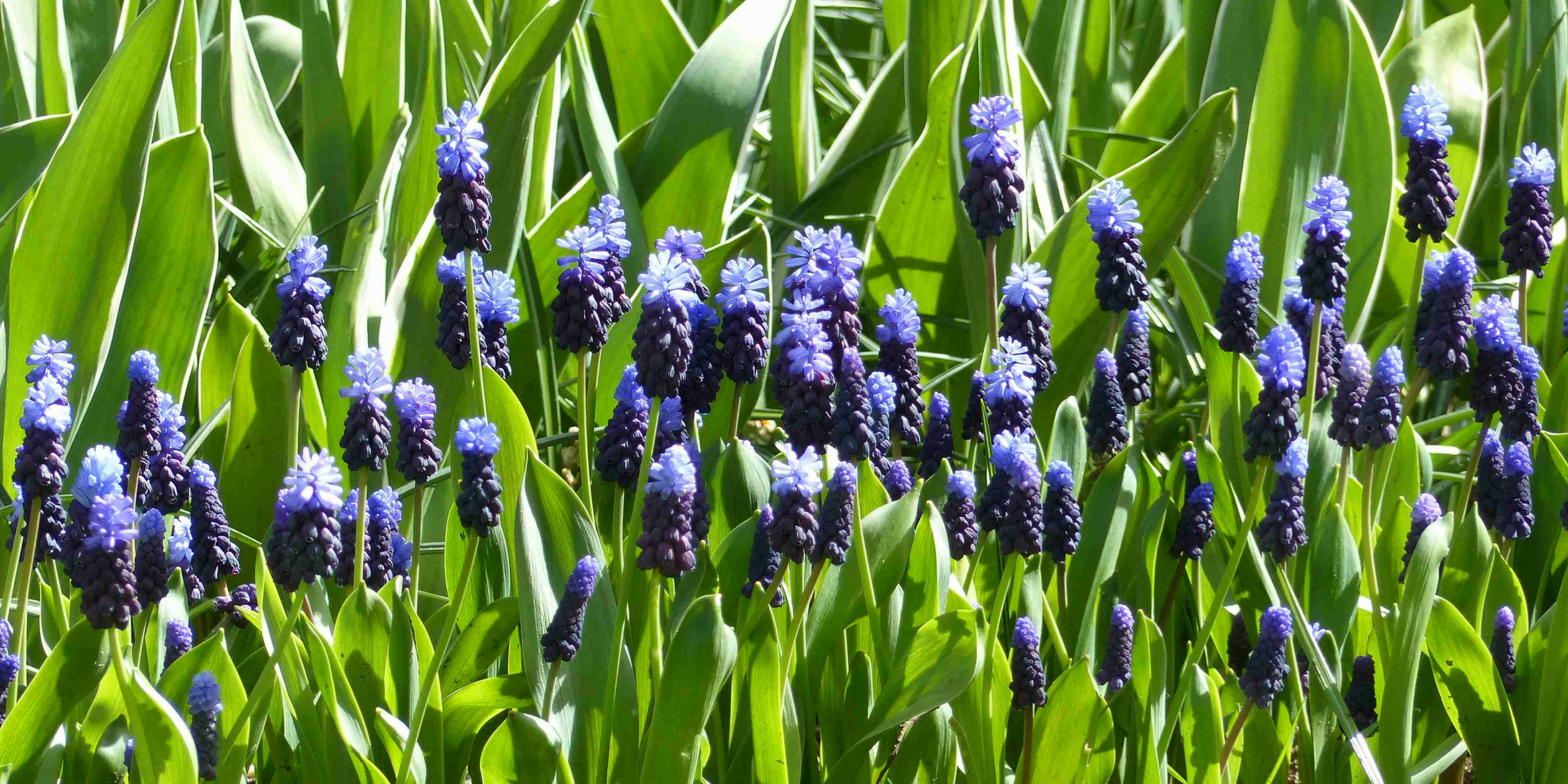
Only Muscari latifolium presents a single broad, fleshy, pruinose green leaf that curls at the base
Very easy to grow, highly accommodating, Muscari grows almost anywhere and multiplies rapidly in any reasonably fertile, moist and well-drained soil. While preferring sunny positions, it will also flower in partial shade. It can even be planted in woodland as it flowers before leaves of deciduous trees appear.
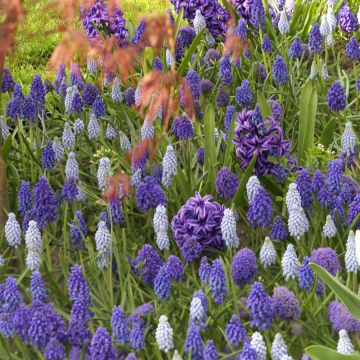
Discreet and versatile, Muscari suits many situations and composes scenes of great delicacy or thrives in semi-wild corners of the garden. It flowers all garden spots including balconies. For a decorative and striking effect, plant Muscari en masse, in groups of around ten bulbs, as a flowering carpet, in woodland at tree bases, along paths, in rockeries or scree gardens, scattered in lightly mown meadows or in Japanese-style gardens.
Small Muscari bulbs slip in between established plants without disturbing perennials and shrubs because they disappear underground when the latter come into growth. This bulbous plant prospers alongside many other spring bulbs such as daffodils, jonquils, anemones and hyacinths, whose blooms will be enhanced by Muscari’s luminous flowering. Early tulips in pink or white are also good companions for its graceful display. Muscaris can also be mixed together to create seas of blue flowers. All Muscaris are suitable for spring containers mixed with pansies, daffodils, crocus, hyacinths or primroses.
Read also
Small bulbs, big impact!Species and varieties
Around ten species are mainly cultivated in our gardens, including Muscari armeniacum or Armenian grape hyacinth, which is most common. Also found are white muscaris aucheri (or Tubergenianum) and Muscaris botryoides, Muscari azureum with foliage shorter than that of other species, a few bicoloured-flowered species such as Muscari latifolium, Muscari neglectum and Muscari macrocarpum, and the curious tufted Muscari, Muscari comosum (or ‘Plumosum’).
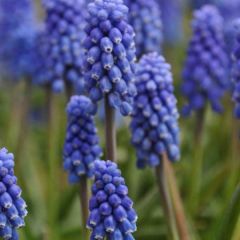
Muscari armeniacum Dark Eyes - Grape Hyacinth
- Flowering time April, May
- Height at maturity 20 cm
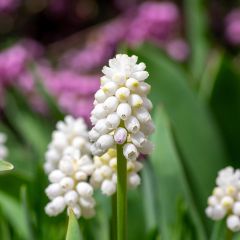
Muscari aucheri White Magic - Grape Hyacinth
- Flowering time May, June
- Height at maturity 20 cm
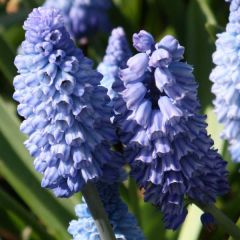
Muscari azureum - Muscari azuré, Jacinthe à grappes
- Flowering time May, June
- Height at maturity 15 cm
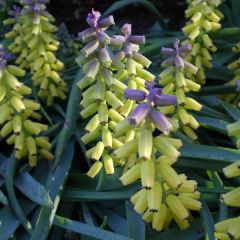
Muscari macrocarpum Golden Fragrance
- Flowering time May
- Height at maturity 15 cm
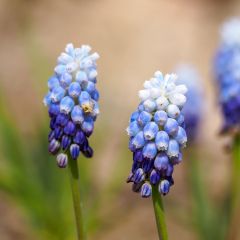
Muscari Mount Hood
- Flowering time May, June
- Height at maturity 15 cm
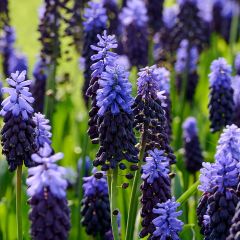
Muscari latifolium - Grape Hyacinth
- Flowering time May, June
- Height at maturity 30 cm
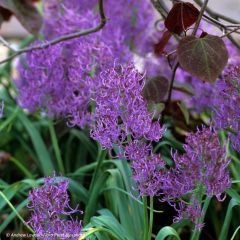
Muscari comosum Plumosum - Feather grape hyacinth
- Flowering time May, June
- Height at maturity 15 cm
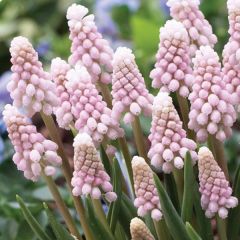
Muscari Pink Sunrise - Grape Hyacinth
- Flowering time May, June
- Height at maturity 15 cm
Discover other Muscari
View all →
Available in 0 sizes
Available in 1 sizes
Available in 1 sizes
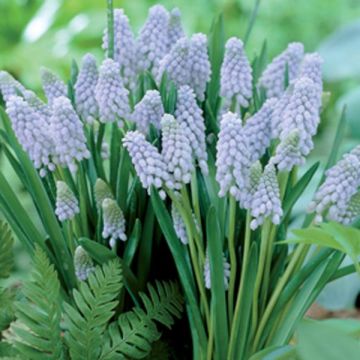
Available in 1 sizes
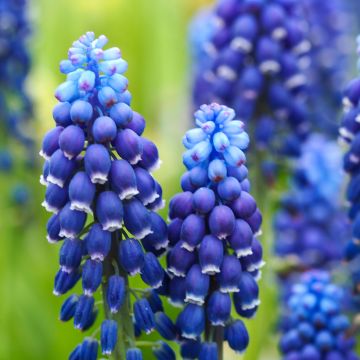
Available in 1 sizes
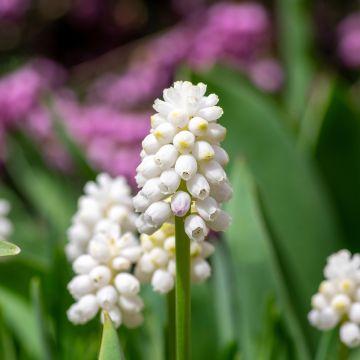
Available in 2 sizes
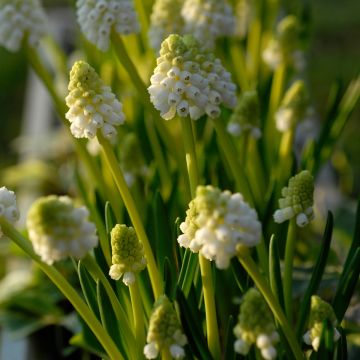
Available in 1 sizes
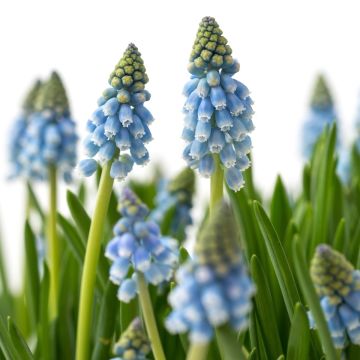
Available in 1 sizes
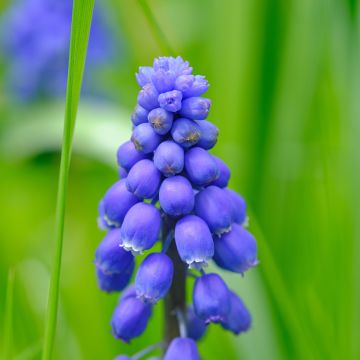
Available in 1 sizes
Available in 0 sizes
Planting
When to plant Muscari?
These small bulbs are planted early in season, from September until mid-November, in ground or in pots.
Where to plant these flowering bulbs?
Muscari are undemanding about soil type and exposure and perfectly hardy in all regions. They quickly form flowering carpets without becoming invasive. They slip in everywhere, between established plants, and will fill gaps within two to three years provided they are allowed to spread naturally.
Plant in sun or partial shade, in ordinary soil, fairly fertile, cool but above all well drained: they do not like excess water. Muscari armeniacum tolerates soils that dry out in summer; others, such as Muscari botryoides, do well in clay soils. Muscari macrocarpum needs summer warmth to flower well. Moderately hardy (-7°C): in regions with severe winters, mulch soil or lift bulbs for winter storage; other species can remain in ground.
Some, such as M. armeniacum, have foliage that withers at flowering time, creating a slightly untidy carpet that can easily be hidden by planting among erythroniums, wood anemones, pulmonarias or euphorbias.
Versatile, Muscari integrate into all settings in understorey, beneath trees, along path edges, in rockeries, scattered through meadow or lawn. All Muscari can make beautiful flowering containers.
How to plant Muscari?
Plant generously, Muscari are best planted in drifts (they are economical) and closely for maximum effect, in well-drained soil to prevent bulb rot.
- Loosen soil deeply
- Improve drainage if necessary by adding gravel mixed into soil or laid as a layer beneath bulbs
- Plant 10 cm deep, point of bulb upwards
- Space bulbs 8 cm apart or plant in groups of around ten in a clump, making sure they do not touch
- Cover bulbs with soil to depth equal to twice bulb height
- Water moderately
- After 2 years, divide clumps and replant bulblets produced by the original bulbs (this will extend area covered and encourage vigour of the flowers)
Growing in pots
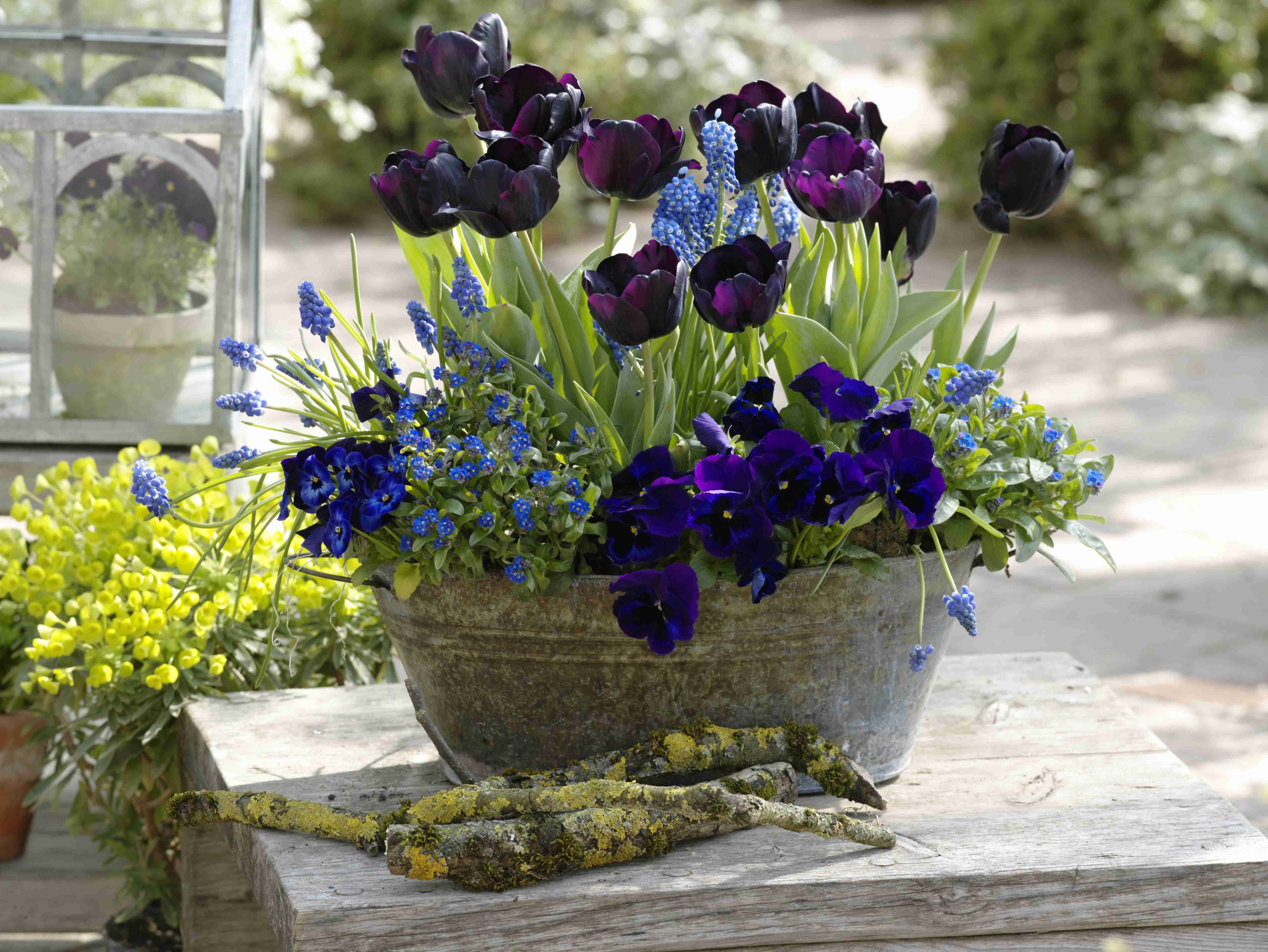
Like hyacinths, Muscari bulbs can easily be forced with cold from autumn onwards, to enjoy their flowering and scent indoors. For outdoor use on terrace or balcony, choose a sunny position and larger calibres for bigger flowers. You can also plant them in pots in year of purchase and subsequently plant out in ground.
- Spread a layer of clay pebbles at bottom of terracotta pot for perfect drainage
- Fill pot with a mix of garden soil, potting compost and pumice
- Plant close together (around ten bulbs per pot) and cover with soil to depth equal to twice bulb height
- Water regularly in autumn and winter, then reduce watering in summer and stop completely during dormancy
Maintenance and care
Muscari is such an accommodating plant that it requires no watering unless grown in a pot, nor any special care. When foliage turns yellow in summer, after 3–4 years, lift the bulbs and separate the bulblets to maintain vigour. No pruning is necessary; however, if you want to control spread by limiting self-seeding, cut the flower stems after flowering. Do not cut back foliage until it has died back, to allow the bulb time to rebuild its reserves during summer dormancy. Muscari bulbs are hardy and can remain in the ground year after year, rapidly forming very floriferous carpets. In regions with severe winters, opt for container planting for less hardy species such as Muscari macrocarpum, or lift and overwinter bulbs in frost-free conditions. In autumn, if desired, fork in well-rotted compost around the base of the plants; this will help bulbs to flower well the following spring.
In pots:
- Water regularly
- Apply bulb fertiliser until the end of flowering
Possible diseases
Planted in suitable conditions, Muscari shows excellent resistance to disease. However, watch for aphid attacks, which can sometimes cause certain diseases that discolour foliage and flowers. If so, simply lift and discard affected bulbs.
Multiplication
Sowing
Germination of Muscaris seeds is slow and unpredictable, especially as a young plant raised from sowing may take several years to flower and Muscaris readily self-seed. We recommend division, which is very easy to do.
Division
After two years’ cultivation, you can divide clumps and separate bulblets. Carry out in June and into early autumn when leaves begin to yellow.
- Lift the clump with a digging fork
- Separate bulbs by hand or with a small knife
- Replant Muscaris immediately
- Water lightly
→ Also check out our tutorial on how to propagate bulbs by scaling!
Associate
Versatile, Muscari is very easy to pair and pairs with a multitude of easy-care plants. Cheerful yet understated, it thrives in naturalistic, low-maintenance gardens and weekend gardens. Planted in large numbers, this small bulb makes a big impact and forms carpets of blue, white or even pink flowers in spring, creating beautiful foregrounds for borders.
With its luminous flowering, Muscari is at home in many situations: as a flowering carpet, at woodland edge at the foot of trees, scattered through the lawn, to dress a path edging or a sunny rockery or in Japanese-style gardens. This radiant bulbous plant prospers alongside other spring bulbs, Anemone sylvestris, Hyacinths, Ipheions, Iris reticulata, Erythroniums. Pulmonarias and Euphorbias look superb paired with these small spring bulbs.
Muscari form magnificent carpets against a backdrop of narcissi, jonquils and early tulips, in contrasting blue/yellow-green combinations or in delicate fresh white/blue scenes. Planted together, they create fantastic blue tides in mid-spring. All are suitable for growing in pots on a windowsill or balcony, mixed with pansies, small narcissi, crocuses, forget-me-nots or primroses.
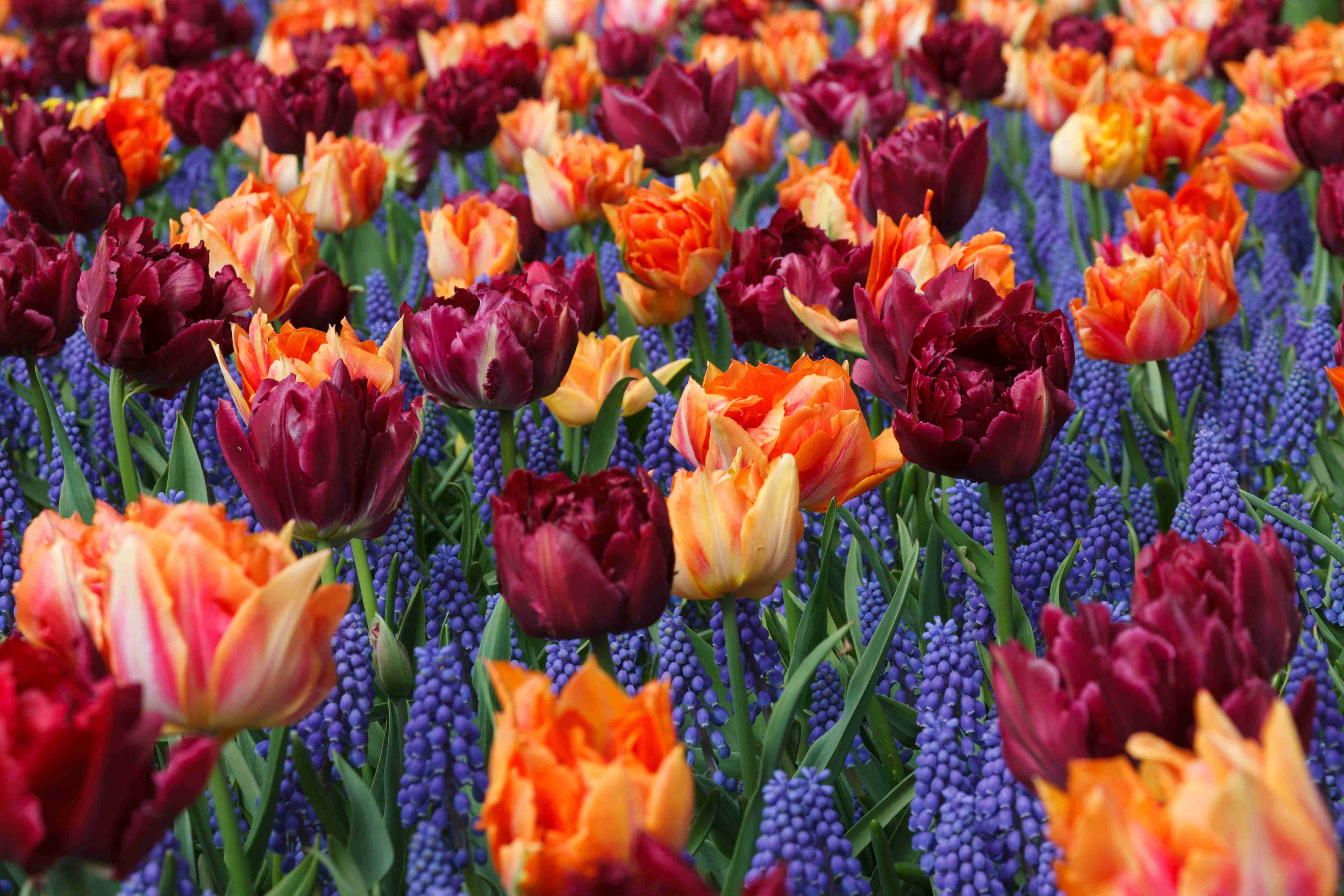
Want even more inspiration? Discover our advice sheet : “Muscari: 8 beautiful pairing ideas”
Useful resources
- Find our advice sheet on growing Muscari in pots
- Our guide to planting depths for spring bulbs
- Advice sheet: which bulbs to grow indoors?
- Advice sheet: bulb sizes — how to choose
- Advice sheet: 6 bulbs easy to naturalise in the garden
- Discover our video on Muscari armeniacum
- Our advice sheet: 9 blue-flowering bulbs to have in your garden
Frequently asked questions
-
Why is my muscari yellowing?
In summer, Muscari enters dormancy, known as "summer dormancy". This necessary period allows the plant to build up reserves for the following spring. Even if you think the yellowing leaves form a somewhat unsightly carpet, only cut back the foliage once it has died back, to give the bulb time to replenish its reserves.
- Subscribe!
- Contents
This form is protected by reCAPTCHA - the Google Privacy Policy and Terms of Service apply.

































Comments