Each late summer brings its share of bulbs for spring colour, to irresistibly brighten our gardens. At this time of year we are often busy seeking the gems among these essential bulbs that will, in turn, lift us out of winter torpor in a few months. Our teams set out each year in search of new arrivals to appeal to the most discerning among you, from frilled tulips to charming early bulbs.
Here are some spring bulbs entering the Promesse de fleurs catalogue this season. Rare tulips, hardy irises, black hyacinths… Discover the 7 spring bulbs to plant this autumn with our tips on how to pair them harmoniously.
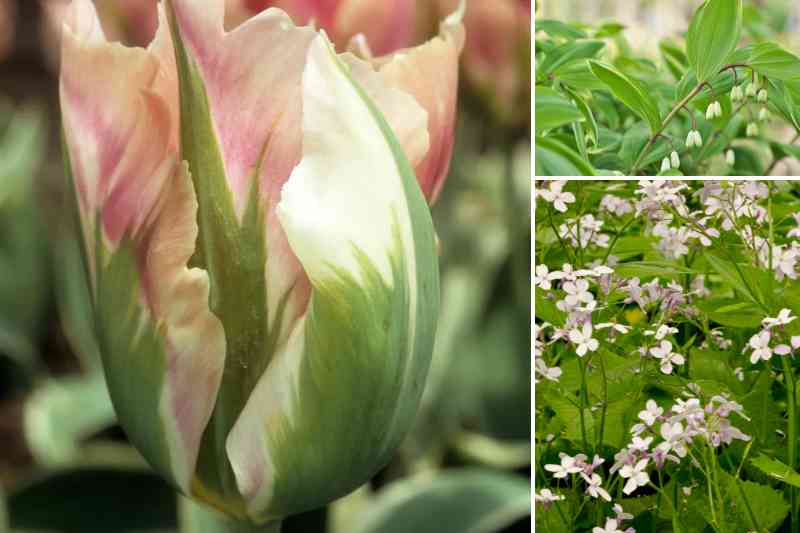
Tulipa viridiflora 'Blushing Artist': a play of light with pastel notes
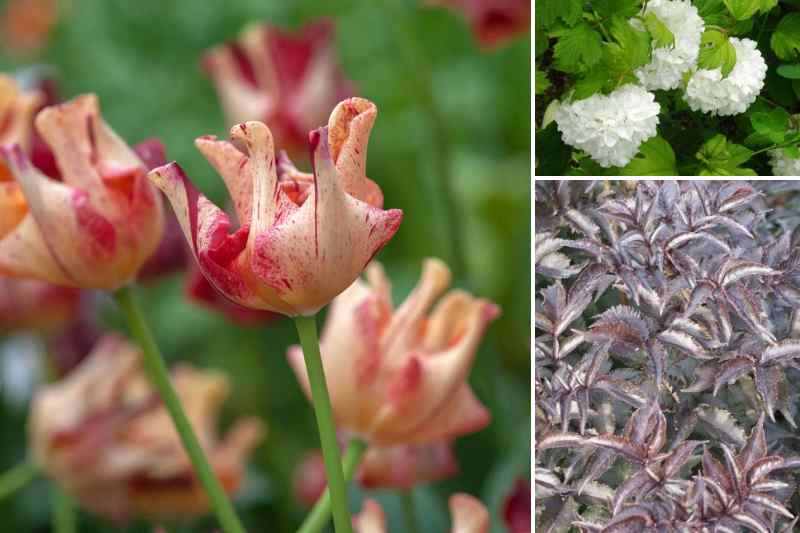
Belonging to the large viridiflora family, these beautiful green-flamed tulips, 'Blushing Artist', are among its finest representatives! Not only does it stand out for its pastel colours, combining cream, pink and green in striations, but it also bears variegated leaves edged with cream, of interest in borders or for collectors.
This elegant fluted tulip grows to about 40 cm tall, which predisposes it equally to border plantings, pot culture or a long border. It flowers well in partial shade as in sun, but partial shade enhances its pale colours even more, and it is considered a late tulip, blooming in early May.
We recommend it either for mass planting in an attractive pot display where the delicacy of its hues will strike a chord, or paired with another 'flamed' tulip such as 'Spring Green', or in a border with perennials like Lunaria annua 'Alba'.
Read also: Tulipa viridiflora : the most popular.
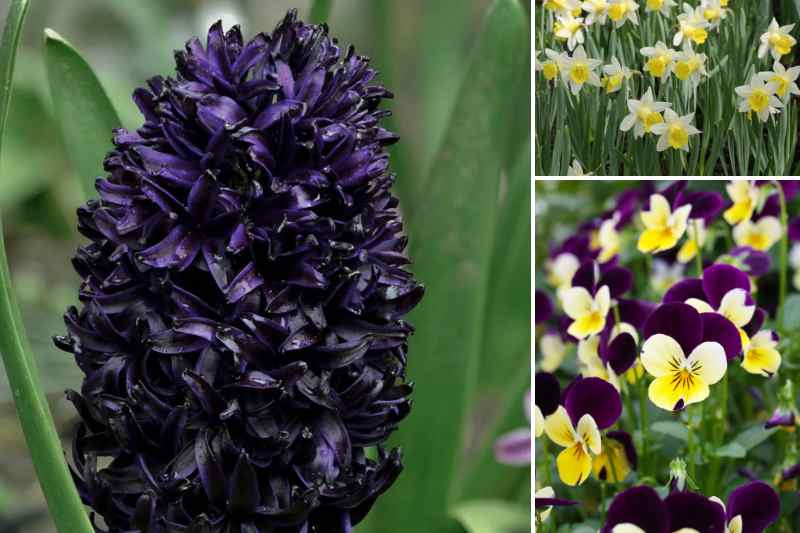
Hyacinth 'Midnight Sky': a captivating darkness
Hyacinths lovers and fans of unusual flowering will not be disappointed by this variety, one of the darkest in the genus. 'Midnight Sky' certainly lives up to its name, intriguing with violet hues on the edge of black. It also has the particularity of being fairly resistant to rodents, and releases a subtle, sweet fragrance, especially in the late afternoon sun.
It prefers humus-bearing soils, well-drained, and a full sun or partial shade exposure. It can also be forced indoors to flower as early as February.
We find it stunning in a large container on a terrace or balcony, paired with a few other bulbs in fresh, bright tones that contrast nicely, such as early mini daffodils with yellow centres, like 'Sun Disc' or Topolino, and tri-colour pansies, creating a violet and pale butter-yellow two-tone display.
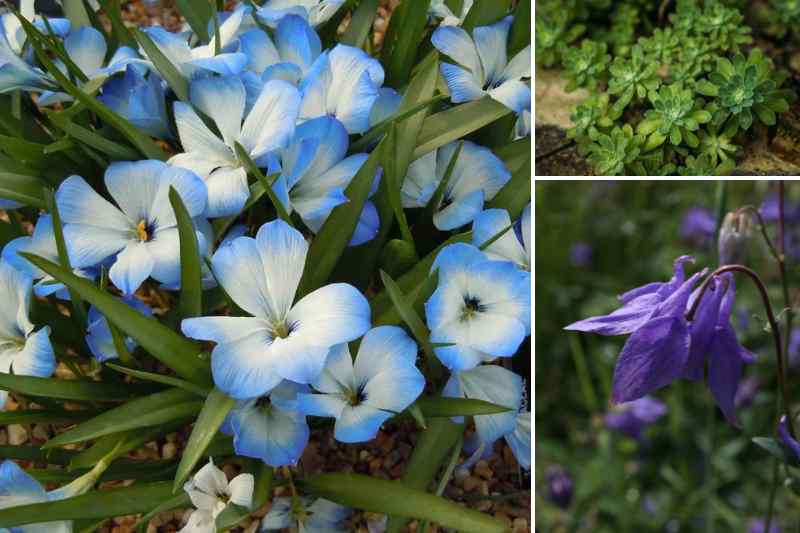
Tecophilaea cyanocrocusvar. Leichtlinii: the blue crocus, jewel of sun-drenched rockeries
Also known as the blue crocus of Chile, here is a neat little bulb that we love! Tecophilaea cyanocrocus is a small crocus perfectly suited to dry, sun-drenched rockeries. Growing to a maximum height of 10 cm, it forms pretty tufts and displays its charming sky-blue flowers with a strongly marked white throat, on slender blue-green linear foliage.
A must for this spring bulb: perfectly drained soil, or it will rot. Note that the blue crocus of Chile dislikes scorching summers or temperatures that are too cold (it will still tolerate down to -5°C under good cultivation conditions) and is among bulbs reserved for experienced gardeners.
For its early-season flowering, between February and March, it will enliven a rock garden of alpine type or a scree garden, or join a stone trough, surrounded by sedums and Pulsatilla that will take over, followed in turn by the deep blue bloom of Alpine aquilegia.
Read also: 6 bulbs easy to naturalise.
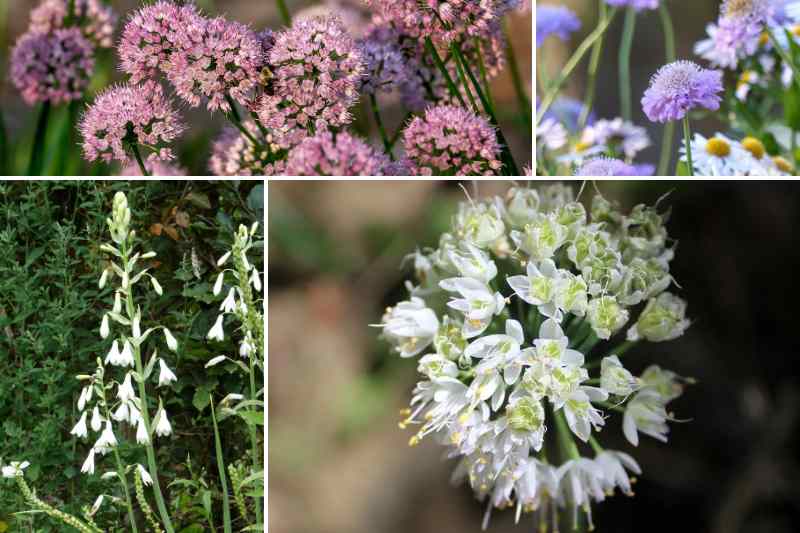
Allium cernuum 'White Dwarf': a wild charm for natural borders
What a delightful crowd-pleaser with this pendulous ornamental onion! Here is the white version of Allium cernuum, an onion with a similarly pendulous head, which adds to its charm, much like its Bulgaria-loving cousin.
Emerging with its foliage in spring, it is in summer that the Allium cernuum 'White Dwarf' rewards us with its small, white, pendant umbels on curved stems for many weeks. This pure white bloom, formed by around twenty small flowers, is also melliferous.
Adopt this original and compact ornamental onion if you want to fill gaps in natural, English-style, or cottage-style borders. It will be perfectly complemented by a handful of taller Galtonias, scabious and Allium millenium, in a rosy-mauve harmony, and by the light foliage of grasses such as Pennisetums or Stipas.
Tulipa 'Striped Crown': the sophisticated legacy of tulipomania
Let us finish this selection with another very beautiful tulip, in pink tones this time, with 'Striped Crown'. This tulip is part of full-season tulips, blooming in April, a little earlier or later in the month depending on exposure. It is distinguished by its specific form, in the Coronet group of tulips, with petals that are tweaked and curled.
Its shape, its cream colour enlivened with raspberry pink, varying with bulbs, its originality aimed at reproducing the striped motifs of Dutch tulips from the 17th-century tulipmania... All of this prefigures 'Striped Crown' joining a small, sophisticated, and precious garden at the foot of spring-flowering shrubs, but also a well-presented pot where you may prefer to let it dominate without other flowers. You can also simply grow it to use in unique bouquets. Like all tulips, give it well-drained soil so you can enjoy it again year after year.
Read also: Tulipomania: when a tulip was worth the price of a house
Each late summer brings its share of bulbs for spring colour, to irresistibly brighten our gardens. At this time of year we are often busy seeking the gems among these essential bulbs that will, in turn, lift us out of winter torpor in a few months. Our teams set out each year in search of […]
Fancy growing your own tea? It's now possible in our regions thanks to this new variety selected by French nurserymen, experts in the production of hardy and aromatic tea.
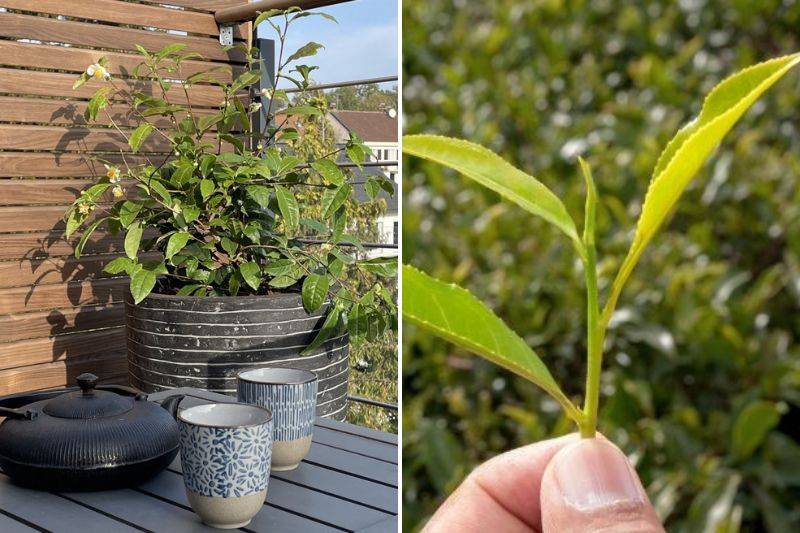
The Théier Théojardin (Camellia sinensis in Latin) forms a bushy shrub with a habit of 1 m in all directions, but can reach up to 2 m in width at ripeness if not pruned. It bears evergreen leaves of a beautiful glossy green and produces white flowers around a heart of yellow stamens, which bloom throughout autumn.
How to grow it in the garden or in a pot?
It is best grown in heather soil, preferably in a mild and humid oceanic climate. Capable of withstanding temperatures of around -10 °C for a short period, it should be placed in a sheltered spot from cold winds in winter and protected from the scorching sun in summer. Elsewhere, it can be successfully grown in a pot on a terrace or balcony, provided the shrub is shielded from the sun. In winter, it will be necessary to protect the plant and pot from severe frosts and icy winds.
Pairing it in the garden
It suits all styles of garden, whether rustic, Japanese, romantic, or wild, as long as the soil is acidic. Planted with Rhododendrons, Pieris, and Magnolia, this shrub adds volume to a flowerbed and provides a screen against the view all year round.
Tea harvesting
The leaves of this tea plant will satisfy even the most discerning home tea enthusiasts! Harvesting takes place in mid-May. I recommend picking only the first three leaves from each shoot, as these are the most aromatic. It takes between 4 and 5 kg of fresh leaves to produce 1 kg of dried tea. If you are a heavy tea drinker, this may not suffice for your daily consumption, but you will enjoy the pleasure of tasting a truly local production!
To learn more:
Fancy growing your own tea? It’s now possible in our regions thanks to this new variety selected by French nurserymen, experts in the production of hardy and aromatic tea. The Théier Théojardin (Camellia sinensis in Latin) forms a bushy shrub with a habit of 1 m in all directions, but can reach up to 2 m in […]
The Cutie Pie rose is a brand new miniature rose with generous flowering reminiscent of the delicacy of apple blossom. Initially carmine pink with a white centre at the start of flowering, its petals lighten to pale pink in summer. Highly appreciated by pollinators, its flowers continuously renew until the first autumn frosts. Requiring little maintenance, it has a very healthy compact foliage and thornless branches.
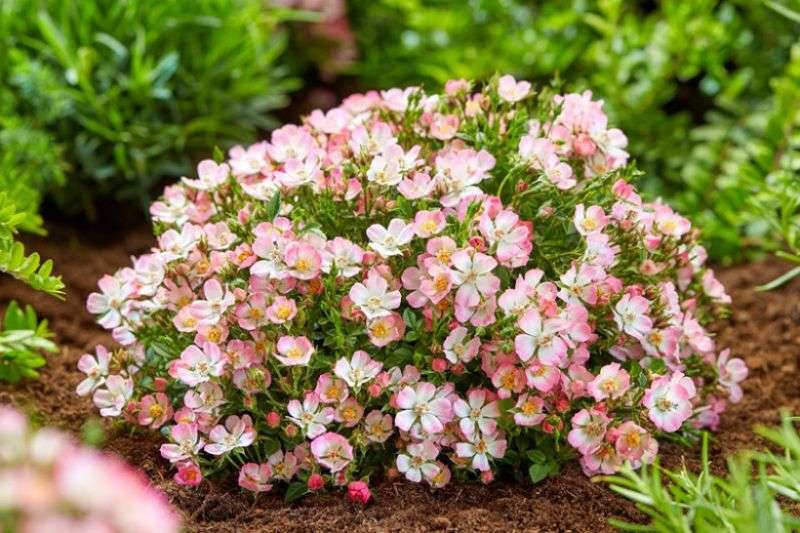
Whatever the style of your garden or terrace, this miniature rose is very easy to grow if you give it a lovely spot in the sun. Like a perennial plant, its small size, 15-20 cm high and 30 cm wide, allows you to tuck it in anywhere. At the edge of a path or to fill a space in the foreground of a border. Used as groundcover, three plants spaced 30 cm apart create a beautiful dense and flowering cushion in my rockery, accompanied by hardy geraniums, carnations, phlox, or nepeta.
On your terrace, it will thrive in a pot (30-40 cm) in dark grey tones that will enhance its beauty. By the second year, it will form an incredible dome of flowers.
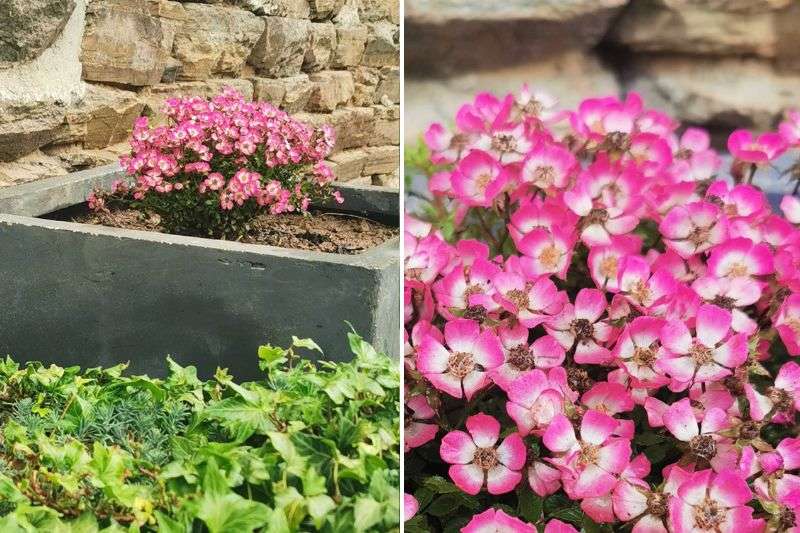
In terms of maintenance, regularly remove faded roses to encourage it to produce even more new flowering shoots. In the ground, it shows itself to be perfectly resistant to cold and drought. Water it once a week during the first year after planting, and it will manage very well on its own thereafter. In pots, protect it in regions with very harsh winters and ensure proper watering and fertilisation.
Don't miss out on this little gem; it will undoubtedly become a must-have!
The Cutie Pie rose is a brand new miniature rose with generous flowering reminiscent of the delicacy of apple blossom. Initially carmine pink with a white centre at the start of flowering, its petals lighten to pale pink in summer. Highly appreciated by pollinators, its flowers continuously renew until the first autumn frosts. Requiring little […]
Since it hit the market, I have been promoting this new variety of Mexican Orange Blossom (scientific name: Choisya x dewitteana 'Londaz' White Dazzler) in catalogues… but now… I finally have it! I took advantage of the long Easter weekend to plant this magnificent bush in my garden. I’ve wanted it for a long time, but I had to make some space to welcome it into my home!

This new Choisya 'White Dazzler' really has everything to please, and it’s not just talk, as I have five good reasons to share with you:
- It flowers abundantly and re-blooms generously, in several successive waves, depending on the weather, sometimes until November-December. Its flowering is white, a neutral colour: it can be paired with anything.
- During the rare periods when it is not in bloom, you can enjoy its decorative foliage, fine and elegant, composed of 5 to 7 narrow lobes, bright green on the young shoots, becoming more matte and darker later. It is evergreen, so you can enjoy it all year round!
- It smells of orange blossom, and this applies to both its flowers and its foliage. Once you know its fragrance, you can spot it from several metres away long before you see it!
- It’s a true all-rounder: you can grow it in pots on the terrace or in borders, small or large, as it maintains a small size (about 1.2 to 1.5 m high and wide). Moreover, it responds well to pruning, and can even be used as a low hedge. If you don’t want to prune it, no worries: it will remain dense and ramified on its own.
- It adapts to your plot: it grows in sun or shade (although it will flower less!), in fresh, rich soil or in dry, stony ground, from north to south: it easily withstands temperatures down to about -12°C, and if the branches were to freeze, it will almost always regrow from the stump!
With all that… how can you not love this Choisya 'White Dazzler', especially since I find it fits beautifully in a "contemporary" setting (planted in a designer pot) or a "graphic" style (with a grass), as well as in an "exotic" decor (with a banana tree or eucalyptus, for example) or, of course, in a more classic style inspired by "romantic" or "cottage" English style (with a rose and perennials). No more excuses, you need it in your home too… professional’s word!
Since it hit the market, I have been promoting this new variety of Mexican Orange Blossom (scientific name: Choisya x dewitteana ‘Londaz’ White Dazzler) in catalogues… but now… I finally have it! I took advantage of the long Easter weekend to plant this magnificent bush in my garden. I’ve wanted it for a long time, […]
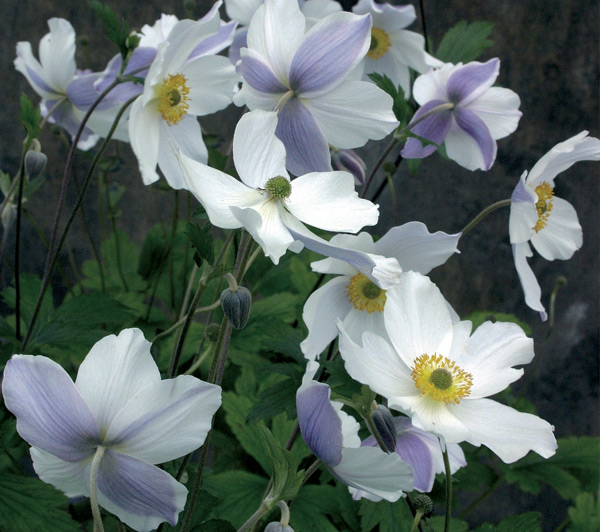
Awarded at the Chelsea Flower Show, the prestigious English horticultural exhibition, the ‘Wild Swan’ anemone is a unique variety. Both graceful and robust, it captivates with its prolonged flowering and natural elegance.
A long-lasting and refined flowering
Unlike classic Japanese anemones, which often have a limited summer or autumn flowering period, ‘Wild Swan’ offers a remarkable display from spring until early autumn. It stands out with its large, slightly satin white flowers that brighten up the garden.
But its true asset lies in a fascinating detail: when the flower closes at the end of the day or a breeze lifts its petals, beautiful purple stripes appear on their underside, adding an unparalleled touch of refinement. This subtle play of colours makes it a plant full of surprises, always changing throughout the hours.
An elegant silhouette and delicate foliage
The ‘Wild Swan’ anemone does not just have exceptional flowering. Its airy and natural habit makes it an ideal perennial for structuring borders. Its dark green, finely cut foliage provides a backdrop that highlights the delicacy of the flowers.
It reaches about 40 to 50 cm in height and spreads 50 cm wide, forming a beautiful, dense, and harmonious clump. Whether at the edge, in a border, or even in a pot on a terrace, it easily finds its place thanks to its balanced silhouette.
Where and how to Grow the ‘Wild Swan’ Anemone?
This anemone is valued for its hardiness and ease of maintenance. It adapts to many situations but expresses its full potential when grown under the right conditions.
Ideal Exposure
- It prefers a partially shaded position, where it receives light without being exposed to the scorching rays of the sun.
- It can also be planted in gentle sun, provided the soil remains cool.
Soil Type
- A rich, light, and well-drained soil is essential to avoid excess moisture that could weaken the plant.
- A humus-bearing and slightly acidic soil is ideal for promoting healthy growth.
Maintenance and Watering
- Water regularly in summer, especially during dry spells, but without overwatering to avoid saturating the roots.
- Remove faded flowers to encourage continuous blooming.
- A winter mulch can be beneficial in regions with very harsh winters.
Successful garden combinations
The ‘Wild Swan’ anemone is perfect for creating natural and romantic scenes. Here are some pairing ideas to showcase it:
- With light grasses (Stipa, Carex) for a contrast between softness and structure.
- With other shade perennials such as ferns, hostas, or heucheras for a fresh and green atmosphere.
- With English roses or astrantias for an English-inspired garden.
Why adopting the ‘Wild Swan’ Anemone?
With its elegant habit, long-lasting flowering, and subtle contrasts, the ‘Wild Swan’ anemone is an exceptional perennial that adds a sophisticated touch to the garden. Easy to grow, it appeals to both novice gardeners and enthusiasts. It offers a beautiful alternative to traditional Japanese anemones and integrates wonderfully into a harmonious composition.
Don't hesitate to adopt it in your garden to enjoy its unique charm season after season!
Further reading
- Discover our 5 favourite double-flowering Japanese anemone varieties
- And everything you need to know about Japanese anemones: planting, growing, and caring.
Awarded at the Chelsea Flower Show, the prestigious English horticultural exhibition, the ‘Wild Swan’ anemone is a unique variety. Both graceful and robust, it captivates with its prolonged flowering and natural elegance. A long-lasting and refined flowering Unlike classic Japanese anemones, which often have a limited summer or autumn flowering period, ‘Wild Swan’ offers a […]
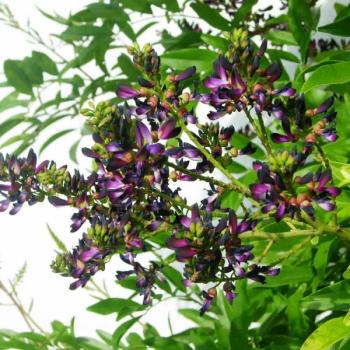
Very similar to a wisteria, Milletia japonica 'Satsuma', or summer wisteria, is an original climbing plant that hails from Asia, specifically Japan. As voluble as a wisteria, its young shoots wrap around any support, allowing it to reach heights of 5 to 6 m.
Milletia japonica 'Satsuma'
An original "wisteria": the summer wisteria or Milletia japonica
The originality of this climbing plant, also known as "Red Wisteria", lies in its flowers. They are a magnificent crimson red mixed with violet, of rare intensity, and they bloom not in spring, like many wisterias, but in mid-summer, around July-August, renewing until late in the season. Although spectacular for their crimson red mixed with violet colour, they emit a subtle fragrance, less intense than that of classic wisterias, but still pleasant. Additionally, its apple-green foliage is evergreen, which is a significant advantage when wanting to hide an unsightly wall.
Good to know: the flowers of Milletia japonica 'Satsuma' are very attractive to bees and other pollinating insects, which come to forage in the height of summer, a time when floral resources can be scarce.
A lovely climbing plant that grows quickly…
The Milletia japonica 'Satsuma' is a fast-growing climber, capable of reaching 5 to 6 metres in just a few years if conditions are right. It requires only light pruning at the end of winter to remove dead wood and balance its structure, while guiding its voluble shoots onto a solid support like a trellis or pergola to help it develop well.
...but with somewhat limited hardiness
Milletia 'Satsuma' has many advantages, except perhaps its hardiness, which prevents it from being grown outdoors in cold regions. Hardy down to about -7 °C, this climbing plant is suited to mild and temperate regions. However, when grown against a south-facing wall, its hardiness is enhanced; indeed, older specimens have survived temperatures of -12 °C for short periods in the Paris region. Some even claim it could withstand down to -15 °C. Nevertheless, this lovely climber will delight amateur gardeners, especially those keen on trying new plants. For the more cautious, Milletia can be grown in a pot and brought indoors during winter.
How to grow Milletia japonica?
The Millettia japonica 'Satsuma' prefers well-drained soil, as it is sensitive to excess moisture, especially in winter. A rich, humus-bearing soil will promote good growth and abundant flowering, but it can also adapt to poorer soils as long as they are deep enough. In terms of pH, it tolerates both slightly acidic and neutral soils, but avoid overly calcareous soils that could hinder its development. For optimal flowering, plant it in full sun, ideally sheltered from cold winds, such as against a south-facing wall.
Milletia has moderate water needs: it appreciates regular watering in the first year to establish its roots, but once established, it tolerates drought quite well. However, during prolonged periods of intense heat, occasional watering will encourage generous flowering and vigorous foliage.
The red wisteria is best planted in spring (March to May) or early autumn (September to October), when the soil is still warm enough to promote good rooting before winter.
Very similar to a wisteria, Milletia japonica ‘Satsuma’, or summer wisteria, is an original climbing plant that hails from Asia, specifically Japan. As voluble as a wisteria, its young shoots wrap around any support, allowing it to reach heights of 5 to 6 m. An original “wisteria”: the summer wisteria or Milletia japonica The originality […]
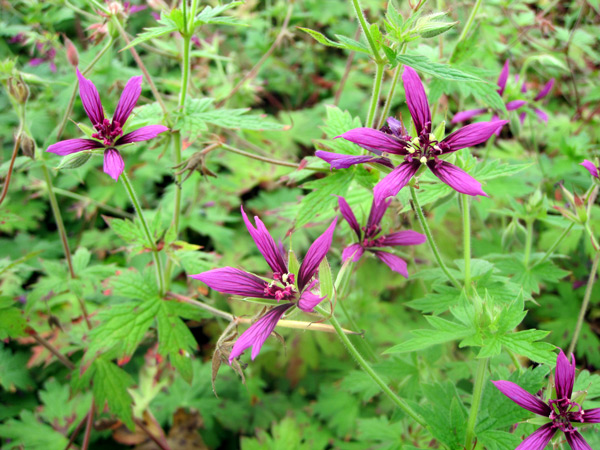
The Geranium Catherine Deneuve is a new variety that, contrary to appearances, is extraordinarily floriferous.
Geranium Catherine Deneuve
In flower since June, this hardy geranium continues to surprise me. With its star-shaped flowers, I initially thought, upon seeing it in a photo, that it was derived from a geranium (x) oxonianum, resembling the very classic Geranium oxonianum f. thurstonianum (a variety once widely used in the shady corners of mixed borders and gradually replaced by more floriferous hybrids).
However, upon examining it more closely, I was pleasantly surprised to discover that this selection is derived from geranium psilostemon, the parent of the famous Geranium 'Patricia' and G. 'Dragon Heart', a rather enticing detail considering the floribundity of these geraniums. Finally, while cultivating it, I find that this new geranium, perhaps slightly less floriferous than the previously mentioned varieties, has an astonishingly long flowering period. In flower since June, the inflorescences keep renewing, and last year it was still in bloom in November!
The small size of the flowers certainly explains this performance; its reduced petals require fewer resources, allowing the plant to exhaust itself less quickly and renew its flowers more rapidly. It strikes a perfect balance between flower size, abundance, and flowering duration—truly a wonderful new addition that deserves its place in our gardens.
The Geranium Catherine Deneuve is a new variety that, contrary to appearances, is extraordinarily floriferous. In flower since June, this hardy geranium continues to surprise me. With its star-shaped flowers, I initially thought, upon seeing it in a photo, that it was derived from a geranium (x) oxonianum, resembling the very classic Geranium oxonianum f. […]
Originating from Japan, the Yoraku Tama hydrangea is a lovely selection still unknown to gardeners that is sure to become the star of autumn gardens. Less well-known than its cousins, the macrophylla and paniculata hydrangeas, this hydrangea is a selection of Hydrangea involucrata.
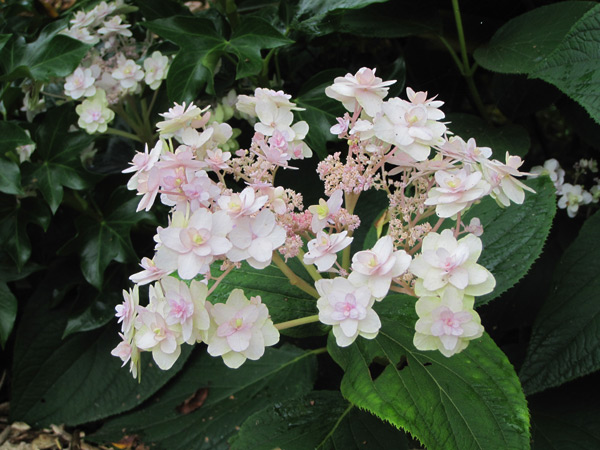 Hydrangea involucrata Yoraku Tama
Neglected by gardeners, Hydrangea involucrata are small, stocky bushes rarely exceeding 1m in height, featuring small umbels of flowers in pale mauve and soft pink shades. They are slightly running and have the unique characteristic of forming flower buds that resemble those of Japanese peonies.
But back to our Yoraku Tama, this new selection is truly astonishing because, firstly, it produces inflorescences much larger than the wild hydrangea involucrata (the flowers measure about 25cm in diameter), secondly, the flowers are double and porcelain pink, which is quite uncommon for this species, and finally, the inflorescences bloom much later than other hydrangeas; in fact, it is the very last to flower in the garden!
Lastly, three final points before adopting it: -1. it is compact (1.20m by 1.20m) and can be planted in a pot or near the front door of the house, -2. it thrives in any fresh, rich soil, provided it does not lack water during the summer, and -3. it is not fragile to cold and blooms until November; yes, it is possible.
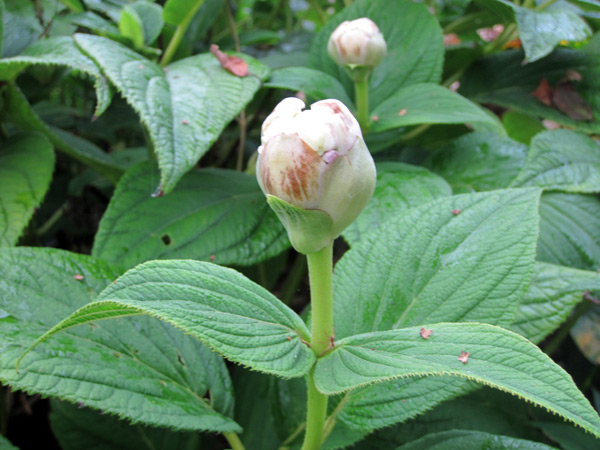 Here is a close-up of the flower bud of the Hydrangea involucrata Yoraku Tama. Without the foliage, one could almost mistake it for a peony flower about to bloom.
Originating from Japan, the Yoraku Tama hydrangea is a lovely selection still unknown to gardeners that is sure to become the star of autumn gardens. Less well-known than its cousins, the macrophylla and paniculata hydrangeas, this hydrangea is a selection of Hydrangea involucrata. Hydrangea involucrata Yoraku Tama Neglected by gardeners, Hydrangea involucrata are small, stocky […]