
Digitalis ferruginea Gigantea - Rusty foxglove

Digitalis ferruginea Gigantea - Rusty foxglove

Digitalis ferruginea Gigantea - Rusty foxglove

Digitalis ferruginea Gigantea - Rusty foxglove
Digitalis ferruginea Gigantea - Rusty foxglove
Digitalis ferruginea Gigantea
Rusty foxglove
Very beautiful young plant and it has been growing well for the past two weeks.
Julien, 24/03/2025
Back-to-school special offer!
Get €10 off for every €50 you spend! And get up to €40 off on a single order.
How does it work?
1. Shop your favourites
Add your favourite plants to your basket. For every €50 you spend (excluding delivery charges, store credit and the plastic-free option), you’ll receive a €10 voucher.
€50 spent = €10 voucher
€100 spent = €20 voucher
€150 spent = €30 voucher
€200 spent = €40 voucher
2. Place your order
Once your basket reaches one of the spending thresholds, place your order. You can even choose your delivery date!
3. Receive your voucher
As soon as your order has been shipped, you’ll receive an email containing your personal voucher code and its value.
4. Use it on your next order
Your voucher is valid for 90 days from the date you receive it. It can be used once only, on a new order worth at least the value of the voucher, excluding delivery charges.
Please note: Vouchers can be combined with other offers, but cannot be split or refunded.
Why not try an alternative variety in stock?
View all →
Available in 3 sizes
Available in 1 sizes
Available in 2 sizes
Available in 2 sizes
Available in 1 sizes
Available in 2 sizes

Available in 1 sizes

Available in 1 sizes

Available in 1 sizes

Available in 0 sizes
This plant carries a 12 months recovery warranty
More information
We guarantee the quality of our plants for a full growing cycle, and will replace at our expense any plant that fails to recover under normal climatic and planting conditions.


Does this plant fit my garden?
Set up your Plantfit profile →
Description
Digitalis ferruginea ‘Gigantea’ est une variété de digitale ferrugineuse reconnaissable à ses hautes hampes remplies de fleurs bronze, ocre et brun doré, parcourues de veines rouge sombre. Sélectionnée pour ses tiges florales démesurées et ses grosses fleurs, elle conserve néanmoins un port étroit et se glisse aisément entre d’autres vivaces. Son coloris s'associe bien aux pourpres, aux mauves et aux jaunes pâles. Elle trouve sa place dans les massifs champêtres, les jardins de cottage, les lisières claires et les prairies fleuries pas trop sèches.
Cette plante de la famille des Plantaginacées se comporte comme une bisannuelle ou une vivace de courte durée. Ses hampes sèchent après la floraison, alors que sa rosette basale persiste plus ou moins en hiver. La première saison est consacrée à l’enracinement et au développement des feuilles ; la floraison intervient à partir de la deuxième année. Une souche peut refleurir pendant 3 ou 4 saisons, mais les semis spontanés jouent un rôle important dans la pérennité de la plante au jardin. L’espèce type Digitalis ferruginea, moins impressionnante, pousse naturellement de la Hongrie au Caucase et jusqu’au Liban, dans les clairières, les lisières, les broussailles, les prairies et les pentes pierreuses, depuis les basses terres jusqu’aux montagnes.
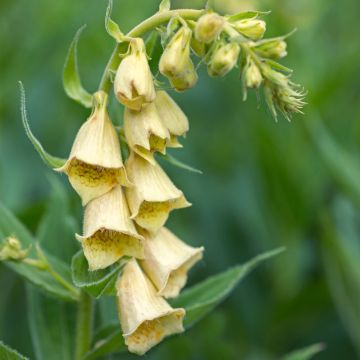
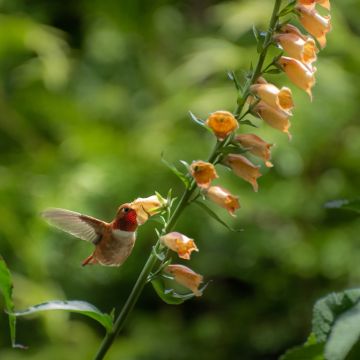
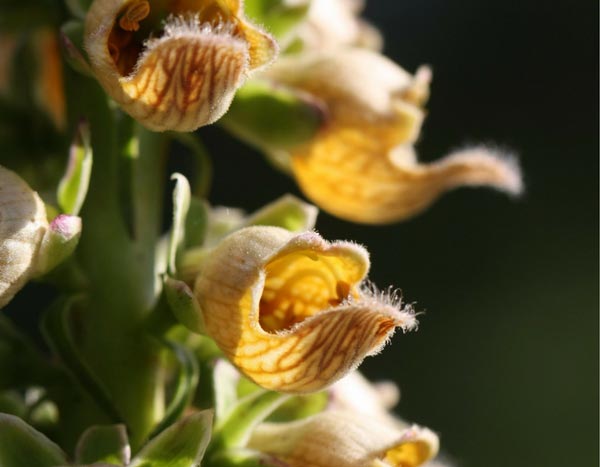
‘Gigantea’ est une sélection horticole de grande taille ; les plantes issues de semis peuvent présenter de légères différences. La plante forme une rosette de feuilles étroites, lancéolées à oblongues, luisantes, vert foncé et fortement nervurées, mesurant 40 à 60 cm de diamètre. Des tiges feuillées, droites et solides, s’élèvent au-dessus de cette base. Elles atteignent 1,50 m et peuvent culminer à 1,80 m dans une terre riche et fraîche. La floraison a lieu de juin à août selon le climat. Les fleurs, longues de 3 à 4 cm, sont serrées tout autour de la hampe. Leur corolle largement tubulaire brun doré, bronze ou de couleur rouille à l'extérieur, s'ouvre sur une gorge plus claire marquée d’un réseau de veines rouge brun. La lèvre inférieure, allongée et garnie de poils fins, sert de piste d’atterrissage aux bourdons. Les fleurs s’ouvrent progressivement du bas vers le sommet. Les fruits sont des capsules remplies de graines fines qui germent dans les espaces de terre nue. Cette digitale a reçu en 2015 l’Award of Garden Merit de la Royal Horticultural Society. L’adjectif latin ferruginea signifie « couleur de rouille » et décrit précisément la nuance peu commune de ses fleurs. Comme toutes les digitales, elle est très toxique par ingestion, mais pas par contact. Elle contient un alcaloïde, la digitaline, encore utilisée de nos jours pour traiter les maladies du cœur.
Cette digitale géante aux tons chauds s'intègre dans un jardin de cottage ou un massif d’allure naturelle. Sa floraison émerge d’un ensemble de vivaces souples, aux fleurs légères et aux couleurs sourdes. Vous pouvez l'associer à des plantes qui se plaisent à mi-ombre dans une terre humifère pas trop sèche. L’Actaea simplex ‘Brunette’, le cerfeuil des bois bronze Anthriscus sylvestris ‘Ravenswing’, le Geranium phaeum ‘Samobor’ et la Campanula lactiflora ‘Prichard’s Variety’ seront de bons compagnons : le violet bleuté, le blanc crème et les tons lie-de-vin font ressortir ses fleurs bronze.
Digitalis ferruginea Gigantea - Rusty foxglove in pictures


Flowering
Foliage
Plant habit
Safety measures
Botanical data
Digitalis
ferruginea
Gigantea
Plantaginaceae
Rusty foxglove
Cultivar or hybrid
ingestion
Cette plante est toxique si elle est ingérée volontairement ou involontairement.
Ne la plantez pas là où de jeunes enfants peuvent évoluer, et lavez-vous les mains après l'avoir manipulée.
Pensez à conserver l'étiquette de la plante, à la photographier ou à noter son nom, afin de faciliter le travail des professionnels de santé.
Davantage d'informations sur https://plantes-risque.info
Planting and care
Digitalis ferruginea ‘Gigantea’ is planted from February to April or from September to November, outside periods of frost or drought. Sun suits it in regions with cool summers, whereas light partial shade is preferable elsewhere. Plant it in a deep, loose soil enriched with mature compost. Chalk and clay are tolerated if water drains away properly in winter; in heavy soil, slightly raised planting is helpful. Watering should be monitored during the first season. A well-rooted plant then tolerates short dry periods, but flowers for longer if the soil retains moisture. The stems should be discreetly staked in slightly windy spots. Cut back the main spike as soon as it fades to stimulate the formation of secondary spikes. A few stems can be left until ripeness to allow the plant to self-seed.
Planting period
Intended location
Care
Planting & care advice
-
-
-
-

-
-
-
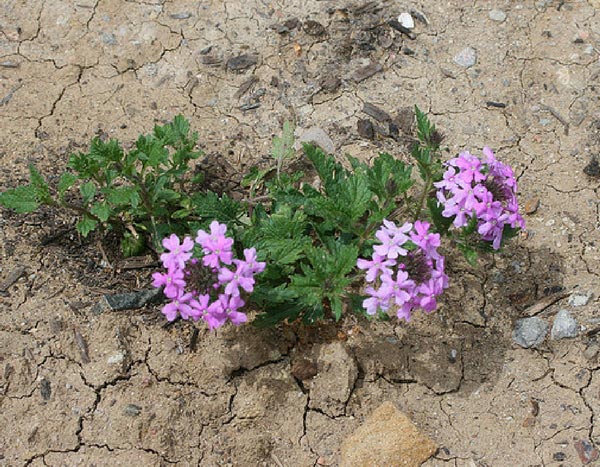
-
-
, onOrder confirmed
Reply from on Promesse de fleurs
Recently viewed products
Haven't found what you were looking for?
Hardiness is the lowest winter temperature a plant can endure without suffering serious damage or even dying. However, hardiness is affected by location (a sheltered area, such as a patio), protection (winter cover) and soil type (hardiness is improved by well-drained soil).
In temperate climates, pruning of spring-flowering shrubs (forsythia, spireas, etc.) should be done just after flowering.
Pruning of summer-flowering shrubs (Indian Lilac, Perovskia, etc.) can be done in winter or spring.
In cold regions as well as with frost-sensitive plants, avoid pruning too early when severe frosts may still occur.
The sowing periods indicated on our website apply to countries and regions within USDA Zone 8 (France, UK, Ireland, Netherlands).
In colder areas (Scandinavia, Poland, Austria...), delay any outdoor sowing by 3-4 weeks, or sow under glass.
In warmer climes (Italy, Spain, Greece, etc.), bring outdoor sowing forward by a few weeks.
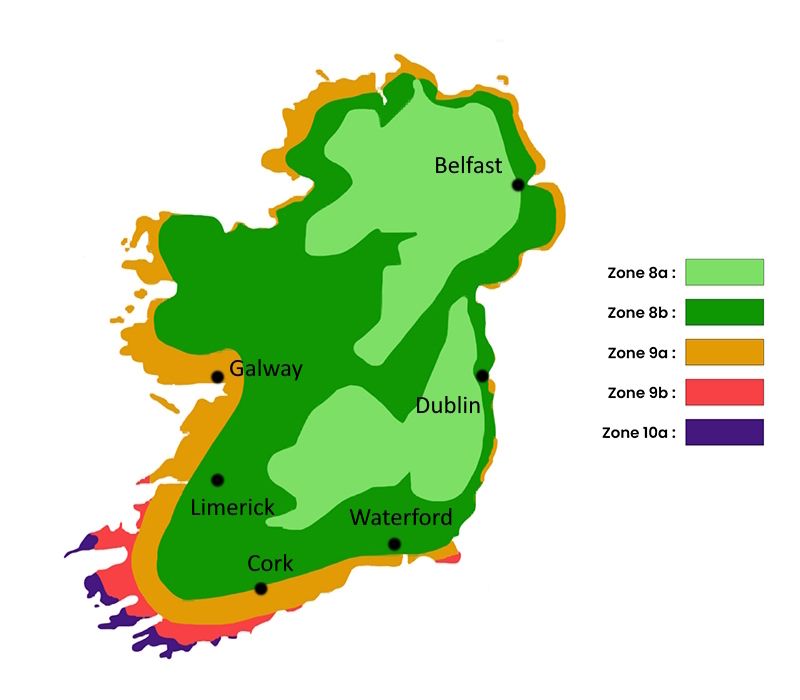
The planting period indicated on our website applies to regions in USDA Zone 9a (East Coast and Midlands: Dublin, Wexford, Waterford, Kilkenny, Portlaoise). It will vary depending on where you live:
- On the west coast and in the north-west (Galway, Limerick, Sligo, Donegal, Westport), delay planting by 1 to 2 weeks in spring and bring it forward by 1 to 2 weeks in autumn compared to the dates given, preferably choosing periods without strong winds.
- In the inland hills and plateaus (Wicklow Mountains, Macgillycuddy’s Reeks, Connemara, Killarney), it is best to plant in spring (April–May) or autumn (September–October), avoiding periods of waterlogged soil in winter and strong winds, which pose the main risk to newly planted trees in these areas.
The flowering period indicated on our website applies to regions in USDA Zone 9a, such as the East Coast and Midlands, including Dublin, Wexford, Waterford, Kilkenny and Portlaoise.
This will vary depending on where you live:
- On the west coast and in the northwest (Galway, Limerick, Sligo, Donegal and Westport), it will be delayed by one to two weeks compared to the given dates, due to stronger Atlantic winds and less spring sunshine.
- In the inland hills and plateaus (the Wicklow Mountains, the Macgillycuddy's Reeks, Connemara and Killarney), flowering will be delayed by two to three weeks. Flowering mainly occurs between May and July, with the limiting factors being less frost and more of the excessive humidity, strong winds and lack of sunshine that are characteristic of these areas.
The harvest period stated on our website applies to regions in USDA zones 8b to 9a (East, South-East and southern coast: Eastern Leinster, County Wexford and County Waterford, Cork region: Dublin, Wexford, Waterford, Kilkenny, Cork). It will vary depending on where you live:
- In the Midlands and the inland plains: the Middle Shannon Valley, Westmeath, Offaly, Longford, Cavan and Monaghan (Athlone, Mullingar, Tullamore, Longford, Cavan, Monaghan), in USDA zones 8a to 8b, the harvest will be delayed by 1 to 2 weeks compared with the dates given. Far from the moderating influence of the sea, these plains experience late frosts right up until the end of spring. The heavy, peaty soils warm slowly here, and damp patches form pockets of frost. Wait until the soil has dried out and warmed up before planting, and protect young plants with a fleece on clear nights.
- In the Atlantic West and North-West: Kerry, Clare, Galway, Connemara, Mayo, Sligo and Donegal (Killarney, Ennis, Galway, Westport, Sligo, Letterkenny), in USDA zones 8b to 10a, the harvest will be delayed by 1 to 3 weeks compared with the dates given. Summers here are cloudier, rainier and windier than in the east, which slows down ripening and encourages late blight and other fungal diseases. Kerry and Clare are at the lower end of the range, whilst Mayo and Donegal, which are cooler and more exposed, are at the upper end. However, the mild coastal winters mean that leafy vegetables and root vegetables can be harvested at dates close to those indicated, or even earlier: shelter crops from the wind with hedges and grow heat-loving plants in greenhouses or polytunnels.
- In the highlands, above 200 m: the Wicklow Mountains, Macgillycuddy’s Reeks, the Galtee and Comeragh ranges, the Twelve Bens in Connemara and the Donegal highlands, in USDA zones 7b to 8a, the harvest will be delayed by 2 to 4 weeks compared with the dates given, depending on the altitude, taking care to beat the first early frosts, which may occur as early as the start of autumn. Wind, constant damp and late frosts lasting into early summer significantly shorten the growing season. Opt for sheltered, south-facing slopes, early-maturing varieties and growing under cover.
Depending on your garden’s aspect, these variations can range from one to two weeks. A frost-prone valley floor delays the harvest, whilst a south-facing wall brings it forward.
Shipping country and language
Your country of residence may be:
Your country of residence is:
For a better user experience on our website, you can select:
Your shipping country:
-
 Austria
-
 Belgium
-
 Bosnia & Herzegovina
-
 Bulgaria
-
 Croatia
-
 Cyprus
-
 Czechia
-
 Denmark
-
 Estonia
-
 Finland
-
 France
-
 Germany
-
 Greece
-
 Hungary
-
 Iceland
-
 Ireland
-
 Italy
-
 Latvia
-
 Liechtenstein
-
 Lithuania
-
 Luxembourg
-
 Malta
-
 Netherlands
-
 Poland
-
 Portugal
-
 Romania
-
 Serbia
-
 Slovakia
-
 Slovenia
-
 Spain
-
 Sweden
-
 Switzerland
Language:
-
French
-
 English
-
Spanish
-
Italian
-
German
-
Portuguese
-
Dutch
-
Finnish
-
[pl]
My Account
Hello
My wish lists
My cart
Log in / Register
Existing customer?
This form is protected by reCAPTCHA - the Google Privacy Policy and Terms of Service apply.
New customer?
Create an account to track your orders, access our customer service and, if you wish, make the most of our upcoming offers.