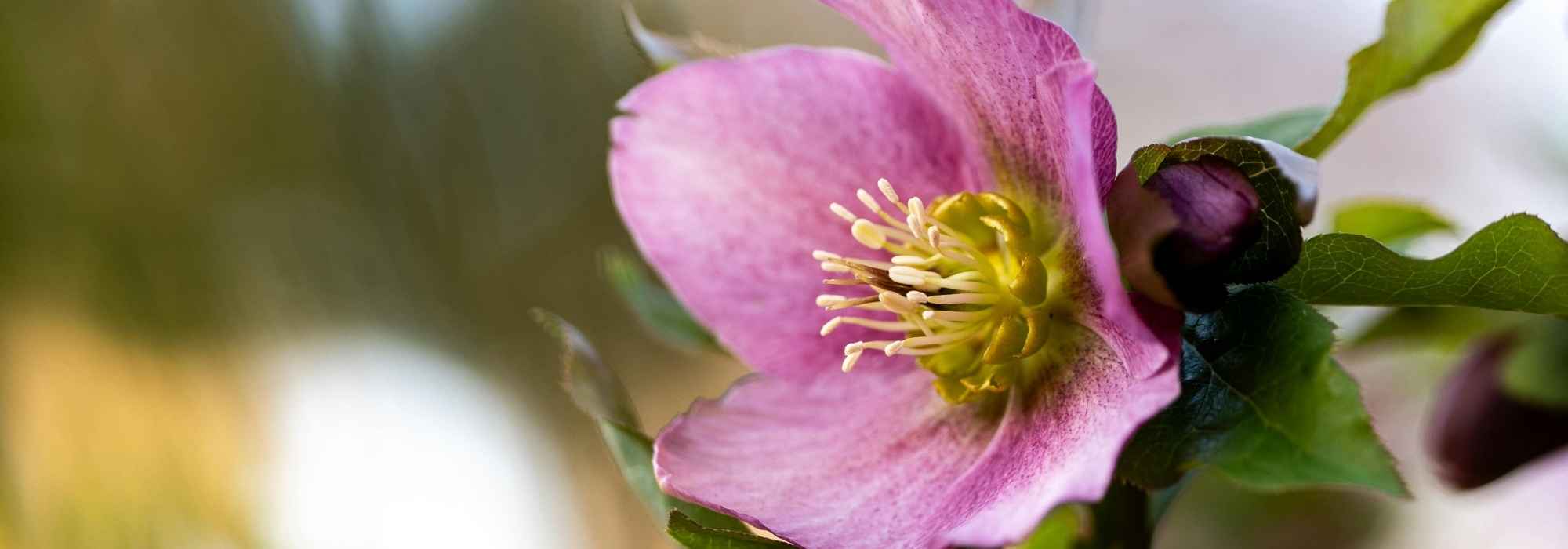
Why do some hellebores have variable colours?
Understanding flower colour variability in hellebores
Contents
Buying your hellebore in flower is the best way to make sure you have chosen the right variety. Hellebores come in a wide range of colours thanks to the many hybridisations, but they are also known for their colour variability, caused by genetic instability. It can be a real disappointment when your hellebore does not flower in the colour you expected… So how can you be sure its flowers will be speckled, or the charming shade of pink that caught your eye in a catalogue, magazine or online?
We explain why, without too much botanical jargon!

What you need to know about flower colours in hellebores
|
Read also
Hellebores: planting, growingSeed-grown hellebores: why is their colour unpredictable?
Growing from seed is a genetic lottery, just as it is with us humans. Reproduction from seed is sexual: each seed results from the fusion of a pollen grain and an ovule, each contributing half of the genetic make-up. The genes that control pigment production are recombined in a new way in every seed. Sow a hundred seeds and you’ll get a hundred different plants, from creamy white to almost black, speckled, plain, veined, variegated… with no way of controlling the outcome.
Two points to help explain:
- Seeds collected from an outstanding plant do not reproduce the variety: they produce variable offspring, only a few of which will resemble the parent plant. This is the classic disappointment for gardeners.
- This variation is amplified by a botanical fact: the hellebores in our gardens are wild hybrids. The Lenten rose, often sought after (Helleborus orientalis) and extensively hybridised, crosses freely with its cousins as soon as they flower nearby. Their flowers also encourage cross-fertilisation between neighbouring plants, because the pistil is receptive before the stamens release their own pollen. Each seed’s genetic make-up is therefore mixed twice over: by the chance of fertilisation and by the hybrid history of its parents.
The key point is that growing from seed creates variability, but does not fix it. This is precisely why it fascinates plant breeders — sowing thousands of seeds, selecting them and keeping the exceptional plant — and disappoints gardeners who thought they were reproducing a variety.
Each hellebore grown from seed is therefore unique in flower colour, which explains the slight colour variations that may occur between two plants. This is normal and unavoidable!
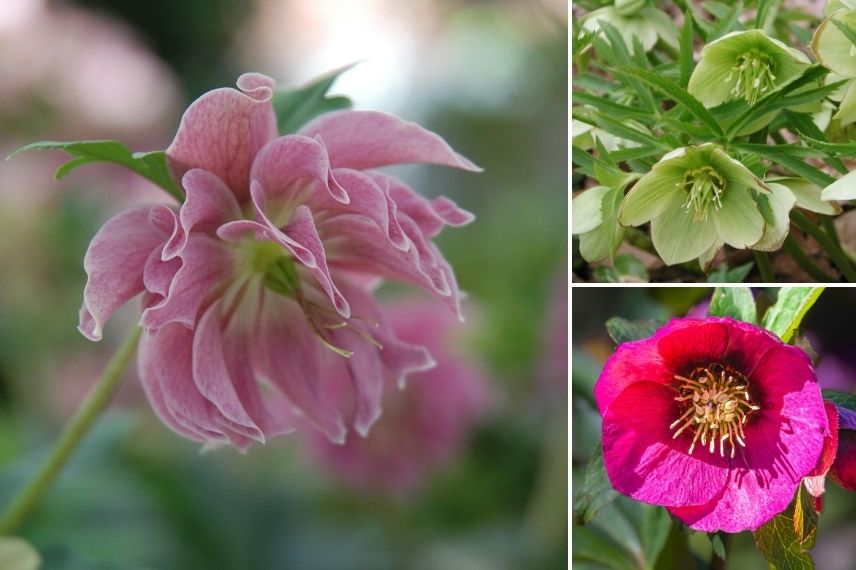
Hellebores are sold in a range of shades, but when grown from seed their colours are often variable
In vitro propagation: how can you be sure the colour will remain true and stable?
The other major method of propagation, laboratory propagation, now dominates among professional hellebore growers.
The principle is simple: a meristem is taken from the mother plant — a few millimetres of tissue at the tip of a shoot, an area of undifferentiated cells that divide constantly. This fragment is sterilised and placed on a nutrient gel (sugars, mineral salts and vitamins), where growth hormones — auxins and cytokinins — control regeneration. Their dosage prompts the production of shoots, then, once the formula is changed, the growth of roots. Meristem cells divide by mitosis, copying the genetic material exactly, without the mixing that occurs during sexual reproduction. The resulting young plant is therefore a true-to-type clone, carrying exactly the same genes as the original plant — including its spots, edges and colours. While sowing produces unpredictable results, in vitro propagation reproduces the genetic material exactly.
This is why the technique dominates the hellebore variety trade. Growers generally seek distinctive flower colours or selections of cultivars with large flowers, double blooms, ‘picotee’ markings, anemone-centred flowers and so on. From a single plant fragment, the laboratory can produce thousands of identical young plants in just a few months. No other cloning method can do this: dividing a clump yields only a handful of divisions each year.
There is one caveat: a flower’s exact colour is still affected by cold (which often intensifies anthocyanins and spotting), the amount of light it receives, soil fertility, rain, which washes pigments from the surface, and the ageing of the sepal described below. The same cultivar will look different in photographs taken in the shade in February and in full sun in April.
Read also
Propagating helleboreWhy do some hellebores change colour as they flower?
One of the botanical peculiarities of hellebores is that their petals are actually sepals. This causes their colour to change as they flower, as it does in other familiar flowers such as hydrangeas and certain clematis and anemones*. Let’s try to explain it simply!
In the genus Helleborus, the true petals have become small nectar-bearing cones, known as nectaries, at the centre of the flower. The colours we admire in winter on this graceful perennial are actually borne by petaloid sepals. Unlike conventional petals, they persist for several months after pollination and have taken over the petals’ role of attracting insects. As they are leaf-like organs (but not bracts), they retain the ability to produce chlorophyll and change colour over time. Their pigments evolve with age, weather and pollination, causing the hellebore to change colour gradually.
The colour palette relies on three groups of pigments:
- The anthocyanins, which produce pink, red, mauve and such deep purple shades that they are described as black.
- Chlorophyll, the green pigment in leaves, appears to varying degrees in the sepals: pure green hellebores are rich in it, while dark forms have almost none.
- Finally, flavonols and other phenolic compounds modify the underlying shades, lightening or cream-colouring the margins.
This pigment process is not fixed. A single flower changes over its six to eight weeks of life: the bud is usually darker. When it opens, the anthocyanins become slightly diluted as the cells stretch. Then, over the following weeks, they oxidise and break down, concentrating the colour towards the edges and creating the contrasting borders that horticulturists call “picotee” flowers. After fertilisation, a second process comes into play: in many light-coloured varieties, the sepals turn green, a sign of programmed senescence — the flower ages, its floral pigments fade, and chlorophyll takes over. Having become a photosynthetic organ again, the sepal then helps nourish the developing seeds. In very dark varieties, rich in stable anthocyanins, this greening goes almost unnoticed. So when a gardener sees their “Christmas rose” turning pale green in spring, they are witnessing, without realising it, the final task of a disguised leaf.
* Clematis and anemones share the feature of coloured sepals, while hydrangeas undergo a change in colour.
4 tips to avoid being disappointed by the colour of a hellebore
Fortunately, there are a few ways to avoid getting the flower colour of a hellebore wrong:
- Buy hellebores in flower, direct from the shop – this is the only way to be absolutely sure of the colour of the flowers!
- Choose true botanical species: in this case, you can be fairly sure of the flower colour, which is often cream or greenish. They come true from seed, as with holly-leaved hellebore, blue-grey hellebore and stinking hellebore.
- Choose named, patented varieties, such as ‘Maestro‘, those in the ViV® series, for example, or those from the Helleborus Gold Collection®, a trade mark belonging to a hybridisation programme led by Josef Heuger, a German breeder and grower.
- Divide a hellebore in your garden in late summer or late winter: dividing the clump produces a plant clone with guaranteed flower colour.
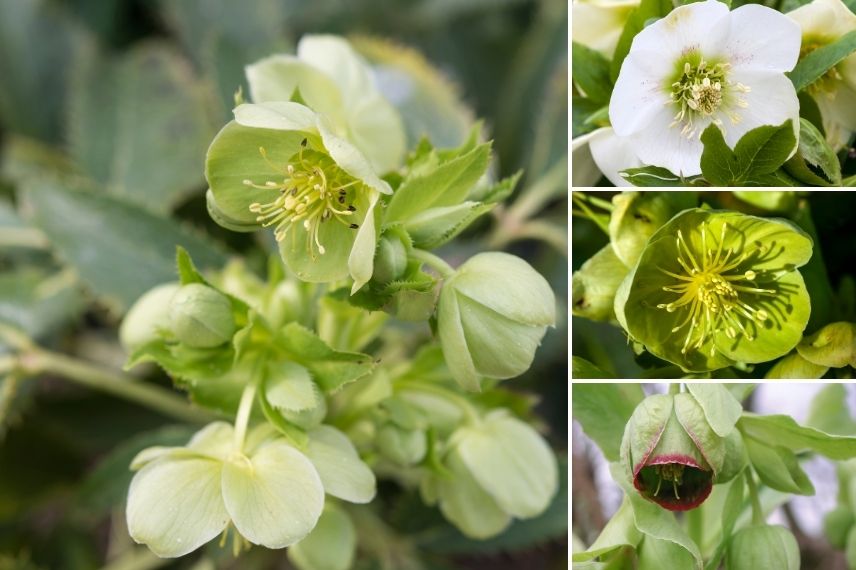
Helleborus argutifolius, or holly-leaved hellebore (left), and on the right, from top to bottom: Helleborus niger, or Christmas rose, Helleborus x sternii and Helleborus foetidus
Frequently asked questions about flower colour in hellebores
Do hellebore seeds all produce the same colour?
No, hellebore seeds do not reproduce the colour of the parent plant. As reproduction is sexual, each seed combines a new genetic make-up: sow 100 seeds and you will get 100 different plants, ranging from creamy white to almost black-purple. Only a few plants, from botanical species such as holly-leaved hellebore and stinking hellebore, remain relatively true to type when grown from seed.
Can a cloned hellebore change colour?
A hellebore propagated in vitro retains the genes of the original variety, but its colour can vary according to growing conditions. Cold often intensifies the anthocyanins and speckling, while the aspect, soil fertility and ageing of the sepals all affect the intensity of the colours. The same cultivar can therefore flower differently in February in the shade and in April in the sun: this is normal and temporary.
Can you cross two hellebore species?
Yes, but not all species can be crossed with one another. Closely related species, such as Helleborus orientalis and its relatives, hybridise spontaneously in the garden through simple cross-pollination — this is how garden Lenten roses originated. By contrast, crossing species from distant sections, for example Helleborus niger with Helleborus argutifolius, only succeeds in the laboratory: the embryo naturally aborts and must be rescued through in vitro culture, and the resulting hybrids are sterile.
- Subscribe!
- Contents
This form is protected by reCAPTCHA - the Google Privacy Policy and Terms of Service apply.

































Comments