How to grow lemon trees?
Everything you need to know about planting and caring for lemon trees in the ground and in pots
Contents
The Poplar Tree in a Nutshell
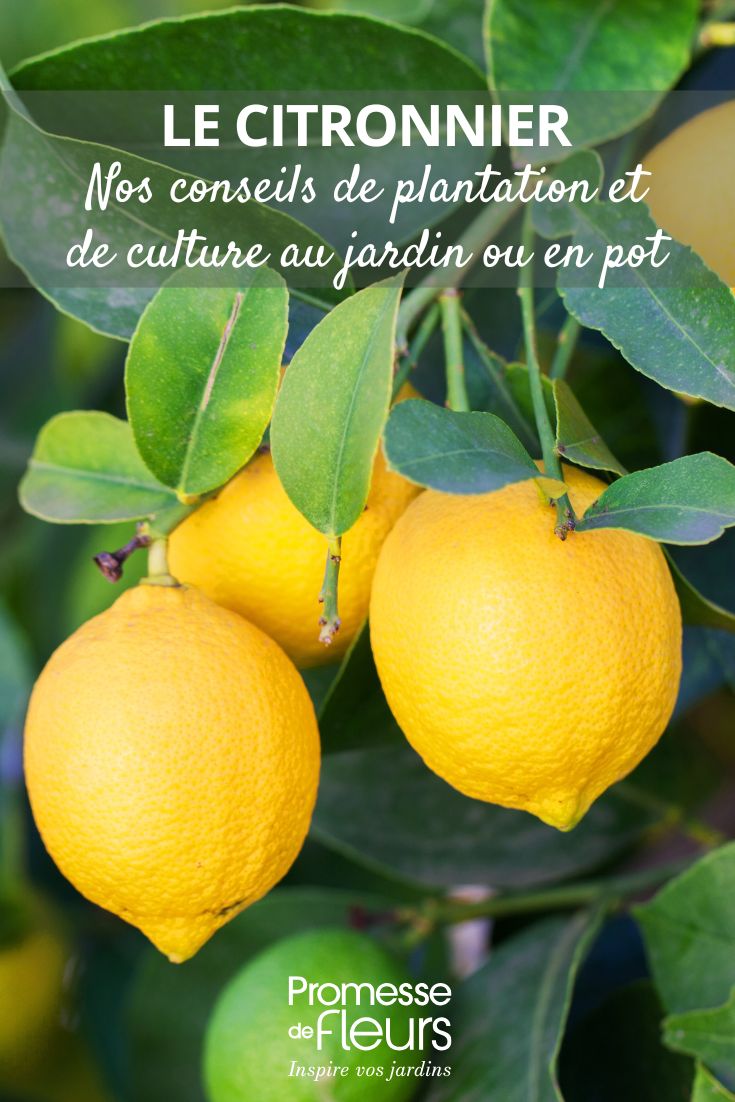
Growing a lemon tree (Citrus limon) in your garden, on your terrace or even on your balcony is a real delight. This emblematic Mediterranean citrus enchants with its glossy foliage, highly scented flowering and fragrant fruit. However, the lemon tree is a demanding fruit-bearing tree that requires some rigour, attention and consistent care to flourish fully and bear fruit.
Discover everything you need to know about growing lemon trees, from planting in the ground or in a pot to caring for them throughout the year.

Which lemon tree should I choose?
For most people, lemon trees are a beautiful citrus tree typical of the Mediterranean basin, where they can be grown in the ground. Elsewhere, container growing is necessary so you can bring your citrus tree indoors for winter. This applies regardless of species or variety. Indeed, there are many types of lemon tree, from the most classic to the most unusual in flavour and shape:
- Le four-seasons lemon tree (Citrus limon) : it is the most widespread lemon tree, offering an almost continuous crop from September to May, especially in Mediterranean regions, provided it is pruned correctly. There are many varieties of Citrus limon such as Citrus limon ‘Femminello Carrubaro’, a very productive variety that produces fruit in clusters, or Citrus limon ‘Lemox’, a recent variety with seedless lemons…
- Le Meyer lemon (Citrus × meyeri ) : a hybrid variety between mandarin and lemon, prized for its sweetness, prolific flowering and good suitability for container growing.
- Other varieties are worth exploring to vary the pleasures : the key lime (Citrus aurantifolia), the Persian lime (Citrus latifolia) or the key lime with red fruit (Citrus aurantifolia ‘Red Lime’), the finger lime (Microcitrus), the yuzu (Citrus junos), the combawa (Citrus hystrix), the citron tree (Citrus medica), or the sweet lemon (Citrus limetta ‘Pursha’) with lemons completely lacking acidity, each offering distinctive flavour profiles and specific culinary uses.
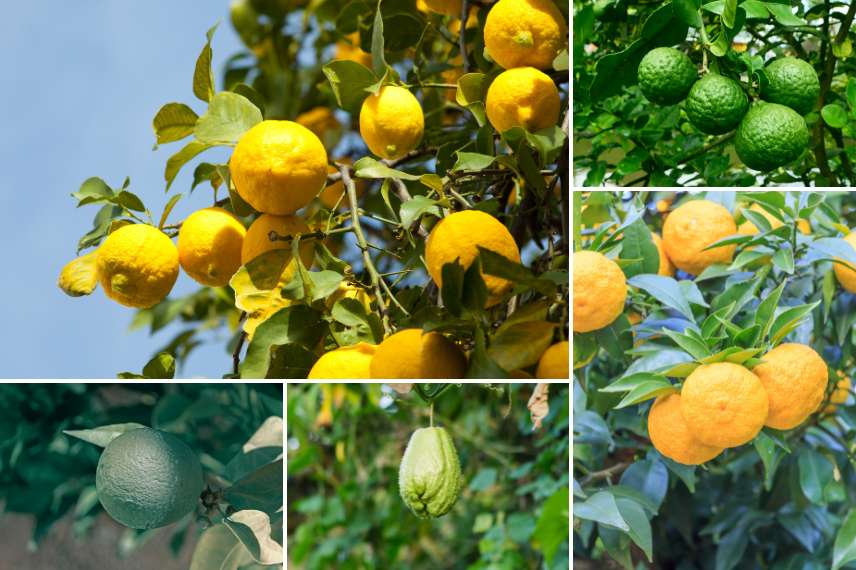
Clockwise, the four-seasons lemon tree, the combawa, the yuzu, the citron tree and the key lime
Most lemon trees can withstand temperatures down to around -5 to -7 °C, but young shoots are at risk below -2 °C.
Planting lemon trees in open ground: where, when and how?
Planting lemon trees in open ground is only possible in coastal areas of southern France.
Where to plant?
Lemon tree should be planted in full sun, but not in scorching conditions, in a well sheltered position away from winds and cold draughts. It must also be protected from sea spray, which it cannot tolerate.
In terms of soil, it needs light, deep soil, rich in humus and perfectly drained. Lemon tree dislikes soils that are too calcareous, too acidic or heavy and compact to the point of becoming waterlogged. Ideally, good garden soil, amended with compost and sand or pumice to ensure drainage suits it perfectly.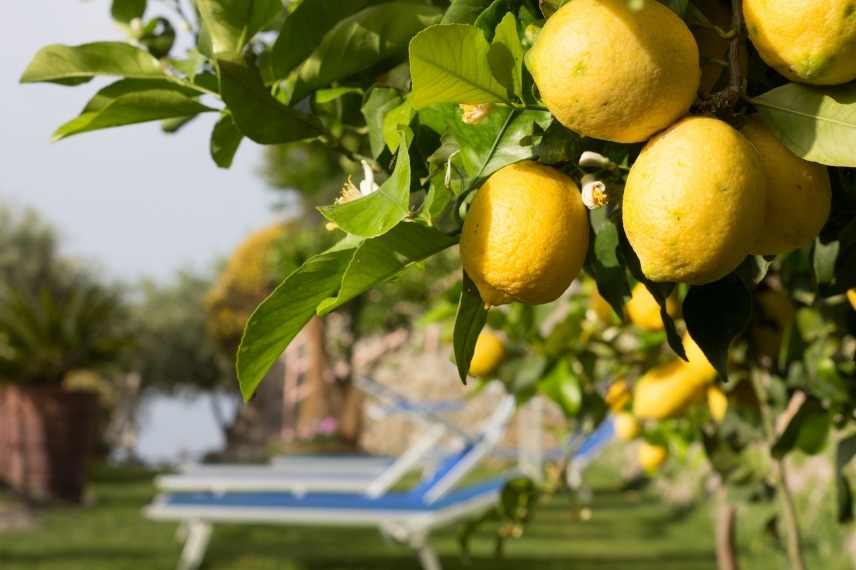
When to plant?
Planting in spring, between April and May, is optimal, after the last frosts or outside periods of drought.
How to plant?
- Dig a hole two to three times as wide and deep as the rootball
- Add coarse gravel to the bottom of the hole, especially if soil is heavy
- Amend the excavated soil with well-rotted compost
- Rehydrate the rootball in a bucket of water
- Place the lemon tree, taking care to keep the collar at soil level
- Backfill with the remaining excavated soil, firm gently then water generously
- Apply mulch around the trunk to retain moisture.
Planting a lemon tree in a pot: where, when and how?
In regions where winters are harsher than in the Mediterranean region, container growing is recommended. Potted lemon trees should be overwintered in an unheated conservatory, winter garden or cold greenhouse, and taken outside in spring and summer to allow pollination by insects.
Which pot and which growing medium to choose?
You should choose a pot larger and deeper than the rootball, because lemon trees do not like to feel cramped. The pot must of course have drainage holes. You can choose plastic pots or terracotta pots, the latter being much more porous.
You must place a layer of expanded clay pebbles in the bottom of the pot before filling it with growing medium, made up of one third of potting compost for citrus trees, one third good garden soil, and one third coarse sand or pumice. 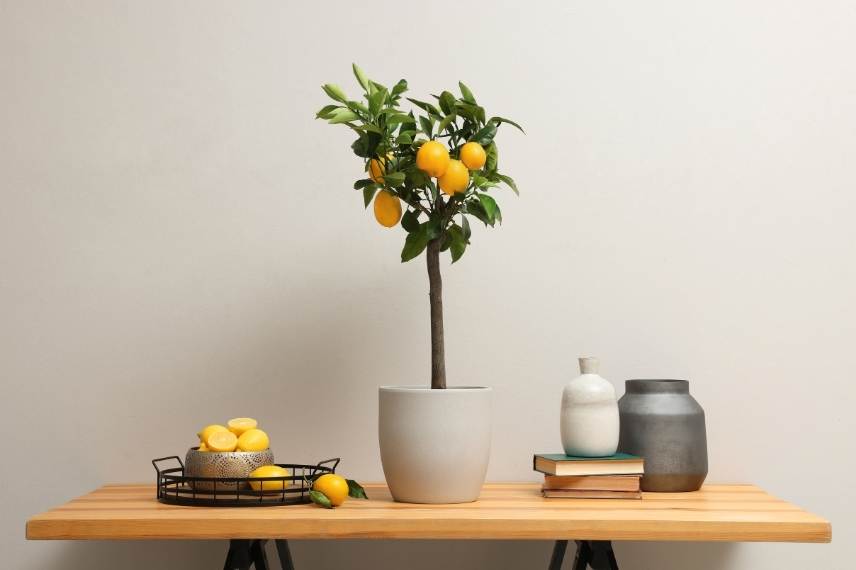
When to plant in a pot?
Planting or repotting a lemon tree should be carried out in late summer or spring.
How to plant or repot a lemon tree in a pot?
- Place a drainage layer of expanded clay pebbles in the bottom of the pot
- Fill the pot halfway with growing medium
- Soak the rootball in a bucket of water
- Set the rootball in the pot, taking care not to bury the collar
- Fill in with the remainder of the mix
- Water until water drains from base of pot
- Apply an organic mulch to the surface.
Read also
Potted lemon tree: to grow and care forHow to care for a lemon tree?
Lemon trees are citrus trees that are fairly demanding, even greedy for water and fertilisers. These two conditions are essential to obtain good fruiting.
Watering the lemon tree
Grown in open ground, a lemon tree must receive regular watering during first two years. Afterwards, waterings are carried out during dry periods, between spring and summer. In autumn and winter, rainfall is generally sufficient.
When potted, keep substrate slightly moist at all times without any standing water. That is why, in spring, water 2 to 3 times a week, almost daily in summer. In autumn and winter, space out waterings, but continue to water. It is essential always to remove residual water from saucer or cache-pot.
Water with non-calcareous water, ideally rainwater, at room temperature.
Fertilisation of the lemon tree
Whether planted in open ground or in a pot, lemon tree is greedy. Apply well-rotted compost or organic manure at base of citrus tree once a year in spring.
When potted, fertilisation is essential from March to October. Apply a liquid fertiliser for citrus trees every three weeks or a slow-release fertiliser for citrus trees every six months.
Pruning the lemon tree
In spring, carry out light pruning of young shoots to encourage flowering and fruiting. Take the opportunity to remove dead or damaged twigs and crossing branches. For this pruning, use scissors or a pruning shear, clean and disinfected. Apply wound sealant to larger wounds if necessary.
Repotting the lemon tree
Repotting takes place every two to three years to renew potting mix and promote growth.
Protection against cold
In regions at limits of hardiness, lemon trees grown in open ground can be protected with a horticultural fleece and a good layer of dead leaves at the base.
Potted lemon tree should be brought indoors into warmth, around October, as soon as daytime thermometer shows 5 °C. It should be installed in a bright, unheated room, such as a conservatory, winter garden or greenhouse.
How to manage diseases and parasitic pests of lemon trees?
Indoors or outdoors, lemon trees can be susceptible to pests such as aphids, mealybugs, whiteflies, red spider mites, citrus leafminers or Mediterranean fruit fly. Likewise, numerous diseases such as gummosis, mal secco or sooty mould can severely affect growth.
We invite you to read Alexandra’s article on diseases and parasites of lemon trees.
However, with careful monitoring of foliage and good growing conditions, these diseases and pests can be avoided. Early signs of distress such as yellow leaves, misshapen fruit or slowed growth should raise concern.
Useful resources
- Our finest poplar varieties
The word from our expert
Poplars are generally giants to be planted only in very large gardens, parks, or as avenue trees along roads or canals. They are also trees cultivated for their soft wood, used in the production of paper pulp, matches, crates, cheese boxes, plywood... France is, in fact, one of the world's leading producers of poplar wood.
But, poplars or Populus are also planted for their qualities as windbreaks, privacy screens, and ornamental features. The tree itself has a lovely habit, often pyramidal and sometimes columnar (as with Populus nigra var. italica). The foliage, with its silvery underside, often turns golden in autumn and rustles at the slightest breeze. Additionally, these trees are highly resistant to diseases, pests, and atmospheric pollution.
Poplars should be planted in full sun in rich, moist to wet soil. They are fast-growing trees but have a relatively short lifespan (averaging 60 years).
The roots of poplars, though relatively shallow, are terribly running and can damage pipes or lift paving or asphalt. Be sure to keep at least 30 metres (or more) between buildings and the planting of a poplar!
- Subscribe!
- Contents
This form is protected by reCAPTCHA - the Google Privacy Policy and Terms of Service apply.

































Comments