
How to get rid of nettles in the garden permanently and without chemicals?
Our tips for getting rid of them in flower beds or the vegetable garden
Contents
To get rid of nettles for good (Urtica dioica), the most effective method is to dig up their underground runners, the rhizomes, with a garden fork after rain, then cover the area with a thick, opaque mulch for several months. This technique exhausts the underground reserves without damaging soil life. Other methods are worth considering if nettles are growing over a large area.
Everything you need to know about removing nettles from the garden
|
Read also
Nettle: a plant with many benefitsWhy do nettles take hold so easily in the garden?
The difficulty of getting rid of nettles is mainly due to the dense network of running rhizomes produced by common stinging nettle (Urtica dioica). This perennial can quickly spread by suckers several dozen centimetres from the parent plant. As soon as a rhizome is cut while digging or using a rotavator, each piece of root left in the ground produces a new clump. It is a little like bindweed.
Nettles grow wild under specific conditions: they favour moist, fertile soils rich in nitrogen or organic matter. They can also appear where the soil has been disturbed or lightly compacted, taking advantage of the lack of competition from other plants.
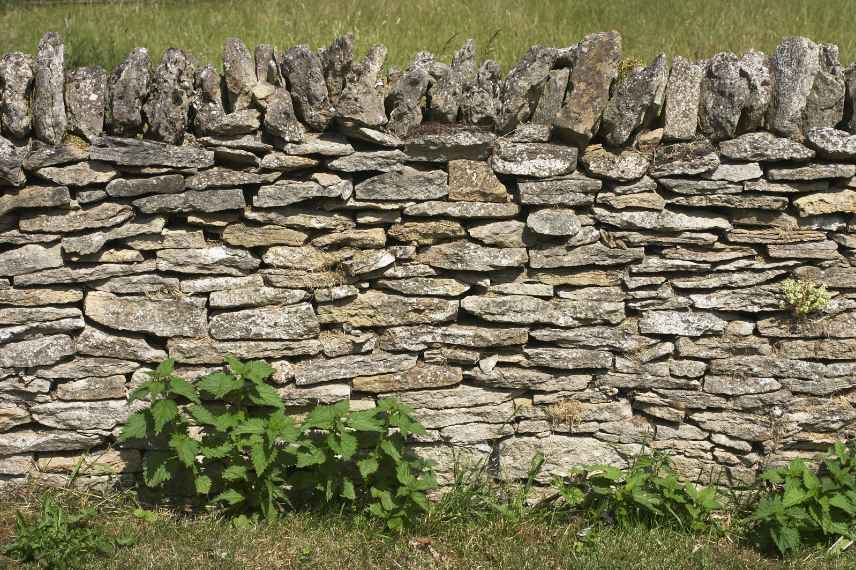
The difficulty of getting rid of nettles is mainly due to the dense network of running rhizomes produced by common stinging nettle (Urtica dioica)
Which methods should you choose to get rid of nettles for good?
To eliminate nettles for good, you must either remove every underground rhizome, without leaving behind even the smallest fragment, or exhaust their reserves by depriving them of light or cutting them back repeatedly. The use of chemical weedkillers is not recommended in the garden: besides harming soil fauna, they often scorch the foliage without reaching the entire network of deep rhizomes.
| Removal method | Suitable area | Timing and frequency | Limitations |
| Hand-digging with a garden fork | A few isolated plants or a small clump in a bed or border | One-off task, followed by another treatment 3 weeks later | Requires loosened, preferably moist soil, and above all great care to remove every rhizome fragment |
| Smothering with cardboard and a thick mulch, or with a plastic sheet | A large infested area with no plants to keep | Leave in place for 4 to 8 months, sometimes longer, ideally from spring to autumn | Makes the area completely unusable |
| Regular mowing or cutting | Borders, orchards, meadows… | Every 2 to 3 weeks from spring onwards, before flowering | Very slow to exhaust the rhizomes; cutting may need to continue for 1 to 2 seasons |
| Outcompeting them with dense groundcover plants | Beds, hedge bases, damp banks | Plant in spring and autumn, after completely removing the nettles | Requires careful weeding beforehand during the first year |
Read also
Nettle manure: how to make it?Which method should you choose depending on the area?
To eradicate nettles, choose a method suited to whether there are nearby plants you need to protect.
How do you dig nettles out of flower beds and borders?
Digging fork is suitable for isolated clumps of stinging nettle because the mass of rhizomes is generally concentrated in the top 20 centimetres of soil, so you can lift it out by loosening the soil.
How to do it, step by step:
- Put on thick gloves and long sleeves.
- If possible, work just after rain or a thorough watering to soften the soil.
- Push a digging fork or broadfork into the ground outside the clump and lift the rootball without turning the soil.
- Shake it gently and free the rhizomes, pulling carefully to remove them along their full length.
- If one breaks, loosen the soil around the break to retrieve the piece.

When lifting the nettle rootball, take care not to break the yellowish rhizomes (Image generated by AI)
How do you weed a large area overrun with nettles?
In a large area, cut the nettles back each time they regrow or deprive them of light for a prolonged period. Cutting is suitable for areas that need to remain accessible. On a clear plot, you can leave an opaque cover in place long enough to weaken the nettles.
Start cutting in spring, as soon as the nettles begin to grow again, then keep cutting throughout the season. Each cut deprives the plant of the leaves it needs to replenish its reserves. A well-established clump may still regrow the following year. If it does, start cutting again in spring.
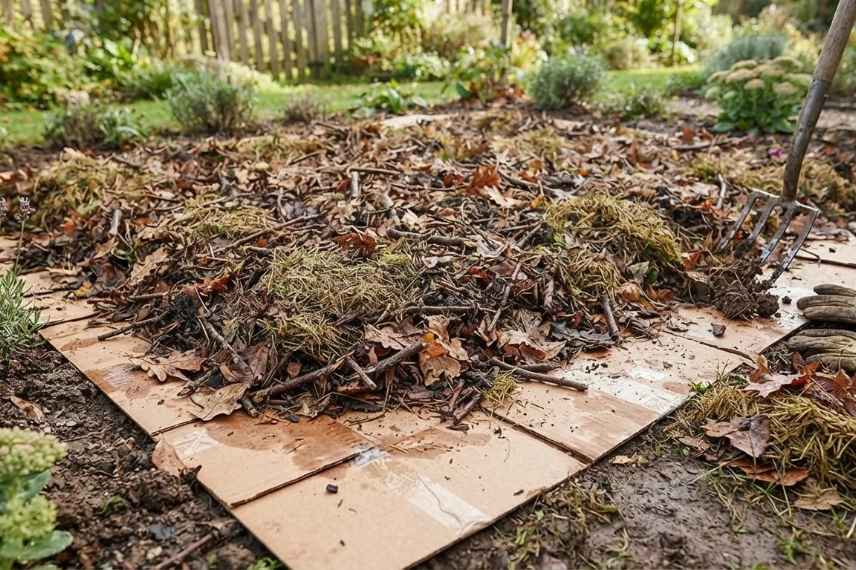
Smothering involves laying out unprinted brown cardboard with no sticky tape, then covering it with a 10 to 15 cm layer of shredded branches, dry grass clippings and fallen leaves.
There are two ways to smother nettles, and both start by cutting the stems to ground level. You can either spread an opaque plastic sheet beyond the infested area, weighing down the edges to stop it blowing away, or lay out unprinted brown cardboard with no sticky tape, then cover it with a 10 to 15 cm layer of shredded branches, dry grass clippings and fallen leaves. This method gradually exhausts the nettles’ rhizomes while earthworms loosen the soil.
How can you stop nettles from coming back?
Once the area has been cleared, leaving the soil bare almost always encourages nettles to return, either from seeds already in the soil or from a fragment of rhizome left behind. Remove any new growth by hand as soon as it appears. Young seedlings pull out easily by hand in loose soil, or can be cut off with a hoe in dry weather. Always act before the flower heads appear to prevent seeds from forming.
To prevent regrowth, it is essential to cover the soil with a permanent mulch 5 to 7 cm thick or quickly plant species suited to cool, fertile soil. In humus-rich, lightly shaded soil where nettles thrived, we favour perennial groundcover plants with dense foliage that can effectively outcompete new growth, such as hardy geranium ‘Rozanne’ or Bulgarian geranium, lady’s mantle (Alchemilla), ferns in the genus Dryopteris or Polystichum, or hostas.
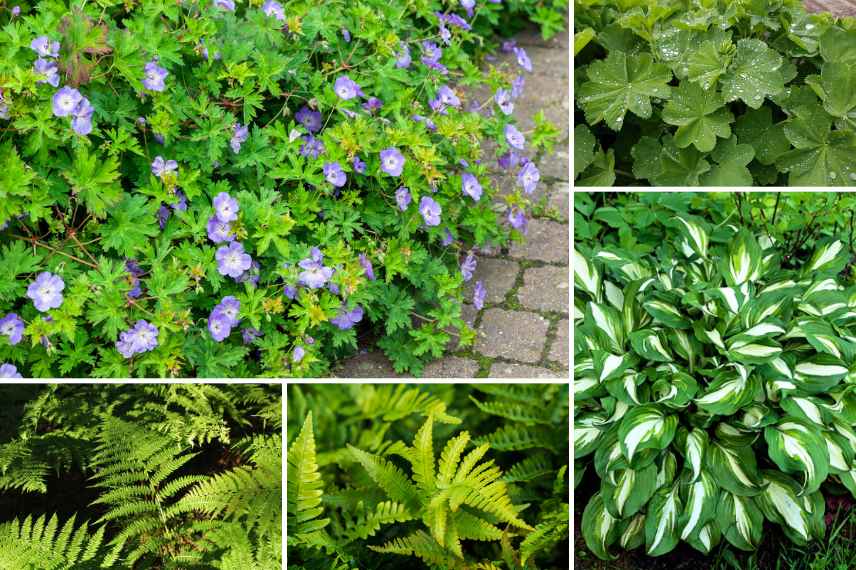
Hardy geranium ‘Rozanne’, lady’s mantle, ferns and hostas can prevent nettles from growing back.
Frequently asked questions about nettles in the garden
Can white vinegar, boiling water or salt get rid of nettles?
White vinegar and boiling water can damage the foliage, but a well-established stinging nettle can regrow from its rhizomes. These treatments mainly affect the parts they touch and can also damage neighbouring plants. In a flower bed or vegetable garden, remove the rhizomes. Salt, meanwhile, should be avoided because it sterilises the soil for a long time and destroys its structure and soil microfauna.
Can you put pulled-up nettles in the compost?
Leaves and above-ground stems without seeds can go in the compost. Remove the rhizomes and any stems bearing ripe seeds. A home compost heap may not get hot enough to stop them regrowing or germinating.
Can you keep a few nettles without letting them take over?
Keep a small clump away from paths if you have room. It provides food for the caterpillars of certain butterflies. Remove any rhizomes that spread beyond it and, if you cut the young shoots, use them to make nettle liquid feed.
When is the best time of year to get rid of nettles?
Early spring (March-April) and autumn (September-October) offer the best conditions for hand-pulling, as the soil is naturally moist and the rhizomes are easier to remove. If you choose to cover the ground, put the cover in place in autumn or late winter so that the soil is ready for planting the following spring.
- Subscribe!
- Contents
This form is protected by reCAPTCHA - the Google Privacy Policy and Terms of Service apply.

































Comments