Light grows lower and shadows lengthen, mornings are wrapped in mist and the damp in the air makes us shiver gently when stepping outside... as Sophie rightly pointed out, no doubt about it, autumn is here! In the garden, opulent blooms of perennials slowly give way to autumn colours of trees and shrubs... All perennials? No! A few stubborn autumn-flowering plants refuse to give up the limelight: the persistence of these late-flowering perennials won't yield until first hard frosts, and some may hold centre stage throughout October and even until late November in the best years.
In my medium-sized garden (700 m²), these perennials that extend the season are particularly precious for keeping borders attractive all year round, because I cannot afford to plant many trees and shrubs with coloured autumn foliage or even ornamental berry-bearing shrubs. Discover my top 5 late-flowering perennials every garden should have!
1) Cimicifugas
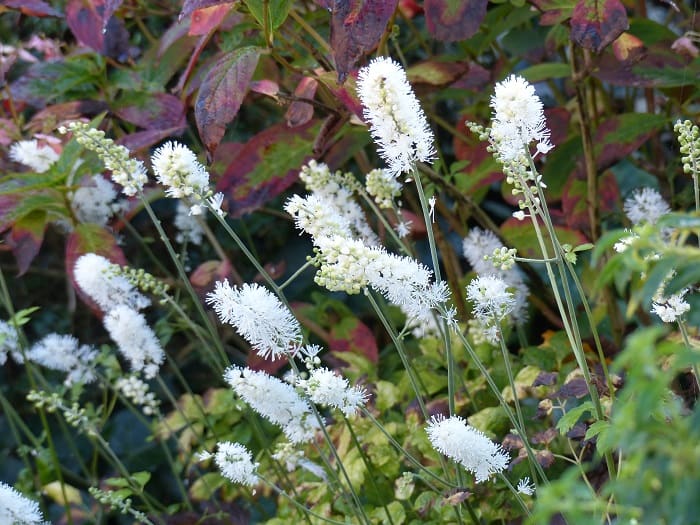
Certainly, they take up a bit of room and while their culture is not particularly difficult, they are not always easy to please. In my garden, they struggle with repeated summer droughts, which are not rare even in the far north! They are nevertheless superb when offered a good, humus-bearing soil that does not dry out too much in summer, in dappled shade beneath large trees, and even in sun so long as the soil stays cool. For the grace of its spikes of white flowers as much as for the delicacy of its sweet scent, I persist in keeping Cimicifuga or Actaea 'White Pearl' in good shape each summer with generous watering using collected rainwater. It therefore ranks among oldest plants in my garden (planted long before I was old enough to have a driving licence to roam nursery aisles on my own!). In my garden, it starts flowering late September to early October and finishes around All Saints' Day. Some may prefer purple-leaved varieties such as 'Atropurpurea', 'Brunette', 'James Compton' or 'Pink Spike' with vaguely pink spikes, but I like the elegance of its apple-green foliage when it emerges in spring far too much to want another!
2) Japanese anemones
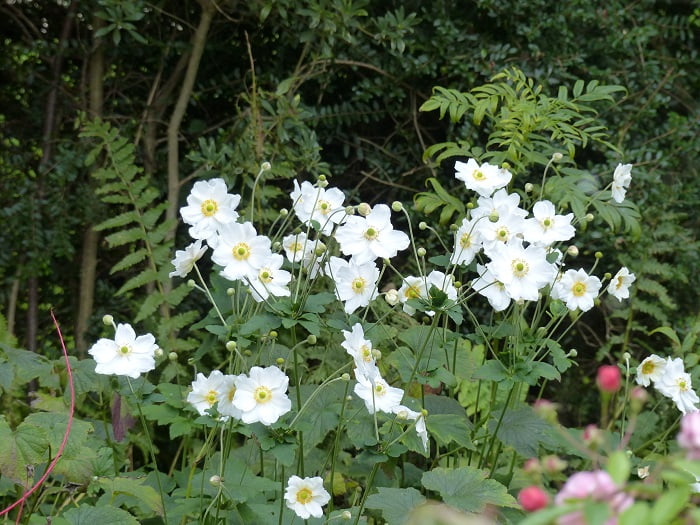
And above all one of them, the indomitable 'Honorine Jobert'. Its flowering starts in August, reaches its peak in September and will not stop before the end of the month. Still going strong some 140 years after its discovery by nurseryman Lemoine of Nancy, this venerable Lady of the garden recovers much better from dry spells than my Cimicifuga! Given to me by a fellow enthusiast years ago, I could no longer imagine my garden without this plant. Among its cousins, some flower earlier, from July–August, but then they do not last quite as long into autumn. If you prefer pink, do look at 'September Charm', 'Pamina' or 'Prinz Heinrich' for a shorter habit.
3) Asters
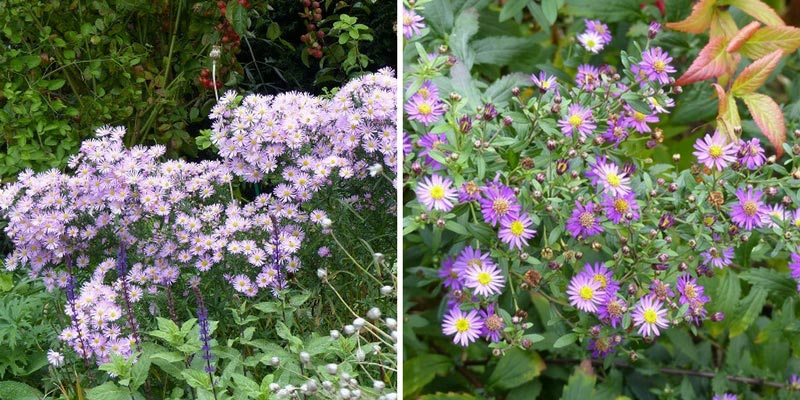
There are countless varieties and by collecting them one can easily have asters in flower from March to November. As I do not have the space required for that obsession (though the desire is certainly there!), I make do with a few well-placed clumps in strategic positions in beds where they take over from summer-flowering perennials. I have set aside the New England hybrids, too tall for my beds, but could not do without Aster ericoides such as 'Pink Star' and even less without the rarer Aster ageratoides 'Ezo Murasaki' with its seemingly endless flowering. Besides, those two are never sick! In shade, I once had Aster divaricatus that I probably unfairly pulled out at some point to replace with a rarity that did not last. That was probably a mistake I will have to put right one day!
4) Fuchsia magellanica
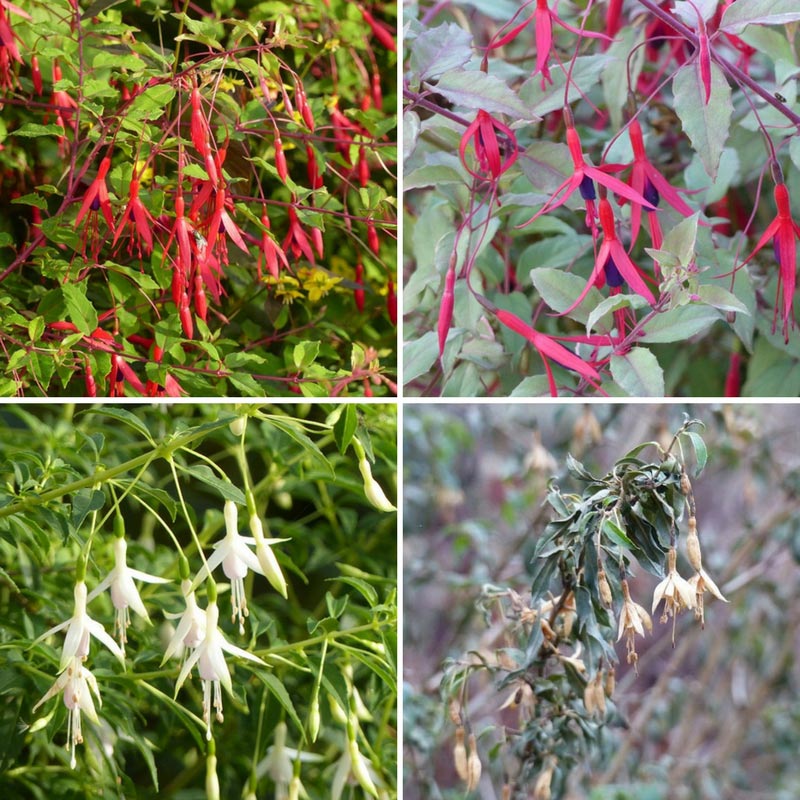
Shrub or perennial, that is not the point... These hardy fuchsias that form real hedges in Ireland and Brittany are truly hardy and when frost is severe they regrow from the crown, their flowering then starting just a little later (late July). Once again, it is one of the very first plants I grew and I still keep the original stock of Fuchsia magellanica 'Ricartonii' from my grandmother. Fuchsias still suffer from that "grandmother's plant" image, which is highly unfair given the qualities of these shrubby perennials: hardy and easy to grow in sun or shade, they ask for almost nothing in return for their generous, elegant flowering. As icing on the cake, golden-leaved ('Aurea') and variegated ('Versicolor') forms exist. I also found at Saint-Jean-de-Beauregard the rare white and variegated form called 'Sharpitor'. If you dislike the characteristic pink-and-purple contrast, you can always opt for Fuchsia magellanica var. molinae, with pale pink-white flowers, and its variant 'Hawkshead' with pure white flowers tinged green at the tips. Tireless, only cold can halt their flowering!
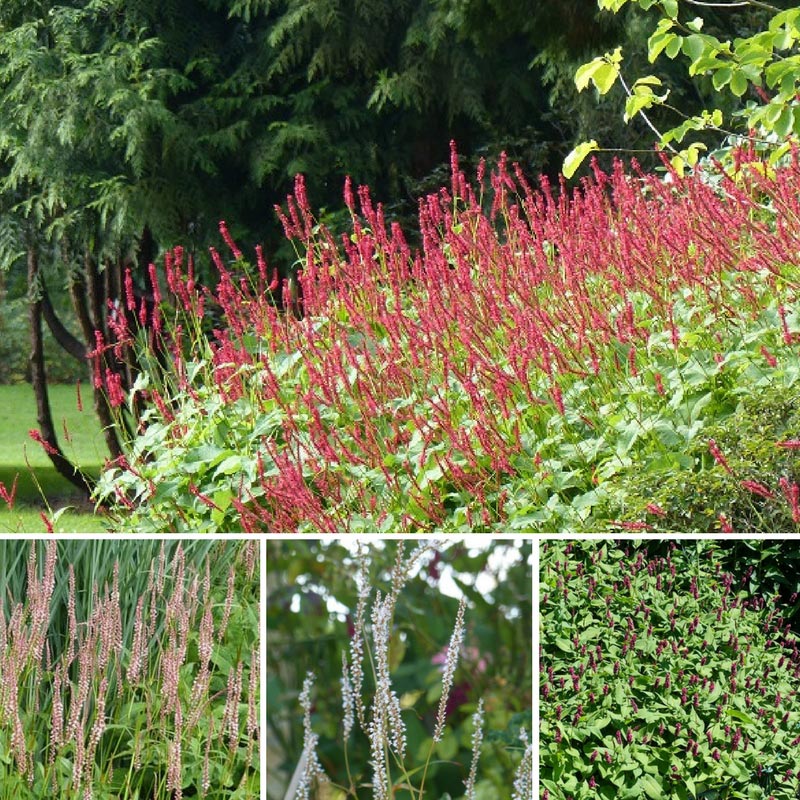
5) Persicarias
Having late flowering in a small garden is good, having long AND late flowering is even better! And that's precisely what persicarias (Persicaria amplexicaulis, formerly Polygonum) bring. Graphic, colourful spikes appear from July for the earliest varieties, and nothing can stop them thereafter! If they spread too much, you can cut them back as often as you like and they will come back all the stronger. I have seen them thrive in poor sandy soils, in dry chalky soils as well as in heavy clay. In short, they are foolproof and I love them all and there will certainly be one to suit you too! If you struggle to choose, I would still recommend 'Blackfield' deep claret-red, 'Alba' white and very free-flowering, 'Firedance' with more orange tones, 'Inverleith' which stays dwarf, and 'Rosea' old-rose, as among the best. New varieties appear regularly and are also well worth trying.
...Bonus: Diamond grass
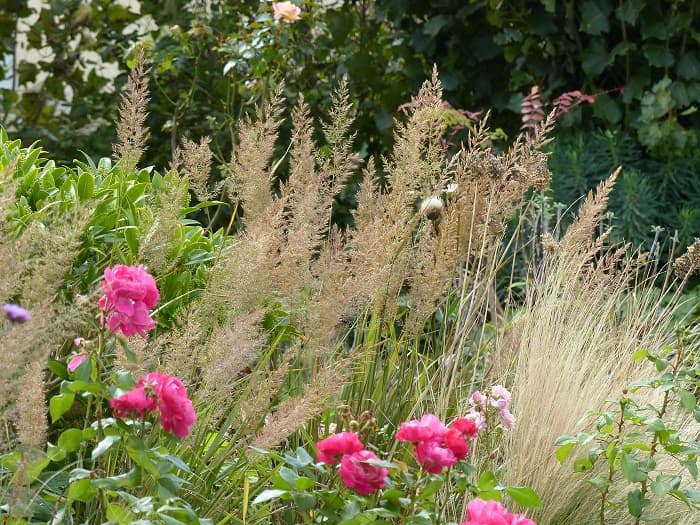
Which modern, serious gardener can still make a garden without ornamental grasses? Almost all are beautiful in autumn, and even beyond, enhanced by mist, hoar frost and low-angle light, but if one stands out it is the famous "diamond grass" (Calamagrostis brachytricha), queen of autumn grasses. Its panicles appear only in September and show superb iridescent shades under autumn sunrays that look like diamond sparkles. At 70–80 cm tall and able to grow in any soil, in sun or shade, it remains a plant too little known yet foolproof.
True, I could also have told you about a Miscanthus, but its autumn colours would have competed with those of the shrubs! 😉
Light grows lower and shadows lengthen, mornings are wrapped in mist and the damp in the air makes us shiver gently when stepping outside… as Sophie rightly pointed out, no doubt about it, autumn is here! In the garden, opulent blooms of perennials slowly give way to autumn colours of trees and shrubs… All perennials? […]
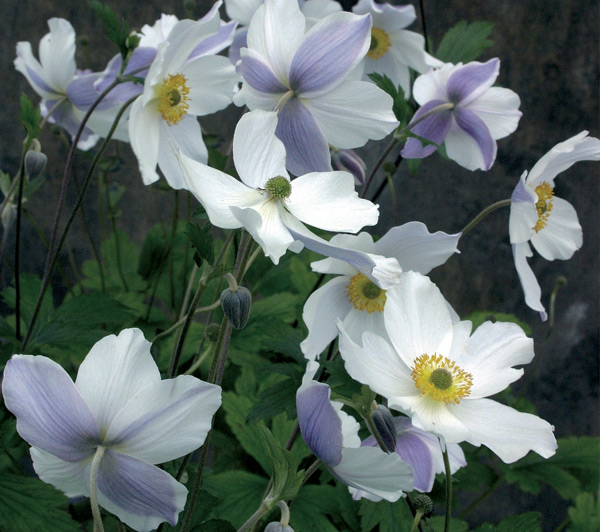
Awarded at the Chelsea Flower Show, the prestigious English horticultural exhibition, the ‘Wild Swan’ anemone is a unique variety. Both graceful and robust, it captivates with its prolonged flowering and natural elegance.
A long-lasting and refined flowering
Unlike classic Japanese anemones, which often have a limited summer or autumn flowering period, ‘Wild Swan’ offers a remarkable display from spring until early autumn. It stands out with its large, slightly satin white flowers that brighten up the garden.
But its true asset lies in a fascinating detail: when the flower closes at the end of the day or a breeze lifts its petals, beautiful purple stripes appear on their underside, adding an unparalleled touch of refinement. This subtle play of colours makes it a plant full of surprises, always changing throughout the hours.
An elegant silhouette and delicate foliage
The ‘Wild Swan’ anemone does not just have exceptional flowering. Its airy and natural habit makes it an ideal perennial for structuring borders. Its dark green, finely cut foliage provides a backdrop that highlights the delicacy of the flowers.
It reaches about 40 to 50 cm in height and spreads 50 cm wide, forming a beautiful, dense, and harmonious clump. Whether at the edge, in a border, or even in a pot on a terrace, it easily finds its place thanks to its balanced silhouette.
Where and how to Grow the ‘Wild Swan’ Anemone?
This anemone is valued for its hardiness and ease of maintenance. It adapts to many situations but expresses its full potential when grown under the right conditions.
Ideal Exposure
- It prefers a partially shaded position, where it receives light without being exposed to the scorching rays of the sun.
- It can also be planted in gentle sun, provided the soil remains cool.
Soil Type
- A rich, light, and well-drained soil is essential to avoid excess moisture that could weaken the plant.
- A humus-bearing and slightly acidic soil is ideal for promoting healthy growth.
Maintenance and Watering
- Water regularly in summer, especially during dry spells, but without overwatering to avoid saturating the roots.
- Remove faded flowers to encourage continuous blooming.
- A winter mulch can be beneficial in regions with very harsh winters.
Successful garden combinations
The ‘Wild Swan’ anemone is perfect for creating natural and romantic scenes. Here are some pairing ideas to showcase it:
- With light grasses (Stipa, Carex) for a contrast between softness and structure.
- With other shade perennials such as ferns, hostas, or heucheras for a fresh and green atmosphere.
- With English roses or astrantias for an English-inspired garden.
Why adopting the ‘Wild Swan’ Anemone?
With its elegant habit, long-lasting flowering, and subtle contrasts, the ‘Wild Swan’ anemone is an exceptional perennial that adds a sophisticated touch to the garden. Easy to grow, it appeals to both novice gardeners and enthusiasts. It offers a beautiful alternative to traditional Japanese anemones and integrates wonderfully into a harmonious composition.
Don't hesitate to adopt it in your garden to enjoy its unique charm season after season!
Further reading
- Discover our 5 favourite double-flowering Japanese anemone varieties
- And everything you need to know about Japanese anemones: planting, growing, and caring.
Awarded at the Chelsea Flower Show, the prestigious English horticultural exhibition, the ‘Wild Swan’ anemone is a unique variety. Both graceful and robust, it captivates with its prolonged flowering and natural elegance. A long-lasting and refined flowering Unlike classic Japanese anemones, which often have a limited summer or autumn flowering period, ‘Wild Swan’ offers a […]
After the lull in flowering during the height of summer, gardens often regain beautiful floral scenes in late summer. To prolong the pleasure into late autumn, depending on the arrival of the first frosts, you can plant perennial plants, bulbs, and bushes that bloom late in the season.
Often overlooked: bulbs that bloom in autumn
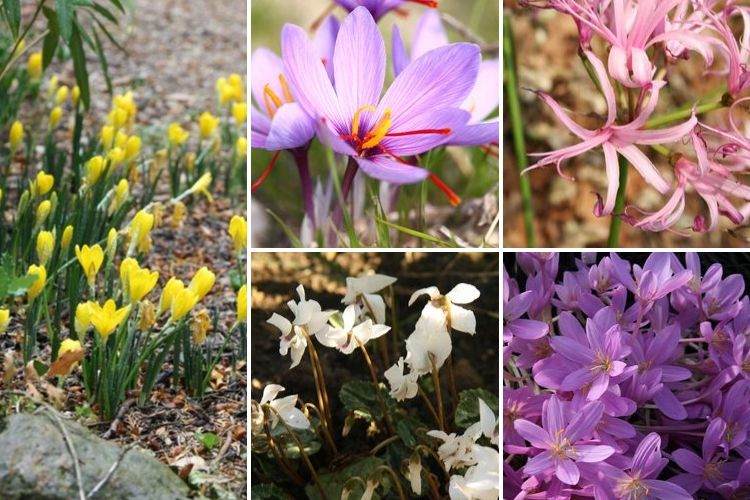
Autumn-flowering bulbous plants are too often ignored by gardeners, who tend to plant in autumn for spring blooms. It would be a shame not to enjoy these lovely late-flowering bulbs, as they are quite easy to grow.
Among them, we particularly love:
- Autumn Crocus: Discover the true saffron, Crocus sativus, with mauve flowers veined in violet and orange stigmas, or try, in full sun and very well-drained soil, Crocus cartwrightianus albus, with white flowers sometimes lasting until December.
- Sternbergia lutea: It blooms like a large crocus with bright yellow flowers in September-October.
- Colchicum: With their large flowers devoid of foliage (which wilts in summer), they punctuate the foreground of a flowerbed or lawn with their white, pink, and almost mauve flowers.
- Autumn Flowering > Cyclamens or Naples cyclamen: To naturalise in partial shade, this small cyclamen gradually forms a carpet of marbled silver foliage dominated by its white or pink flowers from late summer to autumn.
- Nerine: Planted against a warm wall or grown in pots to escape severe frosts, nerines display their large trumpet-shaped flowers in white or pink umbels in October-November.
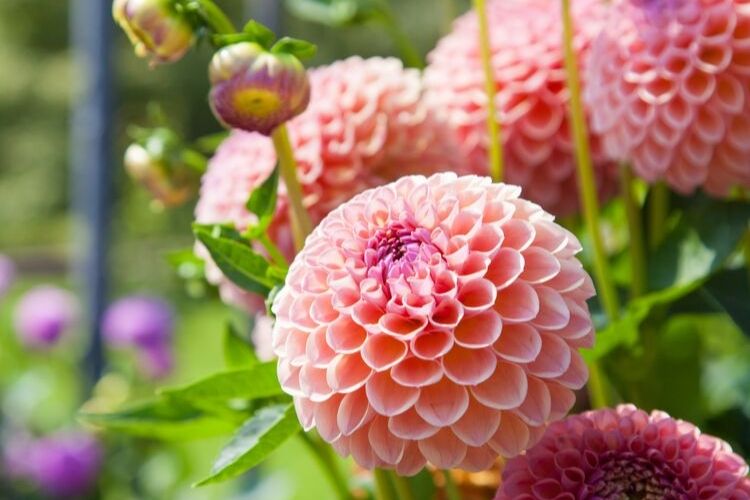
The dahlias, stars of autumn
These are, of course, must-haves for the autumn garden, which will never disappoint if planted in full sun, in deep, fertile, well-enriched soil. Choose from the vast palette of colours, flower shapes, and plant sizes. They easily blend among perennials and create beautiful scenes with soft-stemmed grasses. Planted in spring, they bloom in late summer; planted in early summer, they bloom throughout autumn.
Generous perennials in late season
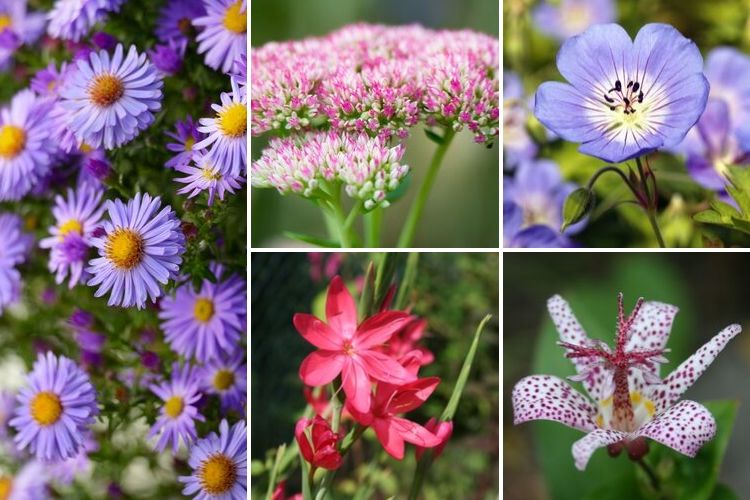
Among these, look for the latest species and varieties, such as Sedum ‘Herbstfreude’ or ‘Ruby Glow’, or among asters, besides the large autumn asters, the airy blooms of Aster laterifolius and its varieties.
Also consider hardy geraniums, some of which are tireless in autumn, like ‘Rozanne’ with its bright violet flowers, the varieties of Geranium pratense, or G. endressii.
Also to discover is the toad lily or orchid lily, Tricyrtis hirta, a little-known rhizomatous perennial, yet precious for its elegant flowering from August to October, with white flowers speckled with garnet, to be planted in shade and in rich, humus-rich soil. The Kaffir lily, Schizostylis coccinea, which should be protected from severe frosts and winter moisture, is another rhizomatous perennial with generous autumn flowering, featuring spikes of bright star-shaped flowers in white, pink, and red.
Grasses for contrast, flexibility, and soft hues
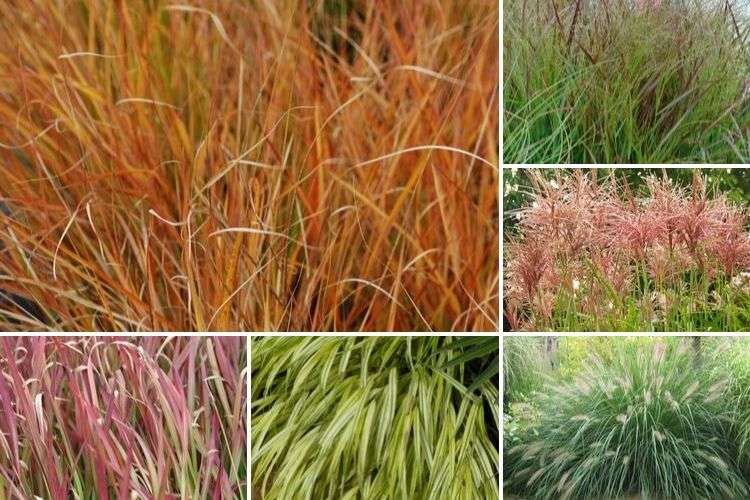
Our favourites for autumn:
- Stipa arundinacea with green and orange foliage, and purple and silver spikelets in autumn,
- Varieties of Panicum virgatum, with light and colourful plumes in autumn, often accompanied by beautiful autumn foliage colour. You can choose between shades of blonde, purple, brown…
- The tall miscanthus structure autumn scenes with their tall upright tufts, reaching nearly 2 m, with their light pink-silver to purple inflorescences and their blonde to brown foliage.
- The pennisetums with a soft habit, whose light feathery blooms last from summer to autumn and whose foliage takes on warm and soft tones.
- Hakonechloa macra ‘Aureola’ whose spreading tufts of variegated golden foliage turn red in autumn, accompanied by reddish spikelets.
- Imperata cylindrica ‘Red Baron’ whose leaves become increasingly red as the season progresses, crimson in autumn with a light silver bloom.
Some late-flowering shrubs
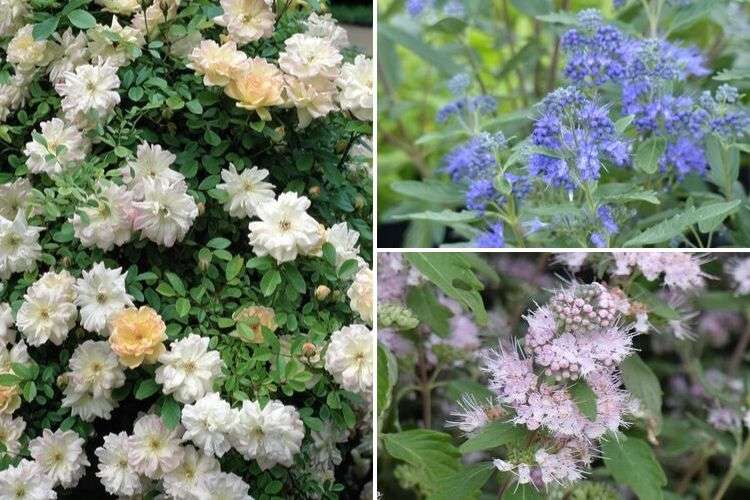
Late-flowering shrubs are quite rare, except for the repeat-flowering roses of which some may bloom as late as Christmas when autumn is mild, such as the climbing rose ‘Phyllis Bide’.
If you love blue flowers, don’t wait to plant a caryopteris, blooming between mid-August and October in clusters of small bright blue-violet flowers, on grey-green foliage. Pair it, for example, with the tireless gaura and white-flowering Japanese anemones.
To complete the colourful effects in autumn
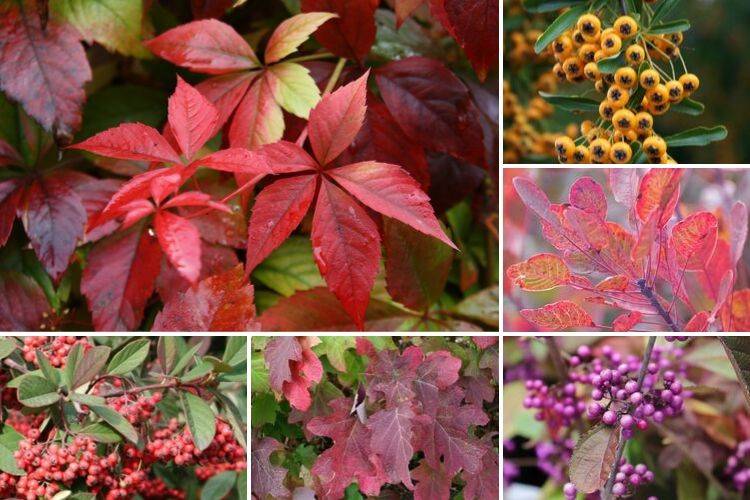
Compose varied and colourful scenes by combining these autumn blooms with fiery foliage (oak-leaved hydrangea, Virginia creeper, smoke bush, sumac, maples…) and decorative fruits (numerous among shrubs, pyracantha, cotoneaster, callicarpa, rowan, European spindle…)
After the lull in flowering during the height of summer, gardens often regain beautiful floral scenes in late summer. To prolong the pleasure into late autumn, depending on the arrival of the first frosts, you can plant perennial plants, bulbs, and bushes that bloom late in the season. Often overlooked: bulbs that bloom in autumn […]