






























Rhipsalis baccifera - Mistletoe Cactus

Rhipsalis baccifera - Mistletoe Cactus
Rhipsalis baccifera - Mistletoe Cactus
Rhipsalis baccifera
Mistletoe Cactus
Special offer!
Receive a €20 voucher for any order over €90 (excluding delivery costs, credit notes, and plastic-free options)!
1- Add your favorite plants to your cart.
2- Once you have reached €90, confirm your order (you can even choose the delivery date!).
3- As soon as your order is shipped, you will receive an email containing your voucher code, valid for 3 months (90 days).
Your voucher is unique and can only be used once, for any order with a minimum value of €20, excluding delivery costs.
Can be combined with other current offers, non-divisible and non-refundable.
Why not try an alternative variety in stock?
View all →
Available in 1 sizes
Available in 1 sizes
This plant carries a 30 days recovery warranty
More information
We guarantee the quality of our plants for a full growing cycle, and will replace at our expense any plant that fails to recover under normal climatic and planting conditions.
Description
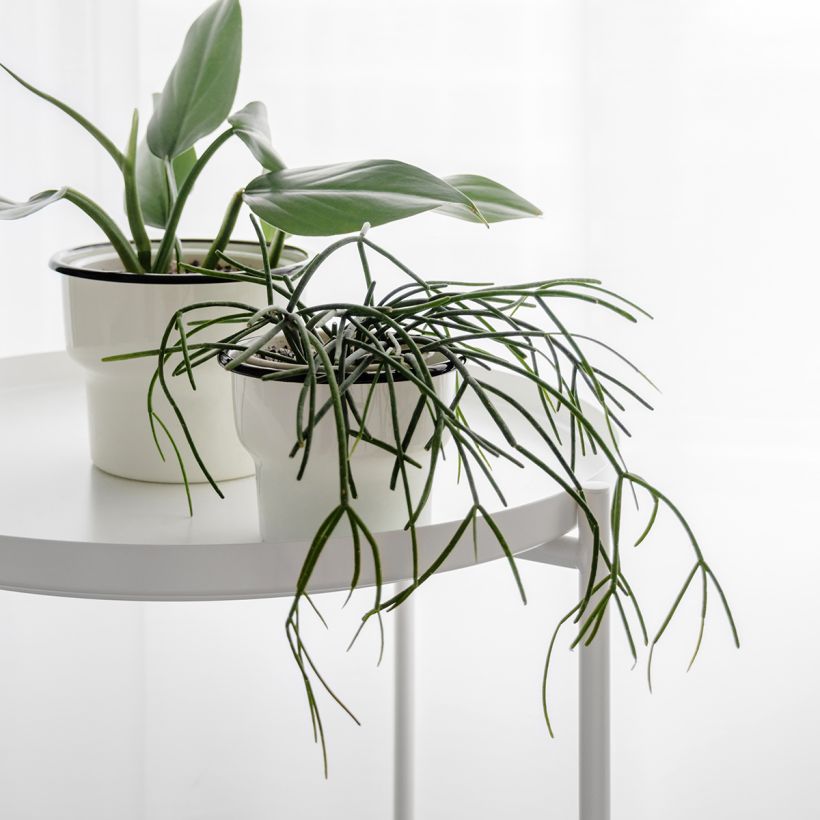
The Rhipsalis cassutha (often called mistletoe cactus) is a trailing indoor cactus that is nothing like a desert cactus: it prefers filtered light, slightly humid air, and the indoor environments of our homes. This plant is ideally placed in a hanging position, on a high shelf or near a curtained window, where its stems form an unusual living curtain. In a contemporary, bohemian, or very minimalist decor, it brings a "liana" feel that softens the lines of a living room, bedroom, or well-lit bathroom.
Botanically, Rhipsalis baccifera belongs to the Cactaceae family. It is an epiphytic (and sometimes lithophytic) cactus, which naturally lives attached to branches or on rocks, in open and humid forests, including at the edge of coastal forests, up to about 1,800 m altitude. Its distribution range is remarkable for a cactus, covering tropical and subtropical America, as well as tropical Africa and Madagascar. The species is very polymorphous: depending on origin and growing conditions, it varies greatly in stem thickness, density of branching, and overall appearance.
The name Rhipsalis cassutha (often spelled cassytha) is now generally treated as a synonym of Rhipsalis baccifera; in horticulture, however, it is still used to refer to a particularly fine and trailing form, with very flexible cylindrical stems that branch into multiple "threads" over time. The stems, from light green to bright green, measure 2 to 5 mm in diameter on this form and lengthen in a cascade; indoors, they reach 1 to 2 m in length. The discreet flowering takes the form of small whitish flowers along the stems, sometimes followed by translucent white berries, which gave rise to the name mistletoe cactus. According to commonly used veterinary references, this plant is non-toxic to cats and dogs.
Indoors, it thrives under bright light without direct sun, or in bright semi-shade, in a room with a stable atmosphere, with 50 to 60% humidity (and above), in a temperature range between 16 and 27°C. It suffers below 10 to 12°C. It is an easy plant for beginners, provided it is spared sudden changes: it fears air that is too dry and temperature fluctuations near radiators or draughts. It particularly enjoys a bright living room, a temperate conservatory, or a bathroom with a window.
This mistletoe cactus is used as a "curtain" plant: in a macramé hanger, on a small table, or in a hanging basket near a filtered glazing. To accompany it, stick with trailing plants that enjoy the same soft light: Scindapsus pictus, with its silvery foliage, the variegated Epipremnum ‘N’joy’, Peperomia prostrata which slides its small round, graphic leaves between the stems, and Tradescantia zebrina ‘Purple Joy’ with its purple and silvery reflections. In a bright room with sufficient air humidity, these plants make up a durable and easy-care ensemble.
And if you like epiphytic plants, you can complete the set with a Tillandsia 'Mizuki' placed on a branch or hung nearby.
Report an error about the product description
Rhipsalis baccifera - Mistletoe Cactus in pictures
Foliage
Plant habit
Flowering
Botanical data
Rhipsalis
baccifera
Cactaceae
Mistletoe Cactus
West Africa, Central Africa, South Africa, Madagascar, Central America, South America
Location
Location
Maintenance and care
Watering tips
Potting advice, substrates and fertilisers
Houseplant care
Disease and pest advice
Maintenance and care
This item has not been reviewed yet - be the first to leave a review about it.
Recently viewed products
Haven't found what you were looking for?
Hardiness is the lowest winter temperature a plant can endure without suffering serious damage or even dying. However, hardiness is affected by location (a sheltered area, such as a patio), protection (winter cover) and soil type (hardiness is improved by well-drained soil).
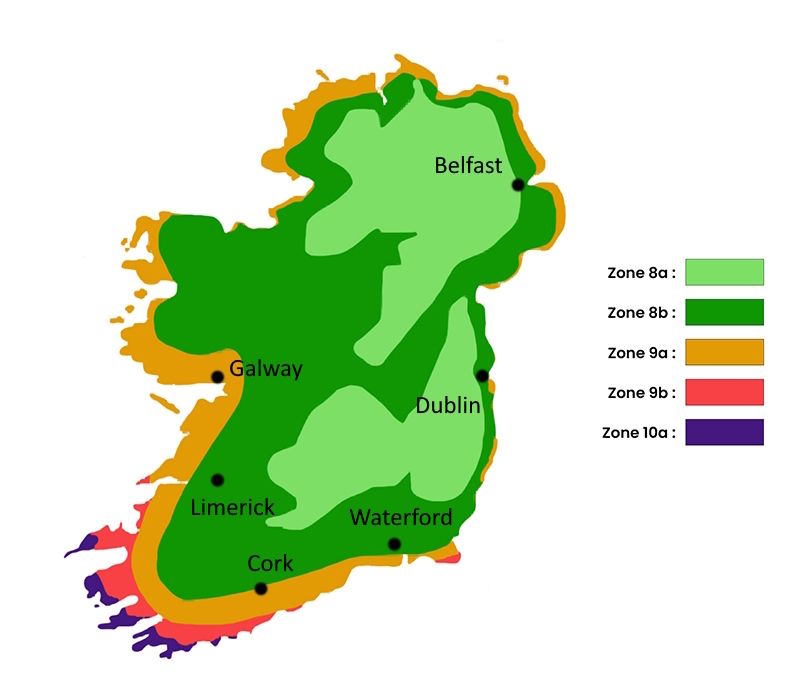
Photo Sharing Terms & Conditions
In order to encourage gardeners to interact and share their experiences, Promesse de fleurs offers various media enabling content to be uploaded onto its Site - in particular via the ‘Photo sharing’ module.
The User agrees to refrain from:
- Posting any content that is illegal, prejudicial, insulting, racist, inciteful to hatred, revisionist, contrary to public decency, that infringes on privacy or on the privacy rights of third parties, in particular the publicity rights of persons and goods, intellectual property rights, or the right to privacy.
- Submitting content on behalf of a third party;
- Impersonate the identity of a third party and/or publish any personal information about a third party;
In general, the User undertakes to refrain from any unethical behaviour.
All Content (in particular text, comments, files, images, photos, videos, creative works, etc.), which may be subject to property or intellectual property rights, image or other private rights, shall remain the property of the User, subject to the limited rights granted by the terms of the licence granted by Promesse de fleurs as stated below. Users are at liberty to publish or not to publish such Content on the Site, notably via the ‘Photo Sharing’ facility, and accept that this Content shall be made public and freely accessible, notably on the Internet.
Users further acknowledge, undertake to have ,and guarantee that they hold all necessary rights and permissions to publish such material on the Site, in particular with regard to the legislation in force pertaining to any privacy, property, intellectual property, image, or contractual rights, or rights of any other nature. By publishing such Content on the Site, Users acknowledge accepting full liability as publishers of the Content within the meaning of the law, and grant Promesse de fleurs, free of charge, an inclusive, worldwide licence for the said Content for the entire duration of its publication, including all reproduction, representation, up/downloading, displaying, performing, transmission, and storage rights.
Users also grant permission for their name to be linked to the Content and accept that this link may not always be made available.
By engaging in posting material, Users consent to their Content becoming automatically accessible on the Internet, in particular on other sites and/or blogs and/or web pages of the Promesse de fleurs site, including in particular social pages and the Promesse de fleurs catalogue.
Users may secure the removal of entrusted content free of charge by issuing a simple request via our contact form.
In temperate climates, pruning of spring-flowering shrubs (forsythia, spireas, etc.) should be done just after flowering.
Pruning of summer-flowering shrubs (Indian Lilac, Perovskia, etc.) can be done in winter or spring.
In cold regions as well as with frost-sensitive plants, avoid pruning too early when severe frosts may still occur.
The harvesting period indicated on our website applies to countries and regions in USDA zone 8 (France, England, Ireland, the Netherlands).
In colder areas (Scandinavia, Poland, Austria...) fruit and vegetable harvests are likely to be delayed by 3-4 weeks.
In warmer areas (Italy, Spain, Greece, etc.), harvesting will probably take place earlier, depending on weather conditions.
The sowing periods indicated on our website apply to countries and regions within USDA Zone 8 (France, UK, Ireland, Netherlands).
In colder areas (Scandinavia, Poland, Austria...), delay any outdoor sowing by 3-4 weeks, or sow under glass.
In warmer climes (Italy, Spain, Greece, etc.), bring outdoor sowing forward by a few weeks.
The planting period indicated on our website applies to regions in USDA Zone 9a (East Coast and Midlands: Dublin, Wexford, Waterford, Kilkenny, Portlaoise). It will vary depending on where you live:
- On the west coast and in the north-west (Galway, Limerick, Sligo, Donegal, Westport), delay planting by 1 to 2 weeks in spring and bring it forward by 1 to 2 weeks in autumn compared to the dates given, preferably choosing periods without strong winds.
- In the inland hills and plateaus (Wicklow Mountains, Macgillycuddy’s Reeks, Connemara, Killarney), it is best to plant in spring (April–May) or autumn (September–October), avoiding periods of waterlogged soil in winter and strong winds, which pose the main risk to newly planted trees in these areas.
The flowering period indicated on our website applies to regions in USDA Zone 9a, such as the East Coast and Midlands, including Dublin, Wexford, Waterford, Kilkenny and Portlaoise.
This will vary depending on where you live:
- On the west coast and in the northwest (Galway, Limerick, Sligo, Donegal and Westport), it will be delayed by one to two weeks compared to the given dates, due to stronger Atlantic winds and less spring sunshine.
- In the inland hills and plateaus (the Wicklow Mountains, the Macgillycuddy's Reeks, Connemara and Killarney), flowering will be delayed by two to three weeks. Flowering mainly occurs between May and July, with the limiting factors being less frost and more of the excessive humidity, strong winds and lack of sunshine that are characteristic of these areas.