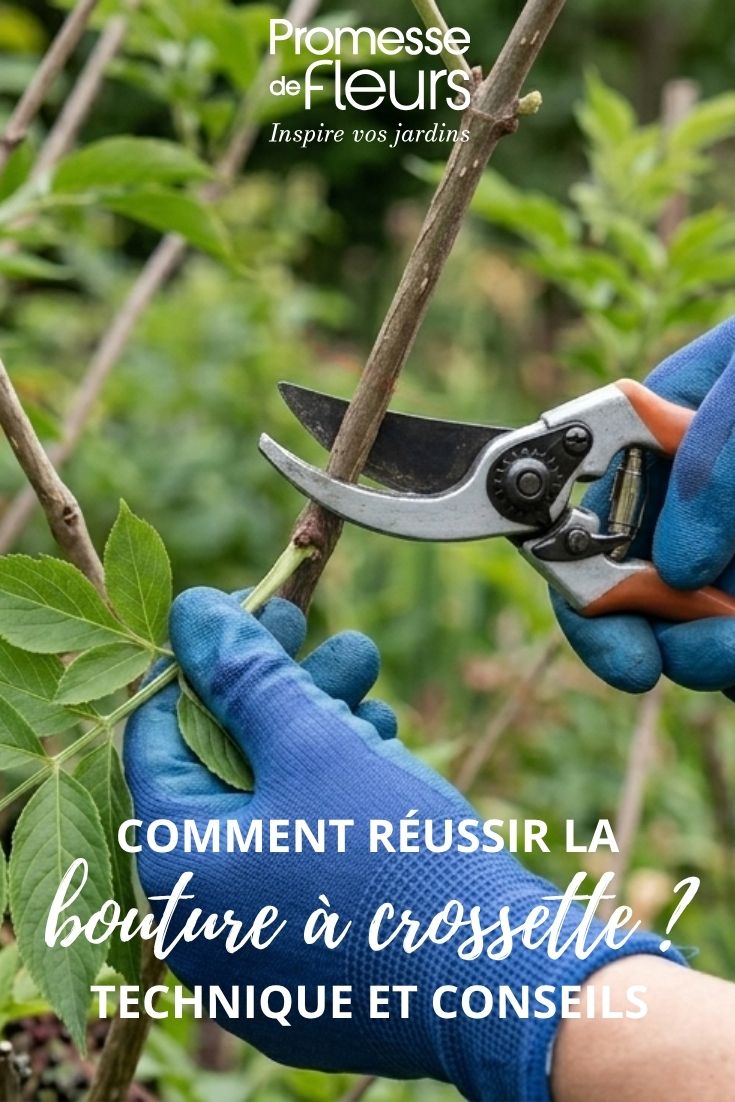
Crossette cutting differs from a standard cutting by the preservation of a small segment of the bearing shoot (the previous year's wood) at the base of the stem. This piece of older wood acts as an energy reservoir, greatly facilitating root emission. Crossette cutting is ideal for shrubs with soft pith or wood that is difficult to root such as grapevine, fig, elder, privet or boxwood.
What are the differences compared with a heel cutting?
The crossette cutting is defined by keeping a complete section of the bearing shoot, forming an inverted "T" at the base of the stem, which provides maximum nutrient reserves. By contrast, a heel cutting retains only a thin strip of bark and wood taken when the lateral stem is pulled away.
The major difference lies in the impact on the mother plant: the crossette requires sacrificing a section of the main branch, while the heel preserves the integrity of the bearing shoot. In short, choose a crossette for soft-wooded plants such as grapevine and a heel for hard wood or conifers.
Which plants can be propagated by crossette cutting?
- Grapevine (Vitis vinifera) : the emblematic plant for this technique, as the old wood provides the necessary reserves for recovery.
- The elder (Sambucus) : its soft-pith wood benefits from the solidity of the "crozier" so it does not rot.
- The fig (Ficus carica) : for varieties whose current-year wood is sometimes too sap-rich.
- Willow (Salix) : although it roots easily, the crossette ensures exceptional vigour.
- Decorative dogwoods (Cornus 'Alba', Cornus sanguinea, Cornus sericea)
- Butterfly tree (Buddleia sp.) : to obtain more robust shrubs in the first year.
- Privet (Ligustrum): very effective for creating hedges quickly.
- The boxwood (Buxus) : speeds up rooting for a plant that naturally grows slowly.

Required equipment
- A pruning shear: blades cleaned beforehand with alcohol to avoid disease
- A deep pot or a well-exposed corner of the garden
- Growing medium: a mix of 50% leaf mould and 50% river sand.
- A pencil or small stick to use as a dibber
When to make a crossette cutting?
Carry out crossette cutting from November to February (dormant period).
Steps
1. Taking the cutting
Choose a nice current-year shoot (flexible but firm wood). Instead of cutting the shoot alone, cut the main branch on either side of the base of your shoot.
- You should obtain a shape like an inverted "T".
- The small horizontal bar (the old wood) should measure about 2 cm.
2. Preparing the stem
- Trim the main vertical stem so it measures about 20 to 25 cm.
- Remove all leaves and lateral shoots from the lower two-thirds. Leave only 2 or 3 leaves (or buds if you are working in winter) at the top.
- Cut the top of the stem on the slant, just above a bud, so rainwater does not sit on the wound.
3. Planting
- Make a hole with your dibber so as not to damage the "crozier" by forcing it in.
- Insert the cutting: the crozier must lie flat at the bottom, buried to two-thirds of the stem height.
- Backfill and press firmly with your fingers (the "plombage") so there is no air around the wood.
Care and monitoring
Water immediately after planting. The growing medium must remain moist, but never waterlogged (risk of old wood rotting).
Place pots sheltered from the wind, ideally against a north-facing wall or in light shade.
Never pull on the stem to check for roots! Wait to see vigorous new leaves develop (usually the following spring) before repotting.
Warning: ensure the crozier comes from healthy wood, without black spots or cankers, as this is where all the vigour of your future plant will originate.


































Comments