Light grows lower and shadows lengthen, mornings are wrapped in mist and the damp in the air makes us shiver gently when stepping outside... as Sophie rightly pointed out, no doubt about it, autumn is here! In the garden, opulent blooms of perennials slowly give way to autumn colours of trees and shrubs... All perennials? No! A few stubborn autumn-flowering plants refuse to give up the limelight: the persistence of these late-flowering perennials won't yield until first hard frosts, and some may hold centre stage throughout October and even until late November in the best years.
In my medium-sized garden (700 m²), these perennials that extend the season are particularly precious for keeping borders attractive all year round, because I cannot afford to plant many trees and shrubs with coloured autumn foliage or even ornamental berry-bearing shrubs. Discover my top 5 late-flowering perennials every garden should have!
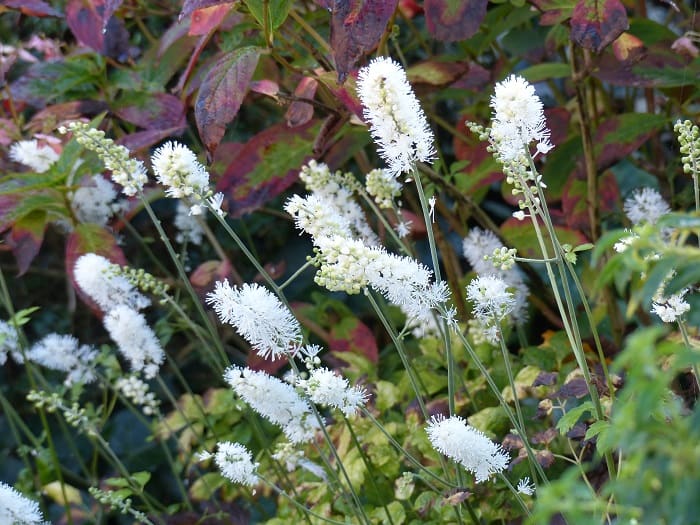
1) Cimicifugas
Certainly, they take up a bit of room and while their culture is not particularly difficult, they are not always easy to please. In my garden, they struggle with repeated summer droughts, which are not rare even in the far north! They are nevertheless superb when offered a good, humus-bearing soil that does not dry out too much in summer, in dappled shade beneath large trees, and even in sun so long as the soil stays cool. For the grace of its spikes of white flowers as much as for the delicacy of its sweet scent, I persist in keeping Cimicifuga or Actaea 'White Pearl' in good shape each summer with generous watering using collected rainwater. It therefore ranks among oldest plants in my garden (planted long before I was old enough to have a driving licence to roam nursery aisles on my own!). In my garden, it starts flowering late September to early October and finishes around All Saints' Day. Some may prefer purple-leaved varieties such as 'Atropurpurea', 'Brunette', 'James Compton' or 'Pink Spike' with vaguely pink spikes, but I like the elegance of its apple-green foliage when it emerges in spring far too much to want another!
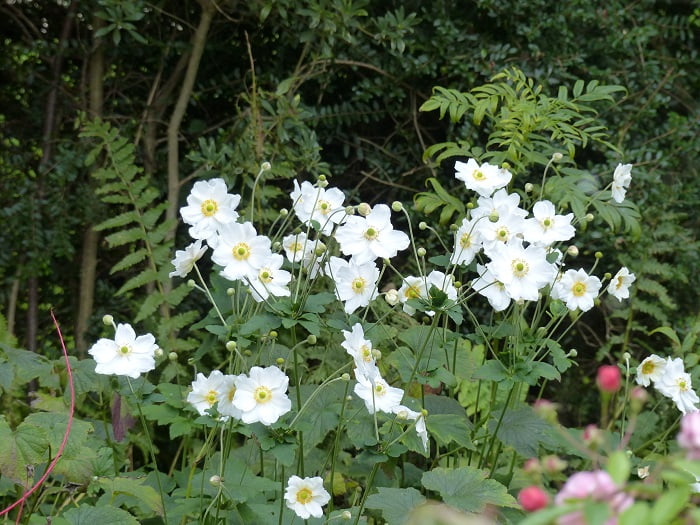
2) Japanese anemones
And above all one of them, the indomitable 'Honorine Jobert'. Its flowering starts in August, reaches its peak in September and will not stop before the end of the month. Still going strong some 140 years after its discovery by nurseryman Lemoine of Nancy, this venerable Lady of the garden recovers much better from dry spells than my Cimicifuga! Given to me by a fellow enthusiast years ago, I could no longer imagine my garden without this plant. Among its cousins, some flower earlier, from July–August, but then they do not last quite as long into autumn. If you prefer pink, do look at 'September Charm', 'Pamina' or 'Prinz Heinrich' for a shorter habit.
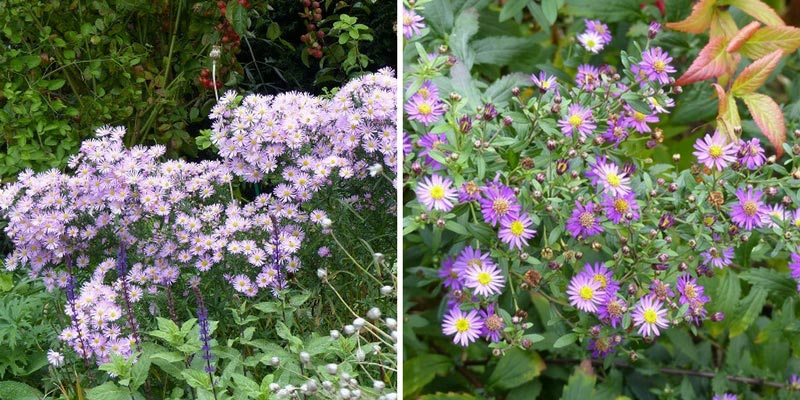
3) Asters
There are countless varieties and by collecting them one can easily have asters in flower from March to November. As I do not have the space required for that obsession (though the desire is certainly there!), I make do with a few well-placed clumps in strategic positions in beds where they take over from summer-flowering perennials. I have set aside the New England hybrids, too tall for my beds, but could not do without Aster ericoides such as 'Pink Star' and even less without the rarer Aster ageratoides 'Ezo Murasaki' with its seemingly endless flowering. Besides, those two are never sick! In shade, I once had Aster divaricatus that I probably unfairly pulled out at some point to replace with a rarity that did not last. That was probably a mistake I will have to put right one day!
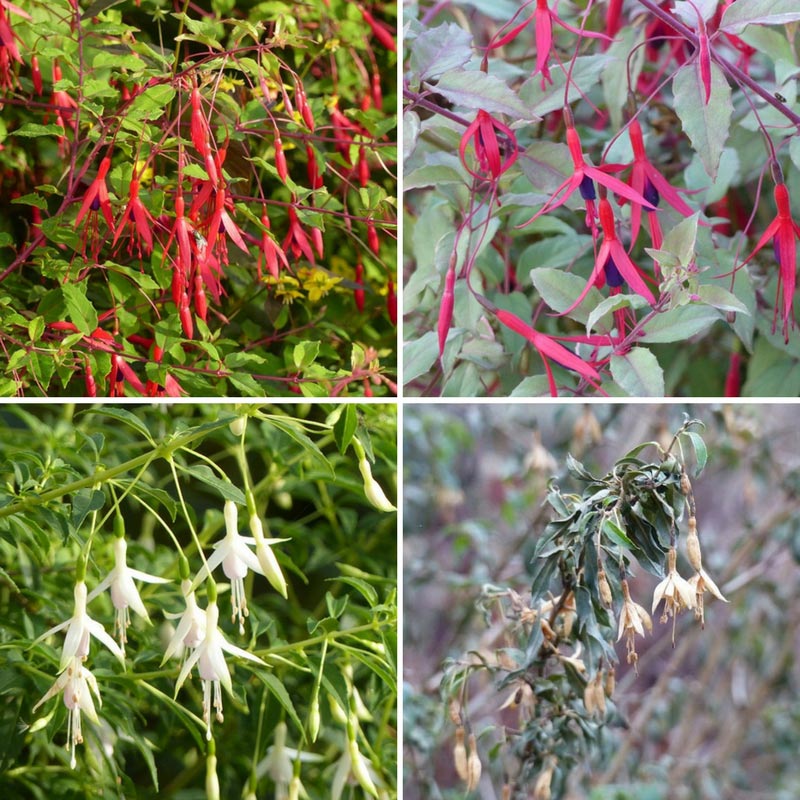
4) Fuchsia magellanica
Shrub or perennial, that is not the point... These hardy fuchsias that form real hedges in Ireland and Brittany are truly hardy and when frost is severe they regrow from the crown, their flowering then starting just a little later (late July). Once again, it is one of the very first plants I grew and I still keep the original stock of Fuchsia magellanica 'Ricartonii' from my grandmother. Fuchsias still suffer from that "grandmother's plant" image, which is highly unfair given the qualities of these shrubby perennials: hardy and easy to grow in sun or shade, they ask for almost nothing in return for their generous, elegant flowering. As icing on the cake, golden-leaved ('Aurea') and variegated ('Versicolor') forms exist. I also found at Saint-Jean-de-Beauregard the rare white and variegated form called 'Sharpitor'. If you dislike the characteristic pink-and-purple contrast, you can always opt for Fuchsia magellanica var. molinae, with pale pink-white flowers, and its variant 'Hawkshead' with pure white flowers tinged green at the tips. Tireless, only cold can halt their flowering!
5) Persicarias
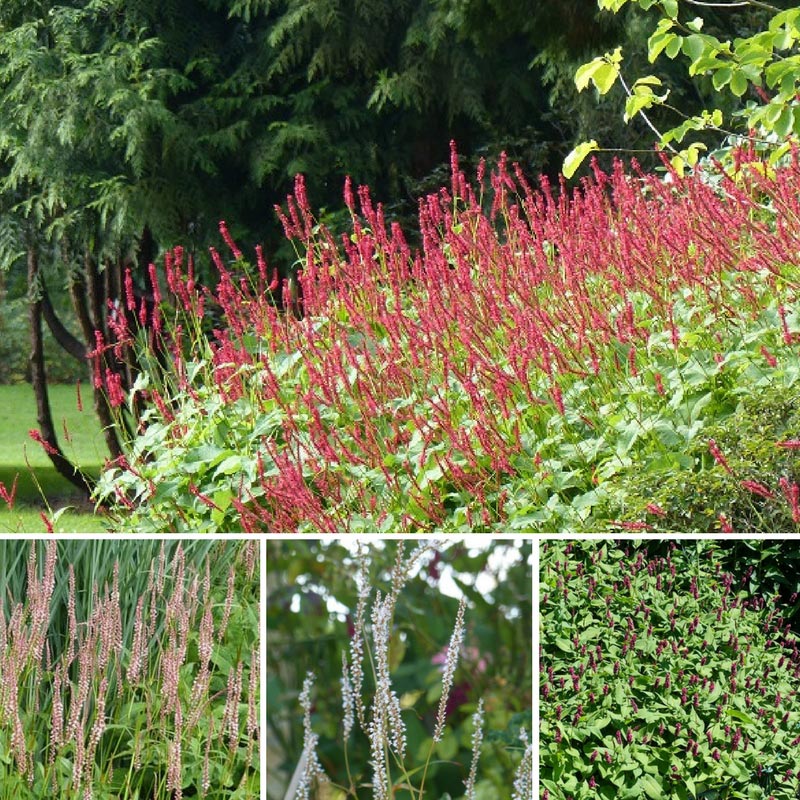
Having late flowering in a small garden is good, having long AND late flowering is even better! And that's precisely what persicarias (Persicaria amplexicaulis, formerly Polygonum) bring. Graphic, colourful spikes appear from July for the earliest varieties, and nothing can stop them thereafter! If they spread too much, you can cut them back as often as you like and they will come back all the stronger. I have seen them thrive in poor sandy soils, in dry chalky soils as well as in heavy clay. In short, they are foolproof and I love them all and there will certainly be one to suit you too! If you struggle to choose, I would still recommend 'Blackfield' deep claret-red, 'Alba' white and very free-flowering, 'Firedance' with more orange tones, 'Inverleith' which stays dwarf, and 'Rosea' old-rose, as among the best. New varieties appear regularly and are also well worth trying.
...Bonus: Diamond grass
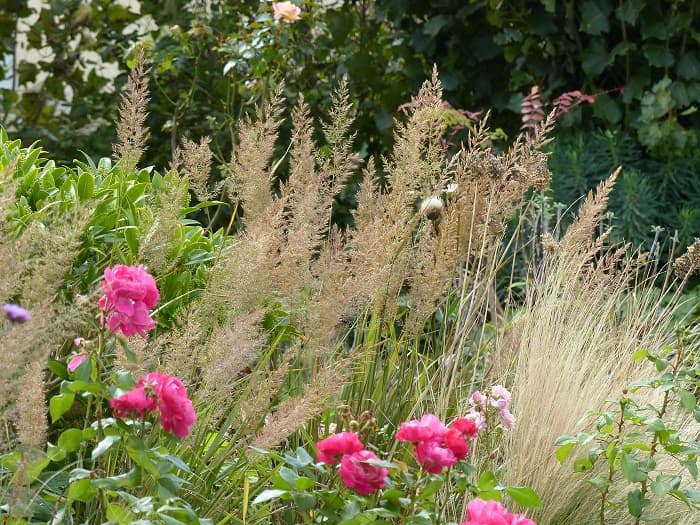
Which modern, serious gardener can still make a garden without ornamental grasses? Almost all are beautiful in autumn, and even beyond, enhanced by mist, hoar frost and low-angle light, but if one stands out it is the famous "diamond grass" (Calamagrostis brachytricha), queen of autumn grasses. Its panicles appear only in September and show superb iridescent shades under autumn sunrays that look like diamond sparkles. At 70–80 cm tall and able to grow in any soil, in sun or shade, it remains a plant too little known yet foolproof.
True, I could also have told you about a Miscanthus, but its autumn colours would have competed with those of the shrubs! 😉


































Comments