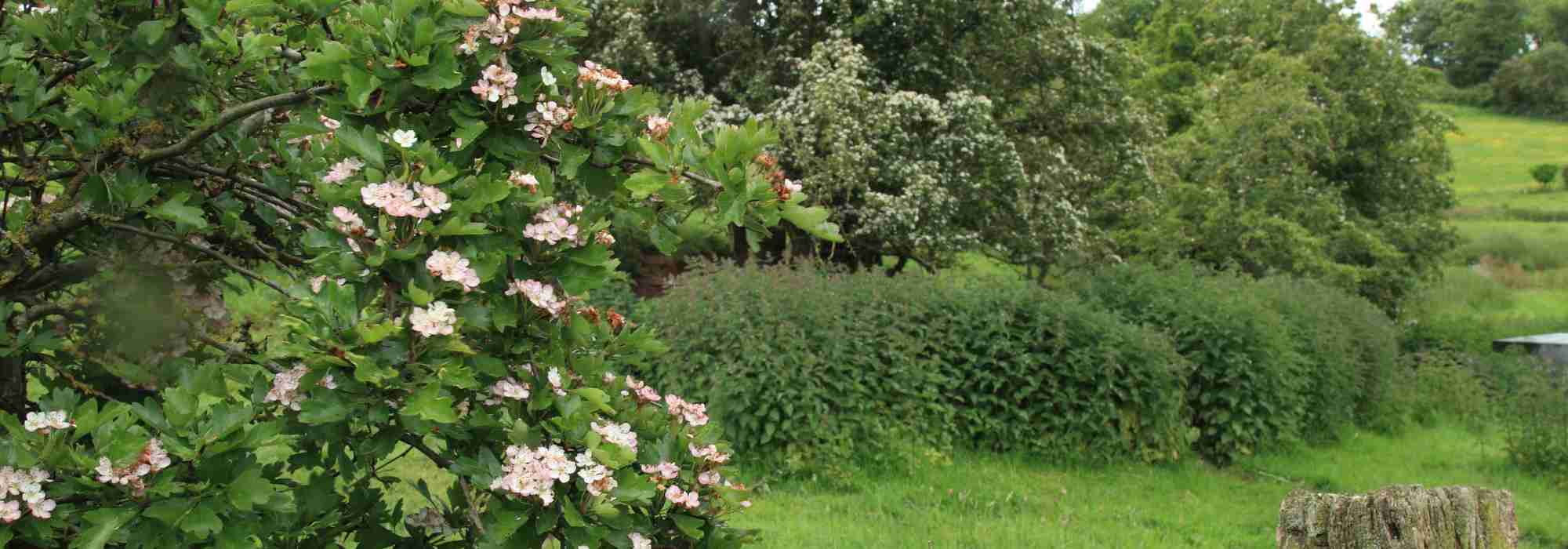
9 shrubs for a bocage hedge
Best shrubs for a wildlife-friendly country hedgerow
Contents
Bocage hedgerows are hedges made up of native tree and shrub species originally intended to mark out agricultural plots and meadows. Unfortunately, during the large-scale land consolidation between the 1960s and 1980s, these bocage hedgerows were removed from our countryside. Yet they provided many benefits such as filtration of wind and water, maintenance of soil fertility, undeniable aesthetic value and even a clear benefit for biodiversity.
→ Want to create a bocage hedgerow in your garden? Here are some of the most useful trees and shrubs to plant.
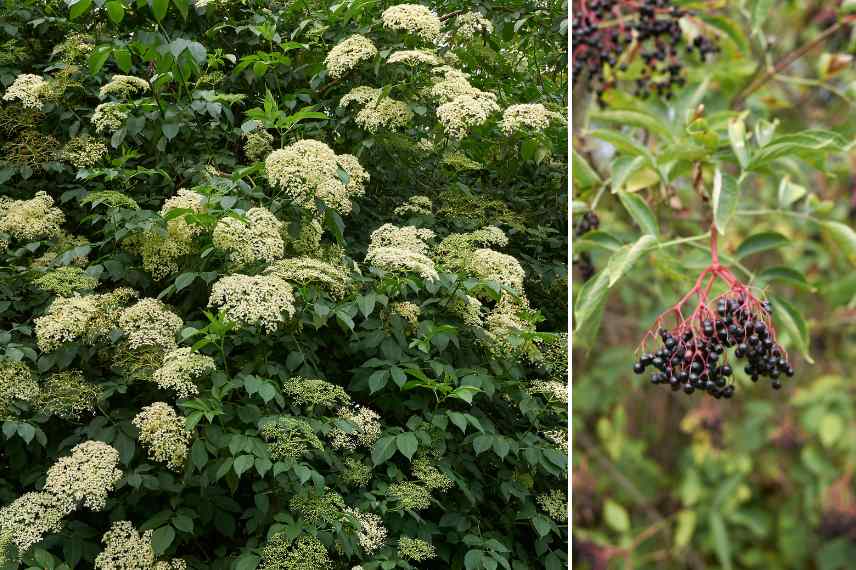
Black elder: edible flowers and fruits
Black elder or Sambucus nigra occurs widely across countryside. It therefore has a place in a bocage hedge. It is a species with a wild aspect, an open, lax habit and often suckers from the stump. This shrub has deciduous foliage with a rather unpleasant smell when crushed. But above all, it’s flowering (and fruiting!) that matters. Flowers open in late spring in large, flat, cream-white corymbs, both decorative, fragrant and attractive to pollinators. They can also be used to flavour white wine or to make fritters. Later, black berries appear, edible once cooked and much favoured by birds.
Black elder is planted in spring or autumn, in any ordinary soil, not too poor, fairly deep and not too dry, in full sun or partial shade. This large shrub can reach 6 m in all directions, but responds well to pruning and can even be cut back hard.
Please note : there are a good number of horticultural varieties of black elder. Sometimes with purple, golden or laciniate foliage, sometimes more compact or with a columnar habit. Feel free to take a look at all our black elders (Sambucus nigra) at the nursery.
Guelder rose: slightly forgotten yet so beautiful
We all have guelder-roses in the garden. Indeed, species and their cultivars are very numerous. The most famous among them is probably Viburnum opulus ‘Roseum’ or guelder-rose ‘Snowball’. A cultivar derived from the species guelder-rose that we may have seen too often in gardens and parks, which has perhaps made us overlook the wild type. Yet it is an absolutely remarkable shrub!
Guelder-rose or Viburnum opulus is a native shrub found in damp woodland understorey. With a naturally rounded habit, it is recognised by its palmate leaves, flat clusters of white flowers followed by small bright red fruits enjoyed by birds and beautiful autumn colours. Fairly fast-growing, the shrub reaches about 3.5 m in height with a 3 m spread.
Guelder-rose is grown in full sun or partial shade in preferably heavy, fresh to moist, rich soil, in any case not too dry.
Please note: our flora includes another native viburnum, wayfaring-tree or wayfaring viburnum (Viburnum lantana). Flowering and autumn leaf colour are superb. So do not hesitate to add it to the garden too!
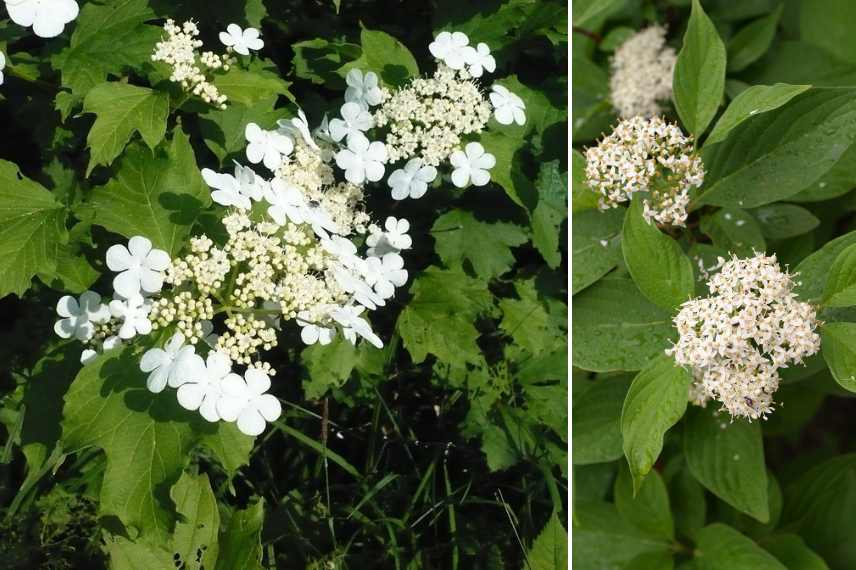
Viburnum opulus and Viburnum lantana
Discover other Countryside Hedges
View all →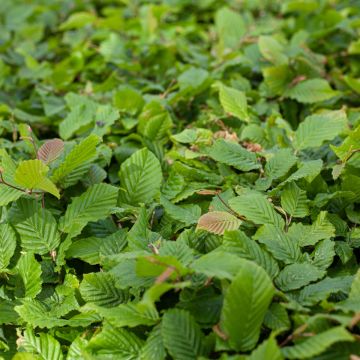
Available in 5 sizes
Available in 3 sizes
Available in 3 sizes
Available in 0 sizes
Available in 6 sizes
Available in 4 sizes
Available in 1 sizes
Available in 5 sizes
Available in 3 sizes
Available in 1 sizes
Cornus sanguinea: beautiful all year round!
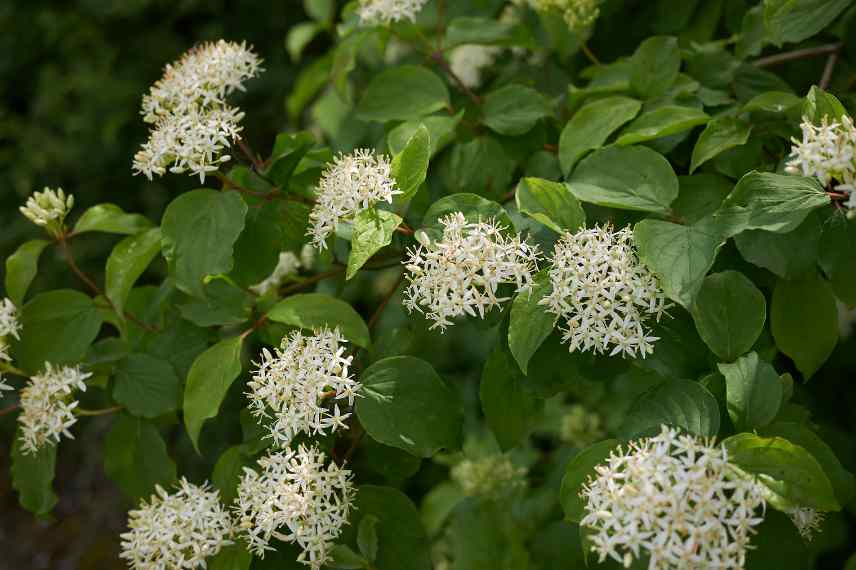
Few shrubs are truly beautiful all year round. But this is clearly the case for the Common dogwood or Cornus sanguinea and its cultivars. Cornus sanguinea is a small native shrub, notable for its young shoots of a very bright glossy red in winter. It produces in late spring or early summer flattened white flowerheads, fairly inconspicuous but much visited by pollinating insects. Flowering is followed by a crop of blue-black berries favoured by birds. Deciduous glossy green foliage takes on warm autumn colours.
At maturity, it will reach on average 2.50 m to 3 m in all directions if not regularly pruned close to ground level. It is very undemanding regarding soil type and copes well with presence of lime. Plant in full sun or partial shade.
please note : there are some cultivars of Cornus sanguinea distinguished by golden foliage or very colourful, bright orange stems. They have the same qualities (flowering and fruiting) for biodiversity within a bocage hedgerow. In general, coloured-wood dogwoods can be included without problems in a natural hedgerow.
Common hornbeam: deciduous, yes but...
Common hornbeam or Carpinus betulus is versatile: woodland tree, specimen to grow in isolation, tree for a clipped hedge (pleaching) and even for a bocage hedgerow. You can either let it grow freely as a tall specimen, or plant it coppiced so it develops like a large shrub.
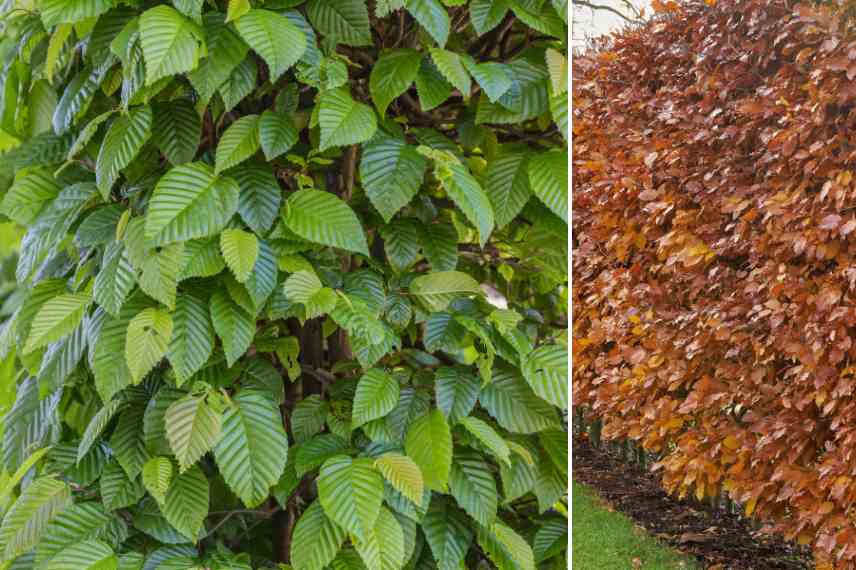
Green, slightly crinkled foliage has one particularity: it is marcescent. This means dead leaves do not fall in autumn but remain on the tree until new leaves appear. Male and female flowers and leaves appear together in spring. Carpinus betulus also produces dangling clusters of samaras 3 to 6 cm long, green turning yellow-brown when mature, in late September.
Hornbeam is a very hardy, undemanding tree, adapting to any sufficiently deep soil, even calcareous and occasionally dry. It particularly favours cool, semi-shaded situations, but can also grow in gentle sun. It can reach 10 m in our gardens, but much less if pruned (pleached or coppiced).
White willow: a beautiful tree with many benefits
Typical of wet areas of our countryside, White willow (or silver willow) or Salix alba can easily be incorporated into a bocage hedge, either coppiced, grown as a tree, or managed as a pollarded tree. Its upright yet trailing habit is elegant, as is its broad rounded crown clad with glossy foliage that reveals a silvery underside in the wind. Flexible shoots can be used in basketry and bear aments in spring, particularly valuable to early-season pollinators. As the tree ages, it can provide shelter for a variety of wildlife, notably bats or even the Little Owl.
Very hardy, Salix alba is planted in any fresh to damp, fairly heavy, fertile soil, in a sunny position. It can reach 20 m in height, but tolerates pruning very well and can therefore be managed as coppice, as a pollarded tree or as a shrub.
Please note: among native willows, don’t forget goat willow (Salix caprea)! This species copes better with dry conditions than other willows in our flora.
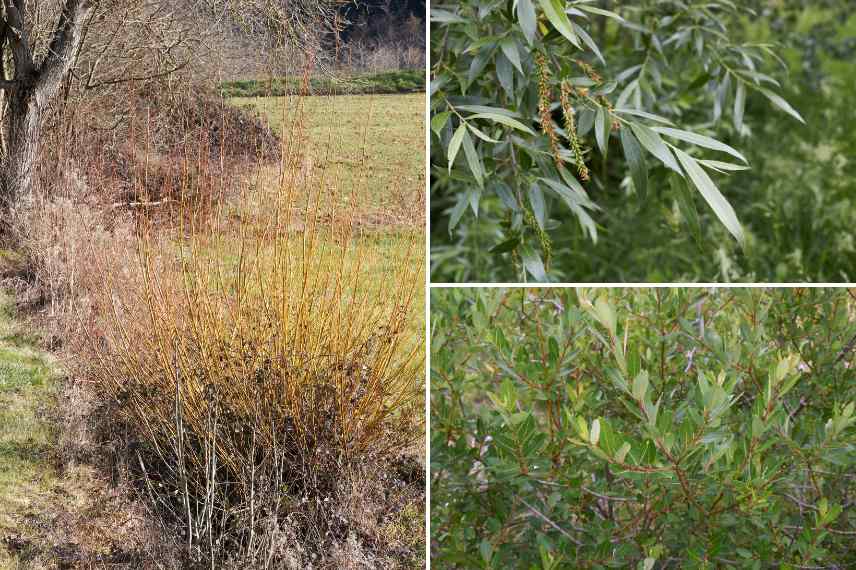
Salix alba (left and top right) and Salix caprea (bottom right)
Hawthorn: a sturdy shelter for wildlife
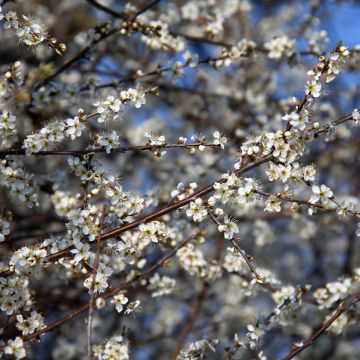
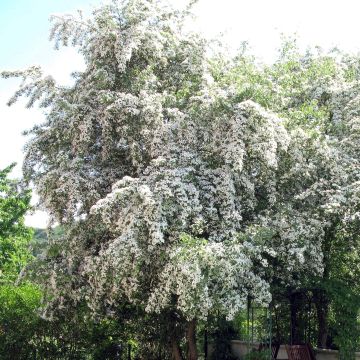
Common hawthorn (white thorn) or Crataegus monogyna is an erect, rounded, fairly compact tree. Short shoots are thorny and May flowering reveals flowers that are very fragrant and white, grouped in dense, flat corymbs of 6 to 12 flowers. Later, red fruits, called haws, develop, delighting birds and small mammals. Leaves are toothed and deciduous, glossy light green with a whitish underside. Flowering and fruiting provide food for garden wildlife, while the tangle of thorny branches creates safe shelter for nesting.
Very hardy, this tree native to Europe is widespread throughout France. Plant in dry, warm, calcareous and, above all, well-drained soil in full sun or partial shade. Tolerant of pruning, hawthorn can be used in a free-form bocage hedge as well as within a clipped hedge. As a specimen, a white thorn can grow up to 7 m in all directions.
Note : there are other interesting species and varieties among hawthorns. Find them in our nursery : all our hawthorns.
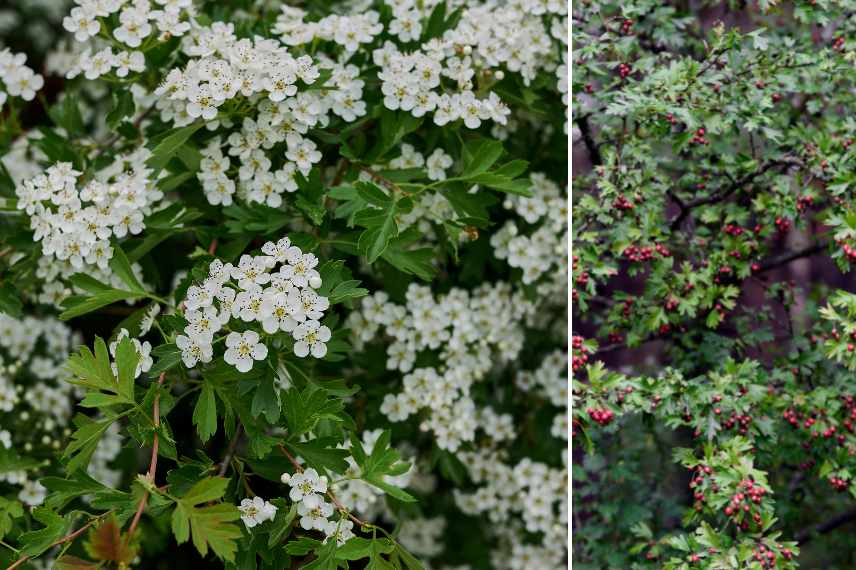
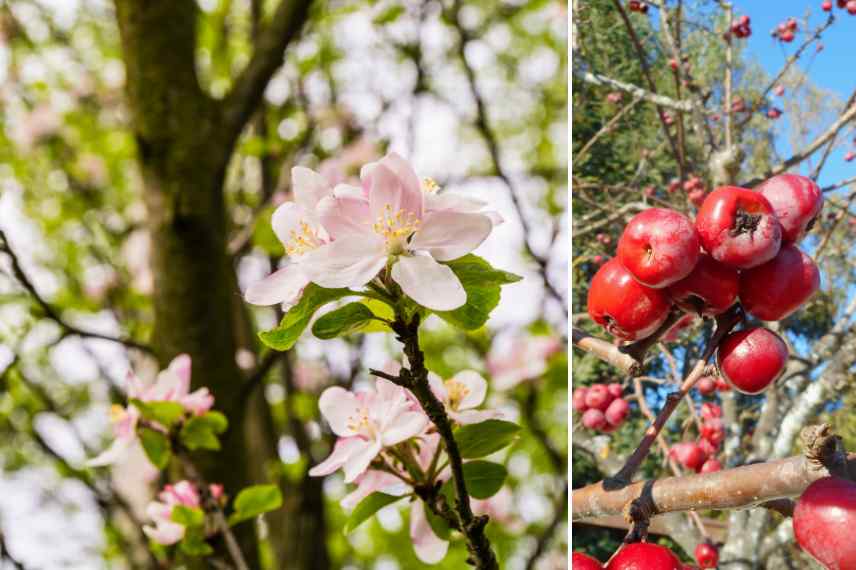
Wild apple tree: beautiful flowers and small apples
Wild apple (woodland apple) or Malus sylvestris is a native apple species that can be found in open forest or at woodland edges. This small tree forms an oval to rounded crown, fairly irregular, which widens and enlarges with age. In spring, it produces a charming display of flowers, pale pink at opening, becoming pure white. These flowers are followed by very small yellow-green apples with red tinges that will persist on the twigs for a long time. Flowering and fruiting provide food for insects, birds and some small mammals.
Easy to grow in ordinary but deep soil, the wild apple requires a sunny position. Malus are very accommodating regarding soil, but they prefer fertile, moisture-retentive soils. Wild apples can, when grown in free form, reach up to 8 m in height.
Did you know? Wild apples are also useful in our orchards. Indeed, they help to pollinate a wide range of fruit-bearing apple varieties thanks to their long flowering (April to May).
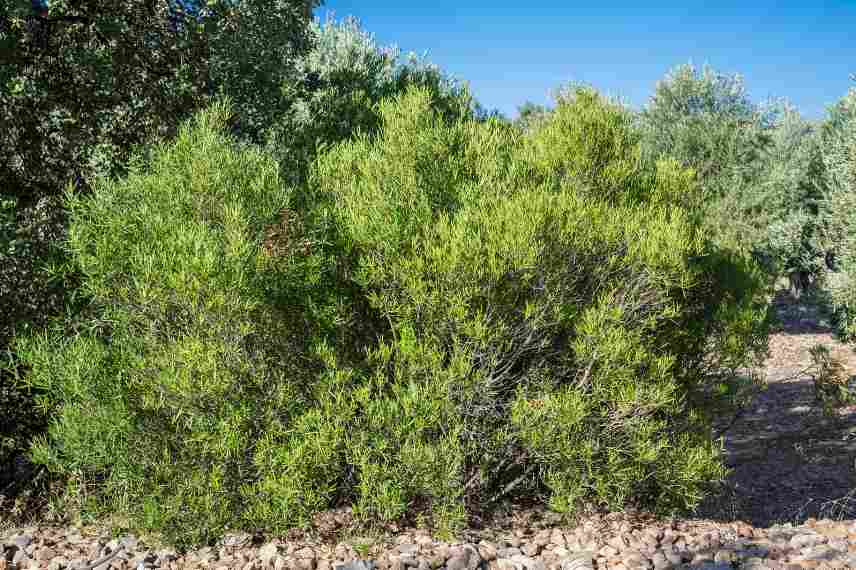
For the south: narrow-leaved filaree
Phillyrea angustifolia or narrow‑leaved phillyrea is an evergreen shrub related to the olive but more discreet, and above all hardier and even more undemanding. This shrub is in fact extremely robust, drought‑ and spray‑tolerant, and indifferent to poor, rocky soils. Phillyrea is somewhat noticeable in spring, thanks to the scent of its small, rather inconspicuous greenish‑white flowers. These flowers are followed by bluish berries resembling small olives: note they are not edible, but birds adore them!
Native to the Mediterranean basin, Phillyrea can nevertheless withstand frosts down to -15°C in well‑drained soil. Phillyrea is very adaptable as to soil and even exposure (sun or shade). Moreover, this shrub is well suited to drought and summer heat. It also tolerates pruning very well, which makes it suitable for training as a hedge or as topiary. But best is to let it grow as it pleases in your hedge; it will reach up to 3 m high and about 2 m wide.
For the south: Laurustinus
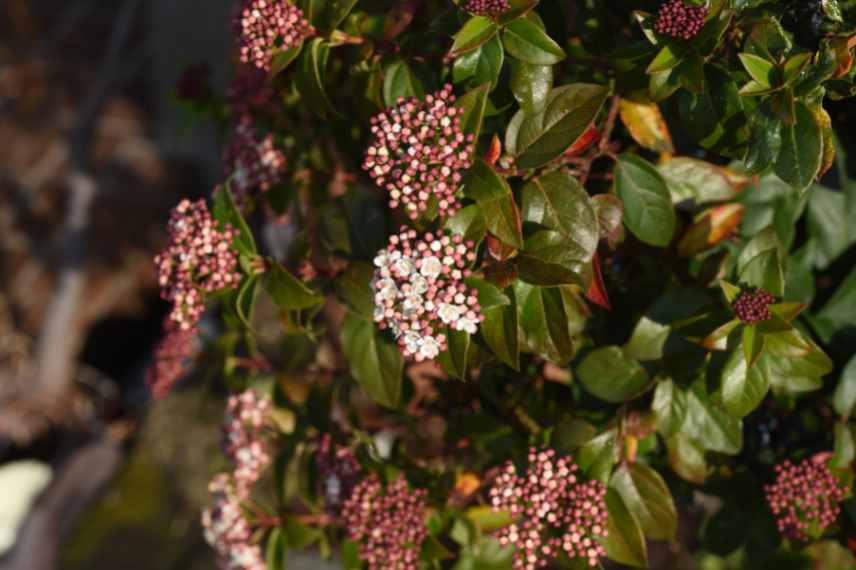
Laurustinus or Viburnum tinus is an interesting shrub year-round, especially during the bleak winter months. Indeed, it has an evergreen foliage and its flowering in small pinkish-white clusters occurs from January through to early spring, at a time when few flowers are present. The shrub is particularly drought-tolerant and copes well with calcareous soils.
Laurustinus tolerates frosts down to -12°C in well-drained soil and sheltered positions, resprouting from the stump when top growth has been damaged. Viburnum tinus can be planted in full sun, but also in partial shade. It has no particular soil requirements but prefers well-drained ground without waterlogging. The species typically grows to around 2.5 m in all directions.
Nota bene : there are now horticultural varieties of laurustinus, sometimes more compact, or with purple foliage (Viburnum tinus ‘Purpureum’) or variegated (Viburnum tinus ‘Variegatum’). Consider using it as part of a bocage hedge. After all, it will still be a Viburnum tinus.
Further reading
- Find our advice on how to create a bocage hedge?
- Want to read more on the subject? We recommend the book “La Maubrairie, jardins du bocage” by Stéphane Marie-Dany Sautot, Editions Tana
- Subscribe!
- Contents
This form is protected by reCAPTCHA - the Google Privacy Policy and Terms of Service apply.































Comments