






























Which way should bulbs be planted?
Or how to plant bulbs and other underground storage organs in the soil?
Contents
Planting bulbs in spring or summer is always a moment steeped in magic. We plant the bulbs in the ground, we often forget them, and after a few weeks or months, ornamental plants appear that soon begin to flower. That said, when a bulb is in hand, a gardener, whether a novice or more seasoned, is always assailed by a doubt: which way should these bulbs be planted? A question, certainly simple, almost trivial, but which is essential for achieving good flowering.
Let’s take a look at the different types of bulbs and the right way to plant them.

What is a bulb?
Before discussing what it means, perhaps we should take a quick look at what a bulb really is. It might even be wiser to speak of a bulbous plant, the bulb being the fleshy base that forms a food reserve. It is, in a sense, a natural store, an underground storage organ that already contains everything needed to grow a plant. Inside, future buds develop, and sometimes even the first small roots. Nutrient reserves are also stored there.
Bulbous plants must go through a period of dormancy, and these bulbs help them survive difficult times. Thus, some bulbs, often native to South Africa, have a summer dormancy period to survive drought. Others, such as tulips, daffodils and hyacinths, remain dormant until spring to avoid the winter cold.
Four types of bulbs can be distinguished:
- True bulbs: these bulbs possess fleshy scales, composed of leaves or leaf stalks. These scales form concentric rows fixed to a flat base from which roots emerge. These bulbs enlarge by adding scales and produce bulblets. In this category you will find the tulips, the narcissi, the amaryllises, the hyacinths, the ornamental alliums, the fritillaries…
- Corms: corms or cormus are formed of a single block and not of overlapping scales. They form a thick, underground base of a stem. They actually have nearly invisible scales and, when cut, you can see that they are made from a single piece. Corms replace themselves each year by forming one or more corms. Among corm-bearing plants you will find the lilies, the crocosmias, the gladioli, the crocus, some iris species, the watsonias, the freesias, the Babianas, the Chasmanthes, the Ixias, the Moraeas, the Sparaxis, the Tritonias, and the Tigridias.
- Rhizomes: these are thickened underground stems that grow horizontally on or just beneath the soil surface (cannas, lily of the valley, garden irises, Achimenes, wood anemone, anigozanthus).
Learning to distinguish these different bulbs helps you understand how to plant them.
Which way should you plant each bulb?
Because they come in different shapes, the various bulbs are not planted in the same way:
- True bulbs: they are planted with the tip facing upwards and the flat side downwards.
- Corms: They often have a slightly flattened shape, with buds on the top. It is important to identify this part, as that is where the plant will emerge.
- Rhizomes: they lie horizontally, just below the soil surface, taking care to orient the buds that will give rise to future shoots upwards.
- Tubers: Here you need to identify the top (where the buds emerge) and the bottom (roots). they are planted with the buds facing upwards, like potatoes.
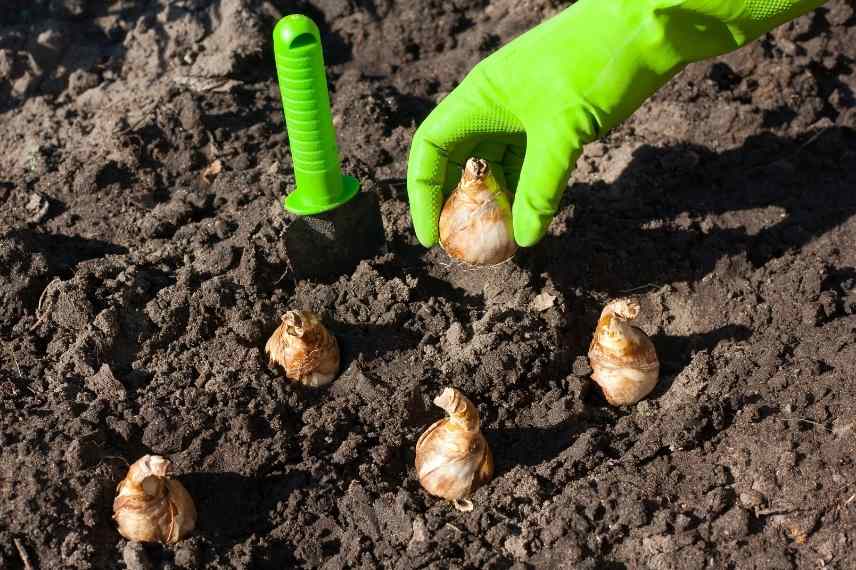
True bulbs are planted with the tip facing upwards
If in doubt, what should you look for in the bulb?
Sometimes it can be tricky to tell the top from the bottom, especially with less conventional bulb shapes such as corms, tubers, or rhizomes. Other clues can help:
- Look for the roots : if you spot a rougher base, with tiny filaments or a fibrous appearance, it’s usually the bottom, whether it’s a bulb, a corm or a tuber.
- Look for buds or shoots : whether it’s a small green shoot on a bulb, an eye on a tuber, or a dormant bud on a rhizome or a corm, it’s usually the top!
- Observe the shape : most bulbs are conical (wider at the base, pointed at the top). Tubers are often irregular, but eyes or shoots should point upwards. Rhizomes, on the other hand, are planted horizontally, with the buds pointing upwards, just beneath the surface.
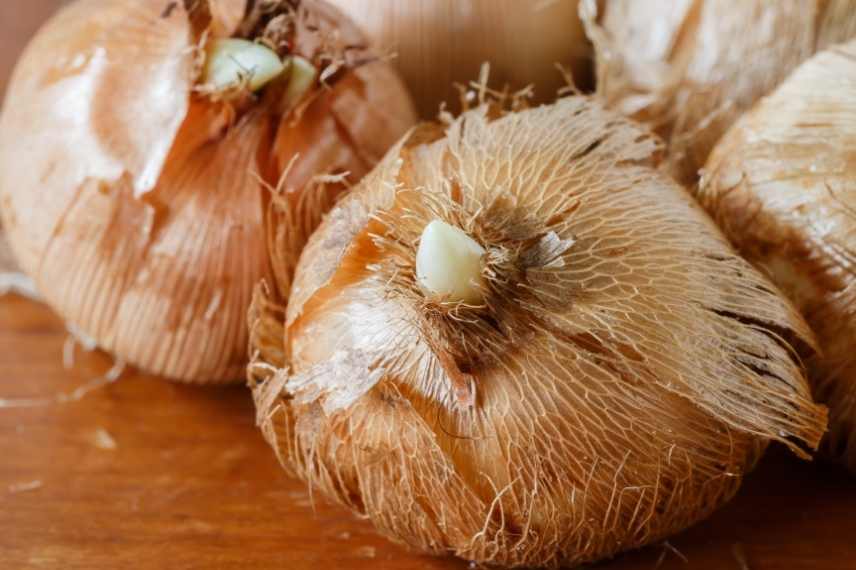
Dormant bud on a corm
And if you’re still not sure, rest assured that nature is well made. Most plants will find their way towards the light, even if they are planted a little off course. The bulb will simply spend a little more energy to correct its trajectory. Flowering may simply be a little delayed, a stem may grow crooked, but the plant adapts perfectly.
Read also
Bulbs: flowers for every seasonWhen is the best time to plant a bulb, and how deep should you plant it?
Once the aim is clear, you should also consider the right moment and the correct depth. A quick reminder:
-
Spring bulbs (flowering in March–April): to be planted in autumn (September to November).
-
Summer bulbs (dahlias, gladioli, etc.): to be planted in spring, when the risk of frost has passed.
For depth, a simple rule: bulbs are planted at a depth equivalent to 2 to 3 times their height. So a bulb 4 cm tall is planted at a depth of 8–12 cm.
A few extra tips
- Prepare the soil: it should be light and well-drained. Bulbs don’t like stagnant water!
- Add sand or gravel at the bottom of the hole if the soil is heavy.
- Plant the bulbs in groups: it’s more natural and more attractive than in a straight line.
- Mark the spot: especially in autumn, otherwise you’ll quickly forget where they were planted.
- No need to water deeply: except during a drought, bulbs don’t need much water.
- Subscribe!
- Contents
Comments