





























The most beautiful autumn-flowering trees to brighten up the garden
Trees to extend the flowering period and bring life to the garden
Contents
It’s often the showy foliage that draws us to trees in autumn. They’re indeed perfect for adding colour and for creating striking contrasts. But some of them also have another aesthetic asset: their flowering. These late-flowering trees prove once again that the late season can definitely be interesting and lively.
Discover these trees that flower from September to November, how to choose them and how to create beautiful autumn scenes.
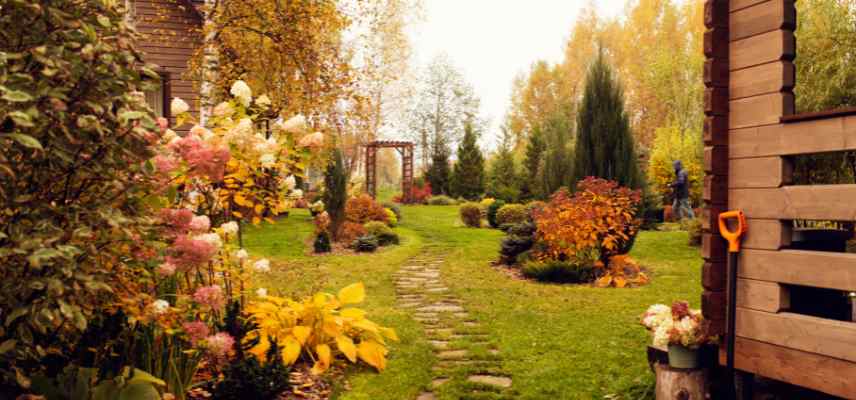
The garden comes alive in autumn, and a few trees and shrubs begin flowering or are still flowering…

Why growing autumn-flowering trees?
Spring and summer are indeed the busiest seasons in the garden, but autumn is far from being left out. It’s not because temperatures cool, light levels drop and the rains return that the garden fades: on the contrary! Many plants can indeed bring a new lease of life, revealing their various decorative assets precisely when conditions are more moderate. Perennials, bulbous plants, bushes, annuals that linger on, etc.
As for trees, many are essential for the flamboyance of their foliage at this time, which delight our eyes with shades of yellow, red, orange or purple. But it would be to forget that some of them also choose autumn to bloom, making them interesting in several respects.
Not neglecting autumn in the garden means you can continue to enjoy colour and flowers for several weeks, for a gentler and more poetic transition to the cold season.
How to choose autumn-flowering trees?
As with all plants, autumn-flowering trees will, of course, be chosen first and foremost to suit your tastes.
But this isn’t the only factor to guide your choices: your growing conditions play a fundamental role in the choice of any plant.
To illustrate, a Mediterranean tree that loves heat and grows in well-drained soil would be unlikely to thrive if planted in a cool, mountainous region, in heavy, waterlogged soil.
To choose the right trees, it is therefore essential to consider:
- weather conditions (windy garden, dry summers, wet winters, subject to hard frosts…);
- soil type (dry or damp, heavy or light, rich or poor, with calcareous or acidic pH…);
- available space (depending on the plant’s size at maturity);
- exposure (sunny, partially shaded, or shaded…)
To help you get it right, our Plantfit app can guide you in defining your garden’s specific profile.
Our favourite autumn-flowering trees
Eucalyptus
Eucalyptus is best known for its handsome evergreen foliage and its often decorative bark. Its graceful habit, rapid growth and tolerance of growing conditions, even when they are challenging (poor soils, dry or, conversely, very wet), are among its other assets.
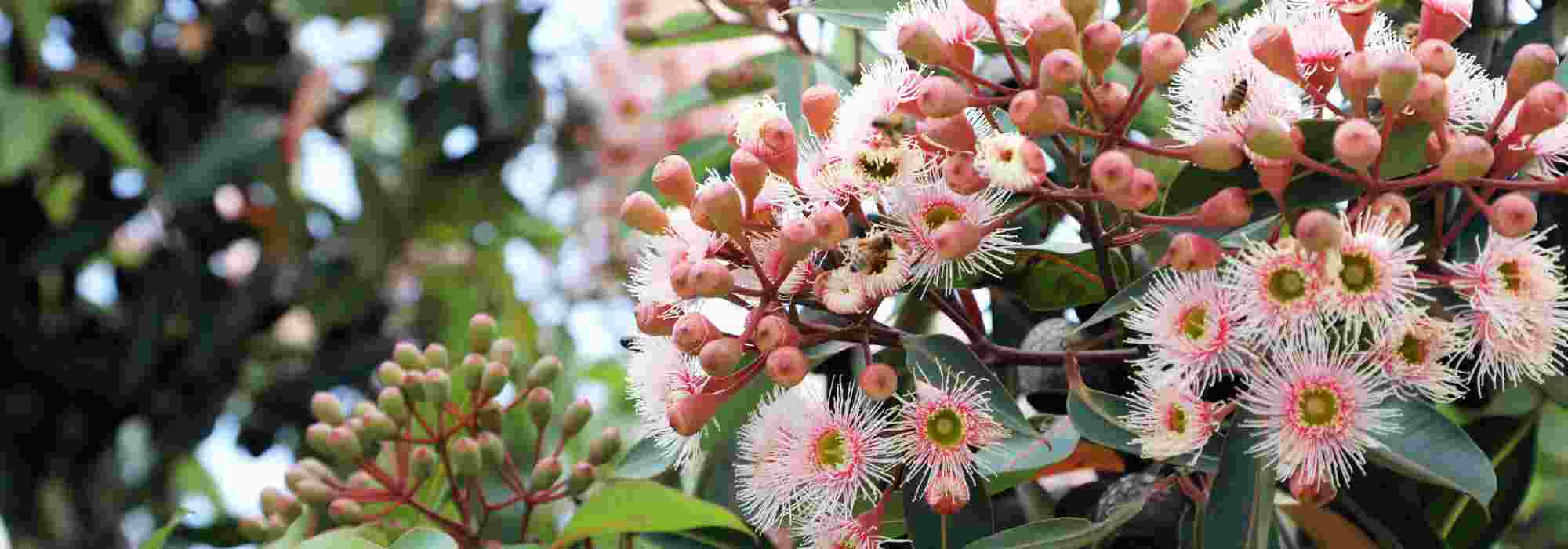
While its flowering may not be the most exuberant, it still has a certain charm. It consists of pretty pom-poms of stamens, often white, which contrast nicely with the colour of the foliage. They are also melliferous. In some species, flowering occurs precisely in autumn. This is the case for the Eucalyptus gunnii, the Eucalyptus rodwayi, the Eucalyptus polyanthemos, the Eucalyptus urnigera or the Eucalyptus apiculata.
Mais flowering can also be more colourful, as with the Eucalyptus leucoxylon ‘Rosea’, which from August to October produces large flower buds and red or pink flowers, extremely bright. For its part, the Eucalyptus sideroxylon also rewards us with a superb, abundant flowering, sometimes white, pink or red depending on the plant, throughout autumn.
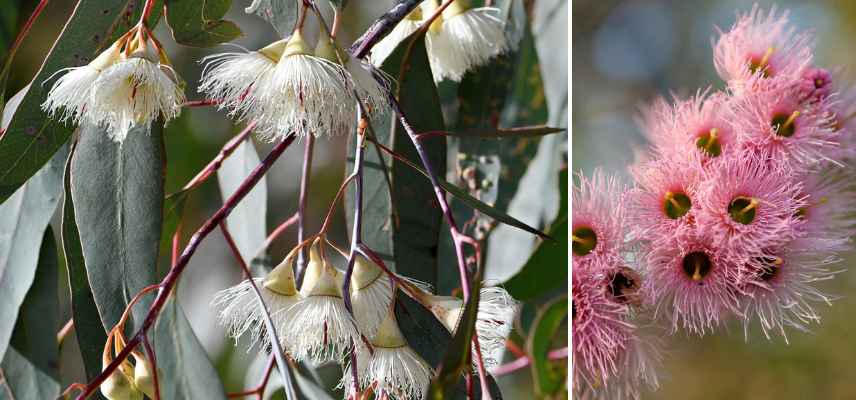
Eucalyptus sideroxylon
Japanese loquats
These large fruiting shrubs, cousins of our common loquat, flower in autumn, from October to November. They produce white flowers in pyramidal clusters, exuding almond notes. They are very attractive to pollinators at a time when food is scarcer. In regions that experience only light frosts (down to -4°C), this flowering will give way to sweet and fleshy fruits. The Japanese loquats are hardy to -12°C and thrive in coastal areas and in southern gardens. They love warmth and sun, in rich, well-drained and cool soil during growth.
The varieties ‘Tanaka’ or ‘Argelino’ reach, for example, 6 to 8 metres in height.
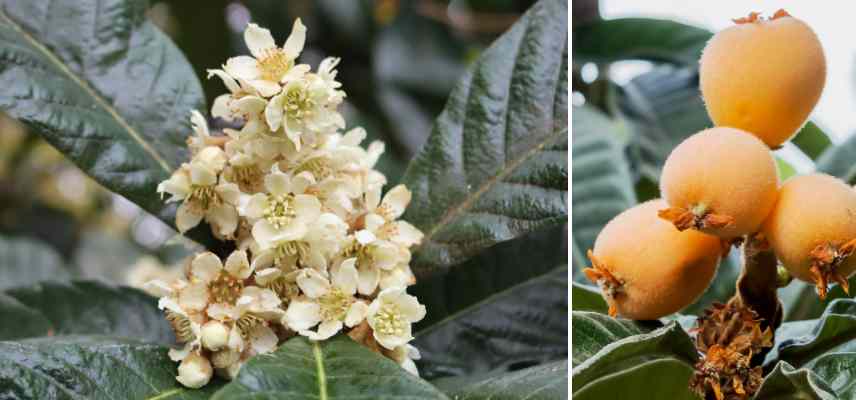
Eriobotrya japonica, flowers and fruits
Large shrubs
These are plants usually classified as shrubs, but some species exceeding 6 metres in height actually form true small trees.
Notably the Taschkent Chitalpa (Chitalpa tashkentensis) ‘Pink Dawn’. This deciduous tree reaches 7 metres in height with a 5 metre spread. It flowers in summer, but a second flush can occur in September if temperatures are mild, which is becoming the case in many of our regions thanks to climate change. Its flowering, with rose-lavender trumpet-shaped blossoms, adds an exotic touch and colour. This small tree enjoys well-drained soils, in full sun and is drought-tolerant once established.
Continuing with the autumn-flowering cherry (Prunus subhirtella) ‘Autumnalis Rosea’, a small tree that waits until November to reveal its magnificent semi-double pale pink and pearly flowers, which will brighten the winter. It thrives in most of our climates, in ordinary, deep soil, in sun.
Also worth mentioning is Heptacodium miconioides, a little-known Chinese deciduous tree, but very beautiful with its late flowering. It produces star-shaped white flowers, then pink and finally red, with a jasmine-like fragrance. It reaches 7 to 8 metres in its country of origin (a little less in our latitudes). It grows in ordinary soil that remains cool, in sun or partial shade.
It is shown in the image Heptacodion and Clerodendron.
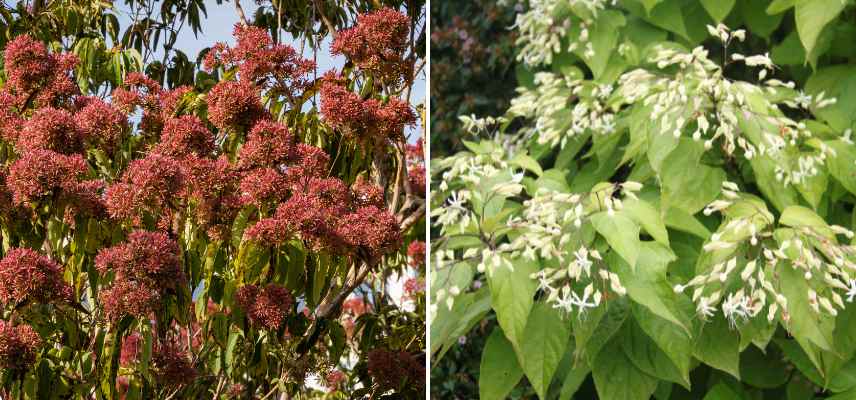
Heptacodion and Clerodendron
The frost-tenders
The Ceiba speciosa, also known as the silk floss tree or bottle tree, is a tree reaching 12 metres in height and 8 metres in spread. It rewards us with a magnificent exotic flowering, with large pink flowers that appear from October to December. Its main weakness? It does not tolerate frosts, so it can only be grown in the ground in the Mediterranean fringe. It can, however, be grown in a large container, so it can be brought indoors in winter in other regions.
For striking late-summer and early autumn flowering, consider the Queen palm (Syagrus romanzoffiana), a palm species closely related to coconuts. It showcases branched inflorescences that arise between the leaves, variable depending on whether the plants are male (shorter flowering) or female (longer flowering with small white-cream flowers). Expect around 12 metres in height and 6 metres in spread. With a limited hardiness of -4°C to -6°C, it will suit gardens with mild winters or be grown as an orangery plant. It loves warmth, sun and cool to moist soils.
Jacaranda mimosifolia has another evocative nickname, the “Blue Flamboyant.” It indeed delights with its lavender, long panicles, slightly scented and highly melliferous. This flowering occurs at the start of spring on still-bare branches and lasts until early summer. But it can be repeat flowering in September–October. However, several years are needed for the tree to reach at least 2 metres before you can enjoy it. Cold-sensitive, Jacaranda cannot tolerate frosts above -4°C, which kills its flower buds. At maturity it will reach 15 metres in height and 10 metres in spread.
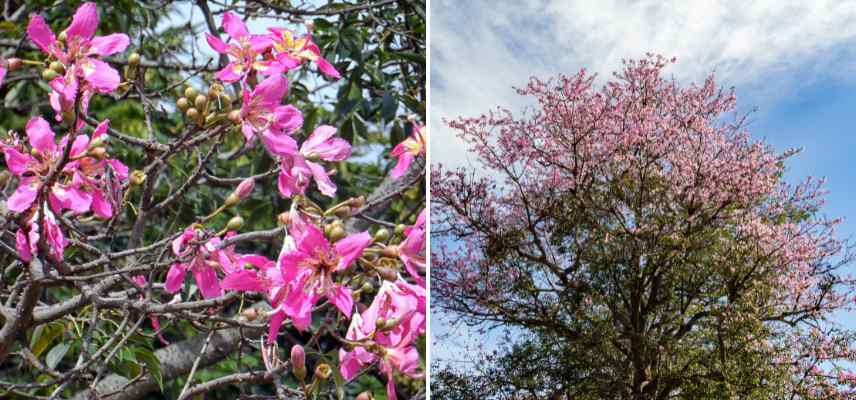
Ceiba speciosa
The fragrant
For a richly scented autumn flowering, consider Magnolia grandiflora ‘Mainstreet’, impressive with its 12 metres in height and 4 to 5 metres in spread. Its large cup-shaped flowers emit a pleasant lemon fragrance from summer through to autumn, around October. This evergreen tree will thrive in rich, deep and consistently cool soil in full sun.
Read also
Create a beautiful autumn gardenCreate a beautiful autumn garden
To create beautiful autumn scenes, pair these trees with other interesting plants during this season. Think of:
- perennials with autumn flowering (asters, sedums, echinacea, Buenos Aires verbena, chrysanthemums…);
- shrubs with autumn flowering (Sasanqua camellia, buddleja, crape myrtle, ceanothus…);
- bulbous plants (Inca lilies, autumn crocuses, crocuses…);
- trees and shrubs with autumn colour (Japanese maple, Liquidambar, Cotinus, Ginkgo biloba…);
- decorative fruits (Callicarpa, privets…);
- annuals that flower until the first frosts (marigolds, calendula, petunias, Cosmos, Fuchsia…).
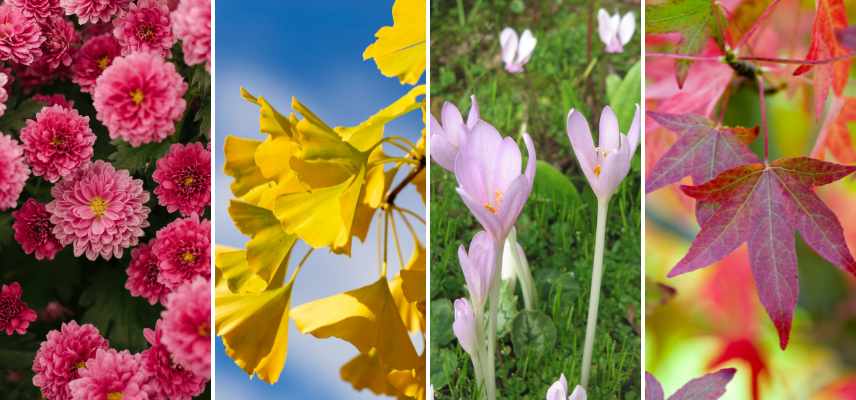
Chrysanthemums, Ginkgo biloba, Colchicum autumnale and Liquidambar
- Subscribe!
- Contents
Comments