





























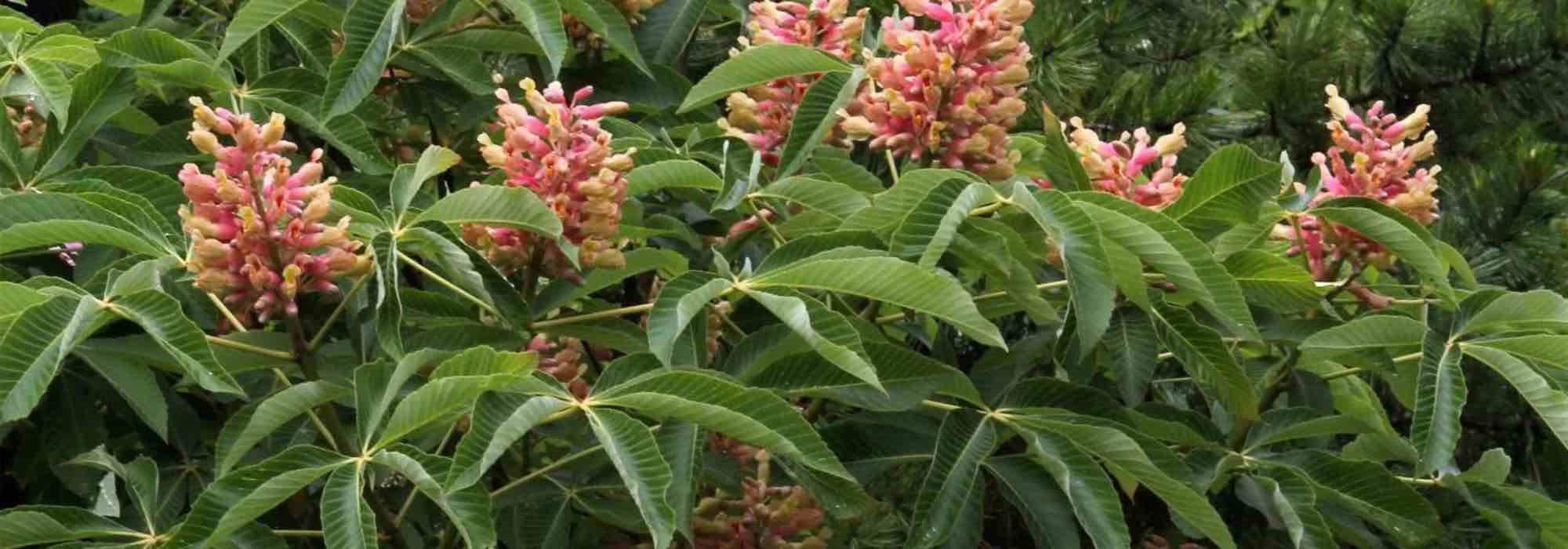
How to choose a horse chestnut tree for your garden?
Our varieties tailored to your needs
Contents
Horse chestnut trees (Aesculus) are ornamental trees prized for their stately habit, spectacular flowering and lush foliage. Although the typical species, Aesculus hippocastanum, is too imposing for many gardens, many other varieties, better suited to smaller spaces or specific needs, offer equally remarkable qualities.
This guide will help you choose the perfect horse chestnut for you: size, habit, hardiness, flower colours, shape and colour of the foliage, or even specific uses.
Choosing a horse chestnut by its size or growth habit
The tallest horse chestnuts or pavias
The tallest specimens measure between 15 and 20 m in height: Aesculus chinensis, the Chinese horse chestnut, which can reach between 15 and 25 m in height and 15 m wide. The Aesculus hippocastanum, the common horse chestnut, can reach 25 m in height with a crown spread of 15–20 m, as its cultivar ‘Memmingeri’ and the cultivar ‘Wisselink’ reach 15 m in height with a 12 m spread.
Citons aussi Aesculus flava, commonly called Pavier or Yellow Buckeye, and Aesculus indica ‘Sydney Pearce’ which reach 20 m high with a 15 m spread.
Medium-sized specimens
Among medium-sized specimens, between 8 and 14 m tall, one can cite another cultivar of the common horse chestnut, ‘Hampton Court Gold’, reaching 10 to 12 m tall, with a crown spread of 6 to 8 m at maturity.
Also note Aesculus (x) neglecta, the cultivars of Aesculus carnea such as ‘Plantierensis‘.
Juste en dessous des 10 m de hauteur à maturité, on trouve ‘Laciniata’, Aesculus x dallimorei and Aesculus x bushi.
The smallest horse chestnuts
Many choices here as well, from the smallest Aesculus hippocastanum ‘Monstrosa’, which at 15 years old does not exceed 1.50 m in height with a 1 m in spread, to the ‘Digitata’ which can reach 6 to 8 m in height with a 5 to 8 m spread. Between the two, the Aesculus parviflora or White Pavier, or the cultivars of Aesculus glabra.
Habit
A quick note on habit to mention a few iconoclastic specimens. ‘Monstrosa’, very small, develops an almost otherworldly silhouette, clearly visible in winter, with shoots forming crested, broad, very short branches. Aesculus hippocastanum ‘Umbraculifera’ develops a small globular crown on a short trunk, and Aesculus pavia ‘Humilis’ forms a large shrub.
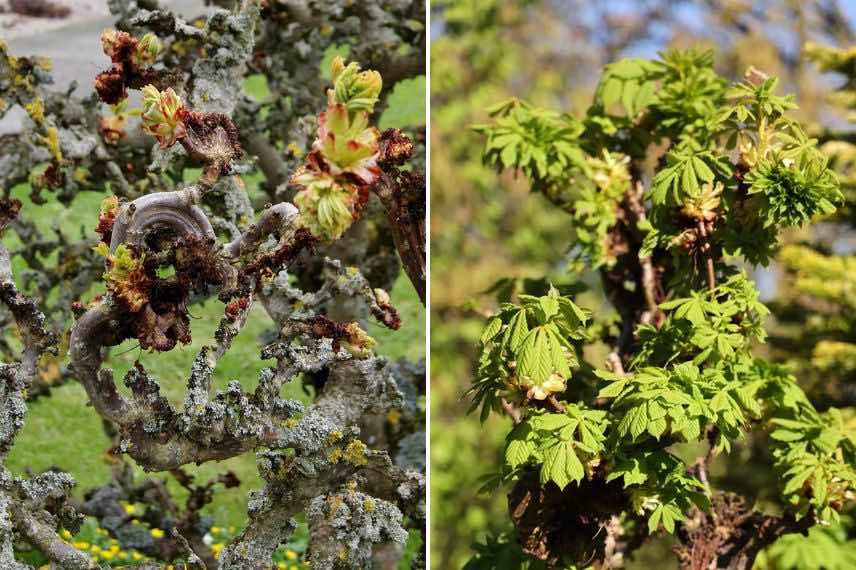
Aesculus ‘Monstrosa’, the smallest, utterly iconoclastic
Choosing a horse chestnut according to its hardiness.
Horse chestnut trees are generally very hardy, able to withstand severe winter temperatures. They flourish with ease in temperate to cold climates, which makes them well suited to our territory. However, some varieties have hardiness limits that deserve consideration when selecting them.
Among horse chestnuts that are less hardy to cold, there is the remarkable Aesculus indica ‘Sydney Pearce’, a Himalaya horse chestnut cultivar, selected by Sydney Pearce, deputy keeper of the famous Kew Gardens, in 1935. Although it is valued for its superb spring flowering, it is less suited to very harsh climates: its hardiness is rated to -12 °C at the extreme for an adult specimen. This makes it primarily suited to regions with moderate winters, such as urban gardens.
For regions with colder winters, other horse chestnut species, such as Aesculus × carnea, Aesculus pavia or Aesculus parviflora, offer excellent hardiness and can withstand temperatures well beyond -20 °C. However, they dislike sea spray and appreciate well-defined seasons.
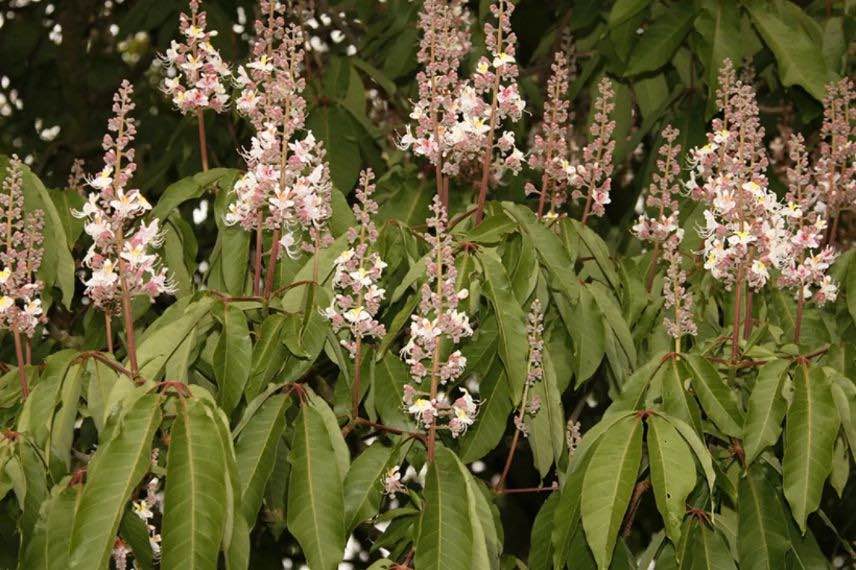
If you live in a climate that isn’t too cold, ‘Sydney Pearce’ is an elegant cultivar
Choosing a horse chestnut tree based on the shape or colour of its foliage
Let us consider a few very interesting specimens for the shape of their foliage, such as ‘Laciniata’ or ‘Digitata’, with leaves remarkably deeply cut in the form of narrow, strap-like leaflets, sometimes thread-like for the former and with slender growth, and with narrow, finely cut leaves for the latter. The Aesculus x glaucescens also offers superb narrow foliage with five fine leaflets.
Regarding leaf colour, let’s mention the Ohio buckeye cultivars, Aesculus glabra, such as ‘October Red‘ and ‘Herkenrode‘, with delicate foliage coloured bright red or red-orange in autumn. ‘Sofia’ is yellow in spring and red in autumn.
Among Indian or common horse-chestnuts, the cultivars ‘Franek‘ and ‘Karolina Reinhold‘ are prettily yellow-variegated. This is also the case for the Aesculus x carnea ‘Marginata’, with foliage yellow-edged and embossed.
Finally the superb Aesculus (x) neglecta ‘Erythroblastos‘ develops new shoots of fluorescent pink, then its foliage turns creamy yellow and light green in summer, before donning brilliant yellow in autumn.
 Aesculus x glaucescens et Aesculus ‘Laciniata’
Read also
Diseases and Pests of the Horse ChestnutChoosing a horse chestnut based on the colour of its flowers
Horse-chestnut trees are distinguished by their spectacular flowering, which varies in colour depending on species and variety, offering a beautiful palette to enrich the landscape.
The red horse-chestnut (Aesculus × carnea) and its cultivars, such as ‘Briotii’, are known for their bright red or deep pink flowers, forming large upright panicles.
The red buckeyes, such as Aesculus pavia and varieties like ‘Humilis’, produce vivid carmine-red flowers that contrast elegantly with their green foliage.
For a softer flowering, the white buckeye (Aesculus parviflora) charms with its creamy-white panicles, graceful and lightly scented, which attract pollinators. Aesculus x glaucescens also develops lighter yellow flowers. In Aesculus x carnea‘Plantieriensis’, these are superb yellow panicles edged with pink.
Similarly, Indian horse-chestnut species and the Chinese horse-chestnut and their cultivars.
The pale-yellow flowers of the yellow buckeye (Aesculus flava) offer a bright and original alternative, ideal for bringing a touch of warmth to the garden. Aesculus x glaucescens also develops lighter yellow flowers. In Aesculus x carnea‘Plantieriensis’, these are superb yellow panicles edged with pink.
Finally, Aesculus pavia ‘Koehnei’ offers colourful flowers, from deep pink to salmon, Aesculus indica ‘Sydney Pearce’ develops superb upright clusters of white, yellow and pink flowers, and Aesculus mutabilis ‘Induta’ is adorned with red to salmon-pink flowers.
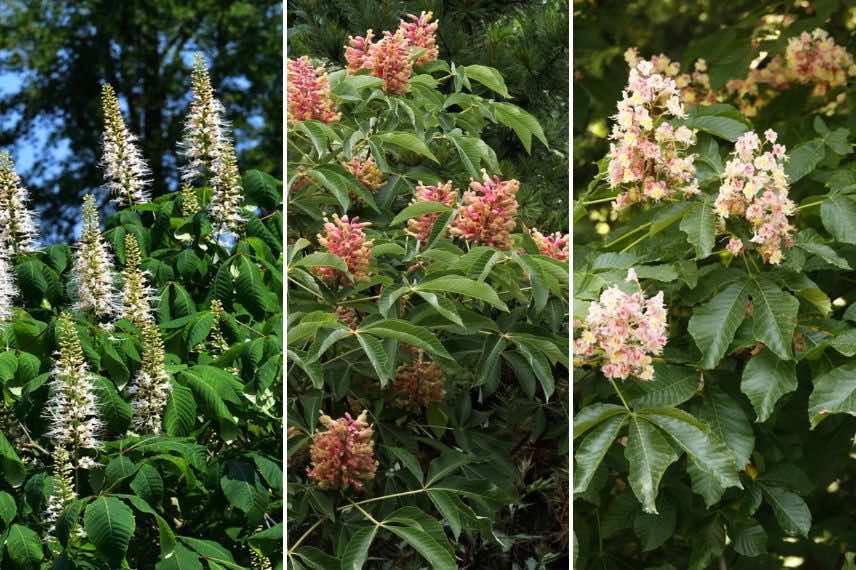
Aesculus pavia, ‘Koehnei’ et ‘Plantierensis’
Choosing a horse chestnut tree according to growing conditions.
Horse-chestnuts and buckeyes are relatively undemanding trees, but successful planting depends on a few specific criteria. As a rule, they prefer deep, well-drained soils that stay moist even in summer.
These trees favour full sun or partial shade, although white buckeye, Aesculus parviflora, is able to thrive in full shade.
Some species and varieties stand out for their greater tolerance of particular conditions. For example, Aesculus × carnea, a hybrid of Aesculus hippocastanum and Aesculus pavia, is recognised for its superior drought resistance compared with other horse-chestnuts. This makes it a wise choice for regions with hotter summers or for soils that do not retain moisture well.
Meanwhile, Aesculus californica, also known as the California buckeye, is particularly drought-tolerant, making it an ideal option for hot climates or gardens where watering is limited.
Choosing a horse chestnut tree based on its uses
Marronniers offer great flexibility in use, thanks to the diversity of their sizes and habit. To create a focal point, structure a space or enrich a hedge, each variety has its place in a garden or landscape design.
Large subjects, such as Aesculus hippocastanum or Aesculus x carnea, are perfect when grown in isolation to bring majesty to a space. Their broad spread and imposing habit are particularly appreciated when planted on a lawn or in a park, where they can fully unfurl their silhouette.
Small-sized buckeyes, notable for their distinctive habit or foliage, also find a place in isolation. Aesculus hippocastanum ‘Umbraculifera’, with its dense, rounded crown, is an excellent choice for open locations such as a lawn or near a terrace. It can also be used to create a line along a driveway or a straight path, bringing a structured and elegant touch to the landscape. Small subjects such as Aesculus hippocastanum ‘Monstrosa’ or ‘Franek‘ are well suited to a solitary planting, where their habit or unique foliage can be fully showcased.
Small subjects are also suited to hedge or mixed borders : Aesculus pavia ‘Humilis’ fits into a large varied hedge or shrub border. Similarly, the white pavement fruit (Aesculus parviflora) is often used in isolation for its spreading silhouette or in a group to form open hedges, providing a natural and ornamental structure to the garden.
Finally, for terraces and balconies, certain varieties such as Aesculus pavia ‘Koehnei’ are ideal in pot culture. Their moderate size and adaptability to confined spaces make them a perfect choice for areas where space is limited, but where an elegant tree is sought.
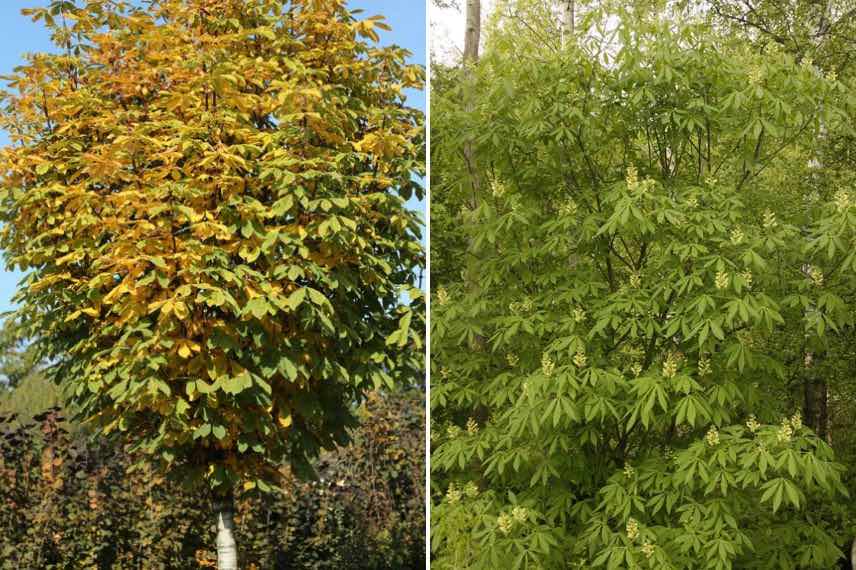
Aesculus ‘Umbraculifera’ and Aesculus x glaucescens
Notes:
– All HTML and shortcodes preserved.
– UK English spelling throughout.
– Terminology aligned with the glossary where applicable (e.g., “habit” for porte, “variety” for variété, etc.).
– The botanical names are left intact.
- Subscribe!
- Contents
Comments