So simple, so refreshing, so endearing, daffodils or narcissi (they are the same) symbolise the return of spring! Depending on the variety, flowering occurs from late February for the earliest to mid-May for the latest. They illuminate borders, beds, rockeries, and window boxes with their natural charm, offering a myriad of often single flowers and sometimes double ones. But what a pleasure it is to gather full bunches of daffodils to create fresh, spring bouquets that will fill the home with their often sweet fragrance. Under good conditions, these freshly cut daffodils last up to 15 days in a vase. Follow my tips and bring spring into your home!
1. Choose fragrant daffodils
All varieties of daffodils, from the simplest to the most sophisticated, are well-suited for bouquet making. You can choose from the most prolific and reliable varieties with sturdy stems that hold well in a vase. Consider 'Cassata', a graceful light yellow daffodil, known as orchid-like flowered, which is interesting for bouquets, the Narcissus 'Dick Wilden', a reliable choice with its large bright yellow double flowers, or the Narcissus 'Dutch Master', timeless, the true large-flowered golden yellow daffodil! The Narcissus ‘Flower Record’ is another must-have daffodil variety with its large white flowers and bright yellow crown edged in orange. Treat yourself to bunches of daffodils from the end of winter with the Narcissus 'February Gold' which is one of the first to bloom in the garden, sometimes as early as February and lasting until May or even June with the Narcissus ‘Sherborn’. And don’t miss out on their distinctive fragrance by choosing fragrant daffodils, such as the poet's daffodil ('Actaea', 'Recurvus', narcissus poeticus 'Albus Plenus Odoratus'), intensely fragrant.
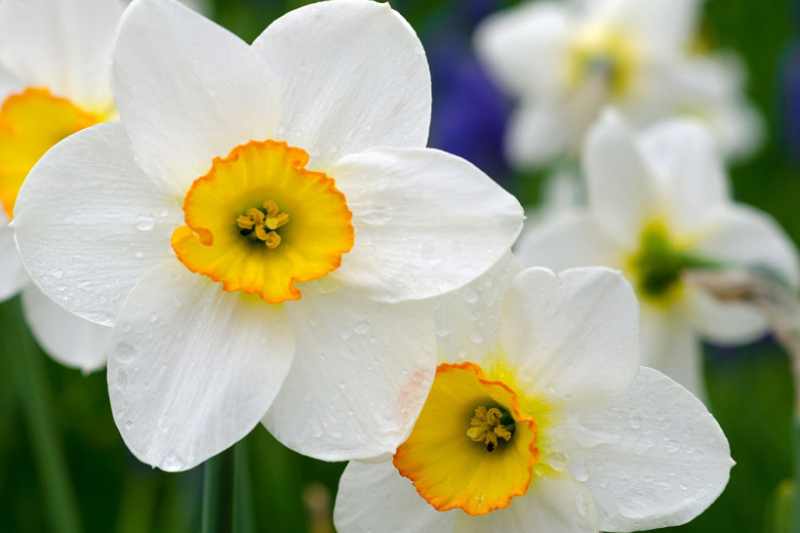
2. Select healthy, budded flowers!
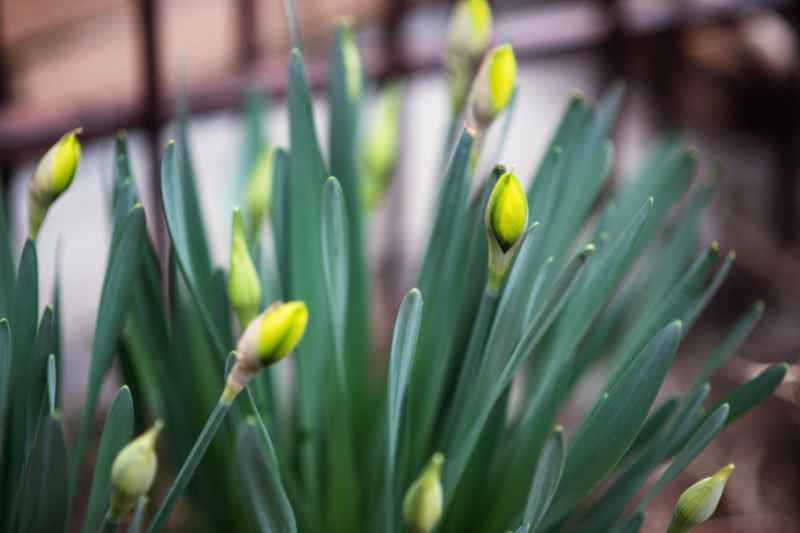
Pick your daffodils when the bud is coloured (wait until the flower's colour is fully visible) and just starting to open. Picked this way at the onset of their blooming, they last about ten days in a vase. Choose healthy flowers with intact stems. No need to use pruning shears; just gently cut the stems by hand or with a small knife to detach them from the bulb.
- Remove the lower leaves from each stem so they do not touch the water in the vase
- Quickly place the cut flowers in fresh water to preserve them
- Place your bouquet in a clean vase filled with water
- Avoid placing the vase in direct sunlight, but in a relatively cool spot
- Change the water regularly
3. Let them be solitary!
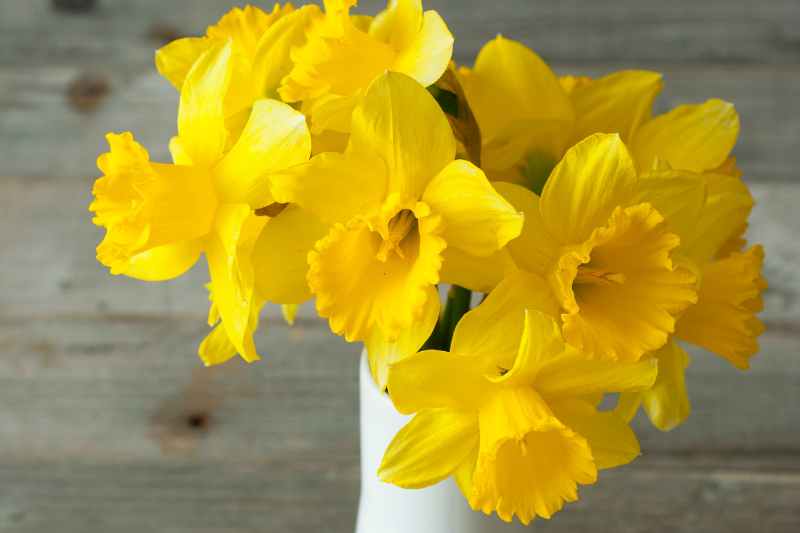
Daffodil stems contain sap that quickly wilts other flowers in a vase, particularly tulips. They are not good companions… We advise you not to mix them with other cut flowers, or you will have to change the water daily to better preserve your bouquet. The solution: soak the ends of the daffodil stems in hot water for 1 to 2 minutes to cauterise them before placing them in their vase. This way, you can enjoy your mixed flower bouquet for longer!
4. Choose the right vase
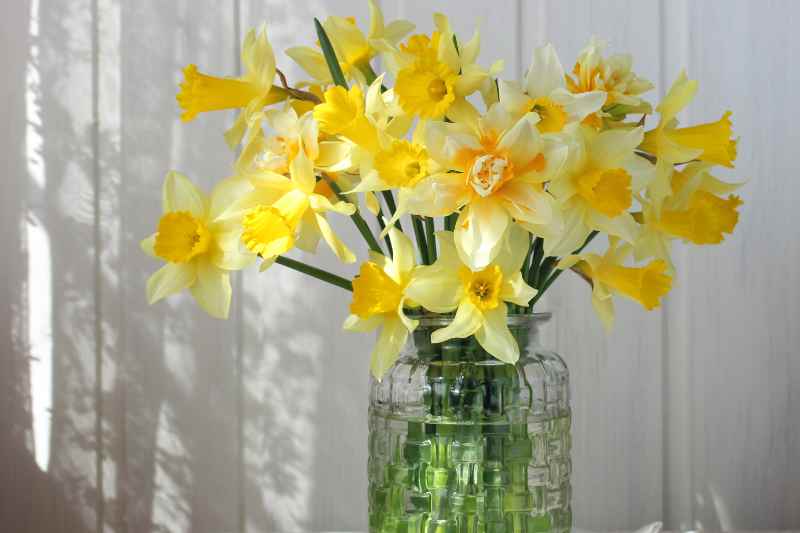
When choosing a vase, let your imagination run wild! A multitude of containers is available to showcase their vibrant and refreshing colours. Personally, I like to place daffodils in a clear glass vase, allowing me to enjoy the graphic display of their green stems. This could be, for example, a repurposed jar as a clever and pretty vase, simple yet effective, or a water carafe that creates a simple, natural, and poetic arrangement. Ceramic pots, especially blue Delft porcelain, will highlight the sunny yellow of their flowers. Placed in a zinc bucket or an enamel jug, they will embody a recycled or vintage spirit.
5. Mix them wisely
So, since other flowers do not tolerate their presence, what can you pair them with in a bouquet? Think of branches, such as twisted willows or catkins, those of decorative wood dogwoods, or spring-flowering shrubs like forsythias, lilacs, or Japanese quinces. Decorative foliage like that of eucalyptus or stems of ferns will look stunning with daffodil flowers.
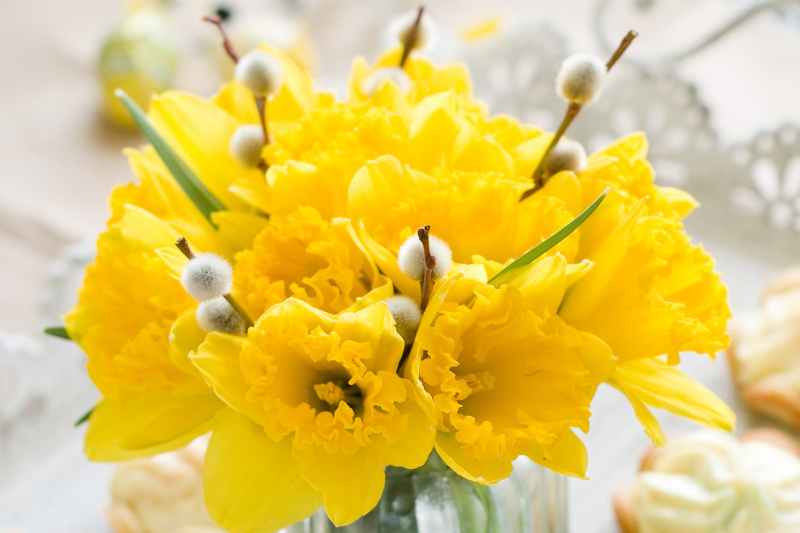
So simple, so refreshing, so endearing, daffodils or narcissi (they are the same) symbolise the return of spring! Depending on the variety, flowering occurs from late February for the earliest to mid-May for the latest. They illuminate borders, beds, rockeries, and window boxes with their natural charm, offering a myriad of often single flowers and sometimes double ones. But […]
Uncontrolled frenzy around the tulip, tulipomania is considered the first speculative bubble in history. This enthusiasm for a small, familiar bulb, now affordable for everyone, seems unimaginable! Yet, before becoming the most popular flower in its category, the tulip indeed travelled and became a coveted item exchanged for a fortune.
So why this tulip crisis? What legacy have tulips left us? Let’s travel back a few centuries to trace the tulip and its incredible journey in Europe…
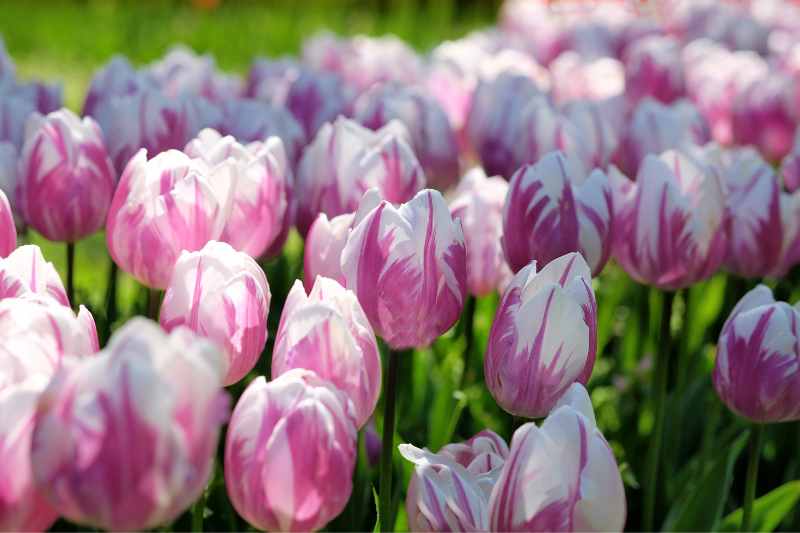
What is tulipomania?
Much has been said and written about tulipomania, that moment in European history when tulips were sold for exorbitant prices on the market. A troubled period, a fascinating and worrying phenomenon… It all unfolds in the 17th century, during the Dutch Golden Age, which radiates across the world, the seas, and trade.
Introduced around 1560 in the United Provinces (now the Netherlands), tulips first sparked the interest of botanists, and soon that of the general public. They garnered admiration in the Netherlands, but also in France, where they were planted in the gardens of the Louvre, with Louis XIII making them a symbol of luxury, and Louis XIV adopting this flower as the official flower of the court…
It was Charles de l’Ecluse (Carolus Clusius), a botanist and professor at the University of Leiden, who began planting the bulb in the sandy soils of the university garden in 1594, thus reproducing the tulip.
Horticulture was already developing in the province of Holland, where around fifty varieties were known by 1580. But by 1630, everything accelerated: over 100 different species of tulips arrived in less than a century.
The tulip became synonymous with success, an outward sign of wealth, and the powerful elite of the country understood this well. One must have them in their garden. Flemish bourgeois, nobles, and tavern owners began cultivating tulips, with some even abandoning their flourishing businesses and shops…
It became so coveted that sales now took place on a secondary market. The tulip became an object of speculation. A financial system was even established around what were called effect notes: from 1635 onwards, this mechanism allowed bulbs to be sold year-round, even while still in the ground, whereas previously tulips were sold in spring when one could assess the flower's conformity. A simple paper was signed, a sort of tulip share, where the merchandise was no longer visible... This sparked unparalleled enthusiasm, exchanging titles multiple times a day to drive prices up.
Tulips were exchanged for astronomical prices, or for land, livestock, silver cups, tons of grain, and other absurdities. It was said that the price of a beautiful bourgeois house on the Dutch canals could buy a single tulip or that it cost ten to twenty times the annual salary of a skilled artisan to procure the precious bulb at the height of the crisis. Even in France, tulipomania raged, as in Lille, where a tulip bulb became the currency of exchange for a brewery, which would bear the name of the tulip brewery. Between 1633 and 1637, tulips were the subject of frenzied trading, with gardens even being raided to unearth the precious bulb. The 'Viceroy' tulips streaked with lilac, and ‘Semper Augustus’, rare with marbled white petals (actually afflicted by a virus, difficult to reproduce), reached records, equivalent to 110,000 euros for a single bulb today. The bursting of the first speculative bubble in history was not far off…
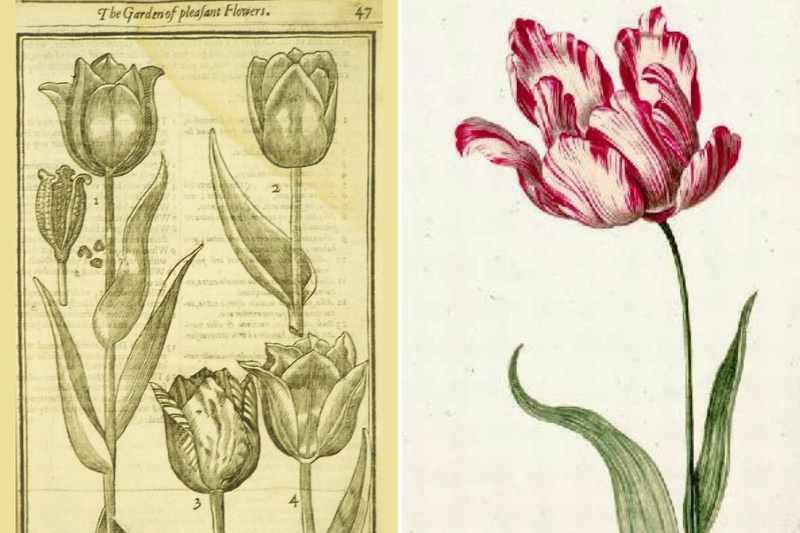
In February 1637, after two years of uncontrolled growth, tulips suddenly found no buyers in Haarlem, and sold poorly, even causing a discount… unprecedented! The government had to intervene to regulate sales. Prices collapsed, word of mouth did the rest, leading to a dizzying drop in market prices.
All those who had bet on the tulip found themselves ruined overnight, while large fortunes, empires built around the tulip, had emerged a few years earlier. The enthusiasm for tulips fell almost overnight. However, the real impact on the economy of the United Provinces was not as severe as that, as the merchants involved remained a restricted elite of the country. In contrast, a moral crisis emerged, denouncing, often in the arts, the indecent profits of a part of society, as seen in Jan Brueghel the Younger's painting satirising the tulip in 1640, where he caricatures speculators as monkeys. Later, other painters would also take up this subject, such as Jean-Léon Gérôme and The Duel at the Tulip (1882), followed by various authors. This was also followed by a number of works on tulip cultivation, including the famous Treatise on Tulips in 1765.
The fascination for tulips continued to be felt until the 19th century, with the famous novel The Black Tulip by Alexandre Dumas (father) which takes us back to the previous 17th century in Holland, where the main character dreams of creating a black tulip to win a fabulous reward.

Turkey: the other land of tulips
But let’s go back even further in time to find the origins of this small bulb… and the first fans of tulips!
Tulips actually come from the East, where they grew wild in the steppes of Central Asia, between Iran, the Caspian Sea, and as far as Afghanistan. These are botanical species of very small size, in warm colours, from yellow to red. They were known and cultivated as early as the 11th century in these regions. They gradually made their way to Anatolia, first through caravans returning from the Silk Road. Then Suleiman the Magnificent conquered some of these regions in the mid-16th century, and nomadic tribes brought back these beautiful flowers in large numbers, landing in Constantinople, now Istanbul. The tulip then became the flower of the sultans.
During the reign of Suleiman the Magnificent, the tulip was everywhere: in the sumptuous gardens of the Ottoman palaces, but also on the ceremonial caftans of the sultans, fabrics, and on the Iznik ceramics, this city that would make ceramic art shine throughout the country. Tulips were a recurring motif, along with the carnation, in the ceramics of the Topkapi Palace, as well as in mosques where floral representation was common. Tulips also adorned the sultan's turbans: Suleiman was known to stick one in his. Fashion did the rest… It was indeed the Turks who first became enamoured with this small, colourful bulb! In Ottoman art, the tulip symbolised the divine.

The word tulip comes from the Persian word, tülbend, which became türban in Turkish: originally a traditional turban of the Turks, they had taken to adorning their headgear when the tulip was introduced to the country. By confusion, the name tulipan was soon attributed to the flower. The Latin name tulipa became widespread in Europe from 1593. However, in Turkey, the flower still retains its original name of lale.
It is reported that in 1554, Suleiman the Magnificent offered some bulbs to a Flemish diplomat, the ambassador of Austria in Constantinople, Ogier Ghislain de Busbecq. He is credited with introducing the tulip to Europe, as he met Charles de l'Ecluse in Vienna a few years later, to whom he handed over some bulbs. Clusius would soon leave to work in Leiden, in the Netherlands, and successfully attempt to multiply tulips there... The rest is tulipomania and its excesses...
In Istanbul, since 2005, every April, the Tulip Festival takes place, a vibrant spectacle, a true open-air exhibition, celebrating the arrival of spring by honouring the tulip in many parks across the city. This is the direct legacy of the tulip festival that took place during the time of the sultans, up to Ahmed III, in the early 18th century, the peak of tulipomania in Turkey, more commonly known by historians as the "Tulip Era".
Tulips today around the world
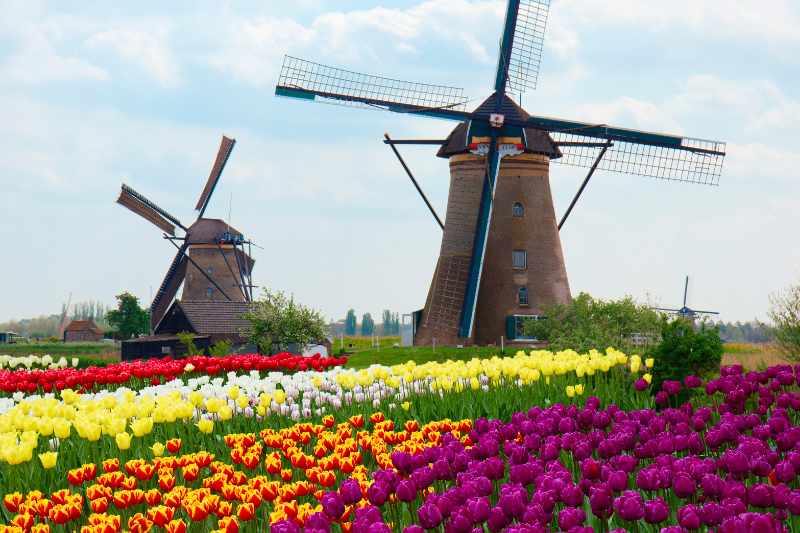
Since tulipomania… not much has changed in tulip production, as today, they are still primarily produced in the Netherlands, which is the world's leading producer. The tulip has become the emblematic flower of the country. Holland even has a world-renowned showcase at Keukenhof, where millions of tourists flock each year to admire the mass-planted flowerbeds. Over twenty thousand hectares are dedicated to bulb flowers in Holland, half of which is solely for tulips, still in the same region of Lisse, the cradle of production in the Netherlands, between Leiden and Haarlem.
Today, there are over 150 different varieties of tulips, and thousands of hybrids. Some producers continue to uphold a French tradition by producing and developing bulb plants, including tulips, particularly in Anjou where the sandy and loamy soil along the Loire is conducive to their cultivation, or in the Landes region.
At Promesse de fleurs, one in three spring bulbs sold is a tulip... There is no doubt that this wonderful little bulb - now affordable - has a bright future ahead!
Further reading
- Everything you need to know about the history of the tulip, with a reference book: The Tulip by Anna Pavord, (2001). Ed. Actes Sud;
- Read or reread The Black Tulip by Alexandre Dumas, a classic;
- Browse online at the BNF, the book by Charles Malo, History of Tulips (1821);
- Explore The ABC of Tulips, by Yves-Marie Allain and Catherine Garnier. 1996. Ed. Flammarion;
- Visit the Keukenhof park near Amsterdam where 7 million bulbs are planted each year, and explore the Amsterdam Tulip Museum.
- Bulbs 2026: 7 spring novelties to plant now!
Uncontrolled frenzy around the tulip, tulipomania is considered the first speculative bubble in history. This enthusiasm for a small, familiar bulb, now affordable for everyone, seems unimaginable! Yet, before becoming the most popular flower in its category, the tulip indeed travelled and became a coveted item exchanged for a fortune. So why this tulip crisis? […]
Alliums are on trend and make a statement wherever they showcase their decorative flowering, sometimes bold, sometimes more subtle... I couldn't tell you which side my heart leans towards. In any case, I couldn't do without ornamental garlic in the garden; they have become essential to me.
Discover 5 excellent reasons to plant alliums in your garden or in pots!
Alliums bloom in late spring
What I particularly appreciate about ornamental garlic is that most flower in May-June, a time when the garden is not yet very lush. Their beautiful spheres remain decorative even once faded, extending their interest for several months! In my garden, they accompany the first roses and brilliantly bridge the gap between spring bulbs and summer perennial plants.
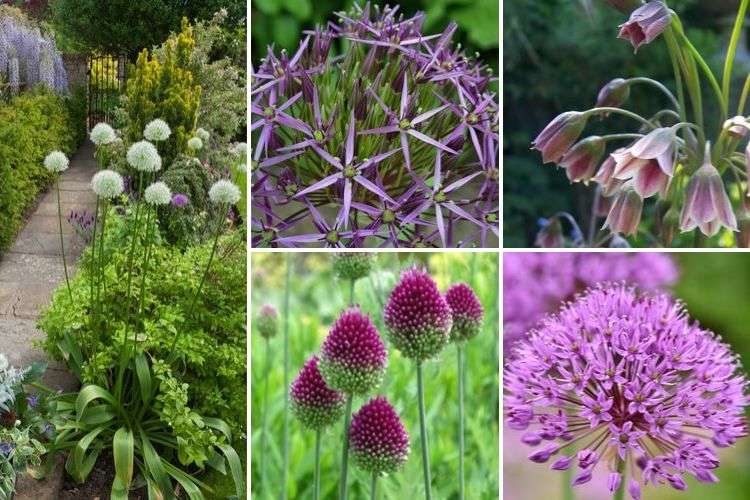
They are hassle-free plants
Alliums are hardy plants that require little! Just respect the exposure according to the species, plant them in light soil and, above all, perfectly drained; this is a must for them to return faithfully each year! Moreover, it's a dry regime for the voles who wouldn't dare plant the shadow of a tooth there. I would add that you get a beautiful display as early as the year following their planting, which is sure to please the eye quickly.
There is at least one variety for every area of the garden
You are probably familiar with the most spectacular alliums, those that boast large spherical umbels (purple, pink, white, burgundy, and even yellow) perched on tall stems. However, the allium family is much more diverse! Some clearly display their interest in grandeur with balls of a diameter that defies all competition, while others prefer to play the card of discretion, and still others are adorned with elegant pendulous bells. Not to mention, the small alliums that are well-suited for pot cultivation. This allows them to be invited in borders, rockeries, on terraces, or balconies.
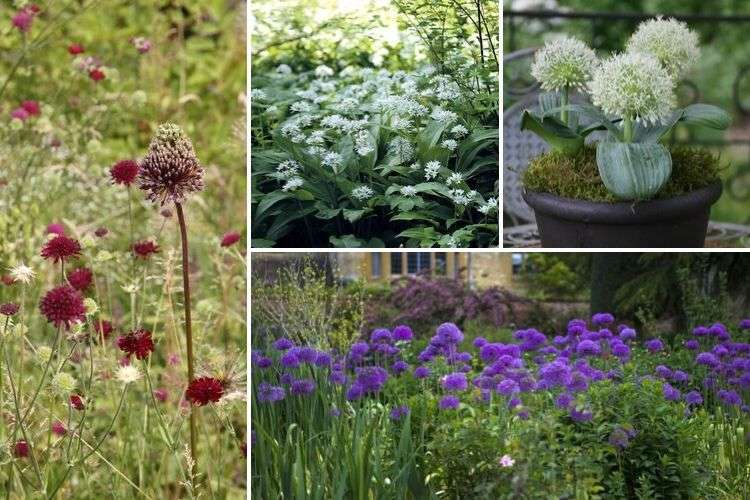
They are perfect for modern gardens but not only...
Essential in contemporary gardens, they remain very versatile and adapt everywhere. I believe they deserve a place in all garden styles. I love using them to create sumptuous colourful graphic scenes, to add character to a somewhat flat border, to compose a romantic border with tulips or roses, or to bring a touch of whimsy among grasses.
They are also ideal flowers for bouquets!
Alliums are also perfect candidates as cut flowers and are well-suited for making bouquets, whether modern, rustic, or dried. They have excellent vase life and pair wonderfully with tulips, roses, gypsophila, and more.
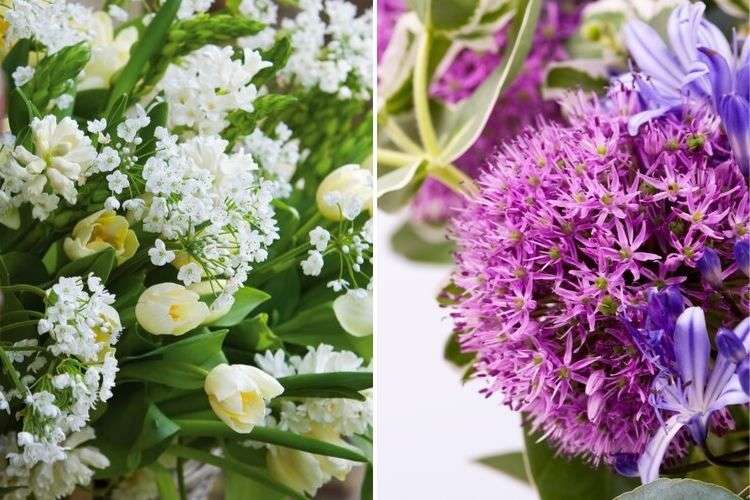
So, get your trowels ready!
Alliums are on trend and make a statement wherever they showcase their decorative flowering, sometimes bold, sometimes more subtle… I couldn’t tell you which side my heart leans towards. In any case, I couldn’t do without ornamental garlic in the garden; they have become essential to me. Discover 5 excellent reasons to plant alliums in […]
Planting spring bulbs is an autumn "routine" that I diligently carry out every year. It's not my favourite task in the garden, but I know that my diligence will be richly rewarded with the first beautiful days full of colour.
While the ideal time to plant spring bulbs has already begun a few weeks ago, I tend to wait until November to get started... Firstly, because I enjoy, in good years, the public holidays, but mainly because at this time, once the less presentable perennials have been cut back (I practice selective seedheads), I can see more clearly. Finally, if I cut the wifi if I'm lucky, I can easily find a child at home half-dead from boredom during the holidays, who can lend me a hand.
So today, let's see everything you need to know, or almost; to plant bulbs well.
Tip #1: For easy bulb planting: choose the right tool
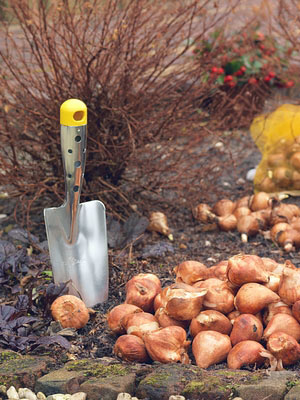
For a long time, I struggled using the first bulb planter that came to hand. You know, that so-called "automatic" thing whose plastic handle usually breaks after the third hole, especially if you're gardening in somewhat firm soil?
Then one day, after seeing this selection, I added a proper bulb planter to my Christmas list that could tackle my 200 holes without breaking... or breaking my back: a long-handled planter with a footrest. And that's when everything changed.
If you're planting less intensively, at the very least, opt for a sturdy tool that is made from a single piece. A good classic planter, used for perennials, can do the job just fine. It will always be better than a flimsy tool!
Tip #2: For abundant flowering: plant at the right time
The very end of summer and autumn (from September to November) is the best time to plant spring bulbs. For early flowering bulbs, like snowdrops and Crocus, the principle is simple: the earlier you plant, the greater your chances of seeing their flowers appear early the first year.
Late spring and early summer bulbs like Camassias or Alliums can also be planted in late winter, but if planted in autumn, they will have more time to settle in and will bloom much better.
For those with a busy planting schedule in autumn or who take advantage of end-of-season promotions, know that it is entirely possible to extend the planting period for bulbs until early winter, especially if you live in a mild climate.
Admittedly, the flowering will be less spectacular the first year, but it works! For all the details, I invite you to check our advice sheet: "Late Planting of Spring Bulbs"
Tip #3: For a real impact, don't skimp on quantity
The beauty of spring bulbs, besides warming our hearts by announcing the approaching end of winter, is their ability to enhance the interest of a summer bed. They are also very useful for flowering effortlessly and without maintenance in natural spaces like meadows and orchards. But for it to be effective, the visual impact must be strong enough.
For small bulbs, there is only one solution: plant in numbers and in masses. This applies to crocus, muscari, but especially to snowdrops, which are never as charming as when they stand closely together like a group of little penguins on the ice!
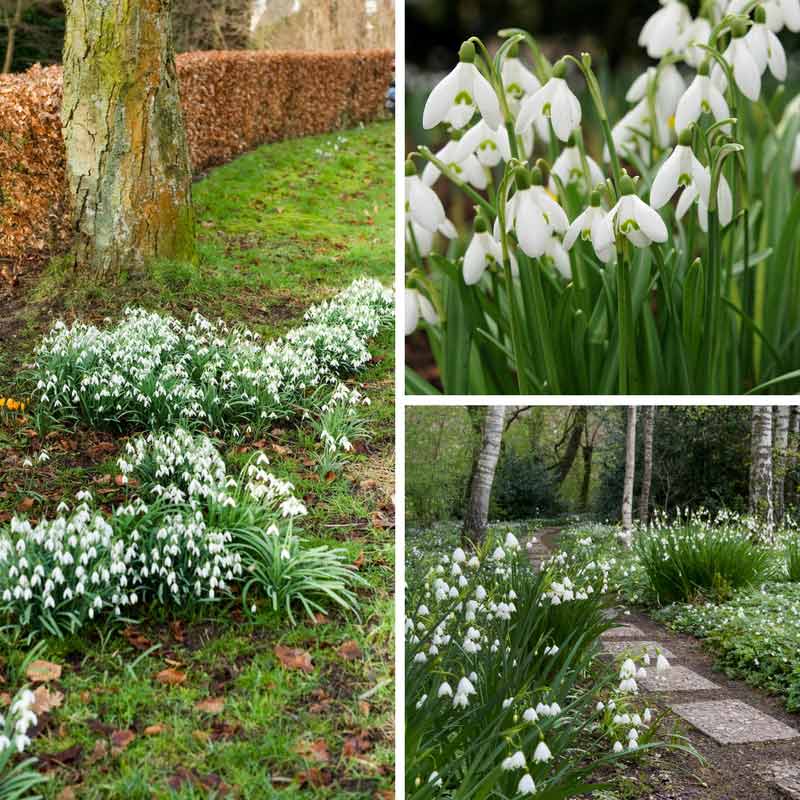
To know how many bulbs to plant, refer to the recommended planting distances in each of our plant sheets. The numbers may seem a bit crazy, but they correspond to what is necessary to achieve a real effect. This figure is expressed in the number of bulbs per square metre, but you are, of course, not obliged to plant a square metre of snowdrops! As you can probably see from the image above, a "patch" of 30 cm² (or 60 bulbs) already offers a very nice visual impact.
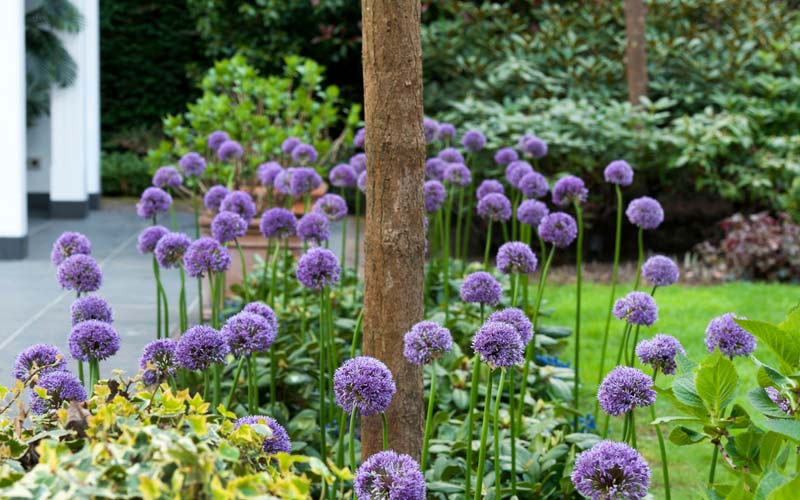
Larger bulbs like giant-flowered alliums and Imperial Fritillaries can be planted less densely, as they are remarkable from a distance and often benefit from being accompanied by other plants. If you are planting in an existing bed, these planting distances are less important, but do ensure to create wide patches by planting your bulbs closely together, among the already established plants.
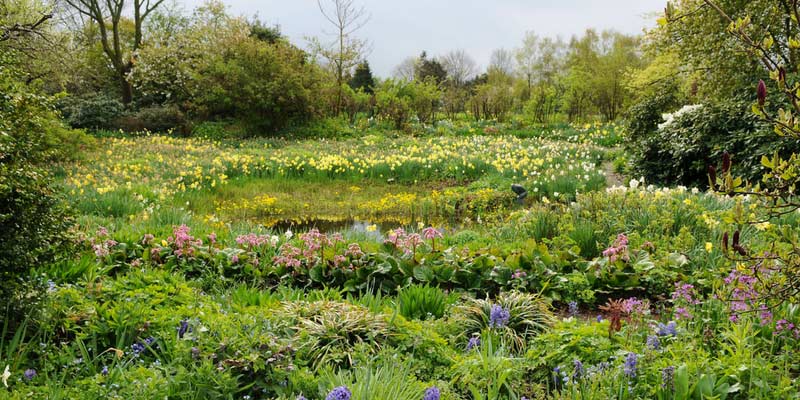
If you are planting in a lawn, the ideal is to opt for bulbs that naturalise easily like botanical daffodils, squills, botanical tulips, and guinea fowl fritillaries... Here too, you can plant a bit less densely because year after year, they will multiply and produce a mass effect at little cost. Remember Pierre's motto: Small bulbs, big effects!
Tip #4: For faster planting: choose the right method
Bulbs, whether planted in groups of 20 or 200, are not planted quite the same way if you want to save time. If you are planting within an already established bed, you will be forced to use a planter and plant individually. However, if you want to create a border specifically for these plants, we recommend a method that involves removing the grass over a wide area rather than planting individually:
In this video, you will see that the grass is put back in place. This is not a requirement: you can also mulch with fallen leaves or pruning chips.
Tip #5: To prevent rot, ensure good drainage and avoid over-fertilising
We can never repeat it enough, and even if some appreciate moist soils, bulbous plants dread waterlogged soils, which inevitably leads to their rot. It is therefore essential, in very wet soil that retains water, to improve drainage. To do this, it's very simple: place a layer of gravel or sand, about two centimetres thick, at the bottom of the planting bed or hole.
Also note that soil that has been fertilised too recently, excessively, or with compost or manure that is not well-matured can also promote the rot of your bulbs. If your soil is poor, you can add fertiliser, but it should:
- be suitable (use a special bulb fertiliser; a fertiliser too rich in nitrogen would encourage foliage growth at the expense of flowers),
- be moderate as bulbous plants are not "greedy".
Tip #6: Plant a bulb in the right direction, at the right depth, is better...
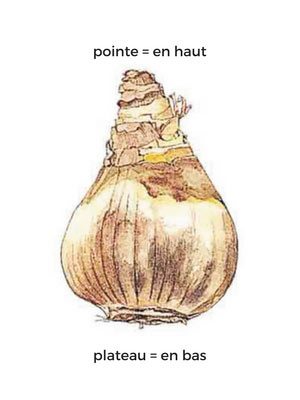
Planting a bulb upside down is a classic mistake of beginner gardeners. Nothing dramatic, as in most cases, the bulb is a contortionist and will eventually turn itself around. This is what is known as geotropism... but, if possible, it's better to spare it this effort! To know which way to plant your bulbs, observe them: the point should be facing upwards and the plateau, from which the roots will emerge, downwards. Logical 🙂
Regarding the planting depth of bulbs, it is often said that the planting depth corresponds to three times the diameter of the bulb... but also that bulbs should be planted at a depth equal to twice their height. And of course, there are exceptions that confirm these rules.
Rather than measuring your bulbs and getting out your calculators, check the indications at the end of each plant sheet... or keep the packets until planting time: it's noted on them!
Tip #7: Beware of voles!
Every spring, we receive a few calls from customers who assure us that their tulip bulbs have not flowered. And in most cases, when we ask them to check the condition of the bulbs, they cannot find them. And when they do, they appear partially gnawed. The culprits? Voles!
If you too have to deal with rodents, don't take any risks: choose bulbs that are generally not attacked or implement the necessary protective measures! To find out how to do this, discover Virginie's tips: "How to Protect Bulbs from Rodents".
And you, do you know how to plant bulbs? What is the trend where you are? Perhaps you have tips to make this task a little less tedious... Don't hesitate to share them in the comments!
Planting spring bulbs is an autumn “routine” that I diligently carry out every year. It’s not my favourite task in the garden, but I know that my diligence will be richly rewarded with the first beautiful days full of colour. While the ideal time to plant spring bulbs has already begun a few weeks ago, […]
Tulips are, among the spring flowering bulbs, the easiest to succeed with: well-sized, standardized bulbs that are almost always homogeneous in quality; they are the easy bulbs par excellence; and yet, it is just as easy, with a little attention, to fail at planting them.
Follow our meticulously established guide, based on the author's extensive first-hand experience with various failures, and also, let’s thank them in passing, the help of many inventive clients who, by phone or email, have vigorously explained their little secrets leading to failure.
Lesson number 1: to fail with your tulips, plant them in late spring or summer
Living in Flanders, I regularly spend weekends (cultural) in Amsterdam, and I have always been amazed to see, in May-June, a plethora of tulip bulbs for sale at the Amsterdam flower market… For a long time, I wondered what that could yield. So I eventually tried planting Dutch tulips in late spring, among other local crops.
The result was quite pitiful: a third of the bulbs did not start, the rest bloomed roughly at the same time as my dahlias, and most of my bulbs did not survive the following winter.
Grandma and popular wisdom say: "tulips should be planted in autumn, preferably in September or October."

Tulips should be planted in autumn!
Series of tests conducted at the nursery nuance this result: tulip bulbs establish better if planted in autumn; results are respectable for winter planting, but become frankly random from March-April onwards.
So, to fail with your tulips, plant them whenever you think of it, in April-May when they are blooming at your neighbour's and it makes you green with envy. The result will be, at best, mediocre.
Proposed variant for distracted and lazy gardeners: buy them in autumn, forget them in the garage for a year and plant them the following autumn, guaranteed failure at 95%! We often advise clients who call us in January after finding a packet of bulbs wickedly hidden by the cleaner at the back of the shed to plant immediately: flowering will be slightly delayed, but quite acceptable.
Lesson number 2: to fail with your tulips, sort your bulbs very ri-gou-rous-ly (and throw them all away)… or don’t sort them at all!
While the first lesson was suited to lazy, procrastinating Latin gardeners like me, the second is aimed at neat freaks, preferably with a background from across the Rhine.
Cultivated tulip bulbs are mechanically harvested by machines with sorts of harrows. It’s not extraordinarily poetic, but effective (and it’s what allows you not to pay ten euros per bulb).

Mechanical harvesting of tulip bulbs
In the process, many bulbs lose their little protective copper-coloured skin (of no importance), and some end up slightly scraped, sometimes superficially nicked, without any detrimental consequence on the bulb's recovery.
On the other hand, mould is a very serious enemy of the tulip bulb: during autumn, bulbs, especially if stored in humid conditions, tend to develop a layer of mould. If this damage is superficial, a quick wipe will remove it, and recovery will be perfect. However, if this mould reaches the inside of the bulb (signal: the mould doesn’t come off with a quick wipe), particularly at the root plate, the bulb has no chance of recovery. Worse: the mould may spread to other nearby tulip bulbs. This is why we manually sort all our tulip bulbs during packaging; also the reason why it is advised to plant tulips in September or October: bulbs are, at that time, practically free from mould attacks.
So, to fail with your tulips, throw away all the bulbs for non-compliance before planting… Or conversely, leave a packet of bulbs lying around in a humid place, and, with a bit of luck, the bulbs will mould within a few weeks.
Lesson number 3: to fail with your tulips, plant them in an unsuitable place: deep shade, marsh, extremely heavy soil, or rocky areas where nothing grows
The tulip, true to its Ottoman origins, loves sun and fairly well-drained soils, which do not retain too much water, but are relatively rich, to allow the bulb to replenish its reserves after flowering.
It blooms on the reserves accumulated by the bulb, even if the growing conditions are poor, so it is difficult to fail the first year. However, if the conditions are sufficiently bad, the bulb will not be able to properly replenish its reserves after flowering: thus, by the second year, the flowers will be weak or absent.
If the bulb is planted in complete shade (less than two hours of sun per day), the flowers will be weak.
If the bulb is planted in very heavy and wet soil, some bulbs may rot from the first year, the rest in subsequent years.
If the tulip is planted in excessively dry soil in spring, the tulips will be stunted, with early yellowing of the foliage, and will not return.
Note: there’s no need to try to fail your tulips by planting them in very acidic or calcareous soil: tulip bulbs tolerate all pH levels, you will not fail them with this classic method.
For technical enthusiasts, it is interesting to note that not all tulips have the same resistance to difficult conditions.
The botanical tulips (small tulips that maintain a distant relationship with their natural ancestors) are ultra-tough. They last for many years even in shaded heavy soil. They naturalise as soon as conditions are suitable. Very difficult to fail, a challenge!
The old horticultural tulips (e.g.: Lily-flowering, Triumph) are quite sturdy. They last about 3 years in poor growing conditions, 7 to 10 years in good growing conditions. Difficult to fail.
The double tulips (peony-flowered tulips) are generally fragile, lasting 2 to 5 years depending on growing conditions. Quite easy to fail.
In summary, to fail your tulip plantings:
- If you live in the northern half of France: plant recent double-flowered varieties in heavy, wet soil in a very shaded position. And if the winter is dry, water abundantly to ensure failure.
- If you live in the south: plant the same varieties in poor, stony soil, without any watering, and cross your fingers for a very dry spring, a guarantee of failure.
Lesson number 4: to fail with your tulips, plant them upside down, or too deep, or not deep enough
Tulips have a top (the small point) and a bottom (the flat area from which the roots will emerge); if planted upside down, point down and roots up, they will struggle to emerge…. To be honest, I must admit, I have never actually tried this method. But I know it works, having dealt with a furious client about the poor quality of our bulbs. He had carefully planted his bulbs upside down…
Variants of failure:
- Maniac version: planting your bulbs too deep (result: stunted tulips… or even no tulips at all). This is a classic method that requires effort; you need to dig deep, about thirty centimetres, but it is worth it: you end up with rather ridiculous-looking tulips.
- Lazy version: planting your bulbs too shallow (bulb almost at the surface), a method that is very economical in time and effort, which is why I like it so much. However, it is more random; sometimes tulips settle in well despite everything, who knows why.
To properly plant your tulips, here’s what a good gardener would write:
- Make a hole 4 times the diameter of the bulb (about 20 cm)
- Fill a quarter of the hole (the height of one bulb) with loose soil, or even potting soil or soil mixed with coarse river sand if you have heavy soil. This effectively extends the number of years of flowering.
- Place the bulb, point up, at the bottom of the hole (about 15 cm)
Cover with soil. If you haven’t made a mistake in these complicated calculations, the bulb should be covered with twice its height of soil (a good 10 cm).
So, to fail with your tulip plantings, plant them upside down, far too deep, at least 20 cm deep, or too shallow, less than 5 cm, in uncompacted soil.
Lesson number 5: how to fail the re-flowering of tulips: early digging or mowing, famine or death by thirst
Nature is poorly made: tulips in the garden need a little attention just when you stop taking care of them, after flowering, when these sublime beauties fade and turn into unsightly stems and leaves that are more or less yellowish.
The post-flowering period, generally April-May or May-June, is when tulip bulbs replenish their reserves to be able to bloom again the following year: they need their foliage, a bit of water (especially if they are planted in pots), and appreciate some fertiliser. You can safely cut the flower stems, but a good gardener does not cut the foliage before it has completely yellowed. On the contrary, they will stimulate it, with a bit of fertiliser, and water in case of spring drought. The said good gardener also plants, in front of or among their tulips, spring-flowering perennials, like brunneras for example, which help to mask the unsightly foliage of tulips after flowering, without having to cut it prematurely.
So, you guessed it, to prevent your tulips from re-flowering properly, you need to thwart this regeneration. The simplest way is to mow immediately after flowering over your tulip bed: the bulbs will not re-flower, or very little. And if you repeat the mowing after flowering the second year, you will eliminate the last survivors.
Note: it was traditional among old gardeners to dig up tulip bulbs at the end of spring to replant them in early autumn. This custom has fallen out of favour, as it does not significantly improve their lifespan. In theory, digging and storing in trays reduces the risk of fungal disease (like fusarium); in practice, there is generally more risk related to poor storage conditions (excessive humidity, presence of rodents, etc.) than to leaving them in the ground in a properly drained garden. In short: leaving your bulbs in the ground will not significantly increase your chances of failing them.
In summary, to prevent tulips from re-flowering in the second year, mow your beds immediately after planting.
* * *
As a special bonus to reward readers who have had the patience to skim through all these many lines:
Bonus gift: how to create an ugly tulip bed?
You can succeed in growing tulips, and still easily end up with a very ugly result. It’s very easy; here are some little tricks from a specialist to help you:
- Mix a lot of non-complementary colours
It is often said that a beautiful bed plays on two colours, a maximum of 3. If you mix bulbs of 4 or 5 non-complementary colours, you will generally achieve a garish result that will remind you of your grandmother's plant mail-order catalogues (no, we won’t name names!).
- Plant several varieties side by side without mixing them
You randomly acquire the magnificent collection of tulips "Carnival of Venice" from Promesse de fleurs (our best seller for 30 years), and instead of mixing the 5 matching varieties of this collection for a harmonious result, plant each variety separately. Even better: instead of planting naturally, that is to say, a bit irregularly, make nice straight planting lines, just like in the vegetable garden. The result will be… strange!
- Plant insufficiently dense
Experienced gardeners plant tulips quite densely for a nice group effect. Without necessarily planting in large numbers, a nice effect can be achieved with 10 bulbs planted in a "potato" shape over 20 cm2, or even with 5 bulbs grouped in "clumps" in the same large planting hole, with a spacing of about ten cm between bulbs.
You read on promessedefleurs.com that you can plant a hundred tulip bulbs per m2, at least 50, and your mother-in-law boasts with her beds of 150 tulips per m2. But since you’re not easily fooled, and you know the generally dishonest mercantile spirit of Promesse de fleurs and your mother-in-law's reckless spending when it comes to anything other than your birthday gift, you scoff and plant your bulbs economically, 10 bulbs per m2; it sounds good, and it makes… one bulb every 40 cm.
Bravo!
The result will be bizarrely ugly: you will have the vision of a small forest of stems (tulip stems are always unsightly). And if you combine this with the previous advice, I promise you that neighbours and passers-by will stop in front of your garden to contemplate your bed.
I promise you this, as I still vividly remember, despite the time that has passed, a sort of gathering of giggling neighbours one day in front of the magnificent first flowering of my very first tulip bed.
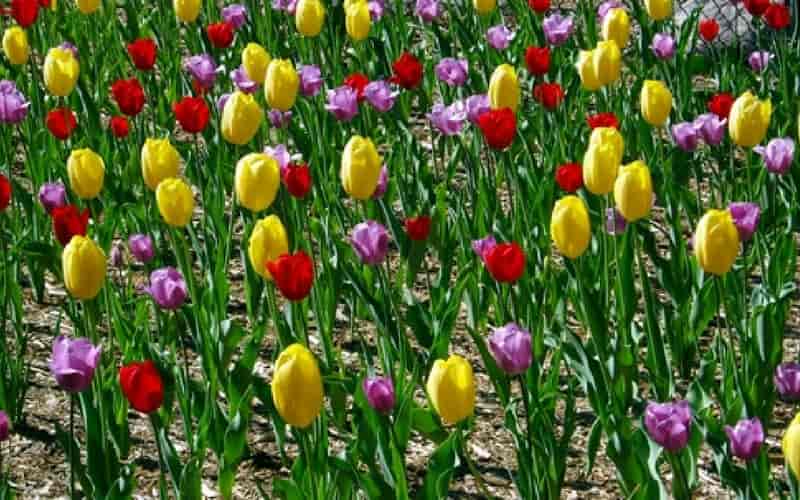
Tulips are, among the spring flowering bulbs, the easiest to succeed with: well-sized, standardized bulbs that are almost always homogeneous in quality; they are the easy bulbs par excellence; and yet, it is just as easy, with a little attention, to fail at planting them. Follow our meticulously established guide, based on the author’s extensive […]
Iris: a prolific perennial that blooms in summer
This year, with the early arrival of warmth across all our regions, we will soon be able to plant or divide garden irises. They need to be in their resting period, filled with reserves and sun-baked, before we can handle their large rhizomes.
Perhaps you are one of those who offer them every summer to your neighbours, friends, colleagues, and acquaintances. They have likely lost their identity from getting tangled in your flower beds. So, just like me, you offer irises as one would give a basket of plums or apricots in years when the tree yields so much that you are forced to make jam: “For the colour, it will be a surprise! There are white, blue, yellow, orange, pink, and even almost red ones,” I say enthusiastically to my interlocutors.
You who once fell under their spell, are you still as devoted?
The beginning of a passion
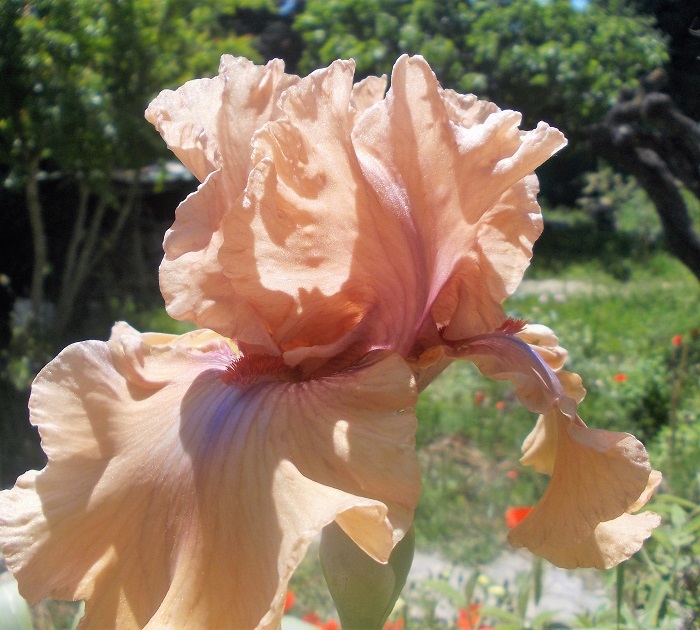
I discovered them an eternity ago, while leafing through a gardening magazine to which I was subscribed. This was long before the invention of the internet… To say that I was thrilled by garden irises would be an understatement. Amazed, captivated, enchanted, and then hooked would be more accurate. So much so that I asked for them as my only reward if I passed my A-levels. That was how it was in our house. I got the diploma, and my first order of irises. The clumsy rhizomes were hastily planted as if hiding a treasure in the family garden, along the edge of the vegetable patch. Today, a few rare anemic survivors remain, which neither neglect, nor weeds, nor shade, nor gastropods have managed to completely eliminate. Years have passed, summers have come and gone, gardens and iris orders too, marked by my crushes that always occurred irresistibly when those in the garden were in full bloom. New colours, new shapes, reserving for the following year those I coveted, I had to have them all!
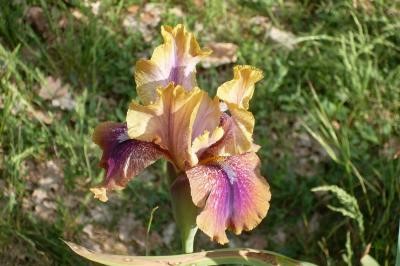
At the moment I fell for irises, I discovered with wonder at a breeder in Var some fantastic hybrids, called “Arilbred”, resulting from cross-breeding between our Iris germanica and botanical species from the arid and semi-desert regions of the Near and Middle East. Probably too difficult to cultivate in our average climates, not floriferous enough, not profitable enough, these wonders gradually disappeared from his catalogue, and no one talks about them anymore. In France, to my knowledge, only one enthusiast (of English origin) offers for sale a few varieties that he hybridises and cultivates with infinite care. I am always on the lookout for these somewhat mythical irises named with lovely Persian, Babylonian, and Phoenician names, names that evoke One Thousand and One Nights or some fabulous Nebuchadnezzar...
A plant not so easy
I must now confess: after having adored garden irises, my enthusiasm has somewhat waned. Here is my testimony:
Many years spent alongside them have taught me that these seemingly robust plants actually require regular care, and therefore quite a bit of time. Let’s not be mistaken: unlike the original irises, extremely austere and nearly indestructible, our stunning modern varieties with their enormous corollas require fairly fertile and sufficiently deep soil to fulfil their promises.
In spring, they must face an army of little soft ogres, without legs and hungry; I remember leading the battle every day by their side to protect the flower spikes. At the crack of dawn, armed with a packet of slug pellets, I keep a keen eye out for the very green nocturnal creature that knows how to be very discreet and rises well before I do!
Garden irises require regular and meticulous weeding on our part, lest we see them smothered by weeds that retain moisture, create harmful shade for their ripening, and provide an ideal refuge for slugs.
Their corollas are sometimes so heavy that they bend the stems to the ground. The wind or rain, of course, exacerbates the problem.
For each variety, once the two or three weeks of spring glory have passed, only the leaves remain, which are ultimately quite ordinary. In summer, if it is dry, they look rather poor.
As greedy and prolific plants, it is advisable to divide and replant them in fresh soil every four years… An impossible mission for an iris collector who has neither much free time nor a truly sunny large garden, that is to say, a real field of cultivation!
Consequently, the distribution of rhizomes becomes a periodic and ritual task, all the more delicate as your relationships, expanded to the widest circle and already cluttered with your gifts, decline your offer while thanking you politely. That is to say, of course, their garden, just like yours, is not extensible!
The wild garden and roadside Iris
All this being said, I wanted to take a moment to pay tribute to our “wild” irises, which have little in common with modern varieties.
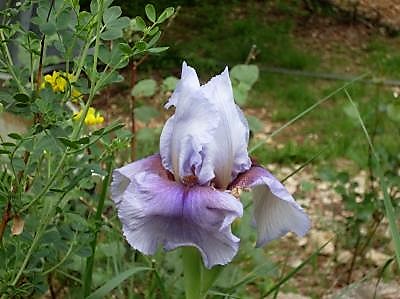
Do you remember their flame-like flowers in mauve-violet and blue tones, their almost transparent silky petals? Their authentic scent of old rice powder, warm, sweet, and suave, capable of dressing an entire flower bed on a warm April day? These are the ones you see blooming by the roadside long before the others, when you’re not driving too fast. They are the ones that raise their spikes laden with dozens of flowers in the wind, clinging to a bank, magnificent in their simplicity and dignity in their solitude. You also catch sight of them not far from a well-tended garden, set apart, resurrected on a pile of plant waste where a furious hand has thrown them.
I hold a special place in my heart for those that my ancestor planted in 1896 in his “enclosure” (that’s what we call walled gardens in the South). They have survived abandonment and now form a vast carpet at the foot of a large Mediterranean hackberry that barely manages to prevent them from blooming.
To be honest, I keep these same “wild” ones a bit outside my own garden as they would quickly colonise: every year in summer, I pull up a few rhizomes from the clumps that have become too large to plant them along the private path that leads to my home. There, at the foot of the evergreen hedge, in truly poor soil, they have room to spread and disturb no one. And they are indeed the only ones, along with viper’s bugloss, mallow, chicory, and wild rocket, to grow and bloom with enthusiasm. Among them, some manage to offer flowers even in the shade! Would you believe it? You are right: shade in Provence is often bright!
And since we are talking about dry shade, do you know the Algerian Iris (Iris unguicularis), evergreen, with long grass-like leaves, flowering as early as February under the large trees?
The poor man's orchid
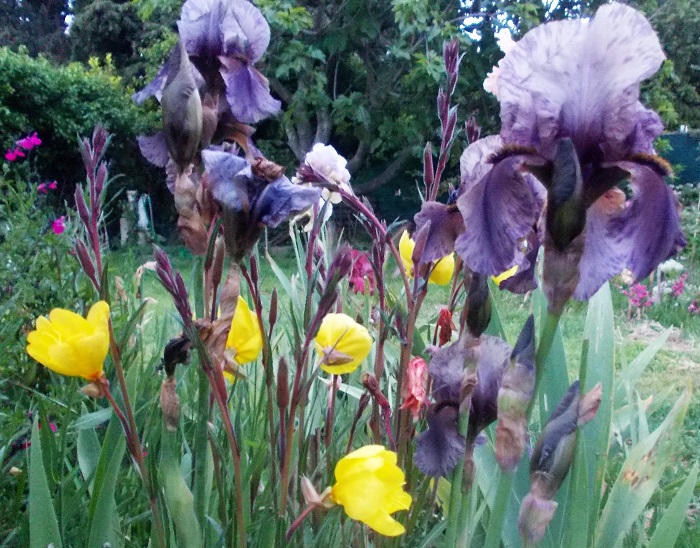
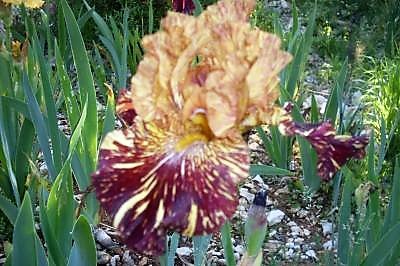
Come on, we still love modern irises. And I love them too: the proof is that I have always taken one or two bags filled with anonymous rhizomes every time I moved. Perhaps out of gratitude towards these plants that have given me so much. I remain attached to their extravagant corollas and feel great respect, yes, for these flowers that are still quite extraordinary.
The garden iris, royal flower, divine messenger of the gods, spirit of the rainbow, leaves a fluid, iridescent, and multicoloured veil in its wake. The original Iris germanica, a hardy plant of poor soil, proudly carries its nickname of ‘Poor Man’s Orchid’!
Iris: a prolific perennial that blooms in summer This year, with the early arrival of warmth across all our regions, we will soon be able to plant or divide garden irises. They need to be in their resting period, filled with reserves and sun-baked, before we can handle their large rhizomes. Perhaps you are one […]
A light mist enveloped the garden this morning... After a surprise heatwave, is autumn already showing its first signs? Anyway, I won't talk about the weather, but about a topic just as vast: tulips! It's the start of the bulb planting season, and the question arises: which tulip to choose from the hundreds of varieties offered in catalogues?
Of course, there’s personal taste to consider, and with 3000 varieties registered and new additions each year, it can be said that when it comes to tulip bulbs, there’s something for everyone! To help you navigate, successive generations of horticulturists have grouped the various varieties into groups or families of tulips, each responding to specific botanical and aesthetic criteria (more or less) precise, as well as usage: depending on the flowering period, your soil, or the style of your garden, you will turn to specific families in which you will seek the most beautiful to your eyes... Discover some tips and landmarks.
1) Choosing tulips according to flowering time
The tulip is one of the most beautiful and famous of the spring-flowering bulbs. Its colours, often vivid and sometimes subtle, brighten the first days of fine weather or, conversely, awaken the sometimes still grey days of early spring. Fortunately, the horticultural classification of tulips also corresponds to the flowering calendar! It is therefore very easy to navigate, and by combining varieties from several families, you can achieve up to 2 months of continuous flowering... what more could you ask for? Of course, the chronological markers on flowering dates provided are not "an exact science" and should be nuanced by the climatic variations observed regionally and from year to year.
In bloom from March-April, the early tulips
- As their name suggests, early single tulips and early double tulips, including the famous hybrids 'Murillo', are among the first to bloom, from early April. They rarely exceed 35cm in height and are thus sturdy enough to withstand bad weather.
- They are, however, preceded by certain botanical species and their hybrids. Among the botanical tulips, there are wild species, although they have unfortunately often disappeared from their natural habitat, with a flowering period that is not uniform and extends from March to June depending on the species. From early to mid-March, you can count on Tulipa tarda, Tulipa humilis and its many varieties, Tulipa clusiana, Tulipa turkestanica... and many others that are rarer! These rarely exceed 10 to 15cm in height.
- The botanical tulips from the greigii group, with marbled black foliage, kaufmanianna or "water lily tulips", and the excellent fosteriana ('Purissima', 'Madame Lefeber', 'Orange Emperor'...) have vivid and varied colours, measuring 20 to 30cm in height, 40cm for fosteriana, they bloom from late March to early April and thus precede the "early" tulips by a little.
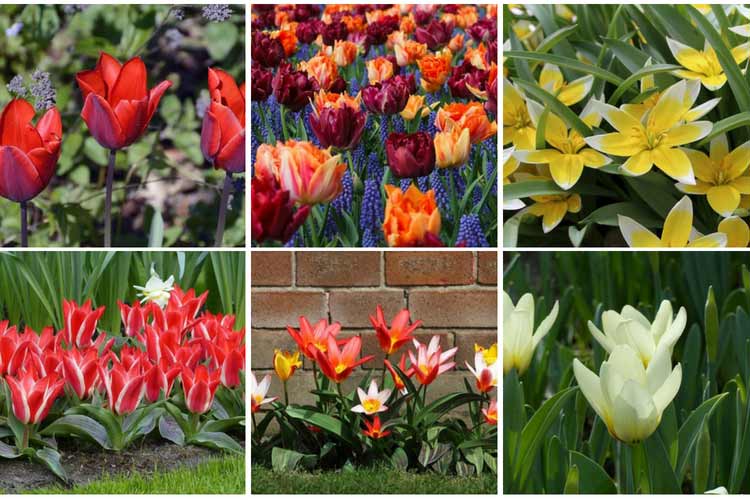 Early single tulip 'Couleur Cardinal' - Early double tulips 'David Teniers' and 'Willem van Oranje' (Murillo) - Tulipa tarda - Greigii tulip 'Plaisir' - Kaufmanniana tulips - Fosteriana tulip 'Concerto'[/caption>
April flowering, the heart of the tulip season
- The Triumph tulip, aptly named, was obtained by crossing an early single tulip and a late tulip, and blooms just in time in April. Triumph tulips now form one of the largest and most diverse groups. 'Attila', 'Princess Irene', 'Shirley', 'Gavota', 'Negrita'... are among the best-known and most appreciated. With an average height of between 40 and 50cm, varieties from this group offer great possibilities for use, in beds as well as in pots and as cut flowers.
- To obtain even more choices in tulips blooming in April, it is also possible to "pick" from the neighbouring groups of parrot tulips and lily-flowered tulips, whose varieties share only their shape. Some are indeed derived from natural mutations of 'Triumph' tulips and have thus changed shape while retaining the same flowering time, such as 'Princess Irene Parrot' for example. 'Ballerina', with orange lily-shaped flowers and a fragrance, also always blooms in the second half of April in my garden.
- The tallest of the "botanical tulips", those measuring about 30cm high, are also in bloom in April: Tulipa praestans, Tulipa whittallii, and the rare and beautiful Tulipa orphanidea 'Flava', to name just a few.
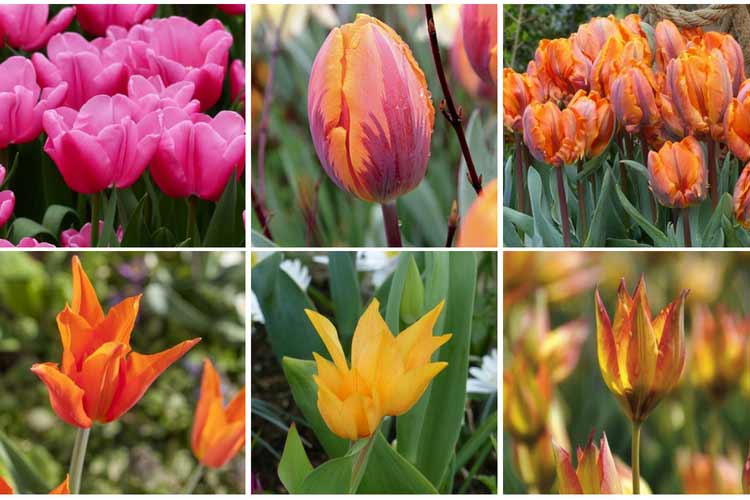 Triumph tulip 'In Love' - Triumph tulip 'Princess Irene' - Parrot tulip 'Irene Parrot' - Lily-flowered tulip 'Ballerina' - Tulip praestans 'Shogun' - Tulipa orphanidea 'Flava'[/caption>
In bloom from late April to mid-May, the late tulips
- The "Darwin" tulips, with large flowers appearing in late April on strong stems that are 50 to 60cm long, are excellent reliable and sturdy garden varieties, always spectacular, but not always to everyone's taste with their pure and contrasting colours ranging from yellow to red, highlighted by a large black heart at the base of the petals ('Apeldoorn', 'Golden Apeldoorn'...).
- The late single tulips, also called "cottage" or "long-stemmed" tulips, reaching 60cm in height or more, and their counterparts, the late double tulips or "peony-flowered" like 'Angélique', bloom in early May. They are the undisputed queens of bouquets! Many varieties are indeed French creations developed for the production of very high-quality cut flowers in the South: 'Avignon', 'Dordogne', 'Ollioules', and of course 'Roi du Midi' are among them.
- The "original" tulips: frilly parrot tulips, elegant lily-flowered tulips, delicate lace or fringed tulips, and fascinating viridiflora tulips like 'Groenland' or 'Spring Green' with flowers striped with a central green band, should be planted in well-maintained beds as these horticultural creations are not always the most resilient.
- Tulipa sprengeri: the exception that confirms the rule, this highly sought-after botanical tulip is always the last to bloom, in June! Its red-orange flowers with slightly pointed petals are both unexpected, elegant, and spectacular. Very rare, it naturalises easily in the sun, provided it is never disturbed by soil work.
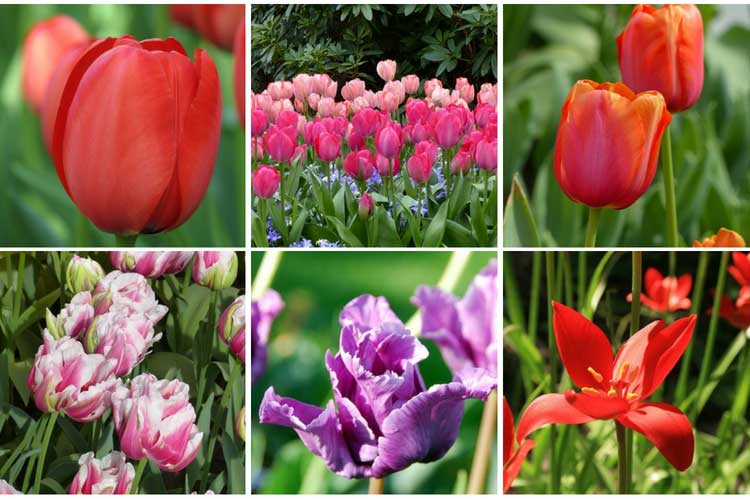 Darwin tulip 'Apeldoorn' - Darwin tulips 'Van Eijk' - Late single tulip 'Avignon' - Late double tulip 'Fantasy Lady' - Parrot tulip 'Blue Parrot' - Tulipa sprengeri[/caption>
2) Choosing tulips according to your soil type
While they thrive in all soils, tulips prefer rich, loose, well-drained soils, warm in summer, without stagnant moisture in winter, with a neutral to alkaline pH (calcareous).
- In a "good garden soil", black and rich, loamy or clay-loamy, as long as there is drainage, all fantasies are allowed, choose at your leisure! You can even leave the bulbs in the ground over winter, without any qualms, except for the most fanciful varieties, your tulip bulbs will return more numerous year after year. If this is the case in your garden, go directly to point 3!
- In heavy clay soil, "sticky" and clinging to fingers and tools... it’s a different story! You can only grow tulips in beds with enriched and amended soil with compost and sand, well worked each year, and on the condition of lifting the bulbs at the end of flowering before drying them for replanting the following autumn. Even doing this, some varieties exhaust themselves faster than others, and you will need to buy new bulbs more often. Of course, you can always circumvent the problem by planting the most precious varieties in pots!
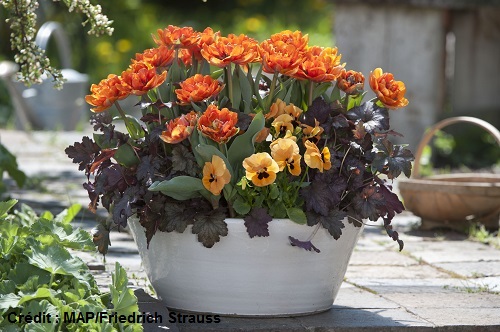 If you have very heavy clay soil, waterlogged in winter, prefer tulips in pots!
- In dry and light soil, sandy, poor, or if your soil is calcareous and shallow, as well as in rockeries, turn to botanical tulips. They take up little space, naturalise, and do not degenerate. Due to their wide range of origin, there is always a species whose growing conditions in nature will be close to those of your garden.
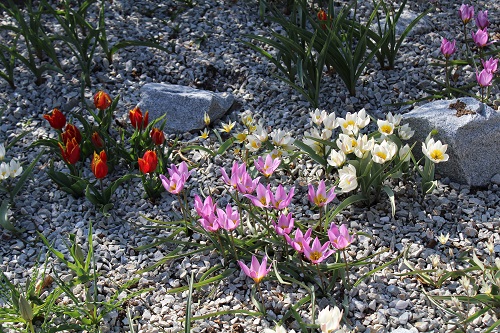 In dry and light soil, poor in nutrients, or in rockeries, small botanical tulips will be your best allies!
3) Choosing tulips according to your garden style
Obvious, you might say? Once you’ve passed the filters of flowering time and soil, you still have to pass a subjective filter, that of your style and your tastes! Classic or contemporary, natural, mineral, small, large, English, French... there's a tulip for almost every garden style, except perhaps the traditional Japanese garden! Not to mention that their possibilities for association are exponential....
- In a contemporary style garden, opt for tulips with well-defined shapes, clean and elegant lines, such as lily-flowered tulips like 'White Triumphator', simple varieties with perfect shapes like 'Maureen', and viridiflora like 'Spring Green'. Add contrast with the black of 'Reine de la Nuit' or 'Fontainebleau' and even 'Dream Touch' for a classic black and white combination. It’s often overlooked, but botanical tulips can also fit well in this style of garden: look towards Tulipa polychroma or Tulipa whittallii whose shapes remind me of some great works of contemporary architecture...
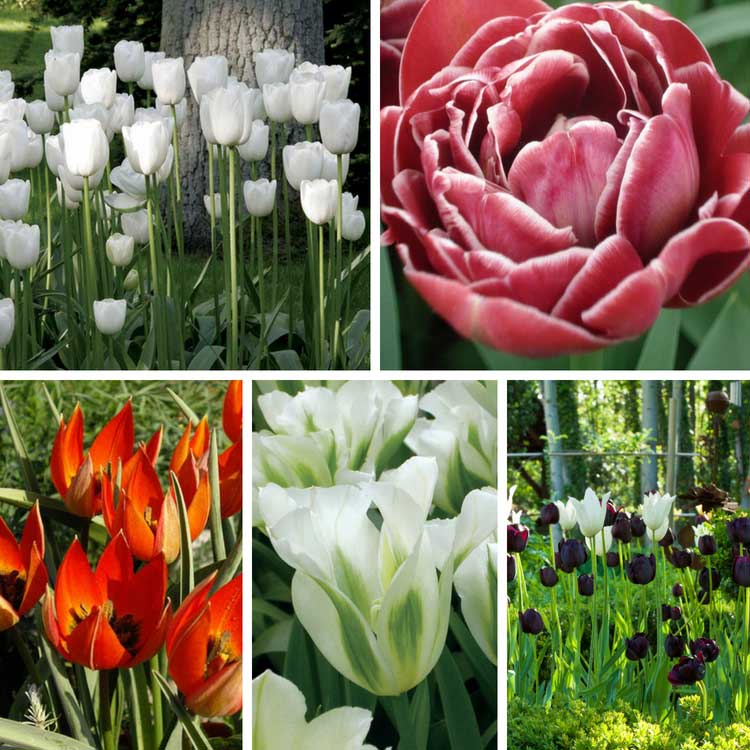 Tulip 'Maureen' - Tulip 'Dream Touch' - Tulipa whittallii - Viridiflora tulip 'Spring Green' - Contrasting tulips: 'White Triumphator' and 'Reine de la Nuit'
- In a romantic style garden, the frills of double flowers, triples, quadruples! The charm of soft colours, pink, mauve, lilac, spotted, the lace of fringed tulips... By combining early and late varieties, it’s easy to have double tulips in bloom for weeks. The eternal 'Angélique' and the precious 'Diamant Bleu' are must-haves to accompany the lesser-known 'Daytona' and 'Huis ten Bosch' in lace, 'Silver Parrot', 'Burgundy'... in a setting of forget-me-nots and fragrant lilacs!
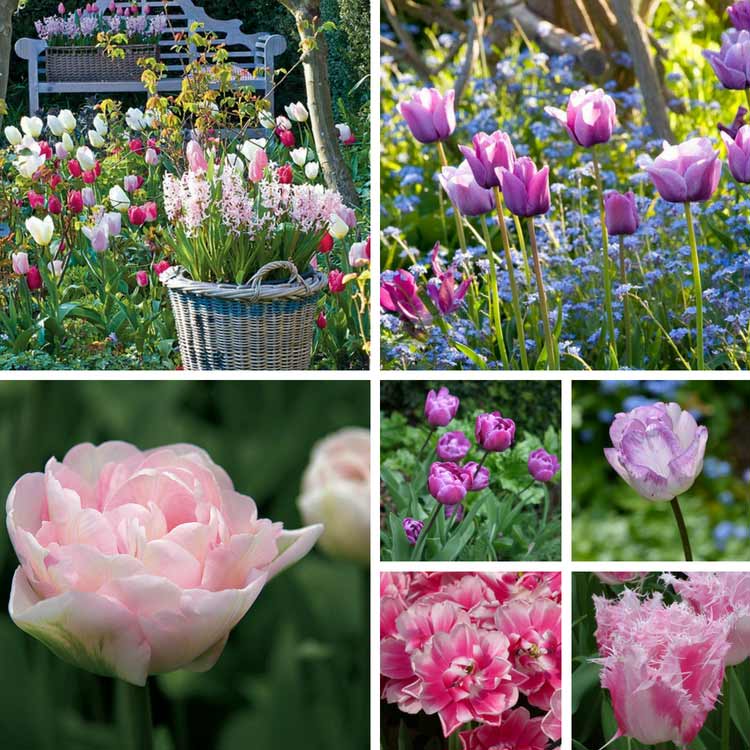 Tulips 'Jazz', 'Synada Amor', 'Page Polka', 'Christmas Dream' and 'Flaming Purissima' create a romantic atmosphere with pink hyacinths - Tulips and Myosotis - Double tulip 'Angélique' - Tulip 'Diamant Bleu' - Triumph tulip 'Shirley' - Early double tulip 'Columbus' - Fringed tulip 'Huis ten Bosch'
- In a natural or naturalistic garden, who said that only perennials and grasses should have a place? The lightness of botanical tulips like Tulipa turkestanica, Tulipa bakeri 'Lilac Wonder', Tulipa clusiana will naturally impose themselves, if I may say so! However, more classic and even almost sophisticated tulips, if well used, planted at controlled densities, will blend in with the brilliance of the greatest virtuosos! For yes, alongside the rose, the tulip is indeed one of the most virtuosic genera we can cultivate in our gardens...
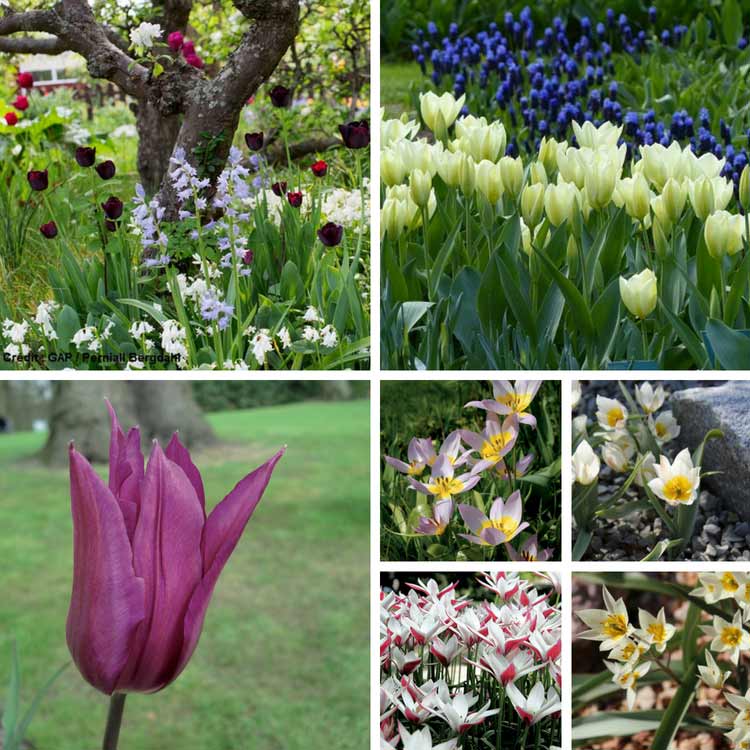 Planted sparsely, these 'Reine de la Nuit' tulips respect a natural effect alongside wood hyacinths - Fosteriana tulips 'Purissima' with Muscari latifolium - Tulip 'Burgundy' - Tulipa bakeri 'Lilac Wonder' - Tulipa polychroma - Tulipa clusiana 'Peppermint Stick' - Tulipa turkestanica
A light mist enveloped the garden this morning… After a surprise heatwave, is autumn already showing its first signs? Anyway, I won’t talk about the weather, but about a topic just as vast: tulips! It’s the start of the bulb planting season, and the question arises: which tulip to choose from the hundreds of varieties […]
Ornamental alliums or ornamental auls (Allium in Latin) are known and prized for their beautiful, graphic, colourful umbels that last into summer. While withered leaves should be removed, gardeners do not all agree on whether spent flowers should be left or cut in summer — what is the truth?
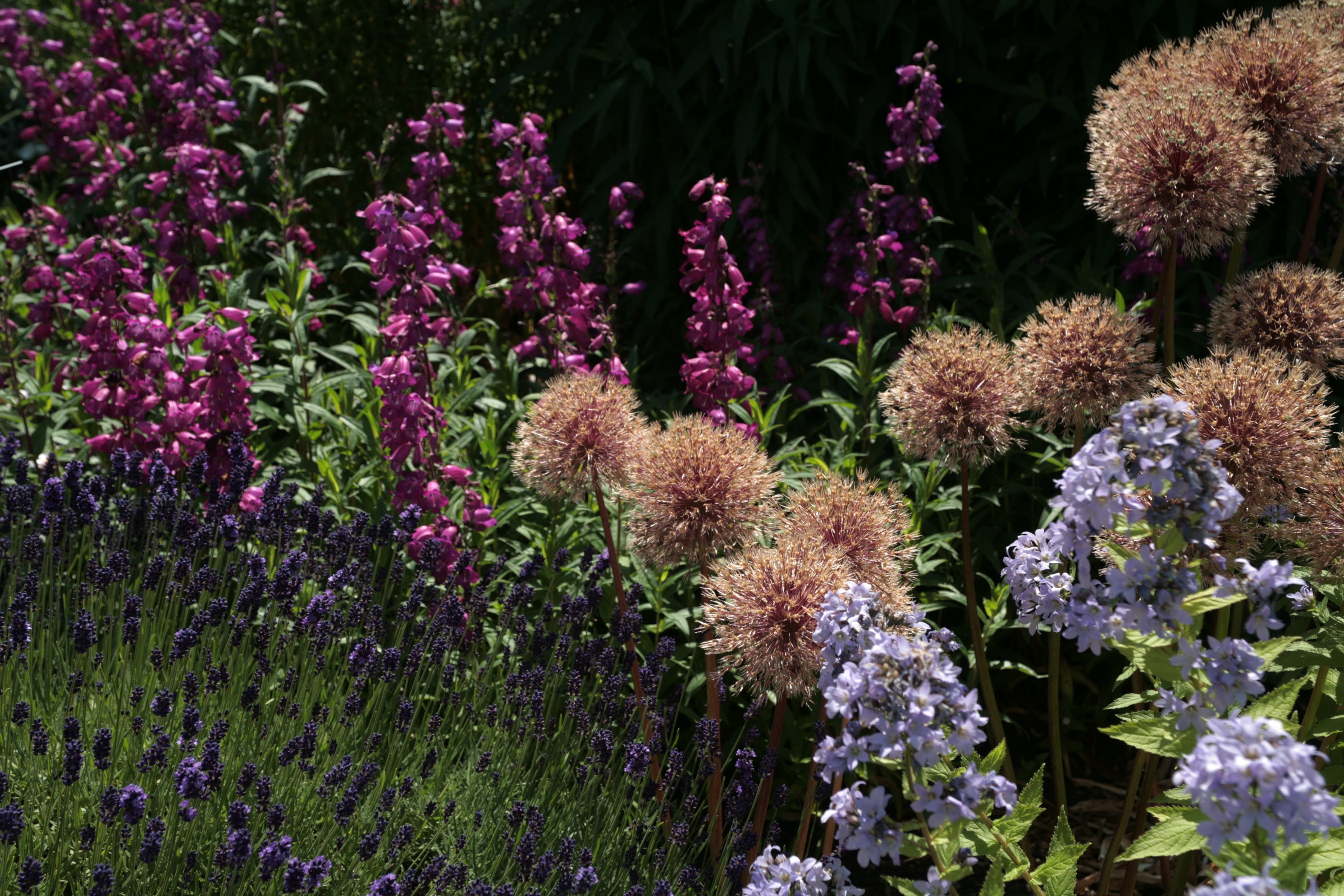
Spent flowers of Allium 'Globemaster' mixed with campanula, penstemons and lavender
Yes, cut them... To prevent spent flowers from exhausting the bulb.
Like most flowering bulbs, Allium draws on its reserves to produce a large, showy inflorescence. But just before flowering it will have produced foliage that allows it to store energy and rebuild reserves during dormancy.
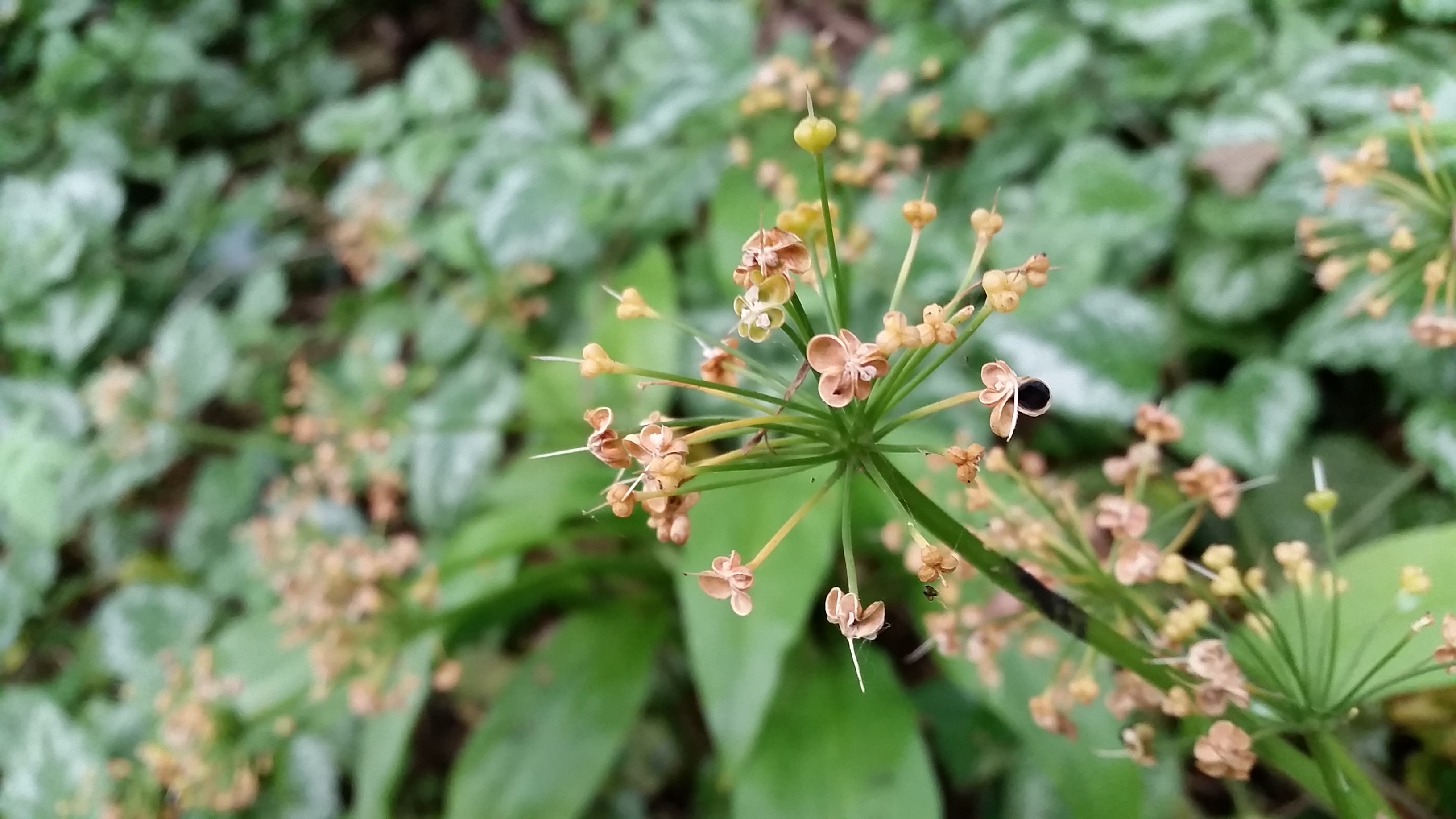
Seed capsules on an inflorescence of ramsons (Allium ursinum)
Cutting spent flowers will not have major consequences for bulb growth, especially if grown in rich soil (notably with phosphorus and potassium). In poor soil, however, it will reduce seed production and prevent the bulb from drawing unnecessarily on its reserves. So yes, cut spent flowers when growing in poor soil or when bulbs are young and still need to grow.
No, leave them... To enjoy spent flowers.
Any gardener keen on a tidy garden dislikes spent flowers. All spent flowers... except those of ornamental alliums, because they offer several advantages!
- Advantage #1: they continue to give structure to borders.
Even when spent, stems remain stiff and the less-coloured flower globes enliven borders until early autumn. Compared with structural bulbs such as Eremurus or fritillaria, Allium flowers have the advantage of remaining decorative for at least three months.
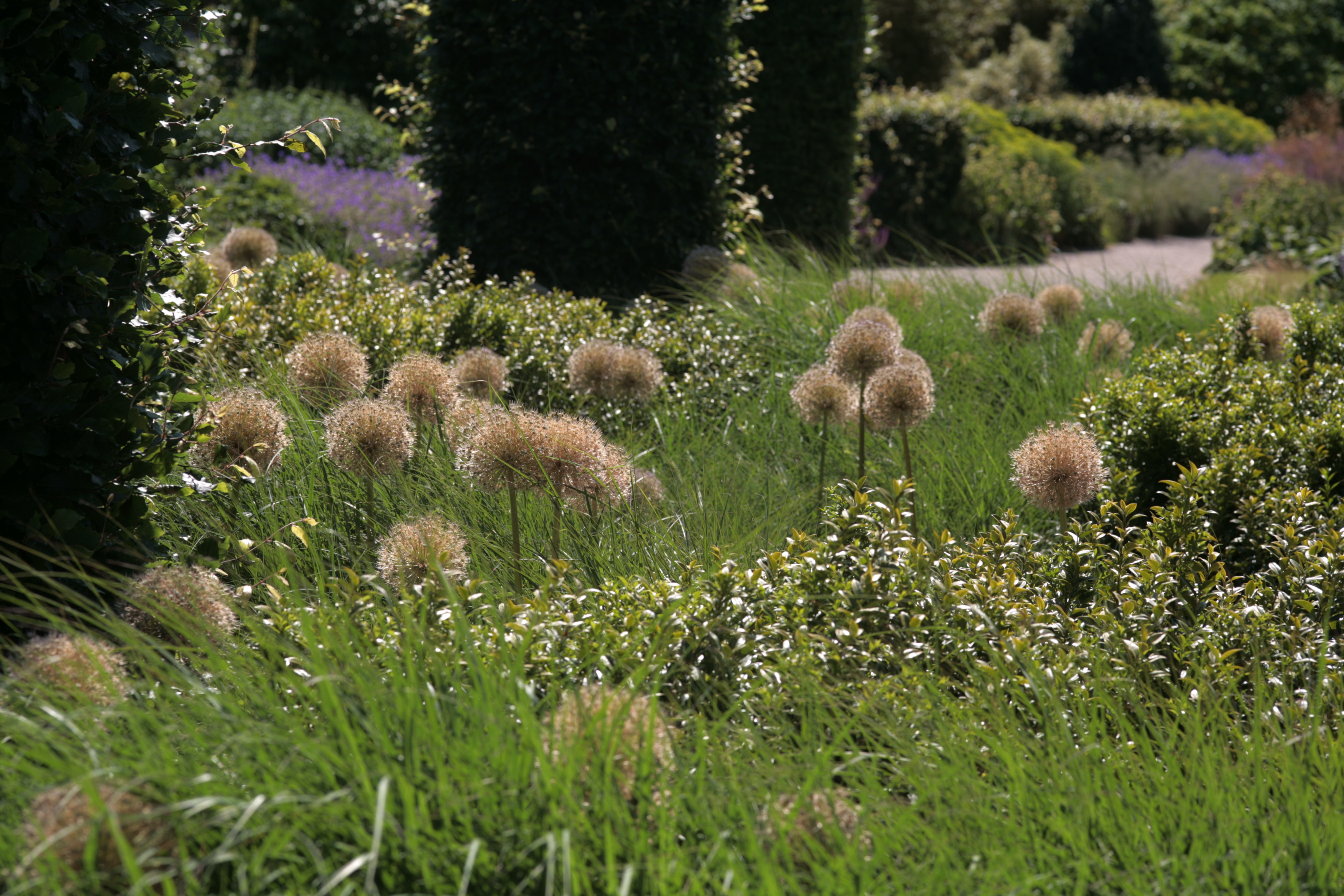
Allium head emerging from grasses

Allium 'Globemaster' at end of flowering
- Advantage #2: the flowers evolve. As they wither, pollinated flowers set seed and form attractive seed capsules, enhancing the inflorescence's grace.
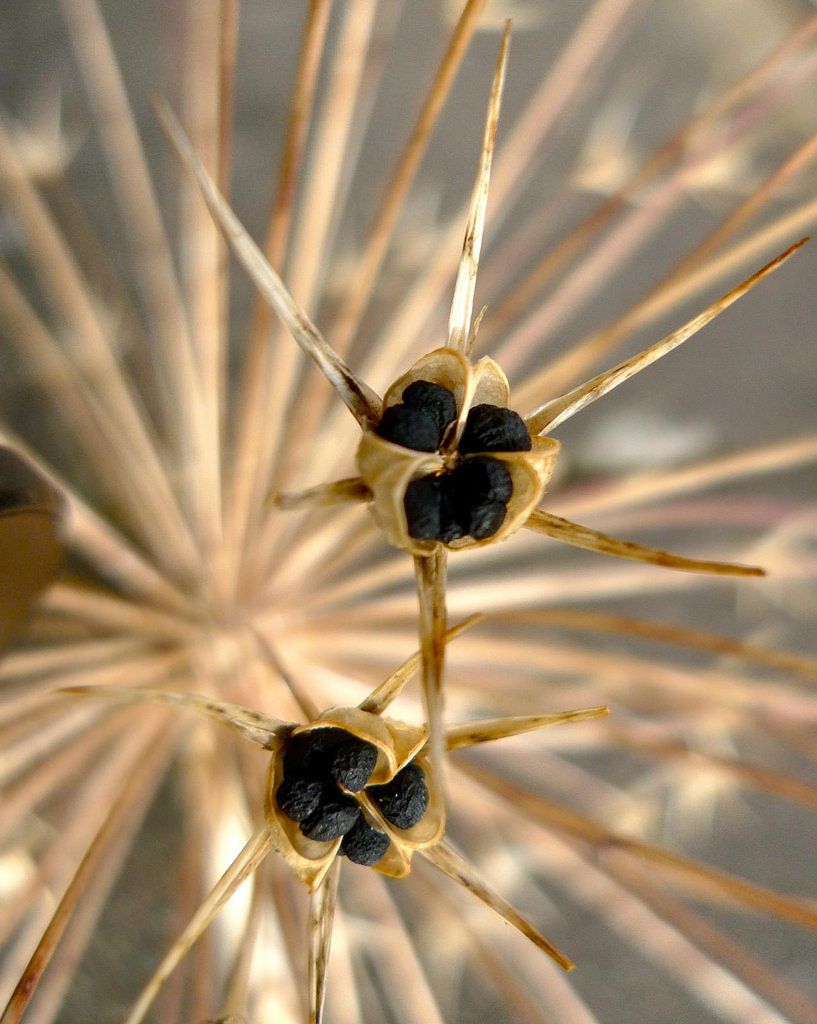
Allium seeds
Advantage #3: treat yourself to superb dried arrangements. Allium flowers are highly prized for dried bouquets. Properly dried, flowers last many years and allow creation of pretty arrangements to decorate celebration tables.
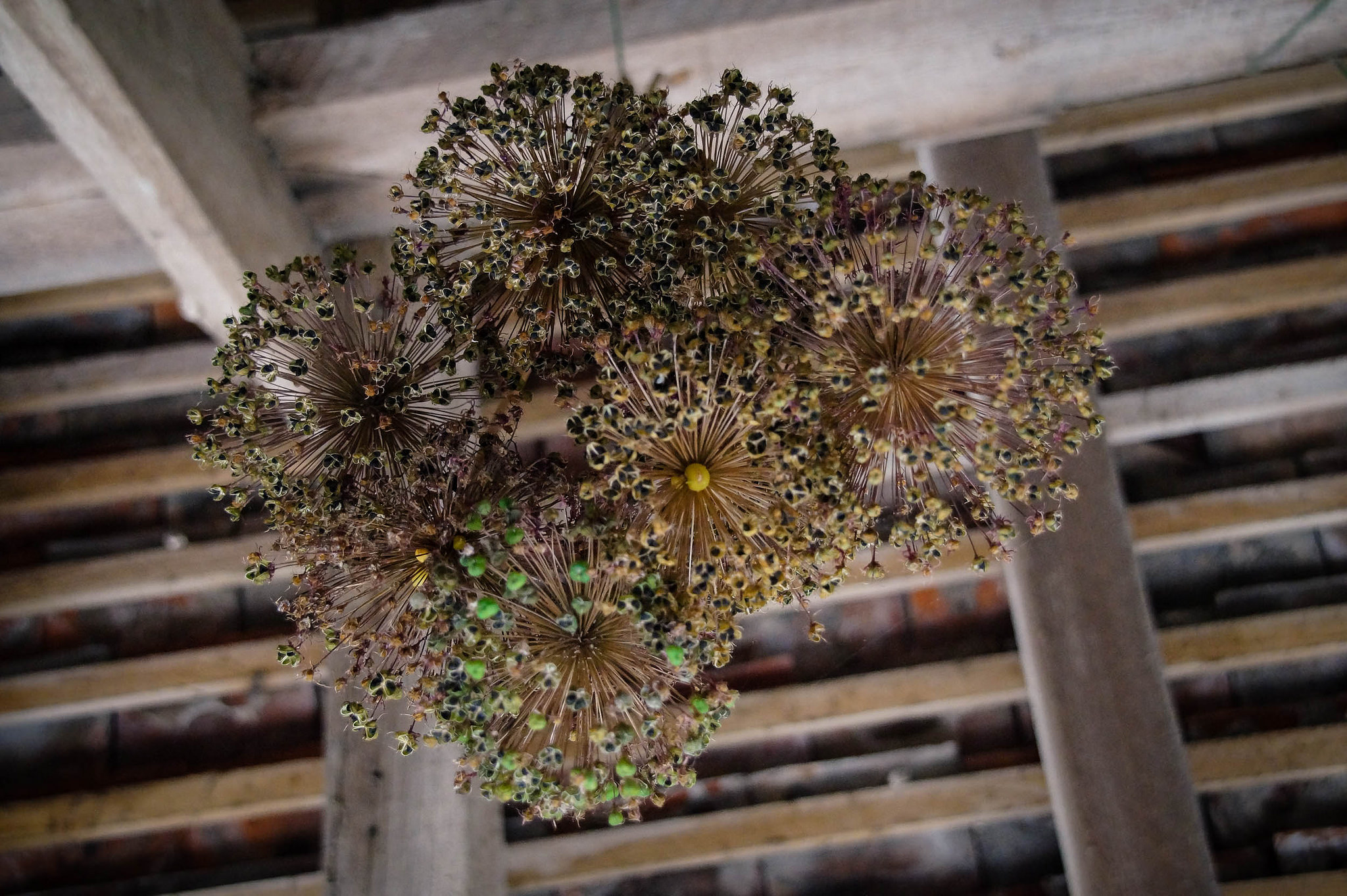
Allium heads hung upside down for perfect drying
In short, prune the small but leave the large.
Flowers of large varieties, those over 40–50 cm tall, can be left until mid-winter, continuing to decorate borders well into autumn. However, some species such as Allium triquetrum or ramsons (Allium ursinum) can be persistent in the garden and even invasive in some regions. Cutting spent inflorescences of these small varieties will limit their spread and/or keep borders tidy by cutting spent flowers and foliage back to the base.
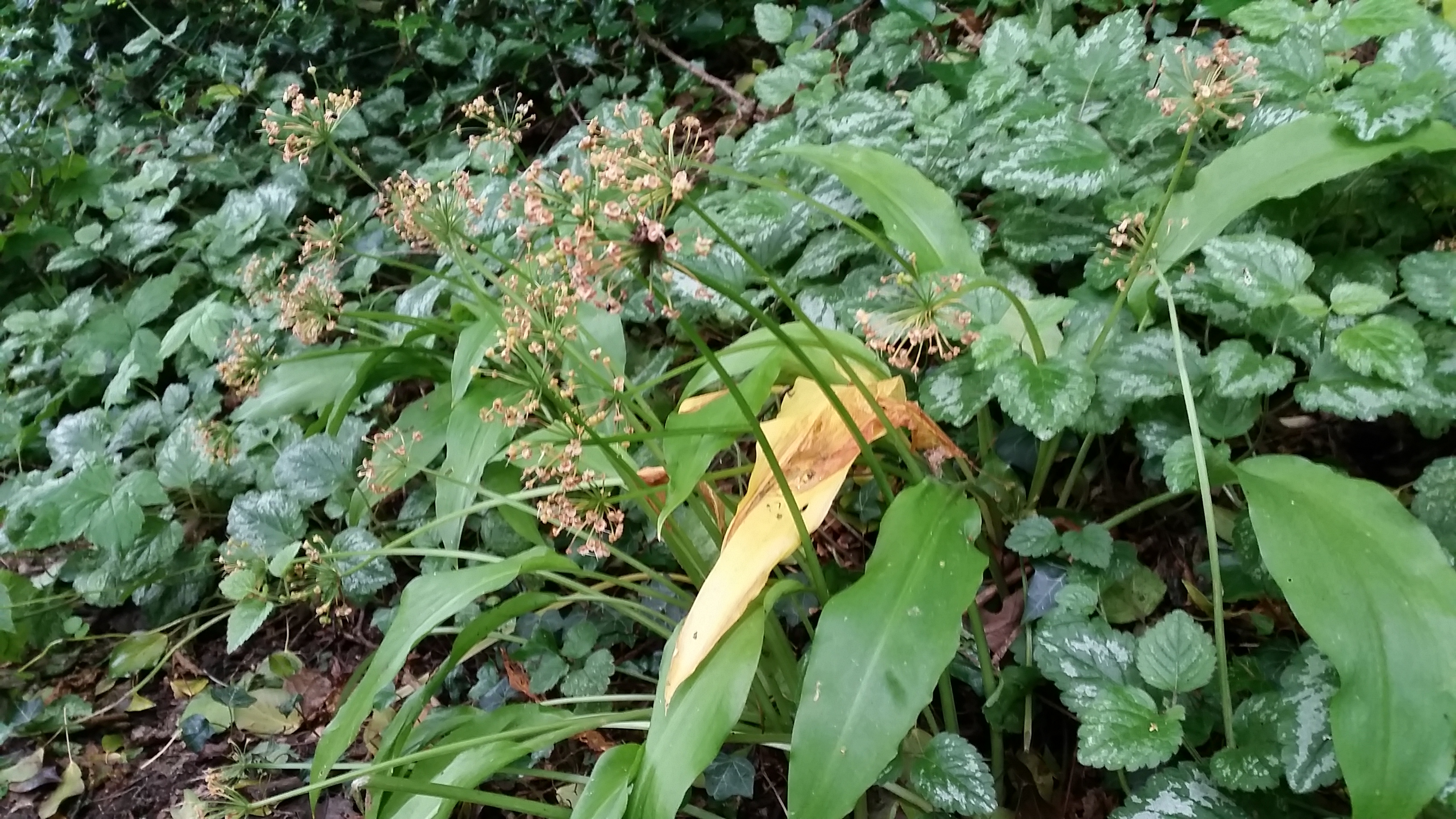
Ramsons in summer: inflorescences and foliage become unsightly, time to prune!
Ornamental alliums or ornamental auls (Allium in Latin) are known and prized for their beautiful, graphic, colourful umbels that last into summer. While withered leaves should be removed, gardeners do not all agree on whether spent flowers should be left or cut in summer — what is the truth? Yes, cut them… To prevent spent […]
There we go, it has started again; I've become impatient. You know how it is, I suppose, you fellow flower enthusiasts? At Promesse de fleurs, we sell bulbs by the dozens, by the hundreds... Enough to make you dream. I find myself thinking about the arrival of the beautiful 'Angélique' and the delicate 'Dark Eyes'. Because, of course, like many gardeners, I am a tad eager. The flowers, the colours, and the scents... I’m being told that it’s not quite the right time: for the lovely dresses of the tulips and the little faces of the muscaris, we’ll have to wait a few more weeks. But, in addition to being impatient, I am a bit stubborn. And I have a craving for flowers, what can I say….
Little manual for the impatient gardener:
Surround yourself with beautiful objects that are just waiting for a second life:
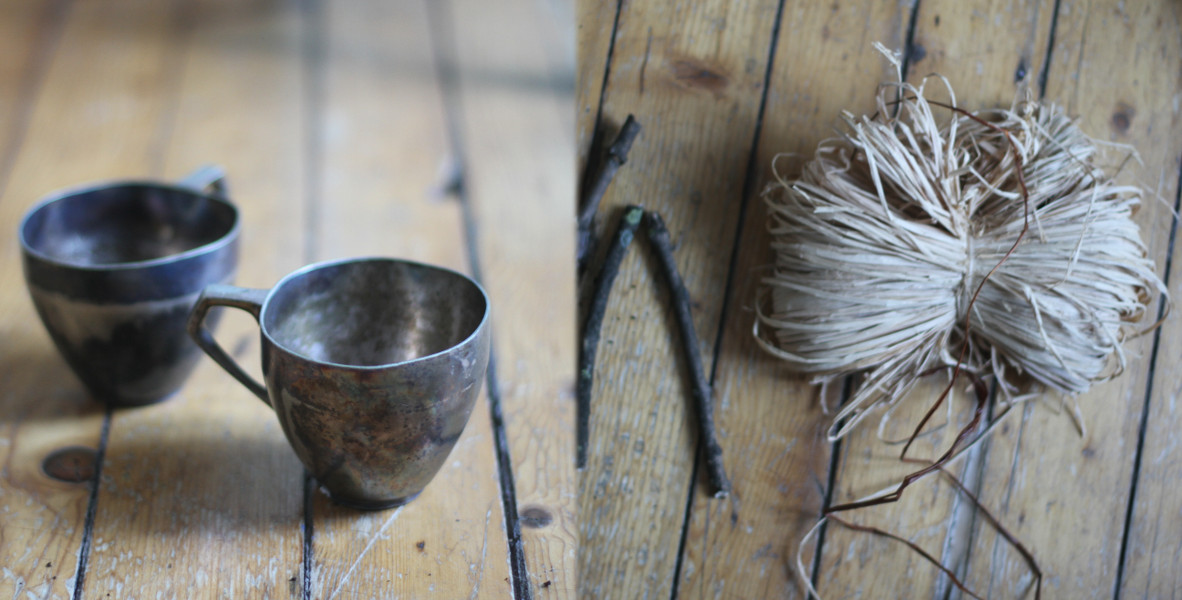 Reclaimed bronze cups, twine, wood
Some bulbs have already undergone forcing (here daffodils and muscaris), we add a few sprigs of vegetation collected from nature:
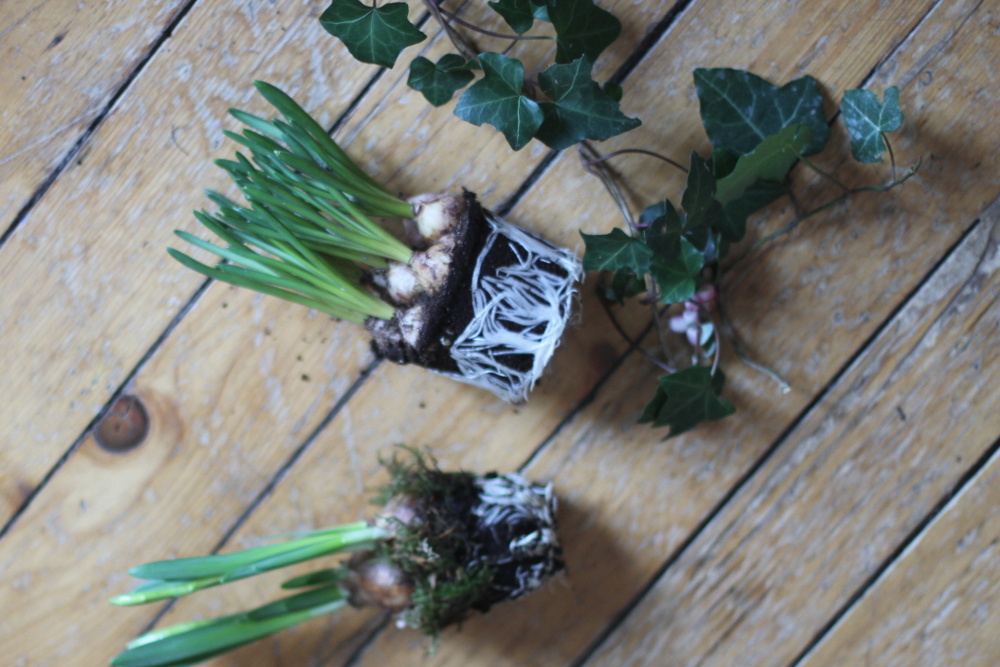 Various forced bulbs and green accessories
We place the bulbs in the "pots", filling with soil if necessary. Then we surround them with ivy and raffia, we fiddle, tie knots, and readjust. We decorate according to inspiration, here with a branch of symphorine in pink:
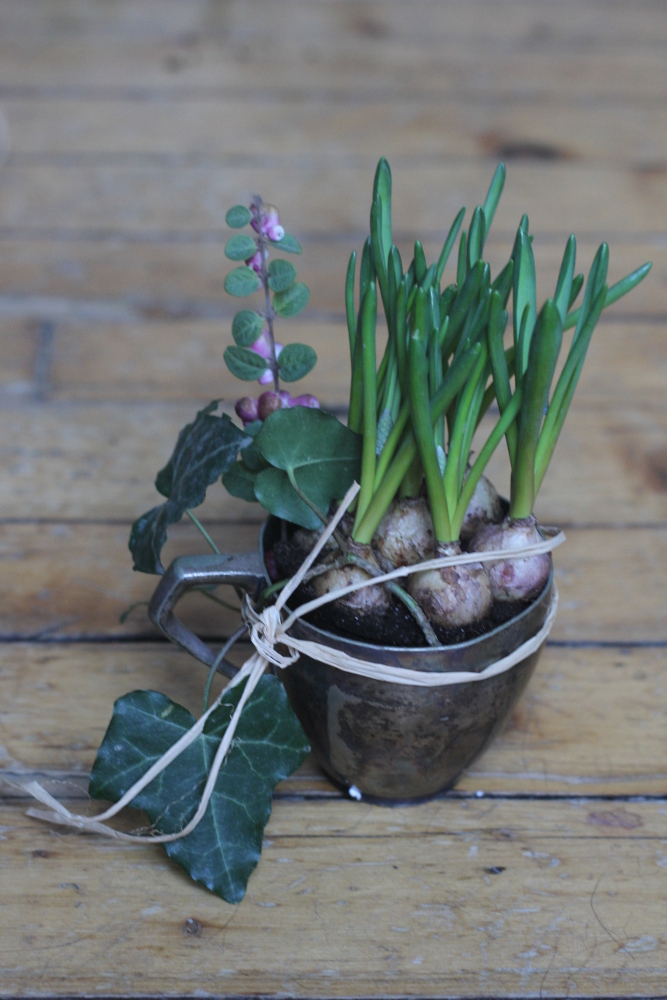 Decorative pot of muscaris
Then we wait for the flowering!
There we go, it has started again; I’ve become impatient. You know how it is, I suppose, you fellow flower enthusiasts? At Promesse de fleurs, we sell bulbs by the dozens, by the hundreds… Enough to make you dream. I find myself thinking about the arrival of the beautiful ‘Angélique’ and the delicate ‘Dark Eyes’. […]
It's not too late to plant tulips! In fact, that's my plan for this weekend in the garden, encouraged by the beautiful weather... Every year, I try a new colour harmony in my "sanctuary" bed of annuals and biennials, but I've also scattered a few hundred among clumps of perennials that I don't dig up each year. Over time, I've been able to identify the best varieties for my garden: the most reliable and easiest to pair, along with a few "favourites" for which I willingly forgive a shorter lifespan... Here’s my "Top 15" list of tulips from my garden:
1. Discovered in the "Carnival of Venice" collection years ago, I can't do without it! Solid as a rock, the Triumph tulip 'Jan Reus' multiplies and returns more beautiful each spring in all the spots in the garden where I've planted it. I love its deep, powerful red-brown colour, which has a sober elegance and pairs well with any other colour.
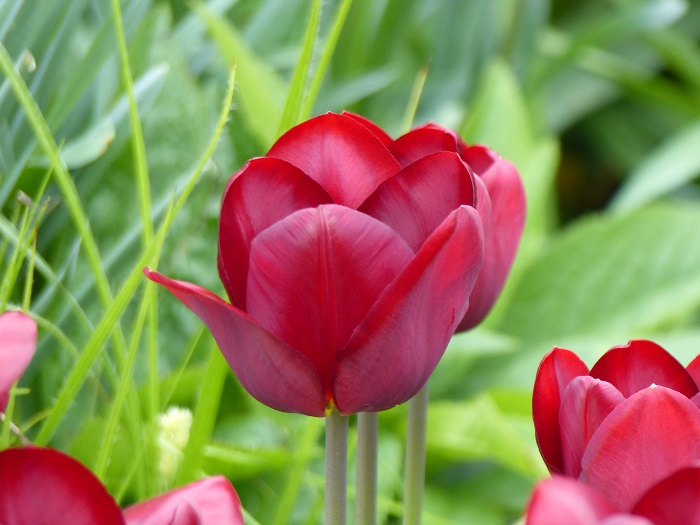
Triumph tulip 'Jan Reus'
2. Undoubtedly one of the best white tulips, 'Purissima' is an early variety, with its large goblet-shaped flowers appearing as early as April. When in full sun, they open completely, revealing a grey-blue stigma set against a bright yellow halo. Close to its wild origins, this tulip from the fosteriana group is very, very hardy. If you adopt it, it will never disappoint you.
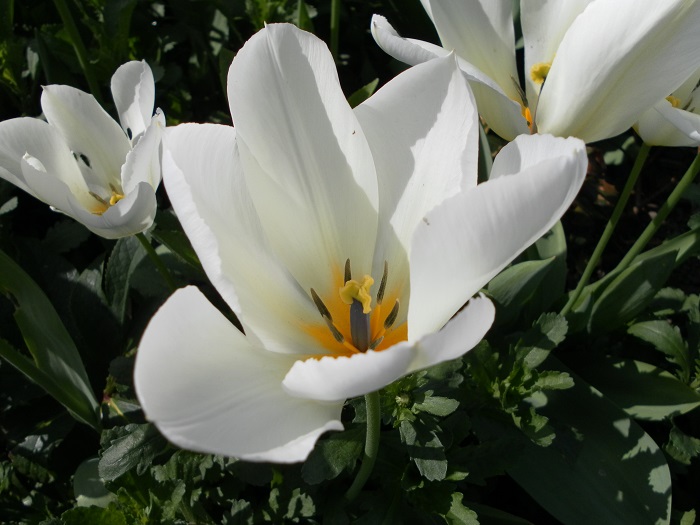
Fosteriana tulip 'Purissima'
3. The Triumph tulip 'Barcelona' is a mid-season variety, vigorous and quite tall, with beautiful bright pink flowers radiating brightness. I've had it in place for 10 years alongside the purple 'Negrita' and the black-purple 'Queen of the Night', accompanied by large clumps of bleeding hearts (Dicentra spectabilis) and the young, tender green foliage of daylilies as a backdrop.
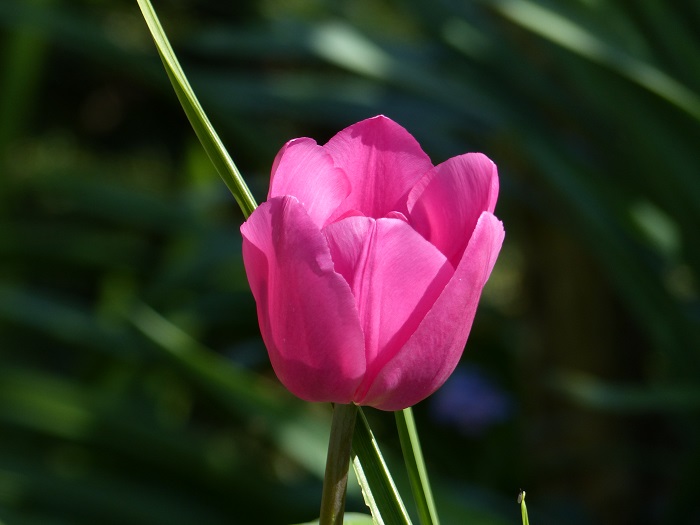
Triumph Tulip 'Barcelona'
4. Speaking of which, here’s the famous black tulip 'Queen of the Night': a classic often imitated, never equalled. Long stems for bouquets or as second and background plants in beds where its dark colour enhances the depth effect. Mid-late flowering, it blooms between the "Triumph" and the very late varieties like the lily-flowered or viridiflora tulips.
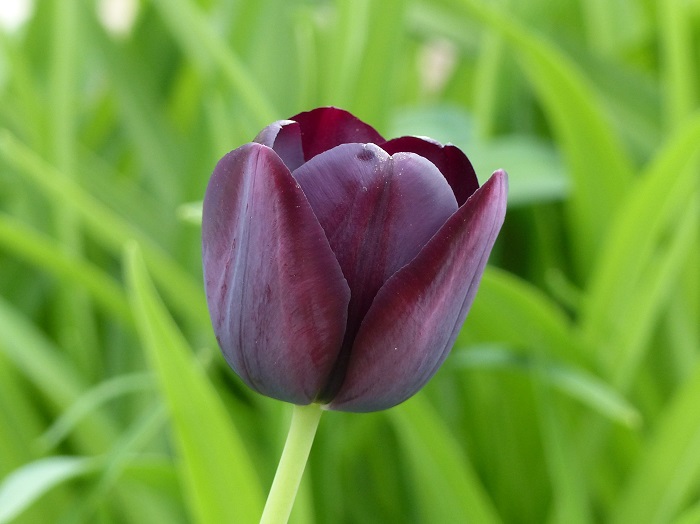
Late single tulip 'Queen of the Night'
5. The botanical tulip Whittallii, a group of tetraploid clones with large brick-orange flowers in the species Tulipa orphanidea, is a beautiful specimen for a wild tulip, standing at 30 cm tall. Its slender stems elegantly bend under the weight of the very graphic flowers, with pointed tepals arranged in a cup shape. Perfect in a warm corner of the garden, near the acid green and spring-like euphorbias, for example.
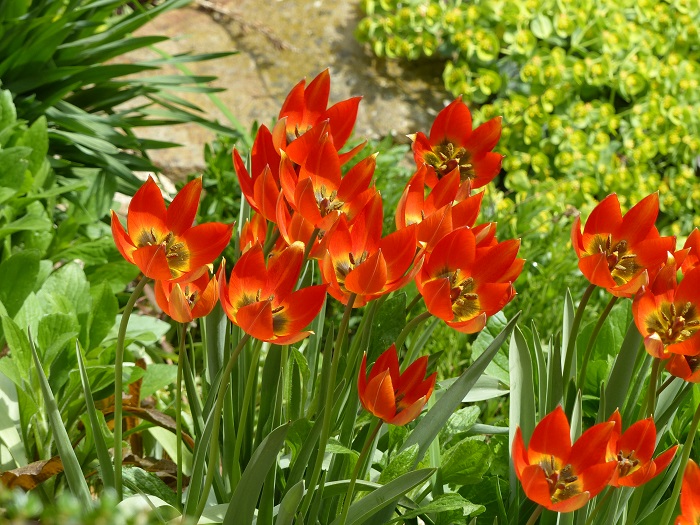
Tulipa orphanidea Whittallii (botanical)
6. The lily-flowered tulip 'White Triumphator', the perfect embodiment of chic. Its height, well-rounded shape, and the purity of its colour give it an incomparable presence. Late-flowering, I love to plant it alongside other late white bulbs like 'Thalia' or 'Piper's End' daffodils and Ornithogalum magnum with spike-like flowers to vary the forms. In my garden, I have to replant it a bit more often than the others, but it's worth it!
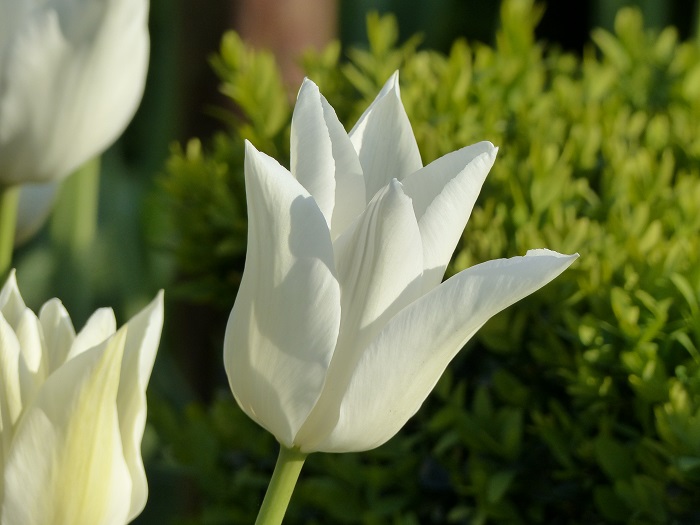
Lily-flowered tulip 'White Triumphator'
7. From the same group as the previous one, the elegant 'Ballerina' is unmatched for brightening up a spring bed. Its slender carrot-orange lily flowers, held high and fragrant, I don't hesitate to sprinkle them in the heart of pink-purple or blue-lilac harmonies to satisfy a colour appetite cruelly sharpened by the winter months.
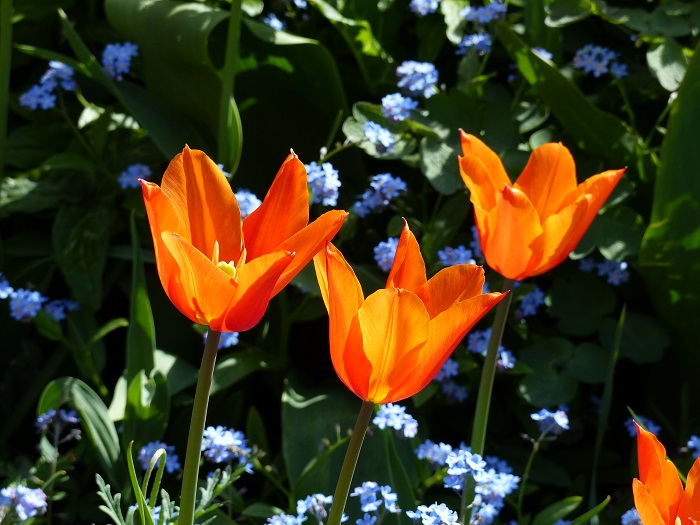
Lily-flowered tulip 'Ballerina'
8. The Triumph tulip 'Negrita', with its large violet-purple flowers, is absolutely essential for creating a white-pink-purple gradient like in the "clair-obscur" harmony. A bit shorter on the stem than the other tulips of this season, it also adds dynamism to the combinations by varying the heights.
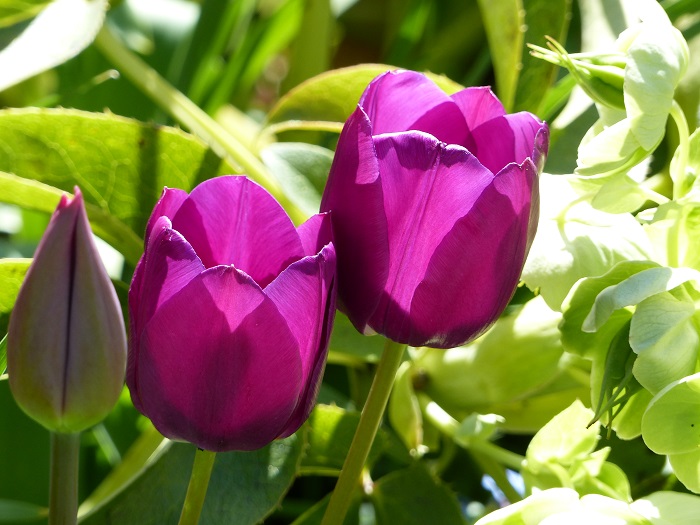
Triumph tulip 'Negrita'
9. I am literally melting for the caramel-orange colour of the tulip 'Cairo'. It’s a recent variety that has quickly gained popularity among gardeners, and it's easy to see why. This robust mid-season tulip, with its large well-formed flowers and wide rounded tepals, brings a true novelty in its colour, a blend of orange with a hint of brown pigments.
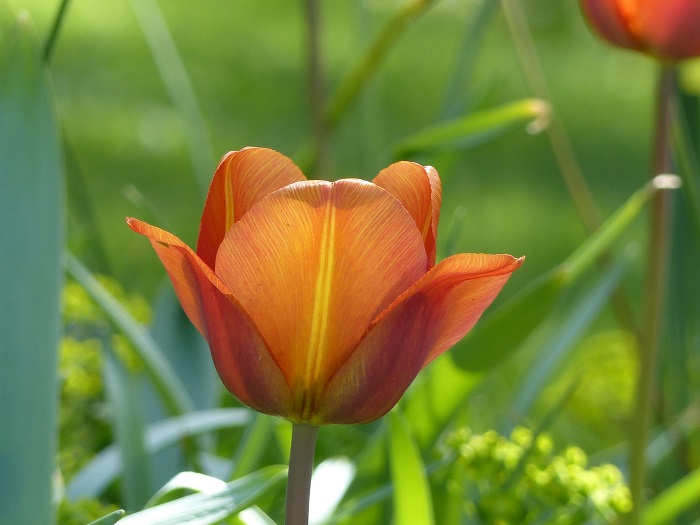
Triumph tulip 'Cairo'
10. Like a blue diamond, or rather amethyst, the double tulip 'Blue Diamond' is an excellent ambassador for this rare and elegant "blue" colour, unique among tulips. Despite its double petals making it a bit more demanding, it’s a proven variety, and its flowers are not too heavy to droop towards the ground at the first rain.
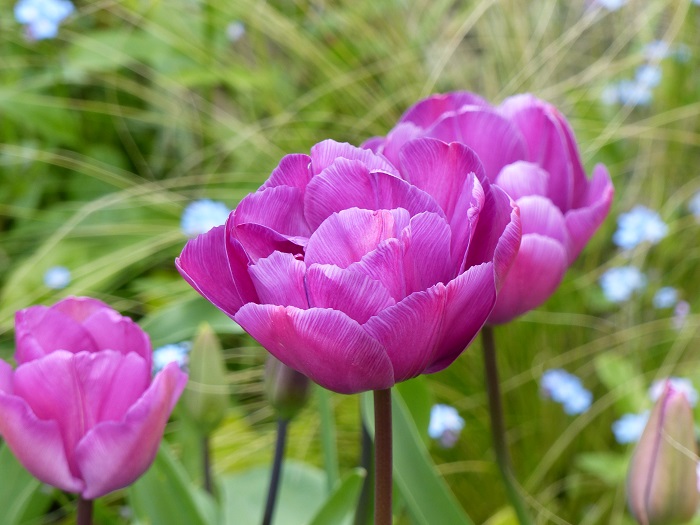
Late double tulip 'Blue Diamond'
11. 'Menton', as its name suggests, is a French variety grown in the South for producing very high-quality cut flowers. In the garden, it’s an extremely robust variety that delights me every spring with very large flowers of an impossible-to-define salmon colour.
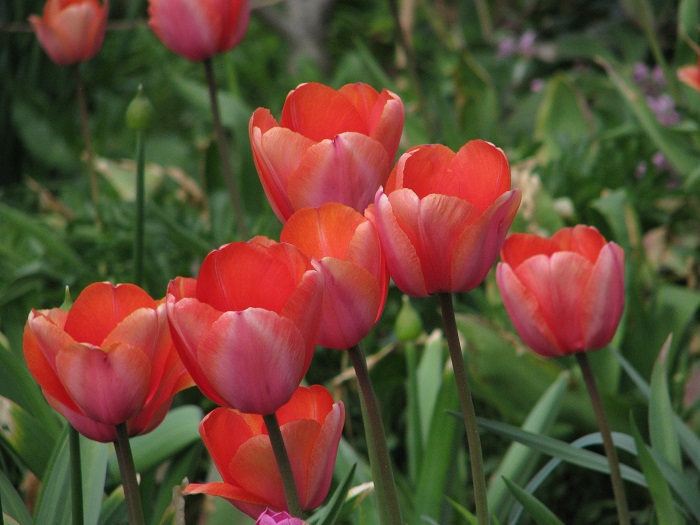
Long-stem tulip 'Menton'
12. I don't know of a purer pink colour among tulips than that of 'China Pink', which makes it very precious to me despite its somewhat fragile nature. Not to mention the unparalleled refinement of the shape of its flowers. Each flower is a condensed essence of spring freshness!
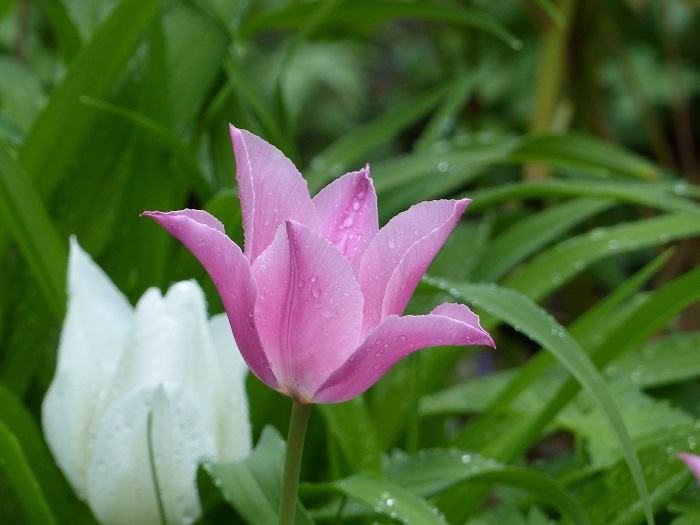
Lily-flowered tulip 'China Pink'
13. I was surprised to find myself loving the tulip 'Ballade' after using it in a harmony of mauve and lilac tones. As much for its pink-lilac colour edged in white and -once in a while- its elegant lily flower shape, I particularly appreciate its robustness and longevity.
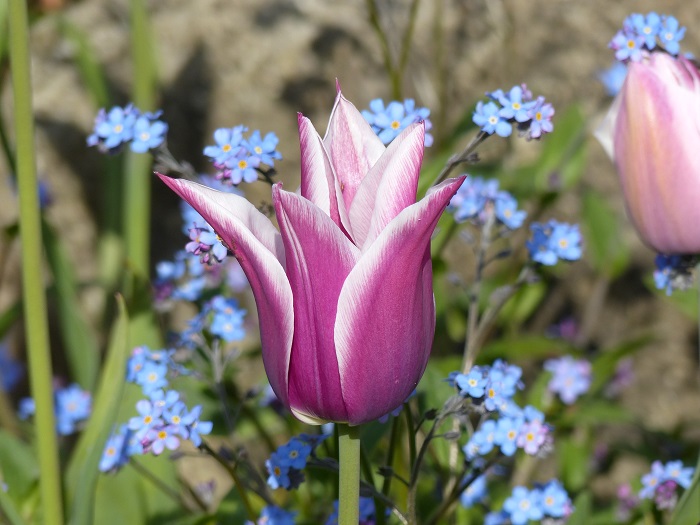
Lily-flowered tulip 'Ballade'
14. I still wonder what made me plant the tulip 'Fontainebleau' the first time, but I have come to appreciate its purple-black colour with a white edge, as it has not chosen to exhaust itself and disappear from the garden. By a happy coincidence, it fits well into a slightly more graphic atmosphere than the rest of my garden, with yuccas and grasses, far from the other colourful tulip varieties.
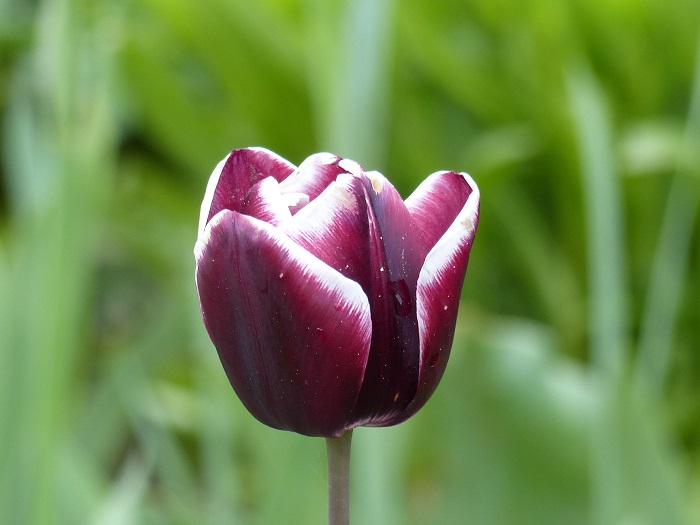
Triumph tulip 'Fontainebleau'
15. And to finish, a great originality with the variety 'Yellow Crown', with the soft colour of true butter yellow, and tepals folded in on themselves, making each flower resemble an origami creation. Although I planted them "just out of curiosity", I was surprised, and indeed delighted to see these tulips return faithfully every year since.
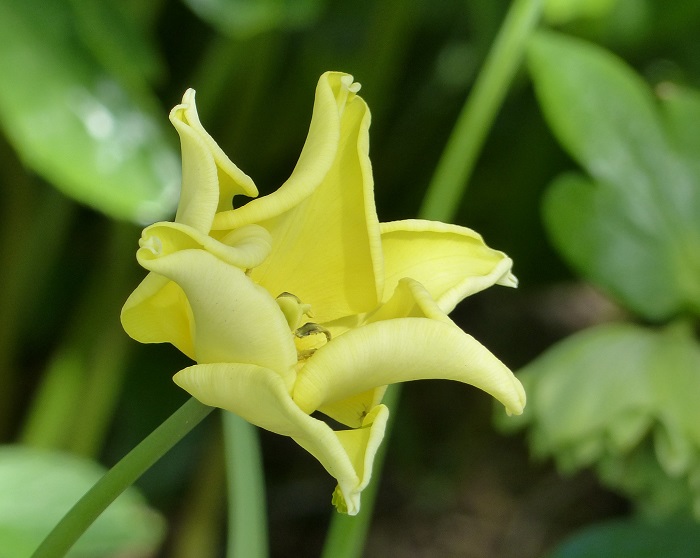
Tulip 'Yellow Crown'
It’s not too late to plant tulips! In fact, that’s my plan for this weekend in the garden, encouraged by the beautiful weather… Every year, I try a new colour harmony in my “sanctuary” bed of annuals and biennials, but I’ve also scattered a few hundred among clumps of perennials that I don’t dig up […]
They are the easiest, most diverse, and always the first to bloom: you can never plant enough of these famous small spring bulbs! Chionodoxas, squills, muscaris, iris reticulata, botanical daffodils… all these garden essentials can fit in anywhere… and there are two opposing ways for us to enjoy them: either we plant them in pots to admire them up close, or we spread them out in large naturalised carpets as far as the eye can see.
For the rarest and most original small spring bulbs, nothing beats planting them in pots. This allows you to have them close at hand when they bloom early in spring, making it hard to venture outside, and to lift them for an even closer look… not to mention that when it comes to pots, any whim is allowed: from the most classic terracotta to repurposed items like old colanders, tin cans, shoes… just be sure to check for drainage holes or use them as cache-pots. Among these precious bulbs, we love: the milky blue of muscari 'Valérie Finnis' and the metallic blue of anemone blanda 'Blue Shades', the cream pom-poms of botanical daffodil 'Erlicheer' and the elegance of the late pure white multiflorous 'Thalia', the refined pattern of flowers from dwarf iris 'Katharina Hodgkin', and the soft salmon colour of hyacinths 'Gipsy Queen'…
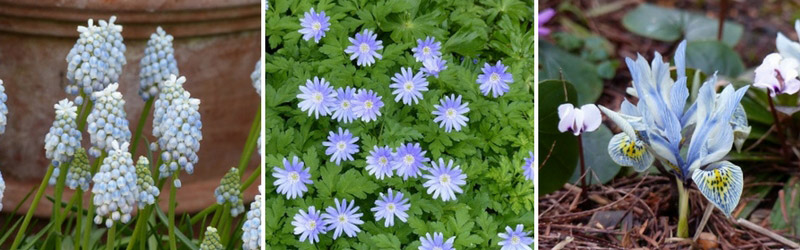
Muscari 'Valerie Finnis' - Anemone blanda 'Blue Shades' - Iris 'Katharine Hodgkin'
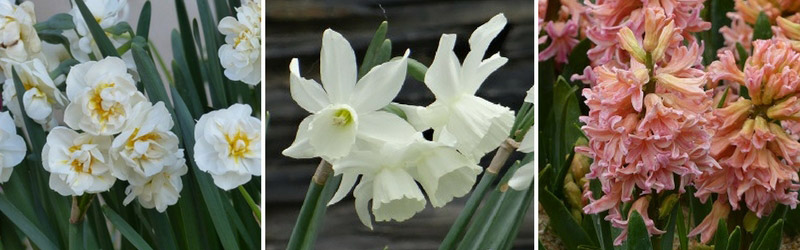
Daffodil 'Erlicheer' - Daffodil 'Thalia' - Hyacinth 'Gipsy Queen'
And when you only have a terrace or balcony, you should definitely not miss the opportunity to pot all the bulbs you desire, whether small or large! All are perfectly suited for pot cultivation. You can even plant them quite closely together, and on several levels. The taller ones like tulips and daffodils at the bottom, and the smaller ones like crocus and muscaris at the top, with hyacinths in the middle. This allows you to either stagger the bloom times by combining early and late bulbs, or conversely, to create a grand ephemeral display with simultaneous blooms that visually complement each other: small bulbs are perfect for contrasting with the larger ones!
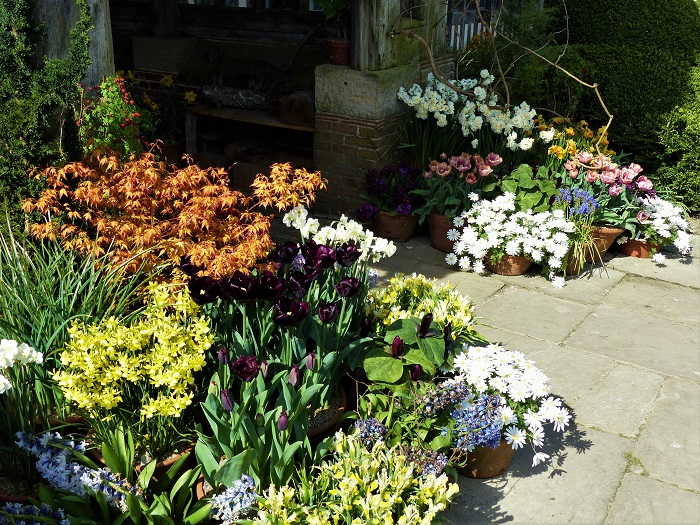
Potted bulbs are essential to the decor around the old porch of Great Dixter in England
Nothing is easier than successfully growing bulbs in pots! The most important thing is to ensure perfect drainage to prevent bulb rot, by having drainage holes at the bottom of the pot and using quality potting soil mixed with a bit of sand or gravel. After flowering, let them dry completely, but don’t forget to water them until they naturally yellow, occasionally with a bit of fertiliser! You can then remove them from the pot and store them in a shaded, well-ventilated place until replanting the following autumn.
In naturalised carpets
Almost all small bulbs naturalise, meaning they will reliably return each year, increasingly numerous and beautiful. If the location suits them and they are not disturbed too much, they will self-seed or multiply to form large carpets, whether in a lawn, under trees, or even in beds of shrubs or perennials: they won’t mind as the small bulbs disappear underground when the perennials and shrubs come into leaf. To successfully create these carpets, it’s very simple: 1- plant generously (they are quite inexpensive!), 2- choose bulbs suited to the situation. If it’s in shade, you will primarily choose anemones, winter aconites (Eranthis), snowdrops, Tommasini crocus (C. tommasinianus)… not forgetting bluebells (Hyacinthoides non-scripta) and woodland tulips (Tulipa sylvestris) for April. If it’s in the sun, then you can enjoy muscaris, crocus, iris reticulata, and botanical tulips that will offer you an almost unlimited choice of colours, from the most delicate, like the lilac-pink tulip bakeri 'Lilac Wonder', to the brightest, like the brick-orange tulip whittallii.
Small bulbs to naturalise for shade
[caption id="attachment_29421" align="aligncenter" width="800"]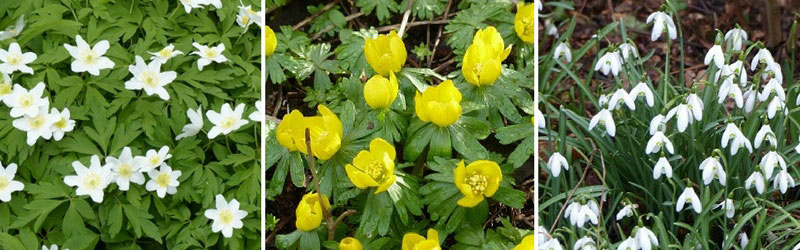 Wood Anemone (Anemone nemorosa) - Winter Aconite (Eranthis hyemalis) - Snowdrop (Galanthus nivalis)
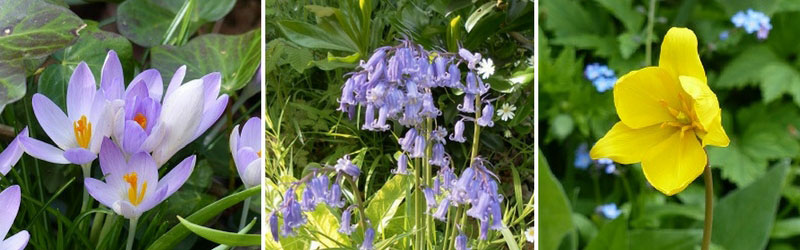
Crocus tommasinianus - Bluebell (Hyacinthoides non-scripta) - Woodland Tulip (Tulipa sylvestris)
Small bulbs to naturalise for sun
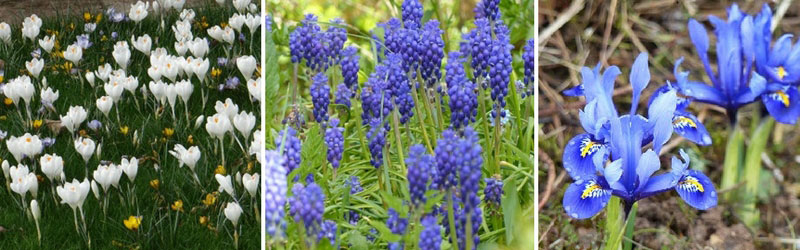
Mammoth Crocus 'Jeanne d'Arc' - Muscari armeniacum 'Blue Spike' - Iris reticulata 'Harmony'
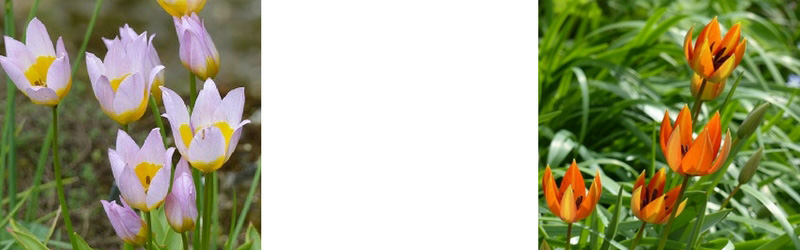
Tulipa bakeri 'Lilac Wonder' Tulipa whittallii
And to inspire you and make you dream, here is a selection of the most beautiful naturalised bulb carpets seen in spring in famous gardens… But don’t be misled: small bulbs also mean replicable displays on a small scale!
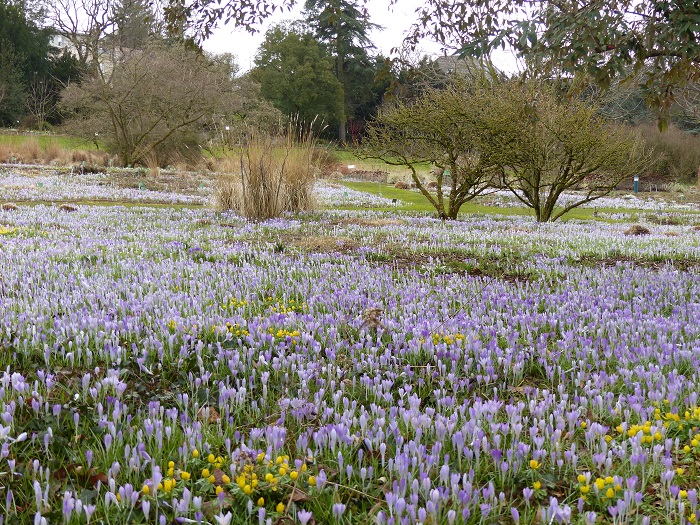 A sea of Crocus tommasinianus colours the perennial beds of Hermannshof from March, accompanied by some clumps of yellow winter aconites
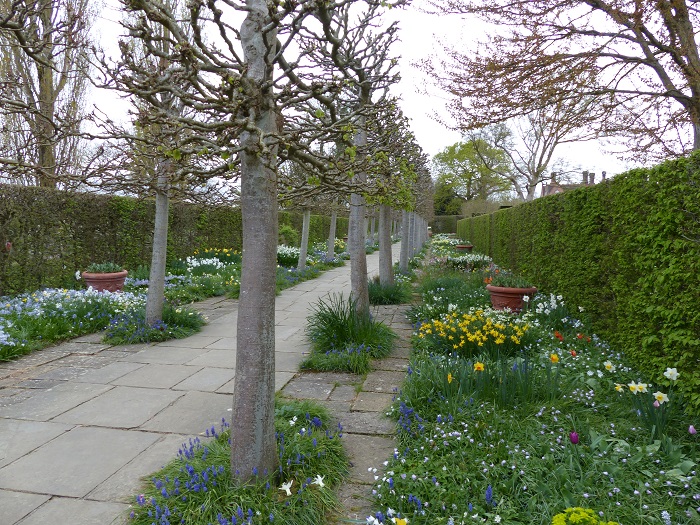 In April, the flowering of this long regular avenue in the English garden of Sissinghurst relies almost entirely on small bulbs
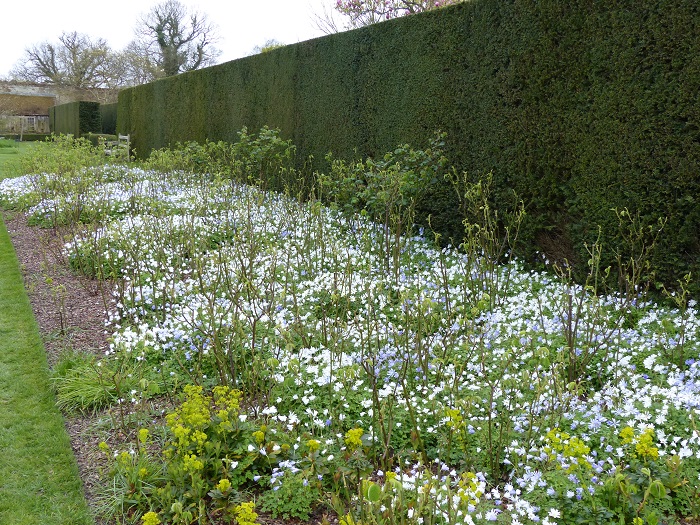 Anemone blanda forms a superb carpet under budding roses at Sissinghurst
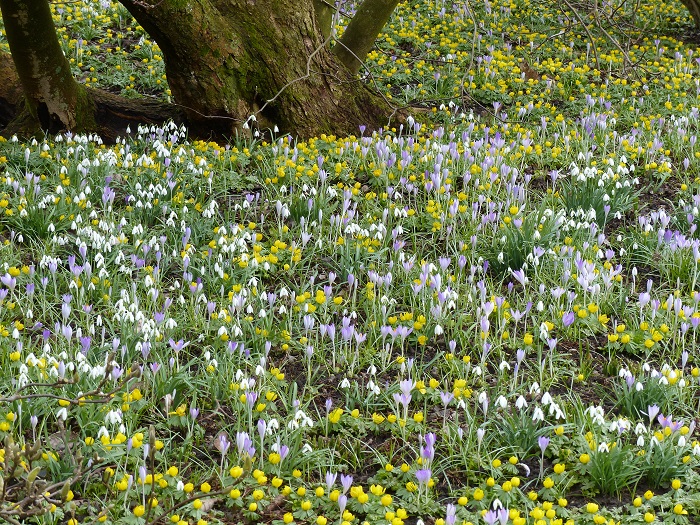 3 small naturalised bulbs together in the shade: Crocus tommasinianus, Eranthis hyemalis, Galanthus nivalis (Hermannshof)
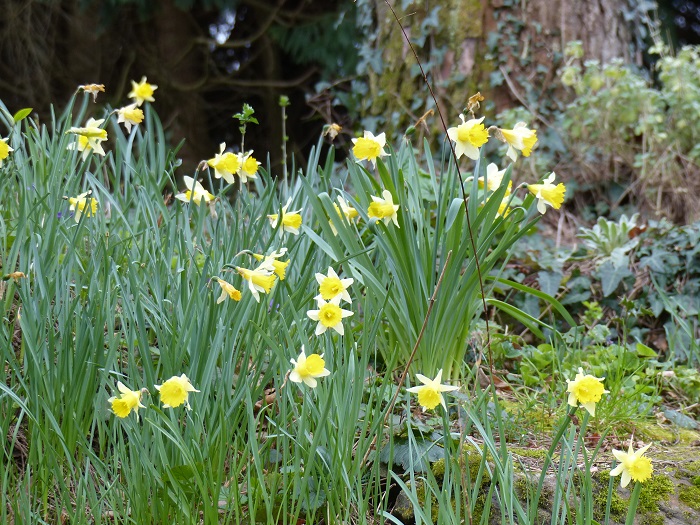 Wood Daffodils (Narcissus pseudonarcissus) at the Beaujoire park in Nantes
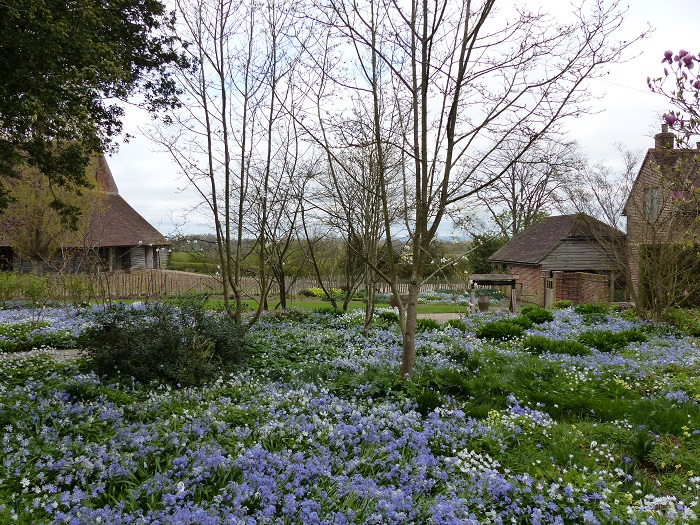 This blue carpet formed by anemone blanda and various species of squill creates a dreamlike decor in this woodland atmosphere (Sissinghurst)
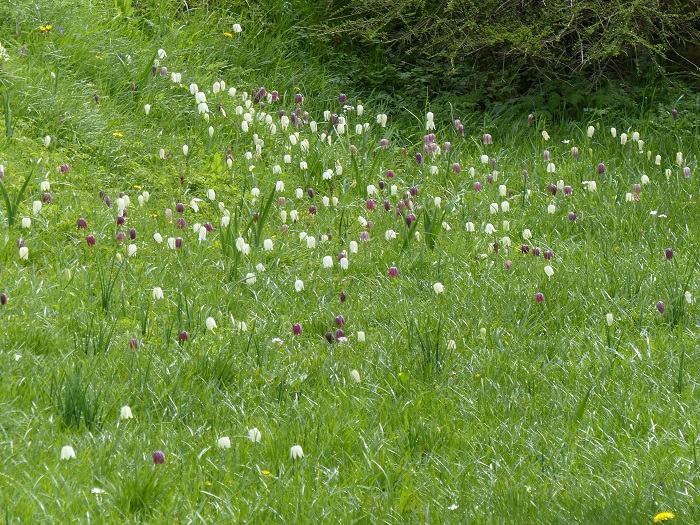 The guinea fowl fritillaries (Fritillaria meleagris) have thrived for nearly 100 years in this cool, moist hollow at Great Dixter
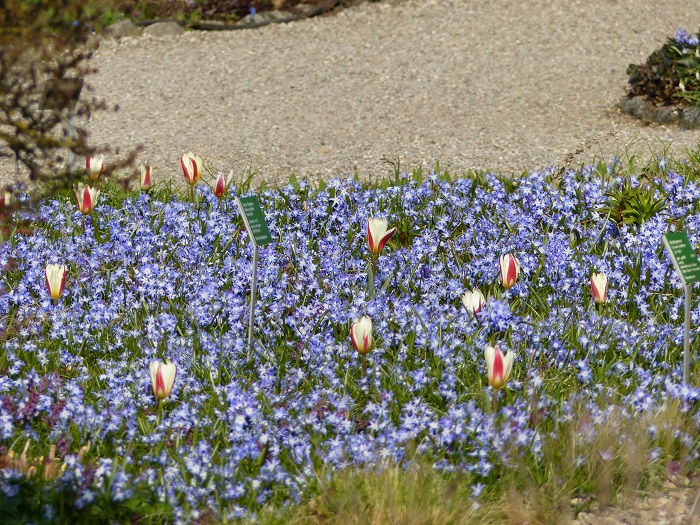 A carpet of Chionodoxa luciliae awakened by some greigii tulips in a sunny bed at Hermannshof
They are the easiest, most diverse, and always the first to bloom: you can never plant enough of these famous small spring bulbs! Chionodoxas, squills, muscaris, iris reticulata, botanical daffodils… all these garden essentials can fit in anywhere… and there are two opposing ways for us to enjoy them: either we plant them in pots […]
Cultivated for several millennia around the Mediterranean basin, saffron has first conquered our plates before finding its way into our gardens. Still rare and precious, this spice, harvested from the flowers of Crocus sativus, requires a touch of patience and a pinch of skill. Grow your own saffron and save money by following these tips.
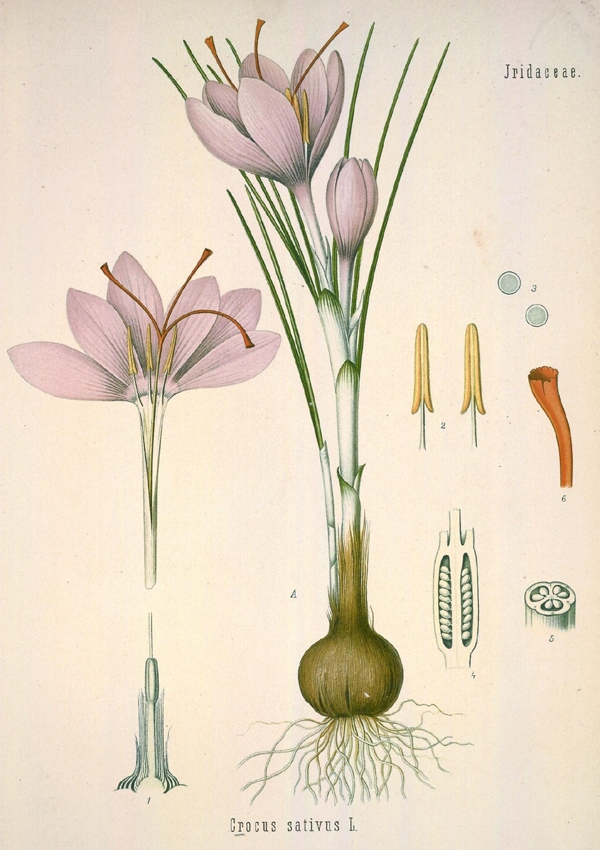
Cultivation of Saffron
The bulbs of saffron crocus are planted in mid-summer, ideally between July and August. It is one of the few plants that can be planted during a heatwave without worrying about its establishment. Depending on the region, the planting method will vary:
- In mild or warm regions (continental or Mediterranean climate), the bulbs are planted in clusters of 3-4, at a depth of 15 to 20 cm (this depth primarily protects the bulb from heat and drought), in well-draining soil, facing south or west.
- In cold or humid regions (oceanic or temperate oceanic climate), the bulbs are planted between 10 and 15 cm deep (if planted too deeply, the bulb will rot; if not deep enough, it will freeze). They should be in full sun, in very well-draining soil, placed on a bed of gravel or sand, as excess water can cause the bulb to rot.
In summary, Crocus sativus should be planted facing south at a depth of 15 cm in very well-draining soil.
Nota bene: the main producers are Iran (80 tonnes), Pakistan (20 tonnes), and Greece (10 tonnes), while France produces only 25 to 50 kg.
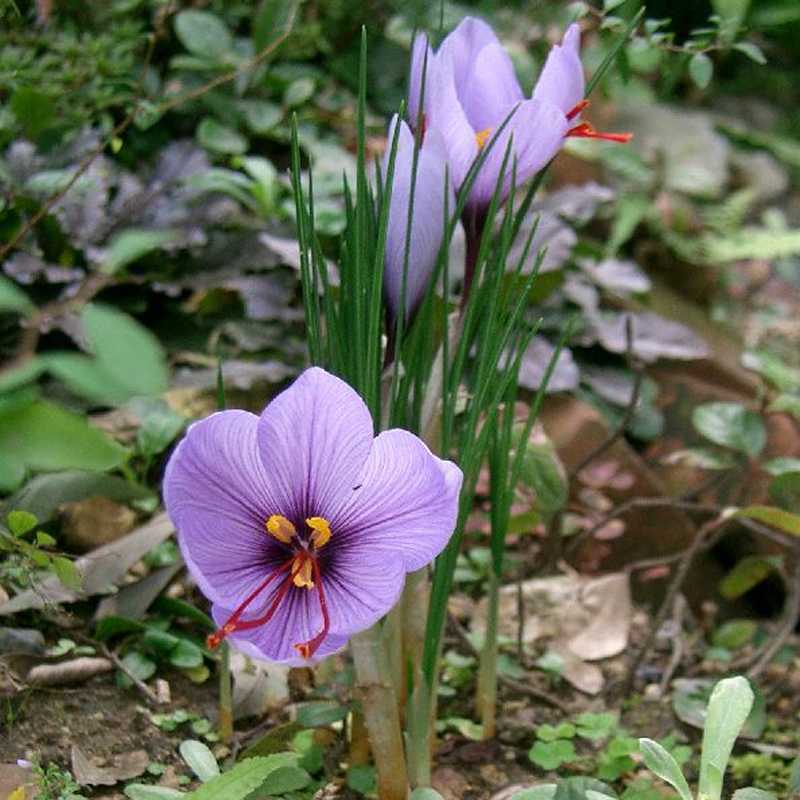
Compared to other Crocus species, the Crocus sativus has inverted vegetation. It flowers in October and dries in spring while others bloom in April and dry in summer.
The harvest takes place in autumn, between October and November. The stigmas are "ripe" when they emerge from the flower. Pick the flowers in the late morning when humidity is low, trim them, and dry the stigmas either in the sun or in a warm oven (no more than 60°C) for a maximum of 30 minutes. Store the precious stigmas in a small airtight box.
Why is saffron so expensive?
The saffron harvest is a completely manual and extremely delicate process. Each flower of Crocus sativus contains only three red stigmas, which must be carefully removed by hand in the early hours of the day to preserve their quality. The yield is very low: it takes about 150,000 flowers to produce 1 kg of dry saffron, which is why this spice is often referred to as "red gold".
The market price of saffron can reach up to 30,000 euros per kilogram, or 30 € per gram, depending on several criteria: the quality of the stigmas (size, colour, aroma), limited production (as saffron only grows under specific climatic conditions), and origin (saffron from Iran, Spain, or Kashmir being the most renowned). This combination of low yield, intensive labour, and variable quality makes saffron one of the most expensive spices in the world.
What yield can one expect from a garden cultivation?
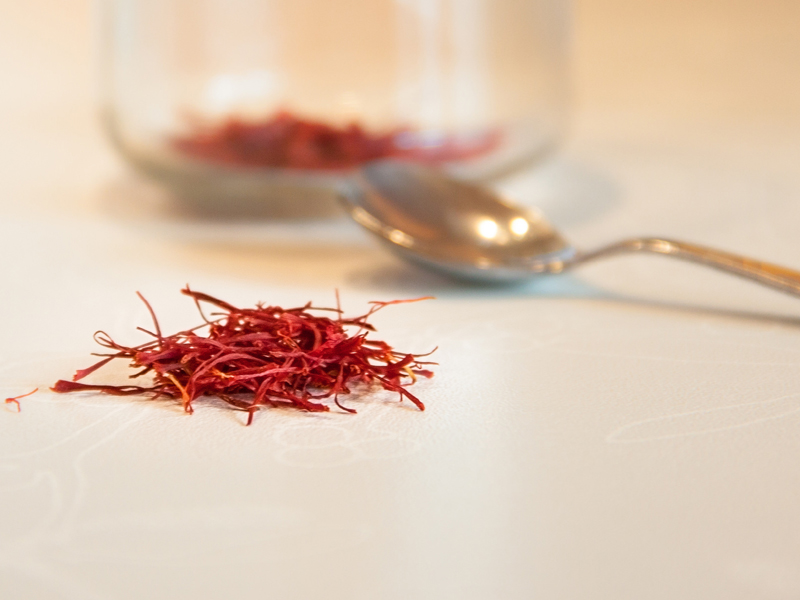
Let’s be honest, the yield of saffron in a garden remains relatively modest. For a small cultivation, you can expect around 50 to 100 saffron bulbs of calibre 8+: 100 bulbs can produce between 0.5 and 1 g of dry saffron per year in the first year.
After that, you can expect 300 flowers after 3 years, yielding 3 g of saffron. The bulbs can remain in the ground from one year to the next and multiply naturally.
With a larger plot, it is possible to plant several hundreds or thousands of bulbs, which will increase production. However, even with a small area, growing saffron can be economically interesting, as a small amount is enough to replace a very expensive spice in the market.
Growing saffron in the garden: a rush for gold?
Let’s not exaggerate! However, depending on your saffron consumption, growing it in your garden can still lead to substantial savings in the medium term.
Growing your own saffron represents a modest initial investment, but it is worth calculating nonetheless. The starting cost includes purchasing the bulbs, which can range from 0.20 to 1 euro per bulb depending on quality and variety. At Promesse de Fleurs, saffron crocus bulbs can be purchased from 0.36 € for 100 bulbs, or 36 €. Additionally, some basic gardening tools (spade, gloves) and the time needed for planting, maintenance, and harvesting are required, although saffron is a relatively low-maintenance plant.
Thus, in the first year, the return on investment is not immediate: the gram of saffron harvested in the first year (equivalent to 30 €) does not cover the initial investment of around forty euros. Consequently, you will have to wait at least until the second year to say: growing my own saffron is profitable!
Cultivated for several millennia around the Mediterranean basin, saffron has first conquered our plates before finding its way into our gardens. Still rare and precious, this spice, harvested from the flowers of Crocus sativus, requires a touch of patience and a pinch of skill. Grow your own saffron and save money by following these tips. […]
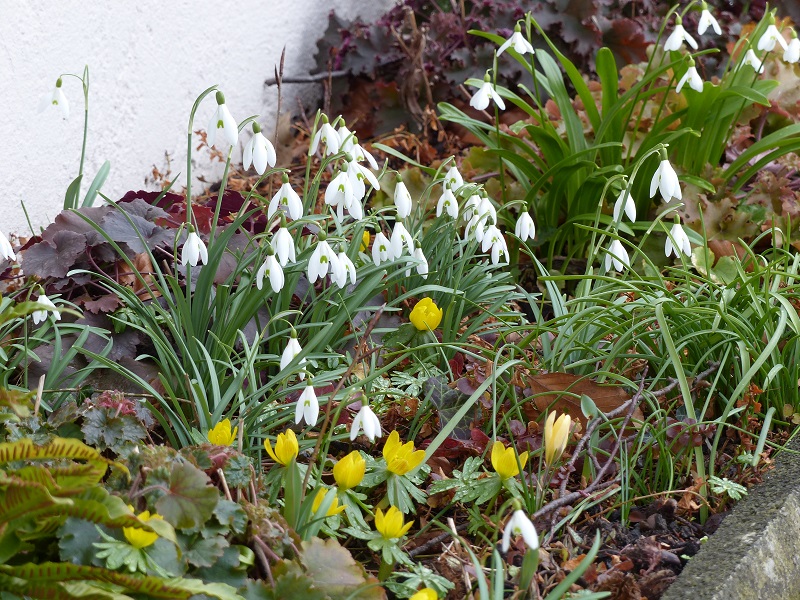
This charming association of early bulbs welcomed me at the foot of my new flat! The winter aconites or yellow hellebores (Eranthis hyemalis) pair perfectly with the white snowdrops (Galanthus), at the foot of the north gable of the house, where they bring light and bright colours at this late winter... Also notice the evergreen foliage of the heucheras accompanying them, discreetly visible in the background today, but which will take centre stage when the bulbs return to dormancy! This is a scene easy to replicate in any garden, like here at the foot of a wall or under trees, and even naturalised in a lawn! Just plant the bulbs together in autumn... be careful not to delay too much as Eranthis bulbs dry out quickly and should be planted as soon as possible for best results.
This charming association of early bulbs welcomed me at the foot of my new flat! The winter aconites or yellow hellebores (Eranthis hyemalis) pair perfectly with the white snowdrops (Galanthus), at the foot of the north gable of the house, where they bring light and bright colours at this late winter… Also notice the evergreen […]
Every year we search for the rare bulb that is hard to find, highly sought after, and will surprise you. Among the new offerings in our spring catalogue this year, we have uncovered some gems for you.
 Pleione forrestii: The lemon-yellow flowers of this terrestrial orchid reveal a subtle spicy fragrance. Hardy down to -5°C, it can be grown in a pot or in a shady rockery, protected.
 Arisaema sikokianum: This is the earliest species of the genus and undoubtedly one of the most graceful.
 Calanthe discolor: Native to the Japanese mountains, this terrestrial orchid with evergreen foliage is quite hardy in our woodlands. It is hardy down to -12°C.
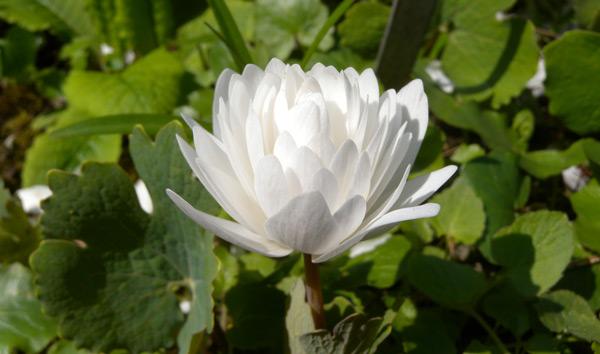 Sanguinaria canadensis Flore Pleno: This small perennial groundcover reveals magnificent double flowers of immaculate white. Its stump suckers in rich, cool, and light soils.
A rare plant is not always synonymous with "uncultivable plant"; rare bulbs are not necessarily the hardest to grow, they are rare due to their shape, cross-breeding, colour, fragrance... But all possess a touch of originality. They do not like excess: not too much shade, sun, wind, water, or dryness.
The ideal conditions for growing them long-term involve having light, cool soil rich in humus with a neutral or acidic tendency. They should ideally be planted in a shady rockery or in a bed facing north or west, against the wall of the house, with the soil amended with compost.
Rest assured, if you do not have these conditions, rare bulbs adapt very well to pot cultivation; in fact, the more tender varieties will be exclusively planted in pots. Just be careful not to overwater them during dormancy, as they do not tolerate excess water. A tip: when planting, place your bulb on a bed of 5cm of gravel or sand to ensure good drainage and promote longevity.
Every year we search for the rare bulb that is hard to find, highly sought after, and will surprise you. Among the new offerings in our spring catalogue this year, we have uncovered some gems for you. Pleione forrestii: The lemon-yellow flowers of this terrestrial orchid reveal a subtle spicy fragrance. Hardy down to -5°C, […]
Small summer scene in the late afternoon: Allium sphaerocephalon is the last ornamental garlic to bloom in the garden. Here, it is paired with the yellow flowers of Asphodeline liburnica, creating a wonderful contrast while remaining elegantly discreet. It is worth noting that it thrives particularly well in warm situations, in well-draining soil.
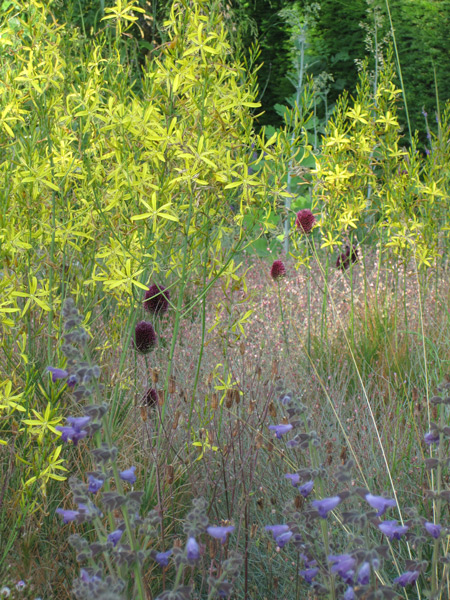
The flowers of Asphodeline liburnica open in the late afternoon when temperatures drop.
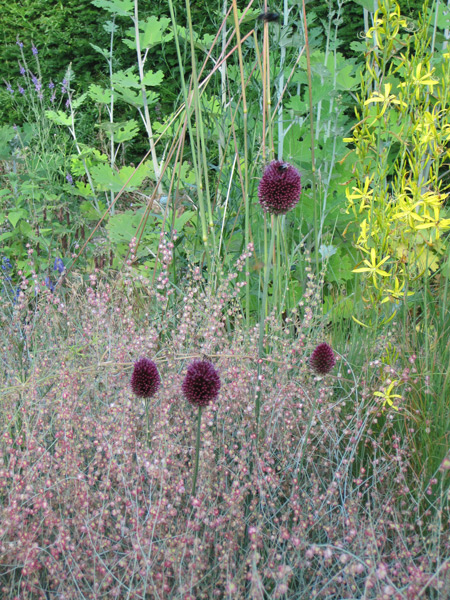
Allium sphaerocephalon
A tip for successfully growing Allium sphaerocephalon in heavy soil: Plant the bulbs directly on a bed of gravel and replace the soil with pure sand; the bulb will be above water in winter and protected from rot.
Small summer scene in the late afternoon: Allium sphaerocephalon is the last ornamental garlic to bloom in the garden. Here, it is paired with the yellow flowers of Asphodeline liburnica, creating a wonderful contrast while remaining elegantly discreet. It is worth noting that it thrives particularly well in warm situations, in well-draining soil. A […]