Kiwis grow very well in Brittany. Did you know? Last week I received a whole crate of them! Since I readily give away my surplus summer harvest, I suppose it's the boomerang effect…
Meanwhile, it's proof that Actinidia does not necessarily come from New Zealand and that it grows very well in our climates. But, having spent part of my Sunday peeling them to make jam, you'll understand that today I'm talking about another kind of kiwi: Kiwaï.
What is Kiwaï?
Kiwaï (Actinidia arguta) or "Siberian kiwi" is a miniature kiwi species that has the undeniable advantage of being eaten with the skin. Admittedly, the fruits are smaller but hairless. Their smooth skin conceals flesh that is just as sweet and fragrant as that of the common kiwi. And because they are just as productive (an adult plant can yield nearly 100 kg of fruit) as their larger cousin Actinidia deliciosa, you only need to eat several to obtain an equivalent or even higher dose of vitamin C.
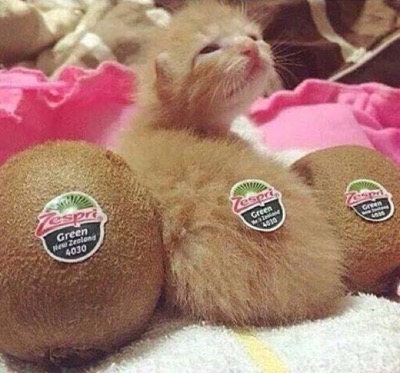
Another advantage of Kiwaï: no confusion possible (Image Pinterest)
How to grow Kiwaï?
Kiwaï is grown exactly like kiwi (see our care sheet): a voluble climbing plant, its long lianas must be trained on a sturdy support. Like kiwi, it is dioecious: female varieties must be accompanied by a male variety. But there are self-fertile varieties. They are a little less productive but have the advantage of being planted alone. Where Kiwaï becomes even more interesting is its extreme hardiness. Native to forests of China, Japan and Russia, it will tolerate temperatures around -20°C, even -25°C (remember… Siberia!), so it can be planted almost anywhere, even in regions with severe winters.
Kiwaï fruit is harvested in late summer to early autumn, earlier than that of common kiwis, and keeps very well when refrigerated.
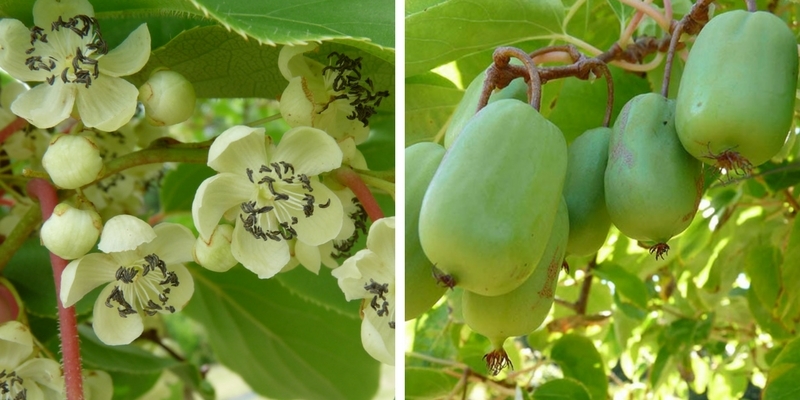
Male Kiwaï flowers and fruits of Kiwaï 'Ambroisia' - Photos Cerdys SA
Varieties
- 'Ambrosia': a female variety that produces small green fruits speckled with red
- 'Ken's Red': a Kiwaï with red skin and purplish flesh, delightfully tangy
- 'Nostino': a male variety that acts as pollinator. It produces flowers but no fruit. Its presence is essential to obtain fruiting of female plants (allow at least one male for 5–6 female plants).
- 'Issai': self-fertile, it produces pretty small green fruits on its own in late summer.
Convinced? Maybe you've already planted this very distinctive actinidia in your garden, do not hesitate to tell us about it!































Comments