For several years, chickens have been moving into gardens and that's a very good thing! They lay tasty fresh eggs, reduce household waste and, on top of that, bring a very bucolic touch to the garden. However, to protect your plants from their tireless scratching and because a cosy home of their own is better than making themselves at home everywhere, it's sensible to plan an enclosure.
By way of anecdote, when we started out as naïve new country-dwellers, we let our hens roam freely until coexistence became complicated. Very tame, they regularly burst into the house and, at bedtime, rather than return to the henhouse, they settled comfortably on the windowsill. Tired of putting them to bed every night and worried they might end up sprawling on the sofa or laying an egg in an improperly closed cupboard, we soon created an enclosed space... a landscaped one, if you please!
So, if you too are the proud owner of hens, here is a selection of trees and shrubs to create them a little corner of paradise.
In the run, chickens need security
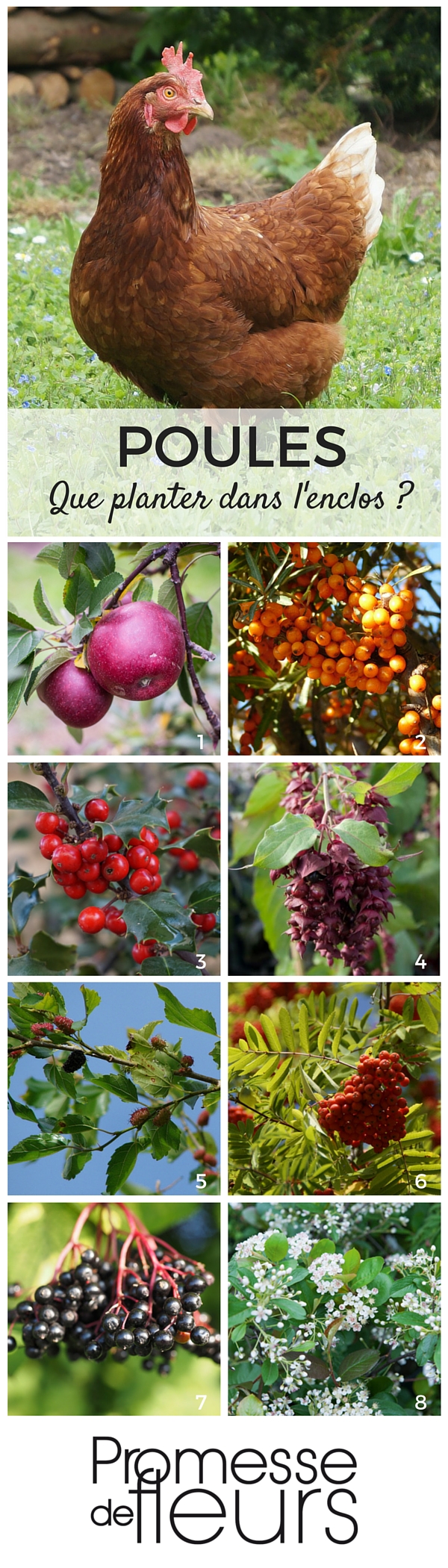
1) Apple tree 2) Sea buckthorn 3) Holly 4) Pheasant tree 5) White mulberry 6) Rowan 7) Elder 8) Aronia
Stray dogs, foxes and even stone martens are common in the countryside. At our place, rather than install a high fence buried into the ground and/or electrified, we fenced simply and chose to let brambles grow. Their dense, thorny growth provides effective protection. However, their exuberant growth requires frequent pruning. As an alternative to secure the run, consider defensive hedging shrubs: Pyracantha, common holly and sea buckthorn are perfect choices.
Chickens catch lice… and the henhouse too!
Hens can pick up lice, which live in their feathers (the "biting lice") and also infest the henhouse. From experience, I can tell you that red mites are an absolute nightmare. These tiny creatures invade the accommodation and feed on poultry at night. To prevent them or at least reduce risk, we use, in addition to sodium bicarbonate or "bi-poux", several dried aromatic herbs as bedding: mint, lavender, tansy and even wormwood. It's a fairly effective natural protection.
Chickens love sun, but shade too! And they are greedy…
Chickens enjoy sunbathing in spring as much as napping in the shade in summer... a bit like us, minus the mojito.
Ideally place hens in an orchard, because they are unrivalled at finding pests, notably the dreaded codling moth (and, a note for beekeepers, the Asian hornet, see here). If you don't have an orchard, planting a shade tree is a thoughtful gesture. The white mulberry, ideal in the south, and the rowan provide cooling shade and also edible fruit for hens. The drawback is that a tree takes several years to provide shade: much faster-growing, black elder proves a good choice.
In place of or to complement these trees, you can also plant various fruit-bearing shrubs such as: Aronia arbutifolia, pheasant tree, currants, raspberries or other soft fruits. Chickens adore these and they provide valuable vitamins.
Finally, in the vegetable patch we always sow a few too many lettuces: they require little work, cost nothing and delight our eight hens… in style!
Further reading :
- Small Encyclopaedia of the Hen and the Henhouse - Michel Audureau - Terre Vivante
- Raising Chickens in My Garden - Michel Audureau - Ulmer


































Comments