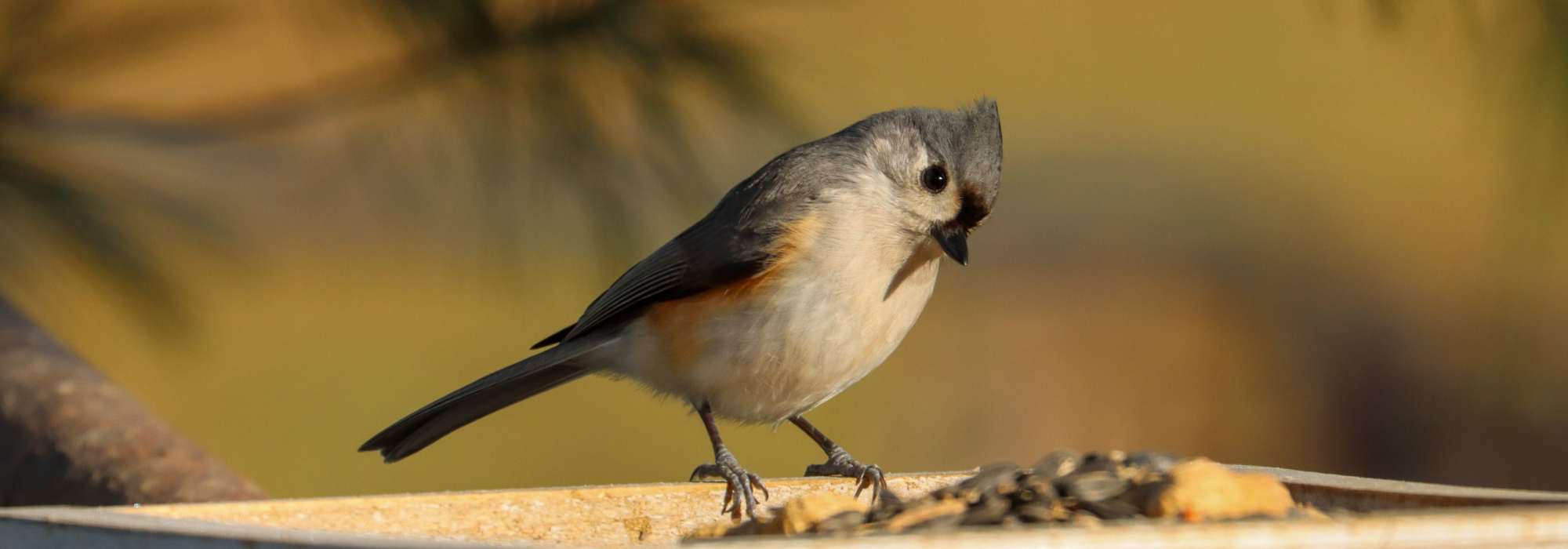
Which bird feeder to choose to attract which birds?
Our guide to choosing the right feeder
Contents
Autumn is well under way, and winter is already looming. In your garden, insects are becoming scarcer, most having already entered hibernation or diapause. Birds are already short of food. If most bird conservation organisations recommend stocking feeders from mid-November to the end of March, this obviously depends on climatic conditions and geographical area. In some regions, winter can arrive particularly early…
You have therefore decided to install one or more bird feeders, not only to ensure survival of this winged wildlife but also to enjoy an ever-rewarding spectacle. On the market, there are many models of feeders and you don’t know which to choose.
Discover all my advice on the different types of feeders best suited to each species of bird. Not all feed in the same way.
Which birds visit gardens, terraces and balconies?
All year round, your garden is visited by flurries of birds that come to feed, drink, sometimes shelter or nest. In spring and summer, the garden becomes, in effect, a vast feeding ground, insectivorous birds finding enough to feed their broods. Thus, larvae and caterpillars of all kinds make a favourite meal for tits. Meanwhile a heap of twigs, logs or even compost shelters many insects, spiders and invertebrates that delight the wren or dunnock. Ivy-clad walls, berry-bearing shrub beds, fruit trees, and some plants such as sunflower, thistles and teasels, or patches of wild grass also delight garden birds.
Life around feeders
But in winter, when insects are scarce, installing feeders helps compensate for lack of food. Indeed, most garden birds have a generalist diet, which varies with seasons and with geographic area of their range. At breeding season many become insectivorous to feed young, others are exclusively granivorous. But in winter, as prey choice narrows, many birds may potentially visit feeders.
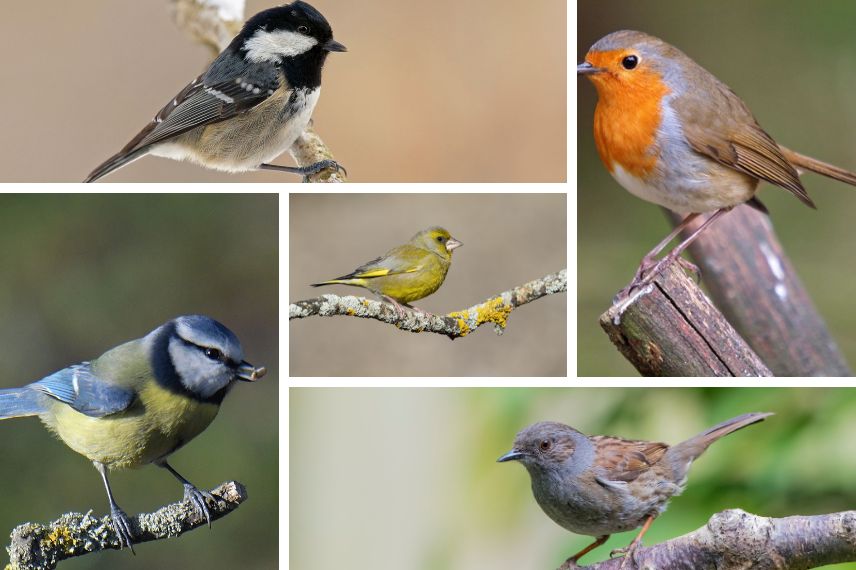
Great tit and blue tit, greenfinch, robin and dunnock visit feeders regularly
In our latitudes, in the countryside or in semi-urban areas, the most common birds visiting feeders are undoubtedly the tit — great tit, blue tit or marsh tit — the chaffinch, the greenfinch, the robin, the house sparrow, the dunnock… not forgetting the collared dove, the wood pigeon, the magpie or the blackbird, and even the starling. In more rural areas, one is more likely to see the nuthatch, the goldfinch, the coal tit and the crested tit or the black redstart… More rarely, the wren.
Different behaviours
All these birds adopt different behaviours, often dictated by diet. Thus, the blue tit has a short beak, ideal for catching insects and larvae on leaves, and also for pecking through the mesh of feeders. By contrast, the chaffinch has a strong, pointed beak, perfect for extracting seeds from their husks. As for the robin, it tends to feed on the ground.
Around feeders, in winter, birds also show territorial behaviour. Thus, robins tend to pursue any intruder entering their territory, the grey wagtail and greenfinches can also be very aggressive around feeders. House sparrows behave similarly. Whereas goldfinches are calmer, often arriving after others.
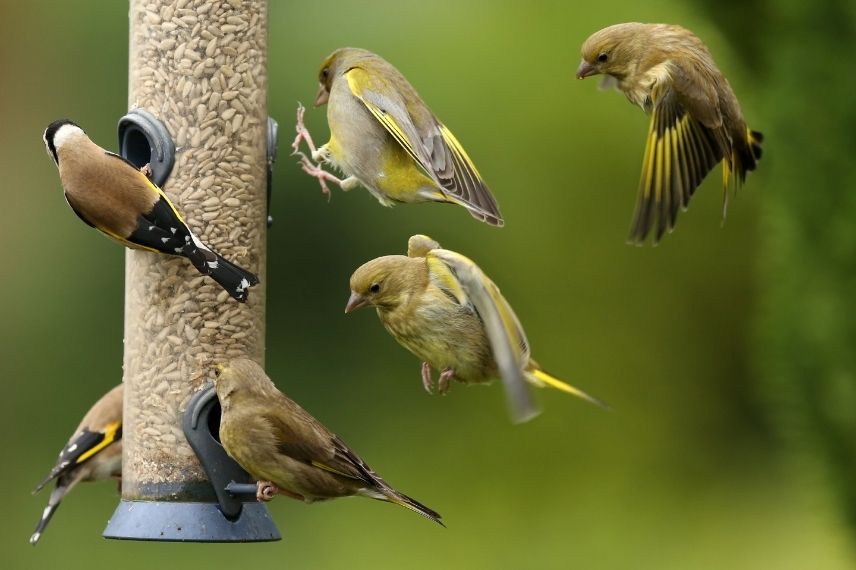
Scuffles often break out among birds, greenfinches frequently showing aggression
That is why, to attract as many different bird species as possible, it is wise to offer several feeding areas, in different designs and stocked with various foods, spread across the garden.
On a balcony or terrace, species will certainly be fewer, but tits and sparrows often turn up.
Read also
What do the birds in our gardens eat?Tips for installing feeders
For a bird, a garden is full of dangers from various sources. That is why a few precautions are necessary when installing feeders:
- Do not place feeders too close to windows and patio doors, which often reflect the garden and can mislead birds. If you only have a balcony, simply hanging curtains can prevent collisions with the glass.
- Position your feeders in a very open spot, where birds can spot danger. At the same time, avoid placing them in the exact middle of an open area, as a Eurasian sparrowhawk could attack birds while they are feeding. Also avoid placing feeders in or near dense bushes or in tree branches, since cats, the main predators of birds, may hide there waiting for the right moment.
- Avoid installing ground-level feeders, unless your garden is completely protected from cat intrusion.
- While not a danger, squirrels (or even rats) can help themselves at feeders and deter birds. To prevent this nuisance, the simplest solution is to fix your feeder to metal poles that squirrels and rodents cannot climb.
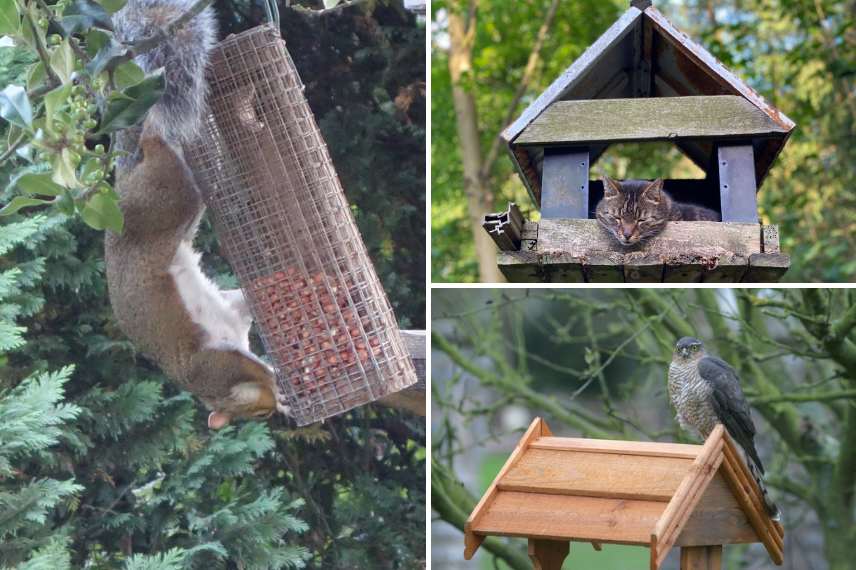
Around feeders, competition is fierce and predators numerous
- Besides cats, the Eurasian sparrowhawk is a real scourge for garden birds. To avoid heavy losses (I have experienced this in my garden, where dozens of sparrowhawks fly over each day), the simplest approach is to install feeders near spiny shrubs where birds can take shelter, but sparrowhawks cannot. It is also wise to change feeder locations regularly and install deterrents such as CDs, repellent balloons or reflectors.
- Some feeders also attract large, more aggressive or voracious birds, such as gulls on the coast, common starlings, great spotted woodpeckers, carrion crows, wood pigeons… Often it is enough to increase the number of feeding stations. The most effective solution remains placing food in feeders that are difficult for larger birds to access, for example mesh or caged feeders. You can also learn to appreciate these birds — they have their own charm!
Otherwise, it is recommended not to put out too much food at once, to avoid quarrels. It is preferable to put out seed in the early morning and in the evening. As spring arrives and temperatures rise, reduce feeding, but do not stop suddenly. Finally, it is essential to clean feeders regularly to limit the spread of disease.
Also consider installing bird baths, even in winter.
Feeding tables, simple yet effective
Among feeder types, feeding tables are the simplest. However, while they are very handy for watching birds, they are just as useful to predators. That is why they must be positioned with care, following the advice given in the previous paragraph.
Ideally, these feeding tables should have a perforated metal base to ensure rainwater drainage. They should also be easy to clean and ideal for seeds.
These feeding tables can be placed on the ground to feed birds such as robin, dunnock or blackbirds, provided no cats visit your garden! They can also be mounted on top of a post, fixed to a wall or hung from a branch. Food can be sheltered from the elements by a roof (which can frighten some skittish species) or by a hopper feeder. The important thing is that the feeder has drainage holes, and that it is sturdy and well anchored in the soil with a stake at least 10 cm long, driven in one third.
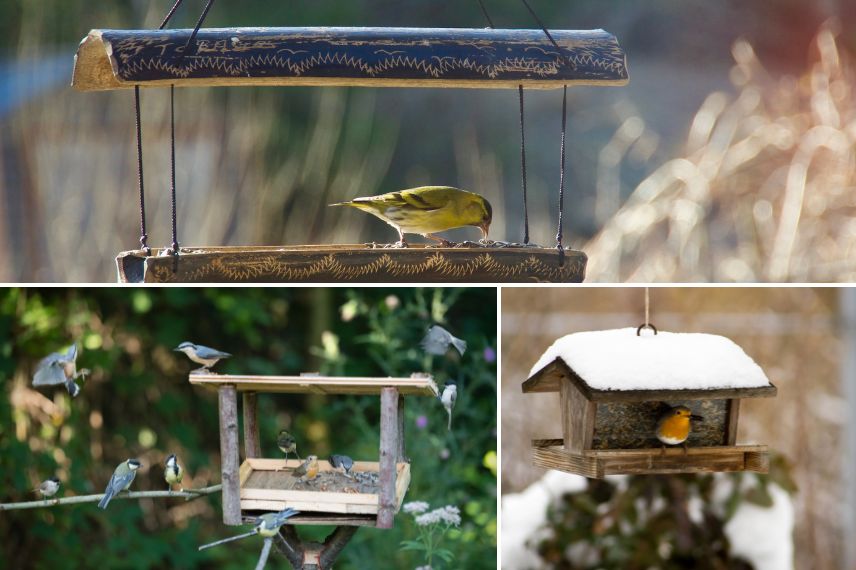
Tables or tray feeders with or without hopper
Easy to make, these feeders attract tits, sparrows, siskins, greenfinches… but also larger birds such as collared doves or woodpigeons.
DIY enthusiasts can build their own wooden feeding tables, possibly with a perforated metal or plastic tray that is easier to clean. Wood can be protected with linseed oil.
Wire-mesh and tubular silo-type feeders, slightly more specialised
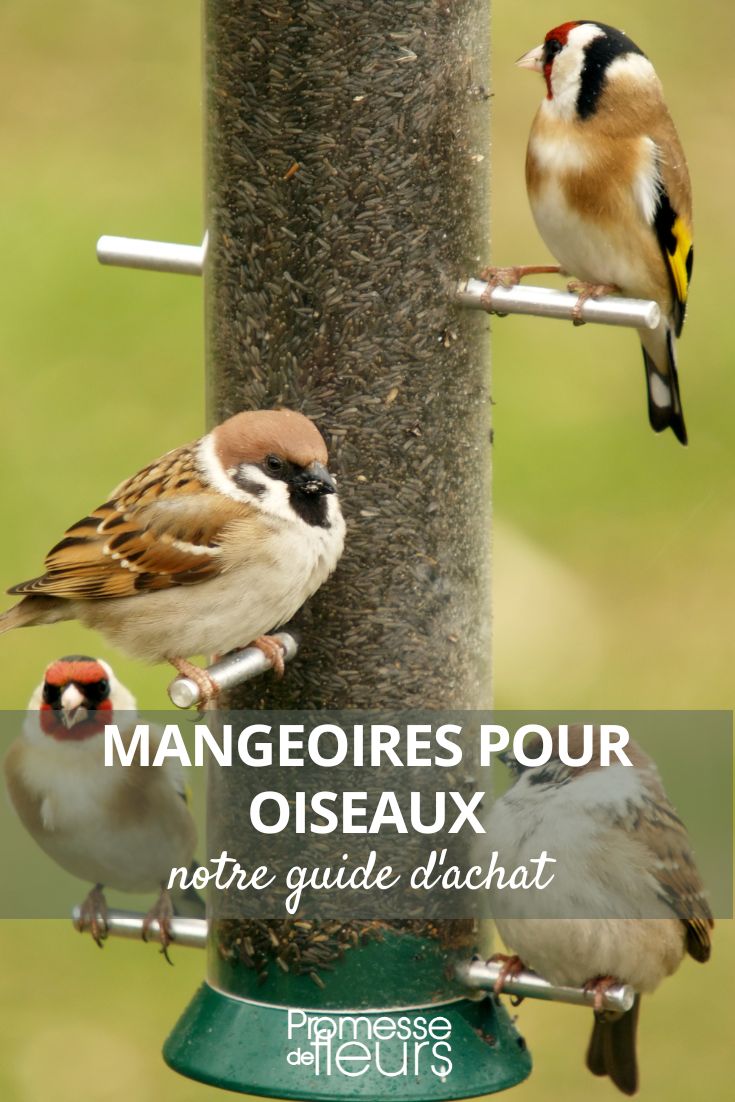
Now let’s look at feeders proper, which come in two forms: tubular and mesh. Tubular feeders are cylindrical silos, often made of Plexiglas, available in various sizes, with several feeding ports and perches. These feeders are particularly useful, as they are easy to clean and watertight. They also help limit transmission of disease. This type of feeder is popular with finches (goldfinches, hawfinches, chaffinches…) and with tits.
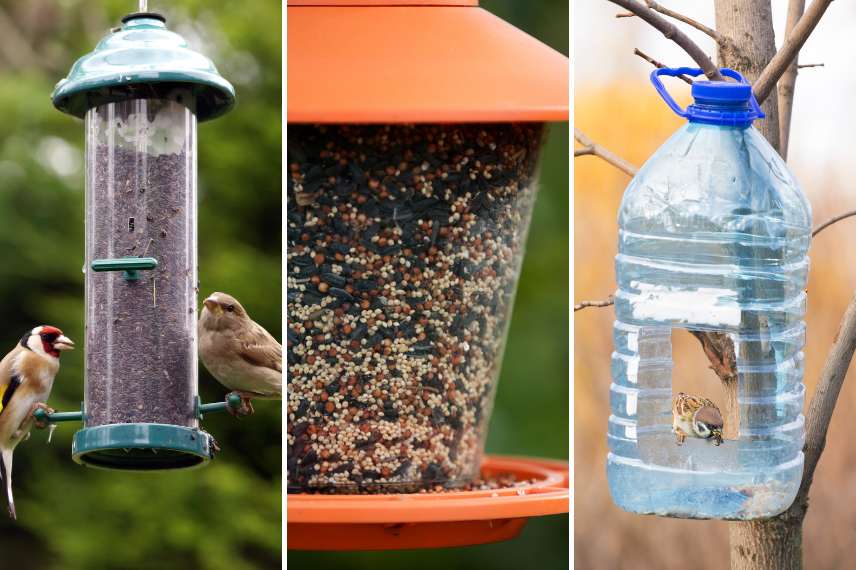
Commercial or homemade tubular feeders
This type of feeder is not difficult to make, using only a few items: a plastic pipe, a gutter, a bottle or plastic container, a tin can…
The second option is the hopper-style mesh feeder, which comes in various shapes and sizes. They are mainly distinguished by mesh size, small meshes being suitable for seeds, larger meshes for peanuts or sunflower seeds. Tits, greenfinches and nuthatches appreciate this style of feeder, where they sometimes hang upside down. Again, with a bit of creativity, it is fairly simple to make one from wire mesh.
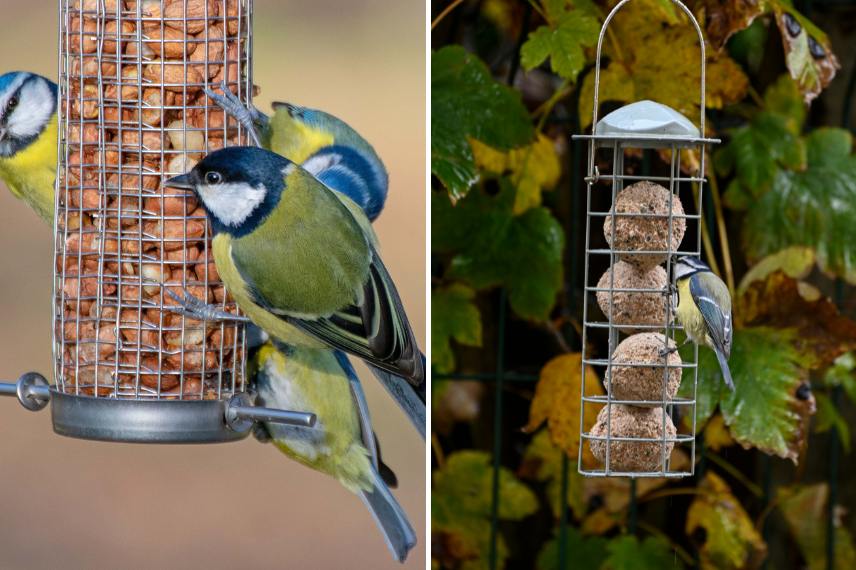
Wire-mesh feeders
Finally, there are other bird feeding options: suspended feeders, made from nets filled with seeds or peanuts, fat balls, suet cakes, millet sprays… Some, such as seed or fat nets, should be avoided because birds tend to get their feet caught in them. However, a simple log drilled with holes, a pine cone, or any container such as a cup can be turned into an effective and original hanging feeder.
Ingrid suggests a few ideas in her articles :
- Subscribe!
- Contents
This form is protected by reCAPTCHA - the Google Privacy Policy and Terms of Service apply.

































Comments