Asian longhorn beetle: a threat to our trees?
How to identify and control this beetle that is highly dangerous to leafy trees?
Contents
Anoplophora glabripennis and Anaplophora chinenis, are the scientific names of notorious wood-boring beetles, more commonly known as the Asian longhorn beetle and the Asian citrus longhorn beetle. Feared to such an extent that they are classified, within the territory of the European Union, as “priority quarantine pest (PQP)” under Regulation (EU) 2016/2031 of 26 October 2016 on protective measures against organisms harmful to plants. In certain regions, the Asian longhorn beetle is also regulated by prefectural order. Because these two insects from family Cerambycidae attack leafy trees relatively common across the territory, such as maple, poplar, birch…some fruit trees and citrus trees such as lemon trees
Although most infestation outbreaks are now virtually eradicated in France, surveillance remains constant and active in certain areas.
Discover what this Asian longhorn beetle really is, how to recognise it and what to do if you suspect detection.

Le « capricorne asiatique » désigne généralement le longicorne asiatique Anoplophora glabripennis, un coléoptère xylophage invasif qui attaque de nombreuses essences d'arbres feuillus. Voici l’essentiel à connaître, utile pour jardinier amateur ou professionnel. Identification - Taille adulte : corps 20–35 mm ; antennes très longues (1,5–2,5 × la longueur du corps), annelées noir et blanc. - Couleur : corps brillant noir avec taches blanches irrégulières sur les élytres. - Jeunes larves : blanc crème, apodes, capables de creuser des galeries profondes dans le bois (larves peuvent atteindre plusieurs cm). - Traces visibles : trous de sortie ronds de 8–15 mm de diamètre, sciure (frass) grossier au pied ou dans cavités d’écorce, suintements de sève, dépérissement et éclaircissement de la cime. Hôtes - Attaque surtout érables (maples, sycamore), peupliers, saules, bouleaux, marronniers, platanes, cerisiers et plusieurs autres feuillus. Certaines espèces locales peuvent être particulièrement vulnérables. Cycle de vie et dégâts - Cycle : 1 à 2 ans selon climat. Femelle pond dans fissures d’écorce ; larves creusent galeries profondes dans le bois, affaiblissant et souvent tuant l’arbre après plusieurs infestations. - Impact : affaiblissement progressif, dépérissement de la cime, risques de rupture de branches et mortalité de l’arbre ; fort enjeu sanitaire pour verdures urbaines et forêts. Origine et dispersion - Originaire d’Asie de l’Est (Chine, Corée, Japon). Espèce invasive en Europe et en Amérique du Nord. Principal vecteur de propagation : bois d’emballage, palettes, grumes et transports de bois infesté. Que faire si vous suspectez une infestation - Ne déplacez pas bois, branches ou bûches provenant de l’arbre suspect. - Prenez photos (gros plan de l’insecte si possible, trous de sortie, frass, vue de l’arbre). - Signalez immédiatement aux autorités phytosanitaires locales (service forestier, organisme de santé des végétaux, mairie si arbre public). En UK, contacter Forestry Commission/Animal and Plant Health Agency ; en Irlande, Department of Agriculture. - Ne tentez pas d’éliminer seul l’arbre infecté sans avis : les mesures officielles (abattage, broyage, brûlage contrôlé) visent à éviter diffusion. Lutte et prévention - Prévention : éviter importations non contrôlées de bois d’emballage ; n’utiliser que bois certifié/traité. Ne pas transporter bois mort ou bûches d’une zone à une autre. - Mesures courantes en cas d’infestation : abattage et broyage/élimination du bois infesté, quarantaines locales, surveillance renforcée. Traitements insecticides localisés ou injections peuvent limiter propagation mais ne remplacent pas souvent l’abattage quand infestation importante. - Surveillance : inspecter régulièrement arbres sensibles pour détecter signes précoces. En résumé - Capricorne asiatique = ravageur xylophage invasif dangereux pour arbres feuillus. Identification facile si on repère taches blanches sur élytres, longues antennes annelées, trous de sortie ronds et frass. En cas de suspicion, éviter déplacement de bois, documenter et signaler aux autorités compétentes pour action rapide. Si vous voulez, envoyez une photo de l’insecte ou des symptômes et je vous aiderai à faire le diagnostic approximatif et indiquer quel organisme contacter selon votre pays.
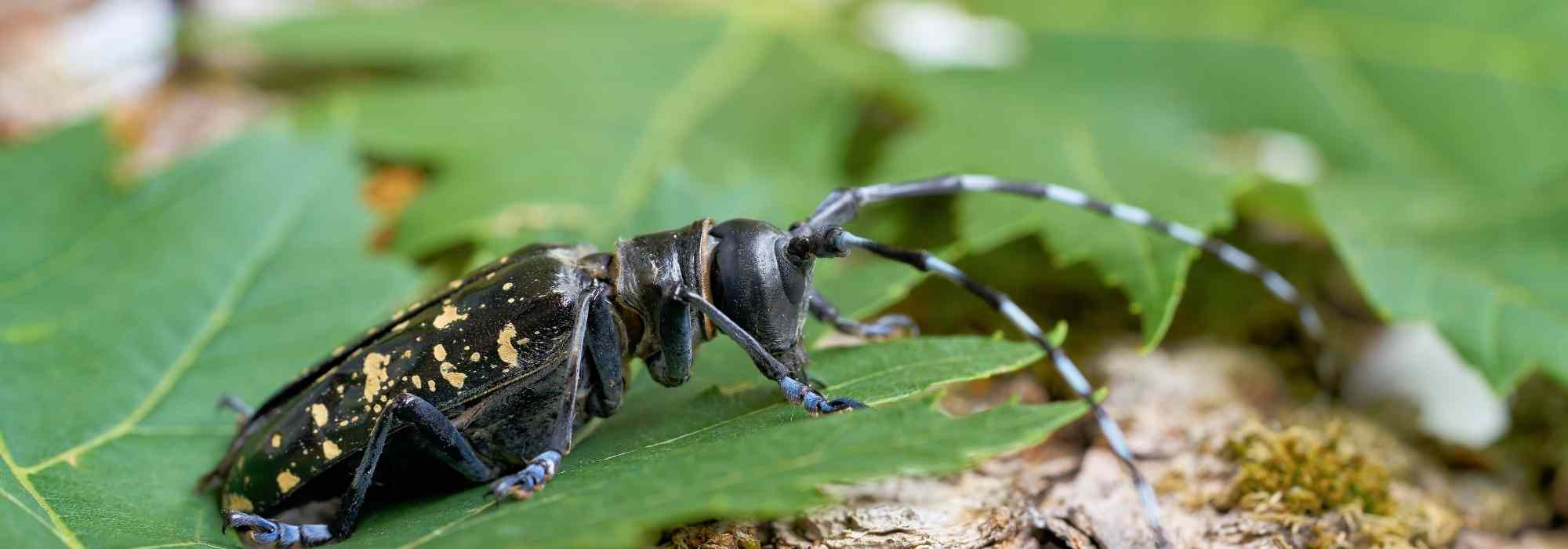
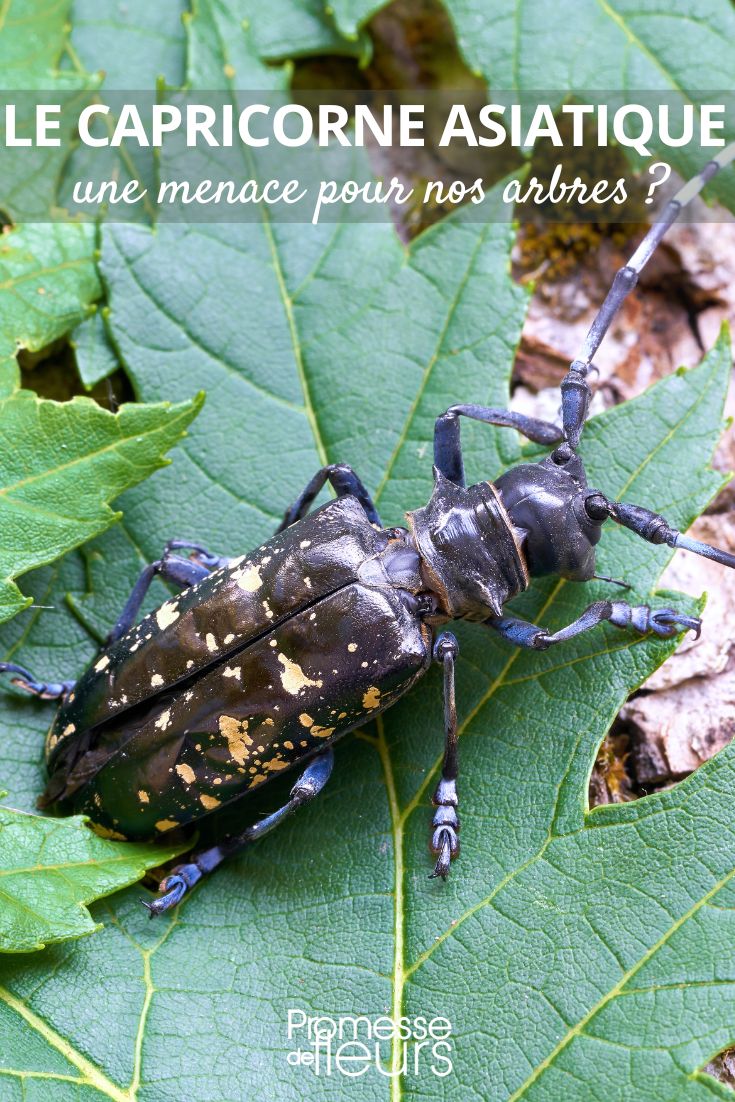
Asian long-horned beetles (Anoplophora glabripennis and chinenis) are beetles recognisable by their glossy, smooth black elytra (hard wings) spotted with whitish patches, and by their very long thread-like antennae which make up two-thirds of their body. These same antennae are striate in grey-blue. This insect, which favours living wood, measures between 20 and 37 mm, the female being slightly larger than the male.
Legless larvae of this insect reach 5 cm in length and have one to two bands on the pronotum (upper part of the first thoracic segment).
Native to East Asia, the Asian long-horned beetle appeared in North America in 1996, then in Europe from 2001. In France, in 2020, five infestation sites had been identified, scattered across the country. To date, only Val-de-Loire, and more specifically the town of Gien, is subject to a systematic monitoring campaign.
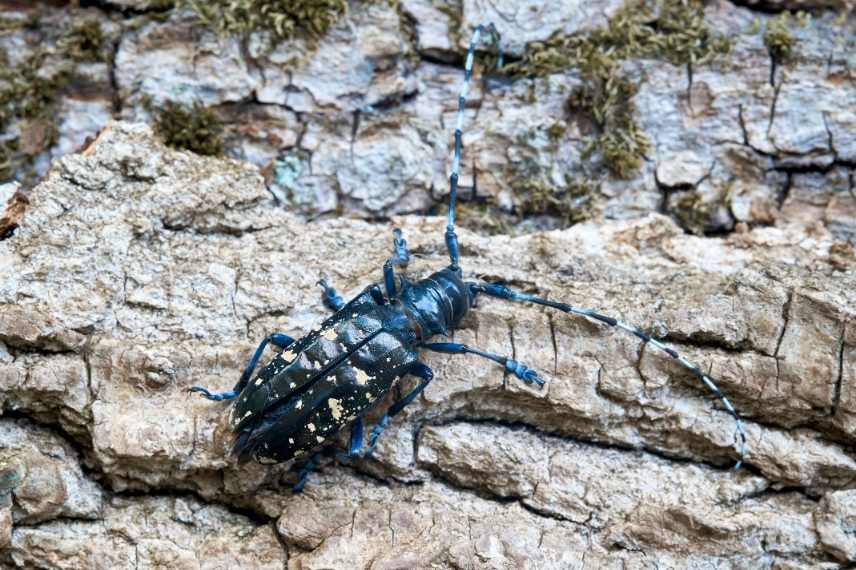
The Asian long-horned beetle has black elytra dotted with black spots and very long antennae
As for the Asian citrus long-horned beetle, it was detected in Europe in 2000, specifically in Milan, then in 2003 in France. Today it appears to have been eradicated in France.
Nevertheless, vigilance remains necessary, because the Asian long-horned beetle is considered a pest of deciduous trees, wild or cultivated, and particularly dangerous. All the more since European climatic conditions are highly favourable to it. And trade with China is an introduction pathway just as favourable as climate!
Life cycle of the Asian longhorn beetle
Life cycle of the Asian longhorn beetle lasts one to two years. It all depends on timing of egg-laying! But it all starts with the flight of the adult longhorn beetles. Males and females gather near their host plants during the growing season. It is especially the period from June to August that is most favourable for mating, as the longhorn beetles only fly on fine sunny days.
The female then searches for a tree and bores into the bark of the trunk and branchs. Between phloem and sapwood she lays 30 to 60 eggs and then dies. Once hatched, the larvae feed in the phloem to continue their development. At the third larval stage, it can penetrate deeper into the tree via galleries. When the larva has pupated, the adult longhorn beetle moves back towards the bark surface and bores a neatly round exit hole about 1 cm in diameter. It is ready to fly. The cycle is complete.
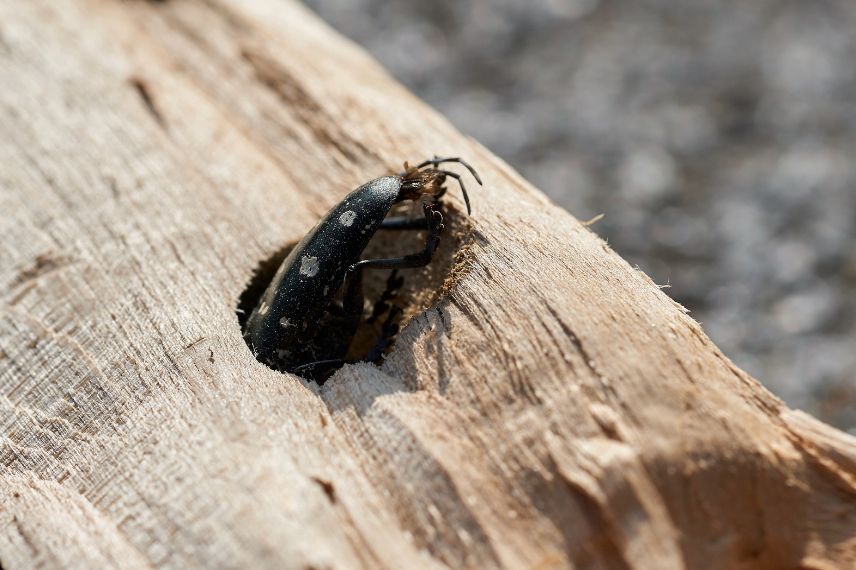
Adult Asian longhorn beetle emerging from hole excavated in bark surface
Which trees are affected and what are the symptoms?
Asian longhorn beetles (Anoplophora glabripennis) primarily attack soft-wooded broadleaved trees, particularly species such as maple (Acer), birch (Betula), willow (Salix), hornbeam (Carpinus), poplar (Populus), linden (Tilia), horse chestnut (Aesculus) and beech (Fagus). In their native range, they infest more than 100 species.
As for the Asian citrus longhorn beetle (Anoplophora chinensis), it feeds on the trees listed above and additionally on alder (Alnus), hazel (Corylus), plane (Platanus), lemon (Citrus) and also apple and pear trees.
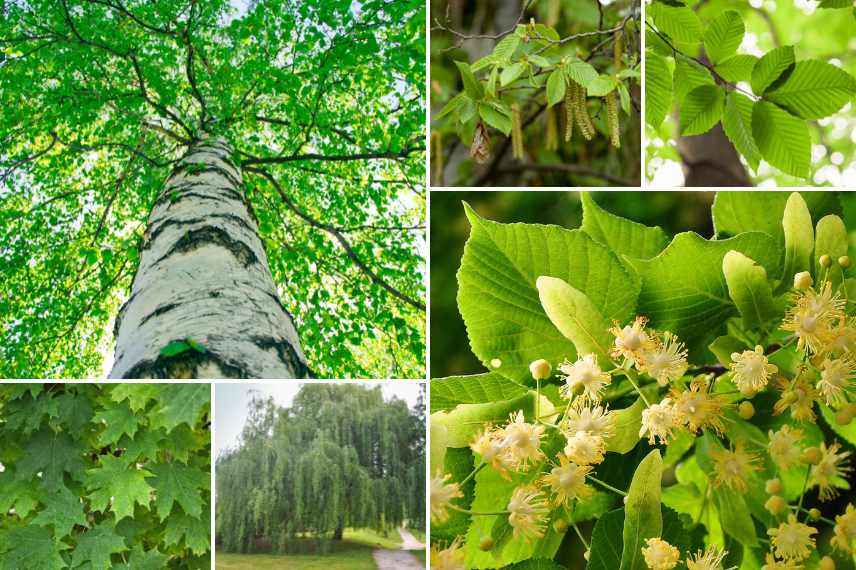
The Asian longhorn beetle favours soft-wooded broadleaved trees
In practice, trees infested by longhorn beetle larvae decline slowly. Simply put, because of the galleries the sap no longer circulates normally, the tree is deprived of nutrients and water. It weakens and can die. Larvae work discreetly, well hidden beneath the bark. However, some signs can help detect an Asian longhorn beetle infestation:
- Small piles of sawdust accumulate at the base of trees or in branch forks. This sawdust results from holes bored by the larvae in the bark
- Notches and round emergence holes made by adults are visible on the trunk or branch bark. The notches correspond to egg-laying sites. Typically, they are noticeable from sap oozing. These holes also provide entry points for fungi and bacteria
- Some branches are stripped of bark by females to facilitate egg-laying
- Some branches dry out and die back.
Read also
Hazel diseases and parasitic pestsWhat to do if Asian longhorn beetle is suspected?
If you observe one or more suspicious signs or symptoms, it is mandatory and essential to inform the competent authorities. Start by marking trees where suspicious signs have been noticed. If you see an insect, capture it and place it in the freezer. A photograph is also important. Then contact the Regional Directorate for Food, Agriculture and Forestry (DRAAF) for your region, which will arrange identification of the insect via the SRAL (Regional Food Service) and/or the FREDON network dedicated to plant health. Both organisations are responsible for monitoring and for controlling these pests.
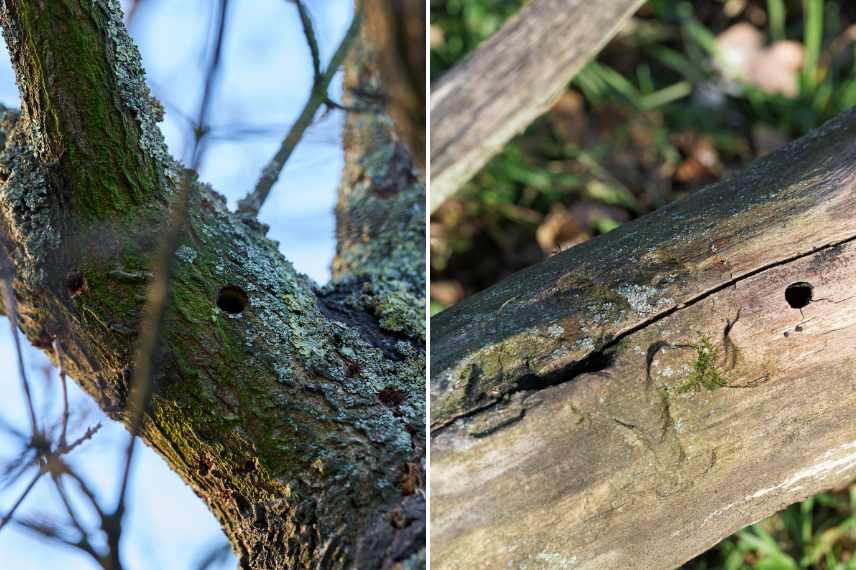
Small circular holes indicate presence of Asian longhorn beetle
Control of this pest requires only the felling of the tree as soon as possible. The tree will be chipped and incinerated. Then a monitoring campaign of trees in the surrounding area will be implemented. Wood products (crates, pallets…) potentially infested may also be incinerated.
As an example, a monitoring campaign is underway in the Centre-Val de Loire region. In 2024, 300,000 host trees were inspected in the communes of Gien, Poilly-lez-Gien and Saint-Martin-sur-Ocre, among others thanks to a canine team. Sixteen trees were felled in March and April 2024, and another felling campaign took place between 17 and 28 June. An outbreak is considered eradicated only four years after detection of the last infested tree.
Areas such as Furiani (Corsica), Divonne-les-Bains and Royan remain under surveillance.
- Subscribe!
- Contents
This form is protected by reCAPTCHA - the Google Privacy Policy and Terms of Service apply.

































Comments