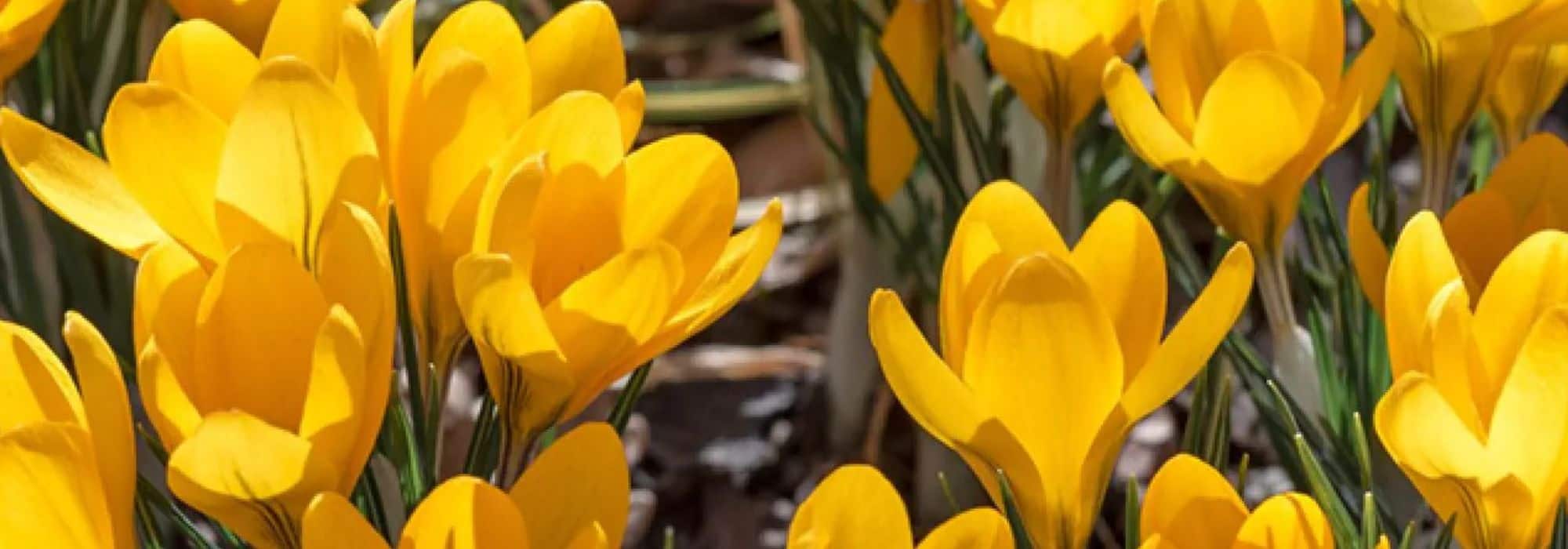
Spring Crocus: how to prolong flowering in the garden?
Our tips and tricks
Contents
Spring crocuses are among those small flowers that brighten the garden from late winter. Their appearance brings a welcome splash of colour, but their flowering is often short-lived. With a few simple steps, it is possible to enjoy them for longer. Discover our tips for planting crocuses under favourable conditions and encouraging a flowering that lasts longer into the season.
Ask yourself the right questions
The holiday home often means installation work, which leaves little time to dedicate to the garden in the first few years. However, even more than elsewhere, the garden will be a true outdoor room in a typically pleasant setting, and it will encourage you to make the most of it, especially if you visit mainly during the warmer months.
If you have just bought or inherited a house where you plan to visit regularly, it is important to ask yourself a few questions that will define your level of commitment:
- Do you wish to spend a lot of time in the garden and relax there often, or is this house more of an opportunity for visits to the area or time dedicated to sports activities?
- Does a garden hold significant importance for you? Depending on your lifestyle or the frequency of your stays, assess the time you can dedicate to it.
- Do you live in a city apartment, are you a novice, and will this be your first garden? Is this second home an opportunity for you to engage in gardening, or conversely, do you not want to add the burden of a second garden?
- When do you come?: This may seem obvious, but it is crucial to install plants that will bloom or be at their peak during your visits.
- What budget can you allocate to the garden? An important question if it is a large garden.
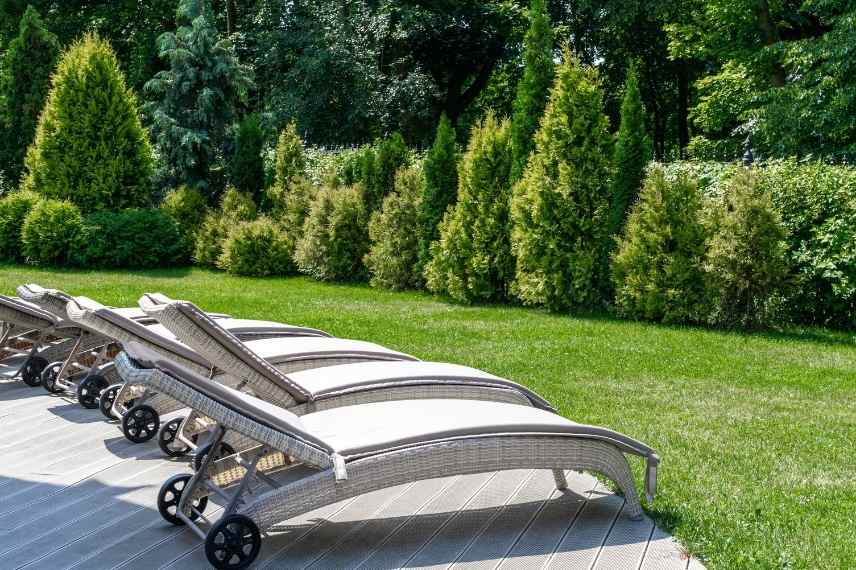
Do you want to lounge in the garden… or something else?
Read also
Coastal garden designPlan your layout wisely according to the size of your garden
In the first instance, planning the layout of a holiday garden is, of course, approached differently depending on whether you have a large space in the countryside or a pocket garden, as is sometimes the case with seaside villas or fishermen’s houses.
While a small outdoor space can be quickly enhanced and maintained, a large garden must be designed according to your priorities, always focusing on the areas closest to the house: the zones you visit most often (terrace, dining area, and relaxation corner).
In any case, you should avoid potted plants, which require regular watering, something that is impossible in a second home… unless you have a mini garden on a slab, as is sometimes the case on the coast: in this case, “camel” plants or succulents can be placed there (see below).
For a large garden, the management of mowing will obviously also need to be considered. We will revisit this in more detail in this article.
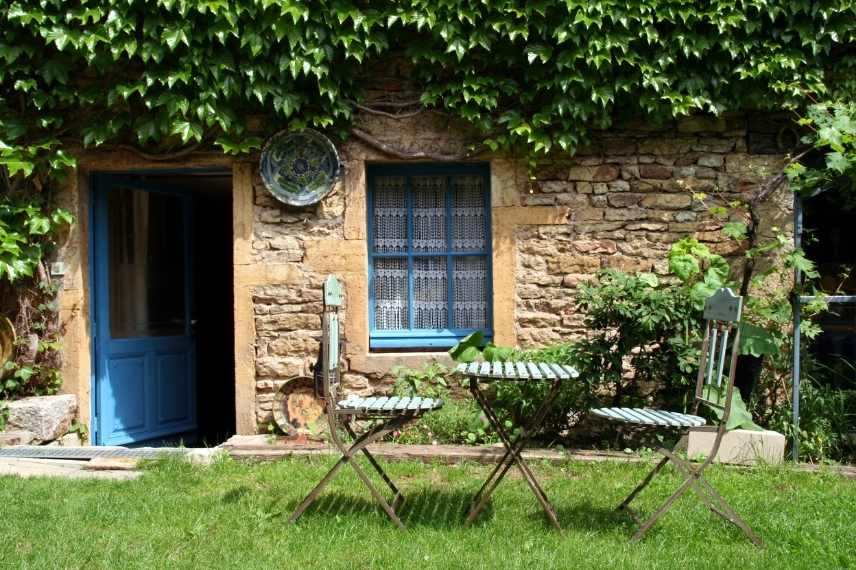
Depending on the size of your holiday garden, maintenance will obviously be adapted
Opt for plants that require little or no pruning
The secondary residence with a garden is a breath of fresh air, far from daily life, and should remain a time spent together with family or friends, while avoiding the chores of pruning as much as possible…
When it comes to bushes, it is therefore essential to plant as many plants that thrive without pruning as possible: they generally have a flexible habit, rounded or spreading, or a naturally compact habit in a ball shape or a free silhouette for establishing informal hedges, as well as dwarf shrubs. They come in both evergreen and deciduous foliage.
> Our selection of beautiful shrubs that require no pruning: all viburnums, Abelia, Weigela, Pittosporum tobira ‘Nana’, Philadelphus (Mock Orange), oleander, rosemary, the arched habit shrubs such as spiraeas and Exochorda, shrubs with a ball or cushion habit (Hebe or shrubby veronica, Pittosporum tobira, Mexican Orange Blossom, Cistus), Mahonia confusa and eurybracteata…
All these shrubs will not suffer from a missed pruning that would compromise flowering.
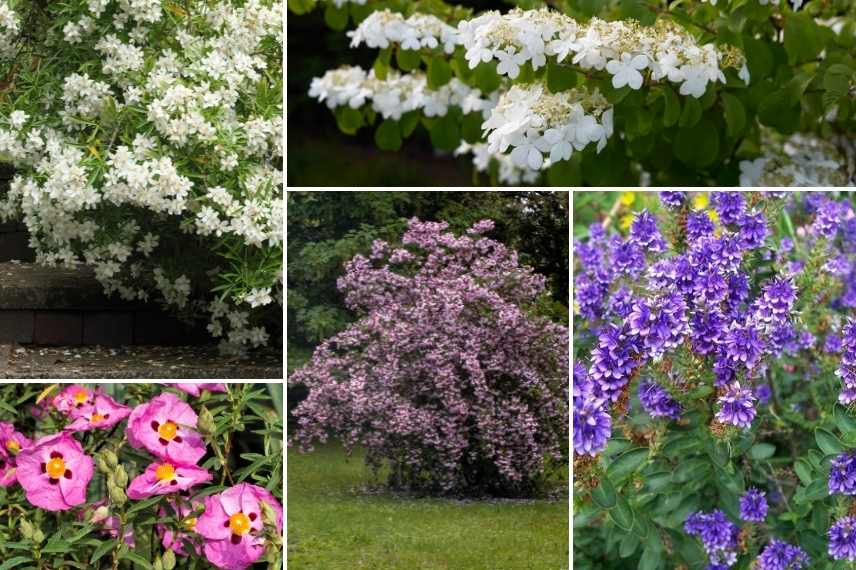
Choisya ternata, Viburnum plicatum, Cistus, Weigelia and Hebe ‘Autumn Glory’
Slow-growing shrubs will of course also be preferred (often evergreen): most heather soil shrubs such as Skimmias, rhododendrons, and Kalmias, Pittosporums, strawberry tree, Berberis, Nandina domestica, creeping Ceanothus, rosemary…
And of course,all exotic-type plants such as Phormiums, Agaves, Yuccas, Cordylines, etc.
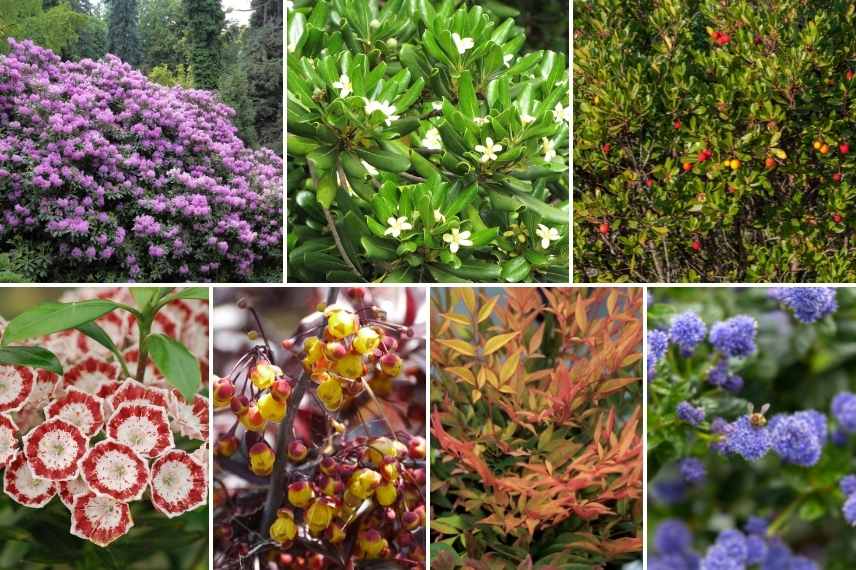
Rhododendron, Pittosporum tobira ‘Nanum’, Arbutus unedo, Kalmia latifolia ‘Minuet’, Berberis thunderbolt, Nandina domestica ‘Gulfstream’ and Ceanothus
→ Also see our tips on low-maintenance gardening, plants and tips.
Read also
Designing a country gardenManage watering
Without water… no growth! Unless you create a dry garden or a scree garden and establish an arid decor (which can be a lovely option south of the Loire), the main concern with holiday home gardens is watering, as you simply aren’t there to activate it.
Since installing an automatic irrigation system, which usually requires an electrical supply that is typically turned off when you leave, is costly, you need to bypass the watering issue with a selection of drought-resistant plants (drought-resistant shrubs, drought-resistant perennials). These are increasingly discussed as the plants of tomorrow, maintaining a decent appearance all summer, with or without you.
The region where your second home is located is important in choosing plants: it is more reasonable to consider planting slightly more water-demanding bushes in Brittany, the Ardennes, or the Basque Country than elsewhere. Well-watered during the first two years, the bushes will thrive thereafter due to ambient humidity and seasonal rainfall. However, this does not account for the recurring heatwaves each year.
Here is a selection of plants that do well without regular watering (also see our list of easy-care plants): Buddleia, Lagerstroemia, Ceanothus, Grevillea, Mahonia, Caryopteris, and among the perennials, many grey-foliaged plants such as Echinops ritro, Helichrysum italicum, Perovskia, centaurea, Gaura, daylilies (once established), euphorbias, lychnis, and salvias, for example. Succulent plants like cacti are also ideal in sufficiently mild climates with not too much winter rainfall.
→ Also check our articles on gardens without watering: designing a garden with minimal watering (or almost none), the grille garden, a garden without watering, and 10 drought-resistant perennial plants for a garden without watering.
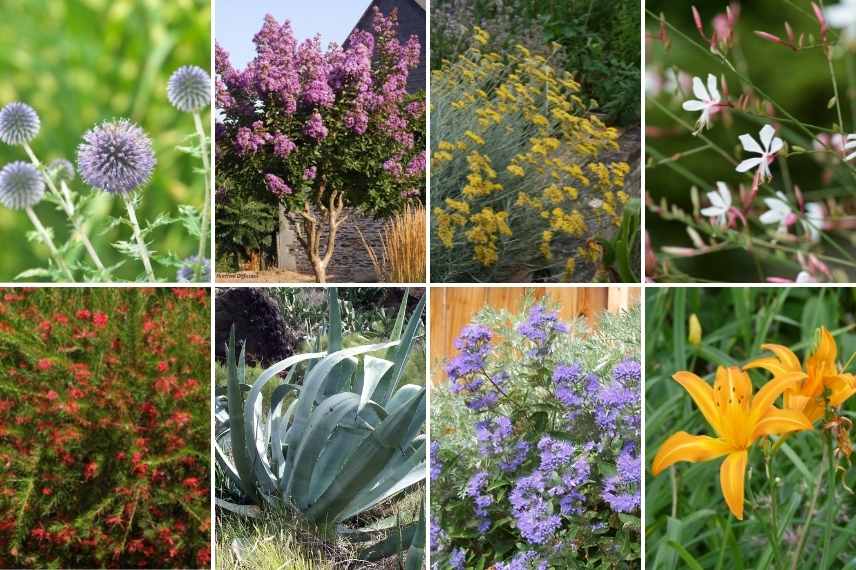
Azure ball, crape myrtle, Helichrysum italicum, Gaura, Grevillea, Agave americana, Caryopteris, and daylilies
Choose easy-care plants
Nothing beats arriving at your holiday home and discovering a garden devoid of colour, lacking seasonal blooms. It is essential to plant as many self-sufficient plants as possible, requiring little to no maintenance: perennial plants, bulbous plants, and certain undershrubs and shrubs.
Of course, you will choose the plants according to your region’s climate, your soil, and the exposure, to avoid having to mulch the most tender plants for winter. When it comes to roses, in a small garden, you might consider planting repeat-flowering roses that require regular pruning, but this would not be advisable in a large garden due to the constant work they demand.
- Groundcover plants: they are essential for reducing the chore of weeding, spreading, creeping, cushion-like, in shade or sun, there is always something to dress and highlight the taller plants in the beds.
- Spring bulbs or summer or autumn bulbs: with them, there is no risk of extra work, they return every year, more numerous and lush, especially the botanical species that naturalise over time. Tulips, daffodils, squills, and alliums lead the way for a colourful spectacle in the garden in spring. Be mindful of the hardiness of summer bulbs; some may not be suitable, but you can always rely on the hardiest summer bulbs like Lilies, Liatris, and Crocosmia.
- Self-seeding perennials: Linaria, Verbascum, California poppy, wallflowers, Mirabilis, Impatiens glandulifera, etc.
- “Camel” plants: led by bushy sages, Perovskia, Buenos Aires verbena, and Gaura for their long flowering, as well as grasses like Stipa and Fescue…
- Conifers, trees, and shrubs suited to drought: strawberry tree, Cercis, oleander, pines, and cypresses, etc.
→ also see our tips on maintenance-free groundcover plants, and how to choose perennial plants?
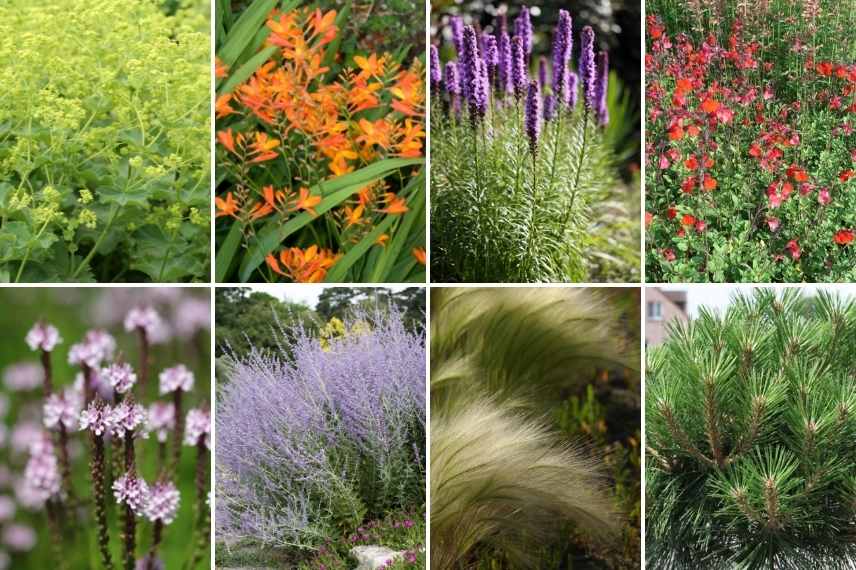
Alchemilla mollis, Crocosmia, Liatris spicata, Salvia macrophylla ‘Royal Bumble’, Linaria purpurea, Perovskia, Stipa tenuissima, and Pinus nigra ‘Pierrick Brégeon’
- Subscribe!
- Contents
This form is protected by reCAPTCHA - the Google Privacy Policy and Terms of Service apply.
![[plantes] Transformez le jardin de votre maison de vacances en un véritable havre de paix grâce à une sélection de {glossary}plant varieties{glossary} adaptées à votre climat. Embellissez votre extérieur avec des {glossary}flowering plants{glossary}, des {glossary}ornamental trees{glossary} et des {glossary}vegetable plants{glossary} pour profiter pleinement de votre séjour. N'hésitez pas à consulter nos conseils d'aménagement pour créer un espace verdoyant et accueillant.](https://www.promessedefleurs.ie/blogwp/wp-content/uploads/2022/10/amenager-un-jardin-de-residence-secondaire.jpg "Setting up a garden for a secondary residence")

































Comments