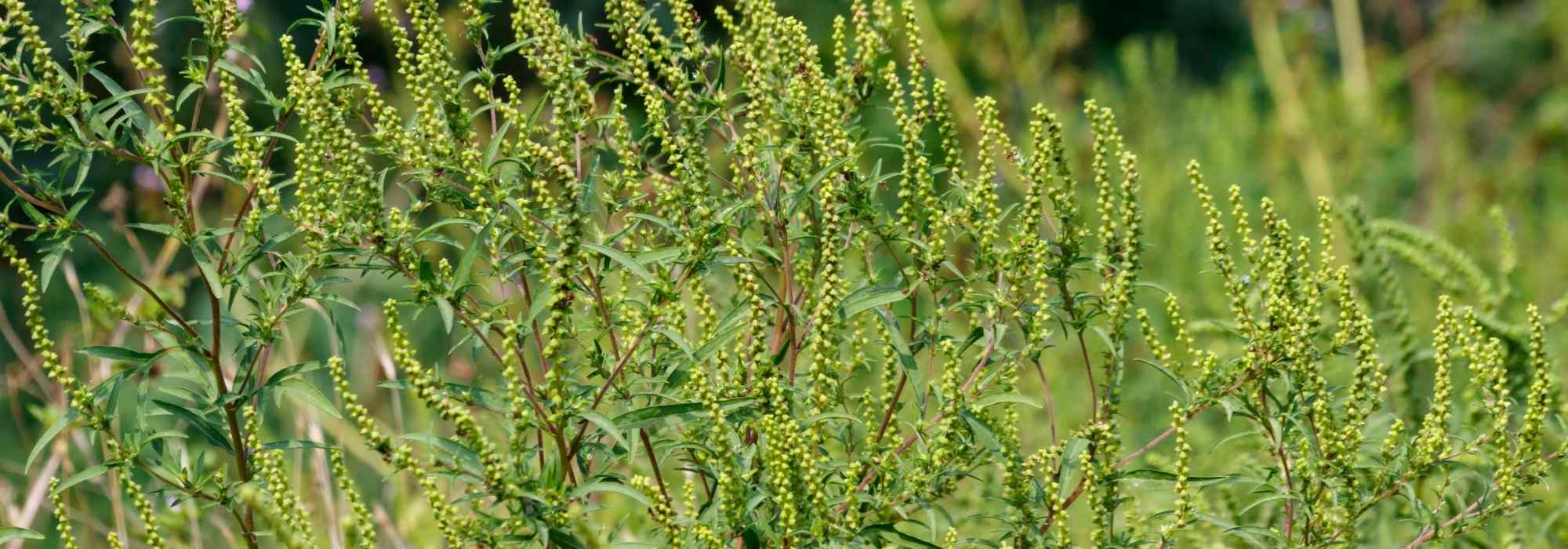
Ragweed: how to control it naturally in the garden?
Getting rid of ragweed without chemicals
Contents
More than just a weed, ragweed is the number-one public botanical enemy, for private gardeners as well as local authorities, because of its impact on public health. Invisible yet invasive, this annual plant is particularly feared for its highly allergenic nature. Its pollen affects millions of people each year, in summer and autumn, causing hay fever and severe asthma. Over the past few decades, it has become one of the major scourges of green spaces, crops and fallow land. That is why combating ragweed is everyone’s responsibility today. Gardeners have an essential role in eradicating this invasive adventive plant from their own garden.
Discover how to identify ragweed, eliminate it permanently and naturally, and, above all, prevent its appearance without using chemical products.

How to recognise the different species of ragweed?
Ragweed is a plant of the Asteraceae family, native to North America. Several ragweed species exist, but the most problematic and widespread in Europe is common ragweed (Ambrosia artemisiifolia). This is the one to target first! Our tips to recognise it :
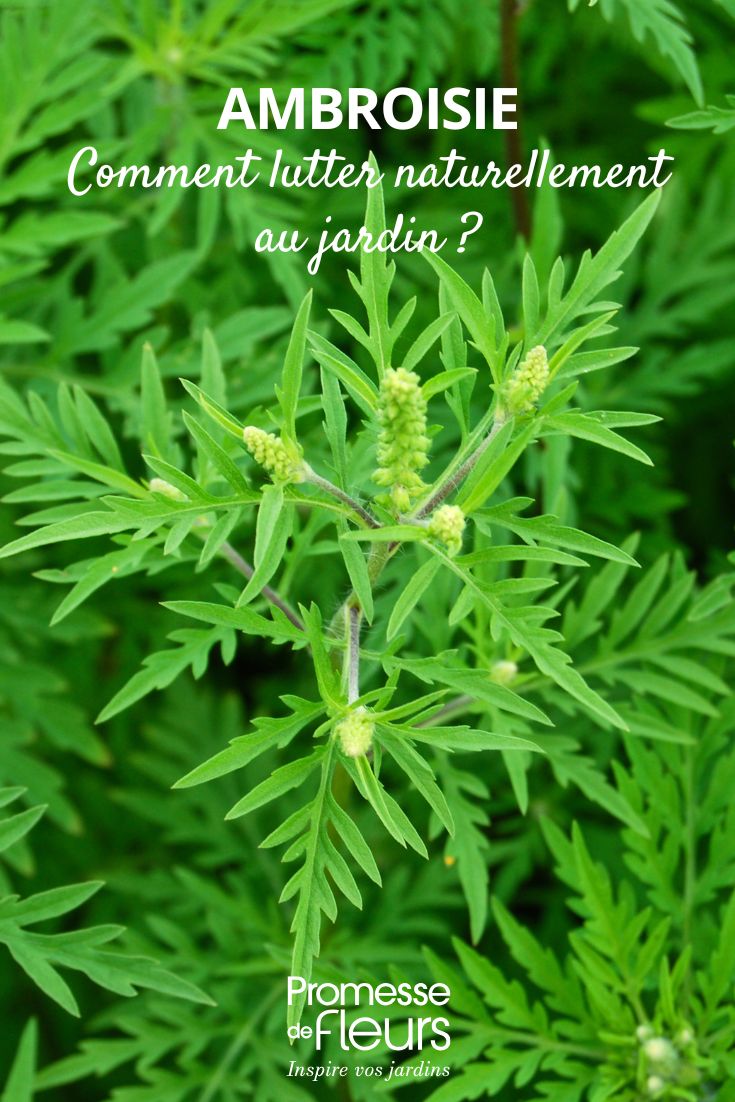
- Light green, very finely divided foliage, resembling that of carrot or mugwort (Artemisia). But, unlike mugwort, ragweed leaves are green on both sides rather than whitish beneath
- Straight, often branched stems, covered with small fine, rough hairs. These stems become woody and reddish with age. Thick and robust, they can reach 30 cm to 1.5 m in height
- A monoecious plant, ragweed produces male flowers, grouped in terminal spikes, upright like candles, yellow-green in colour, and more discreet female flowers located at the base of the leaves. Only male flowers produce the allergenic pollen. Flowers open from July to early autumn.
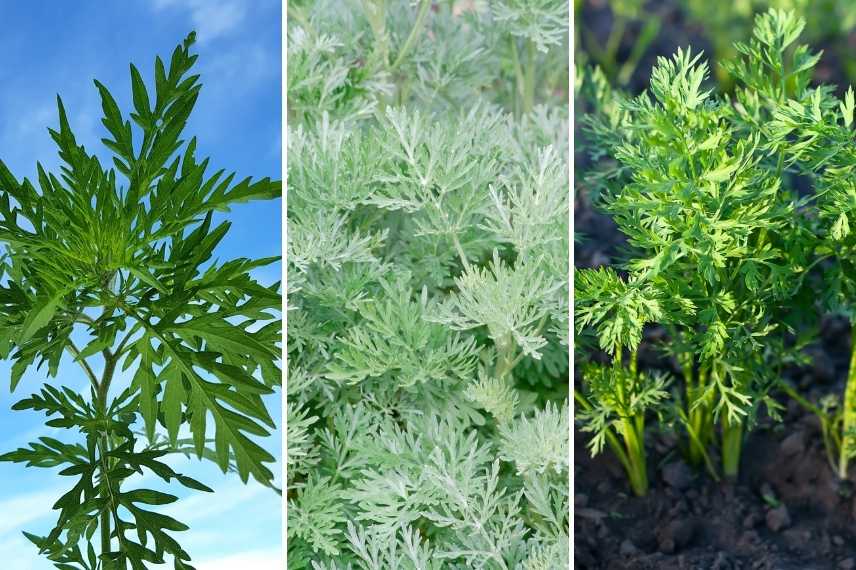
Leaves of ragweed, mugwort and carrot
Two other ragweed species exist, but they are less widespread :
- Giant ragweed or trifid ragweed (Ambrosia trifida) : Much larger and more robust (up to 4 metres). Its leaves are characterised by three deep lobes. It is more frequent in wet areas and along watercourses.
- Slender-spiked ragweed (Ambrosia psilostachya) : A perennial, rhizomatous species that produces running underground roots, making it particularly difficult to remove by simple pulling. Its habit is more spreading than A. artemisiifolia.
Why is it essential to eradicate ragweed?
Eradicating ragweed is not just a question of aesthetics or of competition with your other plantings. Above all, it is a public-health and ecological priority. Moreover, regions occasionally run information campaigns. Ragweed plants spotted in urban or rural areas can also be reported. We will return to this later.
Ragweed is considered an invasive plant with strong allergenic potential. Climate change further favours it. Mild winters, early springs and hot summers encourage its proliferation. It has many negative impacts on the environment.
A highly allergenic plant
The main reason for combating ragweed is its allergenic potential.
- High reactivity: Ragweed pollen, produced in very large quantities on each plant, is one of the most potent allergens known. A few grains per cubic metre of air are enough to trigger reactions
- Debilitating symptoms: Pollen causes severe allergic rhinitis (sneezing, runny nose, itchy eyes), conjunctivitis, and in the most serious cases, asthma attacks or the onset of asthma in people not previously predisposed. Up to 20% of the population could potentially be allergic to this ragweed. On contact, ragweed can cause itching and skin rashes
- Late seasonality: Unlike grasses and other spring pollens, ragweed releases its pollen from mid-August until the first frosts, extending the allergy season.
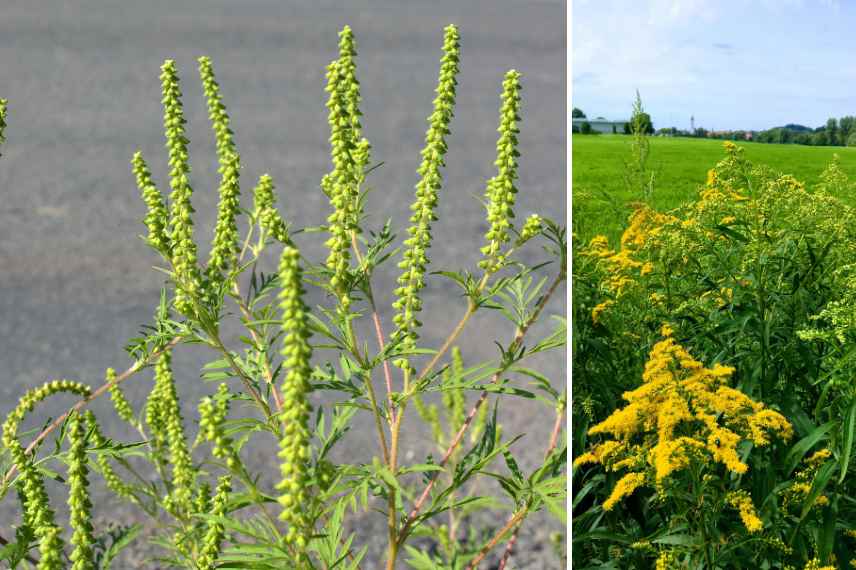
Ragweed flowers are extremely allergenic
Impact on crops and environment
Ragweed is also a highly aggressive plant in both natural and cultivated environments.
- Crop competition: In vegetable gardens or cultivated fields, ragweed quickly depletes soil of water and nutrients, significantly reducing crop yields
- Massive seed production: A single plant can produce up to 3,000 seeds, capable of remaining viable in soil for 5 to 10 years or more. One uncontrolled plant can guarantee infestation for the next decade
- Adaptability: It thrives in disturbed soils, fallow areas, along roadsides, in moderately maintained gardens, and establishes easily after any soil work. It is also a ruderal plant that adapts to all soils, including those saturated with chemical inputs, fertilisers and herbicides, and other pollutants…
How to eradicate ragweed naturally?
To eliminate ragweed, follow one fundamental principle: act before flowering and pollination. Several methods are relatively effective.
Manual pulling for gardens
This is the most effective and ecological technique for small to medium infestations in a garden.
- Intervene before mid-August, ideally as soon as plant is large enough (10 to 15 cm) to grasp, but before yellow flower spikes form
- Pull up entire plant, taking care to remove root. Ragweed will regrow if simply cut
- Always wear gloves and, if possible, a mask, even before flowering, to avoid contact with other pollen or sap.
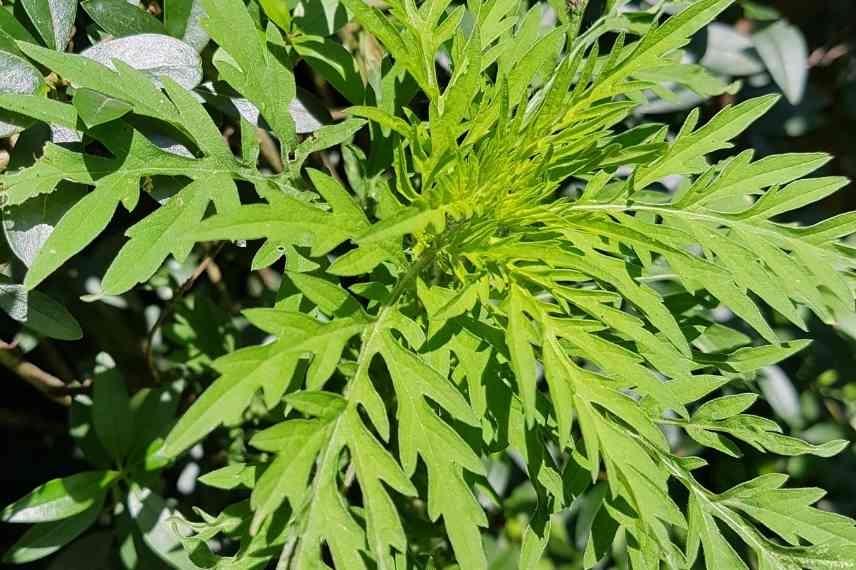
Manual pulling of ragweed is carried out before flowering
Mowing for larger areas
For high-density zones or field margins.
- Mow or cut grass close to ground just before flowering, ideally early August
- If mowing too early, ragweed will regrow and flower lower down but will still produce pollen. It is often necessary to make two passes: first brush-cutting or strimming, then a second mow at the right time. This mowing therefore reduces pollen amount, but does not eliminate plants
- Mowing is ineffective against ragweed with thin spikes (A. psilostachya) because it regrows from its rhizomes.
Thermal weeding and mulching
For paths, terraces or small infested areas.
- Using a thermal weed burner, gas or electric, is effective at destroying young shoots. Operation must be repeated several times
- After clearing an area, cover soil with a thick layer of mulch (wood chips, RCW, straw) or with a black weed membrane. Ragweed is a light-demanding plant and cannot germinate without light. This method is best to prevent germination of dormant seeds.
Read also
Pollen allergy: how to protect yourself?What to do with ragweed waste?
Waste management is crucial to avoid spreading the problem. Uprooted young plants pulled up before flowering and seed set can be left in place to decompose. They can also be added to compost; heat will destroy whole young plants.
If young plants have been pulled up after flowering or seed set, they must NEVER be put in compost or left on the ground in small gardens. Place them in a sealed bin bag and dispose of with household waste so they are incinerated or sent to landfill. However, other organisations recommend leaving the young plants in place to allow them to germinate. This false seedbed will destroy seedlings.
As a reminder, burning plant waste is strictly prohibited in private gardens.
Regulations on ragweed
Ragweed control is not a mere recommendation, but a legal obligation in France, set out in the Public Health Code (articles L. 1338-4 and following). Decree No. 2017-645 of 26 April 2017 makes control of the three problematic ragweed species A. artemisiifolia, A. trifida, and A. psilostachya mandatory. This obligation falls on any owner or occupier (private individual, farmer, road manager, local authority) of public or private land. Each departmental Prefect issues a prefectural order specifying detailed arrangements for applying control measures (uprooting, mowing, etc.) in their area, thus adapting the response to local infestation levels (often very high in the Auvergne-Rhône-Alpes region).
Failure to comply with these obligations is punishable by a fourth-class fine.
For this control to be effective, it is crucial to report any presence of ragweed outside private property via the national single reporting platform Signalement-Ambroisie, the mobile app or by phone on 0 972 376 888. This report, usually relayed by a communal “ragweed contact”, allows organisation and coordination of interventions by municipal services or land managers on untended plots.
How to prevent ragweed from appearing?
In a private garden, prevention is often the key to successful control of ragweed. Several small, easily applied measures are:
- Inspect high-risk areas regularly: edges of beds, base of walls, recently worked or bare areas
- Maintain a dense vegetative cover (thick lawn, green manures, groundcover plants, organic or fabric mulch…) to prevent ragweed seeds from germinating in light
- After working in an infested area, clean your equipment (boots, tools, mower tyres) to avoid carrying seeds to other parts of the garden
- Carefully check any brought-in soil and soil from building sites or landscaping projects.
- Subscribe!
- Contents
This form is protected by reCAPTCHA - the Google Privacy Policy and Terms of Service apply.

































Comments