Creating a beautiful flower bed: well-meaning but misguided ideas
and solutions
Contents
Essential to garden design, beds combine plants, showcasing their colours, shapes, heights and textures. All skill of gardeners and landscapers lies in combining these plants to achieve balance and an aesthetic result.
When creating a new display or reworking an existing planted area, you may wonder how to create a beautiful bed. Here we list common mistakes and misguided ideas to help you avoid missteps and enable you to achieve an attractive plant display year-round and over the years.

Draw a planting bed that is oversized, very small or placed in the middle of the lawn.
Bed size and location are crucial factors. You may sometimes be tempted to create a small bed to break the monotony of a lawn or, conversely, to create a large bed to fill the space. Small beds planted in the middle of the lawn look as if they fell from the sky and feel artificial and inconsequential; oversized beds draw the eye away and overwhelm rest of garden.
→ Create beds whose dimensions are in harmony with rest of garden : very small beds will be lost in a vast garden. Large beds will prevent smaller areas from breathing.
→ Avoid beds placed in the middle of lawns : position beds at the periphery, leaning against house or terrace. A bed can also divide garden into two smaller spaces, genuine rooms of greenery separated by a charming pathway inviting exploration.
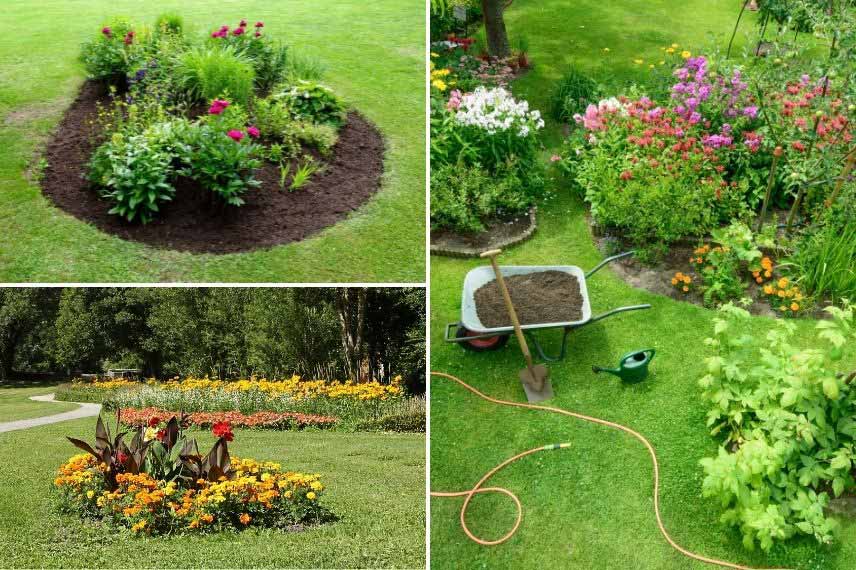
Placed ostentatiously in the middle of the lawn, small beds are not attractive (left). Prefer, for example, beds that divide space, create surprises and form pathways
Read also
The English garden mixed borderCreate a flower bed with an intricate layout
When creating a flower bed, a common mistake is to try (consciously or not) to imitate nature. People often favour sinuous outlines and soft curves. Yet the result is not always successful and rarely looks natural.
→ Very often, a crisp, straight layout will produce a much prettier and more elegant result. That does not prevent compositions from having a natural appearance and makes it easier to arrange plants within the flower bed. It is the chosen plants that will give your composition its character :
- natural and country-style with a profusion of roses, perennials (Achillea, Agastache, Gaura or Salvia) and flowing ornamental grasses (Miscanthus),
- graphic and contemporary with architectural plants (Acanthus, bamboos or Phormium) and stiffer ornamental grasses (Carex or fescues),
- Mediterranean with plants typical of the South (lavenders, oleanders, Agapanthus and Santolinas),
- or exotic with palm trees, Cycas, aloes and agaves.
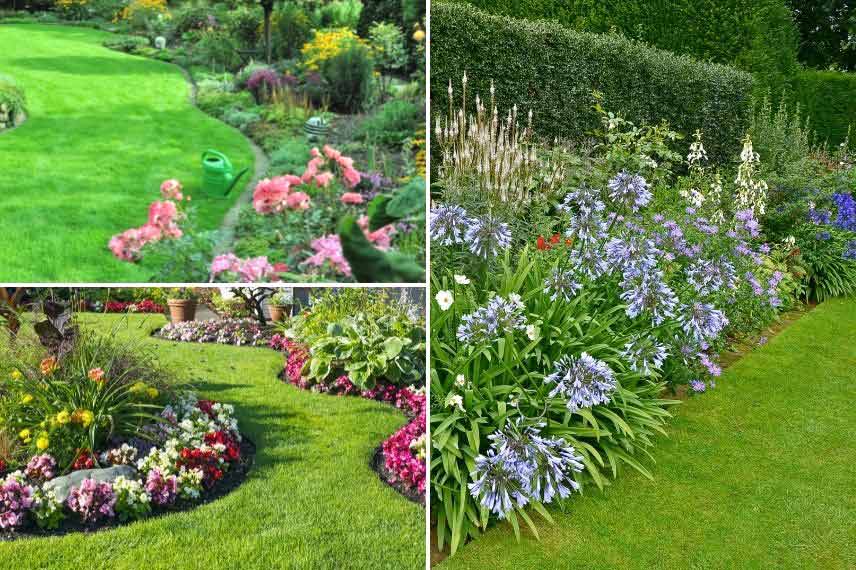
Straight lines (right) are often more elegant than sinuous and curved lines (left)
Want to create a style that stands apart from the rest of the garden
For many, the garden is a space for escape and freedom, and we are tempted to project our travel or lifestyle dreams onto it. Are you a fan of Japanese culture and dreaming of travelling to the Land of the Rising Sun? Unfortunately, creating an Asian-inspired flower bed may not look its best in your garden in Brittany. Tempted by life in the tropics? An exotic flower bed may not be entirely at home next to a chalet in Haute-Savoie.
→ Let’s drop the caricature and return to simple principles to create a beautiful flower bed. It must harmonise with the setting of your home and not clash inappropriately. Choose the style that suits best (formal garden, romantic, naturalistic, wild or contemporary). Originality can come from chosen colour harmonies or from selecting a few collector specimens (shrubs and perennials).
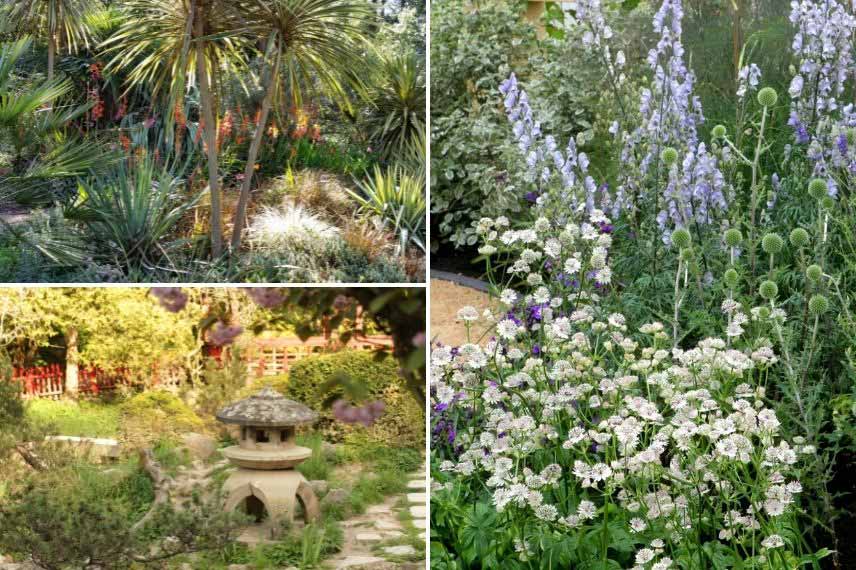
Creating looks inspired by distant places is not always a good idea in the garden (left). Local plants will fit better into the setting (right)
Read also
Designing a city gardenOnly plant perennials and compact plants
Perennials are a great help to fill a border quickly, easily and more cheaply. In addition, their flowering is always wonderful when paired with a few annuals. However, creating a border made only of perennials has drawbacks. Maintenance can quickly become tedious, with pruning, deadheading and dividing clumps. The border’s appeal may also be limited to a few months. The visual effect may also be disappointing, with plants that are too small. To look harmonious, a border needs structure, a framework that shrubs and conifers provide perfectly.
→ To structure a border, start by choosing strong, evergreen elements that bring verticality and scale. To be interesting year-round, include about two thirds evergreen species: Italian cypress or Callistemons in the South, Rhododendrons in heather soil, Bamboos in graphic compositions, Camphor trees in oceanic climates, or boxwood balls for an elegant border. Also consider climbing plants that will climb a support, a fence or a neighbouring tree.
Then compose the border by mixing conifers with smaller evergreen and deciduous shrubs and, of course, enjoy using perennials and a few annuals to fill gaps, taking flowering seasons into account.
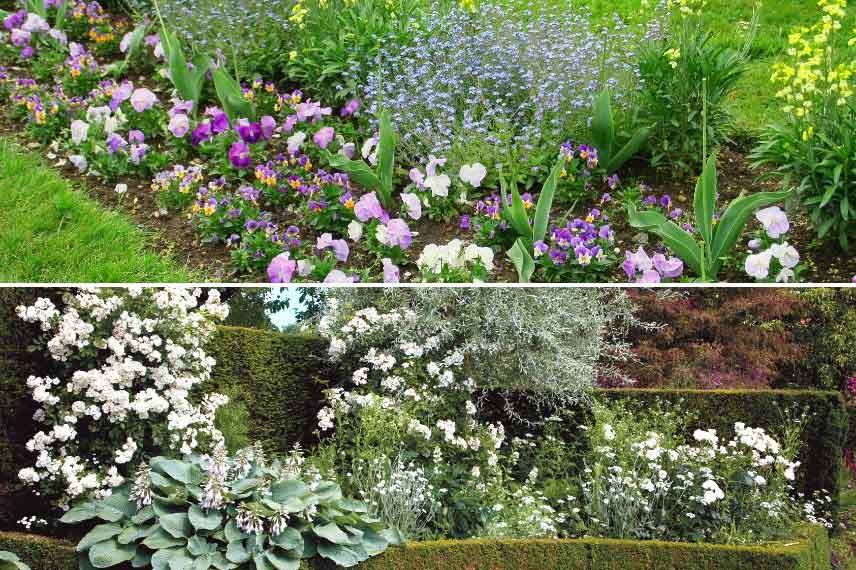
Perennials and annuals alone do not make attractive compositions (top). They need strong plants to set them off, such as hedges, evergreen shrubs, climbing plants and large foliage (bottom)
Increase variety of colours and plants
A common mistake when creating a flower bed: being tempted at the point of purchase to buy a whole bunch of plants in a variety of colours. The diversity of plants makes it easy to select specimens according to individual beauty, without considering how they will harmonise together. Beware of cacophony — a beautiful flower bed is not a plant catalogue!
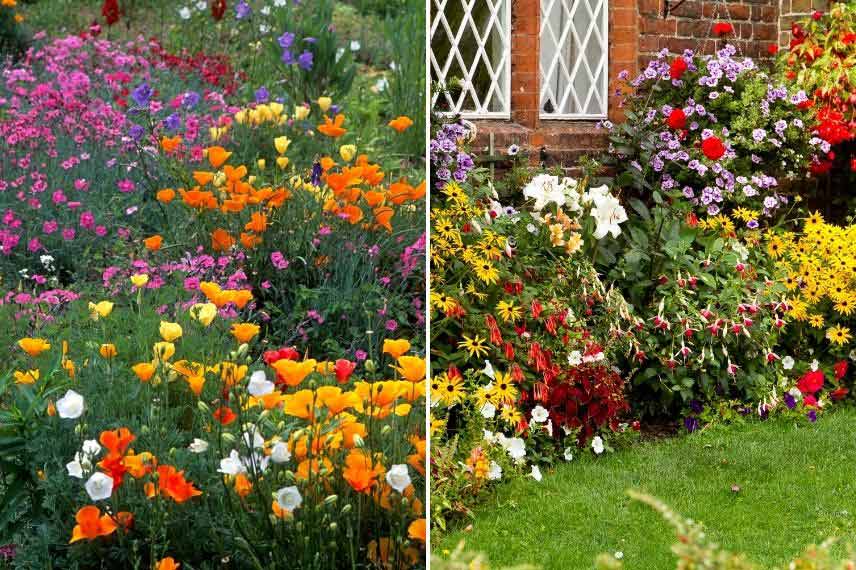
A mix of too many different plants and colours leads to cacophony
→ Opt for a colour harmony from the design stage, there are plenty of choices:
- Monochrome flower beds, choosing a colour accentuated by foliage (white garden, blue garden, yellow garden, etc).
- Classic mixes, based on combinations of two or three colours: convention has it that certain colours go well together, which has given rise to combinations commonly used. Silver foliage often sits alongside pinks, pale blues, creams or burgundy, and green foliage harmonises with warm tones such as yellow, orange and red.
- More original colour mixes, built around purples, chartreuse, browns or even black.
- Bear in mind that a successful flower bed should contain at most two-thirds flowering plants, otherwise it risks jarring the eye and becoming heavy to the point of bad taste.
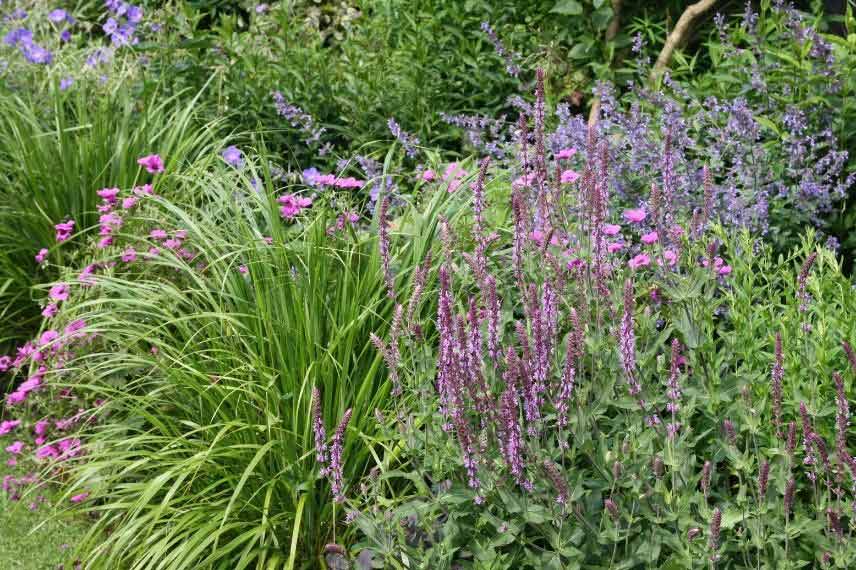
Choose a colour harmony you like and stick to it when buying plants for your bed
→ Read Gwenaëlle’s article about the perception of flower colour.
Plant in ranks of onions
Another essential principle: the massing effect. Do not arrange your plants in neat ranks like vegetables in a vegetable garden. To look attractive, a flowerbed should have a natural appearance.
→ Distribute plants evenly across the whole area to be planted, the larger ones at the back, arranged in 2 to 4 ranks depending on the size of the planted area. Each specimen should be staggered in relation to neighbouring plants. This is the best way to avoid alignments. If you want to achieve a visual massing effect, each plant should occupy about 1 m². It is the slight harmonious imbalance of this area among species that will then ensure the success of your flowerbed. Group plants in odd numbers: 3, 5 or 7 for the smaller ones. Vigorous plants can be planted in pairs for a symmetrical, balanced effect.
Gravel, pebbles, pumice: embrace the mineral
With the best intentions to add colour, retain soil moisture and prevent adventive growth, some people are tempted to spread mineral mulch over large areas. Pebbles, slate, pumice, gravel in all colours—the choice is plentiful… Unfortunately, the result is often far from pleasing, because it looks so unnatural. Nature does not do that sort of thing, so a wise gardener has everything to gain by not doing it either.
→ Save the money you planned to spend on these materials and invest it in attractive plants and an organic mulch, which you can even make yourself by buying a small garden shredder.
Creating mineral surfaces in beds only makes sense in context of a dry garden, for example in Mediterranean regions. If you nevertheless want to introduce a mineral element into your bed, opt instead for a rockery if appropriate for your region, or scatter a few local stones, placed naturally among plants.
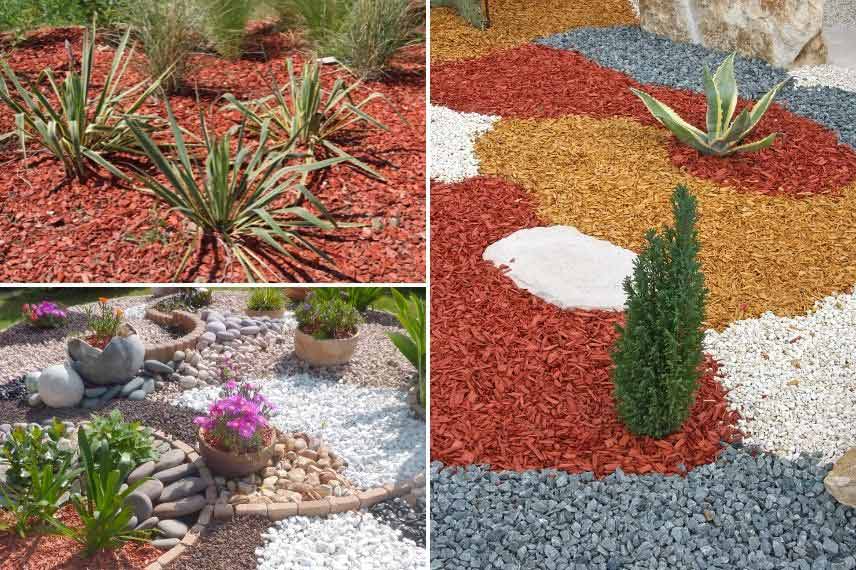
Various mineral mulches are not always successful in beds

- Subscribe!
- Contents
This form is protected by reCAPTCHA - the Google Privacy Policy and Terms of Service apply.

































Comments