Why is my rhododendron not in flower?
Flower buds aborting!
Contents
Your rhododendron promised an extraordinary flowering with its well-formed buds that had been swelling for months… And then disaster strikes! It refuses to turn its flower buds into flowers long-awaited in spring. At best, only one or two inflorescences. No suspicious spots, no blackening, no pests on the plant, but promising, well-formed buds that develop into leaves, leaving us perplexed and very disappointed.
So what happened? Several factors can explain this disappointing behaviour in a rhododendron. We’ll explain why.
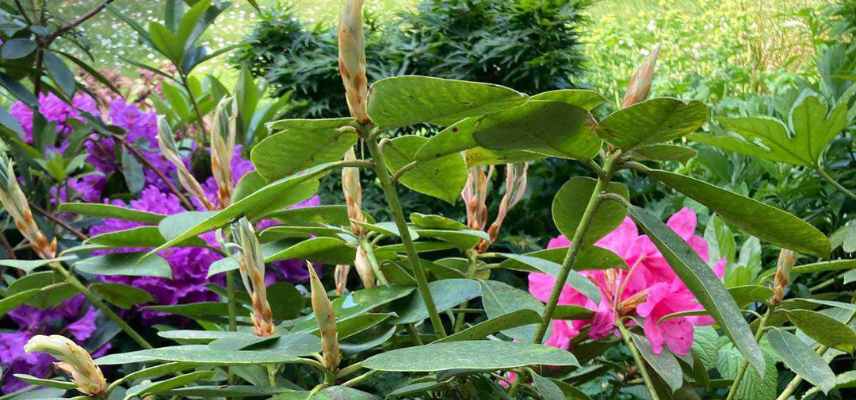
Buds keep elongating… without flowering! (@ Gwenaëlle David Authier)

Lack of water... at the wrong time
This is often why a rhododendron fails to convert induced buds into flowers, producing leaves instead. In botanical terms, this is known as vegetative reversion of flower buds or a return to vegetative growth. Buds suddenly give way to very vigorous pale green young shoots, vegetative buds.
Causes are mainly a lack of water in late spring of the previous year, the period when buds form.
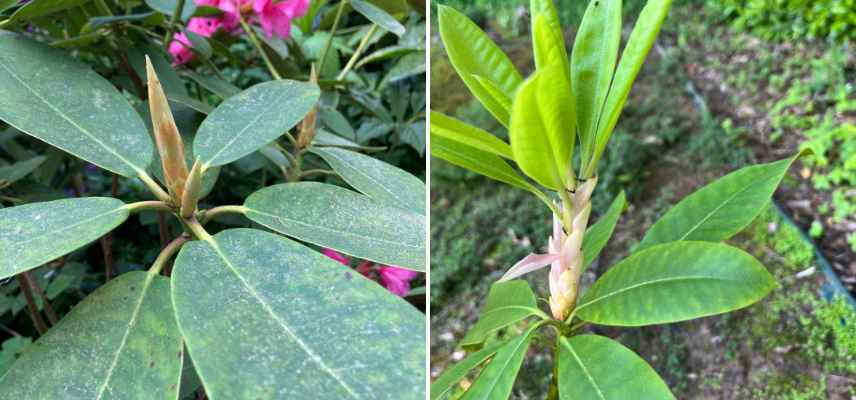
Flower buds elongate… until they reveal not flowers, but young green shoots
→ What to do :
- It is important to maintain good moisture levels during June and until mid-July, as this is when rhododendrons form their flower buds for the following year. This phenomenon mainly concerns the period of floral induction, i.e. June–July of the previous year. Regular, appropriate watering at that time promotes proper bud formation. Soil should remain consistently cool, but not waterlogged.
- Apply an organic mulch systematically over a wide area at the base of plants to preserve coolness around the shallow root system during the hot season.
- Reduce watering in summer (except during drought) to impose a little stress on the rhododendron, which is beneficial for its future flowering.
Read also
Rhododendron: planting, growing and careToo shady a spot
Excessive shade or a complete lack of light (it may have changed due to a nearby building) is also a common reason why a rhododendron does not flower at all or flowers poorly.
If buds formed under good light conditions but shade increases (for example from gradually denser foliage of neighbouring trees), buds may abort their floral development.
We see too many rhododendrons at some of our customers’ properties planted in dense shade, which does not suit them. It also means trees causing the shade are absorbing a large amount of soil moisture, depriving rhododendrons. Gentle morning light (east-facing) or consistent partial shade (light filtered through shrubs) is recommended for all rhododendrons. Ideal spot? Look up above you — you should be able to see at least some sky!
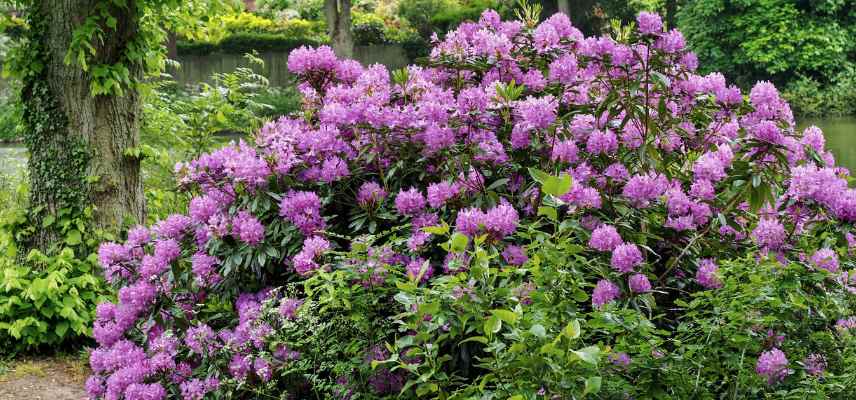
Rhododendrons need a minimum of light and clear space around them to flower well
→ What to do :
- Try pruning nearby vegetation: remove a tree that casts heavy shade or carry out pruning to thin the canopy on surrounding shrubs and trees to let in more light.
- If the problem returns the following spring, we recommend lifting the rhododendron and replanting it in autumn in a brighter spot. Rhododendrons do need a minimum of light, even though they are classed as shade plants.
Plants too young or in recovery
In some young plants recently established in the garden, or after transplanting, the flowering mechanism can be unstable: buds can ‘get it wrong’ and develop the wrong function. Some varieties are also genetically not very floriferous in their first years, even in perfect conditions, and may take up to four to six years before producing a clear, consistent flowering. This is particularly true of some large-leaved species or large varieties of the Loderi group such as ‘King George’, ‘Sir Edmund’ or ‘Pink Diamond’.
→ What to do:
Be patient, but first rule out possible problems of insufficient light or water, which are often the cause of failed flowering.
N.B.: a well-established rhododendron with balanced water status, light and nutrients can sometimes alternate between bountiful years and poor years, without this necessarily being pathological.
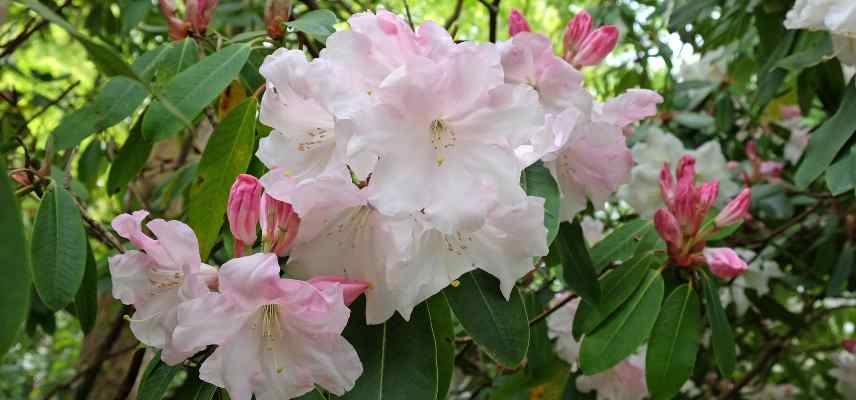
Rhododendron loderi ‘Pink Diamond’
Read also
Rhododendron: succeeding in its plantingExcess nitrogen
This is much less likely, but a rhododendron that received nitrogen early in spring can turn its floral meristems into vegetative meristems, reversing floral induction. This may be the case if you used blood meal, which is high in nitrogen.
→ What to do:
When it comes to fertilising, be careful with rhododendrons! Do not feed them too late after flowering. If you fertilise, apply fertiliser in late spring, between May and June (not after, as this would tend to encourage leaf growth instead), and choose fertilisers specific to rhododendrons and acidophilous plants, with an NPK of 4-6-8 or 3-5-7 (rich in potassium, K), to stimulate flowering.
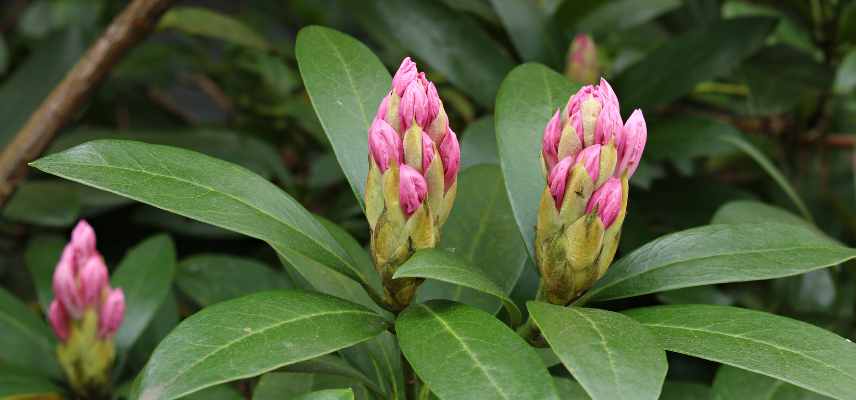
Flower buds on a rhododendron open well when soil conditions suit it
Fungal disease in case of dried buds
Let’s nevertheless mention the case of buds that are clearly diseased, browning and drying before they even open. This is a completely different problem since the buds are visibly affected and rotting. They are attacked by a fungus, the Pycnostysanus azaleae, also encountered under the name Seifertia azaleae, called bud browning in French, or bud blast in English. Easily identified by the bud’s hairy appearance, the bud does not even fall off. The rhododendron leafhopper (Graphocephala fennahi) is often blamed for this disease, because by laying its eggs in flower buds in autumn it would create an entry point for the fungus in spring. But this is not proven in all cases.
They are mainly Ponticum rhododendrons and Ponticum hybrids that are affected.
→ What to do :
Flowering will be absent on affected buds, and in general all buds are affected. Remove affected flower buds as soon as you have identified this disease (not to be confused with buds damaged by frost, which do not have exactly the same appearance).
As a preventive measure, always encourage good airflow through foliage, because a bush that is too compact retains moisture and favours fungal spores. Collect and destroy dry buds in winter. Also systematically remove faded inflorescences at the end of flowering. If leafhopper infestation is confirmed, spray an autumn decoction of garlic or tansy, or apply a mild plant-based insecticide (e.g. natural pyrethrum).
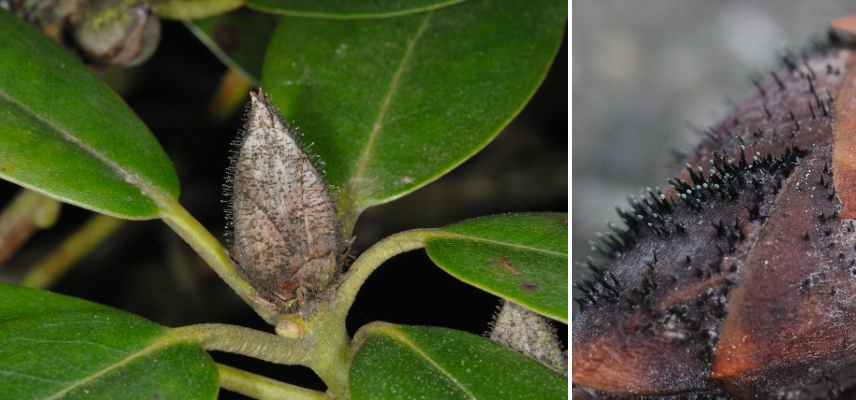
Flower buds affected by the fungus Pycnostysanus azaleae
- Subscribe!
- Contents
This form is protected by reCAPTCHA - the Google Privacy Policy and Terms of Service apply.

































Comments