





























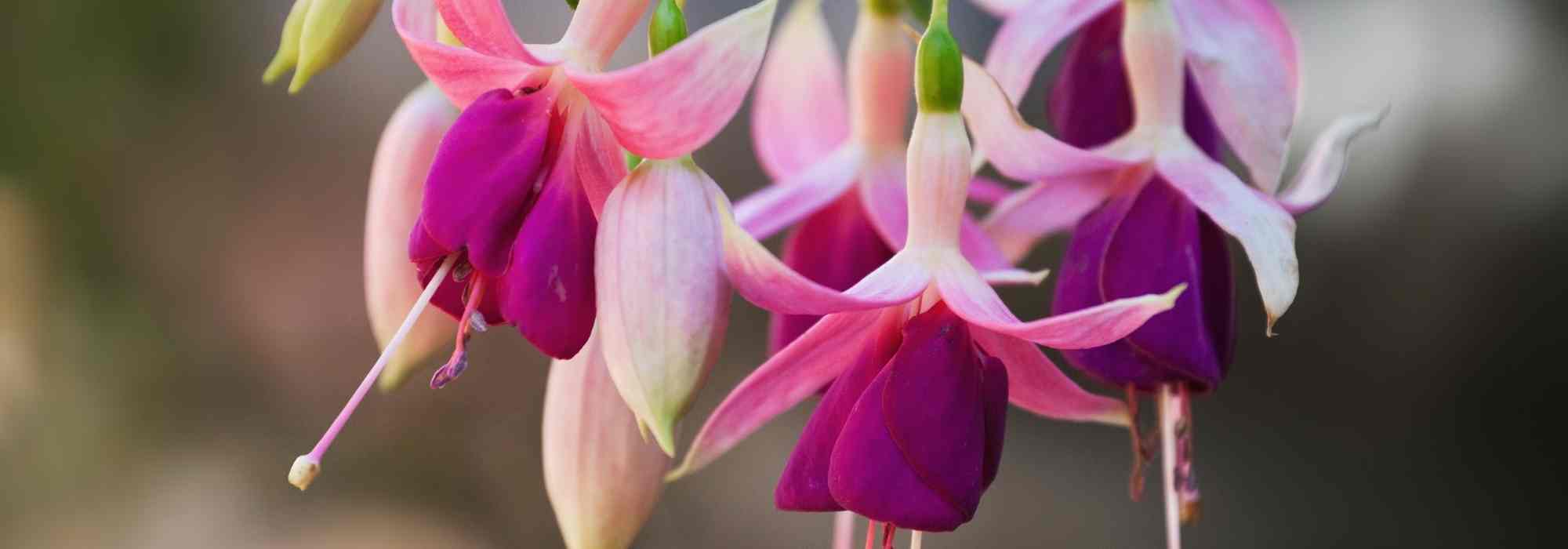
Which fuchsias for in-ground plantation?
Our selection of Fuchsia species and varieties for beds and borders
Contents
Originating from South America, and thus regarded as not particularly hardy, fuchsia is mainly valued for its long-lasting and very distinctive flowering. Some see in these unusual flowers trailing bells, lanterns, or dancers in tutus! The fuchsia never fails to attract attention, especially when grown in hanging baskets, under the shade of a tree. However, some species and varieties are more shrub-like, with a more erect habit, to blend into summer borders and beds in the garden.
Discover our selection of fuchsias suitable for in-ground planting in the garden and our tips for looking after them.

How to choose a Fuchsia for planting in the ground?
We are more used to seeing fuchsias grown in pots or hanging baskets, in a partly shaded corner, brightened by their colourful flowering. However, some fuchsias can be perfectly grown in open ground and establish themselves permanently in a border or a bed where they will offer generous flowering throughout the summer. Indeed, we often forget that the fuchsia is a perennial, certainly frost-tender, but perfectly capable of growing in open ground.
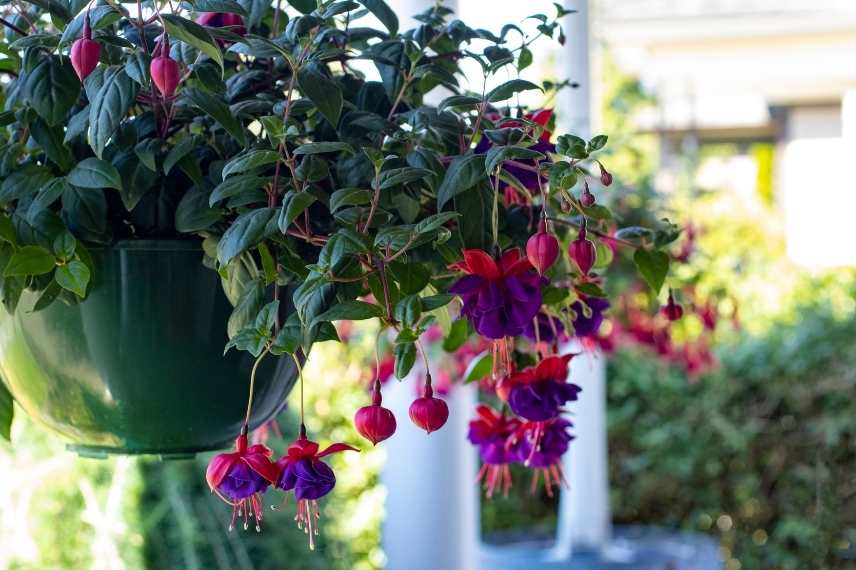
We are more used to seeing fuchsias grown in pots or hanging baskets, but growing them in open ground is possible
To meet this need, it is essential to select hardier species capable of withstanding frosts of at least -10 °C. Fuchsias, which will, of course, need winter protection. In addition, the choice of variety must also suit the desired effect: a shrub-like habit to structure a border, a trailing habit for a soft and light look in a border, or a ground-cover for shaded woodland. This forethought ensures a harmonious integration into the garden.
Magellan's fuchsia, a hardy, shrubby fuchsia
Fuchsia magellanica is a fuchsia perfectly suited to growing in the ground, thanks to its greater hardiness than other species and its bushy habit. In its native habitat, it grows at the edge of woodland or in clearings. Hardy to -15 to -20 °C in sheltered situations, the Magellan fuchsia’s rootstock will withstand the cold, even if the foliage dies back at -10 °C. It will reshoot from the base and flower in the same year.
This fuchsia forms a cespitose shrub with a dense, pliant habit, reaching a height of 1.2 to 2 m depending on the variety, with a spread of about 50 cm to 1 m for the broader varieties. It bears relatively fine, trailing branches. The leaves are oval and finely dentate. But above all, its long-lasting flowering, from May to October, is what makes it so charming. Pendulous, these relatively slender flowers hang from the leaf axils. The flowering can vary in colour depending on the varieties.
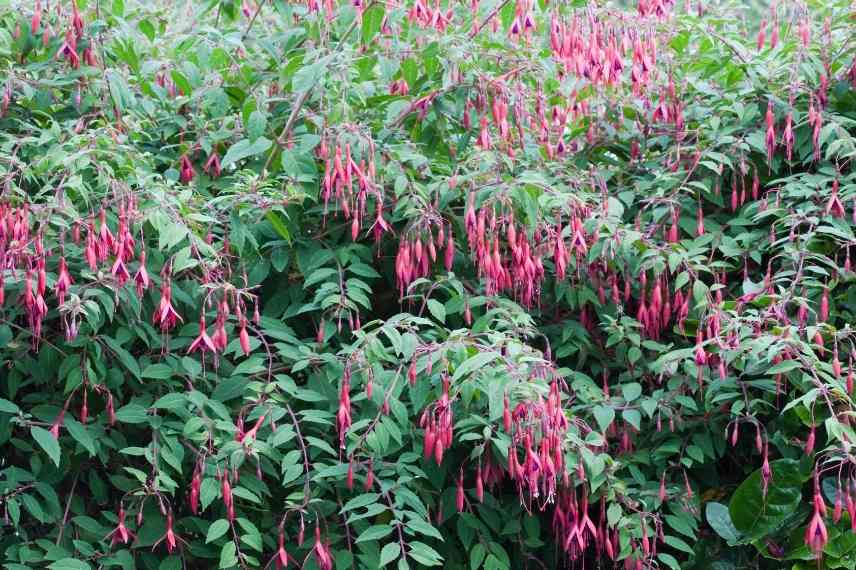
Magellan fuchsia can reach up to 2 m in height
Thus, the varieties ‘Riccartonii’ and ‘Genii’ offer very bright fuchsia-red calyces and a purple-violet corolla, while the variety ‘Snow Cap’ stands out for its semi-double flowers in scarlet red and white. As for the variety ‘Versicolor’, it is distinguished by its light green foliage veined with red and irregularly margined with white. The hybrid Fuchsia magellanica var. gracilis ‘Aurea’ hybrid also offers unusually yellow-bronze foliage on red stems. And for those who enjoy more discreet flowering, yet not lacking in charm, Fuchsia magellanica var. molinea is for them, with its pendulous bells in white shaded with pink.
Three-leaved fuchsia, more sun-tolerant than the others
Fuchsia triphylla is a shrub species with a woody base whose vernacular name derives from its dark green evergreen leaves, with violet undersides and purple-veined, lanceolate leaves whorled in threes. This leaf has a reddish petiole, while the stems are purple. This fuchsia has an upright and spreading habit, rather shrubby, allowing it to reach a height and spread of 50 cm to 2 m, depending on the variety.
This fuchsia is also notable for its red-orange flowering. The slender, long tubular flowers, gathered in clusters, hang gracefully. The variety ‘Thalia’ produces flowers in vivid orange, 4 cm long, while the variety ‘Bush Gartenmeister Bonstedt’ stands out for its foliage and its dark red-bronze stems and its coral-red flowering. The flowers that open from June to October give rise to green oval, pendulous berries that turn purplish-red at maturity.
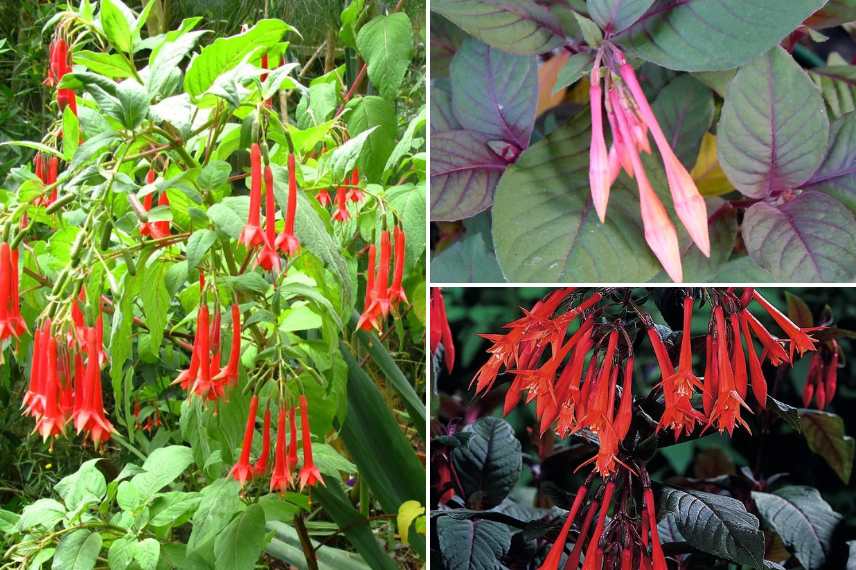
In clockwise order, Fuchsia Triphylla ‘Fulgens’, ‘Thalia’ and ‘Bush Gartenmeister Bonstedt’
Unlike other fuchsias, this species enjoys morning sun, even if its foliage is noticeably better in a shaded situation.
It grows very quickly. However, it can be grown in the ground in areas with mild or temperate winters, as its hardiness is around -10 °C.
A groundcover fuchsia with a carpeting habit
Fuchsia procumbens is a perennial plant, native to New Zealand, notable for its foliage, flowering and fruiting. However, it is not frost-hardy below -5°C, so it should be planted in open ground in regions with a very mild climate.
The first notable feature of this fuchsia is its creeping habit, which allows it to spread up to 40 cm wide with a height of up to 15 cm. It features neat, small, rounded and semi-evergreen foliage. The flowers are also unusual compared with those of other fuchsia species. Erect, they are tubular and consist of a yellow calyx, with recurved sepals, and pink stamens with blue pollen. That said, this flowering, which lasts from July to September, shines with its distinctiveness. These flowers give rise to purple fruits, fairly large and edible.
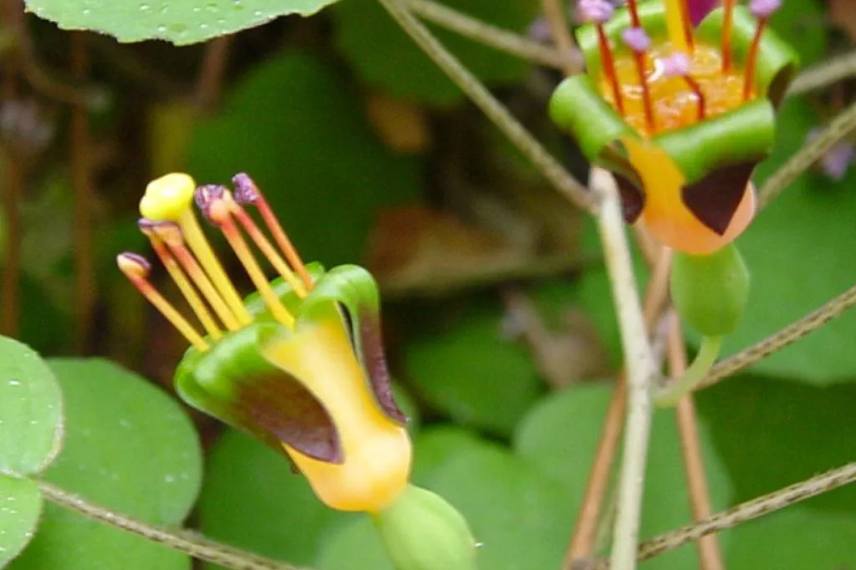
The Fuchsia procumbens is a carpet-forming groundcover
An astonishing climbing fuchsia
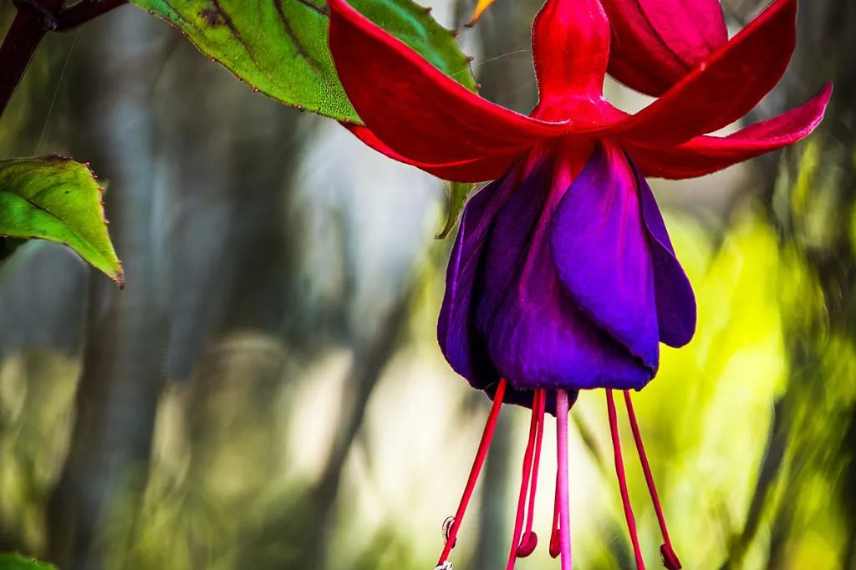
The variety ‘Lady Boothby’ is climbing
Fuchsia ‘Lady Boothby’. Here’s a fuchsia that will surprise more than a few gardeners! Indeed, this hybrid has the peculiarity of being climbing thanks to its woody climbing stems. It is moreover capable of climbing up to 2.5 m high and 1 m wide. It features pendulous, semi-double bell-shaped flowers with fuchsia-pink sepals and a purple corolla, and soft green deciduous foliage. It shows hardiness around -10°C.
Hybrid fuchsias, suitable for planting in the ground as well
Hybrid fuchsias (Fuchsia x hybrida) with a semi-trailing or trailing habit form the bulk of the stock. Very floriferous, they offer a wide palette of colours and shapes. The hardier ones can be grown in open ground, almost anywhere in the territory. Thus, the variety ‘Heidi Ann’ with its carmine-red sepals and a very double, mauve corolla that is distinctly undulated, proves hardy to -15°C. The variety Checkerboard, also hardy to -15°C, appeals with its bi-coloured flowers, pink, white and currant red. These two varieties are distinguished by their bushy habit and a height of almost 1 m.
Smaller, ‘Beacon Rosa’ is also a shrub fuchsia variety with delicate old-rose flowers. A little less hardy (-10°C), the variety ‘Mme Cornelissen’ deserves attention with its bi-coloured and contrasted flowers, displaying a tube and carmine-pink sepals that crown a white corolla from which long pink stamens protrude.
As for ‘Chilli Red’, this is one of the most spectacular novelties. Indeed, this hybrid fuchsia forms a dense shrub with a spreading habit of 50 cm in all directions, with abundant foliage. But it is its flowering that draws so many flower buds that resemble chillies. Hence its name! Very pointed, they open to form tubular, pendant flowers with no corolla in a bright red. A colour that contrasts wonderfully well with the foliage. It is hardy only to -6.5°C.
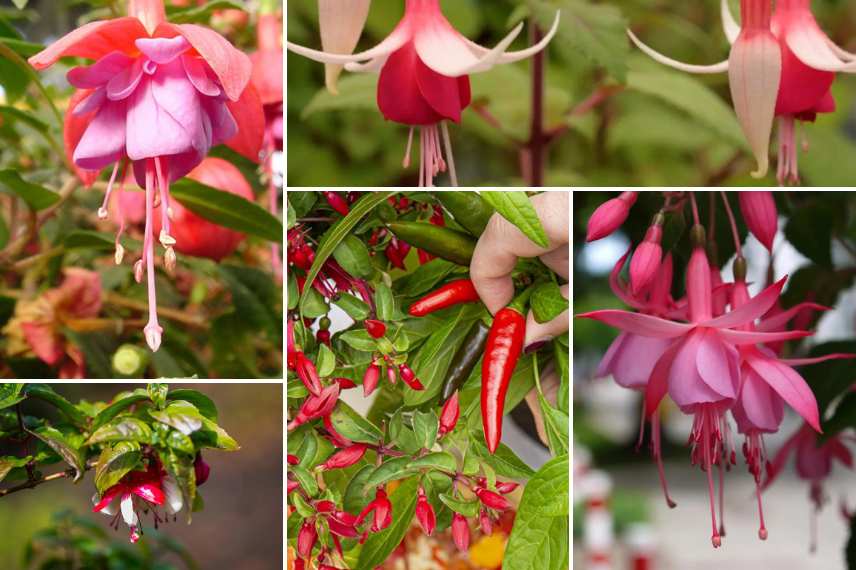
Clockwise, the varieties Heidi Ann, Checkerboard, Beacon Rosa, Chilli Red and Mme Cornelissen
Our planting and care tips
To grow fuchsia in open ground successfully, start by giving it a rich, humus-bearing and well-drained soil. An application of compost at planting will promote vigorous growth. Plant it preferably in partial shade or light shade, avoiding overly sunny spots, especially during the hottest parts of summer. In winter, generous mulching will protect the roots, particularly if your soil is light or sandy.
Prune the stems in late winter to stimulate branching and abundant flowering. Water regularly during the growing season, keeping the soil moist but not waterlogged.
- Subscribe!
- Contents
Comments