
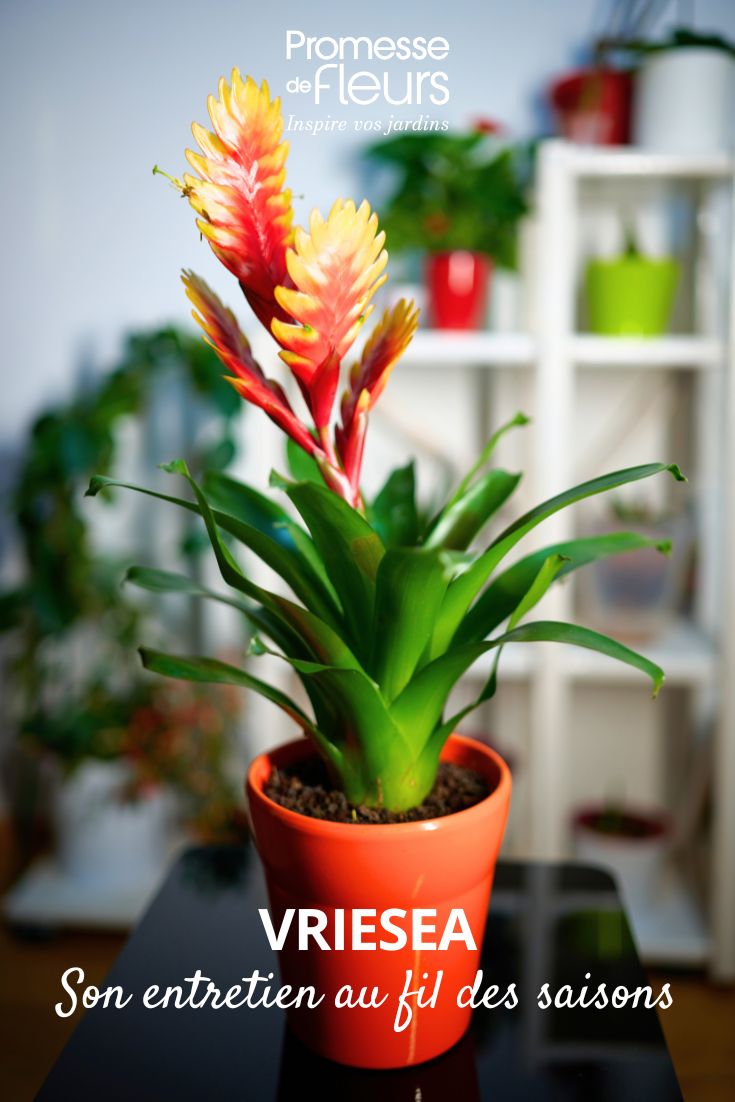
Vriesea: care through the seasons
Watering, light, pruning, fertilisation and other appropriate care all year round
Contents
Vriesea is a beautiful houseplant that produces rosettes of colourful leaves and striking bracts. This bromeliad adds an exotic touch to our interiors. Fairly easy to care for, this epiphytic plant nevertheless has specific requirements, which can vary with the seasons. Let’s look at the care steps to follow throughout the year.
Impact of seasons on indoor plants
It’s a factor less often considered for indoor plants: the cycle of the seasons. Yet, inside our homes, conditions are not exactly the same between summer and winter. It can be warmer or cooler, more or less humid. Light also changes with exposure: in winter, when sun is lower and days are shorter, it penetrates less easily. Even though plants are not directly exposed to outdoor weather (rain, wind, snow…), they still experience changes that can affect their growth.
Moreover, even if less pronounced indoors, the plant follows an evolving life cycle. Generally, it is in a growth phase from spring to early autumn, then slows metabolism to enter dormancy over winter. This is the case for Vriesea.
That is why care routines should be adapted according to the season, even indoors.
Spring: Vriesea growth resumes
This is season of renewal. Spring marks resumption of growth for many plants. With return of light and rising outdoor temperatures, Vriesea also emerges from dormancy to resume growth and flower. The idea is therefore to support it as best as possible during this active season.
First of all, now is time to resume watering. Vriesea has one particularity: it is mainly watered via its rosette of leaves. It is an epiphytic plant, meaning it does not grow in soil like most plants. In its natural habitat, in tropical forests of Central and South America, it settles directly on trees and its rosette acts as a funnel to collect rainwater or dew. It is also via the rosette that the plant captures nutrients needed for growth. For watering, use clean, lime-free water at room temperature and fill the rosette. At the same time, you can lightly water the growing medium, but avoid leaving standing water. If pot is used with a saucer or cache-pot, empty them about 20 minutes after watering.
If you have just welcomed a Vriesea or if plant seems cramped in its pot, this is also the right season for repotting. Note that this plant grows slowly and remains fairly modest in size, between 15 and 80 cm depending on variety. With few roots, it does not require large pots (10–12 cm diameter is generally sufficient). Avoid repotting too late if plant has already started flowering. For repotting, choose a well-draining, airy substrate such as those for orchids. If making your own mix, use pine bark, perlite or sand, coconut fibre and sphagnum moss. Also consider placing a layer of clay pebbles at bottom of pot.
As for light, Vriesea needs a bright atmosphere but no direct sun. Sunlight could scorch and dry its attractive foliage. An east- or west-facing position is generally suitable. In an office, living room, bathroom or bright kitchen… it can be placed in many rooms of the house. If necessary, move plant slightly away from an overly exposed window or add a sheer curtain. To help Vriesea develop evenly, rotate its pot every 2 to 3 weeks. Because of its origins, this plant appreciates warm, humid conditions. Ideal temperature range is 18 to 25°C.
To support growth and flowering, you can apply fertilisers formulated for orchids or bromeliads, with a balanced dosage of nitrogen, potassium and phosphorus. Follow product instructions carefully and remember it is better to give plant slightly less than too much. Excess fertiliser can cause leaf burn or make plant more susceptible to disease and pests.
If needed, prune any yellowed, dried or damaged leaves at base of rosette. For this, use a clean pruning shear disinfected beforehand with alcohol. This helps reduce risk of disease spreading between plants.
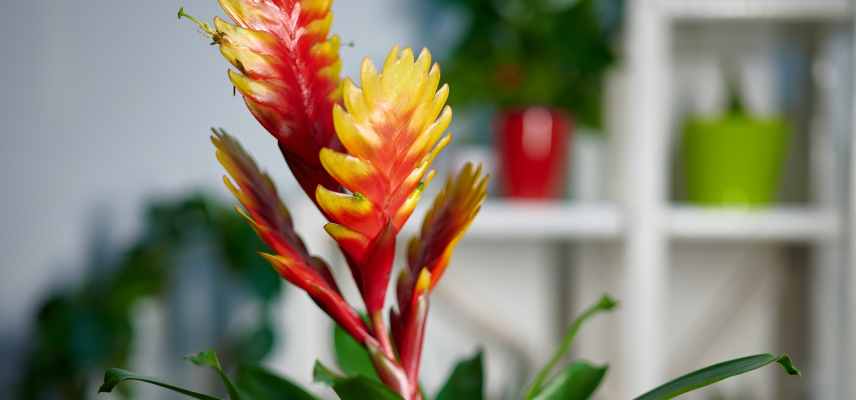
With good care Vriesea flowers from spring
Summer: support flowering and monitor watering
During summer, drought can be a problem for Vriesea. It needs a good humidity level between 50% and 70%. If placed in a bathroom or kitchen, it will more naturally benefit from that ambient humidity. If not, do not hesitate to place the plant on a tray of clay pebbles kept regularly moist.
At the same time, plan weekly waterings. Let the substrate dry slightly at the surface before watering and remember to fill the rosette.
Vriesea flowering often occurs between spring and summer. Once the flower has faded, you can cut it back at the base.
It is also a good time to inspect the plant and check for signs of disease (collar rot, leaf spots…) or pests (scale insects, thrips, red spider mites…).
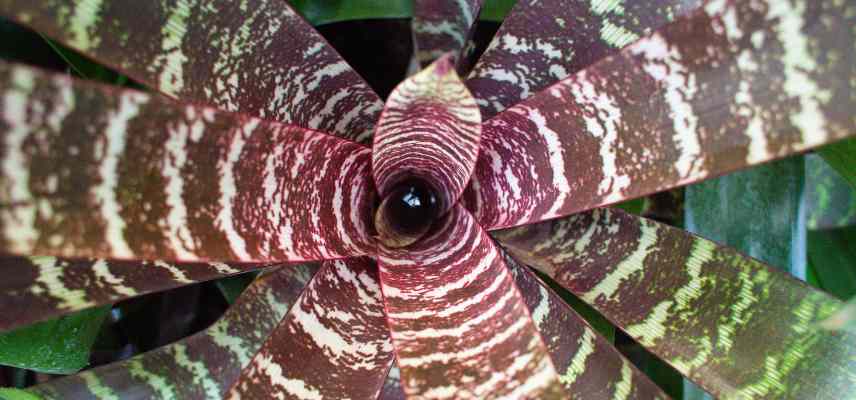
Vriesea is watered at its centre, into its rosette
Autumn: Vriesea's transition season
In autumn, Vriesea gradually slows growth to prepare for winter dormancy.
At this time, it is imperative to stop applying any fertiliser.
Watering should be gradually reduced (to about once every 15 days).
If the plant finished flowering in summer, it will have produced small offshoots that can be separated from the mother plant and moved into new pots. This is the best way to propagate Vriesea. To do this, wait until they are about 10 centimetres tall and gently detach them with a knife.
Winter: dormancy period of Vriesea
Winter puts Vriesea development on hold.
At this time, large temperature swings in particular can damage it. Make sure plant is not exposed to draughts. Conversely, do not place it too close to a heat source (oven, radiator, fireplace, etc.). Vriesea is a tender plant and will not tolerate temperatures below 15°C. If necessary, do not hesitate to move plant to a brighter area, so it can continue to benefit from sunlight.
Watering will be carried out occasionally. Water that collects in the rosette must never become cold. In that case, empty it and refill with slightly less water at room temperature.
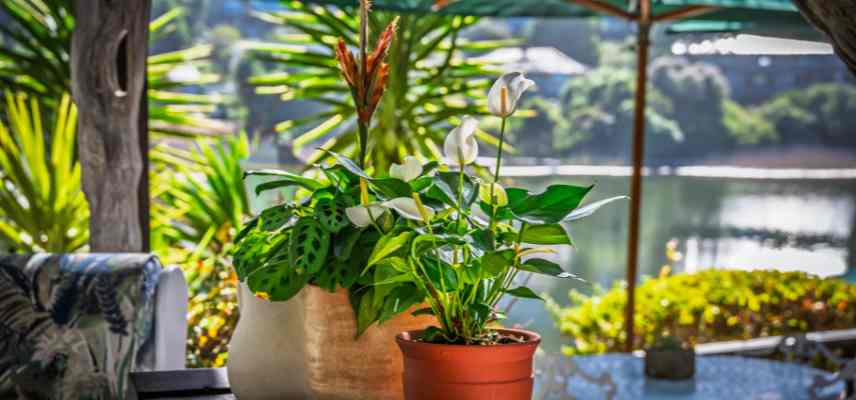
Place your Vriesea (here accompanied by an Anthurium) in as much sunlight as possible in winter
- Subscribe!
- Contents
This form is protected by reCAPTCHA - the Google Privacy Policy and Terms of Service apply.

































Comments