





























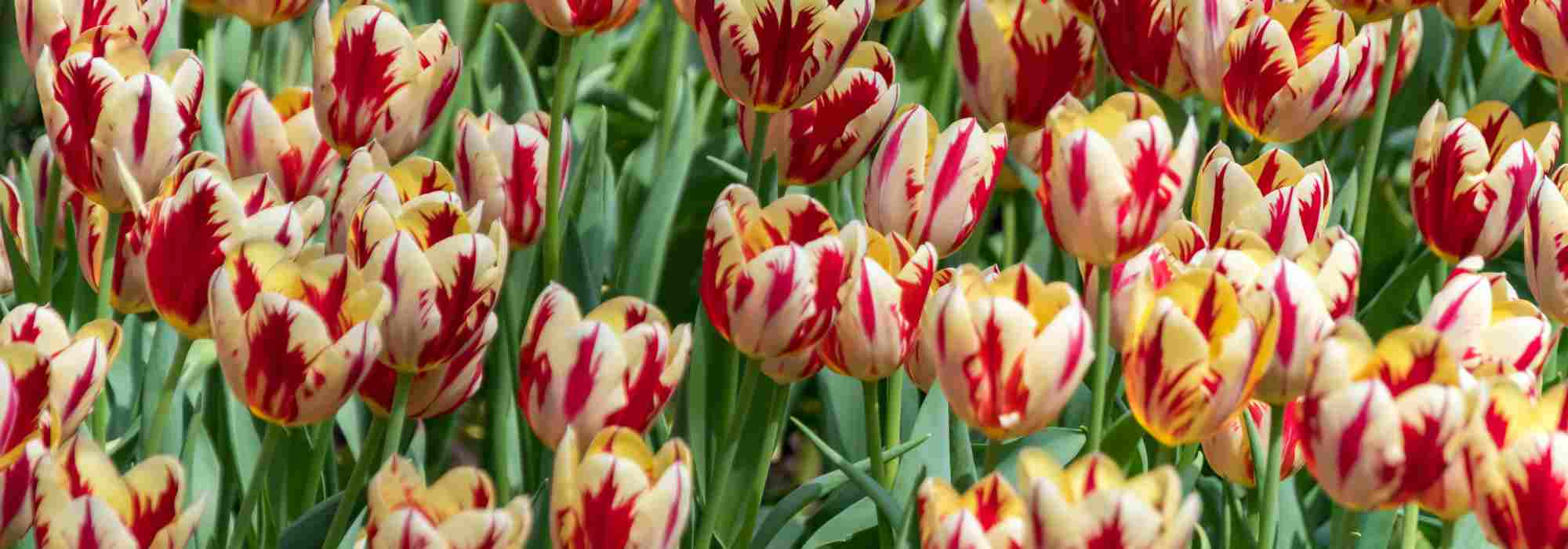
How to choose bi-coloured tulips for spectacular flowering in spring?
Buying guide and criteria to find the ideal variety to suit your preferences
Contents
Tulips are ideal flowers to brighten up spring. There are many varieties, which differ in their shape or colour. Among the most distinctive, we highlight two-tone tulips, ideal for brightening up the garden or pots. We invite you to discover our buying guide to help you navigate and choose the two-tone tulips that suit you, based on a range of criteria: flowering period, shape of flowers, fragrance or foliage.

Choose bi-coloured tulips according to the colour of the flowers
With bi-coloured tulips, you’re sure to find something to suit you. If some varieties are very refined and delicate, others bring vitality and cheer. This is what allows them to fit into every style of garden: romantic, bohemian, contemporary, exotic, natural, etc. They can be marginate, spotted, flamed or striped in various colours.
Warm-toned bi-coloured tulips
These are bi-coloured tulips that will warm up and energise the space. They display colours of yellow, orange or red, full of vitality, which lend an exotic touch.
Case in point is Tulipa crispa ‘Fabio’, magnificent with its coppery red-orange flowering margined with yellow. It also features delicately fringed petals, truly distinctive. In the same style, the dentate tulip ‘Flamenco’ will make beds, borders and bouquets dance with its bright yellow flamed with red.
De forme plus classique, mais toute aussi pétillante, citons la Tulipa triumph ‘Princess Irene’, lively with its flowering orange flamed with purple.
For its part, the double Tulipa Sundowner produces flamboyantly large yellow flowers marked with orange-red.
All frilly, the parrot tulip ‘Estella’ plays extravagance, with its large twisted and fringed petals that seem to swirl. They blend bright cherry-red on a snowy white background, warmed by a yellow heart.
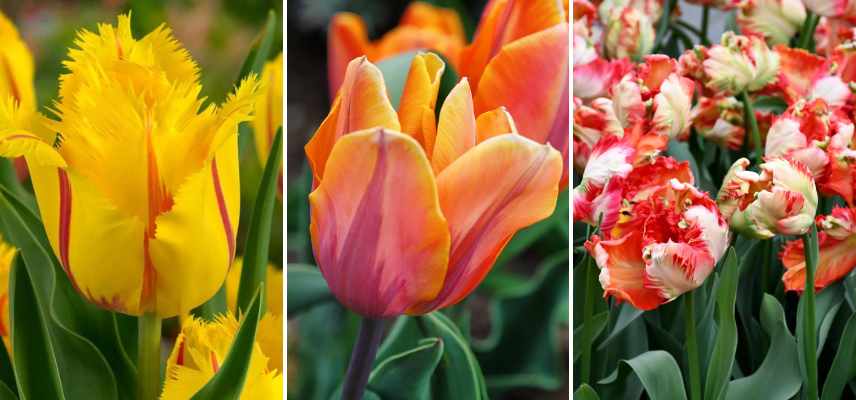
Tulips ‘Flamenco’, ‘Princess Irene’ and ‘Estella’ (©Rijnveld)
Warm-toned bi-coloured tulips in pink tones
In tulips, pink and purple come in all shades, ranging from pale pink or mauve to bright pink or deep purple.
Let’s start with ‘Holland Beauty’, which graces us with pink flowers in a vivid violet hue, edged with a cream-white border.
The double tulip ‘Silk Road’ produces peony-like flowers, randomly spotted or striped with pink on an ivory to pale yellow background.
Also to mention is the botanical tulip ‘Little Beauty’, which features pointed petals in dark pink, opening to a blue-violet heart surrounded by a white halo.
For a more striking colour combination, also discover Tulipa viridiflora Green Love, whose deep pink flower is flamed with leaf green along the entire length of the petals.
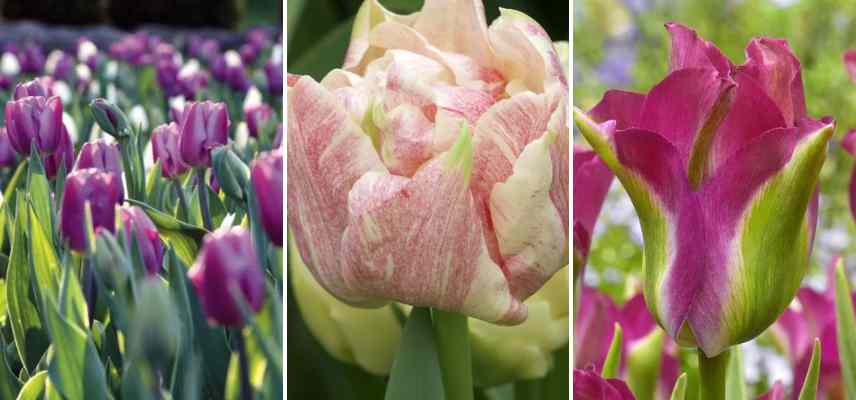
Tulips ‘Holland Beauty’, ‘Silk Road’ and ‘Green Love’
White bi-coloured tulips
In a white garden, they will add a touch of colour without looking out of place. Very refined, they are little jewels to plant confidently in borders, beds or pots. They also look wonderful in delicate bouquets.
This is the case with the lily-flowering tulip ‘Marilyn’, which blooms ivory white margined with cherry red, all in elegant style.
With its large flowers about 10 cm across, the Tulipa triumph ‘Graceland’ bears cream-white, brushed with bright pink.
For its part, the Tulipa clusiana Lady Jane first produces a closed flower in soft pink, which opens into a pure white star of great refinement.
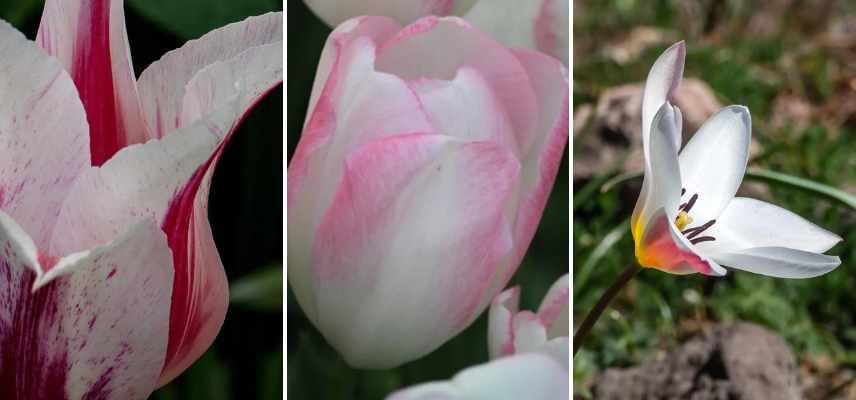
Tulips ‘Marilyn Graceland’ and ‘Lady Jane’
Read also
Tulips: planting, growing and careChoose bicolour tulips based on flower type or shape.
Tulips offer a great diversity not only in colour but also in the shapes of their flowers, ranging from the simplest to the most sophisticated. Petals can be fine and delicate, round and coarse, or even frilled. Flowers can thus take cup-, goblet-, or star-shaped forms, reminiscent of peonies or lilies. Tulips are therefore classified into several groups.
Simple tulips
These are the tulips with the most classic form, a tall cup shape, with six petals. For example, consider ‘Flaming Prince‘, a goblet tulip with pure white petals flamed with deep purple.
Triumph tulips
These are old varieties, derived from a cross between early- and late-flowering simple tulips. They therefore retain a fairly classic cup shape, but are taller (between 50 and 60 cm in height). This is the case of the variety ‘Boston’, producing large bi-coloured flowers pink-purple flamed with pale yellow.
Botanical tulips
Botanical tulips are derived from wild tulips, thus preserving a very natural style. They are among the smallest, measuring between 15 and 25 cm in height. They are also spring bulbs that naturalise easily, meaning they will come back year after year and multiply if growing conditions suit them. In this group, notably Tulipa greigii ‘White Fire’, with cup-shaped white flowers speckled with red and contrasted by a yellow throat.
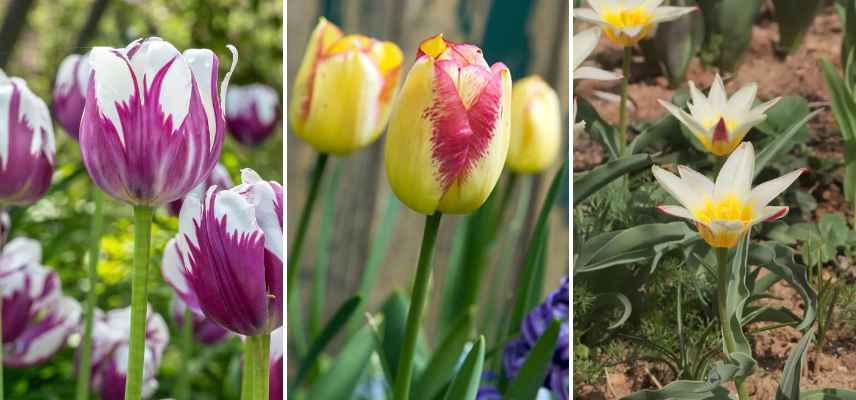
Tulips ‘Flaming Prince’, ‘Boston’ and ‘White Fire’
Darwin hybrids tulips
They are among the tallest, generally between 50 and 70 cm in height. They are also renowned for their large flowers with very intense colours, making a strong visual impact. They are long-lasting single flowers, perfect for bouquets. Among them, let us cite ‘Banja Luka’, producing large flowers of 10 cm flamed with cherry red on a gold-yellow ground.
Double tulips
These are tulips with a greater number of petals, giving them a sophisticated and voluminous appearance. They produce handsome large flowers, with a peony- or rose-like look, as with the variety ‘Horizon’. They produce white flowers speckled with red at the base of the petals, opening into frilled corollas reminiscent of some hibiscus.
Lily-flowered tulips
As their name suggests, they produce tulips resembling lilies. They have an elongated form, pointed petals, more or less open. This is the case of ‘Sonnet’, of great delicacy with its very slender and curved shape. It features a purple edge bordered in gold, evolving as the hours pass.
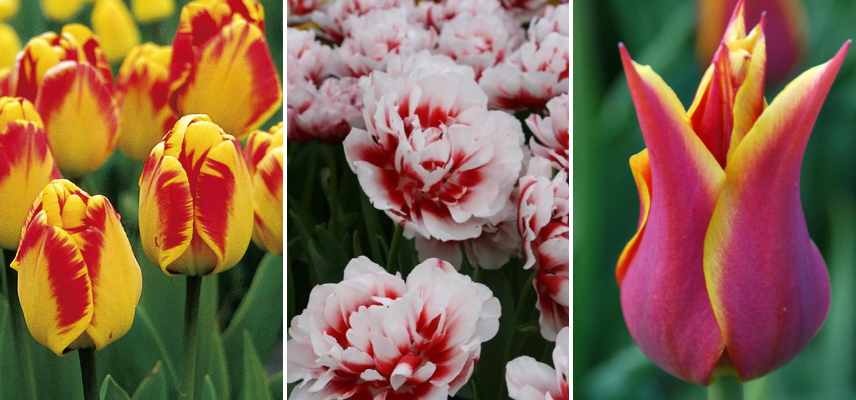
Tulips ‘Banja Luka’, ‘Horizon’ and ‘Sonnet’
Kaufmanniana tulips, or water-lily tulips
Again, their name gives a clue to the shape of their flowers. They have pointed petals and open into a star. This is the case with ‘Fritz Kreisler’, which reveals salmon-pink flowers edged with ivory, with a yellow throat.
Parrot tulips and fringed tulips
Clearly the most original and extravagant. They have crinkled or fringed petals, which never go unnoticed. Among them, we quote ‘Amazing Parrot’, with its embossed and sculpted flowers. They are of course bi-coloured, displaying a red-rose cherry flamed with yellow-orange along the petal edges.
Viridiflora tulips
They are easily recognisable by their stripes or flames of a green tone, ranging from light to dark. This is the case with ‘Formosa’, with its yellow flowers flamed with green. Their flowering lasts about three weeks.
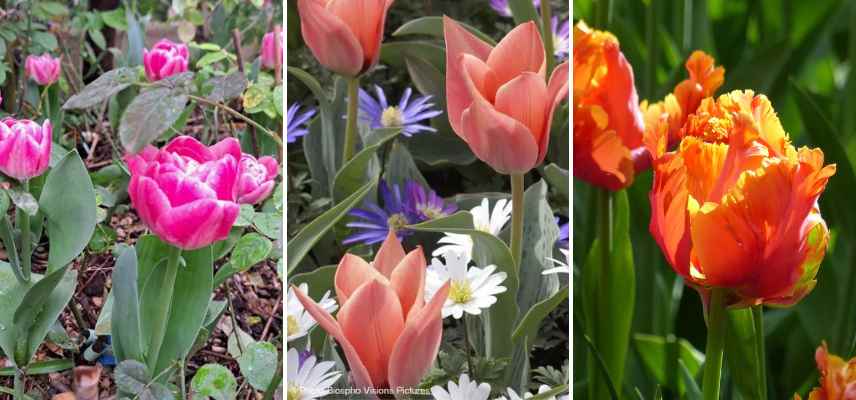
Tulips ‘Rosy Dream’, ‘Fritz Kreisler’ and ‘Amazing Parrot’
Choosing bi-coloured tulips according to their flowering period
Early tulips are the ones that bloom first, starting from March as winter ends. They will wake up the garden and container plantings, gently heralding the arrival of spring. This is the case for many botanical tulips or early double tulips, such as ‘Monsella’.
Conversely, late tulips will naturally bloom much later, around April and May, when spring is already well established. This includes viridiflora, parrot, fringed or lily-flowered tulips. There are also late double tulips, such as ‘Danceline’.
Between them, mid-season tulips provide the bridge, around April. They are Triumph tulips, such as ‘Synaeda Blue’.
By combining these different tulips, you can enjoy a long flowering period that lasts several months.
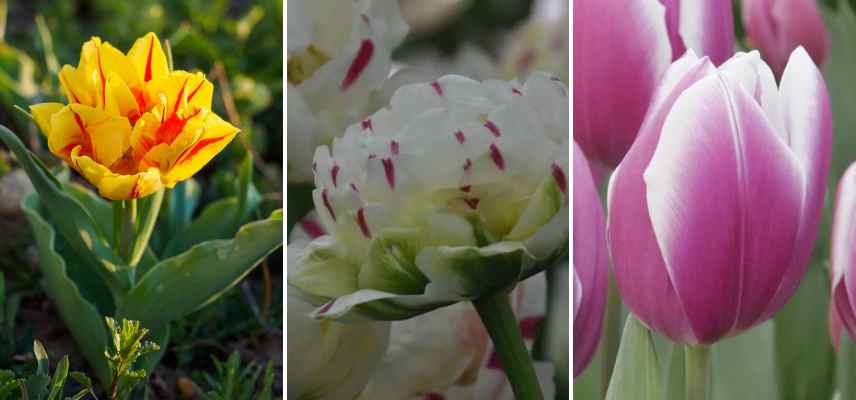
Tulips ‘Monsella’, ‘Danceline’, and ‘Syneada Blue’
Choosing two-tone tulips according to their fragrance
When thinking of scented flowering plants, tulips are not the first to come to mind. Yet, some varieties of bicolour tulips are indeed fragrant.
This is the case of the Darwin Hybrid tulip ‘Apeldoorn’s Elite’, which diffuses a luscious vanilla fragrance. It features large dark orange flowers brushed with red and margined with golden-yellow.
For its part, the Tulipa polychroma produces star-shaped white flowers with a yellow heart, exuding a strong fruity and sweet fragrance.
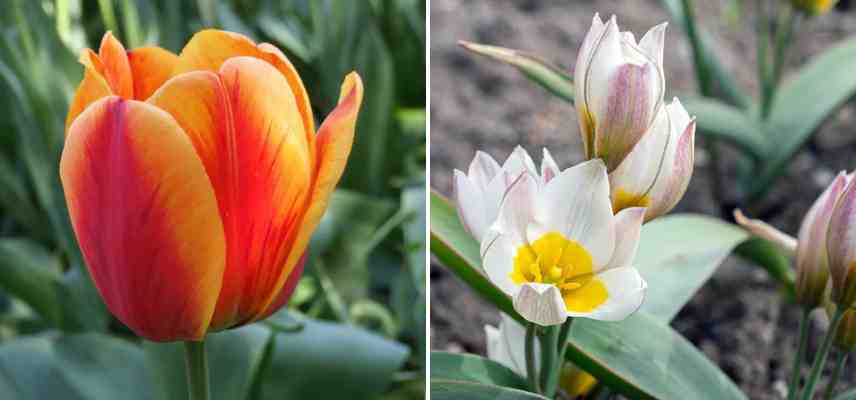
Tulip ‘Apeldoorn’s Elite’ and Tulipa polychroma
Choosing bicolour tulips according to their foliage
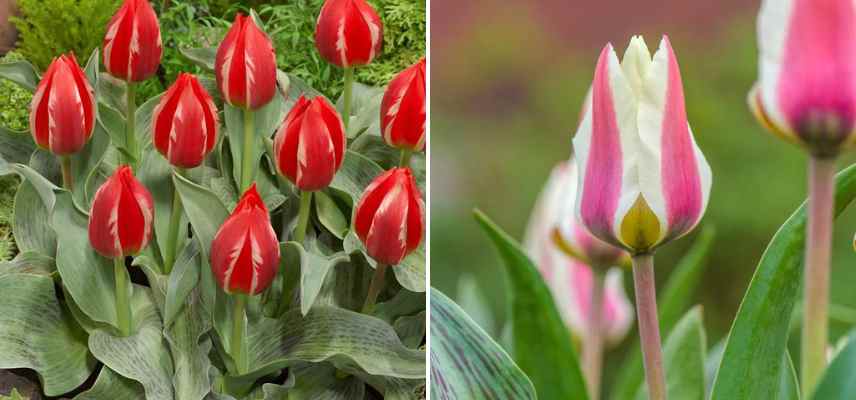
Some bi-coloured tulips also feature ornamental foliage that can be variegated, striate or striped.
This is the case with Tulipa greigii Tulipa greigii‘Friendly Fire’, a dwarf tulip with vivid red flowers delicately flame-marked with white along the petal edges. Its green foliage is marbled with purple.
We should also mention Tulipa fosteriana Tulipa fosteriana‘Border Legend’, which produces white flowers bearing a cherry-red heart-shaped blotch. But it also features lush grey-green foliage often veined with red.
- Subscribe!
- Contents
Comments