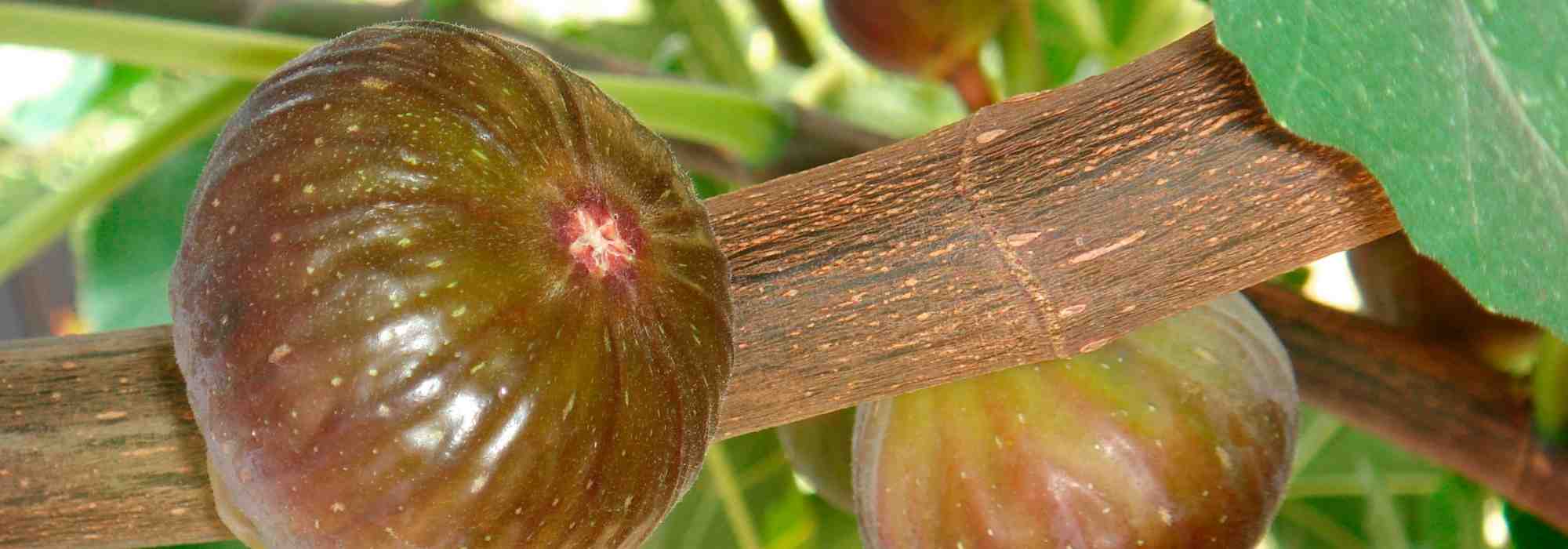
Fig blastophage: tiny insect essential to figs
Essential insect for fig production
Contents
Do you love sweet, juicy, sun‑ripened figs? Do you dream of a fig tree in your garden but wonder why some bear fruit and others don’t? Depending on the region where you live, a tiny insect, invisible to the naked eye but vital, may be at the heart of your questions. This is the fig wasp (Blastophaga psenes), the pollinating insect of the common fig (Ficus carica). Without its intervention, no figs… or at least, no seeded figs, rich in flavour.
Discover who this famous hymenopteran is, its role in the fig pollination system, and the basics of this sym symbiosis between an insect and a fig.
Le blastophage du figuier est une toute petite guêpe (genre Blastophaga, espèce la plus connue Blastophaga psenes) qui joue un rôle essentiel dans la pollinisation de certains figuiers. C’est l’agent de la fameuse relation mutualiste entre les figuiers (Ficus carica) et leurs guêpes pollinisatrices. Principales informations : - Rôle : la femelle entre dans le sycone (la "fleur" renfermée qu’on appelle communément la figue) par l’ostiole, y dépose ses œufs et transporte du pollen d’un figuier à l’autre, assurant ainsi la fécondation des fleurs internes. - Cycle de vie : la femelle pénètre dans une figue mûre (généralement d’un caprifiguier), perd souvent ses ailes en entrant, pond des œufs dans certains ovaires ; les larves se développent dans des galles créées dans les ovaires. Les mâles écloent en premier, fécondent les femelles, percent un trou pour permettre la sortie des femelles, puis meurent. Les femelles sortent couvertes de pollen et vont visiter d’autres figues. - Spécificité : chaque espèce de figuier a normalement sa ou ses espèces de guêpes associées — relation très spécialisée. - Impact pour le jardinier : certaines variétés de figuier (dites Smyrna) nécessitent la présence du blastophage/caprification pour que les fruits se développent correctement. D’autres variétés (dites communes) donnent des fruits sans pollinisation (parthénocarpiques). Il existe aussi des variétés intermédiaires (San Pedro) qui ont un premier cycle parthénocarpique et un second cycle qui peut nécessiter pollinisation. - Stature et danger : la guêpe est minuscule (quelques millimètres), inoffensive pour l’homme et spécifique aux figuiers — elle ne pique pas et ne représente pas de risque sanitaire. Conseils pratiques : - Si vous cultivez un figuier commun en climat tempéré (comme au Royaume‑Uni/Irlande), la présence du blastophage n’est généralement pas nécessaire. - Si vous cultivez une variété Smyrna et souhaitez des récoltes régulières, renseignez‑vous sur la nécessité de caprification (approvisionnement en caprifiguier ou techniques de pollinisation traditionnelle). - En climat trop froid, la guêpe peut ne pas survivre, rendant la caprification difficile en extérieur. Si vous me donnez le nom de votre variété de figuier ou une photo du fruit, je peux vous dire si elle a probablement besoin du blastophage pour produire des fruits pleinement développés.
Blastophage is a hymenopteran of genus Blastophaga, member of family Agonidae, also called “fig wasp”, the only pollinating insect of the common fig (Ficus carica) in Mediterranean regions.
Morphology
The only species naturally present in Europe is Blastophaga psenes. Unlike bees or butterflies, which visit many different flowers, the fig wasp is not a generalist. It is intimately linked to the fig tree.
Sexual dimorphism between male and female is pronounced. Indeed, the female closely resembles a small gnat, with two pairs of wings, antennae and mandibles. Her ovipositor allows her to enter and lay eggs in short-styled flowers, but not in long-styled female flowers of domestic figs. As for the male fig wasp, he is apterous (wingless) and blind. He never leaves his natal fig, where he waits for the females. Fig wasp measures between 1.5 and 2 millimetres.
What makes fig trees special
Fig tree is a very particular tree that produces figs. So far, so simple. But it does not produce flowers, or rather not visible flowers. Flowers are located inside the developing fruit. To add a complication, there are several types of fig trees :
- Caprifig is a “male” fig tree that produces inedible figs called “caprifigs”. These figs contain male flowers and female short-styled flowers, which allow the fig wasp to lay eggs. The fig tree reproduction here depends on a unique relationship between tree and fig wasp.
- Female domestic fig tree, which bears only long-styled female flowers. Fig wasp cannot lay eggs there. These flowers must be pollinated to produce seeds.
- Self-fertile fig tree that produces fruit by parthenocarpy, i.e. without fertilisation. But the figs obtained do not contain seeds. Most fig trees sold in nurseries or online belong to this category and do not need the fig wasp to produce delicious figs.
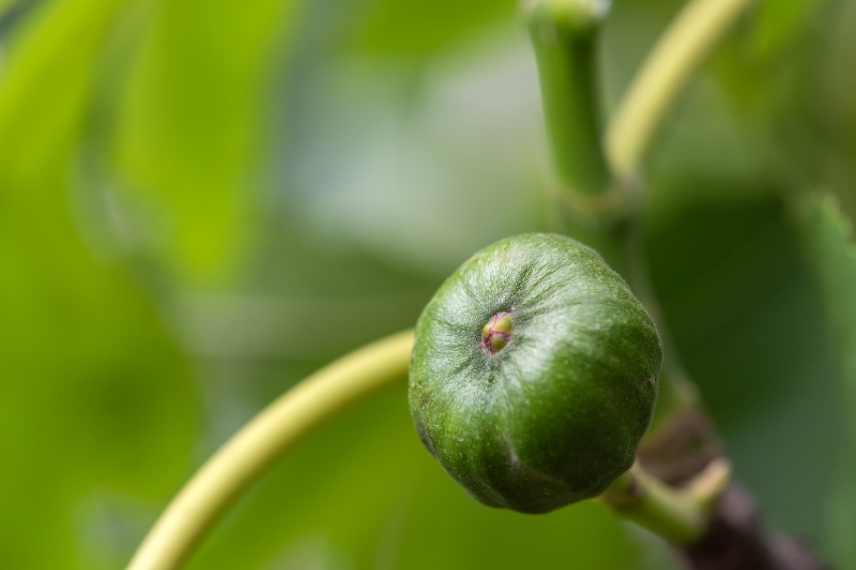
The fertilised, winged female enters figs through the ostiole and lays her eggs in short-styled female flowers
Life cycle of the fig wasp
The mutualism between Blastophaga psenes and Ficus carica is highly specialised. Insect life cycle is closely dependent on the caprifig.
- In spring, around May, caprifig figs ripen, emitting a scent rich in pheromones. The fertilised, winged female enters figs through the ostiole and lays her eggs in short-styled female flowers. At the same time, she becomes covered in pollen
- Eggs give rise to larvae, males and females, inside galls, structures formed in ovaries of short-styled female flowers
- On reaching adulthood, males fertilise females, often inside the fig
- Males then dig tunnels to allow fertilised females to exit, before dying
- Females leave the fig, covered in pollen
- They seek receptive figs, either on caprifigs or on female domestic fig trees. By entering a female fig they bring pollen but cannot lay eggs because of the long style. They generally die quickly, or remain trapped depending on circumstances.
There can be several fig generations in a year, with ripenings at different times. There is therefore an alternation between periods when the fig wasp can lay eggs and periods when it only pollinates.
Ecological role of blastophages
Blastophage is naturally widespread in Mediterranean-climate areas, where fig trees grow. Further north, blastophage does not always manage to survive or complete its life cycle, because of cold, or lack of suitable or synchronised male figs. That is why gardeners must plant self-fertile or parthenocarpic varieties that do not need blastophages to fruit.
Therefore, in southern regions, this small wasp has an important ecological role:
- Pollination : without blastophage, the fig tree (non-parthenocarpic) would not be pollinated, preventing seed formation and therefore sexual reproduction of the fig. Fertilization of the fig therefore depends closely on blastophage.
- Mutualism : it is a classic example of obligatory mutualism, each species deriving a vital benefit from the other. The fig tree provides shelter, food and a place to reproduce; the wasp provides pollen.
- Genetic diversity : insect pollination helps maintain genetic diversity in fig trees by enabling sexual reproduction. This is also important for disease resistance and adaptation to climate change.
- Food chain : figs are a food source for many animals (birds, insects, mammals), so fig reproductive success influences other species. The wasp itself is a link in the ecosystem.
Also note that a naturally pollinated fig often has better flavour, better texture and more seeds, which are sources of nutrients.
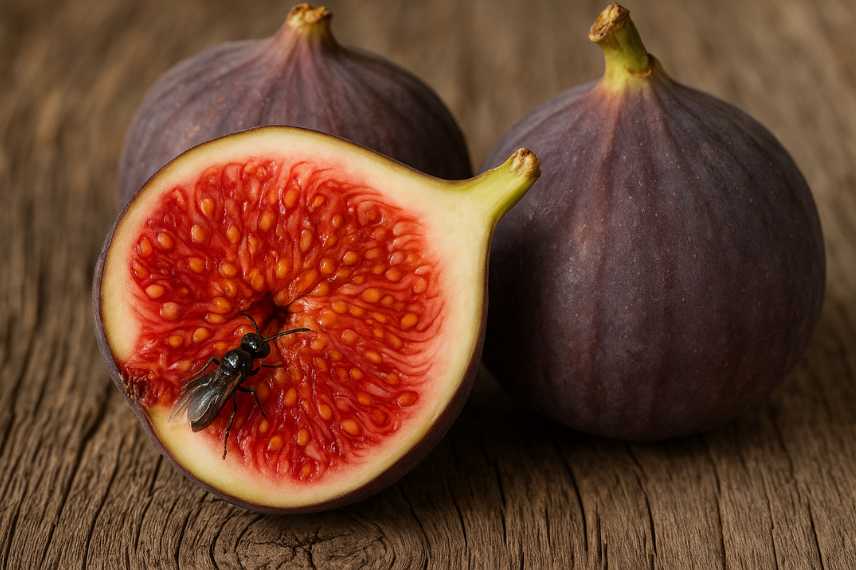
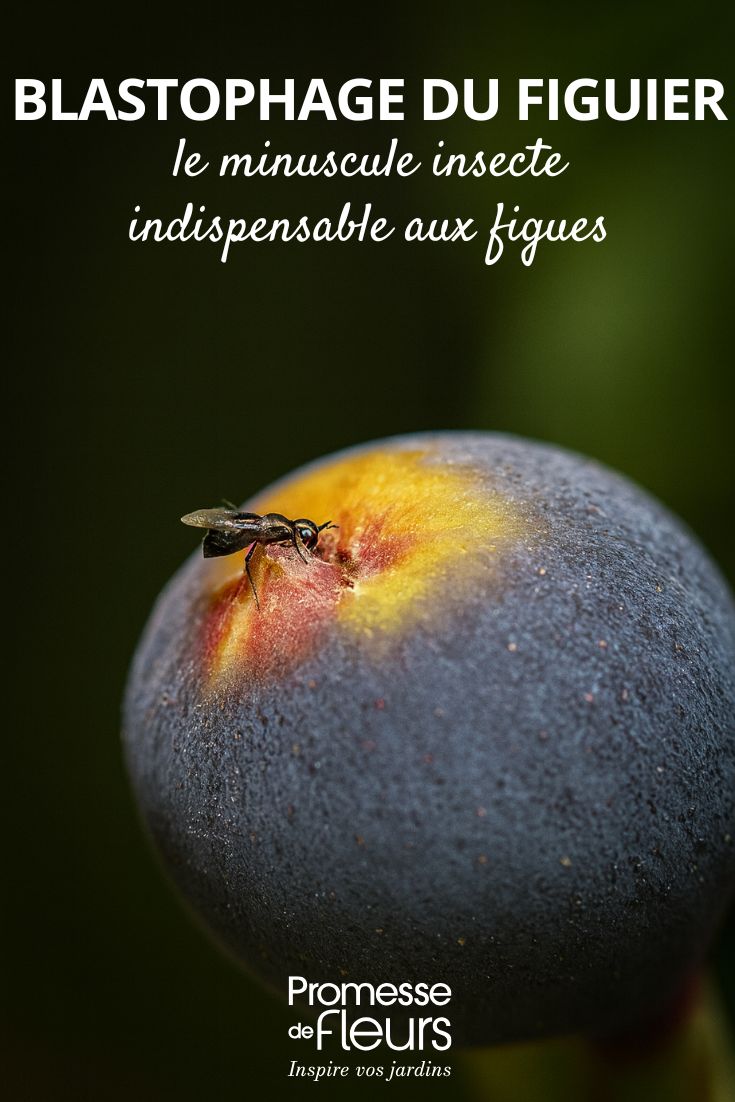
In photo: Blastophage female on a fig (AI-generated image)
What threats face the blastophage?
Blastophage is highly dependent on fig tree. And vice versa. Even the slightest disturbance can have serious consequences for either :
- Climate change : winters that are too cold or late springs with frost episodes can harm blastophage life cycle or disrupt fig–wasp synchronisation. If fig tree does not have receptive figs at the right time, females will not enter them or eggs will fail to develop
- Habitat loss or reduction in number of caprifig trees : if there are not enough male fig trees, blastophage cannot find suitable sites for reproduction, threatening overall pollination
- Use of pesticides : like many insects, blastophage can be affected by pesticide treatments. Although these insects are very inconspicuous, they are essential. Their disappearance would have direct consequences for fig production (for some varieties)
- Controlled introduction : in some regions Blastophaga psenes has had to be introduced when establishing fig trees, to ensure pollination. This must be done carefully to avoid undesirable ecological effects
- Conservation of mutualism : fig tree–blastophage relationship is fragile because highly specialised. Any disturbance (climatic, anthropic, genetic) could disrupt it, with consequences for fig cultivation and local biodiversity.
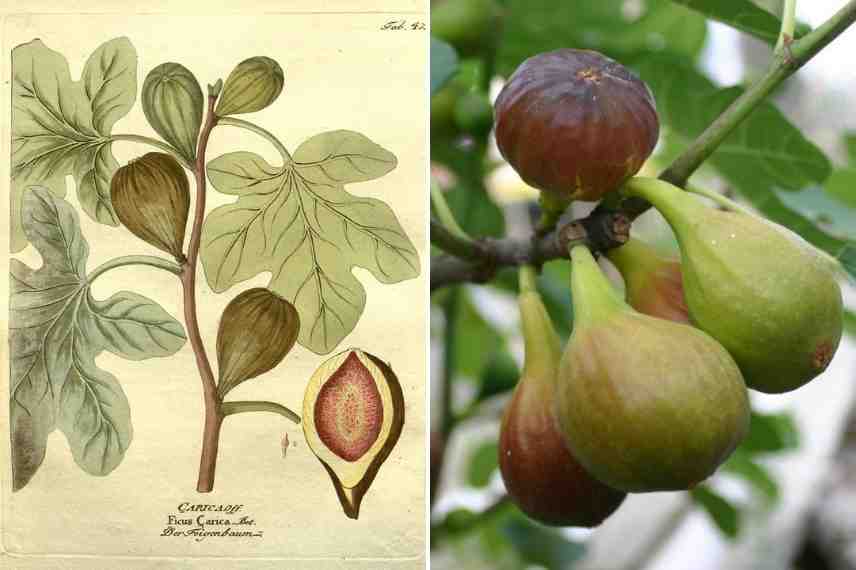
Fig tree, botanical plate from 1822, and fig tree ‘Goutte d’Or’ (biferous)
Your questions, our answers
Is there a wasp in the fig we eat?
Yes, technically the female fig wasp enters the female fig carrying pollen. Most often she does not emerge and dies inside. However, enzymes in the fig completely break her down, so you do not “see” the wasp.
Do you necessarily need the fig wasp to eat figs?
No, not always. If the fig tree is parthenocarpic, it can produce figs without pollination. Many cultivated varieties are parthenocarpic. Indeed, these are the fig trees grown outside Mediterranean or warm regions, because in areas with an unfavourable climate the fig wasp is unlikely to be present.
Can you grow a fig tree without a caprifig?
Yes, when you plant a variety that does not depend on the fig wasp (that is, parthenocarpic) or if you accept figs without seeds, or with few seeds. Otherwise, for sexual reproduction, the caprifig is necessary, as is the presence of the fig wasp.
- Subscribe!
- Contents
This form is protected by reCAPTCHA - the Google Privacy Policy and Terms of Service apply.

































Comments