





























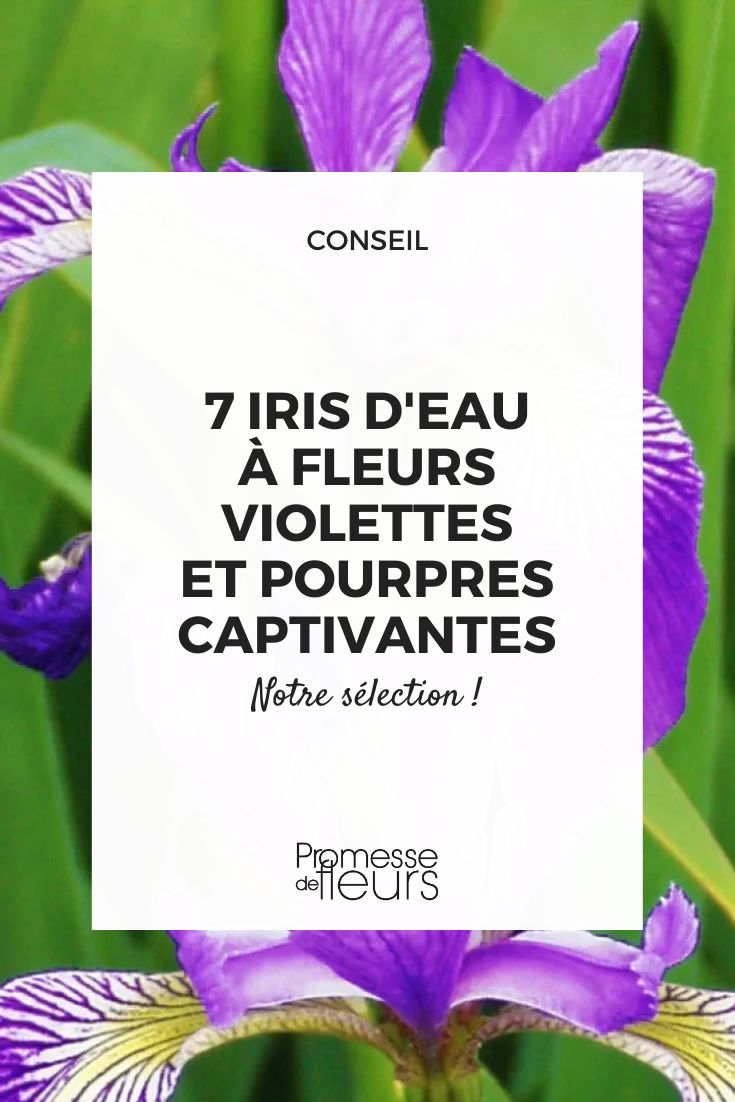
7 water irises with violet and purple flowers
Our selection
Contents
Water irises group together iris species adapted to wet areas. They are essential perennials for creating lush borders around water features or in damp soils. Among them, some varieties stand out for their flowers in enchanting shades of violet and purple. Their elegance, allied with a generous flowering, makes these water irises perfect choices for adding a touch of mystery and colour to your aquatic spaces. Discover 7 water irises with captivating flowers in rich, deep colours.

Siberian iris - Iris sibirica 'Bundle of Joy'
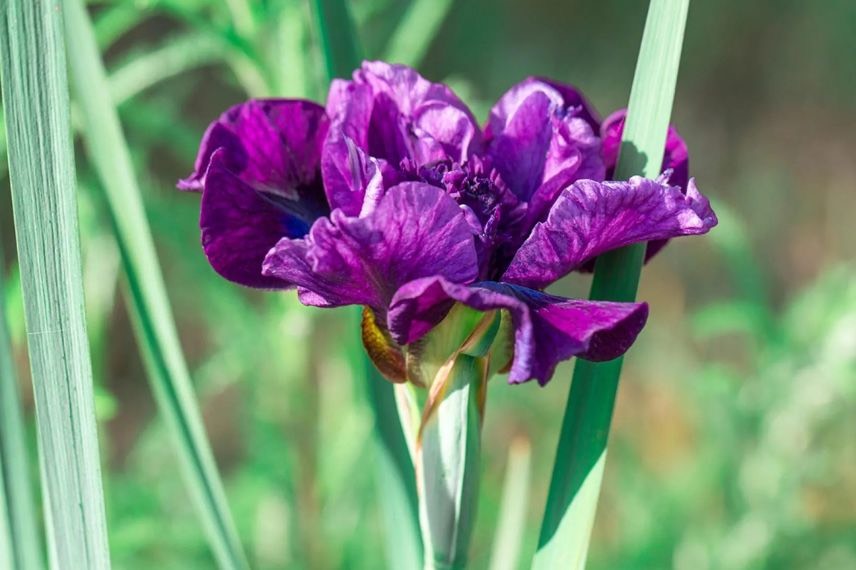
Iris sibirica ‘Bundle of Joy’ is a mid-season iris notable for its double, cup-shaped flowers in purple colour, delicate rose-violet, marked with blue, yellow and white. Its tall flowering stems rise above a clump of green-grey foliage. This iris flowers in spring, from May to June, and can reach up to 60 cm in height.
Adapted to damp soils, it appreciates good, fresh garden soil in summer. Perfect for borders beside water features, but it should not be submerged in winter. Its growth is slower than that of Iris germanica, and it fits well in romantic, English or contemporary gardens. In a stream-side border or in a mixed border, it makes superb associations with perennials such as daylilies, camassias and astilbes, creating an enchanting display.
Read also
How to plant and care for water irises?Japanese iris - Iris ensata 'Iedo Mishiski'
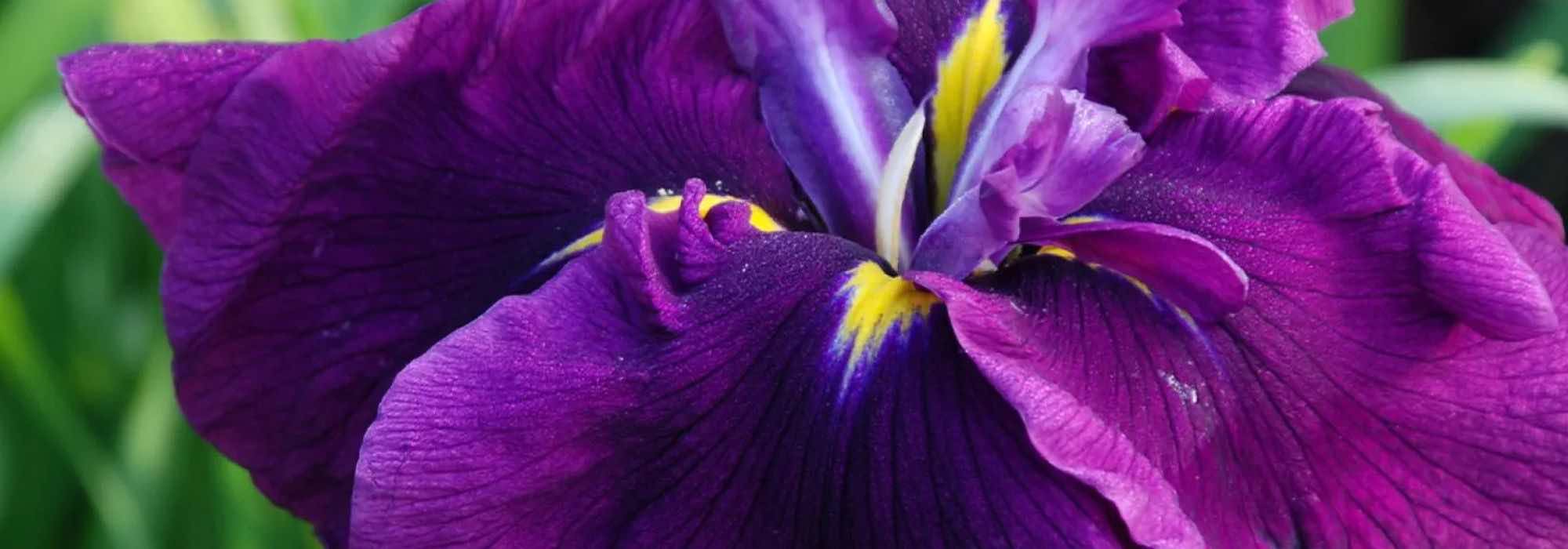
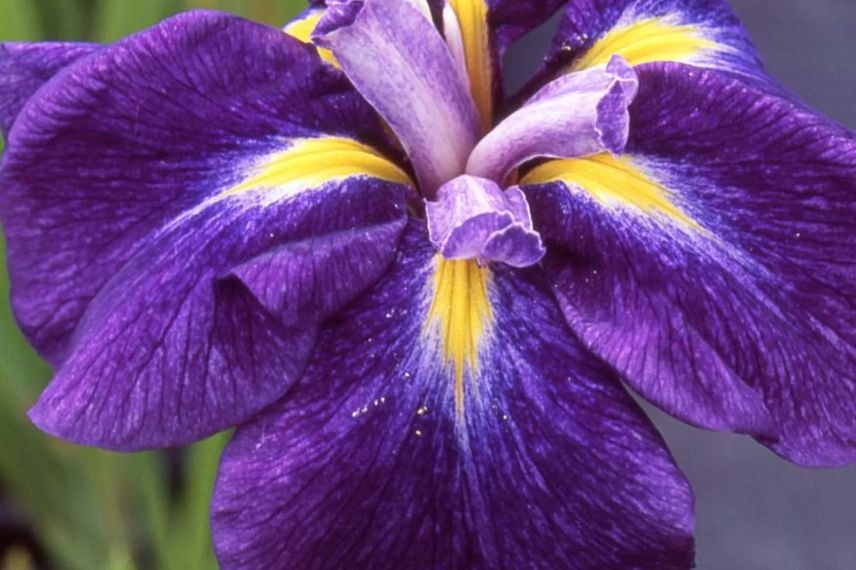
The Iris ensata ‘Iedo Mishiski’ is aJapanese iris, ideal for acidic and moist soils in summer. It bears large, round, open and flat flowers in velvety blue-violet, veined with darker tones. This cultivar flowers from June to August, with blooms 12–15 cm in diameter, composed of three large sepals and flattened petals. The petaloid styles at the centre add a touch of mauve infused with white. Each sepal features a long yellow blotch margined with white, providing a striking contrast. Originating from Asia’s wetlands, this iris prefers heavy and cool soils, as well as the banks of water features. Its deciduous mid-green foliage, with long ribbon-like leaves, grows in an upright habit. This iris reaches up to 90 cm in height when flowering, with a spread of 50–60 cm.
The Iris ensata is prized for its elegance. It prefers acidic, peaty soil, free of lime, and remains thirsty for water during its growing period, while requiring a less damp site in winter. The Iris ensata ‘Iedo Mishiski’ is perfect for borders along ponds and basins, or for damp garden soils. It can be paired with plants such as Darmera peltata, or Lysimachia to create lush, flowering borders.
Marsh iris - Iris versicolor 'Kermesina'
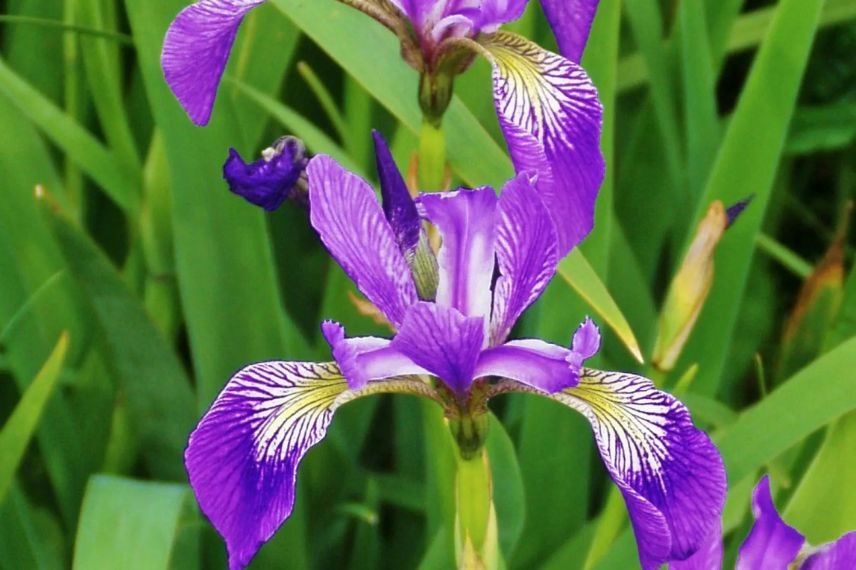
Iris versicolor ‘Kermesina’ is an iris that grows in permanent wetlands, offering an intriguing flowering with plum-veined white petals and a subtle yellow at the base. Its elegant, velvety flowers bloom from May to July, reaching around 60 cm in height with flowers about 10 cm across. Native to the marshes of North America, this hardy species thrives easily in damp, humus-rich soils, or with its roots in water along pond edges. Its ensate leaves, 2.5 cm wide, appear in spring, followed quickly by flowering.
Iris versicolor ‘Kermesina’ prefers full sun or partial shade, and tolerates partial immersion in 5 to 10 cm of permanent water. This species is ideal for creating naturalistic scenes at the edge of ponds, marshes or streams, requiring little maintenance. It takes about two years for the first flowering, but the wild beauty of its flowers is well worth the wait. Pair this iris with plants such as Carex, Iris pseudacorus, or Monbretias, to create lush, colourful scenes along the pond edge.
Read also
Top 5 yellow-flowered water irisesSiberian iris - Iris sibirica 'Purplelicious'
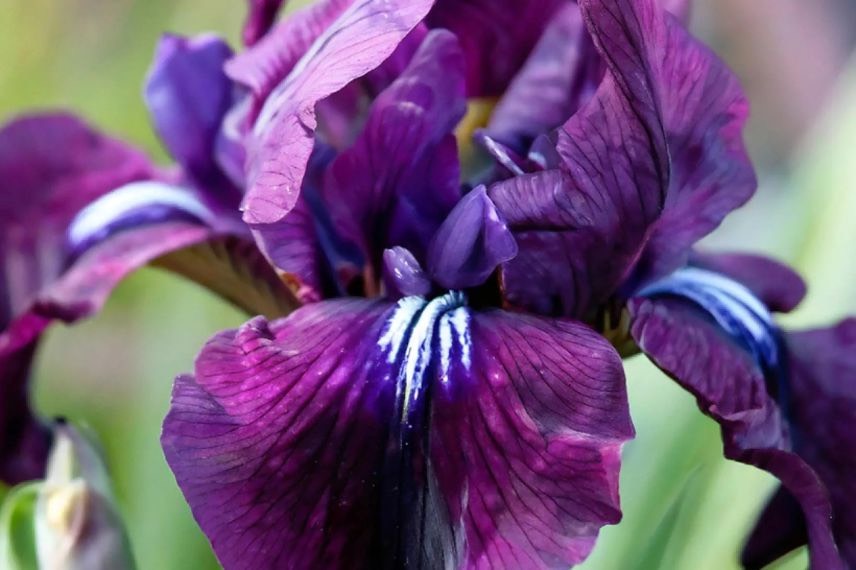
Iris sibirica ‘Purplelicious’‘ is a Siberian iris with violet flowers of striking intensity. Its velvety petals, veined with dark markings, are splashed at the base with indigo and sparkling white. The flowers appear in June and July, on stems reaching up to 1 m tall when in bloom, while the plant forms an upright clump of slender green leaves. This vigorous iris is ideal for damp or cool soils. It suits both edges of water features and contemporary or romantic gardens thanks to its architectural presence and the elegance of its foliage.
Iris ‘Purplelicious’ is a rhizomatous perennial that enjoys rich, well-drained and cool soils, slightly acidic to neutral. It thrives in full sun or partial shade. This plant fits perfectly in a damp garden, provided it is not waterlogged in winter. Perfect in a mixed border or along the edge of a water feature, it can be paired with perennials such as columbines or astilbes, creating enduring floral displays from spring to summer. In a contemporary garden, it pairs very well with Hostas, offering a pleasing harmony.
Japanese iris - Iris ensata 'Royal Banner'
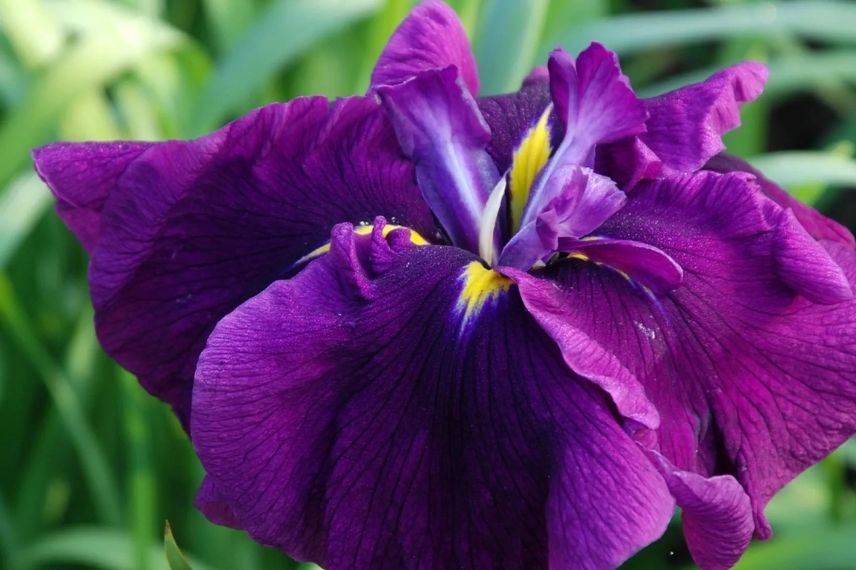
The Iris ensata ‘Royal Banner’ lives up to its name with its majestic flowers featuring large purple-violet sepals, adorned at their centre with wide banners edged in white. This Japanese water iris is suited to acidic and waterlogged soils in summer. It flowers in summer, between July and August, and reaches up to 90 cm in height.
The Iris ensata grows in upright clumps, consisting of long, ribbon-like leaves of a medium green. Its spectacular flowering reveals enormous flowers, with three large, flattened sepals and three petals slightly smaller, all trailing. This cultivar slowly spreads by its rootstocks, becoming more beautiful each year.
Pair it with other border plants for ponds such as Lobelia ‘Queen Victoria’, Anemone rivularis and delphiniums, to create lush and harmonious flowering scenes.
Siberian iris - Iris sibirica 'Sparkling Rose'
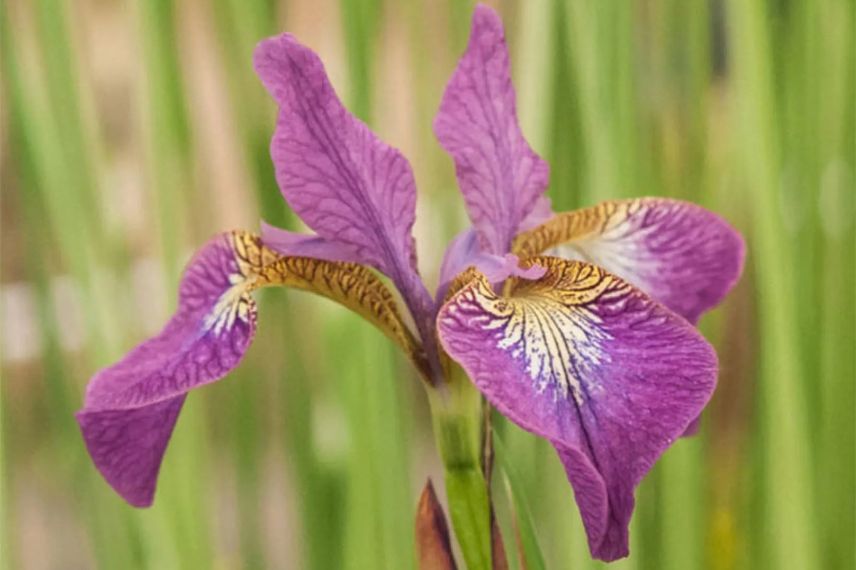
Iris sibirica ‘Sparkling Rose’ produces in May–June light and graceful pink-mauve flowers with blue reflections, veined bronze and violet. This rhizomatous perennial forms a dense clump of slender, bright-green leaves, remaining ornamental for several months. This iris reaches about 80 cm in height, with flowering stems exceeding 1 m in full bloom. It prefers moist, well-drained soils, acidic to neutral, and tolerates ordinary soils enriched with humus, provided they are not dry.
Siberian iris ‘Sparkling Rose’ grows well in full sun, with at least six hours of sunlight per day, and tolerates light shade in hot regions. Planting is recommended from September to April, with 50 cm spacing to allow good growth. Rhizomes should be planted at a depth of 3 to 5 cm. This iris is low-maintenance, dividing every 5 to 10 years when the clump becomes less floriferous.
Pairing with moisture-loving plants such as daylilies, summer snowflakes and ligularias, this iris adds elegance and lightness to romantic or contemporary gardens, as well as to mixed borders in moist soil.
Japanese iris – Iris ensata 'Japanese Pinwheel'
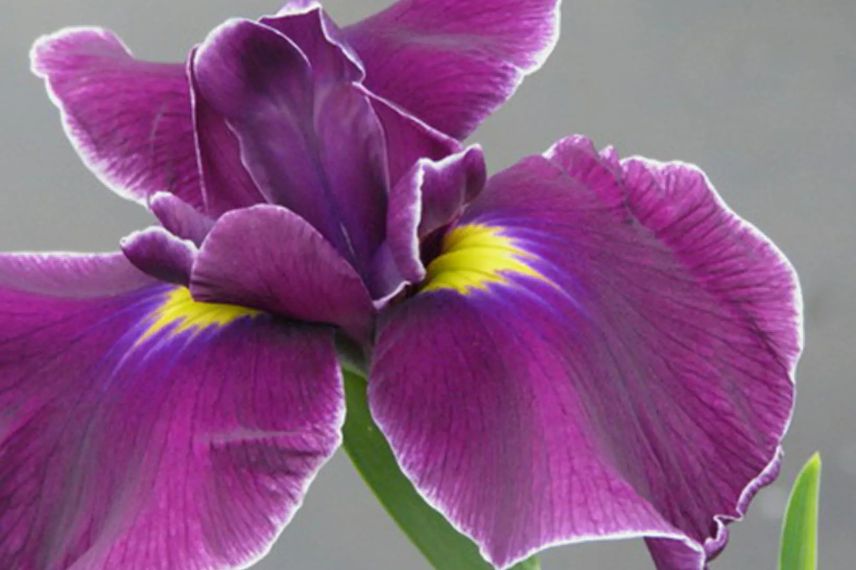
Iris ensata ‘Japanese Pinwheel’ is a remarkable variety for its large violet-purple flowers, finely edged with white, and illuminated by a golden-yellow spot. It may even rebloom in good conditions.
This variety, introduced by Currier McEwen in 1988, forms an erect clump reaching 1 m in height, with strap-like leaves in a medium-green shade. Its flowering, from May to September, features large flowers 12 cm across, with violet-magenta sepals that are flattened and edged in white. Each flower is topped by smaller, finer petals, giving this iris a particularly elegant appearance.
The Iris ‘Japanese Pinwheel’ will thrive in well-drained soil, lightly enriched with compost, planted in a shallow depression or on a bank. Pair it with plants such as Lobelia ‘Queen Victoria’, Astilbes, Lysimachias, or Darmera peltata to create a harmonious and lush border at the edge of a pond.
- Subscribe!
- Contents
Comments