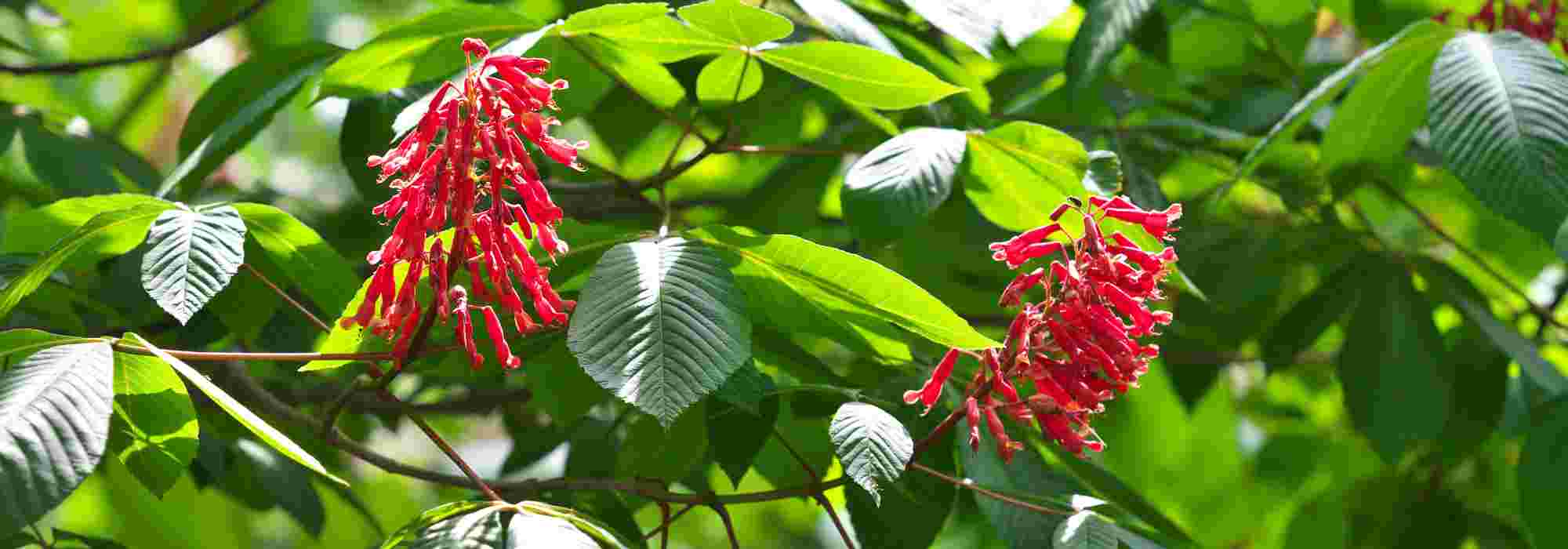
7 trees with red flowers for a vibrant garden!
Flamboyant flowering to bring vitality to the garden
Contents
Red can sometimes be intimidating in the garden. It is indeed a strong, fiery colour, but it appears in many shades, ranging from soft pale red to intense red, including purple. If it is often associated with exotic gardens, it can in fact fit very well into other styles.
If you want to adopt this colour and add a lovely touch of vitality, you will find lovely flowering on certain trees. Discover in this article our selection to grow in pots, but also in hedges, in borders or as solitary specimens.

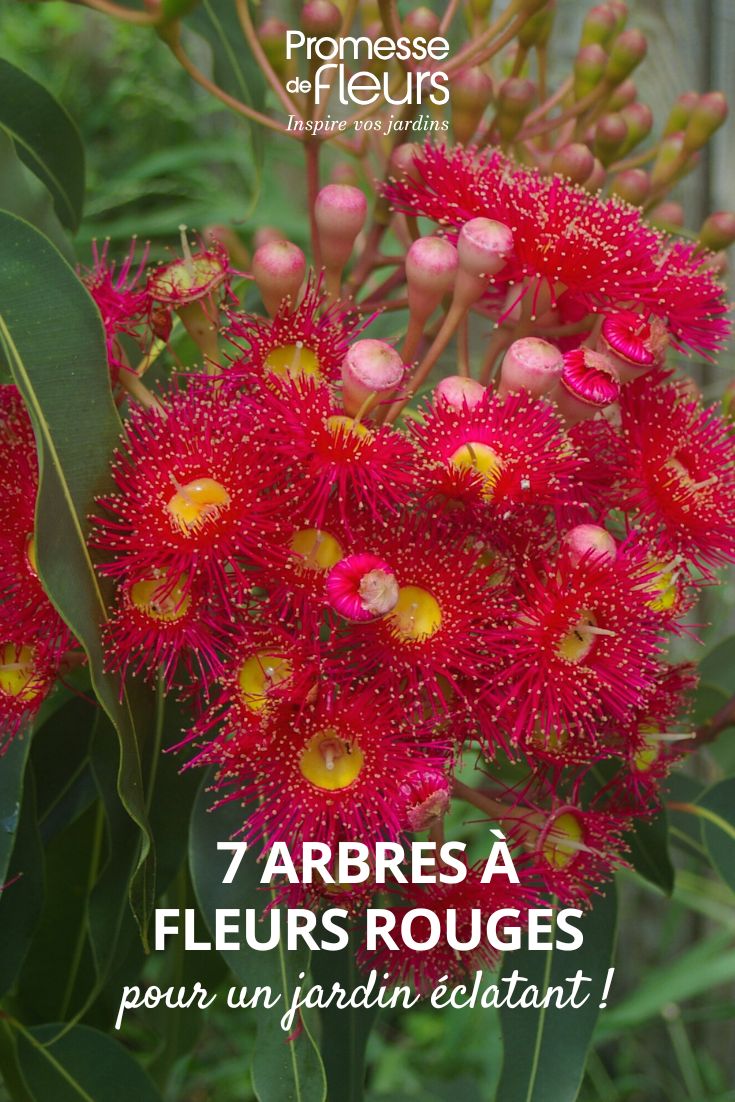
Eucalyptus or red gum - Corymbia ficifolia
Eucalyptus is a tree much appreciated for its decorative foliage and for its bark, sometimes very colourful. Fast-growing and undemanding, it is perfect for providing shade in the garden, but dwarf varieties can also be grown in pots.
With Eucalyptus, flowering is therefore generally not the main decorative asset. Yet some species are very interesting. This is the case of the Eucalyptus or red gum (Corymbia ficifolia). This small tree or large shrub native to Australia reaches 8 metres in height with a 7-metre spread. Its evergreen foliage is reminiscent of certain fig trees. It has a spreading silhouette, yet dense and compact.
In summer, the foliage is almost hidden beneath a profusion of vivid red flowers, which inevitably attract the eye. Between June and July, the tree produces clusters of brightly coloured stamens, which are also a boon for pollinating insects. Very wispy in appearance, they contrast wonderfully with the dark green foliage, giving the garden an unmistakably exotic air. This dazzling flowering pairs perfectly with summer bulbous plants in bright colours, such as the Crocosmias or the Kniphofias.
As for cultivation, it is a tree for mild climates that does not tolerate severe frosts (hardiness -4°C). Plant it in a sunny position in well-drained soil, even poor and sandy, preferably cool.
To learn more, see our guide: Eucalyptus: planting, pruning and care.
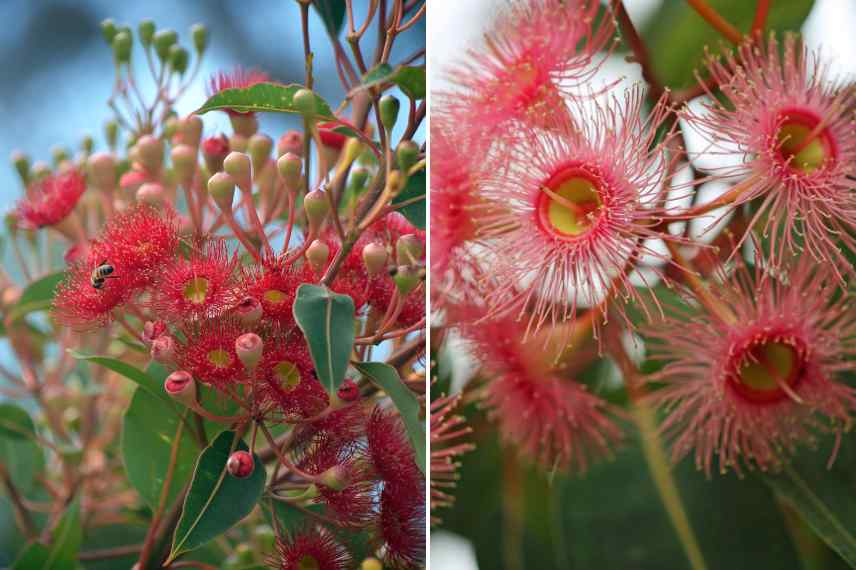
Corymbia ficifolia
Read also
8 landscaping tips for red gardensRed-flowering horse-chestnut - Aesculus carnea ‘Briotii’
Red-flowering horse chestnut (Aesculus carnea) ‘Briotii’ is a moderate-sized variety, reaching about 12 metres in height with an 8-metre spread.
In late spring, between May and June, it produces pretty deep-red flowers with an orange throat, borne in panicles. Sterile, they do not set fruit. They sit above a typical palmate foliage, divided into five puckered dark green leaflets. Here again, the red stands out well against the green, creating a striking contrast.
But the rather soft red of the flowers, tending slightly towards violet, is not overpowering. It will sit comfortably alongside roses or ericaceous shrubs in acidic soil.
In cultivation, this tree is very hardy (below -25°C) and undemanding. Plant in full sun or partial shade, in fairly fertile, cool soil, although it can tolerate occasional drought.
For more information, see our guide: Horse chestnut, Aesculus hippocastanum: planting, growing and care.
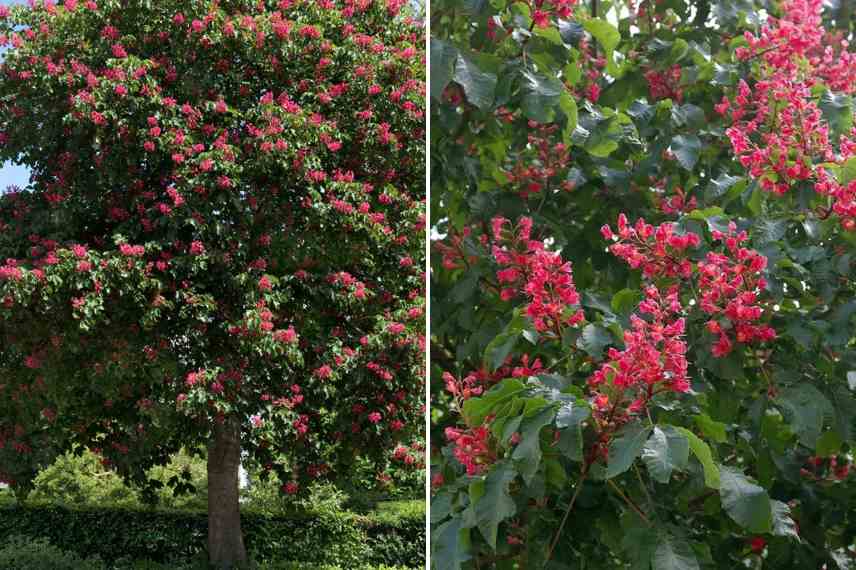
Aesculus carnea ‘Briotii’
Weeping boer-bean - Schotia brachypetala
Drunken parrot tree (Schotia brachypetala), an exotic tree native to South Africa, is not widespread. Its low hardiness (-4°C) limits cultivation outdoors to the mildest parts of the country. However, it can be grown in a pot to enjoy its magnificent red flowering even in less favourable climates.
From late spring to autumn, this small tree in family Fabaceae produces dense clusters of flowers 10 to 20 cm long, whose nectar attracts many pollinating insects. This liquid can sometimes bead on the flowers, giving the tree its “weeping” nickname. The flowers display a scarlet red colour with slight burgundy overtones. They have another peculiarity: they grow directly on branches and on the trunk (not on new shoots) — this is known as a cauliflorous tree. This flowering gives way to long woody brown pods 10 to 25 cm long, containing edible seeds.
Over time, drunken parrot tree will form a large crown about 5 metres across and 7 metres tall, ideal for providing shade. The semi-evergreen foliage (it remains if there is no frost) is pinnate and takes on a glossy dark green at maturity, while young shoots show attractive coppery tones.
In open ground, drunken parrot tree makes a wonderful solitary specimen. It also pairs very well with an Erythrina, whose coral-red flowering is equally flamboyant. Due to its origins (savannas and edges of dry forests), it tolerates drought well. Avoid very calcareous soils and provide a well-drained, preferably sandy soil in a sunny position.
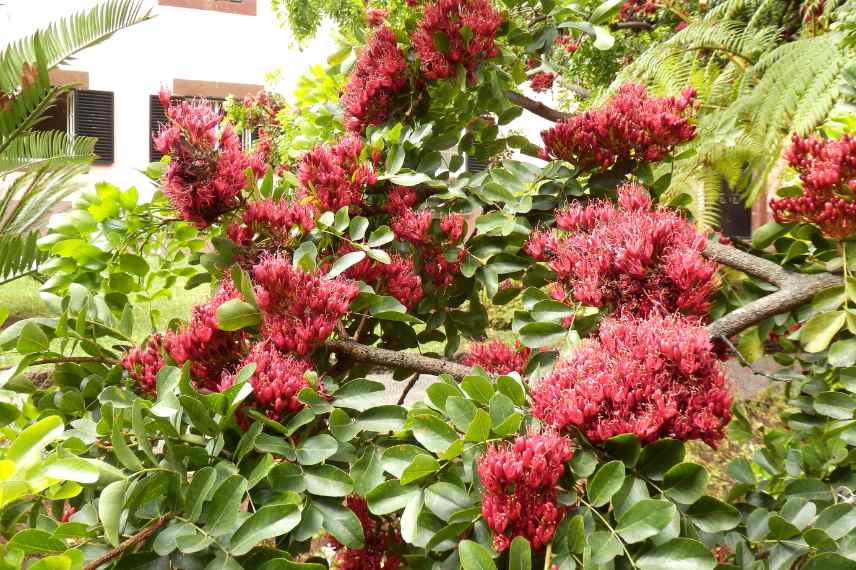
Schotia brachypetala
Bottlebrush - Callistemon viminalis
Bottlebrush (Callistemon viminalis) is one of those trees whose flowering clearly does not go unnoticed, both for its colour and its shape. Its name indeed comes from its magnificent bottlebrush-like flowers, very distinctive, usually displaying a bright red that seems to gleam, thanks to a touch of golden yellow at the tips of the stamens. This flowering occurs in late spring, sometimes also in late summer. Again, it will attract many insects.
In terms of size, expect 7 metres in height with a 3-metre spread. This small tree forms a fine dense crown, slightly pendulous, because of its arching branches. This modest silhouette makes it easy to grow in a pot, since its hardiness does not exceed -6°C.
Callistemon has fine, evergreen foliage, decorative all year round, with a slightly greyish green colour.
Bottlebrush thrives in sun or partial shade, in a rather fertile but well-drained, occasionally dry soil. It makes a good evergreen hedge plant, alongside mimosas, oleanders or ceanothus.
To learn more, see our guide: Callistemon, Bottlebrush: planting, pruning, care.
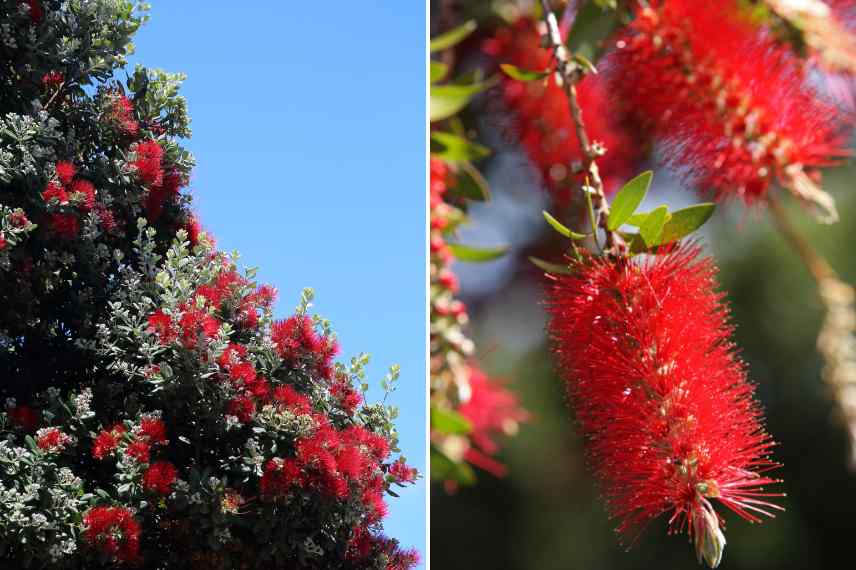
Callistemon vinimalis
Madagascar baobab - Adansonia madagascariensis
Madagascar baobab (Adansonia madagascariensis) is impressive at 20 metres tall with a 15-metre spread at maturity! But in our latitudes it must be grown in a pot because it is very frost-sensitive (hardiness 10°C), so it will remain much smaller. It will only reach in fact 2–3 metres in height with a 1–2 metre spread.
Flowering occurs in spring between March and April on well-established specimens. It consists of erect pink-red flowers with long yellow stamens. They measure up to 10 cm. If pollinated, these flowers are then followed by green fruits. Note that flowering remains rare in our climate.
This baobab also bears a distinctive massive bottle-shaped trunk, cylindrical to swollen, together with a spreading habit. Its mid-green deciduous foliage is attractively divided into oval, pointed leaflets.
This baobab would make a real centrepiece for a room that does not experience very low winter temperatures, such as a heated conservatory or greenhouse. It pairs perfectly with a banana tree, a bird of paradise (Strelitzia reginae) or a palm for an exotic setting. Grow it in a very bright position in well-drained soil. It requires a dry resting period from autumn to spring. To be able to move it out easily in fine weather, consider putting it on castors.
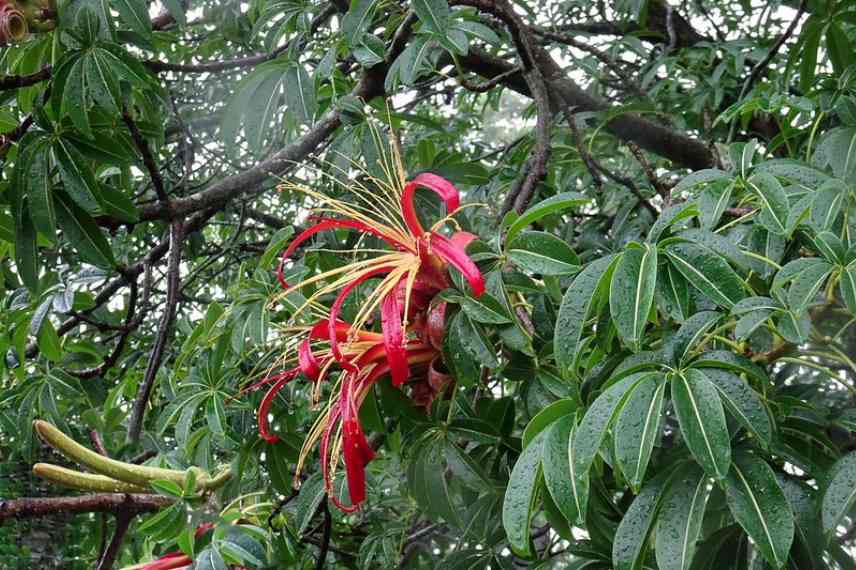
Adansonia madagascariensis (© Tatters)
Maple-leaved bottle-tree - Brachychiton acerifolius
Maple-leaved bottle-tree (Brachychiton acerifolius) bears a surprising name that piques curiosity. Native to Australia, it can store water in its trunk, like baobabs. This enables it to withstand drought, so it can be grown on Mediterranean coast with no problem. Elsewhere, limited hardiness to −4 °C confines it to container cultivation, to be kept under cover in winter.
If nicknamed « Australian flame », this is in honour of its magnificent coral-red flowering in small bell-shaped blooms, which appears in early summer, after leaves fall during dry season. Leaves resemble those of some maples, palmate and deeply lobed.
Allow 15 metres in height by 6 metres across (less in a pot). Give it a sunny position in rich, well-drained soil.
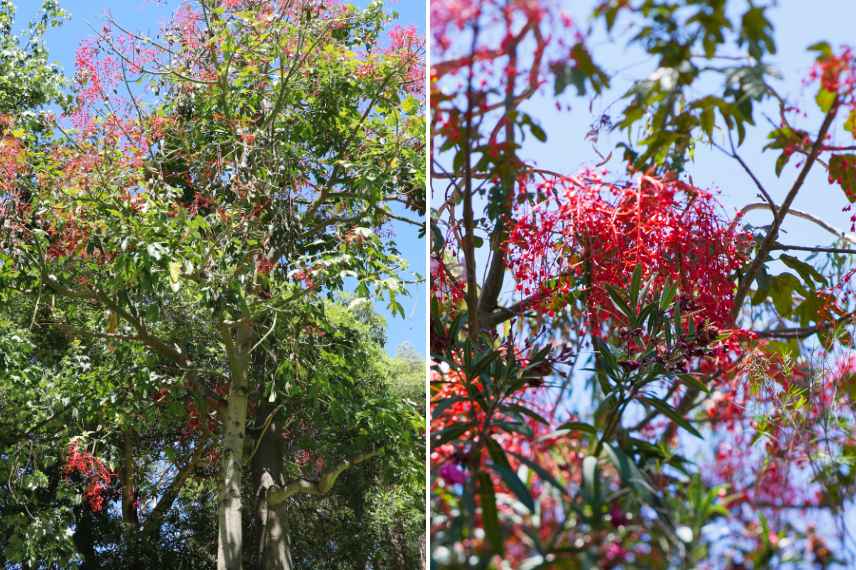
Brachychiton acerifolius
Red maple - Acer rubrum 'Somerset'
We are familiar with the red, flamboyant foliage of maples, but did you know some species also flower in that colour? This is the case of the red maple (Acer rubrum) ‘Somerset’.
In early spring, the flowers develop on still-bare twigs. These small deep-red flowers are borne in clusters, much appreciated by insects.
As with other maples, ‘Somerset’ foliage is first green before colouring in autumn with the first frosts and setting the garden alight.
This modest tree reaches 10–12 metres in height with a spread of 5–8 metres. It is grown in full sun or partial shade, sheltered from wind, in fresh to moist, non-calcareous soil. It pairs perfectly with a Liquidambar.
For more information, discover our feature: Maples: planting, pruning and care.
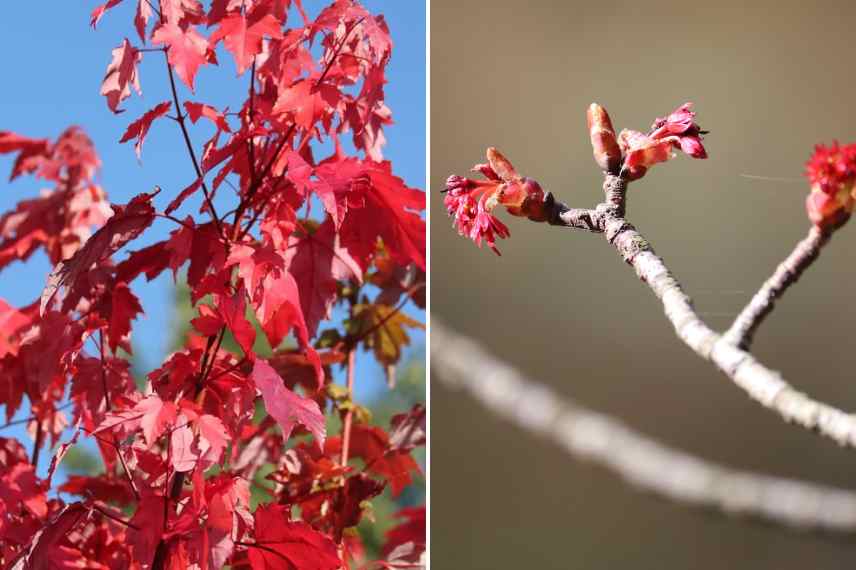
Acer rubrum ‘Somerset’, and on the right the flowering of Acer rubrum, the type species;
- Subscribe!
- Contents
This form is protected by reCAPTCHA - the Google Privacy Policy and Terms of Service apply.

































Comments