In regions subjected to cold and harsh winters, vegetation is in forced dormancy. The gardener, eager to see their peonies, roses, and other hydrangeas bloom again, impatiently awaits the scheduled end of this dreary season. However, many plants, far more than one might think, dare the cold to showcase their most beautiful flowers in winter. Here is a selection of must-have bushes and perennials for winter:
1) Hellebore or Christmas Rose
The hellebores (Helleborus niger and H. orientalis) are the princesses of winter (it should actually be said "Prince" as Hellebore is masculine)! Their flowers come in a wide range of colours and provide a spectacle until early spring. They are easy to grow in cool, semi-shaded soil. To learn all about this superb perennial, check out our plant sheet: "Hellebores: planting and cultivating them"
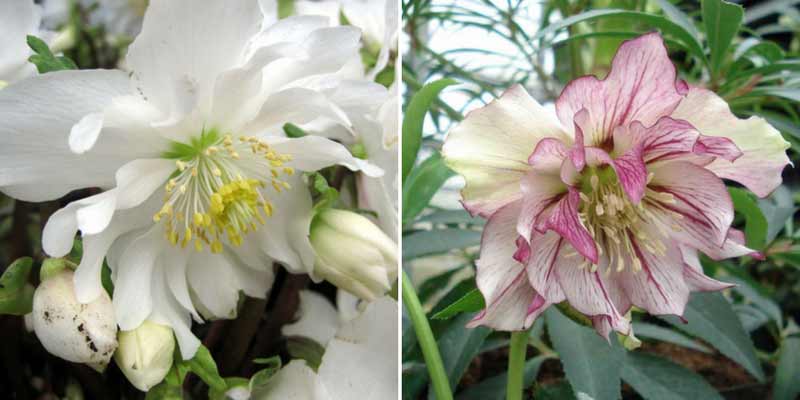
The Helleborus niger Double Fashion (on the left) is the first to open the ball, its immaculate white flowers bloom in December; it is the only Christmas Hellebore with double flowers / Helleborus orientalis Double Picotee (on the right) is equally original. This variety blooms at the end of winter.
2) Japanese Quince
The Japanese quinces (Chaenomeles japonica, C. speciosa) delight us with the early onset of their flowering. They offer simple or double flowers in colours ranging from fiery red, remarkable from afar, to pure white, with lovely salmon or apricot pinks in between. These are vigorous bushes, easy to live with, and perfect for hedges or borders.
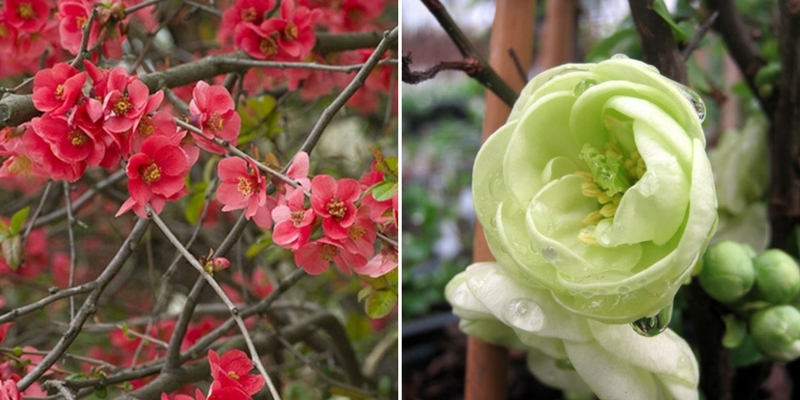
Two stunning varieties: Chaenomeles Nicoline and Chaenomeles speciosa Kinshiden, one of the few with greenish-white flowers.
3) White Forsythia or Abeliophyllum distichum
The abeliophyllum distichum is a small Asian bush, native to Korea, that deserves attention! Very hardy, it offers graceful little white flowers with four petals and a yellow-orange centre on bare branches at the end of winter. Its modest size (1.5 metres in all directions) is ideal for small gardens or the front of shrub borders.
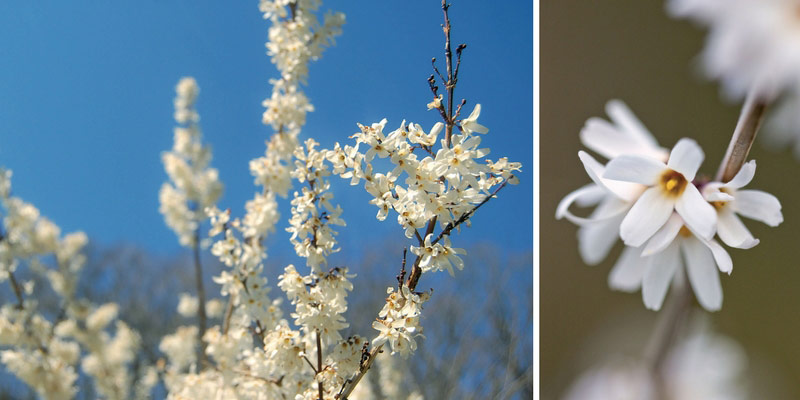
The white flowers of Abeliophyllum distichum resemble snowflakes; it is also known as White Forsythia.
4) Witch Hazel
Sublime in the heart of winter, Witch Hazel also surprises with the unique shape of its flowers. Its fine, elongated petals give it a particular charm, which is likely why it is often referred to as "witch hazel." Considered by many as the "mimosa of the North," it is just as floriferous, though it lacks the fragrance!
To learn more, check out our complete dossier: "Witch Hazel: planting, cultivation, maintenance, and association"
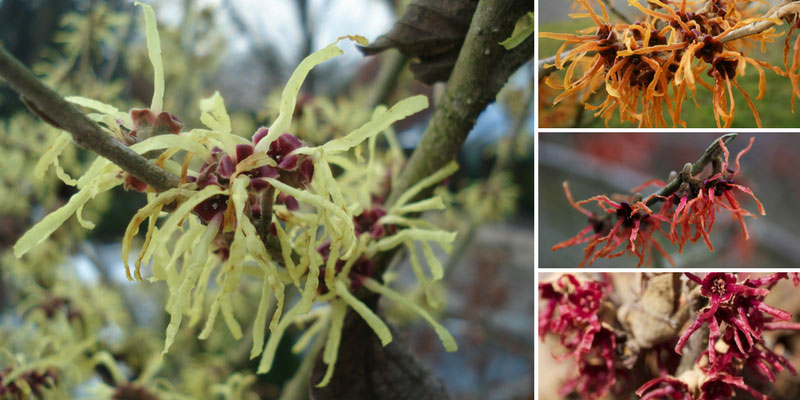
Different varieties of witch hazel: H. pallida, Jelena, Feuezauber, and Amethyst.
5) Camellia 'Cinnamon Scentsation'
Camellias are renowned for their winter flowering, but the variety 'Cinnamon Scentsation' particularly captivates us with its natural form and the sweet, refined scent of cinnamon from its numerous small pale pink flowers. Its flowering typically occurs in February and continues until the heart of spring. Compact, it is easily grown in the garden or in pots on the balcony or terrace.
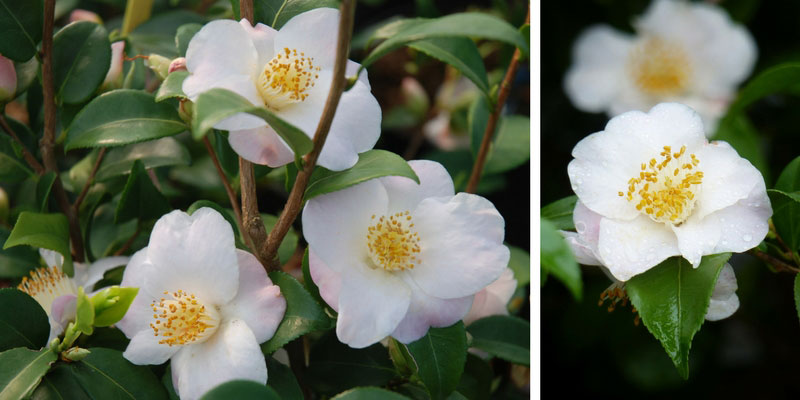
The camellia Cinnamon Scentsation: a rustic camellia with highly fragrant flowers in winter.[/caption>
6) Daphne odora
Daphne odora is a shrub that can lead you by the nose because, in terms of fragrant plants, no other species can dethrone it! Indeed, its small, deep pink flowers emit a powerful, intoxicating fragrance that can be detected from 30 metres away. In the garden, it prefers shade and semi-shade, as well as cool but well-drained soils. Its growth is relatively slow, but your patience will be rewarded with its wonderful fragrance. To learn all about Daphnes, we invite you to consult our plant sheet:"Daphne: how to plant, cultivate, and maintain it"
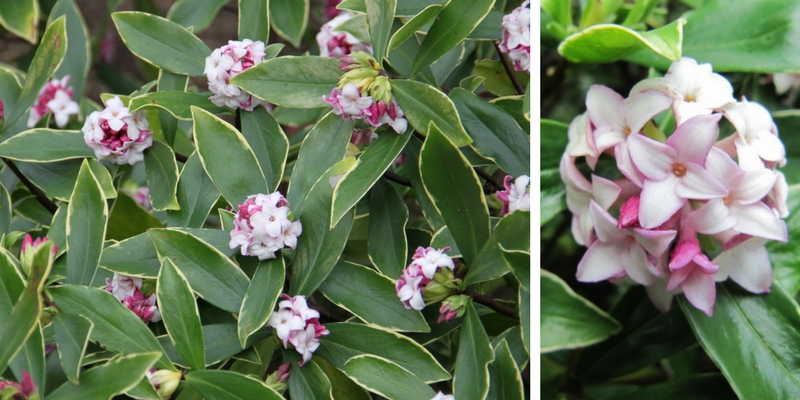
The Daphne odora aureomarginata, a shrub with evergreen foliage whose flowers exude an almost mythical fragrance.
7) Garrya elliptica
Garrya elliptica or Elliptical-leaved Garrya is a beautiful shrub that reaches a height of about 3 metres. Original and very ornamental, it stands out in the heart of winter with its remarkable flowering in pendulous catkins, measuring 20 to 30 cm long. But don’t be fooled by its precious appearance; it is indeed hardy (down to -12 °C) and quite easy to grow. It particularly thrives in well-drained soil, in a maritime climate, or in any garden sheltered from cold winds.
[caption id="attachment_34252" align="aligncenter" width="800"]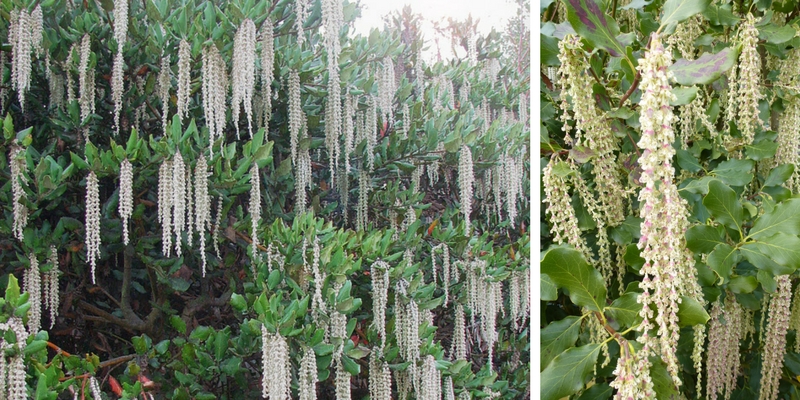 The Garrya elliptica, a remarkable shrub in winter.
8) Winter honeysuckle or Lonicera fragrantissima
Much less known than climbing honeysuckle, the Lonicera fragrantissima forms a rounded, flexible, somewhat spreading bush. Relatively discreet, it reveals itself in winter by covering itself with small, highly fragrant white flowers. Semi-evergreen and about 2 metres tall, it is a perfect candidate for free hedges or the back of borders. It is appreciated by bees, providing them with valuable food, as well as by birds that consume its berries in autumn.
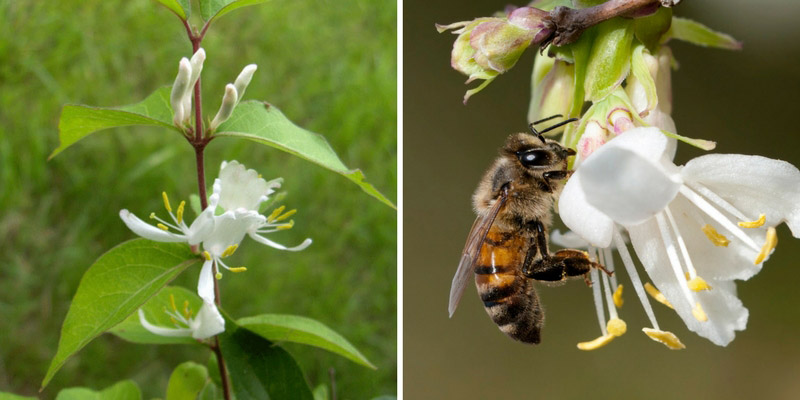
The winter honeysuckle is appreciated by bees, providing them with valuable food, as well as by birds that consume its berries in autumn.
9) Winter clematis
In terms of flowering, climbing plants, and particularly clematis, are not to be outdone: in mild climates, adopt Clematis cirrhosa such as 'Advent Bells', which bloom as early as the beginning of winter! Elsewhere, rely on a safe bet: the Clematis armandii, which, in addition to being evergreen, is hardy and blooms at the end of winter, in March-April.
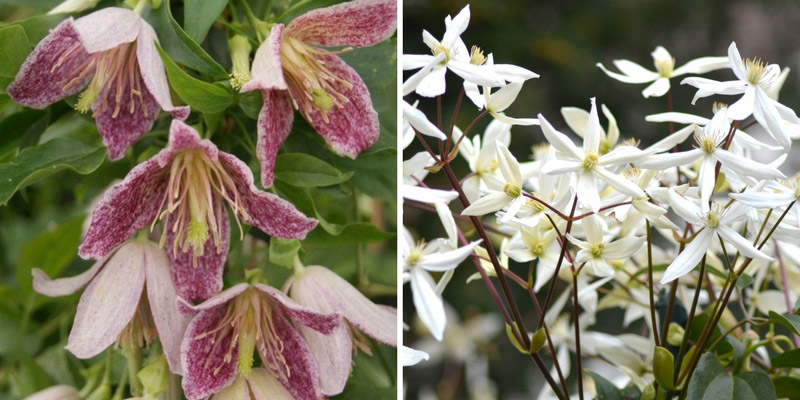 The clematis cirrhosa 'Advent Bells' and Clematis armandii.[/caption>
10) Winter jasmine
The Winter Jasmine (Jasminum nudiflorum) shines with the brilliance of its flowers. It is a somewhat stiff, sprawling climbing plant that displays bright yellow flowers from December on bare branches, which further accentuates the effect. This jasmine will be perfect against a well-exposed wall where it will bloom abundantly.
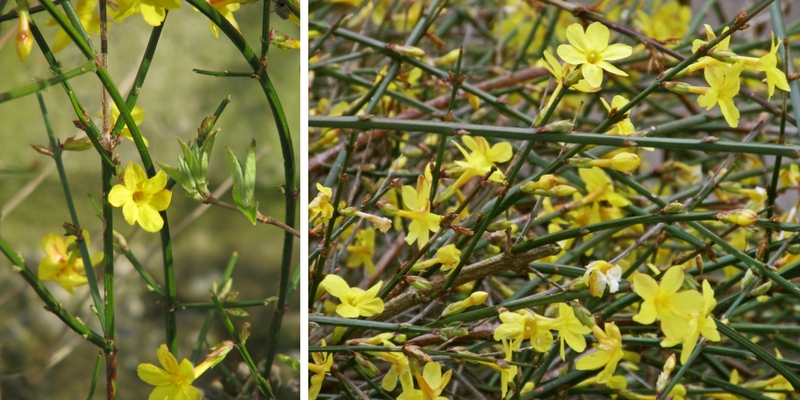 The golden yellow flowers of Jasminum nudiflorum bloom in the heart of winter; despite appearances, this winter jasmine is perfectly hardy, and its flowers bloom even when it freezes.[/caption>
Bonus - Chimonanthus praecox
Many of you have reminded us about the Chimonanthus praecox, and you are right! Also known as Chimonanthe, this winter shrub is particularly distinguished by its fabulous fragrance. Native to China, it is a hardy shrub with a somewhat stiff habit that reaches 3 to 4 metres tall at maturity. From December, its bare branches are adorned with small, rather discreet yellow flowers. To get to know it better, I recommend reading Pierre's article: Chimonanthus praecox, an enchanting fragrance in winter
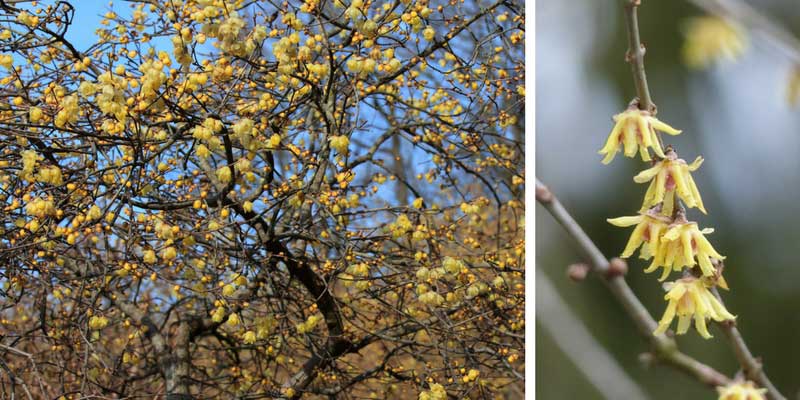 The flowering of Chimonanthus praecox, divinely fragrant.
With the exception of Clematis cirrhosa, all these plants are very hardy and easy to grow. While some tolerate calcareous soils, others prefer more acidic soil. To prolong these winter blooms in cold regions, one tip: plant them sheltered from cold, dry winds in winter, at the foot of a wall or hedge facing west or south. Protected, the flowers will bloom for a few more weeks!
Also read:
In regions subjected to cold and harsh winters, vegetation is in forced dormancy. The gardener, eager to see their peonies, roses, and other hydrangeas bloom again, impatiently awaits the scheduled end of this dreary season. However, many plants, far more than one might think, dare the cold to showcase their most beautiful flowers in winter. […]
Winter gardens are not necessarily synonymous with dry clumps, bare soil, and sad branches!
Flowering is certainly much rarer than in summer, but if you create a few scenes specifically for winter, combining interesting and colourful flowers and foliage, you will appreciate them even more. Discover the scents of winter as well...
Indispensable, the early small bulbs
They bloom almost at ground level, but what a delight! Plant them in fairly large groups, at least ten, to create colourful patches visible from afar, and place them in strategic locations, near the terrace, the front door, along the path between the garage and the house, within view of windows and French doors.
- The Cyclamen of Cos, Cyclamen coum, unfolds its round leaves, marbled with silver or solid dark green, and its small light pink to deep purplish-pink flowers almost simultaneously, at the end of winter or sometimes as early as Christmas.
- The Ipheion, Ipheion uniflorum ‘Wisley Blue’, enchants at the end of winter, from November to December when the winter is mild, with its star-shaped lilac-blue flowers.
- Among the irises, look for the small Iris reticulata, 10-15 cm tall, which bloom in February-March in light blue to dark violet or purple, and the Iris unguicularis which can flower as early as November-December, in lavender blue to dark violet.
- The Winter Aconite, Eranthis hyemalis, unfolds just above the ground, as soon as the weather becomes milder in February, with its bright yellow cup-shaped flowers set on a dark green collar.
- The Snowdrops are, of course, among the first to appear in the garden, bright and delicate at the end of winter. Plant them in groups and let them naturalise over the years. For something out of the ordinary, look for the double-flowered form, Galanthus ‘Flore Pleno’ or Galanthus elwesii, which is larger.
If you plant them in full sun, in a well-sheltered spot, the first botanical crocuses will also bloom as early as February, sometimes late January. Choose from varieties of Crocus chrysanthus, with yellow or white flowers, and C. tommasinianus, with pale blue to violet-blue flowers.
While daffodils rarely bloom before March, ‘February Gold’ deserves a mention for its bright yellow flowers on 20-25 cm stems, blooming in February as its name suggests!
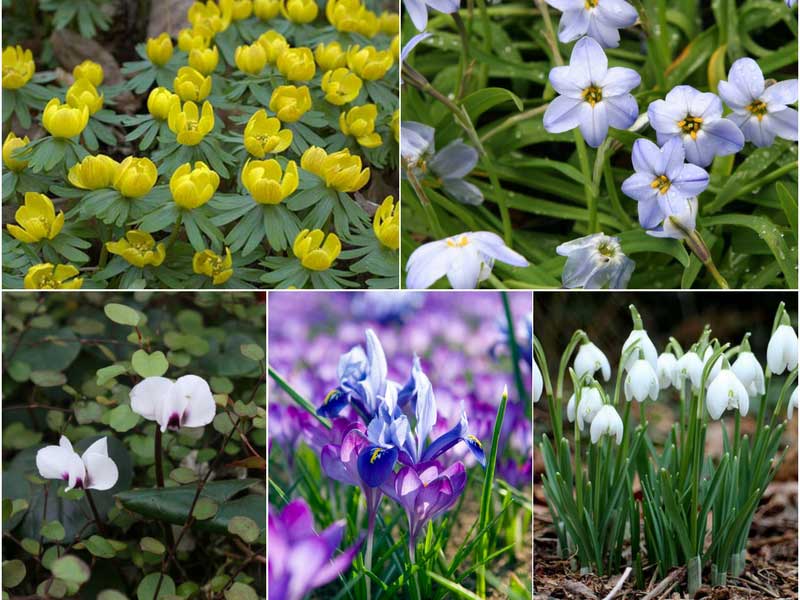 Eranthis hyemalis, Ipheion, Cyclamen coum, Iris reticulata, and Snowdrops
The winter perennials
- Hellebores are often the first perennials that come to mind for winter... and rightly so! The queen is, of course, the Christmas Rose, Helleborus niger, with its large pure white flowers, even if it is not always present for the year-end festivities. The countless and stunning hybrid hellebores that offer extraordinary colours, from white to almost black purple through all shades of pink, bloom from January or February. Original and robust, discover the Corsican Hellebore, Helleborus argutifolius, with its clusters of pale green flowers.
- Bergenias are another reliable choice for the winter garden, with their evergreen foliage often tinged with bronze or purple in cold weather, and their tight clusters of white, pink, or purple flowers. For early blooms, look for Bergenia cordifolia, which flowers as early as February.
- A dwarf shrub often classified among perennials, the Winter Heather, Erica carnea, is another ally for gardeners to enliven winter. It comes in many varieties with fine green to golden or bronze foliage, flowering white, pink, or red from December to April. It tolerates calcareous soils.
- The Pulmonarias are other perennials for late winter and early spring, combining characteristic foliage more or less punctuated or marbled with silver, and bouquets of flowers ranging from blue to pink, sometimes red. Look for the earliest, such as Pulmonaria longifolia, P. rubra, P. saccharata and their varieties.
- Pansies make valuable colourful fillers, and the current selection is such that it is hard not to find something to suit your needs for a few pots or clumps along a path or against a wall of the house.
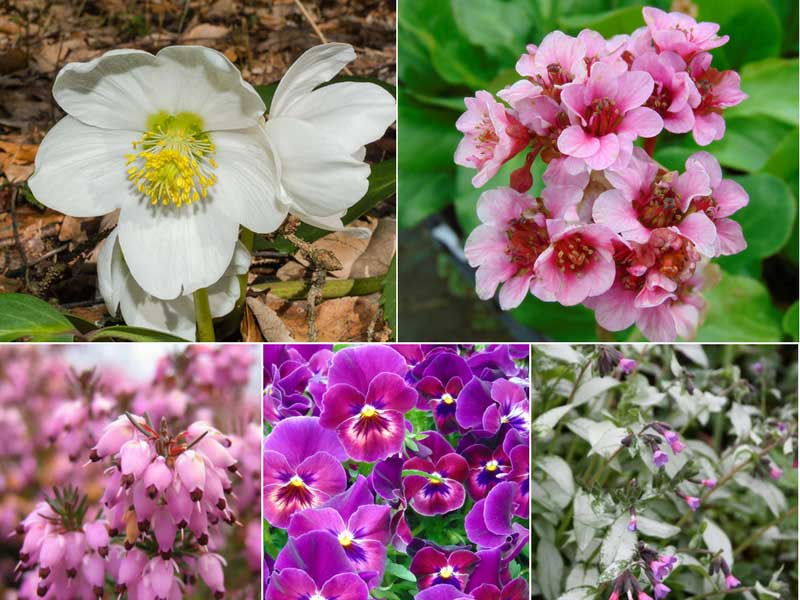 Helleborus niger, Bergenia, Erica carnea, Pansies, and Pulmonaria
Little-known shrubs, winter stars
Often, gardeners design shrub plantings for the beautiful season. It would be a shame to overlook those that bloom and bring colourful touches in the heart of winter!
- The laurel-tin, Viburnum tinus is a must-have, combining evergreen foliage and clusters of small pale pink flowers from autumn to spring.
- Another Viburnum, with deciduous foliage, Viburnum bodnantense, deserves to be planted for its clusters of small waxy pink flowers, fragrant, blooming at the slightest thaw between autumn and spring.
- The Witch Hazels are also among the winter stars, with their astonishing bright yellow to warm orange flowers on bare wood.
- Little known, the Chimonanthus (Chimonanthus praecox) also reveals itself in winter, with its cup-shaped sulphur-yellow flowers, fragrant, on bare branches.
- Very robust, with leathery and spiny foliage, the Mahonia Charity (Mahonia x media ‘Charity’) unfolds its compact clusters, bright yellow, between December and March.
- To discover, a bush honeysuckle, Lonicera fragrantissima, with clusters of very fragrant cream-white flowers throughout winter.
- With discreet white fragrant flowers, the Sarcococca also offers dark, glossy foliage.
- The Skimmias with beautiful glossy foliage are interesting in winter, either for their colourful berries on female plants, or for their dark red flower buds in winter for male forms like Skimmia japonica ‘Rubella’, blooming in spring with white flowers.
- Essential and so easy, the Winter Jasmine (Jasminum nudiflorum) is more of a climber, with light yellow flowers dotting the bare stems all winter and sometimes as early as November when the weather is mild.
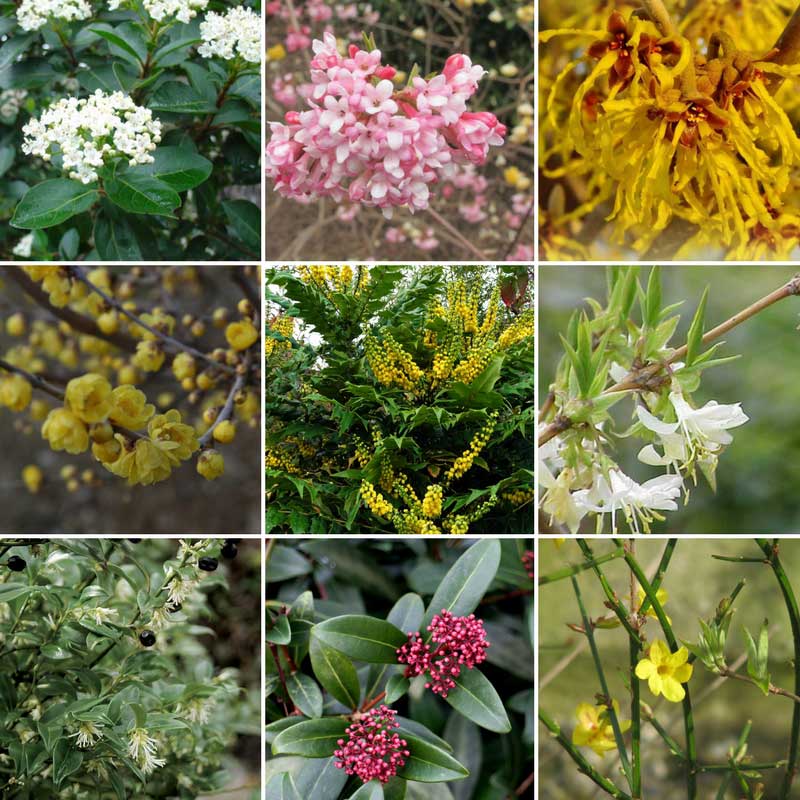 Viburnum tinus, Viburnum bodnantense, Witch Hazel, Chimonanthus praecox, Mahonia, Lonicera fragrantissima, Sarcococca, Skimmia, and Jasminum nudiflorum
Foliage, bark, graphic silhouettes... think of these too to enliven the winter garden!
To animate and structure the garden in winter, be sure to introduce evergreen foliage (box, cotoneaster, yew...), original silhouettes once bare, like that of the contorted hazel, colourful or beautifully exfoliating barks like those of certain Prunus, maples, birches.
Do not rush at the end of autumn to cut back perennials. Some clumps or dried inflorescences retain their beauty until the heart of winter, especially when highlighted by frost. This is often the case with large grasses, large sedums, and certain asters with very small flowers... there will always be time to cut them back at the end of winter!
Winter gardens are not necessarily synonymous with dry clumps, bare soil, and sad branches! Flowering is certainly much rarer than in summer, but if you create a few scenes specifically for winter, combining interesting and colourful flowers and foliage, you will appreciate them even more. Discover the scents of winter as well… Indispensable, the early […]