With spring's arrival, activity is in full swing at the nursery. For several days, many gardeners have been asking us the following question: "My seedlings are becoming leggy — why?"
What is a leggy seedling?
Leggy seedlings show rapid, upward growth of seedlings. This is also described as etiolation. This etiolation appears as abnormally long, very thin and weak stems. Rather than standing upright, they may even flop over. Root system development is reduced, as are leaves, which may show discolouration.
Why are my seedlings leggy?
Leggy seedlings are a common problem when sowing indoors under warm conditions. Main cause: insufficient light combined with excessively high temperatures. Seedlings can also become leggy if sown too densely, not spacing seeds far enough apart.
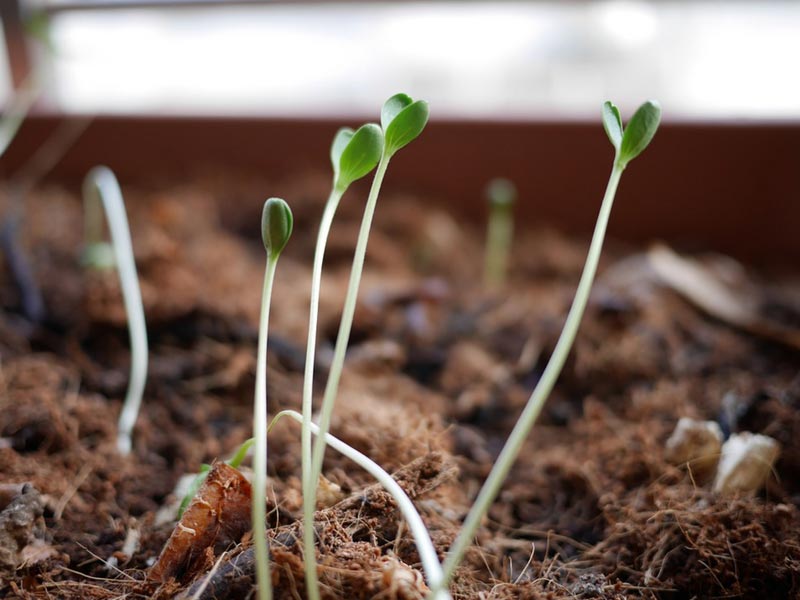
Searching for light, these young seedlings elongate their stems excessively
How to prevent this problem?
Put simply, in nature warm conditions occur in late spring or summer when days are long. If you reproduce those temperatures indoors, make sure light levels match.
To prevent seedlings becoming leggy, here are several practical solutions and tips:
- For plants that require relatively high temperatures to germinate (chillies, peppers, tomatoes), monitor germination closely. Once first leaves appear, move trays to a very bright but cooler spot (a windowsill). Also turn trays daily so all seedlings receive maximum sun.
- If that is not possible, provide supplemental horticultural lighting (available now at IKEA) to supply extra light to meet their needs.
- Don't coddle seedlings too much: do not sow indoors plants that germinate perfectly well at 10–15°C,
- space seeds well: overcrowded sowings create too much competition for light,
- If that all seems complicated, delay sowing by a few weeks. Lengthening days will provide more light and some sowings can even be done outdoors under cover.
What to do with leggy seedlings?
Most of the time, there is no miracle cure: you need to sow again because a leggy sowing rarely produces quality plants and any rescue attempts are long and tedious. For plants that are transplanted by burying part of the stem (Solanaceae), moderate etiolation is less serious because the too-long stem can be buried at transplanting. It will then develop into a well-established root system.
And you, do you have any tips to rescue a leggy seedling?
With spring’s arrival, activity is in full swing at the nursery. For several days, many gardeners have been asking us the following question: “My seedlings are becoming leggy — why?” What is a leggy seedling? Leggy seedlings show rapid, upward growth of seedlings. This is also described as etiolation. This etiolation appears as abnormally long, […]
The first morning frosts have appeared, and it's a bit of the beginning of the end in the vegetable garden, unless, like me, you have a garden greenhouse.
The term greenhouse is broad and encompasses various types of structures that offer varying levels of protection against the cold. For vegetable cultivation, the most commonly used model by market gardeners and gardeners is the tunnel greenhouse.
Although unheated, this greenhouse, known as a "cold greenhouse", is nonetheless very practical. The main advantage is that temperatures rise quickly inside. In the heart of winter, even the slightest ray of sunshine can provide a gentle warmth, conducive to vegetable development. Additionally, by blocking the wind, the greenhouse also limits the effects of the cold.
Let’s explore everything you can do in it, as well as the precautions to take when cultivating under cover.
A greenhouse in the vegetable garden: possibilities and advantages
- Significantly extend the seasons
The greenhouse, by creating a favourable microclimate and protecting vegetables from light frosts, allows for earlier and later cultivation and harvesting. The soil warms up quickly in spring, enabling seeds to germinate rapidly. Thus, in a mild climate, it is possible to sow carrots, early lettuces, radishes as early as January, and to harvest courgettes in June, as well as tomatoes, aubergines, and cucumbers until the end of October.
- Increase productivity
The warmth of the greenhouse also allows for successful cultivation of a wider range of vegetables, particularly those "of the sun" such as tomatoes, peppers, and other more exotic varieties like sweet potatoes or kiwano, which are often less productive in regions with a "hostile" climate. Planted in a warm environment that suits them perfectly, they grow better and faster, thus offering higher yields.
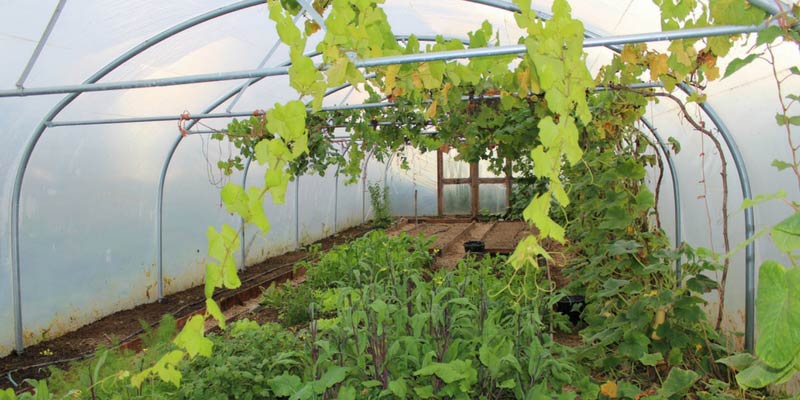 Growing under a tunnel allows for grape harvests, even in a cold climate. Photo credit: Local Food Initiative
- Protect against certain diseases
As mentioned in our advice sheet: "Tomato: downy mildew, other diseases and pests", the best protection is to cultivate them under cover. Indeed, the greenhouse, by sheltering from rain, significantly reduces the risk of cryptogamic diseases.
- Sow and propagate without clutter
Anyone who grows their vegetable plants knows: from March to May, the house is usually very cluttered with tender vegetables that cannot be planted in the garden before the Ice Saints. Although the cold greenhouse is not suitable for very early sowing, sometimes done as early as February, it still allows for storage, or even planting, as early as April, with appropriate additional protection (thick fleece, frames, or specific installations like a heated box) in anticipation of cold nights.
The greenhouse is also the ideal place to grow cuttings, such as those from blackcurrant and gooseberry bushes prepared in autumn, which will be planted in the following spring.
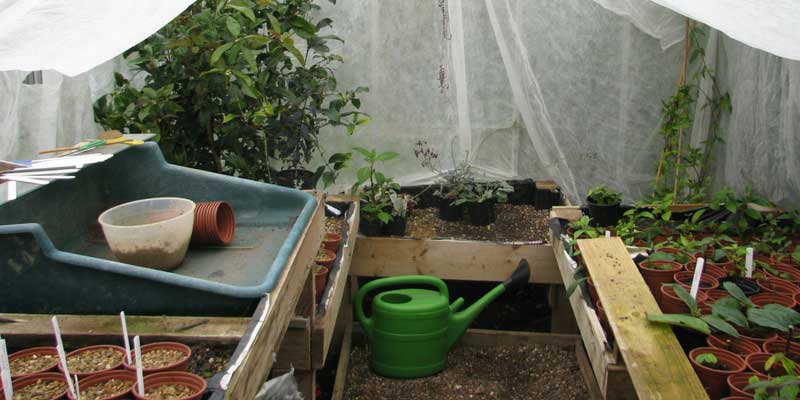 The cold greenhouse is well-suited for sowing and sheltering cuttings. To protect your plants, consider adding extra protection to prevent potential damage from a cold night.
The limitations of the cold greenhouse
- Temperature regulation
It may not be immediately obvious, but in an unheated tunnel greenhouse, it can freeze. It can also get very hot very quickly. The thermal inertia is very low, and without your intervention: temperatures can, within 24 hours, swing dramatically: dropping to -5 °C at night and rising to +40 °C during the day. This temperature range is uncomfortable for plants!
To avoid this, there is only one solution: ventilation… which is usually done by opening the doors or side openings, if the tunnel has them. Regular ventilation also helps to expel excess humidity that encourages the appearance of diseases like powdery mildew. As you can see, managing the climate of a greenhouse can sometimes be a bit tricky and requires, above all, almost constant presence!
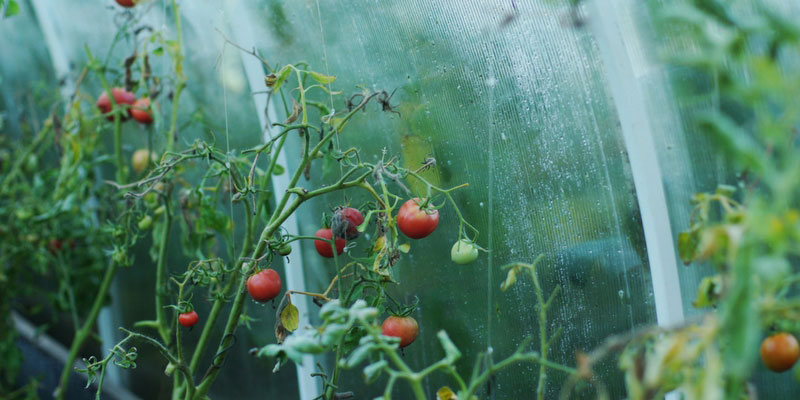 Under cover, regulating ambient humidity is important to avoid diseases.
- Watering management
In the greenhouse, don’t rely on the sky for watering (unless you opt for the "Cabriolet" model from Serres Tonneau) but on your own strong arms or, if not, your clever mind… This may seem obvious, but to cultivate in this enclosed environment, planning for water supply, storage, and possibly an autonomous watering system is crucial. That said, the issue of watering is certainly the easiest to resolve. In our case, the greenhouse is over 50 meters from the house: the collected rainwater is transferred via a small pump to a dedicated reservoir for the greenhouse. The automatic watering system is gravity-fed and does not require electricity.
- Questionable aesthetics
While glass greenhouses generally blend well into gardens, let’s be honest: the same cannot be said for tunnel greenhouses. At night, under the full moon, it may look almost pretty, but the same cannot be said during the day! Nevertheless, there are solutions to integrate it: cultivate around tall plants (Jerusalem artichokes, giant sunflowers, cardoons…) or place it at the back of the garden.
However, know that the appearance of the greenhouse is quickly forgotten when you experience the joy of cultivating and gardening under it on rainy days!
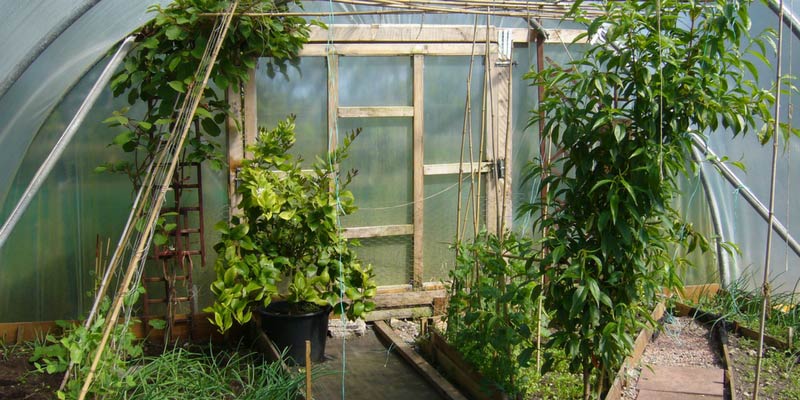 A greenhouse is also a little haven of peace where gardening, even in winter, is a pleasure! Photo credit: Caltriana Nicholson
Finally, discover a Selectos selection of the best garden greenhouses.
The first morning frosts have appeared, and it’s a bit of the beginning of the end in the vegetable garden, unless, like me, you have a garden greenhouse. The term greenhouse is broad and encompasses various types of structures that offer varying levels of protection against the cold. For vegetable cultivation, the most commonly used […]
Installing a balcony vegetable garden and growing vegetables and herbs, even in town, is perfectly possible. In previous articles, we saw that there are many solutions for urban gardening even without a garden: grow bags, and also raised beds.
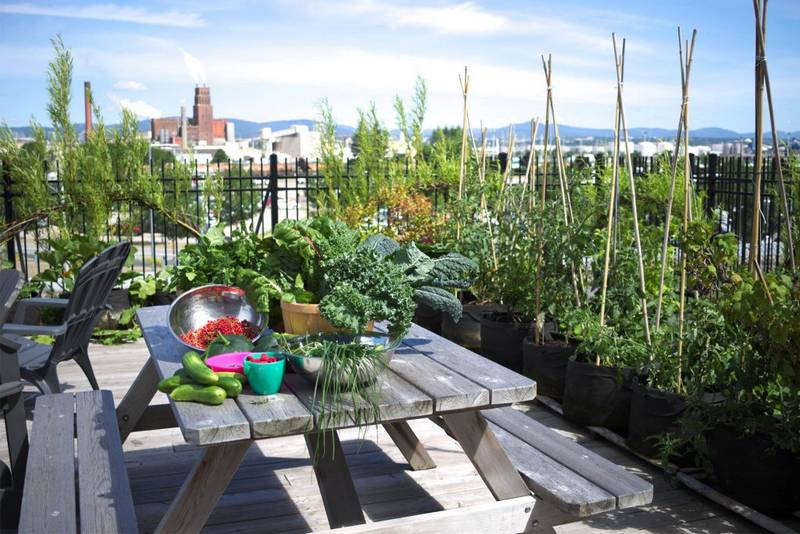
Still, you can’t make the walls any bigger! What other option is there? Choose vegetables and varieties suited to small spaces. These compact or dwarf vegetable plants are often productive. They yield full-size or small-scale vegetables, which is perfect when you don’t need to feed a large family or when you grow as much for enjoyment as for flavour!
To prevent you from restricting yourself to radishes, we have prepared on the site a wide selection of vegetables perfectly suited to small spaces and also ideal for mini vegetable gardens (including square beds); here is a sample:
1) Salads
Almost all lettuces can be grown in pots, but admit that a large heading lettuce, for example, takes up a lot of room. That’s why we recommend cut-and-come-again lettuces and mescluns. However, if you insist on harvesting neat heading lettuces, I recommend:
- Tom Thumb butterhead lettuce: a butterhead type that forms small heads about 15 cm across.
- Little Gem lettuce, the romaine cousin, produces small tender-headed lettuces with excellent flavour.
2) Tomatoes
Cherry tomato is queen of the balcony. If you have a large balcony, you can grow any variety. Otherwise, to avoid the plant taking over the space with its generosity, choose varieties that are productive but of moderate vigour. Some trailing types can even be grown in hanging pots.
- Cherry tomatoes Balconi Red and Balconi Yellow are two F1 hybrids. They produce small ruby-red and golden-yellow fruits about 3 cm in diameter. Their advantage is an ultra-compact habit, with bushy plants that only reach about 30 cm high and as wide.
- Pendulina Red and Pendulina Yellow are similar. From Sweden, they are well suited to hanging pots and will form cascades of pretty cherry fruits weighing 15–30 g, red or yellow depending on the variety.
3) Courgettes
Non-vining courgettes are also available in miniature forms and are easy to grow, such as:
- Courgette 'Patio Star' F1. Ideal for pots, it forms plants about 45 cm high and 60 cm wide and yields delicious small cylindrical dark-green fruits.
- Round 'Eight Ball' courgette stands out for its round fruits: excellent quality and harvestable once about 5 cm in diameter. This variety is repeat-bearing and produces over a long period.
4) Peppers and chillies
Still in the "sun veg" category, peppers and chillies love sunny small spaces. Among miniature varieties, you will probably fall for:
- the Mini Chocolate Bell pepper: productive, producing small red-brown fruits 3–5 cm across.
As for chillies, I invite you to discover:
- Red Cherry chilli (small) produces round fruits the size of a cherry tomato, bright red. Beware, it is very hot!
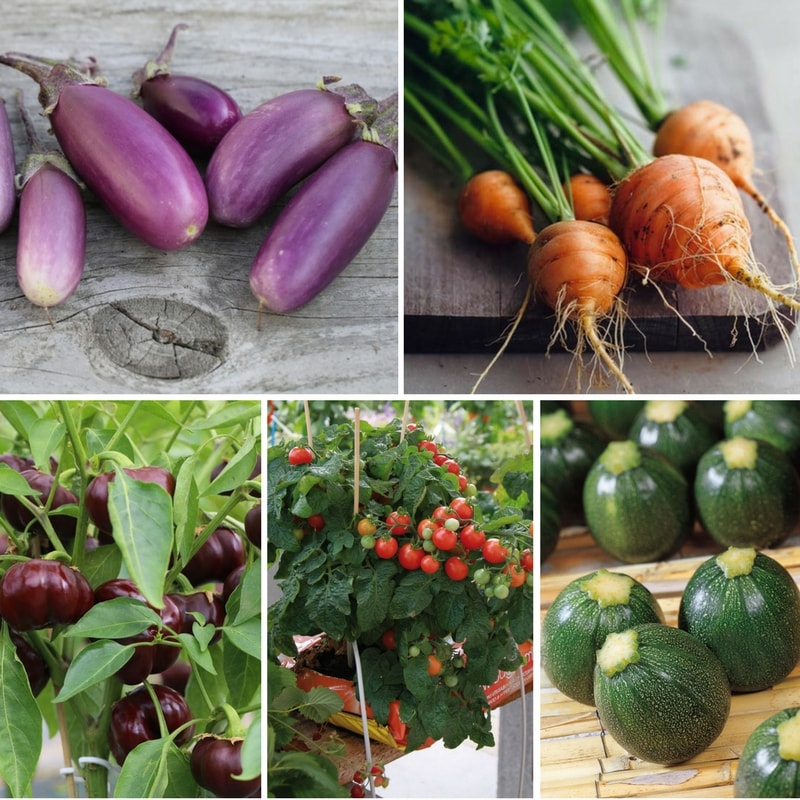
5) Aubergines
Aubergines love heat and will be perfectly happy on a balcony or terrace sheltered from draughts. Lack of space is a great opportunity to discover surprising varieties.
- 'Patio Baby' aubergine is a very early and productive variety that produces compact plants with small fruits, ideal for container growing or confined spaces. Plant in April–May for harvest from July to October.
- Pusa Purple Cluster aubergine has much to recommend it: originating from India, it is productive and forms clusters of small purple fruits on plants of normal size, very decorative and tasty.
- White Round Egg aubergine is a dwarf variety, producing pretty white, round fruits the size of an egg on plants about 30 cm high.
- If you prefer classic types, the Ophelia aubergine is perfect: the plant stays under 35 cm and its dark-purple fruits reach about the size of a golf ball.
6) Carrots
Growing carrots on a balcony is not difficult, but you must choose a container deep enough for root development. Half-long carrots (such as Carotte de Luc) are therefore well suited, but in pots or standard window boxes, peg-top varieties give the best results. I particularly recommend:
- Carrot 'Marché de Paris': an early variety with round, reddish-orange roots, tender and flavoursome. These small carrots are great glazed or as a snack.
7) Cucumbers
Cucumbers are often seen as space-hungry, but they trellis easily. In small gardens or containers, snack-type cucumbers such as 'Rocky', 'Broumana F1' or 'Iznik F1' are popular. They are just as crisp as standard types, but fruit size does not exceed 15 cm.
8) Beans, peas, broad beans
Dwarf beans and dwarf peas are not necessarily the best answer to limited space… Prefer pole varieties of beans and peas that use vertical space by climbing trellises. Plants occupy less ground area and provide abundant harvests. If you like broad beans, I especially recommend the variety Robin Hood, which yields nice short pods with green seeds on plants about 30 cm high.
The list is not exhaustive and for other vegetables, such as cabbages, leeks, sweetcorn... please consult our collection of balcony vegetables on our site.
To conclude, allow me to remind you of key success factors for growing beautiful vegetables on a balcony or terrace:
- use quality potting compost (avoid the cheapest bags that dry out very quickly)
- remember to fertilise regularly
- monitor watering, as container-grown crops are more vulnerable to dry spells.
Installing a balcony vegetable garden and growing vegetables and herbs, even in town, is perfectly possible. In previous articles, we saw that there are many solutions for urban gardening even without a garden: grow bags, and also raised beds. Still, you can’t make the walls any bigger! What other option is there? Choose vegetables and […]
Whether you are a beginner or experienced gardener, you cannot have failed to hear about the famous "Saints de Glace". When will they occur? Should you follow folk sayings and wait for them to pass before starting your vegetable garden and putting out planters? What should you fear during this period? We tell you everything!
You can also find this article in our podcast about the Saints de Glace :
What are the Saints de Glace?
The "Saints de Glace" refer to a period in May traditionally associated with the lune rousse, which occurs after Easter. In practice, it is a few rather tricky days in the garden during which late frosts can occur.
When are they? Dates of the Saints de Glace
There is no need to look for when the Saints de Glace will occur this year! They fall on the same dates every year: 11, 12 and 13 May. These three dates correspond respectively, in the old calendar, to Saint Mamert, Saint Pancrace and Saint Servais. In the cooler regions, one more companion is added: Saint Urbain, celebrated on 25 May.

Can you plant before the Saints de Glace or should you wait?
Of course, it is possible to plant all frost-resistant plants before this period: trees, shrubs and hardy perennials.
However, avoid planting frost-tender annual flowers (petunias, impatiens...) and all tender vegetables such as tomatoes, aubergines, courgettes and peppers. Another factor to take into account is, of course, the region where your garden is located. Risks of late frost are much lower in Nice than in Strasbourg, where you'll need to wait until the end of May to be completely out of the danger zone.
That said, in practice, statistically the risk of frost does not seem that high.
So, if you've been gardening in a T-shirt for 10 days and are eager to start your vegetable garden, nothing prevents you from planting a few tomato plants. Keep an eye on the weather forecast, but also on the sky because cloudless nights are conducive to frost. Make sure you have something to protect your seedlings and plants from the cold… just in case… and everything should be fine!

However, if you're the anxious, not-very-adventurous or absent-minded gardener: be patient! After all, everything in its own time… vegetables planted later, but into well-warmed soil, at the end of May or start of June will quickly catch up with those planted much earlier.
Whether you are a beginner or experienced gardener, you cannot have failed to hear about the famous “Saints de Glace”. When will they occur? Should you follow folk sayings and wait for them to pass before starting your vegetable garden and putting out planters? What should you fear during this period? We tell you everything! […]
Aubergine, pepper and chilli share a strong taste for heat. That's why their sowing is done indoors, from February if you plan to grow them under glass and in March for outdoor cultivation in the vegetable garden.
How to succeed with your sowings and obtain healthy young plants?
This is a sowing sometimes feared by beginner gardeners because seeds need heat to germinate and are somewhat susceptible to damping off. However, if you follow a few simple rules, anyone can succeed.
- Sowing in a mini‑greenhouse or propagator
The classic method is to sow seeds in trays filled with a good seed compost. Sow seeds about 2 centimetres apart then cover them with a few millimetres of sieved compost. Water very gently, using a spray bottle… as a fine mist so as not to displace the seeds. To prevent damping off, then cover with a very fine layer of powdered charcoal.
The optimal germination temperature for these three vegetables is between 20 and 25 °C. Unless you live in an overheated flat, you will need to find the ideal spot. For these sowings, heated propagators (Garland, for example) are very handy but you can also use the top of or a place near a radiator. Personally, I put the trays on top of our masonry stove until germination.
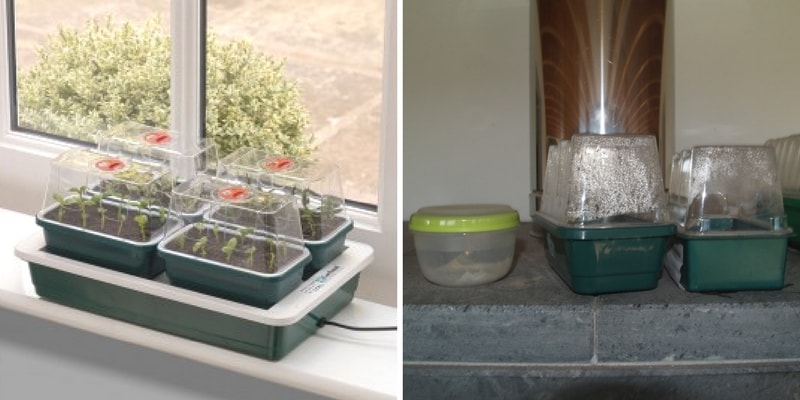
Place sowing in warmth: in a propagator (Photo: Garland) or, as with me, on top of a soapstone stove
With chillies, be careful when handling the seeds and wash your hands thoroughly afterwards: contact with the eyes may cause painful irritation.
- The "Scottex" method, have you heard of it?
There has been quite a lot of talk in recent years about the "Scottex" method… which gets its name not from some obscure botanist but from a brand of kitchen roll! This sowing technique is a little like germination tests. It involves placing the seeds on a piece of absorbent paper, previously moistened (with hot water, if you like), and enclosing them in a glass jar or a plastic tray. The advantage of this method lies in the speed of germination: the time spent at heat is therefore shorter. Having tried the method one year, I found it effective but… you mustn't have sausage fingers when it comes to'placing germinated seeds into pots: the operation requires precision and a gentle touch!
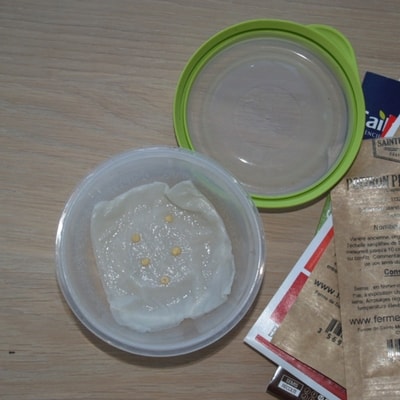
The "Scottex" method
From potting on to planting out in the vegetable garden: precautions to take
Once young plants are well developed (at least two true leaves but don't wait too long), you can prick them out into pots. They still need warmth (normal room temperature is sufficient) but also light, otherwise they will become leggy. Place them on the windowsill and wait… at least until after the last frosts (usually after 15 May) before planting out in the garden. Initially, if you live in a rather cool area, provide light protection against night‑time cold.
Which varieties to choose?
There are many varieties of chillies, peppers and aubergines… For chillies, choosing them according to their heat level will save you from growing something your palate couldn't handle. And for aubergines, if your climate isn't ideal for growing them, opt for sturdy F1s such as 'Bonica' (as seeds or as grafted plants), early and easy to succeed with.
For my part, here is my small selection for this year :
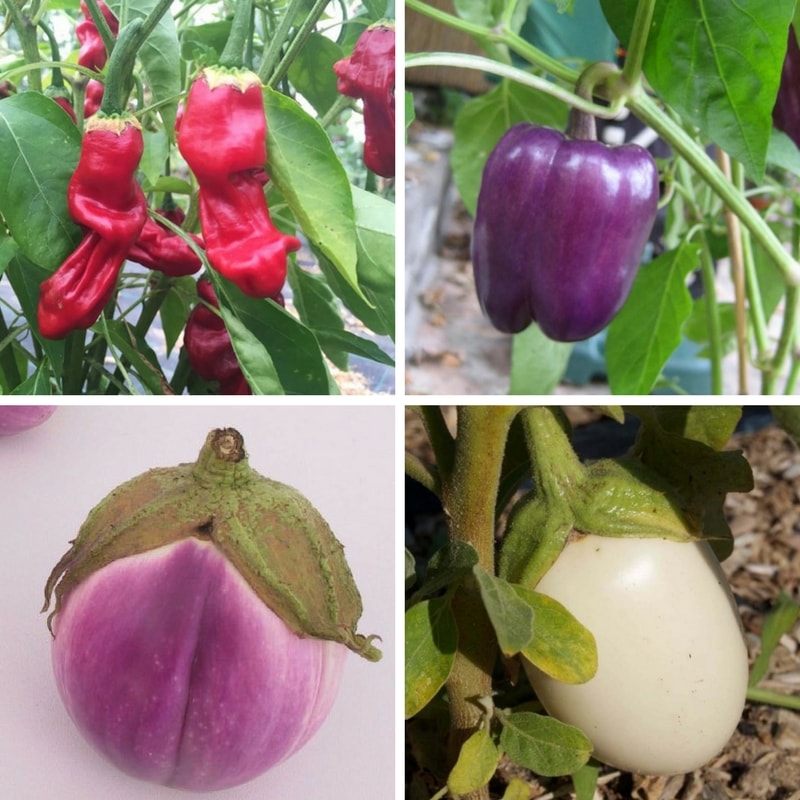
- The chilli 'Penis', a new arrival in our collection… which I must test, if only to see my neighbours' faces (and a little that of my mother‑in‑law... the gardener is mischievous)!
- The pepper 'Purple Bell', very unusual, which will complement my 'Californian Wonder'
- The aubergine 'Rotonda Bianca Sfumata di Rosa' and the aubergine 'Ronde à œuf', alongside the traditional 'de Barbentane'.
And you, have you started sowing for the vegetable garden? Any tips to share?
Aubergine, pepper and chilli share a strong taste for heat. That’s why their sowing is done indoors, from February if you plan to grow them under glass and in March for outdoor cultivation in the vegetable garden. How to succeed with your sowings and obtain healthy young plants? This is a sowing sometimes feared by […]
Here, under Brittany’s mild climate, March is marked by ubiquity: it has to be everywhere at once—in the vegetable garden for early sowings of late-spring vegetables, but also, warm indoors, to prepare the summer harvest.
So, let’s be honest, we’re rushing around… but it’s a joyful bustle as it heralds the return of spring. The programme is simple and revolves around two 'culinary themes': the Jardinère of small vegetables and Ratatouille.
1) Under cover (unheated): the spring vegetable jardinière
Our shelter, a tunnel greenhouse, is a real luxury. Originally devoted to tomatoes and other frost-prone vegetables, it now serves all year round, especially for early sowings. It can, in your garden, be replaced with equal effectiveness by: a well-sited frame, a mini-market-garden tunnel (to be erected on hoops or moulded plastic) or, even more simply, by a forcing fleece.
To obtain early harvests, I sow there from the end of February and directly in the soil:
- the smooth-shelled peas (one row of ‘Très hâtif d’Annonay’ and one row of ‘Petit Provençal’),
- the spring turnips ('Rave d’Auvergne hâtif' and ‘de Milan Rouge Extra Hâtif’),
- the early carrots ('Marché de Paris' is early and ideal in our heavy soil),
- the first radishes ('Fluo F1' for the half-long types and ‘Gaudry 2’ for the round ones).
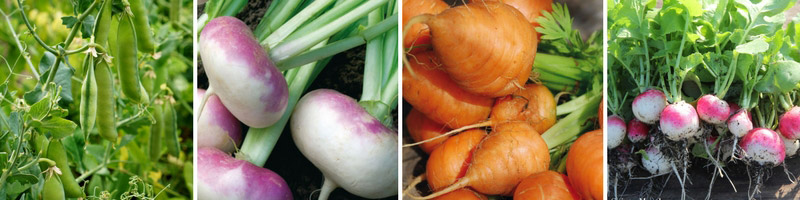
Peas, Turnip 'Rave d'Auvergne hâtif', Carrot 'Marché de Paris' and Radish 'Gaudry'
After seeing whole rows of young seedlings disappear, I resolved to start my lettuces ('Gotte Jaune d’Or', 'Batavia sanguine' and 'Reine de mai') in pots. They will grow under the greenhouse and will be planted three weeks later, once less vulnerable to slug damage.
2) Warm indoors: ratatouille… but also the flowers!
Early March, chillies and peppers get the season underway, as they develop fairly slowly. Then comes the turn of tomatoes and aubergines, and, at the very end of the month, of aromatic herbs that enjoy warmth such as basil and oregano. To these sowings, two or three courgette plants ('Précoce maraîchère') are added, which I sow a little early to enjoy a harvest at the start of summer.
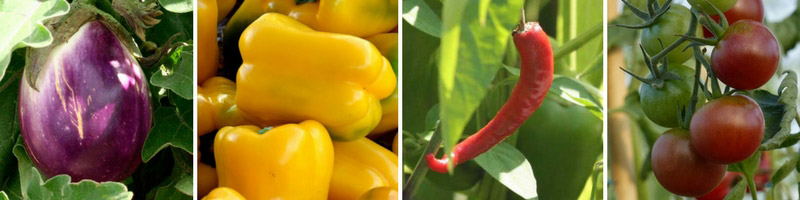
Aubergine 'Violetta di Firenza', Yellow pepper, Cayenne pepper and Tomato Black Cherry
And because I cannot imagine a kitchen garden without flowers, I take the opportunity to grow, still indoors, annual flowers: the marigolds that will accompany the tomatoes, but also the zinnias, which I pair with French beans, cosmos and annual Rudbeckias whose rustic charm delights me every year… not forgetting nasturtiums (very useful for distracting aphids), because even though they now reseed themselves, I never tire of discovering new varieties.

Zinnias, Cosmos, Marigolds and Nasturtiums: essential annual flowers for the vegetable garden
This list isn’t exhaustive; we invite you to add to it in the comments... and please don’t hesitate to ask us any questions, we’ll be very happy to reply.
Here, under Brittany’s mild climate, March is marked by ubiquity: it has to be everywhere at once—in the vegetable garden for early sowings of late-spring vegetables, but also, warm indoors, to prepare the summer harvest. So, let’s be honest, we’re rushing around… but it’s a joyful bustle as it heralds the return of spring. The […]