The first morning frosts have appeared, and it's a bit of the beginning of the end in the vegetable garden, unless, like me, you have a garden greenhouse.
The term greenhouse is broad and encompasses various types of structures that offer varying levels of protection against the cold. For vegetable cultivation, the most commonly used model by market gardeners and gardeners is the tunnel greenhouse.
Although unheated, this greenhouse, known as a "cold greenhouse", is nonetheless very practical. The main advantage is that temperatures rise quickly inside. In the heart of winter, even the slightest ray of sunshine can provide a gentle warmth, conducive to vegetable development. Additionally, by blocking the wind, the greenhouse also limits the effects of the cold.
Let’s explore everything you can do in it, as well as the precautions to take when cultivating under cover.
A greenhouse in the vegetable garden: possibilities and advantages
- Significantly extend the seasons
The greenhouse, by creating a favourable microclimate and protecting vegetables from light frosts, allows for earlier and later cultivation and harvesting. The soil warms up quickly in spring, enabling seeds to germinate rapidly. Thus, in a mild climate, it is possible to sow carrots, early lettuces, radishes as early as January, and to harvest courgettes in June, as well as tomatoes, aubergines, and cucumbers until the end of October.
- Increase productivity
The warmth of the greenhouse also allows for successful cultivation of a wider range of vegetables, particularly those "of the sun" such as tomatoes, peppers, and other more exotic varieties like sweet potatoes or kiwano, which are often less productive in regions with a "hostile" climate. Planted in a warm environment that suits them perfectly, they grow better and faster, thus offering higher yields.
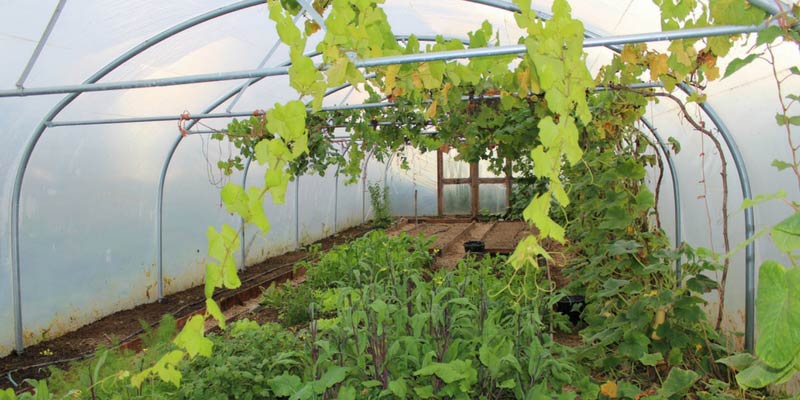 Growing under a tunnel allows for grape harvests, even in a cold climate. Photo credit: Local Food Initiative
- Protect against certain diseases
As mentioned in our advice sheet: "Tomato: downy mildew, other diseases and pests", the best protection is to cultivate them under cover. Indeed, the greenhouse, by sheltering from rain, significantly reduces the risk of cryptogamic diseases.
- Sow and propagate without clutter
Anyone who grows their vegetable plants knows: from March to May, the house is usually very cluttered with tender vegetables that cannot be planted in the garden before the Ice Saints. Although the cold greenhouse is not suitable for very early sowing, sometimes done as early as February, it still allows for storage, or even planting, as early as April, with appropriate additional protection (thick fleece, frames, or specific installations like a heated box) in anticipation of cold nights.
The greenhouse is also the ideal place to grow cuttings, such as those from blackcurrant and gooseberry bushes prepared in autumn, which will be planted in the following spring.
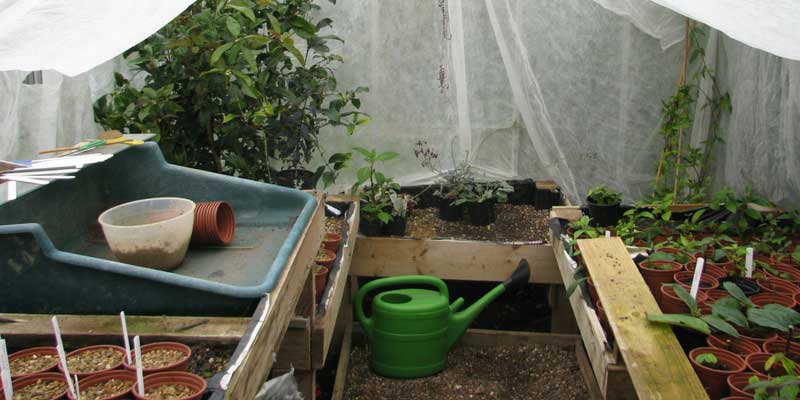 The cold greenhouse is well-suited for sowing and sheltering cuttings. To protect your plants, consider adding extra protection to prevent potential damage from a cold night.
The limitations of the cold greenhouse
- Temperature regulation
It may not be immediately obvious, but in an unheated tunnel greenhouse, it can freeze. It can also get very hot very quickly. The thermal inertia is very low, and without your intervention: temperatures can, within 24 hours, swing dramatically: dropping to -5 °C at night and rising to +40 °C during the day. This temperature range is uncomfortable for plants!
To avoid this, there is only one solution: ventilation… which is usually done by opening the doors or side openings, if the tunnel has them. Regular ventilation also helps to expel excess humidity that encourages the appearance of diseases like powdery mildew. As you can see, managing the climate of a greenhouse can sometimes be a bit tricky and requires, above all, almost constant presence!
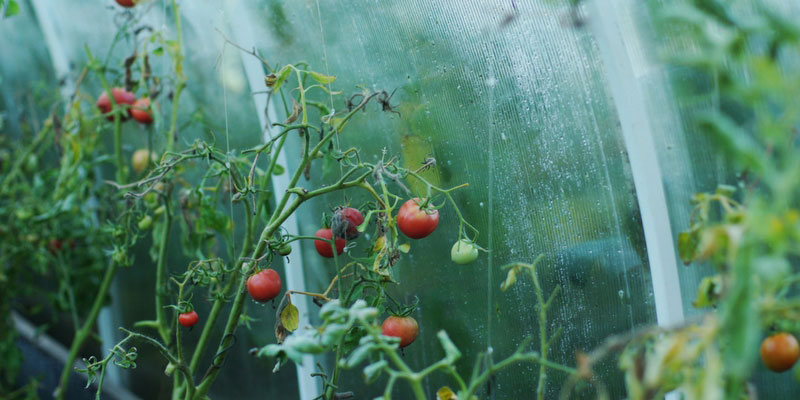 Under cover, regulating ambient humidity is important to avoid diseases.
- Watering management
In the greenhouse, don’t rely on the sky for watering (unless you opt for the "Cabriolet" model from Serres Tonneau) but on your own strong arms or, if not, your clever mind… This may seem obvious, but to cultivate in this enclosed environment, planning for water supply, storage, and possibly an autonomous watering system is crucial. That said, the issue of watering is certainly the easiest to resolve. In our case, the greenhouse is over 50 meters from the house: the collected rainwater is transferred via a small pump to a dedicated reservoir for the greenhouse. The automatic watering system is gravity-fed and does not require electricity.
- Questionable aesthetics
While glass greenhouses generally blend well into gardens, let’s be honest: the same cannot be said for tunnel greenhouses. At night, under the full moon, it may look almost pretty, but the same cannot be said during the day! Nevertheless, there are solutions to integrate it: cultivate around tall plants (Jerusalem artichokes, giant sunflowers, cardoons…) or place it at the back of the garden.
However, know that the appearance of the greenhouse is quickly forgotten when you experience the joy of cultivating and gardening under it on rainy days!
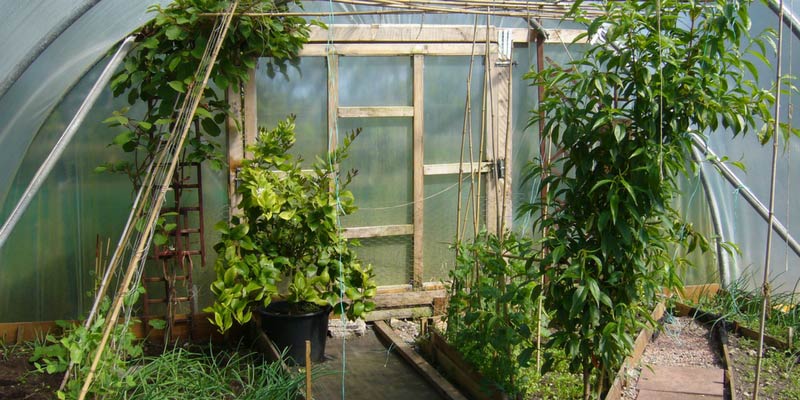 A greenhouse is also a little haven of peace where gardening, even in winter, is a pleasure! Photo credit: Caltriana Nicholson
Finally, discover a Selectos selection of the best garden greenhouses.
The first morning frosts have appeared, and it’s a bit of the beginning of the end in the vegetable garden, unless, like me, you have a garden greenhouse. The term greenhouse is broad and encompasses various types of structures that offer varying levels of protection against the cold. For vegetable cultivation, the most commonly used […]
Have you heard of the cucamelon? I hadn't either… well, until I came across it among the new additions to our wide range of vegetable seeds.
Cucamelon: what is it?
The cucamelon (Melothria scabra) is a climbing plant belonging to the cucurbit family. Also known as the pickling cucumber or "Mouse Melon" in North America. It originates from Central America and Mexico, where it is grown as a perennial plant.
Curious by nature, I sowed my first cucamelon at the end of March to plant out in June. After a rather disastrous start (heatwave + forgotten watering rarely produce good results), it soon recovered and lived up to its reputation as an easy-to-grow plant.
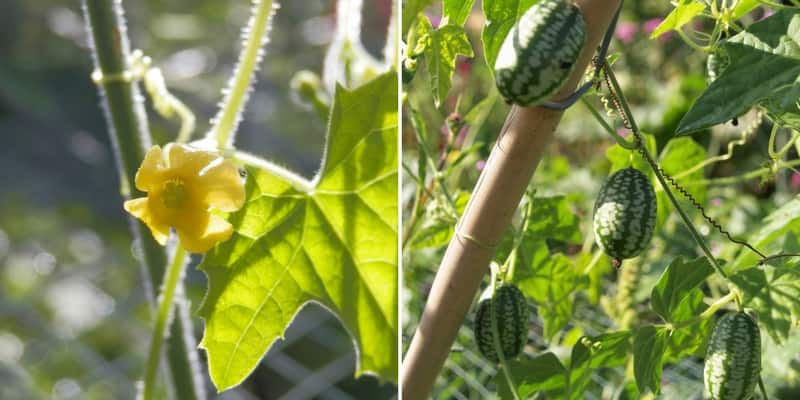
Cucamelon: tiny flower followed by an adorable little fruit
Quickly, its thin, tendril-bearing stems grabbed the wire mesh to form a pretty tangle of lobed leaves. Thanks to a relatively rainy summer, my cucamelon plant developed without any care (nor any sign of powdery mildew!) and is giving me a very respectable harvest this late summer!
In terms of flavour, it was a pleasant surprise: this adorable mini-watermelon has, as promised, a cucumber taste with a slight tang that is far from unpleasant. It is eaten with the skin on, which adds an equally pleasing crunch.
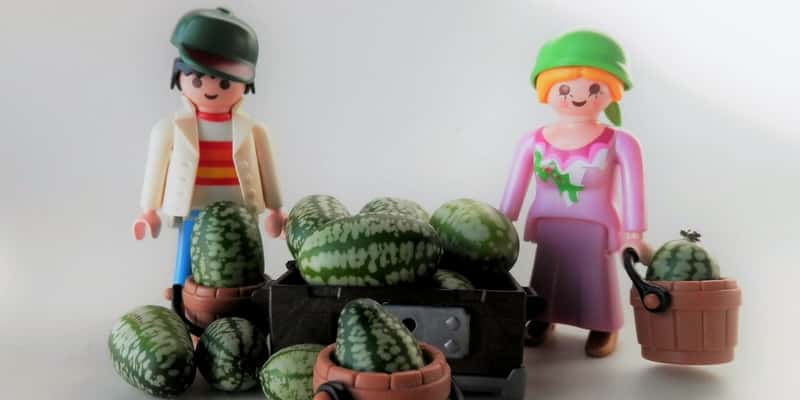
... needless to say, cucamelon is a vegetable children love!
What can you do with cucamelons?
Don't be mistaken, cucamelons are not only there to feed an army of hungry Playmobil figures... They can be eaten and prepared in various ways.
Quite simply, cucamelons are best eaten raw with a pinch of salt, as an aperitif. They can also be used to garnish cocktails such as mojitos: your lemon slice will feel less lonely! A few cucamelons added to a salad of cherry tomatoes or served with radishes also make a lovely addition… Finally, they will delight pickle lovers as they keep very well pickled in vinegar, like gherkins.
For a large jar of 500 g of pickled cucamelons, here is my recipe:
- pick cucamelons just before full maturity (neither too thin nor too plump),
- wash them thoroughly,
- prepare white vinegar (400 ml) by adding 1 teaspoon of salt, 4 tablespoons of cane sugar, 1 tablespoon of mint leaves, 1 tablespoon of dill leaves (washed and chopped beforehand), coriander seeds,
- put the cucamelons in the jar, pour in the vinegar and close the lid,
- store in the fridge for one month then enjoy!
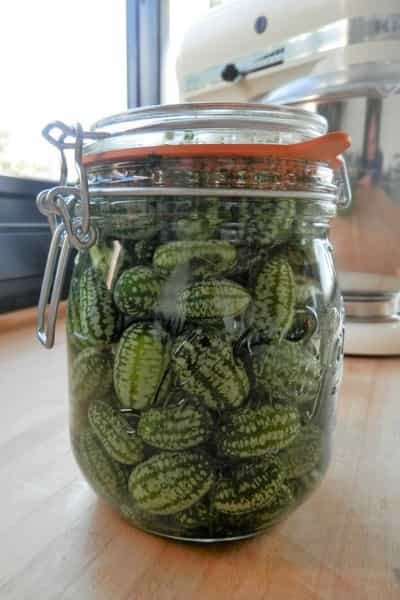
Storing cucamelons: quick and easy!
And you, have you ever grown cucamelons? How do you prepare them?
Have you heard of the cucamelon? I hadn’t either… well, until I came across it among the new additions to our wide range of vegetable seeds. Cucamelon: what is it? The cucamelon (Melothria scabra) is a climbing plant belonging to the cucurbit family. Also known as the pickling cucumber or “Mouse Melon” in North America. […]