Planting trees to combat climate change may seem like a very simple solution. Fortunately, it is!
At a time when more trees are being cut down than planted, every tree you can plant in your garden will prove beneficial in various ways.
One of the causes of climate change is the excessive release of carbon dioxide (CO2), so the most obvious solution that comes to mind is to plant trees, as they absorb this CO2.
Why planting trees?
Plants in general, but trees in particular, have an incredible capacity to absorb CO2. This is simply a result of photosynthesis. The tree absorbs CO2 from the air and transforms it into carbon and oxygen. The oxygen is released into the air for our benefit, while the carbon is stored and gradually released. Forests thus represent the second largest carbon sink after the oceans.
But that's not all; trees are also useful for:
- regulating temperature and humidity: they are true living air conditioners;
- filtering wind and dust, thereby improving air quality;
- fixing certain pollutants such as pesticides or heavy metals;
- improving soil by adding biomass (wood, leaves...) and combating erosion.
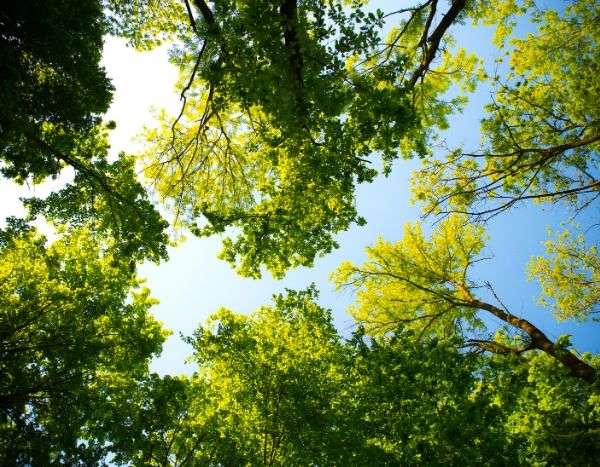
Which trees to plant to combat climate change?
1) Native trees first
There are two huge advantages to planting native species:
- they are perfectly adapted to the climate and soil
- they nourish and provide shelter for local wildlife
The list of native trees is long, but here are a few examples:
- For the North: Field Maple, Glutinous Alder, Downy Birch, Common Hornbeam, Male Dogwood, Common Ash, Holly, Trembling Aspen, Field Elm...
- For the South: Strawberry Tree, Montpellier Maple, Corsican Alder, Chestnut, Olive, Holm Oak...
- For the mountains: Hop Hornbeam, Mountain Elm, Mountain Pine...
- For the Coast: Tamarisk, Sea Buckthorn, Bohemian Olive, Maritime Pine, Field Maple...
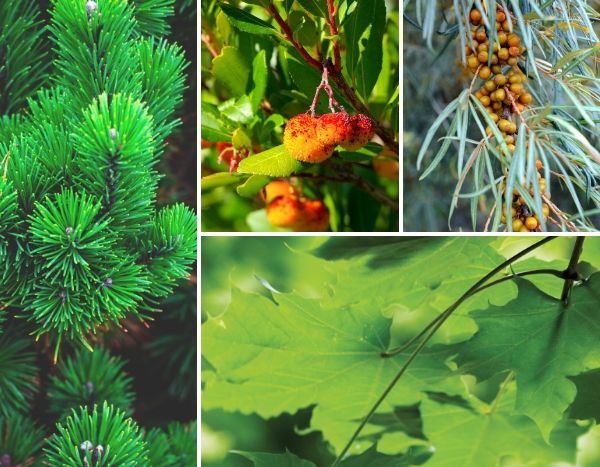
2) Natives, but not only...
Some natives are suffering from climate change while others, more exotic or southern species, seem to be making their way north. For instance, Pines, across all species, are suffering from repeated attacks by Pine Processionary caterpillars. Meanwhile, Common Beech, spruces, and even Pectinate Fir can no longer withstand our hot and dry summers. All these trees have also become less resistant to diseases.
On the other hand, some trees are seeing their original range shift. This is not surprising: it has always been the case! Plants grow where they thrive best. This is why we have issues with certain invasive exotic plants that turn out to be more suited than natives in some natural environments. Or the fact that oak forests are regaining ground over beech forests as they did... only two thousand years ago.
Some examples of trees that have adapted to climate change
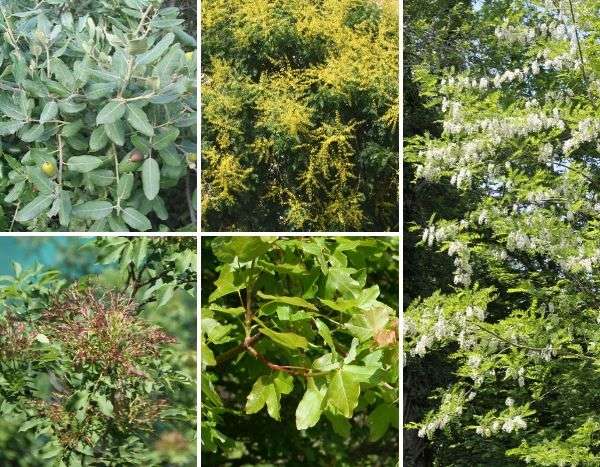
- Holm Oak - Quercus ilex: once confined to the Mediterranean climate, it is now moving further north. It now thrives along the Atlantic coast up to Brittany and will continue its progression towards the centre.
- Turkey Oak - Quercus cerris: previously only found in the southeast of the country, it is now moving categorically north, even reaching Belgium...
- Pubescent Oak - Quercus pubescens: a species particularly adapted to drought that has been thriving in recent years.
- Montpellier Maple - Acer monspessulanum: often found in nature alongside Holm Oak, it is following the same trend, progressing up to Vendée.
- Flowering Ash - Fraxinus ornus: a cousin of Common Ash but significantly less sensitive to ash dieback, it is gradually moving away from its native Corsica and Maritime Alps to further north.
- Pride of India - Koelreuteria paniculata: native to China and Korea, this tree proves to be perfectly resistant to drought and urban pollution.
- Maritime Pine - Pinus pinaster: originally found around the Mediterranean and along the coast, it continues its spread westward and northward.
- Black Locust - Robinia pseudoacacia: this exotic tree is gradually becoming the "king of the forest". It withstands heat, drought, and flooding and is adapted to poor soils as it has the ability to fix nitrogen. It is thus gradually taking the place of other tree species.
For your information: the National Forestry Office is currently conducting trials of Bornmuller Fir (Abies bornmuelleriana) in forests, a species more suited to drought than Pectinate Fir. Meanwhile, in Belgium, trials are being conducted in forests with Turkey and Pubescent Oaks and even... Corsican Pines.
General characteristics of trees resistant to climate change
Trees that exhibit natural resistance to drought and high summer temperatures often share common characteristics:
- Small and numerous leaves: the larger the leaf, the more water evaporates. Small leaves are thus a result of adaptation to drought;
- Waxy and/or fuzzy foliage: if the leaf is thick or equipped with small hairs, it will retain water more effectively;
- Next, it is important to check the tree's region of origin: if it originates from the Scandinavian taiga, it is likely to suffer in summer... Conversely, mediterranean and central European species will be particularly well-suited.
In conclusion
Due to the accelerating climate changes in recent decades, we will need to reassess our approach regarding native species adapted to regions. Some, whose survival requires moisture and distinct seasons, will disappear in favour of less water-demanding species that do not require harsh winters. In any case, planting trees will be beneficial as long as we choose species that can thrive optimally with minimal care. So in conclusion: let’s plant trees!
To learn more
Some researchers express doubts about the effectiveness of tree planting to combat climate change. In reality, it is mainly the notion that CO2 is the sole culprit of climate change that they question, as well as the belief that we will (according to them) need even more agricultural land to feed the population. The ideal would also be to stop deforestation rather than just replanting a few trees here and there. If you wish to learn more and form your own opinion on the matter, read this article (in French): Forests: a solution to the climate crisis?
And if you haven't seen it yet, here are the main results of our survey on climate change and gardening.
Planting trees to combat climate change may seem like a very simple solution. Fortunately, it is! At a time when more trees are being cut down than planted, every tree you can plant in your garden will prove beneficial in various ways. One of the causes of climate change is the excessive release of carbon […]
Every autumn, many trees and shrubs reveal their finest colours, offering a true spectacle: the leaves take on scarlet, coppery or golden hues before falling... Although it amazes us, this phenomenon is the result of a real strategy implemented by plants to protect themselves in winter. They go into dormancy, marking a necessary pause that allows them to resume growth in spring. We invite you here to discover this mechanism that explains the flamboyant colours of autumn!
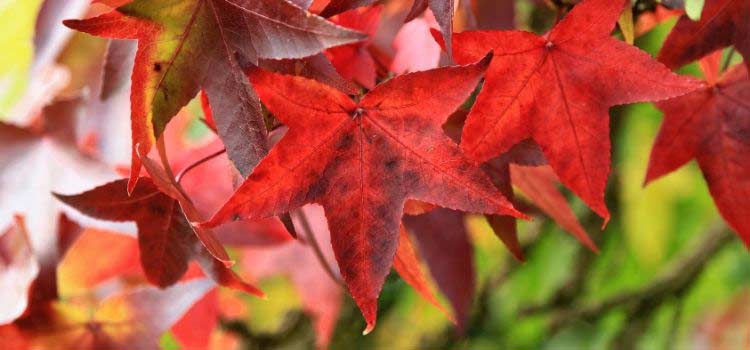
Liquidambar styraciflua is one of the finest trees for autumn foliage! (photo: Frank Vincentz)
Where does the green color of the leaves come from?
The leaf helps the tree capture sunlight. In spring and summer, the leaves are green because they contain chlorophyll. This is a pigment that allows the plant to capture light energy, and to use it to synthesise organic molecules from water (taken up from the soil) and CO2 (taken up from the atmosphere). Thanks to chlorophyll, leaves absorb, from light, blue and red wavelengths, but not green ones... The green colour is therefore reflected by the leaf, which is why we perceive it. Other pigments are present in the leaf, but they are masked by chlorophyll.
Why does the colour change in autumn?
When the length of the day decreases, the tree seeks to go into dormancy and conserve its energy. It will therefore block the sap supply to the leaves, producing at their base a small cork plug. Thus, the leaves no longer receive water and minerals, chlorophyll pigments are no longer renewed and eventually disappear... As they were responsible for the green colour of leaves, these then change colour. However, the other pigments present in the leaves remain – xanthophylls (yellow) and carotin (orange) – with the disappearance of chlorophyll, they become apparent, which gives the leaves superb orange tones!
The red colours, on the other hand, are due to new pigments that are synthesised in autumn, from the sugars present in the leaf: anthocyanins (responsible for deep red, violet and purple colours). At the same time they help protect the leaves from solar radiation, and at the same time prevent insects and other animals from attacking the plant: the red colour repels them, as in nature this hue signals toxicity.
In autumn, not all trees take on the same colour, but several factors cause the colour of the foliage to vary: soil pH, moisture and drought, genetics (the colour varies depending on species and varieties), the age of the plant... Each colour depends on the specific proportions of each pigment, and on how they are expressed!
In North America and Asia, red colours (due to anthocyanins) are particularly marked, while in Europe autumn leaves are more often yellow or orange.
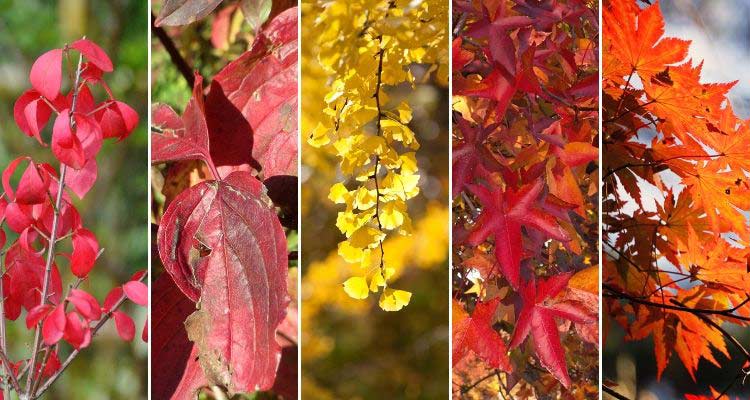
Winged euonymus (photo: Jean Jones), bloodtwig dogwood, Ginkgo biloba, American sweetgum and Japanese maple
Leaves eventually fall...
As they are no longer fed with sap, the leaves dry out, turn brown and eventually fall. This is a way for the tree to save its energy and go into dormancy, awaiting milder temperatures. Its metabolism slows, conserving its water and mineral elements. Leaves are thin and tender tissues; in cold weather they would be prone to freezing and dropping... so there is no point for the tree to try to keep them! Evergreen plants, on the other hand, generally have thicker, tougher leaves able to withstand cold temperatures. They continue to photosynthesise in winter, but even for them the metabolism slows.
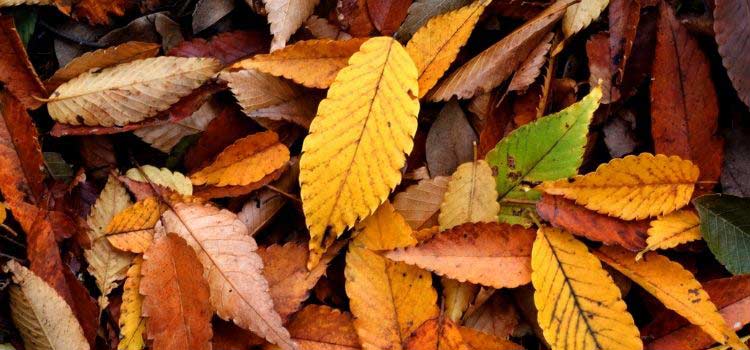
When they fall, the leaves of deciduous trees bring organic matter to the soil. They protect the soil, support insects and microorganisms, and as they decompose, they enrich and improve the soil texture, aiding humus formation. While the ground is covered with a coloured carpet, the falling leaves allow us to admire the tree's entire architecture! This highlights the colour and texture of its bark, branches and branching.
In spring, with longer days, the roots will again draw water and minerals from the soil, which will then circulate in the tree's sap. This “sap rise” will enable bud burst and the appearance of new leaves... allowing photosynthesis through to the next autumn!
Every autumn, many trees and shrubs reveal their finest colours, offering a true spectacle: the leaves take on scarlet, coppery or golden hues before falling… Although it amazes us, this phenomenon is the result of a real strategy implemented by plants to protect themselves in winter. They go into dormancy, marking a necessary pause that […]
Now more than ever in winter, the need for light and colour is felt. To ensure a colourful display in the heart of the dreary season, decoratively-wooded trees and bushes are a top-notch solution to combat winter melancholy. They offer an endless range of interesting colours and textures: coral red, fluorescent orange, milky white are all beneficial colours to incorporate into gardens in the heart of winter. Some species boast smooth or sometimes cracked bark, while others peel in parchment-like strips, creating an irresistible urge to pull at the small piece of bark that reveals lovely bright colours.
If, like me, you are sensitive to the lack of light in winter and are looking for any means to bring colour to your garden during this season, then read this top 5 of the best decoratively-wooded bushes and adopt these essential species that are a must-have in a winter garden.
1 - Betula utilis jacquemontii (Himalayan Birch)
This is the classic of winter gardens to the point that one wonders if decoratively-wooded is synonymous with birch. But do not confuse it with the warty birch (Betula pendula), which is also a common and widely planted species but whose bark is significantly less striking than that of the Himalayan birch.
Long planted in gardens and then neglected, the Himalayan birch has made a comeback in contemporary gardens over the past decade, and rightly so. First of all, its white bark is the only one that illuminates the back of flower beds with such intensity. Next, its light branches provide a gentle shade in gardens, allowing for easy planting of small bushes or perennials at its base. Finally, whether planted alone or in a cluster of three in the back of a flower bed, it offers a very interesting focal point. Landscape architects are not mistaken, and they increasingly use it in contrast with rounded forms (boxwood, trimmed bush honeysuckle) or integrate it into naturalistic flower beds to enhance an atmosphere with unreal and dreamlike accents.
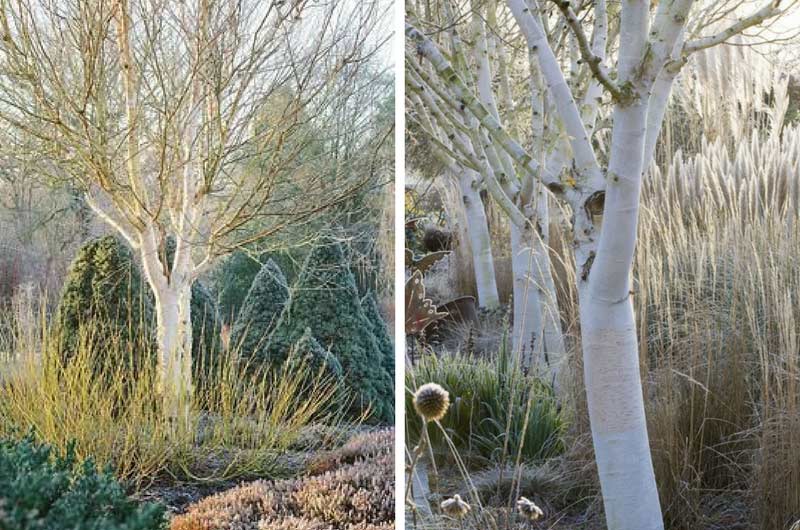 On the right, placed in front of a screen of dark-leaved conifers, the immaculate wood of the Himalayan birch contrasts beautifully. On the left, in a wilder context, the silver spikes of large grasses (Miscanthus and Cortaderia) enhance the striking colour of the bark. (Source Pinterest)
What you should know additionally : Adopt this birch without moderation in your gardens but please, do not top it as some do in winter to drastically reduce its height; it distorts its silhouette and makes it ugly! Instead, opt for coppiced forms at planting, which offer a wider habit but whose branching grows less high than a single specimen that can shoot up.
2- Acer davidii ‘Viper’ (Snake Bark Maple)
The large family of maples includes some species whose ornamental wood is a pure marvel in winter, and this is the case with snake bark maples. Several species are listed under this name, including Acer capillipes, A. pennsylvanicum, A. rufinerve, A. tegmentosum, and numerous hybrids derived from these species.
But of all the snake bark maples, Acer davidii ‘Viper’ remains my favourite! Its bicoloured green-orange wood striped with white is particularly precious in winter. And it is when the foliage has fallen and the light is low that we best appreciate its graphically striped and luminous wood. Lacking bark, this maple is coated with a whitish wax that accumulates on the wood to protect it from the external environment (sunburn, fungi) and becomes intensely luminous when temperatures drop.
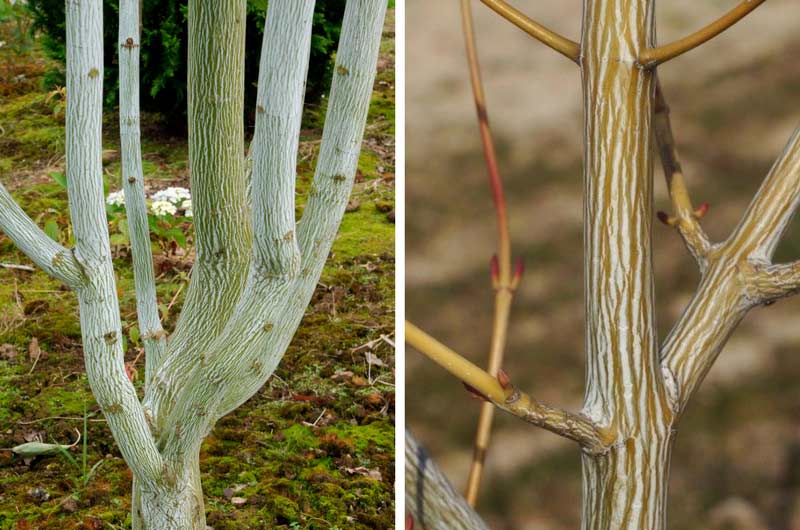 The striped and mottled bark of Acer davidii ‘Viper’ takes on an orange hue with the first frosts. (Source Hortival Diffusion)
What you should know additionally : Beyond its ornamental qualities, it is also for its cultural qualities that it remains my favourite. Unlike hybrids and some other species, Acer davidii is easier to cultivate than other “snake bark”, it does not require an acidic soil and even tolerates a bit of lime. But where it is interesting is that it tolerates heavy and cool soils well and is less susceptible to verticillium wilt than other species, tempting, isn’t it?
3- Cornus sanguinea ‘Winter Beauty’ (Decorative Wood Dogwood)
It is impossible to talk about decorative wood without mentioning dogwoods. I am referring to Cornus alba, sericea, sanguinea, and stolonifera, which form small bushy shrubs and reveal their colour in the heart of winter. These shrubs are obviously essential as they withstand everything! Pruning, cold, heavy, clayey, and humid soils, sun; they only fear the overly draining and dry soils of Mediterranean gardens, but apart from that, we can say they are almost indestructible. They have so many qualities that they have been planted everywhere, becoming a bit too common or even banal.
However, among the dozens of varieties of decorative wood dogwoods, there are a few gems worth discovering. I could mention Cornus ‘Bâton Rouge’ (Pierre's favourite) C. alba ‘Siberian Pearls’ or even C. alba ‘Ivory Halo’, but the one that gives me the most satisfaction is Cornus sanguinea ‘Winter Flame’. First of all, because it is one of the few shrubs to possess bright orange wood, almost fluorescent tinged with red at the tips of the young branches. This colour, quite rare and precious among shrubs with coloured wood, allows for lovely combinations in warm and vibrant shades that one might not dare to make in another season. In light soil, it forms the prettiest duo with Carex testacea Prairie Fire, and in heavy soil, it pairs best with Carex oshimensis 'Evercream'.
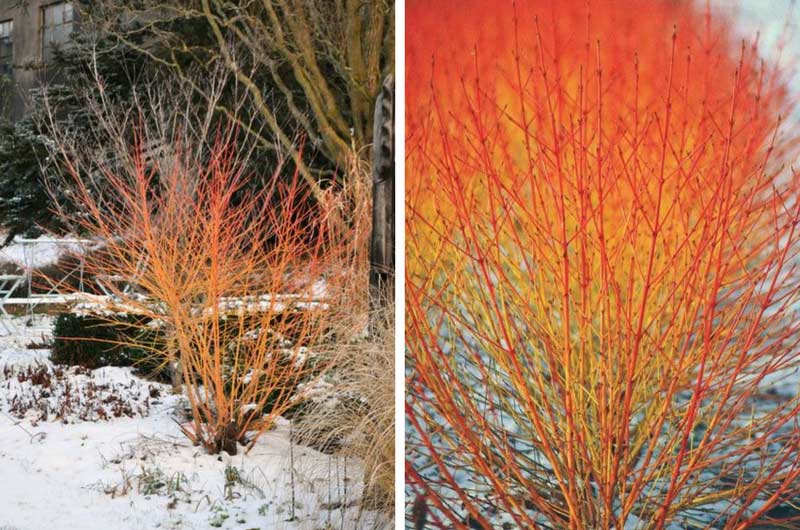 It is in the heart of winter, when the shrub is completely bare, that the spectacle is at its peak. Plant Cornus sanguinea near a bay window to feel the benefits of its warm colour. (Source Pinterest)
What you should know additionally : While all decorative wood dogwoods require spring pruning to maintain beautiful colours in winter, Cornus sanguinea does not need annual pruning. Old wood retains its vibrant colour much longer than its other cousins, C. alba or C. sericea. If it becomes too large, you can still prune it every year, but otherwise, pruning every three years is more than enough to regenerate its wood and maintain beautiful colours. To learn more about pruning decorative wood dogwoods, don’t forget to read Virginie’s article "Dogwood, Decorative Wood Cornus: Planting and Pruning"
4- Prunus serrula (Tibetan Cherry)
Sometimes Prunus serrula (Wood Cherry) is confused with Prunus serrulata (Flowering Cherry), two distinct shrubs that have little in common. Prunus serrulata is the famous Japanese cherry that stands out in spring in gardens and on city sidewalks with its spectacular but fleeting pink flowering.
Prunus serrula is characterised not by its rather discreet flowering but by its shiny and lustrous bark, whose mahogany-red hue with caramel reflections is one of the most beautiful to admire in the garden in winter. It is when it peels that the bark is most interesting, as beneath this dead skin, the new bark is so shiny that it reflects light and seems to shine in the sun.
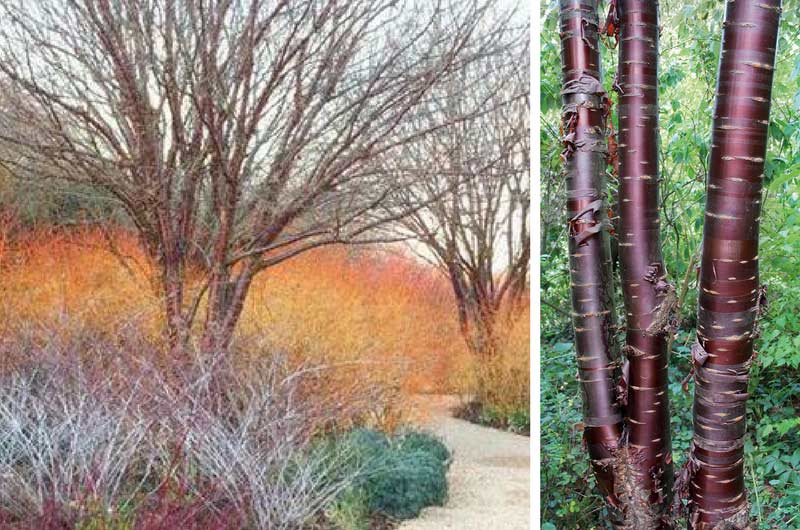 On the left, in this 100% winter scene, the yellow-orange wood of Cornus sanguinea 'Midwinter' highlights the dark silhouette of Prunus serrula. In the foreground, the white wood of Rubus tibetanus contrasts with the mahogany bark of the tree (Source Pinterest). On the right, the cleaned bark of Prunus reveals sublime satin colours.
What you should know additionally : Prunus serrula does not retain such a beautiful and vibrant bark all year round. During summer and early winter, it can become dull and sometimes green, especially when the shrub is planted too much in the shade. While one is often tempted to remove the bark by peeling it off, one risks tearing the sapwood; this deep bark conducts crude sap from the roots to the leaves, and this action can have long-term detrimental effects on the tree. To clean a tree's bark, the solution is simple and involves a stiff-bristled brush, warm soapy water, and elbow grease! Brushing the trunk of the Tibetan cherry once or twice a year with soapy water is the best way to maintain a brilliant bark without damaging the tree, just so you know!
5- Acer palmatum Senkaki (Sango Kaku)
While Japanese maples reward us with stunning graphic and colourful foliage, some, like Senkaki (the Japanese call it Sango Kaku), also boast exceptional wood. It must be said that in summer, its palmate foliage, light green with golden hues, does not suggest such beauty at the end of the season. Already in autumn, its tawny orange foliage is striking, but it is when the shrub begins to shed its leaves that we witness one of the most beautiful leaf-fall displays ever performed by a Japanese maple.
Once its leaves have fallen, the Senkaki maple reveals spectacular wood, tinted a coral red that is almost supernatural. And once again, the cold will enhance the intensity of the hue, making the branches bright red when it freezes. Add to this a lovely upright and very light silhouette, and you have an essential Japanese maple for a winter garden.
Is it more sensitive or more difficult to cultivate than another Japanese maple? The answer is no, it requires acidic, well-draining soil, a bright but not scorching exposure in summer. If you are unsure whether you can provide it with good growing conditions, know that it also does well in pots.
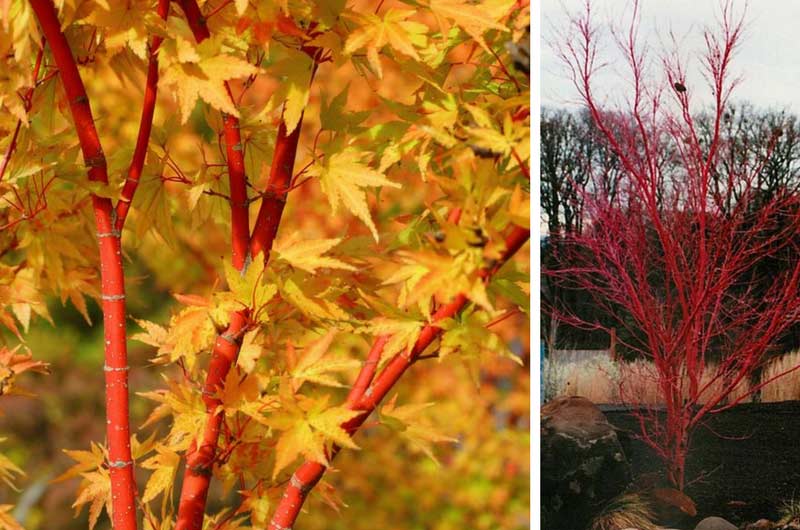 On the left, Acer palmatum Senkaki, with its superb autumn foliage, begins to reveal a coral bark. On the right, in the heart of winter, the bark becomes a much more intense red. (Source Pinterest)
What you should know additionally : Planted alone, this maple retains all its charm. Resist the temptation to associate it with decorative wood dogwoods; they have the same type of bark and also have an upright habit, and you risk creating a dull scene where the maple and dogwood blend together. It is in a zen or mineral garden that the Senkaki maple offers the best potential. This is the shrub that one would typically plant in a minimalist setting, paired with beautiful rocks and a few scattered grasses at the entrance of a house, near the front door, or on a terrace.
Are you interested in creating a winter garden and want to go further? Feel free to revisit Ingrid's article where she introduced one of her favourite books: "Winter Gardens: A Season Reinvented" by Cédric Pollet
And discover Olivier's tips for a beautiful garden even in winter:Now more than ever in winter, the need for light and colour is felt. To ensure a colourful display in the heart of the dreary season, decoratively-wooded trees and bushes are a top-notch solution to combat winter melancholy. They offer an endless range of interesting colours and textures: coral red, fluorescent orange, milky white are […]