The Sambucus nigra 'Black Tower' is a black elder with undeniable ornamental qualities. It surprises with its naturally upright habit, much like its little brother 'Golden Tower'. This uniqueness makes it particularly interesting for structuring space and adding verticality to a garden.
It makes a statement with its beautiful almost black deciduous foliage. In May/June, its corymbs of pink flowers fading to cream white, which are highly visited by pollinating insects, contrast beautifully with its dark and decorative foliage. Later in the season, the flowers give way to clusters of small, round, shiny black berries, much appreciated by birds.
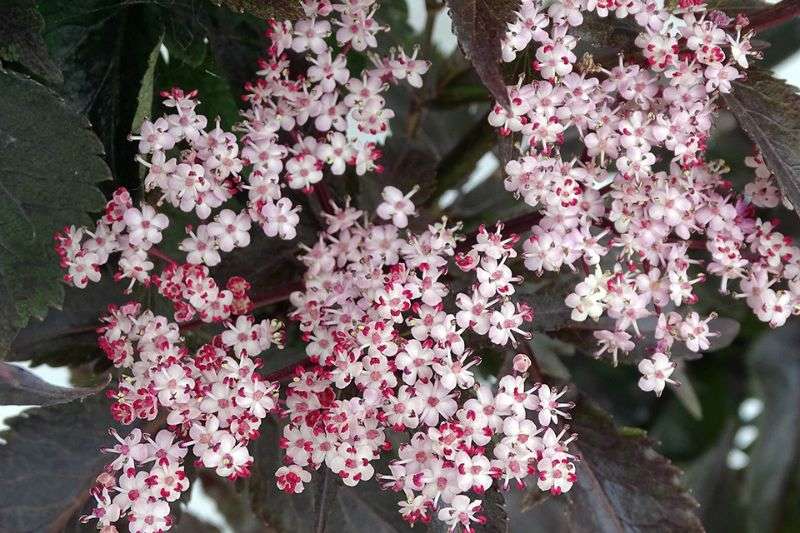
Perfectly hardy, it can be planted anywhere, even in regions with harsh winters, bravely withstanding temperatures down to -25 °C. Compact, it is ideal for integrating into a hedge or a shrub border in a small garden, regardless of its style. It is particularly appreciated in contemporary or Japanese gardens for its graphic quality.
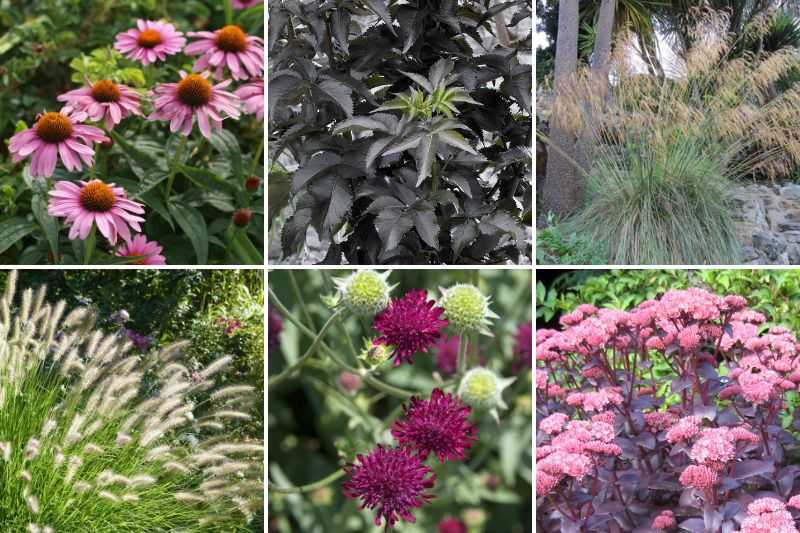
In my garden, it adds depth to the border where I planted it about 4 years ago. Vigorous and fast-growing, it already boasts a lovely size with its 2m height and 1m width. Its slender and graphic silhouette brings personality to the midst of grasses such as the spectacular Stipa gigantea, clumps of Pennisetum 'Hameln', Echinacea purpurea, Eryngium planum, Sedum 'Purple Emperor', with a few touches of Knautia macedonica, not to mention the picturesque Robinia 'Twisty Baby' with its twisted branches in the background, whose tortured branches contrast with the vertical column of the elder.
As a bonus, the flowers and berries of black elder are edible… Elderflower fritters and apple-elderberry jelly are delightful treats that we love at home!
Also discover Servane's recipe: Elderberry Jam and how to dry elderflowers? Feel free to share your favourite recipe with us!
The Sambucus nigra ‘Black Tower’ is a black elder with undeniable ornamental qualities. It surprises with its naturally upright habit, much like its little brother ‘Golden Tower’. This uniqueness makes it particularly interesting for structuring space and adding verticality to a garden. It makes a statement with its beautiful almost black deciduous foliage. In May/June, […]
Picking your own fruit straight from the tree is a dream for many food lovers... even if they don't have the space for a full orchard. Why not combine the useful with the edible and plant a fruit hedge?
Fruit trees and berry bushes can all be planted in an edible hedge, regardless of the size of your garden.
Which fruit trees or bushes should I plant in my edible hedge?
Of course, the ideal is to design your fruit hedge according to your tastes (don't plant a medlar if you're not the type to eat over-ripe fruit!). Cherry, Apple, Pear, Plum trees, as well as Hazelnut, Raspberry, and Currant bushes are all classics. I don't think it's necessary to elaborate on these. Moreover, nature... and horticulture often hold delightful surprises, including in terms of taste. Here’s a small selection of trees or bushes, less common options chosen for their good productivity, originality, or the nutritional value of their fruits.
- The Black Elder 'Haschberg' (Sambucus nigra) is a highly regarded variety for its high productivity. However, you'll need to make a choice: pick its flowers in May to prepare fritters, make the famous elderflower lemonade, or wait until September to harvest its berries, which make delicious jams. This is a vigorous shrub that grows quickly, typically reaching a height of 4 metres and a width of 2 metres... but it prunes well and even forgives mistakes!
- The Thornless Blackberry (Rubus fruticosus) offers only advantages: fruit without the scratches! It can be easily trained on a trellis, making harvesting much easier. Among the many varieties, I particularly like 'Little Black Prince', a dwarf and compact variety that doesn't exceed one metre in height, as well as 'Thornfree', which is fast-growing, productive, and produces large fruit. Their only downside: children will help themselves long before you do.
- The Fig 'Icecrystal' (Ficus carica), which has a low growth habit (about 2 metres high and wide), is quite hardy, ideal for areas north of the Loire, and offers two fruiting periods per year. And, as the icing on the cake, its foliage, which is very lobed, is particularly ornamental. In heavy soil, be sure to plant it on a mound. Like all figs, it dislikes humidity.
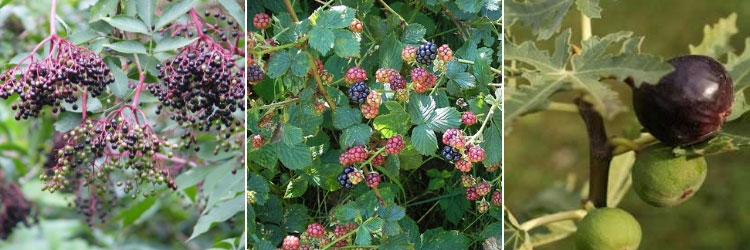
Black Elder 'Haschberg', Thornless Blackberry, and Fig 'Icecrystal'
- The "Mayberry" or Honeyberry (Lonicera caerula kamtschatica) is a bush honeysuckle with edible fruit. It hails from Siberia, which speaks to its hardiness... but it is not self-fertile, so you need to plant at least two for its lovely white flowers to produce, from mid-May, small, pruinose blue fruits, whose flavour lies somewhere between blueberry and kiwi. These prunes can be enjoyed fresh or dried, in juice, jam, or jelly.
- The Goji or Wolfberry (Lycium barbarum) is best known for its red berries with numerous properties (rich in vitamins, minerals, and antioxidants). Its origin is controversial (China? Mediterranean?), but I won't delve into the debate... because, in the end, it grows very well here! Its size varies depending on the variety: 'Sweet Lifeberry®' and 'Instant Success®' form compact shrubs (1.5 metres in all directions), while the species type can reach 3 metres under favourable conditions. Note that the purple flowers of the Wolfberry are charming and fit well in an ornamental garden.
- The Jostaberry or Caseille (Ribes x) gets its name from the contraction of blackcurrant and gooseberry. It’s the ideal fruit for those who can’t decide and for small gardens that require a choice. Self-fertile, this small fruit tree manages well on its own and forms a beautiful bush, without thorns, reaching 2 metres at maturity. Its black berries, larger than those of blackcurrants, develop a tart flavour... and can be enjoyed, as you might have guessed, like blackcurrants or gooseberries.
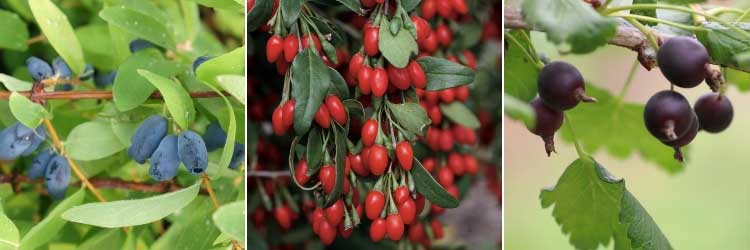
Mayberry, Goji, and Jostaberry
- The Sea Buckthorn (Hippophae rhamnoides), not to be confused with the Strawberry Tree (whose fruits are also edible), is not just popular with chickens! This is a low-maintenance thorny shrub that produces decorative orange berries and, most importantly, is very high in vitamin C, which can be consumed fresh, in compote, jam, or syrup. Self-fertile, the variety 'Friesdorfer orange' is now available in our catalogue, so don't miss out!
- The Nashi (Pyrus pyrifolia) is also one of those fruit trees that could be described as "2 in 1": it’s no wonder it’s called, interchangeably, "Apple Pear" or "Pear Apple." It is not the result of hybridization, as it is actually an Asian pear that produces round fruits like apples, with a taste closer to that of pears. Some varieties like 'Shinseiki' or 'Nijisseki' are self-fertile. Non-self-fertile varieties can be pollinated by a different variety or by the Williams Pear.
- The Serviceberry, particularly the variety Saskatoon berry (amelanchier alnifolia), is a variety that comes straight from the USA. Hardy and robust, it forms a small shrub about 3 metres high and can produce up to 8 kg of sweet berries.
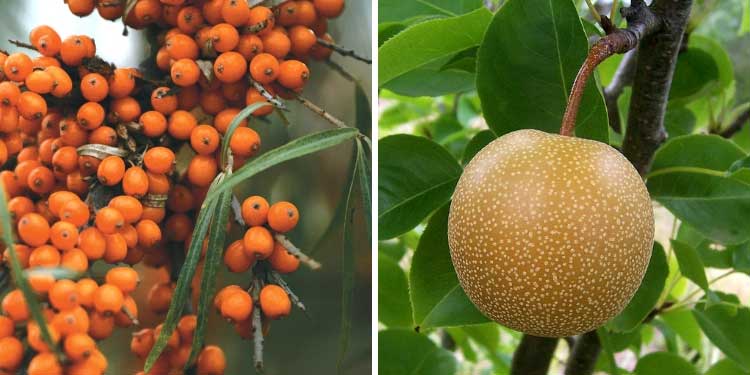 Sea Buckthorn and Nashi
And to top it all off, don't hesitate to plant some herbs (Mint, Lemon Balm, Golden Oregano) at the base of your edible hedge; they will create a lovely border and help reduce weeding.
Planting a fruit hedge: some tips
Unlike traditional hedges, the primary goal of a fruit hedge is not to create a green wall but to harvest fruit.
To achieve this, when planting, allow for generous spacing to:
- let each tree or bush fully express itself,
- allow light to penetrate,
- facilitate pruning, which should be tailored to each fruit tree to encourage fruiting.
Depending on the size and layout of your garden, fruit hedges can be installed:
- on the perimeter, to mark the property line or as a boundary (discuss with your neighbours... when it comes to fruit, creating a hedge and especially sharing the harvest is generally a well-received idea)
- within the garden itself to define spaces... and ideally, in two rows and staggered to save space in length while also achieving a beautiful natural appearance.
Picking your own fruit straight from the tree is a dream for many food lovers… even if they don’t have the space for a full orchard. Why not combine the useful with the edible and plant a fruit hedge? Fruit trees and berry bushes can all be planted in an edible hedge, regardless of the […]