Cucumber Jazzer F1 seeds - Cucumis sativus
Cucumber Jazzer F1 seeds - Cucumis sativus
Cucumis sativus Jazzer F1
Cucumber
Back-to-school special offer!
Get €10 off for every €50 you spend! And get up to €40 off on a single order.
How does it work?
1. Shop your favourites
Add your favourite plants to your basket. For every €50 you spend (excluding delivery charges, store credit and the plastic-free option), you’ll receive a €10 voucher.
€50 spent = €10 voucher
€100 spent = €20 voucher
€150 spent = €30 voucher
€200 spent = €40 voucher
2. Place your order
Once your basket reaches one of the spending thresholds, place your order. You can even choose your delivery date!
3. Receive your voucher
As soon as your order has been shipped, you’ll receive an email containing your personal voucher code and its value.
4. Use it on your next order
Your voucher is valid for 90 days from the date you receive it. It can be used once only, on a new order worth at least the value of the voucher, excluding delivery charges.
Please note: Vouchers can be combined with other offers, but cannot be split or refunded.
Home or relay delivery (depending on size and destination)
Important: You may be charged customs duties by your country’s customs authorities upon delivery.
Schedule delivery date,
and select date in basket
This plant carries a 6 months recovery warranty
More information
We guarantee the quality of our plants for a full growing cycle, and will replace at our expense any plant that fails to recover under normal climatic and planting conditions.
Description
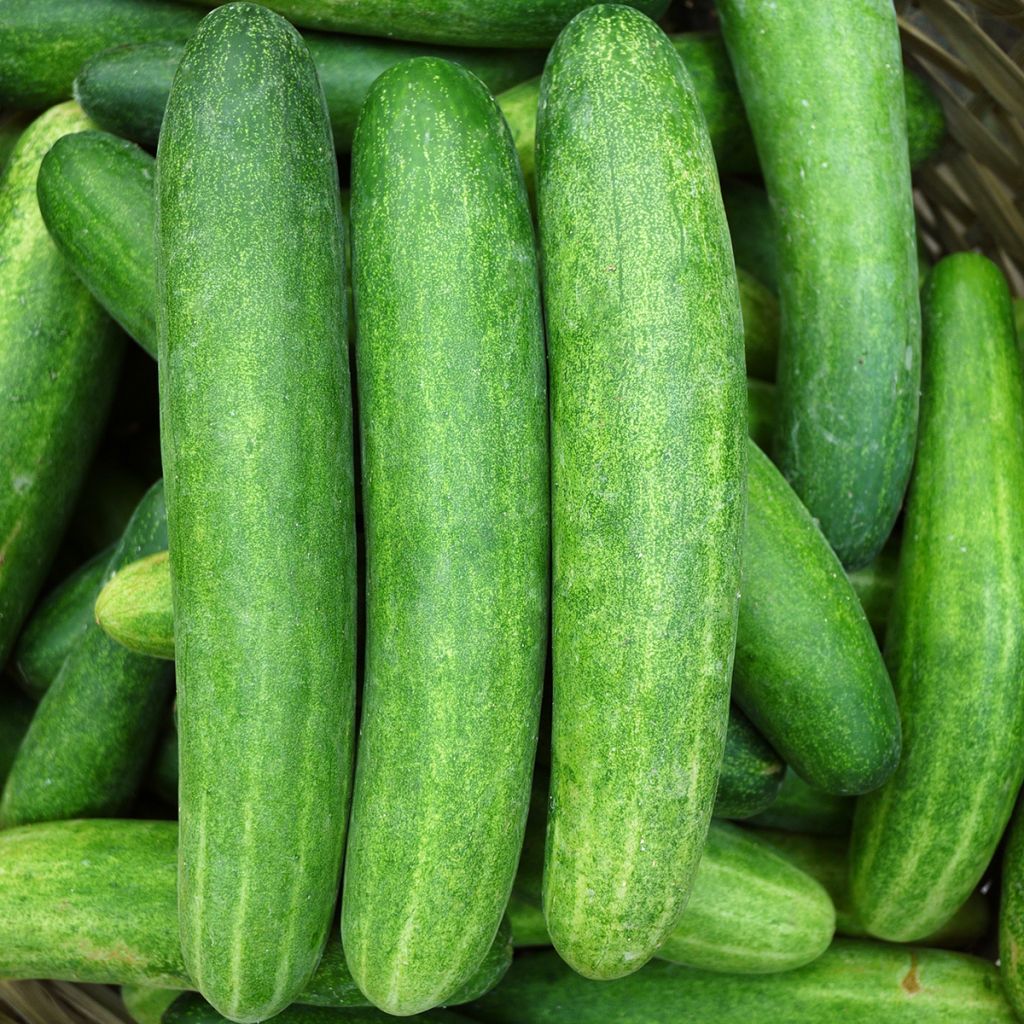
Cucumber Jazzer F1 is a high-performing hybrid, selected for its productivity and consistency. This variety produces straight, smooth or very slightly thorny fruits, approximately 20-22 cm in length, of a uniform dark green colour. Its flesh is crisp, juicy and without bitterness, perfect for raw consumption: salads, sandwiches, crudités.
This variety exhibits strong resistance to the main cucumber pathogens, which are Cca and Ccu, and an intermediate resistance to viruses such as CMV and to powdery mildew (Px), depending on conditions.
Jazzer F1 is also tolerant to temperature variations and environmental stresses. It is suited to cultivation under glass (tunnel) or in open ground.
The designation F1 means that the Jazzer cucumber is a first-generation hybrid. This means it is the result of the cross-breeding of two cucumber lines selected for their complementary qualities (disease resistance, regularity of production, flavour, vigour). F1 hybrids do not reproduce true to type from one generation to the next, so it is advisable to purchase new seeds each year.
Sow from March to June, in pots under cover or directly in open ground when the soil has warmed. The harvest occurs 2 to 3 months later, from July until the first autumn chills. For small gardens, training on netting or wire mesh is recommended: it saves space, improves leaf aeration and makes picking easier.
Like the tomato, the cucumber is one of the emblematic summer vegetables. Refreshing, light and low in calories, it can be enjoyed in salads, as crudités or simply seasoned with a dash of lemon and aromatic herbs. We distinguish between long and smooth varieties, like Jazzer F1, and short or half-long cucumbers, thorny or smooth, as well as more original varieties like the snake cucumber or the horned melon, which need more heat.
An easy vegetable to grow: the cucumber appreciates light soils, rich in humus, well-drained and kept moist. A warm, sunny exposure promotes its development, with ideal temperatures between 18 and 22 °C. Greedy for water, it must be watered regularly, preferably at the base to avoid wetting the foliage.
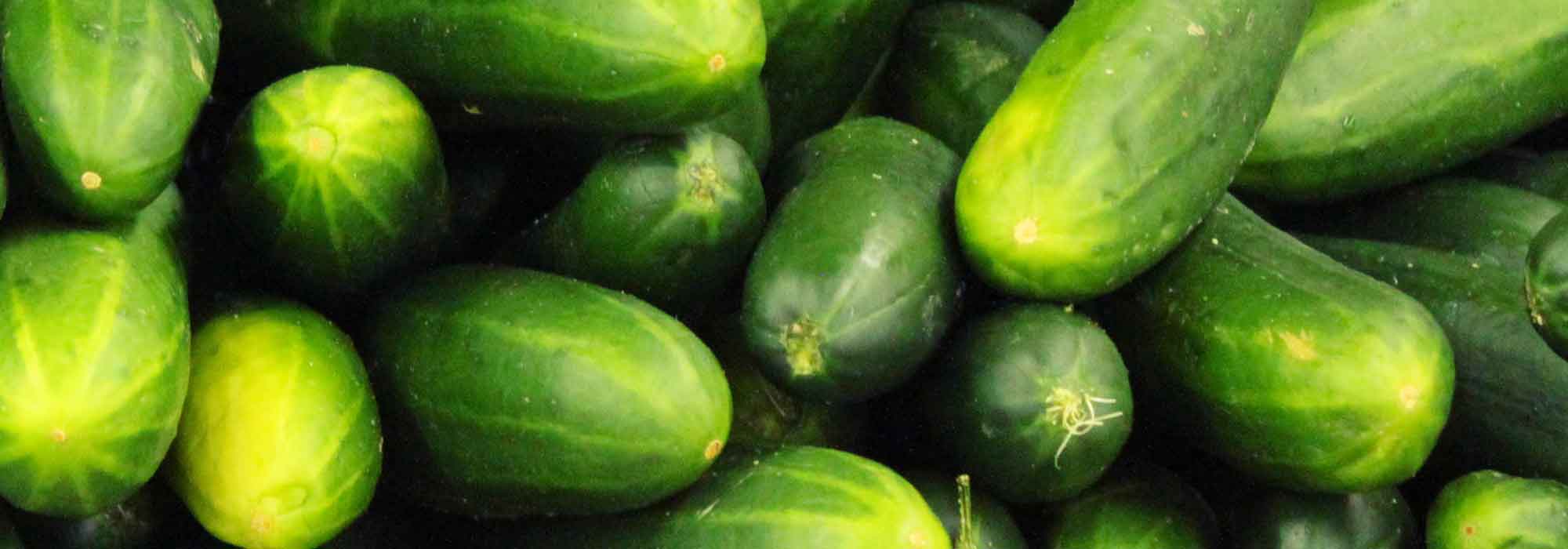
Harvesting Jazzer F1 cucumbers: Harvest as soon as the fruits have reached their final size, before they turn yellow. Picked young, they are more flavoursome and regular harvesting stimulates the formation of new fruits. They keep for a few days in the refrigerator, but can also be prepared in jars, as pickles or through lacto-fermentation to prolong the pleasures of summer.
A little gardener's tip: like all cucurbits, the cucumber can be susceptible to powdery mildew, which appears as a white felting on the leaves. To limit this risk, avoid watering the foliage, ensure good ventilation under cover and remove affected leaves. A spray of horsetail decoction or wettable sulphur can also strengthen the plants' resistance.
Its companions in the vegetable garden: associate your cucumbers with lettuces and beans, and you will promote their growth and balance in the garden. Conversely, avoid planting them too close to potatoes or tomatoes, with which competition is unfavourable.
Harvest
Plant habit
Foliage
Botanical data
Cucumis
sativus
Jazzer F1
Cucurbitaceae
Cucumber
Cucumis sativus ‘Jazzer’
Cultivar or hybrid
Annual
Planting and care
Sowing Jazzer F1 Cucumber:
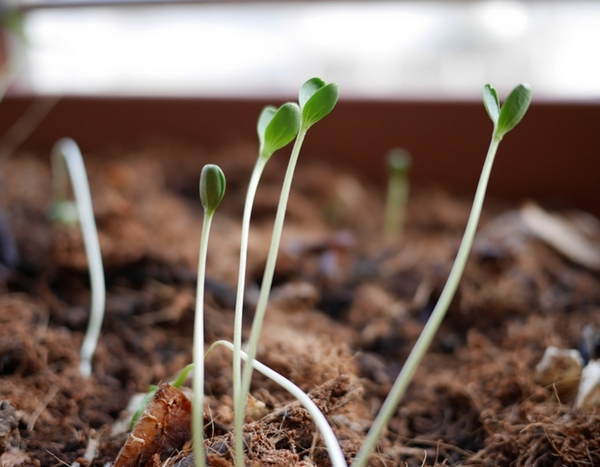
Cucumber germination occurs at temperatures between 16°C and 35°C. Emergence typically takes 8 to 10 days at these temperatures. Sow under cover in March/April (indoors, in a greenhouse, or on a hotbed) and directly in the open ground from mid-May until June, when the soil is sufficiently warm, and the risk of frost has passed. To stagger the harvest, you can space out your sowings, for example every 15 days.
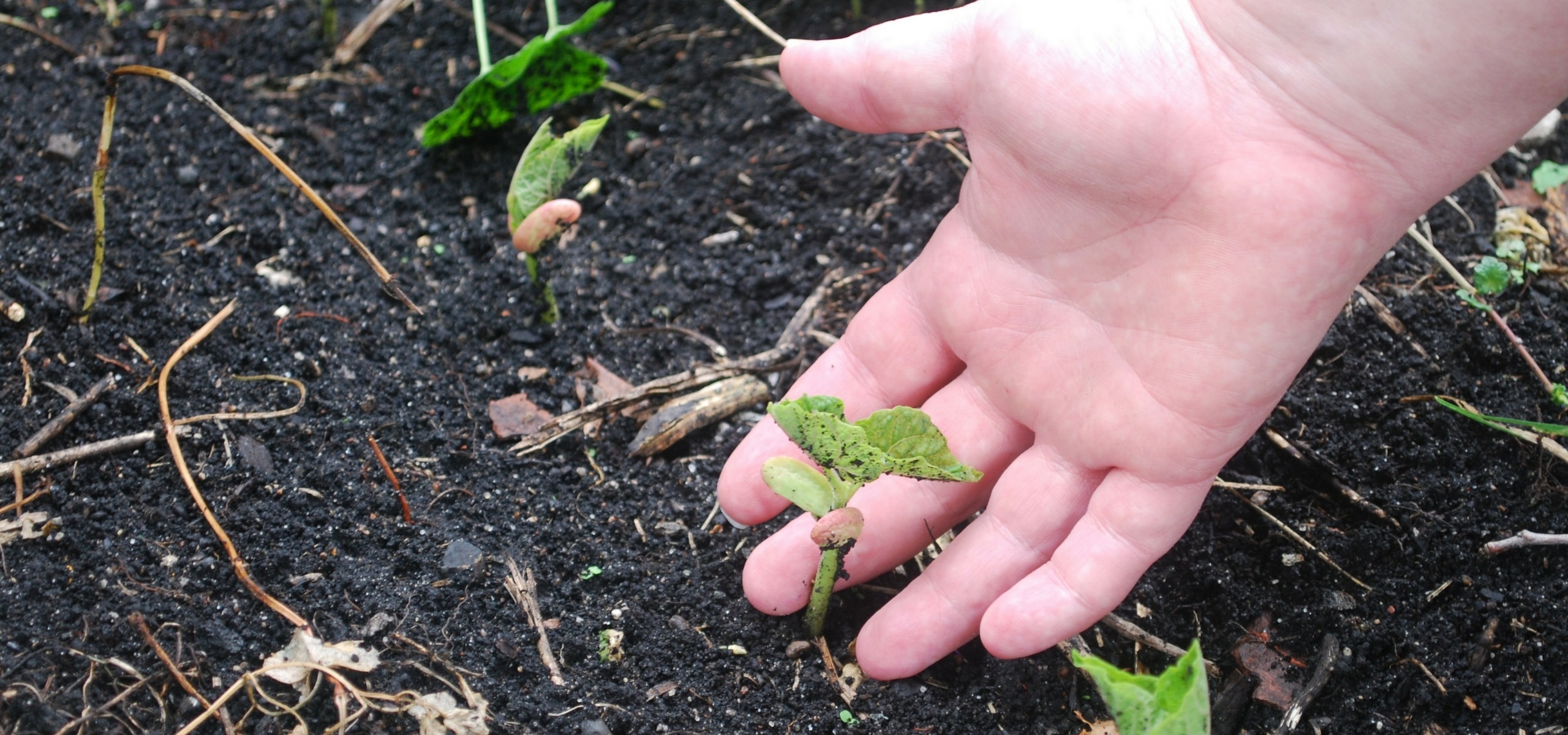
Sowing under cover: Fill pots (or trays with drainage holes) with seed compost and plant 2 or 3 seeds per pot. Water with a very fine spray. When the two true leaves appear, thin out to keep only one young plant per pot. Depending on the sowing date, you can either transplant them into the open ground if the soil is warm enough, or keep one young plant in each pot while waiting for higher temperatures. Ensure the growing medium stays moist but not waterlogged, and maintain it at a mild temperature. When transplanting into the open ground, allow a spacing of 1m in all directions if growing flat on the ground, or 1m between rows and 50 cm within the row if training vertically.
Sowing in the open ground: Stretch a line and mark out furrows, spacing the rows 1 m apart. Sow in stations (2 to 3 seeds in each hole). Within the row, space the stations 1 m apart if growing flat on the ground or 50 cm apart if training vertically. Cover with fine soil and lightly firm it down with the back of a rake. Water with a fine spray to keep the soil moist. When the young plants have reached 2 to 3 leaves, thin out to keep only one young plant.
Growing Jazzer F1 Cucumber:
Cucumber is a fairly demanding vegetable, requiring rich soil. It is advisable, preferably in autumn, to incorporate well-rotted compost (about 3 kg per m²) by lightly forking it in to a depth of 5 cm, after having, as with all vegetable cultivation, thoroughly loosened the soil. It prefers neutral soils (pH 7) but will do very well in slightly acidic or alkaline soil (pH between 5.5 and 7.5).
Cucumber can be grown flat on the ground, but to save space and encourage production, exploit its climbing nature by training it vertically: on a frame covered with wire mesh, inclined at 45%, it will provide beneficial shade for lettuces, or on a teepee to add charm and interest to the vegetable garden.
When plants are trained vertically, they are grown on a single stem, which should be pinched out at a maximum height of 2.5 m. When grown flat, pinch out above the second leaf to obtain two stems, which are themselves pinched out above the 4th leaf. The final pruning involves cutting back to one leaf above each formed fruit.
Plan for 2 or 3 hoeings as well as mulching at the beginning of summer to keep the soil moist.
Seedlings
Care
Intended location
Planting & care advice
-

-

-
-
-

-

-
-

This item has not been reviewed yet - be the first to leave a review about it.
Recently viewed products
Haven't found what you were looking for?
Hardiness is the lowest winter temperature a plant can endure without suffering serious damage or even dying. However, hardiness is affected by location (a sheltered area, such as a patio), protection (winter cover) and soil type (hardiness is improved by well-drained soil).
In temperate climates, pruning of spring-flowering shrubs (forsythia, spireas, etc.) should be done just after flowering.
Pruning of summer-flowering shrubs (Indian Lilac, Perovskia, etc.) can be done in winter or spring.
In cold regions as well as with frost-sensitive plants, avoid pruning too early when severe frosts may still occur.
The harvesting period indicated on our website applies to countries and regions in USDA zone 8 (France, England, Ireland, the Netherlands).
In colder areas (Scandinavia, Poland, Austria...) fruit and vegetable harvests are likely to be delayed by 3-4 weeks.
In warmer areas (Italy, Spain, Greece, etc.), harvesting will probably take place earlier, depending on weather conditions.
The sowing periods indicated on our website apply to countries and regions within USDA Zone 8 (France, UK, Ireland, Netherlands).
In colder areas (Scandinavia, Poland, Austria...), delay any outdoor sowing by 3-4 weeks, or sow under glass.
In warmer climes (Italy, Spain, Greece, etc.), bring outdoor sowing forward by a few weeks.
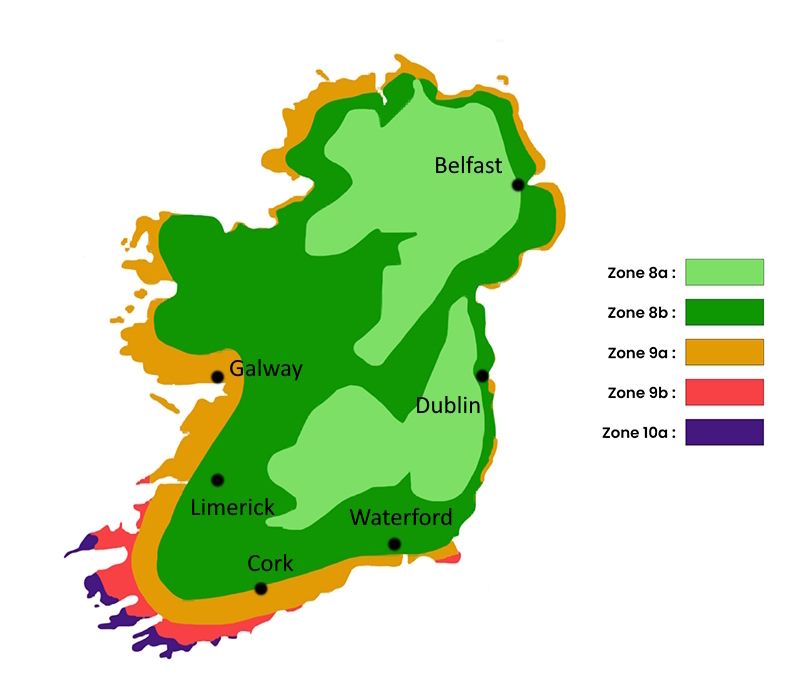
The planting period indicated on our website applies to regions in USDA Zone 9a (East Coast and Midlands: Dublin, Wexford, Waterford, Kilkenny, Portlaoise). It will vary depending on where you live:
- On the west coast and in the north-west (Galway, Limerick, Sligo, Donegal, Westport), delay planting by 1 to 2 weeks in spring and bring it forward by 1 to 2 weeks in autumn compared to the dates given, preferably choosing periods without strong winds.
- In the inland hills and plateaus (Wicklow Mountains, Macgillycuddy’s Reeks, Connemara, Killarney), it is best to plant in spring (April–May) or autumn (September–October), avoiding periods of waterlogged soil in winter and strong winds, which pose the main risk to newly planted trees in these areas.
The flowering period indicated on our website applies to regions in USDA Zone 9a, such as the East Coast and Midlands, including Dublin, Wexford, Waterford, Kilkenny and Portlaoise.
This will vary depending on where you live:
- On the west coast and in the northwest (Galway, Limerick, Sligo, Donegal and Westport), it will be delayed by one to two weeks compared to the given dates, due to stronger Atlantic winds and less spring sunshine.
- In the inland hills and plateaus (the Wicklow Mountains, the Macgillycuddy's Reeks, Connemara and Killarney), flowering will be delayed by two to three weeks. Flowering mainly occurs between May and July, with the limiting factors being less frost and more of the excessive humidity, strong winds and lack of sunshine that are characteristic of these areas.
Shipping country and language
Your country of residence may be:
Your country of residence is:
For a better user experience on our website, you can select:
Your shipping country:
-
 Austria
-
 Belgium
-
 Bosnia & Herzegovina
-
 Bulgaria
-
 Croatia
-
 Cyprus
-
 Czechia
-
 Denmark
-
 Estonia
-
 Finland
-
 France
-
 Germany
-
 Greece
-
 Hungary
-
 Iceland
-
 Ireland
-
 Italy
Italy
-
 Latvia
-
 Liechtenstein
-
 Lithuania
-
 Luxembourg
-
 Malta
Malta
-
 Netherlands
-
 Poland
-
 Portugal
-
 Romania
-
 Serbia
-
 Slovakia
-
 Slovenia
-
 Spain
Spain
-
 Sweden
-
 Switzerland
Language:
-
French
-
 English
-
Spanish
-
Italian
-
German
-
Portuguese
-
Dutch
-
Finnish
My Account
Hello
My wish lists
My cart
Log in / Register
Existing customer?
This form is protected by reCAPTCHA - the Google Privacy Policy and Terms of Service apply.
New customer?
Create an account to track your orders, access our customer service and, if you wish, make the most of our upcoming offers.