





























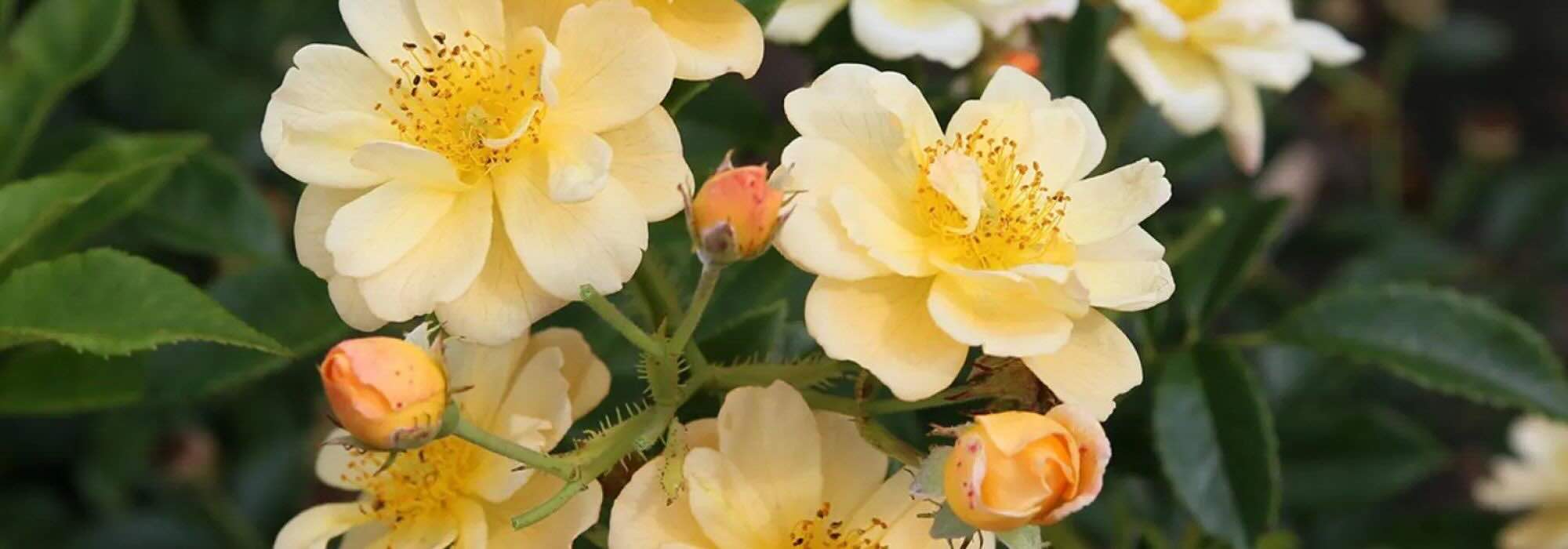
Yellow- and orange-flowered climbing roses to brighten up the garden!
To brighten up all your garden structures with warm colours
Contents
Climbing roses are these beautiful plants that can take on a variety of supports in the garden, whether to dress an unattractive structure, to provide shade or to hide from view. Among them, we distinguish the rambling roses, much more imposing than their peers and reserved for large spaces.
Roses delight us with a wide range of flower colours. To bring a touch of warmth and vitality to the garden, nothing beats yellow or orange flowering. Let us see what the advantages of climbing roses that flower in these colours are and how to incorporate them into the garden according to different criteria.
To learn more about growing roses, discover our dossier “Roses: the best varieties and how to grow them“.

The appeal of yellow and orange flowering in the garden
Yellow and orange are ideal colours for bringing cheer and light to the garden. Their shades can range from the palest, almost pastel, to the brightest, truly flamboyant. Always warm, they recall the sun, tend to catch the eye and are perfect for creating beautiful contrasts in the garden, but also on the terrace or balcony.
These warm colours allow you to create all kinds of scenes, from the more romantic with paler shades to the more exotic with dynamic hues, passing through natural or contemporary ambiences.
They pair with:
- white flowering displays for a very soft look;
- in a monochrome palette of yellows or oranges;
- with their complementary colours on the colour wheel (violet for yellow and blue for orange) to temper their intensity;
- with red or purple flowering displays for a very summery ambience.
Finally, these colours naturally tend to attract pollinators.
Read also
How to choose a rambling rose?Why choosing climbing roses?
Climbing roses have many benefits in the garden.
- They offer a wide range of flower types, ranging from simple, natural-looking, cottage-garden roses to highly double, sophisticated-looking ones, including semi-double flowers. They can also be scented. There is something for every taste and for all garden styles.
- They are easy to pair, whether with other climbing plants (clematis, passionflowers…), at the back of a border, in a shrub hedge or with small grasses at their feet.
- They are multifunctional. They allow you to exploit vertical space in the garden, to hide unsightly structures, to provide shade and to create a privacy screen. Some of them are also beneficial for biodiversity, producing melliferous flowers that delight pollinating insects, followed by fruit that delight birds.
- In terms of cultivation, they are fairly easy to grow. Most of them will enjoy a sunny exposure, not scorching hot or semi-shaded and sheltered from prevailing winds. They will thrive in well-drained, fertile soil that stays cool and moist. Their shoots will simply need guiding to a support to grow vertically, clinging with their thorns. An annual pruning to balance growth is also recommended.
Yellow- and orange-flowered climbing roses for pots and small spaces
Climbing roses are modest varieties, with mature height remaining under 4 metres. They are thus easier to manage and will be content with less imposing supports. These roses are perfect for small gardens and will dress a small pergola, an arch, or trellises with ease.
Some varieties with even smaller dimensions can indeed be grown in pots, by choosing a sufficiently deep container. It is a good solution to create an aesthetic privacy screen on a terrace or balcony, for example. In this case, consider for example the climbing rose ‘Climbing Max® Aloha® ‘KORwesrug’, with 2 to 2.5 metres in height and a 1 metre spread. It is a very easy-to-grow repeat-flowering variety, producing double flowers in orange-toned hues, well scented.
The old rose ‘Phyllis Bide’ is also a small climber, measuring about 2 metres in all directions. It bears throughout the summer small double flowers with a changing colour, ranging from apricot-yellow to cream-pink.
For its part, the climbing rose ‘Disting’O Orange’ treats us from June to October with beautiful turbinate orange roses in a very soft orange. With a compact habit, it reaches between 1.8 and 2 metres in height and spread.
For a true sun-drenched cascade, opt for the climbing rose ‘Golden Showers’, with its semi-double bright yellow flowers shaded with apricot all summer. Expect 2 metres in height with a spread of 1.8 metres.
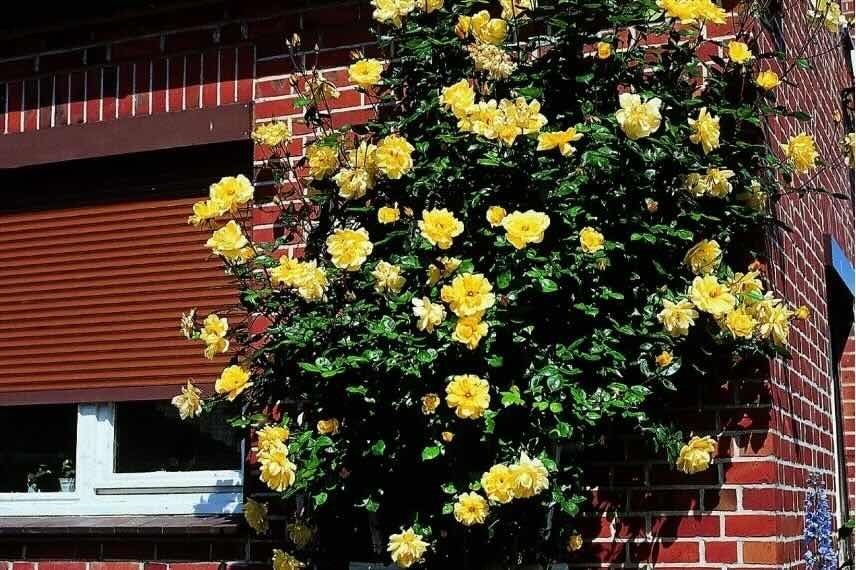
Climbing rose ‘Golden Showers’
Read also
How to choose a climbing rose?The most imposing yellow- and orange-flowered climbing roses
These majestic giants can reach up to 10 metres in height. They are therefore best suited to large spaces. Rambling roses allow you to dress ageing tree trunks, large stone walls or the facades of outbuildings. In all cases, be sure to choose a very sturdy support that can bear their weight. They benefit from rapid growth, thus covering a large area in a short time.
If their flowering is generally not repeat flowering (it occurs only once a year in spring or early summer), it is no less impressive.
Among them, let us mention Banksiae rose ‘Lutea’, a majestic liana capable of climbing up to 12 metres in height. During three weeks in spring, it produces a multitude of small double flowers of a butter-yellow colour. It has the particularity of tolerating drought better than most of its relatives and having evergreen foliage. On the other hand, it proves less hardy (down to -12°C), but can still be grown from the south up to the Paris region.
In a different style, the ‘Mermaid’ rose proves a little less exuberant, reaching 7 metres in height for a 4-metre spread. Its long flowering offers large single flowers of a sulphur yellow, enhanced by a livelier centre and protruding stamens.
Also mention ‘Treasure Trove’. With it, expect 9 metres in height, still, for 4 metres in spread. Its late-summer flowering gives us a warm display, consisting of very fragrant semi-double flowers. Their colour ranges from apricot, salmon-pink and white as they fade. The flowering makes way to a colourful and decorative fruiting, which persists for a long time on the shoots.
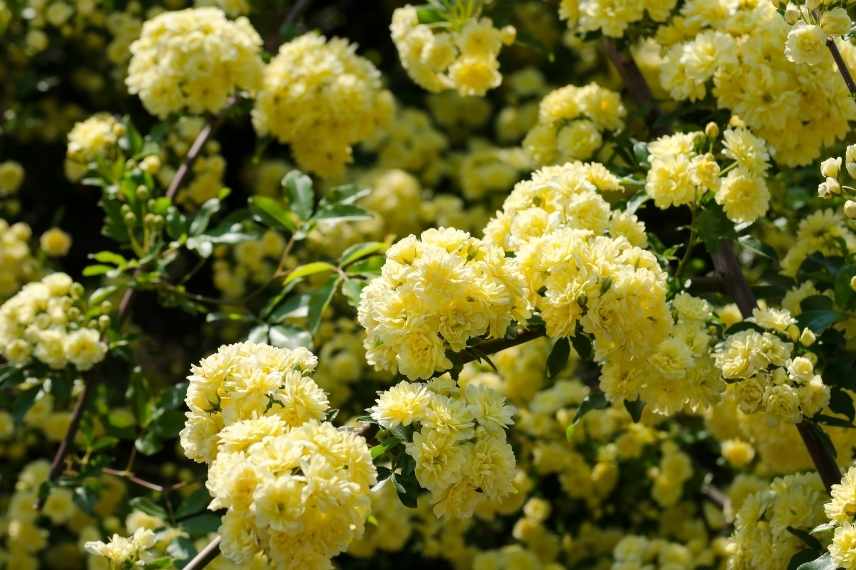
Rosa Banksiae ‘Lutea’
Yellow- and orange-flowered, fragrant climbing roses
Roses can also be quite fragrant. Not content with delighting our eyes, they also stimulate our sense of smell with aromas that can be very powerful at times. If possible, plant these climbing roses near walkways so you can enjoy them more readily.
The David Austin rose ‘Malvern Hills’ graces us all summer with small double blooms of a pretty coppery yellow. Well scented, they exhale musky and velvety notes.
On the climbing rose ‘Papi Delbard’, the large flowers blending yellow, orange and apricot give off a very fruity and fresh fragrance.
Also worth mentioning is the David Austin rose ‘Bathsheba’, with its bicolour very double, orange and cream, which release a powerful myrrh fragrance, with notes of honey and tea rose.
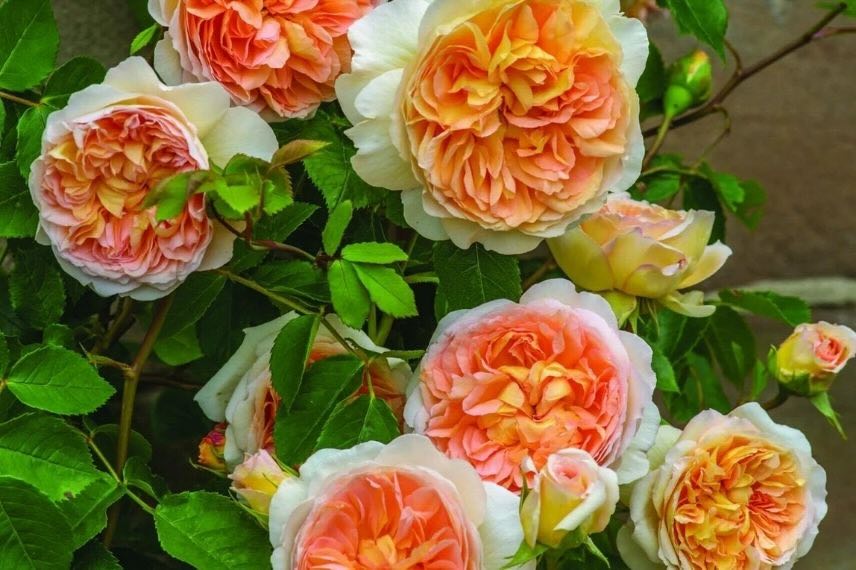
David Austin rose ‘Bathsheba’
Yellow and orange climbing roses with repeat flowering
That’s often the case with climbing roses. Flowering is repeat flowering when the plant produces several times a year, sometimes giving the impression that it lasts for months without a break. Provided they have enough water and faded flowers are regularly deadheaded, these roses can brighten the garden from late spring to the first frosts.
For a flowering that lasts nearly six months, from May to October, consider, for example:
- climbing rose Golden Boy, with its large semi-double yellow flowers delicately scented;
- ‘Golden Gate’, with its gold-yellow double roses emitting a very fresh lemon fragrance;
- ‘Happy Dance Adaphyri’, which produces delicately scented copper-orange roses;
- ‘Peach Melba’, a small climbing plant with fully double roses displaying orange and pink tones.
Yellow and orange disease-resistant climbing roses
Roses can be susceptible to cryptogamic diseases caused by fungi, such as powdery mildew, rust, downy mildew or botrytis. Mild, damp regions are the most at risk.
Fortunately, there are many rose varieties renowned for their excellent disease resistance. You can, in particular, rely on the ADR label, one of the most demanding in the world for roses, which certifies only those with good vigour and resistance to disease. This is notably the case for ‘Golden Gate’ or ‘Peach Melba’.
Among disease-resistant climbing roses, we also mention ‘Golden Age’, which produces small semi-double roses in a yellow gradient. Let’s not forget ‘Siluetta Sunny’, with its two-tone yellow flowers and foliage stays very healthy.
En complément, découvrez nos articles « The diseases of roses » et « The ADR roses, hardy and disease-resistant ».
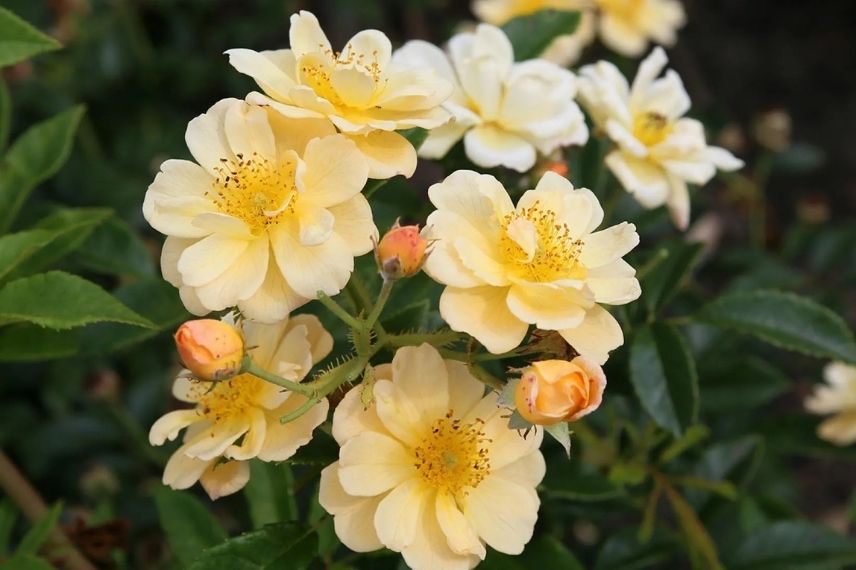
Climbing rose ‘Siluetta Sunny’
- Subscribe!
- Contents

Comments